
The best hill towns worth staying overnight in Puglia
Puglia away from the water is built of limestone and lime wash, streets so bright at midday that the eye retreats into the shade of a doorway, then softening to apricot in the hour before dinner. The Valle d'Itria rolls in low hills of dry-stone walls, olive groves and vineyards of Verdeca and Primitivo, with trulli standing in the fields like something left behind. Kitchens run on orecchiette with turnip tops, burrata that was made that morning, bombette grilled over coals in the butcher's back room, taralli and a glass of something cold. Spring and early autumn are the seasons to sleep here, when the stone gives back its heat all evening and the town squares fill after eight.
Most visitors reach the region and set a course for Alberobello, where the trullo district is a UNESCO site and the coach parks fill from breakfast onwards. The cone roofs are remarkable and the place deserves an hour. The trouble is that almost everyone allocates the same hour on the same morning, then drives back to a beach resort, so the whole of inland Puglia is reduced to a photo stop between the sea and the airport.
The same limestone hills, the same trulli in the fields, the same butchers and the same wine carry on for miles in every direction from that one famous town. The difference is that these places have a proper evening, and each has somewhere to stay that a travel guide has stood behind, which means dinner can run long and the morning market is yours before the day-trippers arrive. Staying overnight is the whole argument here. Worth a detour, and worth a bed.
Of the 59 communes we have mapped in Puglia, 7 qualify as hill towns worth staying overnight: each is an inland hill settlement, and each has a hotel a travel guide has vouched for. The smallest, Cisternino, has 11,139 residents.
If you are still choosing, we have also written The best towns worth staying overnight that eat well in Puglia and The best beach towns worth staying overnight in Puglia.
Cisternino
Why visit Cisternino
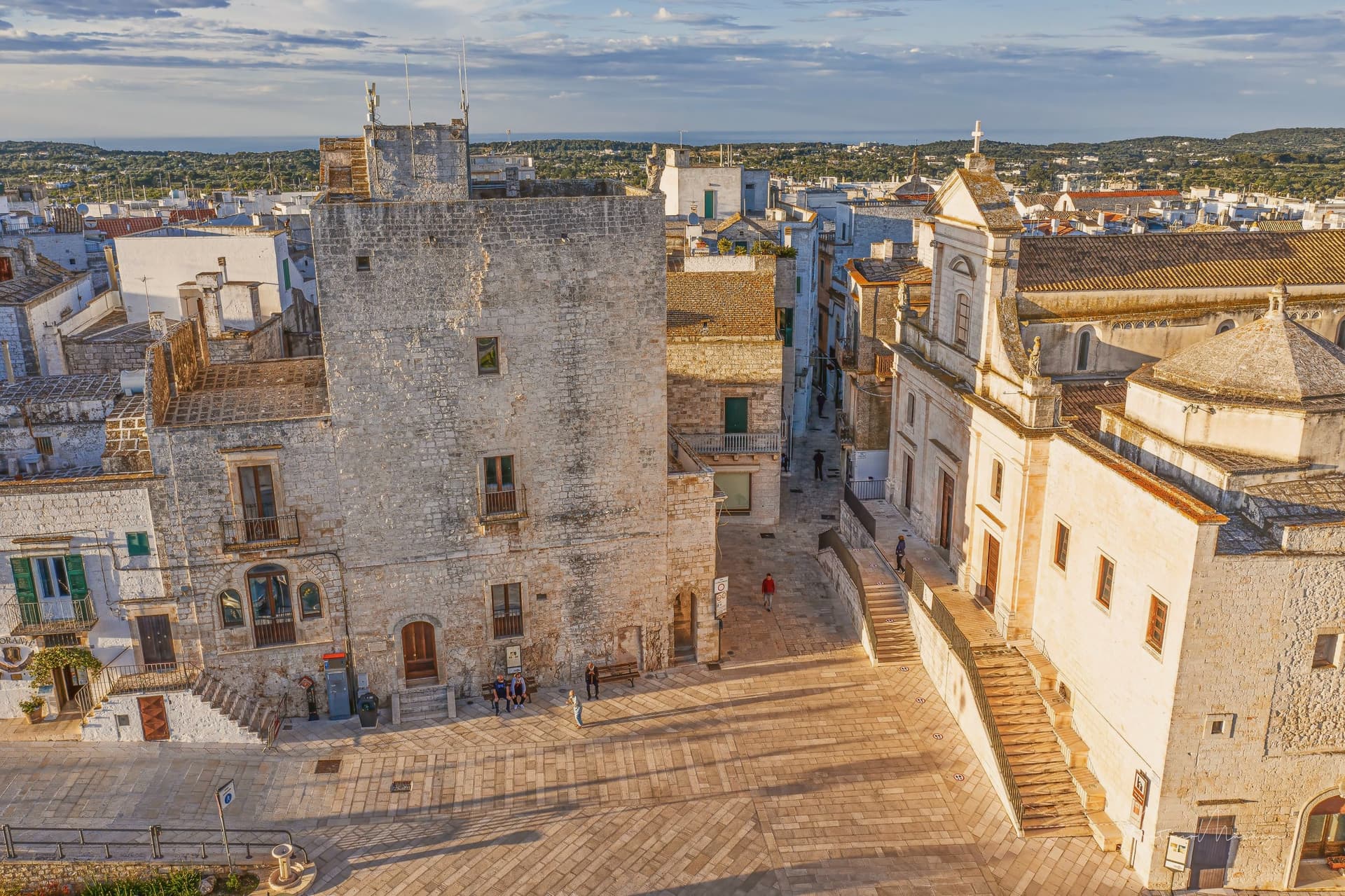
Cisternino occupies the last rise of the southern Murgia, its whitewashed houses looking down over drystone walls, vineyards and trulli in the Valle d'Itria. The town sits within the Itria Valley DOC wine zone, and the older quarter is built as a tight knot against the edge of the plateau, its stone alleys and courtyards folded close enough together that the comparison to a North African medina has stuck.
The civic tower in the main square marks where the newer town gives way to that older core, a single threshold between the two. Cisternino, a Cittaslow member since 2003, was named Cittaslow City of the Year in 2014, a designation that formalizes what the town already does at the butcher-restaurants of the old quarter: meat grilled to order and eaten at a counter or a side table, nothing rushed.
Between the drystone valley below, the huddled white quarter above, and a civic identity built on not hurrying, the town reads as a place organized around slowness at every scale, from its walls to its kitchens.
What to see in Cisternino
- Chiesa Madre di San Nicola di Patara. The neoclassical facade dates from around 1848, standing over a floor where excavations between 1999 and 2000 uncovered thirteen burials, Byzantine fresco fragments and coins.
- Centro storico. Stone alleys, low arches and small courtyards on the Murgia edge, close enough in plan and whitewash to draw comparison to a North African medina.
- Torre Civica. Civic clock tower in the main square at the entrance to the centro storico, the gateway between the modern town and the white labyrinth.
How to get to Cisternino
There is a railway station in the town, so you can arrive without a car and never need one while you are here. Taranto is roughly 50 minutes away by road.
Our tip
April through June and September through October are the months the Itria valley is green and the centro storico is walkable without sweat. July and August reach the mid-thirties on the plateau and the white alleys fill with day-trippers; by ten in the morning the main passages can be shoulder to shoulder. Late afternoon and dusk are the times to walk, when the limestone catches the sun and the crowds thin. Fiera della Bomminella falls in September.
Locorotondo
Why visit Locorotondo
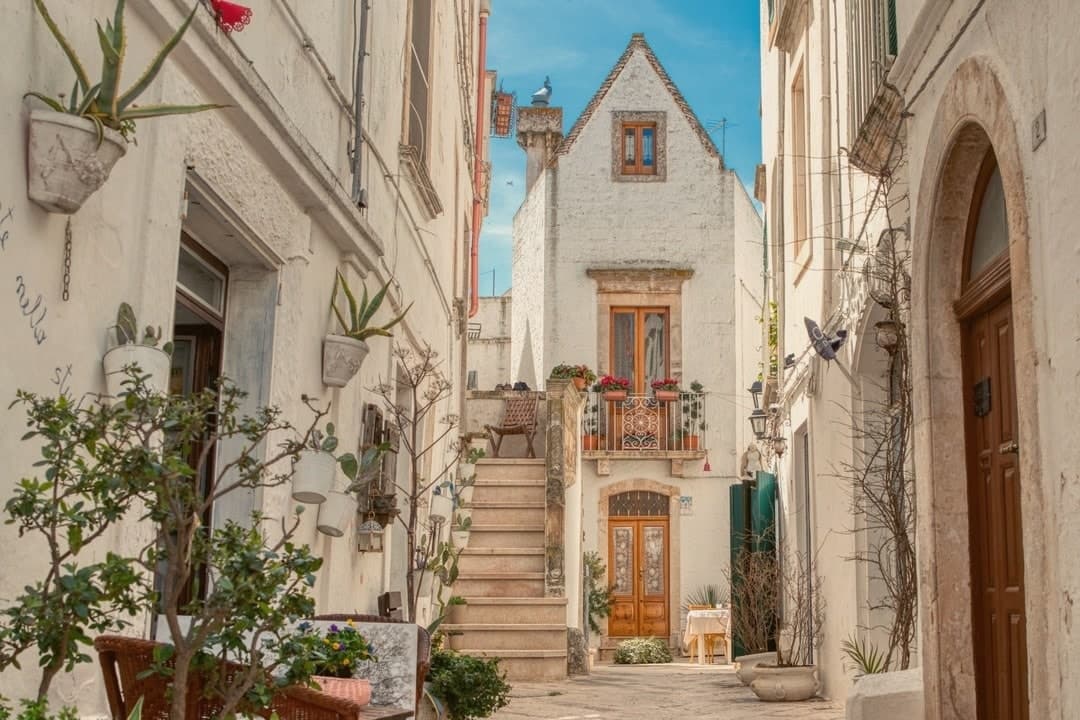
Locorotondo sits on a natural terrace at 410 meters, the high edge of the Valle d'Itria looking south over the trulli countryside between Alberobello, Cisternino and Martina Franca. The name means round place: the centro storico is a perfect circle of whitewashed houses, and the architecture is unique to this town.
The cummerse are stone houses with steep pitched roofs covered in two thin layers of limestone slabs, a profile that exists nowhere else in Puglia. The streets between them run in concentric arcs and are narrow enough to lose the sun by mid-afternoon.
Both the Borghi più belli d'Italia and the Touring Club's Bandiera Arancione recognize the place. The town also makes a white DOC wine from Verdeca and Bianco d'Alessano grapes, grown on 1,650 hectares of vineyards across the surrounding plateau, plus a Città dell'Olio membership for the oil that comes off the same hills.
What to see in Locorotondo
- Centro storico. Circular old town of whitewashed cummerse, an architectural type with double-pitch limestone-slab roofs found only here.
- Villa Garibaldi. Public garden on the ridge with the widest panoramic view over the Itria valley and its trulli countryside.
- Chiesa Madre di San Giorgio. Eighteenth-century parish church on the highest point of the historic center, with a neoclassical façade and a tall central nave.
How to get to Locorotondo
There is a railway station in the town, so you can arrive without a car and never need one while you are here. Taranto is roughly 48 minutes away by road.
Our tip
April through June and September through October are the best months on the Itria plateau. Mornings are clear, the surrounding vineyards green up, and the wind off the Murge keeps evenings cool even in summer. July and August push past thirty degrees, the centro storico fills with day-trippers from Alberobello, and the narrow streets get crowded between ten and one.
Oria
Why visit Oria
Oria sits at 166 meters on a Salento ridge between Taranto and Brindisi, north of Manduria and southeast of the ancient Taras. The town was Hyria, one of the principal Messapian cities, before the Romans absorbed the region.
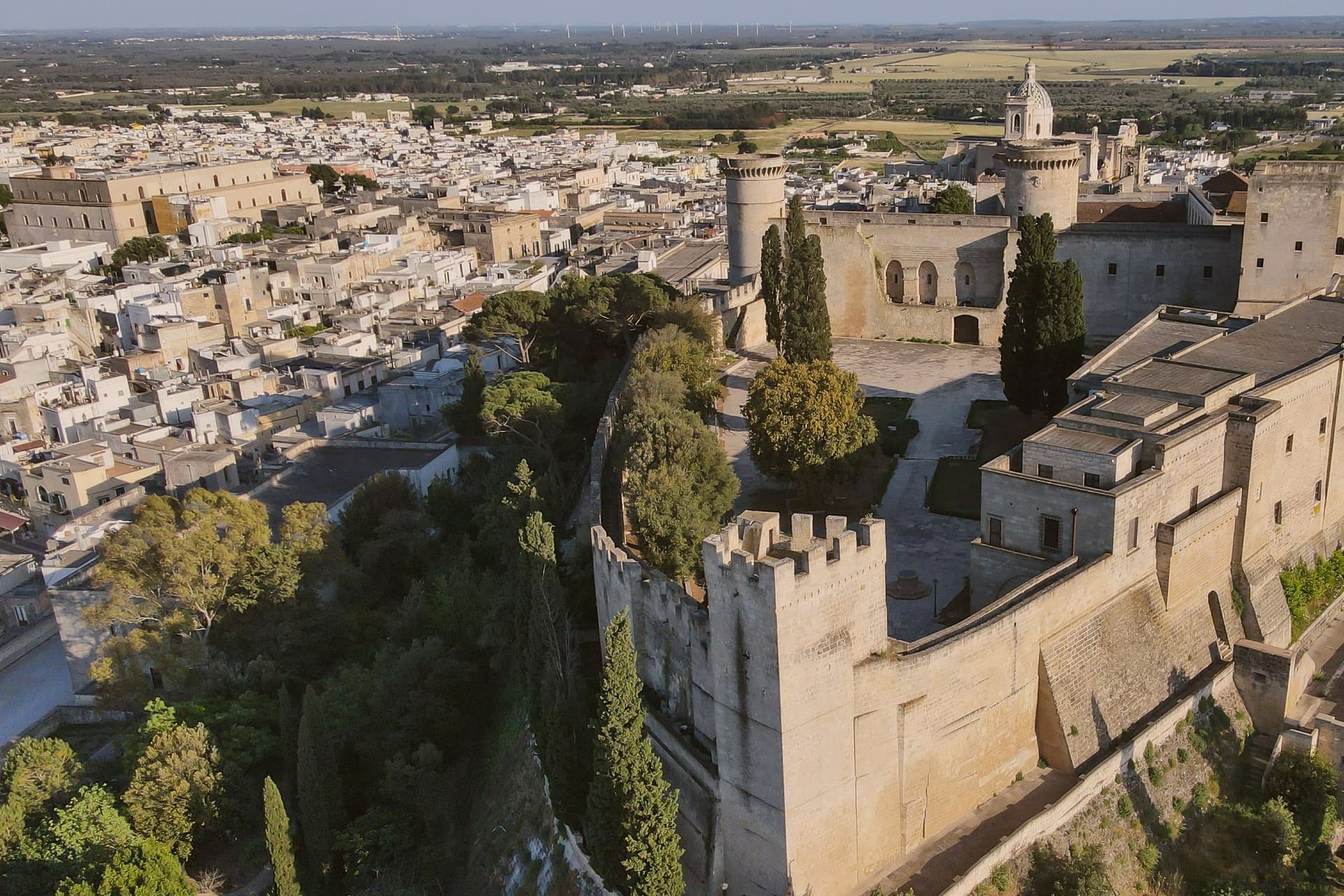
Frederick II rebuilt the castle on the Messapian acropolis between 1227 and 1233; the triangular plan he chose is unique in southern Italian military architecture, with three towers, the Quadrata (Frederician), the Del Cavaliere and the Del Salto (both Angevin additions). Oria also held one of the oldest Jewish communities in Europe, a study center where philosophy, the Talmud, Greek, Latin, medicine and natural science were taught from the ninth century.
Shefatya ben Amitai and Shabbethai Donnolo, two of the first Hebrew writers native to Europe, both lived and worked here. The Jewish quarter, the Giudecca, still organizes the southern edge of the centro storico.
What to see in Oria
- Castello Svevo di Federico II. Frederician castle of 1227-1233 on the Messapian acropolis, triangular plan with three towers, one Frederician and two Angevin, the town's defining monument.
- Cattedrale di Oria. Eighteenth-century Baroque cathedral raised over earlier medieval foundations, the seat of the diocese of Oria since the Lombard era.
- Giudecca. Old Jewish quarter on the southern flank of the centro storico, organized around the Vico degli Ebrei, a continuous medieval settlement from the ninth century.
How to get to Oria
There is a railway station in the town, so you can arrive without a car and never need one while you are here. Taranto is roughly 46 minutes away by road.
Our tip
April through June and September through October are the Salento interior months: clear light on the castle ridge, mild evenings, olive country in flower or harvest. July and August touch thirty-six degrees on the hilltop and the centro storico empties between two and five; the Corteo Storico di Federico II runs in mid-August anyway and pulls a regional crowd. October is the olive harvest. Palio di Oria falls in July.
Ostuni
Why visit Ostuni
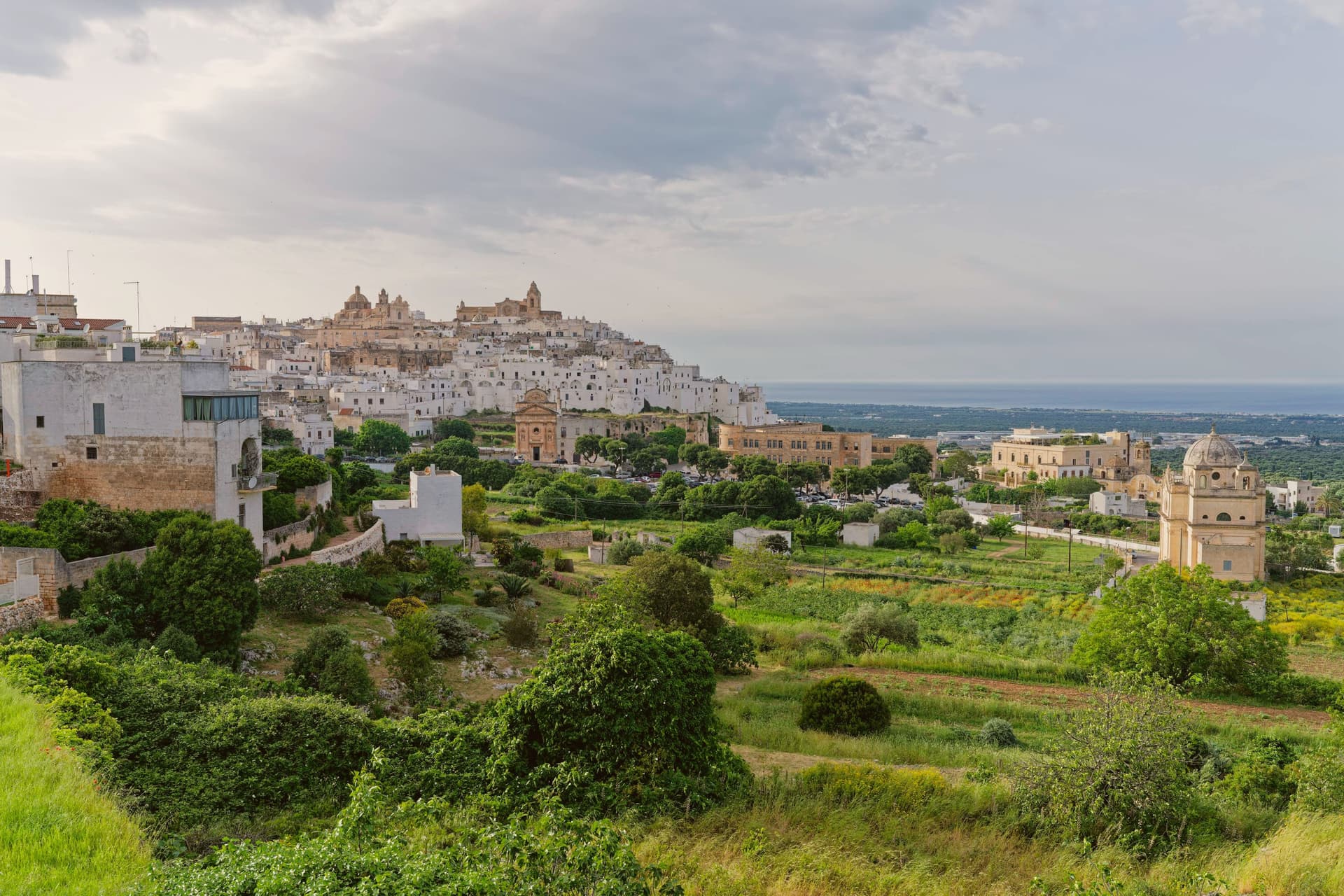
Ostuni sits at 218 meters on three hills above the Adriatic coastal plain, eight kilometers inland in the southeastern Murge. The whitewashing that gives it the name Città Bianca is medieval in origin, a hygienic measure against plague that survived as the local building convention; the entire centro storico is painted white in lime every spring and reads as a single bright mass from the surrounding olive country.
The territory has been inhabited since the Paleolithic; the Messapii founded the urban nucleus before the Romans absorbed the region. The town joined the Norman County of Lecce in 996.
In 1507 it passed to Isabella, Duchess of Bari, then to her daughter Bona Sforza, queen of Poland, who fortified the coast with watchtowers against Ottoman raids in 1539. The Cattedrale, a late-Gothic facade with a rose window of twenty-four rays, anchors the upper town.
The olive landscape around the commune holds some of the oldest cultivated trees in the Mediterranean.
What to see in Ostuni
- Cattedrale di Santa Maria Assunta. Late fifteenth-century Gothic cathedral at the highest point of the centro storico, with a rose window of twenty-four rays unique in Puglia.
- Centro storico. Whitewashed old town on three hills, lime-painted every spring against plague tradition, the single bright mass that names the Città Bianca.
- Piazza della Libertà. Lower civic square outside the medieval walls, with the Guglia di Sant'Oronzo, an early eighteenth-century baroque obelisk to the patron saint.
How to get to Ostuni
There is a railway station in the town, so you can arrive without a car and never need one while you are here. Taranto is roughly 64 minutes away by road.
Our tip
April through June and September through October are the months Ostuni works: olive plain in flower or harvest light, the white walls glowing in mild evenings, the Adriatic eight kilometers away warm enough for swimming by mid-May. July and August touch thirty-five degrees and the centro storico fills with day-trippers from Bari and Brindisi; weekends in August are shoulder to shoulder in the upper alleys. Late afternoon and after dusk are the times to walk, when the white walls cool and the crowds thin.
Nardò
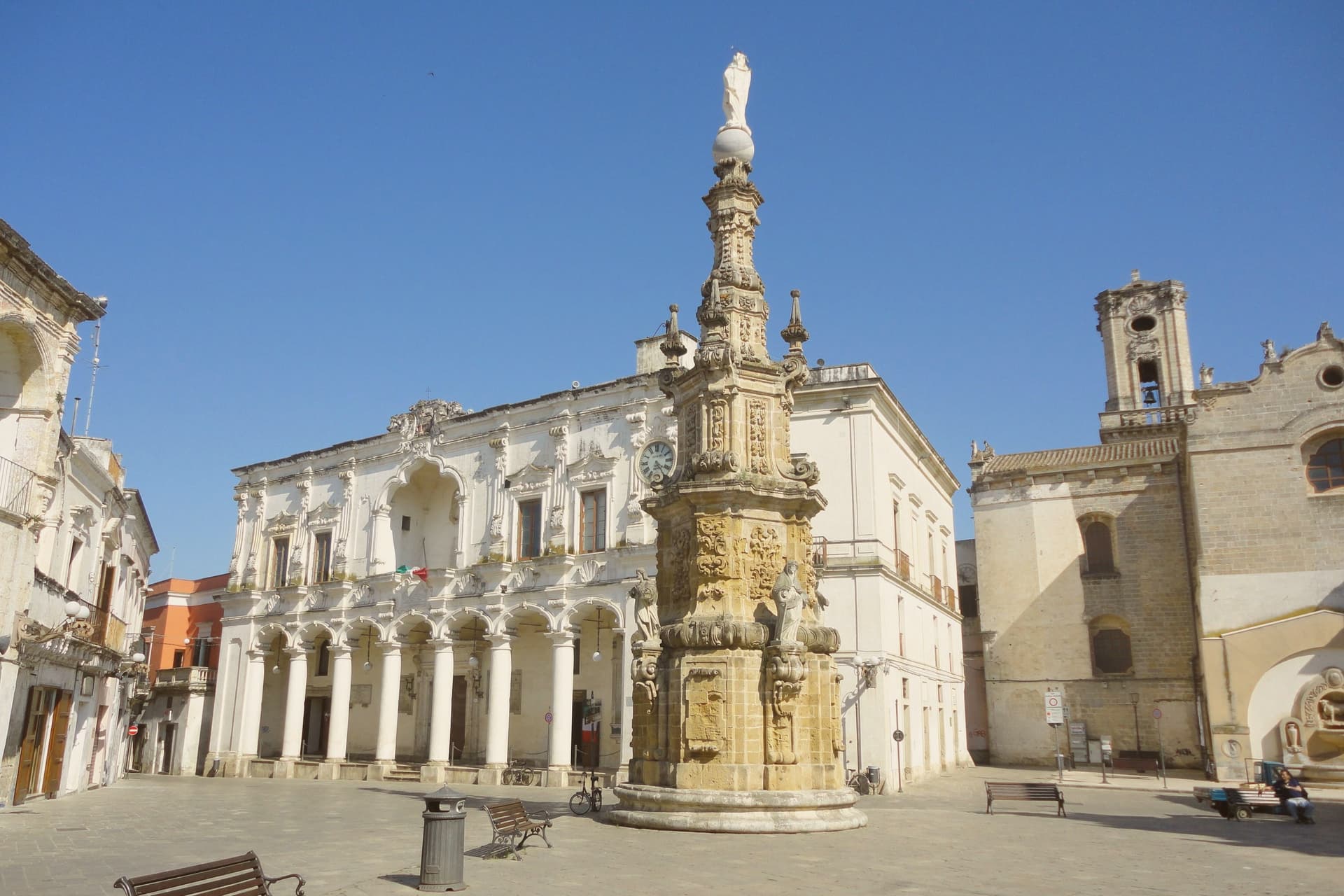
Why visit Nardò
The town sits at 45 meters in the northwestern Salento, about ten kilometers inland from the Ionian coast. With just under 31,000 inhabitants and 190 square kilometers of territory, it is the second-largest commune in the province after the capital.
It was a Byzantine stronghold for centuries; in 1497 the dukes of Acquaviva acquired it and turned it into a cultural seat, with universities, academies and literary circles that drew on the same humanist current as Lecce and Gallipoli. The centro storico, built up under that ducal patronage, forms a dense fabric of palaces and church facades in the local pietra leccese, with the castle standing at its edge, now serving as the municipal seat.
Ten kilometers of inland distance separate that historic core from the municipal coastline, where the Porto Selvaggio nature reserve occupies a stretch of Mediterranean pine forest above limestone cliffs, held by the commune as a regional park. Inland seat of government and culture, coastal reserve of forest and cliff: the two halves of the commune's territory answer to different centuries and different purposes, joined only by the ten kilometers between them.
What to see in Nardò
- Piazza Salandra. Central Baroque square of the centro storico, the Guglia dell'Immacolata at its center, ringed by palazzi and church facades in pietra leccese.
- Castello Acquaviva. Aragonese-Acquaviva castle on the edge of the centro storico, residence of the ducal house from 1497, now the municipal seat.
- Cattedrale di Maria Santissima Assunta. Romanesque-Baroque cathedral founded in the eleventh century and remodelled across the seventeenth, with later Baroque facade and bell tower.
How to get to Nardò
There is a railway station in the town, so you can arrive without a car and never need one while you are here. Taranto is roughly 80 minutes away by road.
Our tip
April through June and September through October are the months Nardò is at its best: Baroque facades in raking light, the Porto Selvaggio pine forest cool, the Ionian water warm enough to swim by mid-May. July and August touch thirty-six degrees and the centro storico empties between two and five in the afternoon; the coastal hamlets of Santa Caterina and Sant'Isidoro fill with Lecce families. The Festa di San Gregorio Armeno in mid-February is the local patronal day, the only large winter event.
Martina Franca
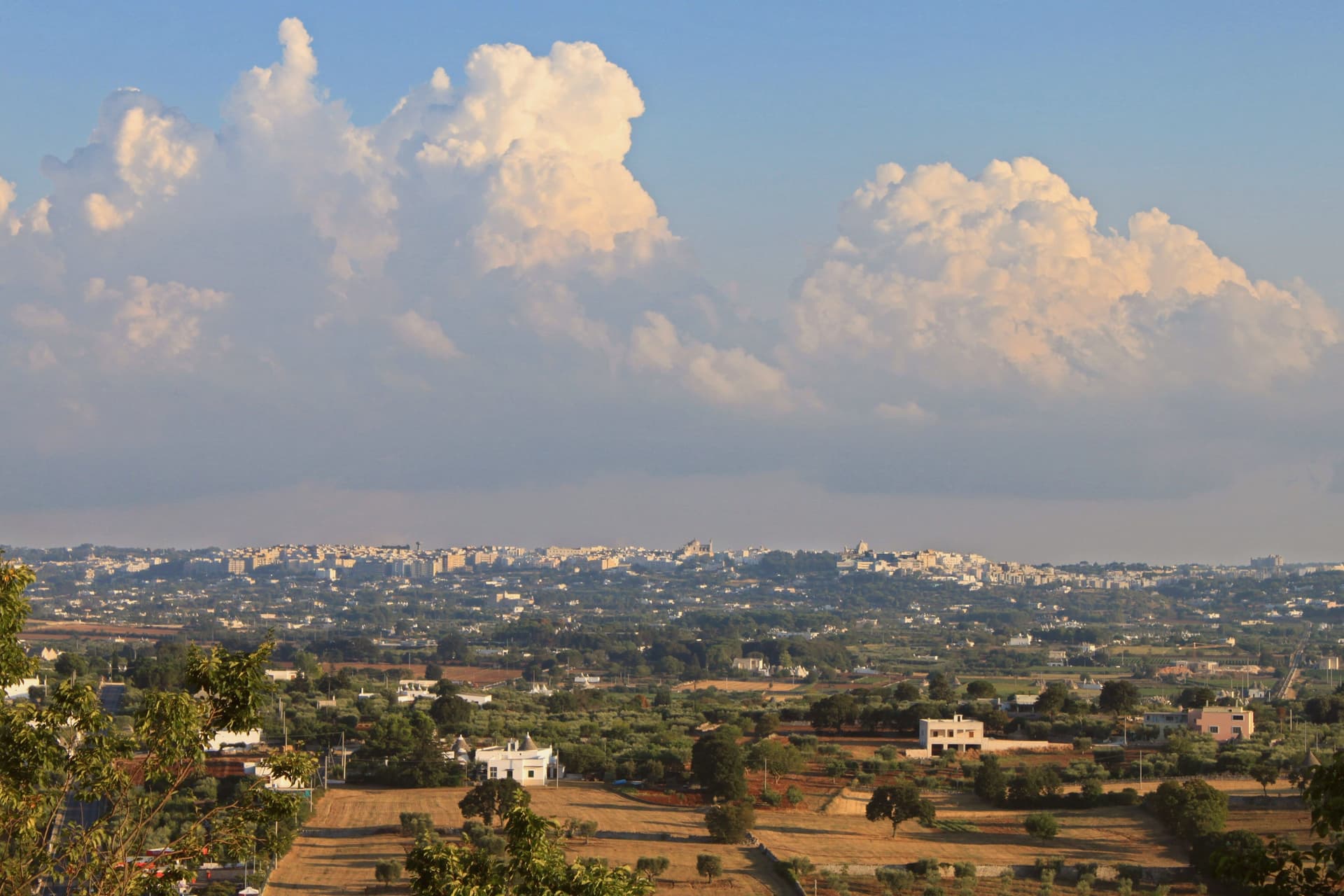
Why visit Martina Franca
Martina Franca sits at 431 meters on the southern edge of the Valle d'Itria, on the border between the provinces of Taranto, Bari and Brindisi. The town was founded in 1310 by Philip I of Anjou, Prince of Taranto, who granted franchigie, tax exemptions, to settlers willing to repopulate the hill, hence Franca in the name.
The centro storico is the densest concentration of Rococo and late-Baroque architecture in Puglia after Lecce: wrought-iron balconies, carved stone portals, churches built or rebuilt after the 1743 earthquake. The Palazzo Ducale of 1668, raised on the foundations of a 1338 medieval castle, is the seat of the municipal offices and the open-air courtyard where the Festival della Valle d'Itria has been performed every July and August since 1975, founded specifically to recover rare and forgotten operas.
The Basilica di San Martino, begun in 1747, is the most complete example of Martinese Rococo. The surrounding plateau makes a Martina Franca DOC white wine and a strong dry-cured capocollo IGP.
What to see in Martina Franca
- Palazzo Ducale. Built in 1668 on the foundations of a 1338 medieval castle, town hall and home of the Festival della Valle d'Itria summer opera courtyard.
- Basilica di San Martino. Eighteenth-century basilica begun in 1747 after the 1743 earthquake, the most complete Martinese Rococo monument and museum of liturgical art.
- Piazza Roma and Piazza Maria Immacolata. The two main squares of the centro storico, linked by Via Cavour, lined with eighteenth-century palazzi and the town's main passeggiata.
How to get to Martina Franca
There is a railway station in the town, so you can arrive without a car and never need one while you are here. Taranto is roughly 38 minutes away by road.
Our tip
April through June and September through October are the best months on the Itria plateau. The 431-meter elevation keeps the air dry, the limestone walls reflect a clear light, and the surrounding vineyards green up in spring then turn gold by the late September harvest. July and August are hot but mitigated by the altitude; they are also the months the Festival della Valle d'Itria runs in the Palazzo Ducale courtyard, the largest cultural draw in southern Puglia. Festa della bombetta falls in August.
Lecce
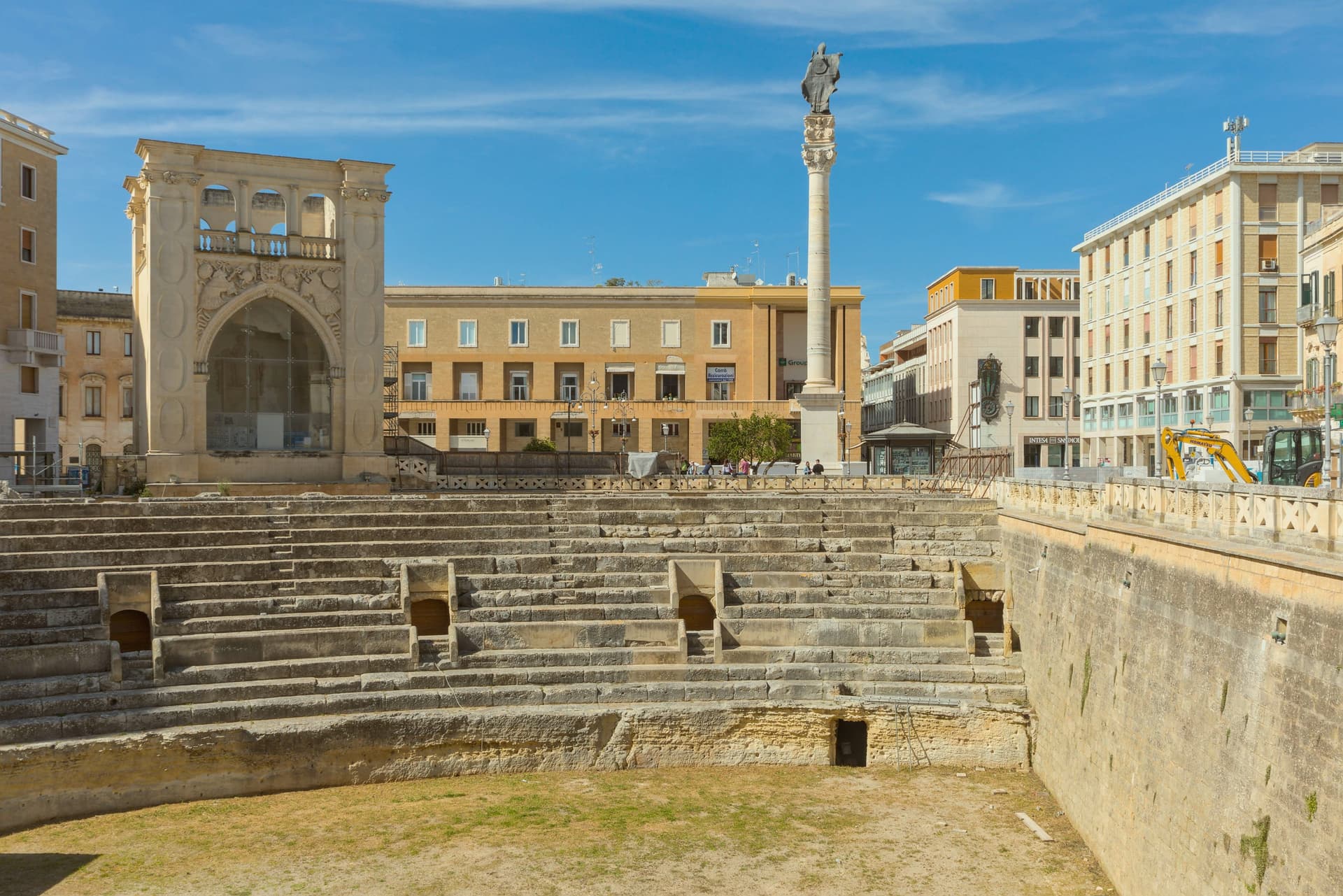
Why visit Lecce
Lecce sits on the Salento plain at 49 meters above sea level, twelve kilometers inland from the Adriatic, the provincial capital. The Messapian settlement of Lupiae stood on this site by the eighth century BC.
Rome took it in the third century BC, and Hadrian later moved the settlement three kilometers away and renamed it Licea, so the modern city occupies a site distinct from either of its named predecessors. The walled centro storico is ringed by Charles V's fortifications, entered from the north through the Porta Napoli arch and anchored on its eastern edge by his castle, built over older Norman foundations.
Within those walls the Baroque churches and squares sit close together, the cathedral square closed in on three sides while the amphitheater lies open and half-sunk in the middle of the newer square that formed around it. The University runs a strong humanities program, and the seafront at San Cataldo, some distance from the old center, carries Lecce's Bandiera Blu.
What holds the town together is the stone itself: soft enough to carve finely, hard enough once cut to last, so that a Messapian and Roman settlement site became, centuries later, the surface on which the south's most elaborate Baroque was cut.
What to see in Lecce
- Basilica di Santa Croce. Worked for nearly two hundred years to completion in 1695, the façade carved with cherubs, monsters and allegories layered so densely that the wall surface almost disappears beneath them.
- Piazza del Duomo. Closed on three sides, the only enclosed cathedral square of its kind in Puglia, gathering the Duomo, Campanile, Bishop's Palace and Seminary into one shared courtyard rather than an open street front.
- Piazza Sant'Oronzo. The city's central square, built around a column brought from the Appian Way to honor the patron saint, with the excavated amphitheater floor sitting below street level at its edge.
How to get to Lecce
There is a railway station in the town, so you can arrive without a car and never need one while you are here. Taranto is roughly 95 minutes away by road.
Our tip
April through June is the green window in inland Salento, with the centro storico walkable in the day and aperitivo on Piazza Sant'Oronzo running late. July and August push past thirty-five degrees and the city empties at midday; the Notte della Taranta in nearby Melpignano, the closing concert of the Salento pizzica festival, falls in late August and draws over a hundred thousand. September and October cool back down for the olive harvest. Festa di Sant'Oronzo falls in August.
More from Anywhere Italy
 The best towns worth staying overnight that eat well in Puglia
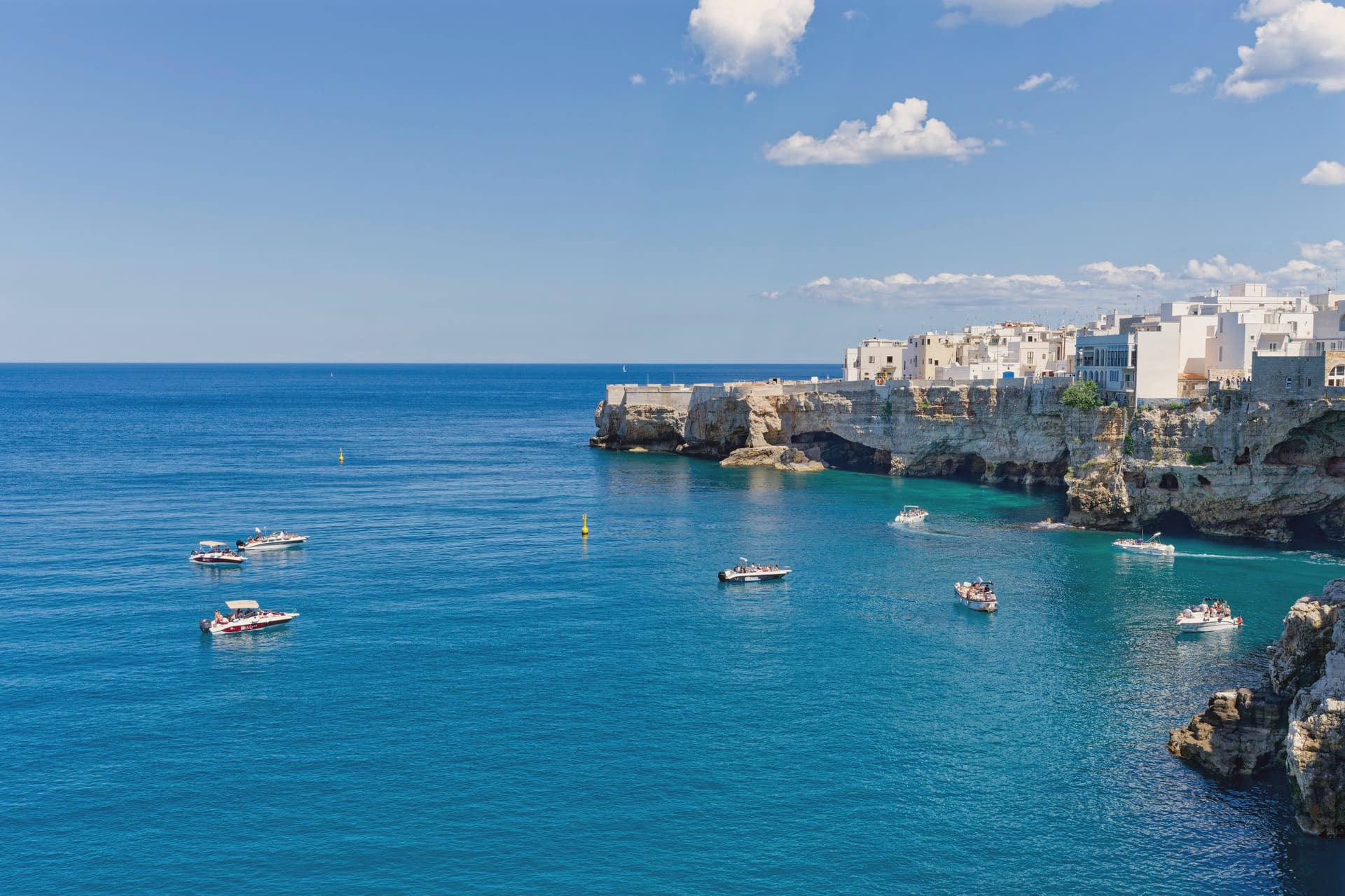 The best beach towns worth staying overnight in Puglia
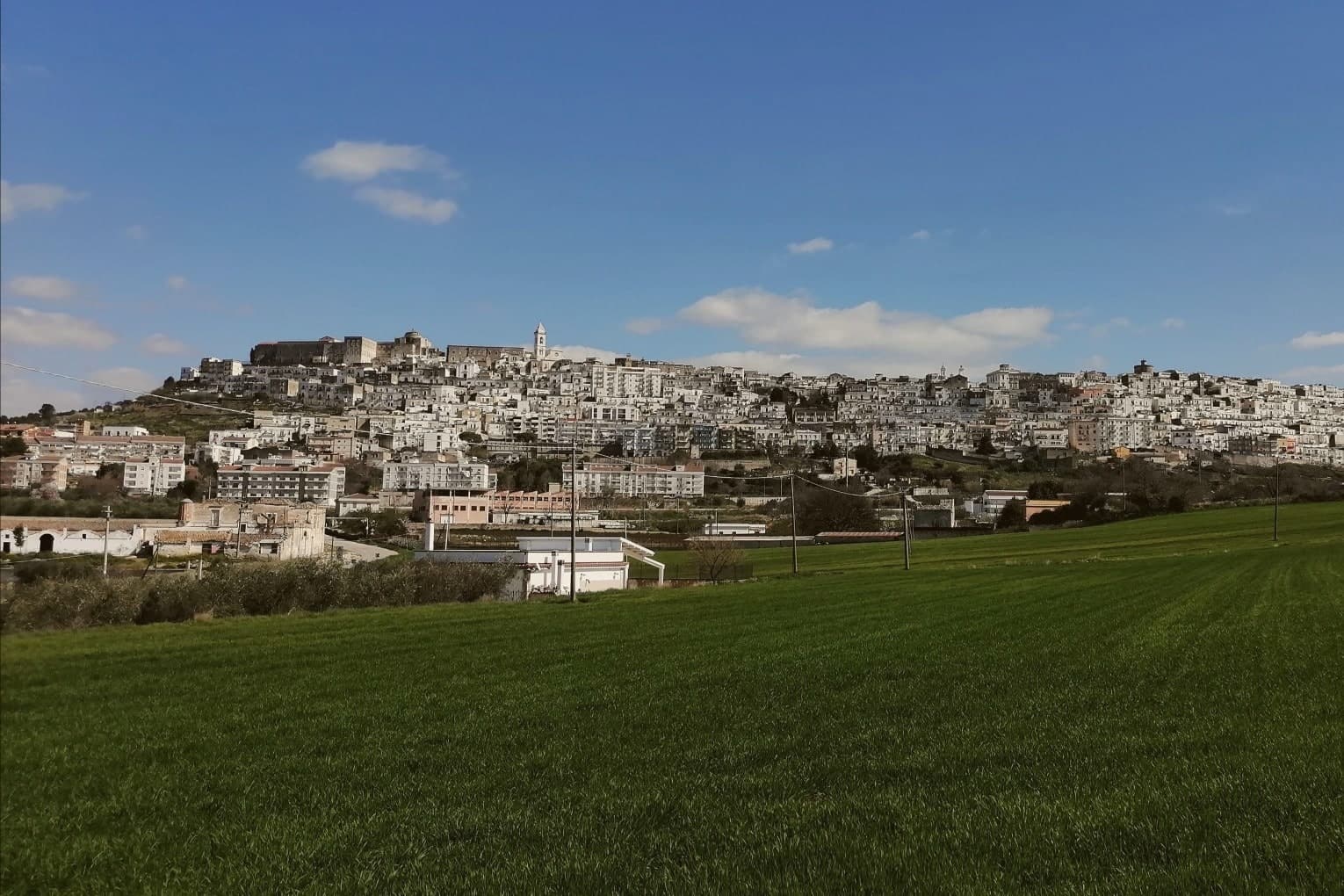 The best hill towns inside a nature park in Puglia
- The 10 best hill towns with a serious restaurant in Puglia
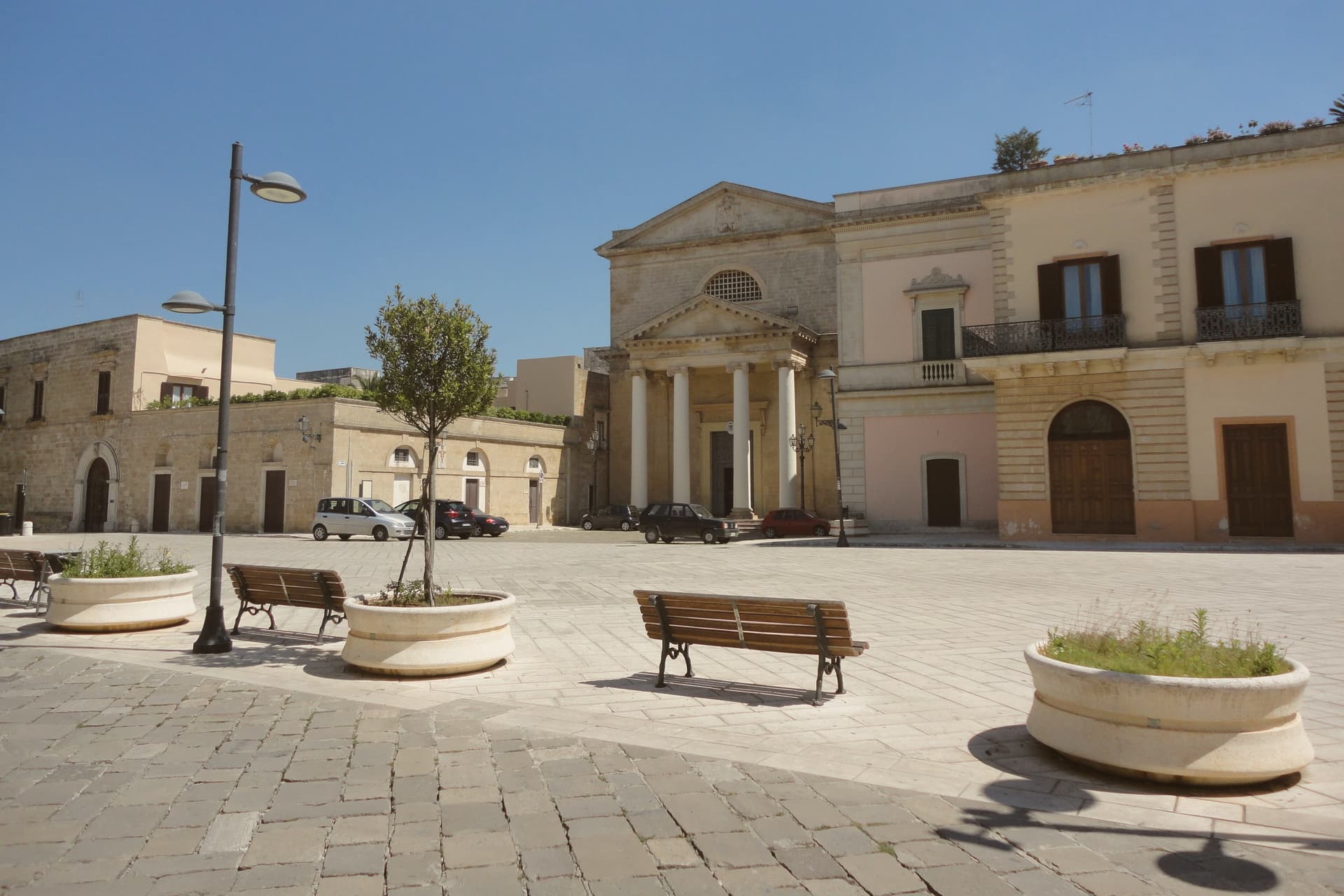 The 7 best beach towns inside a nature park in Puglia
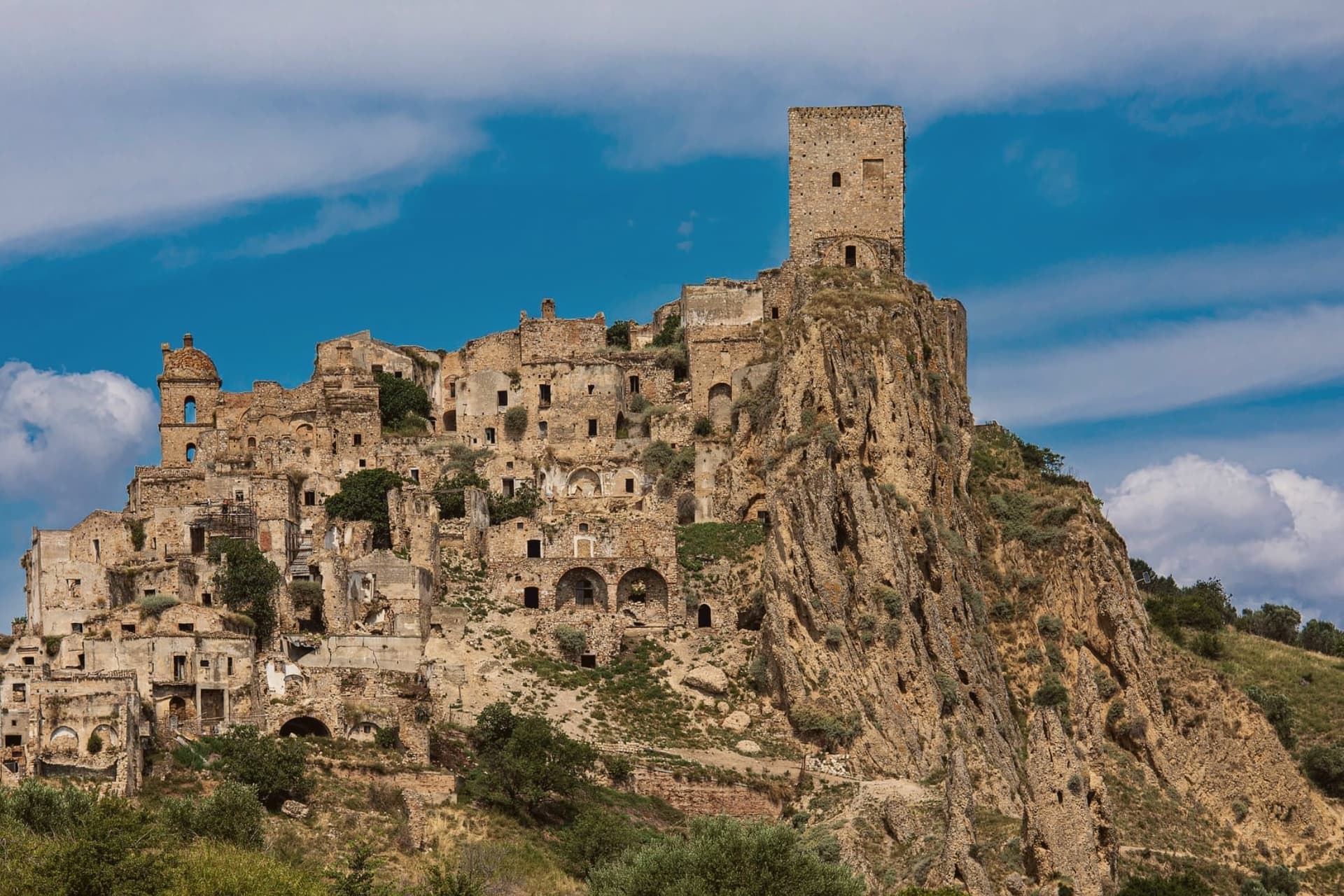 The best hidden hill towns within 90 minutes of Taranto