
The 9 best hill towns you can reach by train in the province of Bari
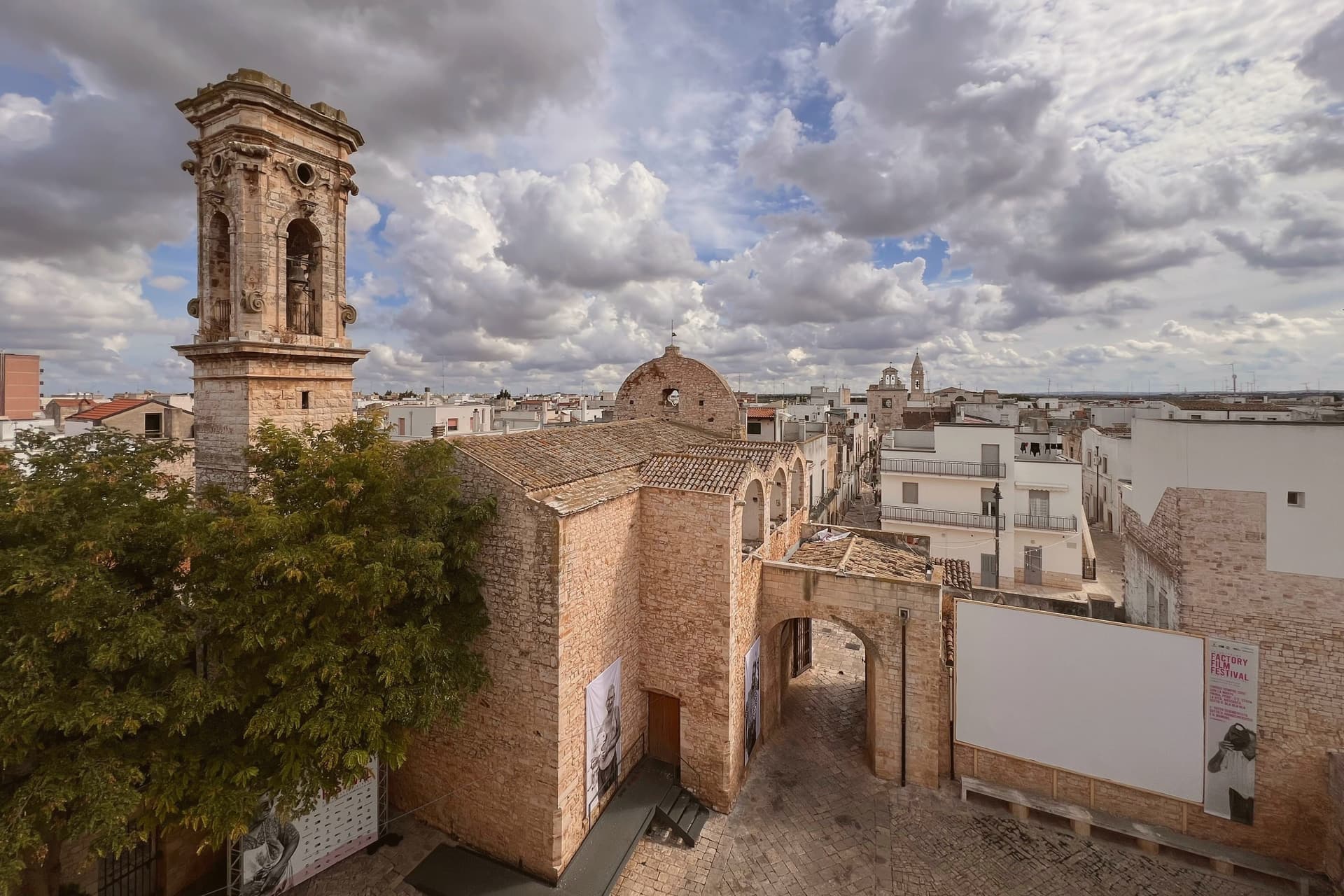
The land behind Bari climbs slowly, from coastal plain into the Murgia, and the building material changes with it: pale local limestone, lime-washed until the walls throw back the light, dry stone walls dividing the olive groves and vineyards. Spring brings almond blossom and fava beans with chicory purée; autumn brings the olive pressing and new oil on bruschetta still warm. The food here is inland food rather than seafood, so orecchiette with turnip tops, lamb baked with potatoes and cheese, capocollo cured in the hill air, and taralli sold by the bag. Trains from Bari Centrale run up into all of it on the Ferrovie del Sud Est and the Bari-Nord lines, which makes the whole plateau workable without a hire car.
Most visitors to Puglia give the province a single day and spend it in Bari itself, walking the old town while women make orecchiette on tables in the street, then move on south to Ostuni or the beaches around Polignano a Mare. Those places earned their crowds, and in July and August they carry them badly: the coastal road backs up, the parking fills by mid-morning, and the terraces above the sea are booked out. The Adriatic beaches on either side of the city work the same way, filling from the coastal trains and emptying again at dusk.
The same limestone, the same lanes, the same cooking continue inland for a good hour past the last beach umbrella, and the railway goes with them. Up on the Murgia there are towns built round a Norman castle, towns whose whole historic centre is a conical roof of trulli, towns sitting above cave systems and gravine ravines cut deep into the rock. Fewer people go, partly because the coast is closer and partly because it takes a timetable rather than a car park. These are the ones worth the ride.
Of the 14 communes we have mapped in the province of Bari, 9 qualify as hill towns you can reach by train: each is an inland hill settlement, and we have confirmed each is reachable without a car. The smallest, Sammichele di Bari, has 6,022 residents.
Elsewhere in the catalogue: The best hill towns you can reach by train within 90 minutes of Bari and The best olive oil towns in the province of Bari.
Sammichele di Bari
Why visit Sammichele di Bari
Sammichele di Bari sits at 280 meters on the Murge plateau, thirty kilometers south of Bari. The settlement was founded as a fief in 1609 when the wealthy Genoese banker Michele Vaaz bought the territory from the Centurione family and named the new town after his patron saint.
The Castello Caracciolo at the centre of the village began as a Norman outpost, passed through Centurione and Vaaz ownership, and was bought by the Caracciolo dukes in 1797 who hired the architect Amenduni to redo the eastern façade in rusticated stone with neo-Gothic bifora windows. Since 1974 the castle has held the Museo della Civiltà Contadina Dino Bianco, one of the oldest and largest ethnographic museums in Italy, with over five thousand objects of nineteenth-century peasant life arranged over four floors.
The annual Sagra della Zampina on the last weekend of September celebrates the spiced spit-roasted pork sausage that the town claims as its own.
We confirmed you can reach this one by train.
What to see in Sammichele di Bari
- Castello Caracciolo. Norman-origin castle bought by Michele Vaaz in 1609 and remodelled by the Caracciolo dukes in the nineteenth century with neo-Gothic windows.
- Museo della Civiltà Contadina Dino Bianco. Ethnographic museum inside the castle, founded by professor Dino Bianco in 1968, over five thousand objects of nineteenth-century rural life.
- Centro storico. Walled old town on the Murge plateau, laid out by Michele Vaaz from 1609 around the castle and the parish church of San Michele Arcangelo.
How to get to Sammichele di Bari
There is a railway station in the town, so you can arrive without a car and never need one while you are here. Bari is roughly 30 minutes away by road.
Our tip
April through June and September through October are the workable months on the Murge. July and August push past thirty-five degrees on the plateau and the centro storico empties between two and five. The late-September Sagra della Zampina falls at the edge of the heat and pulls a crowd from the metropolitan area.
Alberobello
Why visit Alberobello
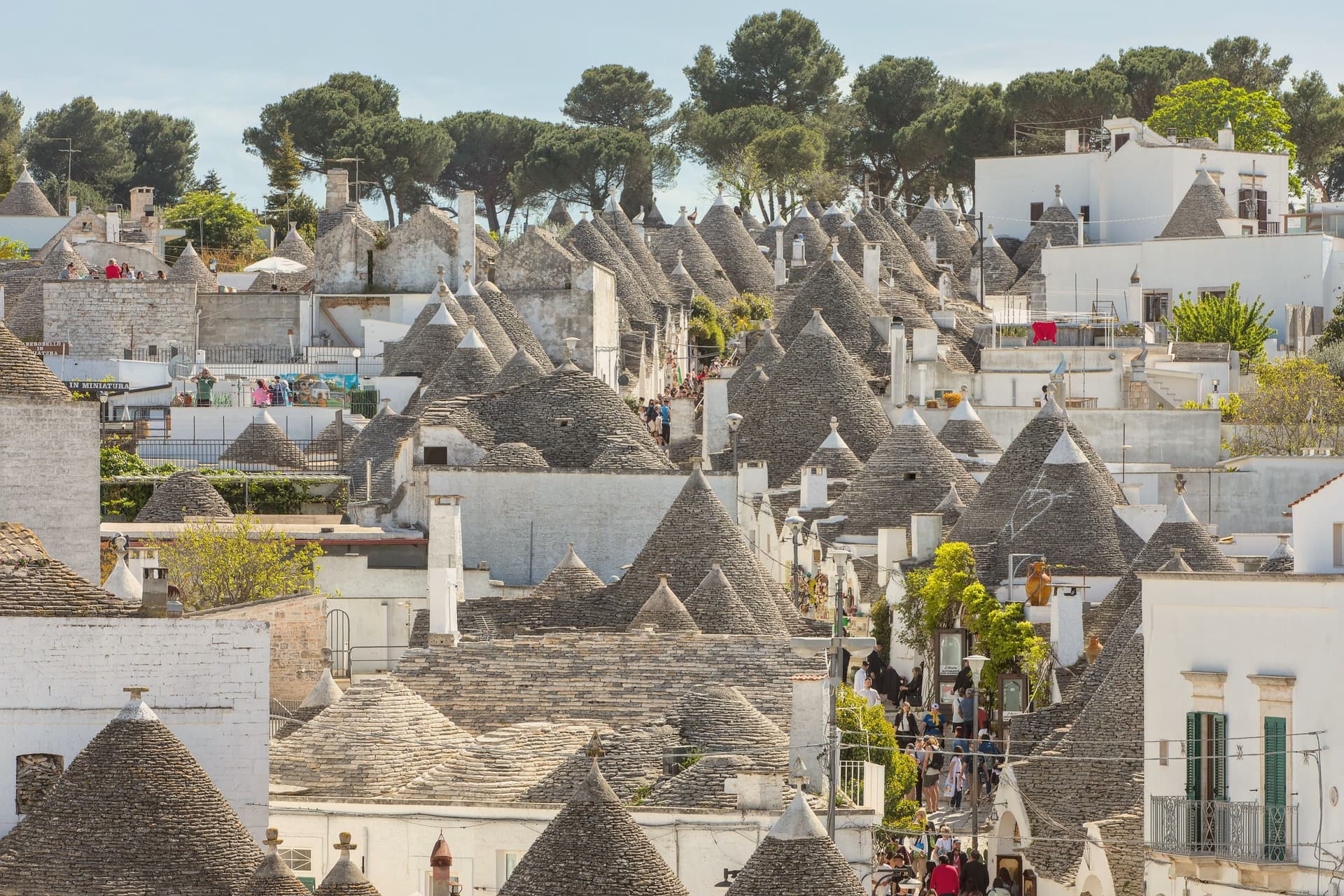
Alberobello sits at 402 meters in the Valle d'Itria, forty-five kilometers southeast of Bari. Two quarters of the town, Rione Monti and Aja Piccola, hold more than 1,500 trulli: limestone cones built from corbelled drystone, with conical or pyramidal roofs piled course by course without mortar.
The technique is prehistoric and still in use across the Murge, but nowhere else is the density and preservation what it is here. The Counts of Conversano enforced drystone construction on their tenant farmers to dodge a Spanish viceroy's tax on permanent settlements: a building that could be dismantled in an afternoon did not count as a town.
UNESCO listed the trulli in 1996. Some are houses, some are shops, some are inhabited by the same families that built them.
The Trullo Sovrano, the only two-storey trullo, was built around 1750 and now functions as a small museum.
We confirmed you can reach this one by train.
What to see in Alberobello
- Rione Monti. The larger of the two trulli quarters, a thousand cones running down the hillside, mostly converted to shops and accommodation.
- Aja Piccola. The smaller residential quarter, about four hundred trulli, still occupied as primary housing and quieter than Rione Monti.
- Trullo Sovrano. The only two-storey trullo in town, built around 1750 by the Perta family, now a small museum of trullo construction and daily life.
How to get to Alberobello
There is a railway station in the town, so you can arrive without a car and never need one while you are here. Taranto is roughly 56 minutes away by road.
Our tip
April through June and September through October are the months the Itria valley is green and the trulli are walkable without sweat. July and August push past thirty-three degrees and the Rione Monti fills with day-trippers from the coast; by ten in the morning the main streets are shoulder to shoulder. Late afternoon and after dusk are the times to walk, when the cones cast long shadows and the crowds thin.
Locorotondo
Why visit Locorotondo
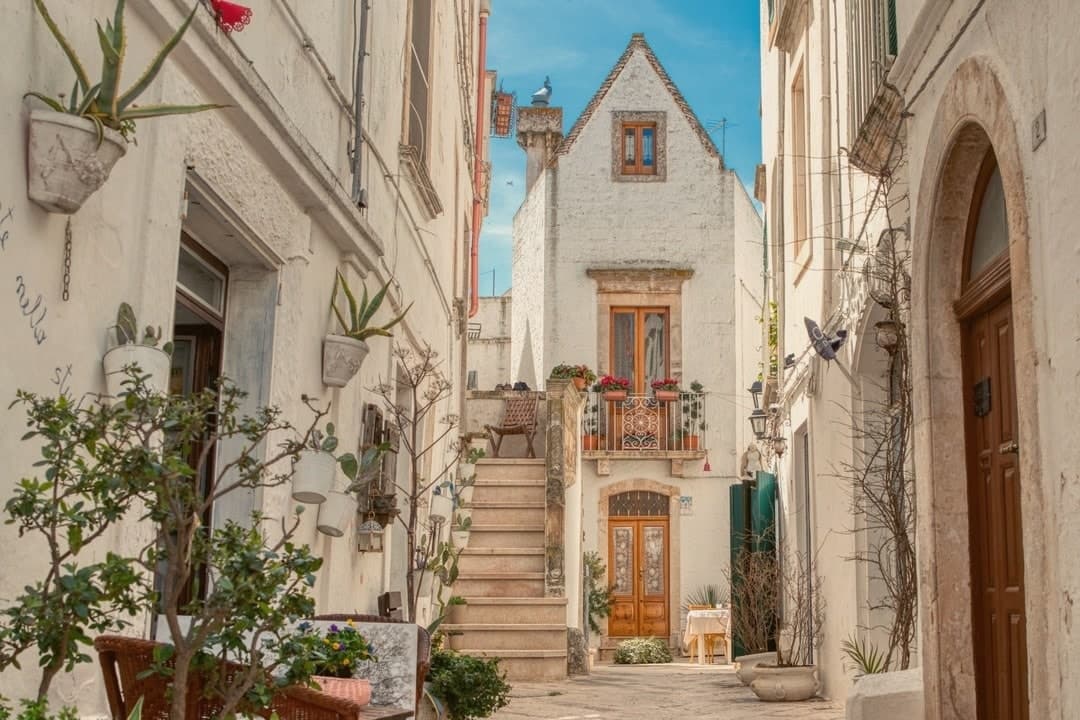
Locorotondo sits on a natural terrace at 410 meters, the high edge of the Valle d'Itria looking south over the trulli countryside between Alberobello, Cisternino and Martina Franca. The name means round place: the centro storico is a perfect circle of whitewashed houses, and the architecture is unique to this town.
The cummerse are stone houses with steep pitched roofs covered in two thin layers of limestone slabs, a profile that exists nowhere else in Puglia. The streets between them run in concentric arcs and are narrow enough to lose the sun by mid-afternoon.
Both the Borghi più belli d'Italia and the Touring Club's Bandiera Arancione recognize the place. The town also makes a white DOC wine from Verdeca and Bianco d'Alessano grapes, grown on 1,650 hectares of vineyards across the surrounding plateau, plus a Città dell'Olio membership for the oil that comes off the same hills.
We confirmed you can reach this one by train.
What to see in Locorotondo
- Centro storico. Circular old town of whitewashed cummerse, an architectural type with double-pitch limestone-slab roofs found only here.
- Villa Garibaldi. Public garden on the ridge with the widest panoramic view over the Itria valley and its trulli countryside.
- Chiesa Madre di San Giorgio. Eighteenth-century parish church on the highest point of the historic center, with a neoclassical façade and a tall central nave.
How to get to Locorotondo
There is a railway station in the town, so you can arrive without a car and never need one while you are here. Taranto is roughly 48 minutes away by road.
Our tip
April through June and September through October are the best months on the Itria plateau. Mornings are clear, the surrounding vineyards green up, and the wind off the Murge keeps evenings cool even in summer. July and August push past thirty degrees, the centro storico fills with day-trippers from Alberobello, and the narrow streets get crowded between ten and one.
Casamassima
Why visit Casamassima
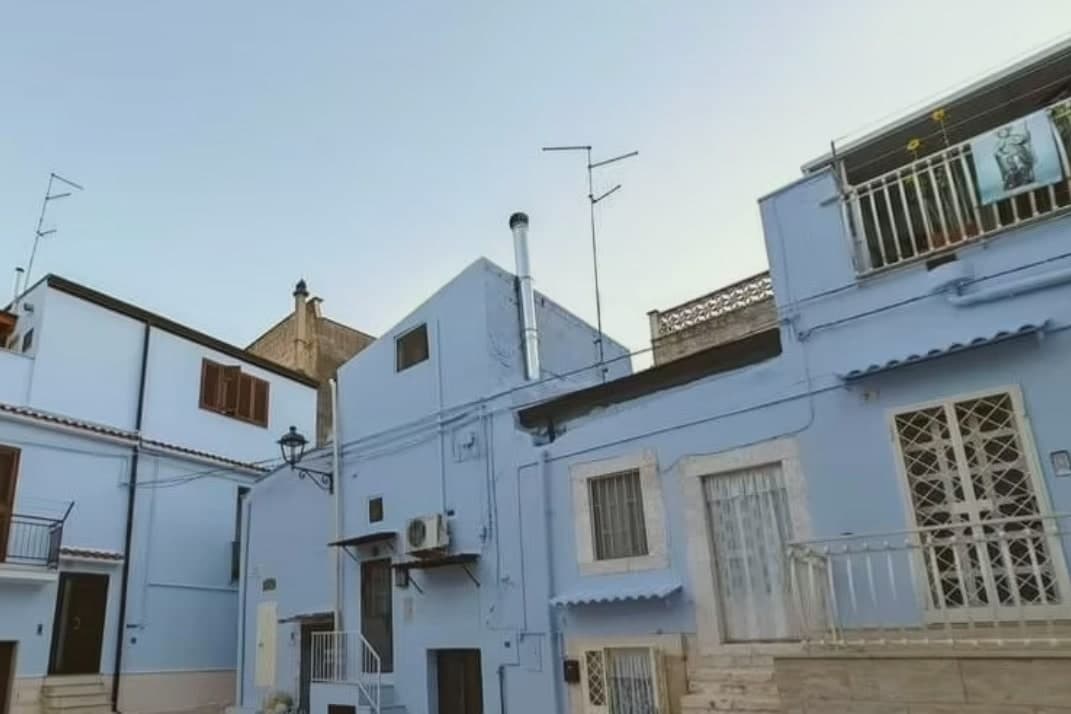
Casamassima sits at 230 meters on the lower Murge slopes, twenty kilometers south of Bari. The village is known nationally as the Paese Azzurro, the blue town: the houses, palazzi and churches of the centro storico are coated in successive layers of blue-tinted quicklime, probably copper sulphate, in a tradition the locals trace to Duke Odoardo Vaaz.
In 1658 a plague carried by a ship into the port of Bari killed over twenty thousand residents of the capital. Vaaz, a feudal lord of Casamassima from a Sephardic Jewish family of Portuguese origin who had bought the fief in 1609 for 76,000 ducats, vowed to the Madonna of Constantinople that he would paint his town blue if the village was spared.
It was. The small church of the Madonna di Costantinopoli still stands as the vow's fulfilment, and the blue lime has been retouched on the same buildings for nearly four centuries.
We confirmed you can reach this one by train.
What to see in Casamassima
- Centro storico (Paese Azzurro). The blue town, an entire medieval quarter coated in successive layers of copper-blue quicklime since the 1658 plague vow, unique in Puglia.
- Palazzo Ducale Vaaz. Twelfth-century manor house turned ducal residence of the Sephardic Vaaz family from 1609, then of the D'Aponte family after the 1667 sale.
- Chiesa di Maria SS di Costantinopoli. Small church built as the fulfilment of Duke Vaaz's plague vow, the historical anchor of the blue-painting tradition.
How to get to Casamassima
There is a railway station in the town, so you can arrive without a car and never need one while you are here. Bari is roughly 22 minutes away by road.
Our tip
April through June and September through October are the months the Murge is mild and the blue centro storico photographs at its best, the lime cool against bright light. July and August reach the mid-thirties on the plateau and the painted lanes empty between two and five in the afternoon. The painter Vittorio Viviani came in the 1960s and built a body of work around the blue light; the Pro Loco still organises walks in his footsteps in spring and autumn. Sagra focaccia di patate del coniglio ripieno falls in September.
Castellana Grotte
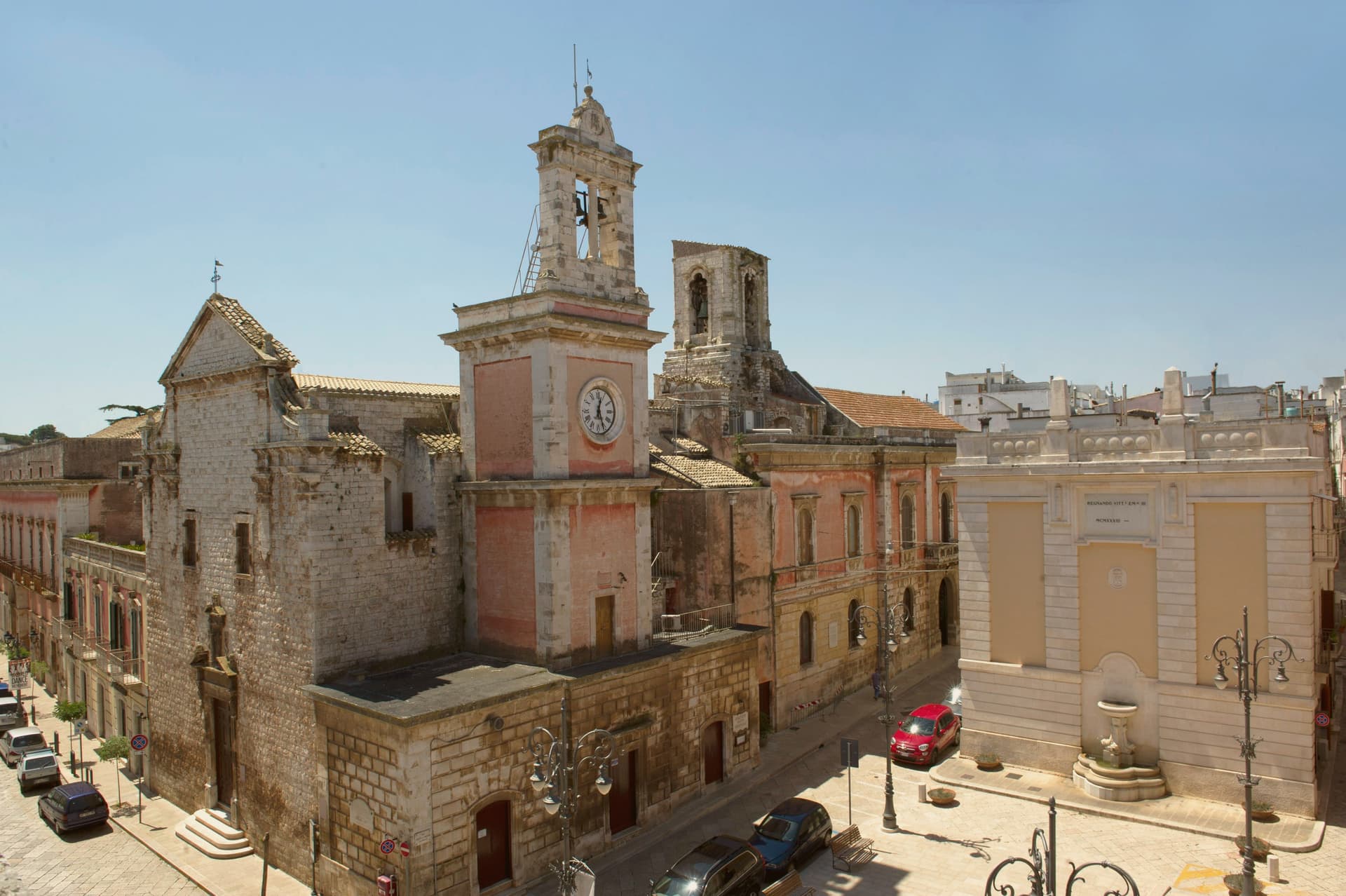
Why visit Castellana Grotte
Castellana Grotte sits on the south-eastern Murge at 290 meters, forty kilometers south of Bari and inland from Monopoli and Polignano. The town takes its name from the cave complex beneath it, reached in 1938 when a speleologist sent by the Italian Touring Club broke through a known sinkhole into the system running under the plateau.
The white alabaster chamber at the far end followed two years later. Above ground the town keeps a separate rhythm from what lies underneath it.
The walled center sits organized around the cathedral square, its mother church raised on Romanesque foundations with a Norman tower pressed into service as a bell tower. On the hilltop above, the sanctuary built after the 1690 plague draws the January procession that carries the Madonna statue down from the Capuchin convent to that same mother church, tying the two sacred points of the town together once a year.
The place works on two levels literally: a plateau town of stone alleys and church squares going about its own history, sitting on top of a cave system that has nothing to do with it except the name.
We confirmed you can reach this one by train.
What to see in Castellana Grotte
- Grotte di Castellana. Galleries descend from a sinkhole known as La Grave into stalactite and stalagmite formations underfoot, with Franco Anelli's route ending at the alabaster chamber of the Grotta Bianca.
- Chiesa Madre di San Leone Magno. Romanesque mother church rebuilt in 1383, three naves under round arches, with a Norman defensive tower converted into the bell tower.
- Santuario di Santa Maria della Vetrana. Hilltop sanctuary built in thanks for deliverance from plague, the destination of the January procession that carries the Madonna statue from the Capuchin convent.
How to get to Castellana Grotte
There is a railway station in the town, so you can arrive without a car and never need one while you are here. Bari is roughly 47 minutes away by road.
Our tip
April through June and September through October are the workable months on the Murge: dry, clear, the caves a constant fifteen degrees regardless of the surface weather. July and August reach the mid-thirties above ground but the cave itinerary stays cold enough for a jacket. The plateau countryside empties between two and five in the afternoon.
Acquaviva delle Fonti
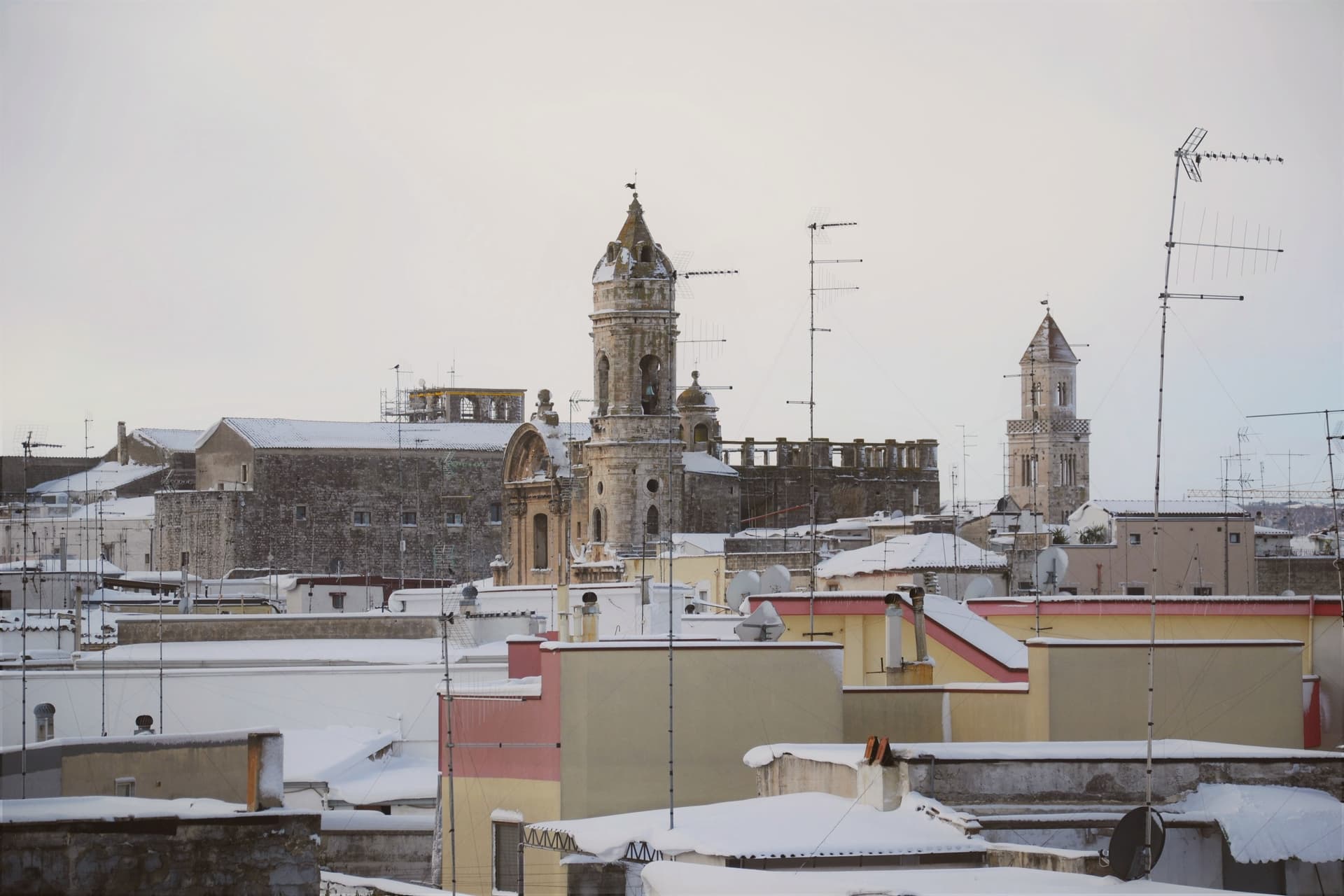
Why visit Acquaviva delle Fonti
Acquaviva delle Fonti sits on the Murge plateau at 300 meters, twenty-five kilometers south of Bari and the same distance from the Adriatic. The name records the springs that fed the town long before the Normans arrived.
The Co-Cathedral of Sant'Eustachio was built in 1158 on Messapian foundations by the Norman lord Roberto Gurguglione, then rebuilt in Renaissance style in the late sixteenth century by Count Alberto Acquaviva d'Aragona; its façade carries a sixteen-arm rose window that is the building's signature. The Palazzo de Mari, now the town hall, anchors the centro storico opposite the cathedral.
The town is best known nationally for the cipolla rossa di Acquaviva, a sweet DOP red onion grown only in local clay-rich soils and celebrated with a late-July sagra and a mid-October festival built around the calzone di cipolla. The ecclesiastical Miulli hospital, one of the largest in Puglia, sits at the edge of town.
We confirmed you can reach this one by train.
What to see in Acquaviva delle Fonti
- Concattedrale di Sant'Eustachio. Romanesque cathedral of 1158 rebuilt in Renaissance style by the Acquaviva d'Aragona counts, with a sixteen-arm rose window over the central portal.
- Palazzo de Mari. Sixteenth-century noble residence on the cathedral square, now the town hall, built by the de Mari family after they acquired the fief.
- Centro storico. Walled old town on the Murge plateau, organized around the cathedral and the palazzo, with stone houses and the springs that gave the place its name.
How to get to Acquaviva delle Fonti
There is a railway station in the town, so you can arrive without a car and never need one while you are here. Bari is roughly 30 minutes away by road.
Our tip
April through June and September through October are the months the Murge stays mild and the countryside is in flower or harvest. July and August push toward thirty-five degrees on the plateau and the centro storico empties between two and five in the afternoon. The late-July onion sagra falls in the worst of the heat but still pulls a crowd. Sagra del Calzone falls in October.
Conversano
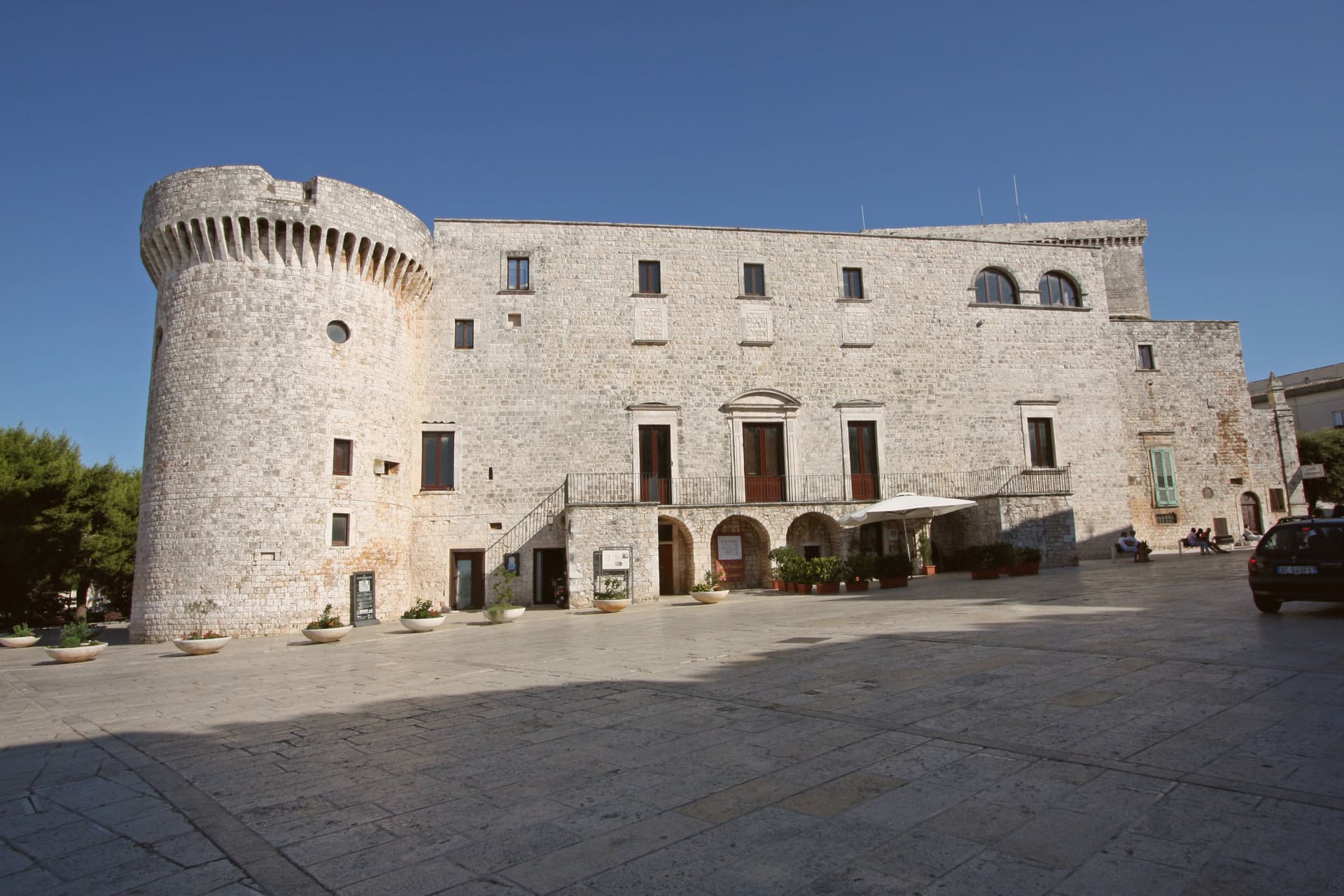
Why visit Conversano
Conversano sits on the first hills of the Murge plateau at 219 meters, twenty-five kilometers southeast of Bari and seven from the Adriatic. The Castello di Conversano was raised around 1054 by the Normans for defence and turned into a seigneurial residence by the Acquaviva d'Aragona counts, who ruled from 1455 until the early nineteenth century.
Inside the castle the Pinacoteca holds the ten-canvas cycle of episodes from Tasso's Gerusalemme Liberata painted by Paolo Domenico Finoglio in the 1640s, commissioned by Count Giangirolamo II d'Acquaviva. Opposite the castle stands the Cattedrale di Santa Maria Assunta, eleventh- and twelfth-century Apulian Romanesque with a sculpted portal, a rose window, and an interior Crucifix that anchors the patronal procession.
The former Monastero di San Benedetto, with a Romanesque cloister, was entrusted in 1266 by Pope Clement IV to Cistercian nuns exiled from Methoni in Greece, an arrangement so unusual it earned the monastery the medieval nickname Monstrum Apuliae, the Wonder of Puglia.
We confirmed you can reach this one by train.
What to see in Conversano
- Castello di Conversano. Norman castle of 1054 turned seigneurial residence by the Acquaviva d'Aragona counts, with the Pinacoteca holding Finoglio's ten Gerusalemme Liberata canvases.
- Cattedrale di Santa Maria Assunta. Apulian Romanesque cathedral of the eleventh and twelfth centuries, sculpted portal, rose window, wooden Crucifix venerated as the city's protector.
- Monastero di San Benedetto. Former Benedictine then Cistercian monastery with Romanesque cloister, called Monstrum Apuliae for the abbess-power of the Greek nuns entrusted to it from 1266.
How to get to Conversano
There is a railway station in the town, so you can arrive without a car and never need one while you are here. Bari is roughly 36 minutes away by road.
Our tip
April through June and September through October are the Murge months at this altitude: clear light, mild evenings, the cherry orchards in flower or fruit. Conversano is the centre of the IGP cherry zone and the late-May ciliegia harvest is the year's commercial peak. July and August hit thirty-five degrees and the centro storico empties in the afternoon.
Putignano
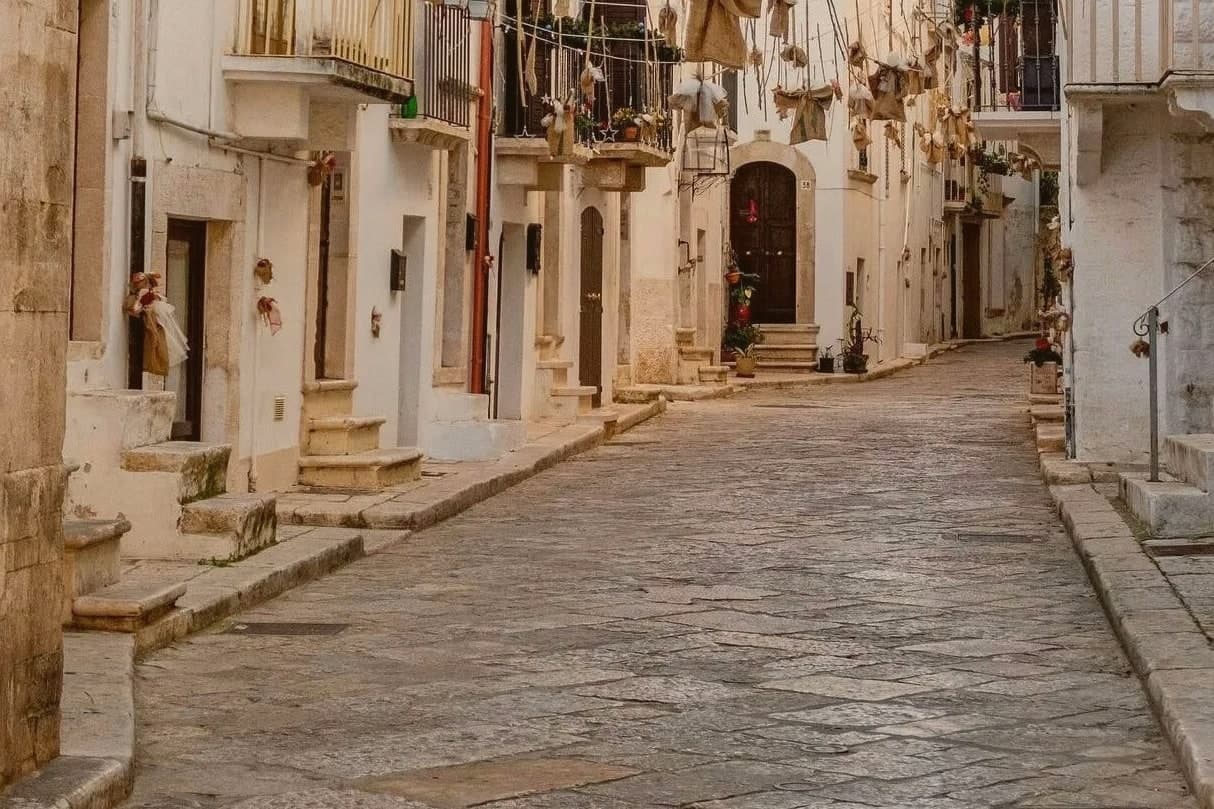
Why visit Putignano
The town sits on the Murgia, the karst plateau between Bari and Lecce, at 372 metres, home to just under 26,000 people. The carnival's origin is tied to a specific piece of geography: a Benedictine confraternity carried the relics of Santo Stefano inland from the coast at Monopoli to escape Saracen raids, arriving on 26 December 1394.
Farmers moving grapevines in the same December procession began singing satirical verses, and that song is what survives today as le Propaggini, still the opening event every 26 December. The carnival that grew from it ran across 631 years of plagues, wars, fascism, and pandemics without a break, which is the basis of its claim to being the oldest in Europe.
Inside the centro storico the old and the underground meet directly: a karst cave system opens beneath a Trullo-roofed building right in the middle of town, its entrance inside the old centre rather than out on the plateau, with stalactites and a section that served as a WWII refuge shelter. The Chiesa Madre di San Pietro Apostolo, a restored Romanesque church with a 16th-century crypt, anchors the same central piazza as the Palazzo del Balì, and stretches of the medieval walls still hold their line nearby.
The kitchen draws on the same plateau and its neighbours: focaccia barese, orecchiette con cime di rapa, capocollo from the next town over, Primitivo di Manduria carried in from 80 km south, and farinella, the sweet polenta cake made with grape must and chickpea flour that belongs specifically to the carnival calendar. What holds the town together is continuity: a religious procession that turned into satire and has not stopped since, a centre small enough that the cave, the church, and the workshops all sit within a short walk of each other, and a plateau setting that feeds both the table and the traffic passing through toward Alberobello and the Valle d'Itria.
We confirmed you can reach this one by train.
What to see in Putignano
- Carnevale di Putignano (Dec 26 – Shrove Tuesday). Five Sunday float processions run from January to Shrove Tuesday. Le Propaggini opens the calendar on 26 December, the Funerale del Carnevale closes it, and 365 bells ring out, one for each day until the next.
- Cartapesta workshops + Museo del Carnevale. Many of the workshops are open for visits while the floats take shape. The museum documents the full run of carnival history, plague years, wars, and fascism included.
- Grotta del Trullo. The cave sits under a Trullo-roofed building in the old centre, which is where its name comes from. Guided visits take in the stalactites and the section that served as a WWII refuge shelter.
How to get to Putignano
There is a railway station in the town, so you can arrive without a car and never need one while you are here. Bari is roughly 46 minutes away by road.
Our tip
Putignano is dominated by Carnevale — January through Shrove Tuesday (typically late January to mid-February or early March depending on Easter date) is the headline season, with the five Sunday float processions drawing 200,000+ visitors per Sunday. Book accommodation 2-3 months ahead for Carnevale weekends. Outside that, the town is best March–June and September–October — summer is brutally hot on the Murgia (frequent 38°C+) and most cartapesta workshops close August. Carnevale di Putignano falls in February.
Gravina in Puglia
Why visit Gravina in Puglia
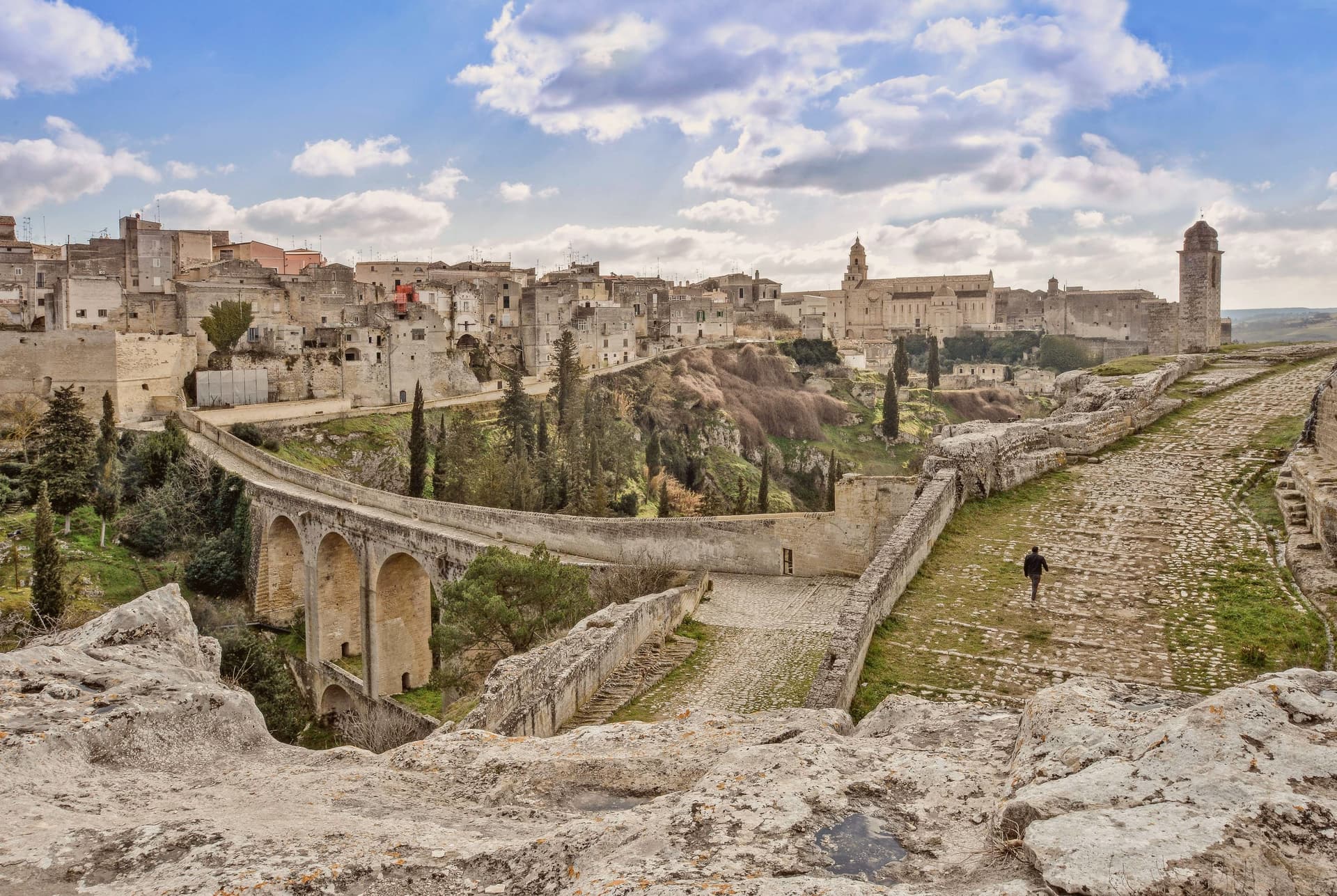
Gravina sits within the gravine, the network of limestone canyons cut across the Bari-Matera-Taranto karst plateau, the same geological system that produced Matera's Sassi 30 km west. This canyon is the deepest of them: 100m down, 350m wide at its narrowest, running straight through the centre of the modern town.
The plateau above holds the current population of 42,703; the old town clings to the cliff edge, its houses stacked against the same rock that the canyon walls below carry as a run of rupestrian churches and sanctuaries hollowed straight from the stone. The defining crossing of the two halves is the aqueduct bridge, built in the 18th century to bring water from the Murgia springs into the city and still walkable as a pedestrian route at 37m above the gorge floor.
On the canyon walls below it: a sanctuary carved into the rock, a church reached by a vertical stair and cut entirely into the cliff face, and a crypt complex holding frescoes from the 10th to 12th centuries, Byzantine work surviving in the dark of the rupestrian chambers. Above, on the plateau, the medieval centro takes over: the Cattedrale di Santa Maria Assunta, Romanesque and founded in 1092, holding its own Byzantine icon of the Madonna delle Grazie; the Castello Svevo rebuilt by Federico II; the Fondazione Ettore Pomarici Santomasi with its archaeological and Renaissance collections.
Gravina holds the Borghi più belli d'Italia designation together with Cittaslow, and lies on the Via Francigena, the branch tracing the old Via Appia route south, as well as bordering the Parco Nazionale dell'Alta Murgia, the karst plateau protected as national park immediately to the north. The food follows the same Murgia-Puglian line as the landscape: focaccia barese, orecchiette with cime di rapa, capocollo di Martina Franca, Primitivo di Manduria and the local Murgia DOC reds, built around the Festa di San Michele Arcangelo each September and the Carnevale Gravinese in late winter.
What Gravina adds up to is a town whose deepest cut in the earth doubles as its main street: canyon below carrying the sacred and the ancient, plateau above carrying the civic and the everyday, the two halves joined by a bridge built for water and now crossed for its own sake.
We confirmed you can reach this one by train.
What to see in Gravina in Puglia
- Ponte Acquedotto (Bond's bridge). Crosses the gorge at 37m height on 18th-c stonework, a walkable pedestrian route today. This is the crossing James Bond takes by motorbike in the Matera chase sequence of No Time to Die.
- Chiesa di San Michele delle Grotte. A church carved entirely into the rock cliff of the gravina, reached by a vertical stair. The most striking of the canyon's rupestrian churches.
- Castello Svevo + Cattedrale. The castle sits on the plateau beside the Romanesque cathedral, founded 1092, which holds the Byzantine Madonna delle Grazie icon.
How to get to Gravina in Puglia
There is a railway station in the town, so you can arrive without a car and never need one while you are here. Bari is roughly 68 minutes away by road.
Our tip
Gravina in Puglia is best March–June and September–October — the Murgia summer is brutally hot (38°C+ inland) and the gorge becomes an oven. The Festa di San Michele Arcangelo 28-29 September is the year's headline. February-March brings the Carnevale Gravinese. Historia falls in September.
More from Anywhere Italy
 The best hill towns you can reach by train within 90 minutes of Bari
- The best olive oil towns in the province of Bari
- The best cheese towns within two hours of Lecce
- The best cheese towns within 45 minutes of Bari
- The best hidden olive oil towns you can reach by train in Puglia
 The 10 best hill towns with a serious restaurant in Puglia