
The best small towns with a food festival in Abruzzo
Abruzzo eats in a way that sounds austere and tastes like the opposite. Lentils grown on high plateaux, saffron threads picked by hand in October, mutton stewed slowly with wild herbs, pecorino from flocks that still move up the mountain in summer, arrosticini turned over long charcoal troughs until the fat crackles. The villages sit in limestone and river stone, low and heavy against winter, with vaulted passageways and stone lintels worn round at the edges. From late August into November the sagre come one after another, each built around a single ingredient rather than a general idea of food, and the cooking happens in the street on trestle tables and gas rings.
The crowds go to the coast in July, to Pescara and the long flat beaches south of it, or inland to the Gran Sasso viewpoints and Campo Imperatore, where the car parks fill early and the same panorama photograph is taken several thousand times a day. Rocca Calascio draws coaches up a road not built for them. None of this is a mistake, the mountain really is that big and the sea really is that warm, but August in Abruzzo's best-known places is a queue with a view attached.
The lentil fields, the saffron plots and the sheep tracks carry on well past the famous overlooks, into the Marsica, the Aterno valley and the vine terraces near the Tronto. The towns here are small enough that the festival is run by the village rather than for visitors, and the pot on the fire belongs to somebody's neighbour. Fewer people come, which mostly means the tables are longer and the prices have not moved much. Worth a detour, and worth checking the date before you set off, because these things happen once a year and then stop.
Of the 73 communes we have mapped in Abruzzo, 11 qualify as towns with a food festival: each holds a recurring food festival built around one local ingredient. This list is the small ones, 6 in all, ordered smallest first. The smallest, Santo Stefano di Sessanio, has 114 residents.
Two more lists worth reading alongside this one: The 9 best small mountain towns you can reach by train in the province of L'Aquila and The prettiest small villages inside a national park in Abruzzo.
Santo Stefano di Sessanio
Why visit Santo Stefano di Sessanio
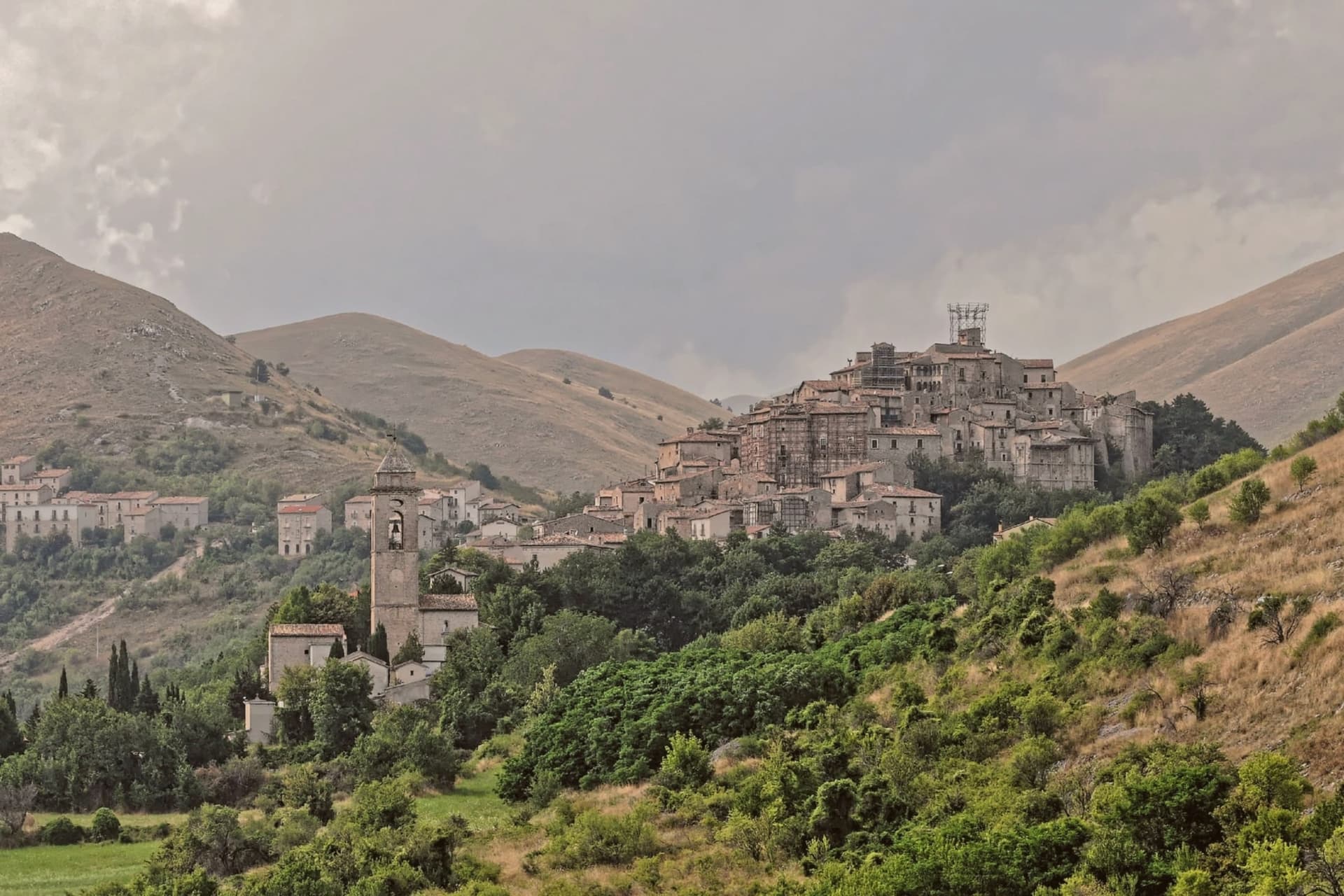
One hundred and fourteen people live in the commune, on the southern rim of the plateau inside the Gran Sasso e Monti della Laga National Park. The village belonged to the Medici from 1579 to 1743, who ran the saffron and wool trades that gave the place its early wealth and left their mark in the gate and the tower built under their rule.
By the late twentieth century most of the houses stood empty. In 1999 the Italian-Swedish entrepreneur Daniele Kihlgren began buying the ruined buildings, one at a time, restoring them rather than replacing them, which is why the stone, the lime plaster, and the timber inside are original.
The upper village and its scattered rooms are the direct result of that decision: there was no single building large enough to house a hotel, so the hotel became the village itself. What Santo Stefano offers now is that reversal, a settlement nearly emptied by the late twentieth century, rebuilt not by adding to it but by restoring what was already there, house by house, and still being rebuilt today in the tower rising again on its old footprint.
What to see in Santo Stefano di Sessanio
- Torre Medicea (ruderi). The tower's stump stands on its original footprint, scaffolded, the reconstruction visible in progress against the rest of the village skyline.
- Borgo medievale e Sextantio. Rooms are scattered through the restored houses of the village rather than gathered under one roof, so staying here means walking the lanes between stone walls and timber to reach them.
- Palazzo delle Logge. A Renaissance loggia looks over the village square and the gate built under the same Florentine administration, its arches the clearest surviving mark of that rule.
How to get to Santo Stefano di Sessanio
Pescara is roughly 109 minutes away by road.
Our tip
June through September is the high season for Santo Stefano. Days at 1,250 meters rarely cross twenty-five degrees, the wool and lentil fields on Campo Imperatore turn green and gold, and the trails up to the plateau are open. December through March brings snow, the Campo Imperatore plateau is one of the cross-country ski centers of the central Apennines, and the Sextantio rooms hold their candle-lit appeal best on long winter evenings. Lentil Festival falls in September.
Castel del Monte
Why visit Castel del Monte
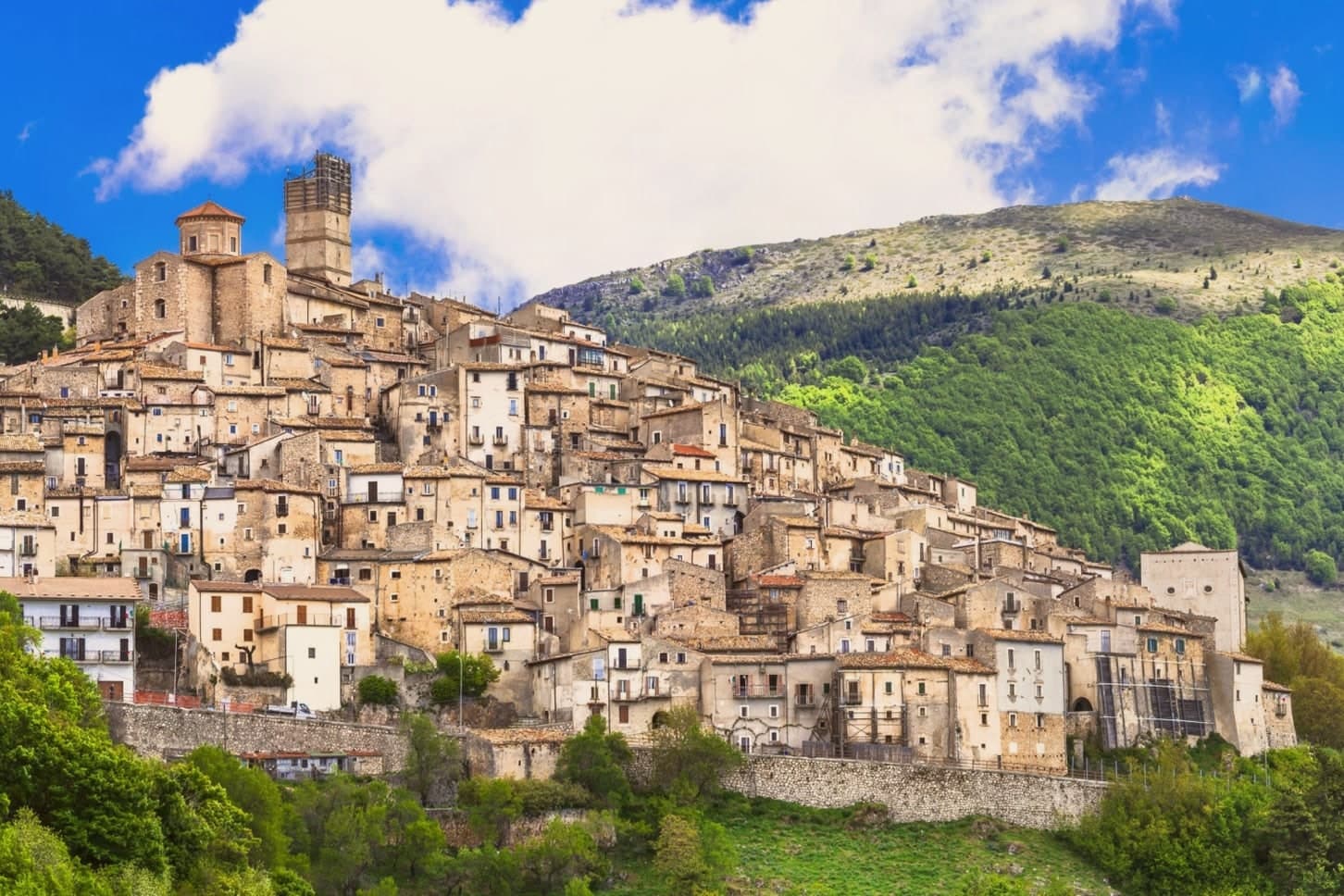
The village sits in the Gran Sasso e Monti della Laga National Park, on the southern slope of Monte Bolza, with Rocca Calascio facing it across the valley and Campo Imperatore stretching north. It descends from the pre-Roman Vestini; finds from an 11th-century BC necropolis lie in the valley below, long before any wool trade or Medici buyer arrived.
The upper village, its stone core threaded with tunnels and vaulted passages, once housed the shepherds who drove flocks south to Puglia and returned to a cluster of churches built for their safekeeping and their thanks. That world ended in the 1850s, and the population emptied with it: 431 people remain where a wool trade once drew merchants from the Medici's own city.
What is left is performed rather than lived at scale, in the symbolic transhumance and in the August gathering that briefly fills the same streets and tunnels the shepherds once used. The place now runs on memory of the trade that built it, kept alive one night a year and in a cheese still made from spring pastures.
What to see in Castel del Monte
- Chiesa Matrice di San Marco. Baroque interior; holds the patron-saint statue carried through the village in the August procession.
- Chiesa di San Donato Fuori le Mura. Romanesque church just outside the medieval walls, among the oldest religious buildings in the village, with a small square in front used for festivals.
- Chiesa della Madonna del Suffragio (dei Pastori). Devotional centre of the transhumance, hung with ex-votos left by herders for safe return from Puglia.
How to get to Castel del Monte
Pescara is roughly 90 minutes away by road.
Our tip
June through September is when Castel del Monte runs at full strength. Campo Imperatore opens for hiking, the Canestrato cheese makers receive visitors, and La Notte delle Streghe in mid-August packs every alley with thousands of people. December through March is the second season for skiers heading to Campo Imperatore and Prati di Tivo, with the village in deep snow. Rassegna degli Ovini di Campo Imperatore falls in August.
Goriano Sicoli
Why visit Goriano Sicoli
Goriano Sicoli sits in the eastern Marsica between L'Aquila and the Adriatic. Italian documents reference the village from 816, though local tradition claims a Roman foundation.
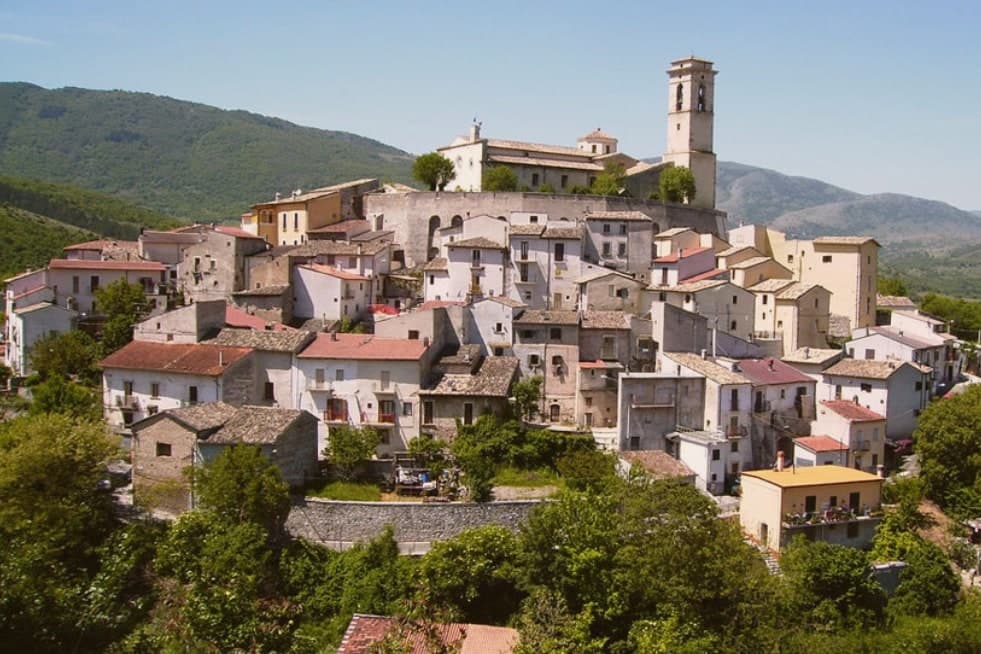
Population is about 511 and falling. The village is built on a slope, its stone houses climbing from the valley floor toward the ridge, with the piazza and its fountain as the fixed point where the streets converge and the town's social life gathers.
Below and around it, the Subequana valley opens into agricultural land and pasture running between Sulmona and L'Aquila, with Sirente rising over the eastern Marsica. The village survives on its position rather than its size: the Terni-Sulmona railway runs through it, the A25 autostrada is twenty minutes away, and Pescara is within an hour.
A place this small, sitting on a rail line and near a motorway between two larger cities, has stayed inhabited by being passed through rather than sought out, which is also how a printmaker's sketch and a Greek-Cretan agrarian myth both ended up attached to it.
What to see in Goriano Sicoli
- Santuario di Santa Gemma. Sanctuary that holds the annual ritual, the busiest fixed point on the village calendar and the reason the piazza and streets around it fill each May.
- Piazza della Fontana. Central piazza, the social heart of the village, built around the stone fountain.
- Borgo medievale. Stone village climbing the slope, the same view drawn by M.C. Escher in a print now in the National Gallery of Art.
How to get to Goriano Sicoli
There is a railway station in the town, so you can arrive without a car and never need one while you are here. Pescara is roughly 68 minutes away by road.
Our tip
May through October is the active window. The Santa Gemma feast falls in early May and is the moment the village fills, with returning emigrants and locals from neighboring villages walking the streets all day. June, September and early October are the cleanest months for walking: cool mornings, long evenings, and the Subequana valley still green. Tartufo della Valle Subequana falls in the season.
Sante Marie
Why visit Sante Marie
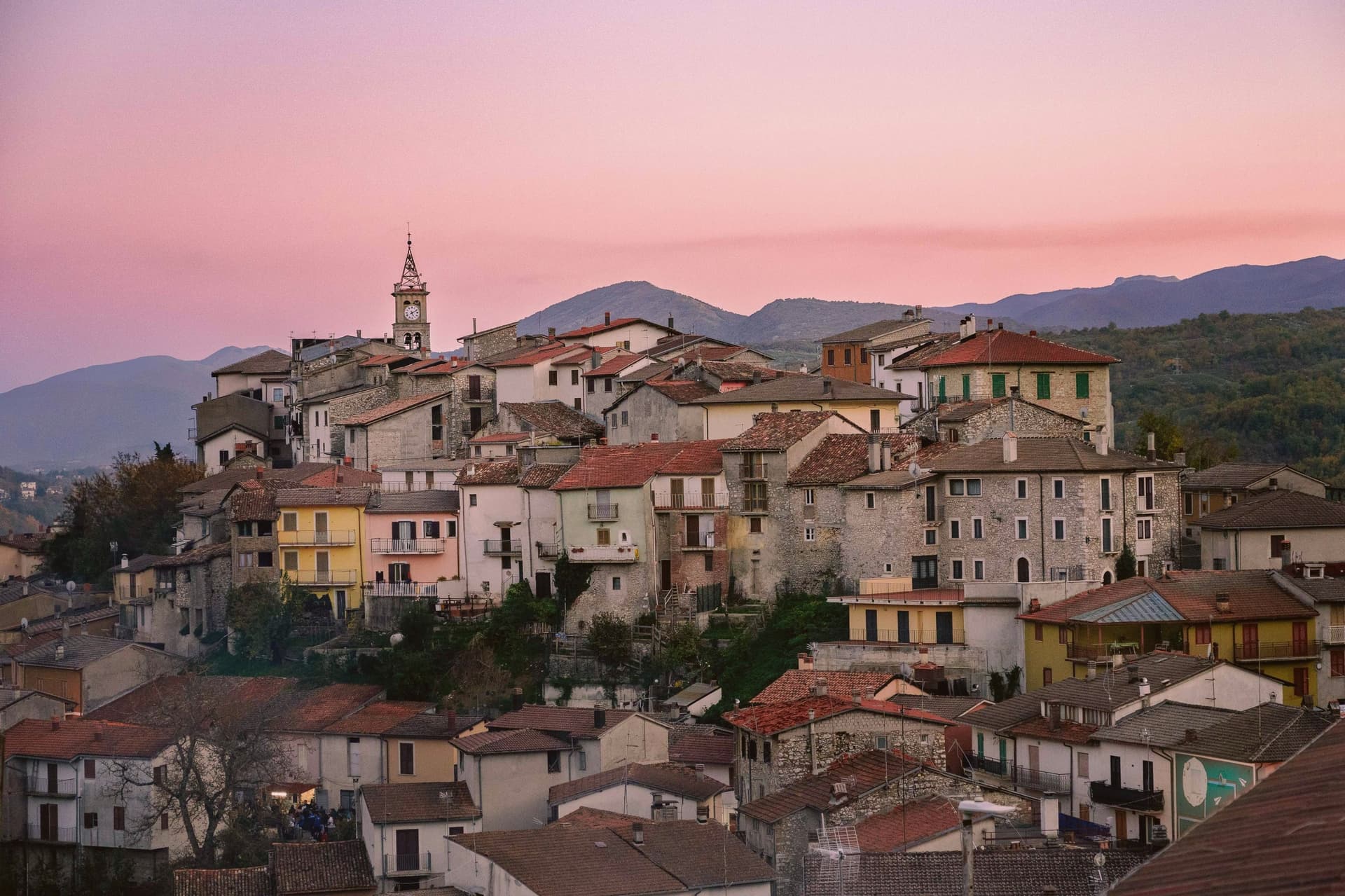
Sante Marie sits at 950 meters in the western Marsica, at the border between L'Aquila and Rieti provinces. The town is the capoluogo of six fractions scattered through the hills: Scanzano, Castelvecchio, Val dei Varri, Santo Stefano, Tubione, and San Giovanni.
Its medieval history runs with the Fief of Tagliacozzo, held in turn by the Counts of Marsi, the De Pontibus, the Orsini and finally the Colonna. The Grotte di Luppa Reserve, established in 2005, sits in the surrounding karst country of the Simbruini and Carseolani mountains.
The town is best known now as the starting point of the Cammino dei Briganti, a seven-day circular trail at altitudes between 800 and 1,300 meters that follows the routes of the Cartore brigands, the post-Risorgimento bands who used these forests as cover. Walkers pick up a safe-conduct pass at the reserve office in the village before setting out.
What to see in Sante Marie
- Cammino dei Briganti. Seven-day circular hiking trail at 800 to 1,300 meters along the routes of the Cartore brigands, starting from Sante Marie.
- Riserva Naturale Grotte di Luppa. Karst reserve established in 2005 protecting caves and Apennine landscape on the Simbruini and Carseolani mountains border.
- Centro storico. Medieval hill village above the modern lower town, the historic core of the Tagliacozzo fief held by Marsi, Orsini and Colonna.
How to get to Sante Marie
There is a railway station in the town, so you can arrive without a car and never need one while you are here. Roma is roughly 68 minutes away by road.
Our tip
May through October is the hiking window. Late May and early June bring the slopes into bloom and the Cammino dei Briganti at its best, with cool morning starts and 1,300-meter ridge crossings still open. September and October dry out the trail and turn the chestnut woods gold. Sagra del Porcino falls in August.
Controguerra
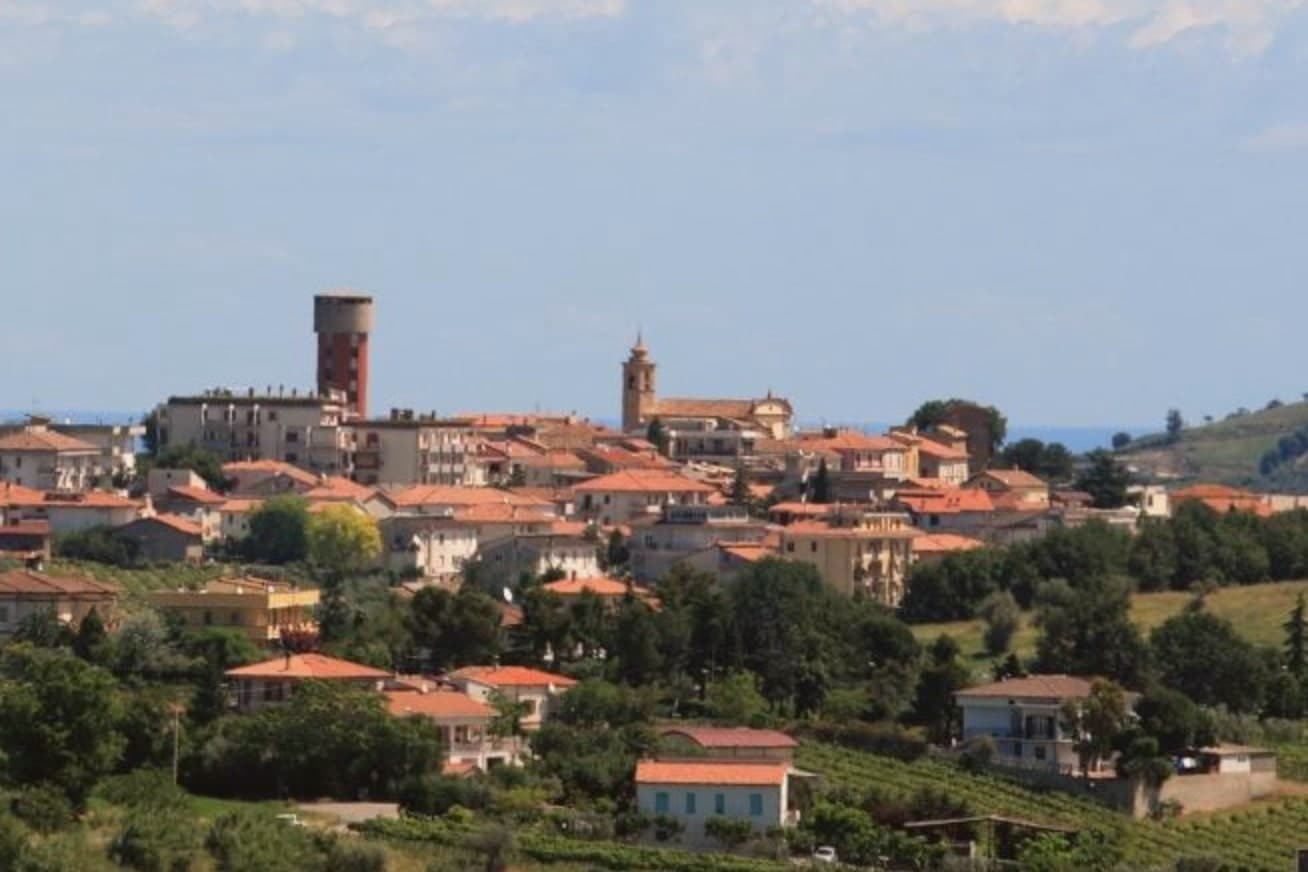
Why visit Controguerra
The village sits fifteen kilometers from the Adriatic, at the northern edge of Abruzzo, where the valley bends toward the river and the sea. The wine zone that carries the town's name reaches beyond it, spread across five communes sharing the same elbow of land between river and coast.
The reds run at least sixty percent Montepulciano, with Merlot, Cabernet Franc and Cabernet Sauvignon allowed up to fifteen percent; the whites are sixty percent Trebbiano with at least fifteen percent Passerina; the spumante sets Trebbiano against Chardonnay, Verdicchio and Pecorino. The old center holds to its ridge above the valley while the vines and olive groves that support both the wine and oil designations spread on the slopes below, the same ground doing double duty.
The place works because the name on the bottle and the name on the map are the same thing, a small hilltop settlement whose slow-food charter governs an area small enough that vineyard and piazza are never far apart.
What to see in Controguerra
- Centro storico. Small hilltop medieval centre on a ridge above the valley, with brick palazzi and the parish church on the central piazza.
- Chiesa di San Salvatore. Parish church on the main piazza, the religious anchor of the medieval ridge village, with a rebuilt eighteenth-century interior.
- Cantine del Controguerra DOC. Family cellars open by appointment, pouring Montepulciano-based reds, Trebbiano-Passerina whites and Pecorino spumante from the same slopes the town gives its name to.
How to get to Controguerra
There is a railway station in the town, so you can arrive without a car and never need one while you are here. Pescara is roughly 56 minutes away by road.
Our tip
April through October is the working season for vineyards and oil. May and September are the best months for cellar visits, with mild light and the vineyards in full leaf. July and August can climb into the mid-thirties and the centro empties through the hot afternoon. Controguerra in festa falls in July.
Scurcola Marsicana
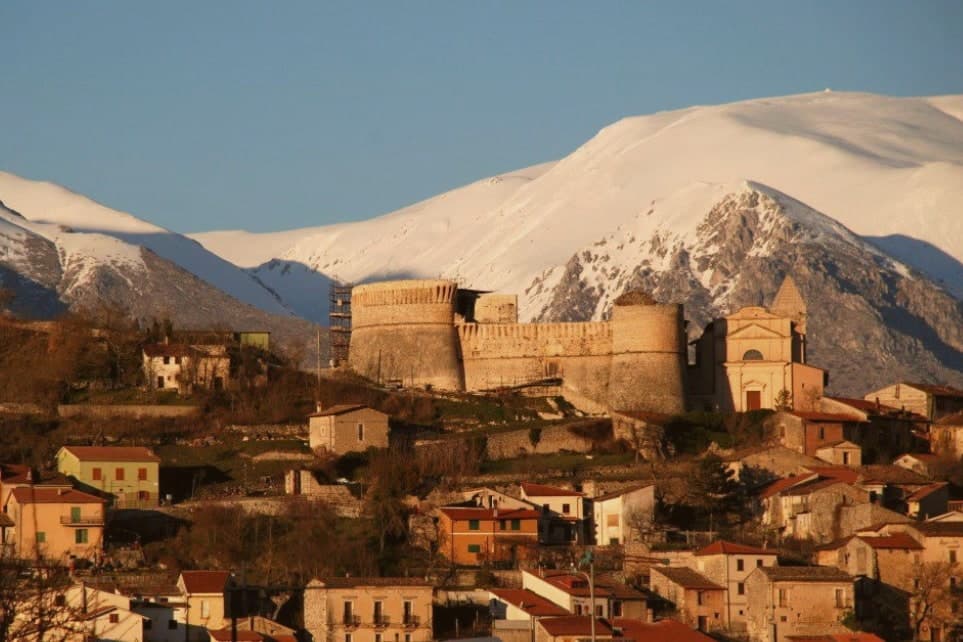
Why visit Scurcola Marsicana
Scurcola Marsicana sits on the western rim of what was once the Fucine lake. The earliest finds in the area date to the ninth and eighth centuries BC; the toponym is Lombard and shows up around 1150, long before the events that made the place known.
The village and its castle sit on the hill, the abbey and the battlefield lie on the plain below, and the mountain rises behind the whole arrangement: high ground, open ground, and the ruin that commemorates what happened on the open ground, all within sight of one another on the plain. The other layer of history is darker: after Italian unification in 1861, Piedmontese troops carried out a massacre of the local population.
The commune has 2,670 residents today, and the Festone every August reenacts the Madonna della Vittoria tradition. A small town, then, built around a plain that settled a dynastic war, with a second, more recent violence folded into the same small territory without any monument to answer it.
What to see in Scurcola Marsicana
- Ex Abbazia di Santa Maria della Vittoria. Now ruined but still readable: broken walls and arches standing in the open plain, the clearest physical trace left of the 1268 victory and the monks who once held the site.
- Castello Orsini. Medieval fortress on the hill above the village, later passed to the Colonna family with the rest of the marquisate.
- Piani Palentini. The wide plain stretches flat in front of the village, open ground with little to break the sightline, the kind of terrain that explains why an army would meet another here rather than in the hills.
How to get to Scurcola Marsicana
There is a railway station in the town, so you can arrive without a car and never need one while you are here. Roma is roughly 71 minutes away by road.
Our tip
May through October is the working window on the Marsica plateau. The Piani Palentini and Monte San Nicola open to walkers, the August Festone fills the streets with the Madonna della Vittoria procession, and the air at 700 meters stays cool through summer. June and September are the cleanest months for the battlefield walk and the abbey ruins. Sagra della Coda alla Vaccinara falls in August.
More from Anywhere Italy
 The 9 best small mountain towns you can reach by train in the province of L'Aquila
- The prettiest small villages inside a national park in Abruzzo
- The 6 best hill towns with a food festival in Abruzzo
- The 10 prettiest small villages in the province of L'Aquila
 The best small hill towns you can reach by train in Abruzzo
 The best hidden mountain towns within 90 minutes of Roma