
The 10 prettiest small villages in the province of L'Aquila
The province of L'Aquila is built out of pale limestone, quarried close to where it was laid, so whole villages read as one continuous grey-gold wall broken by arches, outside staircases and wooden shutters. This is the highest, coldest part of the Apennines: beech woods on the slopes, sheep tracks running up to bare summer pasture, snow lying on the Maiella and the Gran Sasso well into spring. The cooking follows the altitude, mutton and lamb slow-cooked with wild herbs, saffron grown on the Navelli plain, pecorino, lentils from the high fields, red garlic from Sulmona, and confetti sugared almonds sold from shops that have made them for generations. Autumn is the season of transhumance festivals and chestnuts, winter of empty squares and woodsmoke, and late spring of wildflowers on the karst plateaus.
Most visitors come for the mountains themselves rather than the villages under them. Campo Imperatore, the vast high plain often called Italy's Little Tibet, absorbs coach parties, cyclists and skiers, and the road up from Assergi fills every clear weekend in August. Roccaraso, over on the Alto Sangro side, does the same in ski season, when its lifts and hotel blocks take the bulk of the region's winter traffic. Both are worth the drive. Neither tells you much about how people actually lived up here, because both were made for arriving and leaving.
The same limestone, the same pastures and the same kitchen carry on past the ski roads, into the valleys of the Sagittario, the Tirino and the Peligna, and that is where these villages sit. They are small, most of them walled or gated, many with a castle or a stretch of medieval tower still standing, and each has passed the assessment of the national association of Italy's most beautiful villages. Fewer people go, partly because they need a car and a little patience on switchbacks, partly because they are not on the way to anything. They repay the detour with saffron fields, gorge-side lakes, wool-trade churches and squares where the shepherd economy is still legible in the architecture.
Of the 42 communes we have mapped in the province of L'Aquila, 11 qualify as prettiest villages: each has passed the assessment of the national association of Italy's most beautiful villages. This list is the small ones, 10 in all, ordered smallest first. The smallest, Santo Stefano di Sessanio, has 114 residents.
If you are still choosing, we have also written The prettiest small villages inside a national park in Abruzzo and The prettiest villages inside a national park within 90 minutes of Pescara.
Santo Stefano di Sessanio
Why visit Santo Stefano di Sessanio
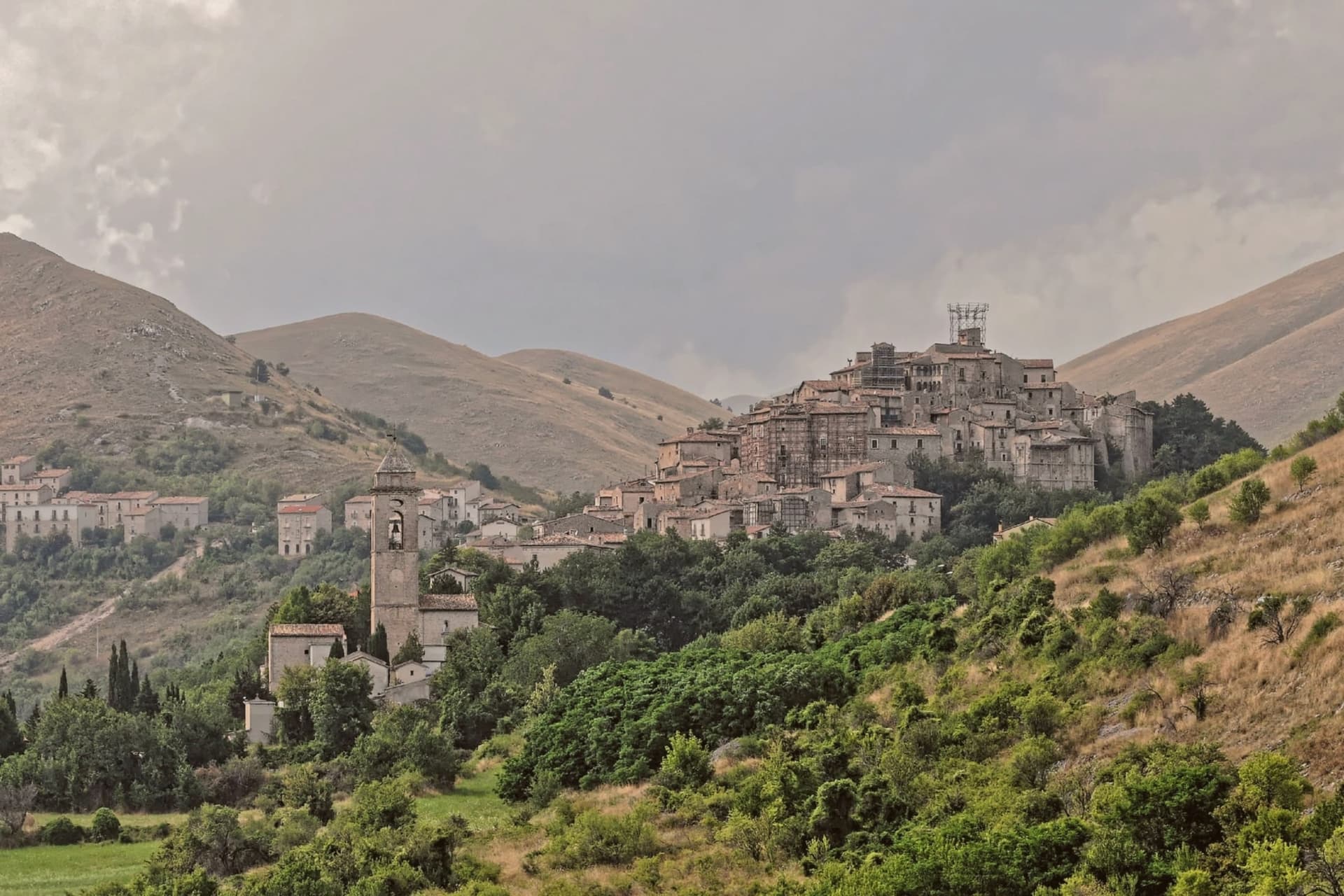
One hundred and fourteen people live in the commune, on the southern rim of the plateau inside the Gran Sasso e Monti della Laga National Park. The village belonged to the Medici from 1579 to 1743, who ran the saffron and wool trades that gave the place its early wealth and left their mark in the gate and the tower built under their rule.
By the late twentieth century most of the houses stood empty. In 1999 the Italian-Swedish entrepreneur Daniele Kihlgren began buying the ruined buildings, one at a time, restoring them rather than replacing them, which is why the stone, the lime plaster, and the timber inside are original.
The upper village and its scattered rooms are the direct result of that decision: there was no single building large enough to house a hotel, so the hotel became the village itself. What Santo Stefano offers now is that reversal, a settlement nearly emptied by the late twentieth century, rebuilt not by adding to it but by restoring what was already there, house by house, and still being rebuilt today in the tower rising again on its old footprint.
What to see in Santo Stefano di Sessanio
- Torre Medicea (ruderi). The tower's stump stands on its original footprint, scaffolded, the reconstruction visible in progress against the rest of the village skyline.
- Borgo medievale e Sextantio. Rooms are scattered through the restored houses of the village rather than gathered under one roof, so staying here means walking the lanes between stone walls and timber to reach them.
- Palazzo delle Logge. A Renaissance loggia looks over the village square and the gate built under the same Florentine administration, its arches the clearest surviving mark of that rule.
How to get to Santo Stefano di Sessanio
Pescara is roughly 109 minutes away by road.
Our tip
June through September is the high season for Santo Stefano. Days at 1,250 meters rarely cross twenty-five degrees, the wool and lentil fields on Campo Imperatore turn green and gold, and the trails up to the plateau are open. December through March brings snow, the Campo Imperatore plateau is one of the cross-country ski centers of the central Apennines, and the Sextantio rooms hold their candle-lit appeal best on long winter evenings. Lentil Festival falls in September.
Anversa degli Abruzzi
Why visit Anversa degli Abruzzi
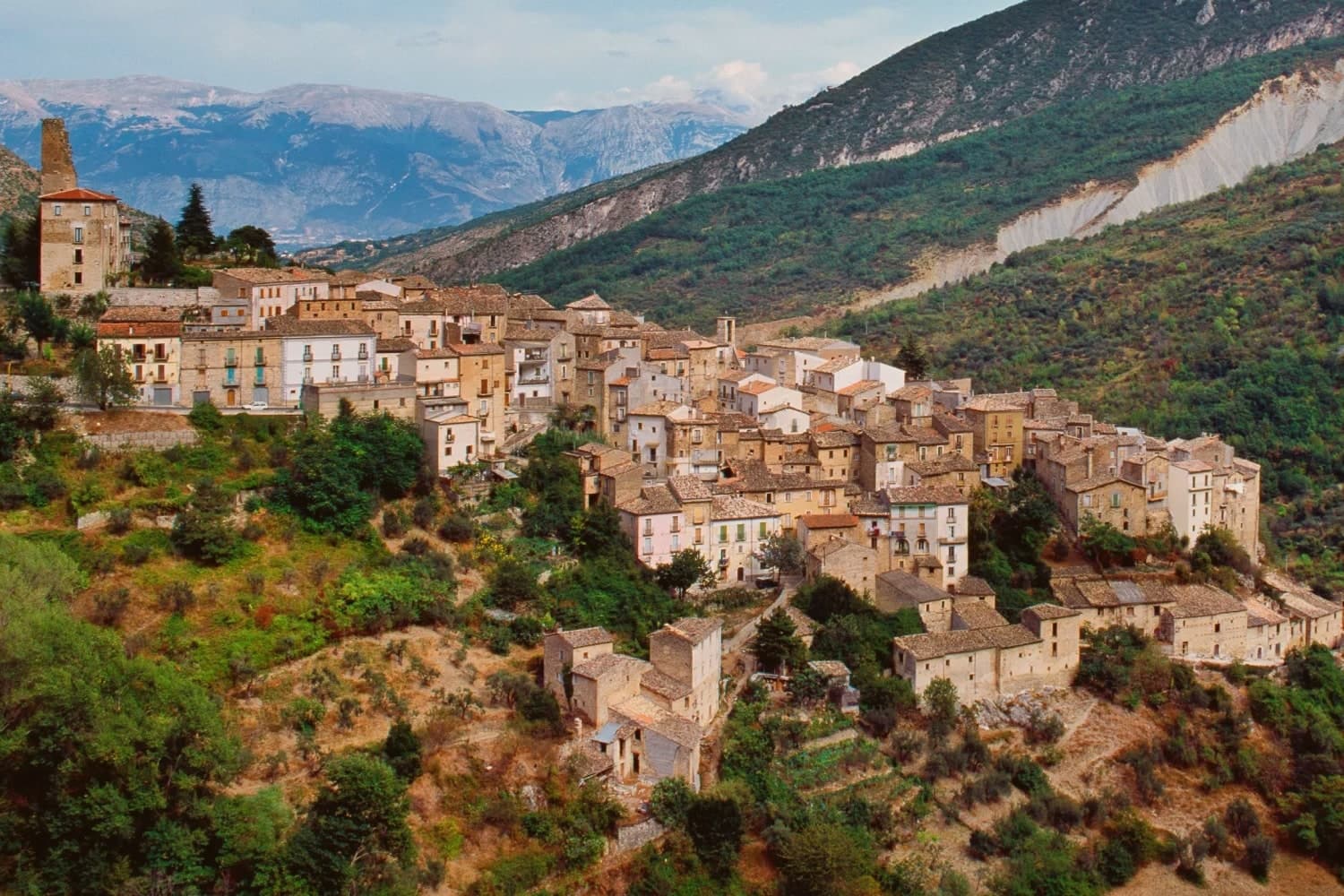
Anversa degli Abruzzi occupies a spur in the upper Sagittario valley, between the Peligna plain and the national park, with the gorges falling away directly beneath the walls. The Normans built here to hold the southern approach to the plain, and the Counts of Sangro controlled the site from the mid-1100s until the 1400s, when Antonio di Sangro gave the fortification its present form.
That same family supplied the material Gabriele D'Annunzio drew on for La Fiaccola sotto il moggio, written in the village in 1905. The borgo itself is compact: an outer ring of houses built into the cliff functions as the town wall, stone alleys thread through it on Norman-era foundations, and the church of Santa Maria delle Grazie, with its 1540 portal, sits as the principal religious building above.
Below, the 400-hectare reserve protects the limestone canyons cut by the river, sheltering wolves and Marsican bears where the village drops toward the water. Population has fallen from 1,934 in 1901 to about 300, and the ceramic tradition, the pignata and the cucù, persists as one of the few threads still tying the present village to the working town the Sangro family once ruled.
A place built for defense, held long enough to enter literature, and now sustained mainly by what it once was.
What to see in Anversa degli Abruzzi
- Castello Normanno. Rebuilt in the 15th century by Antonio di Sangro on the site of the original Norman fortification, perched on cliffs above the village.
- Gole del Sagittario. The reserve's canyons lie directly below the village walls, home to wolves, Marsican bears, dormice, hawks and owls.
- Chiesa di Santa Maria delle Grazie. Late medieval church with a Renaissance portal dated 1540, the principal religious building in the upper borgo.
How to get to Anversa degli Abruzzi
There is a railway station in the town, so you can arrive without a car and never need one while you are here. Pescara is roughly 65 minutes away by road.
Our tip
May through October is the open season for Anversa. The gorges reserve runs guided walks, the upper village stays warm enough in the evening to eat outside, and the D'Annunzio literary trail is fully marked. July and August are hot in the canyon and busy on weekends with day visitors from Pescara and Sulmona.
Castel del Monte
Why visit Castel del Monte
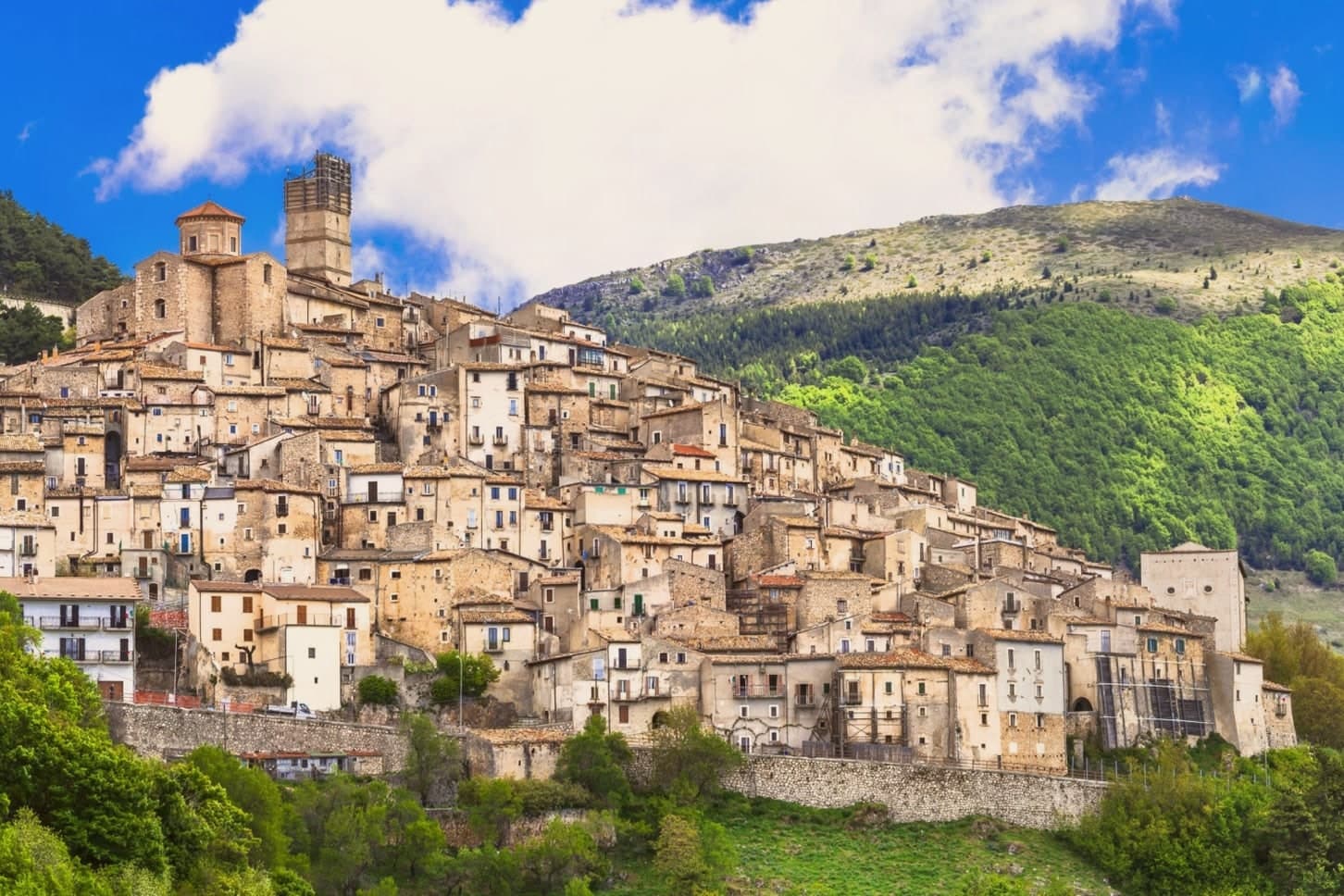
The village sits in the Gran Sasso e Monti della Laga National Park, on the southern slope of Monte Bolza, with Rocca Calascio facing it across the valley and Campo Imperatore stretching north. It descends from the pre-Roman Vestini; finds from an 11th-century BC necropolis lie in the valley below, long before any wool trade or Medici buyer arrived.
The upper village, its stone core threaded with tunnels and vaulted passages, once housed the shepherds who drove flocks south to Puglia and returned to a cluster of churches built for their safekeeping and their thanks. That world ended in the 1850s, and the population emptied with it: 431 people remain where a wool trade once drew merchants from the Medici's own city.
What is left is performed rather than lived at scale, in the symbolic transhumance and in the August gathering that briefly fills the same streets and tunnels the shepherds once used. The place now runs on memory of the trade that built it, kept alive one night a year and in a cheese still made from spring pastures.
What to see in Castel del Monte
- Chiesa Matrice di San Marco. Baroque interior; holds the patron-saint statue carried through the village in the August procession.
- Chiesa di San Donato Fuori le Mura. Romanesque church just outside the medieval walls, among the oldest religious buildings in the village, with a small square in front used for festivals.
- Chiesa della Madonna del Suffragio (dei Pastori). Devotional centre of the transhumance, hung with ex-votos left by herders for safe return from Puglia.
How to get to Castel del Monte
Pescara is roughly 90 minutes away by road.
Our tip
June through September is when Castel del Monte runs at full strength. Campo Imperatore opens for hiking, the Canestrato cheese makers receive visitors, and La Notte delle Streghe in mid-August packs every alley with thousands of people. December through March is the second season for skiers heading to Campo Imperatore and Prati di Tivo, with the village in deep snow. Rassegna degli Ovini di Campo Imperatore falls in August.
Villalago
Why visit Villalago
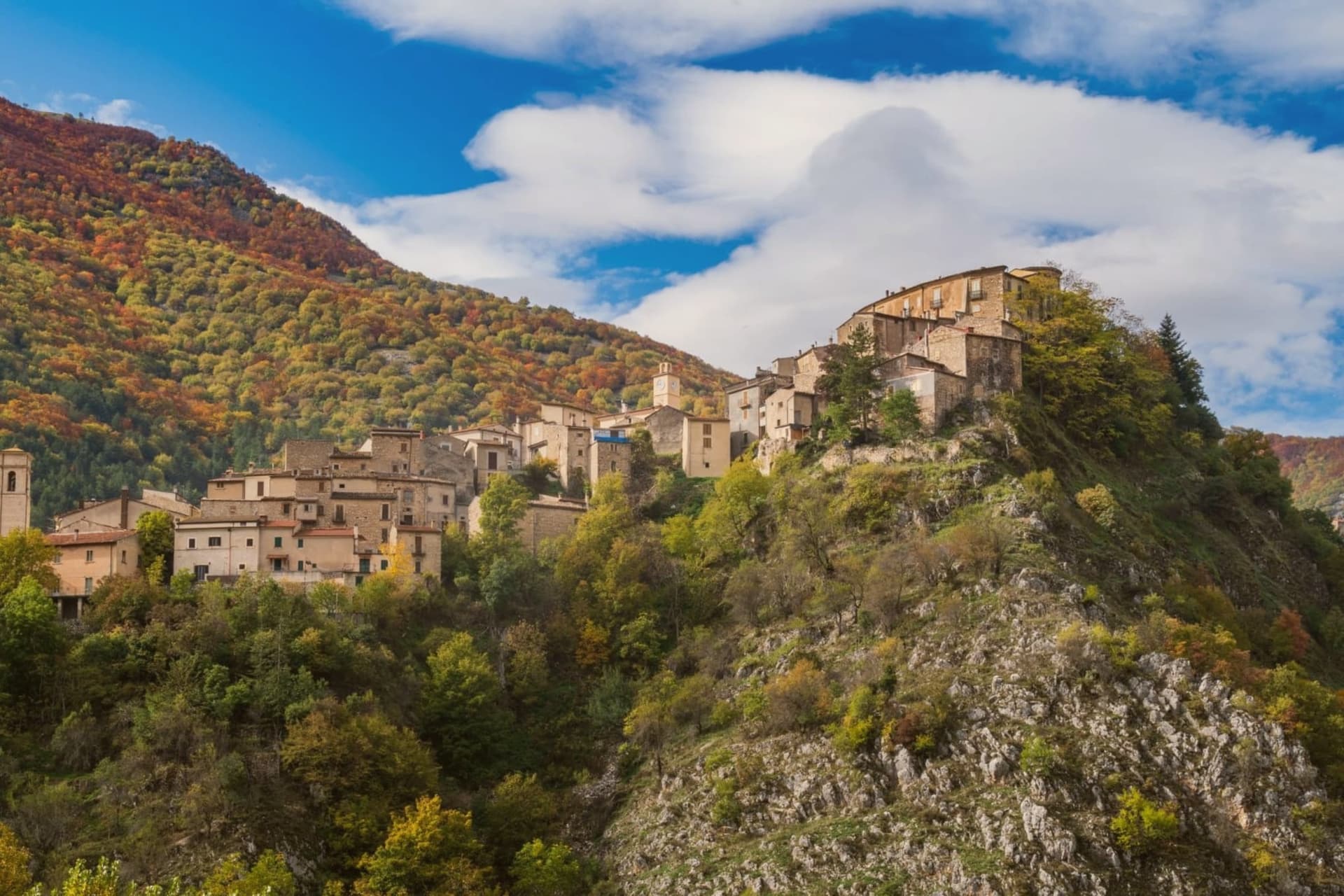
Villalago sits at 930 meters in the Sagittario valley between Scanno and Anversa degli Abruzzi, inside the Parco Nazionale d'Abruzzo, Lazio e Molise. The name comes from the vulgar Latin valle de lacu, the valley of the lake, a reference to the nine natural lakes once present in the territory, most now gone.
Three remain: Lago Pio for swimming, Lago di Scanno to the south with its famous heart shape, and Lago di San Domenico to the north, the artificial reservoir completed in 1929 by the State Railways to electrify the Rome-Sulmona line. On the lake's edge stands the Eremo di San Domenico, a small church built into a cave where, around the year 1000, the Benedictine monk Domenico di Sora lived.
The actual chapel went up in the 1400s, the portico in the 1600s. The parish church holds an altar to the saint carved in stone in the 12th century.
Villalago has been a Borgo dei Borghi finalist on RAI and is one of only three Bandiera Blu lake towns in Abruzzo.
What to see in Villalago
- Eremo di San Domenico. Hermitage on the lake's edge, built into a cave where Saint Dominic of Sora lived around the year 1000, with the chapel added in the 15th century.
- Lago di San Domenico. Artificial reservoir completed in 1929 to power the Rome-Sulmona railway, fed by the Sagittario gorge and held by a dam at the village's edge.
- Centro storico. Stone-built medieval core at 930 meters with the parish church preserving a 1521 Madonna del Rosario and a 12th-century stone altar to San Domenico.
How to get to Villalago
Pescara is roughly 75 minutes away by road.
Our tip
May through October is the window. The lakes warm enough for swimming from June, and the trails through the Gole del Sagittario stay clear until late October. July and August fill with Italian summer visitors but at 930 meters the air remains cool by evening.
Navelli
Why visit Navelli
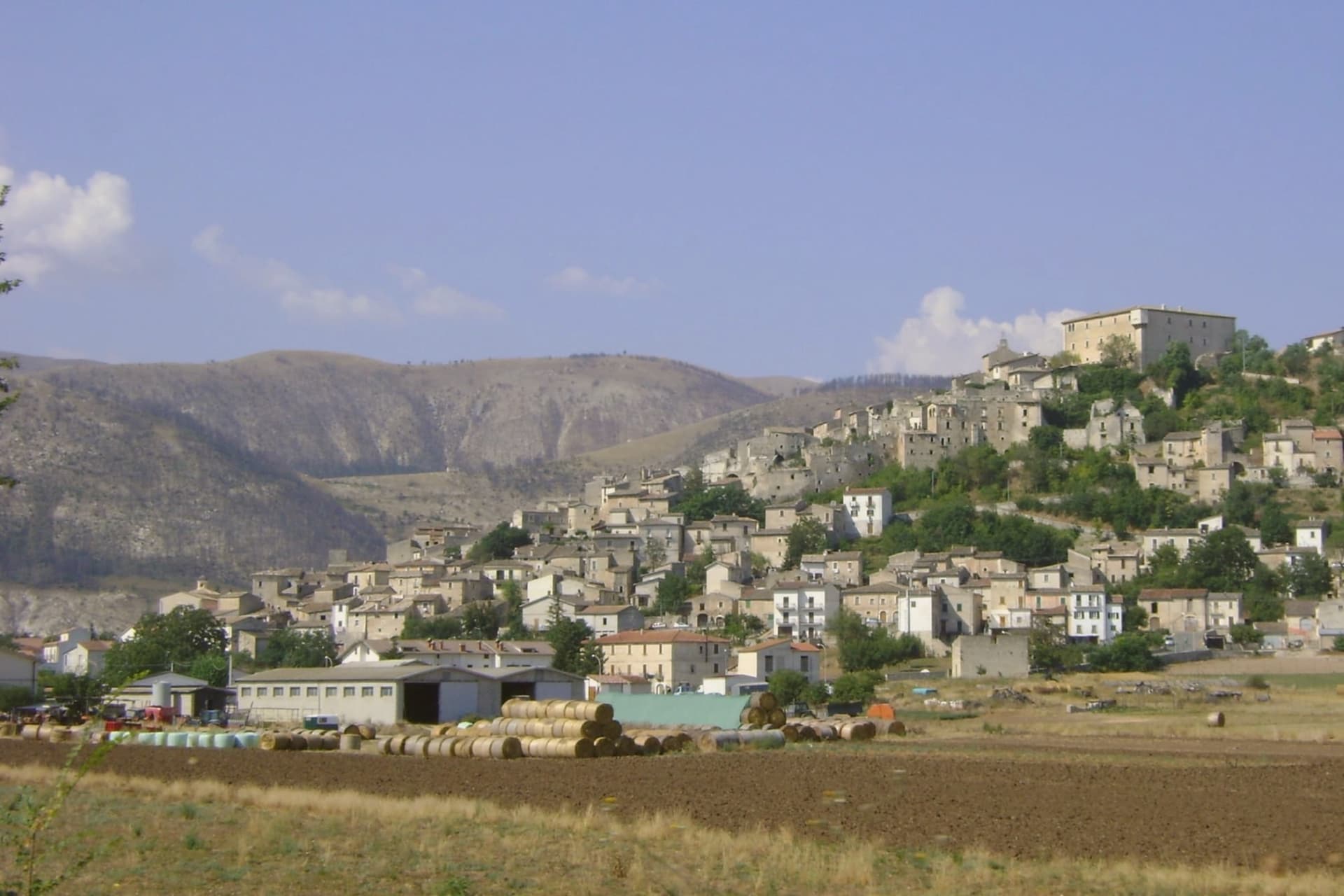
Navelli sits at 760 meters on a rocky outcrop above the Navelli plain, ranked among I Borghi più belli d'Italia. The village is built as a pyramid of houses tilted up the rock, with the most prestigious buildings at the top: Palazzo Santucci, the Chiesa di San Sebastiano, and the Chiesa di Madonna delle Grazie.
The medieval structure is almost intact. Palazzo Santucci was built in 1632 on the ruins of an 8th-10th century castle around which the original settlement clustered.
It served as residence to the feudal lords of Navelli until feudalism was abolished in 1806. The Navelli plain below produces Zafferano dell'Aquila, the DOP saffron registered in 2005, brought from Spain in the 13th century by a Dominican friar from the local Santucci family.
The karst nature of the plain prevents water stagnation and gives the saffron its quality. Production is concentrated around Navelli and surrounding communes.
Population is 537.
What to see in Navelli
- Palazzo Santucci. Renaissance fortified palace built 1632 on a pre-existing 8th-10th century castle, residence of the feudal lords until 1806.
- Chiesa di San Sebastiano. Upper church in the highest part of the village, alongside Palazzo Santucci on the rocky summit of the pyramid.
- Chiesa di Madonna delle Grazie. Second upper church on the village summit, part of the medieval religious core preserved almost intact.
How to get to Navelli
Pescara is roughly 60 minutes away by road.
Our tip
May through October is the strong stretch. The saffron harvest falls in late October, three weeks of hand-picking by Navelli families and the small consortium of nearby producers. June through September is when the village runs at full visiting pace, with the Palazzo Santucci open and the upper churches accessible.
Pescocostanzo
Why visit Pescocostanzo
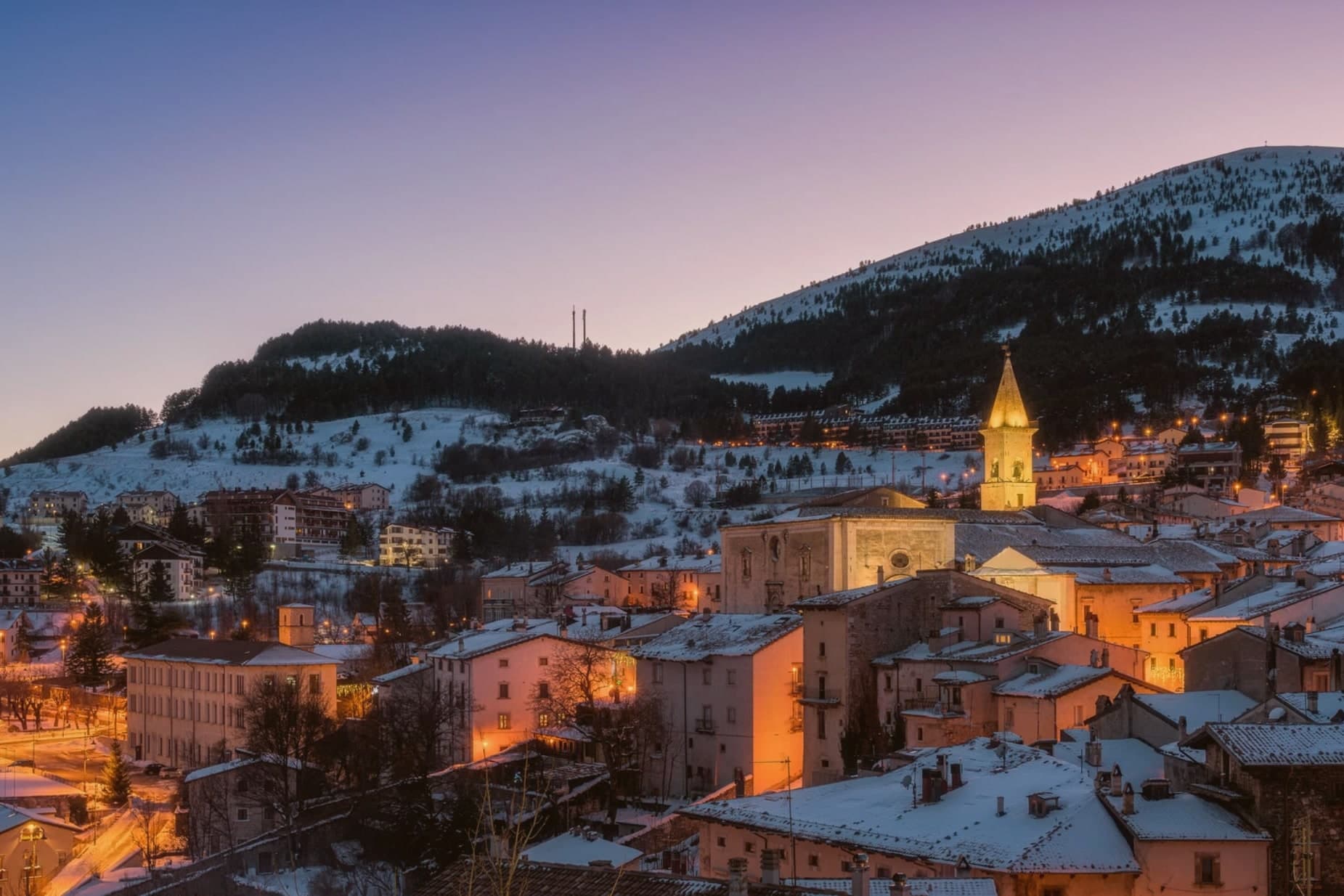
Pescocostanzo sits at 1,395 meters at the southern edge of the Quarto Grande plateau, the high karst basin above the Sangro valley. The town was reshaped between 1456 and the eighteenth century under the Capua family and a generation of Lombard masons who arrived to build for them.
The plan is unusually regular for a mountain commune: a grid of stone houses oriented to the wind, surrounded by woods and pasture. The Collegiata di Santa Maria del Colle, restructured by Cosimo Fanzago in the seventeenth century, is one of the rare five-nave churches in Abruzzo.
Its wrought iron Chapel of the Sacrament gate, made by Sante di Rocco between 1699 and 1707, is the masterpiece of local ironwork. Bobbin lace, merletto al tombolo, is still made here.
The Museo del Merletto a Tombolo inside Palazzo Fanzago shows the technique and the patterns. Filigree gold, carved wood, and lace are still sold on the Corso Roma.
What to see in Pescocostanzo
- Collegiata di Santa Maria del Colle. Five-nave church begun in the late Middle Ages and remodeled by Cosimo Fanzago in the seventeenth century.
- Museo del Merletto a Tombolo. Inside Palazzo Fanzago, displays the local bobbin lace tradition with patterns, tools, and live demonstrations.
- Palazzo Fanzago. Designed by the baroque architect Cosimo Fanzago in 1624, the seat of the lace museum and civic offices.
How to get to Pescocostanzo
Pescara is roughly 84 minutes away by road.
Our tip
December through March brings snow and the ski season, with the Monte Calvario lifts linking to the Alto Sangro system at Roccaraso and Rivisondoli twenty minutes away. June through September is the second season. At 1,395 meters Pescocostanzo rarely crosses twenty-two degrees even in August, and the Bosco di Sant'Antonio offers beech-shaded walks.
Pacentro
Why visit Pacentro
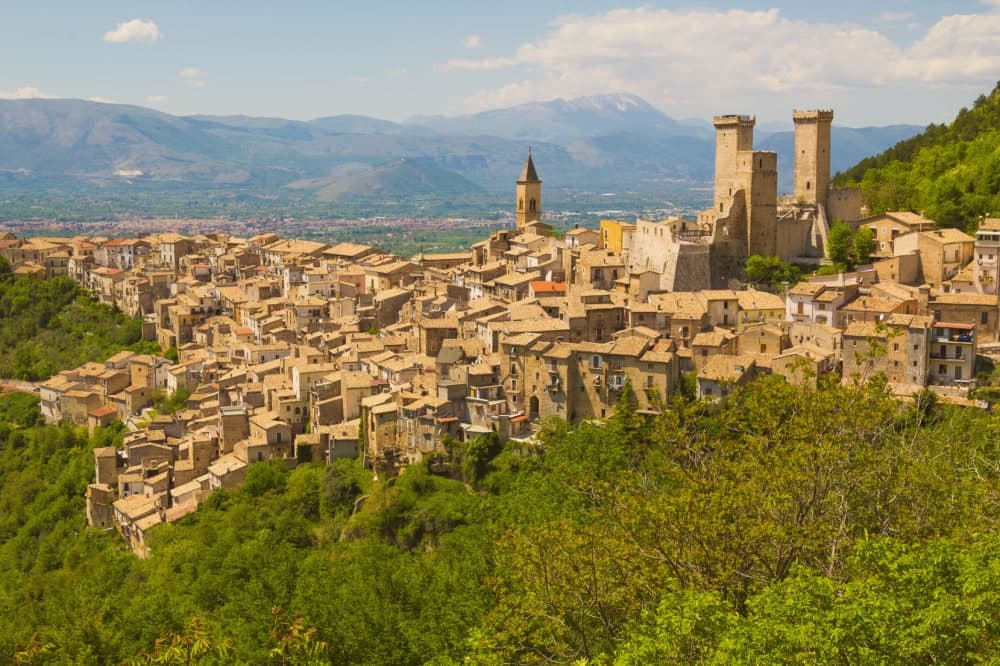
Pacentro sits at 650 meters on a hill spur in the Peligna valley, eight kilometers from Sulmona and inside the Maiella National Park. The Castello Caldora, with its three surviving square towers, dominates the village from the Colle Castello above.
The site has held a castle since the eleventh century; the structure visible today was begun by the Caldora-Cantelmo family in the late fourteenth century and bought by the comune in 1957 and restored. On the first Sunday of September, the Corsa degli Zingari sends barefoot runners down a rocky slope from Monte Ardinghi into the village in honor of the Madonna di Loreto.
The race is documented since the fifteenth century. The other thing people come for is the Ciccone house.
Madonna's paternal grandparents, Gaetano Ciccone and Michelina Di Iulio, emigrated from Pacentro in 1919. The pop singer visited in 2013.
What to see in Pacentro
- Castello Caldora-Cantelmo. Late fourteenth-century fortress on the Colle Castello, three of its four corner towers still standing, restored after 1957.
- Borgo medievale. Stone houses arranged on terraces below the castle, listed among the Borghi più belli d'Italia, preserved in its medieval plan.
- Chiesa di Santa Maria Maggiore. Sixteenth-century parish church with a baroque interior, holding the Madonna di Loreto honored in the September race.
How to get to Pacentro
Pescara is roughly 69 minutes away by road.
Our tip
May through October is when Pacentro opens. The first Sunday of September brings the Corsa degli Zingari and the biggest crowd of the year, with runners descending barefoot from Monte Ardinghi and the village in procession by evening. July and August can be warm in the valley but the elevation keeps Pacentro itself cooler than Sulmona below.
Pettorano sul Gizio
Why visit Pettorano sul Gizio
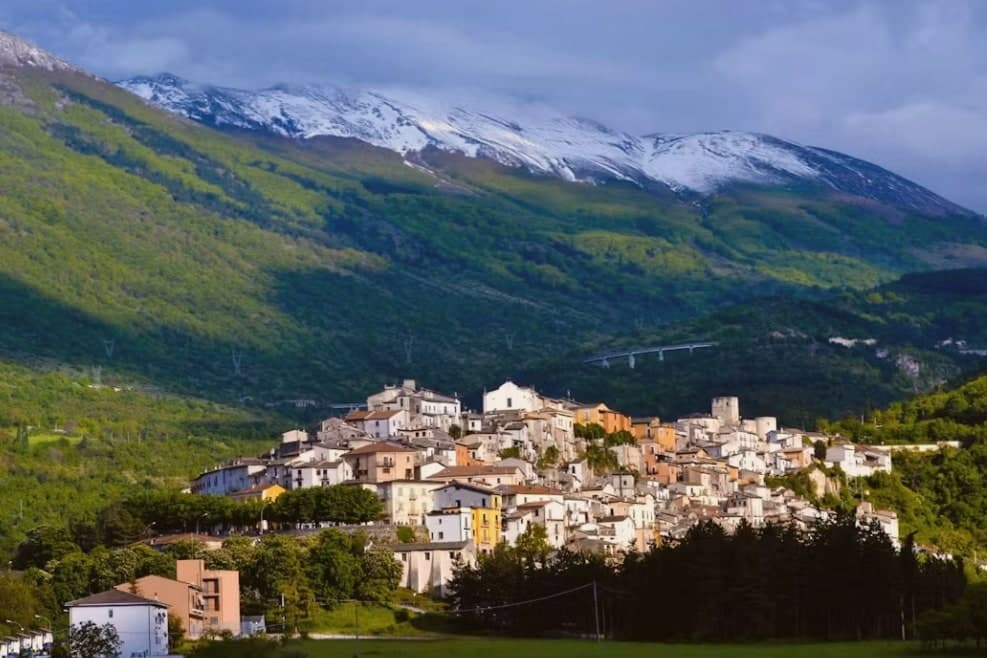
Pettorano sits at 656 meters on a hill above the Gizio river, at the southern entrance of the Valle Peligna, at the foot of the Maiella. The Castello Cantelmo, a pentagonal stone tower built in the 11th century and held by the Cantelmo family from 1310 to the mid-1700s, dominates the village from above.
The 16th and 17th centuries left palazzi behind: Palazzo Croce, Palazzo Gravina, Palazzo Vitto-Massei. The Church of San Nicola outside the walls is documented in 1112.
Today the commune sits inside the Riserva Naturale Monte Genzana, and the castle, restored between 1992 and 1998, hosts exhibitions and the reserve's visitor centre. The Marsican brown bear passes through these woods.
Pettorano is a Borghi più belli d'Italia and one of the Comuni Virtuosi, the network of municipalities that signed up to specific environmental commitments. The population has held steady around 1,300 while neighbouring villages shrank.
What to see in Pettorano sul Gizio
- Castello Cantelmo. Pentagonal 11th-century fortress above the Gizio, seat of the Cantelmo family from 1310 to the mid-18th century, restored as exhibition space.
- Chiesa di San Nicola. Small church outside the medieval walls, already documented in 1112, the oldest religious building in the commune.
- Chiesa di Sant'Antonio Abate. Patron-saint church inside the centro storico, repeatedly rebuilt after earthquakes, with traces of earlier medieval structure.
How to get to Pettorano sul Gizio
Pescara is roughly 70 minutes away by road.
Our tip
May through October is when Pettorano works best. The high valley stays cool even in August, the Monte Genzana trails are open, and the castle exhibition season runs through autumn. June and September are the most reliable, with warm days and cold evenings.
Scanno
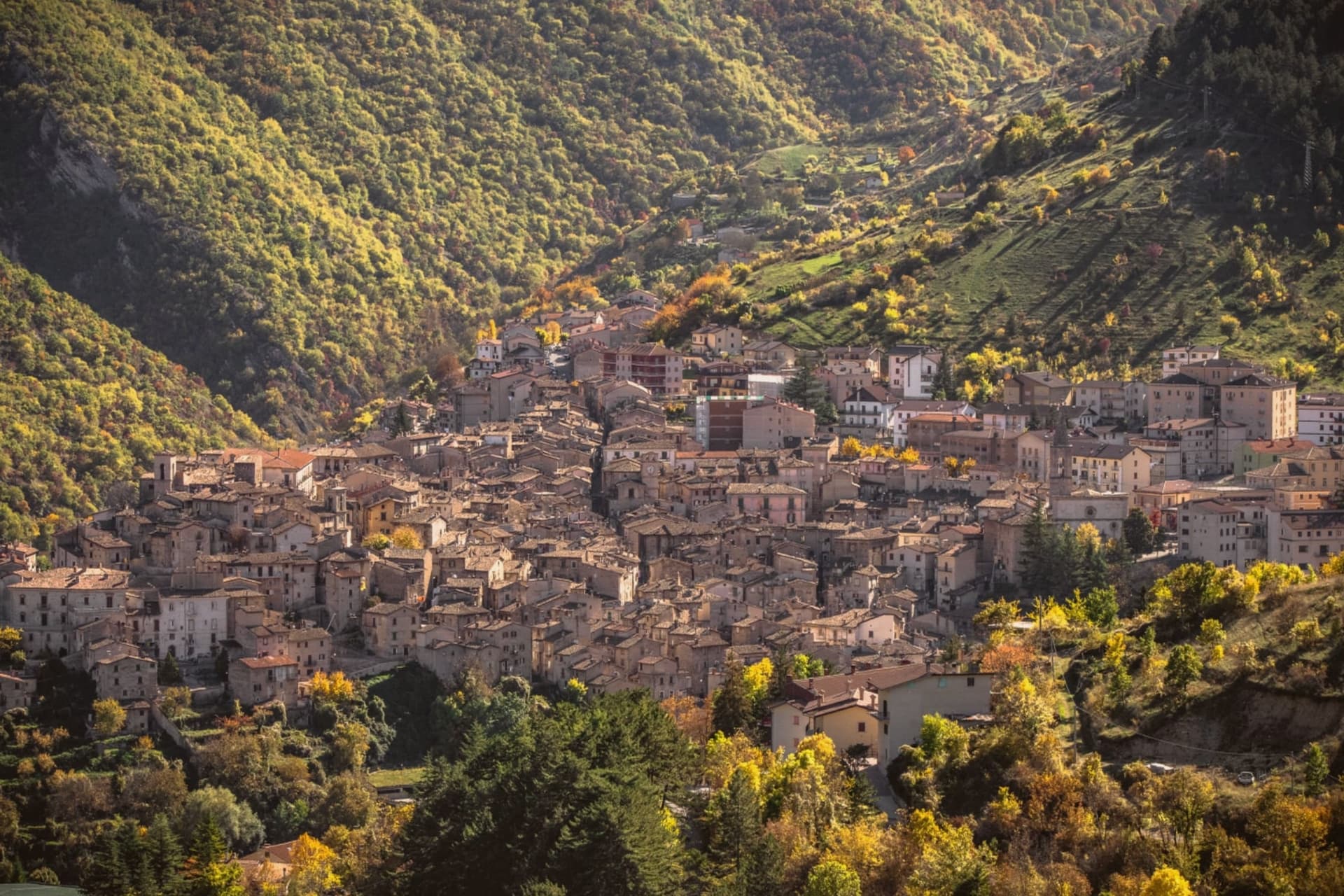
Why visit Scanno
Scanno sits in the Sagittario valley, ringed by the Majella foothills and the Marsicano massif. The lake lies three kilometers down the valley from the town, at a lower elevation, so the walk between them moves from stone alleys to open water framed by the same slopes that produced it: a landslide off the mountain dammed the Tasso river and left the basin behind.
The town's isolation, closed in by the surrounding massifs, is what let the older costume and its headdress survive into the era of the camera, and it is what drew photographers to record it rather than something they invented. The goldsmiths' filigree, made in the same stone streets the women walked, belongs to the same thread: a village shaped by its enclosure in the mountains, still making by hand what it has always made.
What to see in Scanno
- Lago di Scanno. Seen from above, the water reads as a clean heart shape against the valley walls.
- Centro storico. Stone-alley medieval centre where the black costume, with its folded headdress some historians trace to Balkan or Eastern origins, is still worn by older women against limewashed walls.
- Chiesa di Santa Maria della Valle. Parish church first documented in the eleventh century, rebuilt in the seventeenth, with a Renaissance portal and Baroque interior.
How to get to Scanno
Pescara is roughly 80 minutes away by road.
Our tip
June through September is the summer window: trails open in the national park, the lake holds a Blue Flag for swimming, and the centro fills with photographers chasing the Giacomelli setups. December through March is the second season for snow, with skiing on Monte Rotondo and Passo Godi nearby. April, May, October and November are quiet, with many family-run hotels closed and the lake side restaurants shuttered.
Introdacqua
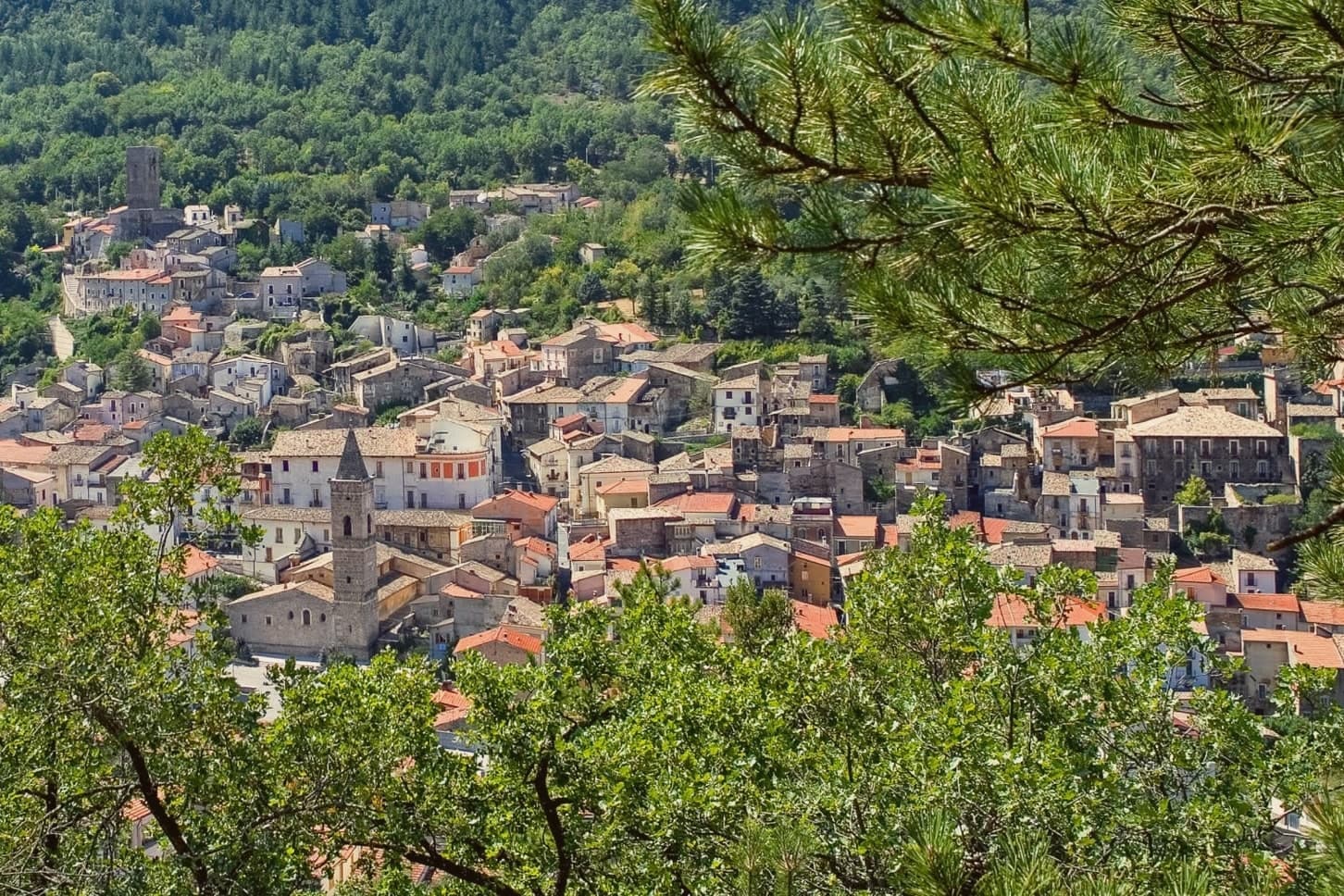
Why visit Introdacqua
Introdacqua sits at 670 meters on the edge of the Valle Peligna, just north of Sulmona, between the Contra and Sant'Antonio valleys. The name is Latin, inter aquas, meaning inside the waters: springs run through the territory, which is the reason the Lombards founded the village here in the 9th century.
The 14th century brought a Medici presence and a building boom around the present centro storico. Five earthquakes hit between 1654 and 1915.
The town survived them all and now ranks among I Borghi più belli d'Italia. In recent years RAI and other outlets have profiled Introdacqua as a borgo cosmopolita: foreign residents from northern Europe, the UK and North America have bought houses in the historic center, and the village has become known across Abruzzo for its outside-Italian population per capita.
The population is just under 2,000, including the returning families and the long-term resident foreigners. The annual Festa del Ringraziamento celebrates the harvest in late autumn.
What to see in Introdacqua
- Centro storico. Medieval village core rebuilt after each of the five recorded earthquakes between 1654 and 1915, now ranked among I Borghi più belli d'Italia.
- Chiesa di San Giuseppe. Principal parish church in the upper village, with a stone portal and a small piazza that opens toward the Peligna valley.
- Sorgenti dell'Introdacqua. Spring system that gave the village its Latin name inter aquas, still running through the territory and feeding the lower valley.
How to get to Introdacqua
Pescara is roughly 83 minutes away by road.
Our tip
May through October is the strong stretch. At 670 meters the Valle Peligna stays warm but breathable through July and August, and the upper trails into the Genzana reserve are open. June and September are the most balanced months, with cool mornings and long evenings in the centro storico.
More from Anywhere Italy
- The prettiest small villages inside a national park in Abruzzo
- The prettiest villages inside a national park within 90 minutes of Pescara
 The best mountain towns inside a national park within 90 minutes of Pescara
 The 6 best small towns that eat well in the province of L'Aquila
 The best small ski towns in the province of L'Aquila
- The prettiest small villages that eat well within 90 minutes of Pescara