
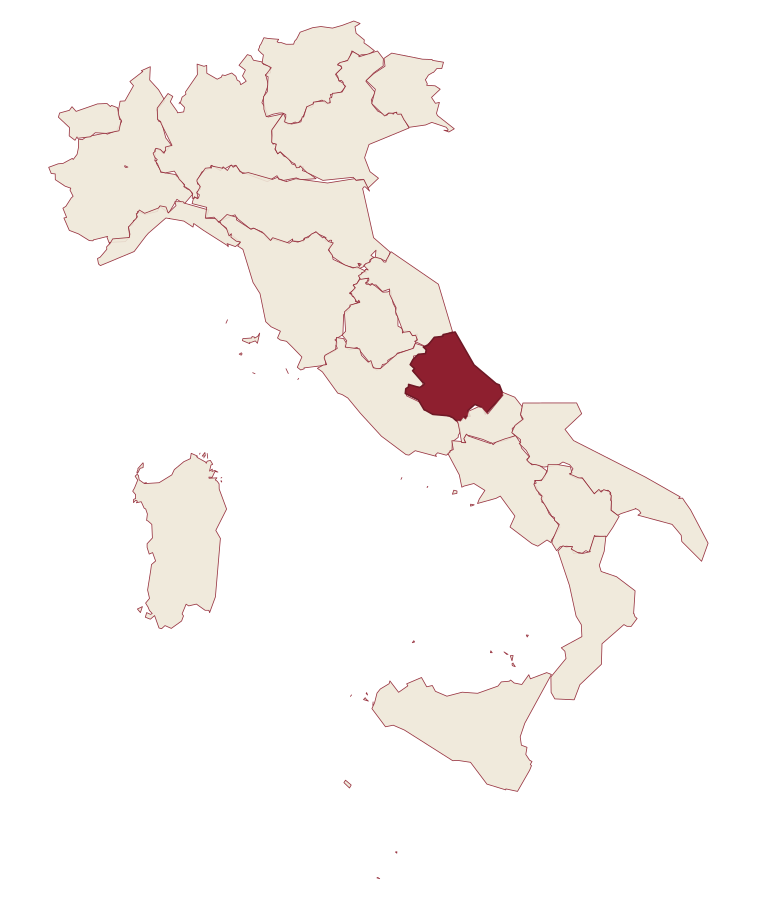
Abruzzo · L'Aquila
Santo Stefano di Sessanio
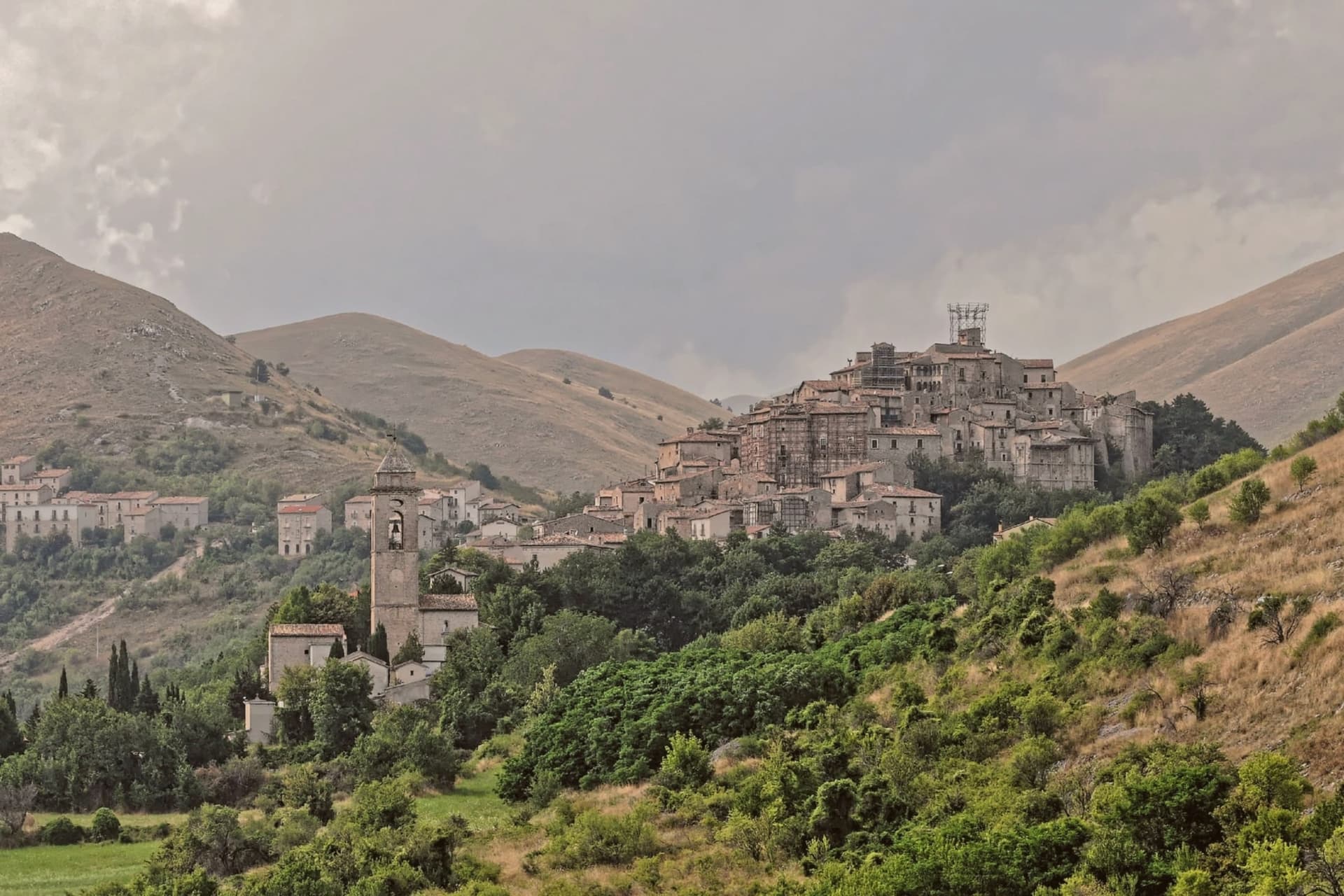
A Medici outpost at 1,250 meters, restored building by building since 1999 into Italy's first scattered hotel.
- Best time
- Jun–Sep, Dec–Mar
- By car
- 1 h 49 min from Pescara
- Population
- 114
Known for
ALBERGO DIFFUSO
Sextantio, opened 2005, defined the scattered-hotel model in Italy: restored medieval houses with original stone, lime, and timber.
LENTICCHIE
Slow Food Presidium lentil, grown on the Campo Imperatore plateau above town, celebrated at the first-September Sagra delle Lenticchie.
MEDICI TOWER
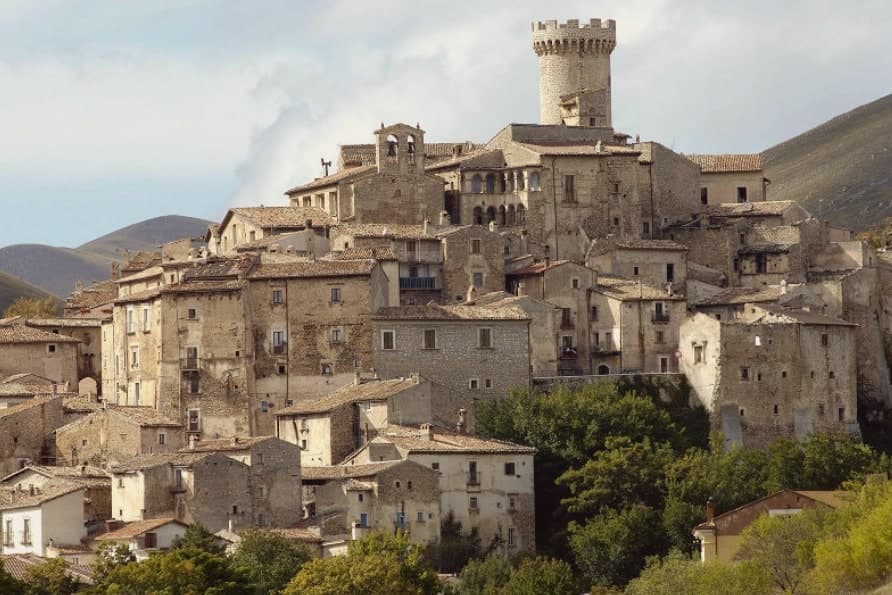
Cylindrical sixteenth-century tower built under Florentine rule, collapsed in the 2017 earthquake, currently being rebuilt.
When to visit
Best · Jun–Sep, Dec–Mar
- J5°
- F8°
- M8°
- A11°
- M16°
- J22°
- J26°
- A25°
- S20°
- O16°
- N10°
- D6°
- Best
- Hot or crowded
- Quiet
- Mostly closed
Daytime averages, 2020–2024. Weather data by Open-Meteo.com.
The festa: Stefano, 2 August
Why come
One hundred and fourteen people live in the commune, on the southern rim of the plateau inside the Gran Sasso e Monti della Laga National Park. The village belonged to the Medici from 1579 to 1743, who ran the saffron and wool trades that gave the place its early wealth and left their mark in the gate and the tower built under their rule. By the late twentieth century most of the houses stood empty.
In 1999 the Italian-Swedish entrepreneur Daniele Kihlgren began buying the ruined buildings, one at a time, restoring them rather than replacing them, which is why the stone, the lime plaster, and the timber inside are original. The upper village and its scattered rooms are the direct result of that decision: there was no single building large enough to house a hotel, so the hotel became the village itself. What Santo Stefano offers now is that reversal, a settlement nearly emptied by the late twentieth century, rebuilt not by adding to it but by restoring what was already there, house by house, and still being rebuilt today in the tower rising again on its old footprint.
The Sunday letter
Santo Stefano di Sessanio is on our list. Its letter is still to come.
We are writing about all 1,000 of these towns, one at a time, in a free letter every Sunday: the photo, the food, the festa. That is our mission. Sign up and you will be there when Santo Stefano di Sessanio comes up. By Peter & Sophia, from Pietrasanta.
Read on
Santo Stefano di Sessanio in our articles
 The best small towns with a food festival in Abruzzo6 towns, Santo Stefano di Sessanio among them.
 10 Borghi più belli d'Italia that stay empty anyway10 towns, Santo Stefano di Sessanio among them.
 10 comuni smaller than a cruise ship's passenger list10 towns, Santo Stefano di Sessanio among them.
 10 towns where the festa is bigger than the town10 towns, Santo Stefano di Sessanio among them.
How to get there
From Rome (FCO), about 3h 11m by car.
Ancona / Pescara (AOI) is about 3h 24m away.
By car from the centre of Pescara 1h 49m or Ancona 3h 19m.
What to see
Torre Medicea (ruderi)
The tower's stump stands on its original footprint, scaffolded, the reconstruction visible in progress against the rest of the village skyline.
Borgo medievale e Sextantio
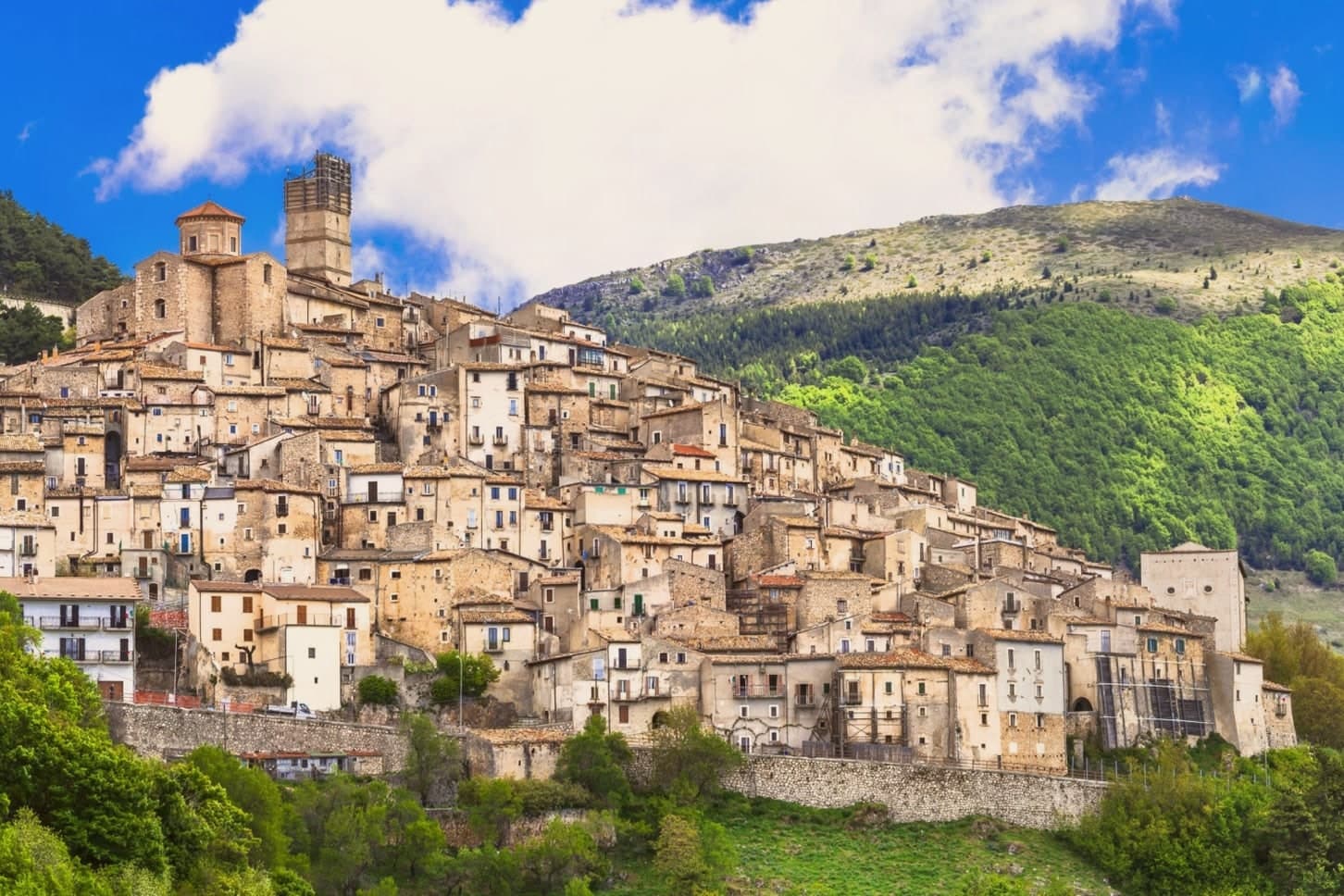
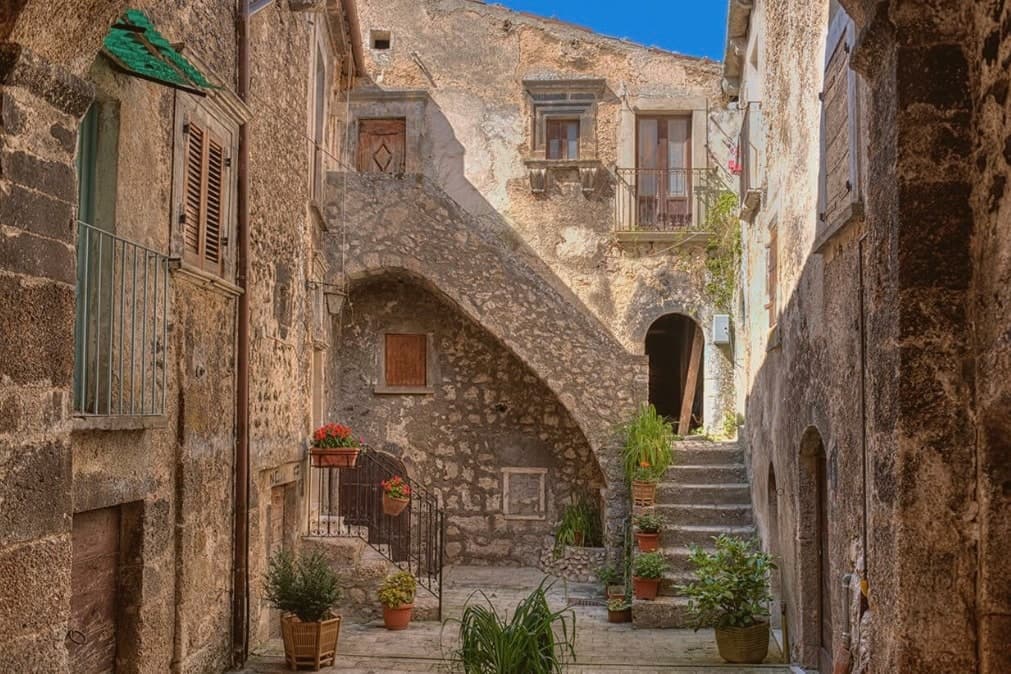
Rooms are scattered through the restored houses of the village rather than gathered under one roof, so staying here means walking the lanes between stone walls and timber to reach them.
Palazzo delle Logge
A Renaissance loggia looks over the village square and the gate built under the same Florentine administration, its arches the clearest surviving mark of that rule.
Campo Imperatore
A karst plateau at 1,500 to 1,800 meters above the village, reached by trail, used as summer pasture for sheep and as the ground where the lentil is grown.
Parco Nazionale del Gran Sasso e Monti della Laga
Santo Stefano lies inside the park, its gate and village core protected at the boundary of the plateau zone.
The slow-trip planner
Building a trip? Find where Santo Stefano di Sessanio fits in a slow Italy circuit.
Answer five questions. We will shape a geographically coherent slow trip from the 1,000 Italian towns most travelers skip. Yours to save and share.
We recommend
Where to stay
Not our picks, but places the guides put their name to: a Michelin star, a Gambero Rosso fork, a Slow Food snail, a Michelin Key for the hotels. Worth a table, a counter, or a night when you pass through.
SextantioHotel
Sextantio holds one Michelin Key.
Through the year
What happens here
Feasts and festivals that come back year after year. We give the month rather than the date, because the date moves and the month rarely does. Check with the source before you plan a journey around one.
Lentil Festivalfood festival
usually held in September. sagritaly.com
Sagra delle lenticchiefood festival
usually held in September. AbruzzoNews - Sagre in Abruzzo
Living here
- Population 114
- In-betweeni
- Pharmacy: none mapped
- Nearest high school over ~30 minutes away
- Nearest airport Rome, 3 h 11 min drive
- Regional capital L'Aquila, 1 h 14 min drive
Common questions
- What is Santo Stefano di Sessanio known for?
- Santo Stefano di Sessanio is a Medici outpost at 1,250 meters, restored building by building since 1999 into Italy's first scattered hotel.
- Where is Santo Stefano di Sessanio?
- Santo Stefano di Sessanio is a comune in the province of L'Aquila, in Abruzzo, at 1250 meters above sea level.
- What is the nearest airport to Santo Stefano di Sessanio?
- Rome (FCO), about 3h 11m by car.
- How long is the drive from Pescara to Santo Stefano di Sessanio?
- About 1h 49m by car.
- When is the best time to visit Santo Stefano di Sessanio?
- Best in Jun–Sep, Dec–Mar. July is the warmest month, averaging 26 degrees, and May the wettest, with about 17 rain days.
- Is there a sagra or a festival in Santo Stefano di Sessanio?
- Yes. Lentil Festival and Sagra delle lenticchie. September is when the first of them falls.
- Which other towns are like Santo Stefano di Sessanio?
- Castelvecchio Calvisio, Calascio and Pietracamela.
- How many people live in Santo Stefano di Sessanio?
- 114 at the 2023 count.
Tags & datadesignations · numbers · sources
Recognised as
The numbers
- Elevation: 1250 m
- Population: 114
- Surface area: 33.7 km²
These figures were compiled from public directories: ISTAT, OpenStreetMap and Wikidata, and from the official listings of the guides named on this page. Town details change; verify with official sources before you travel.
Similar
Towns like Santo Stefano di Sessanio
Castelvecchio Calvisio
Province: L'Aquila
both high in the mountains · both under 1,000 people
Calascio
Province: L'Aquila
both high in the mountains · both under 1,000 people
Pietracamela
Province: Teramo
both high in the mountains · both under 1,000 people
Castel del Monte
Province: L'Aquila
both high in the mountains · both under 1,000 people
Usseaux
Province: Torino
both high in the mountains · both under 1,000 people
Pescopennataro
Province: Isernia
both high in the mountains · both under 1,000 people
🎨 Borghi più belli d'Italia
More Borghi più belli d'Italia towns in Abruzzo
Anversa degli Abruzzi
Province: L'Aquila
At 604 meters above the Sagittario Gorges, a cliff village built around a Norman castle rebuilt by the Counts of Sangro.
Campli
Province: Teramo
A 393-meter town under the Monti della Laga, held by the Farnese for two centuries, with a Scala Santa carrying papal indulgence.
Caramanico Terme
Province: Pescara
A 650-meter Majella spa village at the confluence of the Orfento and Orta rivers.
Casoli
Province: Chieti
A 378-meter hill town above the Aventino under the Maiella, with a pentagonal Norman tower that once hosted a court of artists.
Castel del Monte
Province: L'Aquila
At 1,346 meters under Monte Bolza facing Rocca Calascio, the capital of shepherds, whose wool reached the Medici and whose witches return each August.