
The best hidden wine towns with a medieval festival in Toscana
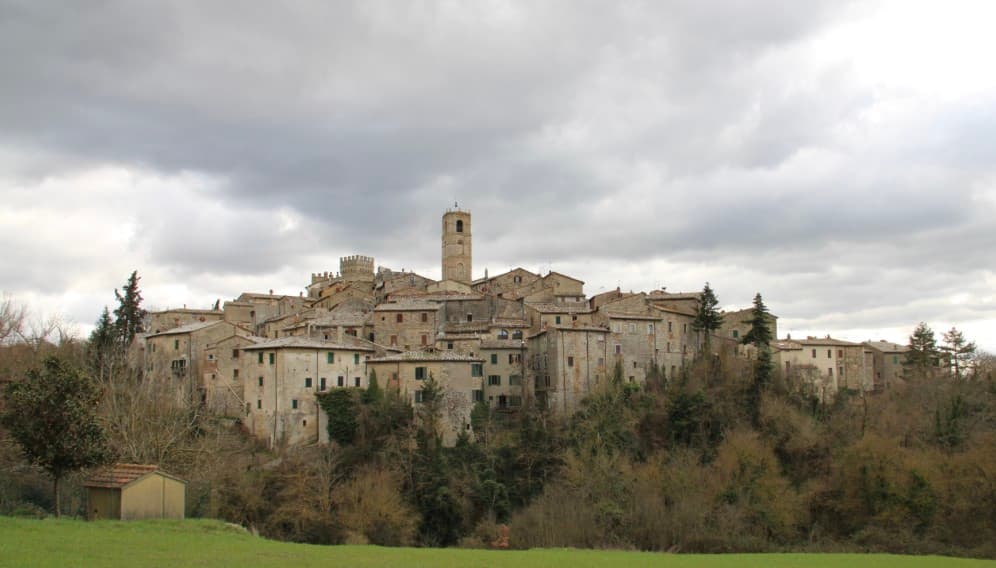
Tuscany in festival season smells of woodsmoke, roasting pork and new wine. The towns that do this well are built of the local rock, travertine, tufa or grey pietra serena, with cellars cut into the hill beneath the main square and the vines starting where the last house ends. The calendar is fixed and old: crossbow tournaments, palios run between neighbourhood districts, banners and drums in the weeks around Easter and again from August into October. Eat what the season puts out, pici with garlic, wild boar cooked slowly, pecorino at every age, and drink whatever the surrounding hill makes, Sangiovese in the south and east, white Vernaccia in the west, Morellino near the coast.
Most people meet all of this in Siena, and for good reason. The Palio is the most famous horse race in Italy, the Campo fills to capacity twice each summer, and the city's wine bars have poured Brunello and Chianti Classico to visitors for generations. In July and August the hill roads into the city queue, the restaurants around the Campo book out weeks ahead, and the medieval procession is watched by a crowd measured in tens of thousands. It is a genuine spectacle. It is also the least private way to see any of it.
The same hills carry on past Siena in every direction, and so do the wine and the drums. Smaller towns across Grosseto, Arezzo and the Val di Chiana keep re-enactments that predate the tourist season and still exist mainly for the people who live there, with associations that make wine seriously and taverns opened by the contrade for the duration of the festival. Fewer people go, the parking is easier, and you can usually eat in the town on the night of the event. These are the ones worth planning a week around.
Of the 84 communes we have mapped in Toscana, 11 qualify as wine towns with a medieval festival: each belongs to the national association of wine towns, and each stages a recurring historical re-enactment. This list is the hidden ones, 10 in all, ordered smallest first. The smallest, San Casciano dei Bagni, has 1,500 residents.
Elsewhere in the catalogue: The best wine towns with a food festival in Toscana and The best hidden towns with a medieval festival that are worth a night in Toscana.
San Casciano dei Bagni
Why visit San Casciano dei Bagni
San Casciano dei Bagni sits at 582 meters at the southern edge of the province of Siena, above 42 hot springs that average 42 degrees Celsius. The baths were used continuously from Etruscan through Roman times and again from the Renaissance, when visitors came from across Europe.
In 2022, an excavation that began in 2019 at the ancient sanctuary turned up 24 bronze votive statues protected by mud, with around 6,000 coins in gold, silver and bronze. The find was the largest of its kind in fifty years; most surviving Etruscan votive material is terracotta.
The 1,500 residents live on a basalt outcrop above the Roman thermal complex, in a centro storico of stone houses and three small churches. The borgo joined the Borghi più belli network in 2014 and remains one of the smallest communes in Toscana to carry both that label and Bandiera Arancione.
The re-enactment here is Palio di San Cassiano di San Casciano dei Bagni, usually held in August.
What to see in San Casciano dei Bagni
- Santuario Ritrovato. Etruscan-Roman thermal sanctuary excavated since 2019, where 24 bronze votives and around 6,000 coins were recovered in 2022.
- Bagno Grande. The principal natural pool of the 42 hot springs, used from the second century BC through the Renaissance and reopened to the public.
- Collegiata di San Leonardo. Romanesque parish church in the centro storico, restored in the seventeenth century, with a baptismal font carved from local travertine.
How to get to San Casciano dei Bagni
Perugia is roughly 68 minutes away by road.
Our tip
The thermal pools make the calendar different here. Winter is the season many visitors prefer, when the 42-degree water steams against cold air and snow occasionally dusts the basalt outcrop. April through June and September into October are the most balanced months: warm hill light, the dry-stone walls of the borgo at their best, the sanctuary excavations open to guided tours. Sagra del Ciaffagnone di San Casciano dei Bagni falls in June.
Cetona
Why visit Cetona
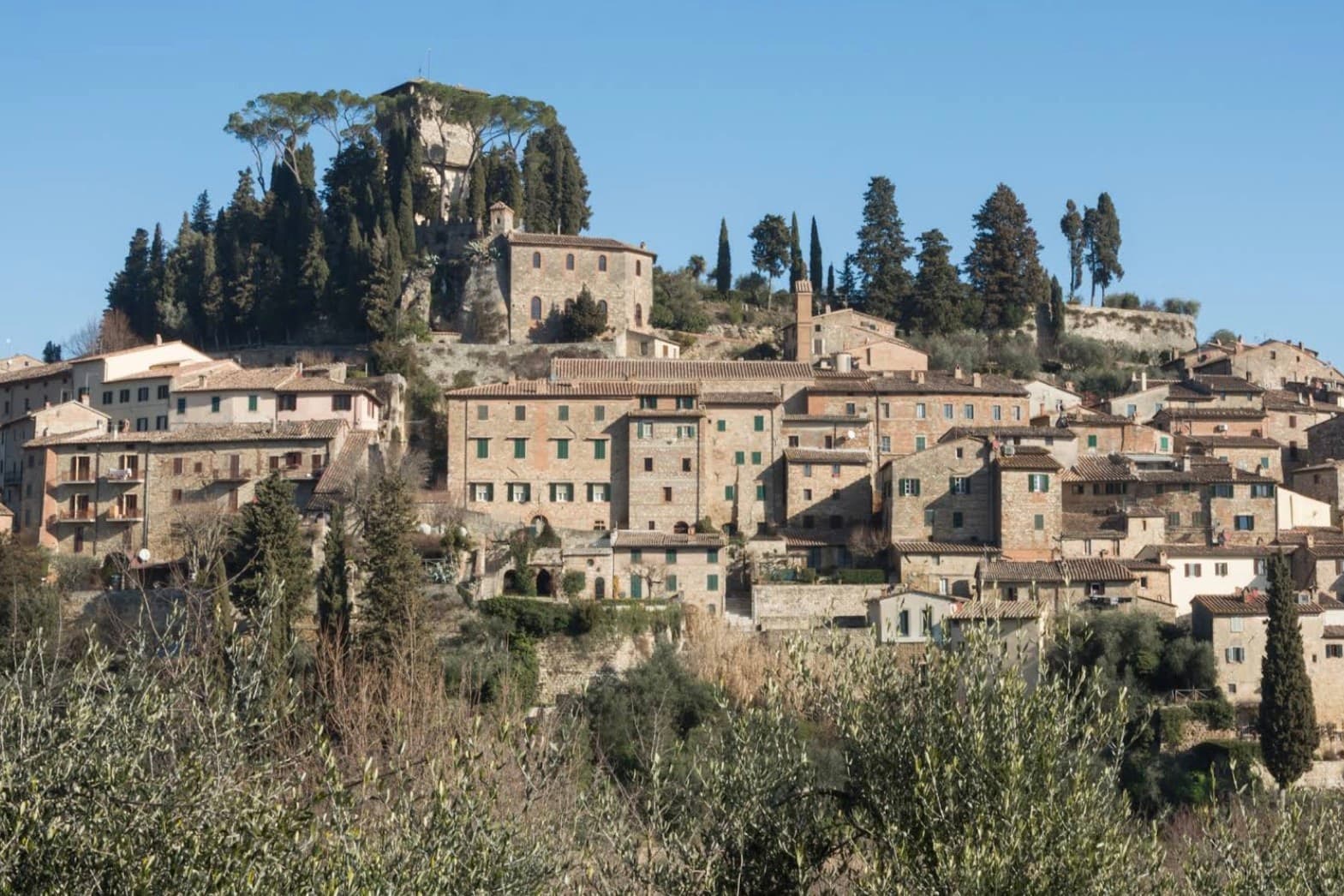
The town sits on the western flank of a ridge at the meeting point of Toscana, Umbria and Lazio, where the mountain divides the Val d'Orcia from the Val di Chiana. The medieval comune passed between Siena, Orvieto and Perugia before falling to Siena in the late fourteenth century, and it was Cosimo I who later sold it whole to a marchese.
The fortress at the top of the grid and the square laid out below it are two halves of the same Renaissance move: a private residence replacing a garrison at the summit, a flat civic stage opened up at the base. Above the town, in the woods, the hermitage and the caves belong to a much older layer, human use of the mountain reaching back to the Mesolithic, long before any comune or marchese laid claim to it.
What the town adds up to is a settlement built in tiers: a prehistoric mountain, a contested medieval center, and a Renaissance overlay that reorganized the base of the hill without touching what stood above it.
The re-enactment here is Corsa delle brocche a Cetona, usually held in July.
What to see in Cetona
- Piazza Garibaldi. Elliptical square at the foot of the medieval grid, flat and open where the streets above it climb steeply. The civic stage of the borgo, still the first thing that orients a visitor.
- Rocca di Cetona. Fortress at the top of the centro storico, its walls and keep still standing though the interior became a private residence rather than a garrison.
- Convento di San Francesco. Franciscan convent below the borgo, founded in 1212, with a single-nave church and a small cloister still in religious use.
How to get to Cetona
Perugia is roughly 78 minutes away by road.
Our tip
April through June and September into October are the months Cetona keeps its calmest pace, the wooded slopes of Monte Cetona green or rust depending on the half. July and August are hot in the centro storico but the mountain trails above 800 meters stay cool. The Mostra del Tartufo, dedicated to the local white truffles, runs the second weekend of November in Piazza Garibaldi. Sagra del Bico di Cetona falls in June.
Chiusi
Why visit Chiusi
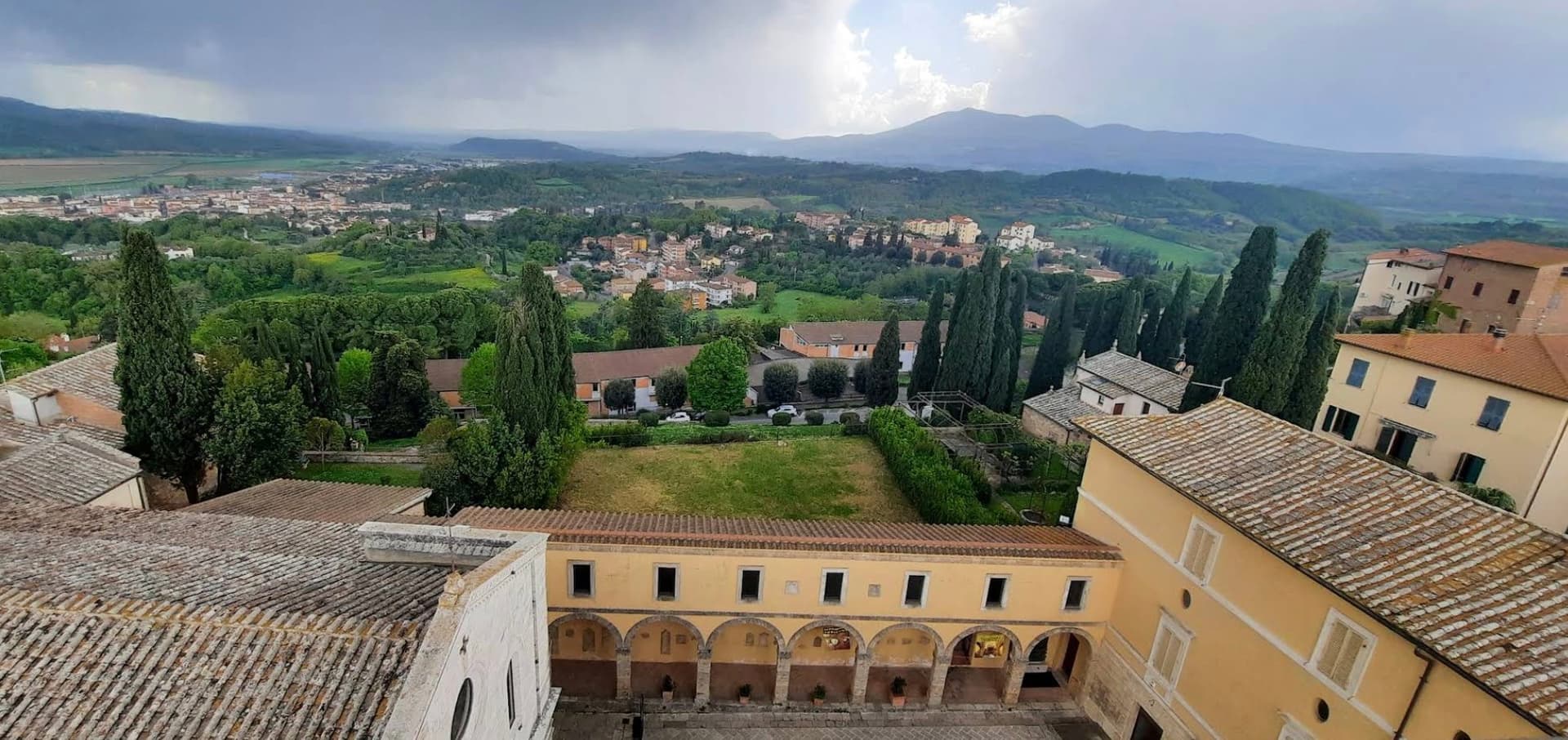
The hilltop stands above the Val di Chiana, the valley floor visible from the town at a height that made it defensible and gave it command of the surrounding farmland. The cathedral, the museums and the tunnel network are close enough to walk between within the old center, while the painted necropolis and the lake lie outside it, a few kilometers apart in different directions, one inland toward the tombs and the other north toward open water.
The tunnels themselves connect the upper town to what lies beneath it: built as drainage, later folded into legend by Pliny the Elder, who took them for part of a king's tomb. The cathedral's own columns, lifted from earlier Roman buildings, make the same point in stone that the tombs make in paint and the museum makes in bucchero and alabaster: this is a town built repeatedly on top of itself, each layer reusing what the last one left behind.
The re-enactment here is Tria Turris Medioevo e Palio delle Torri di Chiusi, usually held in June.
What to see in Chiusi
- Museo Nazionale Etrusco. Holds canopic urns, alabaster sarcophagi, bucchero pottery and grave goods pulled from the necropolises around the town.
- Duomo di San Secondiano. Cathedral built around 560 AD over an earlier basilica, renovated in the thirteenth century, nave and two aisles on antique marble columns from Roman buildings.
- Labirinto di Porsenna. Visited from the Museo della Cattedrale, the tunnels run beneath the streets at a scale that still reads as engineering rather than legend, whatever Pliny made of them.
How to get to Chiusi
There is a railway station in the town, so you can arrive without a car and never need one while you are here. Perugia is roughly 58 minutes away by road.
Our tip
April through June and September into October are the working months on the Val di Chiana edge: mild days, evening light over the lake, the wine and olive cycles below town. The Frittellata of San Giuseppe in mid-March and the Festa di San Mustiola in early June fill the centro storico with traditional kitchens. July and August push past thirty degrees and the basin below town holds the heat; the museums and the Labirinto stay cool. Tria Turris Medioevo e Palio delle Torri di Chiusi falls in June.
Suvereto
Why visit Suvereto
Suvereto sits at 127 meters on the inland edge of the Val di Cornia, twelve kilometers from the Tyrrhenian coast. The name comes from the Latin suberetum, a wood of cork oaks, and the surrounding forests still hold them.
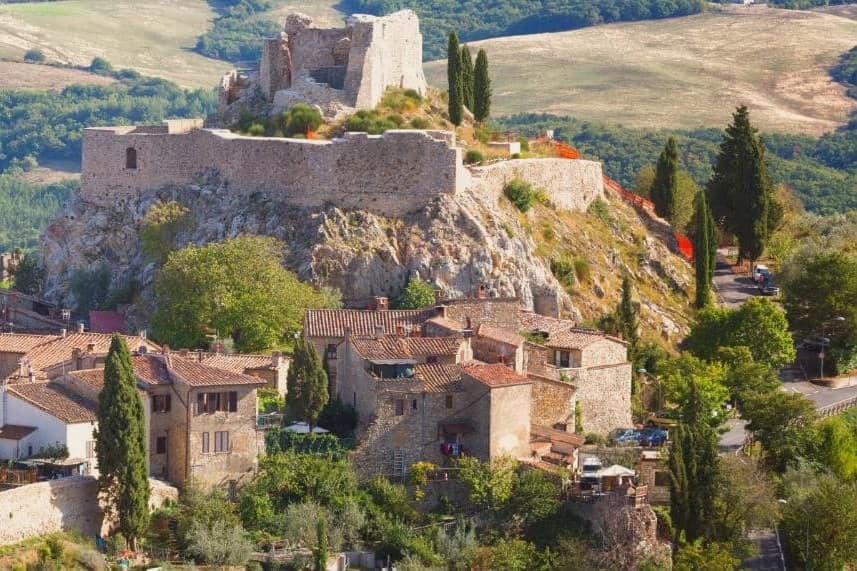
The Rocca Aldobrandesca, first documented in 973, occupies the highest point of the borgo; the Aldobrandeschi family who controlled it also ruled large sections of southern Toscana and the Maremma. The town reached its golden age in the thirteenth century, when Frederick II granted it a charter of freedoms in 1216 and the Palazzo Comunale was built.
The centro storico is a tight grid of stone vicoli that runs uphill from the Romanesque Pieve di San Giusto to the fortress. Suvereto carries five institutional signals at once, a rare combination in the province of Livorno, and the surrounding wine country falls under the Val di Cornia DOC and Suvereto DOCG appellations.
The re-enactment here is Palio dell'Imperatore, usually held in August.
What to see in Suvereto
- Rocca Aldobrandesca. Fortress at the highest point of the borgo, documented from 973, expanded in the twelfth century and partly restored as an open archaeological site.
- Pieve di San Giusto. Eleventh-century Romanesque parish church at the foot of the borgo, with a sandstone façade and a single nave divided by stone columns.
- Palazzo Comunale. Thirteenth-century town hall with a double external staircase and Ghibelline merlons, one of the earliest surviving civic palaces of the Maremma.
How to get to Suvereto
Livorno is roughly 84 minutes away by road.
✷ We have written about Suvereto
“That is the thing the young man on the beach did not see, and the man who lives here cannot stop seeing. This is an industrial coast wearing a beach towel. Run it back far enough and the whole of it, the swamp and the steel and the slag and the white water, is one long story about iron, and the holiday is the costume the story put on after the work ran out.”
Read our piece on Suvereto →The Iron Coast | The Wrong Sea
Our tip
April through June and September into October are the dry months in the Val di Cornia, when the cork forests behind the town hold their light and the wine harvest runs in September. The Sagra del Cinghiale, celebrating the wild boar of the surrounding hills, runs across two weekends in December and draws a different crowd. July and August are hot at 127 meters and most visitors descend to the Tyrrhenian coast in the afternoon. Palio dell'Imperatore falls in August.
Montalcino
Why visit Montalcino
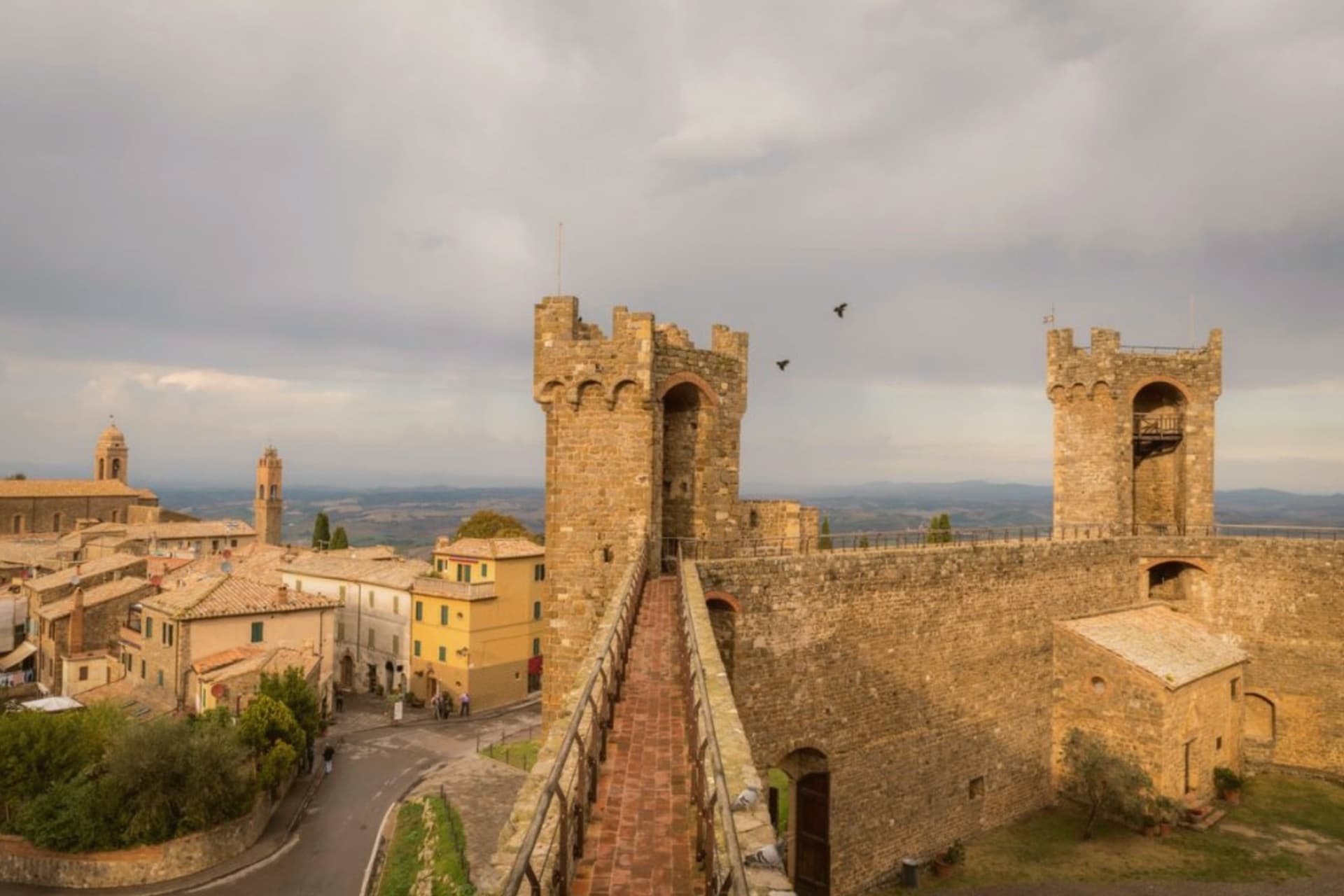
Montalcino sits at 564 meters on a hill south of Siena, the centro storico ringed by walls and crowned by a pentagonal fortress built in 1361. When Florence took Siena in 1555, the Sienese exiles regrouped here and held out for almost four years; the Rocca itself never fell.
That date matters less to most visitors than 1980, when Brunello di Montalcino was named one of the first four Italian wines to receive DOCG status. The vineyards run from the town at 600 meters down to plots at 200, on stony galestro soils that ripen Sangiovese Grosso into a wine that ages for decades.
The Abbey of Sant'Antimo, ten kilometers south, is a Romanesque church first documented in 814 and tied by local legend to a vow by Charlemagne. The town also produces miele, olio, and the white truffles of the surrounding woods.
It carries seven institutional signals at once, more than any other commune in this batch.
The re-enactment here is Torneo di Apertura delle Cacce a Montalcino, usually held in August.
What to see in Montalcino
- Rocca di Montalcino. Pentagonal fortress built in 1361 by Sienese architects Mino Foresi and Domenico di Feo, refuge of the Sienese Republic after 1555.
- Abbazia di Sant'Antimo. Romanesque abbey ten kilometers south, first documented in 814, set among olive groves below the town with Gregorian chant still sung.
- Palazzo dei Priori. Thirteenth-century town hall on Piazza del Popolo, slender tower attached, civic seat of the medieval commune.
How to get to Montalcino
There is a railway station in the town, so you can arrive without a car and never need one while you are here. Perugia is roughly 105 minutes away by road.
✷ We have written about Montalcino
“When the film industry needed a picture of heaven, of the fields a dead hero walks home to, they came and shot it here, and that is the truest thing anyone has ever said about the Val d'Orcia. It is not a place. It is the afterlife as imagined by people who lived in cities. It is how the country looks to men who never spent an hour in it, dreamed up by Florentine bankers five hundred years ago and maintained, beautifully, ever since.”
Read our piece on Montalcino →Val d'Orcia | The Postcard Is Constructed
Our tip
April through June and September into October are the months locals prefer. The hills are green or gold depending on the half, and the vineyards run their full work cycle. The Sagra del Tordo, a medieval archery contest between the four quarters of the town, takes place the last Sunday of October. Sagra del Cinghiale di Montalcino falls in the season.
Manciano
Why visit Manciano
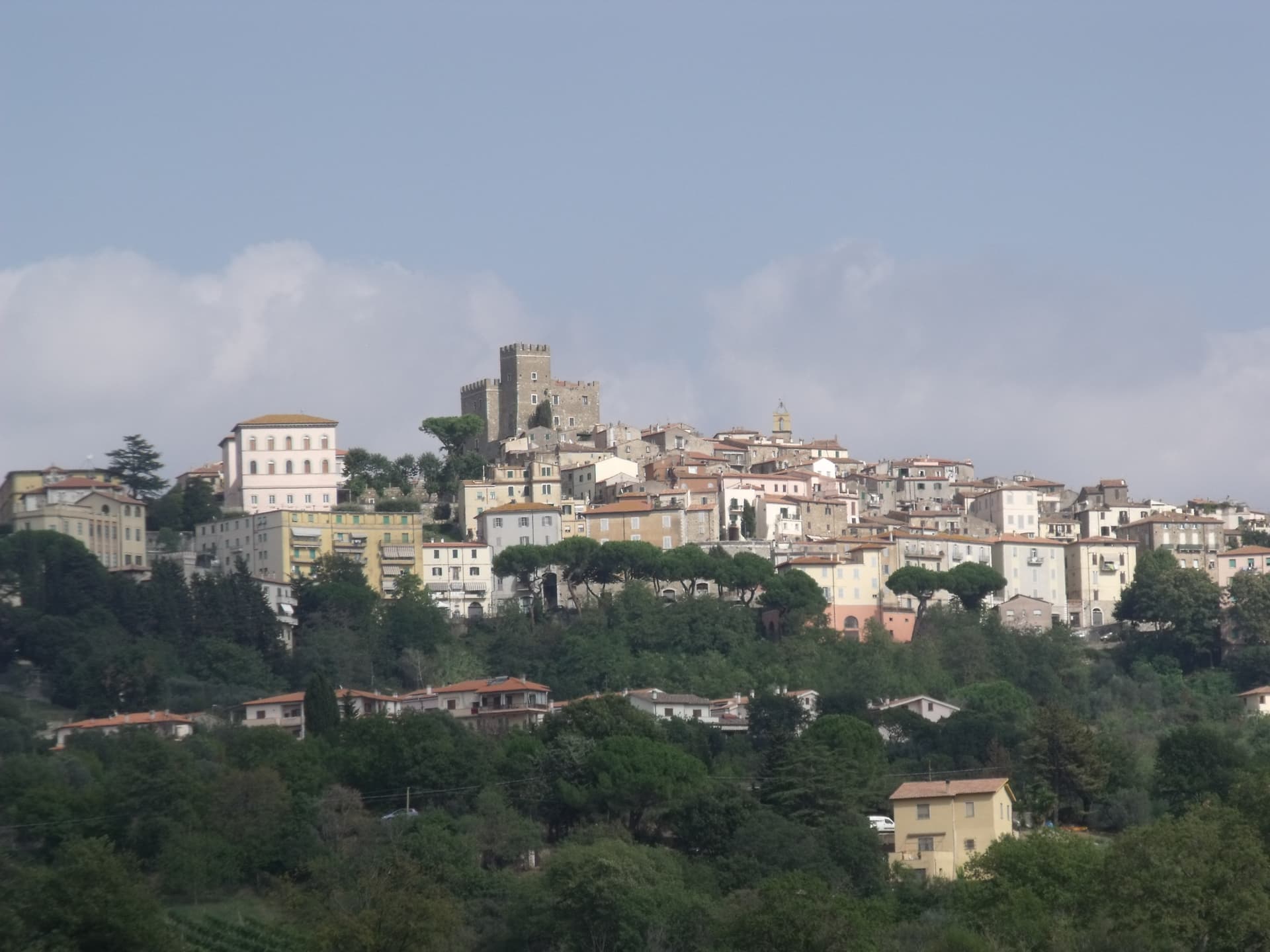
Manciano sits at 444 meters on a hill in the southern Maremma grossetana, with a 360-degree view that runs from Monte Amiata north to the Tyrrhenian coast. The Aldobrandeschi held the original stronghold from the twelfth century.
Siena occupied the town between 1419 and 1455 and built the Rocca that still dominates the centro storico, a square keep with battlements on a shoe-base. After 1455 it returned to local rule and passed eventually to the Medici Grand Duchy.
The comune is large by Toscana standards and includes some of the best-known places of the southern Maremma: Saturnia, the Etruscan town built around its sulphurous hot springs, and Montemerano, a small walled borgo on the road to the Lago di Bolsena. The Albegna and Fiora valleys, which the town once served as a regional market, still meet at its foot.
Wine, olive oil and wild boar work the territory in roughly the order they sit on a Maremmano menu.
The re-enactment here is Palio delle Botti di Manciano, usually held in August.
What to see in Manciano
- Rocca Aldobrandesca. Sienese fortress of 1424 on Aldobrandeschi foundations, square keep, walls with battlements and a solid shoe-base, dominating the centro storico.
- Saturnia. Etruscan town and frazione south of Manciano, with medieval walls, remains of a Roman road and the sulphurous hot springs used since antiquity.
- Montemerano. Small walled borgo east of Manciano, three concentric circles of streets and a fifteenth-century Madonna della Gattaiola in the parish church.
How to get to Manciano
Terni is roughly 132 minutes away by road.
✷ We have written about Manciano
“Everyone driving from Florence down to Rome crosses the Maremma without noticing, because there is nothing on that stretch to make them slow down. The hills give out. The cypresses stop. What opens up instead is flat open country, wheat and grass running off to a few low rises, the least Tuscan-looking part of Tuscany, a landscape you would call dull if you were being honest and which most guidebooks solve by leaving out.”
Read our piece on Manciano →Maremma | The Last Cowboys of Tuscany
Our tip
April through June and September into October are the months Manciano shows the southern Maremma at its best, the territory dry but green, the Saturnia pools warm against cool mornings. The Sagra dell'Anatra runs in mid-August. July and August are hot at 444 meters but easier than the coast; afternoons in the centro storico empty between two and six. Palio delle Botti di Manciano falls in August.
San Gimignano
Why visit San Gimignano
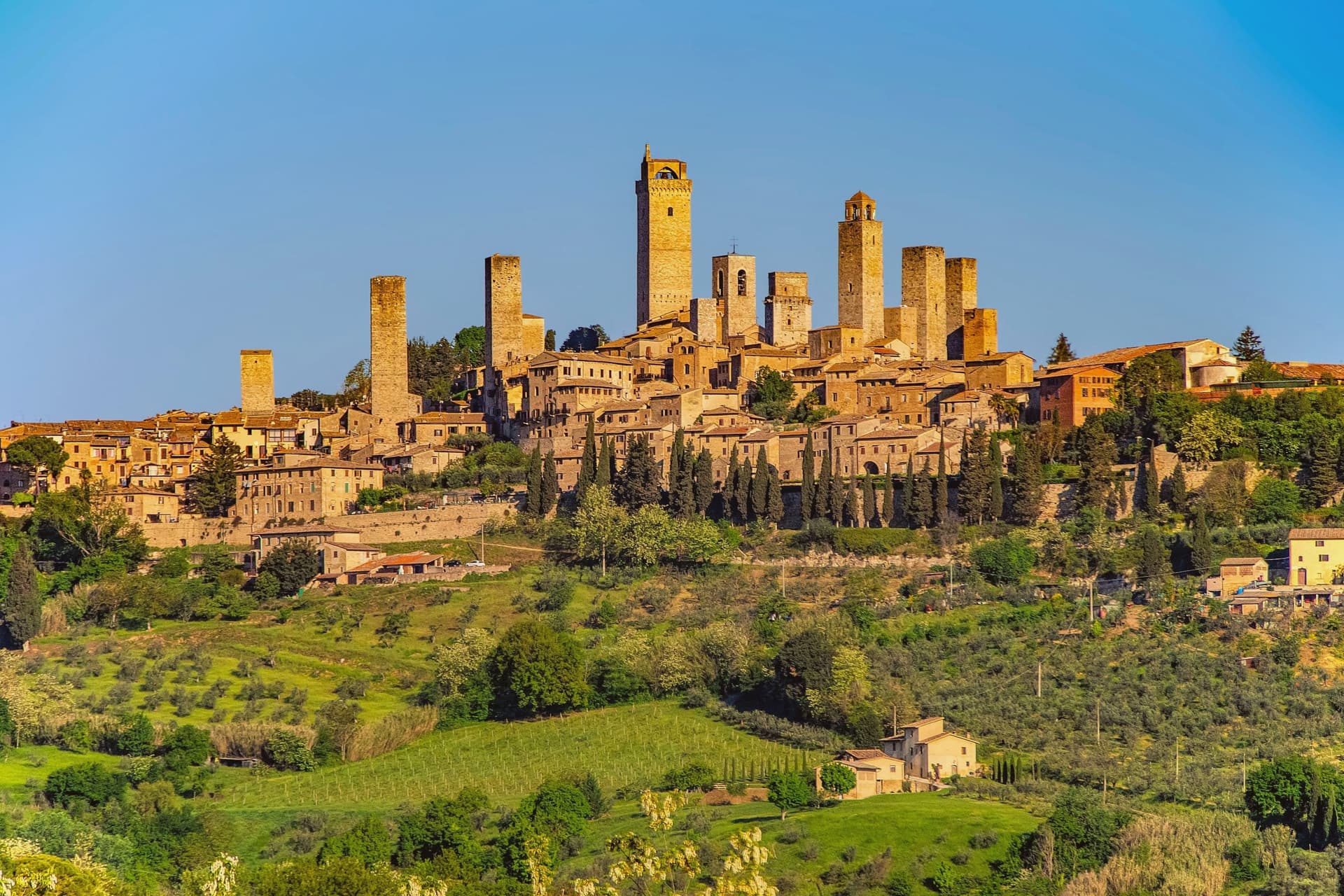
San Gimignano sits at 334 meters in the Val d'Elsa, halfway between Firenze and Siena on the medieval pilgrim road to Rome. Patrician families built 72 tower-houses in the twelfth and thirteenth centuries as proofs of wealth and platforms for vendettas; 14 still stand, the tallest being the Torre Grossa at 54 meters.
The town declared independence from the bishops of Volterra in 1199 and grew rich on saffron and Vernaccia, the white wine grown on the surrounding hills and praised since Dante. The Black Death of 1348 broke the boom; San Gimignano lost more than half its population and submitted to Florence.
That collapse is the reason the medieval skyline survived. UNESCO listed the historic centre in 1990 as a complete record of feudal architecture.
Roughly three million visitors come each year, more than 400 times the resident population, and the centro storico empties into the surrounding olive groves once the day-trippers leave.
The re-enactment here is Fiere delle Messi di San Gimignano, usually held in June.
What to see in San Gimignano
- Torre Grossa. Fifty-four meter civic tower attached to the Palazzo Comunale, the tallest of the surviving 14, open for the climb to the panoramic terrace.
- Piazza della Cisterna. Triangular medieval square paved in brick around an octagonal well of 1287, lined by tower houses and Romanesque palaces.
- Collegiata di Santa Maria Assunta. Romanesque parish church on Piazza Duomo, walls covered by Bartolo di Fredi and Lippo Memmi frescoes of Old and New Testament scenes.
How to get to San Gimignano
Firenze is roughly 61 minutes away by road.
✷ We have written about San Gimignano
“We arrived in the afternoon, into the second half of the day’s crowd. Off-season meant it was groups and guides rather than a flood, but the shops were open and doing their worst, the same garbage souvenirs, the same pasta no one local would eat, and we walked through it the way you walk through a thing you have decided not to let ruin your evening. The towers stood over all of it, indifferent, which is their whole talent.”
Read our piece on San Gimignano →San Gimignano | The Town After Seven
Our tip
April through June and September into October are the months the town is worth a full day rather than three hours. The buses still come, but late afternoon empties the piazzas and lets the towers take their light. July and August push temperatures past thirty and the centro storico becomes uncomfortable between two and six, when the stone radiates heat. Fiere delle Messi di San Gimignano falls in June.
Montepulciano
Why visit Montepulciano
The ridge runs between the Val di Chiana and the Val d'Orcia, 70 kilometers southeast of Siena, and the town follows its spine uphill: streets climb from the gates toward the high point, where the main square sits ringed by the buildings that define the skyline from below. The origin predates the Renaissance fabric by centuries.
Etruscan tombs survive in the surrounding hills, though almost nothing of that period shows in the centro storico itself, which was rebuilt wholesale in the fifteenth and sixteenth centuries over whatever came before. The wine and the festival both use the climb as their setting rather than their subject: the cellars are cut into the rock beneath the palazzi, keeping a constant temperature for aging, and the barrel race each August sends two men from each of the eight contrade hauling an eighty-kilogram cask up the same gradient that every visitor covers on foot, only slower.
The steepness that shaped the defensive site nine centuries ago is still what a person feels first, in the legs, before the buildings register at all.
The re-enactment here is Bravio delle Botti, usually held in August.
What to see in Montepulciano
- Tempio di San Biagio. A 13-meter dome and travertine façade standing alone outside the walls, the ground falling away below it so the building reads as a single volume against the hillside.
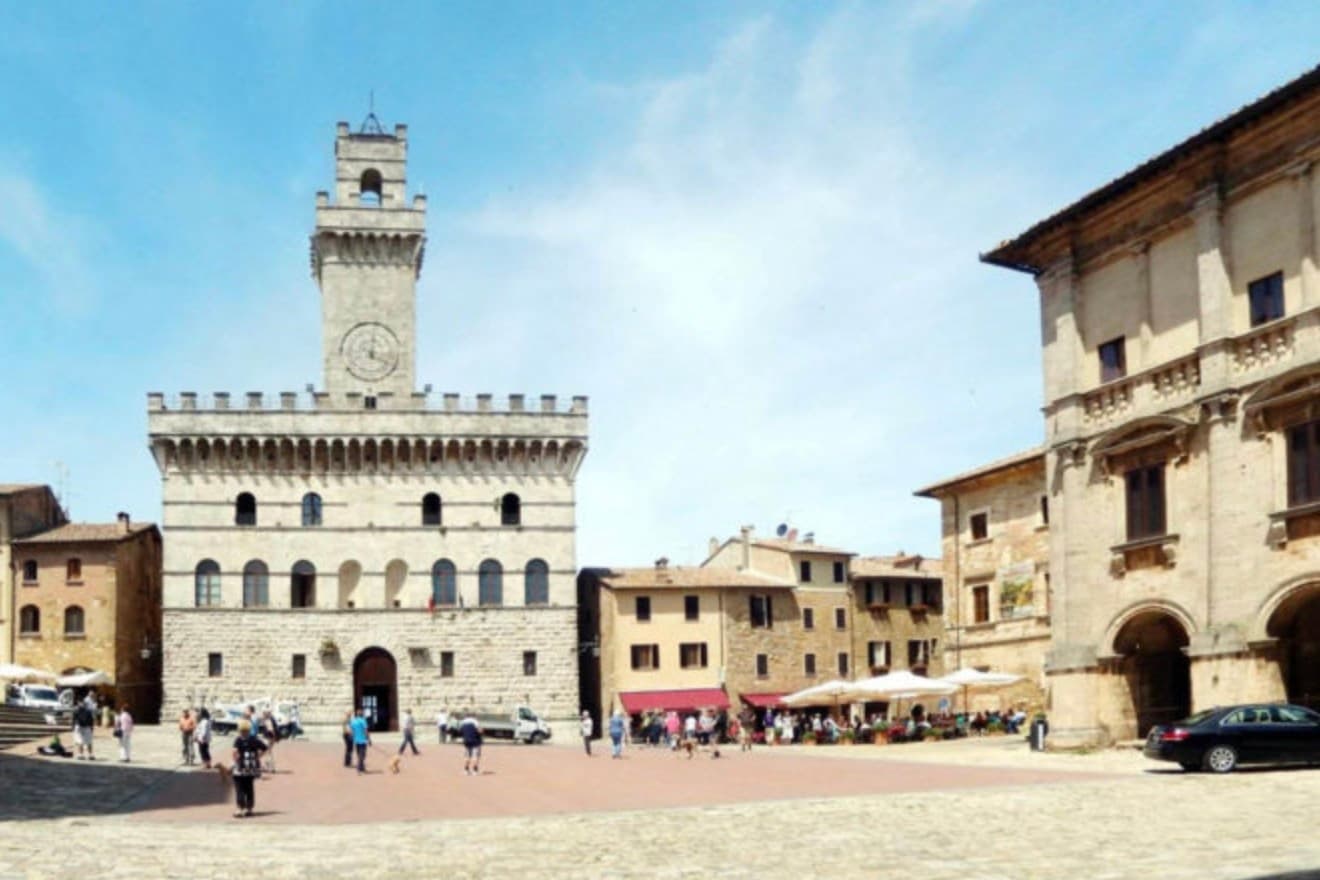
- Piazza Grande. The high piazza at the top of the ridge, ringed by the Duomo, the Palazzo Comunale and the Palazzo Tarugi, all rebuilt in the fifteenth and sixteenth centuries.
- Palazzo Comunale. Town hall designed by Michelozzo in the fifteenth century, its tower offering a view over the Val di Chiana and Val d'Orcia.
How to get to Montepulciano
There is a railway station in the town, so you can arrive without a car and never need one while you are here. Perugia is roughly 57 minutes away by road.
Our tip
April through June and September into October are the working months on the ridge: vine work in the surrounding hills, mild days, evening light that lingers over the Val d'Orcia. July and August push into the low thirties and the climb to Piazza Grande slows even the residents. The Bravìo delle Botti runs the last Sunday of August and fills the town. Calici di Stelle falls in July.
Massa Marittima
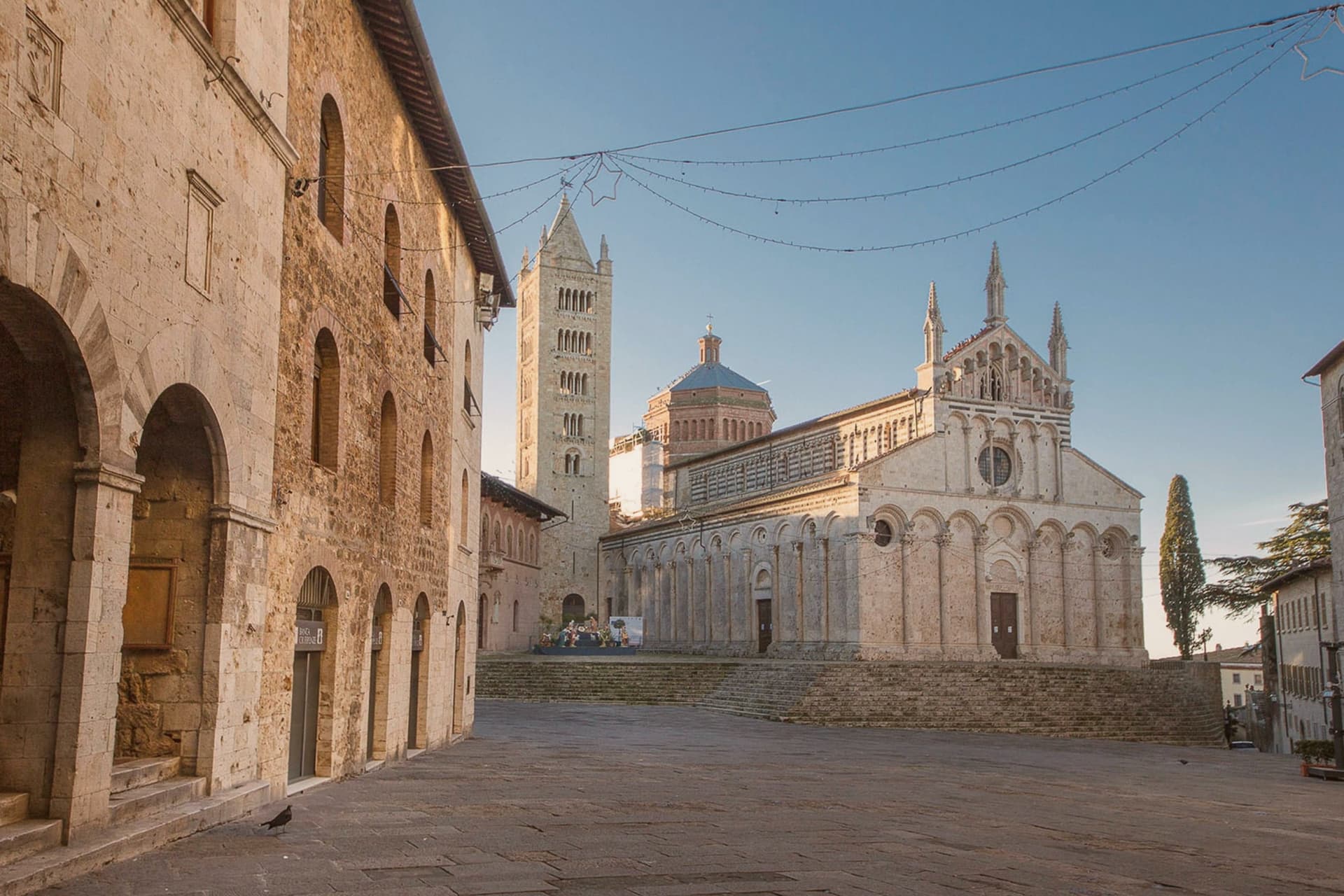
Why visit Massa Marittima
Massa Marittima sits on an isolated hill in the Colline Metallifere, the Tuscan hills that supplied copper and silver from Etruscan times. Despite the name, the sea is roughly twenty kilometers away.
The town's wealth as a free commune was built on that ore, and the buildings on Piazza Garibaldi still date from the century of its independence: the cathedral, the communal palace, the Palazzo Comunale, all raised while the mines were active. The old center keeps a medieval grid, with the Città Nuova rising above it and the watchtower marking the join between the two.
Mining gave way to tourism after the seams ran out, but the layout never had to be redrawn for cars or commerce: what stands today is largely what stood when the terzieri divided the town for its crossbow contest. The hill, the ore beneath it and the thirteenth-century square form one continuous fact: the town's shape was set by what it dug out of the ground, and its history stopped adding new layers once the ground stopped paying.
The re-enactment here is Balestro del Girifalco di Agosto a Massa Marittima, usually held in August.
What to see in Massa Marittima
- Duomo di San Cerbone. Pisan Romanesque cathedral on Piazza Garibaldi, its facade rising in tiers above the square. The Arca inside holds the saint's remains beneath carved marble figures.
- Fonti dell'Abbondanza. The vaulted fountain building where the fresco survives on the interior wall, plaster and pigment exposed after centuries hidden under whitewash.
- Palazzo del Podestà. Communal palace on Piazza Garibaldi, now housing the Museo Archeologico, with the Maestà by Ambrogio Lorenzetti among its rooms.
How to get to Massa Marittima
There is a railway station in the town, so you can arrive without a car and never need one while you are here. Livorno is roughly 95 minutes away by road.
Our tip
April through June and September into October are the months Massa Marittima opens up. The Balestro del Girifalco runs on the fourth Sunday of May and again on the second Sunday of August, and the town fills with archers in costume from the three terzieri. July and August are hot inland and the centro storico thins in the afternoon; the Tyrrhenian beaches at Follonica are half an hour away by car. Balestro del Girifalco di Agosto a Massa Marittima falls in August.
Castiglion Fiorentino
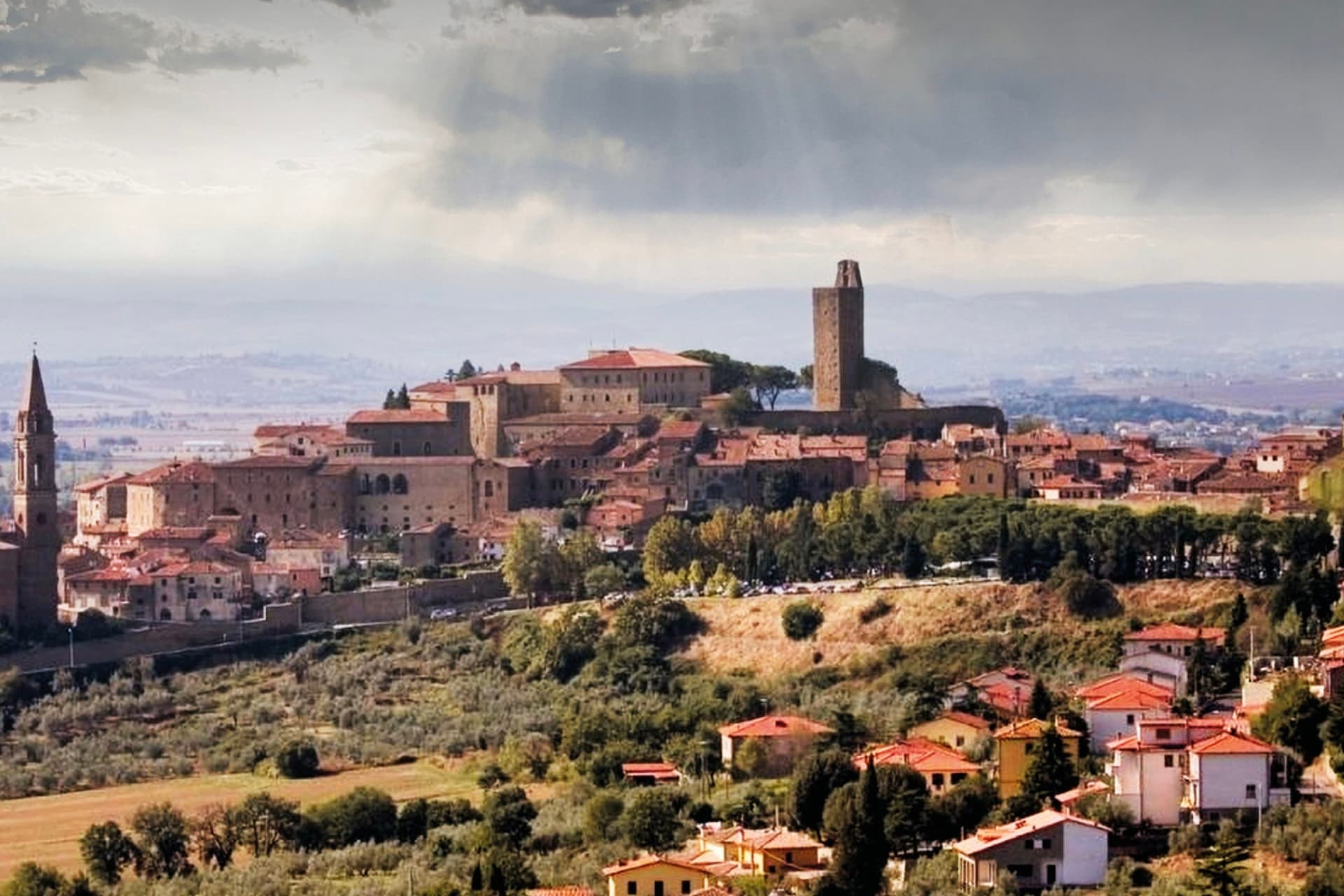
Why visit Castiglion Fiorentino
The hill stands between Arezzo and Cortona, above the fertile plain that gives the area its name. The centro storico is layered directly on what came before it: the medieval streets and the fortress at the summit sit on foundations from the fourth century BC, so walking from the lower gates to the top of the town is also a climb through the town's own construction history, one period built on the next rather than beside it.
The upper terrace holds the oldest religious building along with the fortress, while the main piazza lower down gathers the later additions, the parish church, the arcade, and the gallery, into a single civic space. The town carried allegiance first to Perugia, then to Florence from 1384, and was renamed at that moment, a change of name that marks the point where the additions to the skyline, the arcade among them, became possible.
What results is a town where the sightlines do the explaining: the arcade frames the plain because the plain was always the reason to build here, and the fortress crowns the hill because it was already fortified ground long before anyone called it that.
The re-enactment here is Palio dei Rioni di Castiglion Fiorentino (Arezzo), usually held in June.
What to see in Castiglion Fiorentino
- Cassero. Fortified core at the top of the town. The tower is reached by climbing through the streets of the centro storico, with the drop toward the plain opening out only at the top.
- Logge del Vasari. The three arches sit at the edge of Piazza del Municipio, so the arcade functions as a frame for the view rather than a monument to walk around. Below it, the Pinacoteca occupies the neighboring building.
- Pinacoteca Comunale. Civic gallery next to the Logge with works by Bartolomeo della Gatta, Margaritone d'Arezzo, Taddeo Gaddi and a notable bust reliquary in gilded silver.
How to get to Castiglion Fiorentino
There is a railway station in the town, so you can arrive without a car and never need one while you are here. Perugia is roughly 54 minutes away by road.
Our tip
April through June and September into October are the working months in the Val di Chiana: dry days, mild evenings, harvest of olives and Sangiovese into October. July and August push past thirty degrees and the plain below holds the heat; the town at 342 meters runs a few degrees cooler. The Palio dei Rioni in mid-June fills the streets with banners between the four historic quarters and a horse race in the Cassero square. Palio dei Rioni di Castiglion Fiorentino (Arezzo) falls in June.
More from Anywhere Italy
- The best wine towns with a food festival in Toscana
- The best hidden towns with a medieval festival that are worth a night in Toscana
- The best hidden towns with a food festival that have a serious restaurant in Toscana
- The best hidden towns with a medieval festival in the province of Siena
- The best towns with a food festival in the province of Siena
- The prettiest hidden villages with a serious restaurant in Toscana