
The best wine towns with a food festival in Toscana
Autumn is when Tuscan wine country stops being a view and starts being a kitchen. The vendemmia clears the rows, the cellars fill, and by late October the sagre begin: trestle tables under a stone loggia, tagliatelle turned in a pan the size of a wheel, white truffle shaved over an egg, chestnuts roasting in a drum on the corner of the piazza. The towns doing this are built from travertine and pietra serena, warm ochre in low light, cold and quiet in the hours between the two services. What is poured alongside is grown in sight of the walls, which is the whole point of the exercise.
Most people arrive in Tuscany through Florence and Siena, and both are worth the time, but the Chianti road between them carries the bulk of the wine traffic in Italy. Coach tours run tastings on a schedule, cellar doors take bookings months out, and the harvest weeks are the busiest of the year. It is a good landscape badly overloaded. The food, in high season, tends to be cooked for people who will not come back.
The same soils, the same grape and the same appetite continue south and east, into the Val d'Orcia and the Val di Chiana, up onto Monte Cetona, and west to where the Maremma hills meet the Tyrrhenian. These towns hold a place in the national wine association and each runs a recurring festival on one ingredient, which means a fixed weekend when the town cooks for itself and outsiders are simply welcome. Fewer people go. The tables are longer and the wine is closer to home.
Of the 84 communes we have mapped in Toscana, 12 qualify as wine towns with a food festival: each belongs to the national association of wine towns, and each holds a recurring food festival built around one local ingredient. This list is 10 of them. The smallest, San Casciano dei Bagni, has 1,500 residents.
Two more lists worth reading alongside this one: The best hidden towns with a food festival that have a serious restaurant in Toscana and The best hidden wine towns with a medieval festival in Toscana.
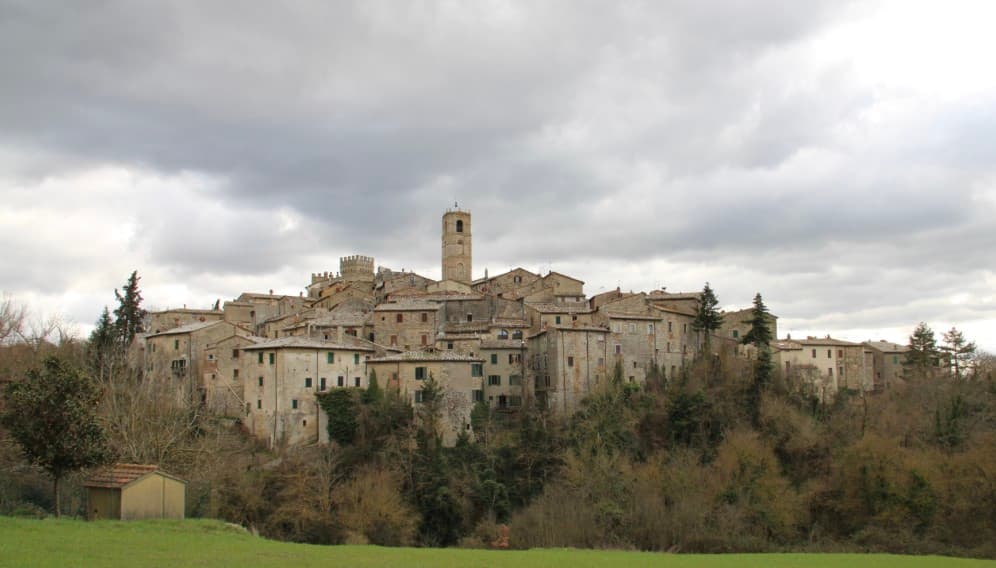
San Casciano dei Bagni
Why visit San Casciano dei Bagni
San Casciano dei Bagni sits at 582 meters at the southern edge of the province of Siena, above 42 hot springs that average 42 degrees Celsius. The baths were used continuously from Etruscan through Roman times and again from the Renaissance, when visitors came from across Europe.
In 2022, an excavation that began in 2019 at the ancient sanctuary turned up 24 bronze votive statues protected by mud, with around 6,000 coins in gold, silver and bronze. The find was the largest of its kind in fifty years; most surviving Etruscan votive material is terracotta.
The 1,500 residents live on a basalt outcrop above the Roman thermal complex, in a centro storico of stone houses and three small churches. The borgo joined the Borghi più belli network in 2014 and remains one of the smallest communes in Toscana to carry both that label and Bandiera Arancione.
The re-enactment here is Palio di San Cassiano di San Casciano dei Bagni, usually held in August.
What to see in San Casciano dei Bagni
- Santuario Ritrovato. Etruscan-Roman thermal sanctuary excavated since 2019, where 24 bronze votives and around 6,000 coins were recovered in 2022.
- Bagno Grande. The principal natural pool of the 42 hot springs, used from the second century BC through the Renaissance and reopened to the public.
- Collegiata di San Leonardo. Romanesque parish church in the centro storico, restored in the seventeenth century, with a baptismal font carved from local travertine.
How to get to San Casciano dei Bagni
Perugia is roughly 68 minutes away by road.
Our tip
The thermal pools make the calendar different here. Winter is the season many visitors prefer, when the 42-degree water steams against cold air and snow occasionally dusts the basalt outcrop. April through June and September into October are the most balanced months: warm hill light, the dry-stone walls of the borgo at their best, the sanctuary excavations open to guided tours. Sagra del Ciaffagnone di San Casciano dei Bagni falls in June.
Montescudaio
Why visit Montescudaio
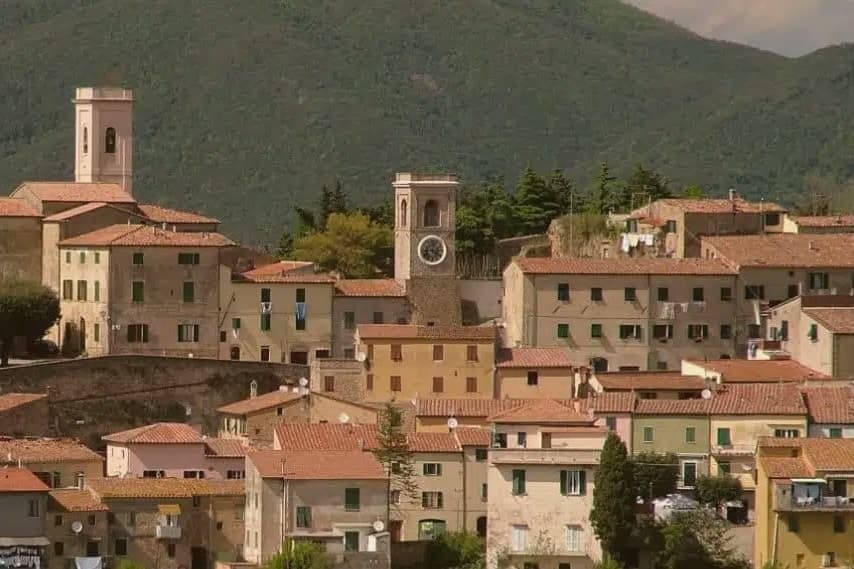
Montescudaio sits fifteen kilometers inland from the Tyrrhenian coast, on a hill above the valley the Cecina river cuts toward the sea. Fewer than 2,200 people live in the commune, and most of them are outside the centro storico, which is left as a tight knot of stone houses ringed by its old walls: a single church, the clock tower, and the terrace where the vines drop downhill toward the Val di Cecina and the water beyond.
The town carries four institutional signals at once, an unusual density for its size: a registered wine appellation, a bread-network membership rare in this part of Tuscany, a name that predates the medieval walls, and the walls themselves built around an eleventh-century abbey. Wine and bread are both grown and baked around the same hilltop that once needed fortifying.
The fortress, the loaf, and the vineyard are not three separate stories here but three uses of the same ground, worked over centuries after the shields it was named for stopped being necessary.
What to see in Montescudaio
- Centro storico. Walled medieval village, a tight ring of stone houses on the hilltop, built around the abbey that gave the settlement its first walls and structure.
- Torre Civica. Clock tower at the entrance to the borgo, the tallest visible structure and former civic landmark of the fortified village.
- Chiesa di Santa Maria Assunta. Eleventh-century parish church on the site of the medieval abbey, the anchor around which the walled village took shape.
How to get to Montescudaio
Livorno is roughly 44 minutes away by road.
Our tip
May through September is the season on the Cecina hills: dry days, vine work, harvest from late August through September. The coast lies fifteen kilometers west and the sea breeze keeps evening temperatures lower than the inland Maremma. July and August bring crowds to the beaches at Cecina and Marina di Bibbona, but the borgo on the hill stays quieter. Festa del Vino di Montescudaio falls in October.
Cetona
Why visit Cetona
The town sits on the western flank of a ridge at the meeting point of Toscana, Umbria and Lazio, where the mountain divides the Val d'Orcia from the Val di Chiana. The medieval comune passed between Siena, Orvieto and Perugia before falling to Siena in the late fourteenth century, and it was Cosimo I who later sold it whole to a marchese.
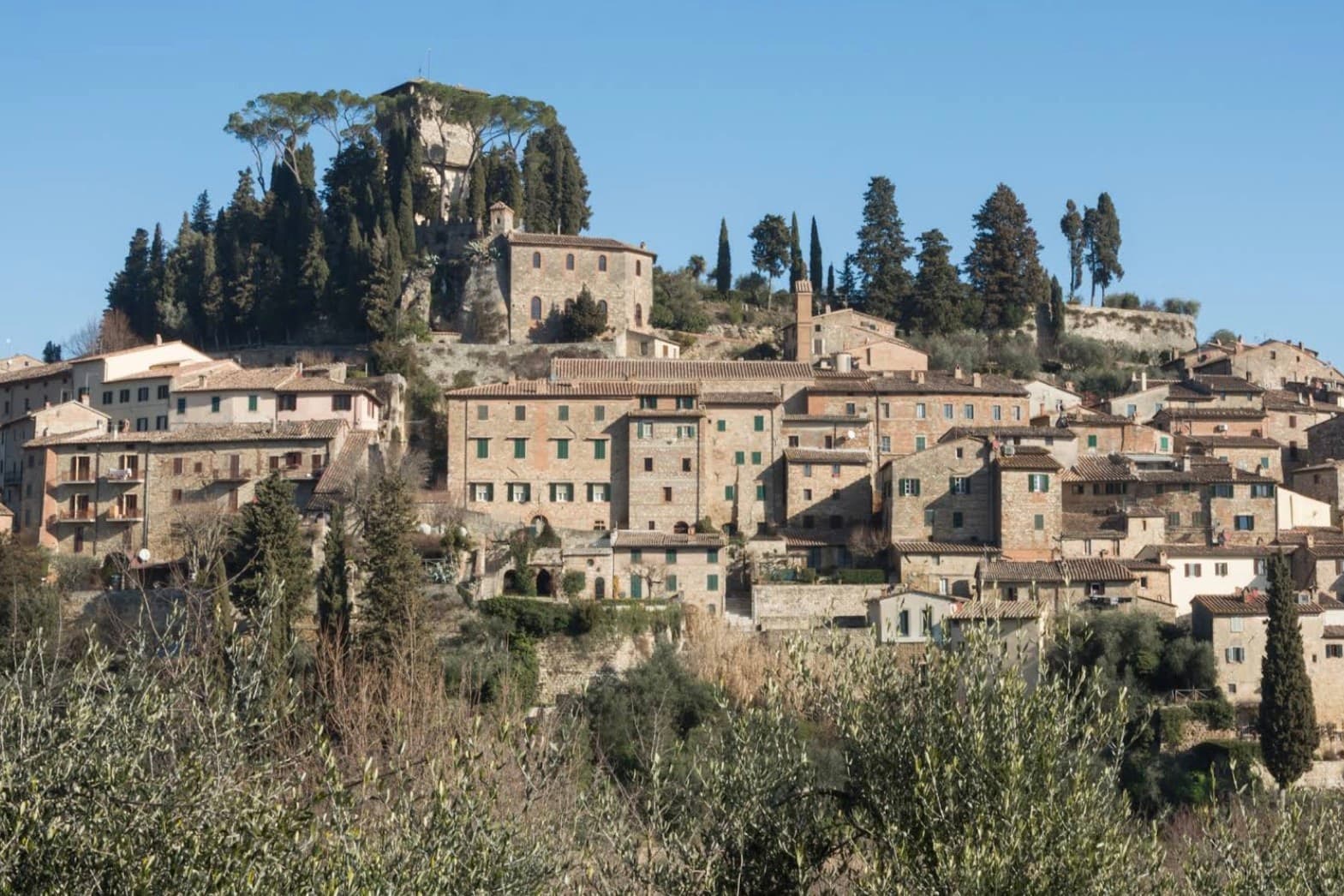
The fortress at the top of the grid and the square laid out below it are two halves of the same Renaissance move: a private residence replacing a garrison at the summit, a flat civic stage opened up at the base. Above the town, in the woods, the hermitage and the caves belong to a much older layer, human use of the mountain reaching back to the Mesolithic, long before any comune or marchese laid claim to it.
What the town adds up to is a settlement built in tiers: a prehistoric mountain, a contested medieval center, and a Renaissance overlay that reorganized the base of the hill without touching what stood above it.
The re-enactment here is Corsa delle brocche a Cetona, usually held in July.
What to see in Cetona
- Piazza Garibaldi. Elliptical square at the foot of the medieval grid, flat and open where the streets above it climb steeply. The civic stage of the borgo, still the first thing that orients a visitor.
- Rocca di Cetona. Fortress at the top of the centro storico, its walls and keep still standing though the interior became a private residence rather than a garrison.
- Convento di San Francesco. Franciscan convent below the borgo, founded in 1212, with a single-nave church and a small cloister still in religious use.
How to get to Cetona
Perugia is roughly 78 minutes away by road.
Our tip
April through June and September into October are the months Cetona keeps its calmest pace, the wooded slopes of Monte Cetona green or rust depending on the half. July and August are hot in the centro storico but the mountain trails above 800 meters stay cool. The Mostra del Tartufo, dedicated to the local white truffles, runs the second weekend of November in Piazza Garibaldi. Sagra del Bico di Cetona falls in June.
Capalbio
Why visit Capalbio
Capalbio stands twelve kilometers from the Tyrrhenian coast, the last hill town before the border with Lazio. Charlemagne gave the land to the Abbey of Tre Fontane in 805; the Aldobrandeschi held it through the medieval period, the Orsini built the castle, and Cosimo I de' Medici took it in 1555.
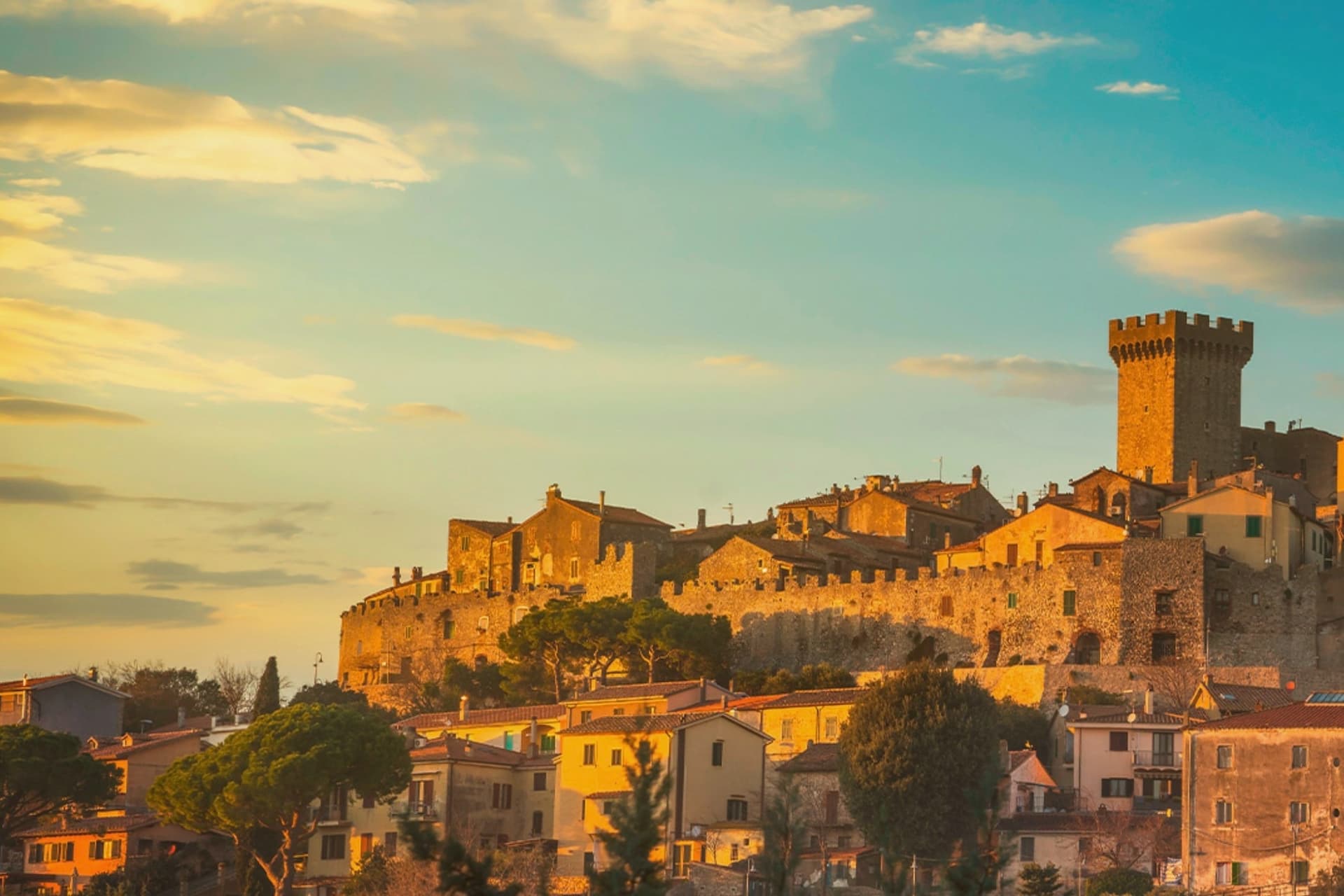
It became an independent commune in 1960. The medieval walls and the fortress define the centro storico at the top of the hill; the surrounding territory drops from the wooded uplands of Monte Calmata down to the coastal reserve at Lago di Burano.
The sculpture park sits four kilometers south of the walls, apart from the old town rather than within it. A borgo that governed itself late, held by abbey, feudal lords and Medici in turn before its own commune, and a territory that runs in one line from hilltop stone to coastal wetland.
What to see in Capalbio
- Rocca Aldobrandesca. Medieval fortress at the top of the borgo, later expanded by the Orsini, with a square tower and battlements that overlook the Maremma.
- Mura medievali. Two concentric circles of walls enclosing the centro storico, with a walkable parapet that opens onto views toward the Argentario.
- Giardino dei Tarocchi. Sculpture park four kilometers south of the borgo, its ceramic and mirrored figures set among holm oaks.
How to get to Capalbio
There is a railway station in the town, so you can arrive without a car and never need one while you are here. Roma is roughly 108 minutes away by road.
✷ We have written about Capalbio
“Everyone driving from Florence down to Rome crosses the Maremma without noticing, because there is nothing on that stretch to make them slow down. The hills give out. The cypresses stop. What opens up instead is flat open country, wheat and grass running off to a few low rises, the least Tuscan-looking part of Tuscany, a landscape you would call dull if you were being honest and which most guidebooks solve by leaving out.”
Read our piece on Capalbio →Maremma | The Last Cowboys of Tuscany
Our tip
May through September is the season the borgo and its territory work together: the centro storico stays cool at 217 meters while the Tyrrhenian coast at Chiarone-Capalbio fills with swimmers. The Giardino dei Tarocchi runs April through October. July and August are hot inland; afternoon hours in the borgo thin out and the coast takes over. Sagra del Cinghiale falls in September.
Montalcino
Why visit Montalcino
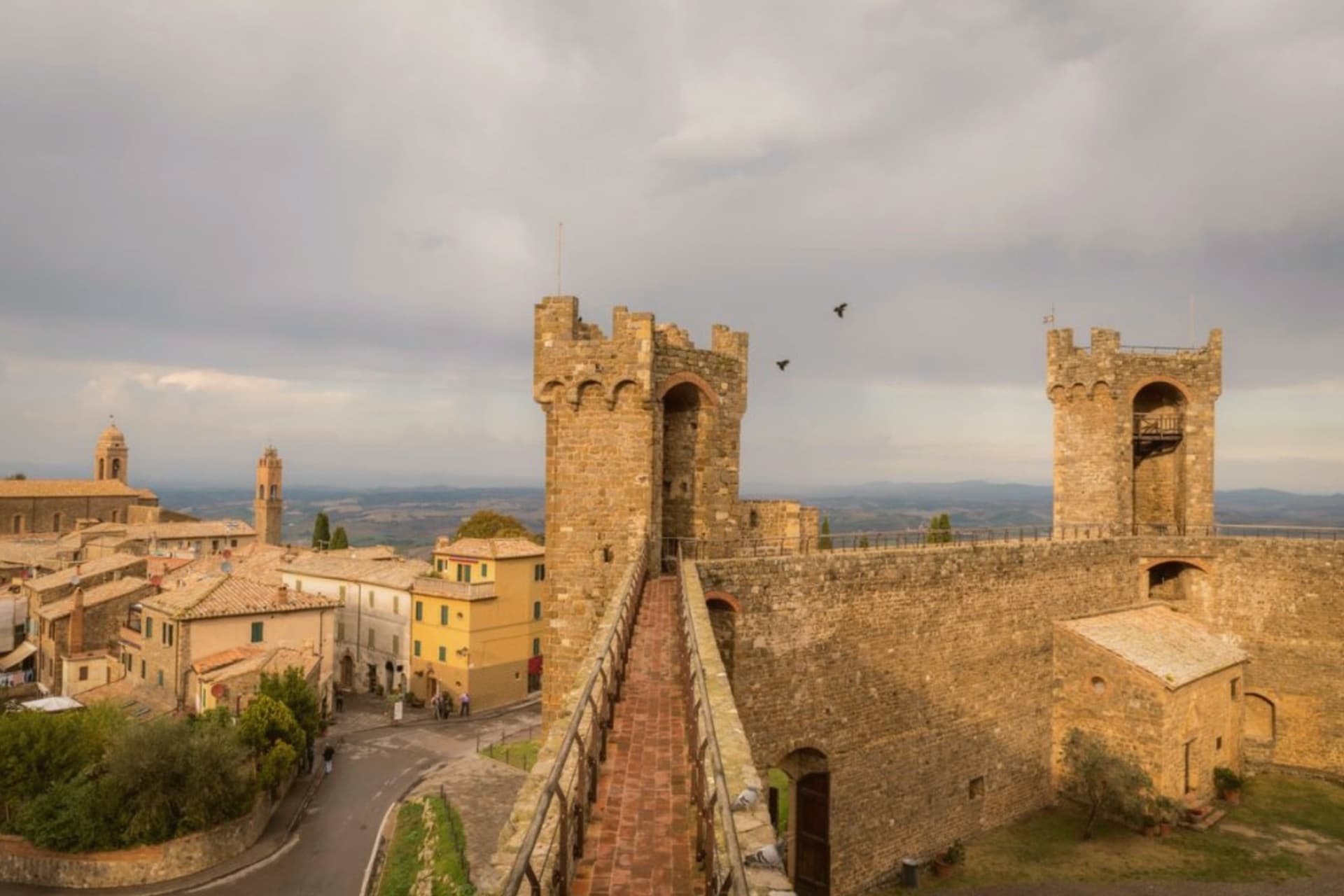
Montalcino sits at 564 meters on a hill south of Siena, the centro storico ringed by walls and crowned by a pentagonal fortress built in 1361. When Florence took Siena in 1555, the Sienese exiles regrouped here and held out for almost four years; the Rocca itself never fell.
That date matters less to most visitors than 1980, when Brunello di Montalcino was named one of the first four Italian wines to receive DOCG status. The vineyards run from the town at 600 meters down to plots at 200, on stony galestro soils that ripen Sangiovese Grosso into a wine that ages for decades.
The Abbey of Sant'Antimo, ten kilometers south, is a Romanesque church first documented in 814 and tied by local legend to a vow by Charlemagne. The town also produces miele, olio, and the white truffles of the surrounding woods.
It carries seven institutional signals at once, more than any other commune in this batch.
The re-enactment here is Torneo di Apertura delle Cacce a Montalcino, usually held in August.
What to see in Montalcino
- Rocca di Montalcino. Pentagonal fortress built in 1361 by Sienese architects Mino Foresi and Domenico di Feo, refuge of the Sienese Republic after 1555.
- Abbazia di Sant'Antimo. Romanesque abbey ten kilometers south, first documented in 814, set among olive groves below the town with Gregorian chant still sung.
- Palazzo dei Priori. Thirteenth-century town hall on Piazza del Popolo, slender tower attached, civic seat of the medieval commune.
How to get to Montalcino
There is a railway station in the town, so you can arrive without a car and never need one while you are here. Perugia is roughly 105 minutes away by road.
✷ We have written about Montalcino
“When the film industry needed a picture of heaven, of the fields a dead hero walks home to, they came and shot it here, and that is the truest thing anyone has ever said about the Val d'Orcia. It is not a place. It is the afterlife as imagined by people who lived in cities. It is how the country looks to men who never spent an hour in it, dreamed up by Florentine bankers five hundred years ago and maintained, beautifully, ever since.”
Read our piece on Montalcino →Val d'Orcia | The Postcard Is Constructed
Our tip
April through June and September into October are the months locals prefer. The hills are green or gold depending on the half, and the vineyards run their full work cycle. The Sagra del Tordo, a medieval archery contest between the four quarters of the town, takes place the last Sunday of October. Sagra del Cinghiale di Montalcino falls in the season.
Manciano
Why visit Manciano
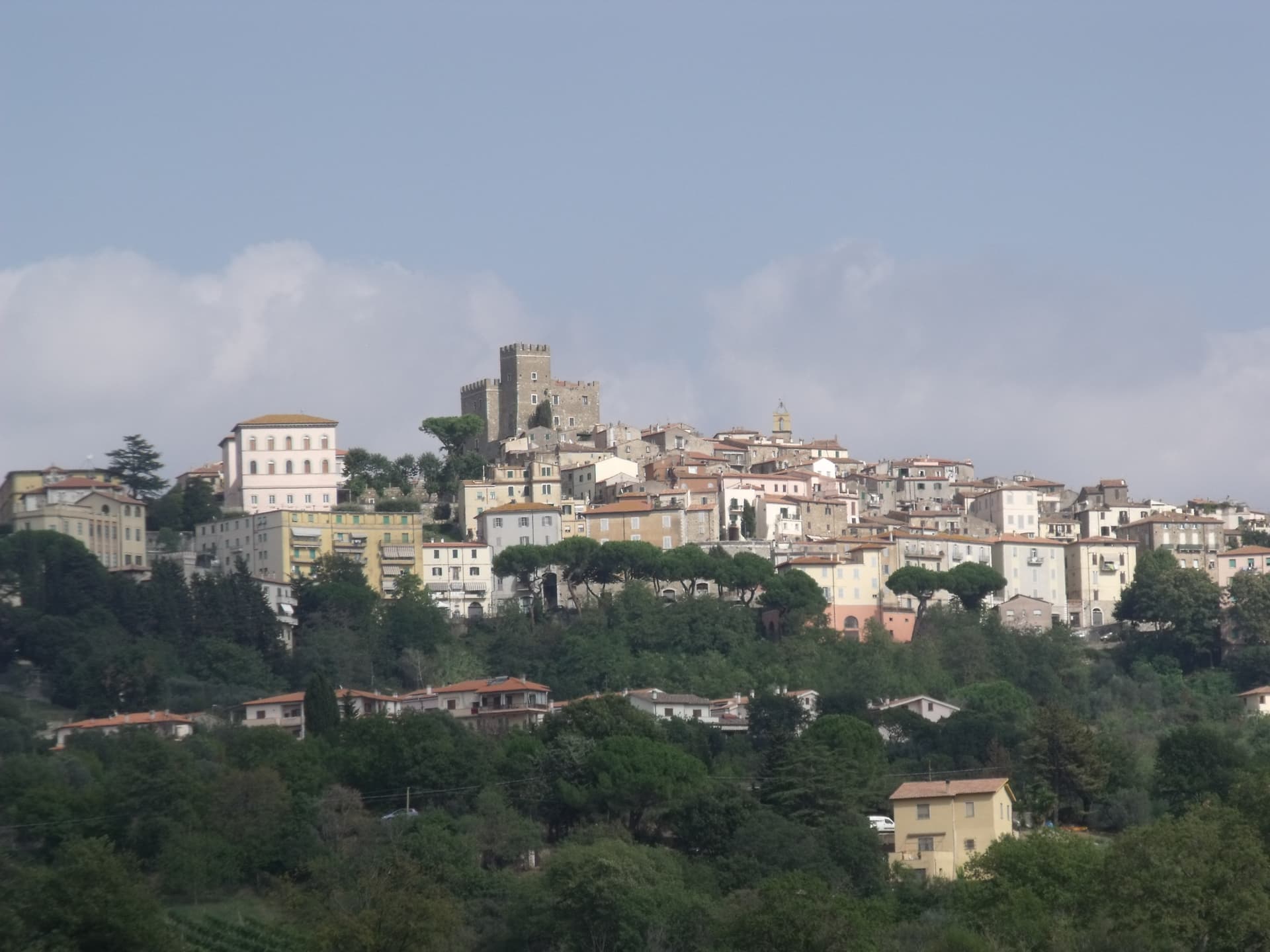
Manciano sits at 444 meters on a hill in the southern Maremma grossetana, with a 360-degree view that runs from Monte Amiata north to the Tyrrhenian coast. The Aldobrandeschi held the original stronghold from the twelfth century.
Siena occupied the town between 1419 and 1455 and built the Rocca that still dominates the centro storico, a square keep with battlements on a shoe-base. After 1455 it returned to local rule and passed eventually to the Medici Grand Duchy.
The comune is large by Toscana standards and includes some of the best-known places of the southern Maremma: Saturnia, the Etruscan town built around its sulphurous hot springs, and Montemerano, a small walled borgo on the road to the Lago di Bolsena. The Albegna and Fiora valleys, which the town once served as a regional market, still meet at its foot.
Wine, olive oil and wild boar work the territory in roughly the order they sit on a Maremmano menu.
The re-enactment here is Palio delle Botti di Manciano, usually held in August.
What to see in Manciano
- Rocca Aldobrandesca. Sienese fortress of 1424 on Aldobrandeschi foundations, square keep, walls with battlements and a solid shoe-base, dominating the centro storico.
- Saturnia. Etruscan town and frazione south of Manciano, with medieval walls, remains of a Roman road and the sulphurous hot springs used since antiquity.
- Montemerano. Small walled borgo east of Manciano, three concentric circles of streets and a fifteenth-century Madonna della Gattaiola in the parish church.
How to get to Manciano
Terni is roughly 132 minutes away by road.
Our tip
April through June and September into October are the months Manciano shows the southern Maremma at its best, the territory dry but green, the Saturnia pools warm against cool mornings. The Sagra dell'Anatra runs in mid-August. July and August are hot at 444 meters but easier than the coast; afternoons in the centro storico empty between two and six. Palio delle Botti di Manciano falls in August.
Montepulciano
Why visit Montepulciano
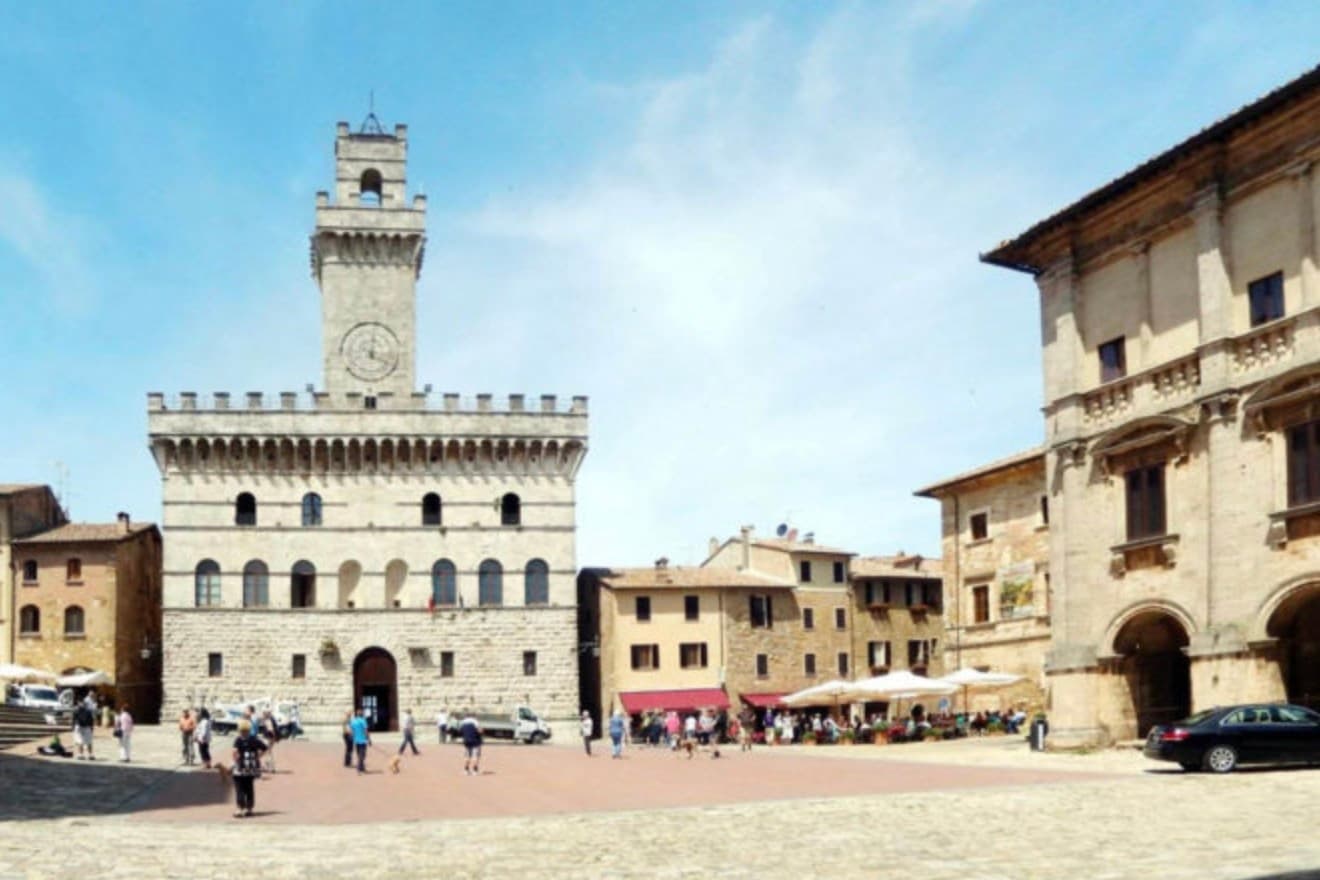
The ridge runs between the Val di Chiana and the Val d'Orcia, 70 kilometers southeast of Siena, and the town follows its spine uphill: streets climb from the gates toward the high point, where the main square sits ringed by the buildings that define the skyline from below. The origin predates the Renaissance fabric by centuries.
Etruscan tombs survive in the surrounding hills, though almost nothing of that period shows in the centro storico itself, which was rebuilt wholesale in the fifteenth and sixteenth centuries over whatever came before. The wine and the festival both use the climb as their setting rather than their subject: the cellars are cut into the rock beneath the palazzi, keeping a constant temperature for aging, and the barrel race each August sends two men from each of the eight contrade hauling an eighty-kilogram cask up the same gradient that every visitor covers on foot, only slower.
The steepness that shaped the defensive site nine centuries ago is still what a person feels first, in the legs, before the buildings register at all.
The re-enactment here is Bravio delle Botti, usually held in August.
What to see in Montepulciano
- Tempio di San Biagio. A 13-meter dome and travertine façade standing alone outside the walls, the ground falling away below it so the building reads as a single volume against the hillside.
- Piazza Grande. The high piazza at the top of the ridge, ringed by the Duomo, the Palazzo Comunale and the Palazzo Tarugi, all rebuilt in the fifteenth and sixteenth centuries.
- Palazzo Comunale. Town hall designed by Michelozzo in the fifteenth century, its tower offering a view over the Val di Chiana and Val d'Orcia.
How to get to Montepulciano
There is a railway station in the town, so you can arrive without a car and never need one while you are here. Perugia is roughly 57 minutes away by road.
Our tip
April through June and September into October are the working months on the ridge: vine work in the surrounding hills, mild days, evening light that lingers over the Val d'Orcia. July and August push into the low thirties and the climb to Piazza Grande slows even the residents. The Bravìo delle Botti runs the last Sunday of August and fills the town. Calici di Stelle falls in July.
Piombino
Why visit Piombino
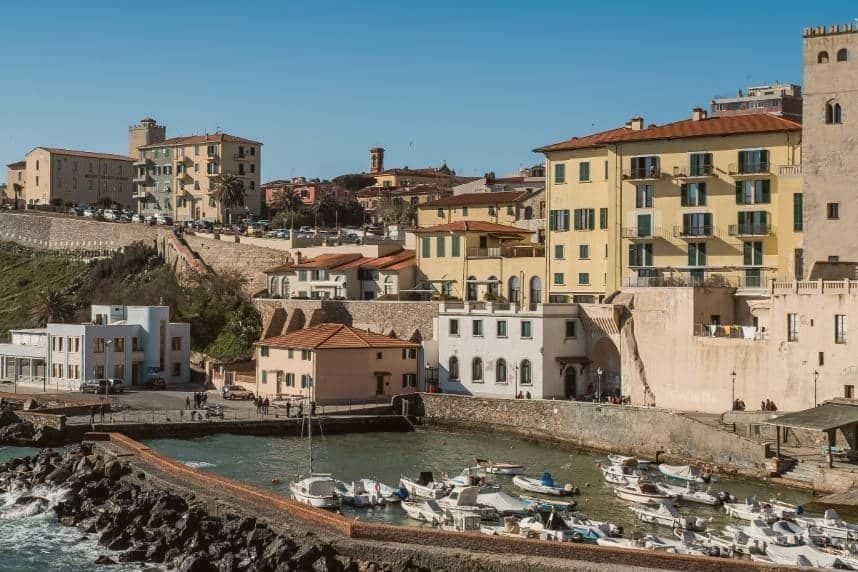
Piombino sits on a triangular promontory pointing southeast into the Tyrrhenian, at the northern edge of the Maremma. The town was founded in the ninth century by refugees from the Etruscan port after Greek pirates attacked the city; they called the new settlement Populino, small Populonia, and the name shortened over time to what it is now.
The old city, now a frazione north on the coast, became the source of the newer town's name rather than the other way round. In the medieval period Piombino became an independent signoria under the Appiani, who ruled from here over a small state that reached out to the islands across the water.
The castle at the seafront, the piazza cantilevered out over the cliff toward Elba, and the working ferry port make up the contemporary town, each looking the same direction the refugees once looked back from: toward the older settlement to the north and the channel to the islands beyond it. The Bandiera Blu coast covers the four kilometers between the port and the old acropolis, so that the walk from new town to old runs along the same shoreline that separates them by name only.
What to see in Piombino
- Castello di Piombino. Principal defensive fortress of the city on a headland pointing southeast into the sea, with the Torrione, the Rivellino and the Cittadella complex, now a museum.
- Piazza Bovio. Long rocky breakwater extending into the sea as La Rocchetta, terraced as a piazza, with a balcony view across the channel to Elba.
- Parco Archeologico di Baratti e Populonia. Chamber tombs from the seventh to second centuries BC cut into the ground of the Gulf of Baratti, laid out for walking among the excavated structures rather than viewed from a distance.
How to get to Piombino
There is a railway station in the town, so you can arrive without a car and never need one while you are here. Livorno is roughly 77 minutes away by road.
✷ We have written about Piombino
“That is the thing the young man on the beach did not see, and the man who lives here cannot stop seeing. This is an industrial coast wearing a beach towel. Run it back far enough and the whole of it, the swamp and the steel and the slag and the white water, is one long story about iron, and the holiday is the costume the story put on after the work ran out.”
Read our piece on Piombino →The Iron Coast | The Wrong Sea
Our tip
May, June, September and October are the months when the Piombino promontory is at its best, sea warm enough to swim and the ferry to Elba running every hour without the August crush. July and August are full season, with the centro storico filling by late morning and the Baratti beach turning over twice a day. November through March is cold and windy on the promontory, with limited ferry crossings and many seaside trattorie closed. Sagra del Pesce - Piombino falls in July.
Chiusi
Why visit Chiusi
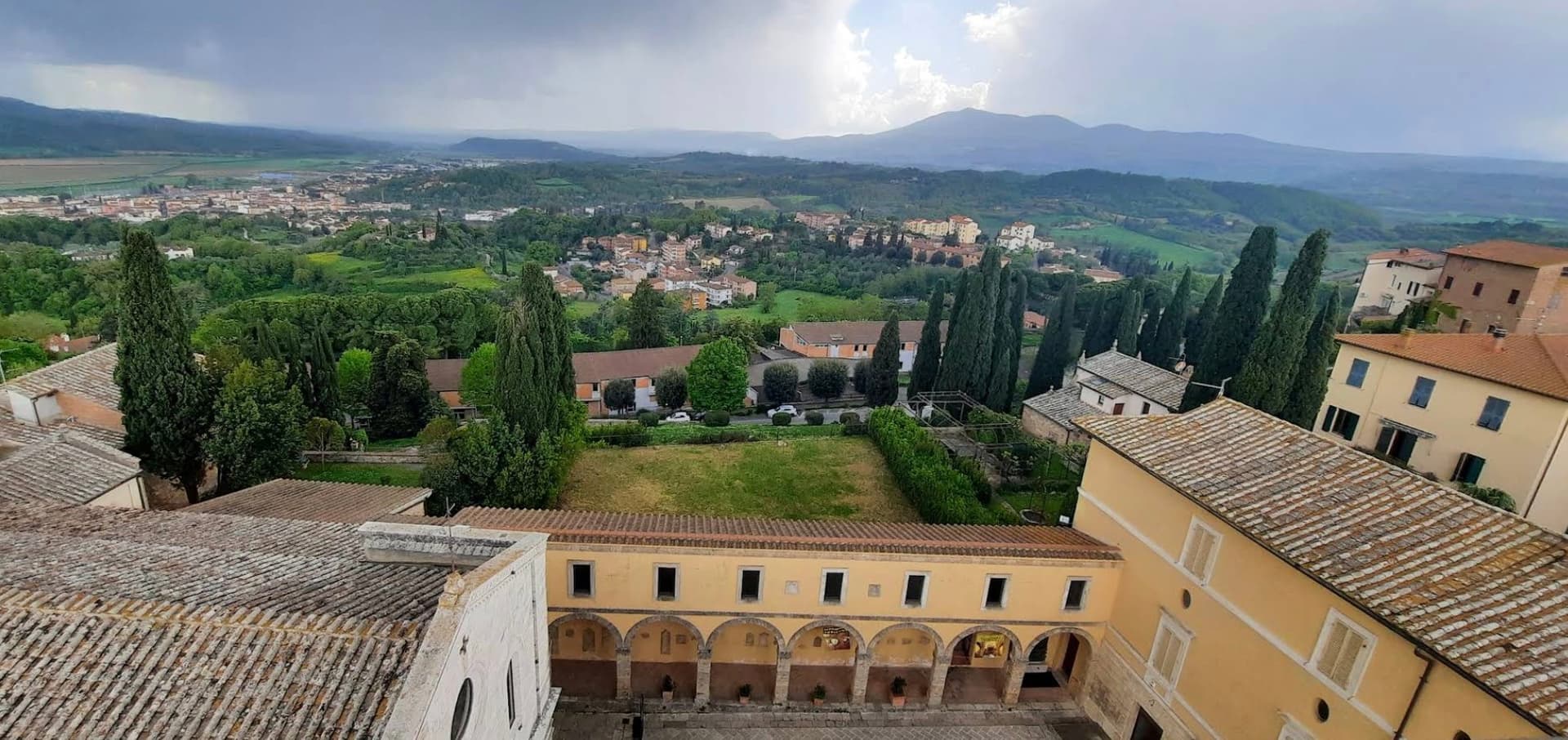
The hilltop stands above the Val di Chiana, the valley floor visible from the town at a height that made it defensible and gave it command of the surrounding farmland. The cathedral, the museums and the tunnel network are close enough to walk between within the old center, while the painted necropolis and the lake lie outside it, a few kilometers apart in different directions, one inland toward the tombs and the other north toward open water.
The tunnels themselves connect the upper town to what lies beneath it: built as drainage, later folded into legend by Pliny the Elder, who took them for part of a king's tomb. The cathedral's own columns, lifted from earlier Roman buildings, make the same point in stone that the tombs make in paint and the museum makes in bucchero and alabaster: this is a town built repeatedly on top of itself, each layer reusing what the last one left behind.
The re-enactment here is Tria Turris Medioevo e Palio delle Torri di Chiusi, usually held in June.
What to see in Chiusi
- Museo Nazionale Etrusco. Holds canopic urns, alabaster sarcophagi, bucchero pottery and grave goods pulled from the necropolises around the town.
- Duomo di San Secondiano. Cathedral built around 560 AD over an earlier basilica, renovated in the thirteenth century, nave and two aisles on antique marble columns from Roman buildings.
- Labirinto di Porsenna. Visited from the Museo della Cattedrale, the tunnels run beneath the streets at a scale that still reads as engineering rather than legend, whatever Pliny made of them.
How to get to Chiusi
There is a railway station in the town, so you can arrive without a car and never need one while you are here. Perugia is roughly 58 minutes away by road.
Our tip
April through June and September into October are the working months on the Val di Chiana edge: mild days, evening light over the lake, the wine and olive cycles below town. The Frittellata of San Giuseppe in mid-March and the Festa di San Mustiola in early June fill the centro storico with traditional kitchens. July and August push past thirty degrees and the basin below town holds the heat; the museums and the Labirinto stay cool. Tria Turris Medioevo e Palio delle Torri di Chiusi falls in June.
Carmignano
Why visit Carmignano
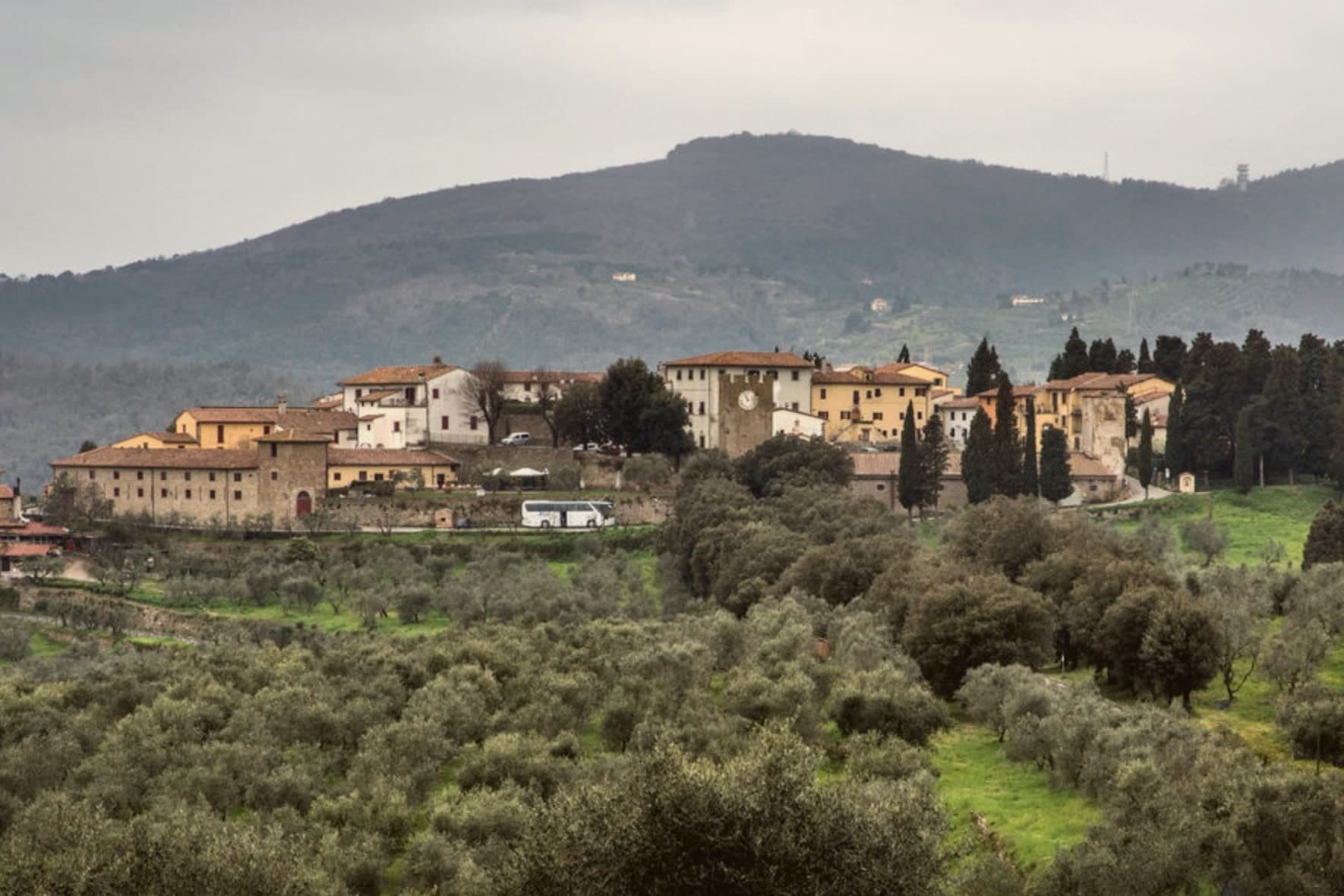
Carmignano sits at 189 meters on the Montalbano hills, twenty kilometers west of Florence and ten southwest of Prato. The commune is built from separate frazioni rather than a single center: Artimino occupies the ridge above, Comeana lies apart with its own tombs, and the town itself holds the parish church at the lower elevation.
This layout puts a Renaissance villa, a pair of seventh-century BC tombs and a working wine appellation within the same small commune without any of them sitting next to each other. The vines of the Carmignano DOCG cover the same Montalbano slopes that were occupied first by the people who built the tombs at Comeana and later by the Medici, so the landscape reads as continuous use of one hillside across the centuries rather than as separate attractions laid on top of it.
Few communes this size hold a Medici villa, a seventh-century BC necropolis and a wine appellation across three distinct frazioni, each still doing what it was built or planted for.
What to see in Carmignano
- Visitazione di Pontormo. Painted for the Pinadori family and still in place in the parish church of San Michele e San Francesco, the panel hangs where it was installed, a late Mannerist work seen in the setting it was made for rather than in a museum.
- Villa Medicea La Ferdinanda. The villa sits on the ridge above Artimino, its roofline broken by the chimneys that give it its nickname, looking out over the same slopes planted with vines below.
- Tumulo di Montefortini. Monumental Etruscan tomb at Comeana from the seventh century BC, 11 meters high and 60 in diameter, with two intact chambers visited through a corridor.
How to get to Carmignano
Prato is roughly 25 minutes away by road.
Our tip
April through June and September into October are the working months on the Montalbano: vine work in the surrounding hills, mild days, evening light over the Arno plain. Harvest runs from mid-September through October. July and August push into the low thirties and Florence twenty kilometers east bakes harder than the ridges here. Festa di San Michele a Carmignano falls in September.
More from Anywhere Italy
- The best hidden towns with a food festival that have a serious restaurant in Toscana
- The best hidden wine towns with a medieval festival in Toscana
 The 10 prettiest villages with a food festival in Toscana
- The best towns with a food festival in the province of Siena
 The best small towns with a food festival in Toscana
- The best hidden towns with a medieval festival that are worth a night in Toscana