
Without a car
Abruzzo by train
32 towns
Towns in this region where we confirmed an active station. Check the timetable before you go: a station on the map is not the same as a useful service.
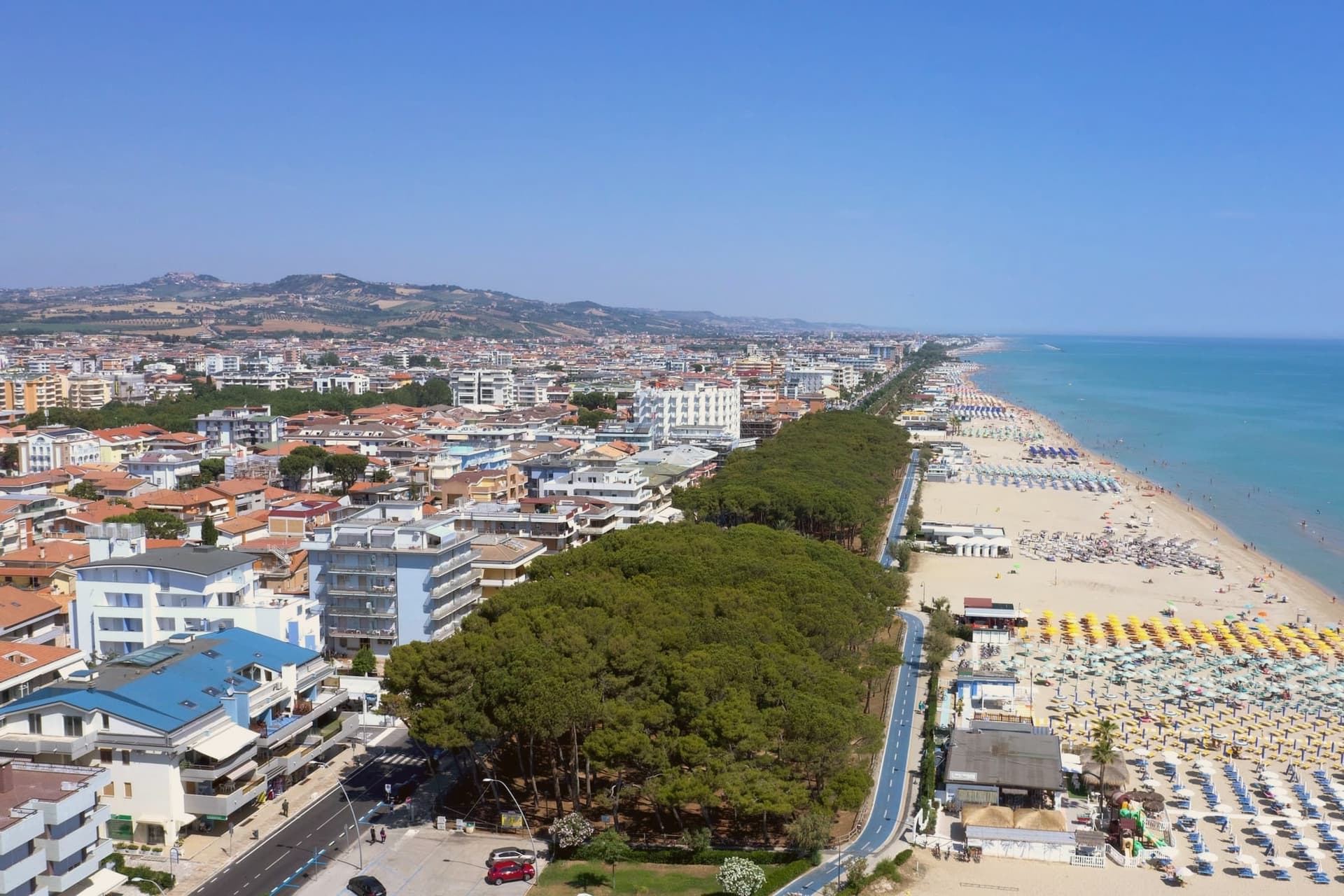
Alba Adriatica
Province: Teramo · 5 m
The northernmost of the Teramo coast's seven sisters, a 1956 spin-off from Tortoreto with a fine-sand beach known as the Spiaggia d'Argento.
Anversa degli Abruzzi
Province: L'Aquila · 604 m
At 604 meters above the Sagittario Gorges, a cliff village built around a Norman castle rebuilt by the Counts of Sangro.
Archi
Province: Chieti · 492 m
A 492-meter rocky spur called the Terrazza sul Sangro, fief of del Balzo, Cantelmo, Colonna and Carafa, now Città del Tartufo and Città dell'Olio.
Balsorano
Province: L'Aquila · 359 m
A pentagonal fortress above the Liri river that became a backdrop for 1970s Italian horror cinema.
Campo di Giove
Province: L'Aquila · 1,064 m
At 1,064 meters under the southwestern Maiella, the highest village in the park, named for a Roman temple to Jupiter.
Capistrello
Province: L'Aquila · 734 m
At 734 meters where the upper Liri valley meets the Marsica, the village where an emperor's tunnel emptied a lake into a river.
Carsoli
Province: L'Aquila · 616 m
A 616-meter mountain town in the Marsica, built next to the ruins of a 4th-century BC Roman fortress town.
Castel di Sangro
Province: L'Aquila · 805 m
At 805 meters where the Sangro meets the Zittola, a Samnite-Roman town whose amateur football club reached Serie B and whose hilltop was fought over in 1943.
Civita d'Antino
Province: L'Aquila · 904 m
At 904 meters above the Roveto valley, the ancient Marsi town that became a Danish painters' colony from 1883 until the 1915 earthquake.
Controguerra
Province: Teramo · 267 m
A 267-meter hill village whose name is legal shorthand for a small Montepulciano and Trebbiano-Passerina DOC.
Crecchio
Province: Chieti · 209 m
A 209-meter hill town between the Adriatic and the Maiella, capital of Italy for one night in 1943 when the king slept in its castle.
Fossacesia
Province: Chieti · 142 m
A hill town above the Costa dei Trabocchi whose Benedictine abbey, San Giovanni in Venere, stands on the site of a Roman temple and looks straight down the coast.
Giulianova
Province: Teramo · 68 m
Coastal town split between hilltop Paese at 68 meters and the Lido below, one rebuilt as a Renaissance ideal city, the other grown around a working fishing fleet.
Goriano Sicoli
Province: L'Aquila · 720 m
At 720 meters in the Subequana valley, a medieval village drawn by M.C. Escher in 1929 keeps a May ritual folklorists trace to Demeter.
Guardiagrele
Province: Chieti · 576 m
The 576-meter terrazza d'Abruzzo on the Majella's foothills, hometown of fifteenth-century goldsmith Nicola da Guardiagrele and seat of the Majella park.
L'Aquila
Province: L'Aquila · 721 m
The regional capital at 721 meters, founded by Frederick II around 1240 and still reconstructing after the 2009 earthquake.
Loreto Aprutino
Province: Pescara · 290 m
A hilltop town at 290 meters in the Aprutino olive country, with a fourteenth-century Judgment fresco and a Castelli majolica collection.
Manoppello
Province: Pescara · 257 m
A hill town above the Pescara river, custodian since 1620 of the byssus veil known as the Volto Santo.
Ortona
Province: Chieti · 72 m
A working Adriatic port under an Aragonese castle, where the cathedral holds relics venerated as those of the apostle Thomas and the ridge above the harbour was fought over street by street in December 1943.
Pescina
Province: L'Aquila · 735 m
A Marsica town at 735 meters, on the rim of the drained Fucino basin, that lost five thousand of six thousand people in a single morning in 1915.
Pineto
Province: Teramo · 4 m
A planned twentieth-century beach town named for D'Annunzio's poem, with the sixteenth-century Cerrano tower anchoring Abruzzo's first marine protected area.
Rocca San Giovanni
Province: Chieti · 155 m
A walled hill town at 155 meters, founded around 1060 by an abbot guarding the Abbey of San Giovanni in Venere.
Roccacasale
Province: L'Aquila · 450 m
A village of 597 under the ruins of a castle blown up by Napoleon's army in 1803.
Roccaraso
Province: L'Aquila · 1,236 m
At 1,236 meters, the south of Italy's largest ski resort, leveled in 1943 and rebuilt from rubble.
Roseto degli Abruzzi
Province: Teramo · 8 m
An Adriatic beach town of 25,500 with ten kilometers of low-rise sand, a hilltop frazione at 285 meters, and Blue Flags since 1995.
Sante Marie
Province: L'Aquila · 950 m
A 950-meter Marsica village and the trailhead of the Cammino dei Briganti, the seven-day brigand trail through the Cartore band's territory.
Scurcola Marsicana
Province: L'Aquila · 700 m
At 700 meters below Monte San Nicola, the field where a medieval battle ended Swabian power in southern Italy.
Silvi
Province: Teramo · 242 m
A split town on the Teramo coast, medieval Silvi Paese at 242 meters above a nine-kilometer beach that built itself on licorice in the 1930s.
Sulmona
Province: L'Aquila · 405 m
At 405 meters in the Valle Peligna, birthplace of Ovid in 43 BC and home of the sugared-almond confetti industry since the 14th century.
Tagliacozzo
Province: L'Aquila · 740 m
A Marsica town at 740 meters, built around a ducal palace and a battle that once decided the fate of southern Italy.
Tocco da Casauria
Province: Pescara · 356 m
A 356-meter hill town between the Pescara river and the Maiella, built around a Carolingian abbey and an herb liqueur called Centerba.
Vasto
Province: Chieti · 144 m
At 144 meters on a hill above the Adriatic, Vasto is home of the brodetto vastese, invented in 1800.
The slow-trip planner
Plan a slow trip across the towns travelers skip.
Answer five questions. We will shape a geographically coherent slow trip from the 1,000 Italian towns most travelers skip. Yours to save and share.
From elsewhere in Italy
Five more towns to discover
Visso
Province: Macerata
The northern Sibillini gate at 607 meters where the Nera meets the Ussita, holding one of two surviving manuscripts of Leopardi's L'Infinito.
Goriano Sicoli
Province: L'Aquila
At 720 meters in the Subequana valley, a medieval village drawn by M.C. Escher in 1929 keeps a May ritual folklorists trace to Demeter.
Ugento
Province: Lecce
A Messapian-Roman town five kilometers from the Ionian, where a Baroque castle sits on the walls of the ancient city of Ozan.
Fontanellato
Province: Parma
A Parma-plain town built around the Rocca Sanvitale, the moated fortress at its center.
Pescina
Province: L'Aquila
A Marsica town at 735 meters, on the rim of the drained Fucino basin, that lost five thousand of six thousand people in a single morning in 1915.