
Abruzzo · L'Aquila
L'Aquila
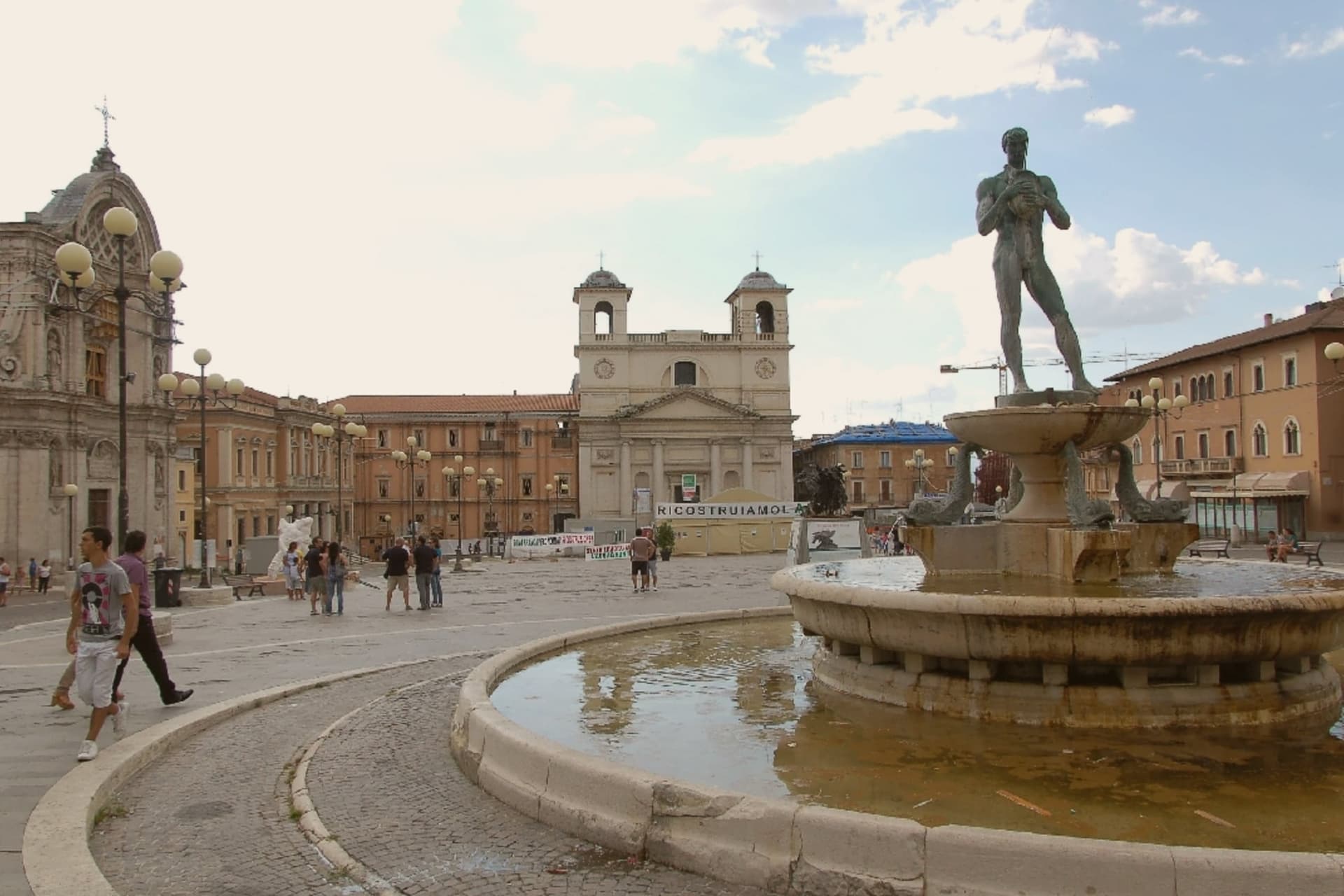
The regional capital at 721 meters, founded by Frederick II around 1240 and still reconstructing after the 2009 earthquake.
- Best time
- May–Oct
- By car
- 1 h 29 min from Rome
- By train
- Station in the comune
- Population
- 69,558
Known for
FREDERICK'S CITY
Founded around 1240 by Holy Roman Emperor Frederick II, with the legend of 99 castles each building its own piazza inside the walls.
COLLEMAGGIO
1287 basilica where Pietro del Morrone was crowned Pope Celestine V on 29 August 1294; the Perdonanza is celebrated every August.
2009 EARTHQUAKE
Magnitude-6.3 quake on 6 April 2009 killed 308 people and damaged most of the centro storico; reconstruction continues into 2026.
ZAFFERANO DELL'AQUILA
The commune lies inside the Zafferano dell'Aquila DOP production zone.
When to visit
Best · May–Oct
- J8°
- F11°
- M12°
- A15°
- M20°
- J26°
- J30°
- A29°
- S24°
- O19°
- N13°
- D9°
- Best
- Hot or crowded
- Quiet
- Mostly closed
Daytime averages, 2020–2024. Weather data by Open-Meteo.com.
Why come
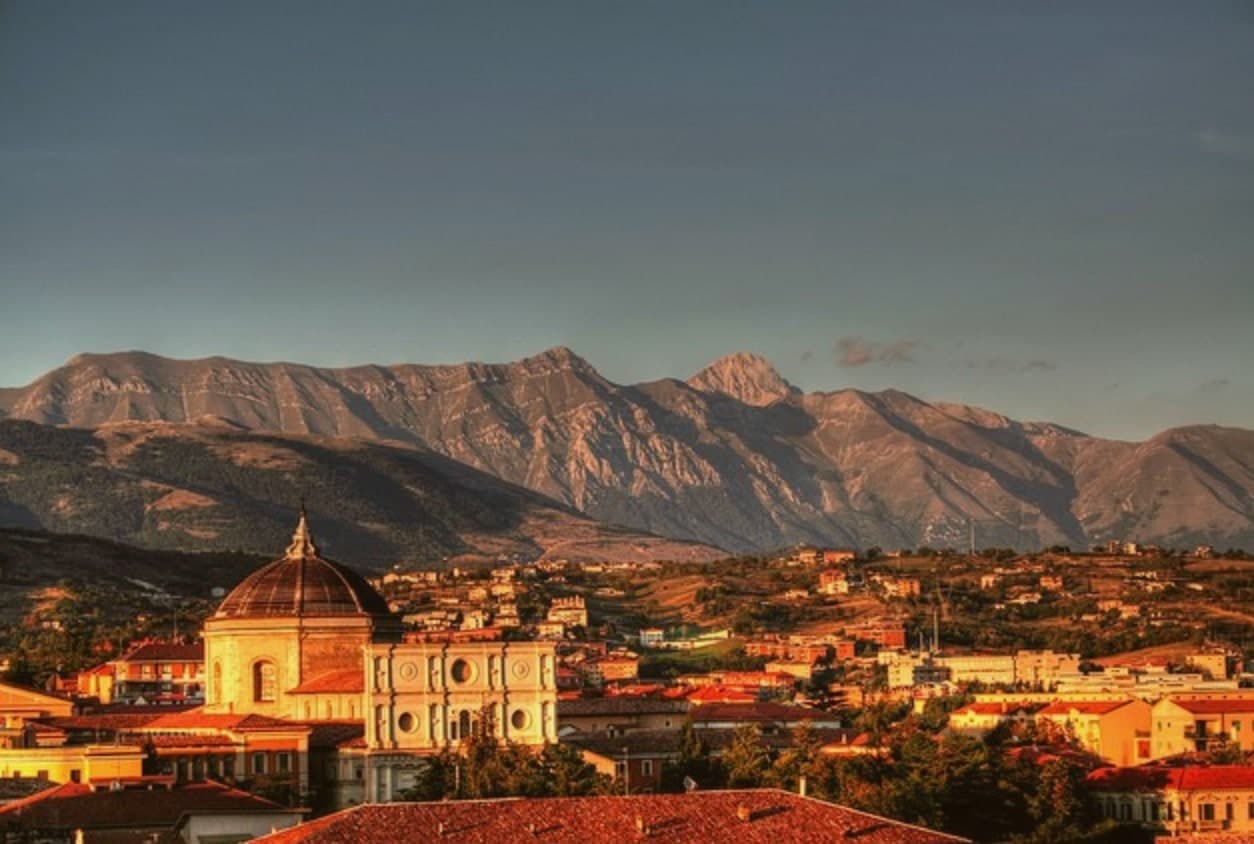
L'Aquila sits at 721 meters in a high plain between the Gran Sasso and the Velino-Sirente massifs, the regional capital of Abruzzo with 69,558 residents. The two ranges frame the city on opposite sides, so the plain reads as a corridor of settlement between mountains rather than a valley floor with one clear edge.
The founding myth ties the city's shape to its origins: people from 99 castles in the surrounding valley are said to have each built a piazza, a church and houses inside the new walls, so the old town is less a single design than a patchwork of neighborhoods stitched together at the point of founding. That patchwork still organizes the upper town, where the fortress on the highest ground, the civic squares, and the older parish churches sit at angles to each other rather than along one axis.
Reconstruction after the earthquake has proceeded unevenly across this patchwork: some quarters and monuments are finished and open, others still show scaffolding, and by early 2025 work stood at 88 percent of projects complete. The city today is best read as a medieval plan of independent parts, still being reassembled piece by piece rather than restored as a whole.
The Sunday letter
L'Aquila is on our list. Its letter is still to come.
We are writing about all 1,000 of these towns, one at a time, in a free letter every Sunday: the photo, the food, the festa. That is our mission. Sign up and you will be there when L'Aquila comes up. By Peter & Sophia, from Pietrasanta.
Read on
L'Aquila in our articles
 The best mountain towns you can reach by train within 90 minutes of Roma6 towns, L'Aquila among them.
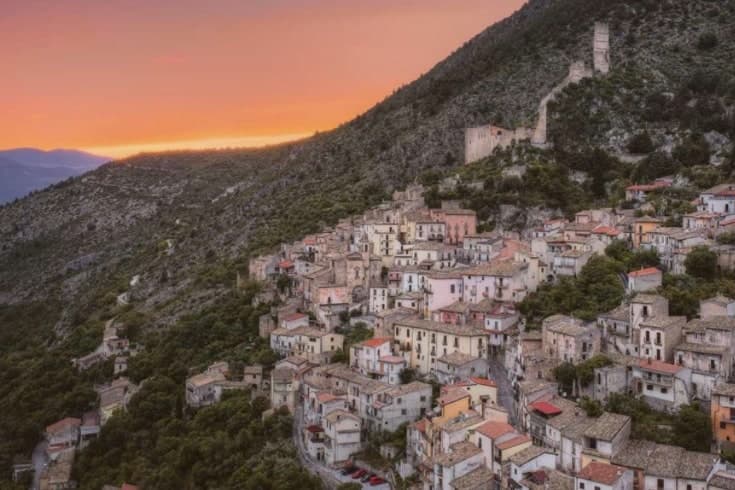 The best towns you can reach by train that sit inside a national park in Abruzzo8 towns, L'Aquila among them.
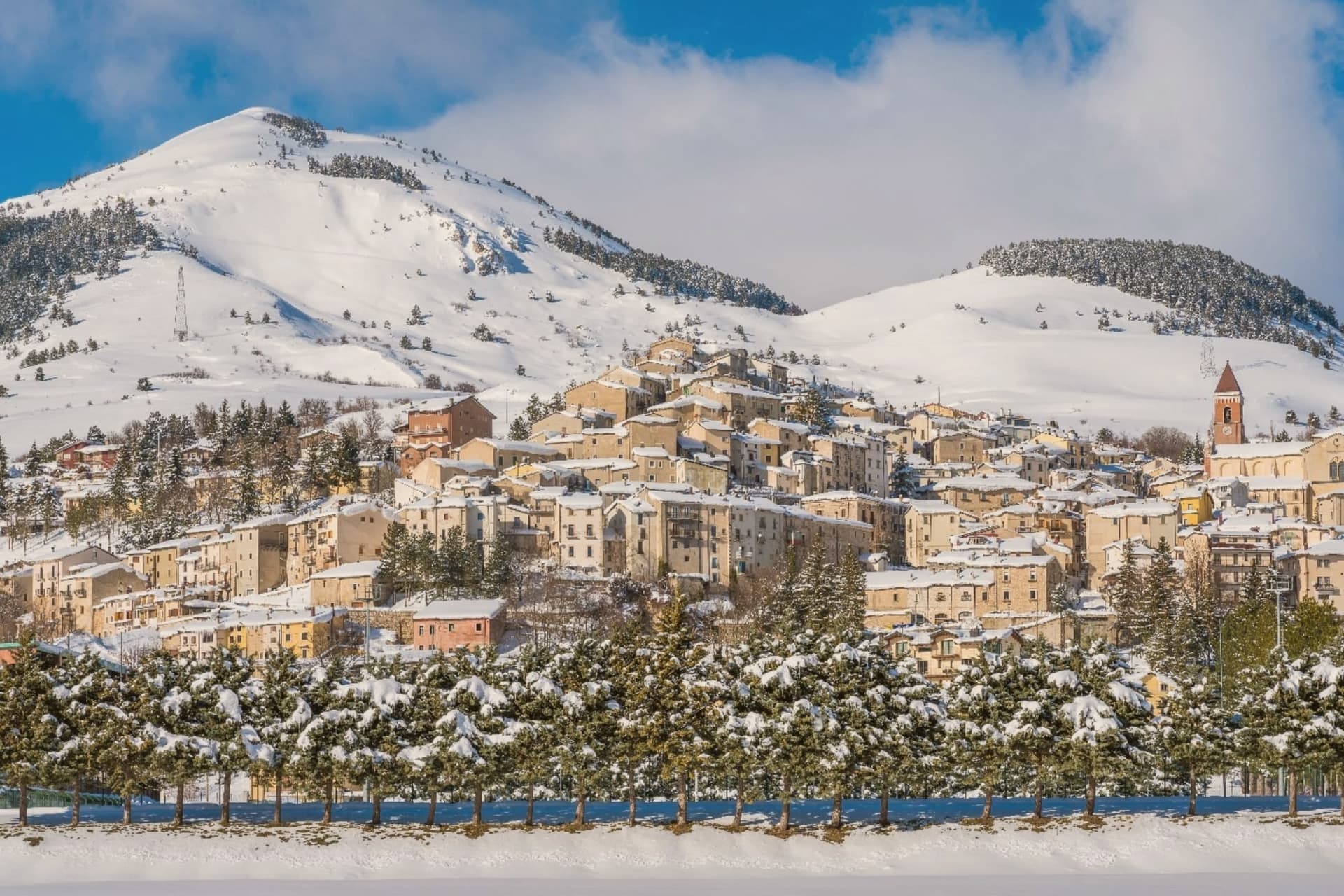 The best towns that eat well in the province of L'Aquila10 towns, L'Aquila among them.
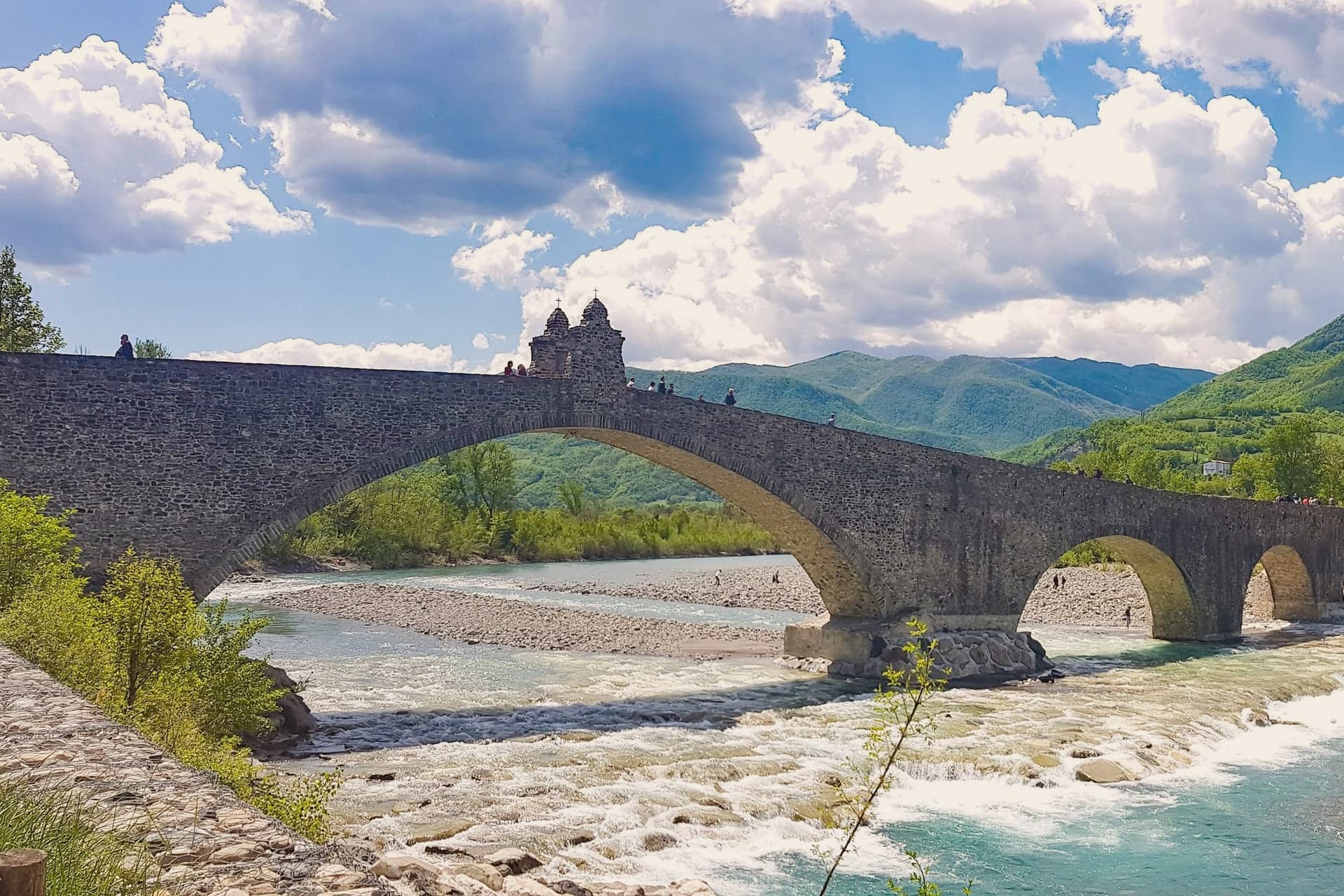 Every ski town in our catalogue, all of them97 towns, L'Aquila among them.
How to get there
From Rome (FCO), about 2h 10m by car.
Ancona / Pescara (AOI) is about 2h 28m away.
By car from the centre of Pescara 1h 39m or Ancona 2h 23m.
There is a railway station in the comune, so you can arrive without a car.
Coming from Rome?
Coming by train into Roma Termini? L'Aquila is about 1h 28m away by road.
What to see
Basilica di Santa Maria di Collemaggio
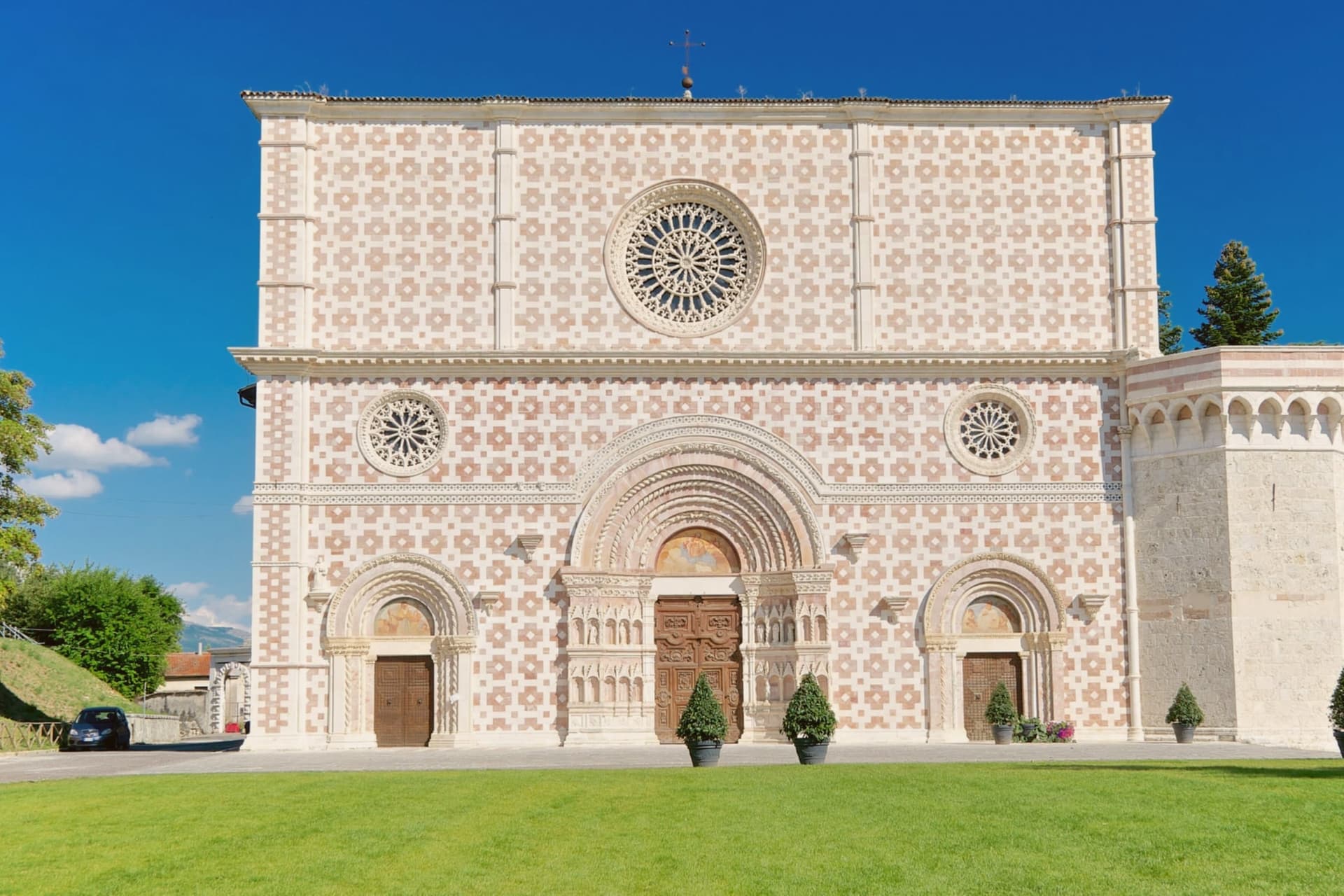
Romanesque-Gothic facade in stripes of pink and white stone, standing apart from the rest of the centro storico; the interior reopened to visitors in 2017.
Fontana delle 99 Cannelle
A civic fountain built into an angle of two walls, water running from 99 carved spouts of varying faces, tucked at the edge of the old town rather than in a central square.
Forte Spagnolo (Castello Cinquecentesco)
A squat, star-shaped fortress with a deep dry moat, occupying the highest ground of the upper town and visible above the rooftops from much of the city.
Basilica di San Bernardino
A tall flight of steps leads to a Renaissance facade by Cola dell'Amatrice; inside, a carved tomb sits beneath a coffered ceiling.
MAXXI L'Aquila (Palazzo Ardinghelli)
Art from Rome's museum installed inside a restored palace, its stuccoed rooms now hung with work far newer than the walls around them.
Piazza Duomo
A long open square flanked by the Duomo and Santa Maria del Suffragio, filled daily with market stalls and used as the gauge of how far the reopening has come.
Gran Sasso d'Italia
The range rises to 2,912 meters at Corno Grande and closes off the northern skyline, a wall of rock that appears at the end of nearly every street running that way.
The slow-trip planner
Building a trip? Find where L'Aquila fits in a slow Italy circuit.
Answer five questions. We will shape a geographically coherent slow trip from the 1,000 Italian towns most travelers skip. Yours to save and share.
We recommend
Where to eat
Not our picks, but places the guides put their name to: a Michelin star, a Gambero Rosso fork, a Slow Food snail, a Michelin Key for the hotels. Worth a table, a counter, or a night when you pass through.
Corso StrettoRistorante
Corso Stretto carries a Gambero Rosso listing.
Da LincostaTrattoria
Da Lincosta has two Gambero Rosso prawns to its name.
ElodiaRistorante
Elodia holds two Gambero Rosso forks (82/100).
Førma Contemporary RestaurantRistorante
Førma Contemporary Restaurant has two Gambero Rosso forks (82/100) to its name.
Le Fontanelle di Enoa'Trattoria
Le Fontanelle di Enoa' has two Gambero Rosso prawns to its name.
Lo Scalco dell'AquilaRistorante
One Gambero Rosso fork (77/100), at Lo Scalco dell'Aquila.
Osteria Alimentari da nonno AlbericoTrattoria
Osteria Alimentari da nonno Alberico carries one Gambero Rosso prawn.
RêverRistorante
A Gambero Rosso listing, at Rêver.
William Zonfa RistoranteRistorante
William Zonfa Ristorante has one Gambero Rosso fork (77/100) to its name.
YOICHIFusion
YOICHI carries two Gambero Rosso Mappamondi.
Living here
- Population 69,558
- A local hubi
- Pharmacy in town
- High school within a 30-minute drive
- Train station in the comune
- Nearest airport Rome, 2 h 10 min drive
- Regional capital L'Aquila, 13 min drive
Common questions
- What is L'Aquila known for?
- L'Aquila is the regional capital at 721 meters, founded by Frederick II around 1240 and still reconstructing after the 2009 earthquake.
- Where is L'Aquila?
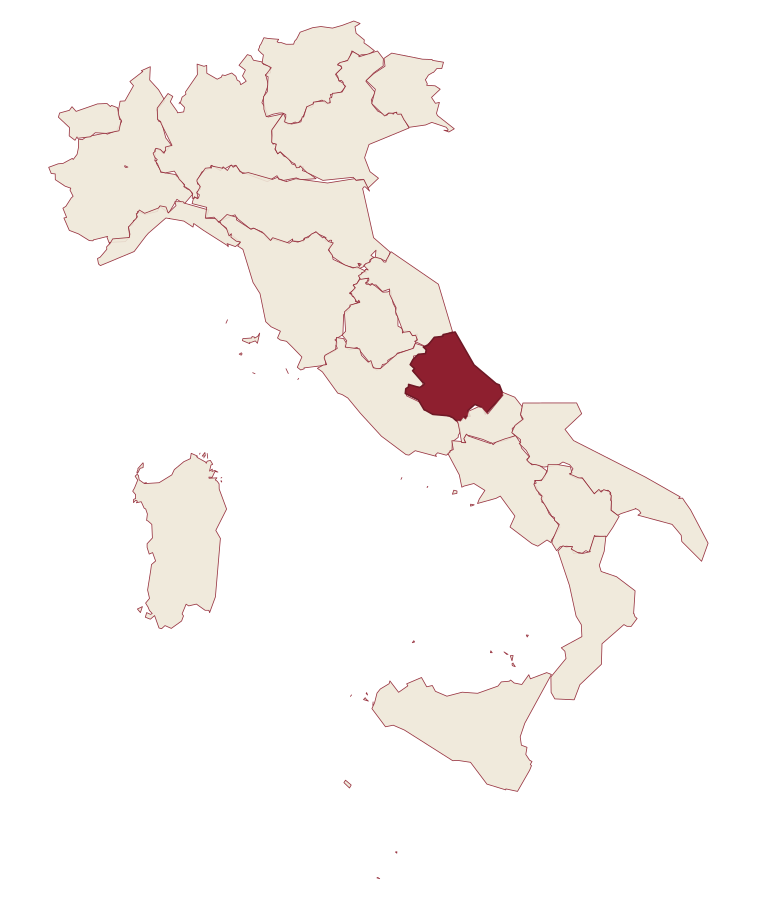
- L'Aquila is a comune in the province of L'Aquila, in Abruzzo.
- What is the nearest airport to L'Aquila?
- Rome (FCO), about 2h 10m by car.
- Can you get to L'Aquila without a car?
- Yes. There is a railway station in the comune, so you can arrive by train.
- How long is the drive from Pescara to L'Aquila?
- About 1h 39m by car.
- When is the best time to visit L'Aquila?
- Best in May–Oct. July is the warmest month, averaging 30 degrees, and May the wettest, with about 14 rain days.
- Which other towns are like L'Aquila?
- Ariano Irpino, Nicosia and Brunico.
- How many people live in L'Aquila?
- 69,558 at the 2023 count.
Tags & datadesignations · numbers · sources
Recognised as
The numbers
- Elevation: 721 m
- Population: 69,558
- Surface area: 473.91 km²
These figures were compiled from public directories: ISTAT, OpenStreetMap and Wikidata, and from the official listings of the guides named on this page. Town details change; verify with official sources before you travel.
Similar
Towns like L'Aquila
Ariano Irpino
Province: Avellino
both mountain-valley towns · both over 10,000 people
Nicosia
Province: Enna
both mountain-valley towns · both over 10,000 people
Brunico
Province: Bolzano
both mountain-valley towns · both over 10,000 people
Randazzo
Province: Catania
both mountain-valley towns · both over 10,000 people
Goriano Sicoli
Province: L'Aquila
both mountain-valley towns · both high up, between 600 and 1,000 metres
Capistrello
Province: L'Aquila
both mountain-valley towns · both high up, between 600 and 1,000 metres
🌲 Parco Nazionale
More Parco Nazionale towns in Abruzzo
Alfedena
Province: L'Aquila
At 914 meters at the head of the upper Sangro valley, the Samnite Aufidena, with a 15,000-tomb necropolis and a Roman conquest in 298 BC.
Barrea
Province: L'Aquila
A 1,066-meter spur above an artificial lake at the heart of the Abruzzo National Park, with a Samnite necropolis and an 11th-century di Sangro castle.
Calascio
Province: L'Aquila
A village of 125 people under the highest castle in the Apennines, cast as the monk's refuge in Ladyhawke.
Campli
Province: Teramo
A 393-meter town under the Monti della Laga, held by the Farnese for two centuries, with a Scala Santa carrying papal indulgence.
Campo di Giove
Province: L'Aquila
At 1,064 meters under the southwestern Maiella, the highest village in the park, named for a Roman temple to Jupiter.