
Hill towns
Hill towns in Abruzzo
27 towns
The ridge and hilltop borghi, sitting around 400 metres. Vineyards below, one road up, walkable once you are there. Good in almost any season.
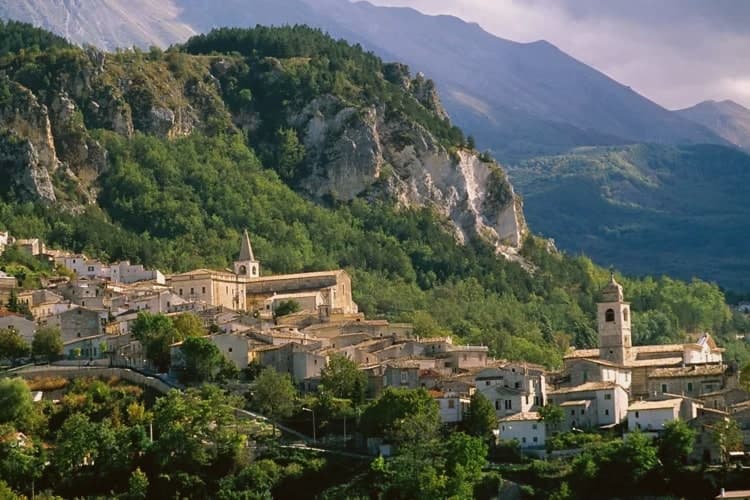
Caramanico Terme
Province: Pescara · 650 m
A 650-meter Majella spa village at the confluence of the Orfento and Orta rivers.
Civitella del Tronto
Province: Teramo · 589 m
A rocky crest at 589 meters above the Tronto valley, crowned by the last Bourbon fortress to surrender to united Italy in March 1861.
Guardiagrele
Province: Chieti · 576 m
The 576-meter terrazza d'Abruzzo on the Majella's foothills, hometown of fifteenth-century goldsmith Nicola da Guardiagrele and seat of the Majella park.
Ofena
Province: L'Aquila · 531 m
A 531-meter Vestian basin called the Forno d'Abruzzo, where Montepulciano ripens on what may be the oldest of its slopes.
Pretoro
Province: Chieti · 530 m
A village of 856 stacked at 530 meters on the eastern Maiella, where wolves live behind fencing and woodturners still work on Via Roma.
Roccamorice
Province: Pescara · 520 m
A village at 520 meters in the Majella foothills, gateway to the rock-cut hermitages carved into the surrounding limestone.
Archi
Province: Chieti · 492 m
A 492-meter rocky spur called the Terrazza sul Sangro, fief of del Balzo, Cantelmo, Colonna and Carafa, now Città del Tartufo and Città dell'Olio.
Capestrano
Province: L'Aquila · 465 m
A hilltop village at 465 meters above the Tirino valley, where in 1934 a farmer turned up the 6th-century BC limestone Warrior of Capestrano.
Roccacasale
Province: L'Aquila · 450 m
A village of 597 under the ruins of a castle blown up by Napoleon's army in 1803.
Atri
Province: Teramo · 442 m
At 442 meters on three hills ten kilometers from the Adriatic, ancient Hadria, source of the emperor Hadrian's family name and the Adriatic's.
Fara San Martino
Province: Chieti · 440 m
A pasta-making town at 440 meters, where the Verde river runs out of a two-meter slot in the Majella wall.
Morino
Province: L'Aquila · 440 m
A village at 440 meters on the Lazio border, beneath the central Apennines' second-highest waterfall at over 80 meters.
Penne
Province: Pescara · 438 m
The brick city at 438 meters between the Tavo and Fino, ancient capital of the Vestini, rebuilt after Allied bombing and awarded the Silver Medal of Civic Merit.
Isola del Gran Sasso d'Italia
Province: Teramo · 415 m
At 415 meters at the foot of a massif holding the Apennines' highest peak outside Sicily, the commune's sanctuary ranks among the world's fifteen most-visited Catholic shrines.
Castelvecchio Subequo
Province: L'Aquila · 409 m
At 409 meters in the Subequana valley, the Roman Superaequum and Franciscan station where the saint himself was given land for a convent built between 1221 and 1261.
Sulmona
Province: L'Aquila · 405 m
At 405 meters in the Valle Peligna, birthplace of Ovid in 43 BC and home of the sugared-almond confetti industry since the 14th century.
Campli
Province: Teramo · 393 m
A 393-meter town under the Monti della Laga, held by the Farnese for two centuries, with a Scala Santa carrying papal indulgence.
Casoli
Province: Chieti · 378 m
A 378-meter hill town above the Aventino under the Maiella, with a pentagonal Norman tower that once hosted a court of artists.
Balsorano
Province: L'Aquila · 359 m
A pentagonal fortress above the Liri river that became a backdrop for 1970s Italian horror cinema.
Tocco da Casauria
Province: Pescara · 356 m
A 356-meter hill town between the Pescara river and the Maiella, built around a Carolingian abbey and an herb liqueur called Centerba.
Corfinio
Province: L'Aquila · 346 m
A village of under a thousand on the Peligna valley floor at 346 meters, sitting on the Italic League's would-be capital Italia.
Città Sant'Angelo
Province: Pescara · 320 m
A hilltop borgo at 320 meters between the Vestina hills and the Adriatic, named for the Archangel and known since 1352 as a Collegiata seat.
Loreto Aprutino
Province: Pescara · 290 m
A hilltop town at 290 meters in the Aprutino olive country, with a fourteenth-century Judgment fresco and a Castelli majolica collection.
Controguerra
Province: Teramo · 267 m
A 267-meter hill village whose name is legal shorthand for a small Montepulciano and Trebbiano-Passerina DOC.
Manoppello
Province: Pescara · 257 m
A hill town above the Pescara river, custodian since 1620 of the byssus veil known as the Volto Santo.
Pianella
Province: Pescara · 236 m
A Cittaslow hill town at 236 meters between the Tavo and Pescara rivers, anchor of the Aprutino oil triangle and home of the dritta olive.
Crecchio
Province: Chieti · 209 m
A 209-meter hill town between the Adriatic and the Maiella, capital of Italy for one night in 1943 when the king slept in its castle.
The slow-trip planner
Plan a slow trip across the towns travelers skip.
Answer five questions. We will shape a geographically coherent slow trip from the 1,000 Italian towns most travelers skip. Yours to save and share.
From elsewhere in Italy
Five more towns to discover
Biccari
Province: Foggia
A Subappennino Dauno borgo at 450 meters under Monte Cornacchia, the highest peak in Puglia at 1,151 meters, with a Byzantine tower at its core.
Sirolo
Province: Ancona
A clifftop borgo at 125 meters, above the Due Sorelle sea stacks of the Adriatic.
Penne
Province: Pescara
The brick city at 438 meters between the Tavo and Fino, ancient capital of the Vestini, rebuilt after Allied bombing and awarded the Silver Medal of Civic Merit.
Palazzolo Acreide
Province: Siracusa
An 8,000-resident hilltop town on the Iblei plateau at 670m, rebuilt entirely in late Baroque after the 1693 earthquake and founded over the Greek Akrai colony in 664 BC, with a Greek theatre and a cluster of rock carvings unlike anything else nearby.
Verucchio
Province: Rimini
A spur over the lower Marecchia valley, cradle of the Villanovan civilization and birthplace of the Malatesta lordship of Romagna.