
The best hidden towns with a serious restaurant in the province of Perugia
The province of Perugia eats in a way that rewards driving. Umbrian cooking here is built on things that keep: cured pork from the mountain towns, lentils and farro grown on high plains, black truffle shaved over strangozzi in winter, wild greens in spring, olive oil pressed on the hillsides below the walls. The towns themselves are stone, mostly pale limestone and brick, with steep lanes leading to a piazza where the good restaurant is often behind an unmarked door. Autumn is when the region shows off, truffle season and grape harvest overlapping, and the Sagrantino from the vineyards south of the Topino turning heavy and tannic in the glass.
Most people who come to eat in Umbria eat in Assisi, or in Perugia itself, and the reasons are obvious. The basilica and the medieval centre draw coaches from March until the end of October, and the streets around them carry a dense band of restaurants pitched at people who will pass through once. Orvieto and Gubbio absorb much of the rest. The food in those places can be very good, but the tables that matter are booked weeks out, and the ones that are free at short notice tend to be the ones designed for turnover.
The same hills, the same truffle grounds and the same growers continue well past the famous names. Kitchens serious enough to be listed by the strictest of the guides sit in walled towns of a few streets, in ceramics towns on the Tiber, in villages above Lake Trasimeno and in the high valleys towards the Sibillini. Fewer people go, which mostly means the dining room is quieter and the wine list is local rather than national. These are the towns in the province where the meal is worth the detour on its own.
Of the 37 communes we have mapped in the province of Perugia, 12 qualify as towns with a serious restaurant: each holds a restaurant listed by the most demanding of the dining guides. This list is the hidden ones, 7 in all, ordered smallest first. The smallest, Montone, has 1,580 residents.
Elsewhere in the catalogue: The prettiest hidden villages with a serious restaurant within 90 minutes of Perugia and The best hill towns with a serious restaurant in the province of Perugia.
Montone
Why visit Montone
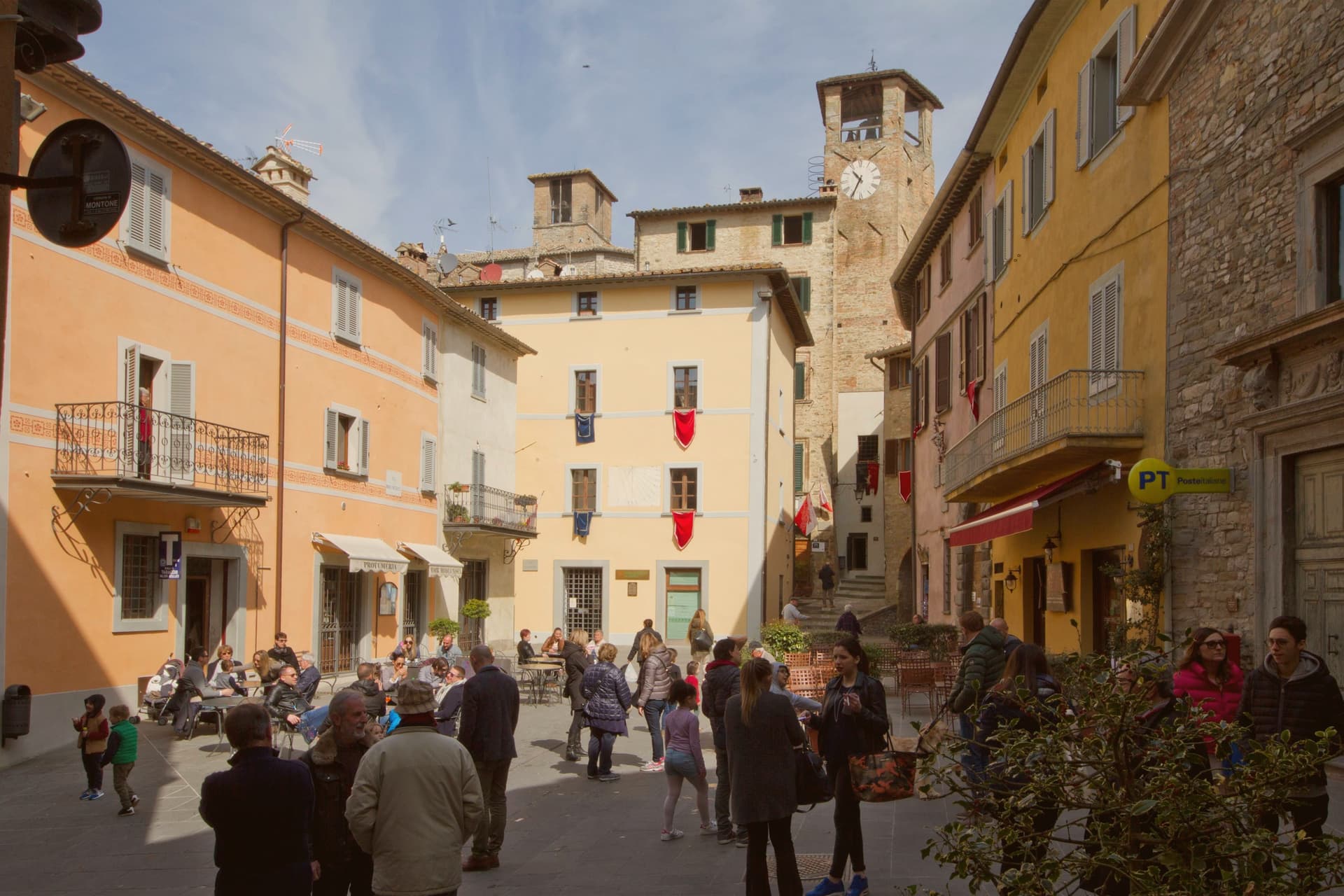
Montone sits at 482 meters on a ridge above the upper Tiber valley, thirty kilometers north of Perugia. The walled centro storico is small enough to circuit in fifteen minutes and steep enough that the route is the climb.
The town is the cradle of the Fortebracci, the condottieri family whose most famous member, Braccio da Montone, was made Count of Montone in 1414 by Antipope John XXIII. The Rocca di Braccio at the top of the hill and the Rocca d'Aries six kilometers out are both Fortebracci works.
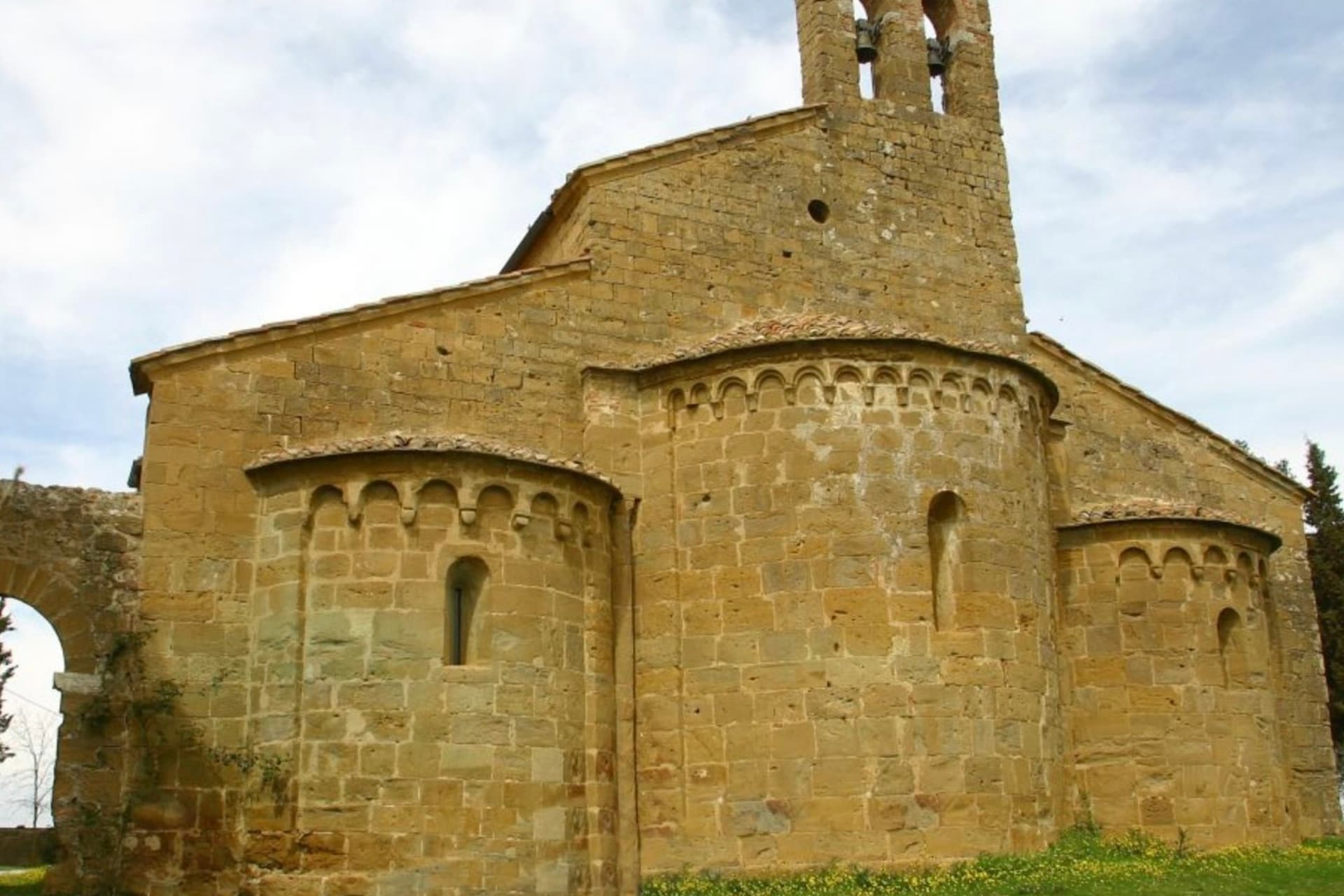
The Gothic Chiesa di San Francesco, built around 1300 where the family had its houses, holds the Pinacoteca with a Bartolomeo Caporali altarpiece. The Donazione della Spina, a relic-thorn from Christ's crown given to the town by Carlo Fortebracci after the Venetians thanked him for naval service against the Turks, is processed twice a year, on Easter Monday and during the August week after Ferragosto.
Since 1997 the Umbria Film Festival has run here every July, founded with Terry Gilliam.
Tipico Osteria dei Sensi, Tipica Osteria dei Sensi, Locanda del Capitano & Tipico Osteria dei Sensi have been named by a guide.
What to see in Montone
- Chiesa di San Francesco. Gothic church of around 1300 with a fourteenth-century convent, picture gallery and cloister, on the hill where the Fortebracci had their houses.
- Rocca di Braccio. Fortress at the top of the borgo rebuilt under Oddo III Fortebracci in the late fourteenth century, now a panoramic ramparts walk.
- Rocca d'Aries. Castle six kilometers from the centro storico, the first Fortebracci stronghold according to tradition, restored and reopened to visit.
How to get to Montone
Perugia is roughly 47 minutes away by road.
Our tip
April through June and September into October are the steady months. The Umbria Film Festival runs in mid-July under Terry Gilliam's patronage, and the borgo doubles for that week with screenings in the piazze and the Rocca. The August Donazione della Spina pageant, the week after Ferragosto, fills the streets with medieval costumes and a Rocca di Braccio banquet.
Norcia
Why visit Norcia
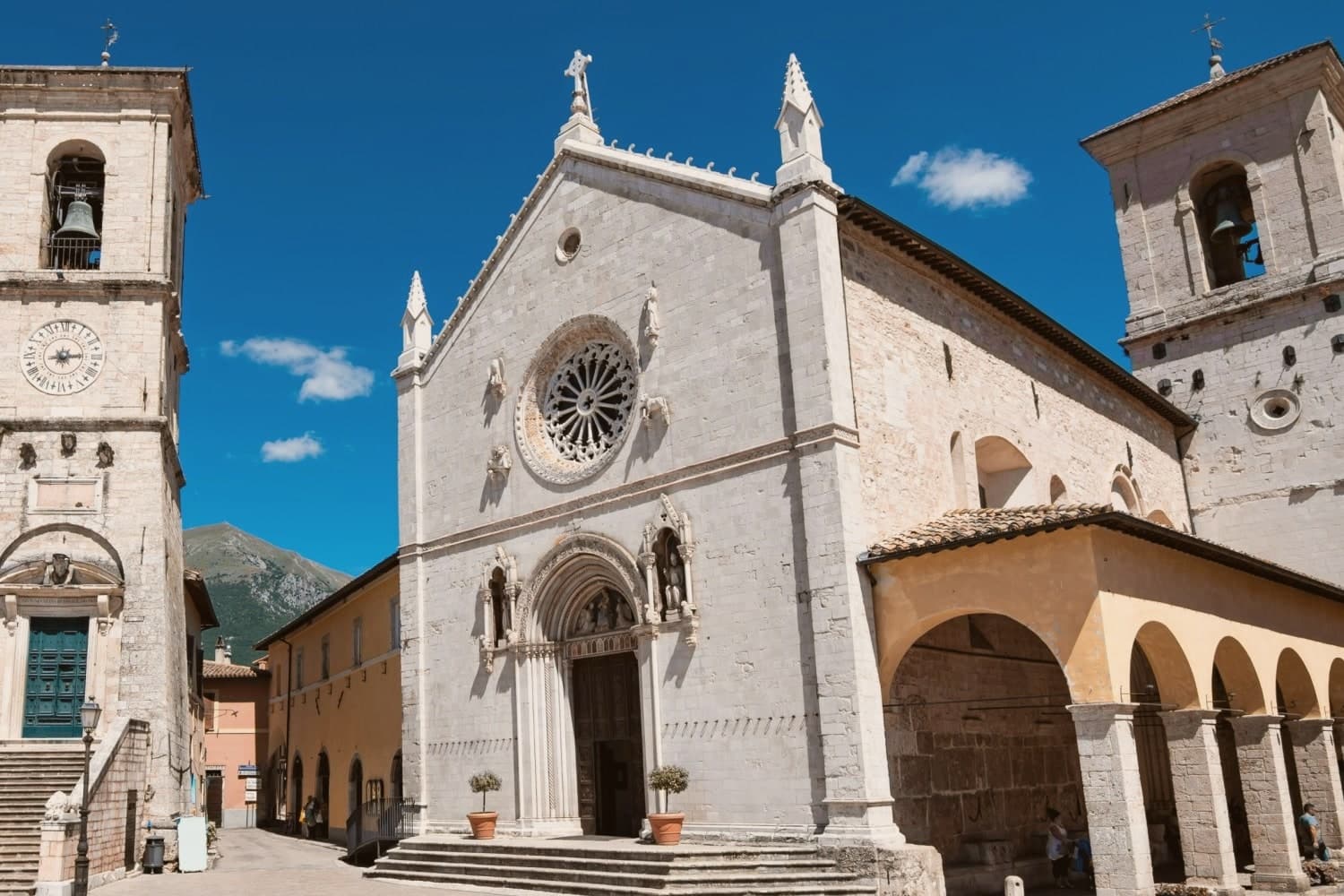
Norcia sits at 604 meters on a high plateau on the Umbrian side of the Monti Sibillini, ancient Nursia of the Sabines, fortified in the 3rd century BC by Rome. Saints Benedict and his twin sister Scholastica were born here in 480; the Benedictine Order and the Ora et Labora motto that shaped Western monasticism began on this piazza.
The Basilica di San Benedetto rises on the traditional birthplace, built between 1290 and 1338 over a pre-existing crypt. On 30 October 2016 a magnitude 6.5 earthquake destroyed the nave; only the façade was left standing.
Reconstruction completed on 30 October 2025, nine years to the day, with the original stones and earthquake-resistant technology. The town gave its name to norcineria, the Italian word for quality pork delicatessen, after centuries of Norcia butchers specializing in wild boar and pork.
Black truffle from the Valnerina, lentils from Castelluccio, and ricotta from the high pastures complete the table.
Vespasia, Granaro del Monte, Casale nel Parco have been named by a guide.
What to see in Norcia
- Basilica di San Benedetto. Built 1290-1338 over the traditional birthplace of Saints Benedict and Scholastica, rebuilt with original stones after 2016, reopened 30 October 2025.
- Castellina. Fortified papal stronghold designed by Jacopo Barozzi da Vignola in 1554, on Piazza San Benedetto, now the Museo Civico e Diocesano.
- Piazza San Benedetto. Civic and religious heart of the centro storico, with the Palazzo Comunale, the basilica, the Castellina and the statue of Benedict at the center.
How to get to Norcia
Terni is roughly 93 minutes away by road.
Our tip
April through June and September into October are the months for Norcia. The plateau holds its color, the lentil fields of Castelluccio bloom from mid-June into July, and the high pastures are open for hiking. July and August stay cooler than the Umbrian valleys at 604 meters, but the town fills with festival crowds for the Mostra Mercato del Tartufo Nero on the last weekend of February and again for sagras through the summer.
Bevagna
Why visit Bevagna
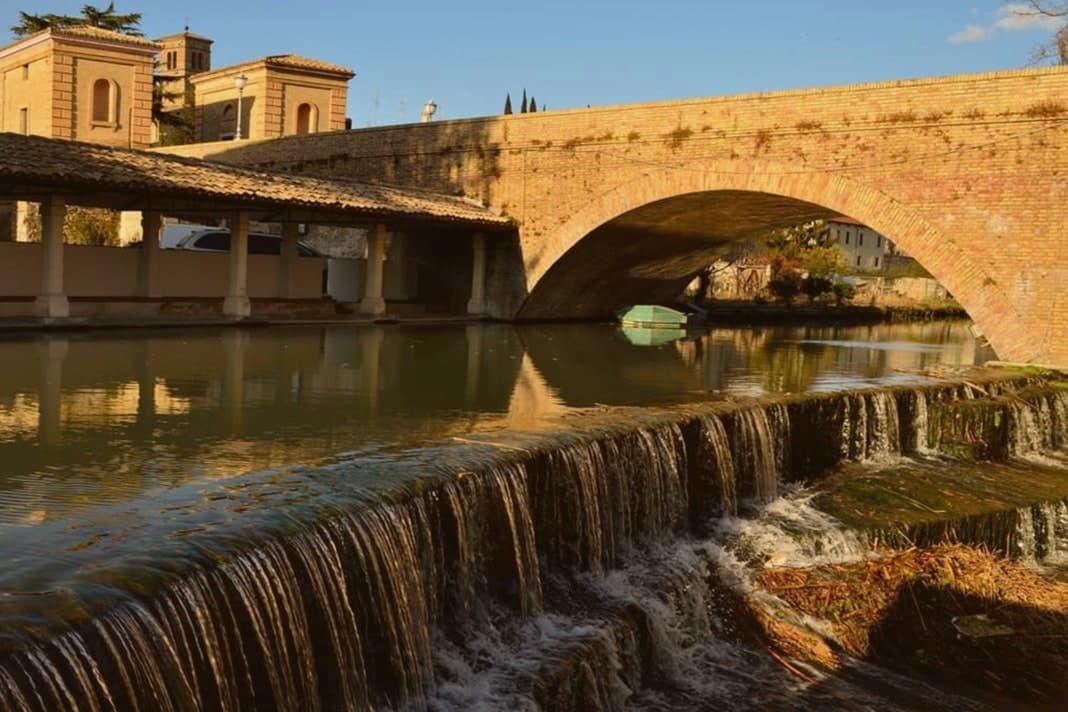
Bevagna sits on the floor of the Umbrian valley at 225 meters, where the Clitunno meets the Timia. Ancient Mevania, the name means she who stands in the middle, was a Roman mansio on the Via Flaminia, listed in the Antonine Itinerary.
A black-and-white mosaic of the 2nd century AD survives almost intact in the frigidarium of the Roman baths, twelve meters by seven, octopuses and dolphins in the center, tritons and sea-horses on the short sides. Piazza Silvestri at the heart of the centro storico holds two Romanesque churches that face each other at odd angles, San Michele Arcangelo and San Silvestro, built within years of each other in the late 12th century.
The Mercato delle Gaite each June turns the town into the year 1300 for ten days, four quarters competing on medieval trades and tavern menus, no anachronisms allowed. The Sagrantino slopes of Montefalco are nine kilometers up the road.
Serpillo, Ottavi Mare have been named by a guide.
What to see in Bevagna
- Piazza Silvestri. Twelfth-century civic square ringed by the Palazzo dei Consoli, the churches of San Silvestro and San Michele, and the fountain of 1896.
- Chiesa di San Michele Arcangelo. Romanesque collegiate church built by Binello and Rodolfo at the end of the 12th century, on the main square.
- Chiesa di San Silvestro. Romanesque parish church across the piazza, signed and dated 1195 by Binello, the same builder as San Michele.
How to get to Bevagna
Perugia is roughly 39 minutes away by road.
Our tip
April through June and September into October are the months for Bevagna. The valley fills with green, the Sagrantino vines run on the slopes above town, and the rose festival fills the gardens around the walls in May. The Mercato delle Gaite runs the second half of June and is the single most concentrated weekend on the Umbrian medieval calendar. Sagra della Lumaca falls in August.
Passignano sul Trasimeno
Why visit Passignano sul Trasimeno
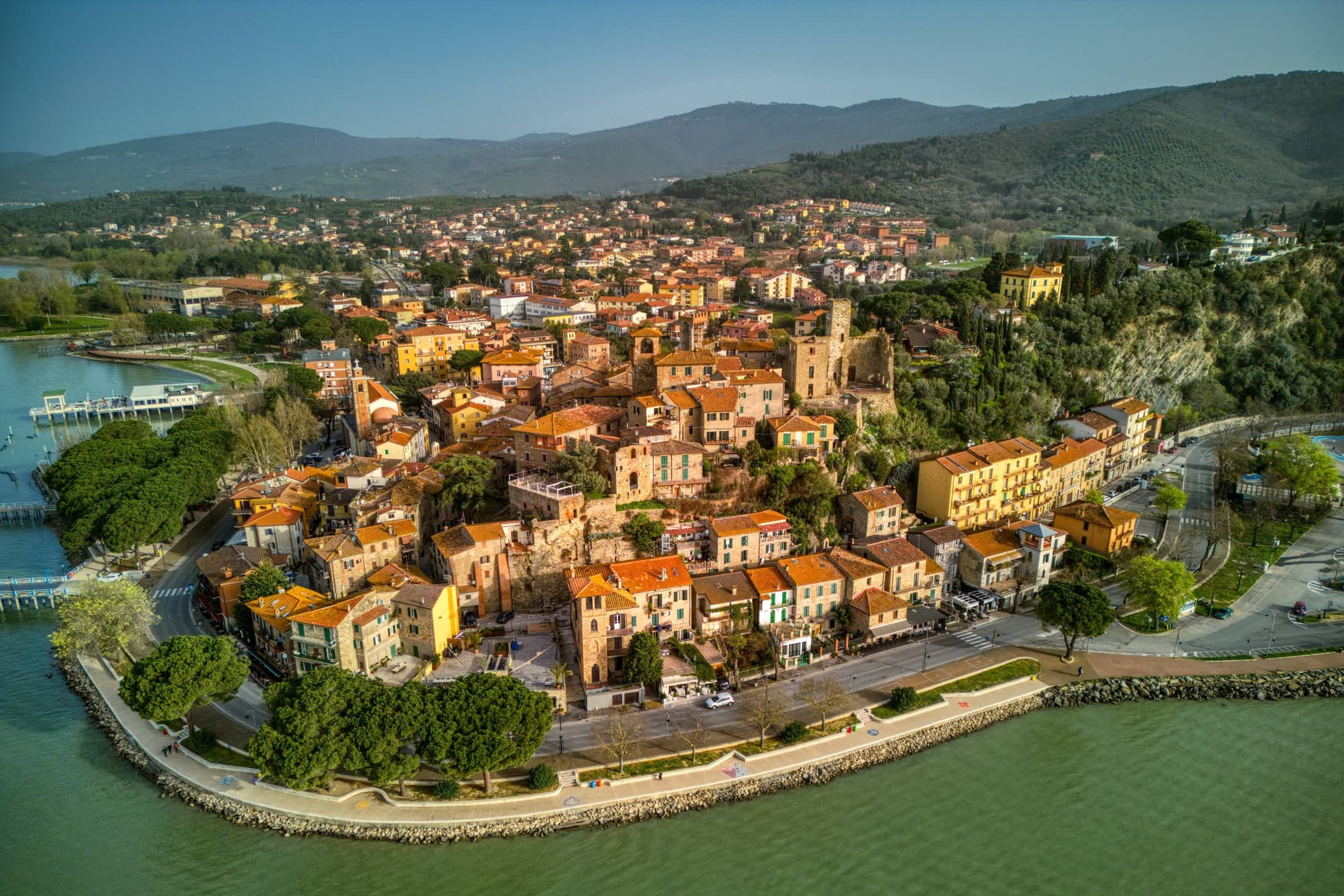
Passignano sul Trasimeno sits on a low promontory on the northern shore of Lake Trasimeno, twenty kilometers northwest of Perugia, separated from the lake only by the road that links Perugia to Tuscany. The Umbri held the ground first, then the Etruscans pushed them east of the Tiber; the Romans turned the spur into a watchtower controlling the pass between northern and central Italy.
In 217 BC Hannibal trapped Gaius Flaminius's army of 25,000 in the narrow road between Tuoro and Passignano, killing about 15,000 Romans in the morning fog of June 21, one of the worst defeats in Roman history. The Rocca, built around 850 by the marquises of Tuscany and conquered by Perugia in 1187, holds a quadrangular plan around a 32-meter keep that survived a 1778 partial demolition.
The Festa della Padella, held in late August, fries lake fish for the village in a four-and-a-half-meter pan on the shore. The Borgo dei Borghi finalist designation arrived in the 2010s.
Da Luciano, Il Molo have been named by a guide.
What to see in Passignano sul Trasimeno
- Rocca di Passignano. Quadrangular fortress built around 850 by the marquises of Tuscany with a 32-meter central keep, partly demolished in 1778.
- Chiesa di San Bernardino. Sixteenth-century church near the Rocca with a Renaissance interior and views down to the lake from its portico.
- Centro di Documentazione Annibale e Battaglia del Trasimeno. Small documentation centre on the Battle of Lake Trasimene of 217 BC and Hannibal's ambush of Gaius Flaminius.
How to get to Passignano sul Trasimeno
There is a railway station in the town, so you can arrive without a car and never need one while you are here. Perugia is roughly 28 minutes away by road.
✷ We have written about Passignano sul Trasimeno
“The lake is like a sanatorium compared to the sea. It’s relaxed. It’s calm. It’s silent. To find this level of almost disturbing quietness, you either go up into the mountains, or you really need to know your way around the sea to find that particular spot not overrun by vacationers and beach people. In Trasimeno, this is easy. Even the most popular towns like Castiglione or Passignano sit in quiet harmony with the stillness of the water.”
Read our piece on Passignano sul Trasimeno →Lago Trasimeno | Never Compete with the Sea
Our tip
April through June and September into October are the months the lake works. The water warms enough by late May for swimming off the Lido and the ferry to Isola Maggiore runs to a steady schedule. July and August are crowded; the Festa della Padella in late August is the loudest weekend of the year. Festa dei Barbari - Castel Rigone falls in July.
Panicale
Why visit Panicale
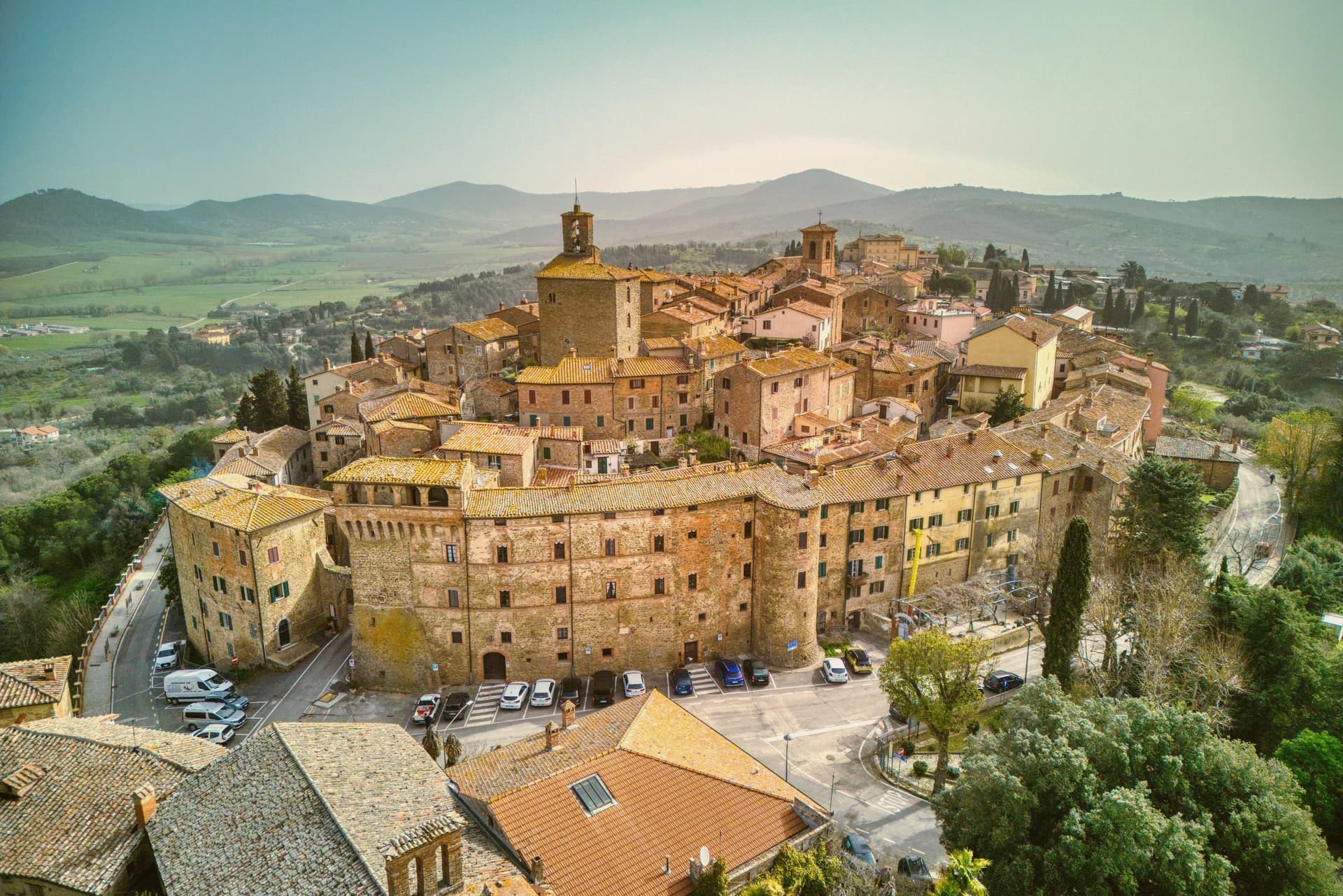
Panicale sits at 431 meters on the eastern slope of Monte Petrarvella, overlooking the southern shore of Lake Trasimeno from twenty-five kilometers southwest of Perugia. The medieval castle dates back in its earliest parts to the ninth century, and by the fourteenth Panicale was a small city-state with two gates facing Perugia and Florence and a moat around the walls.
Boldrino da Panicale, born in 1331, became one of the most feared mercenary captains of the trecento. The Chiesa di San Sebastiano, on a slope outside the walls, holds Pietro Perugino's Martyrdom of Saint Sebastian, frescoed across the entire back wall between spring and autumn of 1505, the saint's body crossed by the arrows of four archers in a deep landscape.
The Collegiata di San Michele Arcangelo on the main square claims an Annunciation attributed to Masolino da Panicale, the Renaissance painter the town shares as a birthplace claim with a Panicale in Tuscany. Three squares step down the slope on three different levels.
Lillotatini, Lillo Tatini have been named by a guide.
What to see in Panicale
- Chiesa di San Sebastiano. Fifteenth-century chapel on a slope outside the walls, with Perugino's Martyrdom of Saint Sebastian, frescoed in 1505 across the entire back wall.
- Collegiata di San Michele Arcangelo. Main parish church on Piazza San Michele, with an Annunciation attributed to Masolino da Panicale, master of Masaccio.
- Castello e mura medievali. Medieval circuit and gates dating to the ninth century, with two entrances toward Perugia and Florence and the line of the old moat.
How to get to Panicale
Perugia is roughly 48 minutes away by road.
Our tip
April through June and September into October are the windows. The lake catches morning light from the Panicale ramparts and the air at 431 meters keeps the heat down even in summer. July and August are warmer, and the Festa dell'Uva in late September runs the medieval procession through the three squares.
Montefalco
Why visit Montefalco
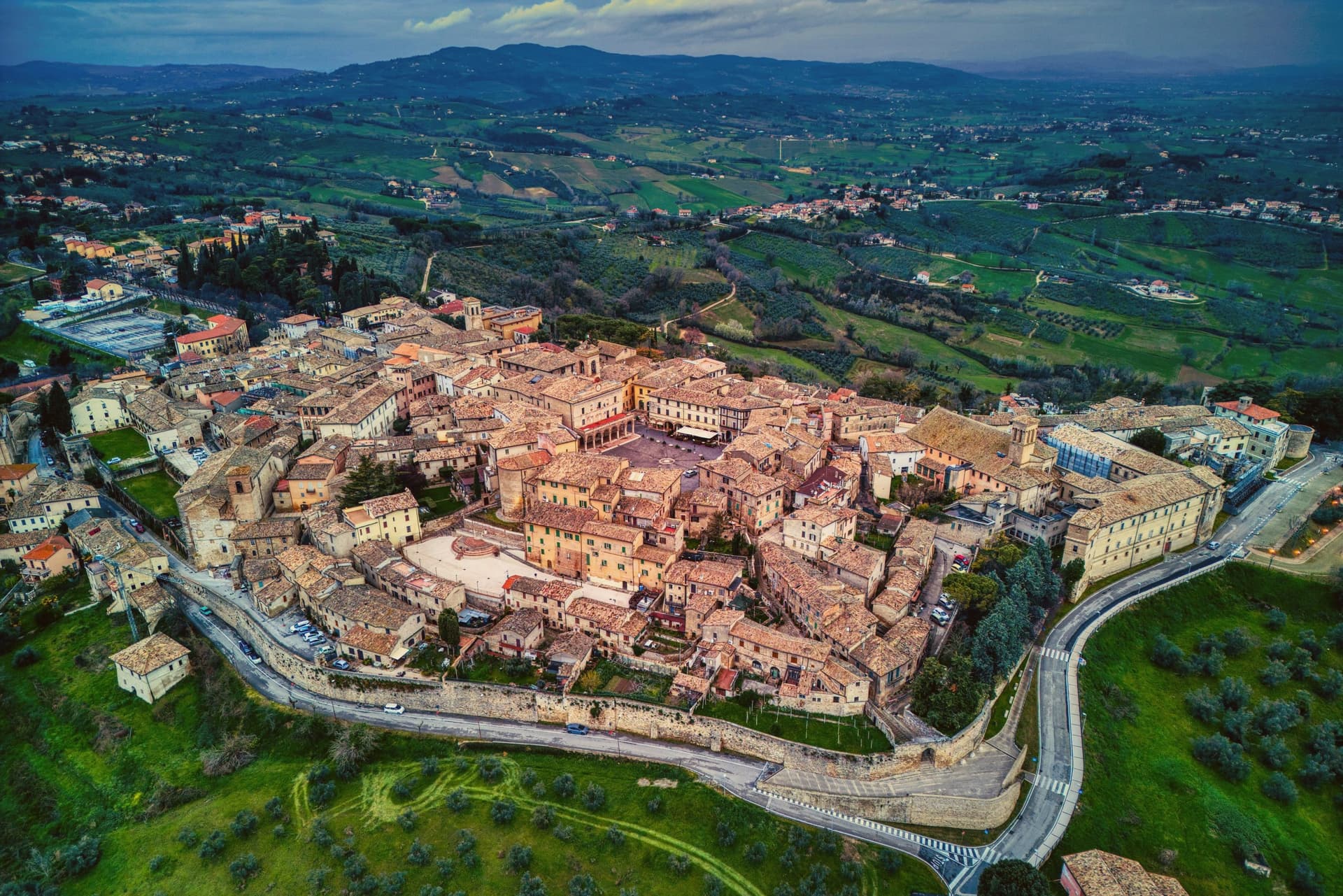
Montefalco sits on a hill above the Umbrian valley, its walls laid out in two concentric medieval circuits with five gates, the inner ring still complete and the outer ring added in the 14th century by the Trinci. At the top, the circular Piazza del Comune gathers four converging streets around the Palazzo Comunale, the high point from which the rest of the town falls away toward the walls and the vineyards beyond them.
The name Sagrantino belongs to the slopes right around those walls, where the grape has been traced back to the 1st century AD, and three of the largest producers, Caprai, Antonelli and Adanti, keep cellars within four kilometers of the centro storico. The harvest runs late September into October.
The fresco cycle Gozzoli painted in the apse of the former church of San Francesco is counted among his most complete surviving works, and the town's own name for itself, the railing of Umbria, describes the same eastern walls where the belvedere gathers seven hill towns into one view. Wine on the slopes, frescoes in the old church, a view of the valley from the walls: a hill town whose economy, art and setting all sit within walking distance of each other.
Camiano Piccolo, L' Alchimista, Locanda del Teatro and 2 more have been named by a guide.
What to see in Montefalco
- Museo Civico di San Francesco. Former Franciscan church holding Benozzo Gozzoli's fresco cycle, plus works of the Umbrian school, in a building that has stood as the town's museum since deconsecration.
- Piazza del Comune. Circular medieval square at the top of the hill, ringed by the Palazzo Comunale, the Oratorio di Santa Maria di Piazza and four converging streets.
- Belvedere of Umbria. Panoramic walk on the eastern walls that takes in Perugia, Assisi, Spello, Foligno, Trevi, Spoleto and Todi from a single viewpoint.
How to get to Montefalco
Perugia is roughly 54 minutes away by road.
Our tip
April through June and September into October are the months for Montefalco. The vineyards run their full work cycle, the harvest of Sagrantino starts in the last week of September, and the railing belvedere holds the long Umbrian light. Settimana Enologica in mid-September brings producers from across the territory onto Piazza del Comune. Enologica Montefalco falls in September.
Deruta
Why visit Deruta
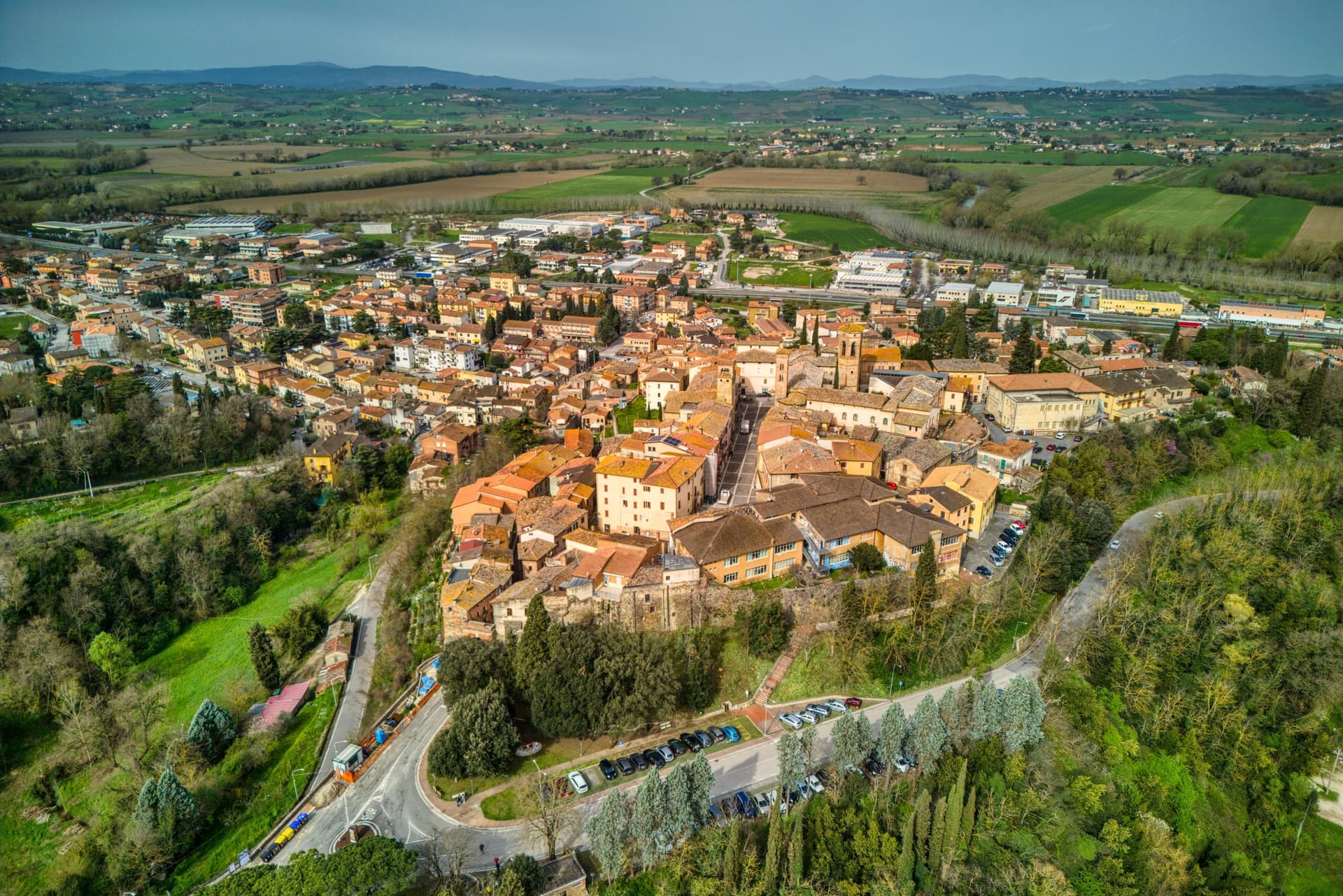
Deruta sits fifteen kilometers south of Perugia, its hill rising above the Tiber on the river's left bank. The walled medieval core, organized around Piazza dei Consoli, occupies the high ground, while the lower town spreads along the old road linking Perugia to Rome.
That road is where the workshops cluster, most of them family businesses running three or four generations deep, and it is also the route that carries traffic five kilometers south to the pilgrimage church, its walls built up over four centuries from votive tiles left by travelers on the same stretch of road. The first documented kilns appear in the archaeological record in the late thirteenth century, and by the early sixteenth the town's workshops had developed the lustro finish that gave Deruta wares their metallic shine, along with the Bella Donna plates that paired painted portraits with flattering banderoles naming the women depicted.
That convent complex, once a working monastery, now holds both the ceramics museum and, next door, the civic gallery with its Perugino and Alunno panels, so the town's religious architecture, its art collection, and its ceramics history sit under the same roof by accident of reuse rather than design. The upper town's churches and museums hold the record of what Deruta made and believed; the lower town's workshops are still making it.
I Rodella have been named by a guide.
What to see in Deruta
- Museo Regionale della Ceramica. Holds over 6,000 pieces from medieval to modern, arranged through the convent's old cloister and cells.
- Chiesa di San Francesco. Consecrated 1388 after earthquake reconstruction, Sienese 14th-century frescoes inside, Domenico Alfani Raphael-school panel above an altar.
- Pinacoteca Comunale. Civic gallery with Perugino's Eterno and Saints Romano e Rocco, plus two altarpieces by Niccolò Alunno from the surrounding churches.
How to get to Deruta
There is a railway station in the town, so you can arrive without a car and never need one while you are here. Perugia is roughly 19 minutes away by road.
Our tip
April through June and September into October are the months locals prefer. The Tiber valley stays mild and the workshops keep regular hours, with kilns running on weekdays and tastings open on weekends. The Festa della Ceramica in late August opens the cellars and the older workshops to the public. Palio della Brocca falls in August.
More from Anywhere Italy
 The prettiest hidden villages with a serious restaurant within 90 minutes of Perugia
- The best hill towns with a serious restaurant in the province of Perugia
 The best hidden hill towns with a serious restaurant within 90 minutes of Perugia
- The 7 best towns with a serious restaurant that sit inside a nature park in the province of Perugia
- The 6 best hidden towns with a serious restaurant that you can reach by train within 90 minutes of Perugia
 The best towns worth staying overnight in the province of Perugia