
The best truffle towns in the province of Perugia
90 towns visited, 910 to go. Follow along, free: Subscribe on Substack
The truffle country of the province of Perugia is limestone, oak and cold water. Black winter truffle comes out of the ground from late autumn into early spring, dug on wooded slopes above the Valnerina and the upper Tiber, and the summer scorzone keeps the season running through the warm months. On a table here it arrives shaved over strangozzi, folded into an omelette, stirred with anchovy and oil into a paste for warm bread, or pressed against pecorino and mountain ham. The towns themselves are built from the same pale stone as the gorges around them, tight lanes and low arches, wood smoke in the air by November.
The reflex is to think of truffles as a Piedmontese matter and go to Alba for the autumn fair, where the white truffle sets records and the market halls fill from opening hour. Travelers already in Umbria tend to base themselves in Perugia or Assisi, eat one truffle pasta on a terrace with a basilica view, and count the region done. Both are reasonable choices and both are busy, priced accordingly, and shaped around visitors who will be gone by the weekend.
The oak woods do not stop at the edge of the famous places. They run east into the Nera valley and the Sibillini foothills, north through Gubbio toward the Marche border and the upper Tiber. The towns here hold the same trade, with truffle markets, weighing houses, family firms that have graded and jarred the harvest for generations, and festivals in the coldest weeks of the year. Fewer people go, which mostly means the truffle is cheaper and the person selling it dug it themselves.
Of the 37 communes we have mapped in the province of Perugia, 9 qualify as truffle towns: each belongs to the national association of truffle towns. The smallest, Vallo di Nera, has 345 residents.
Two more lists worth reading alongside this one: The 6 best hidden truffle towns in the province of Perugia and The best hidden towns on a walking route in the province of Perugia.
All the towns within a day trip: day trips from Perugia.
Why visit Vallo di Nera
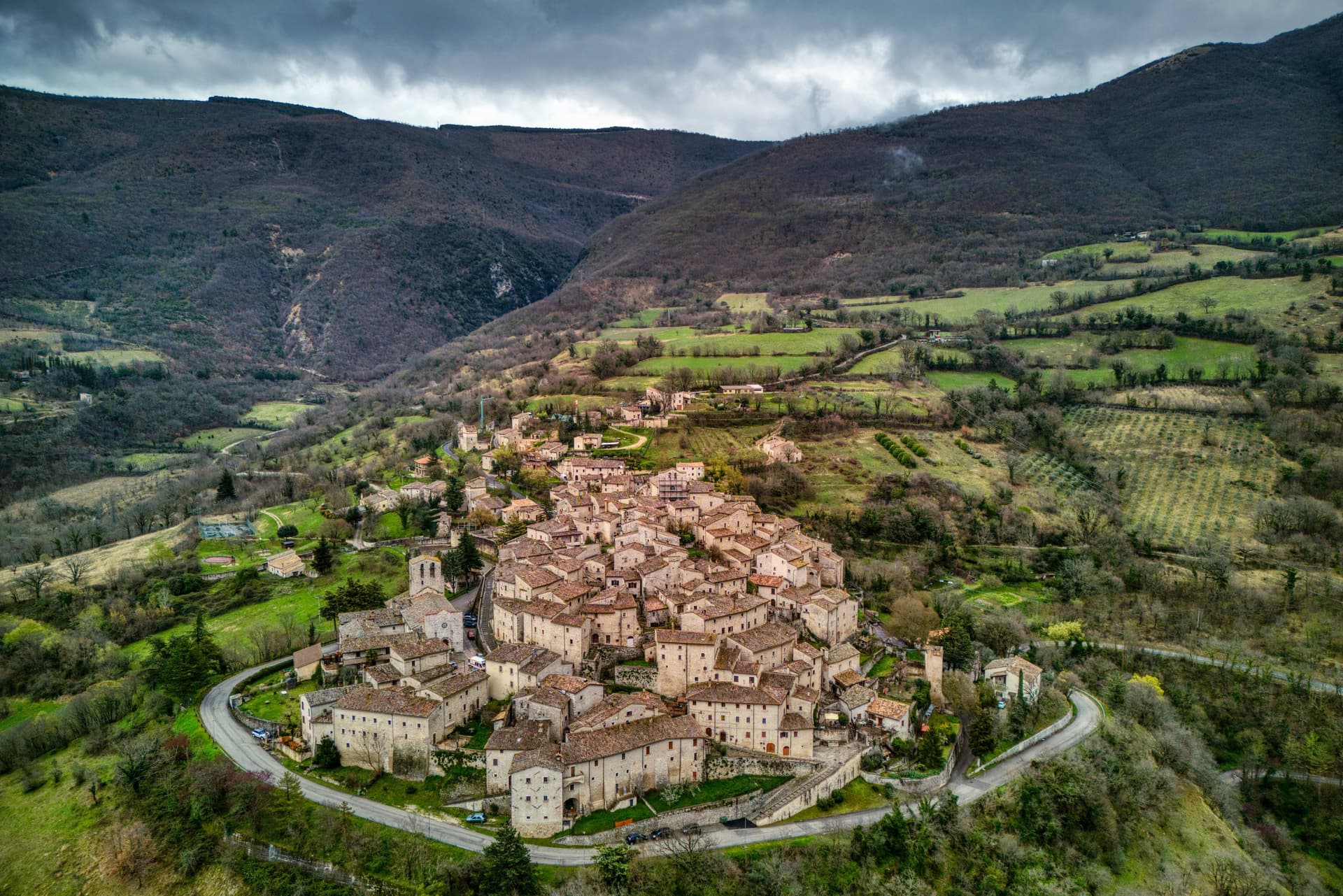
Vallo di Nera sits at 467 meters on a spur of the upper Valnerina, above the Nera river. The town of Spoleto granted the men of Vallo permission to build a castle here in 1217, on the hill where an earlier fortress had stood; the stone houses, the walls and the two symmetrical gates, Portella and Portaranne, have barely changed in eight centuries.
Inside, the village climbs in concentric rings to the Chiesa di Santa Maria Assunta at the top, built in 1176 and given to the Franciscans in the 13th century, who turned a defensive tower into a bell tower and frescoed the apse with a cycle of the Giotto school dated 1383. The Procession of the Whites, traceable to 1401, still leaves the church each year.
The population today is 345, smaller than at any point in the medieval records. Black truffle from the woods above and olive oil from the slopes down to the river are the surviving trades.
What to see in Vallo di Nera
- Chiesa di Santa Maria Assunta. Built 1176, Franciscan from the 13th century, with frescoes of the Giotto school dated 1383 in the apse, by Cola di Pietro da Camerino among others.
- Medieval walls. Twelfth-century walls and towers still encircle the village, with two original symmetrical gates, Portella and Portaranne.
- Centro storico. Light stone houses leaning against each other on three concentric rings, with embrasures, narrow alleys and stone portals preserved since 1217.
How to get to Vallo di Nera
Terni is about 53 min away by road. The full route from Rome.
Our tip
April through June and September into October are the months for Vallo di Nera. The Valnerina is green, the Nera river runs cold, and the trails up to Sellano or down to Scheggino are walkable. July and August push the valley into the mid-thirties; the stone houses hold their cool but most of the 345 residents close shutters between two and six.
Why visit Pietralunga
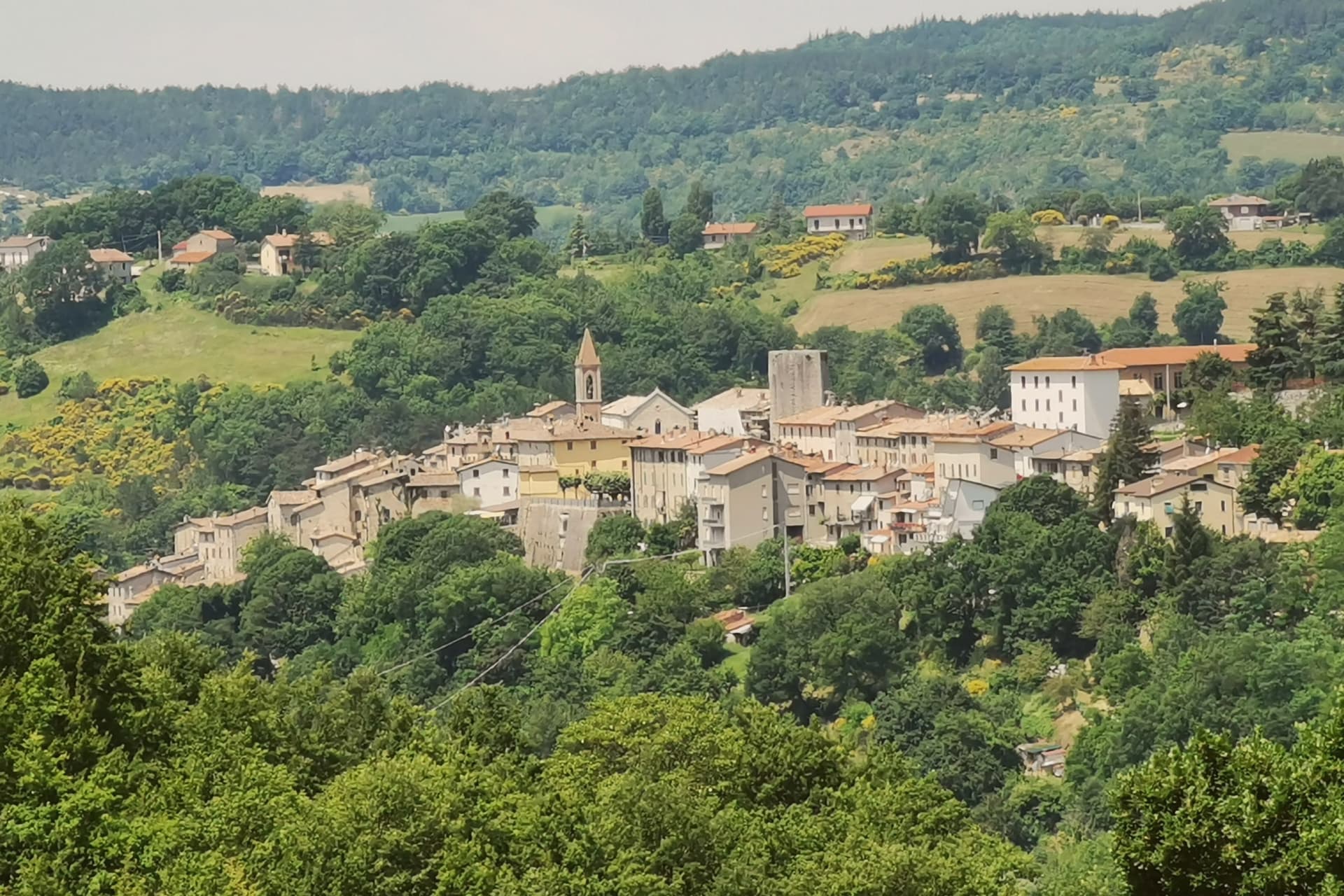
Pietralunga sits at 566 meters on a hilly ridge near the Umbria-Marche Apennines, on the northeast side of the upper Tiber. The Umbrian people founded the original settlement in the period of the Eugubine Tablets, between the second and first centuries BC.
The Lombards rebuilt it as a fortified hilltop village between the sixth and eighth centuries, and the Rocca Longobarda from that era still dominates the ridge. The Pieve di Santa Maria on Piazza Fiorucci dates from the seventh or eighth century in foundation, with an irregular single-nave plan and a Romanesque portal added later.
The territory is one of the densest truffle districts in Umbria, with documented tartufaie in the surrounding woods and a tartufo bianco fair every October. The Pietralunga white potato, grown on the upper slopes, has its own consortium and is one of the products that have kept the smallholders in the area working.
What to see in Pietralunga
- Rocca Longobarda. Eighth-century Lombard fortress dominating the borgo; the original triangular plan and central keep survive on the highest point of the ridge.
- Pieve di Santa Maria. Parish church on Piazza Fiorucci with 7th-8th century foundation and a 13th-century Romanesque portal, single nave with ogive vaults inside.
- Centro storico medievale. Walled Lombard core organized around the Rocca, narrow streets and stone houses radiating from Piazza Fiorucci.
How to get to Pietralunga
Perugia is about 1 h 5 min away by road.
Our tip
May through June and September into October are the working months for the territory. The truffle-hunting season opens in September and runs through January, with the white-truffle fair in October the year's largest event. July and August are warm in the upper Tiber, low thirties typically; the woods cool early in the morning and the trails through the tartufaie become the local refuge.
Why visit Cascia
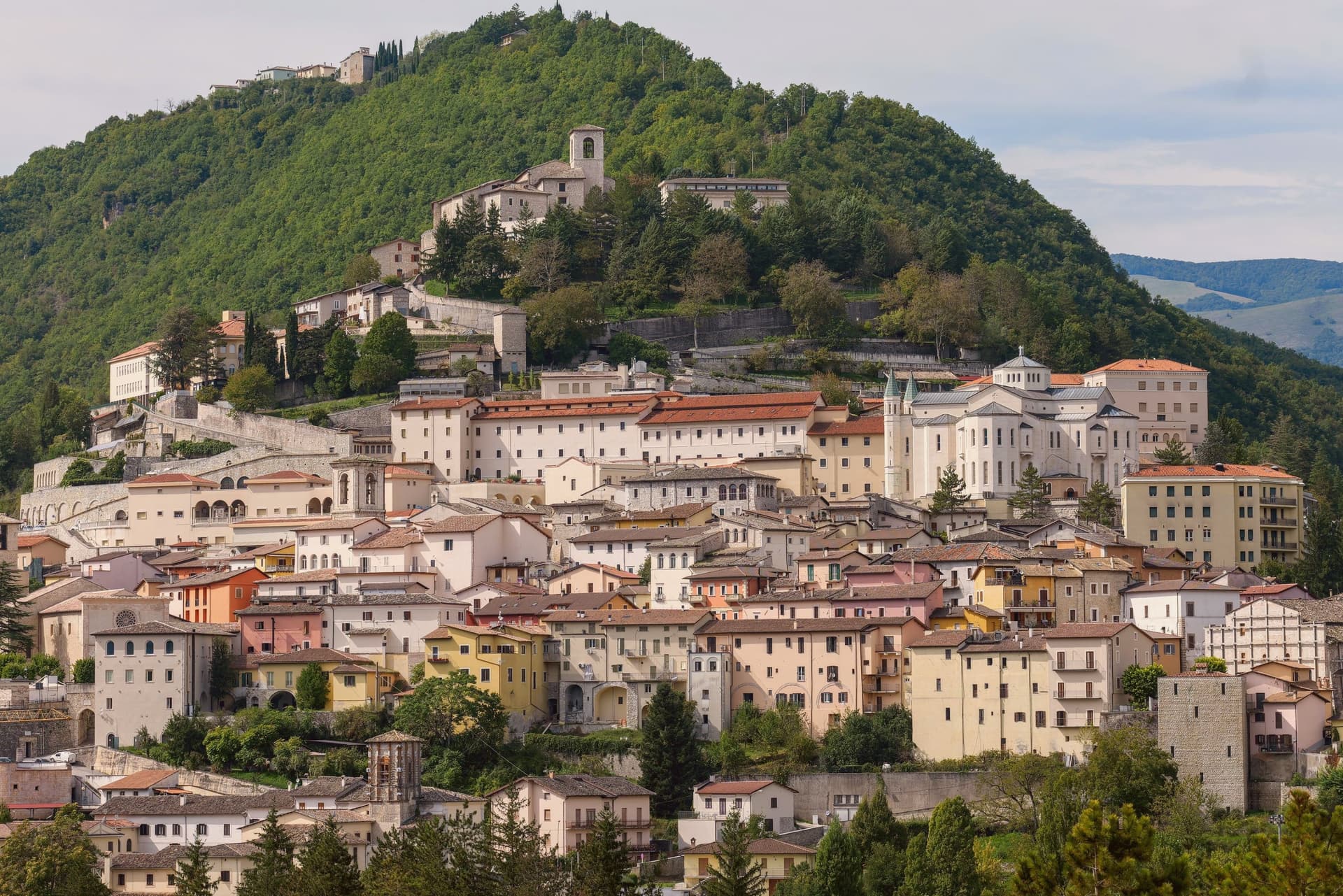
Cascia sits at 653 meters in the mountainous southeastern corner of Umbria, a remote pocket of the upper Valnerina near the Marche and Lazio borders. The commune carries the highest seismic activity in the region together with Norcia twelve kilometers away, and a long history of destructive earthquakes that culminated in the August 2016 sequence.
The town is built around Rita Lotti, who died in the Augustinian monastery here in 1457 and was canonized as Santa Rita in 1900. The Basilica di Santa Rita, built 1937-1947 in white Tivoli travertine on the site of the older church, draws pilgrims year-round and turns Cascia into a town that runs on faith and on truffle.
The Cammino di San Benedetto passes through, linking Norcia to Subiaco and Montecassino. Visitors not pilgrims tend to come for the black truffle, the lentils of nearby Castelluccio, and the silence of the high pastures above town.
What to see in Cascia
- Basilica di Santa Rita. Built 1937-1947 in white Tivoli travertine, Greek-cross plan, frescoes by Montanarini, Filocamo, Consadori, Ceracchini and Vicenzi.
- Monastero di Santa Rita. Augustinian monastery where Rita Lotti lived and died in 1457, attached to the basilica and still active as a religious community.
- Chiesa di San Francesco. Medieval Franciscan church in the lower centro storico, fourteenth and fifteenth-century frescoes inside.
How to get to Cascia
Terni is about 1 h 14 min away by road.
Our tip
May through October is the open season at 653 meters. The basilica is busiest around the May 22 feast of Santa Rita, when pilgrims fill the upper town and accommodation books out months ahead. June through September brings mild days and cool nights, the high pastures green, the truffle hunters working the woods above town.
Why visit Scheggino
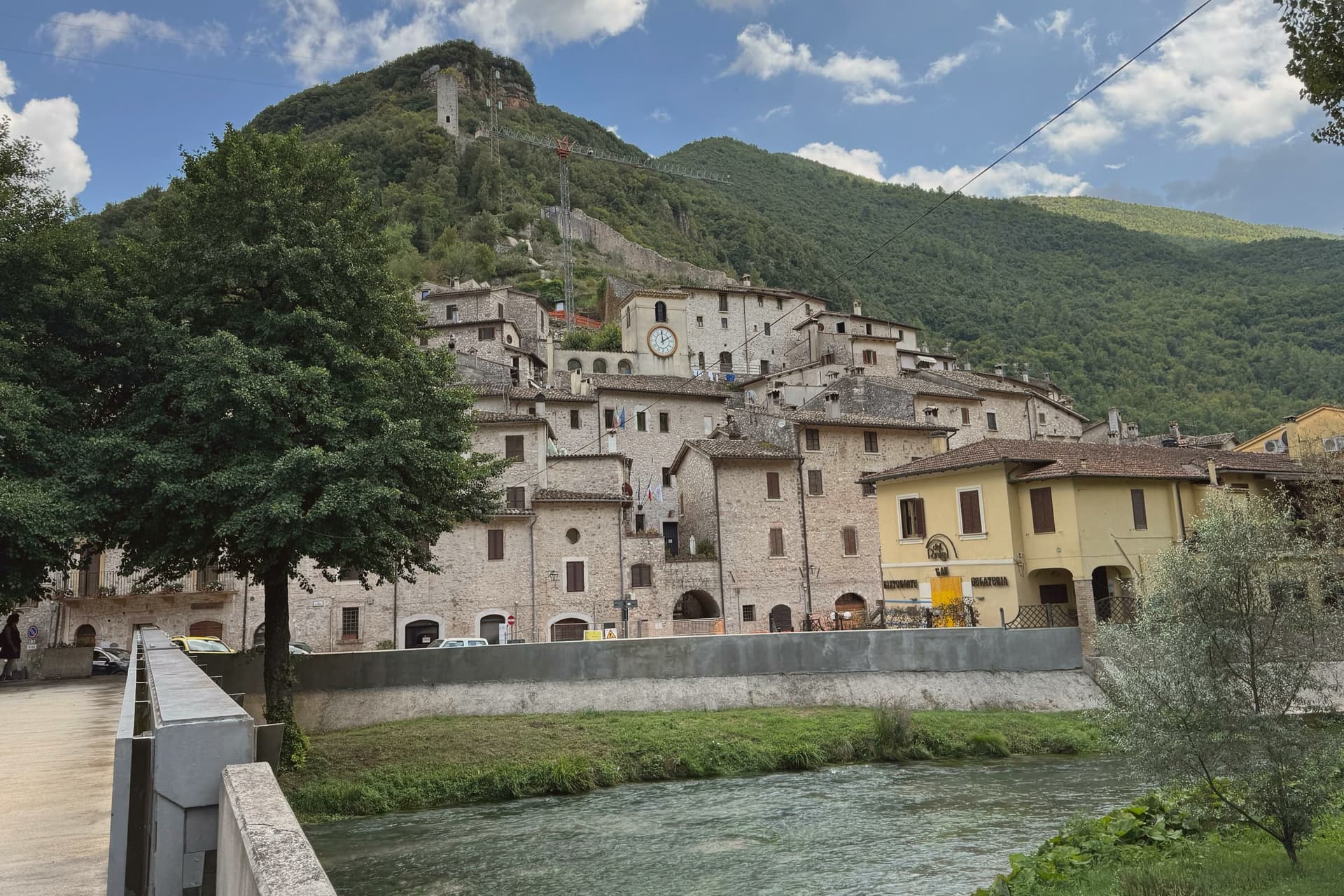
Scheggino sits at 280 meters in the heart of the Valnerina, the village wedged into a triangle of walls between the slope above and the Nera river below. The Duchy of Spoleto built it around the 12th century to defend one of the three bridges over the Nera; the triangular plan and the watchtower of white and pink stone, about 20 meters high, still mark the top of the castle.
The Nera runs alongside the lower edge of the village, divided into channels that once turned mills and now hold trout and the springs that feed the truffle washing rooms. Scheggino is the home of Urbani Tartufi, the first commercial company for the storage and processing of truffle, founded in 1852, which still has its plant on the river.
The Diamante Nero festival each summer prepares a giant frittata with more than 2,000 eggs and 80 kilos of black truffle. The Cammino di San Francesco passes through the village on the way south.
What to see in Scheggino
- Castello di Scheggino. Twelfth-century triangular castle of the Duchy of Spoleto, with a watchtower in white and pink stone about 20 meters high at the summit.
- Chiesa di San Nicola. Romanesque parish church at the heart of the centro storico, frescoes of the Umbrian school of the 15th century in the apse.
- Nera river canals. Channels of the Nera divided through the lower village, once for mills and now for trout farming and the truffle washing rooms of Urbani.
How to get to Scheggino
Terni is about 49 min away by road.
✷ We have written about Scheggino
“Scheggino is the black truffle town on the banks of the Nera river, which lies in the valley and is famous for its giant truffle frittata. Scheggino is one of the stops on our Umbrian Circle road trip.”
Read our piece on Scheggino →The Umbrian Circle | Town Tasting in a Day
Our tip
April through June and September into October are the months for Scheggino. The Nera runs cold and full, the trout farms work at capacity, and the trails up to Vallo di Nera or down to Ferentillo are walkable in shade. July and August push the valley into the mid-thirties; the river canals through the village cool the lower streets and the trattorie pour Nera trout with local truffle.
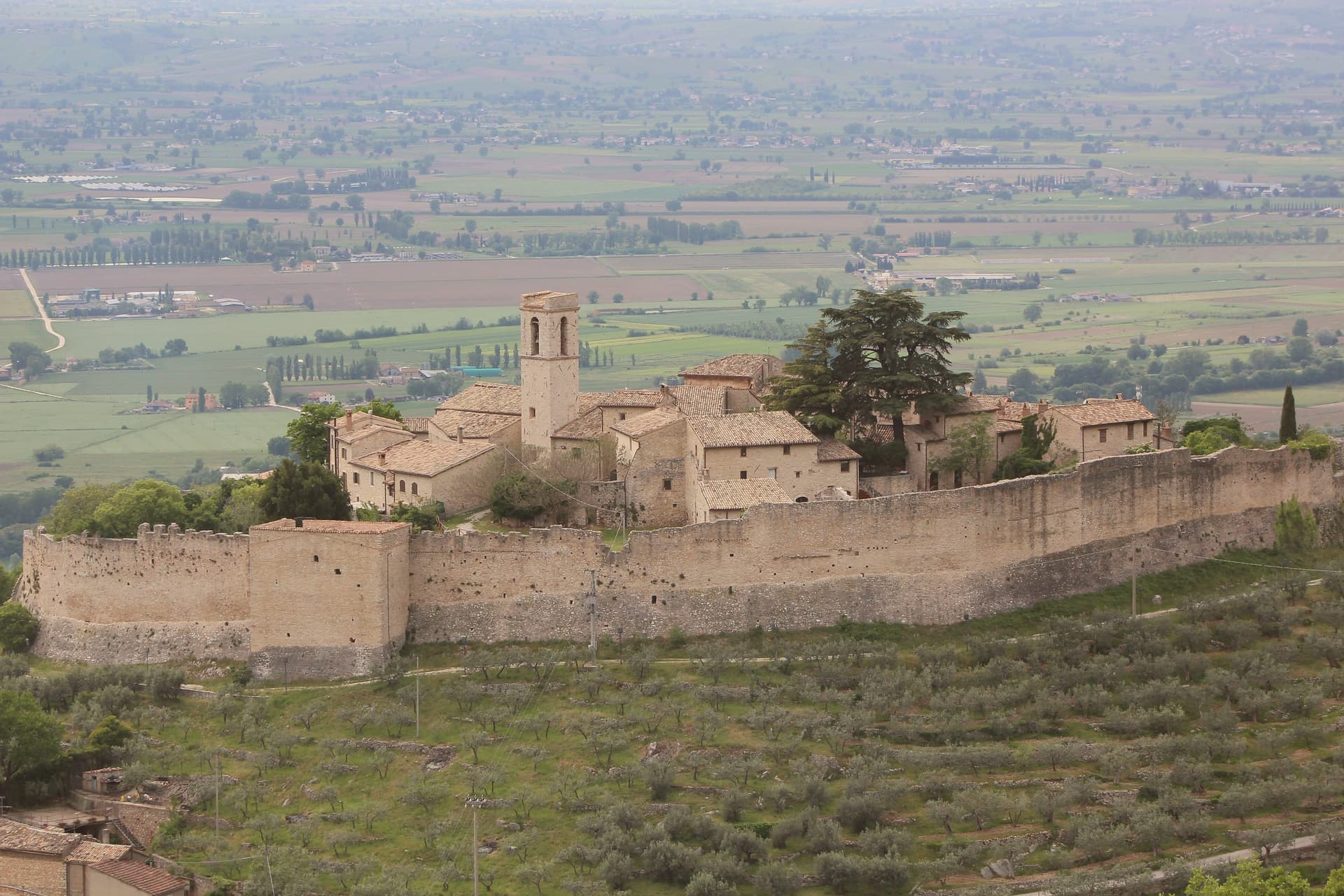
Why visit Campello sul Clitunno
Campello sul Clitunno sits at 290 meters along the Clitunno river, a few kilometers north of Spoleto. The name comes from the Counts Campello, originally Champeaux of Reims, who founded the hilltop nucleus of Campello Alto in the mid-10th century under the Burgundian noble Rovero.
The Fonti del Clitunno, the springs that form the river, produce 1,300 to 1,500 liters of water per second; Pliny the Younger wrote about them, and Lord Byron and Giosuè Carducci returned to the place in poems centuries later, the latter with the ode Le fonti del Clitumno. A kilometer downstream from the springs, in the frazione of Pissignano, the Tempietto del Clitunno is a 4th- or 5th-century pagan sacellum reworked by the Lombards in the 7th and 8th centuries; the interior frescoes have parallels with Santa Maria Antiqua in Rome.
The Tempietto entered the UNESCO World Heritage List in June 2011 as part of the serial site The Lombards in Italy: Places of Power. The Castello di Pissignano above the temple covers the medieval layer.
What to see in Campello sul Clitunno
- Tempietto del Clitunno. Small temple-shaped chapel of the 4th-5th century reworked by the Lombards in the 7th-8th, with frescoes of the Saviour, Peter and Paul; UNESCO World Heritage.
- Fonti del Clitunno. Springs producing 1,300-1,500 liters per second, forming the source of the Clitunno; visited by Pliny, Byron and Carducci.
- Castello di Pissignano. Eleventh-twelfth century hilltop castle just above the Tempietto, founded by Benedictine monks who enclosed the settlement with walls.
How to get to Campello sul Clitunno
It has its own railway station. Terni is about 48 min away by road. The full route from Rome.
Our tip
April through June and September into October are the months for Campello sul Clitunno. The springs run cold and full, the willows along the lake at the source hold the morning light, and the trails between the Tempietto and Campello Alto are walkable in shade. July and August touch the mid-thirties in the Spoleto valley; the Fonti basin runs a few degrees cooler at the water's edge.
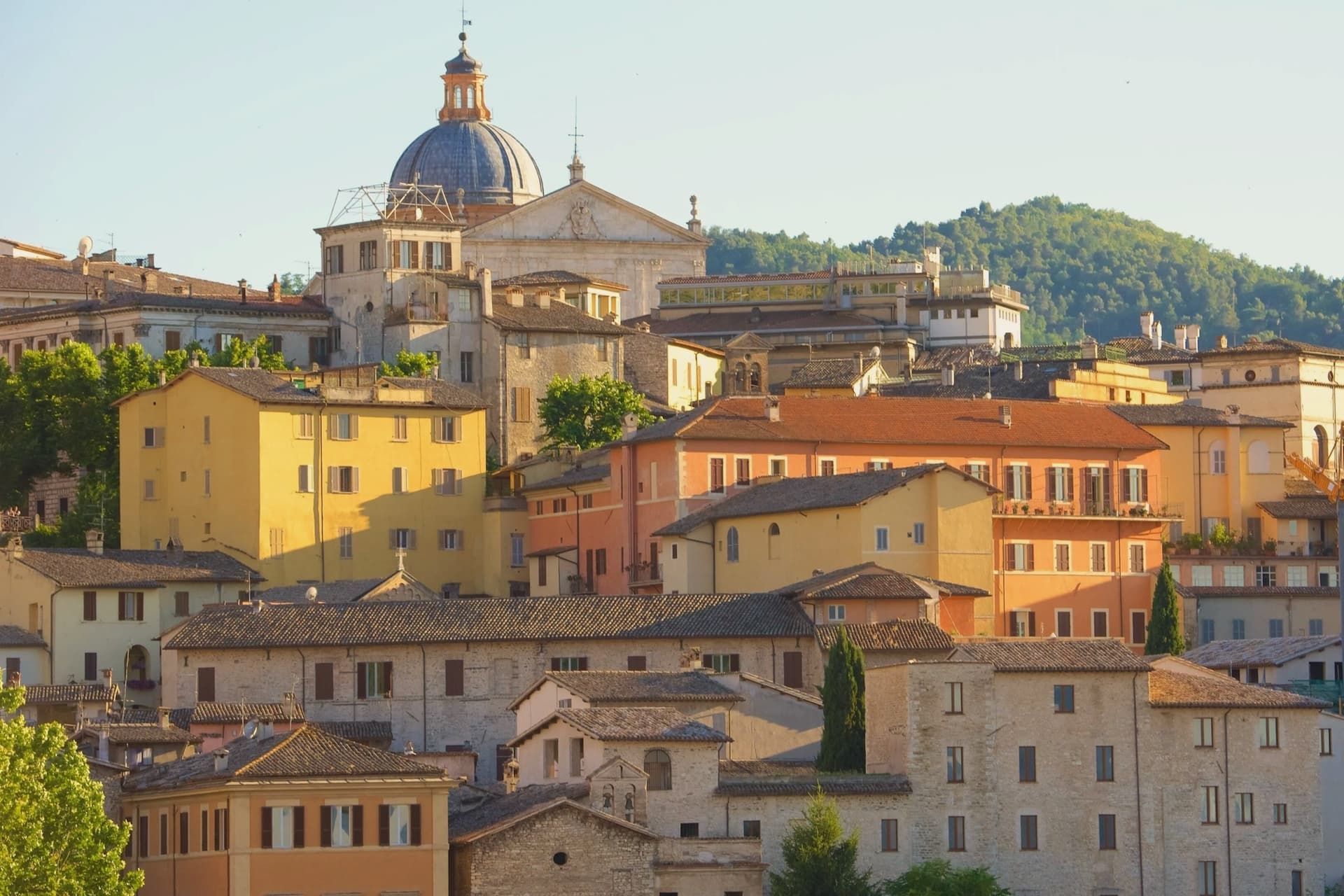
Why visit Spoleto
Spoleto sits at 396 meters at the southern edge of the Valle Umbra, the Apennines rising behind it toward Monteluco. The town was Roman Spoletium from 241 BC, then capital of one of the two great Lombard duchies of Italy from 576, controlling Umbria, Sabina, Picenum and the Pescara valley for more than five centuries.
The Rocca Albornoziana on the Colle Sant'Elia was built between 1363 and 1367 by Matteo Gattapone for Cardinal Albornoz, both a papal fortress and a residence, now the Museo Nazionale del Ducato. From the Rocca the Ponte delle Torri, 230 meters long and 80 meters high, crosses the Tessino gorge to Monteluco, an aqueduct of the 13th century built over Roman foundations.
The Duomo holds a Byzantine mosaic of 1207 across its façade and Filippo Lippi's last fresco cycle in the apse. Gian Carlo Menotti founded the Festival dei Due Mondi in 1958; the Roman theater, the Rocca courtyard and Piazza del Duomo still carry the program each year from late June into mid-July.
Apollinare (MICHELIN), San Lorenzo (MICHELIN) and Il Capanno (Slow Food and L'Espresso) are listed in food guides.
What to see in Spoleto
- Rocca Albornoziana. Papal fortress built 1363-1367 by Matteo Gattapone for Cardinal Albornoz, now the Museo Nazionale del Ducato di Spoleto.
- Ponte delle Torri. Aqueduct bridge 230 meters long and 80 meters high, crossing the Tessino gorge to Monteluco, 13th-14th century on Roman foundations.
- Duomo di Santa Maria Assunta. Twelfth-century Romanesque cathedral with Byzantine mosaic of 1207 on the façade, Renaissance portico, and Filippo Lippi frescoes in the apse.
How to get to Spoleto
It has its own railway station. Terni is about 41 min away by road. The full route from Rome.
Our tip
April through June and September into October are the months for Spoleto. The town opens its gardens, the Rocca courtyard fills with sun, and the long walks along the Giro dei Condotti above the Ponte delle Torri become bearable again. The Festival dei Due Mondi runs from late June into mid-July, when Spoleto doubles in population and the Roman theater carries opera into the small hours.
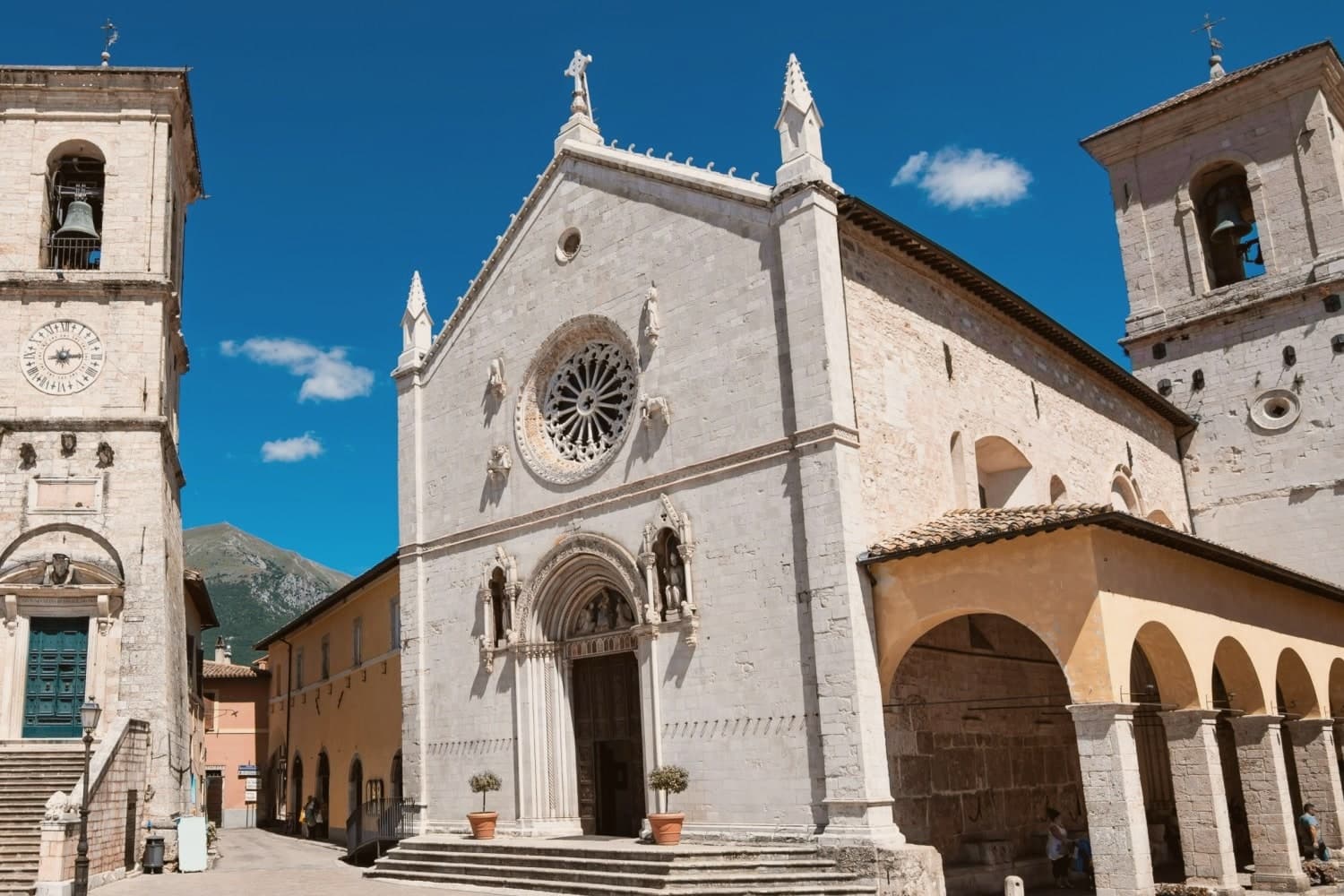
Why visit Norcia
Norcia sits at 604 meters on a high plateau on the Umbrian side of the Monti Sibillini, ancient Nursia of the Sabines, fortified in the 3rd century BC by Rome. Saints Benedict and his twin sister Scholastica were born here in 480; the Benedictine Order and the Ora et Labora motto that shaped Western monasticism began on this piazza.
The Basilica di San Benedetto rises on the traditional birthplace, built between 1290 and 1338 over a pre-existing crypt. On 30 October 2016 a magnitude 6.5 earthquake destroyed the nave; only the façade was left standing.
Reconstruction completed on 30 October 2025, nine years to the day, with the original stones and earthquake-resistant technology. The town gave its name to norcineria, the Italian word for quality pork delicatessen, after centuries of Norcia butchers specializing in wild boar and pork.
Black truffle from the Valnerina, lentils from Castelluccio, and ricotta from the high pastures complete the table.
Vespasia (MICHELIN and Gambero Rosso), Granaro del Monte (MICHELIN and Locali Storici) and Casale nel Parco (Gambero Rosso) are listed in food guides.
What to see in Norcia
- Basilica di San Benedetto. Built 1290-1338 over the traditional birthplace of Saints Benedict and Scholastica, rebuilt with original stones after 2016, reopened 30 October 2025.
- Castellina. Fortified papal stronghold designed by Jacopo Barozzi da Vignola in 1554, on Piazza San Benedetto, now the Museo Civico e Diocesano.
- Piazza San Benedetto. Civic and religious heart of the centro storico, with the Palazzo Comunale, the basilica, the Castellina and the statue of Benedict at the center.
How to get to Norcia
Terni is about 1 h 33 min away by road.
Our tip
April through June and September into October are the months for Norcia. The plateau holds its color, the lentil fields of Castelluccio bloom from mid-June into July, and the high pastures are open for hiking. July and August stay cooler than the Umbrian valleys at 604 meters, but the town fills with festival crowds for the Mostra Mercato del Tartufo Nero on the last weekend of February and again for sagras through the summer.
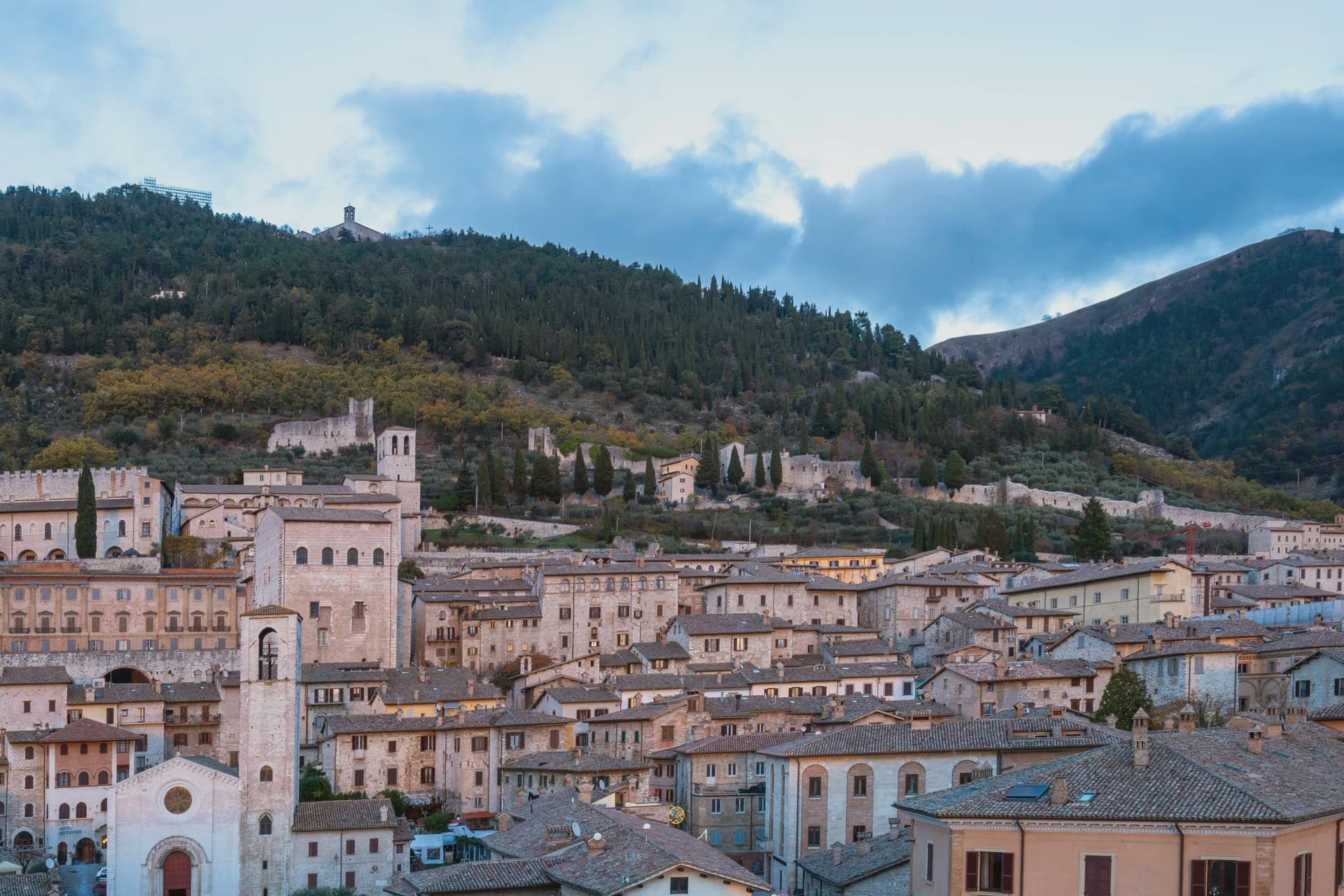
Why visit Gubbio
Gubbio sits at 522 meters on the lower slope of the mountain, the old town stacked in four parallel terraces against it. The settlement was Ikuvium, one of the most important towns of the Umbri before Rome arrived.
In 1444 a peasant woman named Presentina found the bronze tablets in the area of the Roman theater and sold them to the commune in 1456 for 40 florins, a transaction that kept them in the town where they were unearthed rather than scattered to a museum elsewhere. The terraces order the town's life by elevation: the Roman theater and lower ground below, the civic square and cathedral stacked on the upper terraces of the centro storico, the patron saint's basilica set apart on the summit above all of it.
The Corsa dei Ceri each 15 May draws that vertical order into motion, three teams carrying wooden statues of Sant'Ubaldo, San Giorgio and Sant'Antonio Abate from the square at the town's center up to the basilica at its height, filling the town from dawn to dusk. The layout is not incidental: a settlement that predates Rome, a civic archive kept where it was found, and a race that each year retraces the climb from town to summit all point to the same fact, that Gubbio's history has stayed stacked on its own mountain rather than dispersed from it.
Ristorante Taverna del Lupo (Locali Storici), Tenuta Borgo Santa Cecilia (Gambero Rosso), La Fornace di Mastro Giorgio (Gambero Rosso) and 1 more place are listed in food guides.
What to see in Gubbio
- Palazzo dei Consoli. Built 1332-1349 by Angelo da Orvieto and Matteo Gattapone, the Gothic civic palace holds the Tavole Iguvine and the civic museum, its vertical pilasters dividing the façade across the square.
- Tavole Iguvine. Displayed on the ground floor of the palazzo, the tablets were recovered near the Roman theater and record the religious rites of the pre-Roman western world in detail.
- Piazza Grande. Suspended civic square between Palazzo dei Consoli and Palazzo Pretorio, hanging on substructures against the slope of the mountain.
How to get to Gubbio
Perugia is about 51 min away by road.
Our tip
April through June and September into October are the months for Gubbio. The slopes of Monte Ingino are walkable, the Cammino di San Francesco passes through, and the air at 522 meters holds the Apennine clarity. The Corsa dei Ceri on 15 May is the single most concentrated day in town; book months ahead.
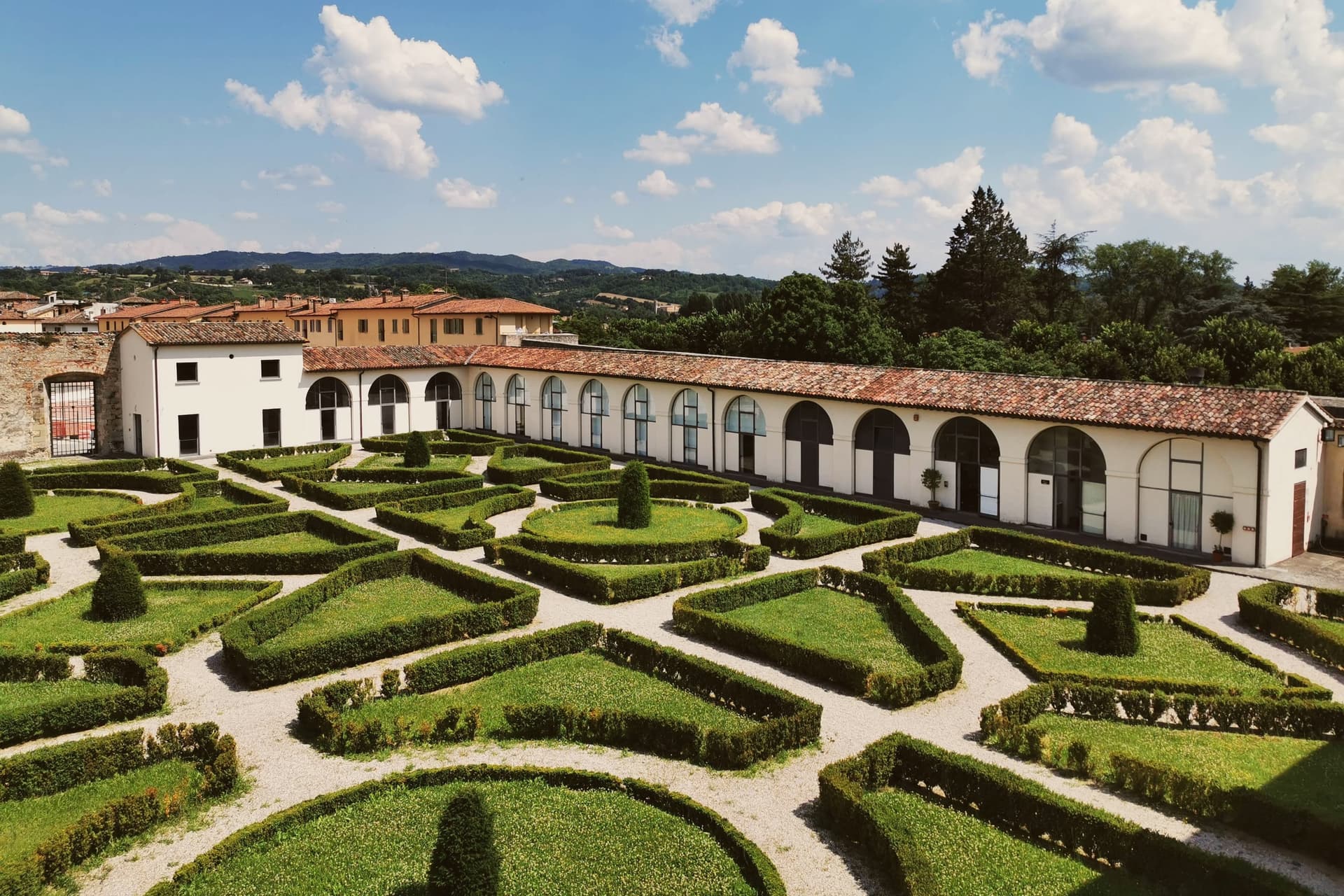
Why visit Città di Castello
Città di Castello sits at the head of the Alta Valtiberina, the upper Tiber valley, where the river that runs through Rome 250 km south is still a narrow, Tuscany-style stream. It is the largest town in Umbria north of Perugia, 56 km from the regional capital and reachable by the historic Trenino Centrale Umbra line.
The town's history sits in three layers. Roman: founded as Tifernum Tiberinum in the 1st c BC, with Pliny the Younger keeping a villa here and describing the upper Tiber landscape in his letters.
Medieval-Renaissance: a walled town run as a signoria by the Vitelli family from the 15th c, whose patronage brought a young painter to the centro to complete his first independent commissions, among them the altarpiece now in the Pinacoteca Comunale, before he left for Rome; the same Pinacoteca, housed in the Vitelli family's own palazzo, also holds works by Signorelli, Ghirlandaio and Della Robbia. Twentieth century: a native-born artist gave his name to a foundation that now runs two sites in the centro, a palazzo holding the earlier period of his work and a former tobacco-drying complex painted black inside and out for the monumental late series, together forming, by the town's own reckoning, the most complete single-artist museum after Picasso's.
Beyond the art, the town carries three Città quality marks: Città del Tartufo for its white truffle zone, which produces some of the best Tuber magnatum in Italy and is marked each year from around 1 November by a market and festival; Città della Ceramica for a maiolica tradition dating to the 16th c and still worked in a dozen workshops across the centro; and a stop on the Cammino di San Francesco, the pilgrim route linking La Verna in Tuscany, where St Francis received the stigmata, to Assisi, his birthplace. There is also a horse fair in early September, the Mostra Nazionale del Cavallo, a Renaissance music festival in July called the Tibernum Festival, and a centro storico whose medieval walls survive in part and can be walked.
The food follows the valley: ciaramicola, the local Easter cake, strangozzi with truffle, the Vitellone Bianco dell'Appennino Centrale IGP beef, pecorino, and the local Sangiovese-based Colli Altotiberini DOC red. What the layers add up to is a river town that kept building on itself rather than being replaced: a Roman villa landscape, a Renaissance signoria that imported a major painter, and a modern art foundation occupying old tobacco warehouses, each still visible in the centro rather than paved over by the one that followed it.
La Miniera di Galparino is listed in Slow Food's Osterie d'Italia.
What to see in Città di Castello
- Fondazione Burri (Palazzo Albizzini + Ex Seccatoi). Two sites: 200+ works in the centro palazzo, and the monumental late series, including the Grande Cretti, in the black-painted ex-tobacco warehouses of the Alta Valtiberina. The Palazzo Albizzini holds the earlier period; the warehouses were painted black inside and out by Burri himself for the later cycle.
- Pinacoteca Comunale (Palazzo Vitelli). Raphael's early processional banner of the Holy Trinity hangs here, alongside Signorelli, Ghirlandaio and Della Robbia.
- Mostra del Tartufo Bianco (early November). A market and festival held from around 1 November in the Alta Valtiberina, drawing producers and restaurants for tastings around some of the best Tuber magnatum in Italy.
How to get to Città di Castello
It has its own railway station. Perugia is about 51 min away by road. The full route from Florence.
Our tip
Città di Castello is best April–June and September–November. The Mostra del Tartufo Bianco every November weekend is the year's culinary headline. The Mostra Nazionale del Cavallo (early September) is the regional horse fair.
More from Anywhere Italy
- The 6 best hidden truffle towns in the province of PerugiaPerugia provincetrufflehidden6 towns · smallest 345 residents
- The best hidden towns on a walking route in the province of PerugiaPerugia provinceon a walking routehidden8 towns · smallest 446 residents
- The best towns on a walking route that eat well in the province of PerugiaPerugia provinceon a walking routeeats well8 towns · smallest 4,544 residents
- The best small towns on a walking route in UmbriaUmbriaon a walking routesmall8 towns · smallest 446 residents
- The best hill towns on a walking route within 90 minutes of PerugiaNear Perugiahill townon a walking routewithin 90 min9 towns · smallest 1,984 residents · closest 33 min away
- The 9 best olive oil towns within 90 minutes of TerniNear Terniolive oilwithin 90 min9 towns · smallest 345 residents · closest 34 min away