
The best hill towns on a walking route within 90 minutes of Perugia
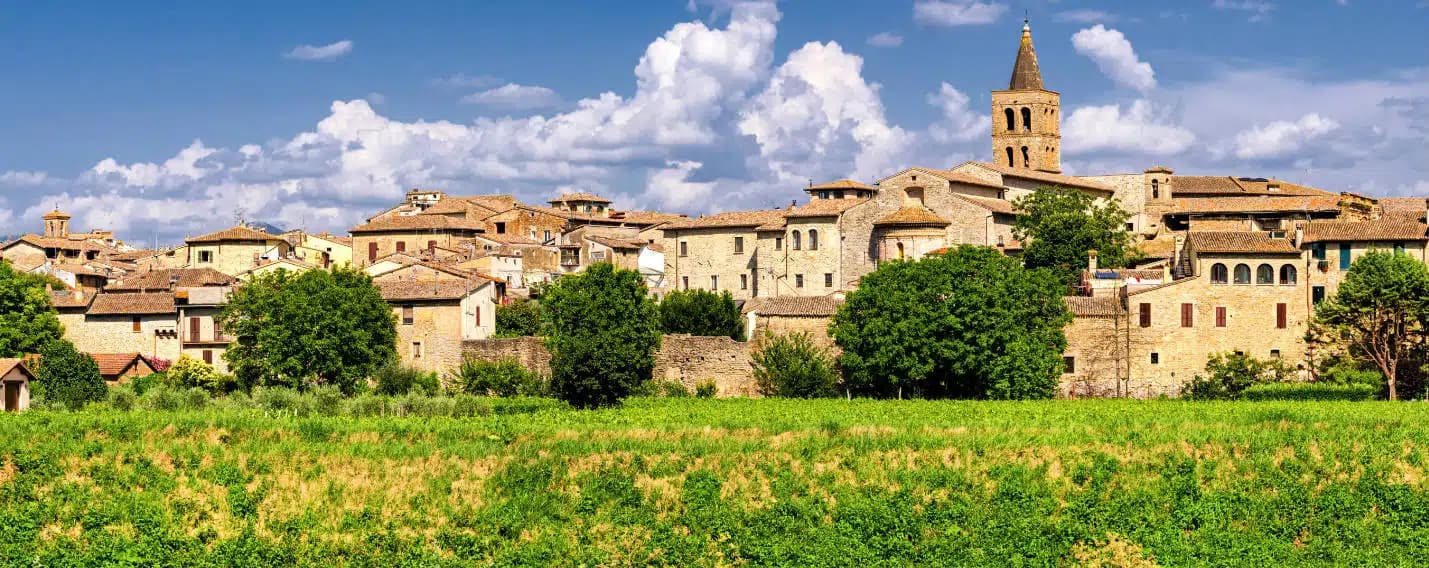
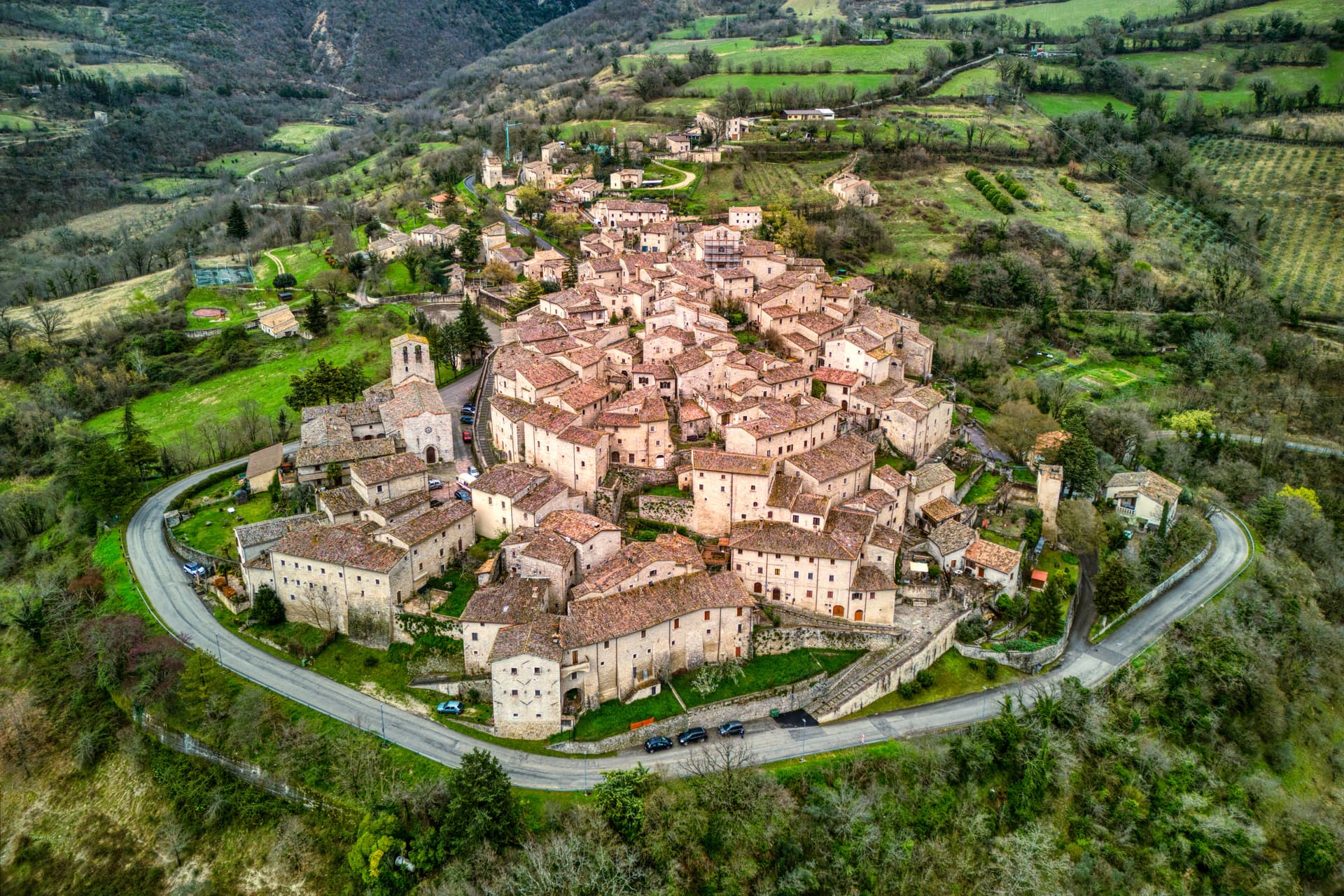
Umbria walks better than it drives. The hill towns here are built from pale local limestone and pink Subasio stone, stacked up slopes above olive terraces, and the paths between them are older than the roads: pilgrim ways, drove routes, Roman consular lines still visible under the gravel. Spring brings broom and wild orchids on the ridges; late autumn brings the frantoi, new oil on bruschetta, and black truffles dug out of the oak woods above the Tiber. Walking is the sensible way to move through it, because the distance between one bell tower and the next is usually an afternoon.
Most visitors base themselves in Perugia, ride the escalators up through the Rocca Paolina, look at the Fontana Maggiore and treat the rest of the region as a series of day trips by car. Orvieto absorbs a further share, coach by coach, for the cathedral facade. Both are worth the time they take. Both also concentrate people into a few hundred metres of street, and neither tells you anything about the country in between.
That country is the point. The same ridges, the same oil, the same stone continue north into the Tiber valley and south along the Via Amerina and the Franciscan paths, and the towns strung along them are stages rather than destinations, places built to receive someone arriving on foot at the end of a day. Fewer people walk them than drive between them. These are the ones worth planning a route around.
Of the 41 communes we have mapped in within 90 minutes of Perugia, 8 qualify as hill towns on a walking route: each is an inland hill settlement, and each is a stage on one of the long historic walking routes. The smallest, Pietralunga, has 1,984 residents.
If you are still choosing, we have also written The best towns on a walking route that eat well in the province of Perugia and The 8 best towns on a walking route that you can reach by train in Umbria.
Pietralunga
Why visit Pietralunga
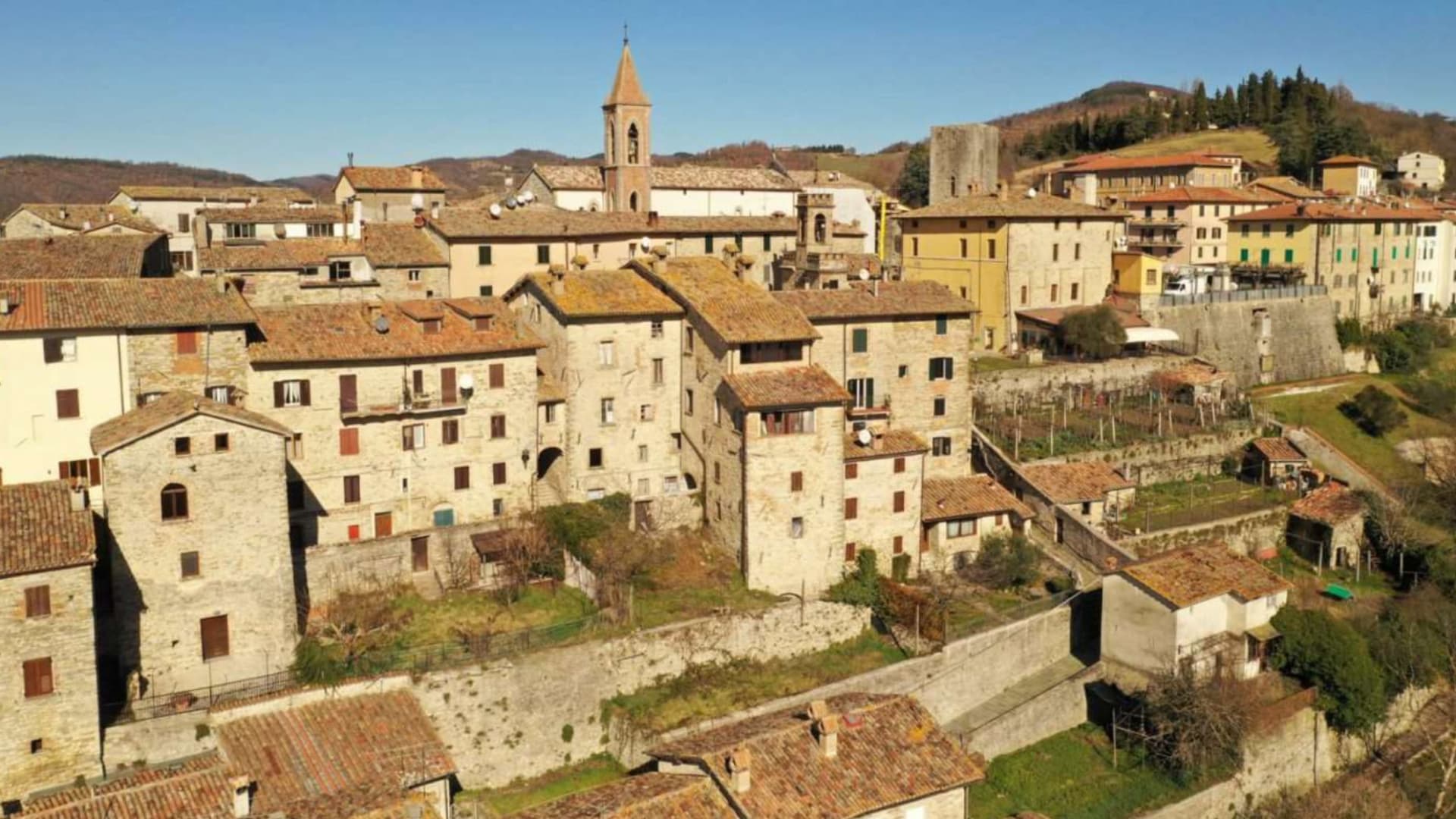
Pietralunga sits at 566 meters on a hilly ridge near the Umbria-Marche Apennines, on the northeast side of the upper Tiber. The Umbrian people founded the original settlement in the period of the Eugubine Tablets, between the second and first centuries BC.
The Lombards rebuilt it as a fortified hilltop village between the sixth and eighth centuries, and the Rocca Longobarda from that era still dominates the ridge. The Pieve di Santa Maria on Piazza Fiorucci dates from the seventh or eighth century in foundation, with an irregular single-nave plan and a Romanesque portal added later.
The territory is one of the densest truffle districts in Umbria, with documented tartufaie in the surrounding woods and a tartufo bianco fair every October. The Pietralunga white potato, grown on the upper slopes, has its own consortium and is one of the products that have kept the smallholders in the area working.
What to see in Pietralunga
- Rocca Longobarda. Eighth-century Lombard fortress dominating the borgo; the original triangular plan and central keep survive on the highest point of the ridge.
- Pieve di Santa Maria. Parish church on Piazza Fiorucci with 7th-8th century foundation and a 13th-century Romanesque portal, single nave with ogive vaults inside.
- Centro storico medievale. Walled Lombard core organized around the Rocca, narrow streets and stone houses radiating from Piazza Fiorucci.
How to get to Pietralunga
Perugia is roughly 65 minutes away by road.
Our tip
May through June and September into October are the working months for the territory. The truffle-hunting season opens in September and runs through January, with the white-truffle fair in October the year's largest event. July and August are warm in the upper Tiber, low thirties typically; the woods cool early in the morning and the trails through the tartufaie become the local refuge. Mostra Mercato del Tartufo Bianco e della Patata falls in October.
Citerna
Why visit Citerna
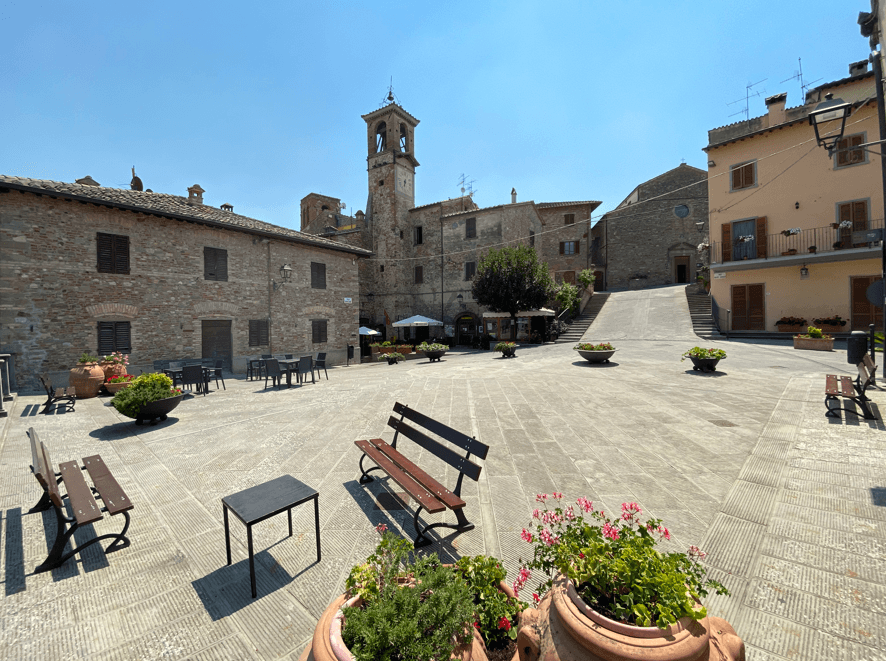
Citerna sits at 480 meters on a ridge at the confluence of the Cerfone and Sovara streams, fifty kilometers north of Perugia in the upper Tiber valley. The name comes from the rainwater cisterns hollowed under the town, still walkable through the underground camminamenti that run beneath the medieval streets.
Umbrian and Etruscan settlement preceded the Roman finds at San Fista and Pistrino. In 1221 Citerna swore loyalty to Città di Castello in exchange for protection, then passed to the Vitelli of Città di Castello as a vicariate in the early sixteenth century, and joined the Kingdom of Italy in 1860 as the first Umbrian town to do so.
The Chiesa di San Francesco on Corso Garibaldi holds a polychrome terracotta Madonna by Donatello, dated around 1415, the only work by the sculptor in Umbria, alongside paintings by Pomarancio, Luca Signorelli and Raffaellino del Colle. The view from the ramparts reaches the mountains of La Verna and Gubbio on a clear day.
What to see in Citerna
- Madonna di Donatello. Polychrome terracotta Madonna and Child of around 1415 in the Chiesa di San Francesco, the only sculpture by Donatello in Umbria.
- Chiesa di San Francesco. Convent church on Corso Garibaldi with works by Pomarancio, Luca Signorelli, Raffaellino del Colle and a Della Robbia school Madonna.
- Camminamenti medievali. Underground walkways and rainwater cisterns hollowed below the streets, the source of the town's name and now open to visit.
How to get to Citerna
Perugia is roughly 68 minutes away by road.
Our tip
April through June and September into October are the months that suit the ridge. Spring and early autumn give clear views from the ramparts as far as La Verna; the air at 480 meters stays mild even in midsummer afternoons. July and August warm the upper Tiber valley but Citerna is small and the underground camminamenti stay cool.
Trevi
Why visit Trevi
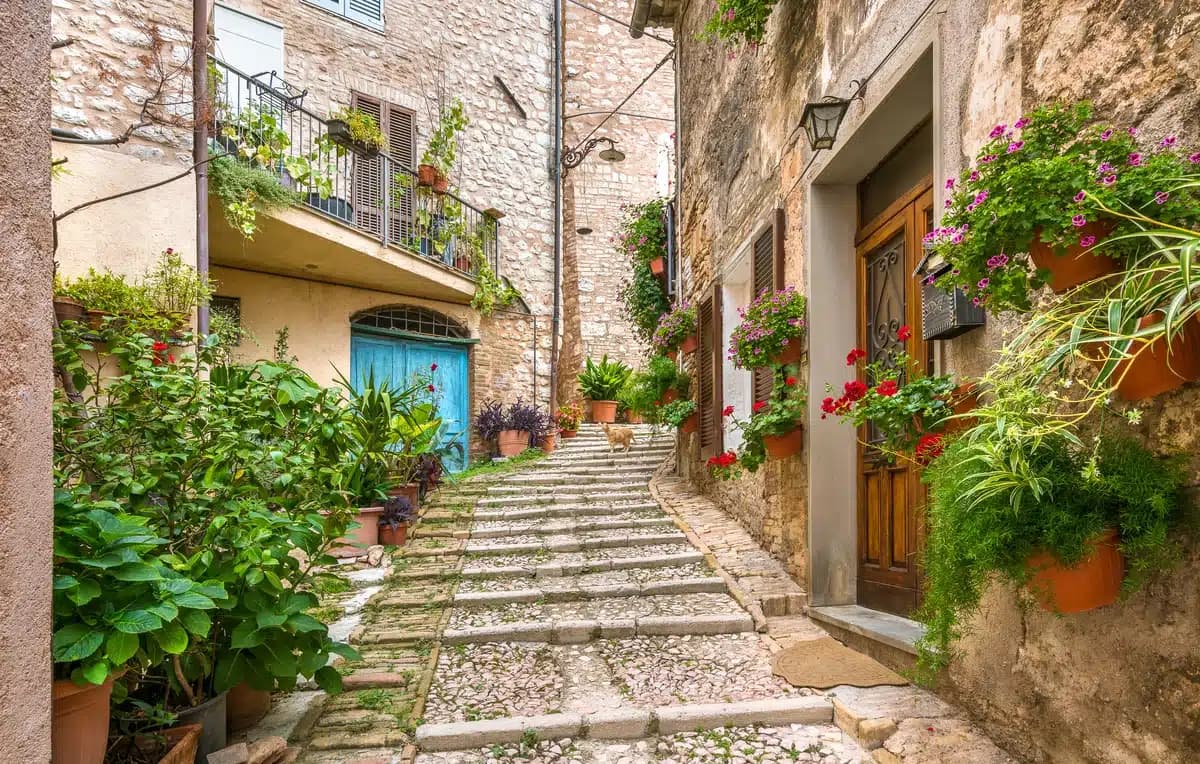
Trevi sits at 412 meters on a conical hill above the Spoleto valley, the centro storico still inside the Roman walls of the 1st century BC. The town stood on the Via Flaminia, the consular road from Rome to the Adriatic, and grew into a Guelph commune by the 12th century.
Olive oil is what people come for. Over 200,000 trees blanket the slopes below the walls on near-ideal calcareous, well-drained soils, and the Olivo di Sant'Emiliano near the abbey of the same name is about 1,700 years old, identified with the tree the bishop of Trevi was tied to in 304 before his martyrdom.
The Santuario della Madonna delle Lacrime, built in 1487 to mark a miracle, holds a fresco by Pietro Perugino. The centro storico runs in concentric rings up the hill, each ring older than the last, with the Palazzo Comunale and the Pinacoteca holding works by Lo Spagna at the top.
What to see in Trevi
- Santuario della Madonna delle Lacrime. Built in 1487 after a Marian apparition wept tears of blood in 1485, with a fresco by Perugino in the Cappella dell'Adorazione.
- Chiesa di Sant'Emiliano. Romanesque parish church at the top of the centro storico, dedicated to the bishop martyred in 304, the patron saint of the town.
- Olivo di Sant'Emiliano. About 1,700-year-old olive tree near the eponymous church, nine meters tall, traditionally the tree to which the bishop was tied before martyrdom.
How to get to Trevi
There is a railway station in the town, so you can arrive without a car and never need one while you are here. Perugia is roughly 47 minutes away by road.
Our tip
April through June and September into October are the months for Trevi. The olive groves are in leaf or in harvest, the hill is green or silver-gold depending on the half, and the valley below holds the morning light. The Festa di Sant'Emiliano runs the last week of January with the Palio dei Terzieri, when the three quarters of the town compete.
Assisi
Why visit Assisi
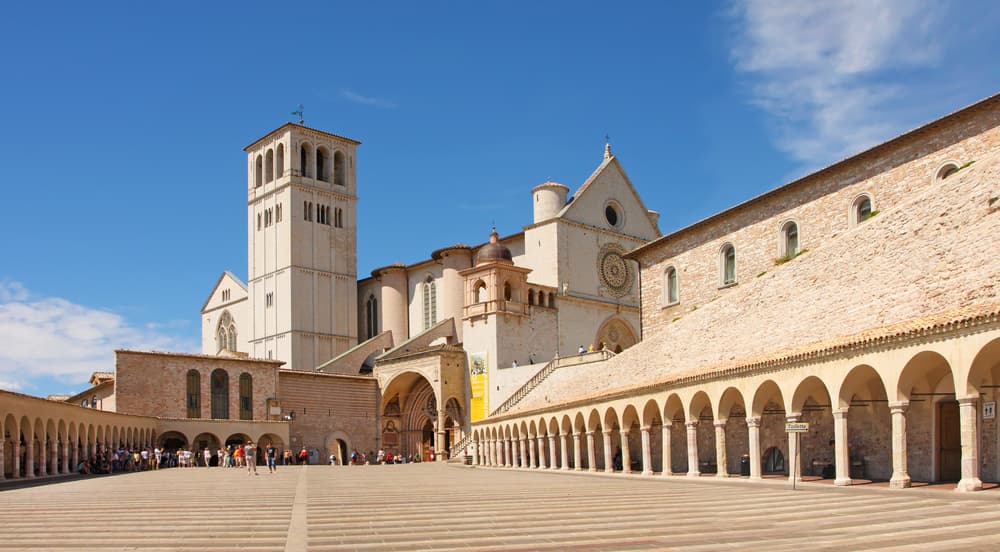
Assisi sits on a terraced spur twenty kilometers east of Perugia, the town built into the western flank of Monte Subasio where it drops toward the plain below. The Umbri settled the site before the Romans came, and the municipium of Asisium grew up around what is now Piazza del Comune, the square that still forms the civic center of the medieval town.
The centro storico runs between two poles: the basilica holding Francis's tomb at one end and the church holding Clare's relics at the other, with the Roman square and its temple facade sitting between them as the oldest layer beneath the medieval one. Below the town, on the plain, stands the basilica built around the chapel where Francis founded his order and died.
Further up the mountain, past the town walls, the hermitage occupies a beech wood where Francis and his companions withdrew from all of it. The layout traces the life it commemorates: birth and burial at the center, founding and death on the plain below, retreat in the wood above.
The town has arranged itself, over centuries, around the geography of one man's biography.
What to see in Assisi
- Basilica di San Francesco. Two superimposed churches over the saint's tomb, frescoed by Cimabue, Giotto, Simone Martini and Pietro Lorenzetti.
- Basilica di Santa Chiara. Church at the eastern end of the centro storico, holding the relics of Saint Clare and the San Damiano Crucifix.
- Tempio di Minerva. Roman temple on Piazza del Comune, six Corinthian columns intact, one of the best-preserved temple façades in the country, converted to a church in 1539.
How to get to Assisi
There is a railway station in the town, so you can arrive without a car and never need one while you are here. Perugia is roughly 35 minutes away by road.
✷ We have written about Assisi
“The basilica is grand, and it is grand from a distance, which is the harder trick. You see it from the valley road as a long horizontal weight along the end of the ridge, held up on arches, wider than the town it belongs to. In front of it there is a huge sloping field, stone, which functions as a piazza sort-of.”
Read our piece on Assisi →Assisi | The Church He Would Have Chosen
Our tip
April through June and September into October are the months Assisi was built for. The hills around Monte Subasio turn green in spring and gold in autumn, and the pilgrim traffic spreads thinly enough that the centro storico keeps its silence in the early morning. October 3 and 4 are the Festa di San Francesco, when delegations from every Italian region process to the basilica. Festa di Sant'Anna falls in July.
Spello
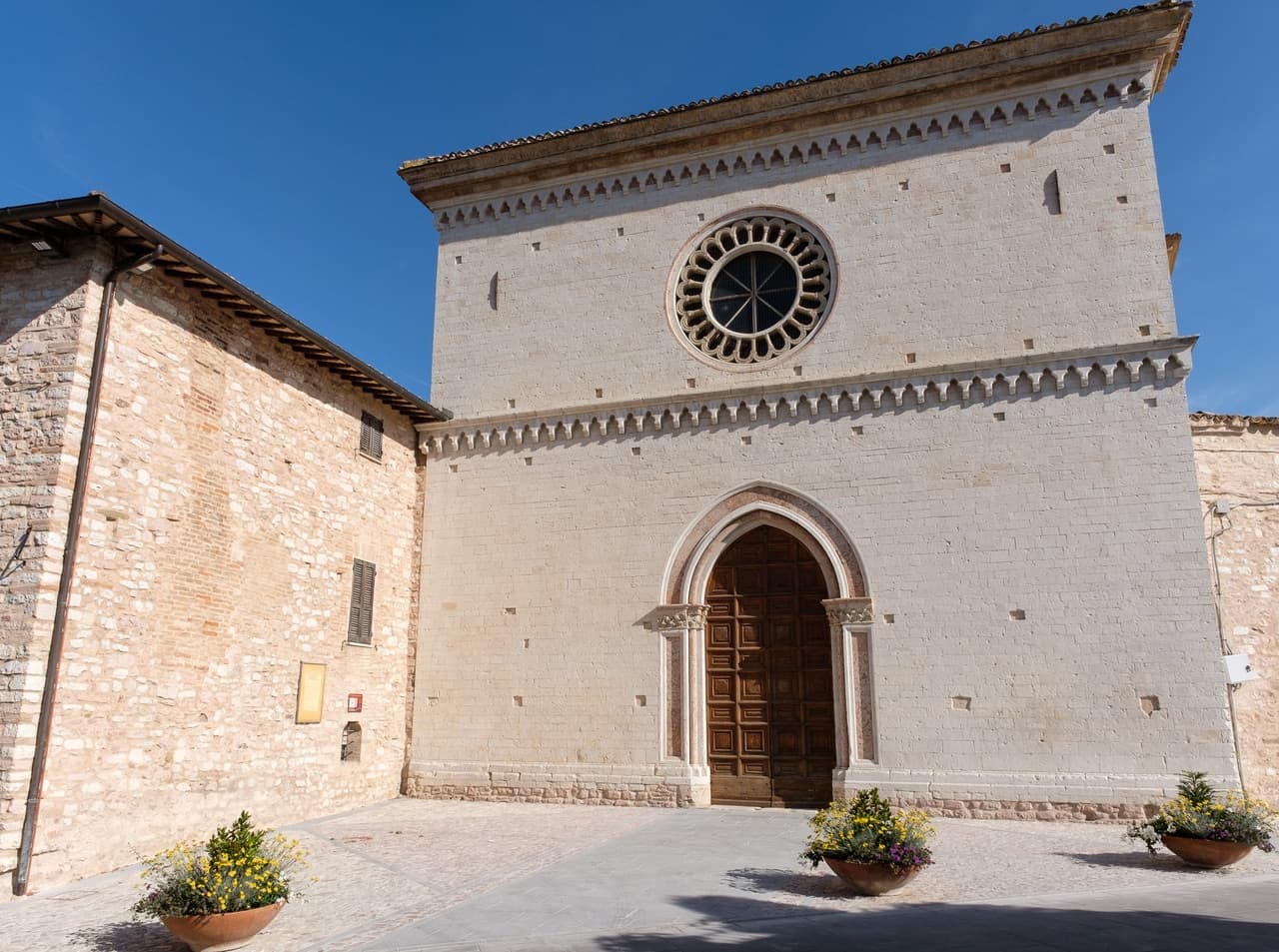
Why visit Spello
The centro storico climbs the lower southern flank of Monte Subasio, still contained within the circuit of walls raised when the town was renamed Splendidissima Colonia Julia by Augustus. Before that it was Hispellum under the Umbrians.
The Roman gates and stretches of wall from the Augustan period were not rebuilt over, so the line of the ancient town is still readable in the streets that climb from them today. The same streets carry the Infiorata each June and the fresco Pinturicchio completed for the chapel he painted in Santa Maria Maggiore, two things separated by roughly fifteen centuries but occupying the same short stretch of the old town: the chapel's Annunciation, Nativity and Christ Among the Doctors sit near the piazza the petal pictures are laid across.
A Roman villa with ten mosaic floors, found only in 2005 and left in place under cover, adds a third layer beneath the town that is still being uncovered rather than one that was always on view. The town's Roman skeleton, its painted chapel, and a floor uncovered within living memory all sit within the same small radius, which is unusual: most places show one era at a time, Spello keeps three in view at once.
What to see in Spello
- Cappella Baglioni. The Cappella Bella, commissioned by Troilo Baglioni, with four sibyls ranged across the vault above the painted scenes below.
- Santa Maria Maggiore. Twelfth-century church on Piazza Matteotti, its interior built around the fresco cycle and the later panel it houses.
- Porta Venere e Torri di Properzio. First-century BC gate flanked by two dodecagonal towers, still standing at close to full height with the stonework legible course by course.
How to get to Spello
There is a railway station in the town, so you can arrive without a car and never need one while you are here. Perugia is roughly 33 minutes away by road.
Our tip
April through June and September into October are the months for Spello. The slopes of Monte Subasio above town carry wildflowers, Cammino di San Francesco walkers pass through, and the Infiorata weekend on Corpus Domini in late May or June is the most concentrated day on the calendar. July and August touch the mid-thirties on the valley floor; the centro storico at 280 meters stays a few degrees cooler in the upper streets, but most visitors come early or wait until after seven. Borgo diVino tour falls in October.
Gubbio
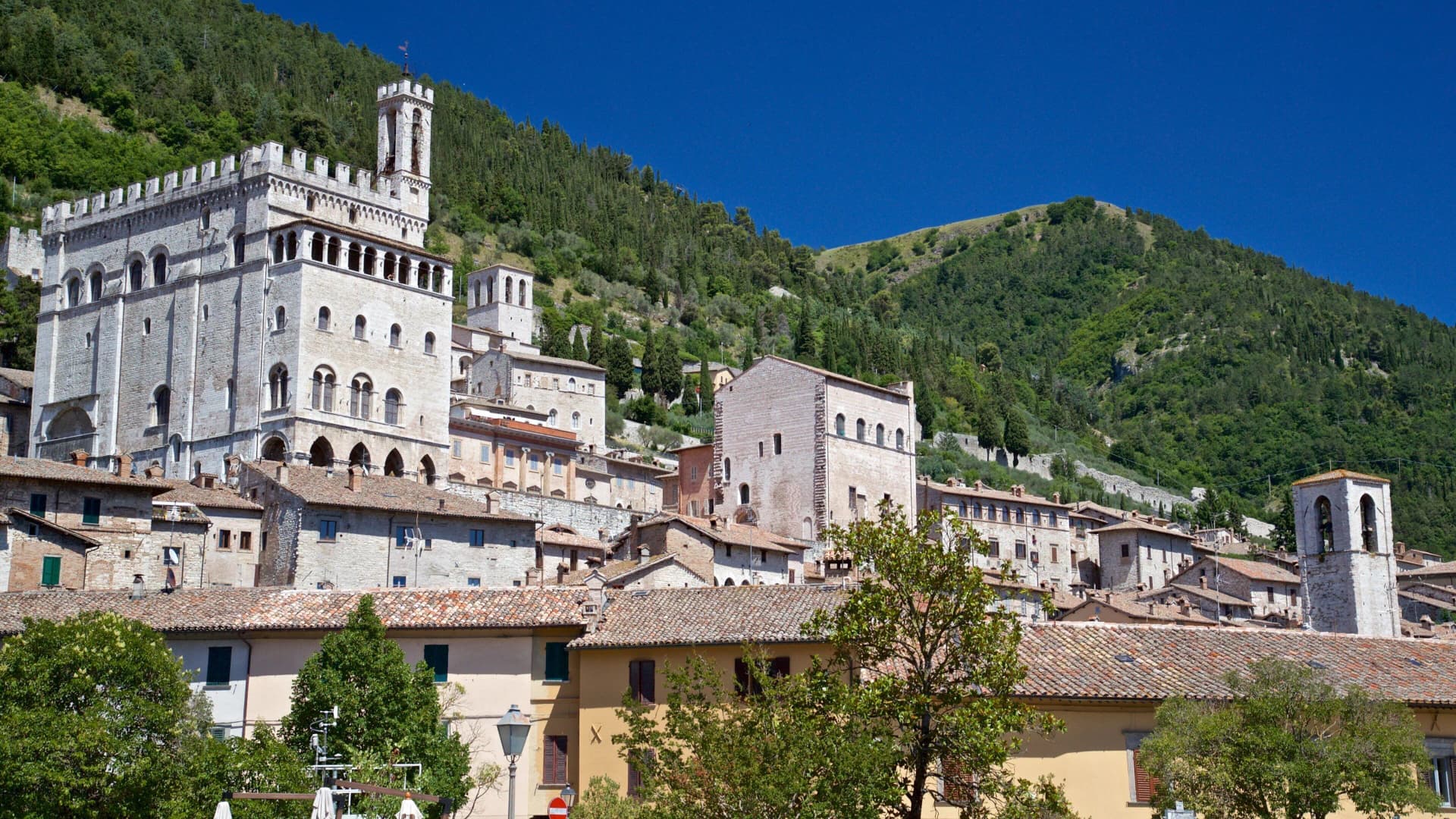
Why visit Gubbio
Gubbio sits at 522 meters on the lower slope of the mountain, the old town stacked in four parallel terraces against it. The settlement was Ikuvium, one of the most important towns of the Umbri before Rome arrived.
In 1444 a peasant woman named Presentina found the bronze tablets in the area of the Roman theater and sold them to the commune in 1456 for 40 florins, a transaction that kept them in the town where they were unearthed rather than scattered to a museum elsewhere. The terraces order the town's life by elevation: the Roman theater and lower ground below, the civic square and cathedral stacked on the upper terraces of the centro storico, the patron saint's basilica set apart on the summit above all of it.
The Corsa dei Ceri each 15 May draws that vertical order into motion, three teams carrying wooden statues of Sant'Ubaldo, San Giorgio and Sant'Antonio Abate from the square at the town's center up to the basilica at its height, filling the town from dawn to dusk. The layout is not incidental: a settlement that predates Rome, a civic archive kept where it was found, and a race that each year retraces the climb from town to summit all point to the same fact, that Gubbio's history has stayed stacked on its own mountain rather than dispersed from it.
What to see in Gubbio
- Palazzo dei Consoli. Built 1332-1349 by Angelo da Orvieto and Matteo Gattapone, the Gothic civic palace holds the Tavole Iguvine and the civic museum, its vertical pilasters dividing the façade across the square.
- Tavole Iguvine. Displayed on the ground floor of the palazzo, the tablets were recovered near the Roman theater and record the religious rites of the pre-Roman western world in detail.
- Piazza Grande. Suspended civic square between Palazzo dei Consoli and Palazzo Pretorio, hanging on substructures against the slope of the mountain.
How to get to Gubbio
Perugia is roughly 51 minutes away by road.
Our tip
April through June and September into October are the months for Gubbio. The slopes of Monte Ingino are walkable, the Cammino di San Francesco passes through, and the air at 522 meters holds the Apennine clarity. The Corsa dei Ceri on 15 May is the single most concentrated day in town; book months ahead. Sagra della Polenta e Salsicce falls in July.
Città di Castello
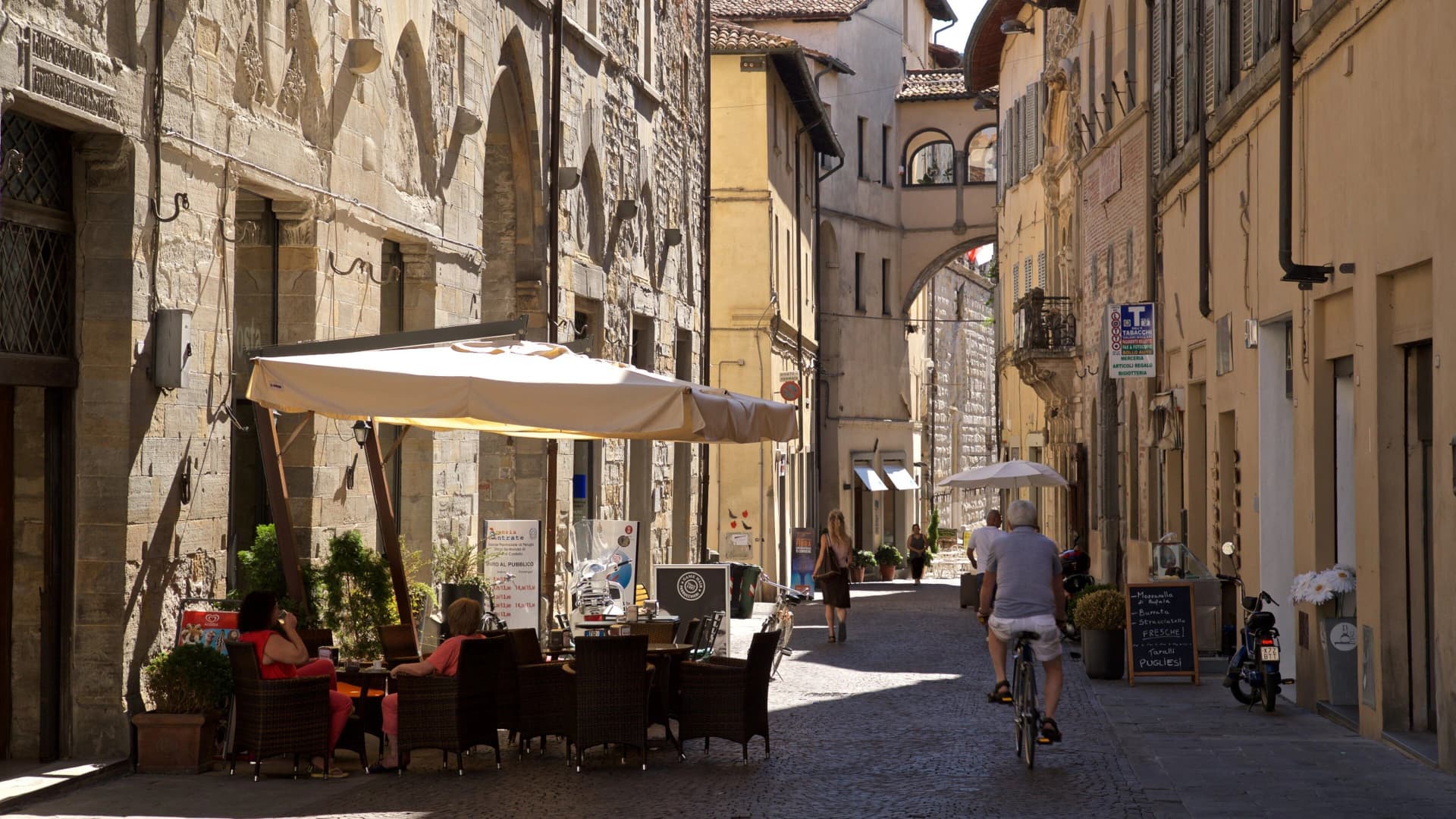
Why visit Città di Castello
Città di Castello sits at the head of the Alta Valtiberina, the upper Tiber valley, where the river that runs through Rome 250 km south is still a narrow, Tuscany-style stream. It is the largest town in Umbria north of Perugia, 56 km from the regional capital and reachable by the historic Trenino Centrale Umbra line.
The town's history sits in three layers. Roman: founded as Tifernum Tiberinum in the 1st c BC, with Pliny the Younger keeping a villa here and describing the upper Tiber landscape in his letters.
Medieval-Renaissance: a walled town run as a signoria by the Vitelli family from the 15th c, whose patronage brought a young painter to the centro to complete his first independent commissions, among them the altarpiece now in the Pinacoteca Comunale, before he left for Rome; the same Pinacoteca, housed in the Vitelli family's own palazzo, also holds works by Signorelli, Ghirlandaio and Della Robbia. Twentieth century: a native-born artist gave his name to a foundation that now runs two sites in the centro, a palazzo holding the earlier period of his work and a former tobacco-drying complex painted black inside and out for the monumental late series, together forming, by the town's own reckoning, the most complete single-artist museum after Picasso's.
Beyond the art, the town carries three Città quality marks: Città del Tartufo for its white truffle zone, which produces some of the best Tuber magnatum in Italy and is marked each November by a weekend market and festival; Città della Ceramica for a maiolica tradition dating to the 16th c and still worked in a dozen workshops across the centro; and a stop on the Cammino di San Francesco, the pilgrim route linking La Verna in Tuscany, where St Francis received the stigmata, to Assisi, his birthplace. There is also a horse fair in early September, the Mostra Nazionale del Cavallo, a Renaissance music festival in July called the Tibernum Festival, and a centro storico whose medieval walls survive in part and can be walked.
The food follows the valley: ciaramicola, the local Easter cake, strangozzi with truffle, the Vitellone Bianco dell'Appennino Centrale IGP beef, pecorino, and the local Sangiovese-based Colli Altotiberini DOC red. What the layers add up to is a river town that kept building on itself rather than being replaced: a Roman villa landscape, a Renaissance signoria that imported a major painter, and a modern art foundation occupying old tobacco warehouses, each still visible in the centro rather than paved over by the one that followed it.
What to see in Città di Castello
- Fondazione Burri (Palazzo Albizzini + Ex Seccatoi). Two sites: 200+ works in the centro palazzo, and the monumental late series, including the Grande Cretti, in the black-painted ex-tobacco warehouses of the Alta Valtiberina. The Palazzo Albizzini holds the earlier period; the warehouses were painted black inside and out by Burri himself for the later cycle.
- Pinacoteca Comunale (Palazzo Vitelli). The surviving early altarpiece, painted for the Vitelli family before the move to Rome, hangs alongside Signorelli, Ghirlandaio, Della Robbia and other Vitelli commissions.
- Mostra del Tartufo Bianco (every November weekend). A market and festival held every weekend of November in the Alta Valtiberina, drawing producers and restaurants for tastings around some of the best Tuber magnatum in Italy.
How to get to Città di Castello
There is a railway station in the town, so you can arrive without a car and never need one while you are here. Perugia is roughly 51 minutes away by road.
Our tip
Città di Castello is best April–June and September–November. The Mostra del Tartufo Bianco every November weekend is the year's culinary headline. The Mostra Nazionale del Cavallo (early September) is the regional horse fair.
Foligno
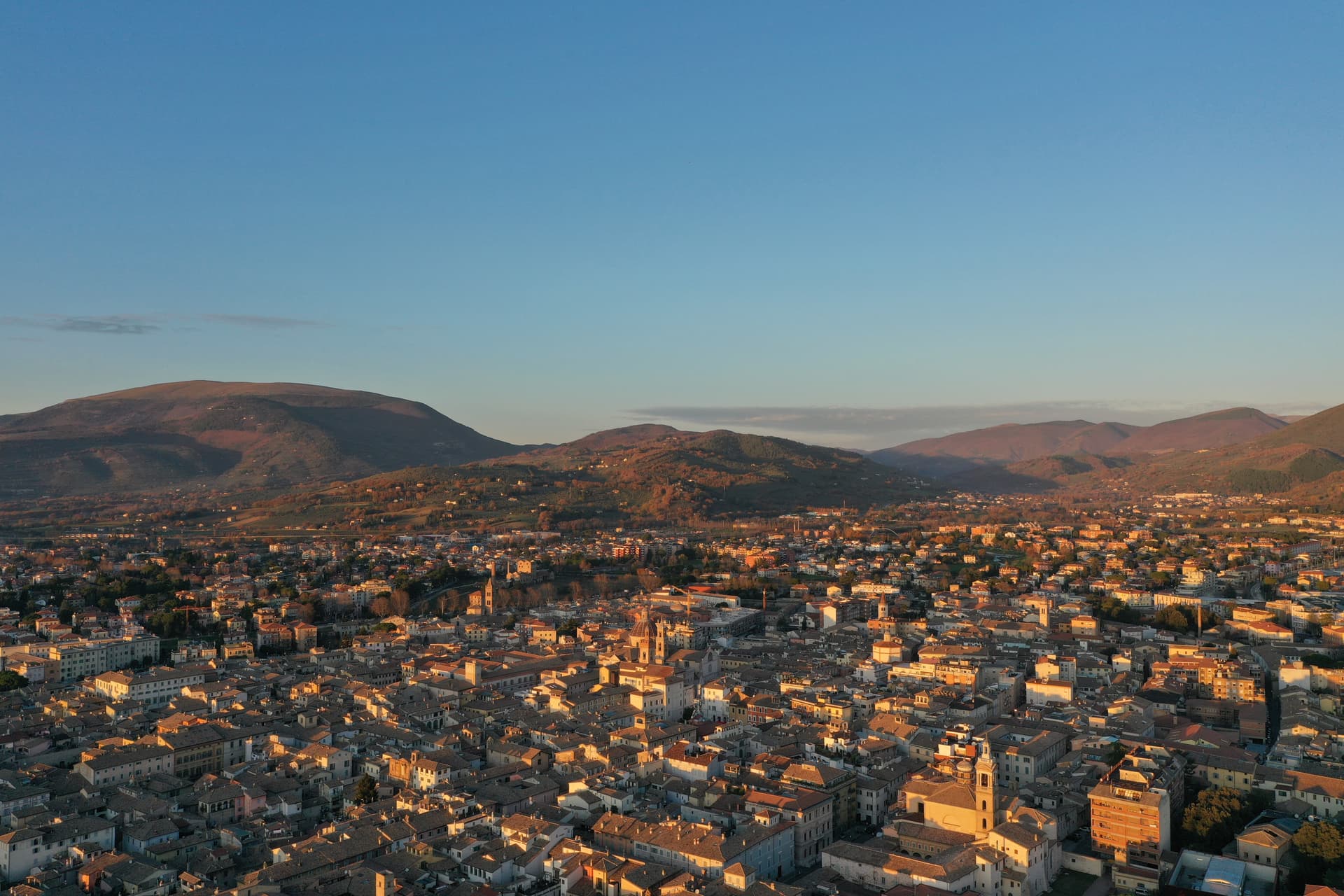
Why visit Foligno
Foligno sits on the left bank of the Topino where the river leaves the Apennines and meets the plain of the Clitunno, the point at which the mountains give way to the Umbrian Valley. The town was called Fulginium in antiquity, and Cicero mentions the prefecture in two surviving fragments.
The Trinci ruled the town from 1305 to 1439, and the palace that carries their name still stands at its center, with the cathedral facing the same square where the town's tournament has run twice a year since its revival. The city's oldest church predates the Trinci period by centuries, its site going back to an 8th-century chapel, while the abbey in the hills above town was founded still earlier, in 1084, its cloister finished in 1229.
Between the ancient prefecture, the medieval abbey, the Trinci court, and the print workshop that put Dante into type, Foligno reads as a valley crossing point where successive centuries each left a building rather than displacing what came before.
What to see in Foligno
- Palazzo Trinci. Seat of the Trinci signoria 1305-1439, frescoed by Gentile da Fabriano and Jacopo Bellini, now holding the Pinacoteca and archaeological museum.
- Cattedrale di San Feliciano. Romanesque cathedral on Piazza della Repubblica, built over the tomb of the bishop-martyr buried here in 251 AD.
- Basilica di Santa Maria Infraportas. Oldest church in the city on the site of an 8th-century chapel, frescoes by Nelli, Ugolino di Gisberto, Alunno and Mezzastris.
How to get to Foligno
There is a railway station in the town, so you can arrive without a car and never need one while you are here. Perugia is roughly 42 minutes away by road.
Our tip
April through June and September into October are the months locals prefer. The Quintana runs twice a year, the June and September editions filling the rioni for a week each. April through October is also the season for the Topino river paths and the climb up to Sassovivo. Festevolezze falls in July.
More from Anywhere Italy
 The best towns on a walking route that eat well in the province of Perugia
 The 8 best towns on a walking route that you can reach by train in Umbria
 The best hidden towns on a walking route in the province of Perugia
 The best hill towns with a food festival in the province of Perugia
 The best olive oil towns that eat well in the province of Perugia
 The best olive oil towns you can reach by train in the province of Perugia