
The best hidden towns on a walking route in the province of Perugia
Walking in the province of Perugia means limestone underfoot, holm oak and beech overhead, and the smell of woodsmoke arriving before the roofs do. The routes cross olive terraces above the Spoleto valley, drop into the Nera and its watercress channels, then climb to open pasture on the flanks of the Sibillini. Food is walker's food and always has been: lentils grown on the high plain, pork cured in the mountain air, black truffle grated over strangozzi, flat bread cooked under ash. Late spring and September are the good months, when the tracks are dry and the villages, built from grey stone quarried within sight of themselves, hold heat into the evening.
Most walkers here point at Assisi, which is where the long pilgrim routes converge and where the coaches park by mid-morning. The basilica earns the attention, and the hill town above it is one of the finest things in central Italy, but the paths in and out are busy from Easter until the end of October, the accommodation books far ahead, and the last hour into town is walked shoulder to shoulder. Plenty of people see only that stage and go home.
The trails do not stop there. The same routes carry on north through the Tiber valley towards the Marche border, south along the Valnerina, and east over the passes to the lentil plain, and the stages between are where fewer people get off the train or the bus. The towns below are all stages on one of those long historic walking routes, each with a bed, a bar that opens early, and a way out on foot the next morning.
Of the 37 communes we have mapped in the province of Perugia, 13 qualify as towns on a walking route: each is a stage on one of the long historic walking routes. This list is the hidden ones, 8 in all, ordered smallest first. The smallest, Scheggino, has 446 residents.
Elsewhere in the catalogue: The best hill towns on a walking route within 90 minutes of Perugia and The 6 best hidden truffle towns in the province of Perugia.
Scheggino
Why visit Scheggino
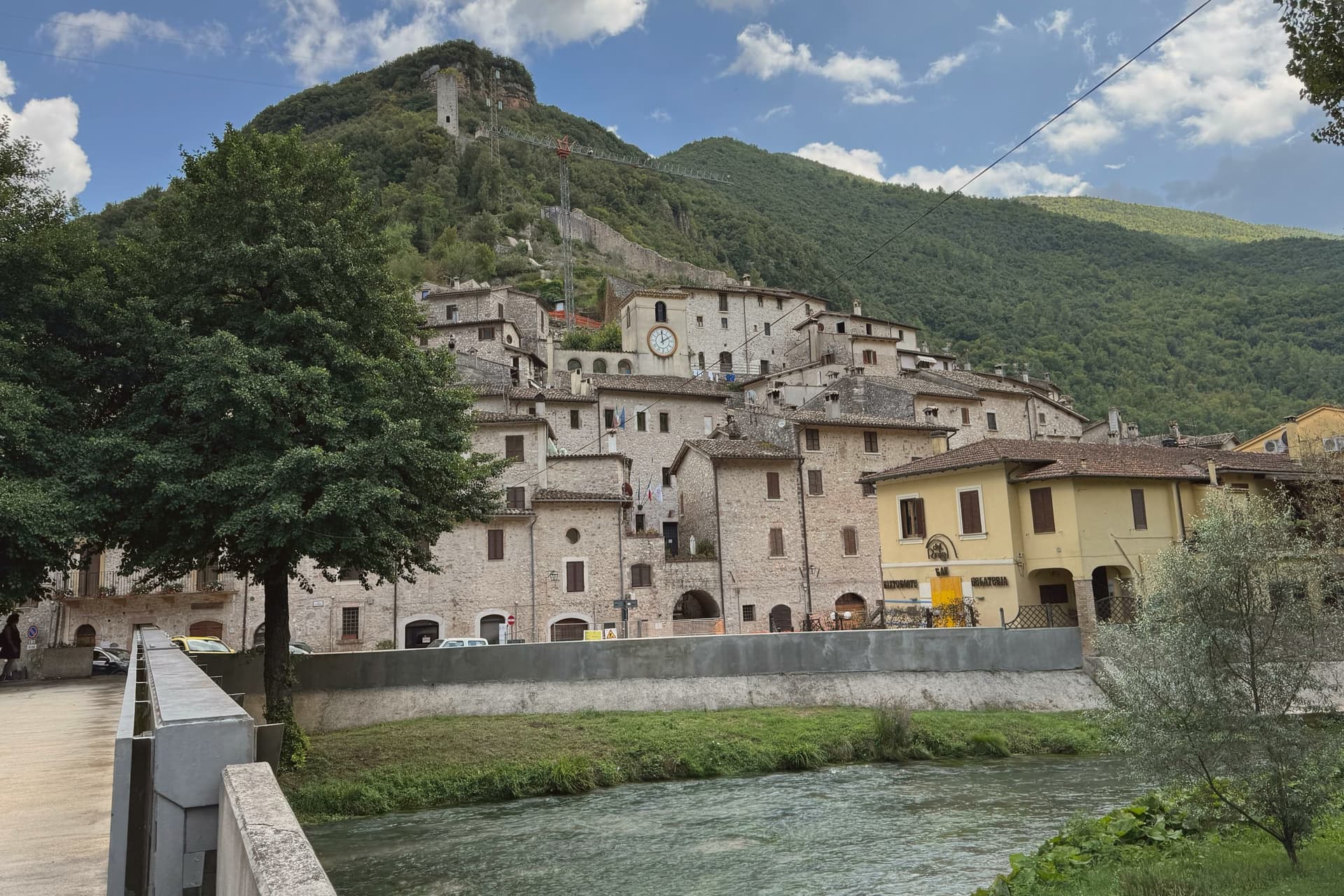
Scheggino sits at 280 meters in the heart of the Valnerina, the village wedged into a triangle of walls between the slope above and the Nera river below. The Duchy of Spoleto built it around the 12th century to defend one of the three bridges over the Nera; the triangular plan and the watchtower of white and pink stone, about 20 meters high, still mark the top of the castle.
The Nera runs alongside the lower edge of the village, divided into channels that once turned mills and now hold trout and the springs that feed the truffle washing rooms. Scheggino is the home of Urbani Tartufi, the first commercial company for the storage and processing of truffle, founded in 1928, which still has its plant on the river.
The Diamante Nero festival each summer prepares a giant frittata with more than 2,000 eggs and 80 kilos of black truffle. The Cammino di San Francesco passes through the village on the way south.
What to see in Scheggino
- Castello di Scheggino. Twelfth-century triangular castle of the Duchy of Spoleto, with a watchtower in white and pink stone about 20 meters high at the summit.
- Chiesa di San Nicola. Romanesque parish church at the heart of the centro storico, frescoes of the Umbrian school of the 15th century in the apse.
- Nera river canals. Channels of the Nera divided through the lower village, once for mills and now for trout farming and the truffle washing rooms of Urbani.
How to get to Scheggino
Terni is roughly 49 minutes away by road.
Our tip
April through June and September into October are the months for Scheggino. The Nera runs cold and full, the trout farms work at capacity, and the trails up to Vallo di Nera or down to Ferentillo are walkable in shade. July and August push the valley into the mid-thirties; the river canals through the village cool the lower streets and the trattorie pour Nera trout with local truffle.
Monteleone di Spoleto
Why visit Monteleone di Spoleto
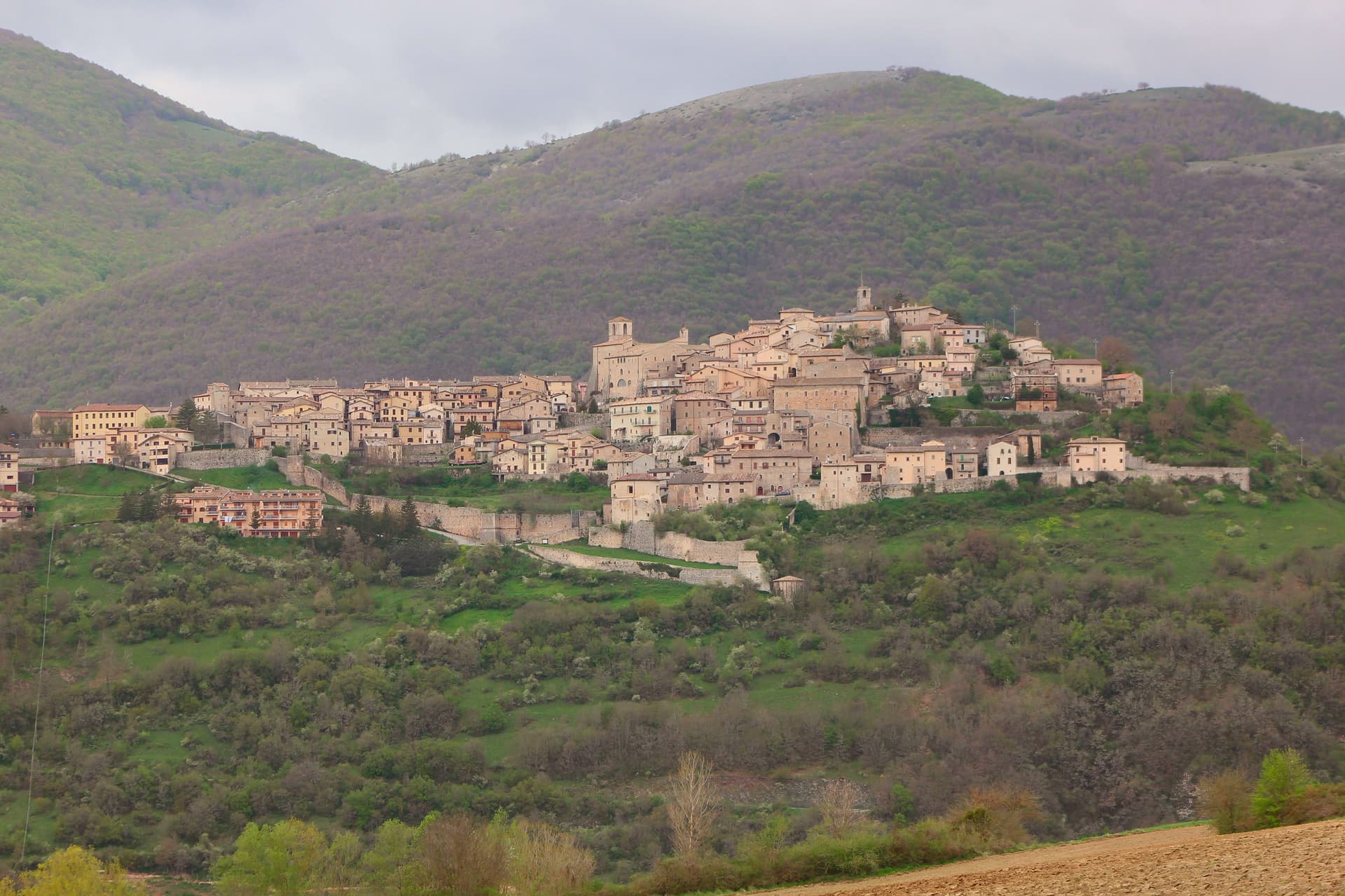
Monteleone sits at 978m on a hilltop in the upper Nera valley, the upper extension of the Valnerina, at the point where Umbria, Lazio and Marche converge. A castle anchors the summit and gives the borgo its defining silhouette, much-rebuilt over the centuries and again after the 2016 earthquake.
Below it sit the Chiesa and Convento di San Francesco, and the whole village is compact enough that the fortress organizes the view from almost anywhere within it. The find that put the town on archaeological maps happened by accident: a local farmer ploughing a field at the Colle del Capitano turned up an Etruscan bronze parade chariot in 1902, a complete biga from the 6th century BC.
His family sold it to French dealers for the equivalent of 950 lire, and it reached the Metropolitan Museum of Art in New York in 1903, where it is now displayed in Gallery 170 as the most complete pre-Roman parade chariot known to survive, its bronze panels depicting Achilles' birth, his combat with Memnon, and his apotheosis. Monteleone has pursued repatriation since 1990 through multiple legal proceedings, none successful, and the Met's title is now considered settled.
The village opened a museum in 2002 holding a full-scale replica alongside the original context of the find, and the town is also a marked stop on a 350-km pilgrim walk running from Norcia, Benedict's birthplace, through Monteleone to Subiaco and Montecassino, with pilgrim accommodation available locally. The 2016 Norcia and Cascia earthquake damaged several buildings in town; the castle and the Franciscan church have been restored, though reconstruction continues elsewhere.
Beyond the village, the Sibillini Mountains National Park lies to the east, the Cascia-Norcia route linking Benedict's and Rita's home towns runs to the north, and Lago di Piediluco is 30 km south. The food follows the Valnerina pattern: strangozzi with truffle, lentils from Castelluccio di Norcia, prosciutto and other Norcineria meats, pecorino, and Sagrantino di Montefalco from 60 km west.
Depopulation has been steep, from 1,800 residents in 1951 to 555 today, which leaves a village built for a much larger population now organized around a fortress, a church and a museum that all outsize the number of people currently living among them.
What to see in Monteleone di Spoleto
- Museo della Civiltà del Carro (replica chariot). Full-scale replica of the Monteleone Chariot, with the context of the 1902 find laid out around it. The panels on the original show Achilles' birth, his combat with Memnon, and his apotheosis. The museum also documents the village's repatriation campaign, active since 1990 and unsuccessful in every legal proceeding brought so far.
- Rocca dei Brancaleoni. The castle anchors the high point of the borgo, its rebuilt walls now standing again after 2016 earthquake repairs. From the top, the view runs across the whole upper Nera valley.
- Chiesa di San Francesco (Renaissance ceiling). 13th-century Franciscan church with later restorations and a carved wooden ceiling added in the 16th century. Also repaired after 2016 earthquake damage.
How to get to Monteleone di Spoleto
Terni is roughly 59 minutes away by road.
Our tip
Monteleone di Spoleto is mountain-seasonal — May through September is the high season. June-July brings the Cammino di San Benedetto pilgrim flow. Castelluccio di Norcia lentil bloom (late June-early July, 20 km east, the famous fiorita) is a major regional draw.
Pietralunga
Why visit Pietralunga
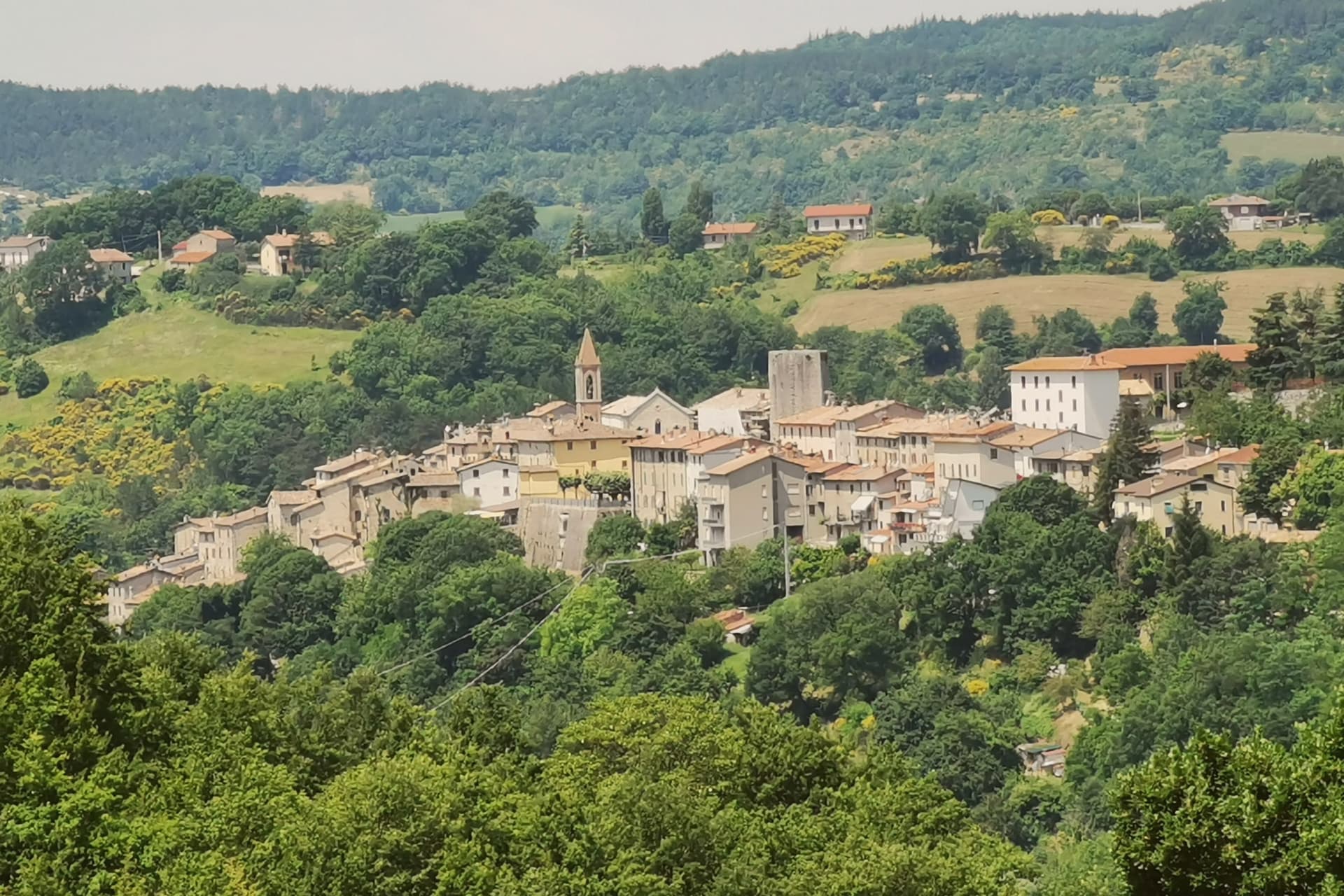
Pietralunga sits at 566 meters on a hilly ridge near the Umbria-Marche Apennines, on the northeast side of the upper Tiber. The Umbrian people founded the original settlement in the period of the Eugubine Tablets, between the second and first centuries BC.
The Lombards rebuilt it as a fortified hilltop village between the sixth and eighth centuries, and the Rocca Longobarda from that era still dominates the ridge. The Pieve di Santa Maria on Piazza Fiorucci dates from the seventh or eighth century in foundation, with an irregular single-nave plan and a Romanesque portal added later.
The territory is one of the densest truffle districts in Umbria, with documented tartufaie in the surrounding woods and a tartufo bianco fair every October. The Pietralunga white potato, grown on the upper slopes, has its own consortium and is one of the products that have kept the smallholders in the area working.
What to see in Pietralunga
- Rocca Longobarda. Eighth-century Lombard fortress dominating the borgo; the original triangular plan and central keep survive on the highest point of the ridge.
- Pieve di Santa Maria. Parish church on Piazza Fiorucci with 7th-8th century foundation and a 13th-century Romanesque portal, single nave with ogive vaults inside.
- Centro storico medievale. Walled Lombard core organized around the Rocca, narrow streets and stone houses radiating from Piazza Fiorucci.
How to get to Pietralunga
Perugia is roughly 65 minutes away by road.
Our tip
May through June and September into October are the working months for the territory. The truffle-hunting season opens in September and runs through January, with the white-truffle fair in October the year's largest event. July and August are warm in the upper Tiber, low thirties typically; the woods cool early in the morning and the trails through the tartufaie become the local refuge. Mostra Mercato del Tartufo Bianco e della Patata falls in October.
Cascia
Why visit Cascia
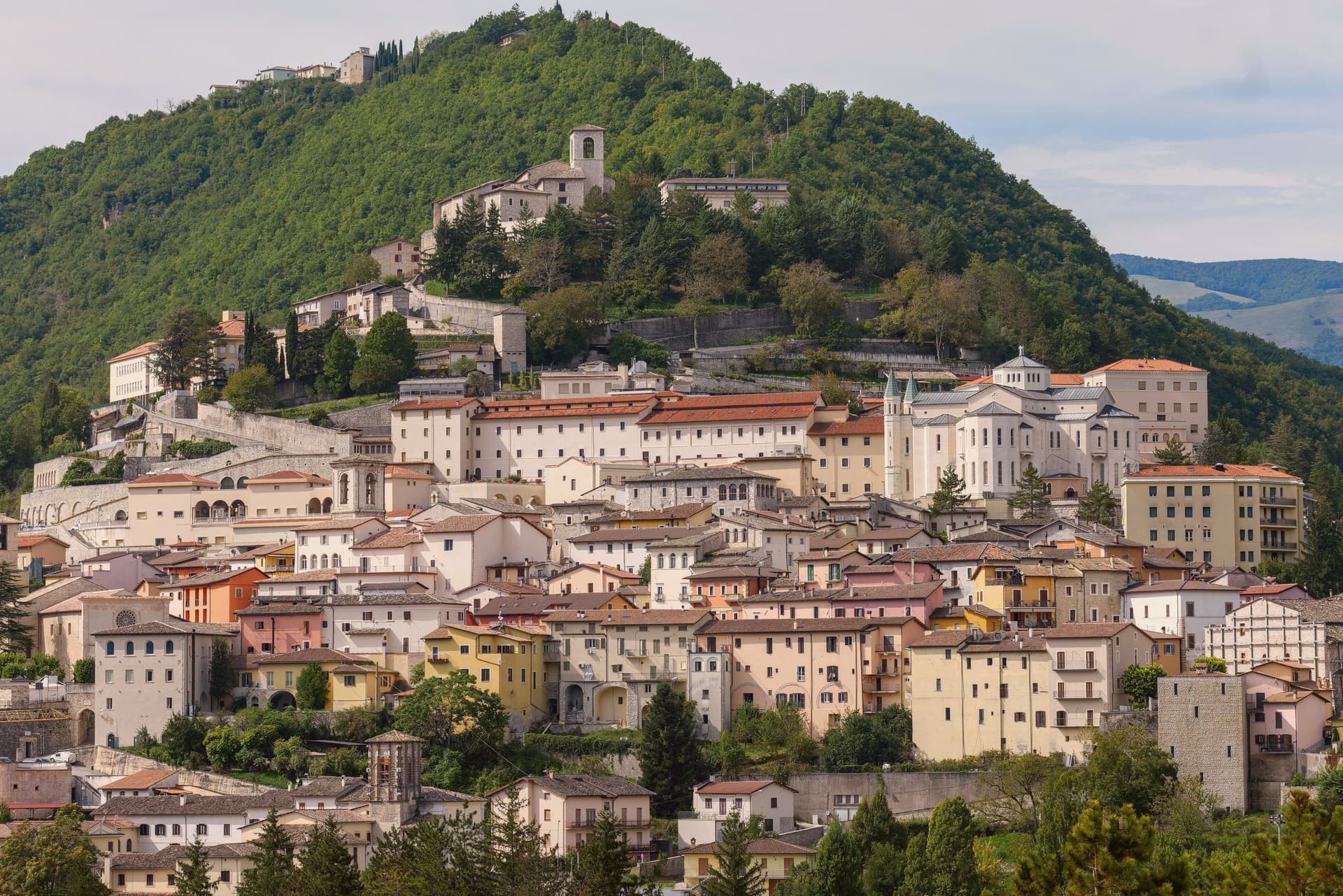
Cascia sits at 653 meters in the mountainous southeastern corner of Umbria, a remote pocket of the upper Valnerina near the Marche and Lazio borders. The commune carries the highest seismic activity in the region together with Norcia twelve kilometers away, and a long history of destructive earthquakes that culminated in the August 2016 sequence.
The town is built around Rita Lotti, who died in the Augustinian monastery here in 1457 and was canonized as Santa Rita in 1900. The Basilica di Santa Rita, built 1937-1947 in white Tivoli travertine on the site of the older church, draws pilgrims year-round and turns Cascia into a town that runs on faith and on truffle.
The Cammino di San Benedetto passes through, linking Norcia to Subiaco and Montecassino. Visitors not pilgrims tend to come for the black truffle, the lentils of nearby Castelluccio, and the silence of the high pastures above town.
What to see in Cascia
- Basilica di Santa Rita. Built 1937-1947 in white Tivoli travertine, Greek-cross plan, frescoes by Montanarini, Filocamo, Consadori, Ceracchini and Vicenzi.
- Monastero di Santa Rita. Augustinian monastery where Rita Lotti lived and died in 1457, attached to the basilica and still active as a religious community.
- Chiesa di San Francesco. Medieval Franciscan church in the lower centro storico, fourteenth and fifteenth-century frescoes inside.
How to get to Cascia
Terni is roughly 74 minutes away by road.
Our tip
May through October is the open season at 653 meters. The basilica is busiest around the May 22 feast of Santa Rita, when pilgrims fill the upper town and accommodation books out months ahead. June through September brings mild days and cool nights, the high pastures green, the truffle hunters working the woods above town.
Citerna
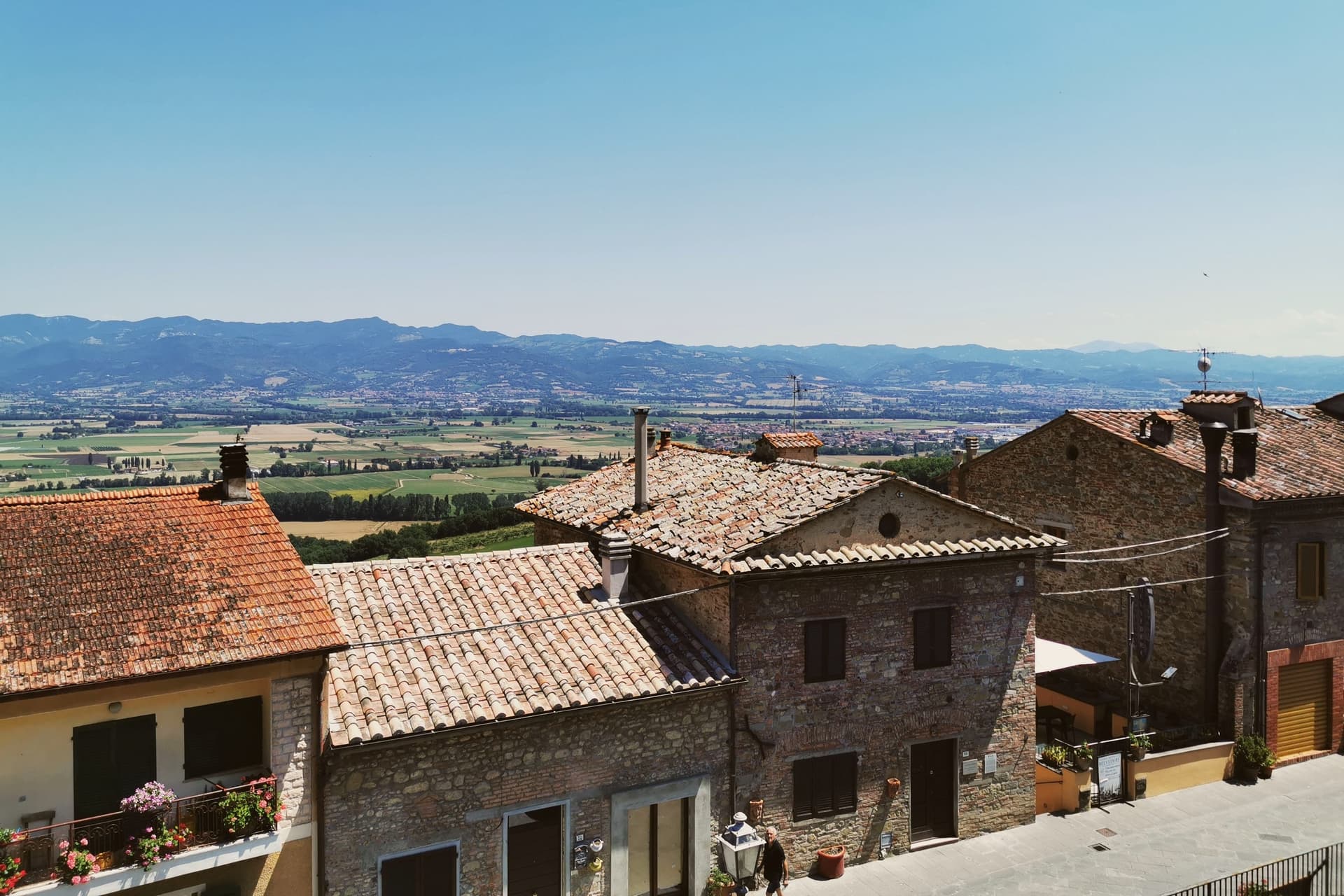
Why visit Citerna
Citerna sits at 480 meters on a ridge at the confluence of the Cerfone and Sovara streams, fifty kilometers north of Perugia in the upper Tiber valley. The name comes from the rainwater cisterns hollowed under the town, still walkable through the underground camminamenti that run beneath the medieval streets.
Umbrian and Etruscan settlement preceded the Roman finds at San Fista and Pistrino. In 1221 Citerna swore loyalty to Città di Castello in exchange for protection, then passed to the Vitelli of Città di Castello as a vicariate in the early sixteenth century, and joined the Kingdom of Italy in 1860 as the first Umbrian town to do so.
The Chiesa di San Francesco on Corso Garibaldi holds a polychrome terracotta Madonna by Donatello, dated around 1415, the only work by the sculptor in Umbria, alongside paintings by Pomarancio, Luca Signorelli and Raffaellino del Colle. The view from the ramparts reaches the mountains of La Verna and Gubbio on a clear day.
What to see in Citerna
- Madonna di Donatello. Polychrome terracotta Madonna and Child of around 1415 in the Chiesa di San Francesco, the only sculpture by Donatello in Umbria.
- Chiesa di San Francesco. Convent church on Corso Garibaldi with works by Pomarancio, Luca Signorelli, Raffaellino del Colle and a Della Robbia school Madonna.
- Camminamenti medievali. Underground walkways and rainwater cisterns hollowed below the streets, the source of the town's name and now open to visit.
How to get to Citerna
Perugia is roughly 68 minutes away by road.
Our tip
April through June and September into October are the months that suit the ridge. Spring and early autumn give clear views from the ramparts as far as La Verna; the air at 480 meters stays mild even in midsummer afternoons. July and August warm the upper Tiber valley but Citerna is small and the underground camminamenti stay cool.
Norcia
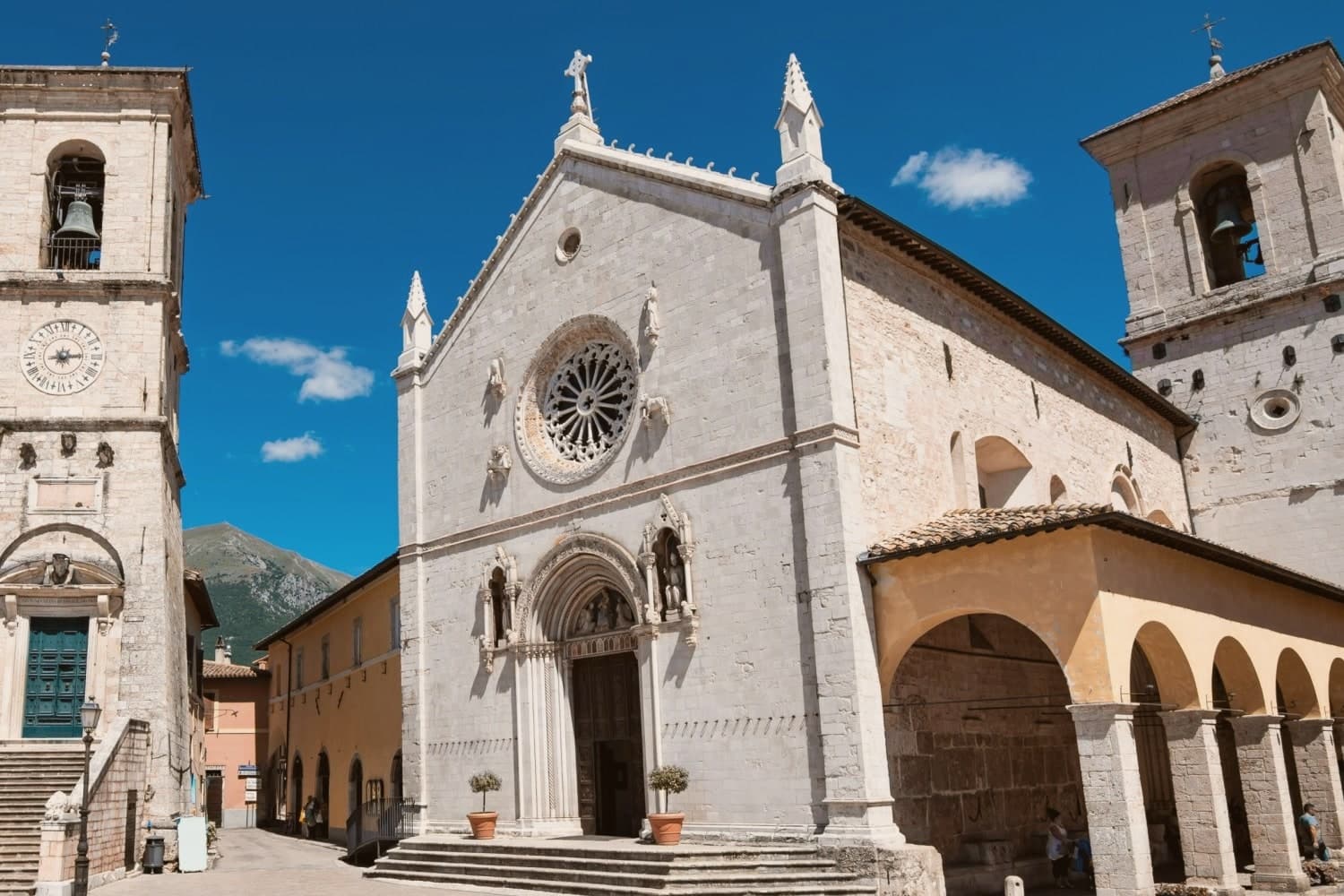
Why visit Norcia
Norcia sits at 604 meters on a high plateau on the Umbrian side of the Monti Sibillini, ancient Nursia of the Sabines, fortified in the 3rd century BC by Rome. Saints Benedict and his twin sister Scholastica were born here in 480; the Benedictine Order and the Ora et Labora motto that shaped Western monasticism began on this piazza.
The Basilica di San Benedetto rises on the traditional birthplace, built between 1290 and 1338 over a pre-existing crypt. On 30 October 2016 a magnitude 6.5 earthquake destroyed the nave; only the façade was left standing.
Reconstruction completed on 30 October 2025, nine years to the day, with the original stones and earthquake-resistant technology. The town gave its name to norcineria, the Italian word for quality pork delicatessen, after centuries of Norcia butchers specializing in wild boar and pork.
Black truffle from the Valnerina, lentils from Castelluccio, and ricotta from the high pastures complete the table.
What to see in Norcia
- Basilica di San Benedetto. Built 1290-1338 over the traditional birthplace of Saints Benedict and Scholastica, rebuilt with original stones after 2016, reopened 30 October 2025.
- Castellina. Fortified papal stronghold designed by Jacopo Barozzi da Vignola in 1554, on Piazza San Benedetto, now the Museo Civico e Diocesano.
- Piazza San Benedetto. Civic and religious heart of the centro storico, with the Palazzo Comunale, the basilica, the Castellina and the statue of Benedict at the center.
How to get to Norcia
Terni is roughly 93 minutes away by road.
Our tip
April through June and September into October are the months for Norcia. The plateau holds its color, the lentil fields of Castelluccio bloom from mid-June into July, and the high pastures are open for hiking. July and August stay cooler than the Umbrian valleys at 604 meters, but the town fills with festival crowds for the Mostra Mercato del Tartufo Nero on the last weekend of February and again for sagras through the summer.
Trevi
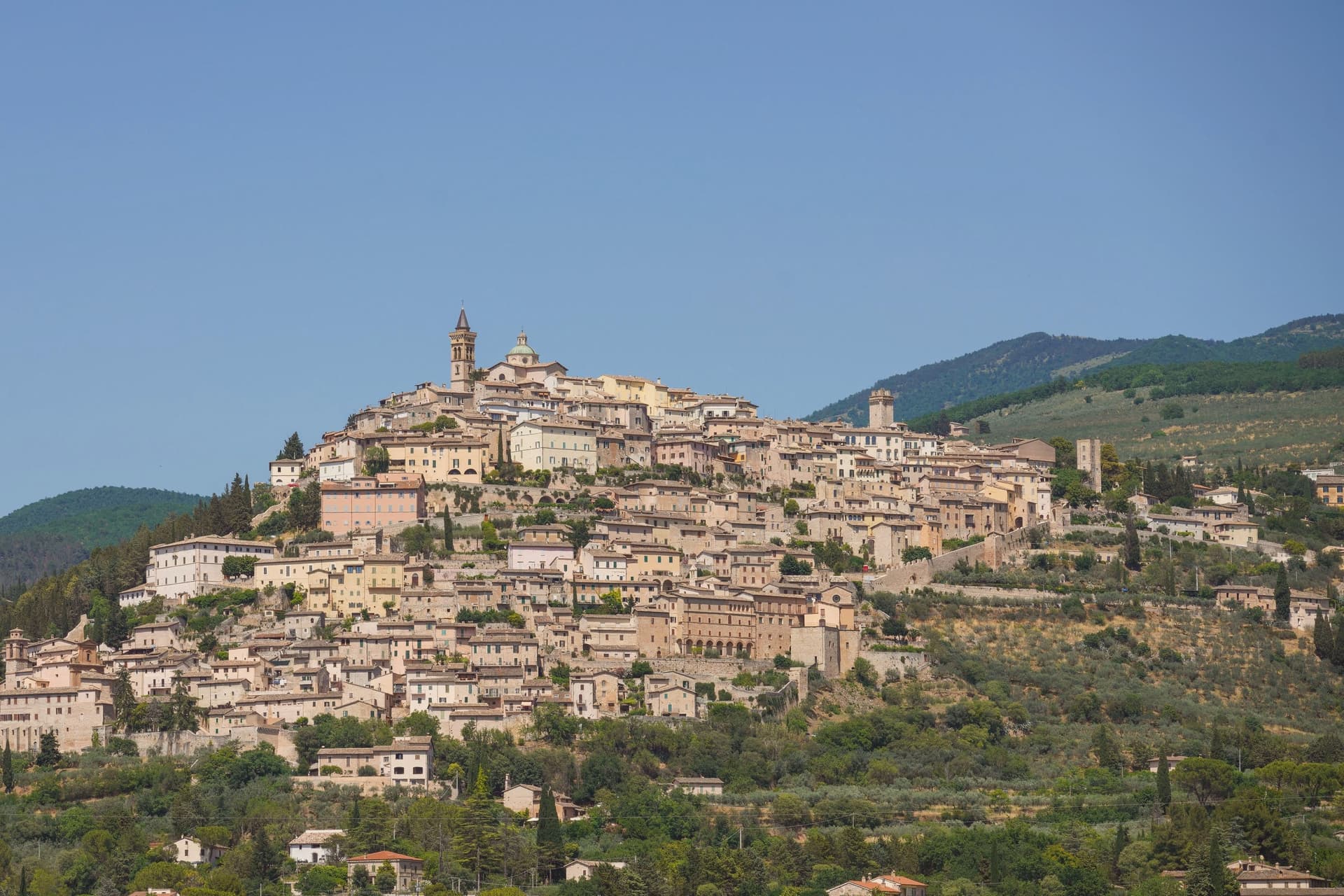
Why visit Trevi
Trevi sits at 412 meters on a conical hill above the Spoleto valley, the centro storico still inside the Roman walls of the 1st century BC. The town stood on the Via Flaminia, the consular road from Rome to the Adriatic, and grew into a Guelph commune by the 12th century.
Olive oil is what people come for. Over 200,000 trees blanket the slopes below the walls on near-ideal calcareous, well-drained soils, and the Olivo di Sant'Emiliano near the abbey of the same name is about 1,700 years old, identified with the tree the bishop of Trevi was tied to in 304 before his martyrdom.
The Santuario della Madonna delle Lacrime, built in 1487 to mark a miracle, holds a fresco by Pietro Perugino. The centro storico runs in concentric rings up the hill, each ring older than the last, with the Palazzo Comunale and the Pinacoteca holding works by Lo Spagna at the top.
What to see in Trevi
- Santuario della Madonna delle Lacrime. Built in 1487 after a Marian apparition wept tears of blood in 1485, with a fresco by Perugino in the Cappella dell'Adorazione.
- Chiesa di Sant'Emiliano. Romanesque parish church at the top of the centro storico, dedicated to the bishop martyred in 304, the patron saint of the town.
- Olivo di Sant'Emiliano. About 1,700-year-old olive tree near the eponymous church, nine meters tall, traditionally the tree to which the bishop was tied before martyrdom.
How to get to Trevi
There is a railway station in the town, so you can arrive without a car and never need one while you are here. Perugia is roughly 47 minutes away by road.
Our tip
April through June and September into October are the months for Trevi. The olive groves are in leaf or in harvest, the hill is green or silver-gold depending on the half, and the valley below holds the morning light. The Festa di Sant'Emiliano runs the last week of January with the Palio dei Terzieri, when the three quarters of the town compete.
Spello
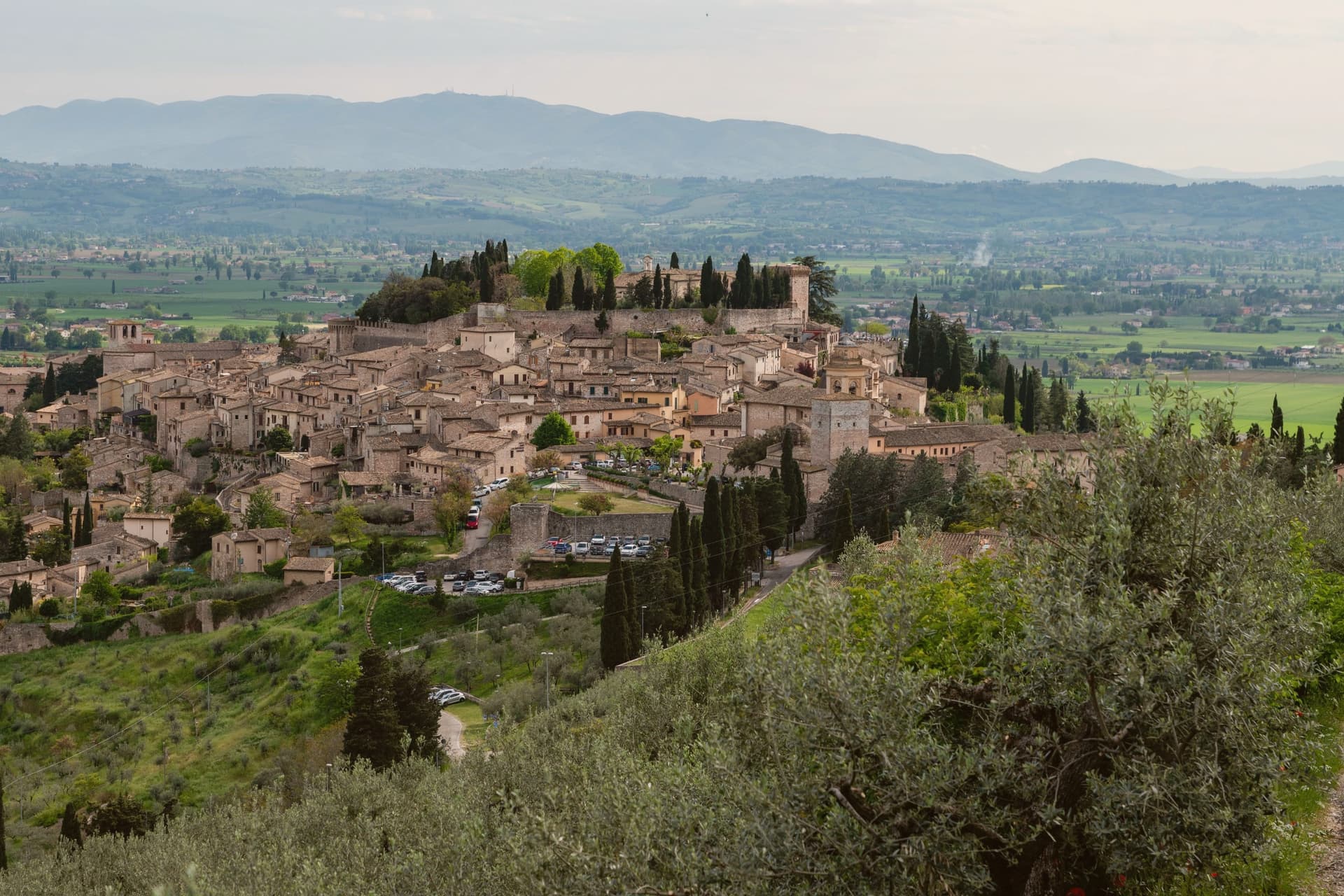
Why visit Spello
The centro storico climbs the lower southern flank of Monte Subasio, still contained within the circuit of walls raised when the town was renamed Splendidissima Colonia Julia by Augustus. Before that it was Hispellum under the Umbrians.
The Roman gates and stretches of wall from the Augustan period were not rebuilt over, so the line of the ancient town is still readable in the streets that climb from them today. The same streets carry the Infiorata each June and the fresco Pinturicchio completed for the chapel he painted in Santa Maria Maggiore, two things separated by roughly fifteen centuries but occupying the same short stretch of the old town: the chapel's Annunciation, Nativity and Christ Among the Doctors sit near the piazza the petal pictures are laid across.
A Roman villa with ten mosaic floors, found only in 2005 and left in place under cover, adds a third layer beneath the town that is still being uncovered rather than one that was always on view. The town's Roman skeleton, its painted chapel, and a floor uncovered within living memory all sit within the same small radius, which is unusual: most places show one era at a time, Spello keeps three in view at once.
What to see in Spello
- Cappella Baglioni. The Cappella Bella, commissioned by Troilo Baglioni, with four sibyls ranged across the vault above the painted scenes below.
- Santa Maria Maggiore. Twelfth-century church on Piazza Matteotti, its interior built around the fresco cycle and the later panel it houses.
- Porta Venere e Torri di Properzio. First-century BC gate flanked by two dodecagonal towers, still standing at close to full height with the stonework legible course by course.
How to get to Spello
There is a railway station in the town, so you can arrive without a car and never need one while you are here. Perugia is roughly 33 minutes away by road.
Our tip
April through June and September into October are the months for Spello. The slopes of Monte Subasio above town carry wildflowers, Cammino di San Francesco walkers pass through, and the Infiorata weekend on Corpus Domini in late May or June is the most concentrated day on the calendar. July and August touch the mid-thirties on the valley floor; the centro storico at 280 meters stays a few degrees cooler in the upper streets, but most visitors come early or wait until after seven. Borgo diVino tour falls in October.
More from Anywhere Italy
- The best hill towns on a walking route within 90 minutes of Perugia
 The 6 best hidden truffle towns in the province of Perugia
- The best towns on a walking route that eat well in the province of Perugia
- The best cheese towns within two hours of Perugia
- The best hidden hill towns you can reach by train in the province of Perugia
 The best hidden olive oil towns you can reach by train within 90 minutes of Perugia