
The best towns with a food festival in Puglia
Puglia eats in public. A sagra here is usually built around one thing, a single ingredient the town has grown or fished or butchered for generations, cooked in a square under strings of bulbs with trestle tables and paper plates and local wine poured from unlabelled bottles. In the Valle d'Itria that thing is bombette, rolled pork cooked over fornello coals; on the Adriatic it is sea urchins split with a knife in spring, or octopus beaten soft on the harbour wall. Inland the calendar turns on cherries in early summer, then almonds, then the olive harvest and the first oil of the year, thick and green and peppery in the throat. The towns themselves are built of the same limestone as the walls between the olive groves, whitewashed or left bare, which is why the light in late afternoon looks the way it does.
Most visitors meet Puglian food in Alberobello, between the trulli and the coach parties, or over a long lunch in Lecce and Polignano a Mare where the tables are booked out from June to September. The cooking in those places can be very good. But the queue moves slowly, the prices have adjusted to the audience, and the meal happens in a restaurant rather than a street. The peninsula's reputation has arrived faster than its infrastructure, and the famous names carry most of the weight.
The olive groves, the masserie and the same fish markets continue well past the towns on the tour circuit. Along the coast north of Bari and south towards the Salento heel, and up on the Murgia plateau where the pastures feed the sheep and the cattle, there are towns that hold a festival every year for the ingredient they are known for locally and not much beyond it. Fewer people go. The towns below each keep a recurring food festival built around one thing, which is the most useful fixed point a traveller can plan around.
Of the 59 communes we have mapped in Puglia, 11 qualify as towns with a food festival: each holds a recurring food festival built around one local ingredient. This list is 10 of them. The smallest, Martano, has 8,583 residents.
Two more lists worth reading alongside this one: The best coastal towns you can reach by train within 90 minutes of Bari and The 7 best beach towns inside a nature park in Puglia.
Martano
Why visit Martano
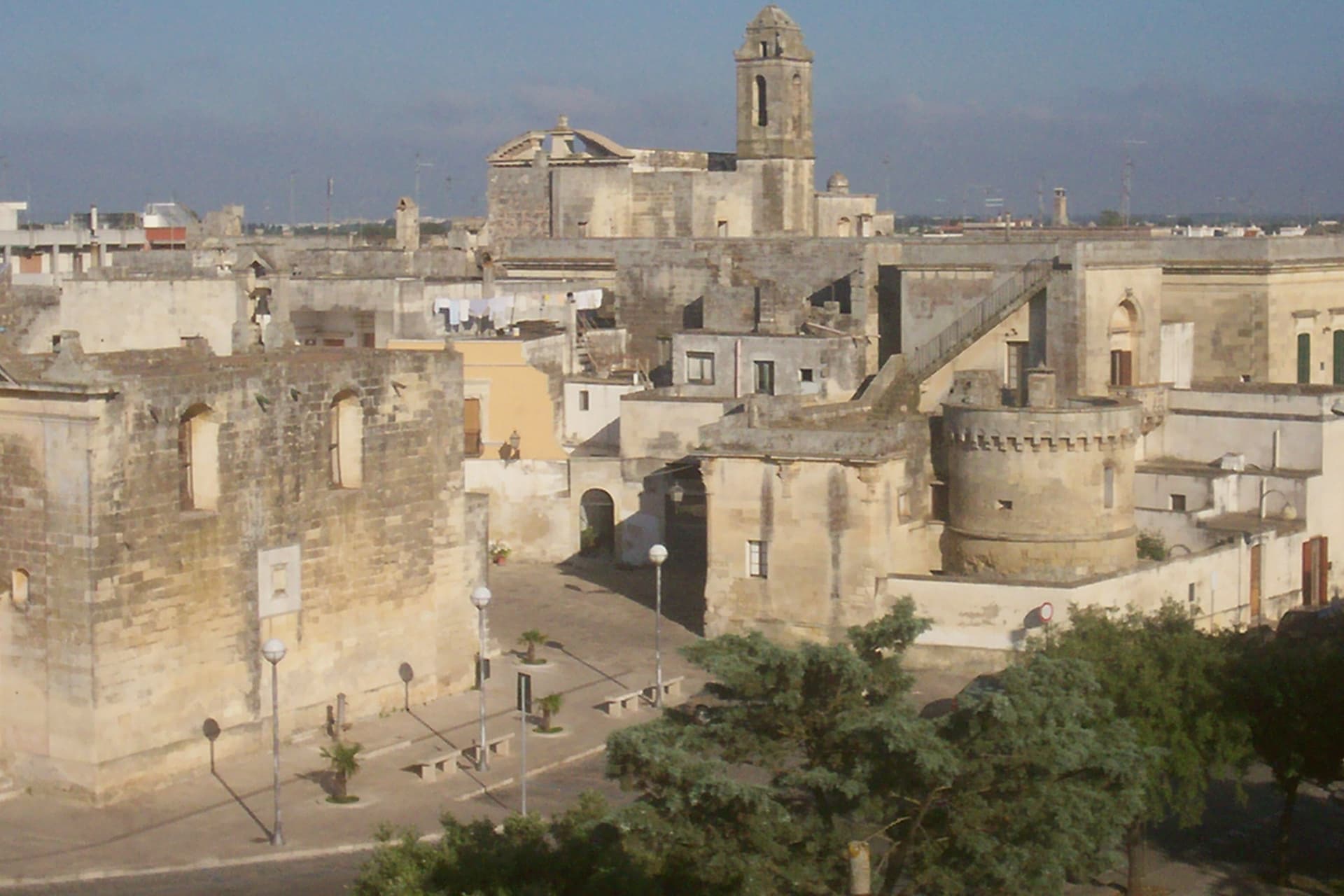
Martano sits at ninety-one meters, twenty kilometers south of Lecce and eighteen kilometers from Otranto. It is the largest of the nine communes of the area where some residents still speak Griko, a Greek dialect inherited from five centuries of Byzantine rule.
The town fell under Greek administration after the collapse of the Western Roman Empire, was part of the County of Lecce from around 1000, then was granted as a fief by King Tancredi to Giorgio Remanno in 1190. The prehistoric record predates all of that and is more visible on the ground than any document: a megalithic mound and a standing stone, both still standing on the town's agricultural fringe, long before the Byzantine and feudal rule that later gave the town its administrative shape.
The centro storico, at the same ninety-one meters, carries the bilingual Italian-Griko signage that marks the town's continued position as capital of the language area. Olive oil and tobacco built the modern economy.
What holds these pieces together is continuity: a language surviving from Byzantine centuries, stones surviving from long before them, and a fief history layered on top, all visible within the same small radius around the old town.
What to see in Martano
- Specchia dei Mori. Drystone megalithic mound twenty meters across and six meters high, also called Segla tu Demoniu in Griko.
- Menhir del Teofilo. Standing stone 48 by 33 centimeters wide at the base, set on the outskirts of the town among agricultural land.
- Chiesa Matrice dell'Assunzione. Parish church dedicated to the Assumption, August 15 patronal festival, anchor of the centro storico.
How to get to Martano
Taranto is roughly 115 minutes away by road.
Our tip
April through June and September through October are the months the Salento inland stays mild. May brings the wild thyme into the trattorie and the early olive flush. July and August push past thirty-five degrees on the limestone plain; the centro storico empties between two and five and the patronal festa on August 15 still pulls a crowd despite the heat. Sagra de la Volìa Cazzata falls in October.
Melendugno
Why visit Melendugno
The comune administers 17 km of Adriatic coast east of Lecce, 19 km from the city, with 10,045 residents spread between that shoreline and an inland centre sitting at 36m altitude. The town of Melendugno itself is the administrative seat: the Chiesa di Santa Maria della Vergine (16th century), the Palazzo Marchesale, and a medieval centro that sees none of the coastal traffic.
The coast and the inland town function almost as two separate places under one name, the beaches and the karst pool drawing visitors who may never see the Palazzo Marchesale. Along that coast, three beaches carry Bandiera Blu status, each with its own character: one framed by faraglioni, one a working marina with a still-active fishing port and a castle, one the smallest but with the most dramatic limestone arches.
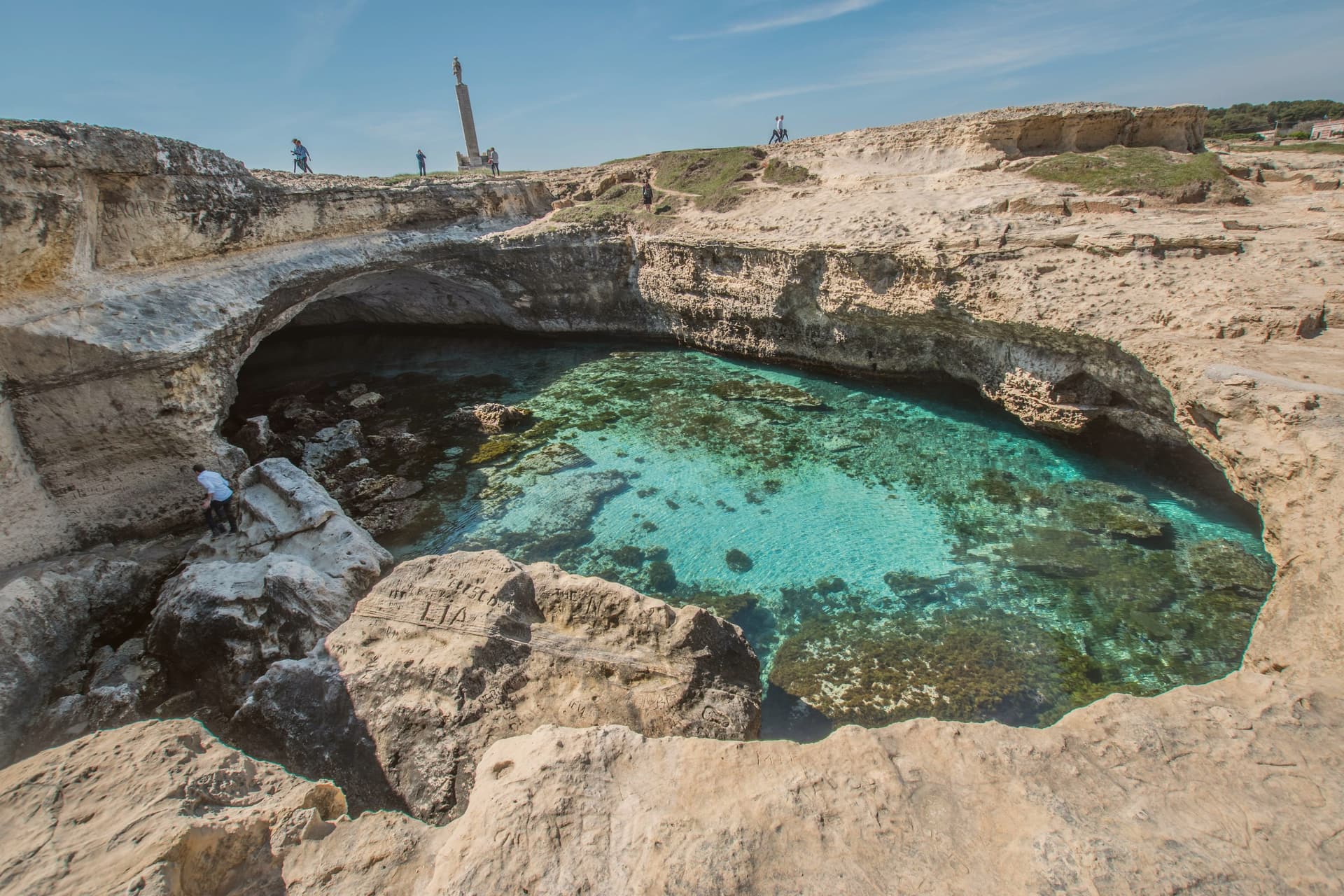
The karst pool at Roca sits beside the archaeological complex of the same stretch: a Messapian settlement built over a Bronze Age fortified predecessor, votive inscriptions cut into the cave walls in proto-Messapian, Greek, and Latin. Two finds from very different eras occupy the same short piece of coastline, one a place to swim, the other a record of who lived there first.
Inland, the comune carries a rare stack of designations beyond the coastal one: Borgo Autentico, Città dell'Olio, tied to the surrounding Salento DOP olive groves and their millennia-old trees toward Acaya, and a honey designation resting on a local beekeeping cooperative that produces thistle, eucalyptus, and millefiori varieties, marked each early autumn by its own sagra. The food follows Salento conventions: pasta con cime di rapa, pittule, bombette of pork, and pasticciotto leccese, whose original source is credited to a 1745 pastry shop in Galatone, 30 km south.
In late August the pizzica festival La Notte della Taranta, the Salento's biggest cultural event, takes place in Melpignano, 25 km south. Between the coast, the archaeology, the olive groves, and the honey cooperative, Melendugno holds more density of designation and documented history per kilometre than its size would suggest.
What to see in Melendugno
- Grotta della Poesia (Roca). A karst-collapsed pool 8m below the rock surface, reached through a single jagged opening above. The water is crystal-clear and connects by underwater tunnels to two adjacent smaller pools.
- Three Bandiera Blu beaches. Torre dell'Orso has 300m of fine sand framed by the Le Due Sorelle faraglioni. San Foca is a working marina with a still-operational fishing port and the Castello Sangiovanni. Sant'Andrea is the smallest of the three, with the most dramatic limestone arches.
- Roca Vecchia archaeological site. A Messapian settlement (5th-3rd c BC) built over an earlier Bronze Age fortified village (16th c BC) on a coastal promontory. Thousands of votive inscriptions in proto-Messapian, Greek, and Latin are scratched into the cave walls.
How to get to Melendugno
Taranto is roughly 117 minutes away by road.
Our tip
Melendugno is best May–June and September–October — the Salento beach summer peaks August (Italian holiday season, ferragosto crush) and the coast is at its hottest 35°C+ in July-August. La Notte della Taranta in nearby Melpignano (late August) is the regional cultural headline. October is harvest in the Salento DOP olive groves. Sagra Ortofrutticola Borgagne falls in July.
Cisternino
Why visit Cisternino
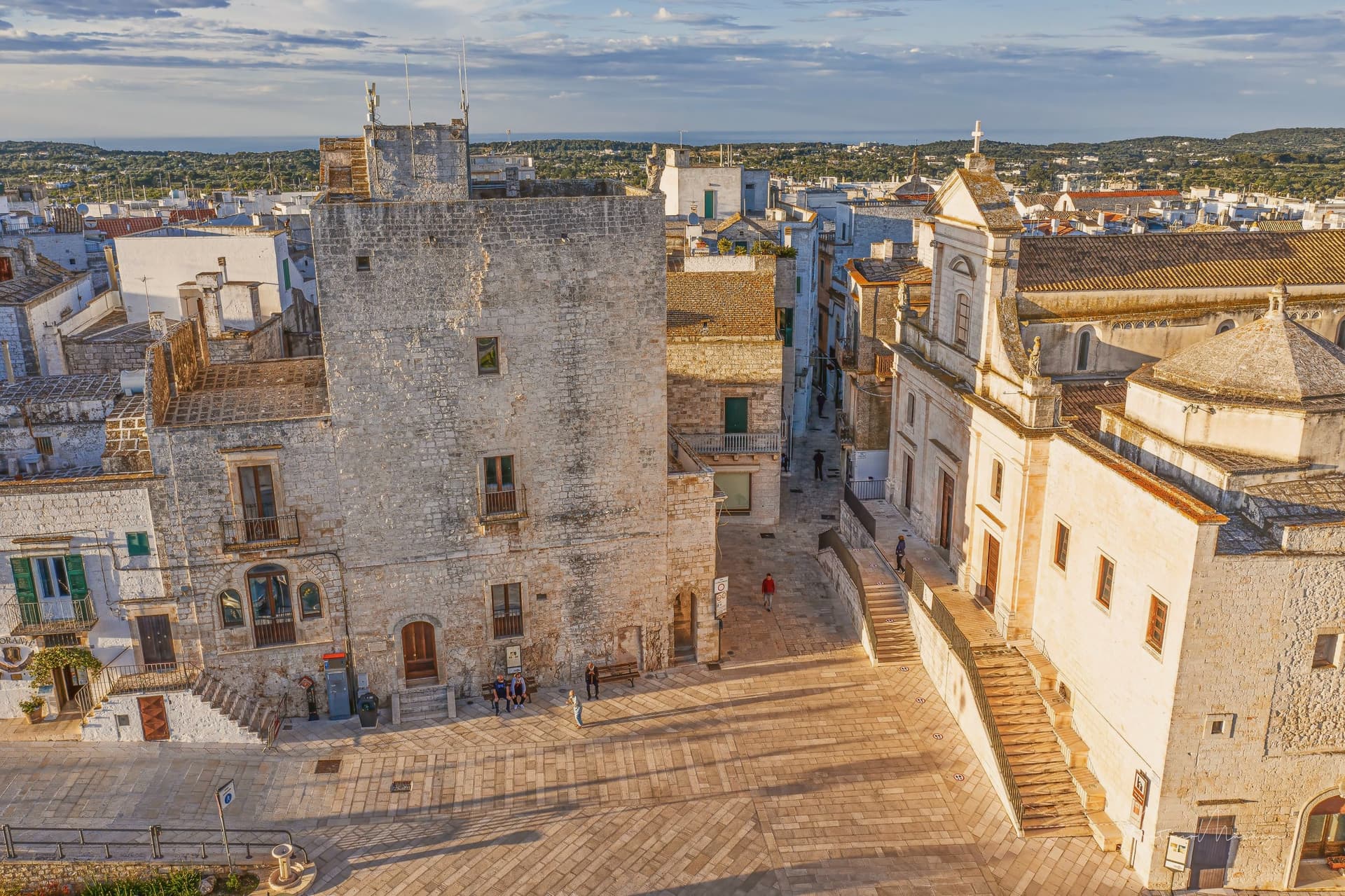
Cisternino occupies the last rise of the southern Murgia, its whitewashed houses looking down over drystone walls, vineyards and trulli in the Valle d'Itria. The town sits within the Itria Valley DOC wine zone, and the older quarter is built as a tight knot against the edge of the plateau, its stone alleys and courtyards folded close enough together that the comparison to a North African medina has stuck.
The civic tower in the main square marks where the newer town gives way to that older core, a single threshold between the two. Cisternino, a Cittaslow member since 2003, was named Cittaslow City of the Year in 2014, a designation that formalizes what the town already does at the butcher-restaurants of the old quarter: meat grilled to order and eaten at a counter or a side table, nothing rushed.
Between the drystone valley below, the huddled white quarter above, and a civic identity built on not hurrying, the town reads as a place organized around slowness at every scale, from its walls to its kitchens.
What to see in Cisternino
- Chiesa Madre di San Nicola di Patara. The neoclassical facade dates from around 1848, standing over a floor where excavations between 1999 and 2000 uncovered thirteen burials, Byzantine fresco fragments and coins.
- Centro storico. Stone alleys, low arches and small courtyards on the Murgia edge, close enough in plan and whitewash to draw comparison to a North African medina.
- Torre Civica. Civic clock tower in the main square at the entrance to the centro storico, the gateway between the modern town and the white labyrinth.
How to get to Cisternino
There is a railway station in the town, so you can arrive without a car and never need one while you are here. Taranto is roughly 50 minutes away by road.
Our tip
April through June and September through October are the months the Itria valley is green and the centro storico is walkable without sweat. July and August reach the mid-thirties on the plateau and the white alleys fill with day-trippers; by ten in the morning the main passages can be shoulder to shoulder. Late afternoon and dusk are the times to walk, when the limestone catches the sun and the crowds thin. Fiera della Bomminella falls in September.
Castellaneta
Why visit Castellaneta
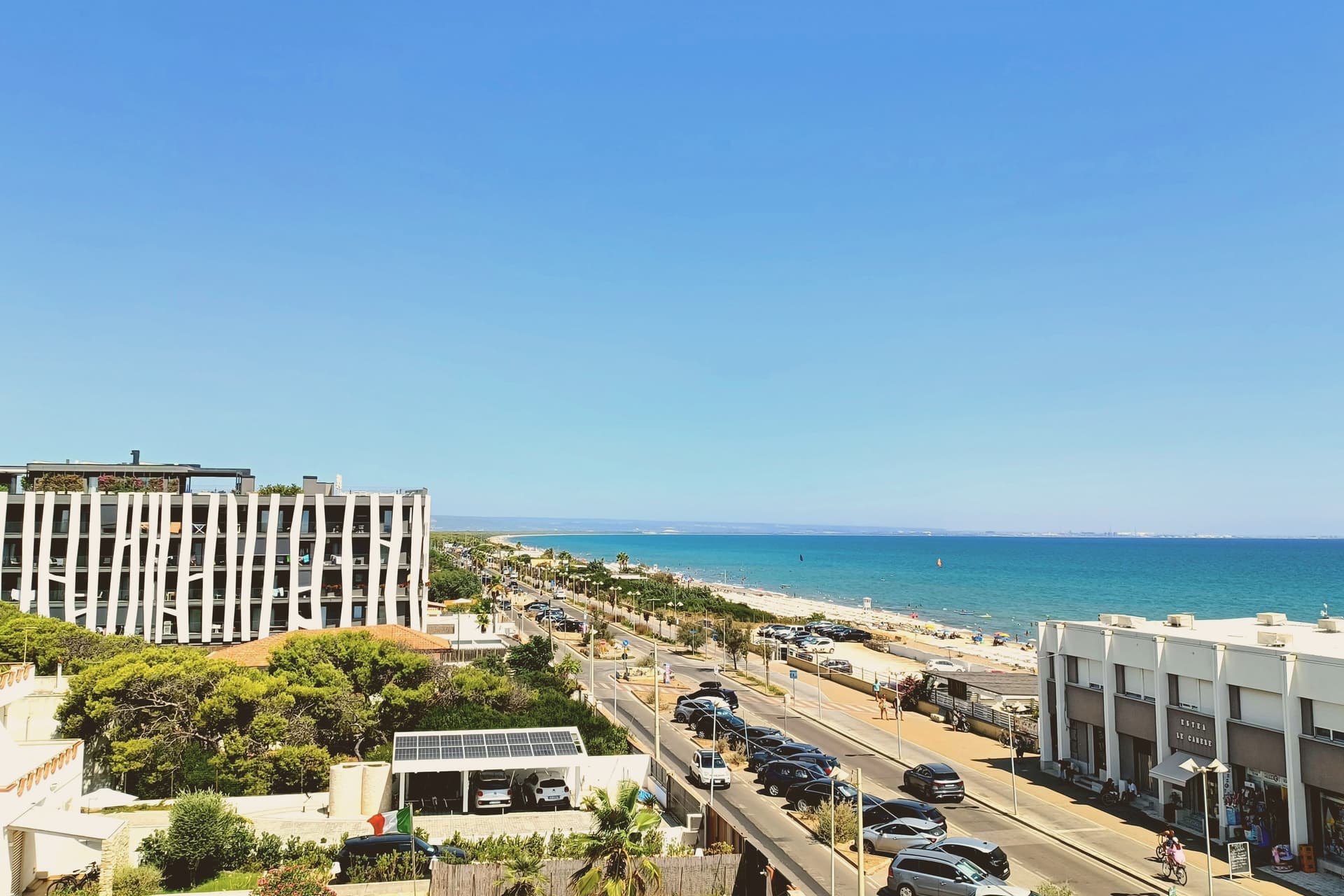
Castellaneta sits on the Murge plateau at 235 meters, on the southern rim of the Gravina Grande, a karst canyon 10 kilometers long and 145 meters deep that wraps the town in near-vertical limestone walls. The municipal territory runs from the gravina down to the Ionian coast at Castellaneta Marina, fifteen kilometers south, where the long sand beach has held Bandiera Blu for ten consecutive years.
The cathedral was founded under the Normans in the eleventh century, rebuilt in Romanesque form in the fourteenth, and given its white limestone facade in 1771. The town is best known abroad as the birthplace of Rodolfo Valentino, born here on 6 May 1895 and reborn in Hollywood as Rudolph Valentino.
A blue ceramic statue of the actor by Luigi Gheno was unveiled in the centro storico in 1961, captured in the documentary Mondo Cane, and the Museo Rodolfo Valentino opened on the 1995 centenary.
What to see in Castellaneta
- Gravina Grande. Karst canyon ten kilometers long and 145 meters deep wrapping the town on three sides, part of the Terra delle Gravine regional park.
- Cattedrale di Santa Maria Assunta. Norman cathedral of the eleventh century rebuilt as a Romanesque basilica in the fourteenth and refaced in white limestone in 1771.
- Museo Rodolfo Valentino. Civic museum opened on the actor's 1995 centenary, with the ceramic statue by Luigi Gheno unveiled in 1961 standing in the square outside.
How to get to Castellaneta
There is a railway station in the town, so you can arrive without a car and never need one while you are here. Taranto is roughly 49 minutes away by road.
Our tip
April through June and September through October are the months the Murge is dry, mild, and the gravina edges walkable. July and August push past thirty-five degrees on the plateau and the centro storico empties in the afternoon, though Castellaneta Marina fills with Italian families and the beach is at its peak. The Festa di Santa Maria della Stella in May and the Carnevale procession through the centro storico are the civic anchors of the calendar. Sagra della Farnedd dei sapori di Puglia falls in August.
Casamassima
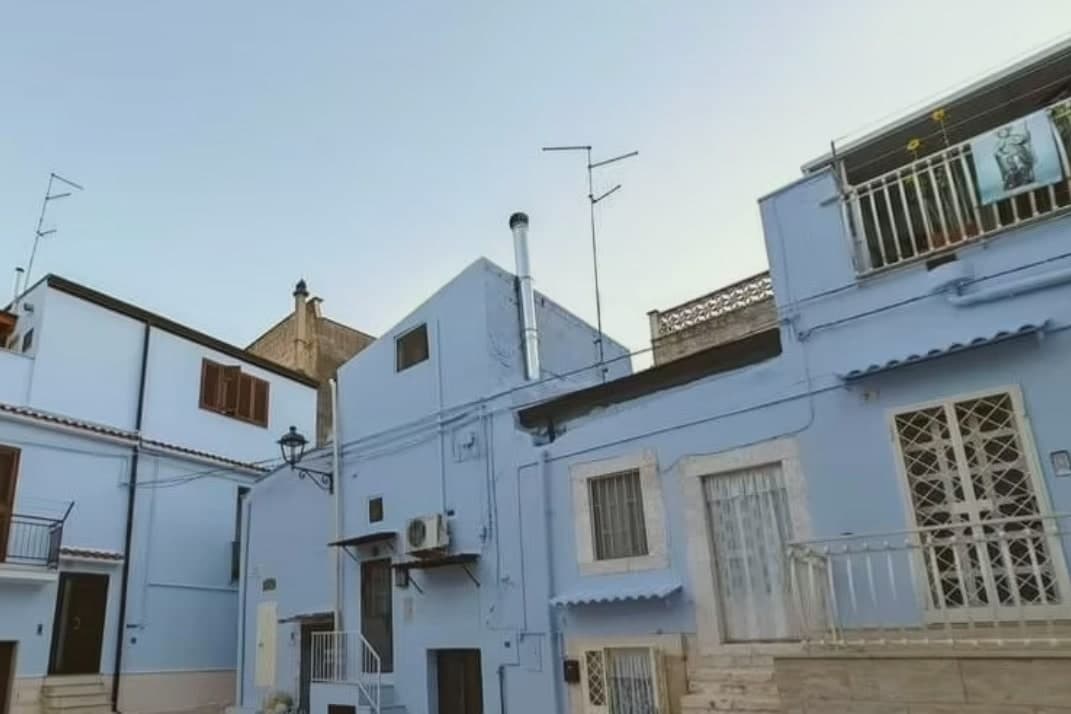
Why visit Casamassima
Casamassima sits at 230 meters on the lower Murge slopes, twenty kilometers south of Bari. The village is known nationally as the Paese Azzurro, the blue town: the houses, palazzi and churches of the centro storico are coated in successive layers of blue-tinted quicklime, probably copper sulphate, in a tradition the locals trace to Duke Odoardo Vaaz.
In 1658 a plague carried by a ship into the port of Bari killed over twenty thousand residents of the capital. Vaaz, a feudal lord of Casamassima from a Sephardic Jewish family of Portuguese origin who had bought the fief in 1609 for 76,000 ducats, vowed to the Madonna of Constantinople that he would paint his town blue if the village was spared.
It was. The small church of the Madonna di Costantinopoli still stands as the vow's fulfilment, and the blue lime has been retouched on the same buildings for nearly four centuries.
What to see in Casamassima
- Centro storico (Paese Azzurro). The blue town, an entire medieval quarter coated in successive layers of copper-blue quicklime since the 1658 plague vow, unique in Puglia.
- Palazzo Ducale Vaaz. Twelfth-century manor house turned ducal residence of the Sephardic Vaaz family from 1609, then of the D'Aponte family after the 1667 sale.
- Chiesa di Maria SS di Costantinopoli. Small church built as the fulfilment of Duke Vaaz's plague vow, the historical anchor of the blue-painting tradition.
How to get to Casamassima
There is a railway station in the town, so you can arrive without a car and never need one while you are here. Bari is roughly 22 minutes away by road.
Our tip
April through June and September through October are the months the Murge is mild and the blue centro storico photographs at its best, the lime cool against bright light. July and August reach the mid-thirties on the plateau and the painted lanes empty between two and five in the afternoon. The painter Vittorio Viviani came in the 1960s and built a body of work around the blue light; the Pro Loco still organises walks in his footsteps in spring and autumn. Sagra focaccia di patate del coniglio ripieno falls in September.
Giovinazzo
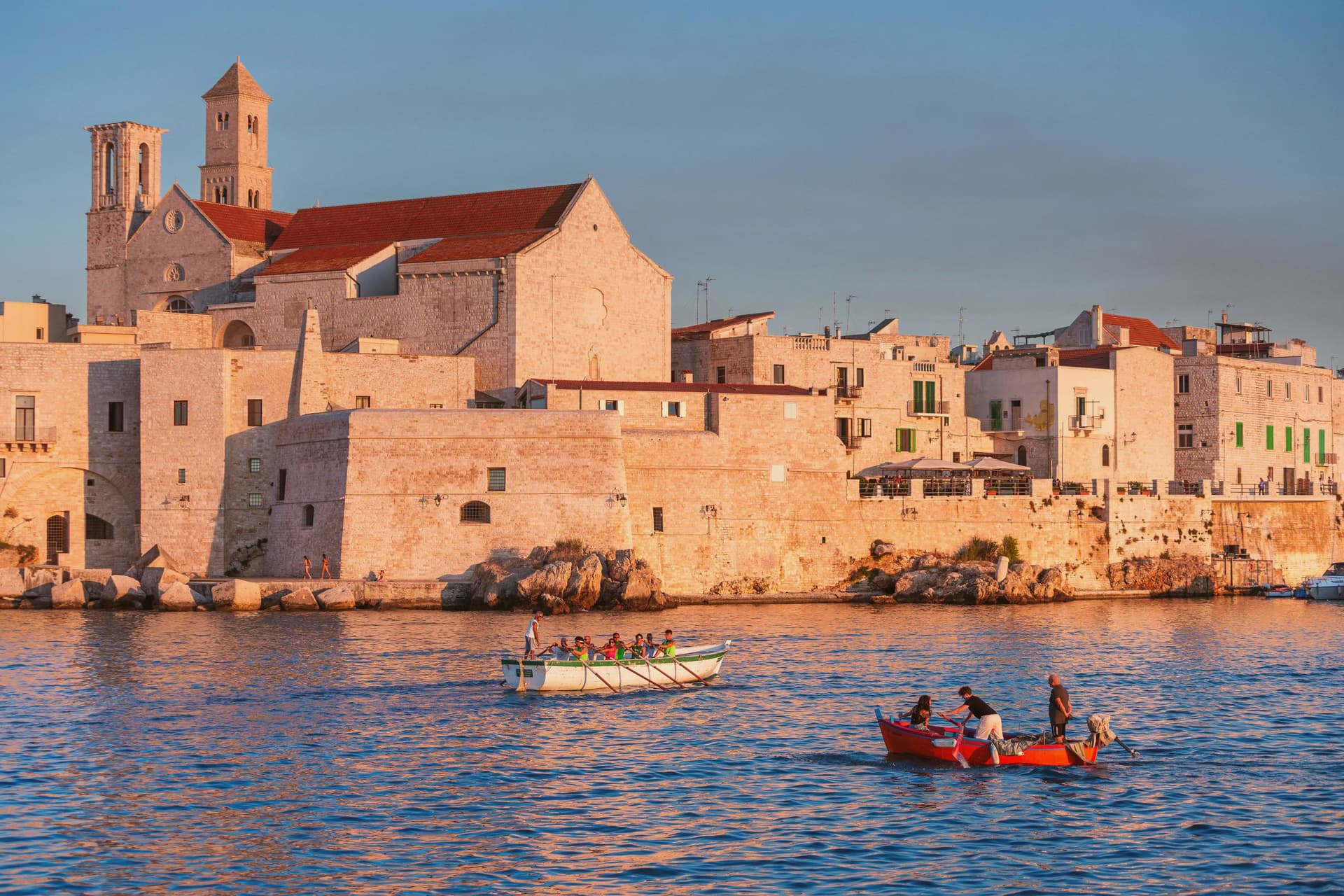
Why visit Giovinazzo
Giovinazzo sits on the Adriatic twenty kilometers northwest of Bari, between Molfetta and the Bari coastal belt, at 7 meters. The Romans called it Natolium, fortifying the site under Trajan in 102 AD on what may be the older Peucetian settlement of Netium.
The Norman cathedral of Santa Maria Assunta was built between 1125 and 1180 in the Puglian Romanesque style and consecrated in 1283; it still holds the Byzantine icon of the Madonna of Corsignano, the patron, celebrated through August. The medieval centro storico runs in narrow stone lanes around the harbor, where the small fishing fleet still ties up below the sea wall.
Five kilometers inland, the Dolmen di San Silvestro is a Bronze Age funerary chamber from around 1500 BC, set in a grove of olive and carob, the agro that makes Giovinazzo a Città dell'Olio. The town hosts one of the few elite roller hockey clubs in Italy.
What to see in Giovinazzo
- Concattedrale di Santa Maria Assunta. Norman cathedral of 1125-1180 in Puglian Romanesque, consecrated in 1283, with the Byzantine icon of the Madonna of Corsignano above the main altar.
- Centro storico. Medieval old town in narrow stone lanes wrapping the small port, walled on the seaward side and rebuilt after Norman reconquest in the eleventh century.
- Dolmen di San Silvestro. Bronze Age funerary dolmen from around 1500 BC, set on a Murgia terrace among olive and carob trees five kilometers inland from town.
How to get to Giovinazzo
There is a railway station in the town, so you can arrive without a car and never need one while you are here. Bari is roughly 31 minutes away by road.
Our tip
May through June and September are the best months on this stretch of Adriatic coast, with warm sea and mild evenings. July and August touch thirty-five degrees and the small harbor fills with weekenders from Bari; the centro storico stays cooler in the lanes than out on the wall. The festa for the Madonna of Corsignano runs through August. Sagra del Panino della Nonna falls in August.
Fasano
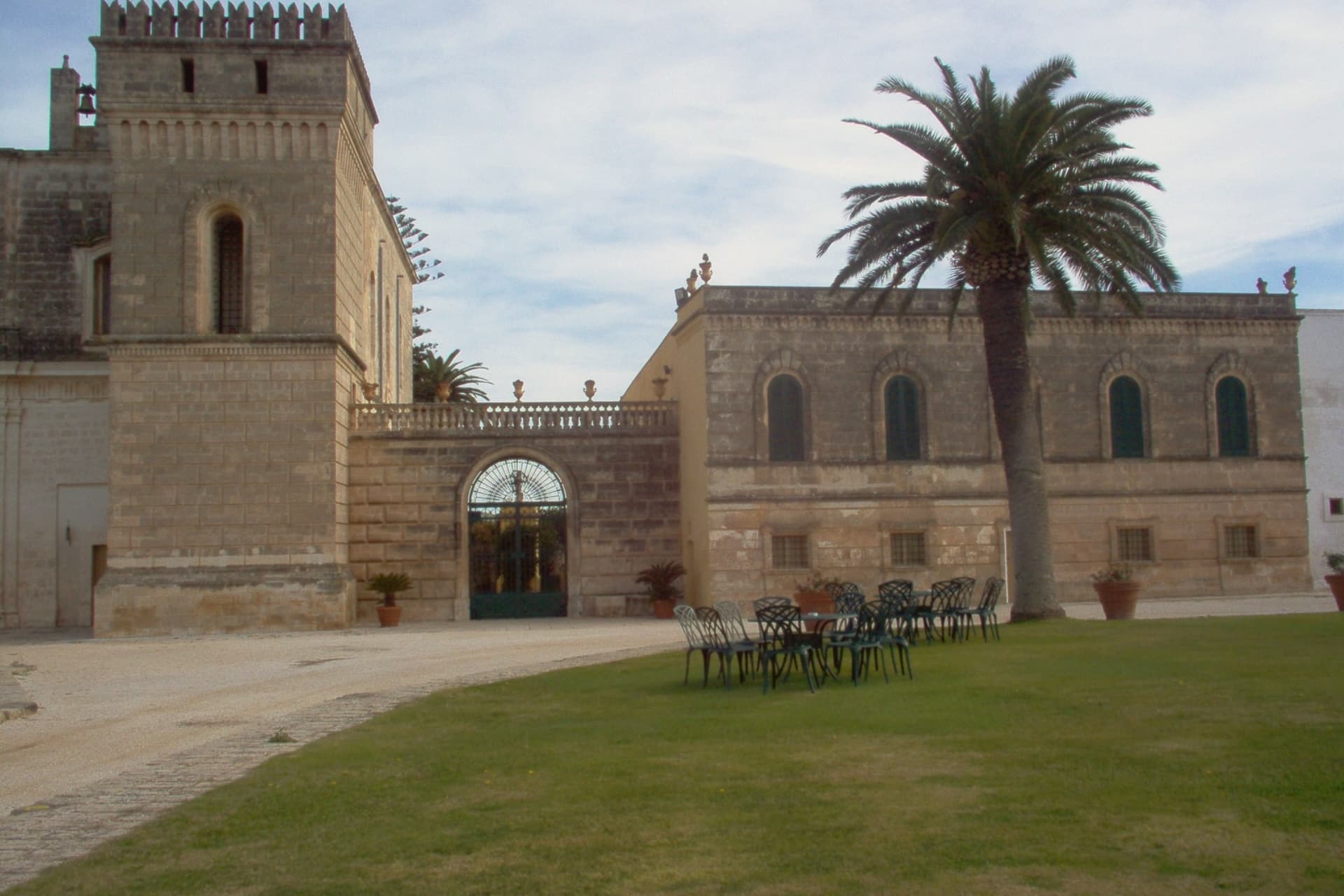
Why visit Fasano
The main centre sits at 118 meters, a hinge point in a wide municipal territory that runs from the Adriatic shore up to the Itria escarpment, home to thirty-eight thousand residents spread across three distinct landscapes rather than one compact town. The coast holds the abandoned city, inhabited from the fifteenth century BC and left empty by the Middle Ages, its excavated stone now sitting a short distance from the museum built to house what came out of the ground there.
Inland and uphill, the wooded escarpment climbs to become the highest ground in the province, the same slopes that carry the wildlife park across its carob and olive scrubland. Further along the shore, the fishing port turned resort gives the territory its beach frontage.
The pattern is coastal city, wooded highland, coastal resort, three pieces of a single municipality that never behaves like a single place. What the town offers is that range within one boundary: Roman ruins at sea level, a panorama at the province's highest point, and a working beachfront, none of them a detour from the others.
What to see in Fasano
- Parco Archeologico di Egnazia. Ruins spread across eighty hectares along the coast, with the Via Traiana running through the site alongside the basilica and a cryptoporticus still traceable underfoot.
- Museo Nazionale Archeologico Giuseppe Andreassi. Museum standing next to the archaeological park, holding the objects pulled from the excavations: Messapian inscriptions, Roman finds, and material spanning the long abandonment of the city.
- Selva di Fasano. Wooded escarpment reaching between 411 and 414 meters, the ground rising from carob and olive scrub to open views that give the terrace its nickname.
How to get to Fasano
There is a railway station in the town, so you can arrive without a car and never need one while you are here. Bari is roughly 52 minutes away by road.
Our tip
May through September is the working season on this stretch of the Adriatic: warm sea, the Bandiera Blu beaches at Savelletri operating, the Selva ten degrees cooler than the coast for an evening break. July and August fill the coast with Italian holidaymakers; Egnazia exposed on the seafront is brutal between noon and three. April and October are quieter alternatives with the sea still mild, the archaeological park at its photographic best, and the olive harvest opening across the surrounding masserie. Festa Della Mietitura E Trebbiatura Del Grano falls in August.
Martina Franca
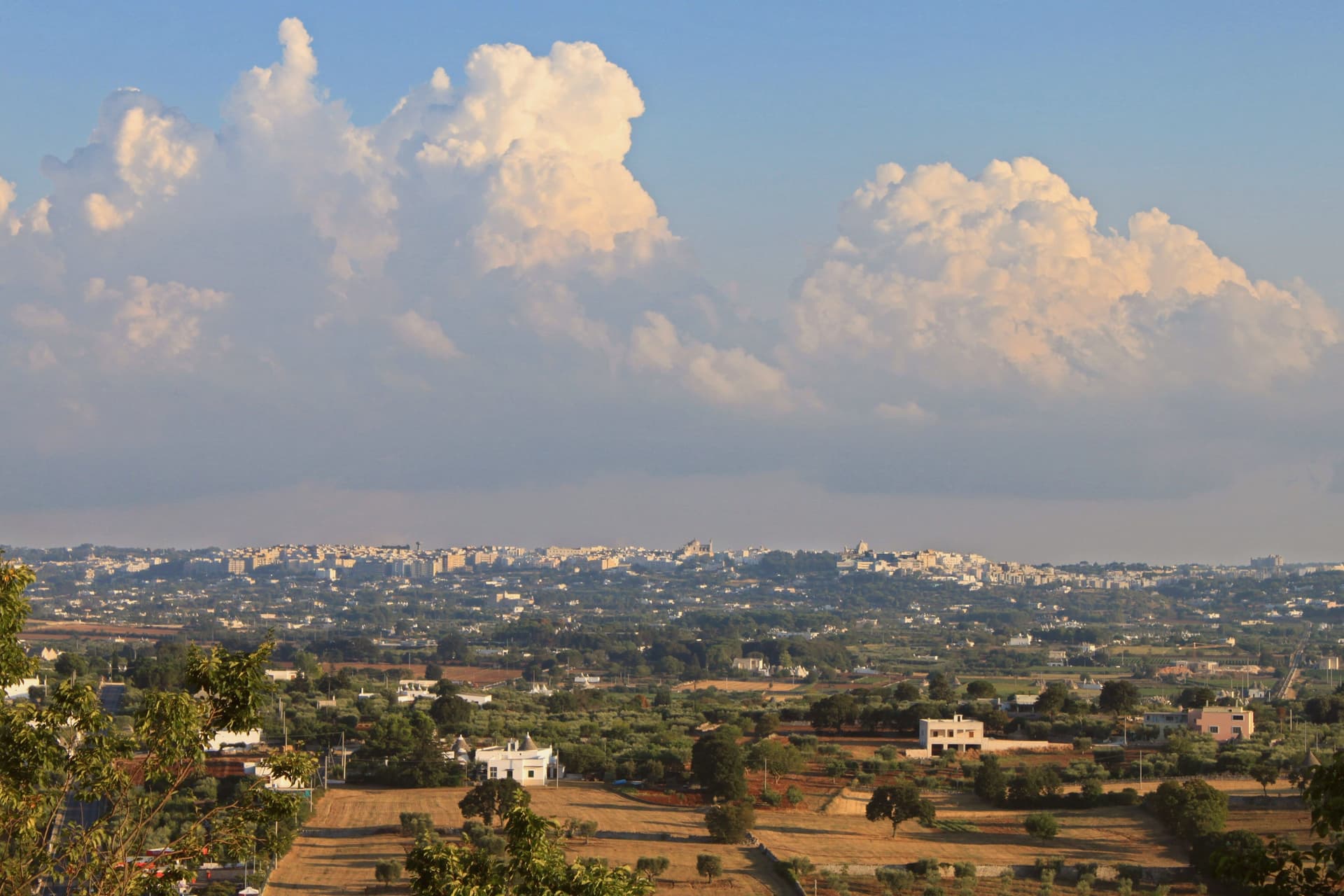
Why visit Martina Franca
Martina Franca sits at 431 meters on the southern edge of the Valle d'Itria, on the border between the provinces of Taranto, Bari and Brindisi. The town was founded in 1310 by Philip I of Anjou, Prince of Taranto, who granted franchigie, tax exemptions, to settlers willing to repopulate the hill, hence Franca in the name.
The centro storico is the densest concentration of Rococo and late-Baroque architecture in Puglia after Lecce: wrought-iron balconies, carved stone portals, churches built or rebuilt after the 1743 earthquake. The Palazzo Ducale of 1668, raised on the foundations of a 1338 medieval castle, is the seat of the municipal offices and the open-air courtyard where the Festival della Valle d'Itria has been performed every July and August since 1975, founded specifically to recover rare and forgotten operas.
The Basilica di San Martino, begun in 1747, is the most complete example of Martinese Rococo. The surrounding plateau makes a Martina Franca DOC white wine and a strong dry-cured capocollo IGP.
What to see in Martina Franca
- Palazzo Ducale. Built in 1668 on the foundations of a 1338 medieval castle, town hall and home of the Festival della Valle d'Itria summer opera courtyard.
- Basilica di San Martino. Eighteenth-century basilica begun in 1747 after the 1743 earthquake, the most complete Martinese Rococo monument and museum of liturgical art.
- Piazza Roma and Piazza Maria Immacolata. The two main squares of the centro storico, linked by Via Cavour, lined with eighteenth-century palazzi and the town's main passeggiata.
How to get to Martina Franca
There is a railway station in the town, so you can arrive without a car and never need one while you are here. Taranto is roughly 38 minutes away by road.
Our tip
April through June and September through October are the best months on the Itria plateau. The 431-meter elevation keeps the air dry, the limestone walls reflect a clear light, and the surrounding vineyards green up in spring then turn gold by the late September harvest. July and August are hot but mitigated by the altitude; they are also the months the Festival della Valle d'Itria runs in the Palazzo Ducale courtyard, the largest cultural draw in southern Puglia. Festa della bombetta falls in August.
Bisceglie
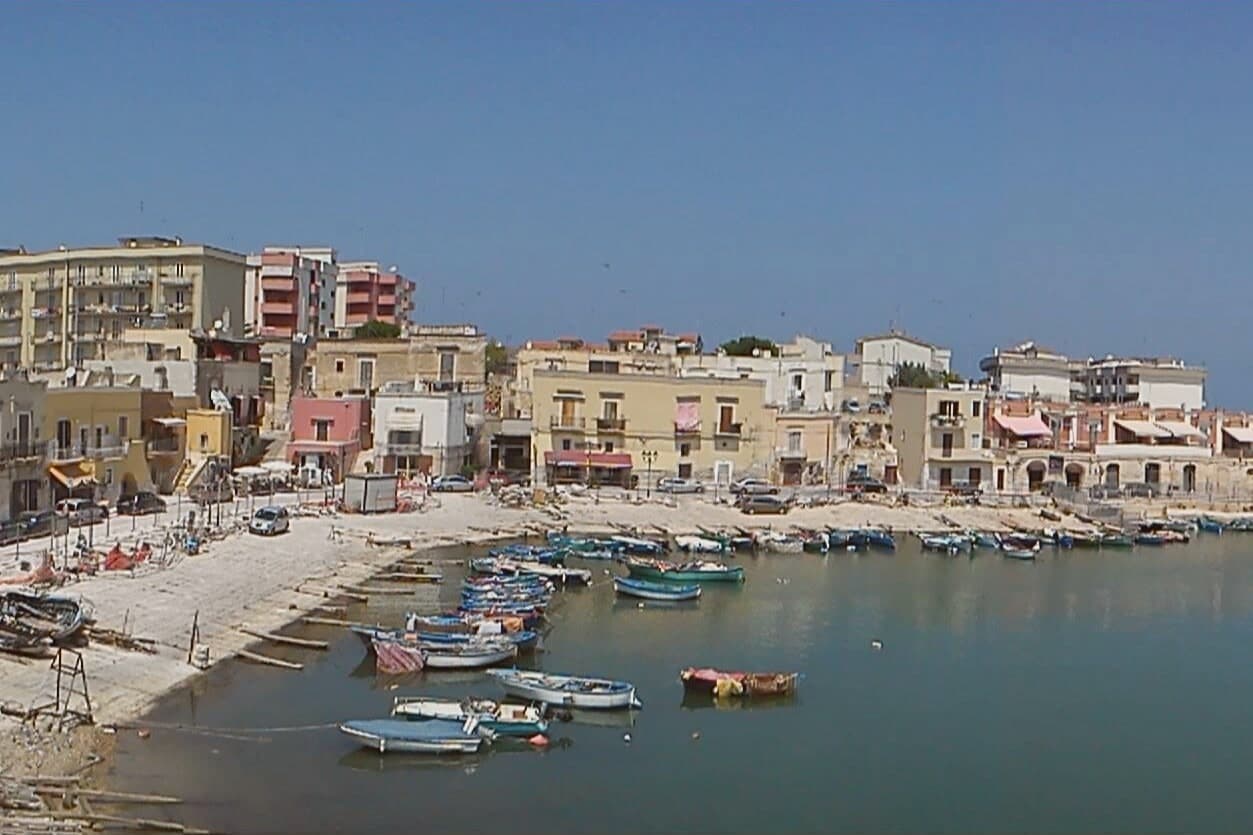
Why visit Bisceglie
Bisceglie sits on the Adriatic coast between Trani and Molfetta, thirty-five kilometers north of Bari, at sea level on a low limestone shelf with the Murge rising inland. The name probably derives from the Latin vigilae, watchtowers, recording the Roman coastal lookouts that preceded the medieval town.
The walled centro storico sits between the cathedral and the port, its stone the same limestone as the dolmens scattered inland, which ties the old town physically to the countryside around it. The harbour below still works, split between commercial fishing and pleasure boats, and the relics beneath the cathedral were moved into their purpose-built crypt under three altars in 1167, a century after the building was begun.
Bisceglie also carries Spighe Verdi for its olive countryside and Città dell'Olio for the Coratina groves that surround it, alongside its recognition for the sea. What holds the town together is the limestone shelf itself: it carried the Roman watchtowers that gave Bisceglie its name, it was cut into dolmens by the Bronze Age communities who ringed the commune with tombs, and it still separates the working port from the olive groves inland, so that fishing, stone, and oil remain the three things the town has always stood on.
What to see in Bisceglie
- Dolmen della Chianca. Bronze Age megalithic tomb with a 10-meter passage and a burial cell two by 1.6 meters, the largest and best-preserved Italian dolmen, three kilometers inland.
- Concattedrale di San Pietro. Norman cathedral begun in 1073 by Peter II of Trani, finished in 1295, now co-cathedral in the Archdiocese of Trani-Barletta-Bisceglie.
- Torre Maestra. Norman square donjon of the twelfth century, twenty-seven meters tall, the surviving keep of the medieval citadel above the port.
How to get to Bisceglie
There is a railway station in the town, so you can arrive without a car and never need one while you are here. Bari is roughly 38 minutes away by road.
Our tip
May through September are the months the Adriatic warms enough to swim and the coastal restaurants stretch onto the sea wall. July and August push past thirty-three degrees and the beaches fill on weekends with day-trippers from Bari and Trani. June and September are the steadier months, water still warm, crowds thinner. Festa di Pantano Ripalta falls in August.
Trani
Why visit Trani
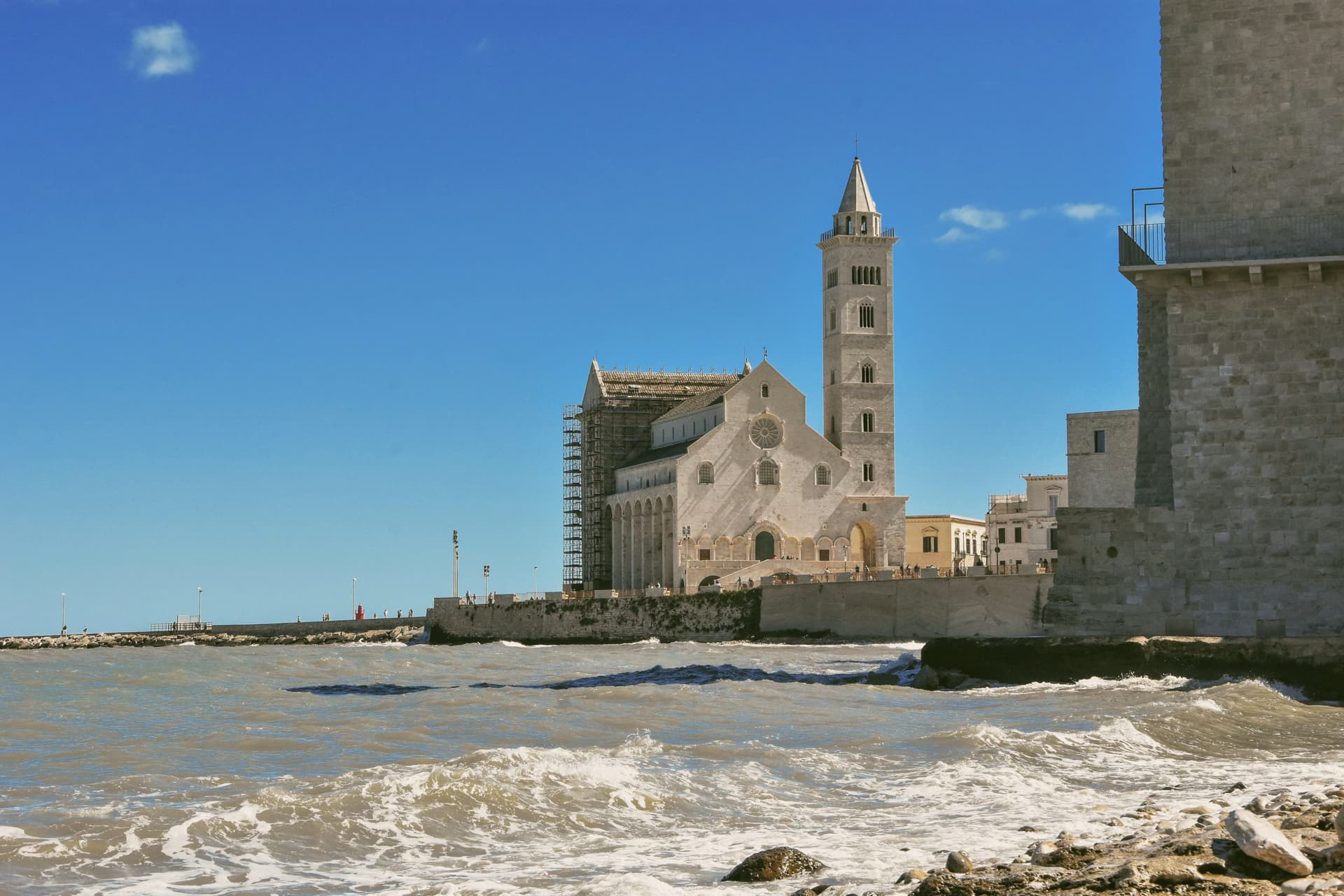
Trani sits on the Adriatic forty-five kilometers west-northwest of Bari, one of the three capitals of the Barletta-Andria-Trani province. The cathedral is the reason most travelers come.
Dedicated to Saint Nicholas the Pilgrim, a Greek who died in Trani in 1094, the church was begun in 1159 and built from the local calcareous tuff that quarries pink-white almost to the point of looking bleached. The fifty-nine-meter bell tower was finished in the fourteenth century; the central bronze door is a 1175 work by Barisano da Trani.
The Castello Svevo on the same harbor was built by Frederick II between 1233 and 1249 to guard the roadstead. Trani's eleventh- and twelfth-century maritime republic linked the Crusader Adriatic to the East and produced the Ordinamenta maris, one of the earliest western sea codes.
The cathedral square at dusk, sea on one side and Castello Svevo on the other, is the photograph.
The re-enactment here is Il Matrimonio di Re Manfredi, usually held in August.
What to see in Trani
- Cattedrale di San Nicola Pellegrino. Romanesque cathedral begun in 1159 on a sea-edge platform, built of local pink-white tuff, with a fifty-nine-meter bell tower and the 1175 bronze door by Barisano da Trani.
- Castello Svevo. Frederick II fortress of 1233-1249 on a rock at the center of the harbor, designed by Filippo Cinardo, later a royal court seat and provincial prison until 1974.
- Porto e lungomare. Working fishing harbor lined with palazzi and trattorie, with the cathedral at one end and the Castello Svevo at the other.
How to get to Trani
There is a railway station in the town, so you can arrive without a car and never need one while you are here. Bari is roughly 38 minutes away by road.
Our tip
May, June, September and October are the easiest months on the harbor: warm without humidity, the cathedral square workable from morning into the evening, the Adriatic still swimmable. July and August are hot and busy, with cruise day-trippers and weekend Bari traffic taking the port. The fish auction at the molo continues through the summer; the local moscato bottling runs from August into September. Festa di San Nicola Pellegrino falls in August.
More from Anywhere Italy
 The best coastal towns you can reach by train within 90 minutes of Bari
 The 7 best beach towns inside a nature park in Puglia
 The best coastal towns with a serious restaurant in Puglia
 The best hill towns inside a nature park in Puglia
- The best hill towns worth staying overnight in Puglia
 The best towns on a walking route in Puglia