
The 7 best beach towns inside a nature park in Puglia
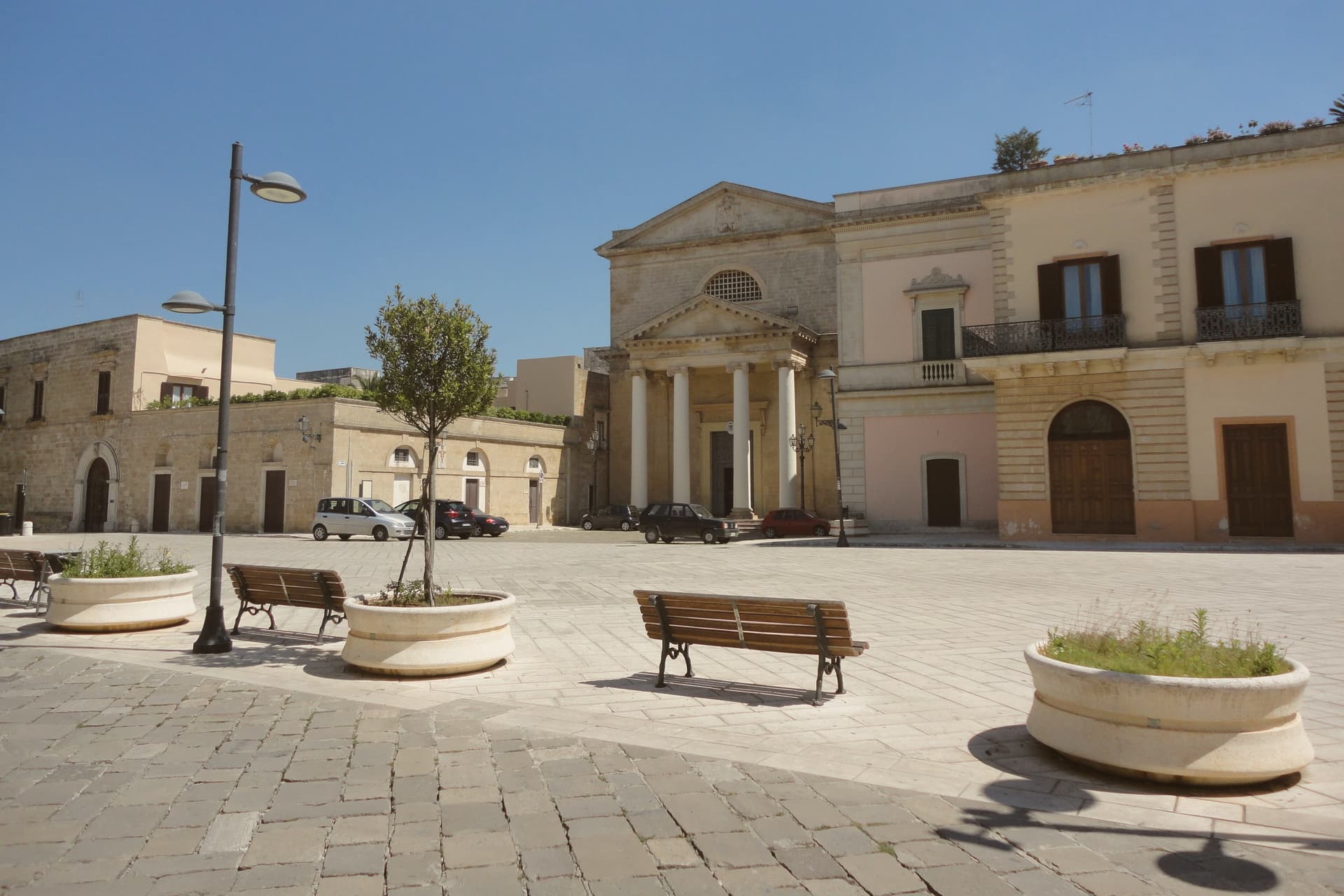
Puglia's coast is limestone and pine. Where the dunes have been drawn into regional parks the shore keeps its shape, low ridges of sand held together by marram and juniper, salt lagoons behind, Aleppo pines giving the only shade for miles. The towns above are built of the same pale tufo that gets quarried inland, and the food follows the geography: raw prawns and sea urchin on the Ionian side, orecchiette with turnip tops, focaccia in the late afternoon, burrata from the masserie on the Adriatic plain. June and September are the good months, when the water is warm and the parasol lines have thinned.
Most visitors to the region work a familiar route. Alberobello for the trulli in the morning, Polignano a Mare for the cliff cove in the afternoon, then back to a hotel in Bari or Monopoli. Polignano's Lama Monachile is one of the most photographed inlets in the country and behaves accordingly in August, a small pebble beach reached by stairs and shared with coach parties. It is a fine place. It is also the reason people leave Puglia thinking the coast is short and busy.
The protected shoreline runs a long way past all that. Dune systems, marsh, coastal towers and pinewood continue down the Ionian arc and along the Adriatic below the Murgia, and the towns that sit inside those parks have beaches with clean bathing water and a park authority limiting what can be built on them. Fewer people go, partly because the parks are not marketed as a single destination. These are the towns where the two things overlap.
The list below is drawn from our catalogue of Puglian comuni that hold the national clean-water award and lie within a regional nature park.
Of the 59 communes we have mapped in Puglia, 7 qualify as beach towns inside a nature park: each holds the national award for clean bathing water, and each sits inside a regional nature park. The smallest, Ugento, has 11,988 residents.
Two more lists worth reading alongside this one: The best hill towns inside a nature park in Puglia and The best beach towns worth staying overnight in Puglia.
Ugento
Why visit Ugento
Ugento sits five kilometers inland from the Ionian, its centro built directly over the Messapian city of Ozan, the name recorded on the fourth-century-BC Soleto Map. The walls of that older city and the chamber tombs of its necropolis mark the boundary between the modern town and the ground it grew from, remnants of the civilization that held the lower peninsula between the seventh and third centuries BC.
The castle at the center of town began as a Norman motte-and-bailey raised on those same Messapian foundations, later rebuilt as a Baroque palazzo by a family who frescoed its grand salons to record their own history. A bronze Zeus, cast around 530 BC and found by chance in a cellar in 1961, is now kept in Taranto, with only a copy remaining locally, so the town's oldest and most valuable object is known here mostly by its absence.
Inland, the layered town of walls, tombs, castle and cathedral holds the historical weight; on the coast, the frazioni carry the summer crowds. The two halves of Ugento, one built on the memory of Ozan and one facing the sea, run on entirely different clocks.
The beach here holds the national bathing award, which a comune has to win back every year on water quality, beach management and safety.
What to see in Ugento
- Castello di Ugento. Norman fort rebuilt as a Baroque palazzo by the d'Amore family in the 1690s, with first-floor grand salons frescoed in 1694 to celebrate family history.
- Nuovo Museo Archeologico. Town archaeological museum displaying Messapian finds, the Cozza Petrosa necropolis material and a bronze copy of the Zeus of Ugento.
- Mura Messapiche e Necropoli di Cozza Petrosa. Walls and the trullo-shaped chamber tombs of the necropolis sit at the edge of the centro, the oldest layer of the city built over by the modern town.
How to get to Ugento
There is a railway station in the town, so you can arrive without a car and never need one while you are here. Taranto is roughly 129 minutes away by road.
Our tip
May, June, September and the first half of October are the gentle months on the Ionian Salento: warm sea, cool evenings, the centro and the coast usable in the same day. July and August are dry and very hot, with the Marine packed and the centro storico empty between two and five in the afternoon. The Bandiera Blu beaches at Torre San Giovanni and Lido Marini do most of the August traffic and rates climb accordingly.
Castellaneta
Why visit Castellaneta
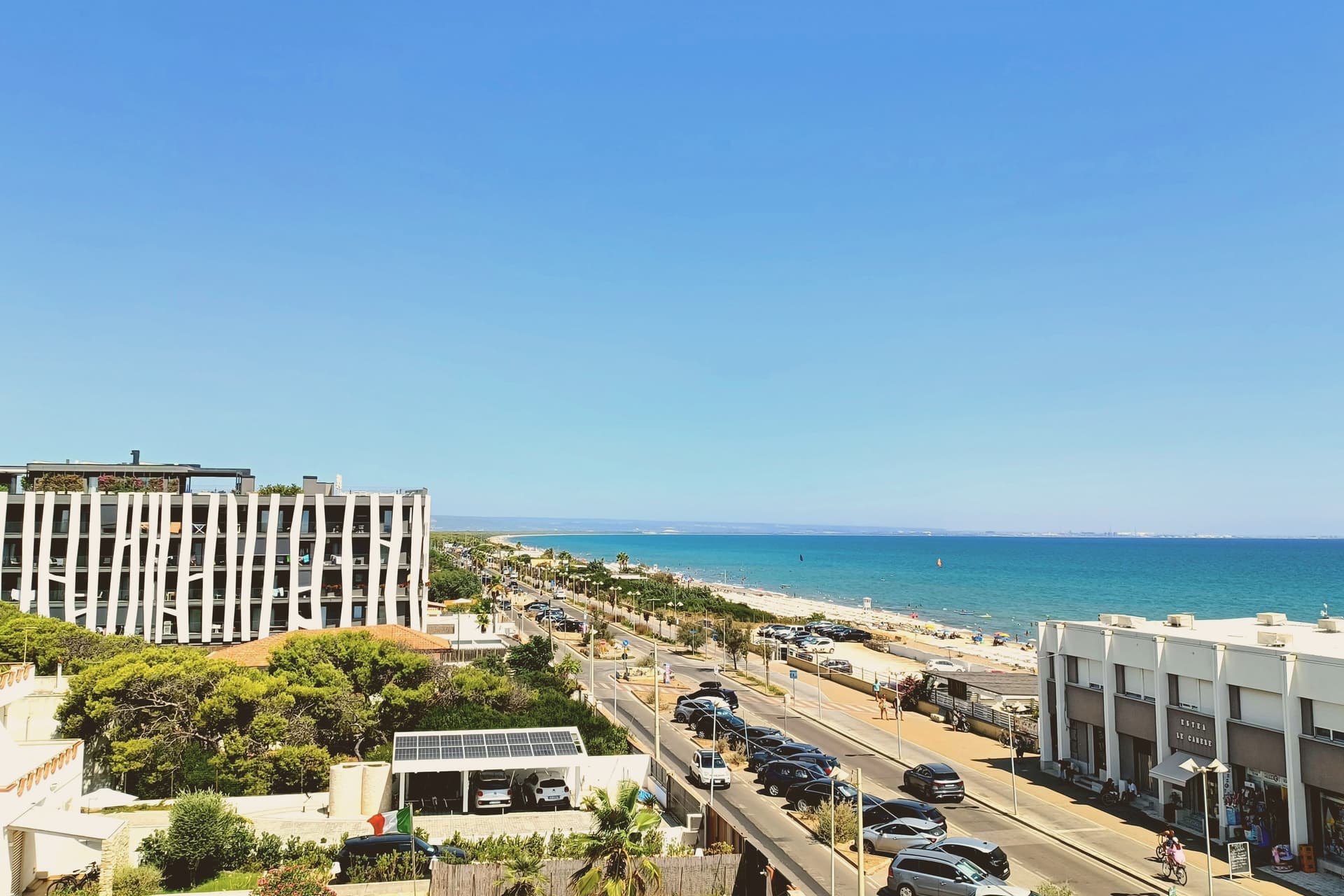
Castellaneta sits on the Murge plateau at 235 meters, on the southern rim of the Gravina Grande, a karst canyon 10 kilometers long and 145 meters deep that wraps the town in near-vertical limestone walls. The municipal territory runs from the gravina down to the Ionian coast at Castellaneta Marina, fifteen kilometers south, where the long sand beach has held Bandiera Blu for ten consecutive years.
The cathedral was founded under the Normans in the eleventh century, rebuilt in Romanesque form in the fourteenth, and given its white limestone facade in 1771. The town is best known abroad as the birthplace of Rodolfo Valentino, born here on 6 May 1895 and reborn in Hollywood as Rudolph Valentino.
A blue ceramic statue of the actor by Luigi Gheno was unveiled in the centro storico in 1961, captured in the documentary Mondo Cane, and the Museo Rodolfo Valentino opened on the 1995 centenary.
The beach here holds the national bathing award, which a comune has to win back every year on water quality, beach management and safety.
What to see in Castellaneta
- Gravina Grande. Karst canyon ten kilometers long and 145 meters deep wrapping the town on three sides, part of the Terra delle Gravine regional park.
- Cattedrale di Santa Maria Assunta. Norman cathedral of the eleventh century rebuilt as a Romanesque basilica in the fourteenth and refaced in white limestone in 1771.
- Museo Rodolfo Valentino. Civic museum opened on the actor's 1995 centenary, with the ceramic statue by Luigi Gheno unveiled in 1961 standing in the square outside.
How to get to Castellaneta
There is a railway station in the town, so you can arrive without a car and never need one while you are here. Taranto is roughly 49 minutes away by road.
Our tip
April through June and September through October are the months the Murge is dry, mild, and the gravina edges walkable. July and August push past thirty-five degrees on the plateau and the centro storico empties in the afternoon, though Castellaneta Marina fills with Italian families and the beach is at its peak. The Festa di Santa Maria della Stella in May and the Carnevale procession through the centro storico are the civic anchors of the calendar. Sagra della Farnedd dei sapori di Puglia falls in August.
Gallipoli
Why visit Gallipoli
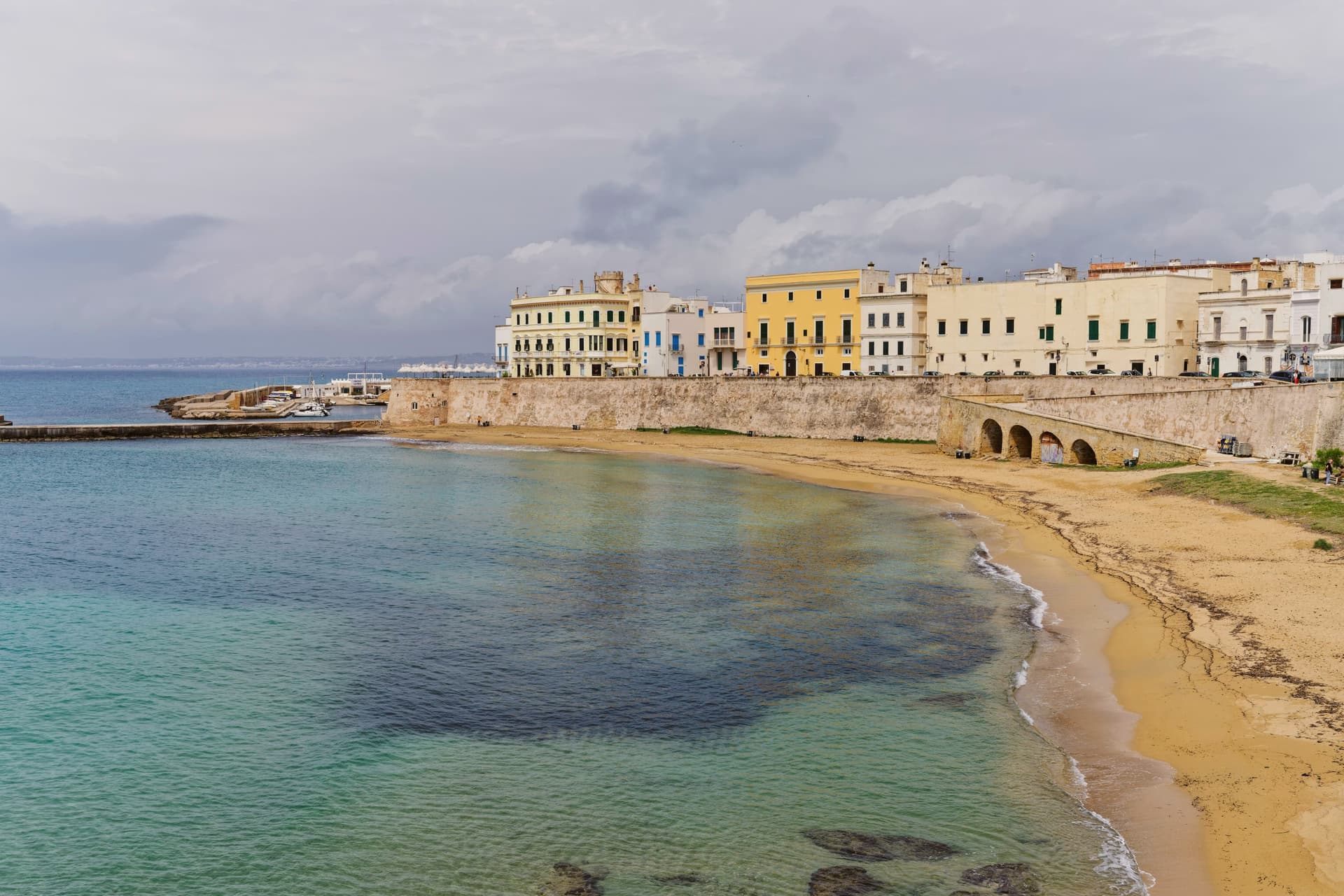
Gallipoli is built on a limestone island off the Ionian coast of Salento, linked to the modern mainland town by a seventeenth-century bridge. The Greek name Kallipolis means beautiful city; the site has been a bishopric since the sixth century.
The Castello Angioino guards the bridge end and was raised on Roman fortifications in the thirteenth century, expanded later under Aragonese and Spanish rule. Inside the walled città vecchia, whitewashed lanes wrap around the Basilica Cattedrale di Sant'Agata, built between 1629 and 1696 in carparo limestone under the Spanish bishop Consalvo de Rueda.
Below the streets, thirty-five frantoi ipogei, underground olive mills cut into the rock from the sixteenth century, once produced the lamp oil that lit the capitals of Europe. The Spiaggia della Purità sits directly under the sea walls.
Gallipoli got its first Bandiera Blu and a five-Vele Legambiente rating in 2024. In summer, the city flips from fishing port to the densest nightlife town in Salento.
The beach here holds the national bathing award, which a comune has to win back every year on water quality, beach management and safety.
What to see in Gallipoli
- Castello Angioino. Thirteenth-century castle on Roman foundations at the bridge crossing, expanded under the Aragonese and Spanish, now an exhibition space.
- Basilica Cattedrale di Sant'Agata. Baroque cathedral of 1629-1696 in carparo limestone, with Doric colonnade and polychrome marble altar, built under Bishop Consalvo de Rueda.
- Città vecchia. Walled old town on the limestone island, a tight grid of whitewashed lanes, palazzi, and small churches wrapped by sea walls on three sides.
How to get to Gallipoli
There is a railway station in the town, so you can arrive without a car and never need one while you are here. Taranto is roughly 111 minutes away by road.
Our tip
May through June is the window before the summer push, with warm sea and the old town still walkable. July and August are the loudest months in Salento: Gallipoli runs the densest nightlife on the Ionian, the Baia Verde fills with day-trippers from across Puglia, and the città vecchia is shoulder to shoulder after sundown. September is the better month if you want the same beaches without the crush.
Ostuni
Why visit Ostuni
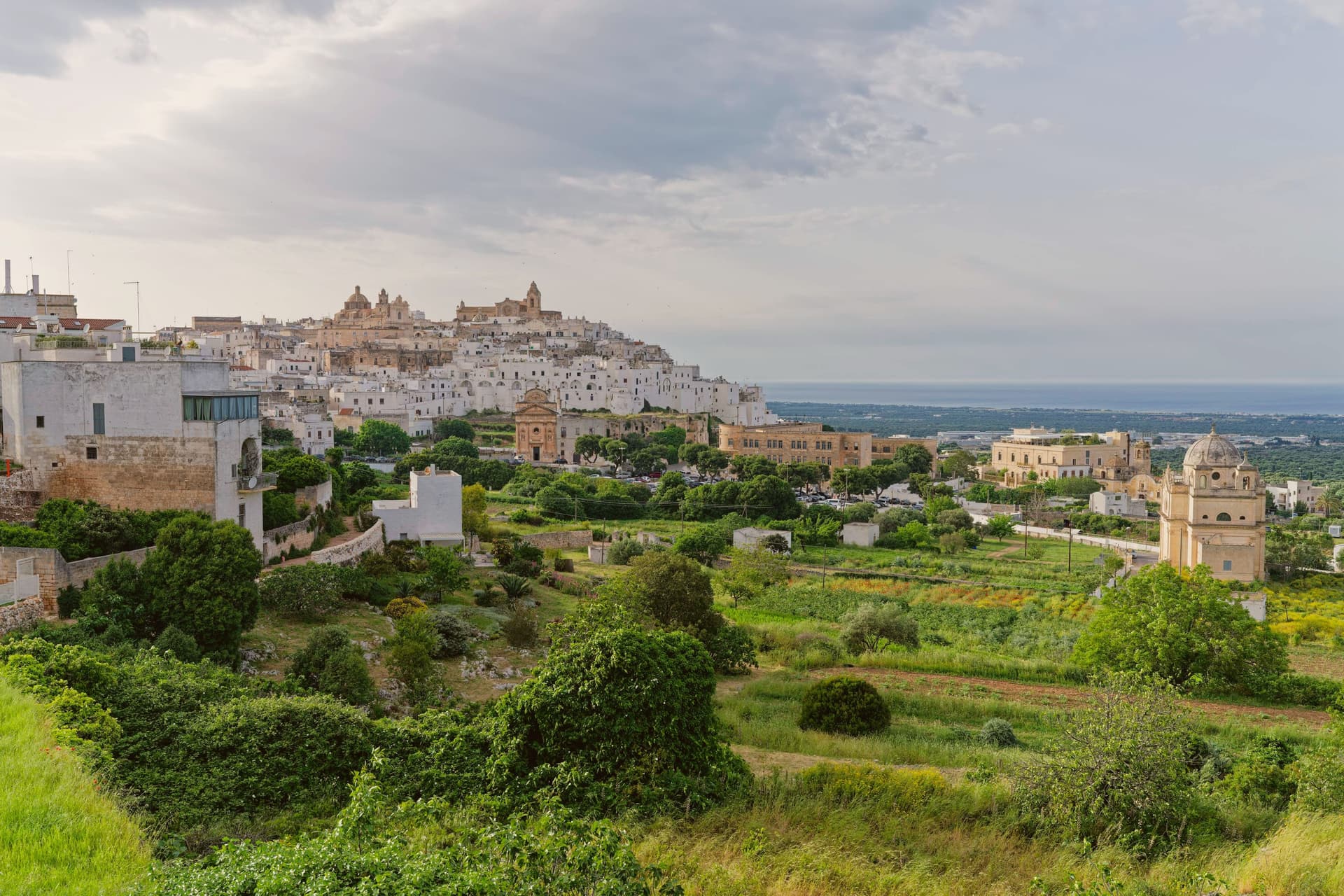
Ostuni sits at 218 meters on three hills above the Adriatic coastal plain, eight kilometers inland in the southeastern Murge. The whitewashing that gives it the name Città Bianca is medieval in origin, a hygienic measure against plague that survived as the local building convention; the entire centro storico is painted white in lime every spring and reads as a single bright mass from the surrounding olive country.
The territory has been inhabited since the Paleolithic; the Messapii founded the urban nucleus before the Romans absorbed the region. The town joined the Norman County of Lecce in 996.
In 1507 it passed to Isabella, Duchess of Bari, then to her daughter Bona Sforza, queen of Poland, who fortified the coast with watchtowers against Ottoman raids in 1539. The Cattedrale, a late-Gothic facade with a rose window of twenty-four rays, anchors the upper town.
The olive landscape around the commune holds some of the oldest cultivated trees in the Mediterranean.
The beach here holds the national bathing award, which a comune has to win back every year on water quality, beach management and safety.
What to see in Ostuni
- Cattedrale di Santa Maria Assunta. Late fifteenth-century Gothic cathedral at the highest point of the centro storico, with a rose window of twenty-four rays unique in Puglia.
- Centro storico. Whitewashed old town on three hills, lime-painted every spring against plague tradition, the single bright mass that names the Città Bianca.
- Piazza della Libertà. Lower civic square outside the medieval walls, with the Guglia di Sant'Oronzo, an early eighteenth-century baroque obelisk to the patron saint.
How to get to Ostuni
There is a railway station in the town, so you can arrive without a car and never need one while you are here. Taranto is roughly 64 minutes away by road.
Our tip
April through June and September through October are the months Ostuni works: olive plain in flower or harvest light, the white walls glowing in mild evenings, the Adriatic eight kilometers away warm enough for swimming by mid-May. July and August touch thirty-five degrees and the centro storico fills with day-trippers from Bari and Brindisi; weekends in August are shoulder to shoulder in the upper alleys. Late afternoon and after dusk are the times to walk, when the white walls cool and the crowds thin.
Nardò
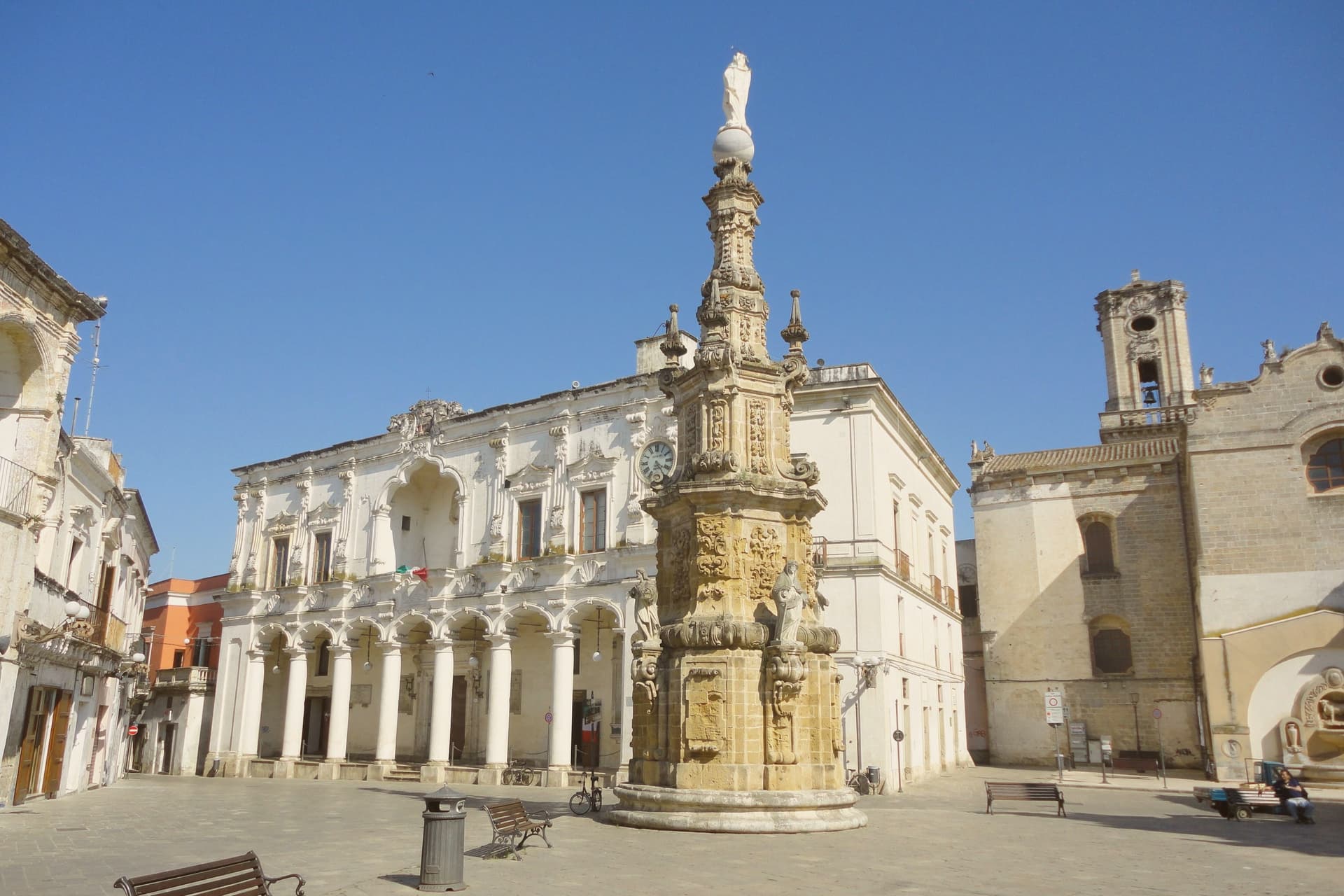
Why visit Nardò
The town sits at 45 meters in the northwestern Salento, about ten kilometers inland from the Ionian coast. With just under 31,000 inhabitants and 190 square kilometers of territory, it is the second-largest commune in the province after the capital.
It was a Byzantine stronghold for centuries; in 1497 the dukes of Acquaviva acquired it and turned it into a cultural seat, with universities, academies and literary circles that drew on the same humanist current as Lecce and Gallipoli. The centro storico, built up under that ducal patronage, forms a dense fabric of palaces and church facades in the local pietra leccese, with the castle standing at its edge, now serving as the municipal seat.
Ten kilometers of inland distance separate that historic core from the municipal coastline, where the Porto Selvaggio nature reserve occupies a stretch of Mediterranean pine forest above limestone cliffs, held by the commune as a regional park. Inland seat of government and culture, coastal reserve of forest and cliff: the two halves of the commune's territory answer to different centuries and different purposes, joined only by the ten kilometers between them.
The beach here holds the national bathing award, which a comune has to win back every year on water quality, beach management and safety.
What to see in Nardò
- Piazza Salandra. Central Baroque square of the centro storico, the Guglia dell'Immacolata at its center, ringed by palazzi and church facades in pietra leccese.
- Castello Acquaviva. Aragonese-Acquaviva castle on the edge of the centro storico, residence of the ducal house from 1497, now the municipal seat.
- Cattedrale di Maria Santissima Assunta. Romanesque-Baroque cathedral founded in the eleventh century and remodelled across the seventeenth, with later Baroque facade and bell tower.
How to get to Nardò
There is a railway station in the town, so you can arrive without a car and never need one while you are here. Taranto is roughly 80 minutes away by road.
Our tip
April through June and September through October are the months Nardò is at its best: Baroque facades in raking light, the Porto Selvaggio pine forest cool, the Ionian water warm enough to swim by mid-May. July and August touch thirty-six degrees and the centro storico empties between two and five in the afternoon; the coastal hamlets of Santa Caterina and Sant'Isidoro fill with Lecce families. The Festa di San Gregorio Armeno in mid-February is the local patronal day, the only large winter event.
Fasano
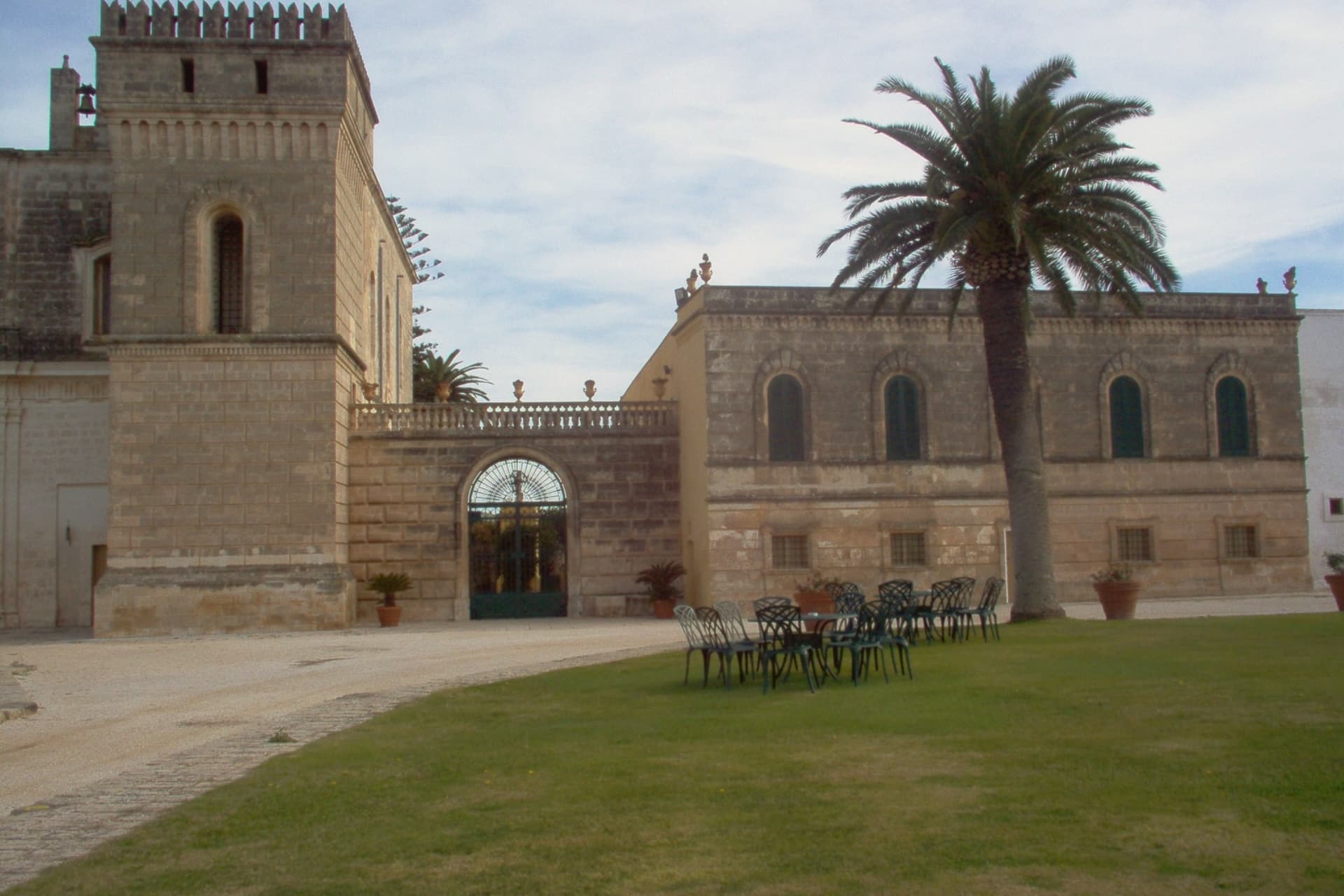
Why visit Fasano
The main centre sits at 118 meters, a hinge point in a wide municipal territory that runs from the Adriatic shore up to the Itria escarpment, home to thirty-eight thousand residents spread across three distinct landscapes rather than one compact town. The coast holds the abandoned city, inhabited from the fifteenth century BC and left empty by the Middle Ages, its excavated stone now sitting a short distance from the museum built to house what came out of the ground there.
Inland and uphill, the wooded escarpment climbs to become the highest ground in the province, the same slopes that carry the wildlife park across its carob and olive scrubland. Further along the shore, the fishing port turned resort gives the territory its beach frontage.
The pattern is coastal city, wooded highland, coastal resort, three pieces of a single municipality that never behaves like a single place. What the town offers is that range within one boundary: Roman ruins at sea level, a panorama at the province's highest point, and a working beachfront, none of them a detour from the others.
The beach here holds the national bathing award, which a comune has to win back every year on water quality, beach management and safety.
What to see in Fasano
- Parco Archeologico di Egnazia. Ruins spread across eighty hectares along the coast, with the Via Traiana running through the site alongside the basilica and a cryptoporticus still traceable underfoot.
- Museo Nazionale Archeologico Giuseppe Andreassi. Museum standing next to the archaeological park, holding the objects pulled from the excavations: Messapian inscriptions, Roman finds, and material spanning the long abandonment of the city.
- Selva di Fasano. Wooded escarpment reaching between 411 and 414 meters, the ground rising from carob and olive scrub to open views that give the terrace its nickname.
How to get to Fasano
There is a railway station in the town, so you can arrive without a car and never need one while you are here. Bari is roughly 52 minutes away by road.
Our tip
May through September is the working season on this stretch of the Adriatic: warm sea, the Bandiera Blu beaches at Savelletri operating, the Selva ten degrees cooler than the coast for an evening break. July and August fill the coast with Italian holidaymakers; Egnazia exposed on the seafront is brutal between noon and three. April and October are quieter alternatives with the sea still mild, the archaeological park at its photographic best, and the olive harvest opening across the surrounding masserie. Festa Della Mietitura E Trebbiatura Del Grano falls in August.
Lecce
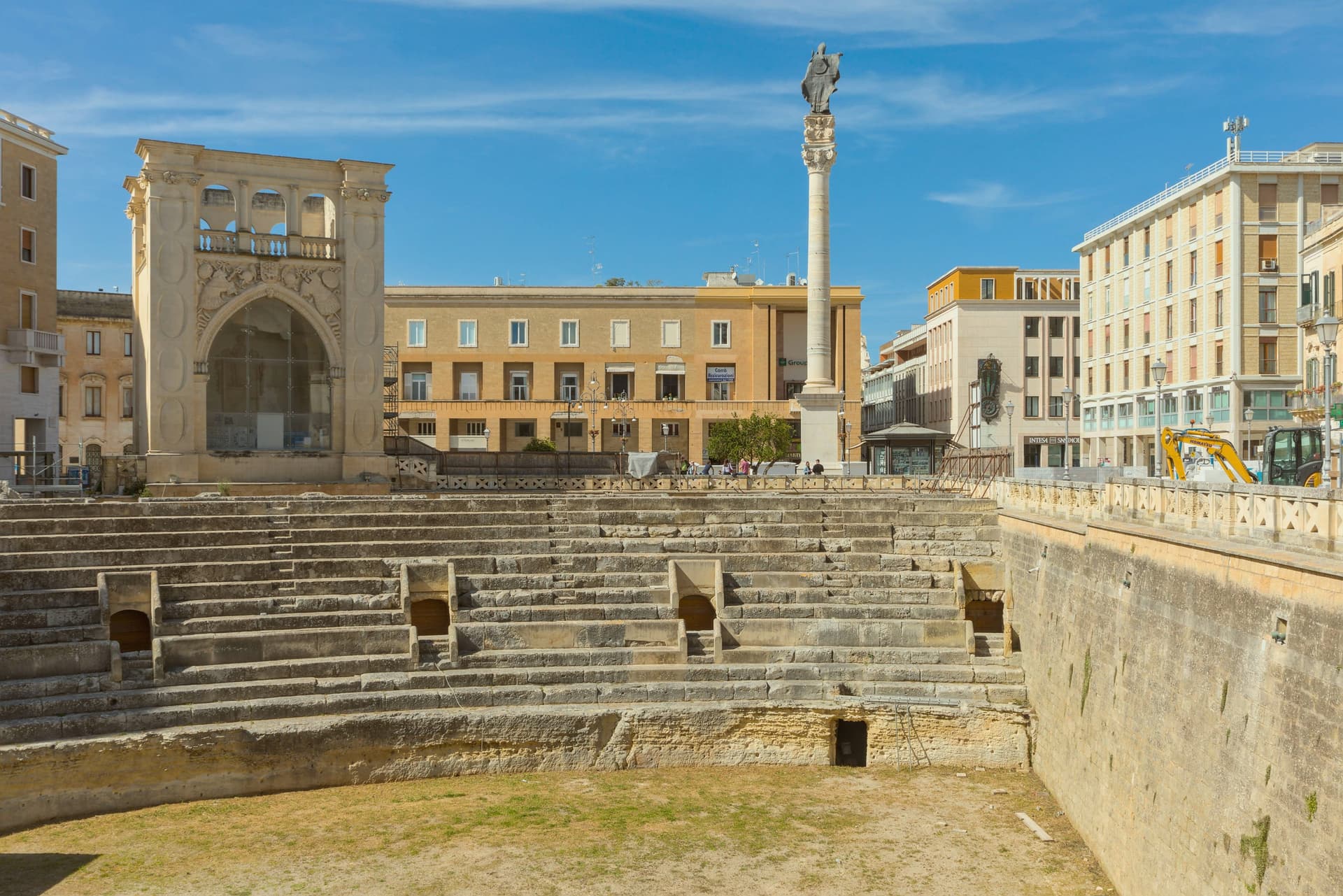
Why visit Lecce
Lecce sits on the Salento plain at 49 meters above sea level, twelve kilometers inland from the Adriatic, the provincial capital. The Messapian settlement of Lupiae stood on this site by the eighth century BC.
Rome took it in the third century BC, and Hadrian later moved the settlement three kilometers away and renamed it Licea, so the modern city occupies a site distinct from either of its named predecessors. The walled centro storico is ringed by Charles V's fortifications, entered from the north through the Porta Napoli arch and anchored on its eastern edge by his castle, built over older Norman foundations.
Within those walls the Baroque churches and squares sit close together, the cathedral square closed in on three sides while the amphitheater lies open and half-sunk in the middle of the newer square that formed around it. The University runs a strong humanities program, and the seafront at San Cataldo, some distance from the old center, carries Lecce's Bandiera Blu.
What holds the town together is the stone itself: soft enough to carve finely, hard enough once cut to last, so that a Messapian and Roman settlement site became, centuries later, the surface on which the south's most elaborate Baroque was cut.
The beach here holds the national bathing award, which a comune has to win back every year on water quality, beach management and safety.
What to see in Lecce
- Basilica di Santa Croce. Worked for nearly two hundred years to completion in 1695, the façade carved with cherubs, monsters and allegories layered so densely that the wall surface almost disappears beneath them.
- Piazza del Duomo. Closed on three sides, the only enclosed cathedral square of its kind in Puglia, gathering the Duomo, Campanile, Bishop's Palace and Seminary into one shared courtyard rather than an open street front.
- Piazza Sant'Oronzo. The city's central square, built around a column brought from the Appian Way to honor the patron saint, with the excavated amphitheater floor sitting below street level at its edge.
How to get to Lecce
There is a railway station in the town, so you can arrive without a car and never need one while you are here. Taranto is roughly 95 minutes away by road.
Our tip
April through June is the green window in inland Salento, with the centro storico walkable in the day and aperitivo on Piazza Sant'Oronzo running late. July and August push past thirty-five degrees and the city empties at midday; the Notte della Taranta in nearby Melpignano, the closing concert of the Salento pizzica festival, falls in late August and draws over a hundred thousand. September and October cool back down for the olive harvest. Festa di Sant'Oronzo falls in August.
More from Anywhere Italy
 The best hill towns inside a nature park in Puglia
 The best beach towns worth staying overnight in Puglia
 The best towns with a serious restaurant that sit inside a nature park in Puglia
 The best hill towns worth staying overnight in Puglia
- The best towns worth staying overnight that eat well in Puglia
 The best towns with a food festival in Puglia