
The best towns that eat well in the province of Lecce
The province of Lecce cooks from a short list and does it well: chickpeas with fried pasta, sagne 'ncannulate under a long-simmered sauce, puccia bread split and filled, pezzetti di cavallo in tomato and bay, and a pasticciotto eaten standing at the bar before the day gets hot. The land is flat, red-soiled and stitched with dry stone walls and olive groves, some of the trees ancient and now scarred by disease, and the houses are cut from pietra leccese, a soft cream limestone that carves like butter and glows towards evening. Wine is Negroamaro and Primitivo, poured young and cold in summer. Late spring and early autumn are the sane months, when the sea is still warm and the tables are not queued.
Most people arriving in the Salento drive straight for Gallipoli, where the old town sits on its island and the summer beach clubs of the Ionian coast fill the road south with traffic from June onwards. It earns some of the attention, and the fish market and the sunsets are real. But August turns the seafront restaurants into a conveyor belt, prices climb, and a table booked at eight becomes a table given away at ten past.
The same limestone, the same olive groves and the same cooking carry on inland and further down both coasts, into the Griko-speaking villages, the small towns behind the dunes and the ports that empty out after the season. These are the places in this list, where a guide-recognised kitchen sits on a quiet piazza rather than a promenade, and where fewer people go for lunch.
Of the 16 communes we have mapped in the province of Lecce, 8 qualify as towns that eat well: a national or international dining guide has named a table in each. The smallest, Giurdignano, has 1,947 residents.
If you are still choosing, we have also written The 9 best hidden towns you can reach by train that eat well in Puglia and The best hill towns in the province of Lecce.
Giurdignano
Why visit Giurdignano
Giurdignano sits inland from Otranto on the limestone shelf of southern Salento, at 78 meters, four kilometers from the Adriatic. The village has fewer than two thousand residents and the highest concentration of megalithic monuments in Italy.
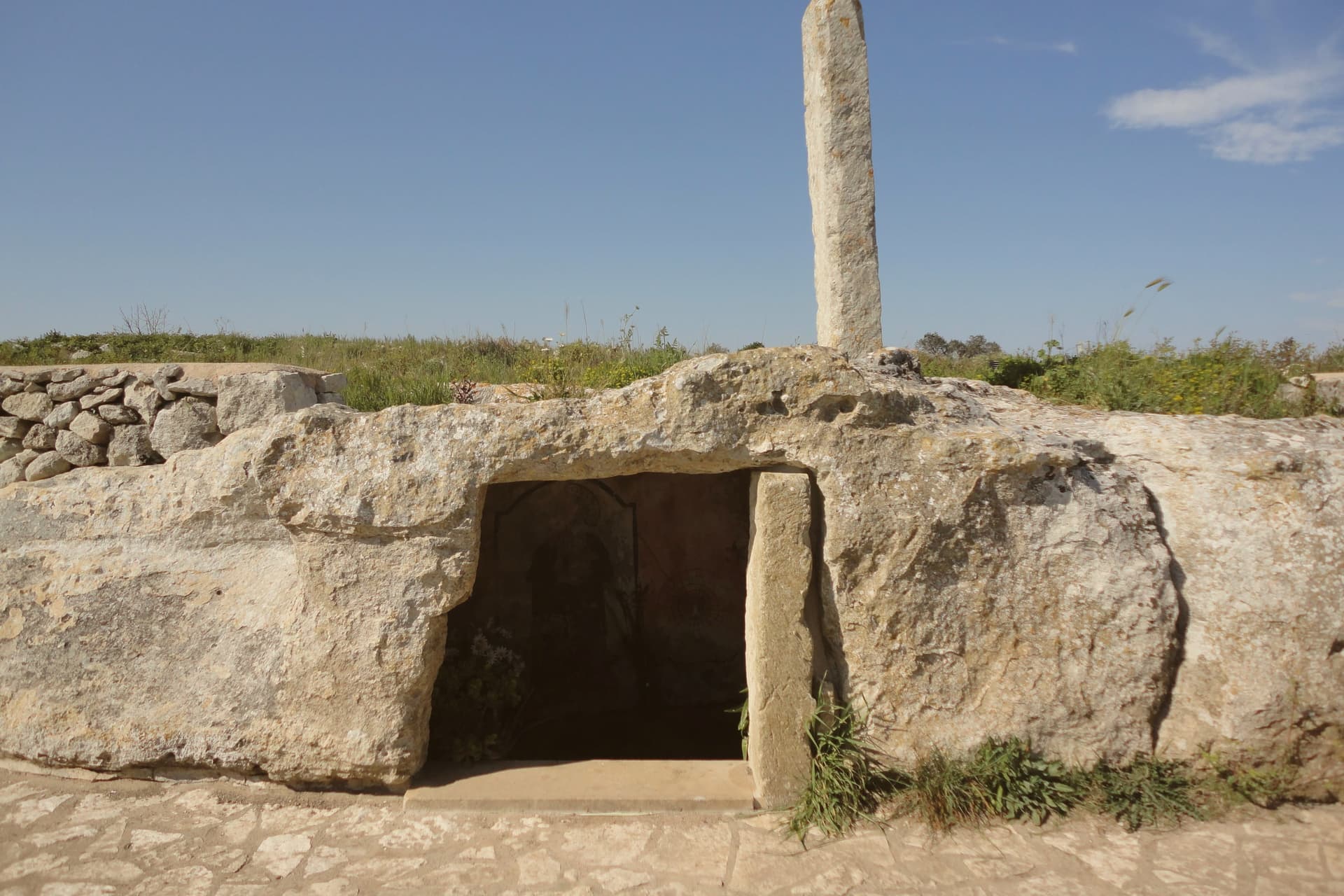
Nineteen menhirs stand in the countryside around it, the tallest the Menhir San Vincenzo at over three and a half meters; several were Christianized in the early medieval period, including the Menhir San Paolo, set beside a Byzantine rupestrian crypt and pierced at the top for an iron cross. The dolmens nearby are likely from the fifth or fourth millennium BC.
Roman imperial necropoleis from the second and third centuries AD have surfaced in the Cantalupi locality. The borgo joined the Città del Tartufo network for the Salento white truffle found in the surrounding macchia and olive groves.
Giurdignano runs as a quiet base for the Otranto coast, four kilometers away.
Casa Borgia have been named by a guide.
What to see in Giurdignano
- Menhir San Paolo. Christianized prehistoric standing stone beside a Byzantine rupestrian crypt, pierced at the top in the early medieval period to hold an iron cross.
- Menhir San Vincenzo. The tallest menhir in the Lecce province at over 3.5 meters, one of the nineteen prehistoric standing stones in the territory of Giurdignano.
- Dolmen Stabile. Megalithic funerary chamber on the road to Uggiano, three slabs and a capstone, dated to the fifth or fourth millennium BC.
How to get to Giurdignano
There is a railway station in the town, so you can arrive without a car and never need one while you are here. Taranto is roughly 128 minutes away by road.
Our tip
April through June is mild on this stretch of southern Salento, the countryside in flower and the menhir paths walkable without sweat. July and August push past thirty-five degrees and most travelers move on to the Otranto seafront four kilometers east; the borgo itself stays quiet. September and October cool back down for the olive harvest and the white-truffle season starts in the surrounding macchia.
Otranto
Why visit Otranto
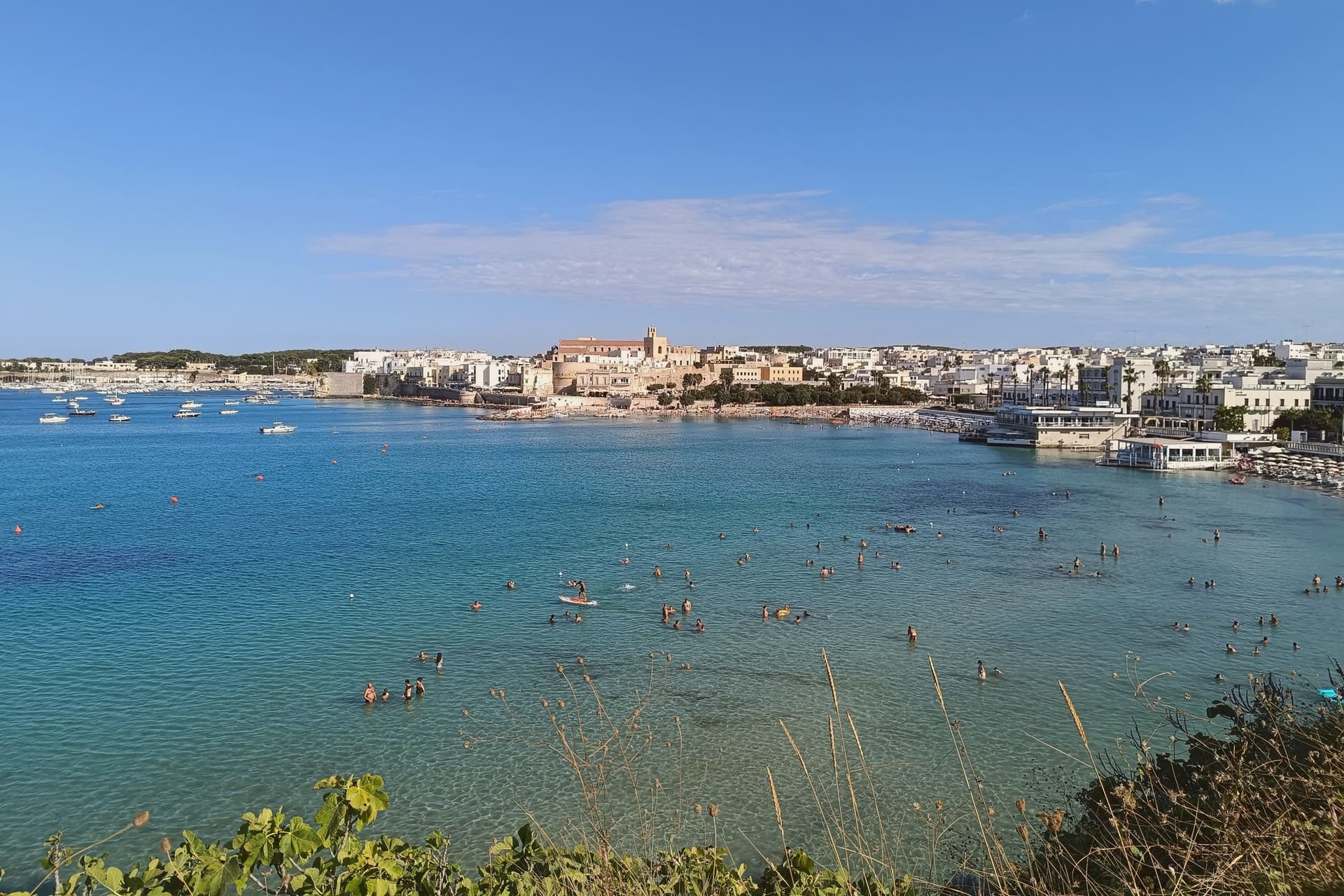
Otranto sits at sea level on a small promontory thirty kilometers southeast of Lecce, the easternmost city of Italy and the closest mainland point to Albania across the eighty-kilometer Strait of Otranto. The Cattedrale di Santa Maria Annunziata, consecrated in 1088, holds a mosaic floor laid between 1163 and 1165 by the monk Pantaleone for Archbishop Gionata.
About 800,000 tesserae across the three naves depict Adam and Eve, Noah, the Tower of Babel and a Tree of Life with biblical, classical and chivalric figures: Alexander the Great, Arthur, the months of the year. On 14 August 1480 an Ottoman force under Gedik Ahmed Pasha took the city; 813 inhabitants who refused to convert were beheaded on the Colle della Minerva and their bones are now in the cathedral, in seven glass-fronted recesses.
Pope Francis canonized them in 2013. The Castello Aragonese, raised by Ferdinand I of Aragon between 1485 and 1498, is the response: a five-sided fortress with a moat, built specifically to prevent a second sack.
Retrogusto, L' Altro Baffo, Umberto 1972 have been named by a guide.
What to see in Otranto
- Cattedrale di Santa Maria Annunziata. Norman cathedral consecrated in 1088, with Pantaleone's mosaic floor of 1163-1165 and the relics of the 813 martyrs of 1480 in seven glass recesses.
- Castello Aragonese. Five-sided Aragonese fortress raised 1485-1498 by Ferdinand I after the Ottoman sack, irregular plan with moat running the full perimeter.
- Chiesa di San Pietro. Byzantine cross-plan church in the centro storico, ninth-tenth century, with three apses and frescoes from the tenth through fifteenth centuries.
How to get to Otranto
There is a railway station in the town, so you can arrive without a car and never need one while you are here. Taranto is roughly 137 minutes away by road.
Our tip
May through September is the working coastal season, Adriatic water warm enough to swim by mid-May and the centro storico operational into the evening. July and August fill the small headland with day-trippers from across Salento and beyond; weekends in August are shoulder to shoulder along the Lungomare and the cathedral fills with queues. June and September are the sane choices, mild evenings and the same water without the crush.
Corigliano d'Otranto
Why visit Corigliano d'Otranto
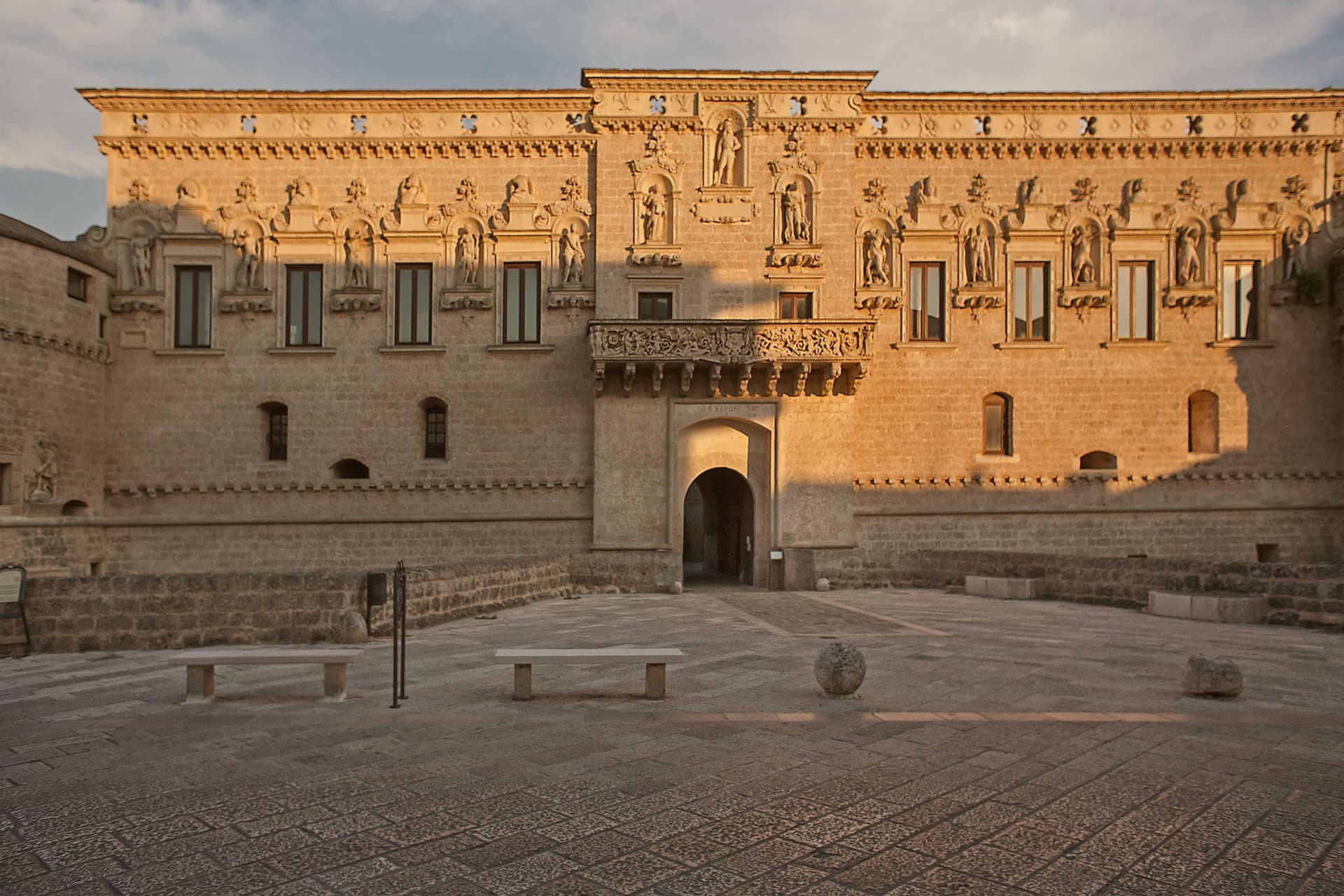
Corigliano d'Otranto sits at 95 meters on the Salento plateau, twenty-five kilometers south of Lecce. The territory carries one of the densest concentrations of megalithic remains in the area, and the town itself grew around a medieval fort that passed to the de' Monti family, a house of French origin, in 1465.
The old town organizes itself around that fort: the centro storico's lanes and baroque palazzi in pale Lecce stone lead to the fort on one side and the parish church on the other, the two structures facing each other as the twin poles of the historic core. Griko street signs sit alongside the Italian ones throughout, a language surviving in the same streets where Bronze Age dolmens and the sixteenth-century rebuilding mark two very different periods of settlement.
The town reads as a place where deep prehistory, a fortified medieval past, and a living minority language occupy the same small footprint rather than separate chapters of its history.
Sinòdia have been named by a guide.
What to see in Corigliano d'Otranto
- Castello de' Monti. The fort stands on medieval foundations acquired by the de' Monti family, who gave it a defensive perimeter and deep moat before the Lecce-stone rebuilding. It anchors the centro storico and faces the parish church across the old town.
- Chiesa di San Nicola Vescovo. Built on the site of an earlier chapel, the church stands opposite the castle as the religious anchor of the centro storico.
- Dolmen Caroppo I e II. The two tombs sit two meters apart on the same rock bank just outside town, found by Oreste Caroppo, part of one of the densest concentrations of megalithic remains in Salento.
How to get to Corigliano d'Otranto
There is a railway station in the town, so you can arrive without a car and never need one while you are here. Taranto is roughly 116 minutes away by road.
Our tip
April through June and September through October are the months the Salento plateau is dry, mild, and the centro storico walkable in afternoon light. July and August reach the high thirties and the Lecce-stone walls hold heat well into the evening; the streets empty between two and six. The Festa di San Nicola in early December and the Notte della Taranta tour stop in August are the year's civic peaks.
Vernole
Why visit Vernole
Vernole sits ten kilometers southeast of Lecce, on the line between the city and the Adriatic, with a small stretch of coast of its own and a string of frazioni that includes Strudà, Pisignano, Vanze and Acaya. The village at Acaya was originally called Segine and was granted as a fief in 1294 by Charles II of Anjou to Gervasio dell'Acaya, well before its Renaissance rebuilding.
That earlier history is easy to miss standing in the citadel today, where the grid of streets and the walled perimeter read as a single sixteenth-century act rather than a place with a medieval name underneath it. The commune itself is split between this inland fortified core and the coast, where the Cesine reserve holds the dune system ten kilometers east of the citadel.
Vernole's own centro, with its rebuilt mother church, sits apart from both, the administrative middle point between a Renaissance curiosity and a wetland on the Adriatic. The three parts, town, citadel and coast, rarely overlap in a visitor's day: whichever draws people to the commune, the other two are reached separately, not passed through.
Lilith have been named by a guide.
What to see in Vernole
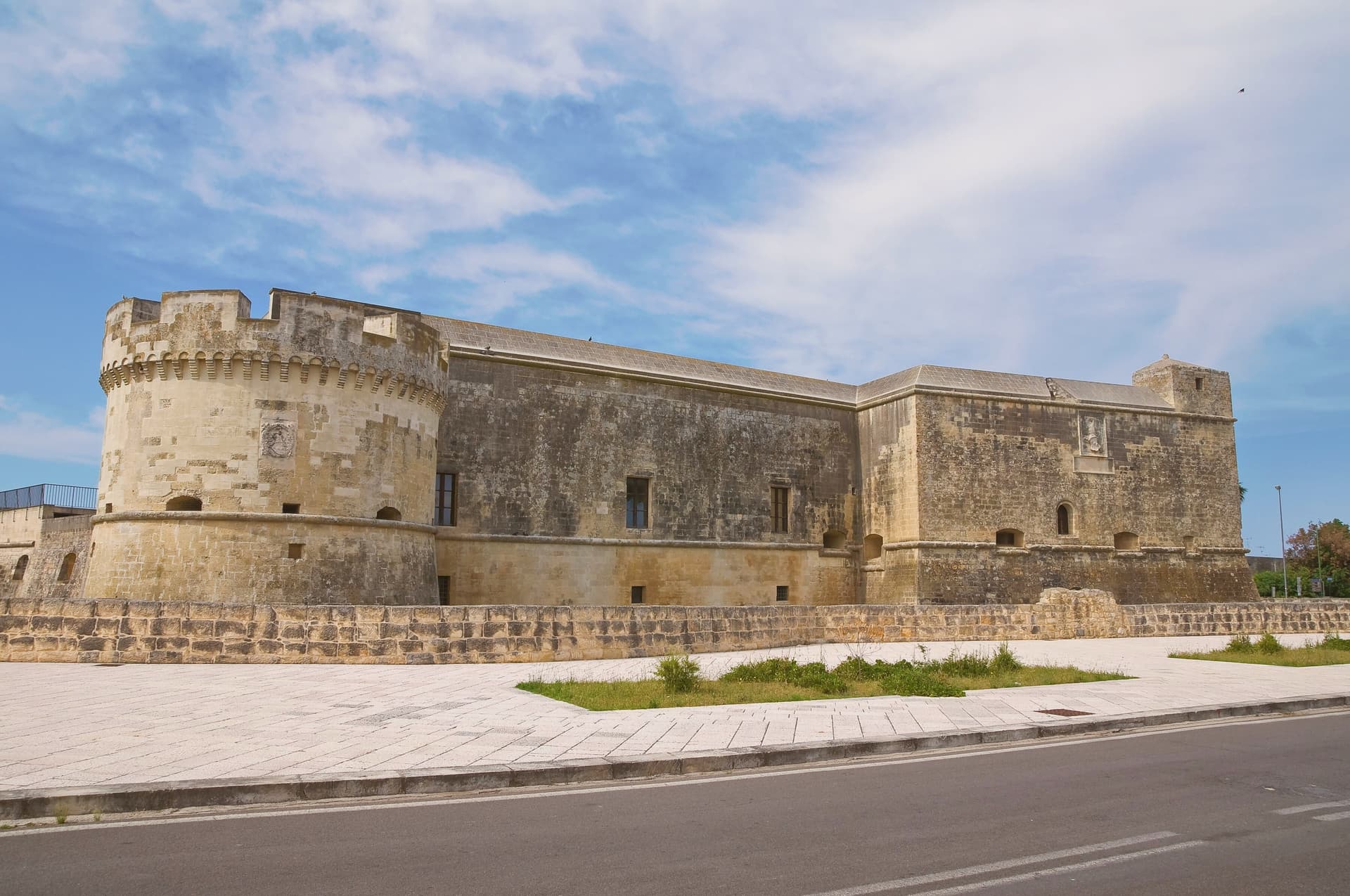
- Castello di Acaya. Renaissance fortress of 1535-1536 by Gian Giacomo dell'Acaya, trapezoidal with a wet moat, one of the best examples of sixteenth-century defensive architecture in Terra d'Otranto.
- Borgo fortificato di Acaya. Walls, gates and a grid of stone streets laid out between 1521 and 1536, still readable underfoot as the plan the engineer drew.
- Riserva Naturale Le Cesine. Dune systems and pine groves along the longest stretch of protected lower-Salento coast, on the Adriatic edge of the commune.
How to get to Vernole
Taranto is roughly 107 minutes away by road.
Our tip
May, June, September and early October are the easiest months: the Acaya walls workable from morning into the evening, Le Cesine in spring migration or autumn passage, and the Adriatic still swimmable. July and August are dry and very hot on the coastal plain, with the citadel best visited at opening or in the last hour of daylight. The classical music programs in the courtyard of the Castello di Acaya run on summer evenings.
Melendugno
Why visit Melendugno
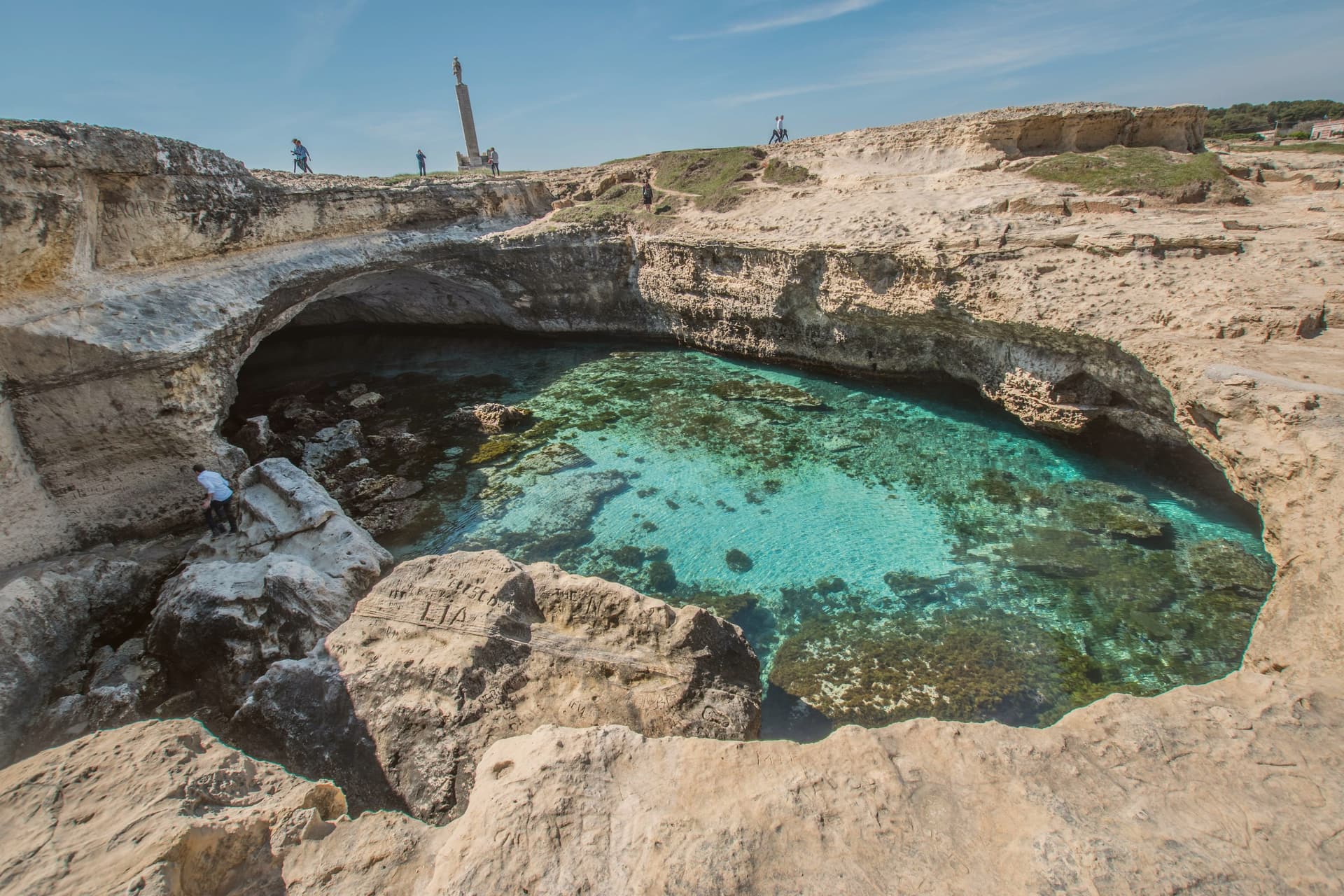
The comune administers 17 km of Adriatic coast east of Lecce, 19 km from the city, with 10,045 residents spread between that shoreline and an inland centre sitting at 36m altitude. The town of Melendugno itself is the administrative seat: the Chiesa di Santa Maria della Vergine (16th century), the Palazzo Marchesale, and a medieval centro that sees none of the coastal traffic.
The coast and the inland town function almost as two separate places under one name, the beaches and the karst pool drawing visitors who may never see the Palazzo Marchesale. Along that coast, three beaches carry Bandiera Blu status, each with its own character: one framed by faraglioni, one a working marina with a still-active fishing port and a castle, one the smallest but with the most dramatic limestone arches.
The karst pool at Roca sits beside the archaeological complex of the same stretch: a Messapian settlement built over a Bronze Age fortified predecessor, votive inscriptions cut into the cave walls in proto-Messapian, Greek, and Latin. Two finds from very different eras occupy the same short piece of coastline, one a place to swim, the other a record of who lived there first.
Inland, the comune carries a rare stack of designations beyond the coastal one: Borgo Autentico, Città dell'Olio, tied to the surrounding Salento DOP olive groves and their millennia-old trees toward Acaya, and a honey designation resting on a local beekeeping cooperative that produces thistle, eucalyptus, and millefiori varieties, marked each early autumn by its own sagra. The food follows Salento conventions: pasta con cime di rapa, pittule, bombette of pork, and pasticciotto leccese, whose original source is credited to a 1745 pastry shop in Galatone, 30 km south.
In late August the pizzica festival La Notte della Taranta, the Salento's biggest cultural event, takes place in Melpignano, 25 km south. Between the coast, the archaeology, the olive groves, and the honey cooperative, Melendugno holds more density of designation and documented history per kilometre than its size would suggest.
Il Vecchio Molo have been named by a guide.
What to see in Melendugno
- Grotta della Poesia (Roca). A karst-collapsed pool 8m below the rock surface, reached through a single jagged opening above. The water is crystal-clear and connects by underwater tunnels to two adjacent smaller pools.
- Three Bandiera Blu beaches. Torre dell'Orso has 300m of fine sand framed by the Le Due Sorelle faraglioni. San Foca is a working marina with a still-operational fishing port and the Castello Sangiovanni. Sant'Andrea is the smallest of the three, with the most dramatic limestone arches.
- Roca Vecchia archaeological site. A Messapian settlement (5th-3rd c BC) built over an earlier Bronze Age fortified village (16th c BC) on a coastal promontory. Thousands of votive inscriptions in proto-Messapian, Greek, and Latin are scratched into the cave walls.
How to get to Melendugno
Taranto is roughly 117 minutes away by road.
Our tip
Melendugno is best May–June and September–October — the Salento beach summer peaks August (Italian holiday season, ferragosto crush) and the coast is at its hottest 35°C+ in July-August. La Notte della Taranta in nearby Melpignano (late August) is the regional cultural headline. October is harvest in the Salento DOP olive groves. Sagra Ortofrutticola Borgagne falls in July.
Ugento
Why visit Ugento
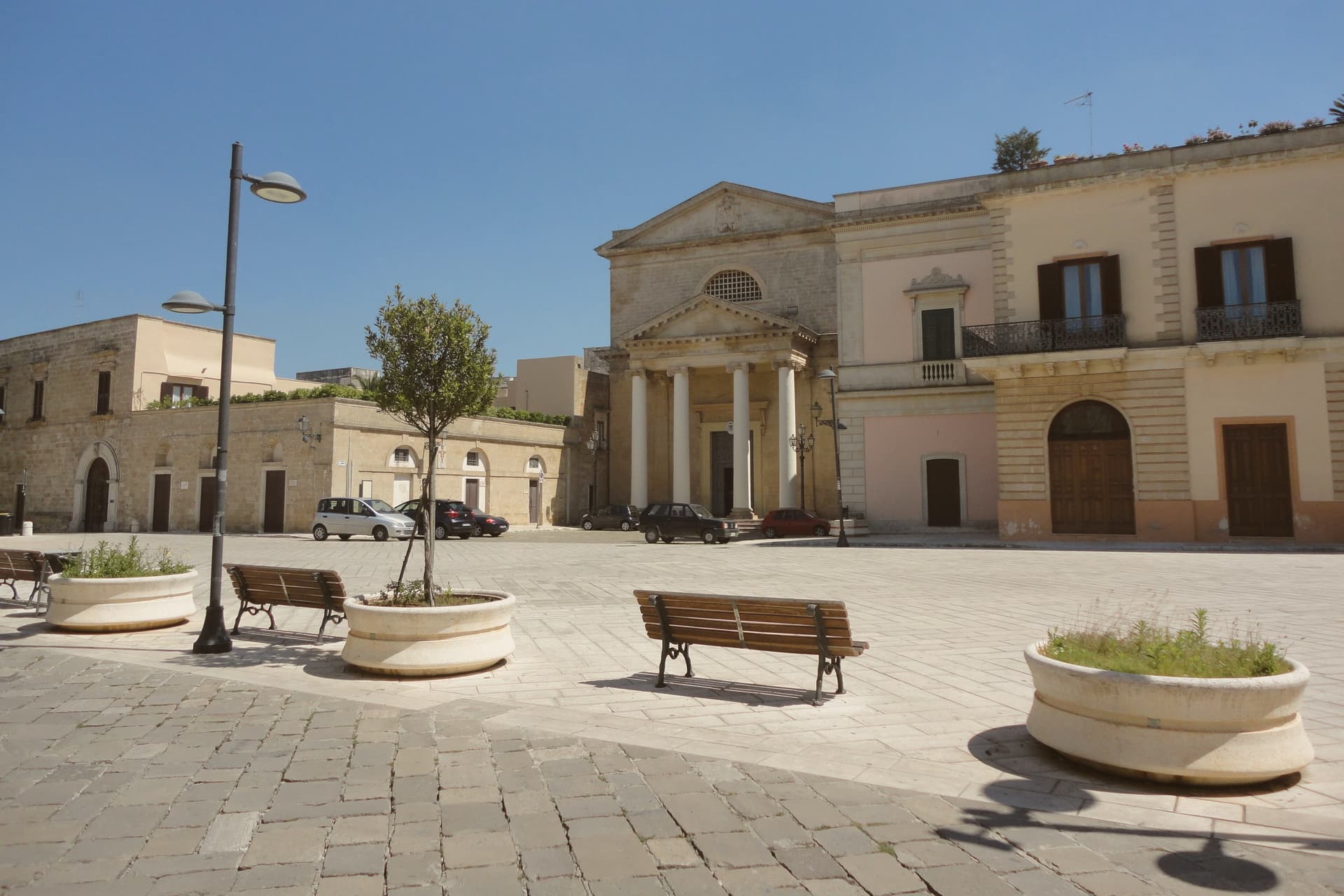
Ugento sits five kilometers inland from the Ionian, its centro built directly over the Messapian city of Ozan, the name recorded on the fourth-century-BC Soleto Map. The walls of that older city and the chamber tombs of its necropolis mark the boundary between the modern town and the ground it grew from, remnants of the civilization that held the lower peninsula between the seventh and third centuries BC.
The castle at the center of town began as a Norman motte-and-bailey raised on those same Messapian foundations, later rebuilt as a Baroque palazzo by a family who frescoed its grand salons to record their own history. A bronze Zeus, cast around 530 BC and found by chance in a cellar in 1961, is now kept in Taranto, with only a copy remaining locally, so the town's oldest and most valuable object is known here mostly by its absence.
Inland, the layered town of walls, tombs, castle and cathedral holds the historical weight; on the coast, the frazioni carry the summer crowds. The two halves of Ugento, one built on the memory of Ozan and one facing the sea, run on entirely different clocks.
La Bottega dei Sapori, Farnari Unconventional Locanda have been named by a guide.
What to see in Ugento
- Castello di Ugento. Norman fort rebuilt as a Baroque palazzo by the d'Amore family in the 1690s, with first-floor grand salons frescoed in 1694 to celebrate family history.
- Nuovo Museo Archeologico. Town archaeological museum displaying Messapian finds, the Cozza Petrosa necropolis material and a bronze copy of the Zeus of Ugento.
- Mura Messapiche e Necropoli di Cozza Petrosa. Walls and the trullo-shaped chamber tombs of the necropolis sit at the edge of the centro, the oldest layer of the city built over by the modern town.
How to get to Ugento
There is a railway station in the town, so you can arrive without a car and never need one while you are here. Taranto is roughly 129 minutes away by road.
Our tip
May, June, September and the first half of October are the gentle months on the Ionian Salento: warm sea, cool evenings, the centro and the coast usable in the same day. July and August are dry and very hot, with the Marine packed and the centro storico empty between two and five in the afternoon. The Bandiera Blu beaches at Torre San Giovanni and Lido Marini do most of the August traffic and rates climb accordingly.
Galatina
Why visit Galatina
Galatina sits twenty kilometers south of Lecce on the gentle rise of central Salento, at 78 meters, the third largest center in the province after the capital and Nardò. The Basilica di Santa Caterina d'Alessandria, built between 1383 and 1391 by Raimondello Orsini del Balzo, holds one of the densest fresco cycles in southern Italy, painted by Sienese followers of Giotto after Raimondello's death in 1406.
Tradition has it that Raimondello brought back a finger of Saint Catherine from Mount Sinai, biting it off the relic himself. The town carries a stranger inheritance as well.
The Cappella di San Paolo, beside a well whose water was said to cure tarantula bites, was the closing ritual of tarantism: tarantate were brought here every June 29 to dance out the poison to the rhythm of pizzica. The practice survived into the 1960s and gave the dance its name.
The patronal festa for Santi Pietro e Paolo still fills the streets with tambourines until dawn.
Ai Calici, Stella del Mare have been named by a guide.
What to see in Galatina
- Basilica di Santa Caterina d'Alessandria. Late-fourteenth-century church built by Raimondello Orsini del Balzo, covered inside with frescoes by Sienese and Giottesque painters, second only to Assisi for fresco volume in Italy.
- Cappella di San Paolo. Small chapel beside the well whose water was held to cure tarantula bites, the closing site of the annual tarantism ritual on June 29.
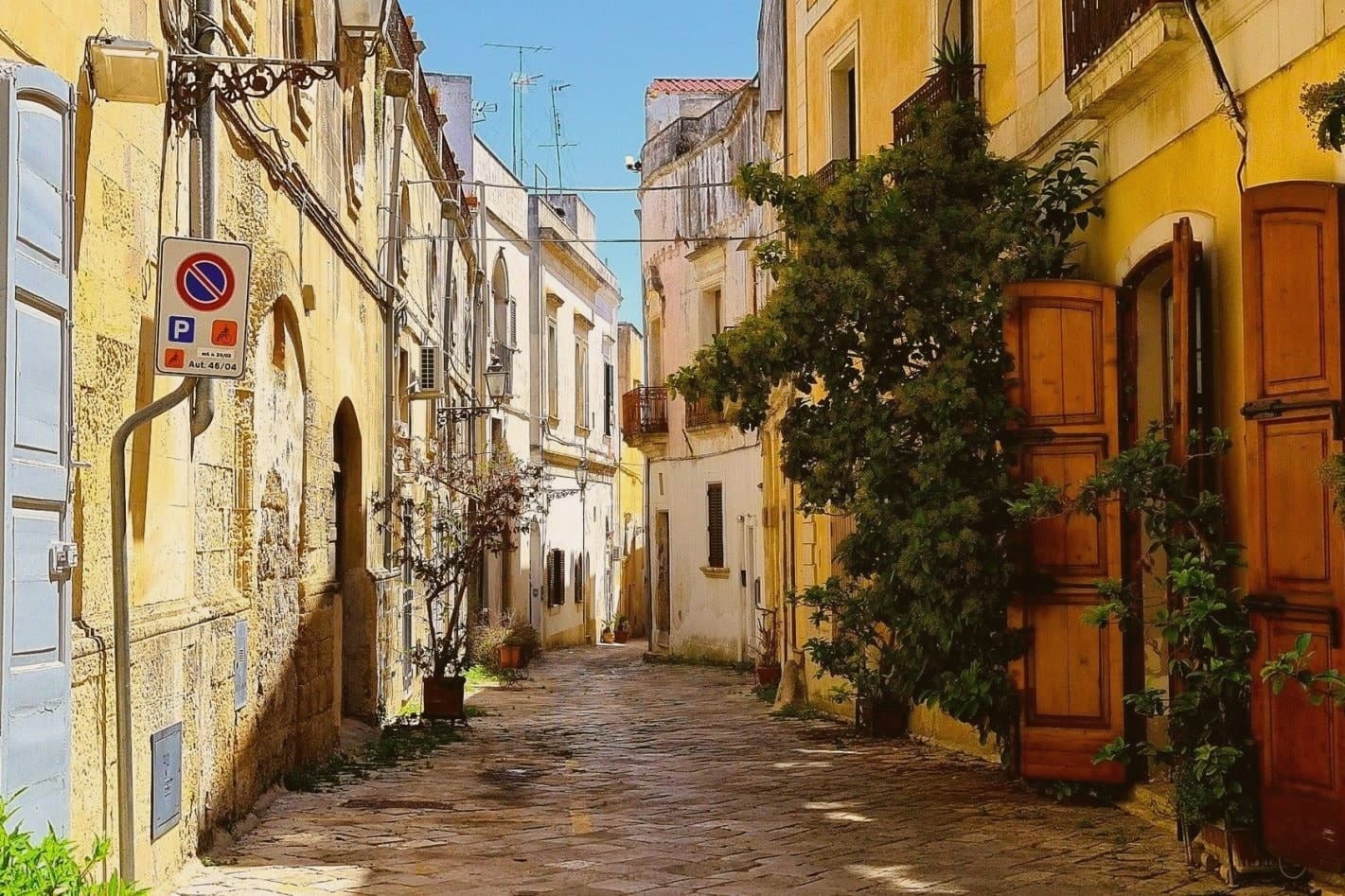
- Centro storico. Walled old town between three medieval gates, dense with Baroque palazzi and the Chiesa Madre, the historic heart elevated to civitas by Ferdinand IV in 1793.
How to get to Galatina
There is a railway station in the town, so you can arrive without a car and never need one while you are here. Taranto is roughly 105 minutes away by road.
Our tip
April through June is the green window in central Salento, before the heat lands. The big two-day festa for Santi Pietro e Paolo falls on June 28 and 29, when pizzica players fill the streets until sunrise. July and August push past thirty-five degrees and the centro storico empties between two and five.
Lecce
Why visit Lecce
Lecce sits on the Salento plain at 49 meters above sea level, twelve kilometers inland from the Adriatic, the provincial capital. The Messapian settlement of Lupiae stood on this site by the eighth century BC.
Rome took it in the third century BC, and Hadrian later moved the settlement three kilometers away and renamed it Licea, so the modern city occupies a site distinct from either of its named predecessors. The walled centro storico is ringed by Charles V's fortifications, entered from the north through the Porta Napoli arch and anchored on its eastern edge by his castle, built over older Norman foundations.
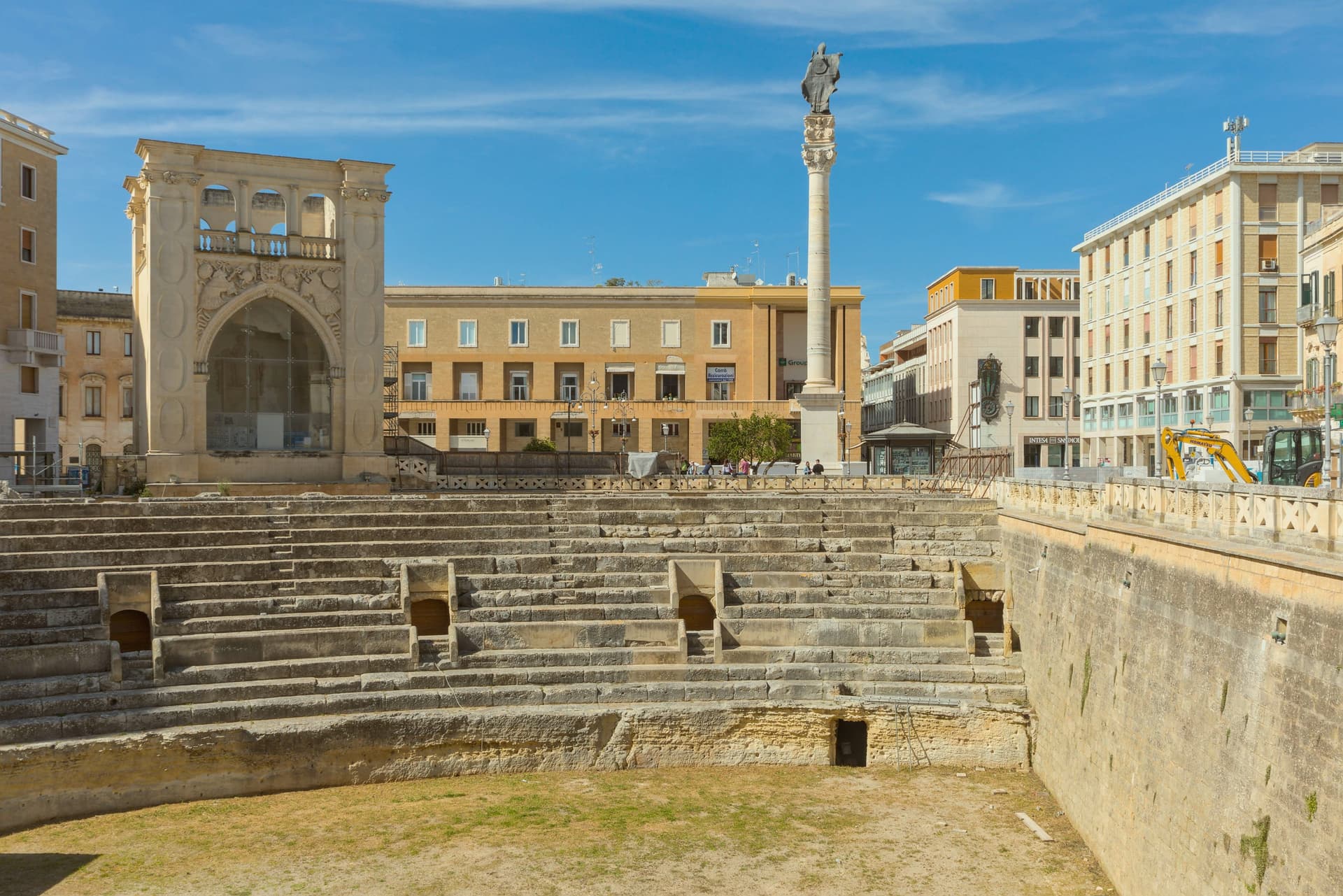
Within those walls the Baroque churches and squares sit close together, the cathedral square closed in on three sides while the amphitheater lies open and half-sunk in the middle of the newer square that formed around it. The University runs a strong humanities program, and the seafront at San Cataldo, some distance from the old center, carries Lecce's Bandiera Blu.
What holds the town together is the stone itself: soft enough to carve finely, hard enough once cut to last, so that a Messapian and Roman settlement site became, centuries later, the surface on which the south's most elaborate Baroque was cut.
Primo Restaurant, Duo Ristorante, Gimmi Restaurant and 11 more have been named by a guide.
What to see in Lecce
- Basilica di Santa Croce. Worked for nearly two hundred years to completion in 1695, the façade carved with cherubs, monsters and allegories layered so densely that the wall surface almost disappears beneath them.
- Piazza del Duomo. Closed on three sides, the only enclosed cathedral square of its kind in Puglia, gathering the Duomo, Campanile, Bishop's Palace and Seminary into one shared courtyard rather than an open street front.
- Piazza Sant'Oronzo. The city's central square, built around a column brought from the Appian Way to honor the patron saint, with the excavated amphitheater floor sitting below street level at its edge.
How to get to Lecce
There is a railway station in the town, so you can arrive without a car and never need one while you are here. Taranto is roughly 95 minutes away by road.
Our tip
April through June is the green window in inland Salento, with the centro storico walkable in the day and aperitivo on Piazza Sant'Oronzo running late. July and August push past thirty-five degrees and the city empties at midday; the Notte della Taranta in nearby Melpignano, the closing concert of the Salento pizzica festival, falls in late August and draws over a hundred thousand. September and October cool back down for the olive harvest. Festa di Sant'Oronzo falls in August.
More from Anywhere Italy
- The 9 best hidden towns you can reach by train that eat well in Puglia
- The best hill towns in the province of Lecce
 The best hidden coastal towns that eat well in Puglia
- The best coastal towns within an hour of Lecce
- The best hidden hill towns that eat well in Puglia
- The best towns worth staying overnight that eat well in Puglia