
The best coastal towns within an hour of Lecce
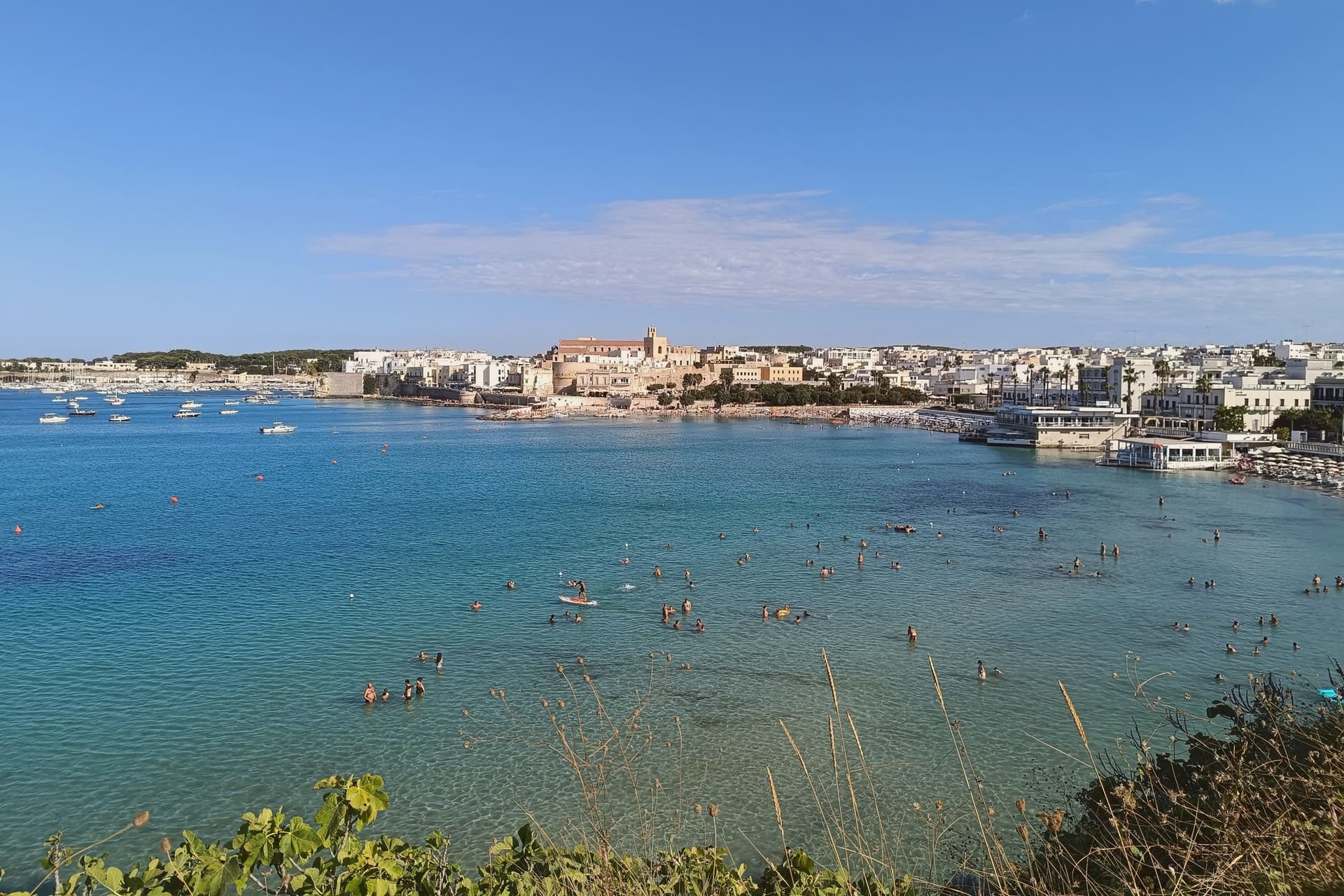
Lecce sits far enough inland that the sea arrives as a decision rather than a view, and the drive out crosses flat red earth, dry stone walls and olive groves before the light changes and turns hard and white. On the Adriatic side the coast is low limestone, pitted and sharp underfoot, with water that drops quickly into deep blue. On the Ionian side it goes soft: long shallow sand, pine breaks, dunes behind salt marsh where flamingos stop. The food follows the geography, raw sea urchins and mussels near the rocks, then bread, tomatoes and orecchiette a little further back, and everywhere the same pale tufo stone cut into houses, churches and harbour walls. Late spring and September are the good months, when the water is warm and the beach clubs have not filled.
People come to Salento for the beaches and mostly go to Torre dell'Orso and the stretch north towards Porto Cesareo, or press south to Santa Maria di Leuca where the two seas meet. In August the coast road there moves at walking pace, the lidi charge for a parasol what a meal costs, and parking becomes the day's main activity. The reputation is deserved, the caves and the white sand are remarkable, which is exactly why everybody is standing on them.
The same coastline continues in both directions, and the peninsula is narrow enough that no part of it is far from Lecce. There are fishing harbours with working boats, towns whose beaches serve the town rather than the season, and inland places that hold their own coast a short drive away. These are the ones covered here, all within about an hour of the city, all on the sea, and all visited by fewer people than the famous stretch between them.
Of the 19 communes we have mapped in a one-hour drive of Lecce, 6 qualify as coastal towns: each is on the sea. The smallest, Otranto, has 5,631 residents.
Elsewhere in the catalogue: The best hidden coastal towns that eat well in Puglia and The best towns that eat well in the province of Lecce.
Otranto
Why visit Otranto
Otranto sits at sea level on a small promontory thirty kilometers southeast of Lecce, the easternmost city of Italy and the closest mainland point to Albania across the eighty-kilometer Strait of Otranto. The Cattedrale di Santa Maria Annunziata, consecrated in 1088, holds a mosaic floor laid between 1163 and 1165 by the monk Pantaleone for Archbishop Gionata.
About 800,000 tesserae across the three naves depict Adam and Eve, Noah, the Tower of Babel and a Tree of Life with biblical, classical and chivalric figures: Alexander the Great, Arthur, the months of the year. On 14 August 1480 an Ottoman force under Gedik Ahmed Pasha took the city; 813 inhabitants who refused to convert were beheaded on the Colle della Minerva and their bones are now in the cathedral, in seven glass-fronted recesses.
Pope Francis canonized them in 2013. The Castello Aragonese, raised by Ferdinand I of Aragon between 1485 and 1498, is the response: a five-sided fortress with a moat, built specifically to prevent a second sack.
What to see in Otranto
- Cattedrale di Santa Maria Annunziata. Norman cathedral consecrated in 1088, with Pantaleone's mosaic floor of 1163-1165 and the relics of the 813 martyrs of 1480 in seven glass recesses.
- Castello Aragonese. Five-sided Aragonese fortress raised 1485-1498 by Ferdinand I after the Ottoman sack, irregular plan with moat running the full perimeter.
- Chiesa di San Pietro. Byzantine cross-plan church in the centro storico, ninth-tenth century, with three apses and frescoes from the tenth through fifteenth centuries.
How to get to Otranto
There is a railway station in the town, so you can arrive without a car and never need one while you are here. Taranto is roughly 137 minutes away by road.
Our tip
May through September is the working coastal season, Adriatic water warm enough to swim by mid-May and the centro storico operational into the evening. July and August fill the small headland with day-trippers from across Salento and beyond; weekends in August are shoulder to shoulder along the Lungomare and the cathedral fills with queues. June and September are the sane choices, mild evenings and the same water without the crush.
Vernole
Why visit Vernole
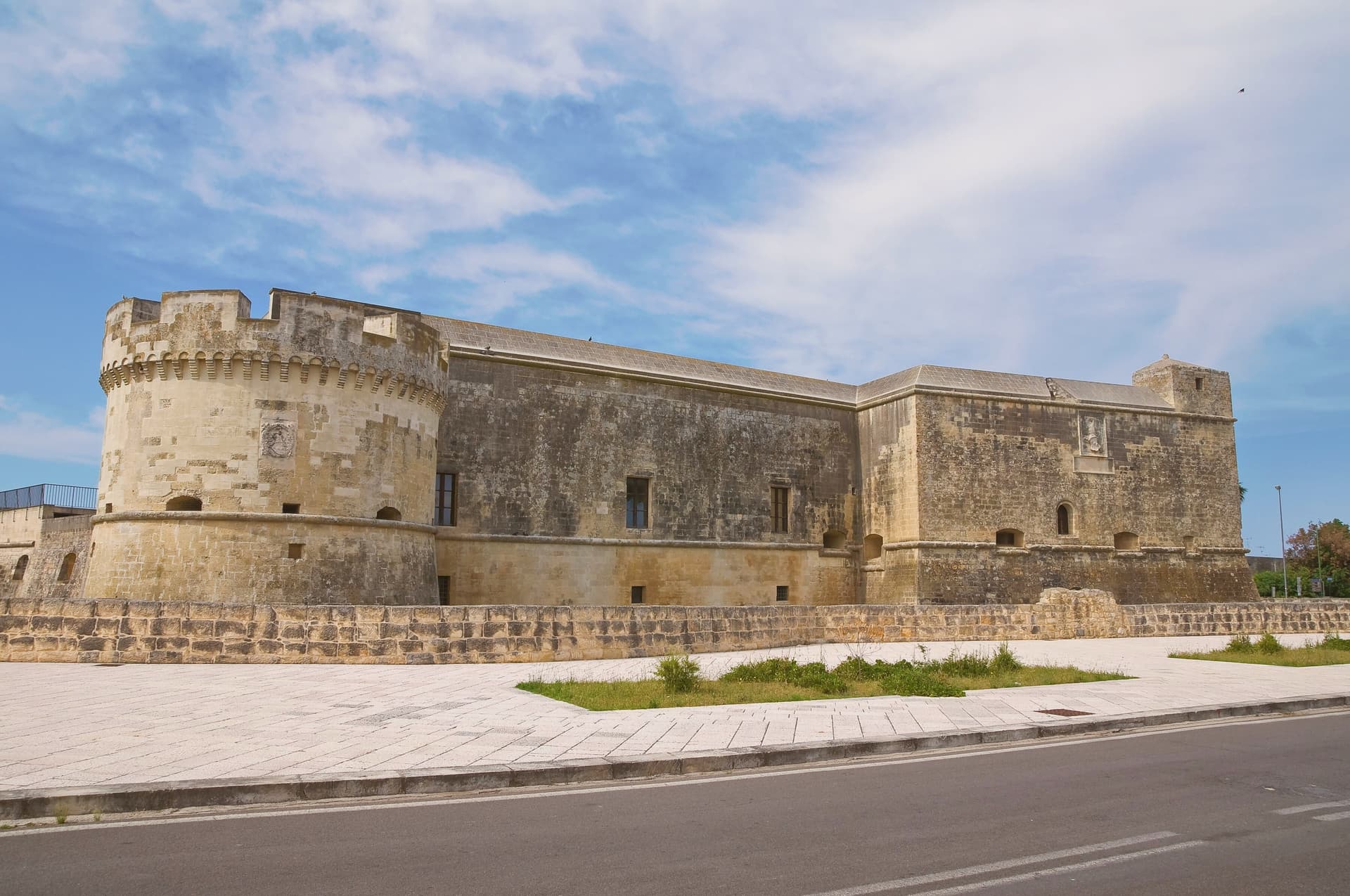
Vernole sits ten kilometers southeast of Lecce, on the line between the city and the Adriatic, with a small stretch of coast of its own and a string of frazioni that includes Strudà, Pisignano, Vanze and Acaya. The village at Acaya was originally called Segine and was granted as a fief in 1294 by Charles II of Anjou to Gervasio dell'Acaya, well before its Renaissance rebuilding.
That earlier history is easy to miss standing in the citadel today, where the grid of streets and the walled perimeter read as a single sixteenth-century act rather than a place with a medieval name underneath it. The commune itself is split between this inland fortified core and the coast, where the Cesine reserve holds the dune system ten kilometers east of the citadel.
Vernole's own centro, with its rebuilt mother church, sits apart from both, the administrative middle point between a Renaissance curiosity and a wetland on the Adriatic. The three parts, town, citadel and coast, rarely overlap in a visitor's day: whichever draws people to the commune, the other two are reached separately, not passed through.
What to see in Vernole
- Castello di Acaya. Renaissance fortress of 1535-1536 by Gian Giacomo dell'Acaya, trapezoidal with a wet moat, one of the best examples of sixteenth-century defensive architecture in Terra d'Otranto.
- Borgo fortificato di Acaya. Walls, gates and a grid of stone streets laid out between 1521 and 1536, still readable underfoot as the plan the engineer drew.
- Riserva Naturale Le Cesine. Dune systems and pine groves along the longest stretch of protected lower-Salento coast, on the Adriatic edge of the commune.
How to get to Vernole
Taranto is roughly 107 minutes away by road.
Our tip
May, June, September and early October are the easiest months: the Acaya walls workable from morning into the evening, Le Cesine in spring migration or autumn passage, and the Adriatic still swimmable. July and August are dry and very hot on the coastal plain, with the citadel best visited at opening or in the last hour of daylight. The classical music programs in the courtyard of the Castello di Acaya run on summer evenings.
Campi Salentina
Why visit Campi Salentina
Campi Salentina sits on the Salento plain at forty-seven meters, fifteen kilometers north of Lecce. Menhirs around the territory point to Bronze Age occupation, but the town as such dates to 926, when Saracen raids destroyed the nearby villages of Afra, Bagnara, Firmignano, Ainoli and Terenzano and pushed survivors together at the current site.
The Normans came in the eleventh century; Tancred of Altavilla donated Campi to the Bishop of Lecce, and the castle followed in the centuries after. In 1522 the Paladini family bought the fief, and after Maria Paladini married Giovanni Enriquez, the town was elevated to a marquisate in 1627.
The town earned the title of città by presidential decree in 1998. The coat of arms is a sheaf of wheat: locals call Campi the granary of the Terra d'Otranto, and the surrounding plain is olive groves and vines.
The menhirs, the ninth-century founding, and the seventeenth-century marquisate mark three separate layers on the same plain: a scattering of prehistoric stones, a town built from the wreck of five destroyed villages, and a feudal seat raised in status centuries later without ever moving from that original site. What holds the layers together is the plain itself, flat ground given over to wheat and now to vines, which explains why a granary emblem and a castle used only as a summer residence could belong to the same small place.
What to see in Campi Salentina
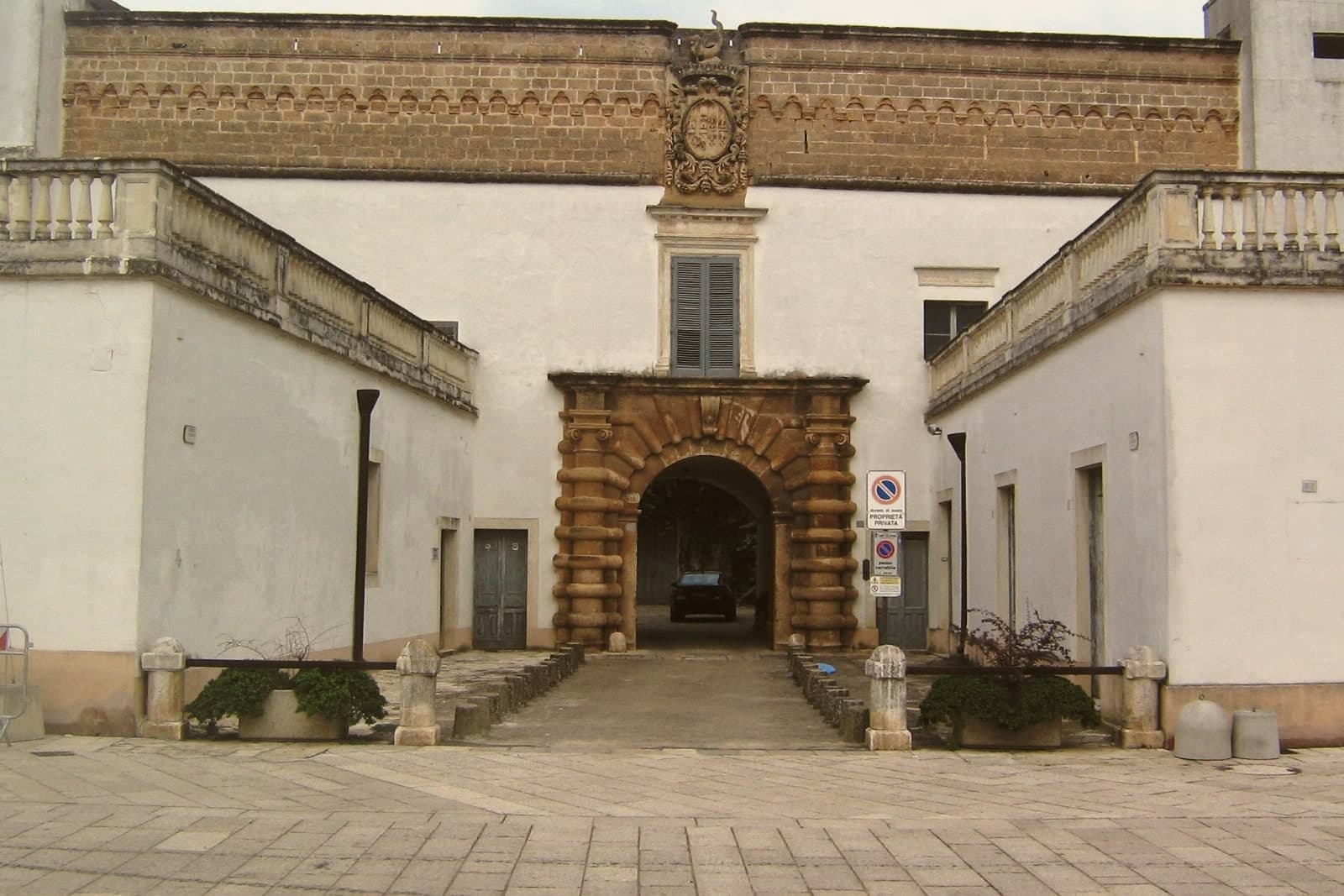
- Castello dei Paladini-Enriquez. The castle stands at the center of the old town, its walls marking the line between the summer residence Frederick II built and the marquisate palace the Paladini and Enriquez families made of it afterward.
- Chiesa Matrice di Santa Maria delle Grazie. Sixteenth-century mother church in the centro storico, rebuilt over the medieval foundations of the original village church.
- Centro storico. Walled Salento old town around the castle and the chiesa matrice, with stone palazzi from the Paladini and Enriquez period.
How to get to Campi Salentina
There is a railway station in the town, so you can arrive without a car and never need one while you are here. Taranto is roughly 81 minutes away by road.
Our tip
May through September are the months the Salento plain is dry, mild and walkable. June through August reach the mid-thirties and the inland villages empty between two and five in the afternoon; Lecce and the Adriatic coast pull the day-trippers. April and October are the steadier months, the wine and olive work either starting or finishing, the light still soft.
Ugento
Why visit Ugento
Ugento sits five kilometers inland from the Ionian, its centro built directly over the Messapian city of Ozan, the name recorded on the fourth-century-BC Soleto Map. The walls of that older city and the chamber tombs of its necropolis mark the boundary between the modern town and the ground it grew from, remnants of the civilization that held the lower peninsula between the seventh and third centuries BC.
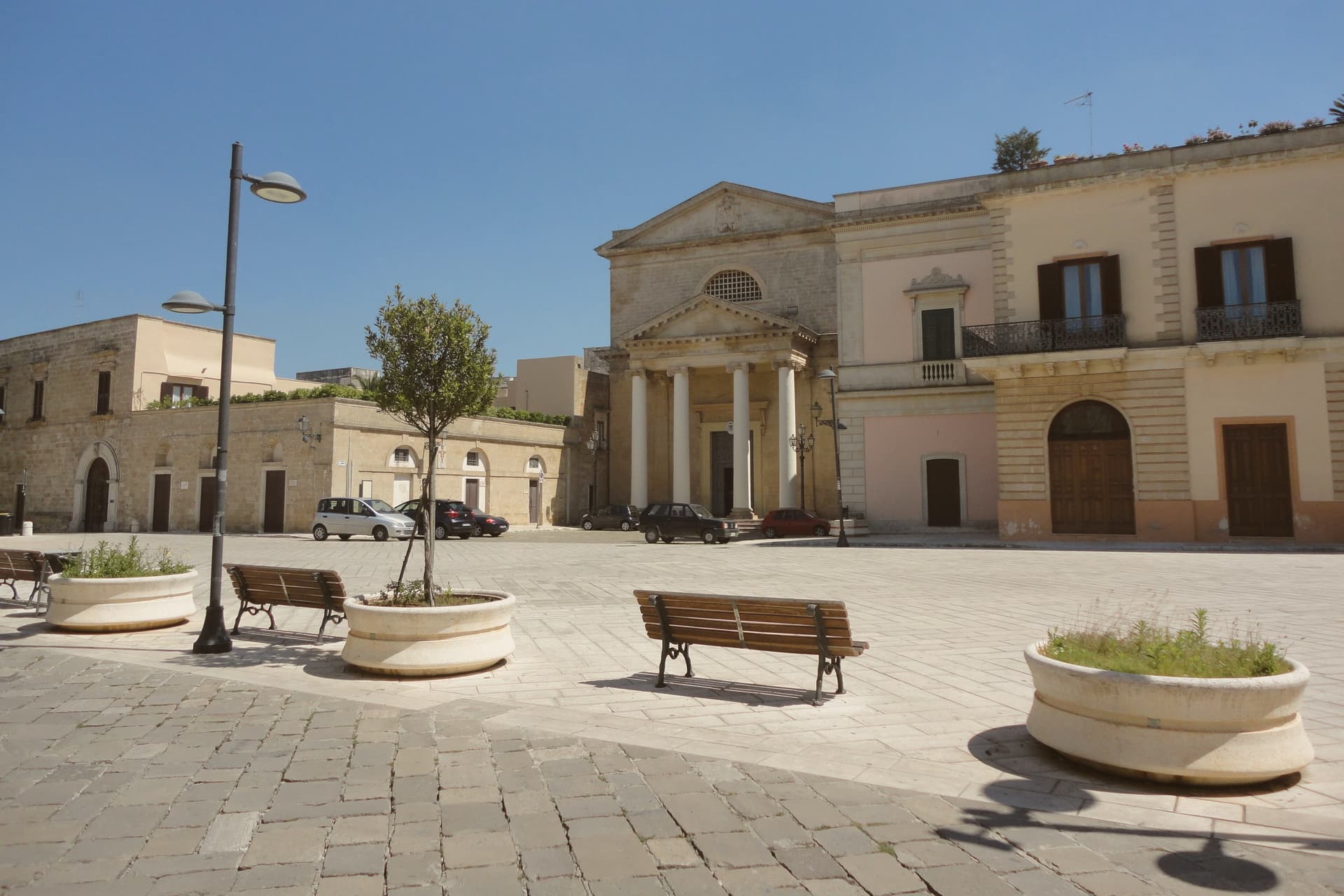
The castle at the center of town began as a Norman motte-and-bailey raised on those same Messapian foundations, later rebuilt as a Baroque palazzo by a family who frescoed its grand salons to record their own history. A bronze Zeus, cast around 530 BC and found by chance in a cellar in 1961, is now kept in Taranto, with only a copy remaining locally, so the town's oldest and most valuable object is known here mostly by its absence.
Inland, the layered town of walls, tombs, castle and cathedral holds the historical weight; on the coast, the frazioni carry the summer crowds. The two halves of Ugento, one built on the memory of Ozan and one facing the sea, run on entirely different clocks.
The beach here holds the national bathing award, which a comune has to win back every year on water quality, beach management and safety.
What to see in Ugento
- Castello di Ugento. Norman fort rebuilt as a Baroque palazzo by the d'Amore family in the 1690s, with first-floor grand salons frescoed in 1694 to celebrate family history.
- Nuovo Museo Archeologico. Town archaeological museum displaying Messapian finds, the Cozza Petrosa necropolis material and a bronze copy of the Zeus of Ugento.
- Mura Messapiche e Necropoli di Cozza Petrosa. Walls and the trullo-shaped chamber tombs of the necropolis sit at the edge of the centro, the oldest layer of the city built over by the modern town.
How to get to Ugento
There is a railway station in the town, so you can arrive without a car and never need one while you are here. Taranto is roughly 129 minutes away by road.
Our tip
May, June, September and the first half of October are the gentle months on the Ionian Salento: warm sea, cool evenings, the centro and the coast usable in the same day. July and August are dry and very hot, with the Marine packed and the centro storico empty between two and five in the afternoon. The Bandiera Blu beaches at Torre San Giovanni and Lido Marini do most of the August traffic and rates climb accordingly.
Carovigno
Why visit Carovigno
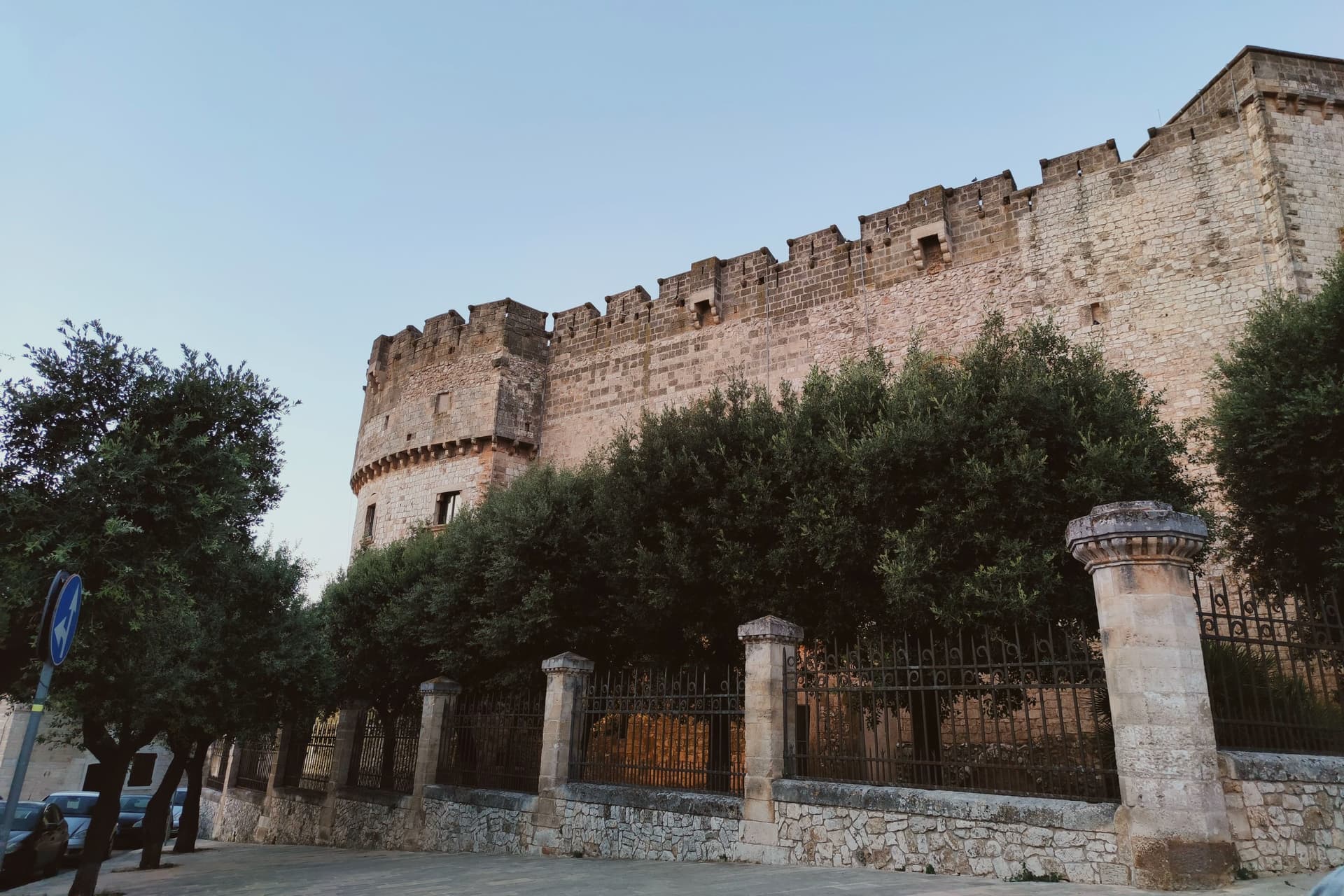
Carovigno sits at 161 meters in upper Salento, seven kilometers from the Adriatic and thirty kilometers from Brindisi. The distance between hill and sea shapes the commune: a walled town on high ground looking inland toward Ostuni, and a strip of protected coast running north along the water, eight kilometers of it, separate enough from the centro storico that they read almost as two different places joined by one municipal boundary.
The old town itself is compact, arranged around its mother church with the castle at the summit and the medieval walls, patched with older stone, closing the circuit. Outside the walls, three kilometers off, stands the sanctuary that draws the town out of itself once a year for the Easter procession.
The coast belongs to no season and no rite in particular. It is simply there, kept clear of building, running along the edge of the commune while the life of the town carries on up on the hill.
What holds Carovigno together is this separation of functions: defense and worship concentrated on the high ground, the shoreline left open and undeveloped, and the two connected only by the road and by the yearly walk to the sanctuary.
The beach here holds the national bathing award, which a comune has to win back every year on water quality, beach management and safety.
What to see in Carovigno
- Castello Dentice di Frasso. Fortress at the highest point of the centro storico, built for defense and later remade into an aristocratic residence, its rooms and outlook telling a different story from its military origins.
- Cinta muraria e torri medievali. Four towers, Torre del Civile, Torre Giranda, Torre delli Brandi and Torre del Prete, still standing on foundations laid before the medieval walls that now bear their names.
- Riserva Naturale di Torre Guaceto. The shoreline itself: shallow clear water, dune systems underfoot and a watchtower standing alone against the coast, reachable north of the town.
How to get to Carovigno
There is a railway station in the town, so you can arrive without a car and never need one while you are here. Taranto is roughly 69 minutes away by road.
Our tip
May through September are the months the Adriatic warms enough to swim at Torre Guaceto and the upper-Salento groves are walkable without sweat. July and August push past thirty-three degrees and the centro storico fills with day-trippers from the Brindisi-Ostuni stretch. June and September are the steadier months, water still warm and the trattorie open without the August crowds.
Gallipoli
Why visit Gallipoli
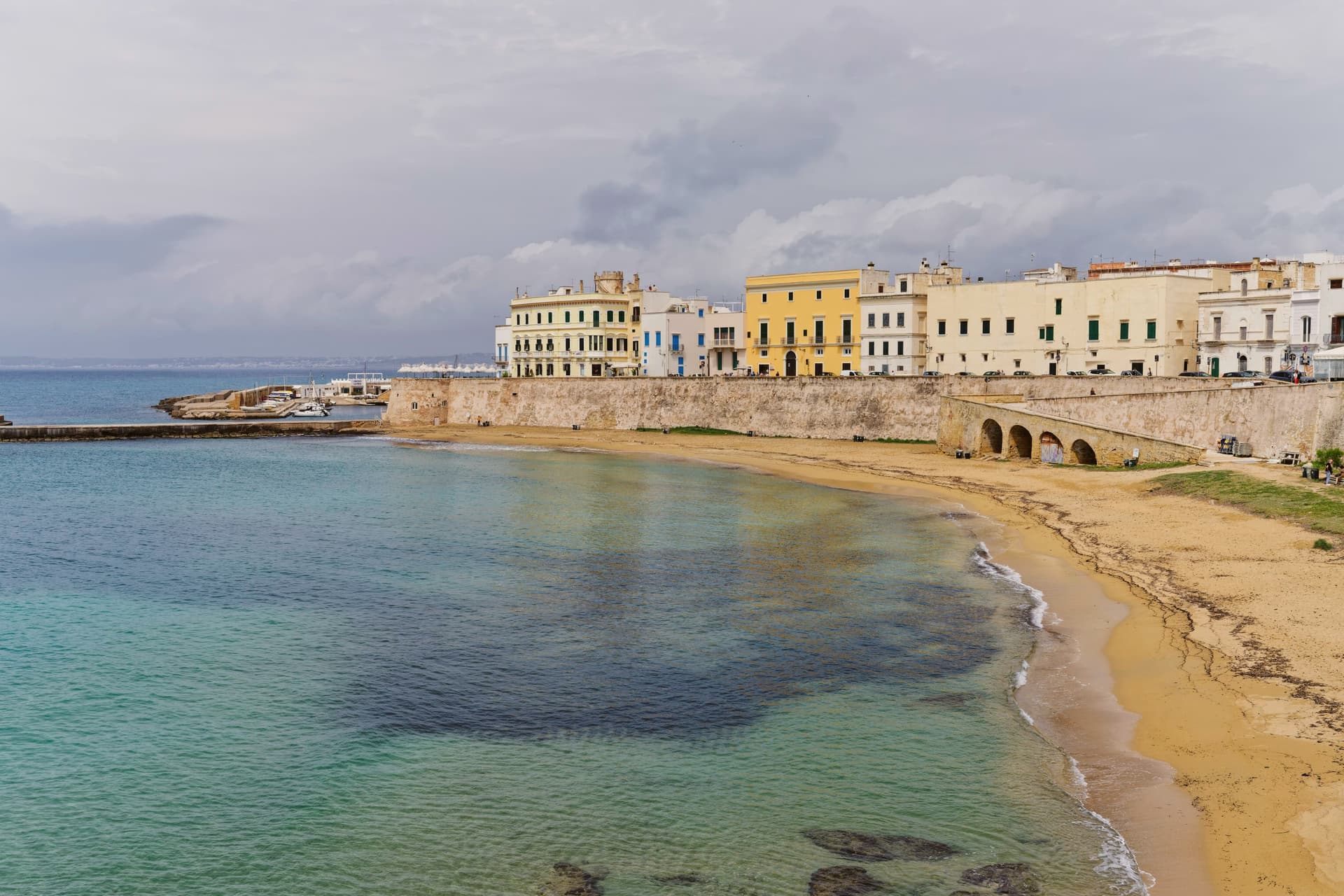
Gallipoli is built on a limestone island off the Ionian coast of Salento, linked to the modern mainland town by a seventeenth-century bridge. The Greek name Kallipolis means beautiful city; the site has been a bishopric since the sixth century.
The Castello Angioino guards the bridge end and was raised on Roman fortifications in the thirteenth century, expanded later under Aragonese and Spanish rule. Inside the walled città vecchia, whitewashed lanes wrap around the Basilica Cattedrale di Sant'Agata, built between 1629 and 1696 in carparo limestone under the Spanish bishop Consalvo de Rueda.
Below the streets, thirty-five frantoi ipogei, underground olive mills cut into the rock from the sixteenth century, once produced the lamp oil that lit the capitals of Europe. The Spiaggia della Purità sits directly under the sea walls.
Gallipoli got its first Bandiera Blu and a five-Vele Legambiente rating in 2024. In summer, the city flips from fishing port to the densest nightlife town in Salento.
The beach here holds the national bathing award, which a comune has to win back every year on water quality, beach management and safety.
What to see in Gallipoli
- Castello Angioino. Thirteenth-century castle on Roman foundations at the bridge crossing, expanded under the Aragonese and Spanish, now an exhibition space.
- Basilica Cattedrale di Sant'Agata. Baroque cathedral of 1629-1696 in carparo limestone, with Doric colonnade and polychrome marble altar, built under Bishop Consalvo de Rueda.
- Città vecchia. Walled old town on the limestone island, a tight grid of whitewashed lanes, palazzi, and small churches wrapped by sea walls on three sides.
How to get to Gallipoli
There is a railway station in the town, so you can arrive without a car and never need one while you are here. Taranto is roughly 111 minutes away by road.
Our tip
May through June is the window before the summer push, with warm sea and the old town still walkable. July and August are the loudest months in Salento: Gallipoli runs the densest nightlife on the Ionian, the Baia Verde fills with day-trippers from across Puglia, and the città vecchia is shoulder to shoulder after sundown. September is the better month if you want the same beaches without the crush.
More from Anywhere Italy
 The best hidden coastal towns that eat well in Puglia
 The best towns that eat well in the province of Lecce
- The best coastal towns with a serious restaurant in Puglia
 The best coastal towns within 90 minutes of Taranto
- The 7 best beach towns inside a nature park in Puglia
- The 9 best hidden towns you can reach by train that eat well in Puglia