The best hill towns in the province of Lecce
The province of Lecce is flatter than most of Italy, which is why the rises here read as mountains. Towns sit on low limestone humps above the olive plain, built from the same soft golden pietra leccese that carvers turn into balconies, saints and curling stone foliage, and that goes honey-coloured in late afternoon. The food is inland and frugal in the best way: horse meat stewed in tomato, pittule fried at Christmas, chickpeas with wild greens, sagne 'ncannulate, primitivo and negroamaro from vineyards that start where the last houses stop. Spring and early autumn are the seasons for it, when the light is long and the heat has not yet flattened the whole peninsula.
Almost everyone who comes to Salento comes for the water, and books a room on the coast. Gallipoli's old town on its island, and Otranto's cathedral with its mosaic floor, absorb the bulk of the summer, along with the beach clubs strung between them where parking becomes a competitive sport by mid morning. It is a good coast and the crowding is deserved. It also means August in this province is largely a story about the sea.
The olive country behind the beaches keeps going, and the ground keeps lifting, in the Serre and along the ridge that runs down towards the tip of the heel. Up there are the Griko villages where an old form of Greek is still spoken and sung, menhirs standing in field corners, castles, tobacco warehouses and baroque churches out of all proportion to the streets around them. These are the towns in this list: inland, built on slopes too steep to spread across, and reached by fewer people than the coast an easy drive away.
Of the 16 communes we have mapped in the province of Lecce, 10 qualify as hill towns: each is an inland hill settlement built on ground too steep to spread. The smallest, Giurdignano, has 1,947 residents.
Two more lists worth reading alongside this one: The 6 best hidden hill towns in the province of Lecce and The best towns that eat well in the province of Lecce.
Giurdignano
Why visit Giurdignano
Giurdignano sits inland from Otranto on the limestone shelf of southern Salento, at 78 meters, four kilometers from the Adriatic. The village has fewer than two thousand residents and the highest concentration of megalithic monuments in Italy.
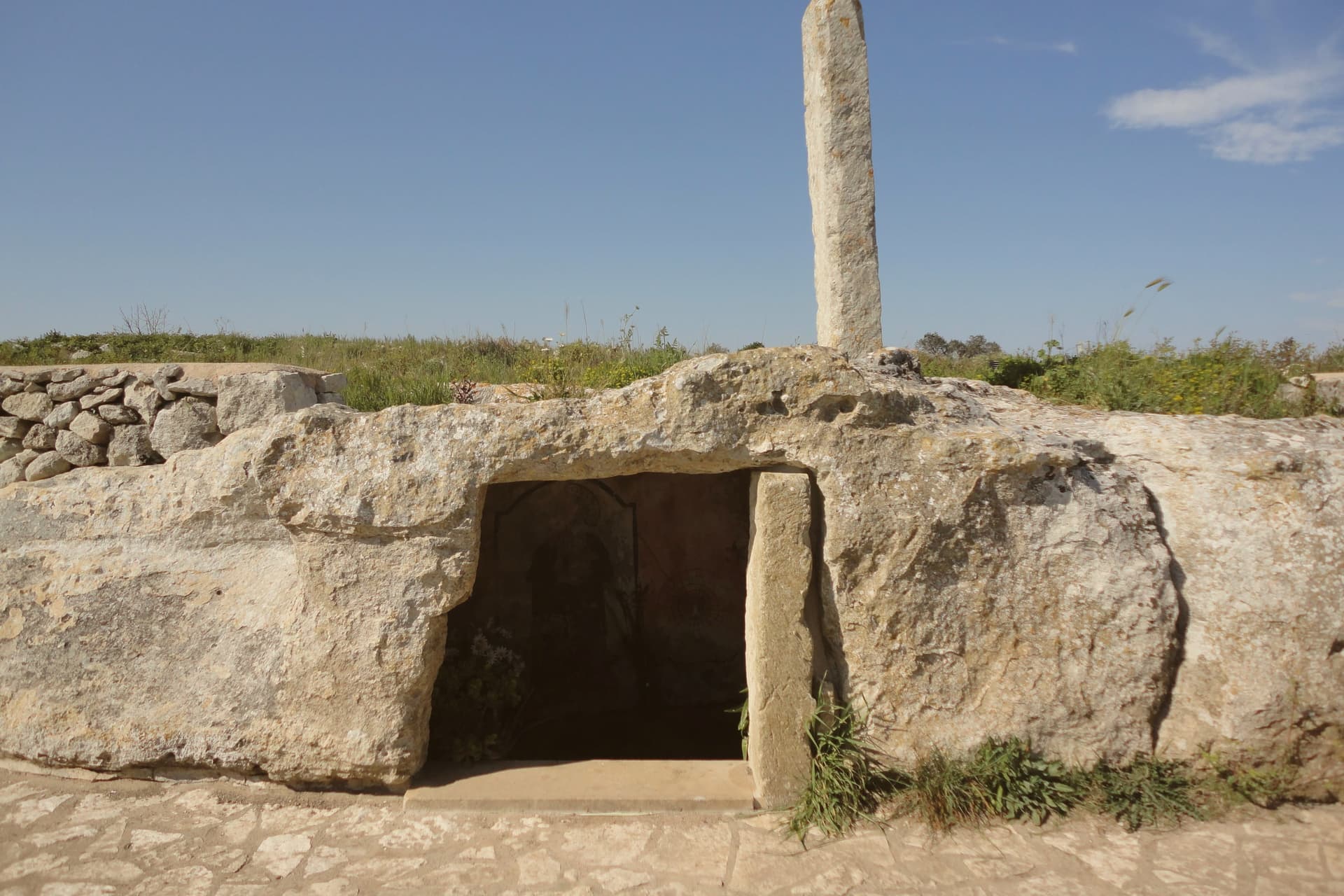
Nineteen menhirs stand in the countryside around it, the tallest the Menhir San Vincenzo at over three and a half meters; several were Christianized in the early medieval period, including the Menhir San Paolo, set beside a Byzantine rupestrian crypt and pierced at the top for an iron cross. The dolmens nearby are likely from the fifth or fourth millennium BC.
Roman imperial necropoleis from the second and third centuries AD have surfaced in the Cantalupi locality. The borgo joined the Città del Tartufo network for the Salento white truffle found in the surrounding macchia and olive groves.
Giurdignano runs as a quiet base for the Otranto coast, four kilometers away.
What to see in Giurdignano
- Menhir San Paolo. Christianized prehistoric standing stone beside a Byzantine rupestrian crypt, pierced at the top in the early medieval period to hold an iron cross.
- Menhir San Vincenzo. The tallest menhir in the Lecce province at over 3.5 meters, one of the nineteen prehistoric standing stones in the territory of Giurdignano.
- Dolmen Stabile. Megalithic funerary chamber on the road to Uggiano, three slabs and a capstone, dated to the fifth or fourth millennium BC.
How to get to Giurdignano
There is a railway station in the town, so you can arrive without a car and never need one while you are here. Taranto is roughly 128 minutes away by road.
Our tip
April through June is mild on this stretch of southern Salento, the countryside in flower and the menhir paths walkable without sweat. July and August push past thirty-five degrees and most travelers move on to the Otranto seafront four kilometers east; the borgo itself stays quiet. September and October cool back down for the olive harvest and the white-truffle season starts in the surrounding macchia.
Nociglia
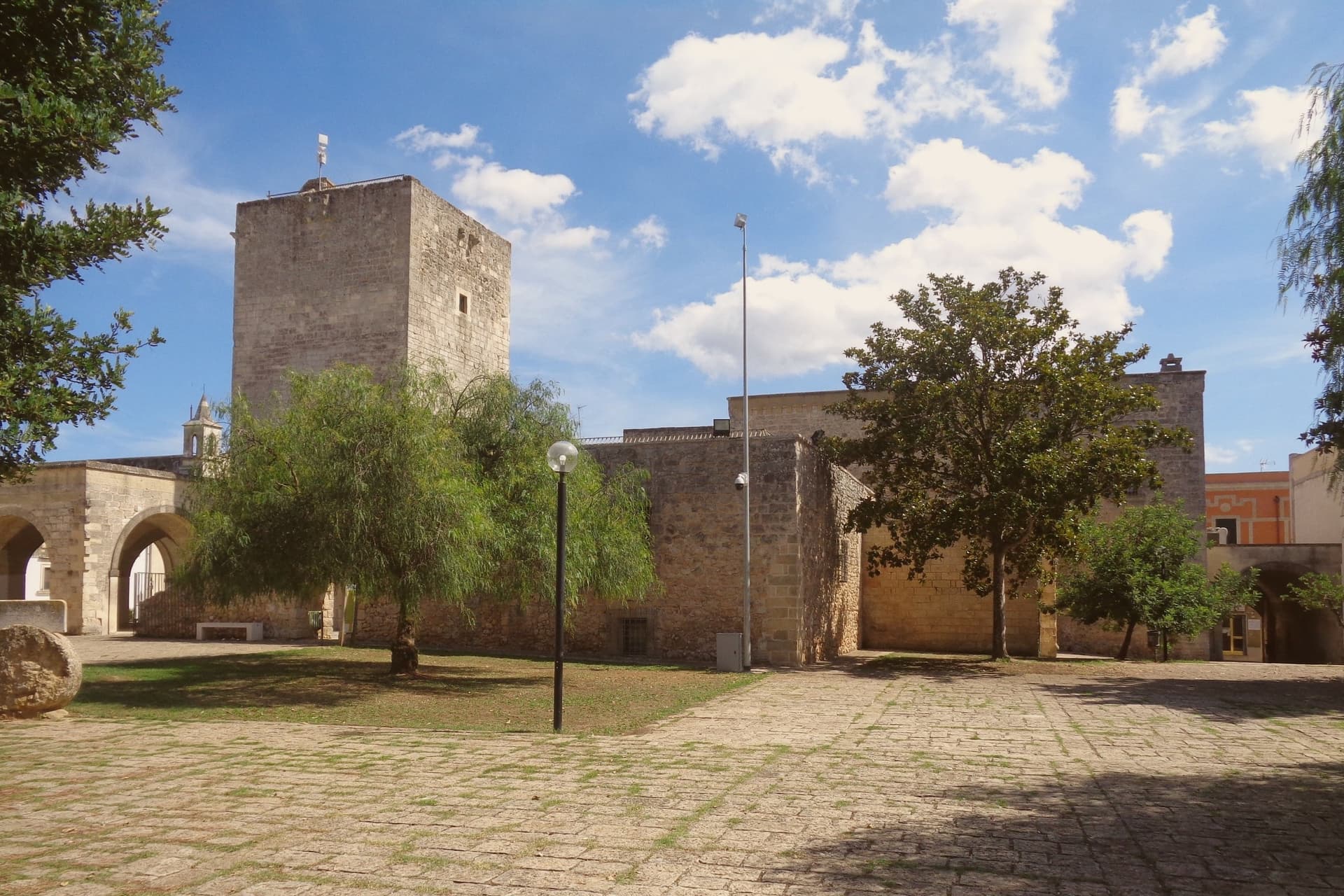
Why visit Nociglia
Nociglia sits at about 90 meters in the southern Salento, forty kilometers south of Lecce and ten kilometers west of the Adriatic. The name appears on the medieval itinerary map of the Via Traiana as Nucillium, which records that the Roman road passed through and the site was already settled.
The first documentary mention places Nociglia in the Principato di Taranto in 1378, a Norman-Angevin fief on the Salento interior. The watchtower in the centro storico was built in the early fourteenth century; the nucleus of the Castello Baronale dates to the late fourteenth century and was extended over the following centuries by the local barons.
The Bosco Belvedere that gave the village its origin, where Messapian populations took refuge during the Roman advance, still survives in fragments around the commune. Population is just over two thousand and shrinking, the standard Salento interior pattern.
What to see in Nociglia
- Castello Baronale. Late fourteenth-century baronial castle in the centro storico, extended over the following centuries, the village's principal civic monument.
- Torre di Nociglia. Early fourteenth-century watchtower in the old town, one of the few surviving Angevin defensive towers in the southern Salento interior.
- Centro storico. Small Salento village core organized around the castle and parish church, stone houses with the typical flat roofs of the lower peninsula.
How to get to Nociglia
Taranto is roughly 130 minutes away by road.
Our tip
April through June and September through October are the workable months in the southern Salento interior: olive flowering in spring, mild evenings, the Bosco Belvedere green and walkable. July and August touch thirty-six degrees and the small centro storico empties in the afternoon; the Adriatic is ten kilometers east and pulls the village down to the coast on weekends. The patronal festa falls in late summer.
Specchia
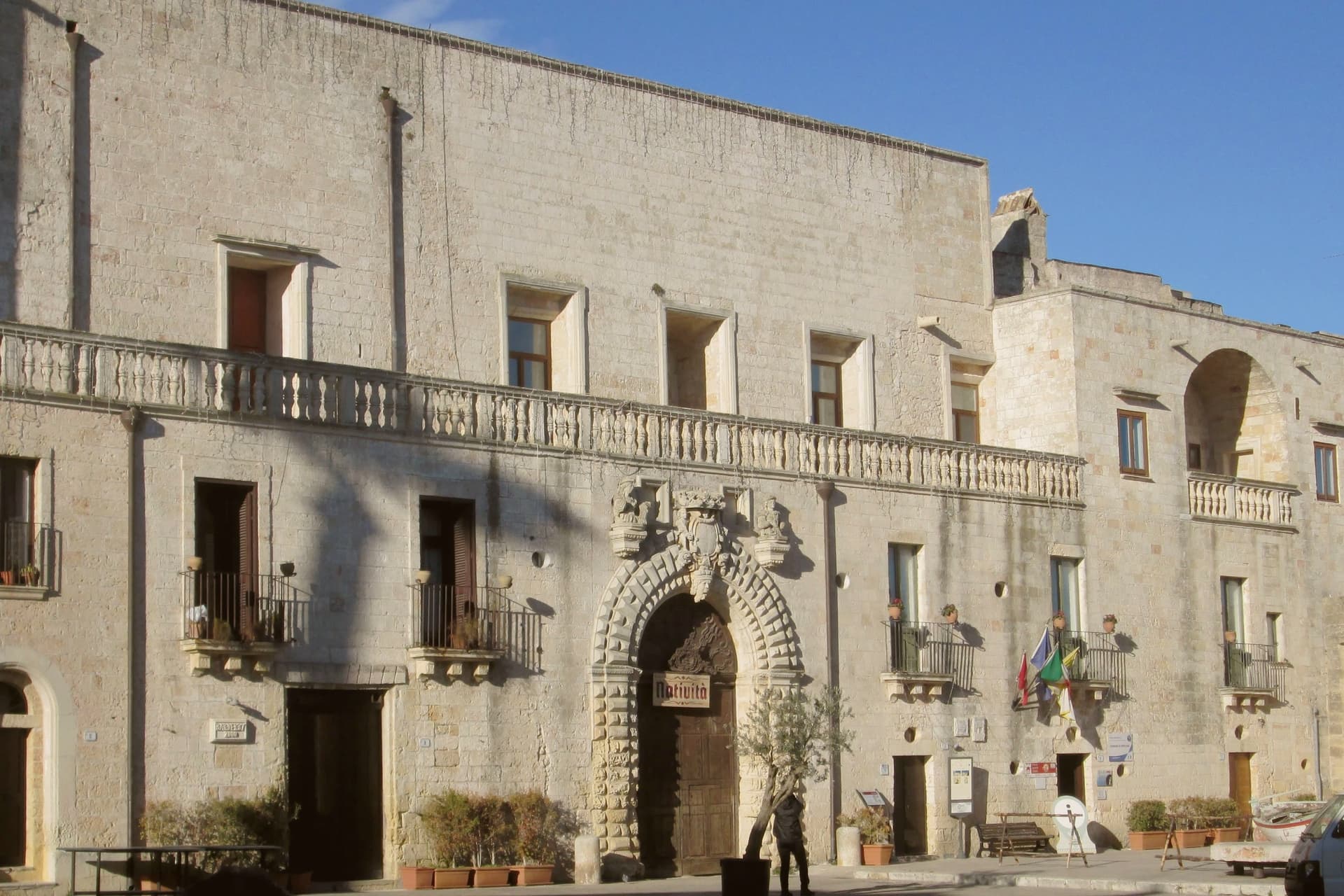
Why visit Specchia
Specchia sits on the Serra Magnone at 130 meters, one of the higher points in lower Salento, forty-five kilometers south of Lecce and ten kilometers from the Ionian coast. The name comes from the specchie, conical piles of dry stones the Messapians built across the peninsula as defensive lookouts.
The medieval nucleus formed in the ninth century when Saracen raids pushed coastal villagers inland and onto the hill. The fifteenth-century street plan survives intact: a tight grid of alleys, courtyards and Baroque portals enclosed by what remains of the walls.
Castello Risolo dominates the center, a sixteenth-century block enlarged in the seventeenth century by the Trane and Protonobilissimo families as their residence. The Convento dei Francescani Neri dates to 1531.
Specchia entered the Borghi più belli d'Italia network in 2004 and the Ministry of Tourism named it Gioiello d'Italia in 2012. Walking the lanes after dusk, the village reads as one continuous courtyard.
What to see in Specchia
- Castello Risolo. Sixteenth-century castle in the heart of the centro storico, enlarged between 1600 and 1700 by the Trane and Protonobilissimo families as their noble residence.
- Convento dei Francescani Neri. Franciscan church and convent of the Black Friars, documented from 1531, with harmonious lines that anchor the upper edge of the old town.
- Centro storico medievale. Fifteenth-century street plan of narrow lanes, stone staircases, courtyards and Baroque portals, preserved nearly intact within the line of the old walls.
How to get to Specchia
There is a railway station in the town, so you can arrive without a car and never need one while you are here. Taranto is roughly 145 minutes away by road.
Our tip
April through June and September through October are the months to come: warm afternoons, cool evenings on the ridge, the countryside green or in olive harvest. July and August push past thirty-five degrees and the old town empties between two and five in the afternoon, then refills after sunset for the passeggiata. The Ionian beaches at Torre Vado and Pescoluse sit ten to fifteen kilometers away and absorb most of the August crowd.
Corigliano d'Otranto
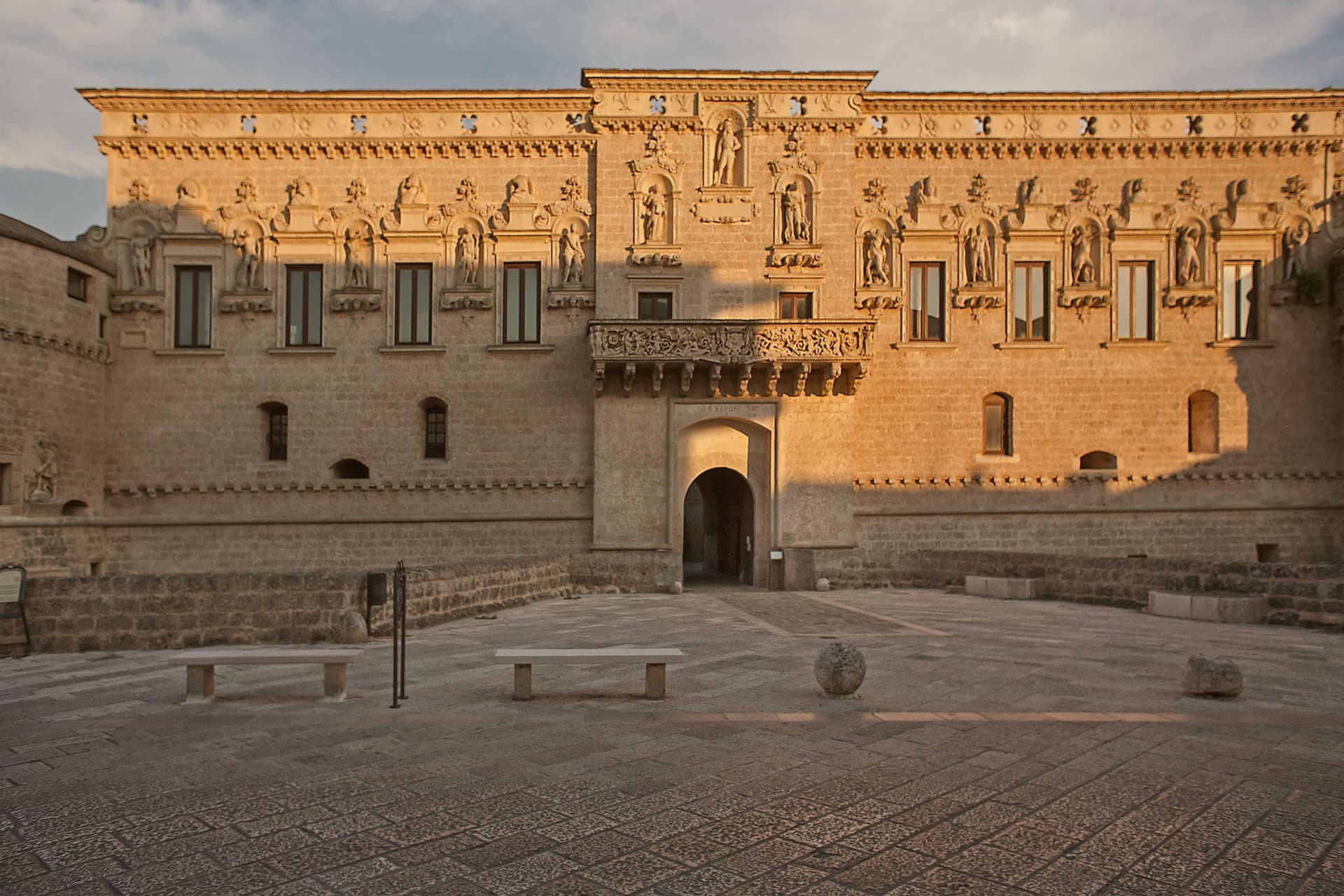
Why visit Corigliano d'Otranto
Corigliano d'Otranto sits at 95 meters on the Salento plateau, twenty-five kilometers south of Lecce. The territory carries one of the densest concentrations of megalithic remains in the area, and the town itself grew around a medieval fort that passed to the de' Monti family, a house of French origin, in 1465.
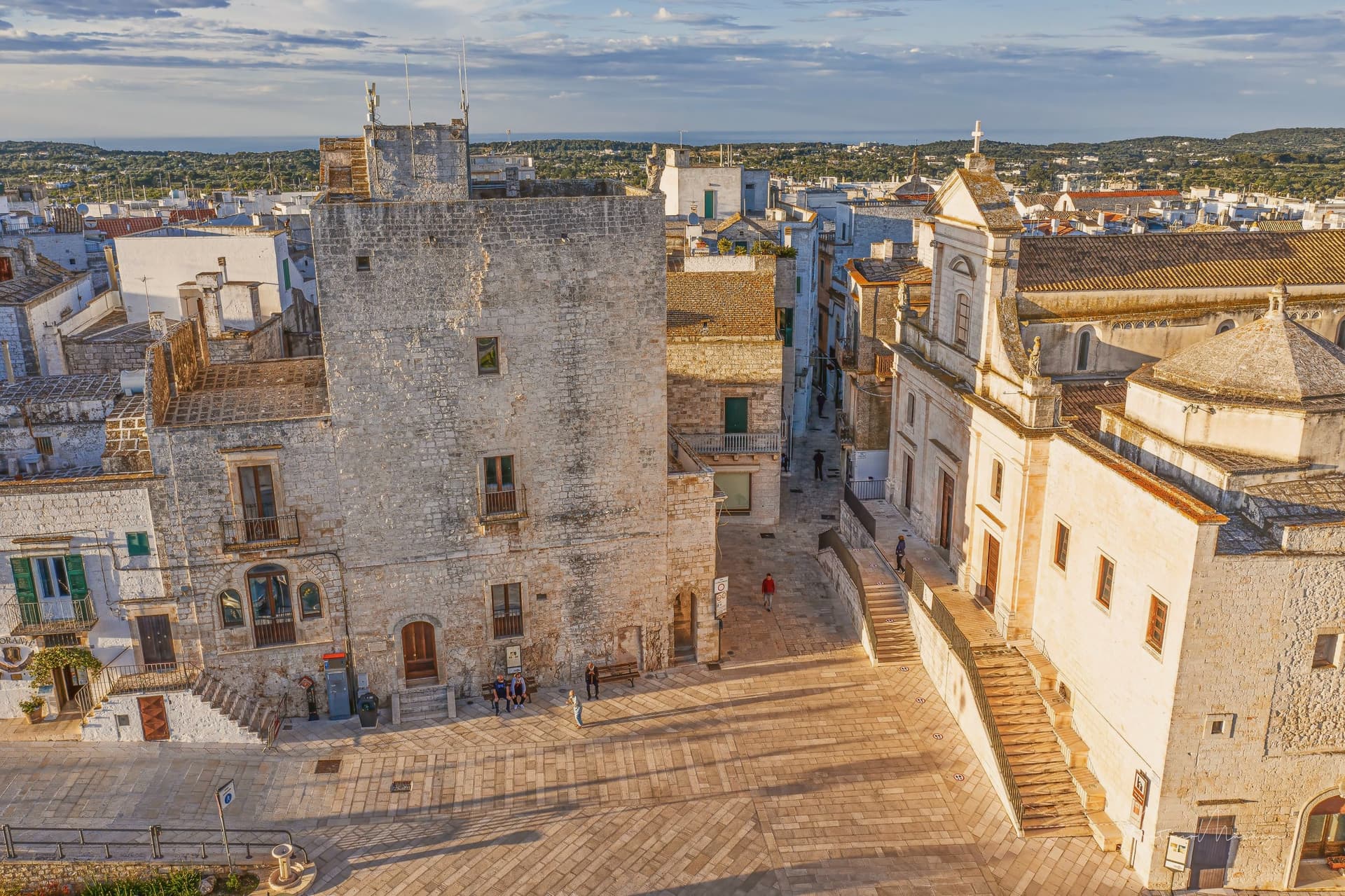
The old town organizes itself around that fort: the centro storico's lanes and baroque palazzi in pale Lecce stone lead to the fort on one side and the parish church on the other, the two structures facing each other as the twin poles of the historic core. Griko street signs sit alongside the Italian ones throughout, a language surviving in the same streets where Bronze Age dolmens and the sixteenth-century rebuilding mark two very different periods of settlement.
The town reads as a place where deep prehistory, a fortified medieval past, and a living minority language occupy the same small footprint rather than separate chapters of its history.
What to see in Corigliano d'Otranto
- Castello de' Monti. The fort stands on medieval foundations acquired by the de' Monti family, who gave it a defensive perimeter and deep moat before the Lecce-stone rebuilding. It anchors the centro storico and faces the parish church across the old town.
- Chiesa di San Nicola Vescovo. Built on the site of an earlier chapel, the church stands opposite the castle as the religious anchor of the centro storico.
- Dolmen Caroppo I e II. The two tombs sit two meters apart on the same rock bank just outside town, found by Oreste Caroppo, part of one of the densest concentrations of megalithic remains in Salento.
How to get to Corigliano d'Otranto
There is a railway station in the town, so you can arrive without a car and never need one while you are here. Taranto is roughly 116 minutes away by road.
Our tip
April through June and September through October are the months the Salento plateau is dry, mild, and the centro storico walkable in afternoon light. July and August reach the high thirties and the Lecce-stone walls hold heat well into the evening; the streets empty between two and six. The Festa di San Nicola in early December and the Notte della Taranta tour stop in August are the year's civic peaks.
Martano
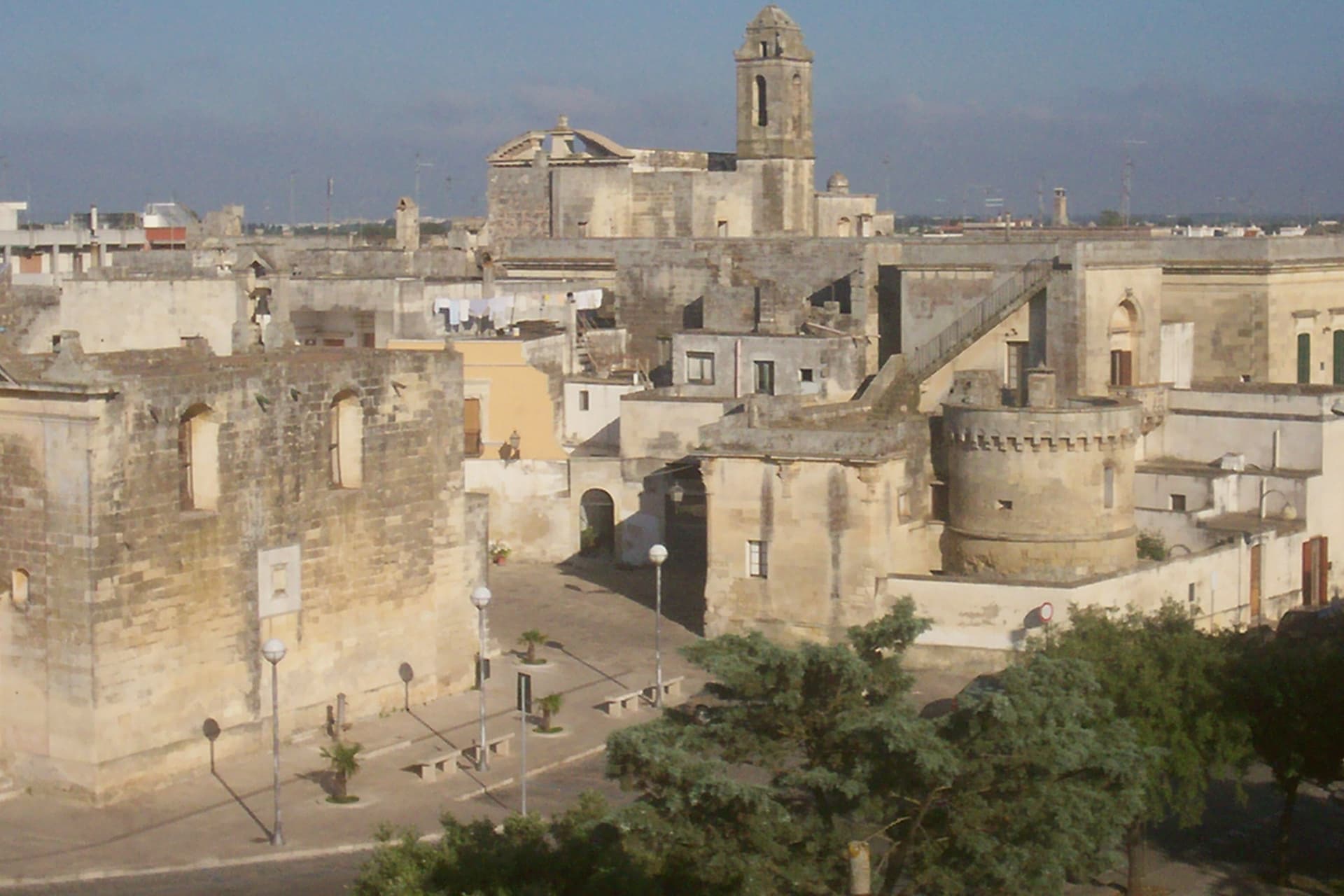
Why visit Martano
Martano sits at ninety-one meters, twenty kilometers south of Lecce and eighteen kilometers from Otranto. It is the largest of the nine communes of the area where some residents still speak Griko, a Greek dialect inherited from five centuries of Byzantine rule.
The town fell under Greek administration after the collapse of the Western Roman Empire, was part of the County of Lecce from around 1000, then was granted as a fief by King Tancredi to Giorgio Remanno in 1190. The prehistoric record predates all of that and is more visible on the ground than any document: a megalithic mound and a standing stone, both still standing on the town's agricultural fringe, long before the Byzantine and feudal rule that later gave the town its administrative shape.
The centro storico, at the same ninety-one meters, carries the bilingual Italian-Griko signage that marks the town's continued position as capital of the language area. Olive oil and tobacco built the modern economy.
What holds these pieces together is continuity: a language surviving from Byzantine centuries, stones surviving from long before them, and a fief history layered on top, all visible within the same small radius around the old town.
What to see in Martano
- Specchia dei Mori. Drystone megalithic mound twenty meters across and six meters high, also called Segla tu Demoniu in Griko.
- Menhir del Teofilo. Standing stone 48 by 33 centimeters wide at the base, set on the outskirts of the town among agricultural land.
- Chiesa Matrice dell'Assunzione. Parish church dedicated to the Assumption, August 15 patronal festival, anchor of the centro storico.
How to get to Martano
Taranto is roughly 115 minutes away by road.
Our tip
April through June and September through October are the months the Salento inland stays mild. May brings the wild thyme into the trattorie and the early olive flush. July and August push past thirty-five degrees on the limestone plain; the centro storico empties between two and five and the patronal festa on August 15 still pulls a crowd despite the heat. Sagra de la Volìa Cazzata falls in October.
Galatone
Why visit Galatone
Galatone sits inland between Galatina and the Ionian coast, thirteen kilometers from Gallipoli and twenty-five from Lecce, at 57 meters. Its origins are Greek-Byzantine: the place was called Kastellion, and the Griko dialect was spoken in churches into the late fourteenth century.
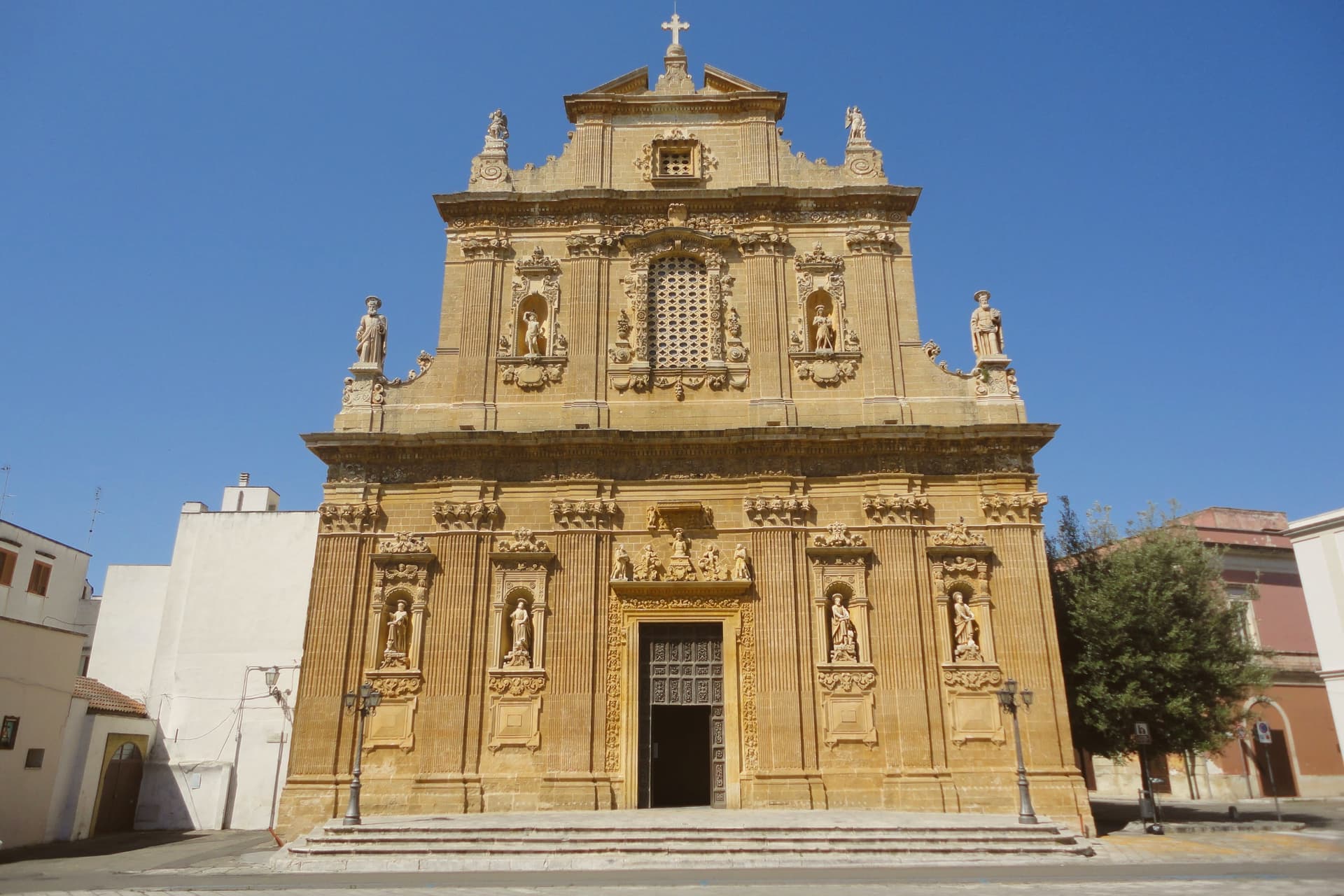
The Santuario del Santissimo Crocifisso della Pietà, built between 1683 and 1694 to replace an earlier church that collapsed that February, is the major monument and one of the strongest Baroque buildings in the province; the decorative work passed through Giuseppe Zimbalo's hands, and the sanctuary still houses the fourteenth-century Byzantine icon of the Crocifisso that drew miracles. Pope Pius VI elevated it to sanctuary status in 1796.
Facing the church stands the fourteenth-century Squarciafico castle, seat of the marchesi who held the fief from 1556. The Renaissance scholar Antonio de Ferraris, known as il Galateo, was born here and wrote the first geographic study of Salento.
The town puts on an Infioritalia flower-carpet festa each spring.
What to see in Galatone
- Santuario del Santissimo Crocifisso della Pietà. Baroque sanctuary of 1683-1694 with a richly ornamented three-tier façade, frescoed cupola, and the fourteenth-century Byzantine icon that drew pilgrimage.
- Castello Squarciafico. Fourteenth-century castle opposite the sanctuary, seat of the Squarciafico marquesses from 1556 and ancestral home of the Princes of Belmonte.
- Castello di Fulcignano. Twelfth-to-fourteenth-century Norman castle on the southern edge of town, surviving ruin of the abandoned medieval farmhouse of Fulcignano.
How to get to Galatone
There is a railway station in the town, so you can arrive without a car and never need one while you are here. Taranto is roughly 98 minutes away by road.
Our tip
April through June is mild on the Salento plain and the Infioritalia flower festival usually falls in this window. July and August push above thirty-five degrees and the centro storico empties in the early afternoon, though the Ionian beaches of Gallipoli are thirteen kilometers away. September and October cool back down for the olive harvest, the staple crop of the surrounding countryside.
Copertino
Why visit Copertino
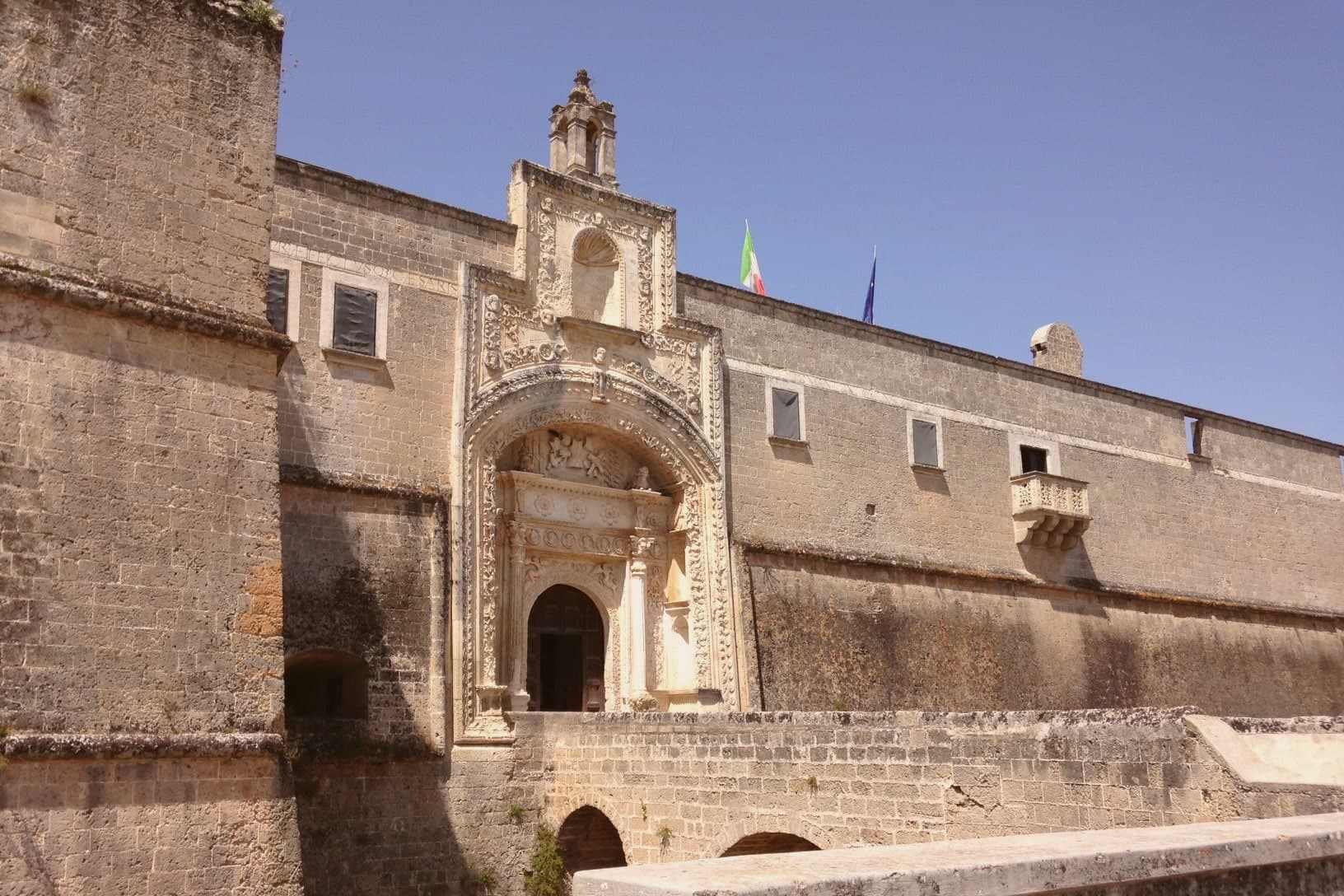
Copertino sits at 34 meters on the Salento plain fifteen kilometers west of Lecce. The fortress at its center was built for Alfonso Castriota, its Renaissance redesign the work of Charles V's fortifications expert, wrapped around an earlier Norman-Angevin keep that still forms the building's core.
That layering, medieval keep inside Renaissance bastion, is the clearest evidence of how the town's defenses grew in stages rather than at one moment. The centro storico gathers everything else the town has to show: the basilica, the monastery, the surviving gates, and the bulk of the castle ramparts, all framing a set of central squares.
The Basilica di Santa Maria ad Nives, dedicated to Our Lady of the Snows, holds the town's other identity, its shrines and objects connect it to the friar born here as Giuseppe Maria Desa, whose ecstatic levitations gave him the name he is known by. Copertino also lies in the heart of the Salice Salentino and Copertino DOC wine zones, so the plain around the walls is agricultural rather than incidental.
A fortress town and a pilgrimage town turn out to be the same walled center, one built for cannon fire, the other for a birth.
What to see in Copertino
- Castello di Copertino. Quadrangular plan built around a Norman-Angevin keep, the older core that Evangelista Menga's redesign absorbed. The ramparts form part of the frame around the central squares.
- Basilica di Santa Maria ad Nives. Mother church of the centro storico, dedicated to Our Lady of the Snows, preserves shrines and testimonies of the saint's life and miracles.
- Santuario di San Giuseppe da Copertino. Sanctuary on the site of the saint's birthplace, with the room where he was born preserved as a chapel, a pilgrimage point on his September feast.
How to get to Copertino
There is a railway station in the town, so you can arrive without a car and never need one while you are here. Taranto is roughly 91 minutes away by road.
Our tip
April through June and September through October are the Salento months: mild light, low humidity, the wine harvest opening in September. July and August reach the high thirties and the Salento plain offers no shade between noon and four; the castle bastions photograph well in late afternoon when the limestone goes orange. The feast of San Giuseppe da Copertino on 18 September is the year's civic peak and packs the basilica and the saint's sanctuary.
Galatina
Why visit Galatina
Galatina sits twenty kilometers south of Lecce on the gentle rise of central Salento, at 78 meters, the third largest center in the province after the capital and Nardò. The Basilica di Santa Caterina d'Alessandria, built between 1383 and 1391 by Raimondello Orsini del Balzo, holds one of the densest fresco cycles in southern Italy, painted by Sienese followers of Giotto after Raimondello's death in 1406.
Tradition has it that Raimondello brought back a finger of Saint Catherine from Mount Sinai, biting it off the relic himself. The town carries a stranger inheritance as well.
The Cappella di San Paolo, beside a well whose water was said to cure tarantula bites, was the closing ritual of tarantism: tarantate were brought here every June 29 to dance out the poison to the rhythm of pizzica. The practice survived into the 1960s and gave the dance its name.
The patronal festa for Santi Pietro e Paolo still fills the streets with tambourines until dawn.
What to see in Galatina
- Basilica di Santa Caterina d'Alessandria. Late-fourteenth-century church built by Raimondello Orsini del Balzo, covered inside with frescoes by Sienese and Giottesque painters, second only to Assisi for fresco volume in Italy.
- Cappella di San Paolo. Small chapel beside the well whose water was held to cure tarantula bites, the closing site of the annual tarantism ritual on June 29.
- Centro storico. Walled old town between three medieval gates, dense with Baroque palazzi and the Chiesa Madre, the historic heart elevated to civitas by Ferdinand IV in 1793.
How to get to Galatina
There is a railway station in the town, so you can arrive without a car and never need one while you are here. Taranto is roughly 105 minutes away by road.
Our tip
April through June is the green window in central Salento, before the heat lands. The big two-day festa for Santi Pietro e Paolo falls on June 28 and 29, when pizzica players fill the streets until sunrise. July and August push past thirty-five degrees and the centro storico empties between two and five.
Nardò
Why visit Nardò
The town sits at 45 meters in the northwestern Salento, about ten kilometers inland from the Ionian coast. With just under 31,000 inhabitants and 190 square kilometers of territory, it is the second-largest commune in the province after the capital.
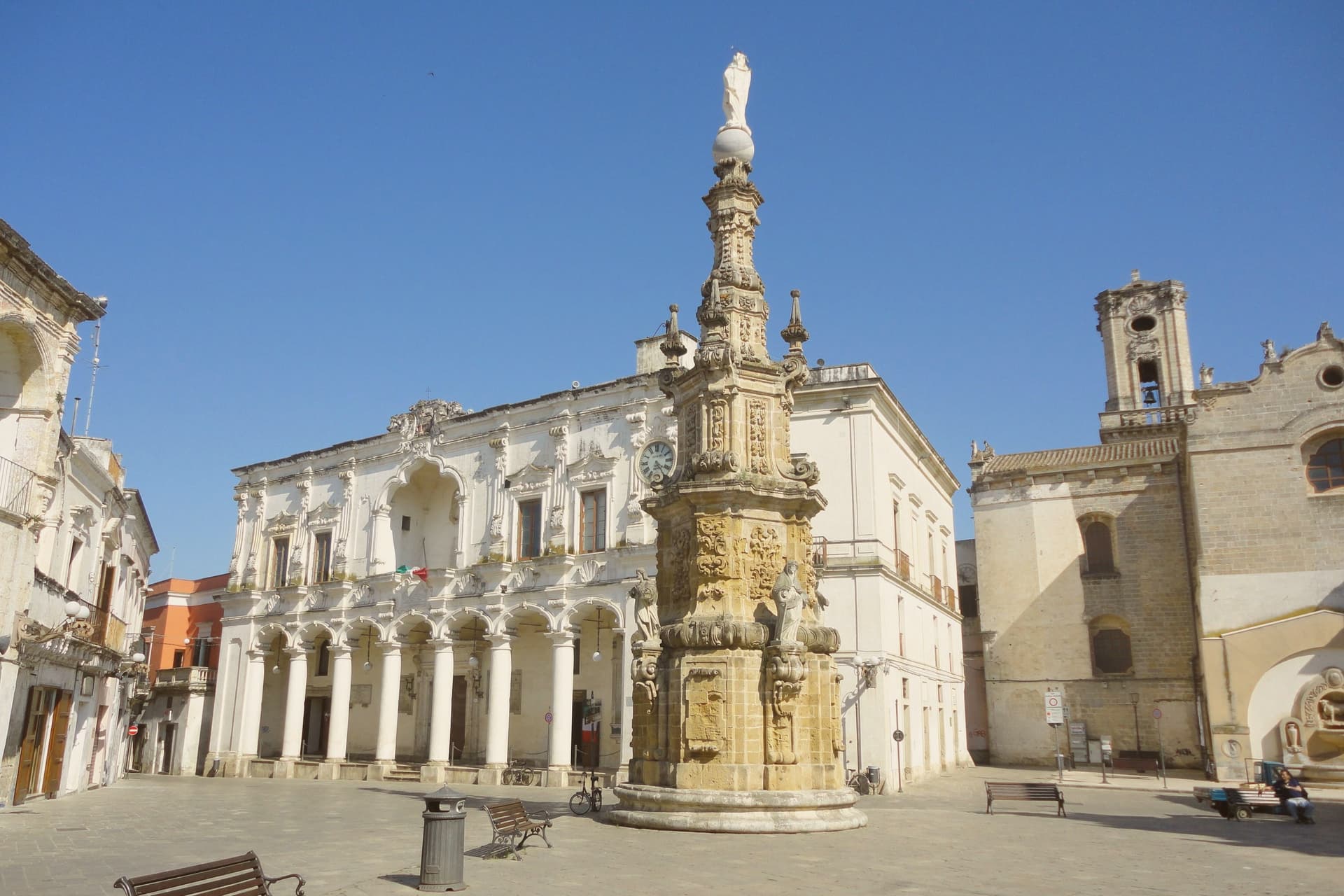
It was a Byzantine stronghold for centuries; in 1497 the dukes of Acquaviva acquired it and turned it into a cultural seat, with universities, academies and literary circles that drew on the same humanist current as Lecce and Gallipoli. The centro storico, built up under that ducal patronage, forms a dense fabric of palaces and church facades in the local pietra leccese, with the castle standing at its edge, now serving as the municipal seat.
Ten kilometers of inland distance separate that historic core from the municipal coastline, where the Porto Selvaggio nature reserve occupies a stretch of Mediterranean pine forest above limestone cliffs, held by the commune as a regional park. Inland seat of government and culture, coastal reserve of forest and cliff: the two halves of the commune's territory answer to different centuries and different purposes, joined only by the ten kilometers between them.
What to see in Nardò
- Piazza Salandra. Central Baroque square of the centro storico, the Guglia dell'Immacolata at its center, ringed by palazzi and church facades in pietra leccese.
- Castello Acquaviva. Aragonese-Acquaviva castle on the edge of the centro storico, residence of the ducal house from 1497, now the municipal seat.
- Cattedrale di Maria Santissima Assunta. Romanesque-Baroque cathedral founded in the eleventh century and remodelled across the seventeenth, with later Baroque facade and bell tower.
How to get to Nardò
There is a railway station in the town, so you can arrive without a car and never need one while you are here. Taranto is roughly 80 minutes away by road.
Our tip
April through June and September through October are the months Nardò is at its best: Baroque facades in raking light, the Porto Selvaggio pine forest cool, the Ionian water warm enough to swim by mid-May. July and August touch thirty-six degrees and the centro storico empties between two and five in the afternoon; the coastal hamlets of Santa Caterina and Sant'Isidoro fill with Lecce families. The Festa di San Gregorio Armeno in mid-February is the local patronal day, the only large winter event.
Lecce
Why visit Lecce
Lecce sits on the Salento plain at 49 meters above sea level, twelve kilometers inland from the Adriatic, the provincial capital. The Messapian settlement of Lupiae stood on this site by the eighth century BC.
Rome took it in the third century BC, and Hadrian later moved the settlement three kilometers away and renamed it Licea, so the modern city occupies a site distinct from either of its named predecessors. The walled centro storico is ringed by Charles V's fortifications, entered from the north through the Porta Napoli arch and anchored on its eastern edge by his castle, built over older Norman foundations.
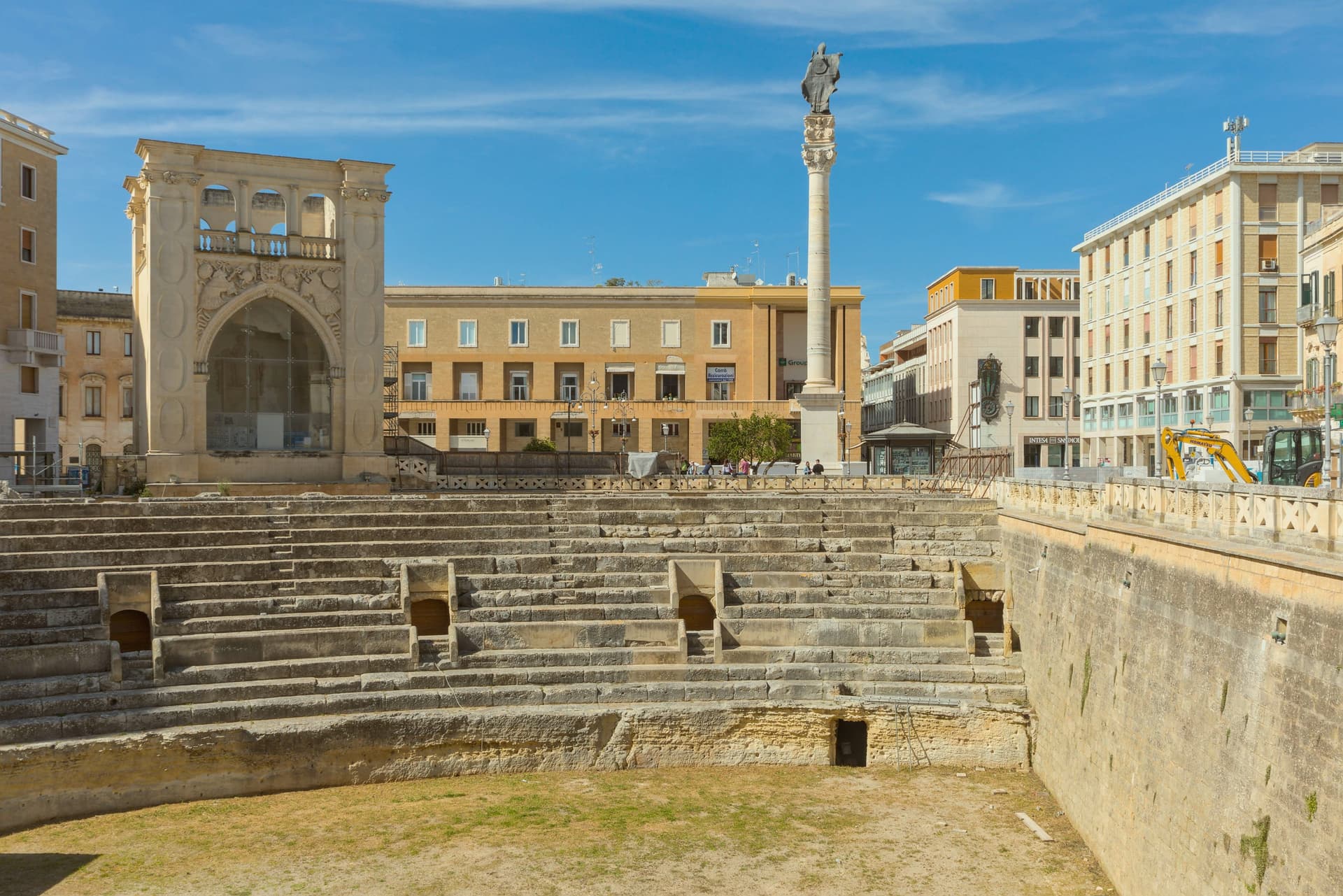
Within those walls the Baroque churches and squares sit close together, the cathedral square closed in on three sides while the amphitheater lies open and half-sunk in the middle of the newer square that formed around it. The University runs a strong humanities program, and the seafront at San Cataldo, some distance from the old center, carries Lecce's Bandiera Blu.
What holds the town together is the stone itself: soft enough to carve finely, hard enough once cut to last, so that a Messapian and Roman settlement site became, centuries later, the surface on which the south's most elaborate Baroque was cut.
What to see in Lecce
- Basilica di Santa Croce. Worked for nearly two hundred years to completion in 1695, the façade carved with cherubs, monsters and allegories layered so densely that the wall surface almost disappears beneath them.
- Piazza del Duomo. Closed on three sides, the only enclosed cathedral square of its kind in Puglia, gathering the Duomo, Campanile, Bishop's Palace and Seminary into one shared courtyard rather than an open street front.
- Piazza Sant'Oronzo. The city's central square, built around a column brought from the Appian Way to honor the patron saint, with the excavated amphitheater floor sitting below street level at its edge.
How to get to Lecce
There is a railway station in the town, so you can arrive without a car and never need one while you are here. Taranto is roughly 95 minutes away by road.
Our tip
April through June is the green window in inland Salento, with the centro storico walkable in the day and aperitivo on Piazza Sant'Oronzo running late. July and August push past thirty-five degrees and the city empties at midday; the Notte della Taranta in nearby Melpignano, the closing concert of the Salento pizzica festival, falls in late August and draws over a hundred thousand. September and October cool back down for the olive harvest. Festa di Sant'Oronzo falls in August.