
The prettiest villages that eat well in Friuli-Venezia Giulia
Friuli-Venezia Giulia sits where the Alps come down to meet the Adriatic, and the food changes with every valley. There is frico, the fried cheese and potato disc, gnocchi filled with plums in late summer, cjarsons in the Carnia mountains, prosciutto cured in the air around San Daniele, and white wine from the Collio that people who care about Italian whites talk about first. The villages are built from river stone and pale Karst limestone, with Austrian and Slovene edges to the rooflines and the vocabulary. Autumn is the season here, when the vineyards turn and the osterie start serving game and polenta.
The visitor traffic concentrates on Trieste and the coast around Grado, and it is understandable: the Habsburg cafes, the Miramare castle above the water, the seafood along the lagoon. Udine takes the overflow, and the Collio wine road takes what is left, particularly at harvest. All of it is worth going to. None of it is quiet in September, and the tables that matter get booked long before you arrive.
The hills and the mountains carry on well past the wine road, north into Carnia and west into the Pordenone foothills, and the cooking carries on with them. The villages here are smaller, the dining rooms fewer, and the assessment that judged them beautiful looked at their stone and their setting rather than their footfall. Fewer people go, which is the point.
Of the 26 communes we have mapped in Friuli-Venezia Giulia, 6 qualify as prettiest villages that eat well: each has passed the national assessment of Italy's most beautiful villages, and a dining guide has named a table in each. The smallest, Frisanco, has 572 residents.
Two more lists worth reading alongside this one: The best hill towns that eat well in Friuli-Venezia Giulia and The 9 best towns with a serious restaurant in Friuli-Venezia Giulia.
Why visit Frisanco
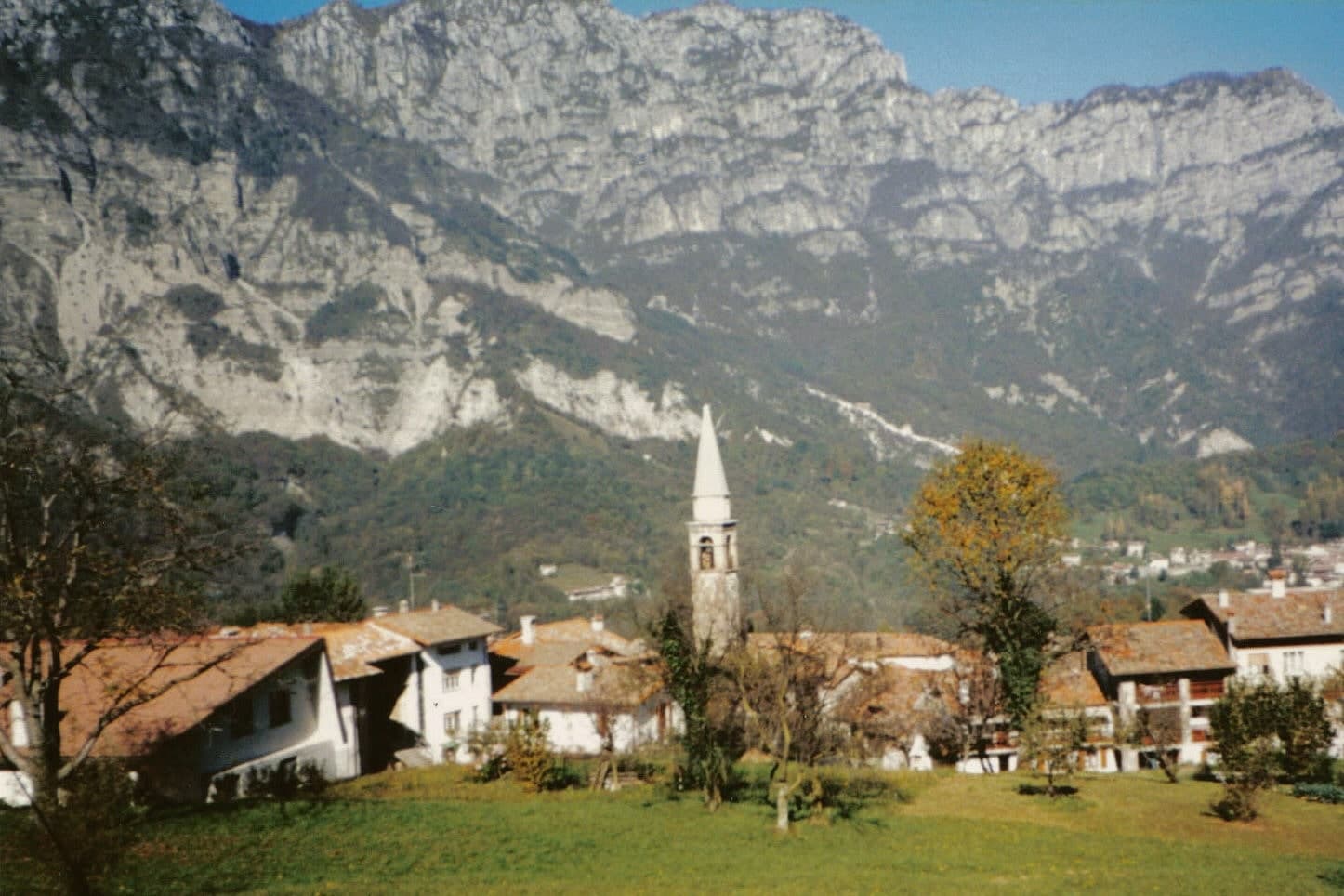
Frisanco sits at 415 meters in the Val Colvera, a side valley of the Cellina that cuts north from the Pordenone plain into the Carnian Prealps. The commune holds 572 residents across four hamlets, of which Poffabro, at 525 meters, is the one that draws visitors.
The painter Armando Pizzinato called Poffabro the most rational example of spontaneous architecture in the Friulian Prealps: three-storey stone houses with wooden ballatoi running the full length of each upper floor, arched porticoes at ground level, and roofs of split larch. The town burned in 1606, taking the public archive with it, and rebuilt in the same vernacular.
Inquisition records from 1648 to 1650 describe Frisanco as a nido di streghe, a witches' nest. The presepi tradition has run since 1997: every December, residents place nativity scenes in windows, niches, and courtyards across Poffabro, and the village fills with visitors from late November through Epiphany.
The Parco Naturale Dolomiti Friulane begins at the village edge.
Osteria da Cippi have been named by a guide.
What to see in Frisanco
- Borgo di Poffabro. Frazione at 525 meters with three-storey stone houses, wooden ballatoi running across each floor, and arched ground-floor porticoes, classed Borghi più belli.
- Chiesa di San Nicolò. Parish church at the head of Poffabro's main street, mentioned as early as 1492, with an eighteenth-century facade and a single nave.
- Parco Naturale Dolomiti Friulane. Regional park bordering the commune, with trails into Monte Raut, the Cellina gorges, and the Val Cimoliana on the Veneto side.
How to get to Frisanco
Udine is roughly 68 minutes away by road.
Our tip
April through October is the open season for Frisanco. The Val Colvera trails dry out by April and the Dolomiti Friulane park is walkable into October. July and August can push past twenty-eight degrees in the valley, though the village stays cooler than the Pordenone plain below.
Why visit Sappada
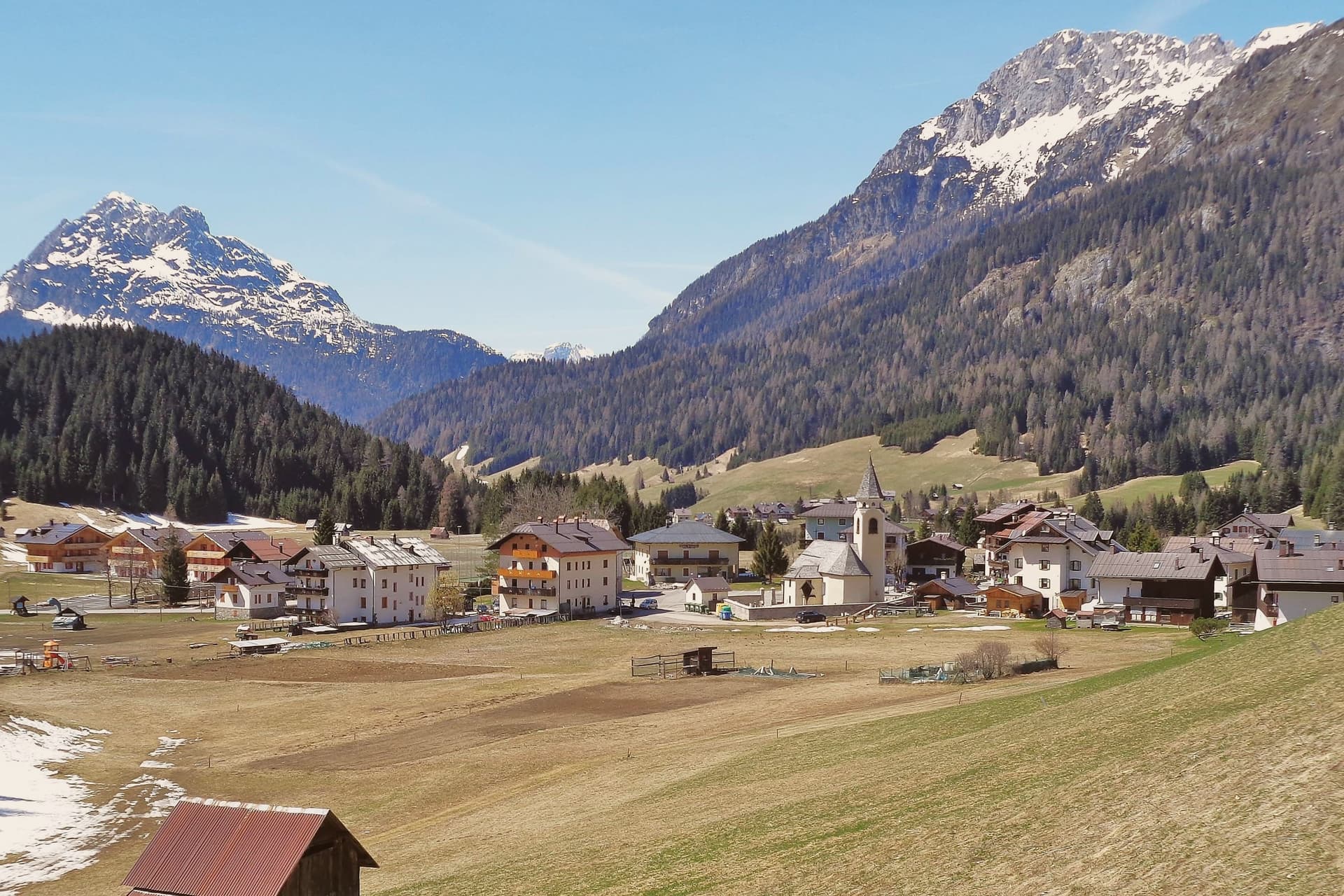
Sappada sits in the upper Piave valley, on the seam between Cadore, Carnia, and East Tyrol. Fifteen borgate are strung along the road between 1,250 and 1,290 meters, among them Mühlbach, Bach, and Hoffe, forming the oldest surviving German-speaking enclave south of the main Alpine ridge.
Settlers crossed the watershed from the Villgraten valley under the Patriarchate of Aquileia, and the dialect they carried is still spoken at home. The river that flows past Treviso and Venice begins as snowmelt above the village, in an enclosed basin reached by a path through pasture.
Sappada belonged to Veneto until 2017, when a referendum moved it into Friuli-Venezia Giulia, a late administrative shift for a place whose deeper affiliations run north toward East Tyrol rather than south toward the Veneto plain. The borgate hold the vernacular, the peak above the valley holds the border views, and the village below ties the two together: a mountain settlement whose language, houses, and geography all point away from the region it now belongs to on paper.
Laite, Mondschein have been named by a guide.
What to see in Sappada
- Sappada Vecchia. Cluster of borgate at the upper end of the village, with seventeenth-century larch-wood houses on stone bases, the best-preserved East Tyrolean vernacular.
- Sorgenti del Piave. An hour's walk up the Val Sesis through pasture and a small votive chapel, ending at the enclosed basin where the river surfaces.
- Monte Peralba. 2,694-meter peak above the Val Sesis, with via ferrata routes, a Franz Joseph chapel near the summit, and views into Austria and Cadore.
How to get to Sappada
Udine is roughly 93 minutes away by road.
Our tip
December through March is one of the two main seasons. The Sappada 2000 lifts run from late November to Easter, the 22 kilometers of pistes hold snow longer than the lower Carnian resorts, and the Plodar Vosenocht carnival runs on three Sundays before Lent. June through September is the second season: the Sorgenti del Piave walk opens, Monte Peralba's via ferrata clears of snow, and the borgate stay cool even when the Veneto plain bakes.
Why visit Fagagna
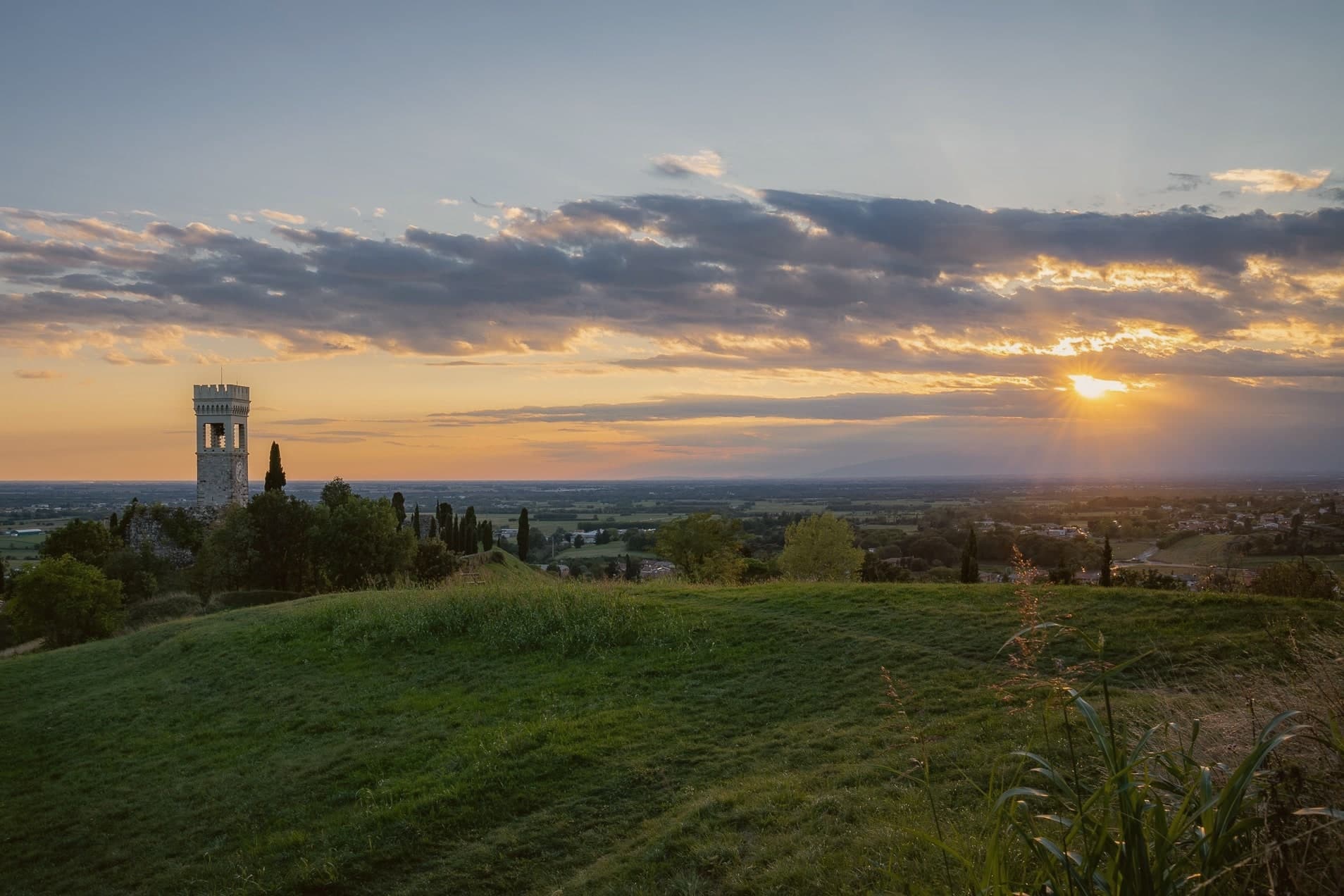
Fagagna, Friulian Feagne, sits at 177 meters on the morainic hills thirteen kilometers northwest of Udine. The hill has been strategic since Roman times, and the castle passed to the Patriarch Rodoaldus as part of the 983 donation.
What remains today is scattered rather than whole: a stretch of wall, the Borgo gate, the clock-tower converted into a bell tower, the ruined keep, a fourteenth-century house, and the small church tucked inside the old walls. The four boroughs, Centro, Palûd, Pic, and Riul, each keep a colour and a stake in the town's identity that surfaces once a year in the piazza, and otherwise define the town's internal geography more than its street plan does.
A regional nature reserve on the edge of town gives Fagagna a second, unrelated distinction alongside its medieval fragments. The town has been a member of Borghi più belli d'Italia since 2007.
Between the broken castle, the annual race, and the ibis reserve, the town reads less as one attraction than as several small, unconnected reasons to stop, each surviving on its own terms.
San Michele have been named by a guide.
What to see in Fagagna
- Castello di Fagagna. What survives is fragmentary: wall fragments, the Borgo gate, and the clock-tower, the visible remnant of the donated fortress.
- Chiesa di San Michele Arcangelo. Small castle chapel inside the original walls, one of the surviving medieval structures from the patriarchal period.
- Oasi dei Quadris. Regional wetland reserve where the ibis colony nests and feeds, set in the countryside outside the built-up center.
How to get to Fagagna
Udine is roughly 20 minutes away by road.
Our tip
April through October is the working window. May and June bring the morainic hills at their greenest; the Oasi dei Quadris is busiest with ibis breeding and visiting birders. July and August get hot, though the elevation keeps nights cooler than Udine on the plain. Sagrute di Vilalte falls in July.
Why visit Gradisca d'Isonzo
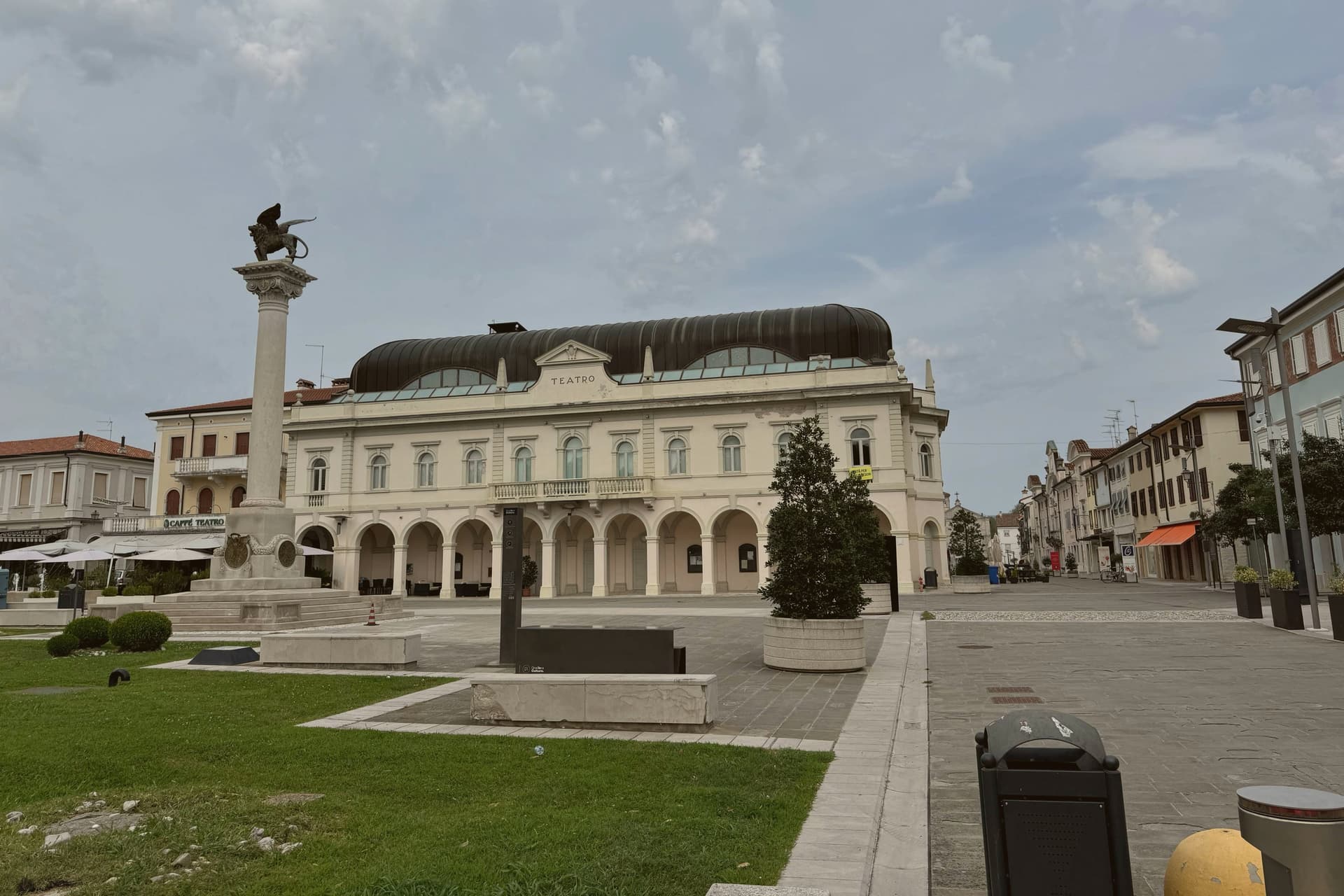
Gradisca d'Isonzo sits at 32 meters on the right bank of the Isonzo, ten kilometers downriver from Gorizia. The Venetian Republic built it from scratch starting in 1479 as a frontier bastion against Ottoman raids that had reached Friuli the previous decade.
The fortification consumed twenty years and the advice of Leonardo da Vinci, sent here by the Senate in 1500 to redesign the artillery defenses. The result was a walled town twenty meters high, ringed by seven towers and a wide moat, with the river itself diverted into the defenses.
Maximilian I took it for the Habsburgs in 1511 during the War of the League of Cambrai, and it stayed in Austrian hands as the seat of the Principesca Contea di Gorizia e Gradisca for the next four centuries. The town that grew inside the walls is Baroque: the Palazzo Torriani, the Loggia dei Mercanti, the Casa de Fin, all built under the Habsburgs.
Casanova passed through in 1773. Today the walls, towers, and grid still hold.
Meja dell'Hotel Franz have been named by a guide.
What to see in Gradisca d'Isonzo
- Fortezza Veneziana. Walled town from 1479, twenty meters high, ringed by seven towers and a wide moat, designed in part by Leonardo da Vinci in 1500.
- Torre di San Giorgio. Northwest bastion tower of the Venetian wall, the most complete of the seven and the symbol of the borgo.
- Palazzo Torriani. Sixteenth-century palazzo of the Della Torre family, later the residence of the Austrian Capitano, now the Town Hall on Via Roma.
How to get to Gradisca d'Isonzo
There is a railway station in the town, so you can arrive without a car and never need one while you are here. Udine is roughly 34 minutes away by road.
Our tip
April through June and September into October are the best months for Gradisca. The Isonzo runs blue-green from the Julian Alps snowmelt, the cycle path along the river opens, and the Saturday market fills the Spianata. July and August bring the heat the Friuli plain is known for, often above thirty-three degrees with high humidity, and the centro storico empties from two until six.
Why visit Cividale del Friuli
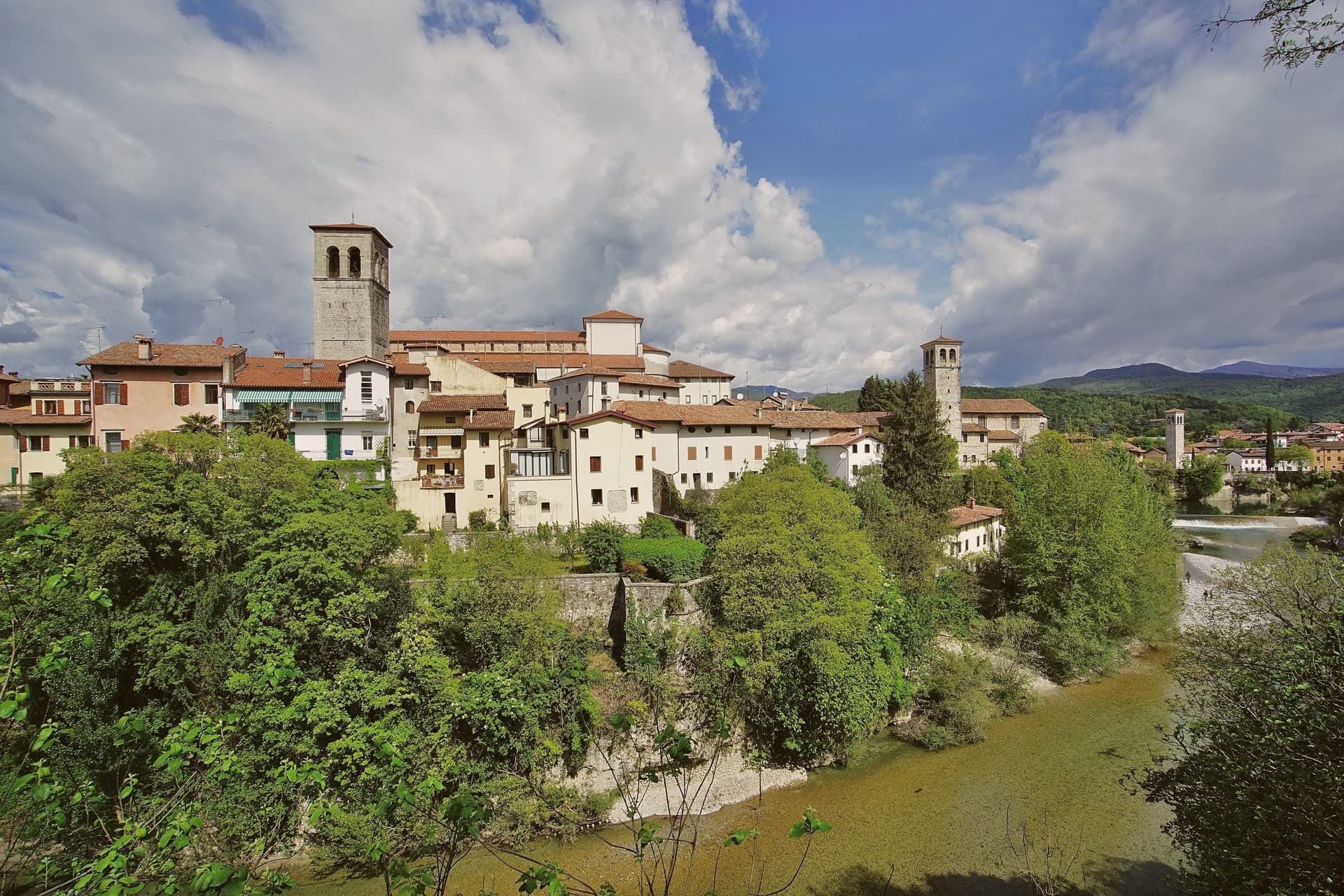
Cividale del Friuli sits at 138 meters on the right bank of the Natisone, fifteen kilometers from Udine and close enough to the Slovenian border that the river marks it. Julius Caesar founded the place as Forum Iulii in the first century BC, the name that eventually gave Friuli its own.
In 568 the Lombard king Alboin made it the capital of his first Italian duchy, and the Patriarchate of Aquileia later moved its seat here for four centuries. The Tempietto Longobardo, an eighth-century palatine chapel, holds six stucco female saints carved around 760, the best-preserved sculpture of the Lombard age in Europe.
It is one of seven sites in the UNESCO serial nomination Longobardi in Italia. The Ponte del Diavolo, begun in 1442, spans the Natisone gorge in two asymmetrical arches.
The Palio di San Donato fills the streets in late August, and Mittelfest brings Central European theater and music to the piazzas every July.
Al Monastero have been named by a guide.
What to see in Cividale del Friuli
- Tempietto Longobardo. Eighth-century palatine chapel in the Monastero di Santa Maria in Valle, with six stucco female saints in high relief, UNESCO-listed since 2011.
- Ponte del Diavolo. Stone bridge over the Natisone gorge, begun in 1442 on two asymmetrical arches resting on a central rock outcrop.
- Duomo di Santa Maria Assunta. Fifteenth-century cathedral with the Pala di Pellegrino II, a twelfth-century gilded silver altarpiece, and an attached Museo Cristiano.
How to get to Cividale del Friuli
There is a railway station in the town, so you can arrive without a car and never need one while you are here. Udine is roughly 26 minutes away by road.
Our tip
April through June and September into October are the months when the Natisone valley shows best, with green hills, mild evenings, and the Slovenian border country open for walking. July brings Mittelfest and August the Palio di San Donato, so the centro storico fills with theater crowds and historical pageant. Both months can push past thirty degrees, though 138 meters of elevation and the river keep nights cooler than the Friulian plain. Palio di San Donato falls in August.
Why visit Spilimbergo
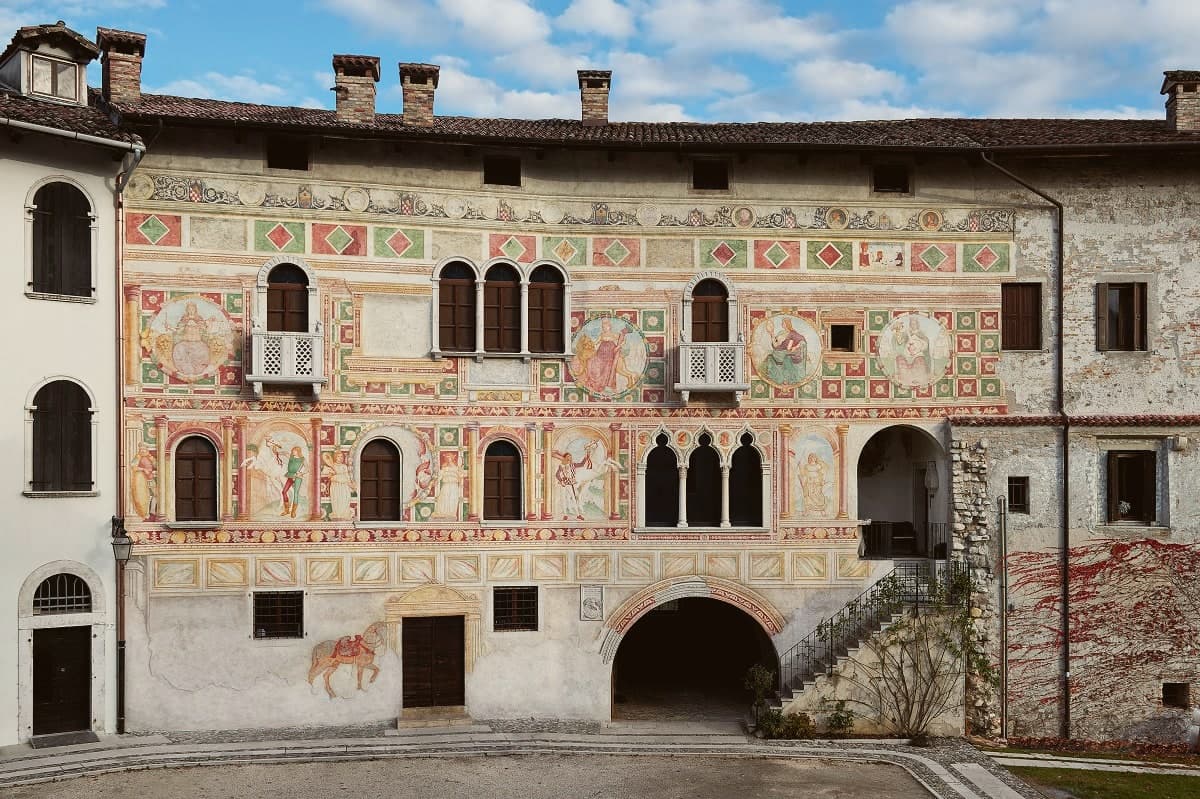
Spilimbergo takes its name from the castrum de Spengenberg, built by Carinthian counts who came south as vassals of the Patriarch of Aquileia. Their fortress anchors one end of a centro storico that reads as a sequence of additions: the Romanesque-Gothic cathedral raised through the fourteenth century, the painted palace that later hosted Charles V, Bona Sforza, and Henry III of France, and Corso Roma running between frescoed palazzi to the old market stone still used to measure trade.
The Scuola Mosaicisti, founded in 1922, is the newest of these layers but the one that has carried the town's name furthest, its alumni's work turning up in the Library of Congress, the Holy Sepulchre, the Foro Italico, and the World Trade Center transit hub. The Folkest folk-music festival runs every July, and the town carries Borghi più belli and Borgo dei Borghi finalist recognition.
Outside it, the Tagliamento broadens into the braided, three-kilometer bed that gives the town its setting on the right bank. A place, in sum, where a medieval frontier post and a twentieth-century craft school have ended up equally responsible for putting Spilimbergo on a map.
Osteria da Afro, La Torre have been named by a guide.
What to see in Spilimbergo
- Castello di Spilimbergo. Eleventh-century fortress of the Spengenberg counts, burned in the 1511 popular revolt and partially rebuilt; the palace with the painted façade survived.
- Palazzo Dipinto. The frescoes cover prancing horses, ladies, pages, and figures of the Theological and Cardinal virtues across the fifteenth-century façade.
- Duomo di Santa Maria Maggiore. Romanesque-Gothic cathedral begun in 1284 by count Walterpertoldo II, with apse frescoes executed between 1350 and 1359.
How to get to Spilimbergo
Udine is roughly 39 minutes away by road.
Our tip
April through June is the season for the Tagliamento gravel beds and the Bellunello frescoes; the light catches the Palazzo Dipinto best in the late afternoon. Folkest fills the piazzas with folk musicians from across Europe through early July. August is hot and the centro storico empties between two and five. Istrago in Festa falls in the season.
More from Anywhere Italy
- The best hill towns that eat well in Friuli-Venezia Giulia
 The 9 best towns with a serious restaurant in Friuli-Venezia Giulia
- The best hill towns in Friuli-Venezia Giulia
- The best towns you can reach by train that eat well in Friuli-Venezia Giulia
- The prettiest small villages in Friuli-Venezia Giulia
- The prettiest villages in the province of Pordenone