
The prettiest villages in the province of Pordenone
The province of Pordenone sits where the Friulian plain runs out and the prealps begin, and the building material changes as you climb: brick and pale Venetian stucco around the moated villas of the lowlands, rough river stone and wooden balconies in the valleys behind Piancavallo. Water is everywhere here, in resurgence springs that stay cold through August, in the Livenza rising clear from a cave mouth, in the wide white gravel of the Tagliamento. The food follows the same line, frico and polenta and cured pork in the hills, freshwater fish and pitina in the valleys, glasses of Friuli Grave refosco and a good deal of local white. Late spring and September are the kindest months, when the mosaic courtyards are warm and the mountain roads are clear.
Most visitors to Friuli Venezia Giulia head for Trieste and the karst above it, or for the Roman floors of Aquileia and the beach at Grado, and the coach parks fill accordingly. Udine takes the rest, its Venetian squares busy through the summer. Pordenone province tends to be crossed rather than stopped in, a stretch of motorway between Veneto and the border.
The same rivers, hills and tables continue west of Udine, and that is where these villages are. Each has been assessed and admitted by the national association of Italy's most beautiful villages, which means walled centres, abbey frescoes, mosaic schools and stone hamlets under the mountains, with far fewer people looking at them.
Of the 7 communes we have mapped in the province of Pordenone, 6 qualify as prettiest villages: each has passed the assessment of the national association of Italy's most beautiful villages. The smallest, Frisanco, has 572 residents.
If you are still choosing, we have also written The best hill towns in Friuli-Venezia Giulia and The 9 best towns with a serious restaurant in Friuli-Venezia Giulia.
Frisanco
Why visit Frisanco
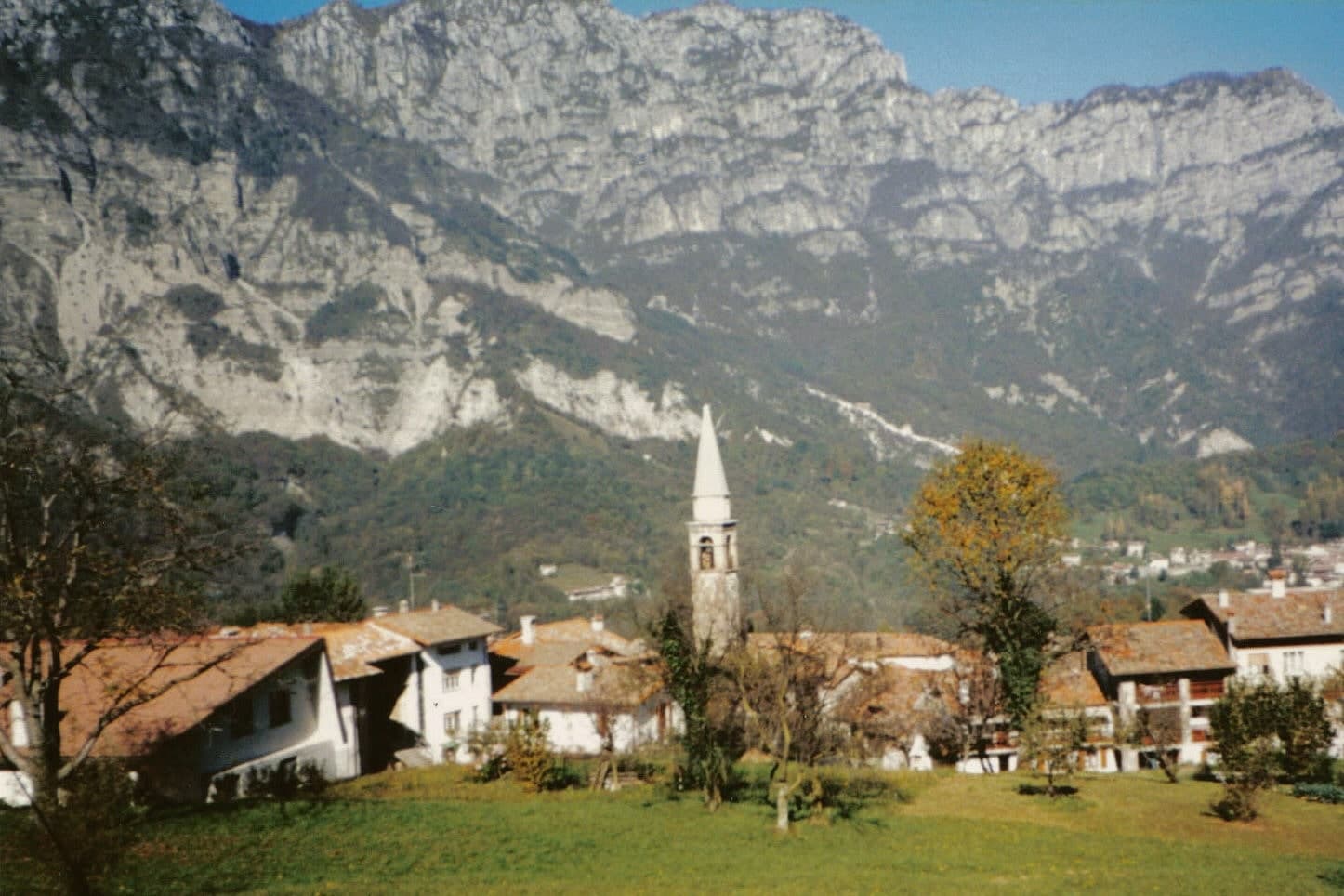
Frisanco sits at 415 meters in the Val Colvera, a side valley of the Cellina that cuts north from the Pordenone plain into the Carnian Prealps. The commune holds 572 residents across four hamlets, of which Poffabro, at 525 meters, is the one that draws visitors.
The painter Armando Pizzinato called Poffabro the most rational example of spontaneous architecture in the Friulian Prealps: three-storey stone houses with wooden ballatoi running the full length of each upper floor, arched porticoes at ground level, and roofs of split larch. The town burned in 1606, taking the public archive with it, and rebuilt in the same vernacular.
Inquisition records from 1648 to 1650 describe Frisanco as a nido di streghe, a witches' nest. The presepi tradition has run since 1997: every December, residents place nativity scenes in windows, niches, and courtyards across Poffabro, and the village fills with visitors from late November through Epiphany.
The Parco Naturale Dolomiti Friulane begins at the village edge.
What to see in Frisanco
- Borgo di Poffabro. Frazione at 525 meters with three-storey stone houses, wooden ballatoi running across each floor, and arched ground-floor porticoes, classed Borghi più belli.
- Chiesa di San Nicolò. Parish church at the head of Poffabro's main street, mentioned as early as 1492, with an eighteenth-century facade and a single nave.
- Parco Naturale Dolomiti Friulane. Regional park bordering the commune, with trails into Monte Raut, the Cellina gorges, and the Val Cimoliana on the Veneto side.
How to get to Frisanco
Udine is roughly 68 minutes away by road.
Our tip
April through October is the open season for Frisanco. The Val Colvera trails dry out by April and the Dolomiti Friulane park is walkable into October. July and August can push past twenty-eight degrees in the valley, though the village stays cooler than the Pordenone plain below.
Cordovado
Why visit Cordovado
Cordovado lies at 15 meters in the alluvial plain southeast of Pordenone, twenty kilometers from the sea. The name comes from Curtis de Vado, the agricultural court built near a ford on a now-vanished branch of the Tagliamento.
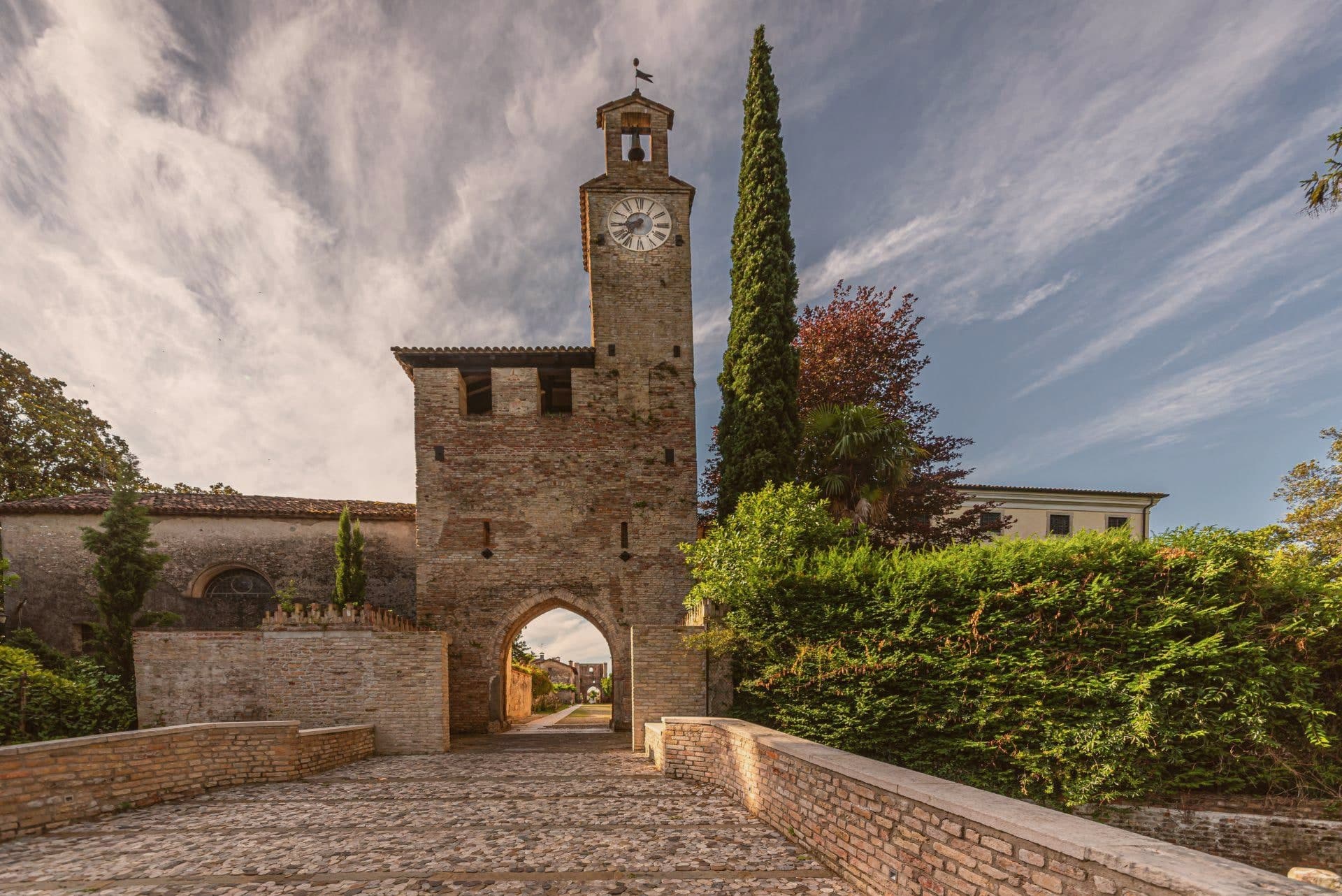
The bishops of Concordia, who also held the title of marquises of Cordovado, fortified the court in the eleventh and twelfth centuries and made it their plain castle and summer residence, the seat of civil, military, and ecclesiastical power. The medieval walls and two gate towers still ring the borgo.
The castle inside was last fully described in 1856, before being partly demolished. The Santuario della Madonna delle Grazie, built in 1603 on the site of a 1592 Marian apparition, has an octagonal plan and a carved gilded ceiling by Cataldo Ferrara from 1656.
Ippolito Nievo set parts of Confessions of an Italian here in the 1850s; Pier Paolo Pasolini later wrote about the village. Twenty-three public fountains run on spring water across the territory.
What to see in Cordovado
- Castello di Cordovado. Medieval castle of the bishops of Concordia inside the walled borgo, with two surviving gate towers and a residential courtyard.
- Santuario della Madonna delle Grazie. Baroque sanctuary built in 1603 with an octagonal plan and a carved gilded ceiling by Cataldo Ferrara from 1656-1658.
- Borgo medievale. Walled medieval nucleus with two gate towers, civic houses, and the bishops' residential complex inside the original perimeter.
How to get to Cordovado
Udine is roughly 46 minutes away by road.
Our tip
April through June and September through October are the workable months. The plain warms early; April and May bring green fields and the irrigation springs at their clearest. July and August are humid and still, with summer thunderstorms breaking over the Pordenone lowlands and mosquitoes thick along the ditches. Cordovado Medievale falls in the season.
Polcenigo
Why visit Polcenigo
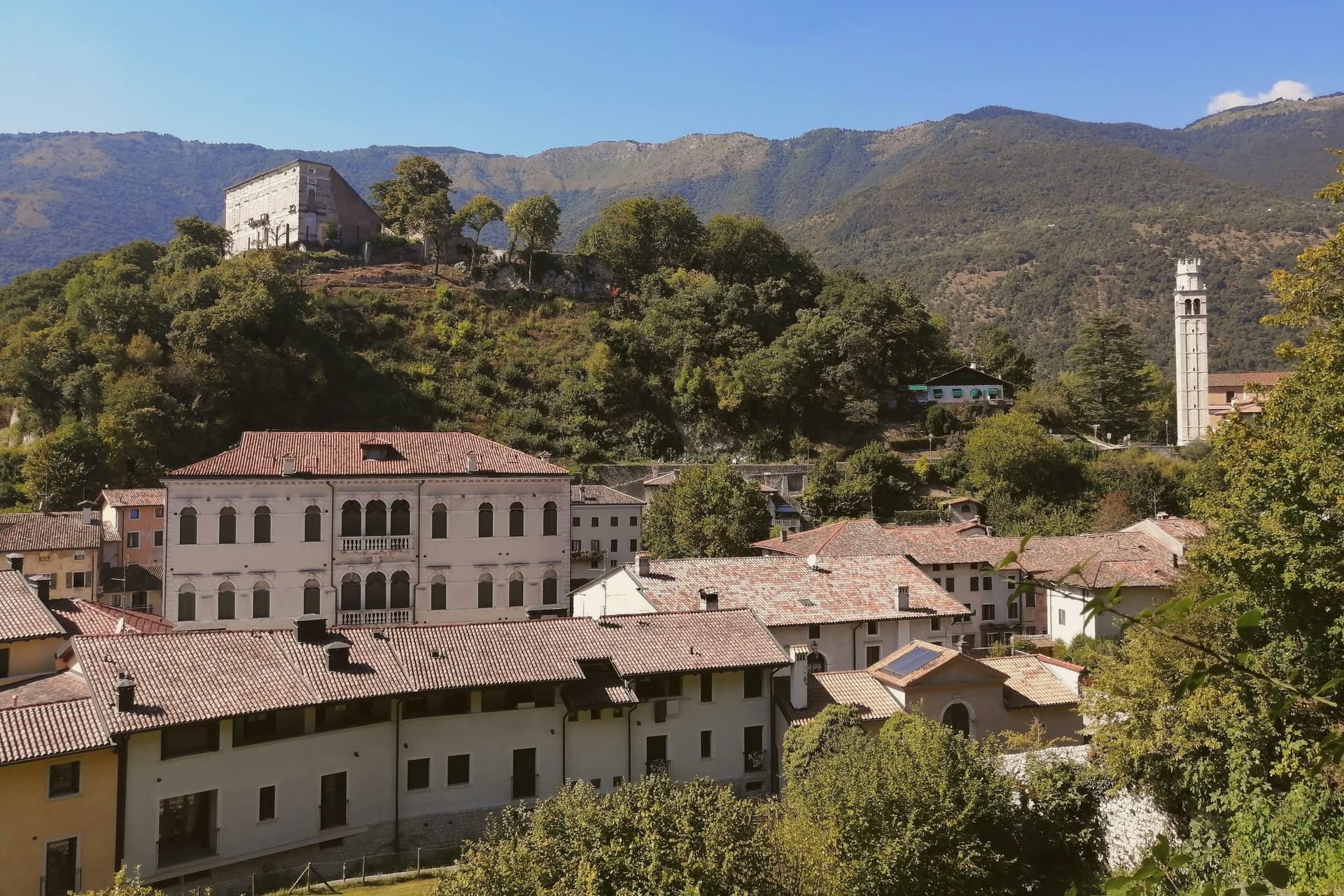
Polcenigo sits at 40 meters on the slopes of the Western Carnic Prealps, where the limestone aquifer of the Cansiglio plateau surfaces in clear-water springs. The Livenza river begins here at the Santissima spring; a second resurgence, the Gorgazzo, holds an intense blue pool that drops past 212 meters, the deepest explored spring in Italy.
Two kilometers from the centro storico, the Palù di Livenza was inhabited from the early Paleolithic; the Neolithic pile-dwelling settlement on its wetlands was inscribed in the UNESCO Prehistoric Pile Dwellings around the Alps in 2011. The village above the springs grew up around the castle of the Polcenigo counts; the Parco di San Floriano on the hill behind is the only rural park in Italy.
Borgo Creativo Polcenigo, a network of artisan workshops, has worked since the 2010s to keep the trades alive. The annual Sagra dei Sest, the wicker-basket fair every first Sunday of September, is the village's marker.
What to see in Polcenigo
- Palù di Livenza. Neolithic pile-dwelling site occupied since 4900 BC, inscribed on the UNESCO Prehistoric Pile Dwellings around the Alps list in 2011.
- Sorgente del Gorgazzo. Blue-water spring pool, the deepest explored Italian spring at -212 meters, reached by speleonaut Luigi Casati in 2008.
- Sorgenti della Livenza. Karst resurgence at Santissima where the Livenza river is born; navigable within meters of its source.
How to get to Polcenigo
Venezia is roughly 78 minutes away by road.
Our tip
April through October is the working window, though Polcenigo runs longer than most because the springs do not freeze. May and June are the best months at the Gorgazzo, when the pool shows its strongest blue and the surrounding woods are at their greenest. July and August are humid in the lowland and hot at midday; the springs themselves stay cold and locals swim. Ancient Basket Fair falls in September.
Valvasone Arzene
Why visit Valvasone Arzene
Valvasone Arzene is a 2015 merger of Valvasone and Arzene, on the right bank of the Tagliamento, fifteen kilometers east of Pordenone. The Friulian name is Voleson Darzin.
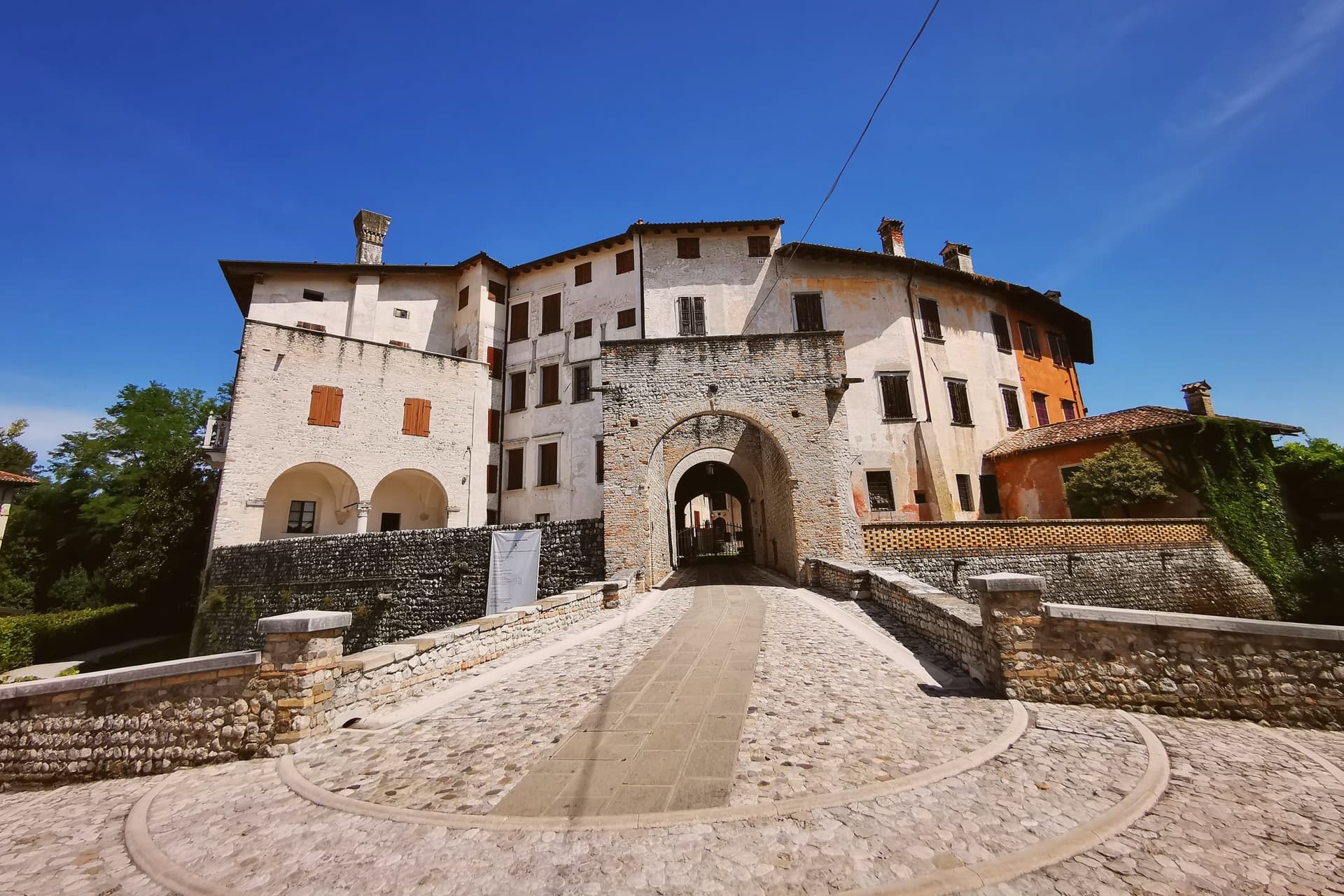
Medieval Valvasone formed around the ford that crossed the river before bridges existed, and the settlement's layout follows from that crossing point rather than from any planned design. The old town kept its street pattern almost intact over the centuries, which is what a visiting body of experts recognized when it named the commune to Borghi più belli d'Italia: not one monument but the whole surviving fabric, castle and church and streets together, arranged around the point where the ford once stood.
Pier Paolo Pasolini taught at the Valvasone middle school from 1947 to 1949 and called the borgo a city of silence in his 1947 prose, before a scandal cost him both job and Communist Party membership. What holds the town together, in the end, is the river: it gave the original settlement its reason to exist at that spot, it still marks the commune's eastern edge, and it remains one of the last stretches of its kind in the Alps, largely unaltered while the borgo around it changed hands, mergers, and centuries.
What to see in Valvasone Arzene
- Castello di Valvasone. The frescoed rooms sit above painted cantinelle and stuccoes, with a small eighteenth-century chamber theater tucked into the same fabric, medieval walls carrying a full sixteenth-century decorative program inside.
- Duomo del Santissimo Corpo di Cristo. The organ by Vincenzo Colombi still plays inside a parish church whose shutters, painted by Pordenone and Amalteo, close over the pipes when the instrument is silent.
- Centro storico. The medieval street pattern of the old ford town survives largely as laid out, the density and layout that put the commune on the Borghi più belli d'Italia list rather than any single building.
How to get to Valvasone Arzene
Udine is roughly 46 minutes away by road.
Our tip
April through June is the working window before the Tagliamento plain humidity sets in. Late September and October return the borgo to clear evenings and golden light along the riverbank. July and August are hot and muggy, weather imported wholesale from the Po Valley plain to the south, with mosquito-heavy dusks.
Sesto al Reghena
Why visit Sesto al Reghena
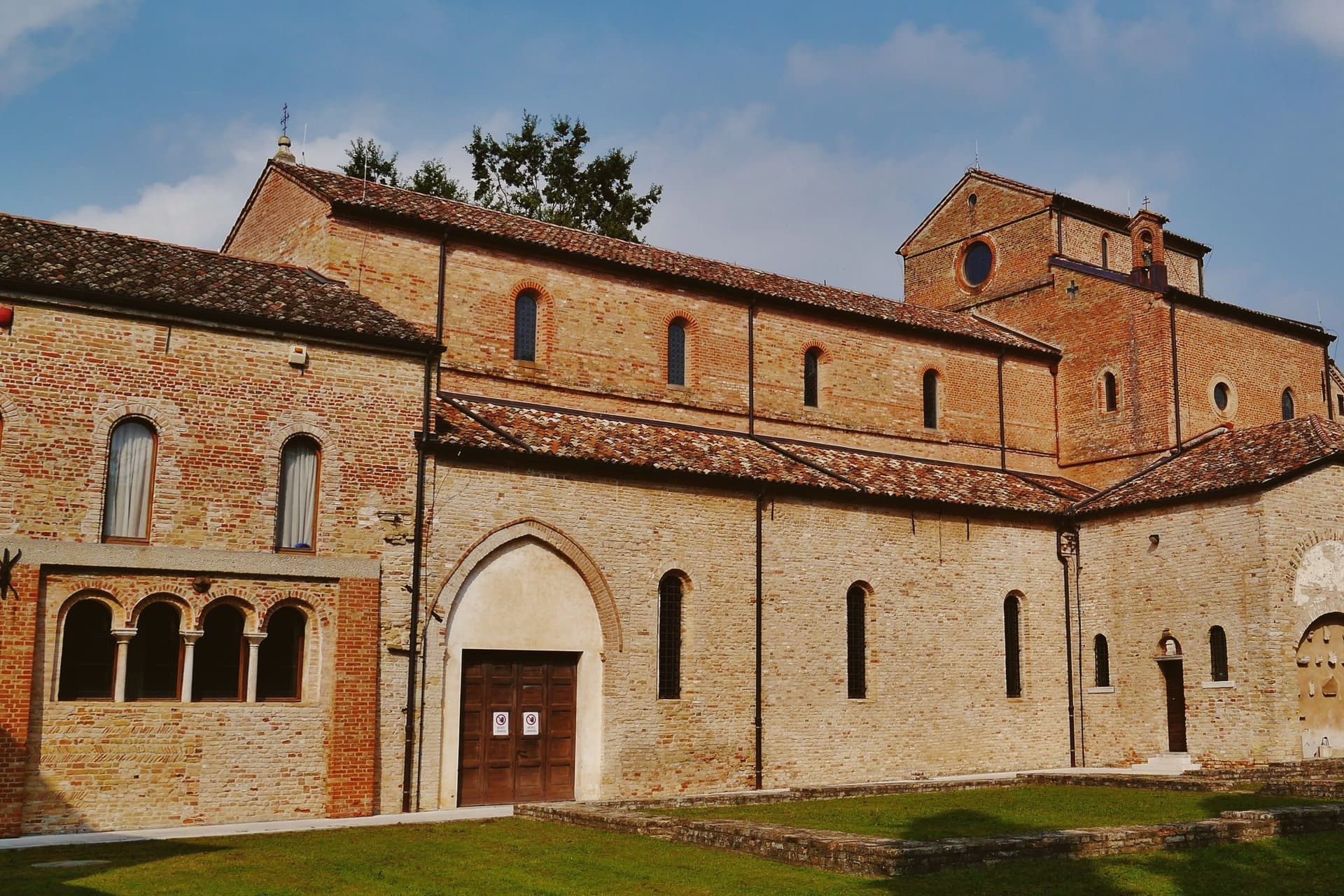
Sesto al Reghena sits at 13 meters on the Friuli-Venetian plain, between the Tagliamento and the Reghena, a small river bordered by linden trees that runs through the centro. The name records the sixth Roman mile out of Concordia Sagittaria on the road to Iulia Augusta.
The town is one place: the Abbazia di Santa Maria in Sylvis, founded by the Lombard nobles Erfo, Marco, and Anto between 730 and 735, occupied by Benedictines until 762, sacked by a Magyar raid in 899, and refortified with walls and a moat in the tenth century. The abbey crypt is supported by twenty columns, several of them Roman spolia.
At the center stands the Urn of St. Anastasia, a single block of Greek marble carved by Cividale masters in the eighth century, with rose, cross, and arched motifs.
The abbey complex is the current town hall, the only commune in Italy headquartered inside a fortified Benedictine monastery. In Friulian, the village is called Siest.
What to see in Sesto al Reghena
- Abbazia di Santa Maria in Sylvis. Eighth-century Benedictine abbey, refortified after the 899 Magyar sack, with a crypt of twenty columns and Carolingian-era frescoes; now the town hall.
- Urna di Sant'Anastasia. Single block of Greek marble in the abbey crypt, carved by Cividale masters in the eighth century with roses, crosses, arches, and rosettes.
- Torre Grimani. Surviving gate-tower of the medieval abbey defenses, named for the Venetian commendatory abbots who held the monastery in the sixteenth century.
How to get to Sesto al Reghena
There is a railway station in the town, so you can arrive without a car and never need one while you are here. Udine is roughly 53 minutes away by road.
Our tip
April through June and September into October are the months Sesto reads best. The Reghena banks are walkable, the abbey courtyard catches afternoon sun, and the Lison-Pramaggiore vineyards south of town are in their working seasons. July and August push past thirty-three degrees with the heavy humidity of the lower Friulian plain, and the abbey's crypt becomes the coolest room in the comune.
Spilimbergo
Why visit Spilimbergo
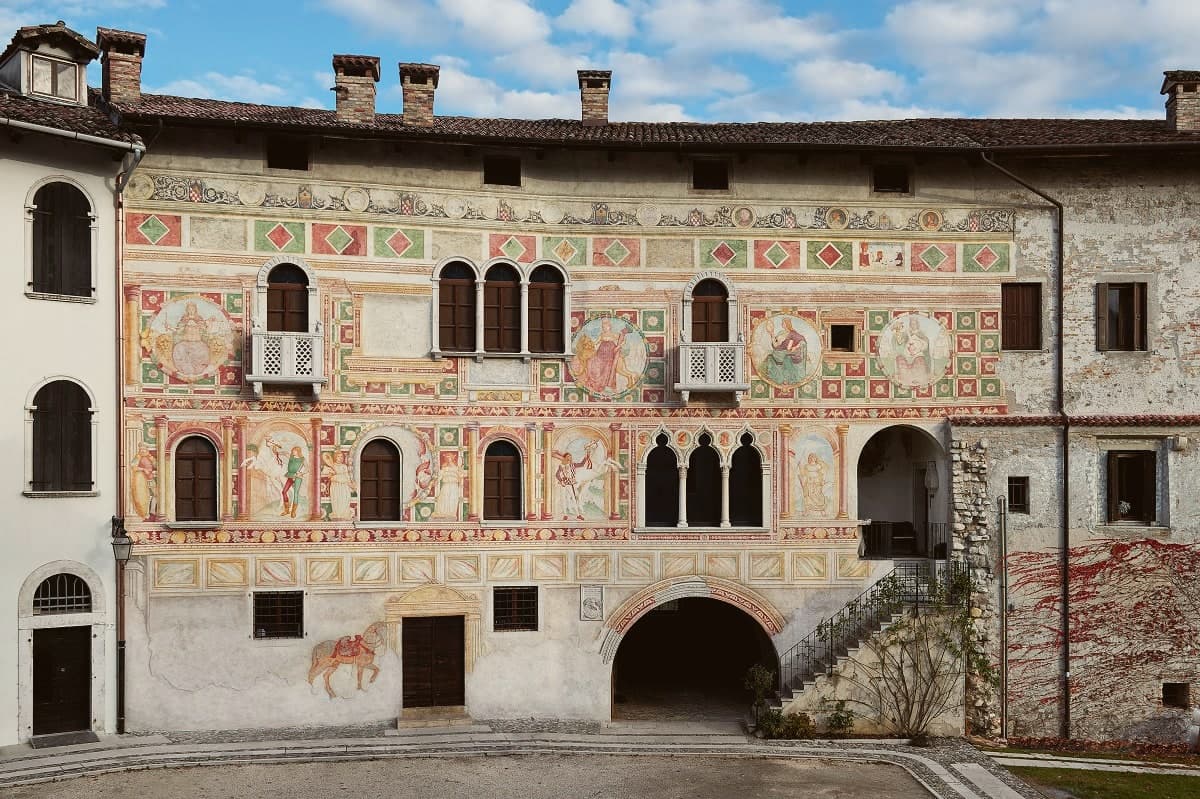
Spilimbergo takes its name from the castrum de Spengenberg, built by Carinthian counts who came south as vassals of the Patriarch of Aquileia. Their fortress anchors one end of a centro storico that reads as a sequence of additions: the Romanesque-Gothic cathedral raised through the fourteenth century, the painted palace that later hosted Charles V, Bona Sforza, and Henry III of France, and Corso Roma running between frescoed palazzi to the old market stone still used to measure trade.
The Scuola Mosaicisti, founded in 1922, is the newest of these layers but the one that has carried the town's name furthest, its alumni's work turning up in the Library of Congress, the Holy Sepulchre, the Foro Italico, and the World Trade Center transit hub. The Folkest folk-music festival runs every July, and the town carries Borghi più belli and Borgo dei Borghi finalist recognition.
Outside it, the Tagliamento broadens into the braided, three-kilometer bed that gives the town its setting on the right bank. A place, in sum, where a medieval frontier post and a twentieth-century craft school have ended up equally responsible for putting Spilimbergo on a map.
What to see in Spilimbergo
- Castello di Spilimbergo. Eleventh-century fortress of the Spengenberg counts, burned in the 1511 popular revolt and partially rebuilt; the palace with the painted façade survived.
- Palazzo Dipinto. The frescoes cover prancing horses, ladies, pages, and figures of the Theological and Cardinal virtues across the fifteenth-century façade.
- Duomo di Santa Maria Maggiore. Romanesque-Gothic cathedral begun in 1284 by count Walterpertoldo II, with apse frescoes executed between 1350 and 1359.
How to get to Spilimbergo
Udine is roughly 39 minutes away by road.
Our tip
April through June is the season for the Tagliamento gravel beds and the Bellunello frescoes; the light catches the Palazzo Dipinto best in the late afternoon. Folkest fills the piazzas with folk musicians from across Europe through early July. August is hot and the centro storico empties between two and five. Istrago in Festa falls in the season.
More from Anywhere Italy
- The best hill towns in Friuli-Venezia Giulia
 The 9 best towns with a serious restaurant in Friuli-Venezia Giulia
- The best hill towns that eat well in Friuli-Venezia Giulia
 The prettiest villages you can reach by train within 90 minutes of Udine
 The best hidden hill towns within 90 minutes of Venezia
- The best hidden towns you can reach by train in Friuli-Venezia Giulia