
The best towns you can reach by train that eat well in Friuli-Venezia Giulia
The food here carries an accent. Central European bread and poppy seed sit beside Adriatic fish and Slovenian herbs, and the wine list runs to Friulano, Ribolla Gialla and orange wines left on the skins in the Collio and the Carso. Autumn is the season most people would choose, when the vineyards on the Isonzo gravel turn and the osterie put out game, polenta and gnocchi filled with plums. The old towns are built low, in pale stone and Venetian brick and Austro-Hungarian stucco, arcaded against the bora that comes down off the karst in winter. It is a region that rewards eating slowly, and it does so within walking distance of a railway platform.
Most travellers who make it this far north-east cross the border into Slovenia or turn back west towards Venice, which absorbs the coach parties and the cruise passengers and leaves the rest of the Adriatic head largely to Italians on holiday. Venice is an hour or so away by fast train, and the itineraries built around it treat everything beyond Palmanova as a day trip at best. The result is that the Friulian food towns get visitors who arrived on purpose rather than by drift. Fewer people go, and the tables are easier to book.
The vineyards, the buffets and the frico do not stop at the edge of anybody's day trip. They run along the line east through the Collio to the Slovenian frontier, north up the valley towards the mountains, and south onto the Isonzo plain, and the towns strung along that railway have kitchens that a dining guide has singled out by name. Each of these can be reached without a car, which matters in a region where lunch is a long one and the wine is the point. Arrive on the train, walk to the table, walk back.
Of the 26 communes we have mapped in Friuli-Venezia Giulia, 6 qualify as towns you can reach by train that eat well: we have confirmed each is reachable without a car, and a dining guide has named a table in each. The smallest, Gradisca d'Isonzo, has 6,430 residents.
Two more lists worth reading alongside this one: The best towns that eat well within 75 minutes of Trieste and The best hill towns that eat well in Friuli-Venezia Giulia.
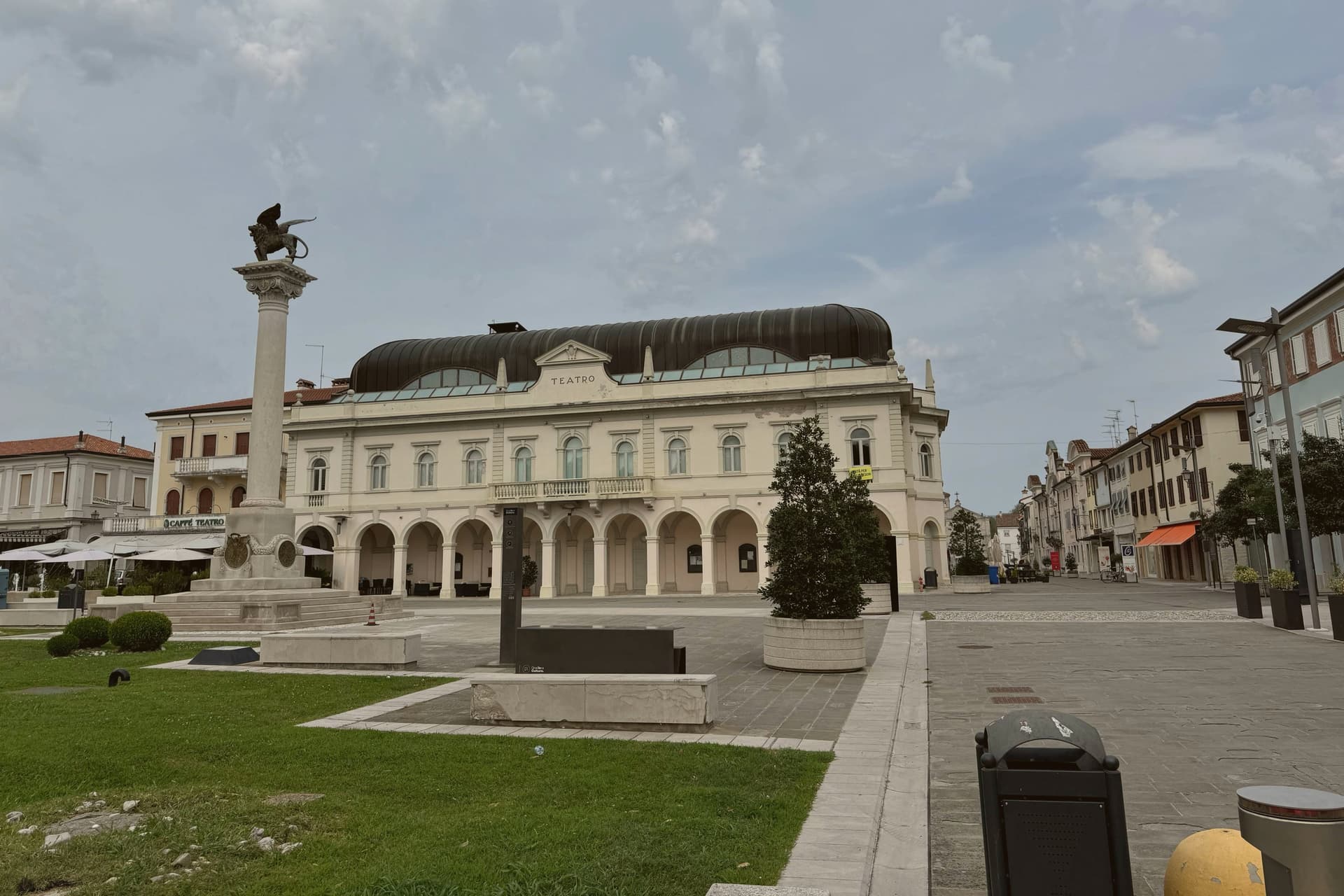
Gradisca d'Isonzo
Why visit Gradisca d'Isonzo
Gradisca d'Isonzo sits at 32 meters on the right bank of the Isonzo, ten kilometers downriver from Gorizia. The Venetian Republic built it from scratch starting in 1479 as a frontier bastion against Ottoman raids that had reached Friuli the previous decade.
The fortification consumed twenty years and the advice of Leonardo da Vinci, sent here by the Senate in 1500 to redesign the artillery defenses. The result was a walled town twenty meters high, ringed by seven towers and a wide moat, with the river itself diverted into the defenses.
Maximilian I took it for the Habsburgs in 1511 during the War of the League of Cambrai, and it stayed in Austrian hands as the seat of the Principesca Contea di Gorizia e Gradisca for the next four centuries. The town that grew inside the walls is Baroque: the Palazzo Torriani, the Loggia dei Mercanti, the Casa de Fin, all built under the Habsburgs.
Casanova passed through in 1773. Today the walls, towers, and grid still hold.
Meja dell'Hotel Franz have been named by a guide.
What to see in Gradisca d'Isonzo
- Fortezza Veneziana. Walled town from 1479, twenty meters high, ringed by seven towers and a wide moat, designed in part by Leonardo da Vinci in 1500.
- Torre di San Giorgio. Northwest bastion tower of the Venetian wall, the most complete of the seven and the symbol of the borgo.
- Palazzo Torriani. Sixteenth-century palazzo of the Della Torre family, later the residence of the Austrian Capitano, now the Town Hall on Via Roma.
How to get to Gradisca d'Isonzo
There is a railway station in the town, so you can arrive without a car and never need one while you are here. Udine is roughly 34 minutes away by road.
Our tip
April through June and September into October are the best months for Gradisca. The Isonzo runs blue-green from the Julian Alps snowmelt, the cycle path along the river opens, and the Saturday market fills the Spianata. July and August bring the heat the Friuli plain is known for, often above thirty-three degrees with high humidity, and the centro storico empties from two until six.
Cormons
Why visit Cormons
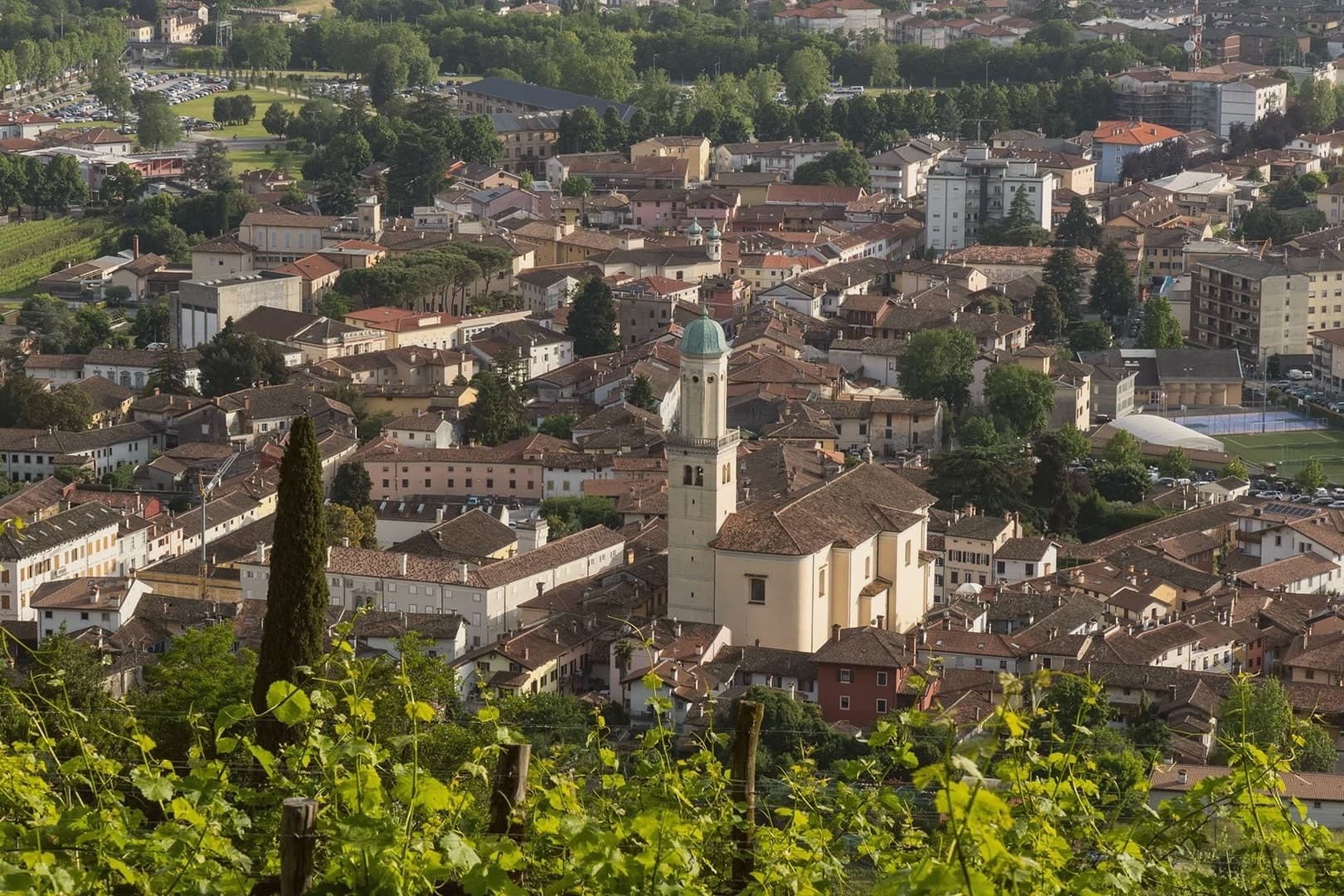
Cormons sits at 51 meters where the Friulian plain rises into the Collio hills, twelve kilometers west of Gorizia on the Slovenian border. Once a Lombard fortress, then a residence of the Patriarchs of Aquileia, the town was contested between Venice and the Habsburgs and stayed Austrian from 1500 to 1918.
Palazzo Locatelli and Palazzo Waiz Del Mestri, facing the main square, keep the Viennese restraint of that period, and the church that anchors the square dates from the same Habsburg-era rebuilding. The vineyards begin on the slopes immediately north of town, where the soil locals call ponka gives way to the hill of Monte Quarin above, its ruined fortress looking down over the DOC zone and across the border into Slovenia.
The cooperative cellar draws its grapes from growers scattered through those same slopes. In 1870 Count La Tour brought French vines into nearby Russiz di Capriva for the Imperial Court palate, which the 1891 Austrian Oenological Congress in Gorizia codified.
What holds the town together is the border itself: a fortress height, a planted slope, and a square built by the empire that once ruled both, still standing in the order Austrian rule left them.
Trattoria al Cacciatore, Locanda alle Vigne have been named by a guide.
What to see in Cormons
- Piazza della Libertà. Central Habsburg-era square framed by Palazzo Locatelli and other Austrian-influenced civic buildings, with the statue of Emperor Maximilian I at its center.
- Duomo di Sant'Adalberto. Eighteenth-century cathedral on the central square, the principal church of the Habsburg-era town, with painted ceiling and altarpieces of the period.
- Monte Quarin. Hill above Cormons (274 m) with ruins of the Lombard-patriarchal fortress, panoramic views over the Collio vineyards and into Slovenia.
How to get to Cormons
There is a railway station in the town, so you can arrive without a car and never need one while you are here. Udine is roughly 34 minutes away by road.
Our tip
April through June is the green window on the Collio hills, vines budding then leafing, ponka soil still cool from spring. September and October are the vendemmia months, the harvest dictating the rhythm of every cantina in the commune. July and August are warm and humid, the plain's heat pushed into the hills; tasting rooms run on appointment. Borgnano in Festa! falls in August.
Cividale del Friuli
Why visit Cividale del Friuli
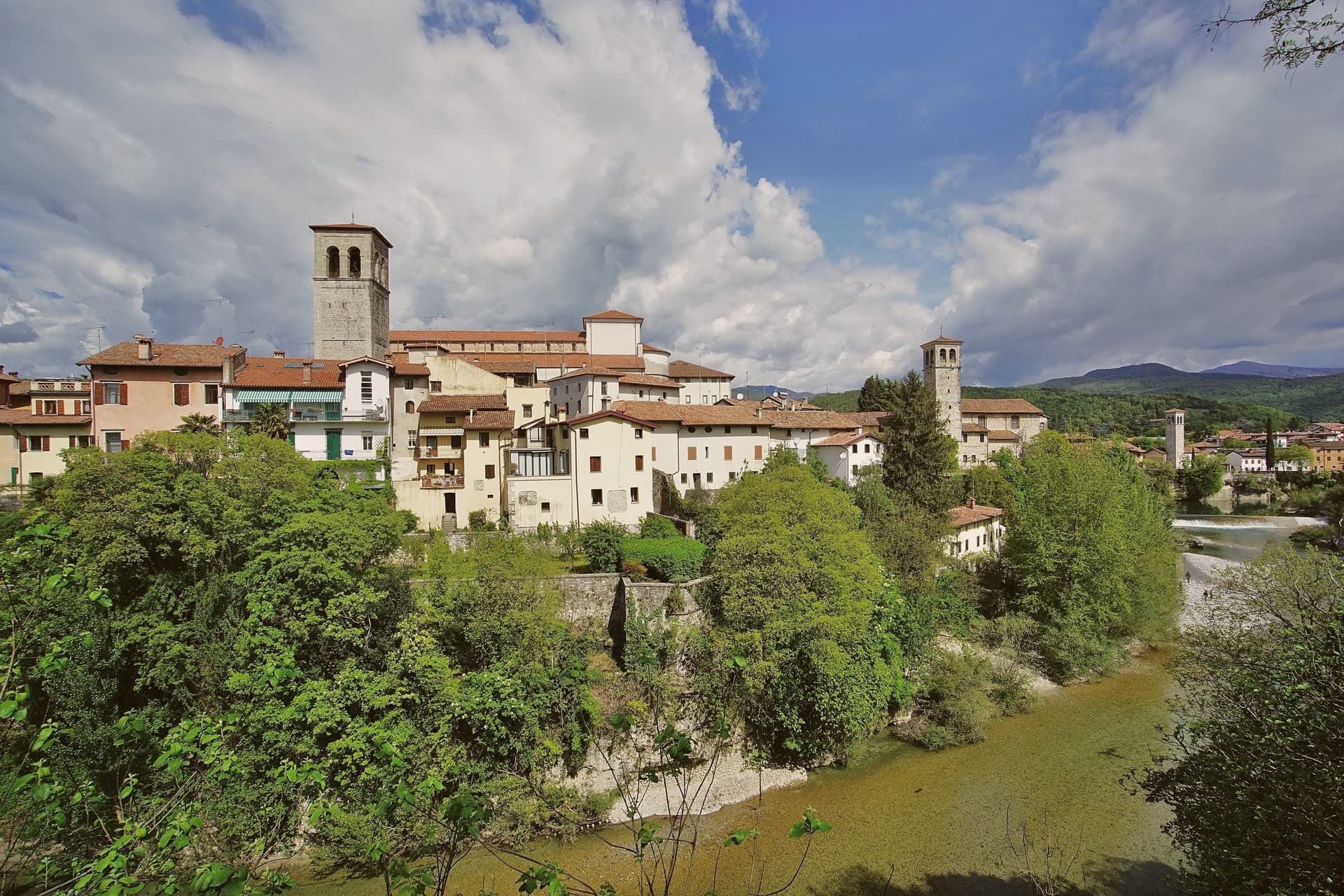
Cividale del Friuli sits at 138 meters on the right bank of the Natisone, fifteen kilometers from Udine and close enough to the Slovenian border that the river marks it. Julius Caesar founded the place as Forum Iulii in the first century BC, the name that eventually gave Friuli its own.
In 568 the Lombard king Alboin made it the capital of his first Italian duchy, and the Patriarchate of Aquileia later moved its seat here for four centuries. The Tempietto Longobardo, an eighth-century palatine chapel, holds six stucco female saints carved around 760, the best-preserved sculpture of the Lombard age in Europe.
It is one of seven sites in the UNESCO serial nomination Longobardi in Italia. The Ponte del Diavolo, begun in 1442, spans the Natisone gorge in two asymmetrical arches.
The Palio di San Donato fills the streets in late August, and Mittelfest brings Central European theater and music to the piazzas every July.
Al Monastero have been named by a guide.
What to see in Cividale del Friuli
- Tempietto Longobardo. Eighth-century palatine chapel in the Monastero di Santa Maria in Valle, with six stucco female saints in high relief, UNESCO-listed since 2011.
- Ponte del Diavolo. Stone bridge over the Natisone gorge, begun in 1442 on two asymmetrical arches resting on a central rock outcrop.
- Duomo di Santa Maria Assunta. Fifteenth-century cathedral with the Pala di Pellegrino II, a twelfth-century gilded silver altarpiece, and an attached Museo Cristiano.
How to get to Cividale del Friuli
There is a railway station in the town, so you can arrive without a car and never need one while you are here. Udine is roughly 26 minutes away by road.
Our tip
April through June and September into October are the months when the Natisone valley shows best, with green hills, mild evenings, and the Slovenian border country open for walking. July brings Mittelfest and August the Palio di San Donato, so the centro storico fills with theater crowds and historical pageant. Both months can push past thirty degrees, though 138 meters of elevation and the river keep nights cooler than the Friulian plain. Palio di San Donato falls in August.
Gorizia
Why visit Gorizia
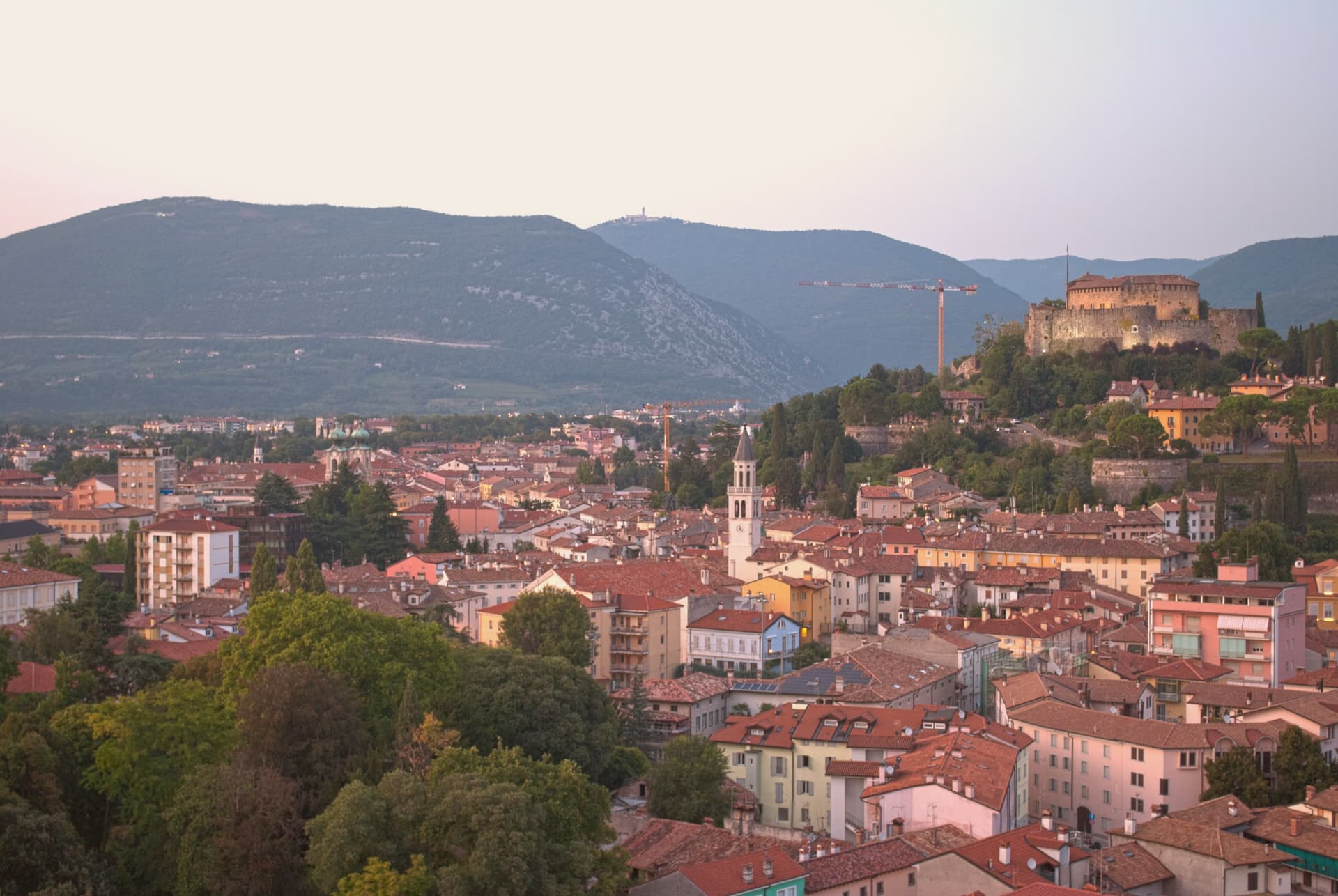
Gorizia sits at 84 meters at the foot of the Julian Alps, on the Slovenian border. The Counts of Gorizia held the town as an independent county from 1127 until 1500, when it passed to the Habsburgs, who kept it until 1918.
Annexed to Italy after World War I, the city lost part of its territory to Yugoslavia in 1947, when a wall went up that became one of the symbols of the Iron Curtain, cutting the border square in front of the railway station the Austrians had built in 1906 into two halves. Schengen lifted the border in 2007, and in 2025 Gorizia and Nova Gorica together held the joint cultural title that marked the year, the first cross-border holders in the program's history.
The city itself divides between the medieval upper town, Borgo Castello, rising around the eleventh-century castle, and the plain below, where the Isontino stretches out to produce Collio and Carso wines. The rebozzato cafés on Corso Verdi still serve in Friulian, Italian, Slovenian, and German, a hangover from a border that has moved but never quite disappeared.
A city built on a fault line, first political, then physical, now a shared cultural address for two towns that were once one and then were forced apart.
Rosenbar, Chincaglieria Gastronomica, Alla Luna and 1 more have been named by a guide.
What to see in Gorizia
- Castello di Gorizia. Eleventh-century castle on the hill above the city, restored after World War I damage, with museum rooms and ramparts open to walk.
- Borgo Castello. Medieval upper town inside the castle ramparts, the original nucleus of the city before it spread onto the plain below.
- Piazza della Transalpina (Trg Evrope). Border square cut in two by the 1947 line, reunited in 2004, with the old dividing line still marked by a strip of pavement tile. Served as the inauguration stage of European Capital of Culture.
How to get to Gorizia
There is a railway station in the town, so you can arrive without a car and never need one while you are here. Udine is roughly 41 minutes away by road.
Our tip
April through June and September into October are the working windows, the Isontino plain green or gold, the hill paths around the castle walkable without humidity. July and August carry the Friulian-plain heat moderated only slightly by altitude. The European Capital of Culture program in 2025 stretched events across all twelve months and proved that the city carries shoulder-season weight. Flavors of the Frontier falls in September.
Udine
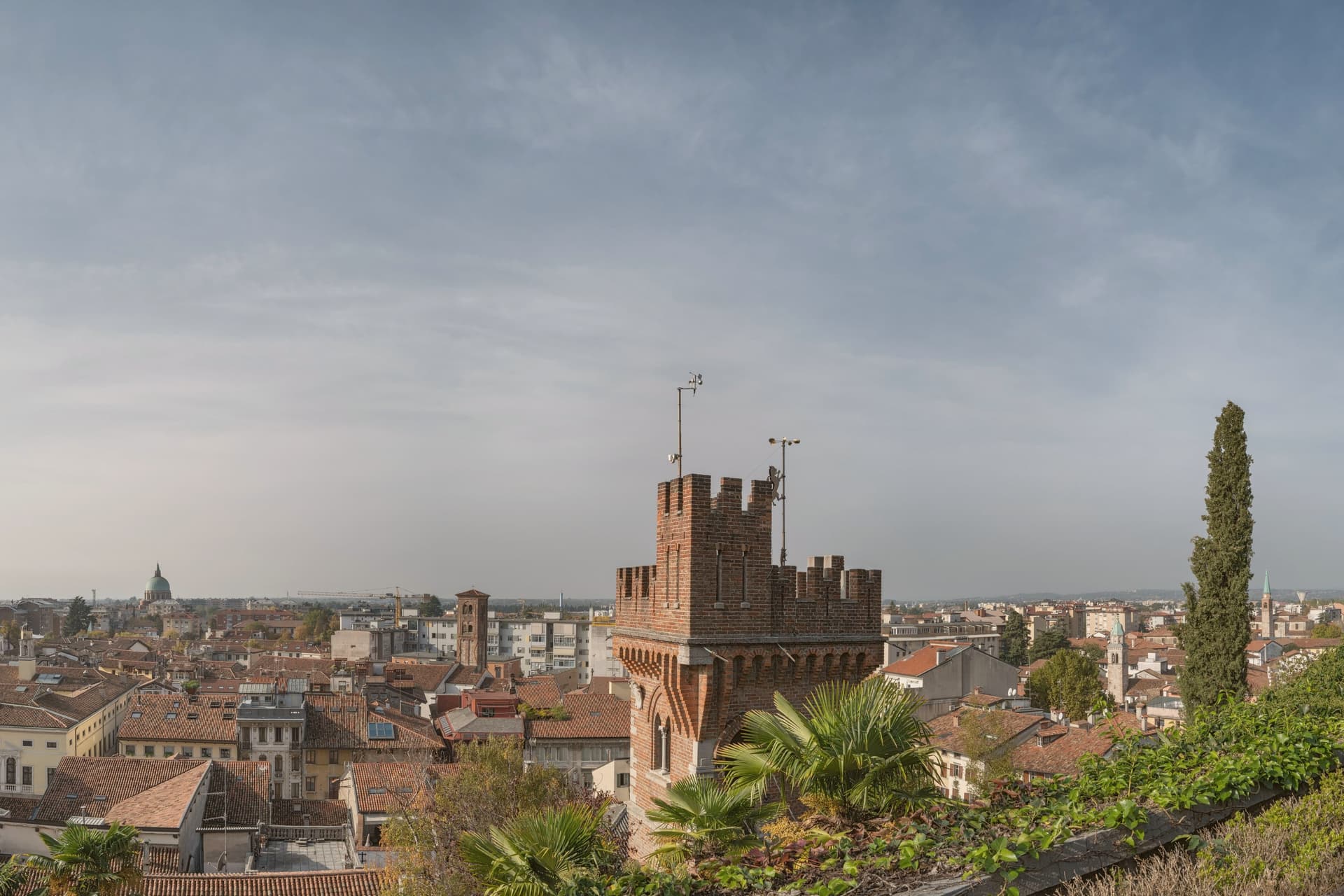
Why visit Udine
Udine sits at 113 meters in the center of the Friulian plain, raised on a single man-made hill that legend assigns to Attila's army. The city is documented from 983, when Emperor Otto II donated the castle to the Patriarchs of Aquileia.
By the twelfth century the patriarchs had moved their residence here, and for four hundred years Udine served as capital of the Patria del Friuli before Venice took the city in 1420 and governed it until 1797. The hill and the square below it still read as two distinct centers: the castle above, rebuilt after the 1511 earthquake, looking down on the civic and religious cluster of the Piazza della Libertà, the Duomo, and the patriarchs' palace.
From May 1915 to October 1917 the city was the seat of the Italian military command and was nicknamed Capitale della Guerra. A town built twice over as a seat of power, first ecclesiastical, then military, with its hill as the constant.
Trattoria Alla Vedova, Agli Amici, Hostaria alla Tavernetta and 4 more have been named by a guide.
What to see in Udine
- Piazza della Libertà. Framed by the Loggia del Lionello of 1448, the Porticato di San Giovanni, and a clock tower with bronze Mori that strike the hour above the square.
- Castello di Udine. Rebuilt in the sixteenth century after the 1511 earthquake, former seat of the Patriarchs of Aquileia and then of the Venetian governors, now housing civic museums on the hill above the city.
- Galleria del Tiepolo (Palazzo Patriarcale). The frescoes here were painted for the Patriarch Dionisio Dolfin; Giambattista Tiepolo's rooms are reached through the palace's staircase and galleries, the setting as much a part of the work as the ceilings themselves.
How to get to Udine
There is a railway station in the town, so you can arrive without a car and never need one while you are here. Udine is roughly 2 minutes away by road.
Our tip
April through June and September into October are the Friulian shoulder months, dry, mild, evenings cool enough to sit out on Piazza della Libertà. July and August push past thirty with high humidity off the plain; the porticos shade the worst of it, but the air stagnates. November through March is fog and cold: short days, gray light, the castle on its hill rising above the haze on Piazza Matteotti. Friuli Doc a Udine falls in the season.
Trieste
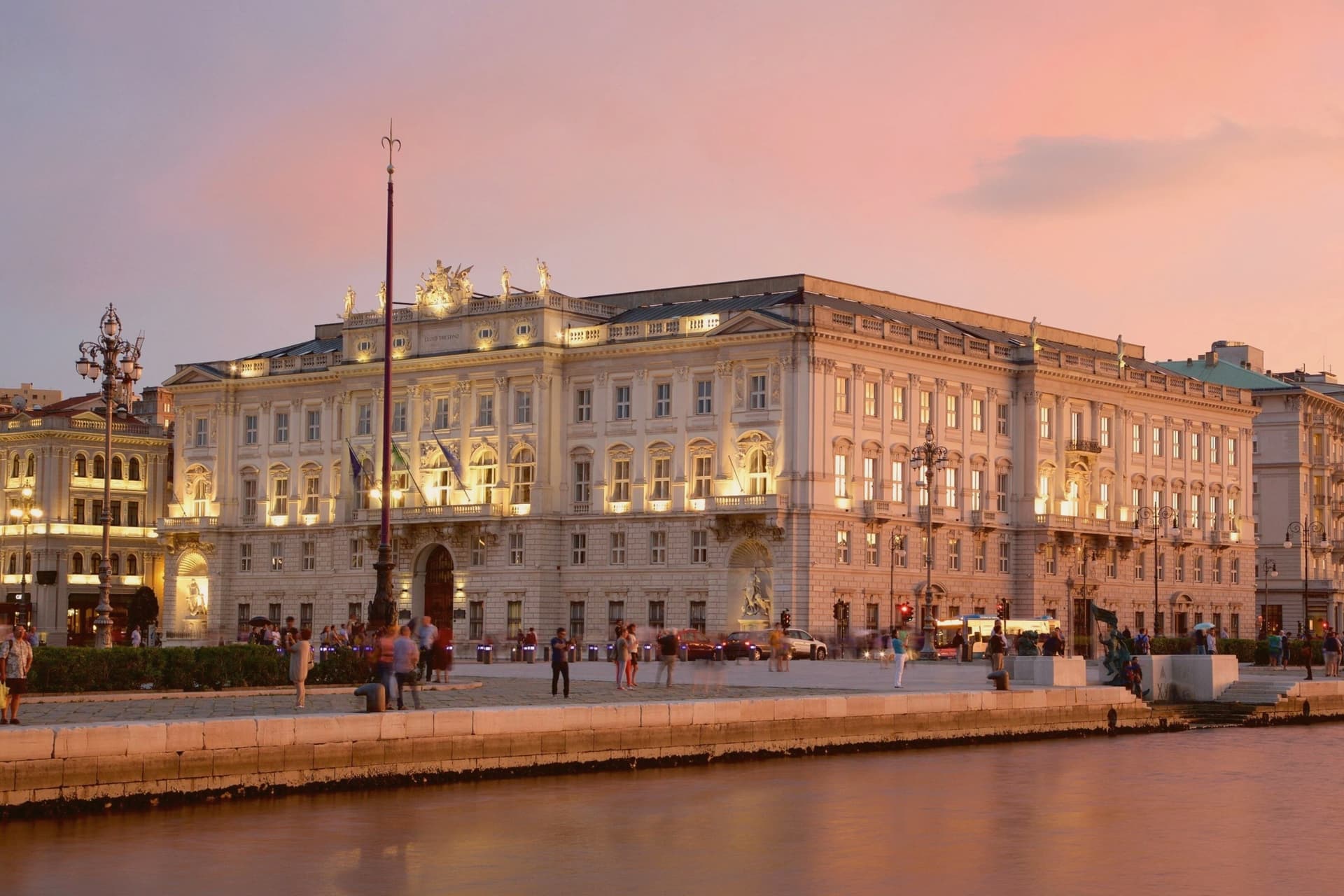
Why visit Trieste
Trieste sits at the head of its gulf, on a narrow strip of Italian land between the Adriatic and Slovenia. Rome made it a colony under Julius Caesar; Augustus built the harbor and walls around 33 BC.
The Habsburgs held the city from 1382 until 1918 and ran it as their empire's free port, the access route to the sea for Vienna: that arrangement set the shape of the modern city, laying out the Borgo Teresiano and the Canal Grande that cuts into it, and opening the great sea-facing square onto the water where the old town meets the Habsburg extension. The castle on the cliffs north of town was built by Archduke Maximilian, who left it for Mexico in 1864 and was executed three years later.
The former rice-husking plant used as the only Nazi camp on Italian soil with a crematorium sits in the southern industrial belt, apart from the imperial center. A city built as an empire's outlet to the sea, then handed over at the end of that empire, carries both the harbor it was built for and the border it was built against.
Antica trattoria Suban, Antica Trattoria Menarosti, L’Approdo and 8 more have been named by a guide.
What to see in Trieste
- Piazza Unità d'Italia. The largest sea-facing square in Europe, framed by Habsburg-era municipal and Austrian Lloyd buildings opening directly onto the Adriatic.
- Castello di Miramare. White castle on the cliffs north of the city, set in a park of acclimatized Mediterranean and exotic species.
- Cattedrale di San Giusto. Romanesque cathedral on the San Giusto hill, formed from the eleventh-century fusion of two adjoining basilicas, with fifth-century mosaics and a fourteenth-century rose window.
How to get to Trieste
There is a railway station in the town, so you can arrive without a car and never need one while you are here. Trieste is roughly 10 minutes away by road.
Our tip
May through September is the open season on the gulf. The bora, the dry northeast wind that defines Trieste weather, drops off, the cafés put tables on Piazza Unità, and the Barcola sea promenade fills with swimmers. July and August are warm but moderated by the sea, less heavy than the Friulian plain. Sagra di San Marco falls in April.
More from Anywhere Italy
 The best towns that eat well within 75 minutes of Trieste
 The best hill towns that eat well in Friuli-Venezia Giulia
 The best towns with a food festival in Friuli-Venezia Giulia
 The best wine towns in Friuli-Venezia Giulia
 The best hidden towns you can reach by train in Friuli-Venezia Giulia
- The 9 best towns with a serious restaurant in Friuli-Venezia Giulia