
The 7 best towns with a medieval festival in Marche
Marche does its history in public. Through the warm months the piazzas of the interior fill with drummers, crossbowmen and riders in the colours of their quarter, and the smell of grilled meat and porchetta drifts out of the side streets while the flag-throwers rehearse against a wall of pale travertine and brick. The countryside behind these towns is a rolling arrangement of wheat, olive and vine running from the Sibillini foothills down to the Adriatic, so the wine at the trestle tables is usually Verdicchio or a Rosso Piceno from a few valleys away. Olive all'ascolana, stuffed and fried, is the food of a festival evening. Late June through August is the peak, though several of these events recur in early autumn when the light is better and the heat has broken.
People who want medieval Italy in costume tend to go to Tuscany and Umbria, and mostly to Siena, where the Palio fills the Campo twice a summer and the surrounding streets are booked out months ahead. Gubbio's crossbow contest draws the same crowd. The pageantry is real and the queues are longer than the parades. Hotel prices in those towns are set by the calendar rather than by the room.
The same tradition runs the length of Marche, where re-enactment is a matter of local pride rather than a ticketed spectacle. Quintains, crossbow duels and costumed processions recur here every year in towns whose walls, castles and brick theatres sit in plain view and whose grandstands are smaller. Fewer people go, the food is cooked by the neighbourhood associations, and the towns below are where to find it.
Of the 63 communes we have mapped in Marche, 7 qualify as towns with a medieval festival: each stages a recurring historical re-enactment in costume. The smallest, Gradara, has 4,889 residents.
If you are still choosing, we have also written The best towns with a food festival that eat well in Marche and The best hill towns with a serious restaurant in Marche.
Gradara
Why visit Gradara
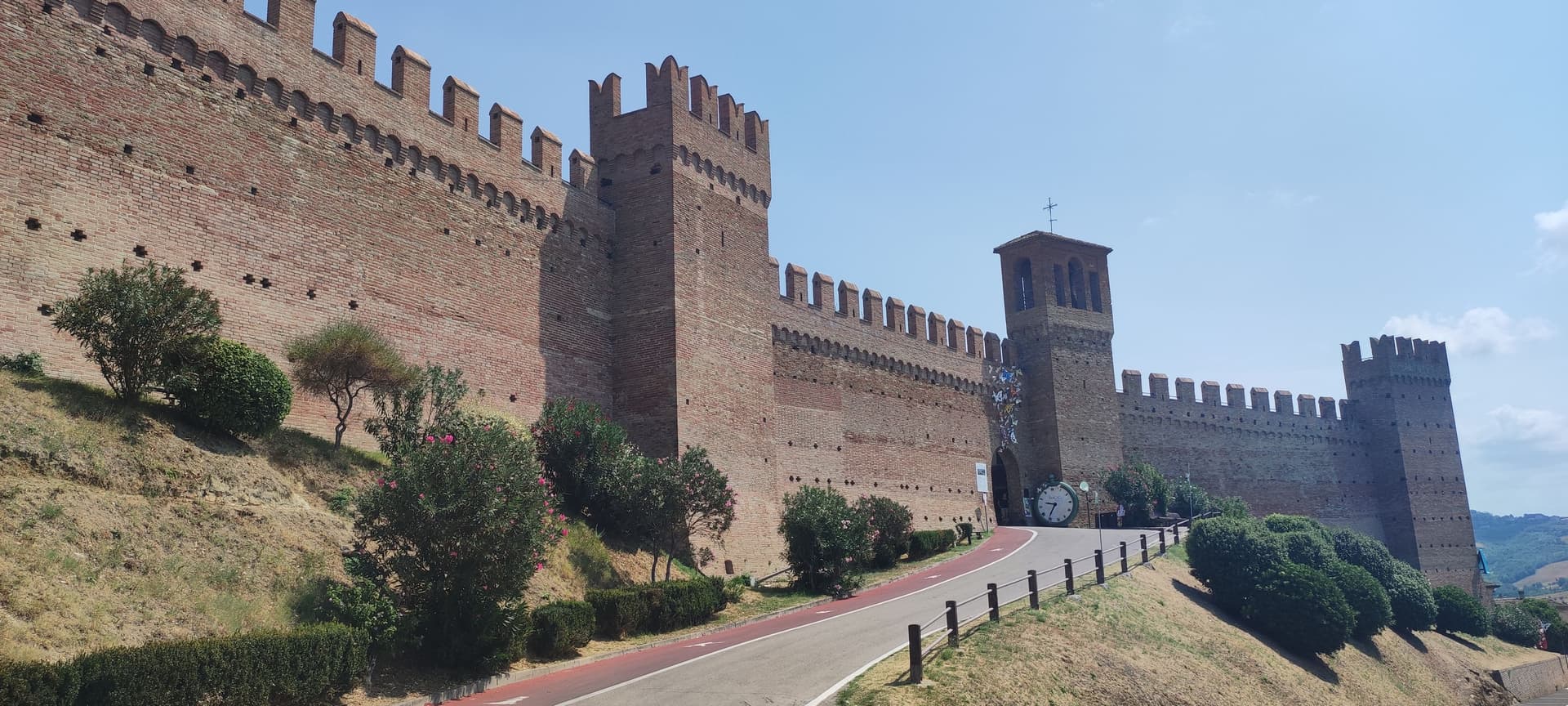
Gradara sits at 142 meters on a hill three kilometers from the Adriatic, at the northern border of the Marche with Romagna. The castle was begun in the twelfth century by Pietro and Ridolfo del Grifo and completed in the fifteenth, when the Malatesta extended the double ring of walls that still runs almost 800 meters around the borgo.
In the fifth canto of the Inferno, Dante placed Paolo and Francesca here: around 1275 Guido da Polenta of Ravenna married his daughter Francesca to Giovanni Malatesta and sent his younger brother Paolo as proxy. The two fell in love.
Gianciotto Malatesta caught them and killed both. Whether the killing happened at Gradara, Pesaro or Rimini is disputed among scholars; tradition keeps it here.
The borgo was voted Borgo dei Borghi by RAI viewers in 2018. The Castello and the Camerino di Lucrezia draw most visitors.
Olive groves around the walls supply the Cartoceto DOP oil.
The re-enactment here is Giovedì al Castello - Rievocazione storica, usually held across August and September.
What to see in Gradara
- Castello di Gradara. Twelfth-century rocca completed by the Malatesta in the fifteenth century, one of the best-preserved medieval fortresses in Italy, with the Camerino di Lucrezia frescoed cycle.
- Mura medievali. Double ring of fourteenth and fifteenth-century walls running almost 800 meters around the borgo, walkable along the camminamento.
- Camera di Paolo e Francesca. Frescoed chamber inside the castle, traditionally identified as the room where Dante set the killing of the two lovers.
How to get to Gradara
Rimini is roughly 30 minutes away by road.
Our tip
May through September is the working season for Gradara. The hill is dry from late April, the castle and walls are open every day, and the literary park below the rocca turns green into June. July and August bring the heaviest crowds: the proximity to Cattolica and Gabicce Mare puts seaside families on the castle road and the borgo's narrow streets fill from mid-morning. Giovedì al Castello - Rievocazione storica falls in August.
Sassoferrato
Why visit Sassoferrato
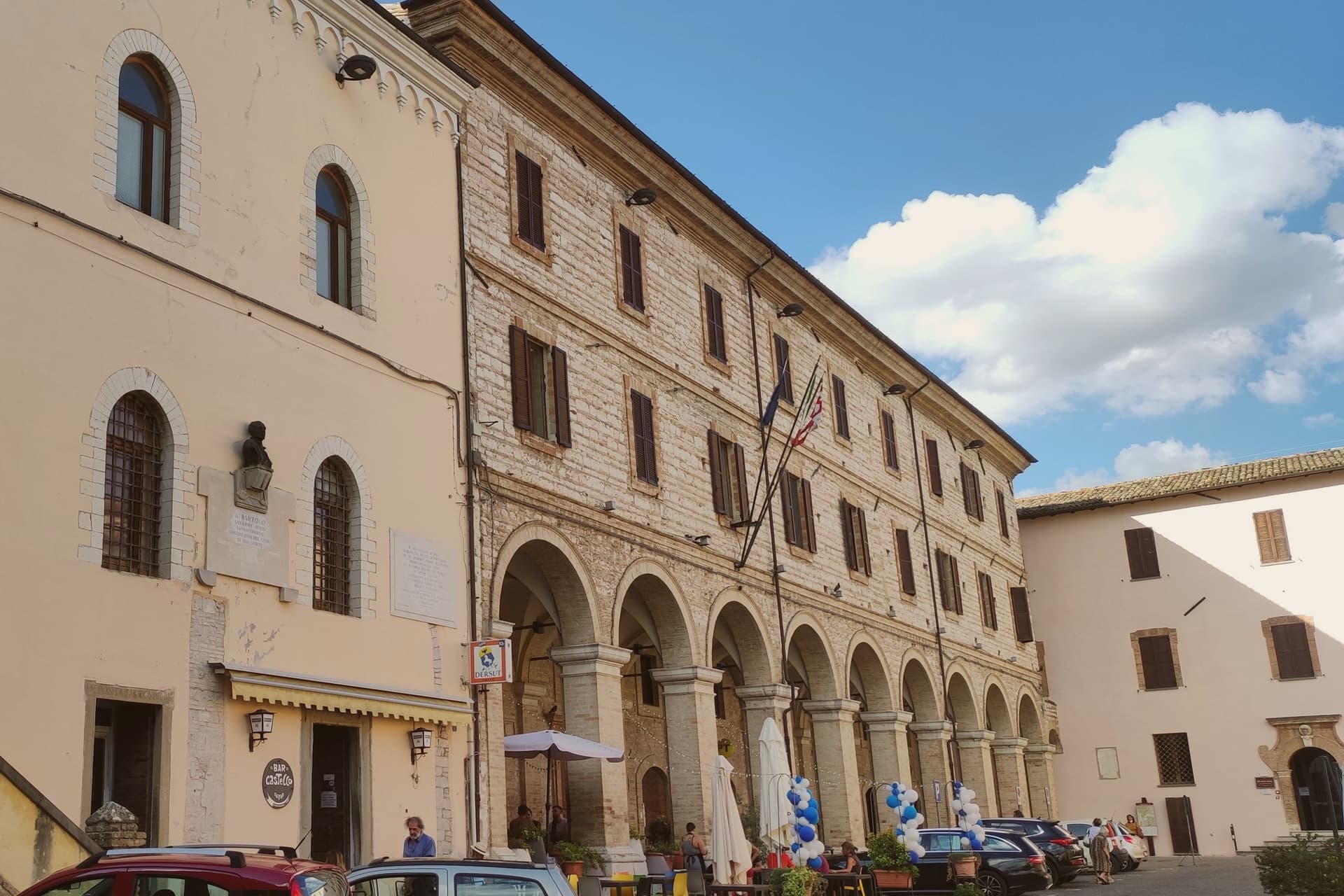
Sassoferrato sits on the eastern slope of the Apennines on two levels: the Borgo at around 310 meters and the Castello at 400 meters, dominated by the Rocca built in 1365 by order of Cardinal Albornoz. A kilometer south of the modern town lies Sentinum, the Roman city next to which the consuls Publius Decius Mus and Fabius Maximus Rullianus defeated a coalition of Samnites, Etruscans, Umbrians and Senone Gauls in 295 BC, in the decisive battle of the Third Samnite War that allowed Rome to unify central Italy.
The archaeological park preserves the cardo and decumanus, the urban baths, a second extramural bath complex and the ruins of a metalworking shop. The Civic Archaeological Museum inside the Palazzo dei Priori, built 1355, holds the finds from Sentinum, including a Byzantine Saint Demetrius mosaic icon on wooden support.
Giovanni Battista Salvi, called Il Sassoferrato, was born here in 1609; Palazzo Oliva holds a collection of his Raphaelesque devotional paintings. The town gives its name to the Battle of the Nations historical reenactment, held each August.
The re-enactment here is Palio della Miniera di Zolfo, usually held in August.
What to see in Sassoferrato
- Rocca Albornoz. Fourteenth-century fortress built 1365 by order of Cardinal Albornoz, dominating the upper Castello district at 400 meters.
- Parco Archeologico di Sentinum. Roman city a kilometer south of town, with the cardo and decumanus, the urban baths and the extramural bath complex still visible.
- Museo Civico Archeologico. Inside the 1355 Palazzo dei Priori, holding the finds from Sentinum and the Byzantine Saint Demetrius mosaic icon on wooden support.
How to get to Sassoferrato
Perugia is roughly 74 minutes away by road.
Our tip
April through June and September into October are the best months for Sassoferrato. The Sentino valley turns green from April, the archaeological park at Sentinum opens its full guided program through the warmer months, and the Palio di Sant'Ugo and Battaglia delle Nazioni reenactment fill the streets each August. July and August touch the high twenties at 386 meters but the two-level position keeps the Castello cooler than the Borgo and the lower river. Palio della Miniera di Zolfo falls in August.
Montecosaro
Why visit Montecosaro
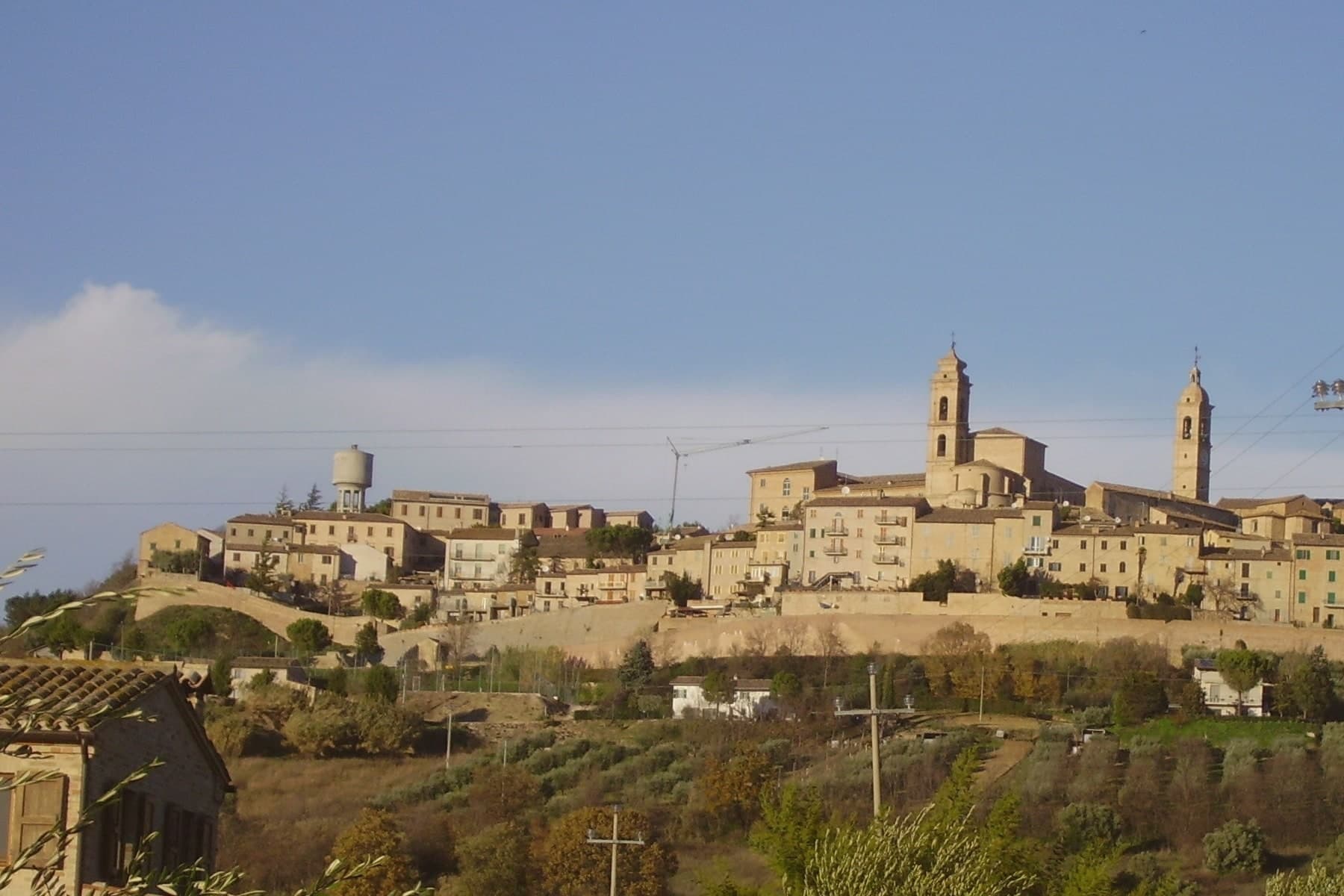
Montecosaro sits at 267 meters on a hill above the lower Chienti valley, fifteen kilometers from Macerata and inland from the Adriatic at Civitanova. The first record of a monastery in the river plain dates to 936, when the abbot Ildebrando received the church of Santa Maria from Farfa.
The current Basilica di Santa Maria a Piè di Chienti was raised in 1125 by the Lombard abbot Agenolfo, on the left bank a few kilometers from the river mouth: a three-nave Romanesque church with a raised presbytery and a ring of apsidioles, holding among the strongest Cluniac architecture in central Italy. The hilltop borgo above grew from a medieval castle after 1200, walled in the fourteenth century inside an oval that culminates at the Cassero, the former fortress now a public garden.
The Augustinian convent and the church of Sant'Agostino in the upper town date from the same century, rebuilt in the late eighteenth.
The re-enactment here is Contesa dei Cento Ducati, usually held in August.
What to see in Montecosaro
- Basilica di Santa Maria a Piè di Chienti. Romanesque church rebuilt in 1125 by the Lombard abbot Agenolfo on a Farfa monastic foundation of 936, three naves with raised presbytery and apsidioles.
- Centro storico. Oval-walled medieval centro storico on the hill, with fourteenth-century walls and concentric streets climbing toward the Cassero.
- Cassero. Highest point of the walled borgo, where the medieval fortress once stood, now a public garden with views over the Chienti valley.
How to get to Montecosaro
There is a railway station in the town, so you can arrive without a car and never need one while you are here. Ancona is roughly 46 minutes away by road.
Our tip
April through June and September into October are the best months for Montecosaro. The Chienti valley turns green in spring and gold through the autumn harvest weeks, with mild afternoons on the hilltop and long views from the Cassero across to the Sibillini. July and August touch the low thirties; the hill catches more breeze than the river plain below, and the Basilica di Santa Maria stays cool through the day. Contesa dei Cento Ducati falls in August.
Treia
Why visit Treia
Treia stands at 342 meters in the hills between the Potenza and Chienti valleys, thirty-five kilometers from Ancona. The Roman town of Trea lay on the plateau below, a municipium founded shortly after 49 BC that flourished between Augustus and Antoninus Pius.
Around the year 1000 the population moved up to the more defensible hilltop of Montecchio, and the older site emptied. The new town stayed under the name Montecchio until 1790, when Pope Pius VI raised it to the rank of città and restored its Roman name.
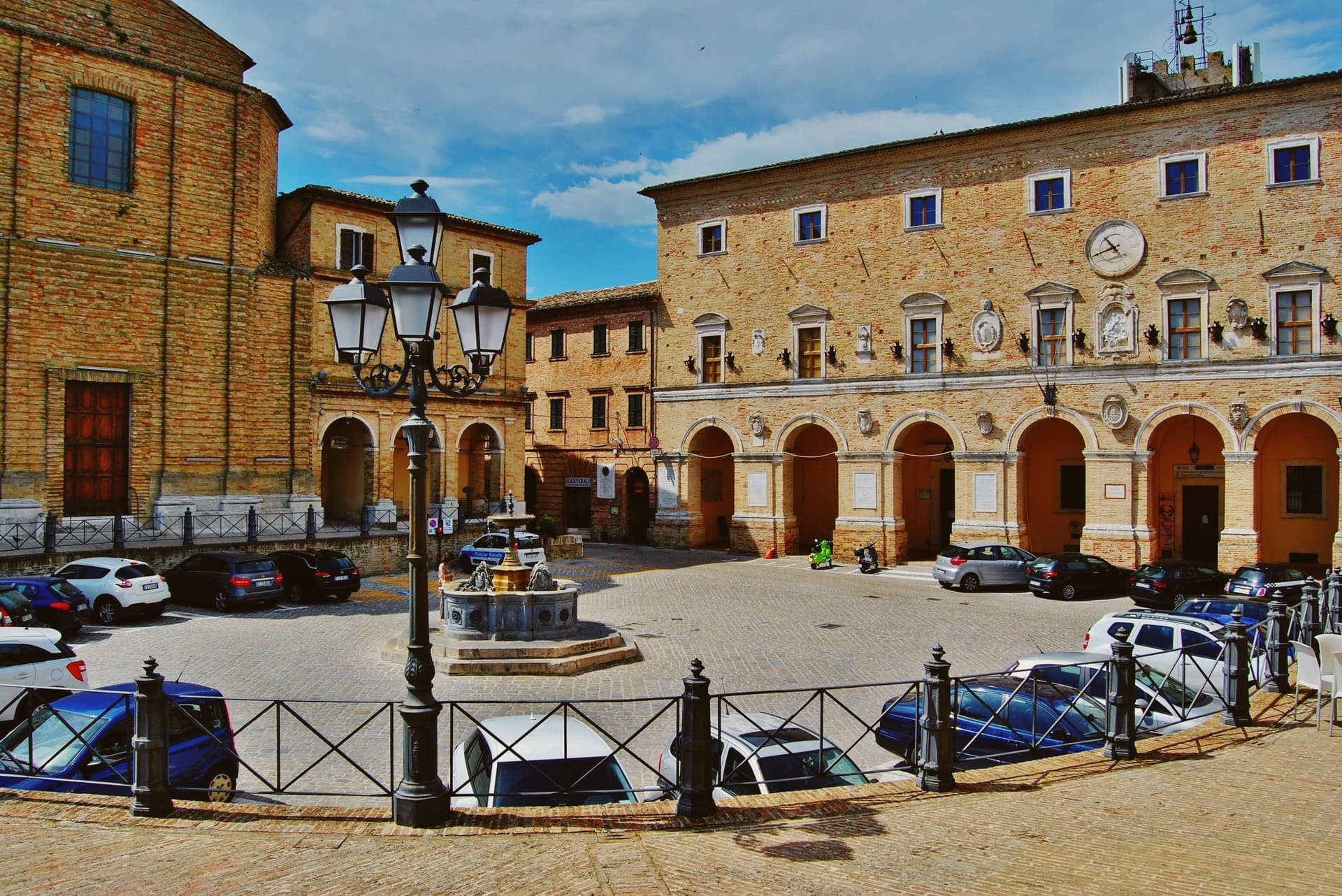
The Piazza della Repubblica, on the highest point of the ridge, is closed at one end by the Cattedrale della Santissima Annunziata and at the other by Giuseppe Valadier's small Accademia Georgica, the eighteenth-century home of an agronomic academy founded in the fifteenth as the Accademia dei Sollevati. The Disfida del Bracciale, an Ottocento street-game in which four contrade compete, has filled the centro storico every first Sunday of August since 1978.
The re-enactment here is Disfida del Bracciale, usually held across July and August.
What to see in Treia
- Piazza della Repubblica. Belvedere piazza on the highest point of the ridge, closed by the Cattedrale della Santissima Annunziata at one end and the Accademia Georgica at the other.
- Accademia Georgica. Eighteenth-century Giuseppe Valadier building housing an academy founded in the 1400s, with 1,196 parchments of the municipal archive and over 15,000 volumes.
- Santuario del Santissimo Crocifisso. Cesare Bazzani sanctuary completed in the early twentieth century on the site of an older parish church, holding a sixteenth-century Umbrian fresco and a thirteenth-century crucifix.
How to get to Treia
Ancona is roughly 58 minutes away by road.
Our tip
April through June and September into October are the best months for Treia. The hills between the Potenza and Chienti turn green in spring, the wheat ripens through June, and the autumn light on the long ridge runs gold through October. July and August touch the low thirties; the high point of the centro storico catches a breeze most afternoons, and the Disfida del Bracciale on the first Sunday of August is the busiest weekend of the year. Disfida del Bracciale falls in July.
Fermo
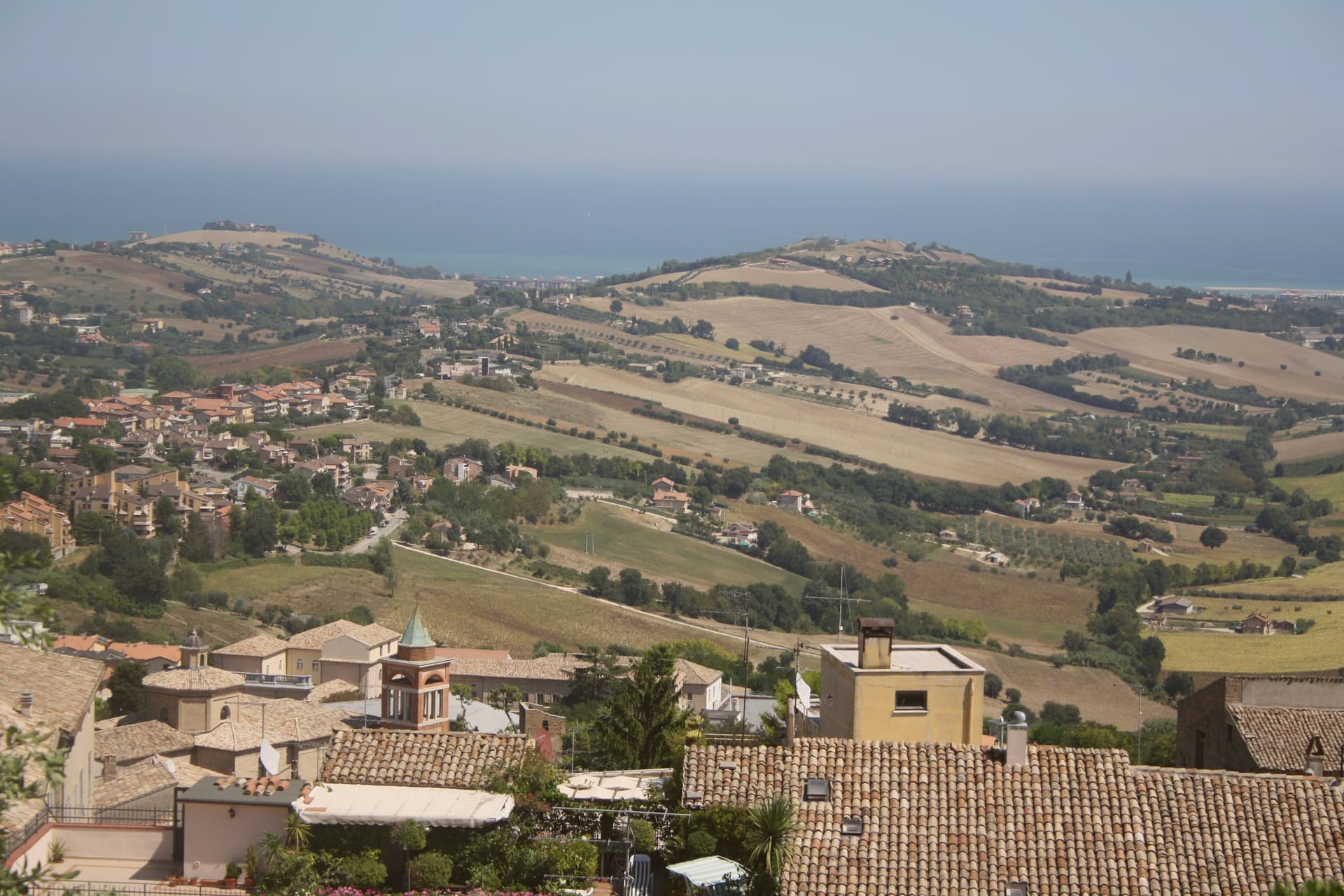
Why visit Fermo
Fermo sits eight kilometers inland from the Adriatic and from the seaside frazione of Lido di Fermo, which holds the commune's Bandiera Blu: a hill town with its own beach attached at a distance, the two connected by the same municipal boundary but separated in character and elevation. The Roman colony of Firmum Picenum was founded on the hilltop in 264 BC after the conquest of the Picentes, with six thousand Latin colonists settled there.
In the tenth century the town became the capital of the Marchia Firmana, the territorial label that eventually gave the region its name. The historic center still reads as a hilltop capital looking down toward a coast it administers rather than touches.
What began as a Latin colony on high ground, gained a name that outgrew it and spread to the whole region, and kept its port at arm's length: the distance between the hill and the shore is not incidental but the shape of how Fermo has always held its territory.
The re-enactment here is Cavalcata dell'Assunta, usually held in August.
What to see in Fermo
- Cisterne Romane. Thirty barrel-vaulted rooms in three parallel rows under the historic center, opus signinum waterproofing still in place, built to hold 15,000 cubic meters of water.
- Piazza del Popolo. The porticoes meet at the head of the square where the Palazzo dei Priori stands, the arrangement that has organized the civic center since the medieval period.
- Palazzo dei Priori. Built in 1296 by joining a thirteenth-century palace and a church, housing the Pinacoteca Civica, the Sala del Mappamondo and the Sixtus V bronze statue.
How to get to Fermo
Ancona is roughly 60 minutes away by road.
Our tip
April through June and September into October are the months for Fermo. The hilltop catches Adriatic light without coastal humidity, the Sabulo's wide views across the Aso and Tenna valleys run clear, and Lido di Fermo's beach eight kilometers below holds its Bandiera Blu status from May. July and August touch the low thirties in the valley but the centro storico stays cooler at 319 meters; the Cavalcata dell'Assunta on August 15 fills the streets with the historic medieval procession dating to 1182. Cavalcata dell'Assunta falls in August.
Macerata
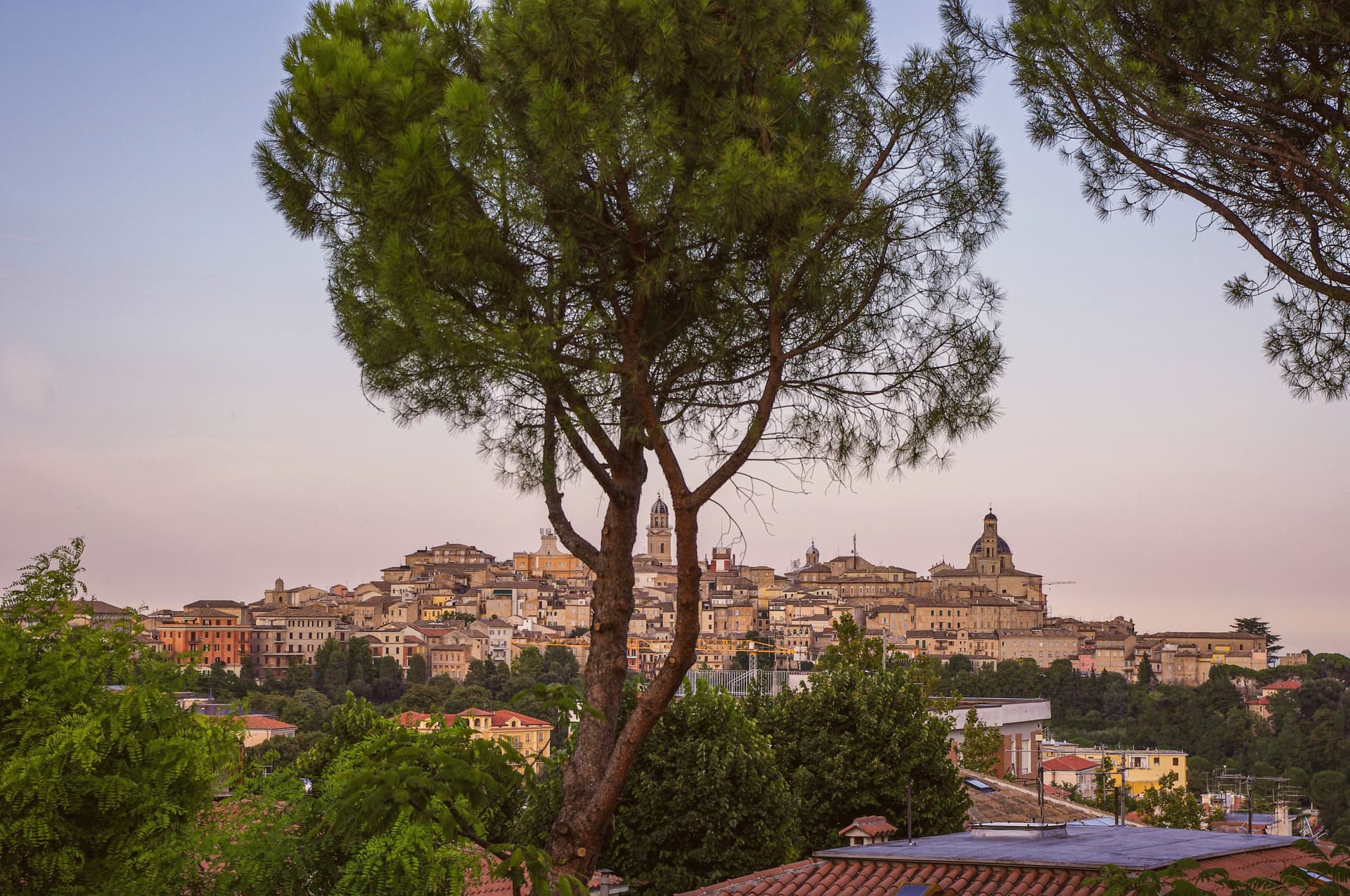
Why visit Macerata
Macerata sits at 315 meters on a hilltop between the Chienti and Potenza valleys, thirty-five kilometers south of Ancona. The Roman Helvia Recina stood on the plain below; after the city was destroyed by the Goths the survivors moved up to the present site, where the town grew into the provincial capital.
The University, founded in 1290, is one of the oldest in continuous operation in Europe. The Sferisterio, the city's signature monument, is a 100-meter neoclassical arena designed by Ireneo Aleandri in 1823, originally built for pallone col bracciale, the bracelet-ball game once played across central Italy.
From 1921, when Verdi's Aida was first staged there, it became one of Italy's principal open-air opera venues. The Macerata Opera Festival runs through July and August.
The provincial museum holds works by Carlo Crivelli, Lorenzo Lotto and Antonio Canova. The 2016 earthquakes damaged outlying frazioni but the centro storico held.
The re-enactment here is Rievocazione storica della Trebbiatura - Degustazione dell'oca, usually held across June and July.
What to see in Macerata
- Sferisterio. Neoclassical 100-meter open-air arena designed by Ireneo Aleandri in 1823, originally built for pallone col bracciale, now seat of the Macerata Opera Festival since 1921.
- Università di Macerata. Founded in 1290, one of the oldest continuously operating universities in Europe, with its main rectorate on Piazza della Libertà.
- Piazza della Libertà. Main square of the centro storico, holds the Loggia dei Mercanti, the Palazzo del Comune and the Torre dei Tempi with its astronomical clock.
How to get to Macerata
There is a railway station in the town, so you can arrive without a car and never need one while you are here. Ancona is roughly 58 minutes away by road.
Our tip
April through June and September into October are the best months for Macerata. The Chienti and Potenza valleys hold green from April, the centro storico runs cool in the morning and the surrounding hills toward Montelupone and Treia are open for walking. July and August anchor the Macerata Opera Festival at the Sferisterio, with three major productions across roughly six weeks; nights stay warm but the open arena keeps moving air. Rievocazione storica della Trebbiatura - Degustazione dell'oca falls in June.
Ascoli Piceno
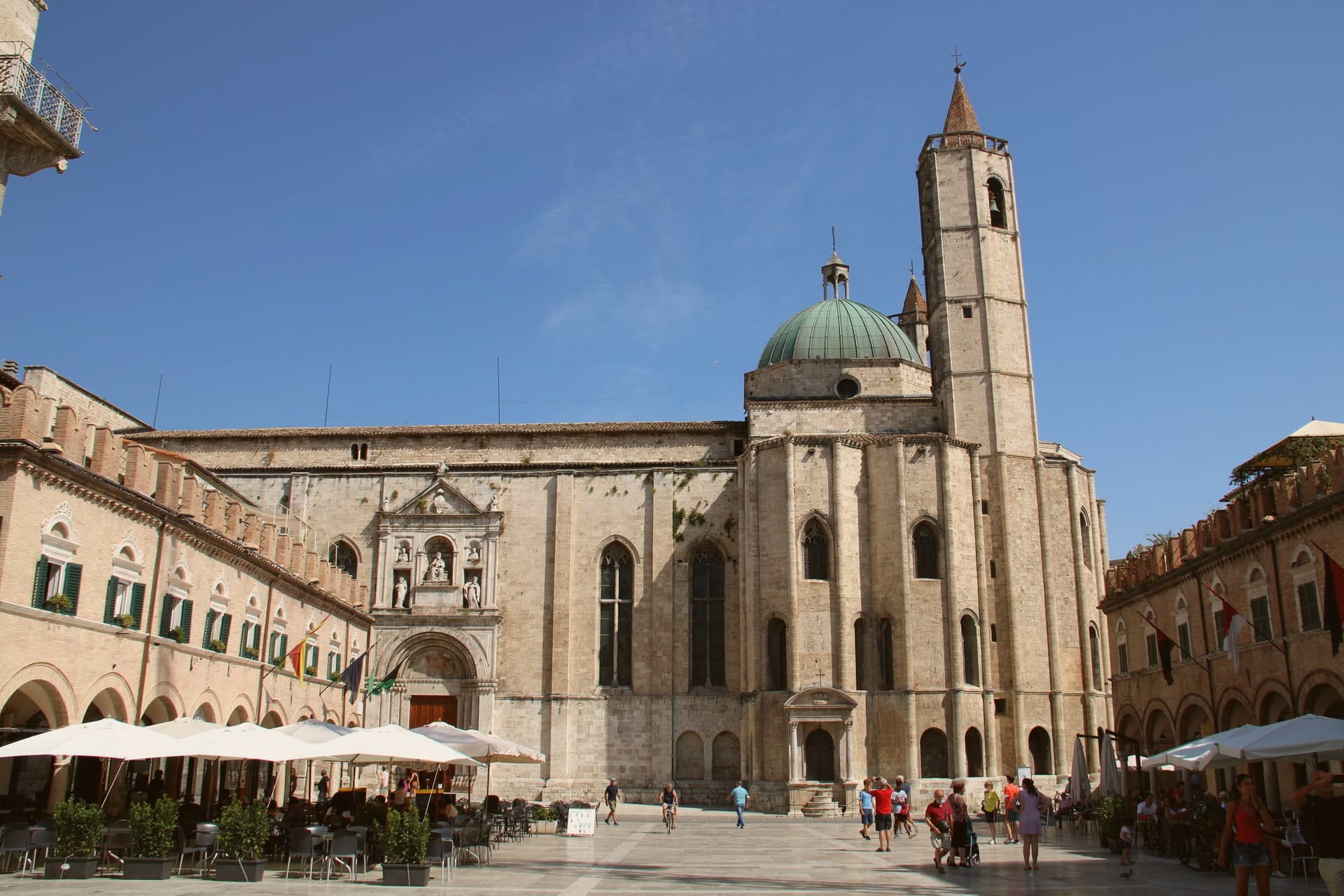
Why visit Ascoli Piceno
Ascoli Piceno sits at 154 meters at the confluence of the Tronto and the Castellano, the historic capital of the Piceni who held this part of the Marche before Rome. The town is built almost entirely from local travertine, which gives the centro storico its luminous pale surface and its mirror behavior under rain: Piazza del Popolo, paved in polished travertine slabs, is one of the most photographed squares in Italy.
In 91 BC the Ascolani killed the Roman delegation in their forum and triggered the Social War; the city was razed and rebuilt by Rome and the present grid still follows the Roman layout. The Quintana, run in costume in July and August, is a joust between the six sestieri, the city districts, the knight on horseback charging an effigy of an Arab warrior.
Anisetta Meletti, the local aniseed liqueur invented in 1907, is poured at the Caffè Meletti on the piazza.
The re-enactment here is Quintana - Giostra della Quintana in onore di Sant'Emidio, usually held in August.
What to see in Ascoli Piceno
- Piazza del Popolo. Paved in polished travertine slabs and lined by Renaissance porticoes, the Palazzo dei Capitani and the Loggia dei Mercanti, one of the most photographed squares in Italy.
- Chiesa di San Francesco. Gothic basilica begun in the thirteenth century, three travertine portals, two bell-towers, the largest Marchigiana example of the Franciscan order's architecture.
- Cattedrale di Sant'Emidio. Cathedral on Piazza Arringo, with a fifth-century crypt holding the relics of Sant'Emidio, patron saint invoked against earthquakes.
How to get to Ascoli Piceno
There is a railway station in the town, so you can arrive without a car and never need one while you are here. Pescara is roughly 72 minutes away by road.
Our tip
April through June and September into October are the best months for Ascoli Piceno. The travertine is dry, the surrounding olive groves turn through the Ascolana tenera harvest from October, and the Tronto and Castellano walks along the city's south edge are open every day. July and August touch the mid-thirties; the centro storico empties between three and six in the afternoon but the Quintana weekends fill it again. Ascoliva Festival falls in August.
More from Anywhere Italy
 The best towns with a food festival that eat well in Marche
 The best hill towns with a serious restaurant in Marche
 The 10 best hill towns that eat well within 90 minutes of Ancona
- The best hill towns with a food festival within 90 minutes of Ancona
 The 8 prettiest villages that eat well in Marche
 The prettiest villages with a food festival in Marche