
The best hill towns with a serious restaurant in Marche
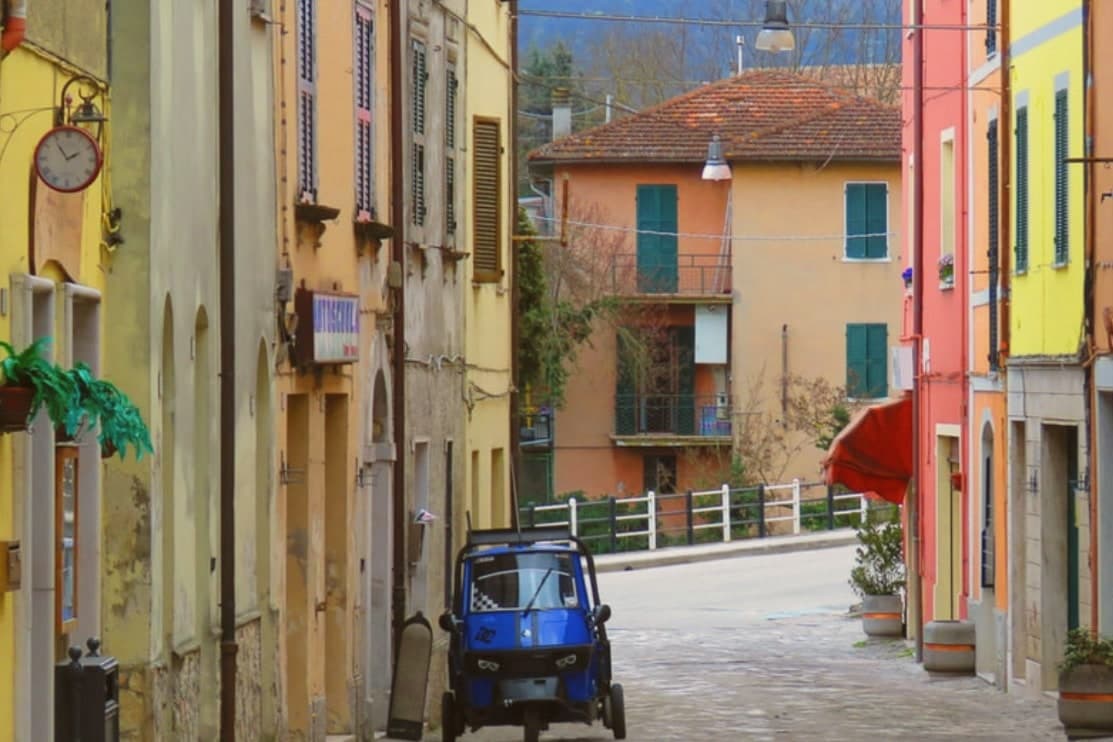
The Marche interior is a country of ridges, each one carrying a walled town in brick or pale travertine, with the Sibillini showing white to the south for much of the year. Autumn is the season the region cooks for: white truffle out of the Metauro valley, olive all'ascolana fried to order, maccheroncini rolled thin, vincisgrassi baked in the oven for a Sunday that starts at one and ends when it ends. The wine lists lean local, Verdicchio and Pecorino from the hills, Rosso Piceno from the slopes nearer the sea. Kitchens here tend to be family-run and quietly ambitious, which is a combination the serious guides keep noticing.
People come to Marche for the coast, and mostly for Conero, where the white cliffs drop into clear water and the beaches below Sirolo and Numana fill from June onwards. It is a good stretch of shoreline, which is why the parking, the beach clubs and the seafront tables are booked out well before anyone arrives. Portonovo in August is the version of the region most visitors take home. Twenty minutes inland, the crowds thin out almost completely.
The same produce that supplies those coastal kitchens comes from the hills behind them, and so do many of the cooks. Follow the valleys up from the Adriatic and the towns get older, higher and quieter, with a Renaissance palace or a Romanesque crypt at the top and somewhere serious to eat within walking distance of it. These are the towns on this list: inland, walkable in an afternoon, and holding a restaurant that the hardest guide to please has written up. Worth planning a route around rather than a single detour.
Of the 63 communes we have mapped in Marche, 10 qualify as hill towns with a serious restaurant: each is an inland hill settlement, and each holds a restaurant listed by the most demanding of the guides. The smallest, Acqualagna, has 4,151 residents.
Elsewhere in the catalogue: The 6 best hidden hill towns with a serious restaurant in Marche and The 10 best hidden towns with a serious restaurant in Marche.
Acqualagna
Why visit Acqualagna
Acqualagna sits at 204 meters in the Metauro valley, twelve kilometers from Urbino, on the plain just downstream from the gorge cut by the Candigliano river. The Roman city of Pitinum Mergens stood nearby until Alaric's Goths destroyed it; the survivors founded Montefalcone, the castle from which today's village grew.
The name Acqualagna comes from Aqua Lanea, water of slaughter, after the sixth-century battle fought on that same plain. Three fairs anchor the year: black truffle on the last Sunday of February, summer black on the last Sunday of July, white truffle across the last weekend of October and the two that follow.
The town below and the gorge above read as one unit, a river valley that has carried Roman road traffic, monastic settlement and truffle trade in turn, each leaving its mark on the ground without erasing what came before.
Anticofurlo have been named by a guide.
What to see in Acqualagna
- Gola del Furlo. The gorge narrows between Monte Paganuccio (977 m) and Monte Pietralata (888 m); the 38-meter Roman tunnel, cut in 76 AD, is still driven through by the Via Flaminia today.
- Abbazia di San Vincenzo al Furlo. Medieval Benedictine monastery set into the slopes above the gorge, counted among the oldest religious foundations in the Metauro valley.
- Riserva Naturale Statale Gola del Furlo. Nature reserve established in 2001, covering 3,600 hectares of woodland, grazing land and ridgeline above the river.
How to get to Acqualagna
There is a railway station in the town, so you can arrive without a car and never need one while you are here. Rimini is roughly 81 minutes away by road.
Our tip
April through June and September into October are the months for Acqualagna. The Metauro hills hold their green, the woods around Monte Paganuccio are open for walking, and summer truffle season turns the piazzas over to tasting tables in late July. July and August touch the high twenties; the gorge stays cooler than the valley floor. Fiera Regionale del Tartufo d'Estate falls in August.
Offida
Why visit Offida
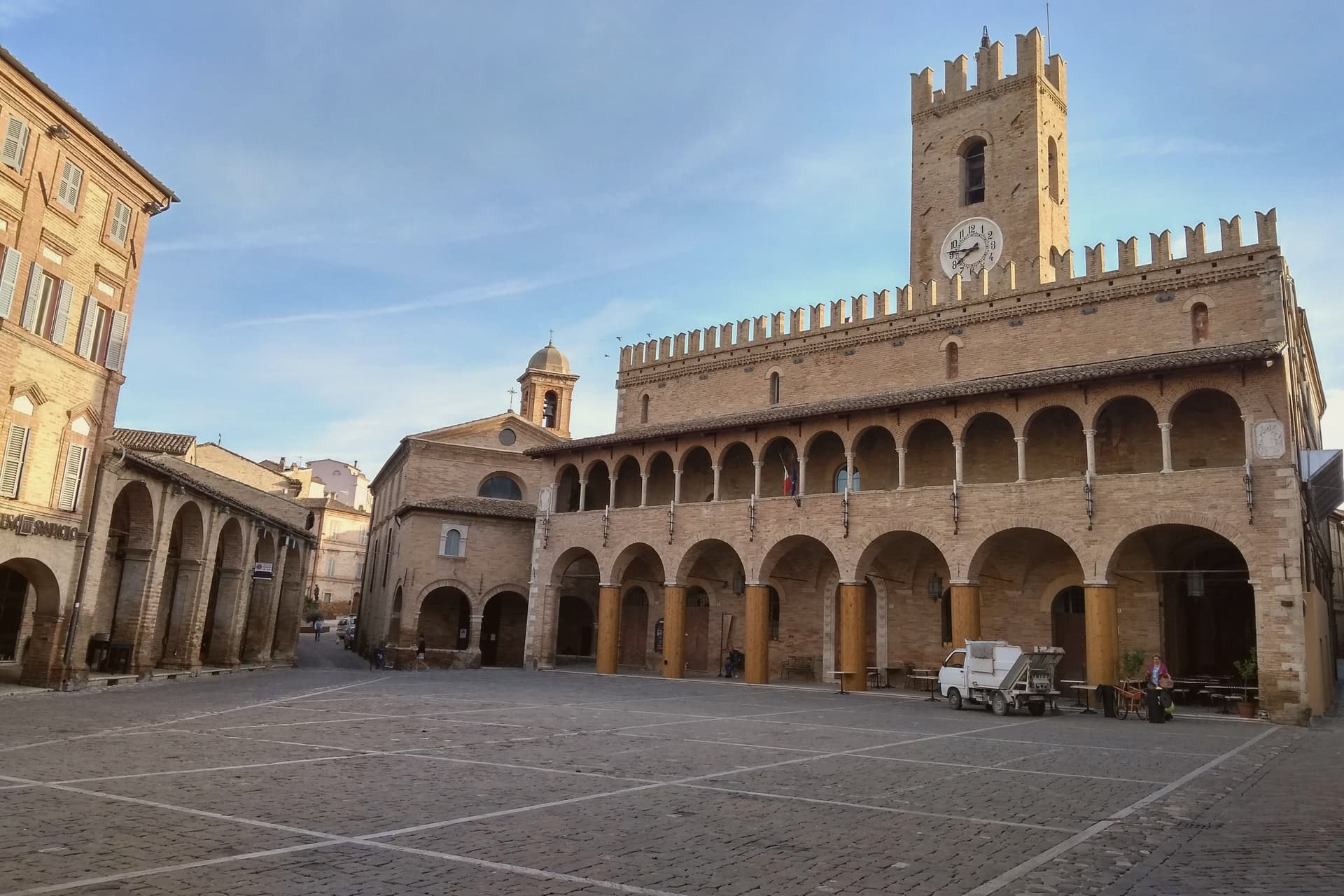
Offida sits at 293 meters on a cliff between the Tesino and Tronto valleys, twenty-three kilometers from Ascoli Piceno. The Chiesa di Santa Maria della Rocca rises on a rock spur at the western edge of the village, surrounded on three sides by cliffs that drop into two valleys: a Romanesque-Gothic temple in brick and travertine, raised by Master Albertino in 1330 on an older Benedictine foundation, with a double row of trilobed arches around the apse.
Inside, the apse and transept hold the fresco cycle of the Master of Offida, an anonymous monk painter who carried Giotto's lesson through the Rimini school, with the Marriage of Saint Catherine and Saint Christopher dated by inscription to 1367. Bobbin lace, merletto a tombolo, has been worked in town since the fifteenth century; the Museo del Merletto in Palazzo De Castellotti holds the collection.
The Carnevale Storico, with the Bove finto run and the Vlurd fire bundles, dates from before Lent in early February.
Osteria Ophis, Blob Caffè & Ristorante have been named by a guide.
What to see in Offida
- Chiesa di Santa Maria della Rocca. Romanesque-Gothic brick-and-travertine church raised in 1330 by Master Albertino on a rock spur west of town, with the Master of Offida fresco cycle dated 1367 in the transept.
- Museo del Merletto a Tombolo. Inside Palazzo De Castellotti, with the lace collection, tools, historical documents and demonstrations of the bobbin-lace work practiced in town since the fifteenth century.
- Palazzo Comunale. Civic palace on the long Piazza del Popolo, with a portico, the Teatro Serpente Aureo and the access to the Museo del Merletto and the archaeological museum.
How to get to Offida
Pescara is roughly 74 minutes away by road.
Our tip
April through June and September into October are the best months for Offida. The hills around the town turn green by April and gold through the September harvest, the wine cellars run open tastings between vendemmia and St. Martin, and the Pecorino and Passerina vineyards stand out along the ridges. Sagra del Chichìripieno falls in August.
Treia
Why visit Treia
Treia stands at 342 meters in the hills between the Potenza and Chienti valleys, thirty-five kilometers from Ancona. The Roman town of Trea lay on the plateau below, a municipium founded shortly after 49 BC that flourished between Augustus and Antoninus Pius.
Around the year 1000 the population moved up to the more defensible hilltop of Montecchio, and the older site emptied. The new town stayed under the name Montecchio until 1790, when Pope Pius VI raised it to the rank of città and restored its Roman name.
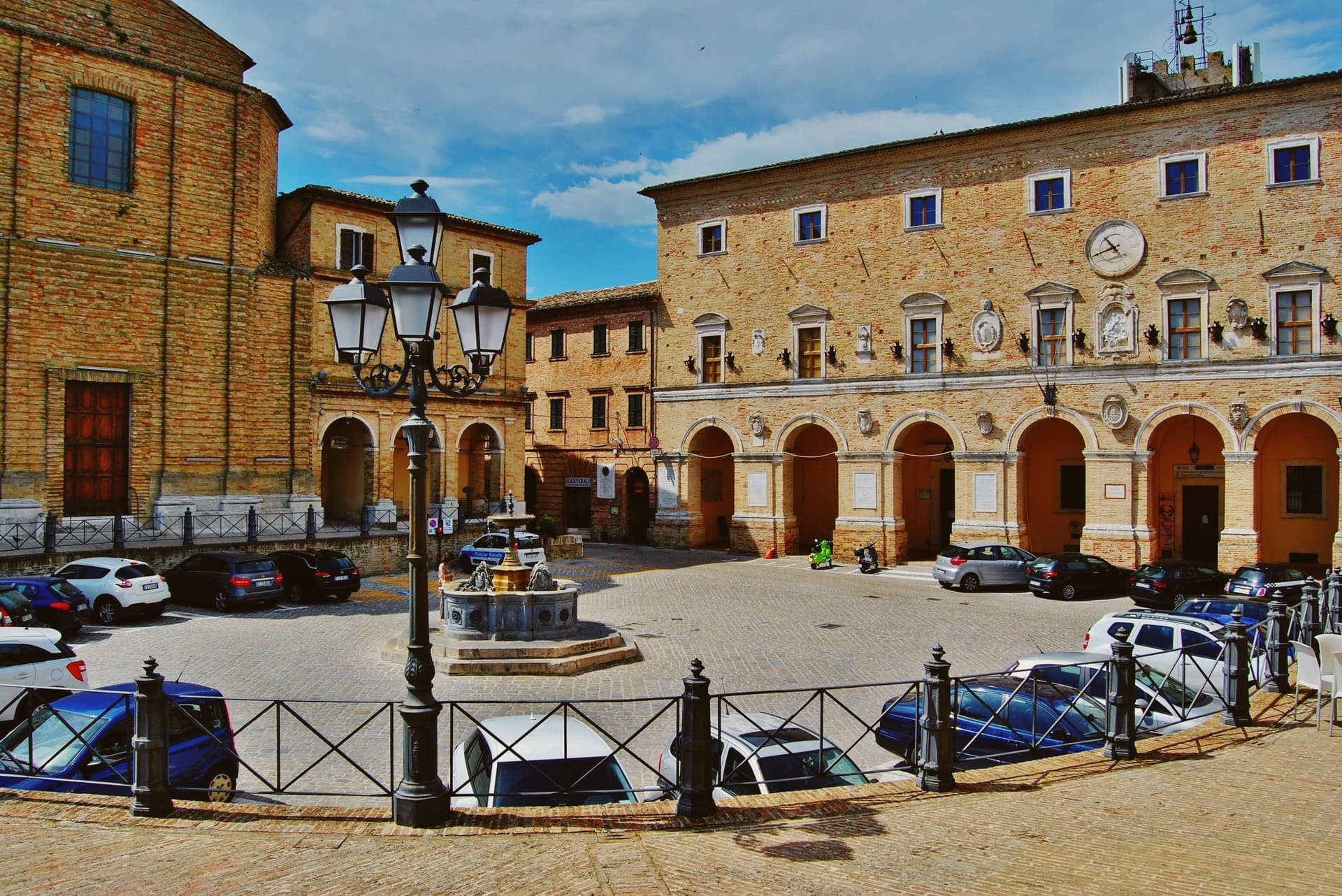
The Piazza della Repubblica, on the highest point of the ridge, is closed at one end by the Cattedrale della Santissima Annunziata and at the other by Giuseppe Valadier's small Accademia Georgica, the eighteenth-century home of an agronomic academy founded in the fifteenth as the Accademia dei Sollevati. The Disfida del Bracciale, an Ottocento street-game in which four contrade compete, has filled the centro storico every first Sunday of August since 1978.
Il Casolare dei Segreti have been named by a guide.
What to see in Treia
- Piazza della Repubblica. Belvedere piazza on the highest point of the ridge, closed by the Cattedrale della Santissima Annunziata at one end and the Accademia Georgica at the other.
- Accademia Georgica. Eighteenth-century Giuseppe Valadier building housing an academy founded in the 1400s, with 1,196 parchments of the municipal archive and over 15,000 volumes.
- Santuario del Santissimo Crocifisso. Cesare Bazzani sanctuary completed in the early twentieth century on the site of an older parish church, holding a sixteenth-century Umbrian fresco and a thirteenth-century crucifix.
How to get to Treia
Ancona is roughly 58 minutes away by road.
Our tip
April through June and September into October are the best months for Treia. The hills between the Potenza and Chienti turn green in spring, the wheat ripens through June, and the autumn light on the long ridge runs gold through October. July and August touch the low thirties; the high point of the centro storico catches a breeze most afternoons, and the Disfida del Bracciale on the first Sunday of August is the busiest weekend of the year. Disfida del Bracciale falls in July.
Fossombrone
Why visit Fossombrone
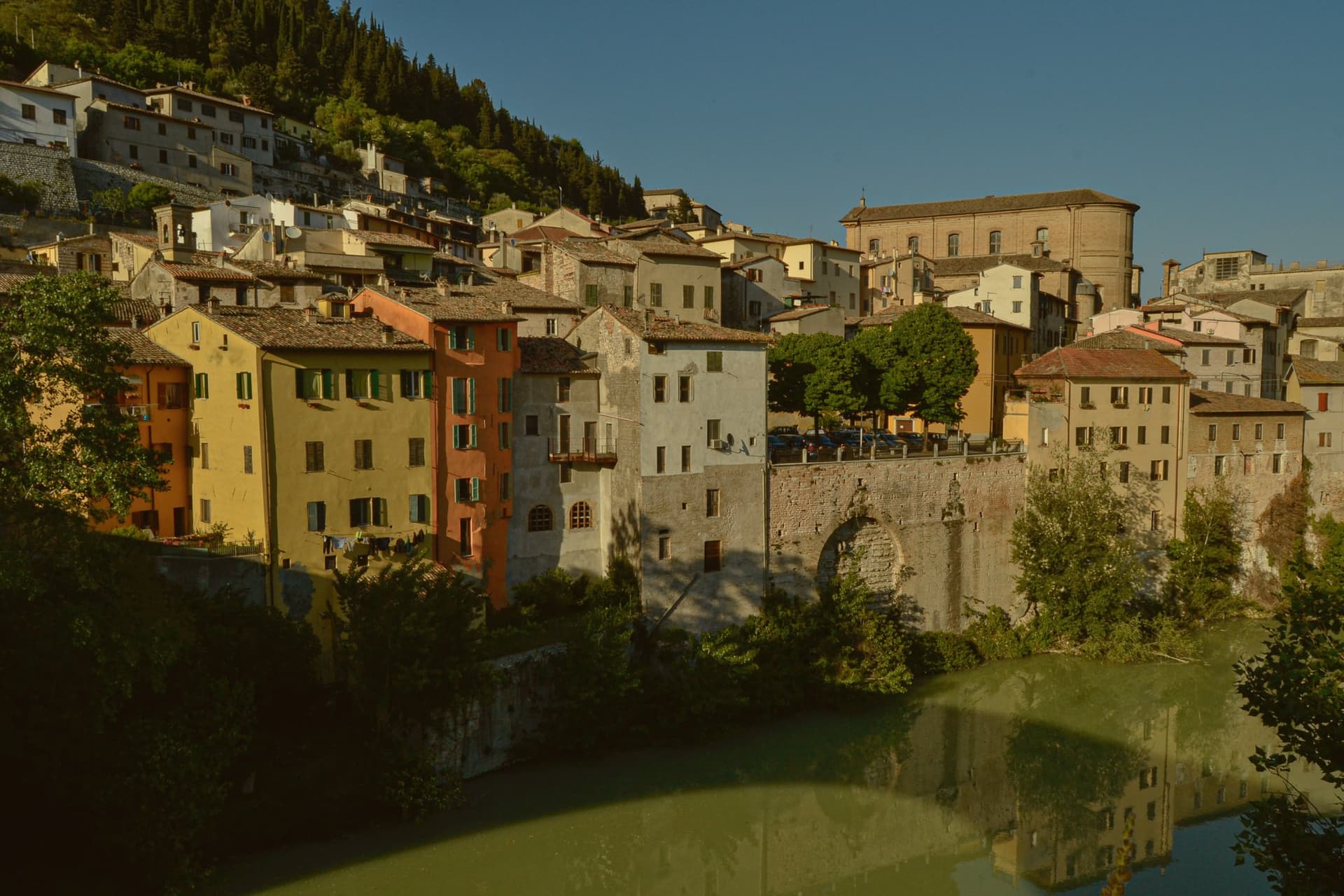
Fossombrone sits on the Metauro river in the foothills of the central Apennines, 30 km inland from Pesaro. The site has been continuously occupied since the 8th century BC: a north-Piceno village, then a partial Celtic settlement, then the Roman colony founded around 120 BC by the consul Caius Sempronius Gracchus.
The town's layers sit stacked in physical order. The Roman city's remains lie in the flat ground just east of the modern centre.
Above it, the medieval and Renaissance town climbs a single long street to the ducal court at its summit. Lower down, the Casa Cattabrini and the cathedral anchor the centro storico by the river.
Upstream, 8 km from the centre, the Metauro narrows into the gorge that gives the town its wider setting, its cliffs cut through by the Roman engineers and now enclosed within a nature reserve. The geography explains the sequence: river valley first, road town second, fortified height last, each built on what the one before had left standing.
Osteria Zanchetti have been named by a guide.
What to see in Fossombrone
- Forum Sempronii (area archeologica). Excavations east of the modern centre reveal the forum, basilica and domus mosaics, with a continuous stratigraphy running from the north-Piceno village through the Roman imperial city. The Via Flaminia ran through the colony.
- Corte Alta. The palace begun by Federico da Montefeltro and completed under the Della Rovere dukes sits at the top of a single long street climbing from the lower town. It holds a small civic museum alongside the frescoed hall.
- Galleria del Furlo (76 AD). The tunnel runs 38 metres through limestone above the narrowing Metauro, with the gorge around it protected as a nature reserve, some of the wildest ground in the Marche.
How to get to Fossombrone
Rimini is roughly 69 minutes away by road.
Our tip
April through October is the open season on the Metauro. May and June are the best months for the Furlo Gorge walks — wildflowers, cool gorge shade, the river running clear. July and August are warm in the valley but the gorge stays cooler than the coast; the Corte Alta keeps regular hours.
San Severino Marche
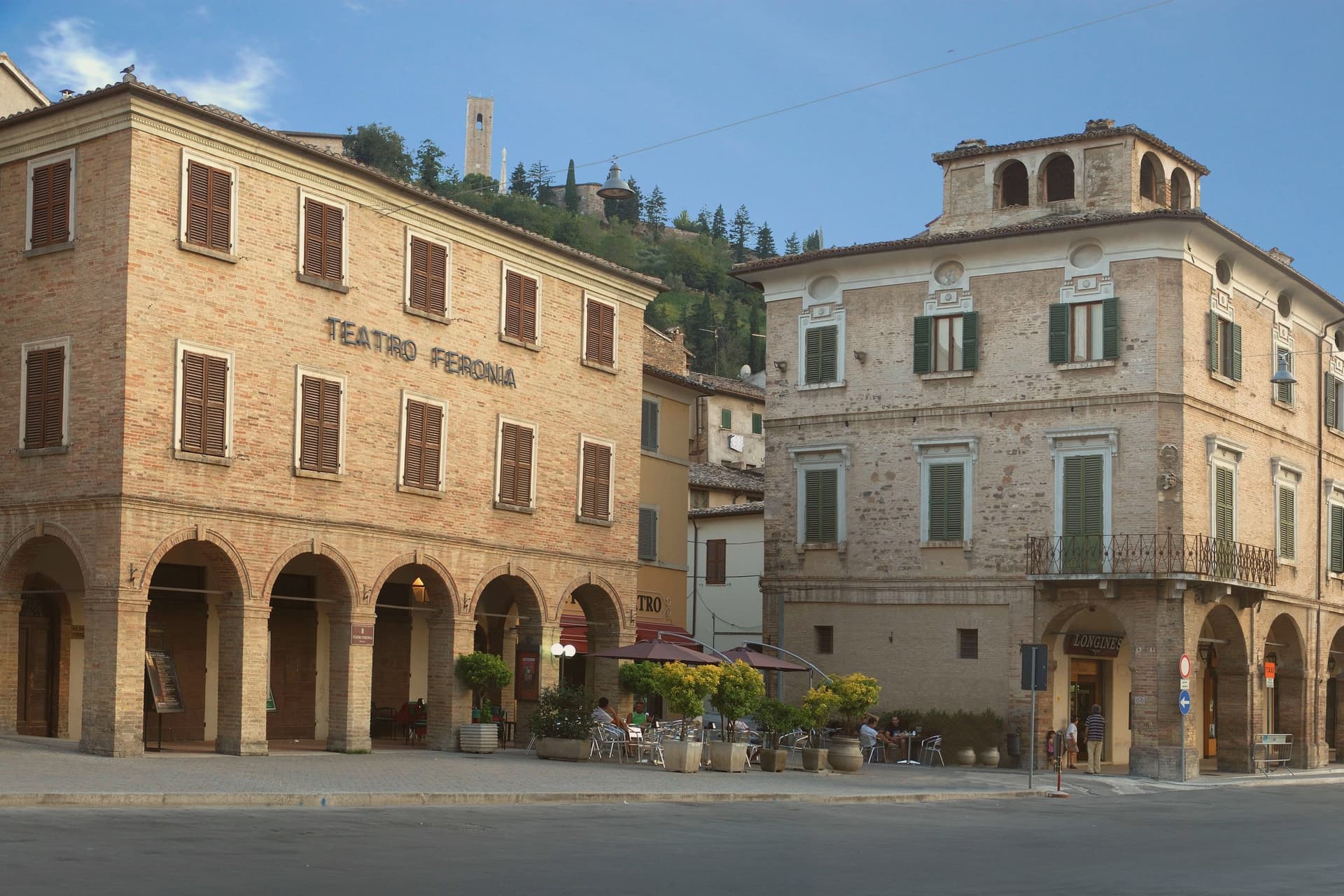
Why visit San Severino Marche
San Severino Marche sits at 235 meters in the Potenza valley, fifty kilometers southwest of Ancona, and the town is built in two distinct pieces rather than one continuous fabric. The medieval Castello occupies the hill above the town, still ringed by surviving city walls, while the Borgo below grew up around its own civic center on the valley floor.
The two parts do different jobs: the hill was governed and defended, walled and towered under the Smeducci dynasty through the fourteenth century, while the valley floor was built for markets and public life, organized around the wide colonnaded ellipse that still serves as the town's gathering space. The Salimbeni brothers, Lorenzo and Jacopo, were born in the town and worked across both halves of it, painting in a hilltop church and in a crypt-church alike, and their frescoes, along with a Vittore Crivelli polyptych, have since been gathered into a civic gallery in the lower town.
That movement of paintings from hill to valley mirrors the town's own shift in weight over time, from a fortified seat of government above to a civic and commercial center below, with the art now sitting closer to the square than to the walls that first sheltered it.
Cavallini have been named by a guide.
What to see in San Severino Marche
- Piazza del Popolo. The elliptical square anchors the lower town, its porticoes running unbroken around the full curve, giving the Borgo a single continuous gathering space rather than a scattering of smaller squares.
- Duomo Vecchio. The bell tower and the raised setting on Monte Nero are what register first, the cathedral standing above the walls rather than among them. Inside, the chapel that once held the Salimbeni Saint John cycle is now empty, the frescoes moved elsewhere in town.
- Torre degli Smeducci. The tower is the only structure on the hill that reads as purely defensive, plain where the church nearby is decorated, and it still dominates the skyline of the upper town.
How to get to San Severino Marche
There is a railway station in the town, so you can arrive without a car and never need one while you are here. Ancona is roughly 71 minutes away by road.
Our tip
April through June and September into October are the working months for San Severino Marche. The Potenza valley turns green from April, the climb to the Duomo Vecchio holds its best light through the autumn afternoons, and the Palio dei Castelli on the second Sunday of June fills both city centers with neighborhood processions. July and August touch the low thirties; the elliptical Piazza del Popolo offers shaded porticoes through the hottest hours and the lower city empties between four and seven.
Urbino
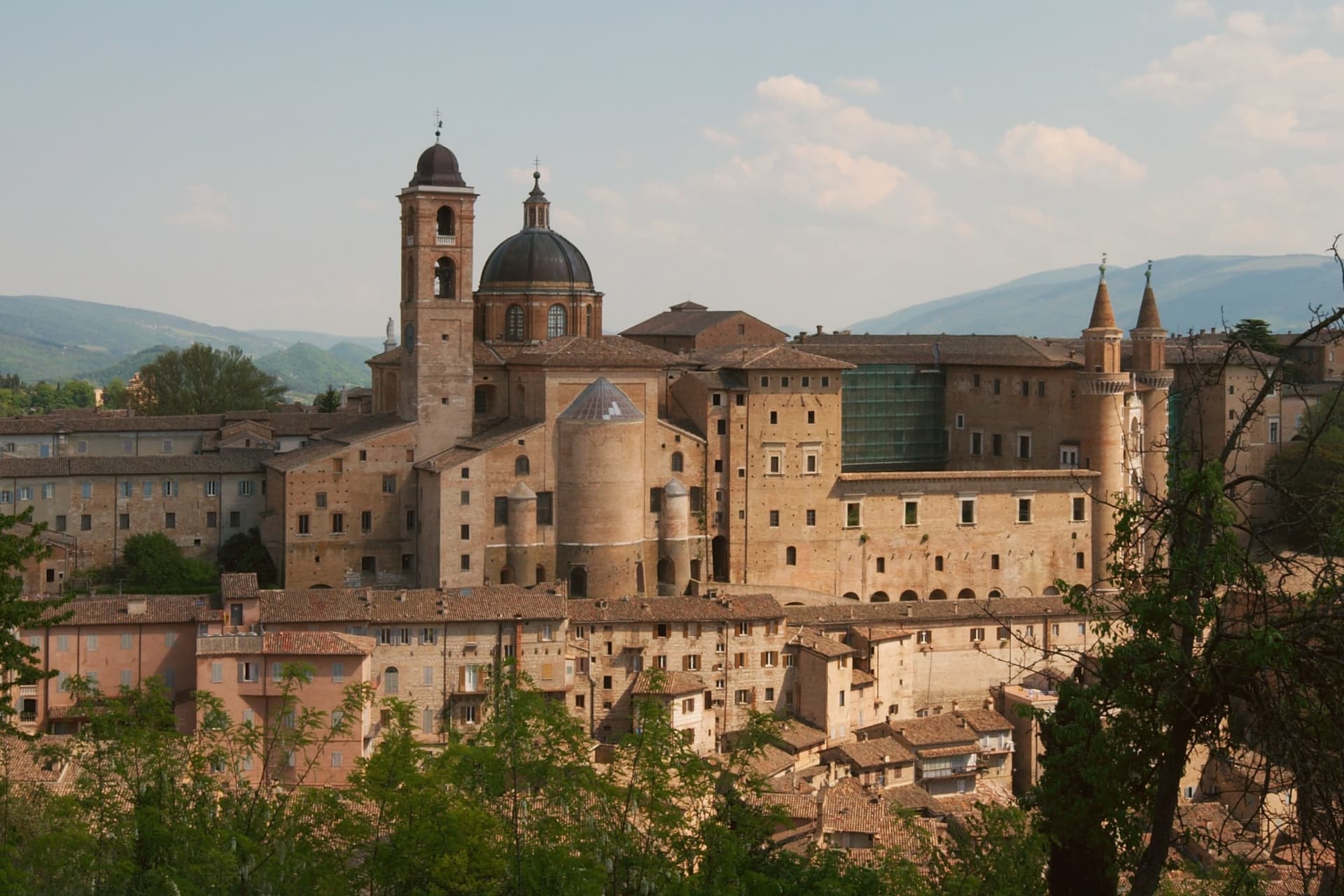
Why visit Urbino
Urbino sits at 451 meters in the Apennine foothills, seventy kilometers north of Perugia, its historic core spread across twin hills with the fortress on the higher of the two and the palace complex below on the other. Federico II da Montefeltro ruled from 1444 to 1482, and under him the town became one of the central courts of the Italian Renaissance: he was condottiere, diplomat, patron and humanist at once, and the building campaign he set running through the 1450s to the 1470s, first under Maso di Bartolomeo, gave the city the asymmetric silhouette that still defines it from a distance.
The university, founded in 1506, keeps that Renaissance investment active in the present rather than fossilized: the centro storico holds roughly 14,000 residents and around 14,000 enrolled students, so the old town runs on a population it did not have in the fifteenth century. The two hills, the ducal seat and the fortress above it, read as the same civic project seen from two elevations: one built to project a court outward, the other to hold the higher ground behind it.
What the 1998 inscription recognizes is that this pairing, court and citadel, survives largely as Federico left it.
Portanova have been named by a guide.
What to see in Urbino
- Palazzo Ducale. Federico da Montefeltro's Renaissance palace begun 1444, completed by Luciano Laurana with the twin torricini facade, now housing the Galleria Nazionale delle Marche.
- Galleria Nazionale delle Marche. One of the most important Renaissance painting collections in Italy, with Raffaello, Piero della Francesca's Flagellazione and Madonna di Senigallia, Paolo Uccello and Tiziano.
- Casa Natale di Raffaello. Fifteenth-century house on Via Raffaello where the painter was born in 1483 in the workshop of his father Giovanni Santi, now a museum of the early years.
How to get to Urbino
There is a railway station in the town, so you can arrive without a car and never need one while you are here. Rimini is roughly 65 minutes away by road.
Our tip
April through June and September into October are the best months for Urbino. The hills hold their green, the city's brick warms in afternoon light, and the long climb to the Fortezza Albornoz is bearable in mild weather. July and August touch the low thirties at 451 meters; the Palazzo Ducale stays cool inside, but the steep streets in afternoon sun are slow going.
Recanati
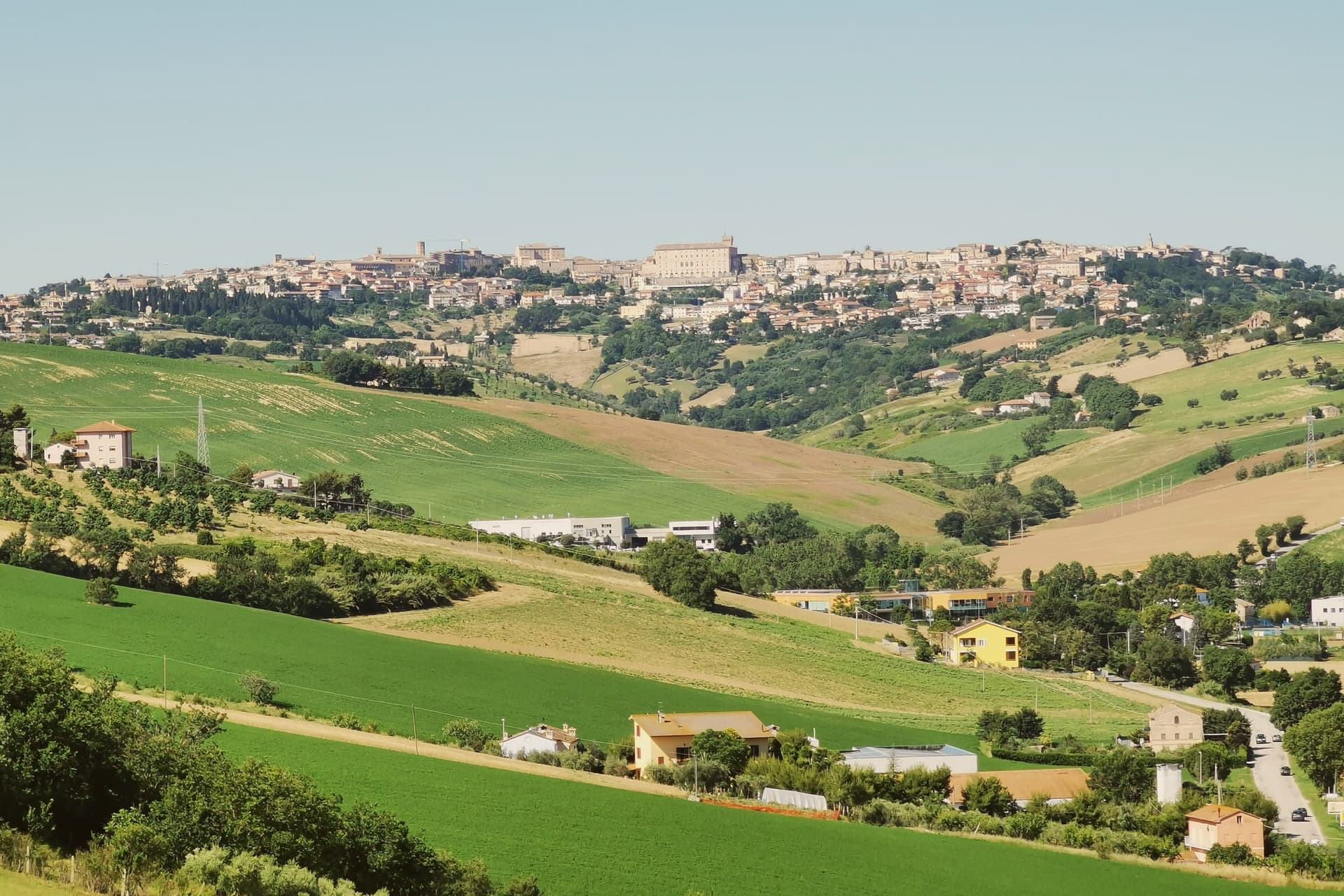
Why visit Recanati
Recanati sits at 296 meters on a hill between the Potenza and Musone valleys, twenty-five kilometers south of Ancona and ten from the Adriatic. The town was founded around 1150 from the union of three earlier castles, Monte Morello, Monte San Vito and Monte Volpino, declared itself a free republic in 1290 and ran an international fair through the fifteenth century.
The poet lived above Piazza Sabato del Villaggio in the family library until 1822, and the hill behind the palace, hedge-bordered and looking toward the Sibillini and the sea, is the ground the writing came from; the medieval tower nearby, part of the Sant'Agostino complex, gave a later poem its perch. A tenor born in the same town more than half a century afterward is remembered a short distance away, his costumes and scores kept where the theater still stands.
What the hill town adds up to is a place small enough that a library, a hedge, and a tower could hold a life's landscape, and specific enough that the view from each still matches what was written about it.
Casa Bertini have been named by a guide.
What to see in Recanati
- Palazzo Leopardi. Eighteenth-century family palace where Giacomo Leopardi lived until 1822, with the preserved library of more than 20,000 volumes he read as a boy.
- Colle dell'Infinito. Hedge-bordered hill behind the palace, its panorama across the Musone valley toward the Sibillini and the Adriatic is what the hedge in the poem blocks from view.
- Torre del Passero Solitario. Thirteenth-century tower at the Sant'Agostino complex, the highest point of the centro storico, its silence is what gave Leopardi's solitary sparrow its perch.
How to get to Recanati
Ancona is roughly 43 minutes away by road.
Our tip
April through June and September into October are the months for Recanati. The Musone valley turns green from April, the hedges of the Colle dell'Infinito catch their best afternoon light through autumn, and the Leopardiana literary festival fills the centro storico in late June. July and August touch the high twenties; the Adriatic ten kilometers east keeps the evenings cooler than the inland Macerata plain. Le Grazie in Festa falls in September.
Fermo
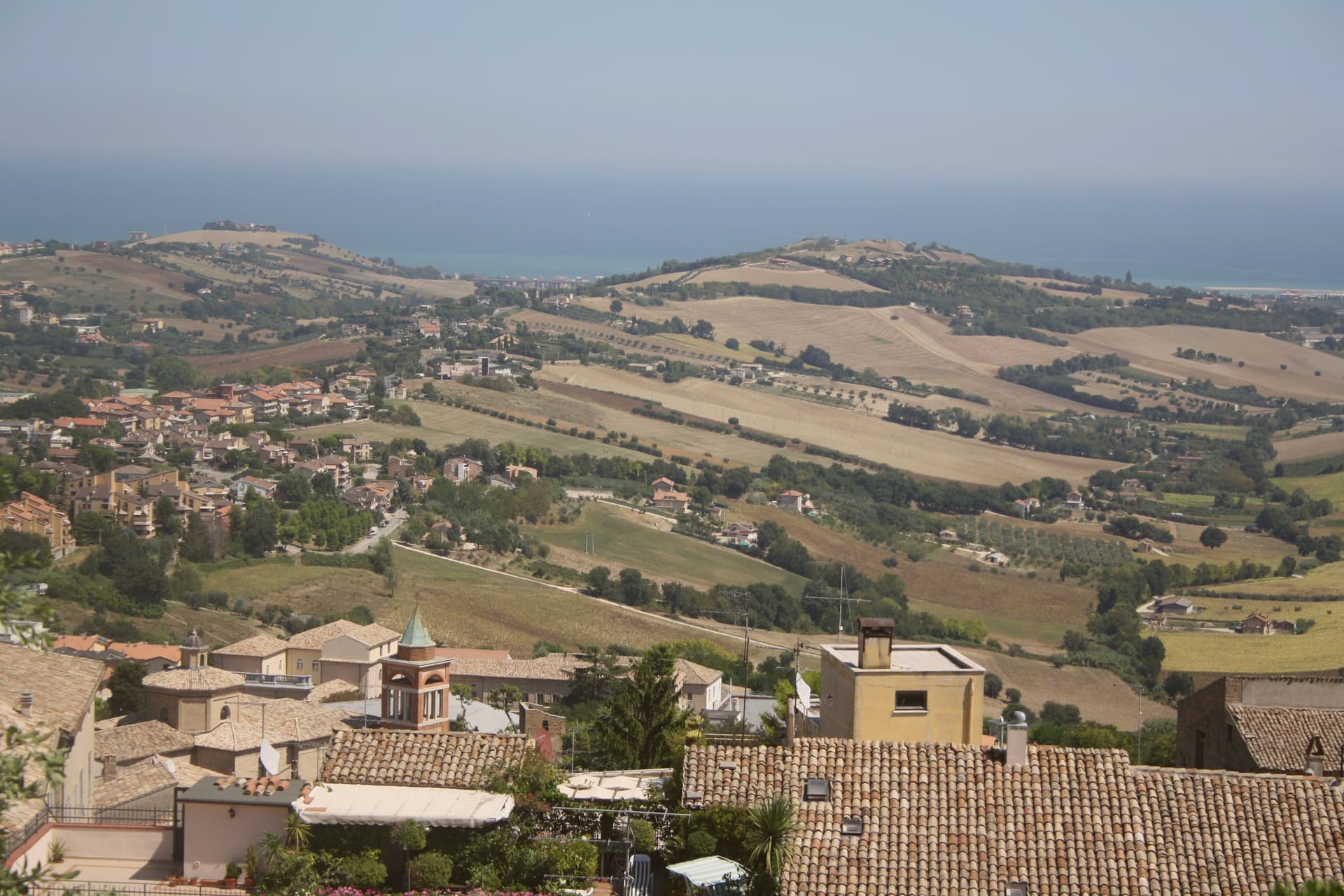
Why visit Fermo
Fermo sits eight kilometers inland from the Adriatic and from the seaside frazione of Lido di Fermo, which holds the commune's Bandiera Blu: a hill town with its own beach attached at a distance, the two connected by the same municipal boundary but separated in character and elevation. The Roman colony of Firmum Picenum was founded on the hilltop in 264 BC after the conquest of the Picentes, with six thousand Latin colonists settled there.
In the tenth century the town became the capital of the Marchia Firmana, the territorial label that eventually gave the region its name. The historic center still reads as a hilltop capital looking down toward a coast it administers rather than touches.
What began as a Latin colony on high ground, gained a name that outgrew it and spread to the whole region, and kept its port at arm's length: the distance between the hill and the shore is not incidental but the shape of how Fermo has always held its territory.
Emilio, L'Enoteca Bar a Vino have been named by a guide.
What to see in Fermo
- Cisterne Romane. Thirty barrel-vaulted rooms in three parallel rows under the historic center, opus signinum waterproofing still in place, built to hold 15,000 cubic meters of water.
- Piazza del Popolo. The porticoes meet at the head of the square where the Palazzo dei Priori stands, the arrangement that has organized the civic center since the medieval period.
- Palazzo dei Priori. Built in 1296 by joining a thirteenth-century palace and a church, housing the Pinacoteca Civica, the Sala del Mappamondo and the Sixtus V bronze statue.
How to get to Fermo
Ancona is roughly 60 minutes away by road.
Our tip
April through June and September into October are the months for Fermo. The hilltop catches Adriatic light without coastal humidity, the Sabulo's wide views across the Aso and Tenna valleys run clear, and Lido di Fermo's beach eight kilometers below holds its Bandiera Blu status from May. July and August touch the low thirties in the valley but the centro storico stays cooler at 319 meters; the Cavalcata dell'Assunta on August 15 fills the streets with the historic medieval procession dating to 1182. Cavalcata dell'Assunta falls in August.
Macerata
Why visit Macerata
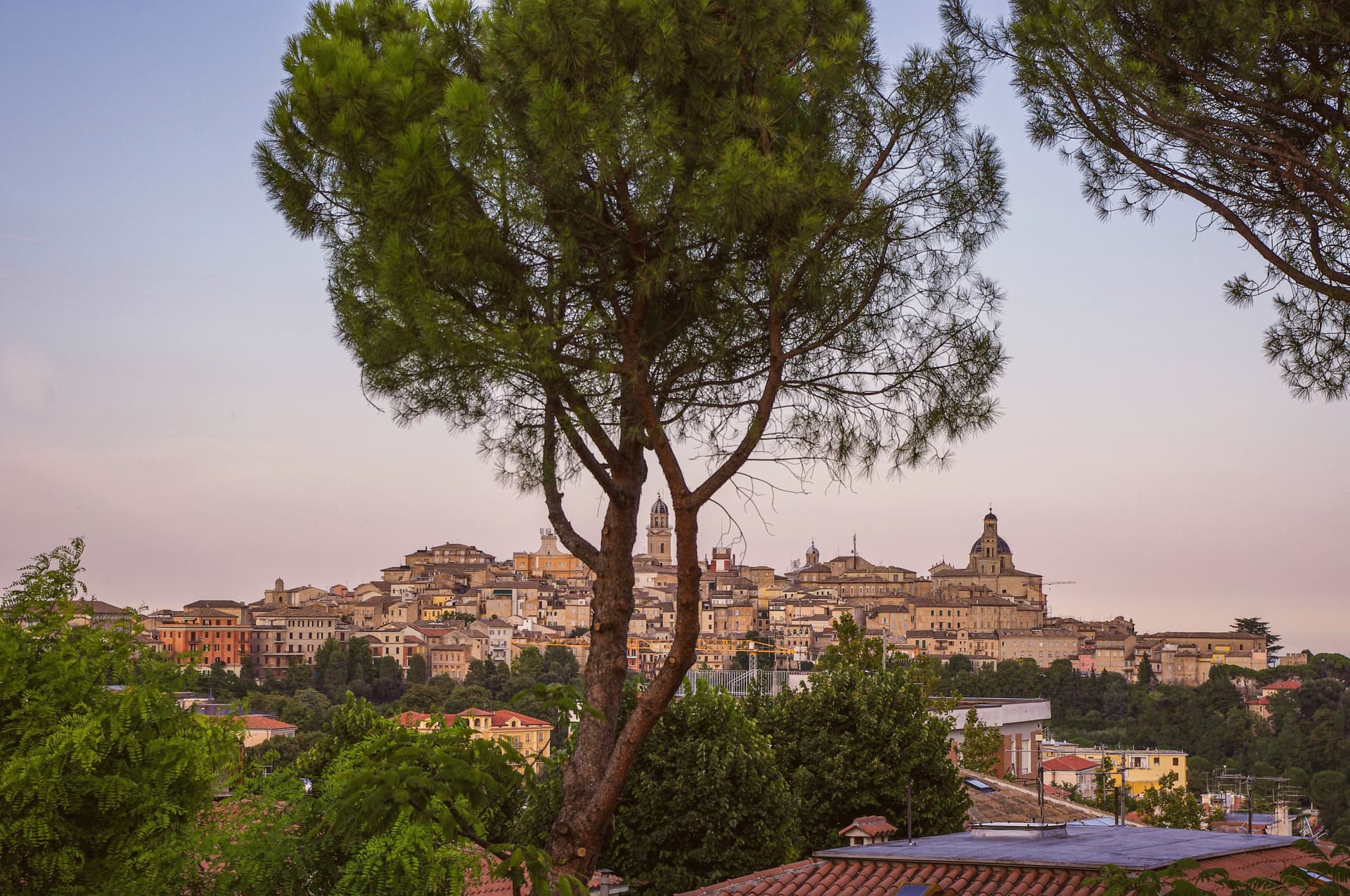
Macerata sits at 315 meters on a hilltop between the Chienti and Potenza valleys, thirty-five kilometers south of Ancona. The Roman Helvia Recina stood on the plain below; after the city was destroyed by the Goths the survivors moved up to the present site, where the town grew into the provincial capital.
The University, founded in 1290, is one of the oldest in continuous operation in Europe. The Sferisterio, the city's signature monument, is a 100-meter neoclassical arena designed by Ireneo Aleandri in 1823, originally built for pallone col bracciale, the bracelet-ball game once played across central Italy.
From 1921, when Verdi's Aida was first staged there, it became one of Italy's principal open-air opera venues. The Macerata Opera Festival runs through July and August.
The provincial museum holds works by Carlo Crivelli, Lorenzo Lotto and Antonio Canova. The 2016 earthquakes damaged outlying frazioni but the centro storico held.
Signore te ne ringrazi have been named by a guide.
What to see in Macerata
- Sferisterio. Neoclassical 100-meter open-air arena designed by Ireneo Aleandri in 1823, originally built for pallone col bracciale, now seat of the Macerata Opera Festival since 1921.
- Università di Macerata. Founded in 1290, one of the oldest continuously operating universities in Europe, with its main rectorate on Piazza della Libertà.
- Piazza della Libertà. Main square of the centro storico, holds the Loggia dei Mercanti, the Palazzo del Comune and the Torre dei Tempi with its astronomical clock.
How to get to Macerata
There is a railway station in the town, so you can arrive without a car and never need one while you are here. Ancona is roughly 58 minutes away by road.
Our tip
April through June and September into October are the best months for Macerata. The Chienti and Potenza valleys hold green from April, the centro storico runs cool in the morning and the surrounding hills toward Montelupone and Treia are open for walking. July and August anchor the Macerata Opera Festival at the Sferisterio, with three major productions across roughly six weeks; nights stay warm but the open arena keeps moving air. Rievocazione storica della Trebbiatura - Degustazione dell'oca falls in June.
Ascoli Piceno
Why visit Ascoli Piceno
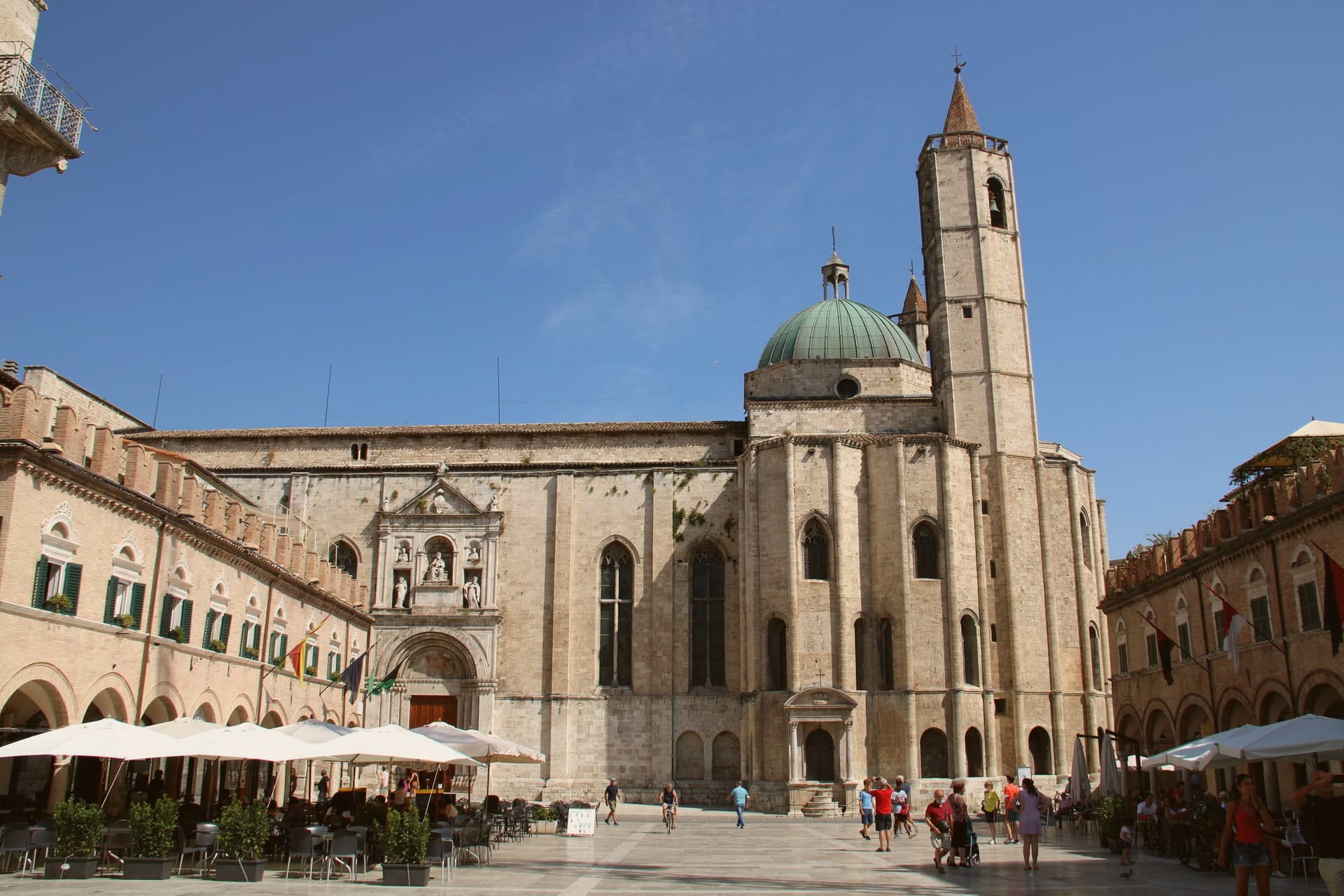
Ascoli Piceno sits at 154 meters at the confluence of the Tronto and the Castellano, the historic capital of the Piceni who held this part of the Marche before Rome. The town is built almost entirely from local travertine, which gives the centro storico its luminous pale surface and its mirror behavior under rain: Piazza del Popolo, paved in polished travertine slabs, is one of the most photographed squares in Italy.
In 91 BC the Ascolani killed the Roman delegation in their forum and triggered the Social War; the city was razed and rebuilt by Rome and the present grid still follows the Roman layout. The Quintana, run in costume in July and August, is a joust between the six sestieri, the city districts, the knight on horseback charging an effigy of an Arab warrior.
Anisetta Meletti, the local aniseed liqueur invented in 1907, is poured at the Caffè Meletti on the piazza.
Caffè Meletti, Tetsu have been named by a guide.
What to see in Ascoli Piceno
- Piazza del Popolo. Paved in polished travertine slabs and lined by Renaissance porticoes, the Palazzo dei Capitani and the Loggia dei Mercanti, one of the most photographed squares in Italy.
- Chiesa di San Francesco. Gothic basilica begun in the thirteenth century, three travertine portals, two bell-towers, the largest Marchigiana example of the Franciscan order's architecture.
- Cattedrale di Sant'Emidio. Cathedral on Piazza Arringo, with a fifth-century crypt holding the relics of Sant'Emidio, patron saint invoked against earthquakes.
How to get to Ascoli Piceno
There is a railway station in the town, so you can arrive without a car and never need one while you are here. Pescara is roughly 72 minutes away by road.
Our tip
April through June and September into October are the best months for Ascoli Piceno. The travertine is dry, the surrounding olive groves turn through the Ascolana tenera harvest from October, and the Tronto and Castellano walks along the city's south edge are open every day. July and August touch the mid-thirties; the centro storico empties between three and six in the afternoon but the Quintana weekends fill it again. Ascoliva Festival falls in August.
More from Anywhere Italy
- The 6 best hidden hill towns with a serious restaurant in Marche
 The 10 best hidden towns with a serious restaurant in Marche
- The best towns with a serious restaurant that eat well within 90 minutes of Ancona
 The 10 best hill towns that eat well within 90 minutes of Ancona
 The best towns with a food festival that eat well in Marche
 The 7 best towns with a medieval festival in Marche