
The 7 best hidden towns you can reach by train in Veneto
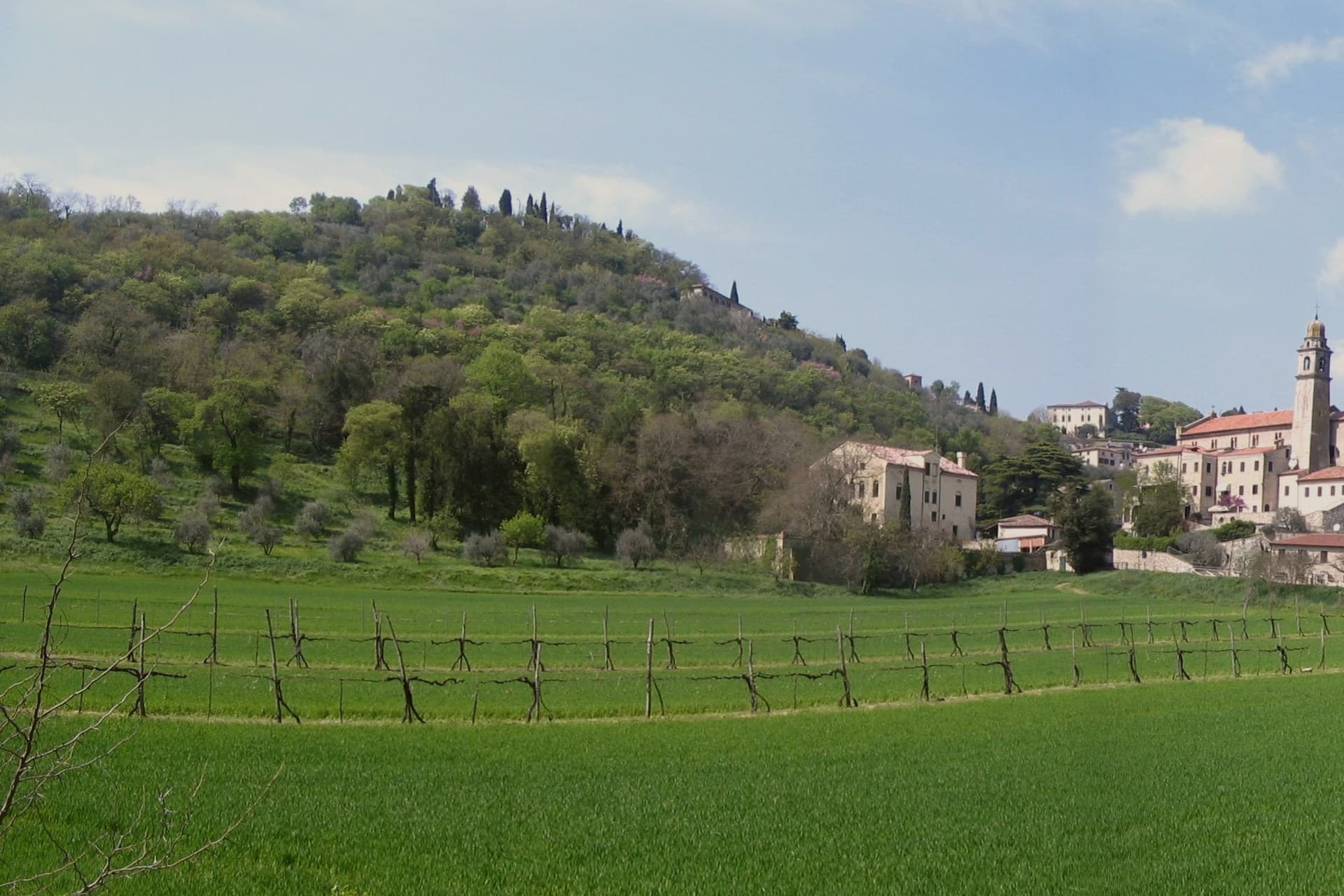
Veneto is flat enough for the train to do the work, and the landscape changes fast: rice and maize on the plain, then the volcanic bumps of the Colli Euganei with their thermal water and olive terraces, then the moraine hills that hold Lake Garda in place. The building material shifts with it, brick and terracotta around Padua and Verona's south, pale limestone from the Valpolicella quarries further north. Autumn is the season that pays best, with the Amarone grapes drying in lofts, radicchio going into the ground and mist sitting low over the canals. Spring brings asparagus, boiled eggs and a glass of Bardolino Chiaretto in the shade.
Almost everyone arriving by rail keeps going to Venice, which is exactly why Venice feels the way it does in July, with the vaporetti loaded and the Rialto slow going. Verona absorbs the overflow, filling its arena for the opera and its Piazza Bra with tables set for whoever walks past. Both are worth the visit, and both are the reason the rest of the region reads as empty by comparison. The crowds cluster within walking distance of two stations and thin out fast beyond them.
The same railway lines carry on. The Milan to Venice route runs along Garda's southern shore and up towards the Valpolicella slopes, while the Padua branch drops south through the thermal belt towards the walled towns of the lower plain. The towns here sit on those lines, with walls you can walk, spa water, canal locks and cellars pouring their own hills, and we have confirmed each can be reached without a car.
Of the 41 communes we have mapped in Veneto, 16 qualify as towns you can reach by train: we have confirmed each is reachable without a car. This list is the hidden ones, 7 in all, ordered smallest first. The smallest, Arquà Petrarca, has 1,810 residents.
If you are still choosing, we have also written The best towns you can reach by train within 45 minutes of Verona and The 10 prettiest hidden villages in Veneto.
Arquà Petrarca
Why visit Arquà Petrarca
Arquà sits between Monte Ventolone and Monte Castello, in the Euganean Hills south of Padova. The name dates to medieval records; the suffix Petrarca was added in 1868, after the Veneto's annexation to the Kingdom of Italy, as a public homage to the poet who chose to die here.
Francesco Petrarca arrived in 1370 and lived in a thirteenth-century house he renovated himself across two stories, the Casa del Petrarca, now a museum with frescoes from the fifteenth and sixteenth centuries. He died at his desk on the night of 18-19 July 1374.
His tomb, an ark in red Verona marble inspired by Roman sarcophagi, was placed in the churchyard of Santa Maria Assunta in 1380 and reset in 1965. The village kept its medieval layout: two piazzas linked by a stepped path, the Casa above and the church and tomb below.
The hills around it grow Colli Euganei DOC wine, olives, and the giuggiole that go into the local liqueur Brodo di Giuggiole.
We confirmed you can reach this one by train.
What to see in Arquà Petrarca
- Casa di Francesco Petrarca. The poet's thirteenth-century house, renovated by him on two floors and now a museum with frescoes added by later owners in the fifteenth and sixteenth centuries.
- Tomba di Petrarca. Sarcophagus in red Verona marble in the churchyard of Santa Maria Assunta, placed in 1380, six years after the poet's death.
- Chiesa di Santa Maria Assunta. Parish church first documented in 1026, enlarged through the centuries, with frescoes of the Venetian-Byzantine school up to the fifteenth century.
How to get to Arquà Petrarca
There is a railway station in the town, so you can arrive without a car and never need one while you are here. Padova is roughly 28 minutes away by road.
Our tip
April through June and September through October are the months Arquà is built for. The hills are green in spring and gold in autumn; the slope from Piazza Roma down to the church is comfortable walking weather. July and August push past thirty degrees and the village empties between two and six, though Padova day-trippers still arrive in the late afternoon.
Battaglia Terme
Why visit Battaglia Terme
Battaglia Terme sits at 9 meters on the eastern edge of the Euganean Hills, fifteen kilometers south of Padova. The Paduans dug the Battaglia Canal between 1189 and 1201 to link Padova to Monselice, Este and ultimately the Adige and the lagoon; the town grew up at the confluence with the older Bisato Canal from Monselice, completed in 1139.
For seven centuries Battaglia lived from the barge traffic that hauled wheat, marble and wine north and south through the navigable network. The Museo della Navigazione Fluviale, the only river navigation museum in Italy, holds more than four thousand objects from boats and tools to navigation charts and boatmen's diaries.
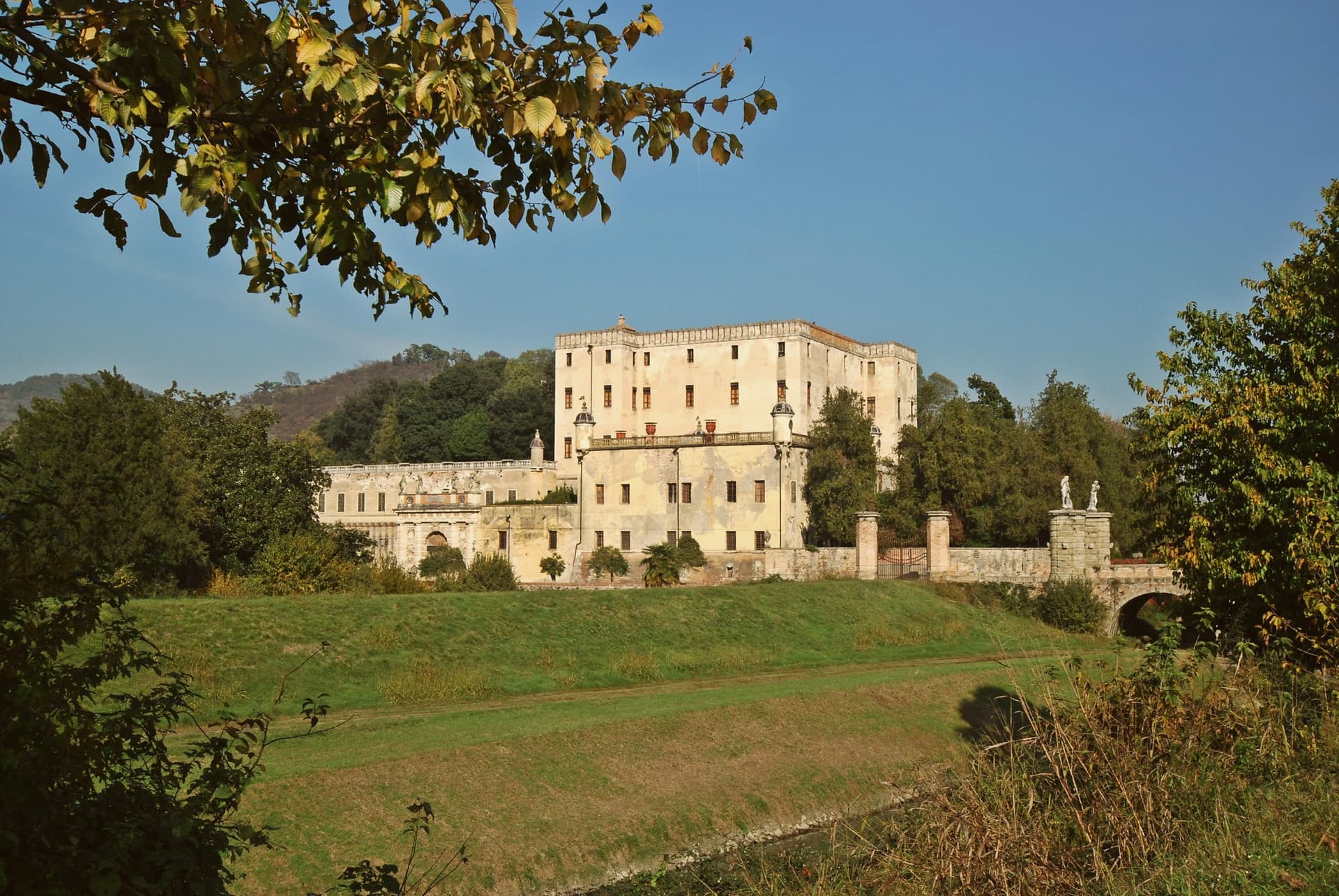
The thermal springs surface here too: warm saline water and a natural vapour grotto known since the Middle Ages, exploited from the eighteenth century at the Terme di Battaglia. Above town stands the Castello del Catajo, built 1570-73 by Pio Aeneas I degli Obizzi to control the canal, with frescoes and Renaissance esoteric symbols across forty rooms.
We confirmed you can reach this one by train.
What to see in Battaglia Terme
- Castello del Catajo. Hilltop castle built 1570-73 by Pio Aeneas I degli Obizzi, with frescoes and esoteric Renaissance symbols across more than forty rooms.
- Museo della Navigazione Fluviale. Italy's only river navigation museum, with over four thousand objects from boats and tools to boatmen's diaries and navigation charts.
- Canale di Battaglia. Canal dug 1189-1201 by the Paduans, still navigable, running through the center of town and crossed by historic bridges.
How to get to Battaglia Terme
There is a railway station in the town, so you can arrive without a car and never need one while you are here. Padova is roughly 21 minutes away by road.
Our tip
Battaglia works year-round through the springs, but the canal-and-castle season runs April through October. Spring and autumn are best for walking the towpaths between Battaglia, Monselice and Este, when the Euganean hills above are green and the canal water is clear. July and August are warm and mosquito-thick along the canal; the spa hotels keep the visitors but the towpaths empty.
Costermano sul Garda
Why visit Costermano sul Garda
The commune sits on a moraine amphitheater twenty-five kilometers northwest of Verona. The hills were a feud of the Brescia monastery of Santa Giulia in the early Middle Ages, then passed through Scaliger and Venetian rule before joining Italy in 1866; the name sul Garda was added only in 2018, to anchor the town's tourism identity to the water it sits above rather than on.
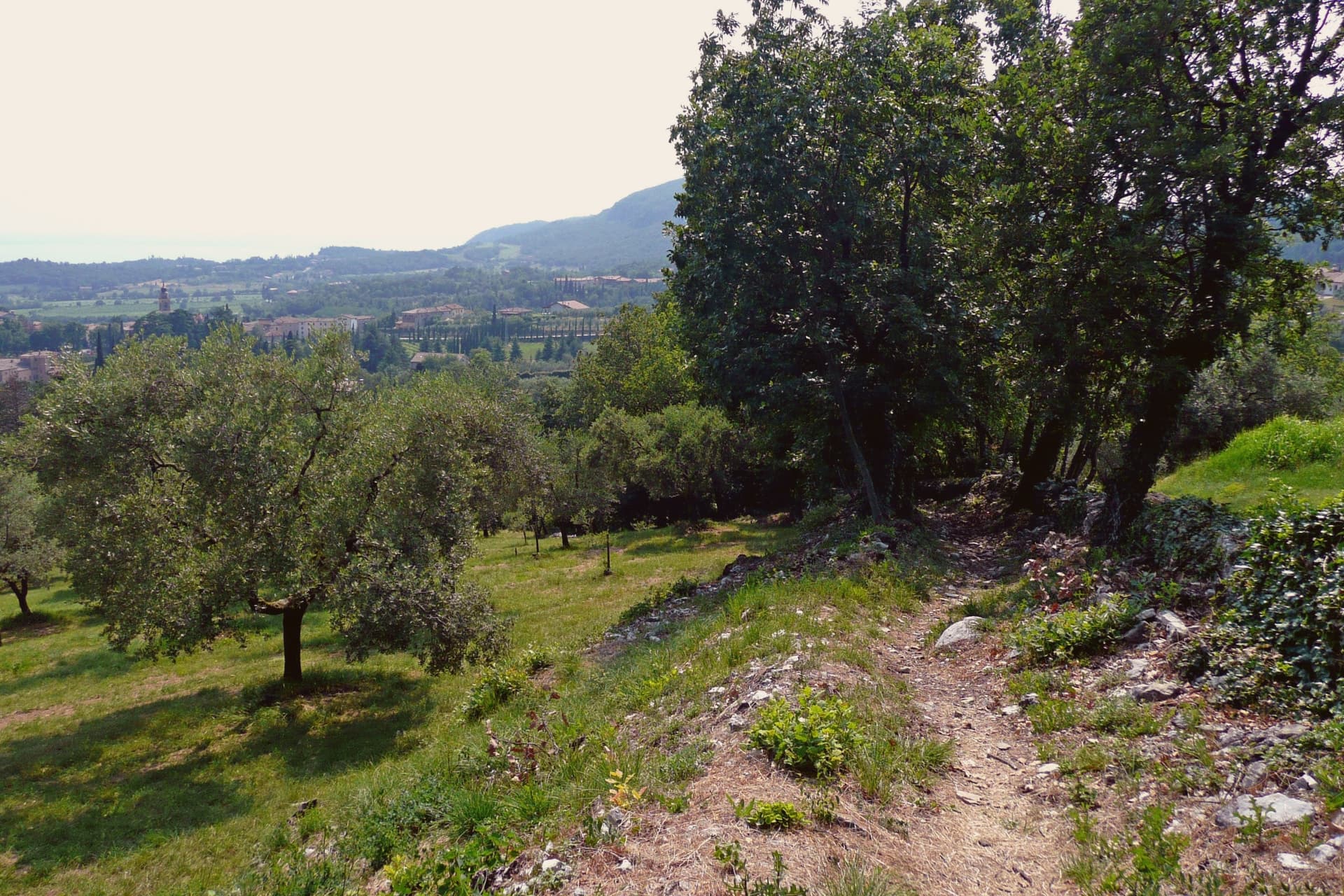
That distinction matters here: this is not a lakefront village but a hill settlement looking down at the shore, its center, its cemetery hill, and its vineyard slopes arranged around the belvedere at Marciaga rather than around a harbor. The economy runs on olive oil and hillside vines, and on the holiday accommodation that has filled these slopes since the 1970s, but the single largest reason people come here is not agricultural.
The cemetery holds the dead of a war fought decades after the monastery's feud and centuries after the Scaliger lords, and it sits on the same morainal hill as the sanctuary, the parish church, and the vine rows, a place where the working landscape and the memorial landscape occupy the same short walk rather than separate zones.
We confirmed you can reach this one by train.
What to see in Costermano sul Garda
- Santuario della Madonna del Castello. Sanctuary on the spur of Marciaga, its fifteenth-century frescoes intact, with a terrace looking over Lake Garda and the eastern shore.
- Deutsche Soldatenfriedhof. The graves cover the hillside above the lake, laid out since 1967 for the dead of the Second World War, a place kept in silence rather than commentary.
- Chiesa di San Siro. Parish church rebuilt in the nineteenth century in the center of the village, its freestanding campanile visible from the surrounding slopes, with a sightline to Monte Baldo across the water.
How to get to Costermano sul Garda
There is a railway station in the town, so you can arrive without a car and never need one while you are here. Verona is roughly 34 minutes away by road.
Our tip
April through October is the working window. April and May bring the lake back to swimming temperature on the shore four kilometers below, and the morainal hills into wildflower. June through August fills the holiday rentals and the lakefront day-traffic from Garda and Bardolino; the hills stay a few degrees cooler than the shore.
Bardolino
Why visit Bardolino
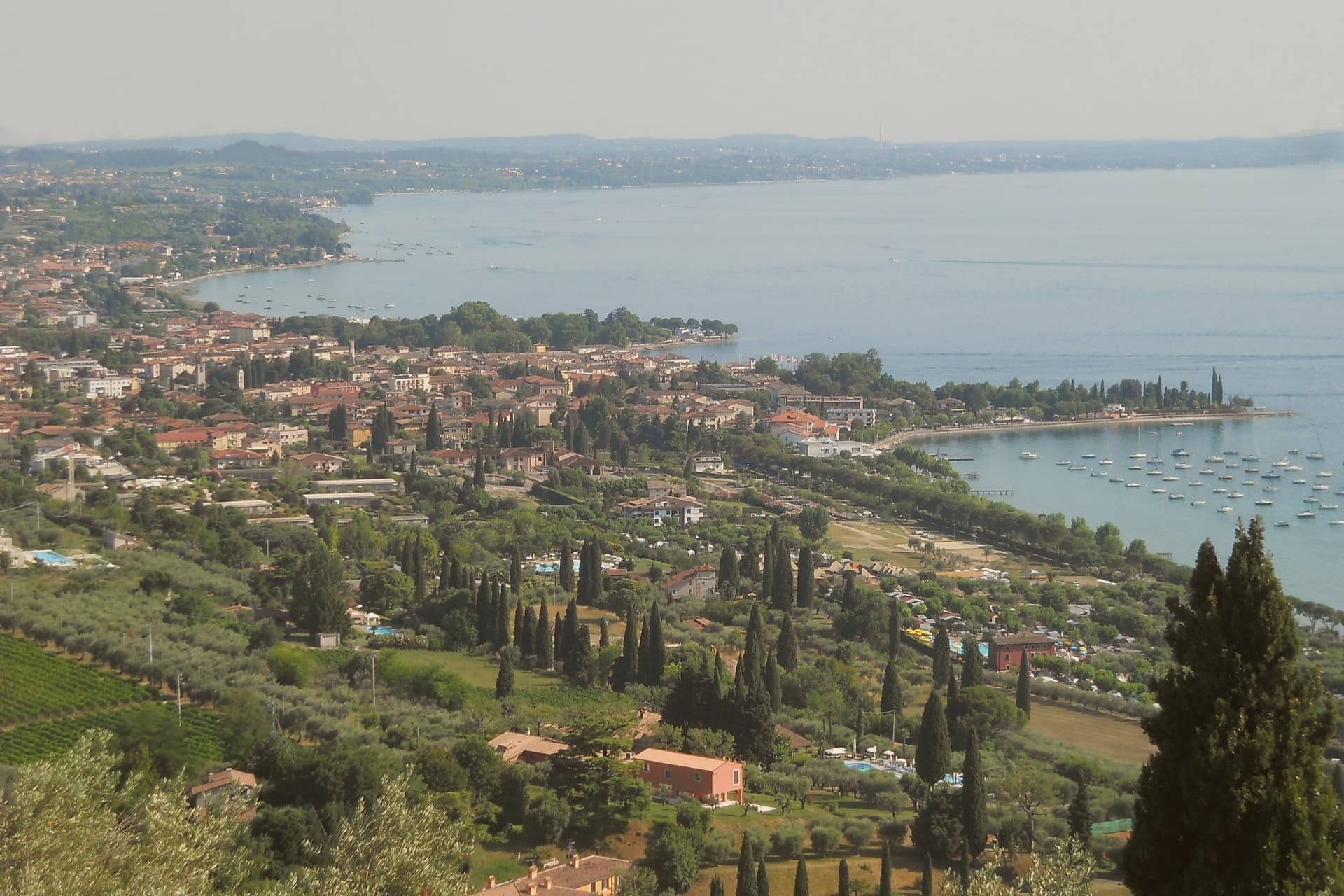
Bardolino sits on the eastern shore of Lake Garda at 65 meters, twenty-five kilometers northwest of Verona. The hills behind town have been planted with vines since the Roman period, and the modern DOC was granted in 1968.
Three grapes do the work: Corvina, Rondinella and Molinara. Long maceration produces Bardolino, the light red the town has lived on since the nineteenth century; short skin contact produces Chiaretto, the rosé that has overtaken the red in current sales.
Two churches hold the medieval line. San Zeno in the centro storico is ninth-century, one of the oldest in the province of Verona.
San Severo, built between the late eleventh and early twelfth centuries on the foundations of an earlier church mentioned in an 893 charter of Berengario, is the town's Romanesque anchor. The lakefront has been a tourist promenade since the 1950s.
The Palio del Chiaretto runs the first weekend of June; the Festa dell'Uva e del Vino runs the first week of October.
We confirmed you can reach this one by train.
What to see in Bardolino
- Chiesa di San Severo. Romanesque church built between the late eleventh and early twelfth centuries on the foundations of a structure mentioned in a 893 charter.
- Chiesa di San Zeno. Ninth-century church in the centro storico, one of the oldest in the province of Verona, on a Latin cross plan with a small apse.
- Centro storico. Walled medieval core around Piazza Matteotti, with arcaded streets dating to the Venetian period from the fifteenth century.
How to get to Bardolino
There is a railway station in the town, so you can arrive without a car and never need one while you are here. Verona is roughly 36 minutes away by road.
Our tip
April through October is the working season. April and May bring the lake back to swimming temperature and the Romanesque churches at their quietest. June through August fills the lungolago with German and Austrian visitors; weekends are crowded, weekday mornings still manageable. Bardolino Freddo falls in August.
Montagnana
Why visit Montagnana
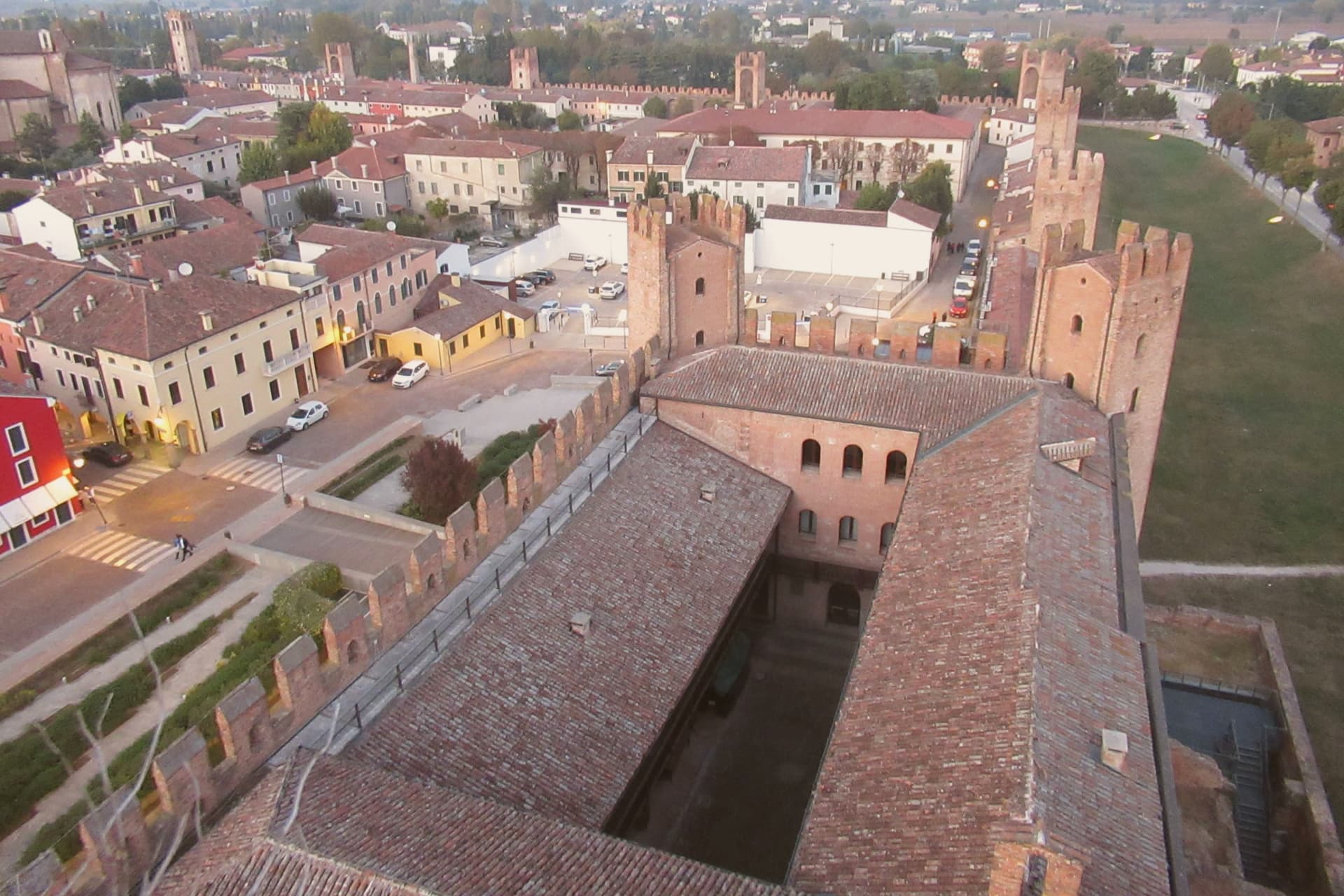
Montagnana sits at 16 meters on the lower Padova plain, thirty-five kilometers southwest of Padova, on the watershed between the Adige and the Bacchiglione. The wall ring is unbroken enough that the town's whole plan still reads as the fortification that produced it: the castle anchors the eastern gate, the rocca anchors the western one, and the road to Verona runs between them through what was once contested ground between Ezzelino's garrison and the Carraresi who came after.
Inside the walls, the center holds the Duomo and the two flanking palazzi around Piazza Maggiore, while the villa built for the cardinal stands deliberately outside the gate, a country house that still shows its face to the town. The May festival now fills the same ground the walls were built to defend, the modern economy of the place staged inside its medieval perimeter.
We confirmed you can reach this one by train.
What to see in Montagnana
- Cinta muraria. Six to eight meters high and ninety-six centimeters thick, the rampart carries a continuous parapet walk, so the towers can be counted from above rather than just from the road.
- Castello di San Zeno. Fortress at the eastern gate, built by Ezzelino III da Romano in 1242, with the Mastio tower 38 meters high and a civic museum inside.
- Rocca degli Alberi. Western gate fortress built by the Carraresi between 1360 and 1362, with a moat and double drawbridge defending the road to Verona.
How to get to Montagnana
There is a railway station in the town, so you can arrive without a car and never need one while you are here. Vicenza is roughly 47 minutes away by road.
Our tip
April through June and September through October are the right months for Montagnana. The lower Padova plain runs cool and clear in those windows, and the parapet walk on the walls gives the best views when the haze lifts. The Festa del Prosciutto Veneto DOP runs across two weekends in mid-May, the largest event of the year, with tastings and tours of the curing houses.
Peschiera del Garda
Why visit Peschiera del Garda
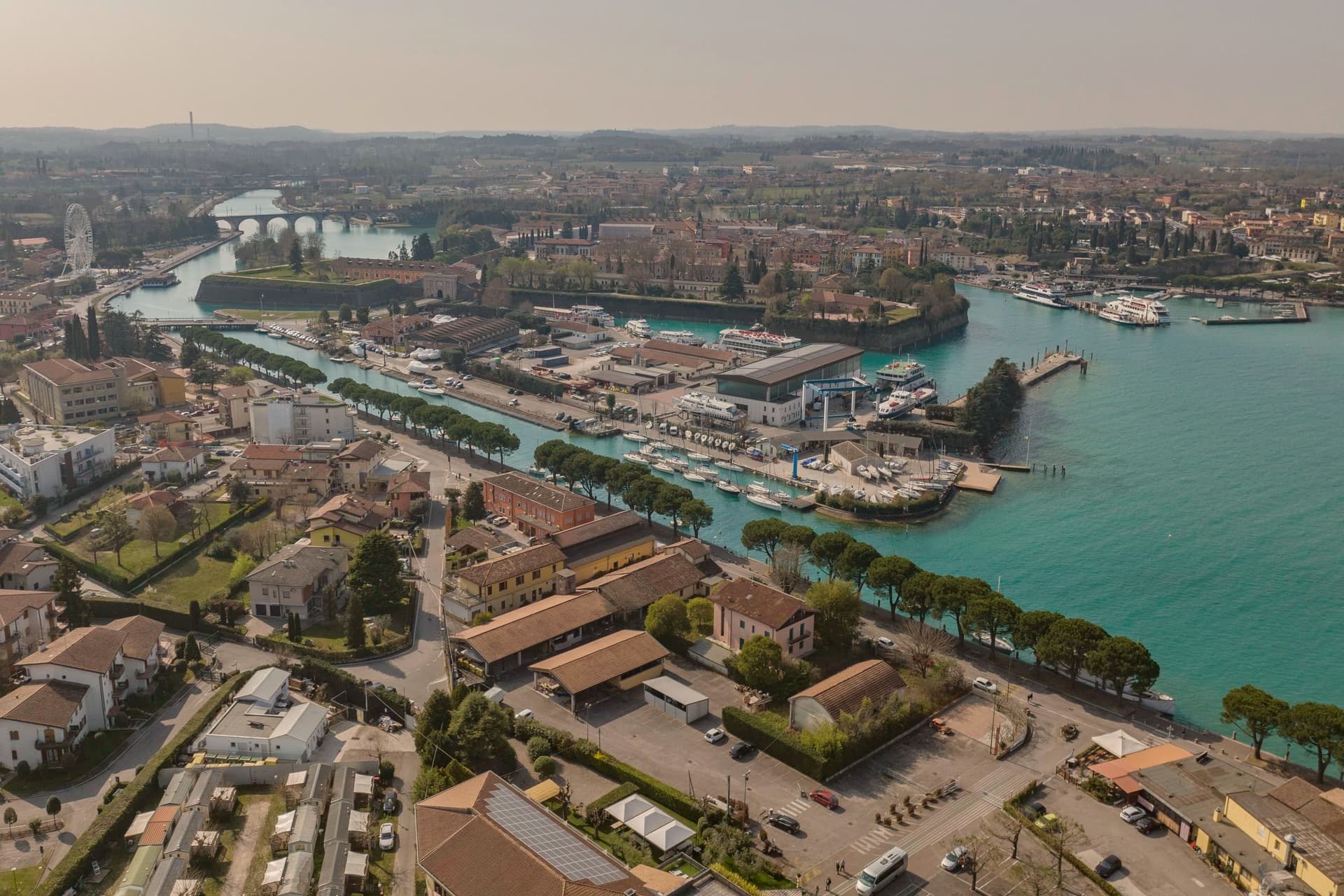
Peschiera sits at 68 meters on the Mincio at the point where the river leaves Lake Garda, twenty-five kilometers west of Verona. The Romans called it Ardelica.
The town the Republic of Venice rebuilt in 1549 was set on the medieval walls' corners, with a moat fed by the river, and the design came from Guidobaldo della Rovere before its execution on site. Austria took the town in 1815 and folded it into a wider system with Verona, Mantua and Legnago, the four together holding Lombardy-Venetia until 1866; Peschiera held the northwest corner of that arrangement, the point closest to the lake.
The fortress and the marsh settlement belong to different periods and different UNESCO listings, one Bronze Age and lakeside, one sixteenth-century and defensive, but both sit on the same stretch of water where the Mincio gathers itself before running south. The river itself is the town's organizing fact: it leaves the lake, splits into three canals to cross the walls, and rejoins below the railway bridge.
What Peschiera adds up to is a place built twice on the same threshold, where a lake becomes a river and a river becomes a border worth fortifying.
We confirmed you can reach this one by train.
What to see in Peschiera del Garda
- Mura veneziane. Pentagonal fortress designed by Michele Sanmicheli for Venice from 1549, with five bastions, a moat fed by the Mincio and three water gates.
- Canali del Mincio. Three canals cross the fortress and rejoin below the railway bridge; the central one runs through the main square inside the walls.
- Piazza Ferdinando di Savoia. Main square inside the walls, bordered by the Palazzo del Comando, the Voltoni arches over the Mincio and the Caserma Catterin.
How to get to Peschiera del Garda
There is a railway station in the town, so you can arrive without a car and never need one while you are here. Verona is roughly 30 minutes away by road.
Our tip
April through June and September through October are the strongest months in Peschiera. The fortress walls, the moat and the Mincio canals are at their clearest in spring and autumn, and the lakefront south of the walls fills with sailing and ferry traffic. July and August push past thirty degrees and the southern Garda concentrates much of the lake's day-trip volume; the parking lots around the railway station queue from midmorning.
Sant'Ambrogio di Valpolicella
Why visit Sant'Ambrogio di Valpolicella
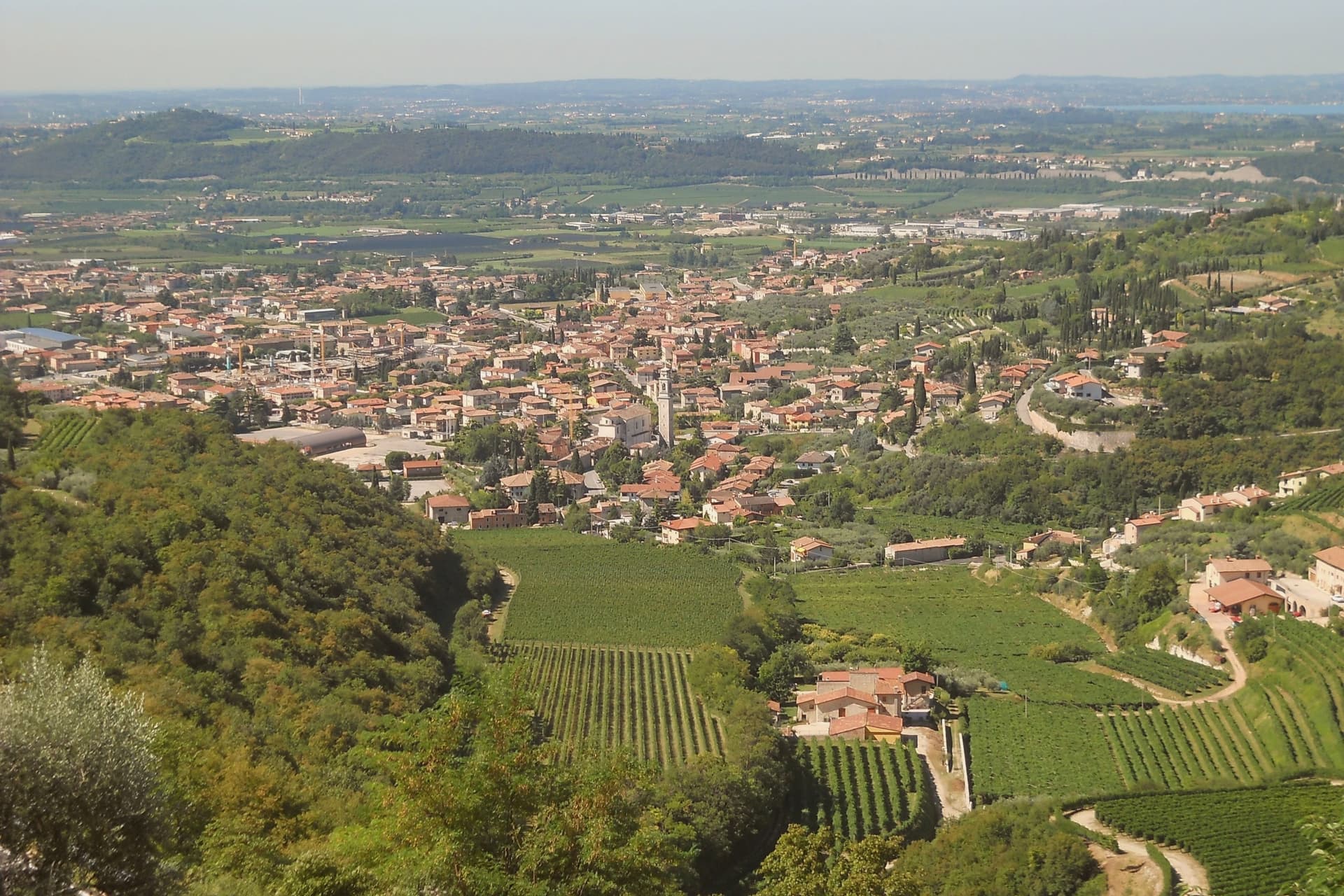
Sant'Ambrogio di Valpolicella sits at 174 meters in the heart of the Valpolicella DOC, fifteen kilometers northwest of Verona, on the rolling hills that close the eastern shore of Lake Garda. The commune groups five frazioni around the main village: Domegliara, Gargagnago, Monte, Ponton and the ridge settlement above them.
Gargagnago sits at the foot of the hills, its cellars closest to the valley floor; the ridge frazione occupies the higher limestone ground, reached by a climb steep enough to have earned the church its nickname. Between them the Serego Alighieri estate has worked the same parcels since Pietro Alighieri, son of Dante the poet who had followed his father into exile in Verona, bought the property in 1353, and the family still grows Corvina, Rondinella and Molinara there, with the Vaio Armaron Amarone counted among the appellation's cru benchmarks.
The pattern of the commune is one of a valley economy and a hill economy sharing a single administrative roof: wine pressed and aged below, an older, stiller settlement kept above it, with the quarries that once supplied Verona still worked on the slopes that join the two.
We confirmed you can reach this one by train.
What to see in Sant'Ambrogio di Valpolicella
- Pieve di San Giorgio Ingannapoltron. Romanesque parish church whose ciborium columns carry an inscription naming the master builder Orso and his disciples Juventino and Juviano.
- San Giorgio di Valpolicella. Frazione on the limestone ridge above the valley, in the Borghi più belli d'Italia network, nicknamed Ingannapoltron for the steep climb up to it.
- Villa Serego Alighieri. Estate still owned by the Alighieri descendants; produces Vaio Armaron Amarone from Corvina, Rondinella and Molinara grown on the same parcels the family has worked.
How to get to Sant'Ambrogio di Valpolicella
There is a railway station in the town, so you can arrive without a car and never need one while you are here. Verona is roughly 34 minutes away by road.
Our tip
April through June and September through October are the months for Valpolicella. The vineyards green up in spring, harvest runs from mid-September into October, and the appassimento drying begins in the cellars while the leaves turn. July and August push past thirty degrees in the valley and the village empties between two and six in the afternoon; cellar visits move to morning slots.
More from Anywhere Italy
- The best towns you can reach by train within 45 minutes of Verona
 The 10 prettiest hidden villages in Veneto
- The best towns you can reach by train that have a serious restaurant in Veneto
 The best wine towns within 75 minutes of Trento
- The best wine towns within two hours of Bolzano
- The best towns you can reach by train within an hour of Padua