
The best towns you can reach by train within an hour of Venice
The regional network out of Venice runs through flat farmland, past canals and brick campanili, and then up into the moraine hills where the vines start. Trains are frequent, cheap and slow enough to watch the landscape change: reeds and radicchio fields giving way to thermal steam near the Euganean Hills, then to Prosecco terraces further north. Station cafés open early for espresso and a tramezzino, and by midday the osterie are pouring ombre and serving baccalà mantecato, bigoli, sopressa. Autumn is the season the region shows best, with new wine, mushrooms and mist sitting low over the Sile.
Almost everyone who arrives at Santa Lucia stays put, and the historic centre of Venice absorbs the crowds of an entire continent in a few square kilometres. The queues for the Basilica di San Marco and the Doge's Palace start early, the vaporetti are full, and the walk from the station to Rialto becomes a slow shuffle in high season. It is a rational choice, given what is there. It also means the mainland, which most visitors cross at speed on the causeway, goes largely unlooked at.
The same trains keep going. Within an hour of the terminus there are walled towns, thermal baths fed by water off the Alps, an abbey with Lombard frescoes, a lagoon port that sells its own fish, and hill towns where the sparkling wine is made. Each of the towns here has a station we have confirmed you can arrive at, which makes them a plausible day out or a quieter base than the islands.
Of the 11 communes we have mapped in a one-hour drive of Venice, 10 qualify as towns you can reach by train: we confirmed a station you can arrive at. The smallest, Arquà Petrarca, has 1,810 residents.
Two more lists worth reading alongside this one: The best towns you can reach by train within an hour of Padua and The best towns that eat well within an hour of Venice.
Arquà Petrarca
Why visit Arquà Petrarca
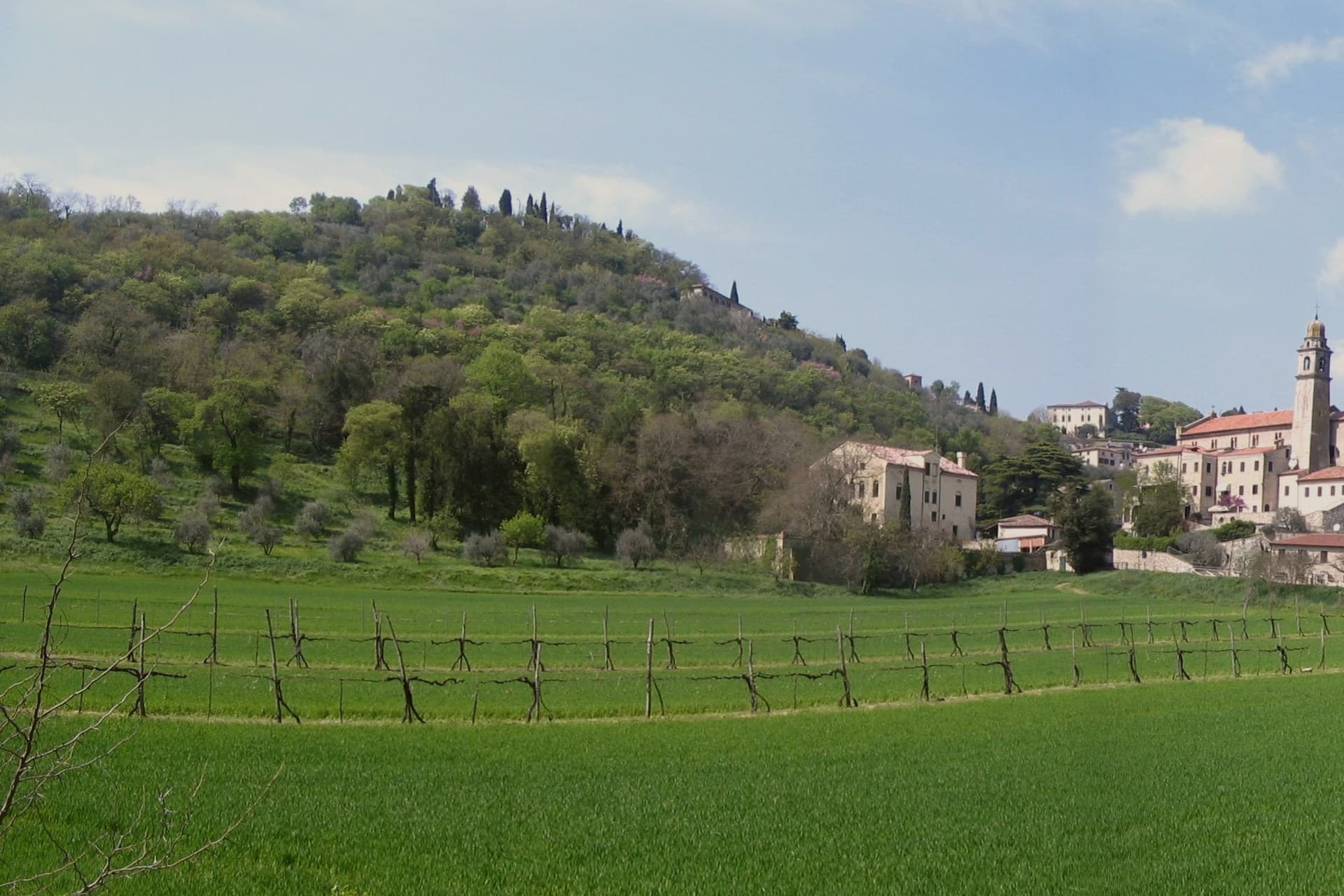
Arquà sits between Monte Ventolone and Monte Castello, in the Euganean Hills south of Padova. The name dates to medieval records; the suffix Petrarca was added in 1868, after the Veneto's annexation to the Kingdom of Italy, as a public homage to the poet who chose to die here.
Francesco Petrarca arrived in 1370 and lived in a thirteenth-century house he renovated himself across two stories, the Casa del Petrarca, now a museum with frescoes from the fifteenth and sixteenth centuries. He died at his desk on the night of 18-19 July 1374.
His tomb, an ark in red Verona marble inspired by Roman sarcophagi, was placed in the churchyard of Santa Maria Assunta in 1380 and reset in 1965. The village kept its medieval layout: two piazzas linked by a stepped path, the Casa above and the church and tomb below.
The hills around it grow Colli Euganei DOC wine, olives, and the giuggiole that go into the local liqueur Brodo di Giuggiole.
We confirmed you can reach this one by train.
What to see in Arquà Petrarca
- Casa di Francesco Petrarca. The poet's thirteenth-century house, renovated by him on two floors and now a museum with frescoes added by later owners in the fifteenth and sixteenth centuries.
- Tomba di Petrarca. Sarcophagus in red Verona marble in the churchyard of Santa Maria Assunta, placed in 1380, six years after the poet's death.
- Chiesa di Santa Maria Assunta. Parish church first documented in 1026, enlarged through the centuries, with frescoes of the Venetian-Byzantine school up to the fifteenth century.
How to get to Arquà Petrarca
There is a railway station in the town, so you can arrive without a car and never need one while you are here. Padova is roughly 28 minutes away by road.
Our tip
April through June and September through October are the months Arquà is built for. The hills are green in spring and gold in autumn; the slope from Piazza Roma down to the church is comfortable walking weather. July and August push past thirty degrees and the village empties between two and six, though Padova day-trippers still arrive in the late afternoon.
Battaglia Terme
Why visit Battaglia Terme
Battaglia Terme sits at 9 meters on the eastern edge of the Euganean Hills, fifteen kilometers south of Padova. The Paduans dug the Battaglia Canal between 1189 and 1201 to link Padova to Monselice, Este and ultimately the Adige and the lagoon; the town grew up at the confluence with the older Bisato Canal from Monselice, completed in 1139.
For seven centuries Battaglia lived from the barge traffic that hauled wheat, marble and wine north and south through the navigable network. The Museo della Navigazione Fluviale, the only river navigation museum in Italy, holds more than four thousand objects from boats and tools to navigation charts and boatmen's diaries.
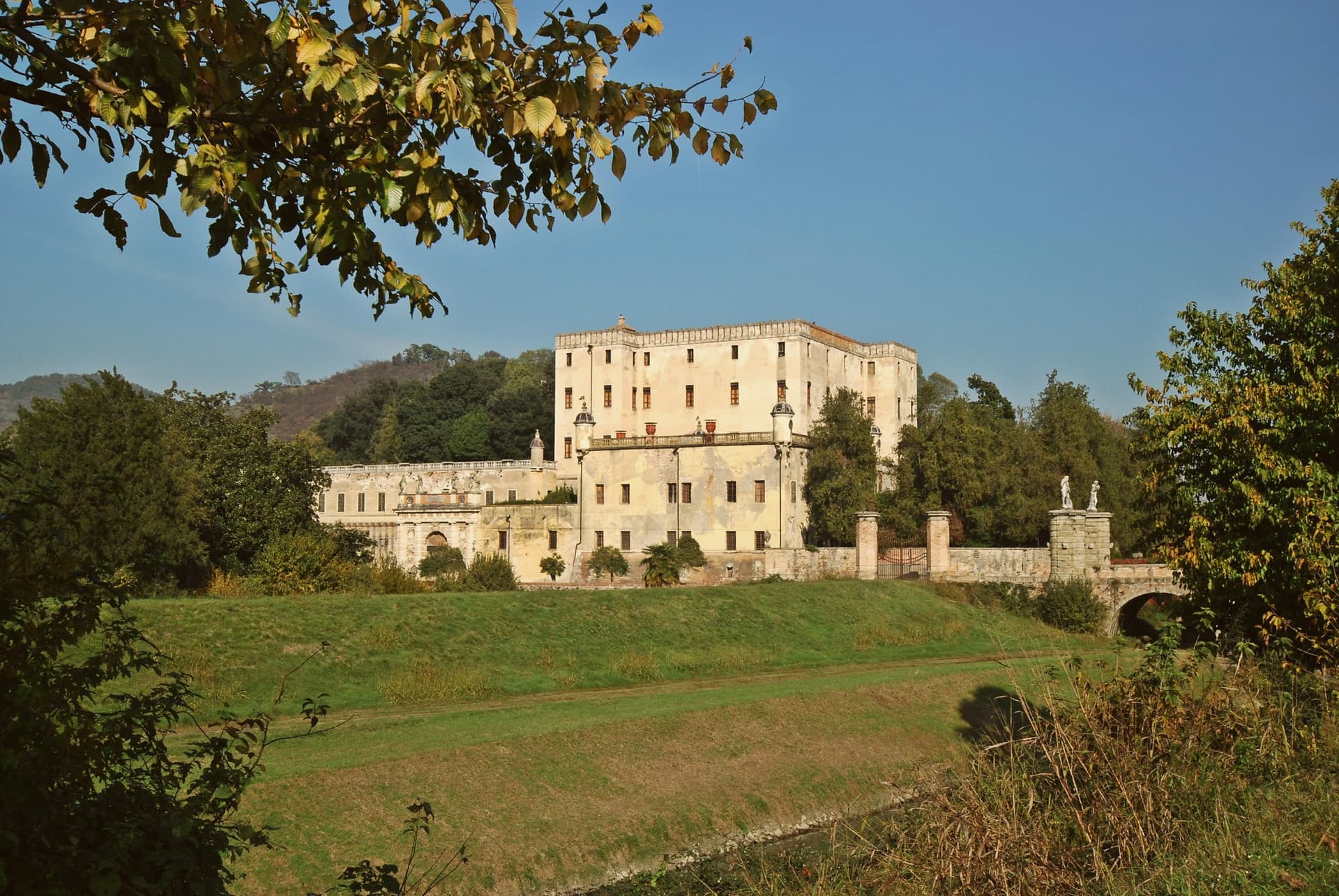
The thermal springs surface here too: warm saline water and a natural vapour grotto known since the Middle Ages, exploited from the eighteenth century at the Terme di Battaglia. Above town stands the Castello del Catajo, built 1570-73 by Pio Aeneas I degli Obizzi to control the canal, with frescoes and Renaissance esoteric symbols across forty rooms.
We confirmed you can reach this one by train.
What to see in Battaglia Terme
- Castello del Catajo. Hilltop castle built 1570-73 by Pio Aeneas I degli Obizzi, with frescoes and esoteric Renaissance symbols across more than forty rooms.
- Museo della Navigazione Fluviale. Italy's only river navigation museum, with over four thousand objects from boats and tools to boatmen's diaries and navigation charts.
- Canale di Battaglia. Canal dug 1189-1201 by the Paduans, still navigable, running through the center of town and crossed by historic bridges.
How to get to Battaglia Terme
There is a railway station in the town, so you can arrive without a car and never need one while you are here. Padova is roughly 21 minutes away by road.
Our tip
Battaglia works year-round through the springs, but the canal-and-castle season runs April through October. Spring and autumn are best for walking the towpaths between Battaglia, Monselice and Este, when the Euganean hills above are green and the canal water is clear. July and August are warm and mosquito-thick along the canal; the spa hotels keep the visitors but the towpaths empty.
Sesto al Reghena
Why visit Sesto al Reghena
Sesto al Reghena sits at 13 meters on the Friuli-Venetian plain, between the Tagliamento and the Reghena, a small river bordered by linden trees that runs through the centro. The name records the sixth Roman mile out of Concordia Sagittaria on the road to Iulia Augusta.
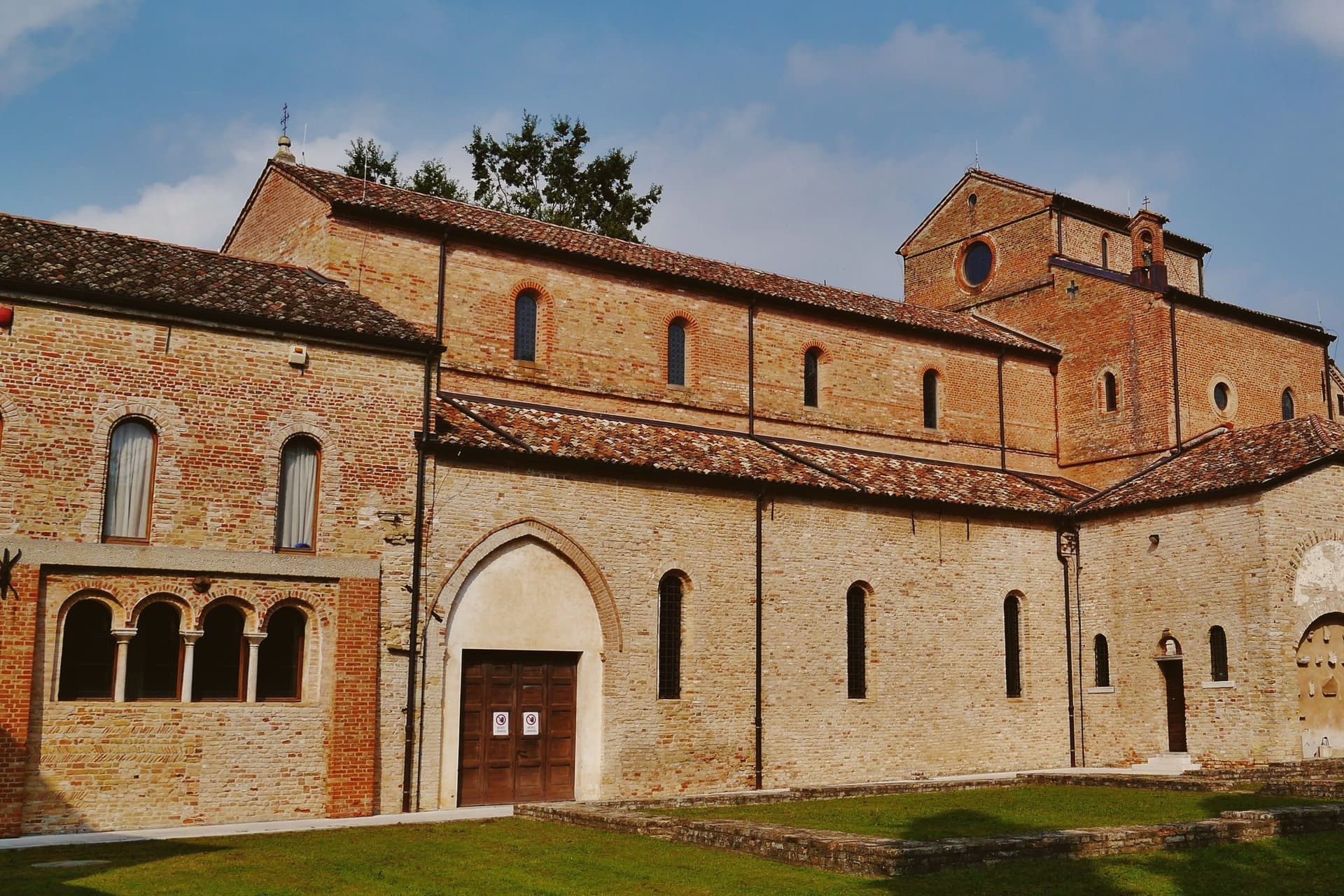
The town is one place: the Abbazia di Santa Maria in Sylvis, founded by the Lombard nobles Erfo, Marco, and Anto between 730 and 735, occupied by Benedictines until 762, sacked by a Magyar raid in 899, and refortified with walls and a moat in the tenth century. The abbey crypt is supported by twenty columns, several of them Roman spolia.
At the center stands the Urn of St. Anastasia, a single block of Greek marble carved by Cividale masters in the eighth century, with rose, cross, and arched motifs.
The abbey complex is the current town hall, the only commune in Italy headquartered inside a fortified Benedictine monastery. In Friulian, the village is called Siest.
We confirmed you can reach this one by train.
What to see in Sesto al Reghena
- Abbazia di Santa Maria in Sylvis. Eighth-century Benedictine abbey, refortified after the 899 Magyar sack, with a crypt of twenty columns and Carolingian-era frescoes; now the town hall.
- Urna di Sant'Anastasia. Single block of Greek marble in the abbey crypt, carved by Cividale masters in the eighth century with roses, crosses, arches, and rosettes.
- Torre Grimani. Surviving gate-tower of the medieval abbey defenses, named for the Venetian commendatory abbots who held the monastery in the sixteenth century.
How to get to Sesto al Reghena
There is a railway station in the town, so you can arrive without a car and never need one while you are here. Udine is roughly 53 minutes away by road.
Our tip
April through June and September into October are the months Sesto reads best. The Reghena banks are walkable, the abbey courtyard catches afternoon sun, and the Lison-Pramaggiore vineyards south of town are in their working seasons. July and August push past thirty-three degrees with the heavy humidity of the lower Friulian plain, and the abbey's crypt becomes the coolest room in the comune.
Abano Terme
Why visit Abano Terme
Abano Terme sits at 14 meters on the eastern slope of the Euganean Hills, ten kilometers southwest of Padova. The springs surface at 80°C, classified as hyperthermal bromo-iodine-salt water, and the Veneti were already worshipping them in the eighth century BC.
The Romans built a temple to Aponus here and called the place Aquae Patavinae. The Lombards destroyed the baths in the sixth century.
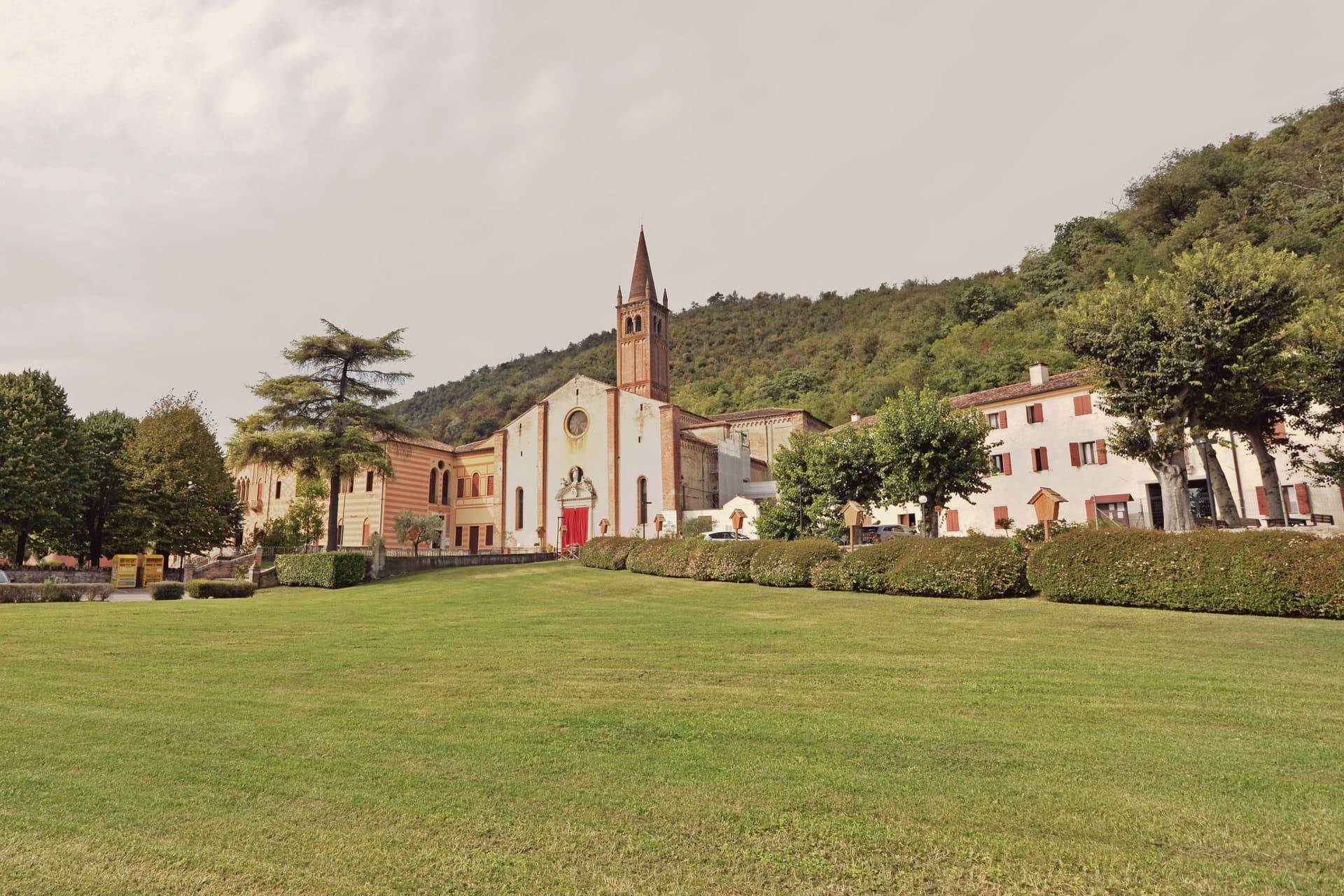
They were rebuilt when Abano became an autonomous comune in the twelfth, enlarged again in the late fourteenth, and absorbed into the Republic of Venice from 1405 to 1797. The Colle Montirone archaeological site still holds traces of the Roman thermal complex, and the Duomo di San Lorenzo, rebuilt in 1780 over an older church, anchors the historic center.
The contemporary draw is fango-balneotherapy: mineral mud aged for sixty days in the source basins, then applied at body temperature. Most of the 250 hotels in Abano-Montegrotto are spa hotels.
We confirmed you can reach this one by train.
What to see in Abano Terme
- Duomo di San Lorenzo. Cathedral rebuilt in 1780 over a pre-existing church, with a campanile dating to the fourteenth century and a Baroque interior.
- Colle Montirone. Archaeological site on a small thermal hill, with traces of the Roman baths of Aponus and an obelisk erected in the eighteenth century.
- Parco Termale Urbano. Public thermal park threading the centro storico, with footpaths between hotels, gardens and the source pools.
How to get to Abano Terme
There is a railway station in the town, so you can arrive without a car and never need one while you are here. Padova is roughly 15 minutes away by road.
Our tip
Abano works year-round because the heat comes from underground. January through March is peak spa season for residents of northern Italy: the contrast between cold air and hot pools is part of the appeal, and hotel cure programs run twelve days at this time. April through June and September through October bring the hills into play, with walking weather and lighter spa traffic.
Vittorio Veneto
Why visit Vittorio Veneto
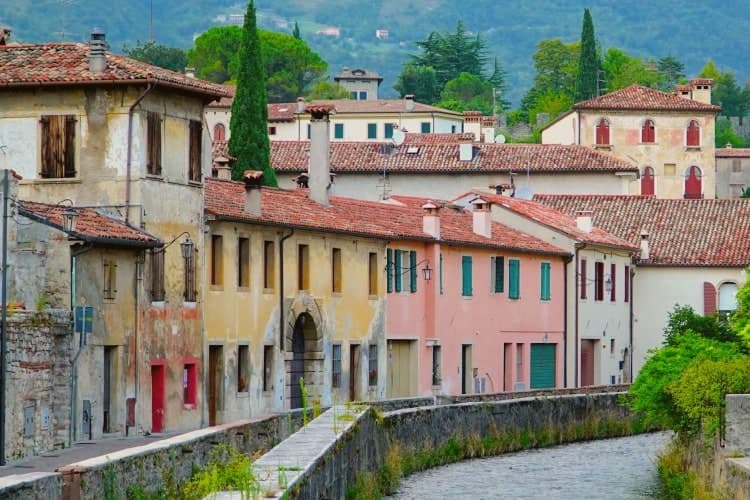
Vittorio Veneto sits at 138 meters at the foot of the Cansiglio plateau, seventy-five kilometers north of Padova. The commune was formed in 1866 by merging Ceneda, on the plain, with Serravalle, in the narrow valley above, and named for King Vittorio Emanuele II.
The two centers kept their own identities rather than blending into one. Serravalle is the older, walled district, set higher in the valley, with its cathedral holding the altarpiece of the Virgin with two saints.
Ceneda lies lower down on the plain, holding the Loggia of the Comunità and an eighteenth-century cathedral of its own alongside the castle ruins on the hill above it. In July 1923 the town took the name it carries now, after the battle that had taken its name from it three years earlier: the offensive of 24 October 1918 broke the Austro-Hungarian line, and the Armistice of Villa Giusti, effective 4 November, closed the war on this front.
The renaming fixed a wartime event permanently onto a place that had, until then, been two separate medieval settlements sharing a valley. What stands today is that same double structure, upper town and lower town, walled district and plain, still legible as two places joined by one name.
We confirmed you can reach this one by train.
What to see in Vittorio Veneto
- Duomo di Serravalle. Rebuilt cathedral in the upper walled centro storico, holding the altarpiece of the Virgin with Saints Peter and Andrew in continuous liturgical use since it was painted.
- Museo della Battaglia. In the Loggia of the Comunità di Ceneda, built 1534-1538, with relics and documents of the offensive that ended the war on this front.
- Serravalle. Northern walled district above Ceneda, with sixteenth-century arcaded houses along the Meschio and the 1462 Loggia Serravallese.
How to get to Vittorio Veneto
There is a railway station in the town, so you can arrive without a car and never need one while you are here. Venezia is roughly 59 minutes away by road.
Our tip
April through October is the working season. April and May bring the Cansiglio plateau into play with walking weather and the upper Meschio at full flow. June through August stays cooler than the plain, with the narrow Serravalle valley holding shade through midday; the lower part around Ceneda pushes into the low thirties. Festa della Val Lapisina falls in July.
Conegliano
Why visit Conegliano
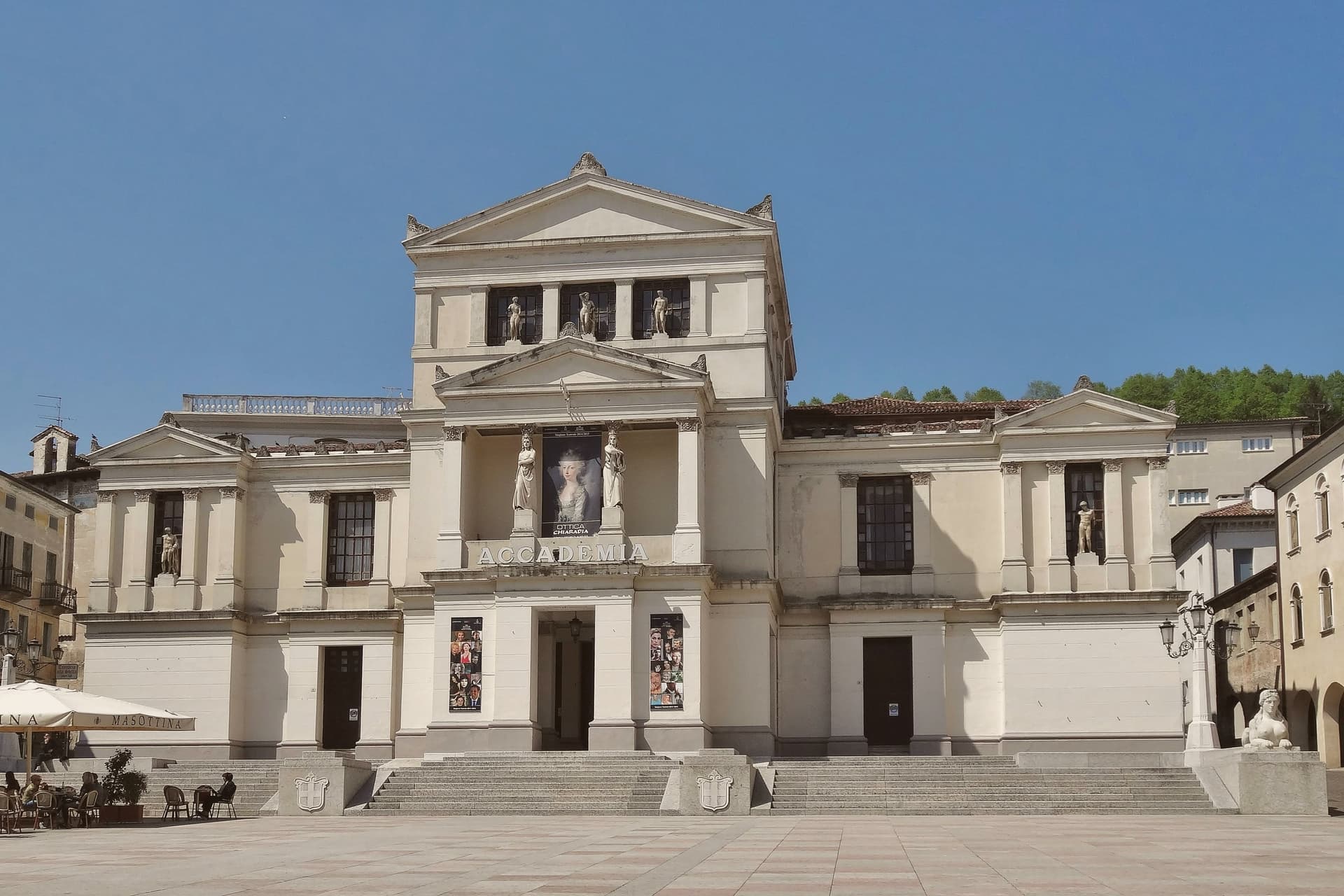
Conegliano sits at 65 meters where the Veneto plain meets the Prealps, fifty kilometers north of Venice. A tenth-century castle on the hill above the town still holds its bell tower and outer walls and now houses a small museum.
The painter Giambattista Cima was born here around 1459; his altarpiece for the Duomo, dated 1492, hangs in the cathedral and stays in continuous use. The Contrada Granda, the arcaded main street that runs below the castle, holds the medieval and Venetian-period layout intact.
The defining contemporary fact is Prosecco. In 1876 the Scuola Enologica opened on Via XX Settembre, the first oenology school in Italy, and it has trained the producers who built the Glera-based wine into a global category.
The Conegliano-Valdobbiadene DOCG was created in 2009 and the surrounding hills were inscribed by UNESCO in 2019. The town runs a working economy of agriculture, food processing and tertiary services, and the railway station puts Venice forty minutes south and Belluno forty minutes north.
We confirmed you can reach this one by train.
What to see in Conegliano
- Duomo di Conegliano. Fourteenth-century cathedral with a façade hidden behind the arcaded Scuola dei Battuti, housing the 1492 altarpiece by Cima da Conegliano.
- Castello di Conegliano. Tenth-century castle on the hill above the town, with bell tower and outer walls preserved; the tower houses the Museo Civico.
- Contrada Granda. Arcaded main street running below the castle, the spine of the centro storico, intact since the Venetian period.
How to get to Conegliano
There is a railway station in the town, so you can arrive without a car and never need one while you are here. Venezia is roughly 53 minutes away by road.
Our tip
April through June and September through October are the months Conegliano is built for. The hills are green in spring and gold in autumn; the Prosecco vineyards flower in late May and harvest runs from mid-August into September. July and August push into the low thirties and the centro storico empties in the afternoon. Campolongo in Festa a Conegliano falls in August.
Chioggia
Why visit Chioggia
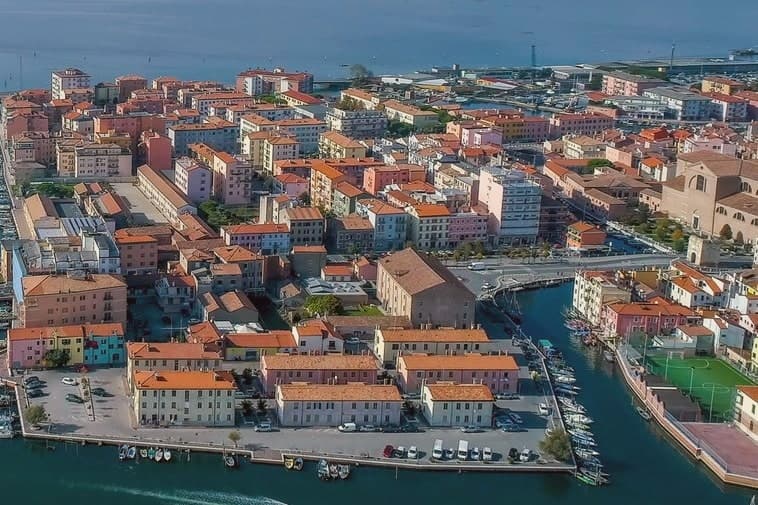
Chioggia sits at 2 meters on a small island at the southern entrance to the Venetian Lagoon, twenty-five kilometers south of Venice and connected to the mainland and to its frazione Sottomarina by causeways. The Romans knew it as Clodia.
By the eleventh and twelfth centuries it had grown into a salt-producing port and became a free commune in 1110. The naval war that carries the town's name ran through 1378-81 and ended Genoese rivalry with Venice, leaving Chioggia under the Serenissima for the next four centuries.
The defeat reduced the town to fishing, salt and limited Adriatic trade. The fleet never left.
The street plan is a herringbone of calli running off the town's single straight spine, with three canals threading between them and the bridges that gave the town its Little Venice nickname. Inland lies the historic island itself; across the causeway sits Sottomarina, the beach frazione facing the open Adriatic where the lagoon town has none.
What Chioggia lost at sea it kept at the dock: a working port still built around the same trade that outlasted the war which was supposed to end it.
We confirmed you can reach this one by train.
What to see in Chioggia
- Cattedrale di Santa Maria Assunta. Cathedral founded in the eleventh century, raised to episcopal seat in 1110, rebuilt from 1623 to designs by Baldassare Longhena.
- Canale Vena. Main canal of the centro storico, lined with fishing boats and crossed by nine bridges including the seventeenth-century Ponte Vigo.
- Mercato del Pesce. Wholesale fish market on the canal, open before dawn six days a week, the operating center of the Adriatic fleet.
How to get to Chioggia
There is a railway station in the town, so you can arrive without a car and never need one while you are here. Venezia is roughly 46 minutes away by road.
Our tip
May through September is the working season. June and early July bring warm Adriatic water and the long Sottomarina beach to capacity on weekends; mid-August fills it past comfort. The Sagra del Pesce on the third weekend of July puts the whole fleet on display along Canale Vena.
Treviso
Why visit Treviso
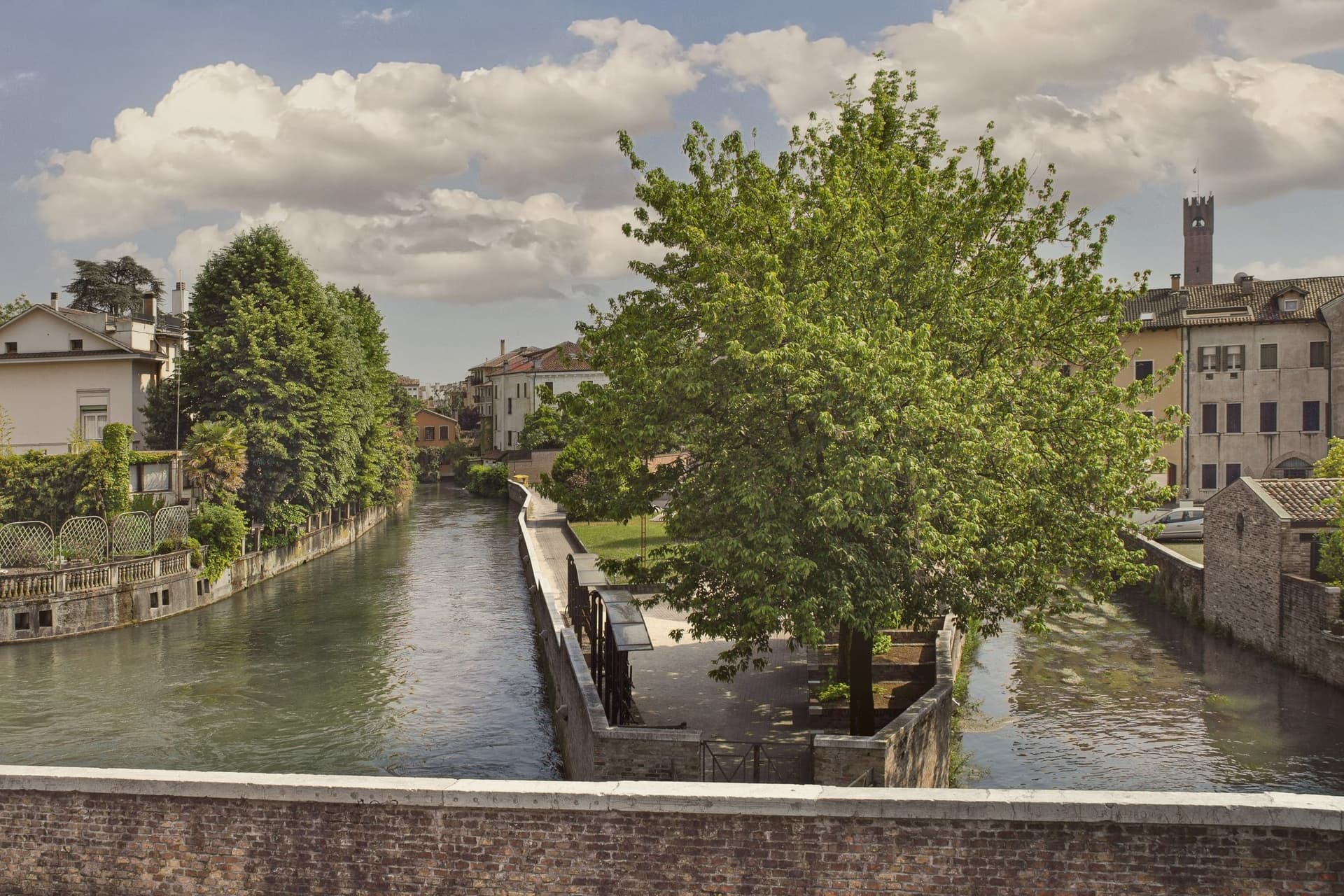
Treviso sits at 15 meters where the Botteniga flows into the Sile, twenty-five kilometers inland from Venice. The Roman Tarvisium took its name from a Celtic root for bull, and the city became a municipium after 89 BC.
After the Caminesi and a brief Scaliger domination, Treviso submitted to the Republic of Venice on 29 June 1339, the first major mainland territory of the Serenissima. The walls and ramparts that still ring the centro storico were built then and renewed in the next century under Fra Giocondo.
The Botteniga splits into a network of canals locals call the cagnan; the Sile runs the southern flank of the walls and feeds the Pescheria, the fish market on its own island. The Palazzo dei Trecento on Piazza dei Signori, the Loggia dei Cavalieri, the Duomo with the Annunciazione of Titian and the frescoed cloister of San Nicolò give the city its medieval and Renaissance spine.
Tiramisu was invented at the Alle Beccherie restaurant near the duomo in the 1970s.
We confirmed you can reach this one by train.
What to see in Treviso
- Piazza dei Signori. Civic heart of Treviso, with the thirteenth-century Palazzo dei Trecento, the Torre Civica and the arcades that frame the medieval public space.
- Duomo di San Pietro. Cathedral founded in the twelfth century and rebuilt in the eighteenth, with the Annunciazione by Titian in the Malchiostro chapel.
- Chiesa di San Nicolò. Gothic Dominican church with frescoes by Tomaso da Modena, including the 1352 chapter house portraits of forty Dominican brothers.
How to get to Treviso
There is a railway station in the town, so you can arrive without a car and never need one while you are here. Venezia is roughly 39 minutes away by road.
Our tip
April through June and September through October are the working months. The Sile and the canals are at their best in spring and autumn, when the willows along the southern walls are in leaf and the trattorie open their courtyards. July and August push past thirty degrees and the centro storico empties in the afternoon; the canals still hold cooler air at dusk.
Vicenza
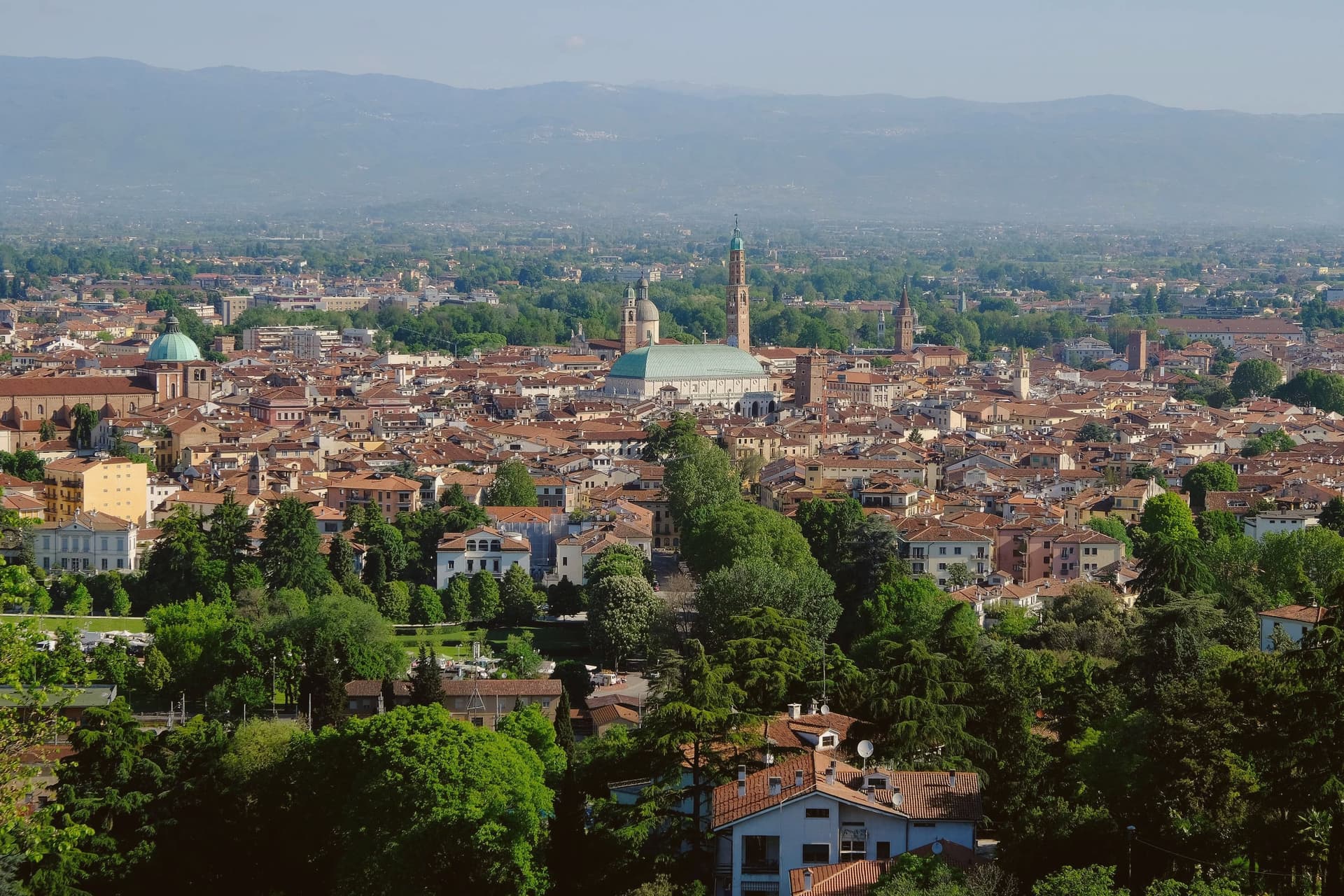
Why visit Vicenza
Vicenza is the city that made Palladio and that Palladio made. Andrea della Gondola — better known as Palladio — was a stonemason's apprentice in Vicenza in the 1520s, was renamed by his patron Trissino after the Greek goddess Pallas Athena, and spent the next 50 years building villas, palazzi and churches for the local Venetian-territory aristocracy.
The result: a 16th-century city of unprecedented architectural coherence, UNESCO-inscribed in 1994 as 'The City of Vicenza and the Palladian Villas of the Veneto'. The greatest hits cluster inside the walls: the Basilica Palladiana on Piazza dei Signori (his first major commission, 1549 — a Gothic medieval town hall wrapped in a white loggia of perfectly proportioned arches), Palazzo Chiericati (now the Pinacoteca), Loggia del Capitaniato, Palazzo Thiene, and the Teatro Olimpico — his final building (1580–1585), the world's oldest surviving indoor theatre, with a permanent trompe-l'œil stage set by Scamozzi depicting 'the seven streets of Thebes' in forced perspective.
A 20-minute walk south of the centro: Villa La Rotonda (1567), the symmetrical perfect-square villa that every American state capitol and Monticello copied. Vicenza also has Venice's gold and silver — half the gold sold in Italy passes through here annually (it's Europe's largest gold-jewellery district), and Vicenzaoro is the world's biggest gold trade fair.
Plus the Veneto kitchen: baccalà alla vicentina (salt cod with milk, anchovies and onions, served over polenta), bigoli with duck ragù, the local Lessini Durello sparkling wine, and Vicenza's own asparago bianco DOP in May.
We confirmed you can reach this one by train.
What to see in Vicenza
- Basilica Palladiana + Piazza dei Signori. Palladio's 1549 wrap of perfect-proportioned white arches around the medieval Palazzo della Ragione — his first major commission, the building that made his name. The rooftop terrace is open and free.
- Teatro Olimpico. Palladio's final work (1580–85) and the world's oldest surviving indoor theatre. Scamozzi's permanent stage set shows 'the seven streets of Thebes' in trompe-l'œil forced perspective — they still perform here.
- Villa Capra 'La Rotonda'. The perfectly symmetrical 1567 villa on a hilltop 2 km south — a square plan with four identical pedimented porticoes, copied by Jefferson at Monticello and every state capitol in America.
How to get to Vicenza
There is a railway station in the town, so you can arrive without a car and never need one while you are here. Vicenza is roughly 3 minutes away by road.
Our tip
Vicenza is best from April through June and September through October — the Veneto plain gets hot and sticky in July and August, and the Palladian villas (especially the Rotonda) are most photogenic in low-angle spring or autumn light. May is asparago bianco season and the gardens are full. Winter is foggy and quiet but the indoor sights — Teatro Olimpico, the Pinacoteca, the basilica's interior — are at their most atmospheric. Festa dei Oto a Vicenza falls in August.
Padova
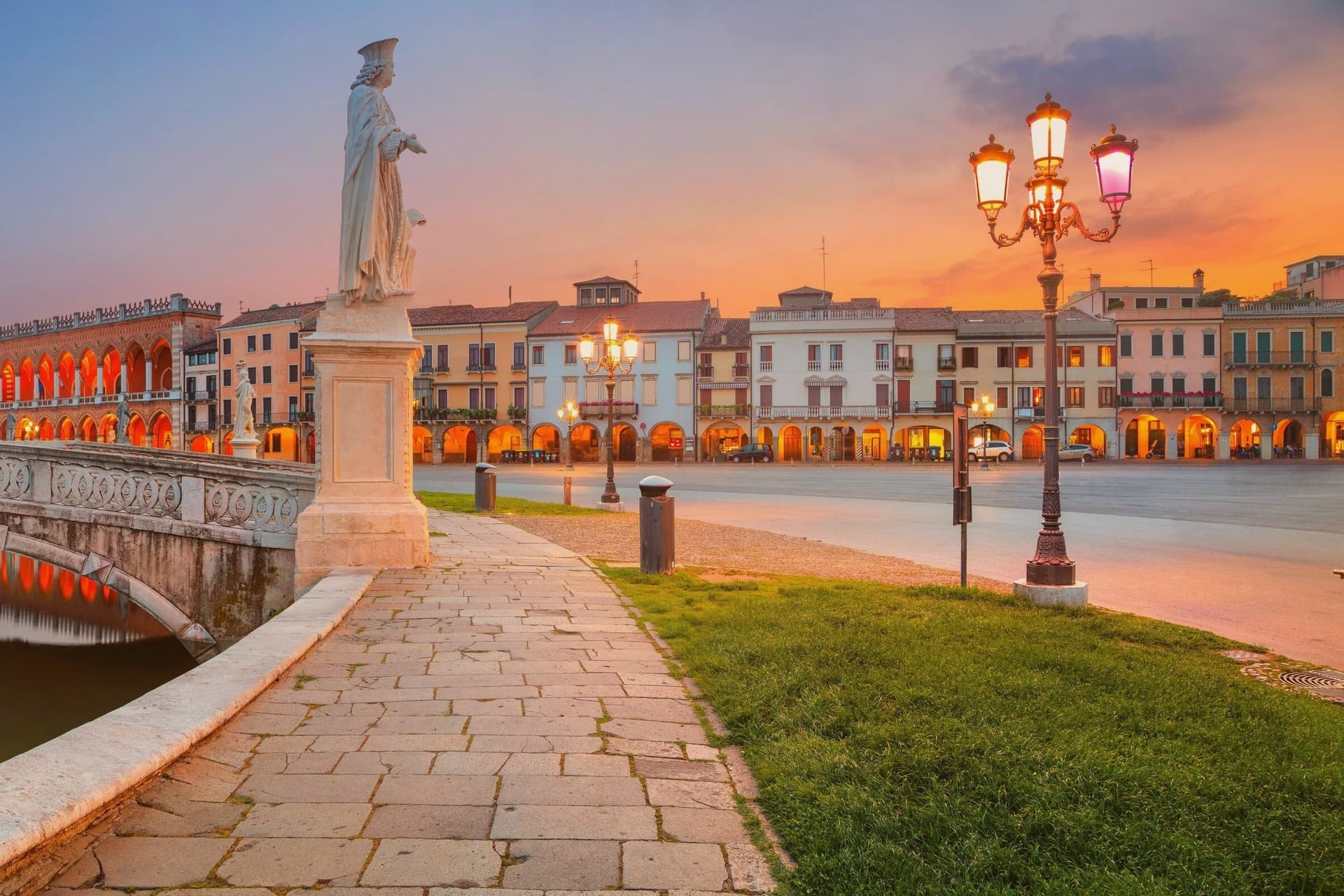
Why visit Padova
The Università degli Studi di Padova was founded in 1222 by scholars who had left Bologna in search of academic freedom, and for half a millennium it supplied the Veneto with its doctors and lawyers. Galileo lectured on physics here between 1592 and 1610.
Copernicus studied here. Elena Cornaro Piscopia became, in 1678, the first woman anywhere to receive a university doctorate.
The teaching happened in the same rooms tourists now walk through, which is part of what makes the university feel less like a monument and more like a machine that has never stopped running. The city's older story predates the university by centuries in spirit if not in stone: in 1303 Enrico Scrovegni commissioned a fresco cycle for his family chapel, an act of atonement for his father's usury, and the result changed what painting could do.
Separately, and for entirely different reasons, the city's botanical garden preserves a walled circular plan laid down in the sixteenth century, the layout that made it the template for every university garden that followed. Away from these two, the Basilica di Sant'Antonio draws pilgrims to a reliquary and a bronze outside its doors, the Palazzo della Ragione holds an astrological fresco hall and a two-hundred-year-old wooden horse, and a historic caffè has served coffee since 1831 in a neoclassical room that once served as Risorgimento headquarters.
The kitchen runs to bigoli with duck ragù, baccalà mantecato, risi e bisi in spring, and white asparagus from the Piazza delle Erbe market in May. What holds the city together is the university's habit of making its past into working infrastructure: a lecture hall still gives lectures, a dissection theatre still stands where it was built, a garden still grows on its original beds.
We confirmed you can reach this one by train.
What to see in Padova
- Cappella degli Scrovegni (Giotto, 1303–1305). 38 scenes from the life of Christ and Mary, painted directly onto the plaster of a single chapel. The air-handling required to keep the pigment stable is why entry is capped at 15 minutes and 25 people at a time.
- Orto Botanico (1545, UNESCO). A walled circular garden, laid out on its founding plan and unchanged in shape since. Goethe stood among its beds. A modern biodiversity greenhouse has been added alongside the historic plot.
- Prato della Valle. An elliptical canal ringed by 78 statues of Padovan worthies, enclosing a central island and facing the Basilica of Santa Giustina. At 88,000 square metres it is the largest piazza in Italy.
How to get to Padova
There is a railway station in the town, so you can arrive without a car and never need one while you are here. Padova is roughly 3 minutes away by road.
Our tip
Padova is best April–June and September–October. May is the Padovan asparago bianco IGP at the Piazza delle Erbe market and the gardens at the Orto Botanico in full bloom. June 13 is the feast of Sant'Antonio — a quarter-million pilgrims, hotels full for 50 km.
More from Anywhere Italy
- The best towns you can reach by train within an hour of Padua
- The best towns that eat well within an hour of Venice
 The best towns you can reach by train that have a serious restaurant in Veneto
 The best towns that eat well within an hour of Padua
 The best towns with a World Heritage site within 75 minutes of Venice
- The best towns inside a nature park in Veneto