
Coastal towns
Coastal towns in Calabria
17 towns
Towns on the sea. A cliff town high above the water counts here rather than under mountains, because the sea is why you would go.
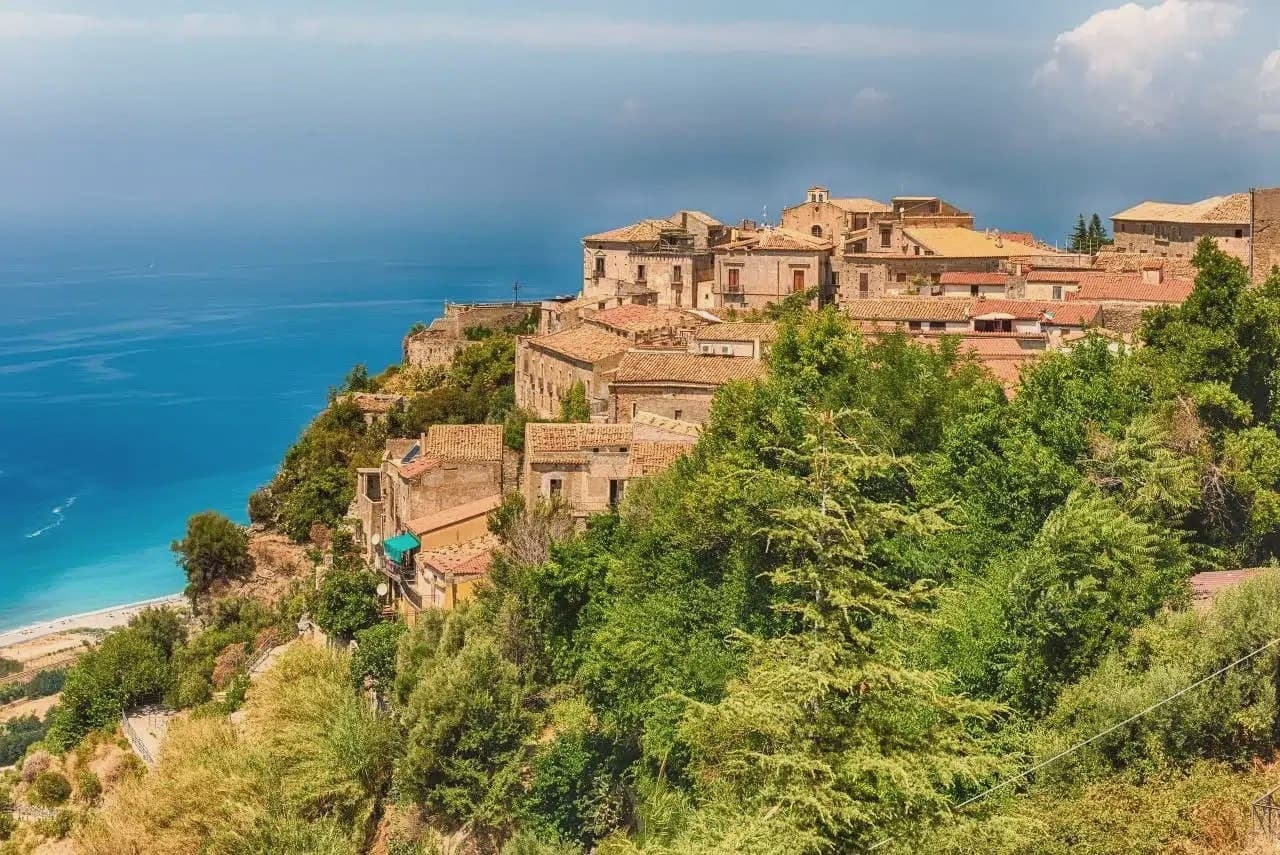
Fiumefreddo Bruzio
Province: Cosenza · 220 m
A Tyrrhenian hill town under Monte Cocuzzo, with a thirteenth-century castle frescoed in the 1990s.
Corigliano-Rossano
Province: Cosenza · 219 m
The Sibari plain city merged in 2018 from two older towns, one built around a Norman castle and the other around a Byzantine manuscript tradition.
Roseto Capo Spulico
Province: Cosenza · 217 m
A castle on a rock above the Ionian, in a village that began as a satellite of Sybaris in the seventh century BC.
Rocca Imperiale
Province: Cosenza · 210 m
Frederick II's Hohenstaufen fortress at the Calabria–Basilicata border, a Borgo più Bello d'Italia perched on a hill above the Ionian coast, with the castello at the summit and the locally-grown limone di Rocca Imperiale IGP scenting the orchards.
Villapiana
Province: Cosenza · 206 m
An Ionian commune where the Sibari plain meets the first slopes rising toward Pollino.
Belvedere Marittimo
Province: Cosenza · 150 m
A Riviera dei Cedri town on the Tyrrhenian, its castle set on the highest coastal hill above a convent that has kept a saint's relics for three centuries.
San Nicola Arcella
Province: Cosenza · 110 m
A cliff village above the Tyrrhenian Riviera dei Cedri, where a sea arch fronts a cove only reachable on foot or by boat.
Scilla
Province: Reggio di Calabria · 91 m
Homer's sea-monster headland on the Costa Viola, the Castello Ruffo on the cliff above Chianalea and the swordfish boats working the Strait below.
Isola di Capo Rizzuto
Province: Crotone · 90 m
A promontory on the Ionian coast wrapped by Italy's largest marine reserve, with an Aragonese castle standing on a rock offshore.
Cariati
Province: Cosenza · 76 m
A walled Ionian fishing town on the Saracen Coast, its ramparts among the most intact in southern Italy.
Trebisacce
Province: Cosenza · 73 m
A Bronze Age plateau above the Ionian Sea whose name comes from the Greek for small table, with a Byzantine mother church below.
Parghelia
Province: Vibo Valentia · 70 m
A 1,300-person village on the Costa degli Dei at 70 meters, four kilometers from Tropea and quieter than its famous neighbour.
Bagnara Calabra
Province: Reggio di Calabria · 50 m
A swordfish town on the Costa Viola where boats with lookout masts still hunt the Strait, and the IGP torrone has been made by hand since the eighteenth century.
Tropea
Province: Vibo Valentia · 50 m
Cliff town on a tufa headland over the Tyrrhenian Coast of the Gods, with a Norman monastery on a sea rock.
Pizzo
Province: Vibo Valentia · 44 m
A tuff-cliff town over the Gulf of Sant'Eufemia, where a king was shot in 1815 and the tartufo gelato was invented a century later.
Praia a Mare
Province: Cosenza · 10 m
A Tyrrhenian beach town in the Gulf of Policastro, backed by mountains and facing an offshore island.
Soverato
Province: Catanzaro · 10 m
The wealthiest town per capita in Calabria, built around a white-sand stretch on the Ionian shore.
The slow-trip planner
Plan a slow trip across the towns travelers skip.
Answer five questions. We will shape a geographically coherent slow trip from the 1,000 Italian towns most travelers skip. Yours to save and share.
From elsewhere in Italy
Five more towns to discover
Biccari
Province: Foggia
A Subappennino Dauno borgo at 450 meters under Monte Cornacchia, the highest peak in Puglia at 1,151 meters, with a Byzantine tower at its core.
Sirolo
Province: Ancona
A clifftop borgo at 125 meters, above the Due Sorelle sea stacks of the Adriatic.
Penne
Province: Pescara
The brick city at 438 meters between the Tavo and Fino, ancient capital of the Vestini, rebuilt after Allied bombing and awarded the Silver Medal of Civic Merit.
Palazzolo Acreide
Province: Siracusa
An 8,000-resident hilltop town on the Iblei plateau at 670m, rebuilt entirely in late Baroque after the 1693 earthquake and founded over the Greek Akrai colony in 664 BC, with a Greek theatre and a cluster of rock carvings unlike anything else nearby.
Verucchio
Province: Rimini
A spur over the lower Marecchia valley, cradle of the Villanovan civilization and birthplace of the Malatesta lordship of Romagna.