
For foodies
Where to eat well in Aosta Valley
8 towns
Towns holding at least one place a guide put its name to. The ones several guides agree on come first.
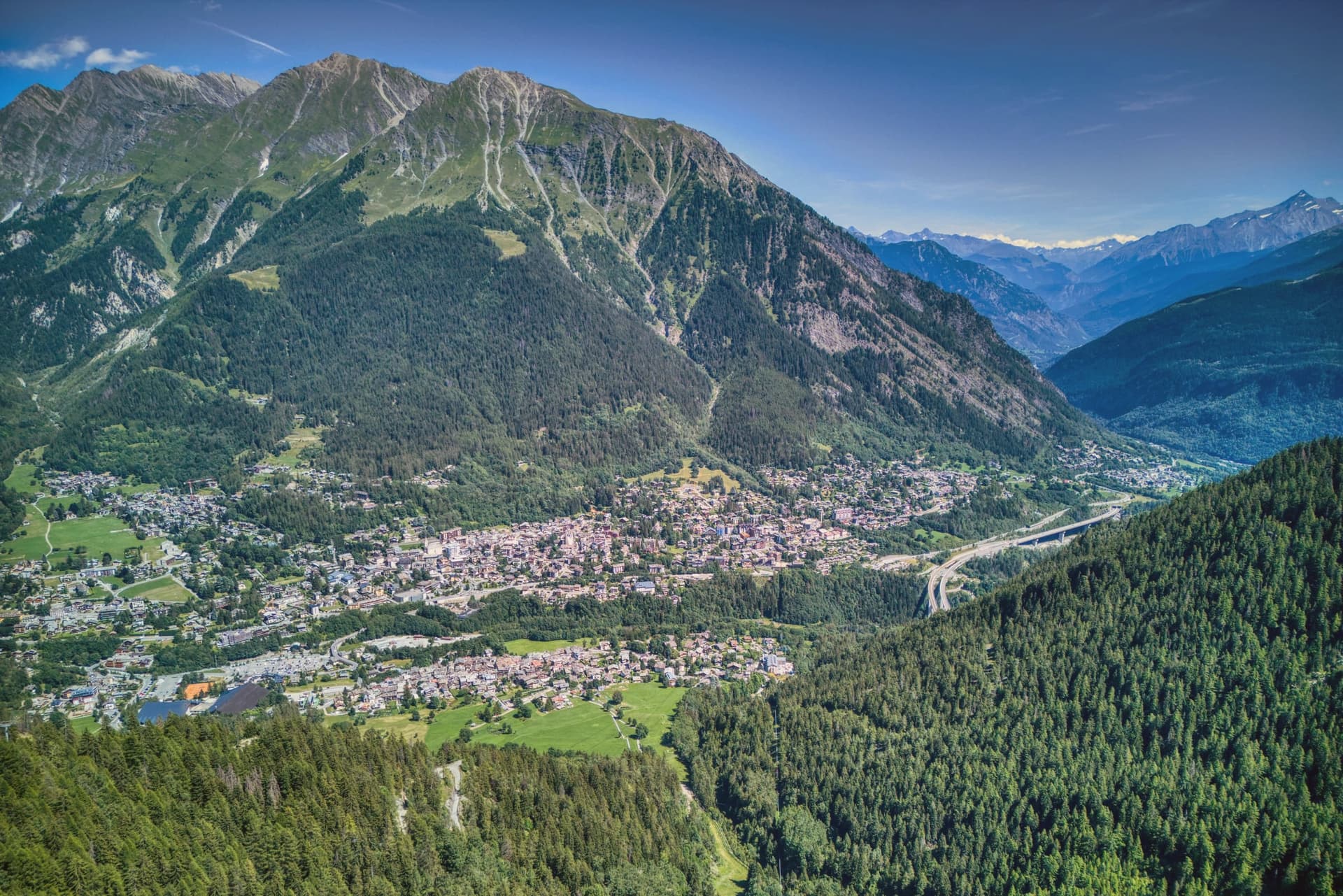
Courmayeur
Province: Aosta Valley · 1,224 m
The Italian base of the 4,810-meter peak, a Roman waystation on the Via delle Gallie that became the country's highest commune and its best-known ski address.
Cogne
Province: Aosta Valley · 1,534 m
The mining town turned capital of the Gran Paradiso, the Aosta Valley's largest commune with 95 percent of its land inside Italy's oldest park.
Valtournenche
Province: Aosta Valley · 1,524 m
The valley under the Cervino, home of the guides who raced Whymper up the mountain in 1865.
Ayas
Province: Aosta Valley · 1,710 m
A scattered upper-valley commune of three villages, where Walser settlers and Romance-speaking herders share the slopes below Castor and Pollux.
Bard
Province: Aosta Valley · 400 m
A 108-person village under the largest Savoy fortress in the Alps.
Fénis
Province: Aosta Valley · 537 m
The Castello di Fénis, with its double ring of crenellated walls, eight cylindrical towers, and frescoed inner courtyard, sits at the centre of a small Aostan commune east of Aosta, with an Apennine reserve climbing south to 3,000m.
La Thuile
Province: Aosta Valley · 1,441 m
Italy's gateway to the Petit Saint-Bernard pass: a 1,441m alpine village under Mont Blanc, with the Rutor glacier and its tiered waterfalls behind it and a Roman-Salassi history that goes back two millennia.
Saint-Vincent
Province: Aosta Valley · 575 m
A belle-époque thermal town on a sunny south-facing terrace at 575m, where a mineral spring, a landmark casino, and a Matterhorn view north of town define a resort built for the 19th-century cure.
The slow-trip planner
Plan a slow trip across the towns travelers skip.
Answer five questions. We will shape a geographically coherent slow trip from the 1,000 Italian towns most travelers skip. Yours to save and share.
From elsewhere in Italy
Five more towns to discover
Visso
Province: Macerata
The northern Sibillini gate at 607 meters where the Nera meets the Ussita, holding one of two surviving manuscripts of Leopardi's L'Infinito.
Goriano Sicoli
Province: L'Aquila
At 720 meters in the Subequana valley, a medieval village drawn by M.C. Escher in 1929 keeps a May ritual folklorists trace to Demeter.
Ugento
Province: Lecce
A Messapian-Roman town five kilometers from the Ionian, where a Baroque castle sits on the walls of the ancient city of Ozan.
Fontanellato
Province: Parma
A Parma-plain town built around the Rocca Sanvitale, the moated fortress at its center.
Pescina
Province: L'Aquila
A Marsica town at 735 meters, on the rim of the drained Fucino basin, that lost five thousand of six thousand people in a single morning in 1915.