
The best mountain towns inside a national park within 90 minutes of Pescara
Leave the Pescara seafront and the road climbs fast, out of the vineyards and into beech woods, then above the treeline onto pale limestone. These are the massifs of the Gran Sasso, the Maiella and the Abruzzo, Lazio and Molise park, where villages are built from the same grey stone as the ridge behind them and the houses lean into each other against the wind. The eating is mountain eating: pecorino aged in cellars, mutton stewed with wild herbs, saffron grown on the Navelli plain, lentils, chitarra pasta. Autumn brings the flocks down the drove roads and the first frost onto the high pasture, and winter closes several of the passes altogether.
The obvious move is Roccaraso, which has the lifts, the ski school, the hotel beds and the Neapolitan weekend traffic that fills every car park by mid-morning in February. It works, and its ski area is large, but it has been built for volume, and in high season the queues and the resort architecture are the price of that. Campo Imperatore draws the other crowd, coach parties on the plateau photographing the same view of Corno Grande.
The same mountains carry on past both of them. Wolves and chamois live in these parks, the drove roads still cross them, and the villages along the flanks of the Maiella and under the Gran Sasso are smaller, quieter and mostly still lived in year-round. Fewer people go, which is part of why the stone streets, the hermitages and the shepherd's tracks have kept their shape. These are the towns on that ground, all of them inside a national park, all within about an hour and a half of the coast.
Of the 61 communes we have mapped within 90 minutes of Pescara, 10 qualify as mountain towns inside a national park: each sits in the mountains, and each sits inside a national park. The smallest, Castelvecchio Calvisio, has 118 residents.
Elsewhere in the catalogue: The best high-altitude villages within 90 minutes of Pescara and The prettiest villages inside a national park within 90 minutes of Pescara.
Castelvecchio Calvisio
Why visit Castelvecchio Calvisio
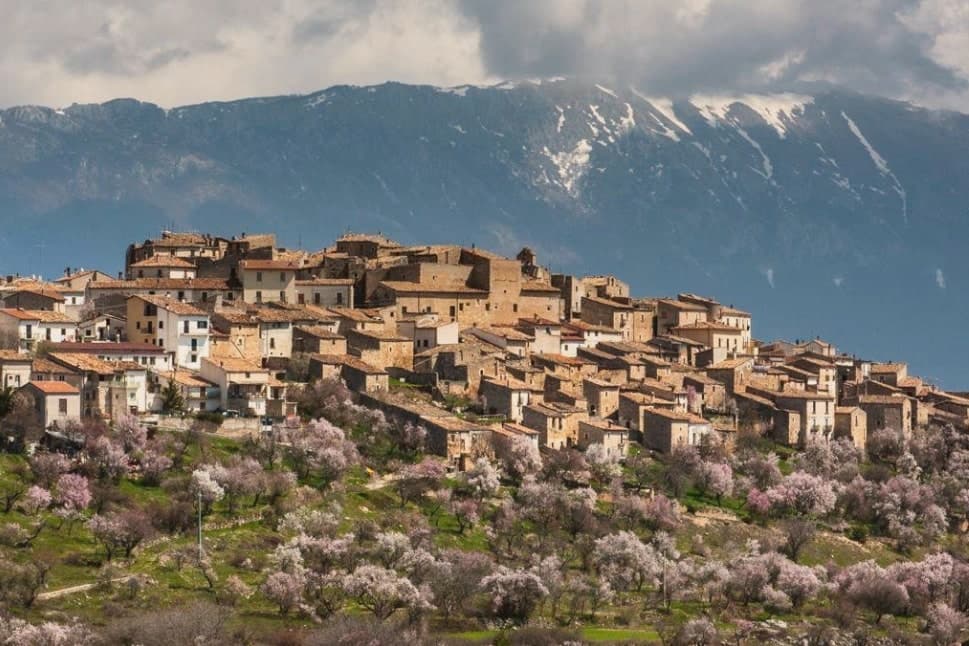
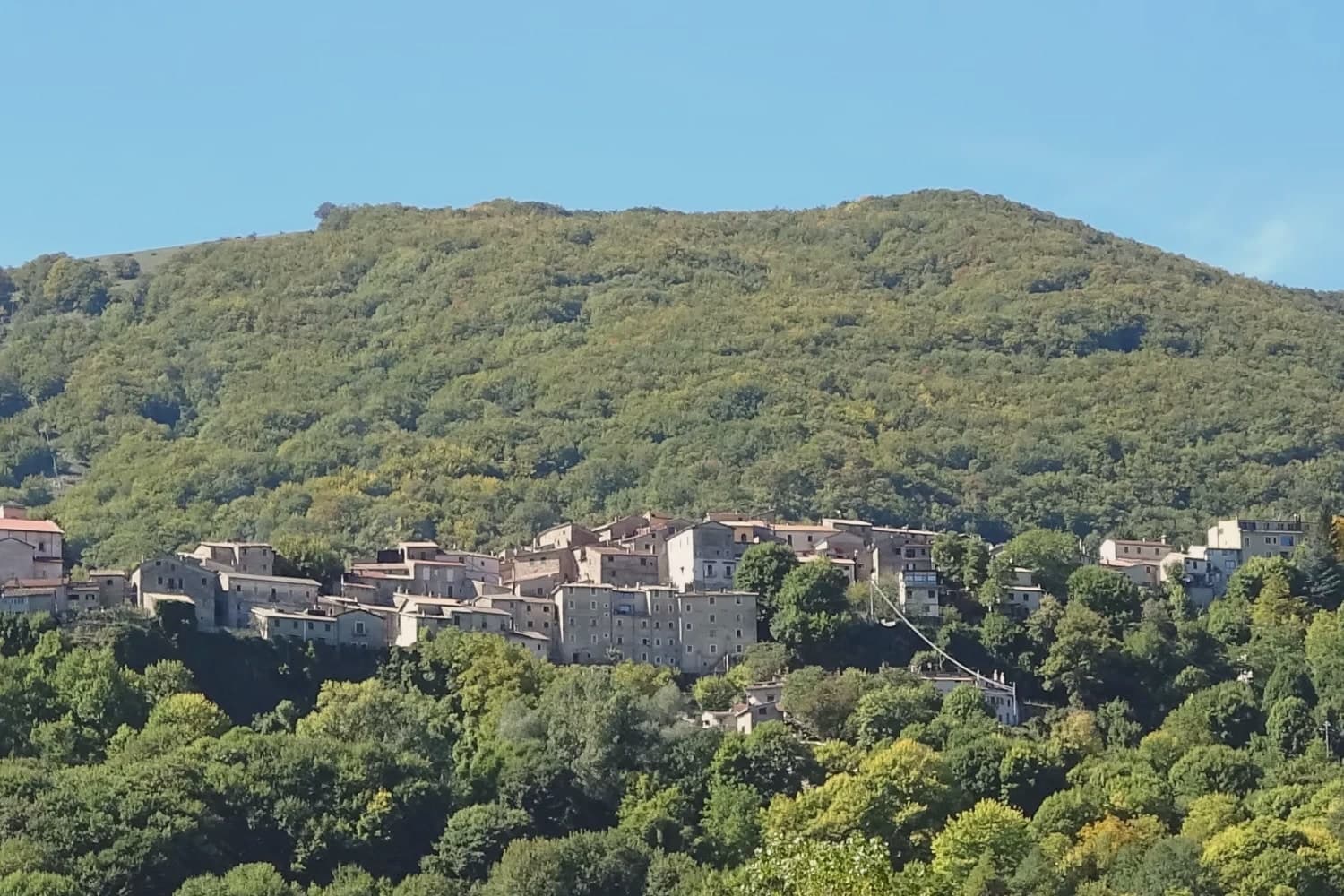
Castelvecchio Calvisio sits at 1,067 meters on a ridge above the Tirino valley, in the Gran Sasso e Monti della Laga National Park. The medieval village has a rare and distinctive form: a fortified ellipse of stone walls, with houses built into the walls themselves, and internal alleys laid out orthogonal to the perimeter.
The barbacani, broad external stone staircases climbing the houses, mark each level of the multi-storey dwellings. Narrow streets pass under vaulted arches; the steps of the alley stairs widen as they rise.
The population sits at 118, one of the smallest in the province. The Church of San Giovanni Battista, with its bell tower above the rooftops, stands at the centre of the elliptical plan.
The Church of Santa Maria delle Grazie is just below. Ruins of the original castle survive on the highest point of the settlement, the defensive watchtower from which the village grew.
The village has been part of the Borghi Autentici network for over a decade, anchored on conservation of its medieval form.
The village sits at 1067 metres.
What to see in Castelvecchio Calvisio
- Borgo fortificato (centro storico). Fortified elliptical village with houses built into the perimeter walls, orthogonal alleys, vaulted passages, and external stone staircases called barbacani.
- Chiesa di San Giovanni Battista. Parish church at the centre of the elliptical plan, with its bell tower the only structure rising above the rooflines of the village.
- Chiesa di Santa Maria delle Grazie. Second medieval church of the village, just below the centre, with architectural elements that mark the original Romanesque-Gothic transition.
How to get to Castelvecchio Calvisio
Pescara is roughly 70 minutes away by road.
Our tip
June through September is the strong window for Castelvecchio Calvisio. The Tirino valley is dry, the trails to Calascio and Campo Imperatore are clear, and the elliptical borgo opens for visitors. The village hosts a small summer festival in August.
Calascio
Why visit Calascio
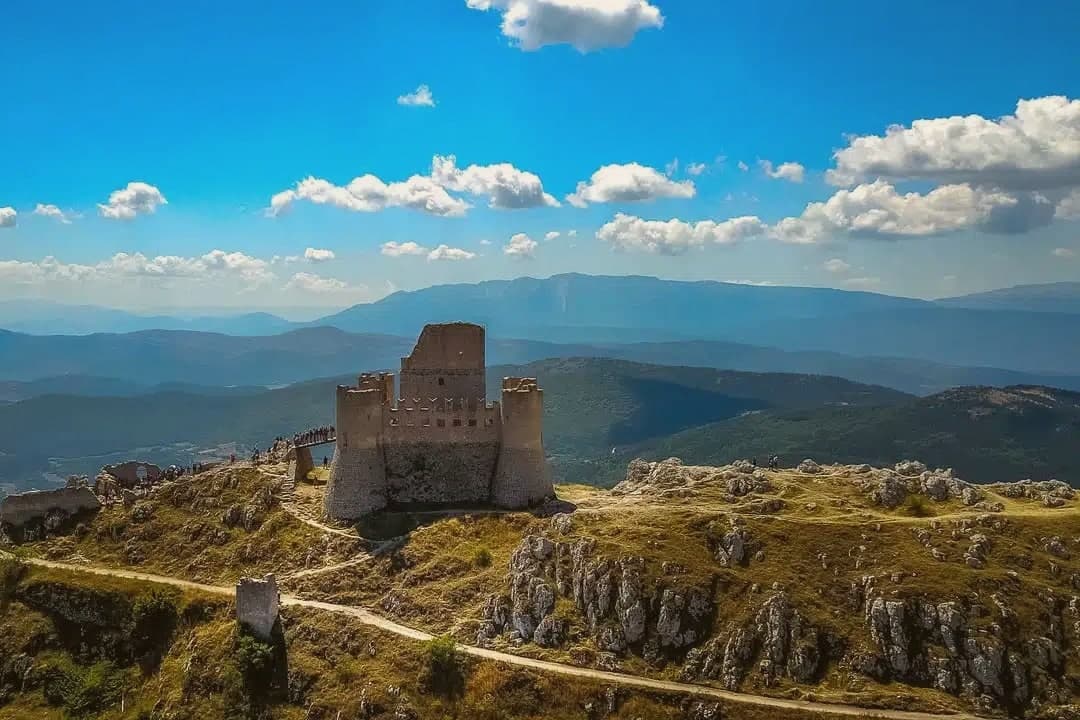
Calascio sits at 1,200 meters in the Gran Sasso e Monti della Laga National Park, the lower stone village where the shepherds who stayed after the transhumance ended made their houses. The fortress above it began around the year 1000 as a watchtower controlling the routes that ran 250 kilometers down from L'Aquila to the Tavoliere delle Puglie, and it was this wool wealth that built the village below.
Wool from these flocks was prized enough that the Medici came north to buy it. The upper village beside the castle emptied when the transhumance ended in the 1850s and has been under slow restoration since, stonemasons working with original materials under the Borgo Autentici designation, while the lower village kept its 125 residents and its parish church.
From the castle the view runs across Campo Imperatore, the high plateau immediately to the north, toward the Gran Sasso peaks. The two settlements read as before and after: the upper one preserved in its abandonment, the lower one still lived in because it held the people the transhumance left behind.
The village sits at 1200 metres.
What to see in Calascio
- Rocca Calascio. Highest fortress in the Apennines at 1,460 meters, watchtower for transhumance routes from L'Aquila to Puglia, film location for Ladyhawke and The Name of the Rose.
- Chiesa di Santa Maria della Pietà. Octagonal Renaissance chapel below the fortress, built on the site of a 1456 battle won by local farmers against bandits, with painted interior.
- Borgo di Rocca Calascio. Partly abandoned upper village beside the castle, slowly restored by stonemasons, with the Rifugio della Rocca offering rooms in stone houses.
How to get to Calascio
Pescara is roughly 76 minutes away by road.
Our tip
June through September is high season at Calascio: the Rocca trail is dry, the Campo Imperatore plateau is open for hiking, and the air at 1,200 meters stays cool through August afternoons. December through March is the second season, when ski traffic to Campo Imperatore brings winter visitors and the Rocca in snow becomes the picture everyone wants. The village empties on weekdays from November to April and the road up to the Rocca closes after heavy snow.
Castel del Monte
Why visit Castel del Monte
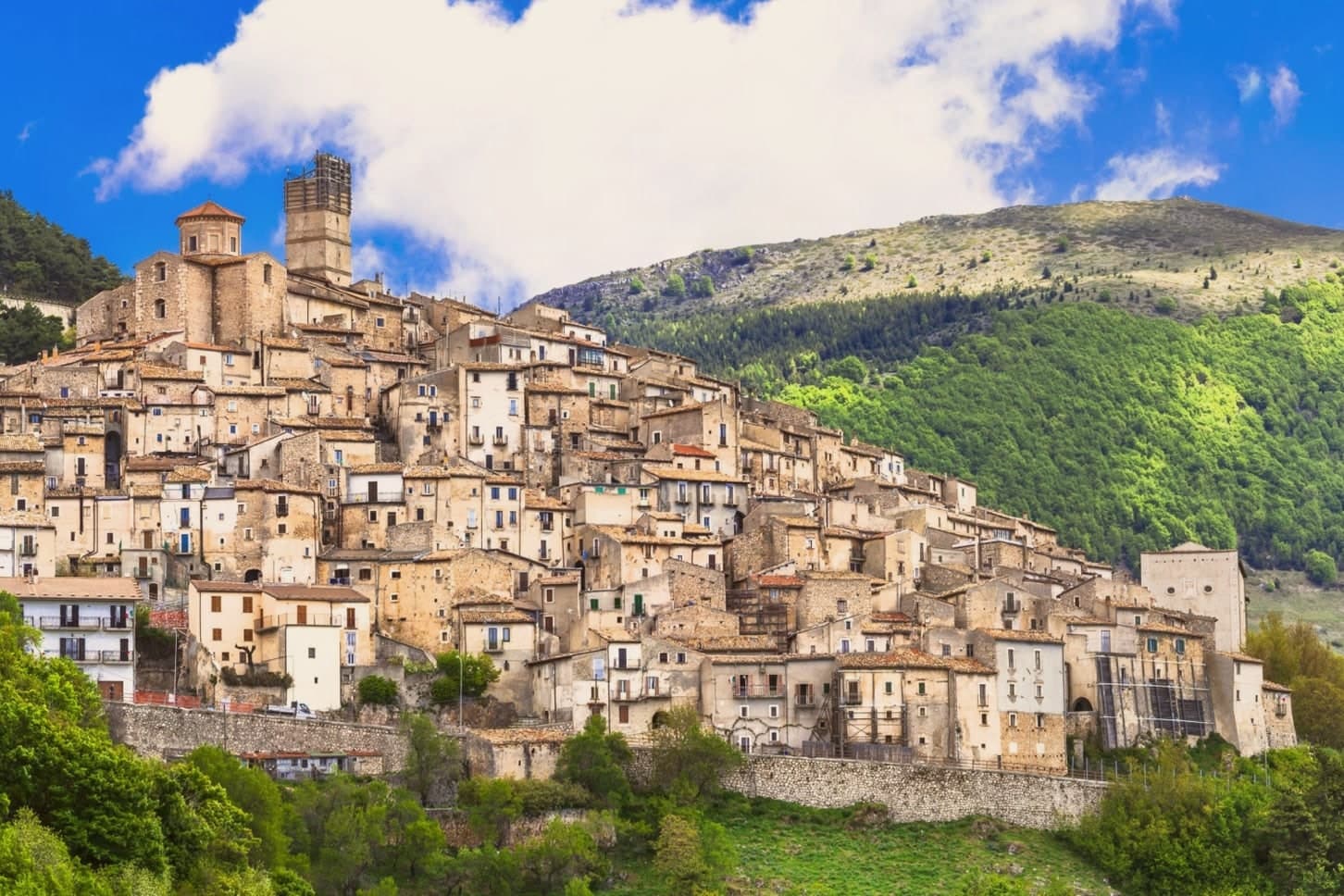
The village sits in the Gran Sasso e Monti della Laga National Park, on the southern slope of Monte Bolza, with Rocca Calascio facing it across the valley and Campo Imperatore stretching north. It descends from the pre-Roman Vestini; finds from an 11th-century BC necropolis lie in the valley below, long before any wool trade or Medici buyer arrived.
The upper village, its stone core threaded with tunnels and vaulted passages, once housed the shepherds who drove flocks south to Puglia and returned to a cluster of churches built for their safekeeping and their thanks. That world ended in the 1850s, and the population emptied with it: 431 people remain where a wool trade once drew merchants from the Medici's own city.
What is left is performed rather than lived at scale, in the symbolic transhumance and in the August gathering that briefly fills the same streets and tunnels the shepherds once used. The place now runs on memory of the trade that built it, kept alive one night a year and in a cheese still made from spring pastures.
The village sits at 1346 metres.
What to see in Castel del Monte
- Chiesa Matrice di San Marco. Baroque interior; holds the patron-saint statue carried through the village in the August procession.
- Chiesa di San Donato Fuori le Mura. Romanesque church just outside the medieval walls, among the oldest religious buildings in the village, with a small square in front used for festivals.
- Chiesa della Madonna del Suffragio (dei Pastori). Devotional centre of the transhumance, hung with ex-votos left by herders for safe return from Puglia.
How to get to Castel del Monte
Pescara is roughly 90 minutes away by road.
Our tip
June through September is when Castel del Monte runs at full strength. Campo Imperatore opens for hiking, the Canestrato cheese makers receive visitors, and La Notte delle Streghe in mid-August packs every alley with thousands of people. December through March is the second season for skiers heading to Campo Imperatore and Prati di Tivo, with the village in deep snow. Rassegna degli Ovini di Campo Imperatore falls in August.
Rivisondoli
Why visit Rivisondoli
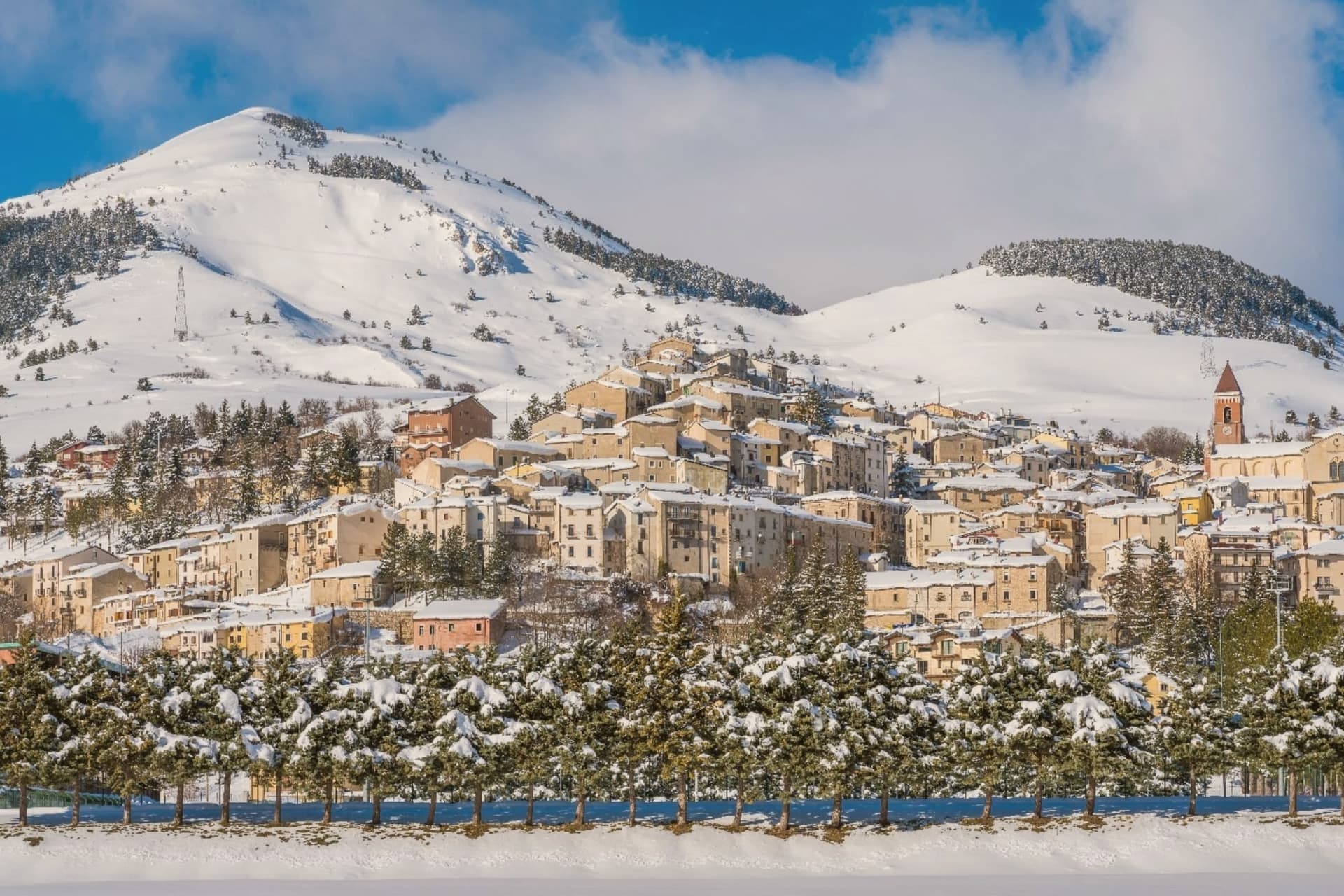
Rivisondoli sits on the flank of Monte Calvario, looking down at the plateau that runs north toward Roccaraso. The town was first recorded in 724 in a diploma of Grimoald II, Duke of Benevento, and grew in the 12th century along the Via degli Abruzzi, the military and trade route across the central Apennines.
It was once known for its weapons production. The 1792 fire destroyed most of the village, and the opening of the Sulmona-Isernia railway in the 19th century turned it toward tourism rather than trade.
The Italian royal family kept a residence here in 1913. Rivisondoli and Roccaraso face each other across the Cinque Miglia plateau, close enough that their ski slopes were joined into one domain and their names are now said together.
The older village, rebuilt twice, climbs one flank of the mountain while the plateau below stays open and treeless, the same ground that once slowed traders and caravans on the route through the Apennines. What began as a stop on a military road became, after fire and war remade the town twice, a place oriented instead toward winter visitors and a single night in January.
The village sits at 1320 metres.
What to see in Rivisondoli
- Alto Sangro ski area. The lift network runs between 1,309 and 2,142 meters, joining Rivisondoli's slopes to Roccaraso's across the open plateau.
- Presepe Vivente. Hundreds of villagers in period costume take the hillside outside town for the performance, the cast spread across the open ground rather than a stage.
- Altopiano delle Cinque Miglia. Treeless and averaging 1,250 meters, the plateau in the Alto Sangro is prone to extreme winter winds, a stretch that historically caught travelers unprepared.
How to get to Rivisondoli
Pescara is roughly 89 minutes away by road.
Our tip
December through March is the season the town runs on. The Alto Sangro lifts open, weekend numbers multiply, and the Cinque Miglia plateau north of town becomes the cross-country skiing route. The January 5 Presepe Vivente draws the biggest single crowd of the year.
Campo di Giove
Why visit Campo di Giove
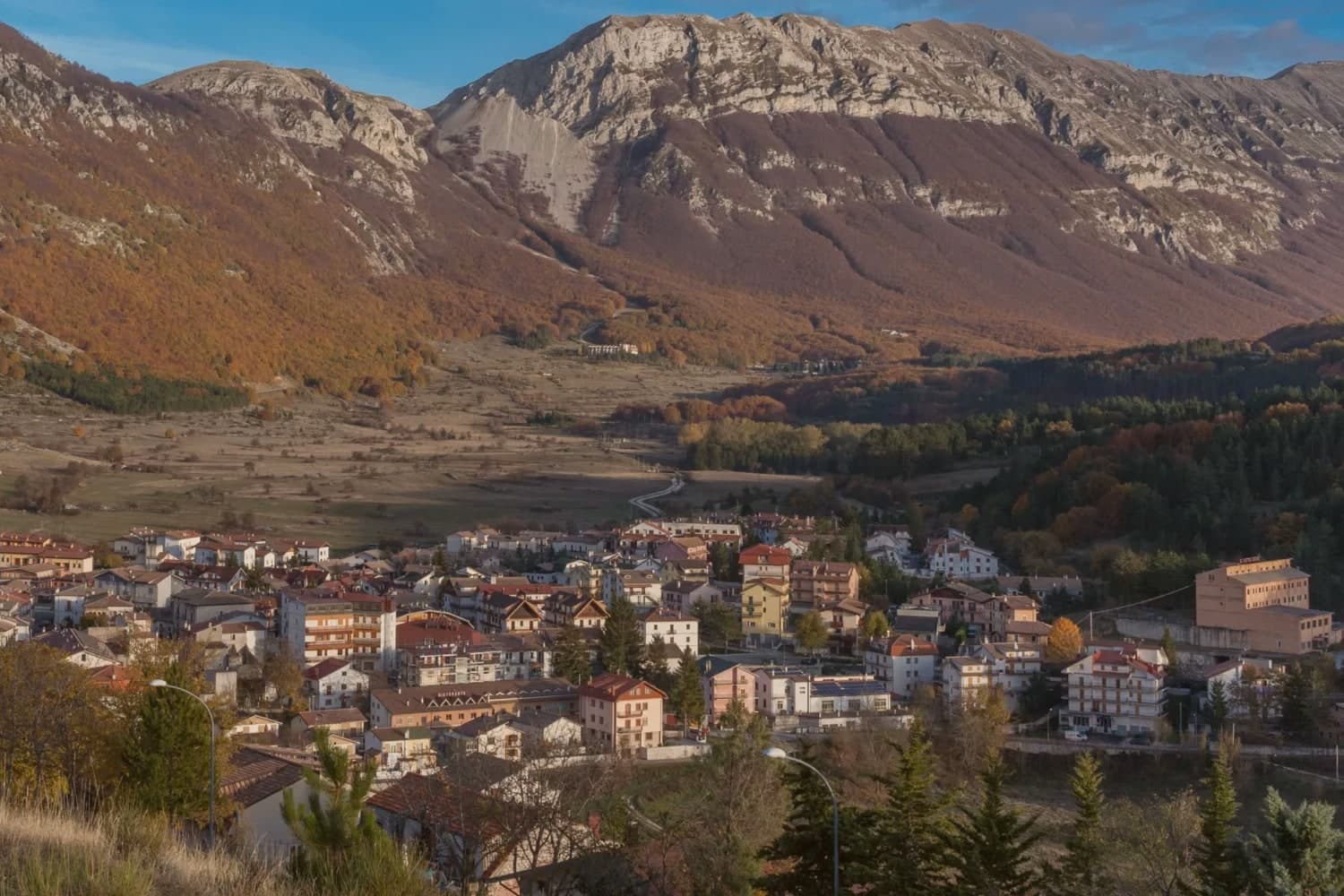
Campo di Giove sits at 1,064 meters at the foot of the southwestern Maiella, the highest commune inside the Maiella National Park. The name is documented as Campo Jovis from the 4th century AD, with local tradition claiming a Roman temple to Jupiter on the site after a victory over the Paeligni.
A villager called Odorisio appears in a document from January 1136. In the 14th century the village was a Cantelmo stronghold; it then passed to the Caldora, the Belprato, the Pignatelli, and finally the Recupito.
Above the village, the ski station operates between 1,150 and 2,360 meters, the highest piste in Abruzzo. The mother church of Sant'Eustachio holds the statue of the patron saint.
Sant'Antonino was one of the sixteen convents founded by Fra Pietro da Morrone, the hermit who would become Pope Celestine V. The Master of Campo di Giove, an anonymous 15th-century painter named for the polyptych he made for the village church, is on display at the Museo Nazionale d'Abruzzo in L'Aquila.
The village sits at 1064 metres.
What to see in Campo di Giove
- Chiesa Madre di Sant'Eustachio. Parish church of the village patron, with the statue of Sant'Eustachio, the saint celebrated each September with the village feast.
- Convento di Sant'Antonino. One of the sixteen convents founded by Fra Pietro da Morrone, the hermit who became Pope Celestine V, documented in a 1274 papal bull.
- Palazzo delle Logge. 16th-century palazzo with arched loggia on the main piazza, one of several Renaissance buildings from the Caldora and Pignatelli periods.
How to get to Campo di Giove
There is a railway station in the town, so you can arrive without a car and never need one while you are here. Pescara is roughly 82 minutes away by road.
Our tip
Campo di Giove runs on two seasons. December through March, the Maiella ski lifts run from the village edge to 2,360 meters, the highest piste in Abruzzo. June through September is the second season: temperatures stay below 25 even in August at 1,064 meters, and the Sentiero della Libertà hike, retracing the WWII escape route over the Maiella, draws walkers.
Lama dei Peligni
Why visit Lama dei Peligni
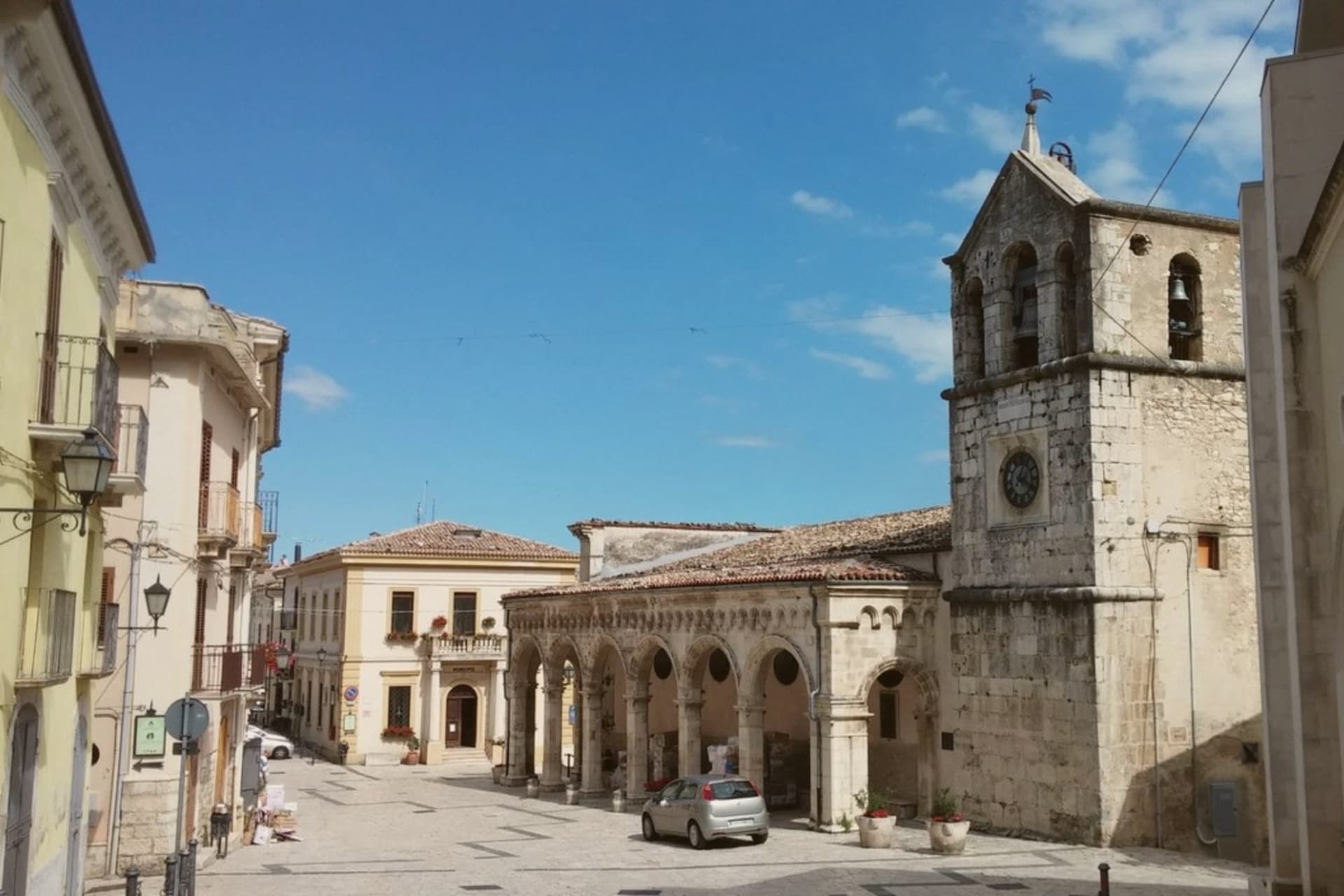
Lama dei Peligni sits at 669 meters on the southern flanks of the Majella, between the Aventino river and the massif behind it. The name comes from a pre-Latin word for ground where water pools.
The earliest evidence of human use here, the so-called Uomo della Maiella, was excavated from Contrada Fonterossi at the start of the twentieth century, a burial dated between 7000 and 5000 BC. The Grotta del Cavallone opens at 1,475 meters in the wall above town, the highest accessible natural cave in Europe, 1,300 meters of karstic gallery branching into three secondary tunnels.
The Maurizio Locati museum at the entrance to the village runs a fenced reserve for the Abruzzo chamois, the species the zoologist worked to reintroduce in the Majella park. The Maiella Brigade fought partisan actions out of these slopes in 1943-44, and the obelisk at San Pietro commemorates them.
The village sits at 669 metres.
What to see in Lama dei Peligni
- Grotta del Cavallone. Karst cave at 1,475 meters, 1,300 meters of gallery on the border with Taranta Peligna, the highest accessible natural cave in Europe.
- Museo Naturalistico Maurizio Locati. Wildlife and archaeology museum at the village entrance, dedicated to the zoologist who reintroduced chamois in the Majella park.
- Giardino Botanico Michele Tenore. Botanical garden adjacent to the museum, reconstructing Majella flora alongside a Neolithic village display and chamois enclosure.
How to get to Lama dei Peligni
Pescara is roughly 78 minutes away by road.
Our tip
May through October is the window. The Cavallone cave opens for guided visits from May to September; the rest of the year it closes for safety. The chamois reserve and botanical garden run from late spring through October.
Pescocostanzo
Why visit Pescocostanzo
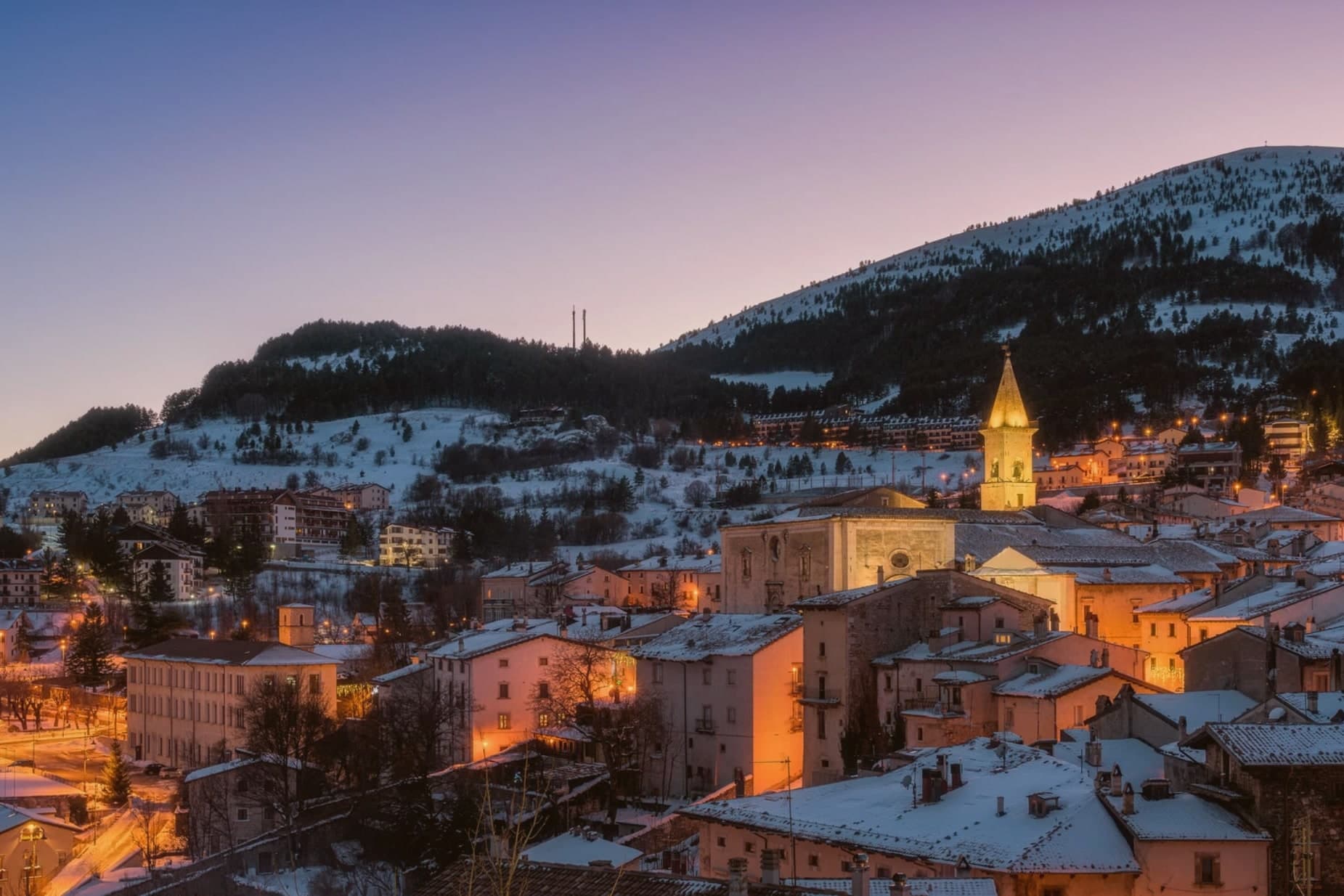
Pescocostanzo sits at 1,395 meters at the southern edge of the Quarto Grande plateau, the high karst basin above the Sangro valley. The town was reshaped between 1456 and the eighteenth century under the Capua family and a generation of Lombard masons who arrived to build for them.
The plan is unusually regular for a mountain commune: a grid of stone houses oriented to the wind, surrounded by woods and pasture. The Collegiata di Santa Maria del Colle, restructured by Cosimo Fanzago in the seventeenth century, is one of the rare five-nave churches in Abruzzo.
Its wrought iron Chapel of the Sacrament gate, made by Sante di Rocco between 1699 and 1707, is the masterpiece of local ironwork. Bobbin lace, merletto al tombolo, is still made here.
The Museo del Merletto a Tombolo inside Palazzo Fanzago shows the technique and the patterns. Filigree gold, carved wood, and lace are still sold on the Corso Roma.
The village sits at 1395 metres.
What to see in Pescocostanzo
- Collegiata di Santa Maria del Colle. Five-nave church begun in the late Middle Ages and remodeled by Cosimo Fanzago in the seventeenth century.
- Museo del Merletto a Tombolo. Inside Palazzo Fanzago, displays the local bobbin lace tradition with patterns, tools, and live demonstrations.
- Palazzo Fanzago. Designed by the baroque architect Cosimo Fanzago in 1624, the seat of the lace museum and civic offices.
How to get to Pescocostanzo
Pescara is roughly 84 minutes away by road.
Our tip
December through March brings snow and the ski season, with the Monte Calvario lifts linking to the Alto Sangro system at Roccaraso and Rivisondoli twenty minutes away. June through September is the second season. At 1,395 meters Pescocostanzo rarely crosses twenty-two degrees even in August, and the Bosco di Sant'Antonio offers beech-shaded walks.
Pacentro
Why visit Pacentro
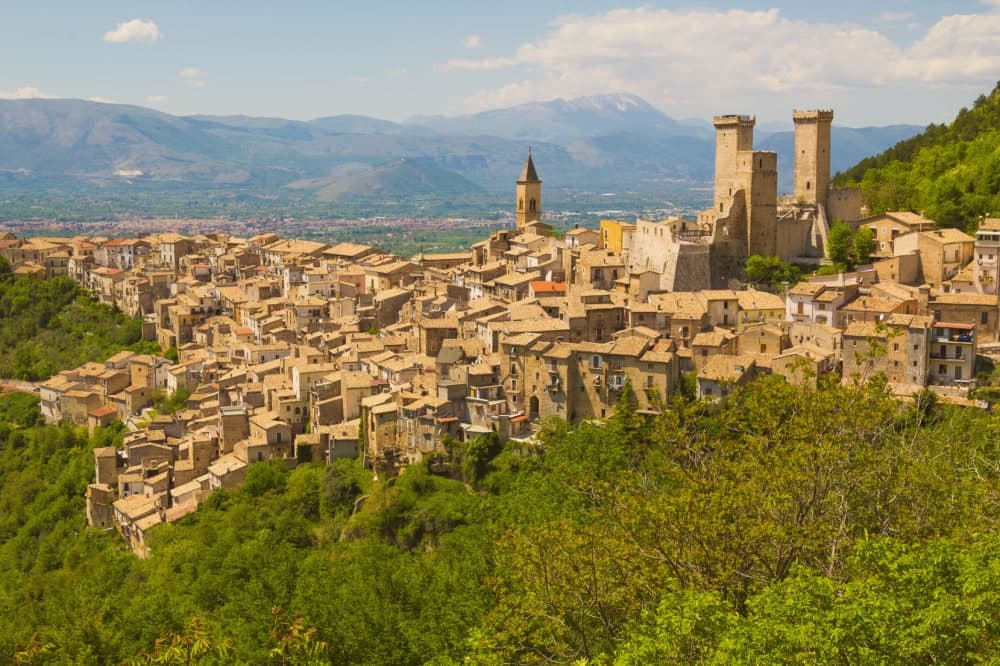
Pacentro sits at 650 meters on a hill spur in the Peligna valley, eight kilometers from Sulmona and inside the Maiella National Park. The Castello Caldora, with its three surviving square towers, dominates the village from the Colle Castello above.
The site has held a castle since the eleventh century; the structure visible today was begun by the Caldora-Cantelmo family in the late fourteenth century and bought by the comune in 1957 and restored. On the first Sunday of September, the Corsa degli Zingari sends barefoot runners down a rocky slope from Monte Ardinghi into the village in honor of the Madonna di Loreto.
The race is documented since the fifteenth century. The other thing people come for is the Ciccone house.
Madonna's paternal grandparents, Gaetano Ciccone and Michelina Di Iulio, emigrated from Pacentro in 1919. The pop singer visited in 2013.
The village sits at 650 metres.
What to see in Pacentro
- Castello Caldora-Cantelmo. Late fourteenth-century fortress on the Colle Castello, three of its four corner towers still standing, restored after 1957.
- Borgo medievale. Stone houses arranged on terraces below the castle, listed among the Borghi più belli d'Italia, preserved in its medieval plan.
- Chiesa di Santa Maria Maggiore. Sixteenth-century parish church with a baroque interior, holding the Madonna di Loreto honored in the September race.
How to get to Pacentro
Pescara is roughly 69 minutes away by road.
Our tip
May through October is when Pacentro opens. The first Sunday of September brings the Corsa degli Zingari and the biggest crowd of the year, with runners descending barefoot from Monte Ardinghi and the village in procession by evening. July and August can be warm in the valley but the elevation keeps Pacentro itself cooler than Sulmona below.
Pettorano sul Gizio
Why visit Pettorano sul Gizio
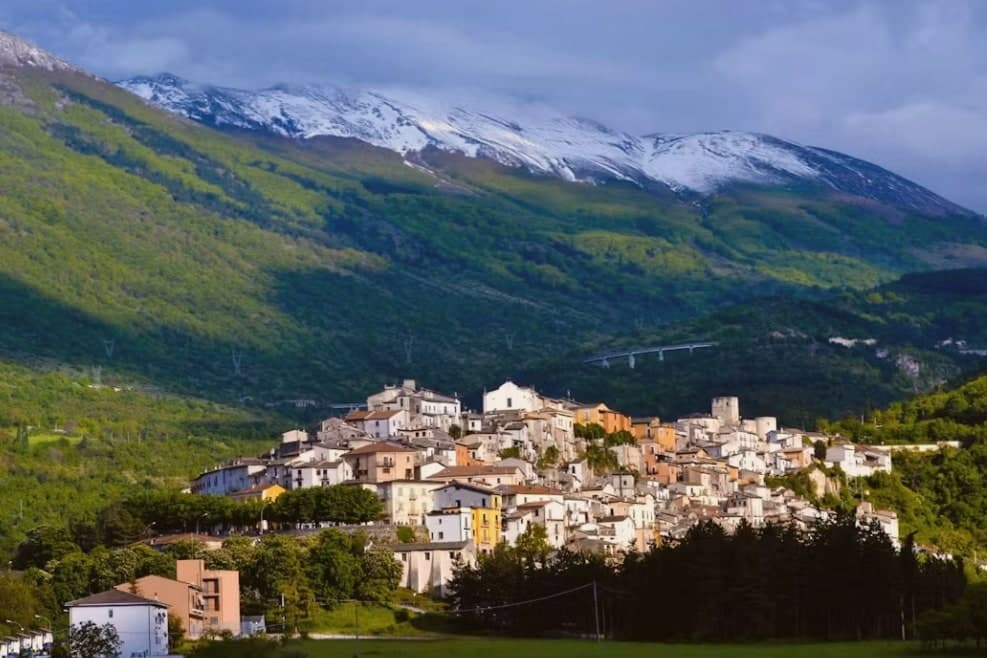
Pettorano sits at 656 meters on a hill above the Gizio river, at the southern entrance of the Valle Peligna, at the foot of the Maiella. The Castello Cantelmo, a pentagonal stone tower built in the 11th century and held by the Cantelmo family from 1310 to the mid-1700s, dominates the village from above.
The 16th and 17th centuries left palazzi behind: Palazzo Croce, Palazzo Gravina, Palazzo Vitto-Massei. The Church of San Nicola outside the walls is documented in 1112.
Today the commune sits inside the Riserva Naturale Monte Genzana, and the castle, restored between 1992 and 1998, hosts exhibitions and the reserve's visitor centre. The Marsican brown bear passes through these woods.
Pettorano is a Borghi più belli d'Italia and one of the Comuni Virtuosi, the network of municipalities that signed up to specific environmental commitments. The population has held steady around 1,300 while neighbouring villages shrank.
The village sits at 656 metres.
What to see in Pettorano sul Gizio
- Castello Cantelmo. Pentagonal 11th-century fortress above the Gizio, seat of the Cantelmo family from 1310 to the mid-18th century, restored as exhibition space.
- Chiesa di San Nicola. Small church outside the medieval walls, already documented in 1112, the oldest religious building in the commune.
- Chiesa di Sant'Antonio Abate. Patron-saint church inside the centro storico, repeatedly rebuilt after earthquakes, with traces of earlier medieval structure.
How to get to Pettorano sul Gizio
Pescara is roughly 70 minutes away by road.
Our tip
May through October is when Pettorano works best. The high valley stays cool even in August, the Monte Genzana trails are open, and the castle exhibition season runs through autumn. June and September are the most reliable, with warm days and cold evenings.
Scanno
Why visit Scanno
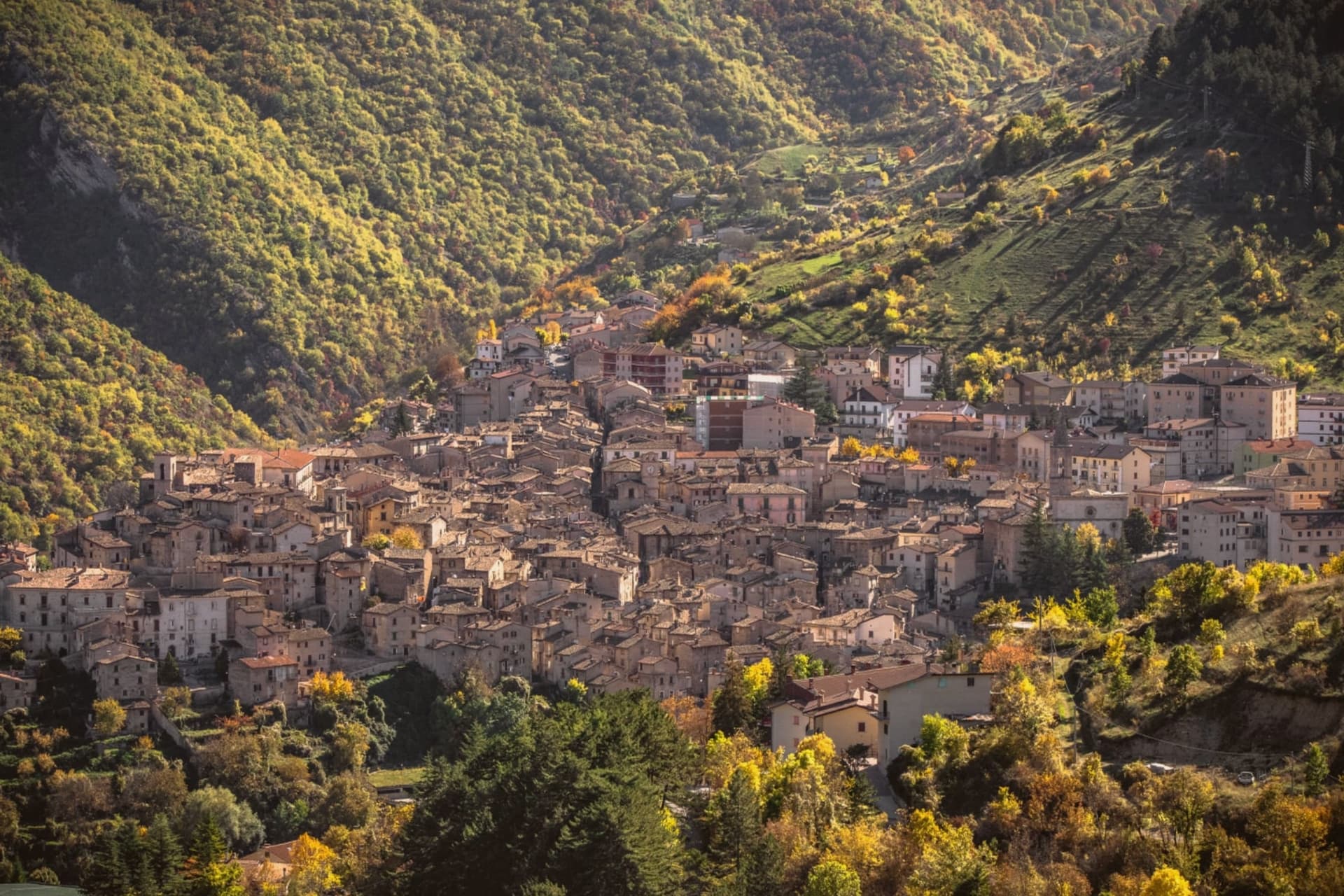
Scanno sits in the Sagittario valley, ringed by the Majella foothills and the Marsicano massif. The lake lies three kilometers down the valley from the town, at a lower elevation, so the walk between them moves from stone alleys to open water framed by the same slopes that produced it: a landslide off the mountain dammed the Tasso river and left the basin behind.
The town's isolation, closed in by the surrounding massifs, is what let the older costume and its headdress survive into the era of the camera, and it is what drew photographers to record it rather than something they invented. The goldsmiths' filigree, made in the same stone streets the women walked, belongs to the same thread: a village shaped by its enclosure in the mountains, still making by hand what it has always made.
The village sits at 1057 metres.
What to see in Scanno
- Lago di Scanno. Seen from above, the water reads as a clean heart shape against the valley walls.
- Centro storico. Stone-alley medieval centre where the black costume, with its folded headdress some historians trace to Balkan or Eastern origins, is still worn by older women against limewashed walls.
- Chiesa di Santa Maria della Valle. Parish church first documented in the eleventh century, rebuilt in the seventeenth, with a Renaissance portal and Baroque interior.
How to get to Scanno
Pescara is roughly 80 minutes away by road.
Our tip
June through September is the summer window: trails open in the national park, the lake holds a Blue Flag for swimming, and the centro fills with photographers chasing the Giacomelli setups. December through March is the second season for snow, with skiing on Monte Rotondo and Passo Godi nearby. April, May, October and November are quiet, with many family-run hotels closed and the lake side restaurants shuttered.
More from Anywhere Italy
 The best high-altitude villages within 90 minutes of Pescara
- The prettiest villages inside a national park within 90 minutes of Pescara
 The prettiest small villages inside a national park in Abruzzo
- The 10 prettiest small villages in the province of L'Aquila
 The best small ski towns in the province of L'Aquila
- The 6 best small towns that eat well in the province of L'Aquila