
Basilicata · Potenza
Rotonda
The Pollino park's Lucanian gateway: a 3,171-resident borgo at 626m on the Basilicata/Calabria border, headquarters for the Parco Nazionale del Pollino, Italy's largest national park, with the Loricato pine forests immediately above town.
- Best time
- May–Sep
- By car
- 1 h 59 min from Salerno
- Population
- 3,171
Known for
POLLINO PARK GATEWAY
Italy's largest national park HQ in town. Loricato pine forests with 1,000-year-old specimens accessible from the centro by marked trail.
FAGIOLO POVERELLO + MELANZANA ROSSA DOP
Two Slow Food Presidia products from this microclimate, recognized with DOP and Presidium status. Sagre in August.
BORGO AUTENTICO
Italian small-village quality mark for community life and authenticity. The Lucanian gateway to the Pollino.
SANGINETO CASTLE + DE GREGORIO MADONNA
Medieval Sangineto family castle ruins and a Lucanian Mannerist altarpiece in the Chiesa Madre, a 16th-century parish church.
When to visit
Best · May–Sep
- J9°
- F11°
- M12°
- A15°
- M20°
- J25°
- J29°
- A28°
- S24°
- O20°
- N15°
- D11°
- Best
- Hot or crowded
- Quiet
- Mostly closed
Daytime averages, 2020–2024. Weather data by Open-Meteo.com.
Why come
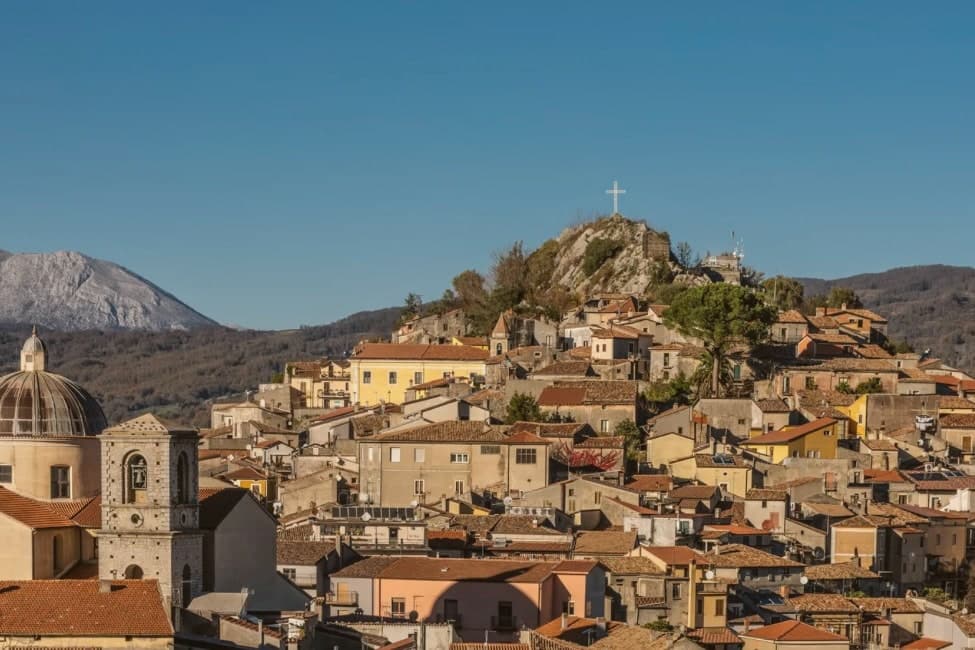
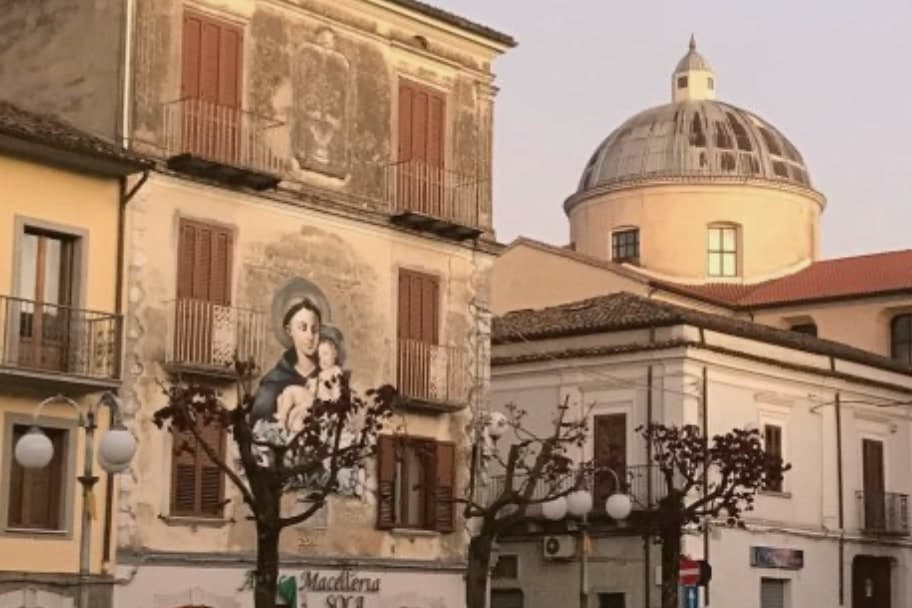
Rotonda sits at 626m in the Mercure river valley, on the Basilicata side of the border that the Parco Nazionale del Pollino, at 1,925 km2 and founded in 1993, draws across two regions. The centro is Lucanian in character: intact stone-paved vicoli, a quiet architectural register, and a hill silhouette closed by the medieval castle ruins above and the 16th-century parish church below, the two marking the old and the sacred ends of the settlement. Inside the church, later restorations have not displaced the Madonna painted by the Lucanian Mannerist Giovanni de Gregorio, and the castle ruins belonged to the Sangineto family. The park's administrative and visitor apparatus is folded into the town itself rather than kept apart from it: the executive headquarters, the visitor centre, and the main interpretive trail system all sit within walking distance of the church and the castle summit, with the pine-clad slopes rising directly behind the centro. The pines are Loricato, a high-altitude conifer surviving only here and in the Balkans, some specimens reckoned a thousand years old, and they give the park its symbol.
Two Slow Food Presidia are grown on the terraces that step down toward the river, a microclimate specific enough that neither product is found elsewhere: the Fagiolo Bianco Poverello, a white bean with a 14-day cooking-resistance and a buttery texture, and the Melanzana Rossa di Rotonda DOP, a small red eggplant resembling a tomato but closer to a fruit in its cooking properties, used locally in jams and sweet-and-sour preserves. Both have their own August sagre. Further out, the Loricato pine trails climb toward Monte Pollino at 2,248m and Serra del Prete at 2,181m, the Calabria-side Civita and Bovesìa Grecanic villages lie about 30 km south, and the Tirreno coast at Maratea and Praia a Mare is roughly 50 km west. The table draws on the same geography: pasta with peperoni cruschi, capocollo and salsiccia lucana, pecorino, the Aglianico del Vulture red from 100 km north, and the Cirò DOC from Calabria 60 km south.
Two DOP designations, the Borgo Autentico mark, and the national park's executive seat together make Rotonda one of the most signal-loaded small comuni in Basilicata: a town where the bureaucracy of Italy's largest national park and the agriculture of two Slow Food terraces occupy the same short stretch of streets.
The Sunday letter
Rotonda is on our list. Its letter is still to come.
We are writing about all 1,000 of these towns, one at a time, in a free letter every Sunday: the photo, the food, the festa. That is our mission. Sign up and you will be there when Rotonda comes up. By Peter & Sophia, from Pietrasanta.
Read on
Rotonda in our articles
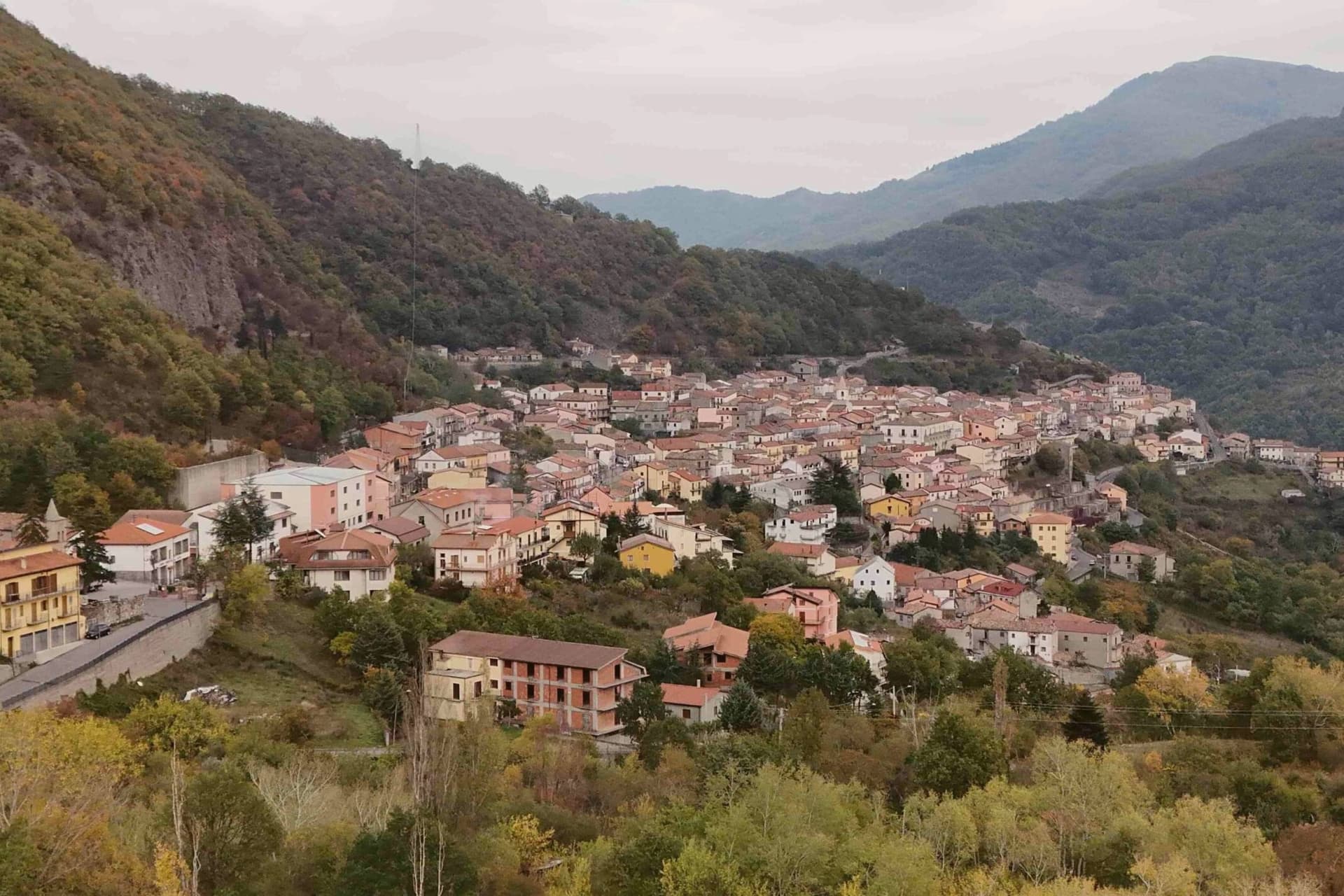
 The best mountain towns that eat well in the province of Potenza6 towns, Rotonda among them.
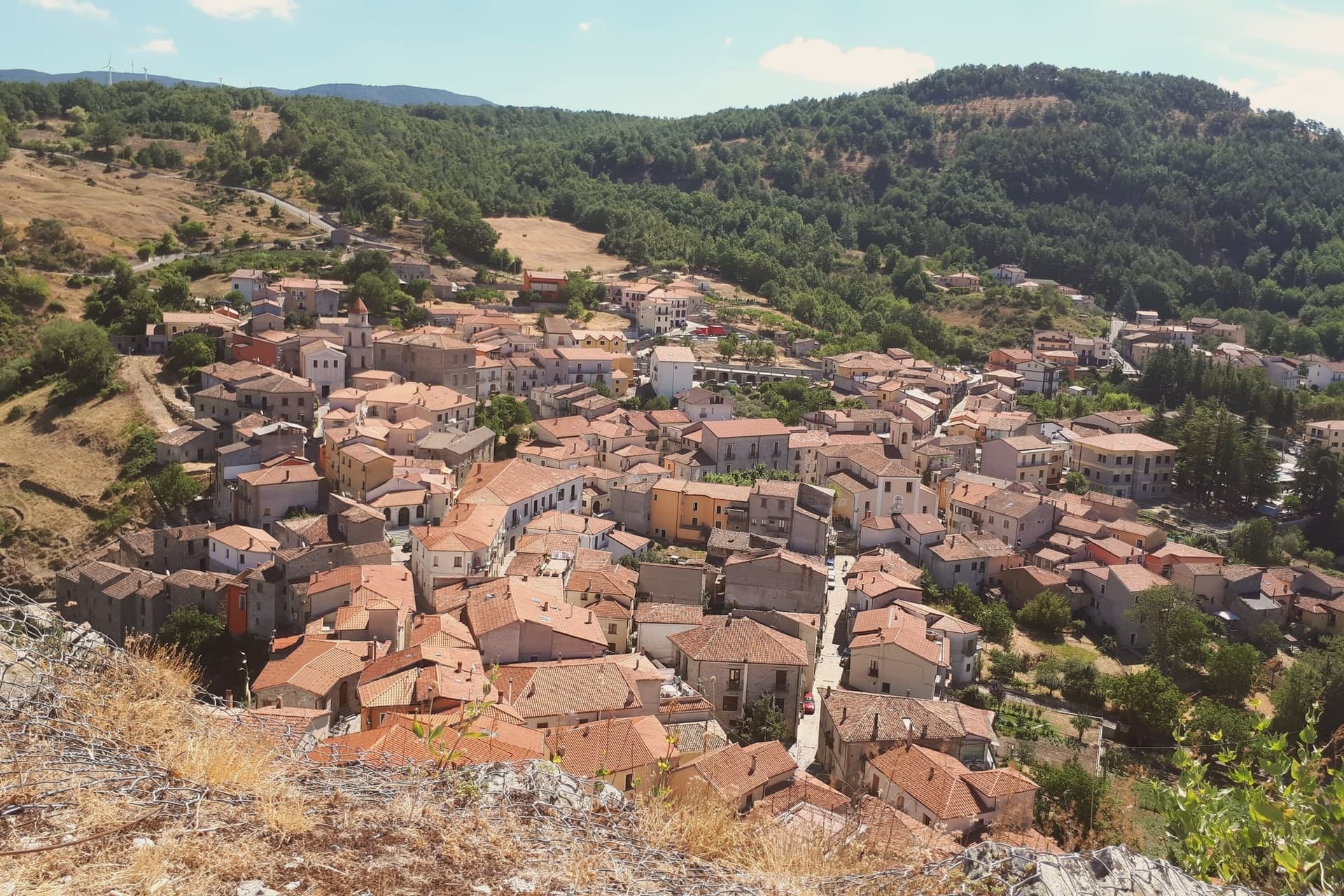
 The best towns with a serious restaurant in Basilicata6 towns, Rotonda among them.
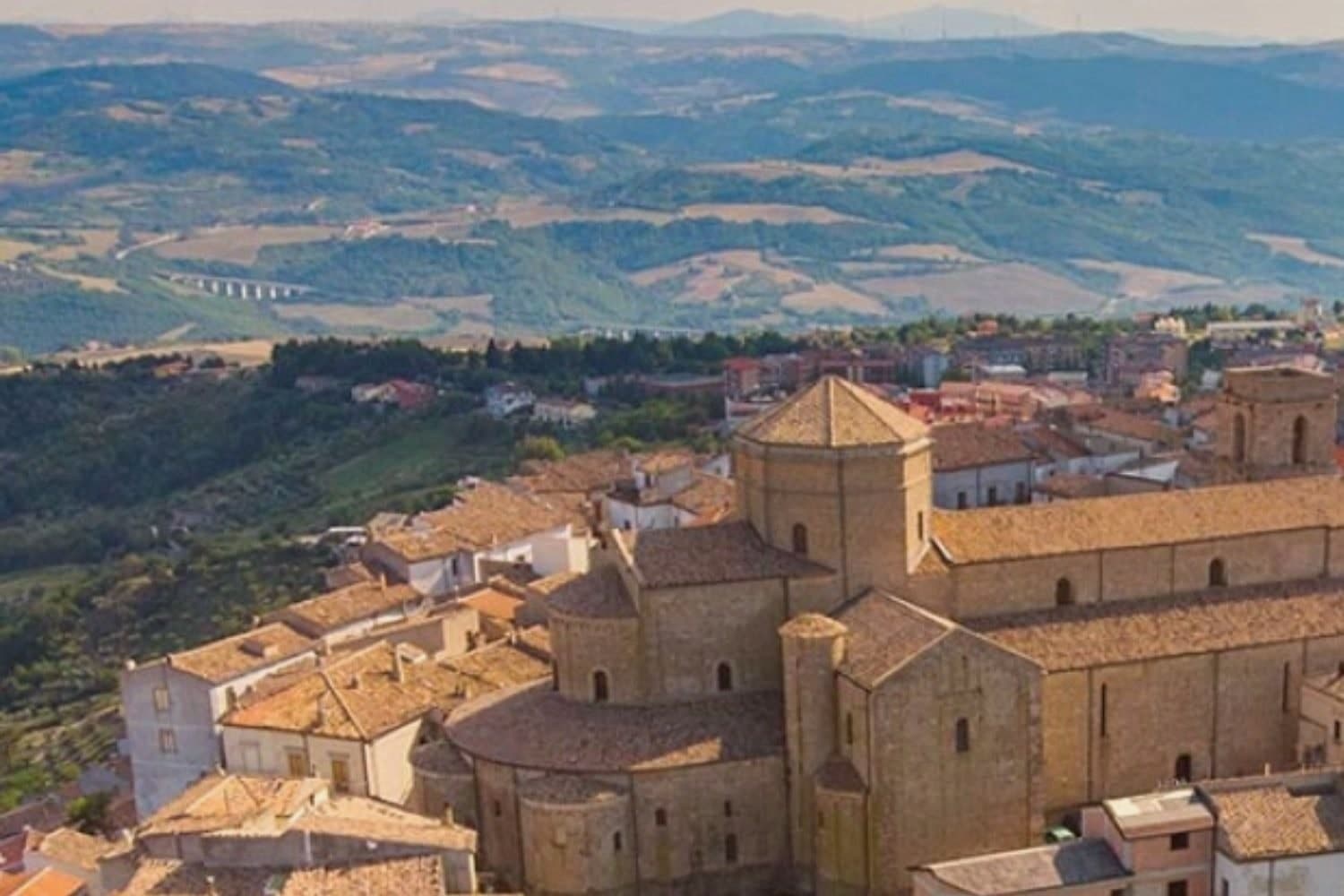
 The 8 best towns inside a national park in the province of Potenza8 towns, Rotonda among them.
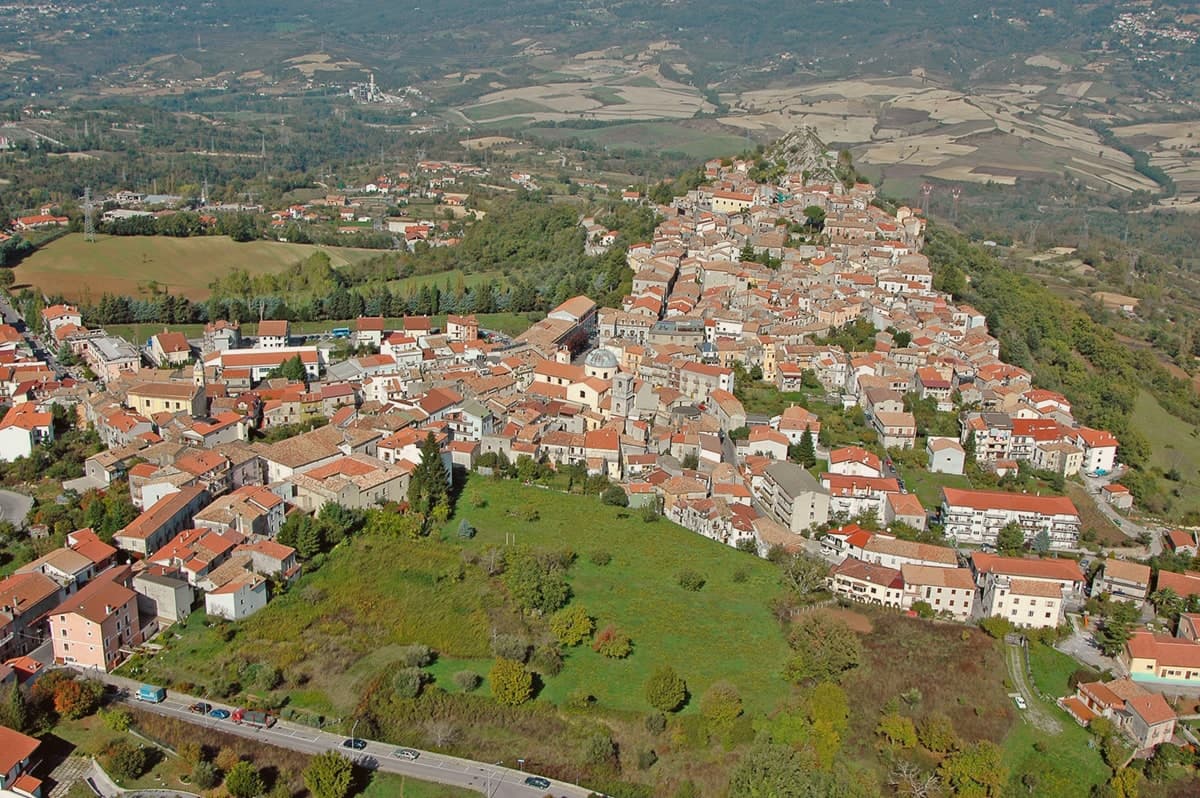
 The best towns that eat well in the province of Potenza9 towns, Rotonda among them.
How to get there
From Lamezia / Reggio (SUF), about 2h 19m by car.
Naples / Salerno (NAP) is about 2h 42m away.
By car from the centre of Salerno 2 hours, Naples 2h 42m or Bari 3h 31m.
What to see
Parco Nazionale del Pollino HQ
Executive headquarters, visitor centre, and main interpretive trail system, set at the edge of the centro with the pine-clad slopes rising directly behind it.
Fagiolo Bianco Poverello (Slow Food Presidium)
Delicate white bean grown on Mercure valley terraces. 14-day cooking-resistance and a buttery texture unlike ordinary dried beans. Sagra del Fagiolo in early August.
Melanzana Rossa di Rotonda DOP
Small red eggplant resembling a tomato, closer to a fruit in its cooking properties. Used in jams and sweet-and-sour preserves, grown only in this microclimate. Sagra della Melanzana Rossa in August.
Chiesa Madre + medieval castle ruins
The parish church holds its altarpiece inside stone walls that have taken later restorations without losing the original plan. Above it, the bare ruins of the castle occupy the summit, walls thinned to outline by time and weather.
Monte Pollino + Loricato pines
Trail network climbing from the village toward Monte Pollino (2,248m) and Serra del Prete (2,181m), passing through pine stands where the oldest trees stand gnarled and wind-bent, some reckoned a thousand years old.
The slow-trip planner
Building a trip? Find where Rotonda fits in a slow Italy circuit.
Answer five questions. We will shape a geographically coherent slow trip from the 1,000 Italian towns most travelers skip. Yours to save and share.
We recommend
Where to eat
Not our picks, but places the guides put their name to: a Michelin star, a Gambero Rosso fork, a Slow Food snail, a Michelin Key for the hotels. Worth a table, a counter, or a night when you pass through.
Da PeppeRistorante
A Slow Food snail for Da Peppe, and a spot in the Michelin Guide.
Living here
- Population 3,171
- Very remotei
- Pharmacy: none mapped
- High school within a 30-minute drive
- Nearest airport Lamezia / Reggio, 2 h 19 min drive
- Regional capital Potenza, 1 h 54 min drive
Common questions
- What is Rotonda known for?
- Rotonda is the Pollino park's Lucanian gateway: a 3,171-resident borgo at 626m on the Basilicata/Calabria border, headquarters for the Parco Nazionale del Pollino, Italy's largest national park, with the Loricato pine forests immediately above town.
- Where is Rotonda?
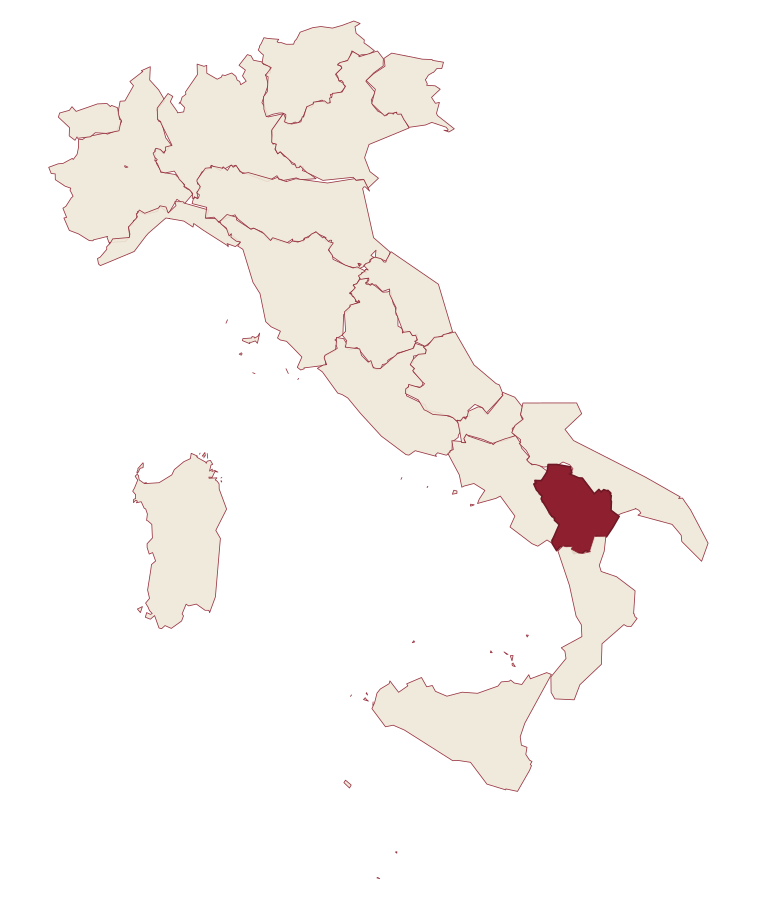
- Rotonda is a comune in the province of Potenza, in Basilicata.
- What is the nearest airport to Rotonda?
- Lamezia / Reggio (SUF), about 2h 19m by car.
- How long is the drive from Salerno to Rotonda?
- About 2 hours by car.
- When is the best time to visit Rotonda?
- Best in May–Sep. July is the warmest month, averaging 29 degrees, and November the wettest, with about 15 rain days.
- Which other towns are like Rotonda?
- Latronico, Orgosolo and Bagolino.
- How many people live in Rotonda?
- 3,171 at the 2023 count.
Tags & datadesignations · numbers · sources
Recognised as
The numbers
- Elevation: 626 m
- Population: 3,171
- Surface area: 42.92 km²
These figures were compiled from public directories: ISTAT, OpenStreetMap and Wikidata, and from the official listings of the guides named on this page. Town details change; verify with official sources before you travel.
Featured on
Rotonda appears on this themed pick from our Collections:
Similar
Towns like Rotonda
Latronico
Province: Potenza
both between 3,000 and 10,000 people · both high up, between 600 and 1,000 metres
Orgosolo
Province: Nuoro
both between 3,000 and 10,000 people · both high up, between 600 and 1,000 metres
Bagolino
Province: Brescia
both between 3,000 and 10,000 people · both high up, between 600 and 1,000 metres
Castel di Sangro
Province: L'Aquila
both between 3,000 and 10,000 people · both high up, between 600 and 1,000 metres
Saracena
Province: Cosenza
both between 3,000 and 10,000 people · both high up, between 600 and 1,000 metres
Morano Calabro
Province: Cosenza
both between 3,000 and 10,000 people · both high up, between 600 and 1,000 metres
💎 Borghi Autentici
More Borghi Autentici towns in Basilicata
Accettura
Province: Matera
A 770-meter village in the Gallipoli Cognato park where, each Pentecost, a Turkey oak is married to a holly tree.
Aliano
Province: Matera
The clay-hill village at 555 meters above the Agri valley where Carlo Levi served his 1935 exile and is buried in the cemetery.
Grottole
Province: Matera
A hilltop borgo at 481 meters between the Bradano and Basento, where six hundred empty houses outnumber residents in the centro storico.
San Mauro Forte
Province: Matera
A 540-meter Lucanian hill town built around a surviving Norman tower, where the Sagra dei Campanacci on 16 January wakes the village with cowbells.