
The best towns you can reach by train that eat well within 90 minutes of Roma
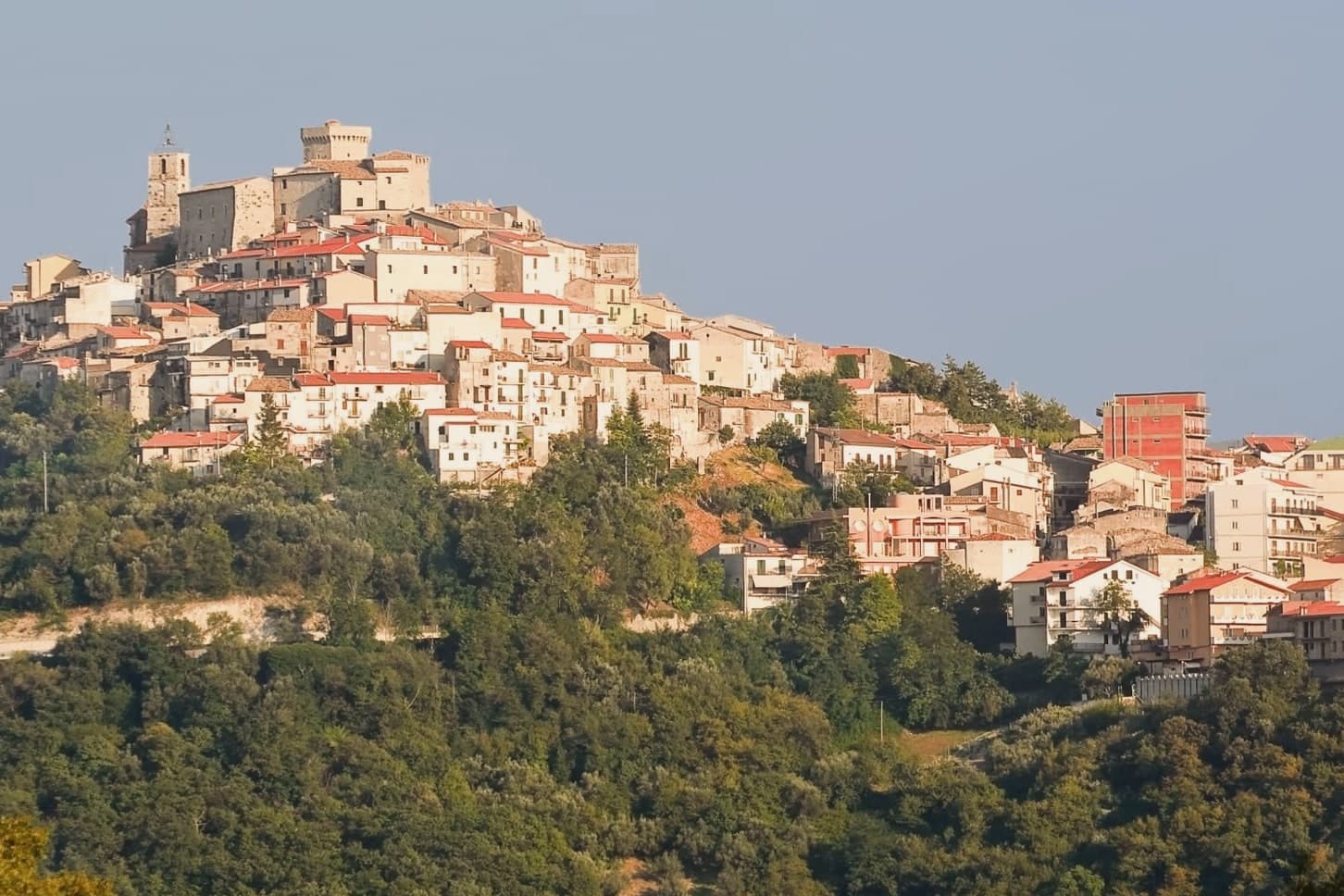
The regional trains out of Termini and Tiburtina run into a landscape that changes fast: volcanic lake craters ringed with vines south of the city, tufa gorges and Etruscan necropoli to the north, then the Apennines rising cold and grey to the east. The food follows the geology. Porchetta cut warm off the bone and eaten in paper, coregone and lake perch from the crater water, artichokes in spring, chestnuts and lamb and saffron once the weather turns. Houses are built from what was underfoot, dark grey peperino and honey-coloured tufa, and the trattorie tend to occupy their ground floors.
Most people eating outside Rome eat inside Rome, in Trastevere or around Campo de' Fiori, where the queue at the famous tables starts before the kitchen opens and the menu has been translated into four languages. It is a reasonable choice and the cooking can be very good. It is also the most crowded dining in Italy, priced accordingly, and it means the whole of Lazio gets compressed into a few streets on the wrong side of the river.
The same cooks, the same producers and the same suppliers work up and down the regional lines, an hour or less from the station where you started. These are the towns on those lines where a dining guide has named a table, and where we have confirmed you can arrive, eat properly and get back without hiring anything. Some sit on lakes, some on cliffs above ravines, one is a mountain city with its own saffron. Fewer people make the trip than the timetable would suggest.
Of the 31 communes we have mapped within 90 minutes of Roma, 11 qualify as towns you can reach by train that eat well: we have confirmed each is reachable without a car, and a dining guide has named a table in each. This list is 10 of them. The smallest, Carsoli, has 5,007 residents.
If you are still choosing, we have also written The best towns with a serious restaurant that eat well within 90 minutes of Roma and The best towns you can reach by train in the province of Roma.
Carsoli
Why visit Carsoli
Carsoli sits at 616 meters in the Marsica, between the plain of the former Fucino lake and the valley of the Turano river, with Monte Velino and Monte Calvo both rising above 2,000 meters on its skyline. The modern town stands four kilometres northeast of Alba Fucens's neighbor Carsioli, the Roman colony founded between 302 and 298 BC as a stronghold to guard the road to Alba Fucens; walls and an aqueduct still stand at the locality of Muro Pertuso, surveyed in 1901 by the archaeologists Pfeiffer and Ashby.
The town's religious and military history sits closer to the modern centre than the Roman ruins do. The Castle of Colle Sant'Angelo, raised around the year 1000 by the Counts of the Marsi, stood until later wars, and ruins of its adjoining church remain near the site.
Carsoli's autumn season runs on chestnut and polenta fairs with deep peasant roots, and the patron-saint feast of Santa Vittoria fills the streets with procession and stalls. The town's layout traces its own history: a Roman garrison post relocated over centuries into a medieval and then modern settlement, so that walking from the modern centre outward means walking backward through the different periods that built it.
L'Angolo d'Abruzzo, V'Incanto Osteria Moderna have been named by a guide.
What to see in Carsoli
- Sito archeologico di Carsioli. The city walls and aqueduct still stand at the site, four km from the modern town, surveyed by archaeologists in 1901.
- Chiesa di Santa Maria in Cellis. The church stands on the edge of town, with a rose window set over the main portal.
- Chiesa di Sant'Antonio. 16th-century church inside the centro storico, used as a hospital and later as a nursery, with a frescoed altar inside.
How to get to Carsoli
There is a railway station in the town, so you can arrive without a car and never need one while you are here. Roma is roughly 60 minutes away by road.
Our tip
May through October is the strong window for Carsoli. Spring brings clear views toward Monte Velino and the high Marsica meadows in flower. June and September are the most comfortable months at 616 meters, with cool nights and dry days.
Subiaco
Why visit Subiaco
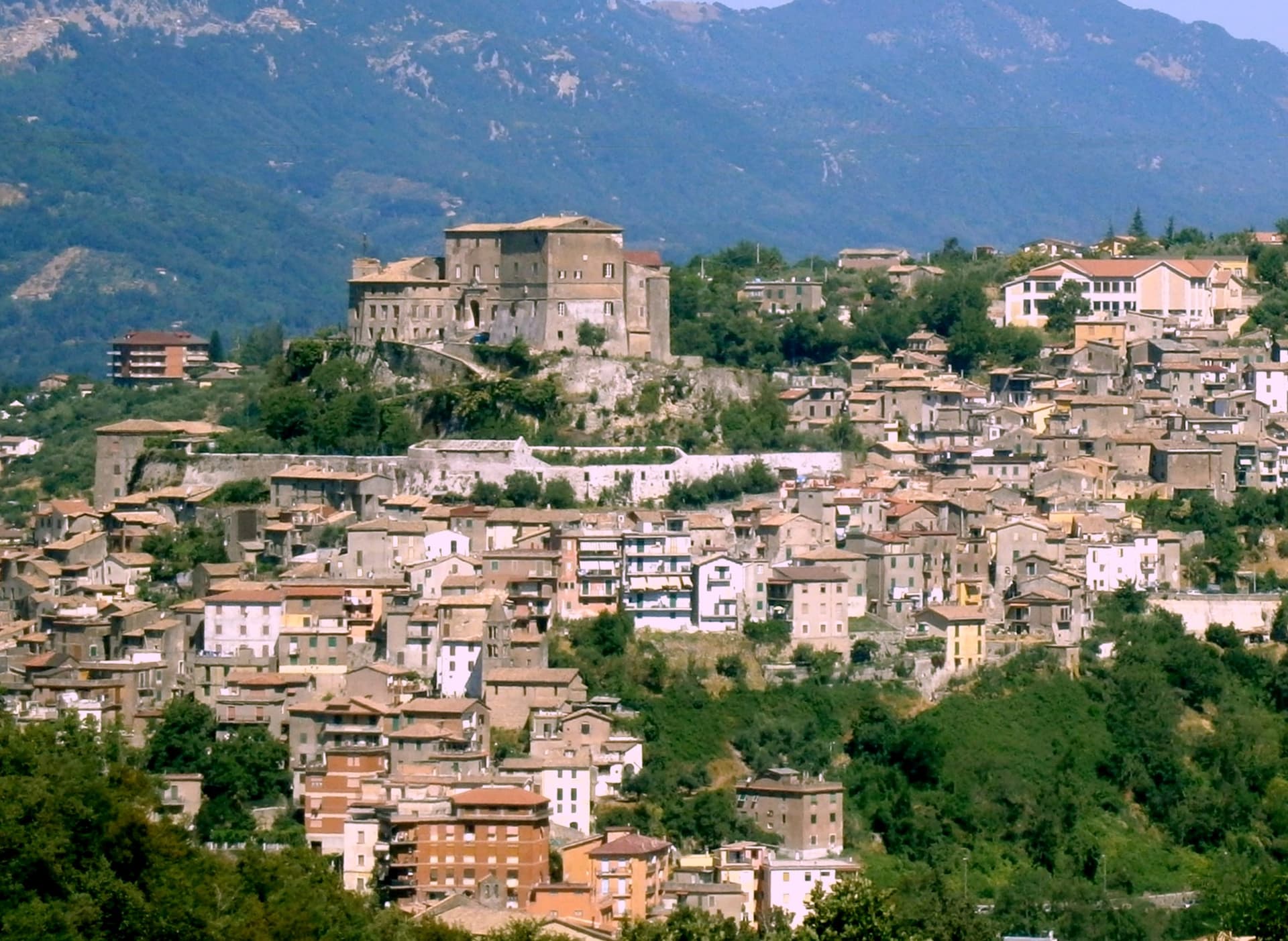
Subiaco sits at 408 meters along the upper Aniene, seventy-three kilometers east of Rome and forty from Tivoli. Nero built a villa here in the first century, damming the river into artificial lakes known as Sublaqueum, below the lake, and the name outlasted the villa and the emperor both.
The town that grew up here reads in layers going up the valley side: the river and the bridge at the bottom, the abbey partway up the hill, the fortress at the summit, and the cliff sanctuary further out along the cliff face that gave the hermit's cave its shelter, each one built at a different remove from the water and from the town center. What holds these layers together is a single life.
A man who came here as a young man to live alone in a cave gave his name to a monastery down the hill, and centuries later that same monastery's press put the first printed book on Italian soil into circulation. The fortress above answers to a different history, the abbots who ruled here as feudal lords, one of whom fathered a child who became one of the most written-about women of her age.
A river valley that supplied an emperor's pleasure lakes became, without much overlap, the ground where monastic life took its early shape.
Contrada Rapello have been named by a guide.
What to see in Subiaco
- Monastero del Sacro Speco. Built into the cliff face of Monte Taleo, the sanctuary rises in tiers over the cave itself, and the frescoes by Conxolus and the school of Cimabue cover walls that follow the rock rather than a flat plan.
- Abbazia di Santa Scolastica. The only one of Benedict's twelve original monasteries still standing, sixth century in origin; its library holds three hundred manuscripts, including a copy of the Lactantius run off the abbey's own press.
- Rocca Abbaziale (Rocca dei Borgia). Set on the highest ground of the borgo, the fortress was raised by abbot Giovanni V in the twelfth century and later gave Lucrezia Borgia, daughter of the abbot Rodrigo Borgia, a birthplace in 1480.
How to get to Subiaco
There is a railway station in the town, so you can arrive without a car and never need one while you are here. Roma is roughly 70 minutes away by road.
Our tip
April through June and September through October are the months for Subiaco: the Aniene runs full, the cliff sanctuaries are open from morning, and the pilgrim road south fills with walkers on the Cammino di San Benedetto. July and August are warm in town and cool in the monasteries; the cave at the Sacro Speco holds twelve degrees year-round. November through March is the quiet pilgrim season, mist on the river and few coaches in the lots. Festa Madonna di Pompei Rione Colle falls in August.
Castel Gandolfo
Why visit Castel Gandolfo
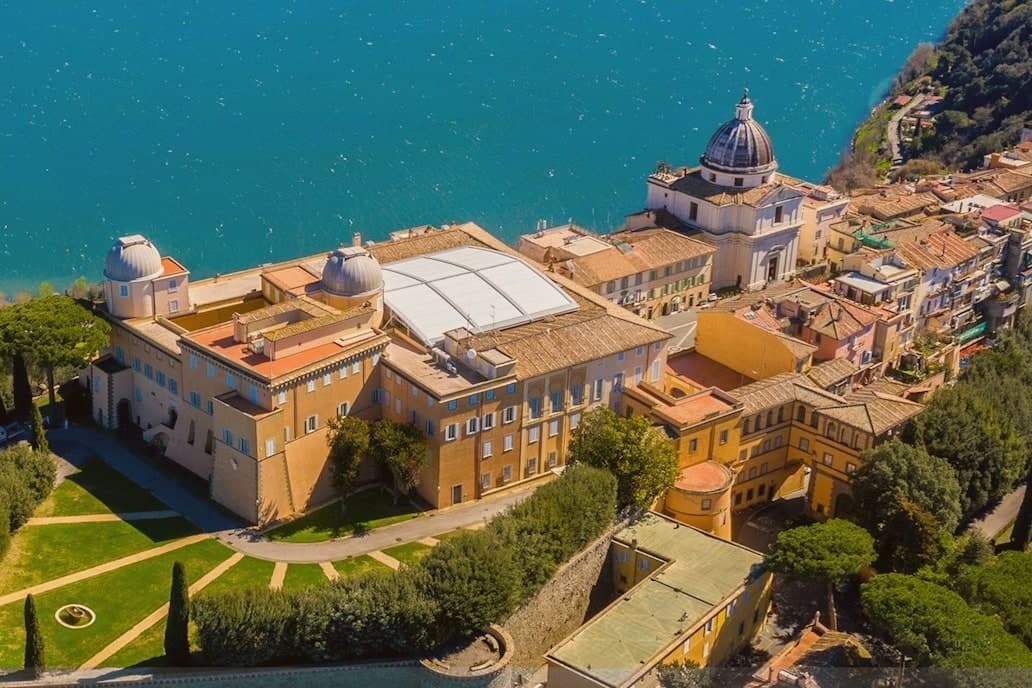
The town sits at 426 meters on the rim of the Lake Albano crater, twenty-five kilometers southeast of Rome among the Castelli Romani. It stands on the site of Alba Longa, the city Aeneas's son Ascanius is said to have founded.
The lake below was formed by the fusion of two volcanic craters and reaches 170 meters deep. The Villa Barberini stands adjacent to the palace, acquired by Taddeo Barberini in 1631, its gardens running down toward the water.
Pope Francis kept the palace as a museum after 2016; Leo XIV restored it to residential use in June 2025 and resides in the Villa Barberini next door, while the Borgo Laudato Si', created by Francis in 2023, carries ecological education across 55 hectares of the same estate. A town built on legend, given over for a time to public viewing, and returned to private residence: three uses of the same ground, laid one on top of the other without erasing what came before.
Tinello Bistrot, Antico Ristorante Pagnanelli have been named by a guide.
What to see in Castel Gandolfo
- Palazzo Apostolico. The palace Carlo Maderno raised between 1623 and 1626 stood open as a museum from 2016, its rooms given over to display cases and visitors. In June 2025 it returned to residential use, the museum arrangement dismantled to make way for a household again.
- Ville Pontificie e Giardini Barberini. Fifty-five hectares of papal villas and gardens running down to Lake Albano, with the seventeenth-century Villa Barberini at their center.
- Lago Albano. The crater lake sits at 293 meters above sea level and covers five square kilometers, its rim shared between this town and Albano Laziale.
How to get to Castel Gandolfo
There is a railway station in the town, so you can arrive without a car and never need one while you are here. Roma is roughly 35 minutes away by road.
Our tip
April through October is the open season for Castel Gandolfo, with the gardens open and the lake at swimming temperature from June. June and September are the calmer months and the historic papal-residence weeks. July and August fill with Roman day-trippers and Vatican tourists; the lake shore is busy.
Ronciglione
Why visit Ronciglione
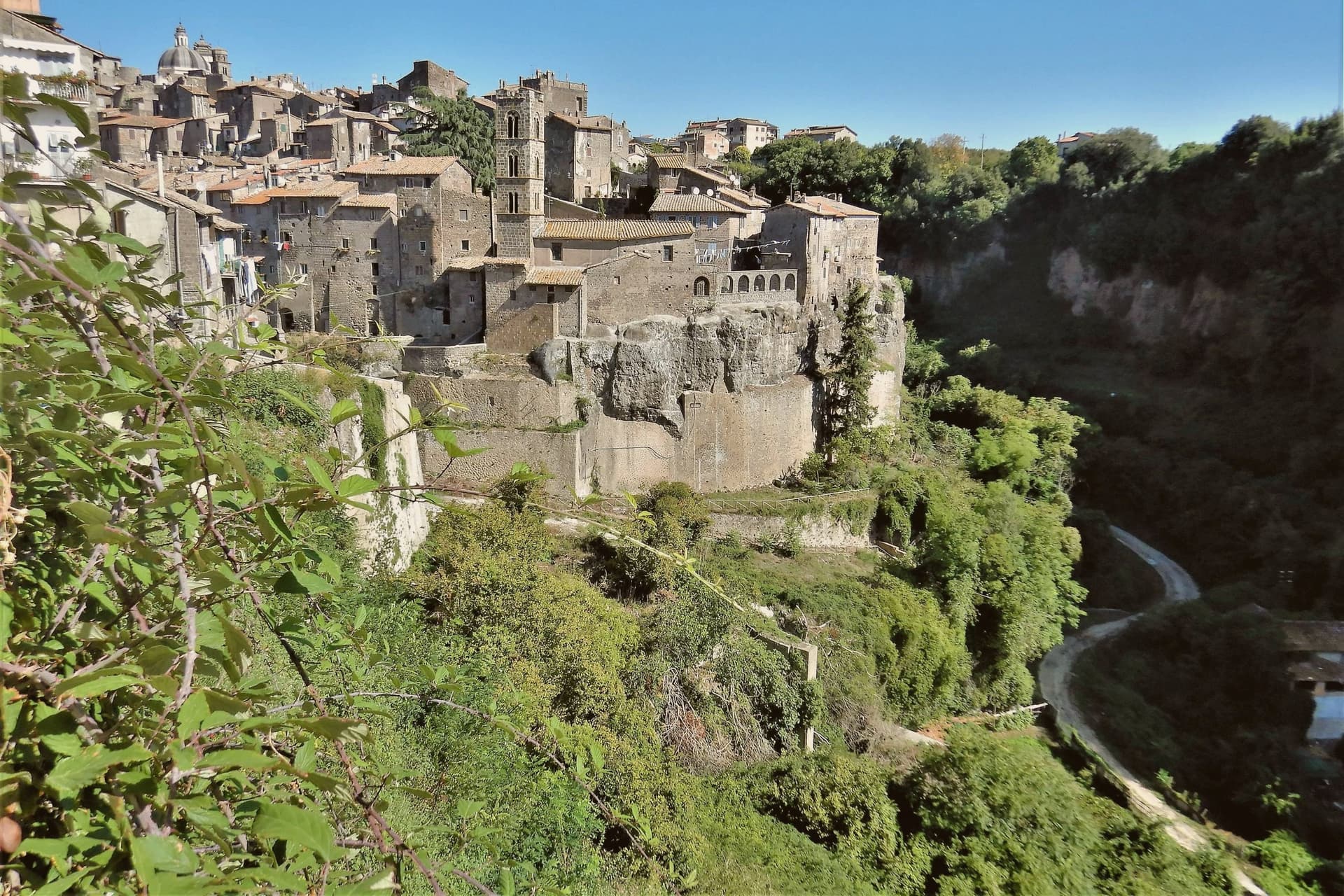
The town stands on a tufa spur at 441 meters, five kilometers from the lake, with the Cimini hills and their hazelnut groves closing in around it on every side. The first record of it dates to 1103.
The Prefetti di Vico held it before the Farnese took it as a Duchy, and the sixteenth-century pontiff who granted the town its Carnival did so during that same passage of rule from prefects to dukes. The fortress's towers control the single natural approach to the historic center, so the medieval town and its defenses are really one structure: whoever held the towers held the road in.
Everything built afterward, the cathedral, the contrade, the Carnival itself, sits inside that same defended perimeter. What the RAI title recognized in 2023 was less a single monument than that whole arrangement still intact: a fortified approach, a walled center, and a lake and hills that have not changed shape around it.
Riva Felice have been named by a guide.
What to see in Ronciglione
- Rocca dei Borgia (I Torrioni). Medieval fortress of the Prefects of Vico, twin round towers guarding the only natural approach to the centro storico.
- Duomo dei Santi Pietro e Caterina. Baroque cathedral of 1671, polychrome marble altar, fifteenth-century triptych by a Viterbo painter, wooden statue of San Bartolomeo.
- Lago di Vico. Volcanic lake ringed by the Cimini hills, its waters filling the crater below the level of the town on its spur.
How to get to Ronciglione
There is a railway station in the town, so you can arrive without a car and never need one while you are here. Roma is roughly 64 minutes away by road.
✷ We have written about Ronciglione
“Suddenly, we weren't running around. Ronciglione has nothing, and I mean zero things to show you. It's a pretty generic medieval town near Rome. It doesn't have a big piazza. There is a gate, a duomo, 2-3 main streets, and pretty much that's it. Yet, it was the center of our attention at that time. After spending just a few days there, we went back to Rome without wrinkles, with an oddly weird smile on our faces.”
Read our piece on Ronciglione →Ronciglione | Baptism into the Other Italy
Our tip
April through June brings the Cimini hills into green, hazelnut groves in flower and Lake Vico cool enough for the morning. September and October are the harvest months, dry, mild, with the air clear enough to see Monte Cimino from the Rocca. July and August touch the upper thirties and fill the lake with Romans on weekends. Palio di Ronciglione falls in July.
Tarquinia
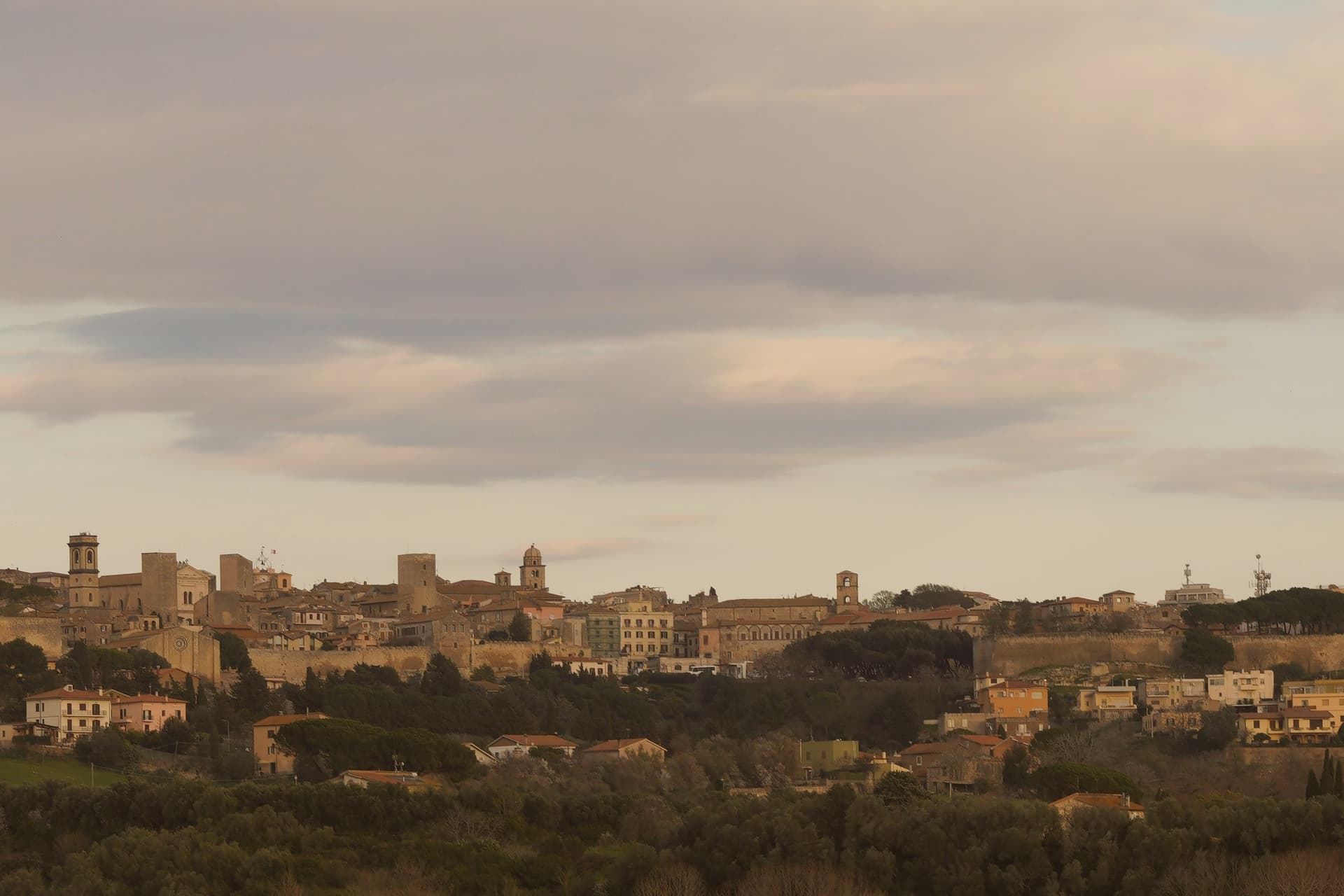
Why visit Tarquinia
Tarquinia sits on a plateau at 133 meters above the Maremma plain in northern Lazio, six kilometers inland from the Tyrrhenian coast. The Etruscan city of Tarquinii stood on the adjacent Colle della Civita and was one of the twelve great Etruscan capitals, ringed by eight kilometers of sixth-century walls enclosing 135 hectares.
What survives above ground is mostly medieval: the present town moved here in the Middle Ages and was renamed Corneto until 1922, when Mussolini's regime restored the ancient name. What survives below ground is what made the place a UNESCO site in 2004.
The Monterozzi necropolis on the hill east of town holds 6,000 rock-cut tombs from the seventh century BC onward, and around two hundred of them carry painted interiors. The frescoed banquets, dancers, hunters and musicians inside Tarquinia's tombs are the largest body of pre-Roman painting in the Mediterranean.
The Palazzo Vitelleschi in the upper town houses the national museum and the Winged Horses terracottas.
Namo Ristobottega have been named by a guide.
What to see in Tarquinia
- Necropoli dei Monterozzi. UNESCO Etruscan necropolis on the hill east of the medieval town, 6,000 rock-cut tombs with around 200 painted interiors from the 7th century BC onward.
- Museo Archeologico Nazionale Tarquiniense. Housed in the 15th-century Palazzo Vitelleschi, with Etruscan sarcophagi, painted slabs and the famous Cavalli Alati terracottas.
- Palazzo Vitelleschi. Early Renaissance palace built between 1436 and 1439 for Cardinal Vitelleschi, blending Gothic and Renaissance elements in a single façade.
How to get to Tarquinia
There is a railway station in the town, so you can arrive without a car and never need one while you are here. Roma is roughly 77 minutes away by road.
Our tip
April through June and September through October are the strongest months. The Maremma light is clean, the tomb interiors stay cool, and the wind off the Tyrrhenian keeps the plateau comfortable. July and August are workable but hot; the underground necropolis is the right place to be in the middle of the day, and Lido di Tarquinia six kilometers downhill takes the evening crowd.
Ariccia
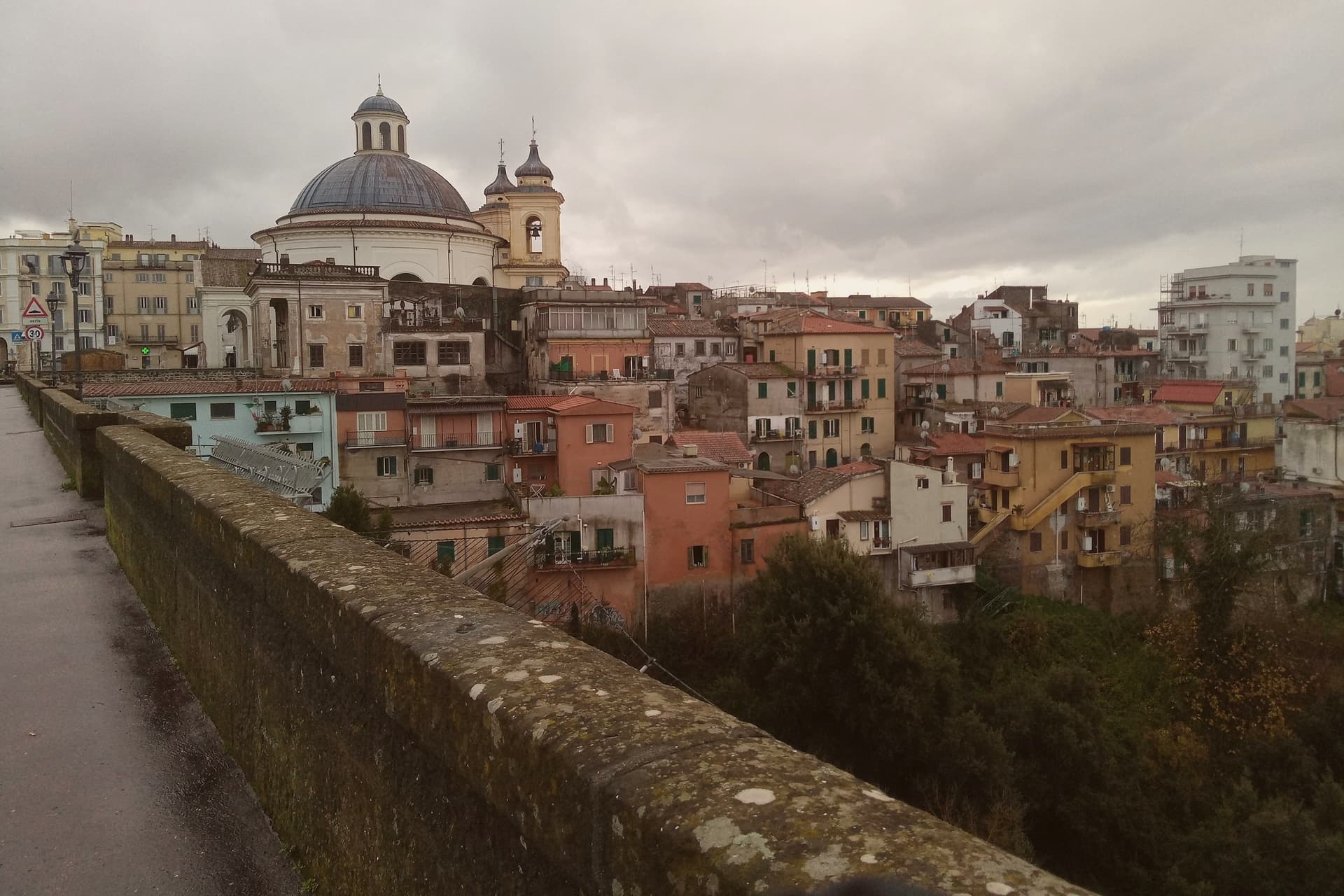
Why visit Ariccia
Ariccia sits on the rim of the Alban Hills volcanic complex, and the crater geography organizes everything about the place. The town centre occupies the ridge; below it on the eastern side the ground drops into the deep crater valley of Vallericcia, crossed by the viaduct linking the town to the next ridge.
The gorge itself became notorious after a series of suicides in the 1990s, now blocked with high railings. Further east and below, the volcanic lakes and the papal estate sit in a cluster within a few kilometres of the town centre, part of the same crater system that shaped Ariccia's position in the first place.
The Roman past predates the Baroque town by centuries: Aricia was the southern terminus of the original Via Appia, laid out in 312 BC, and the neighbouring lake was the site of the Latin League's federal sanctuary of Diana Aricina. The porchetta tradition is separate again: whole pork loin, deboned and seasoned with rosemary, garlic, pepper and wild fennel, slow-roasted on rotating spits in wood-fired ovens and served at room temperature in panini or by the etto.
The fraschette that serve it were originally outdoor wine vendors, marked with frasche, branches, as signs, and the town's status as a Città del Vino within the Frascati zone explains why the wine on the table is local rather than incidental. What makes Ariccia distinct among the Castelli towns is that these layers, Roman road terminus, crater rim settlement, unified Baroque set piece, and porchetta town, sit on top of each other in one small place rather than being scattered across the region.
Sintesi have been named by a guide.
What to see in Ariccia
- Palazzo Chigi + Piazza di Corte (Bernini). The Chigi family's Baroque summer residence. The palazzo, the piazza and the church facing it were designed as one ensemble. The palazzo is preserved as a 17th-c interior museum.
- Santa Maria dell'Assunzione (Bernini). Bernini's circular church, domed and modelled on the Pantheon: small, perfect, often empty.
- Ponte Monumentale. 1854 triple-tier brick viaduct spanning the 312m-deep Vallericcia crater. Walk across for the panoramic view; the gorge below is wooded and undeveloped.
How to get to Ariccia
There is a railway station in the town, so you can arrive without a car and never need one while you are here. Roma is roughly 41 minutes away by road.
Our tip
Ariccia is year-round — the Castelli Romani are Rome's cooler escape in summer (400m altitude buys 5-7 degrees off the city heat) and the porchetta is cold-served so it works in any weather. October–November is the Sagra dell'Uva and the Sagra della Porchetta (first weekend in September) — fraschette spill into the streets. Saturday lunch in any season is the locals' main event.
Bracciano
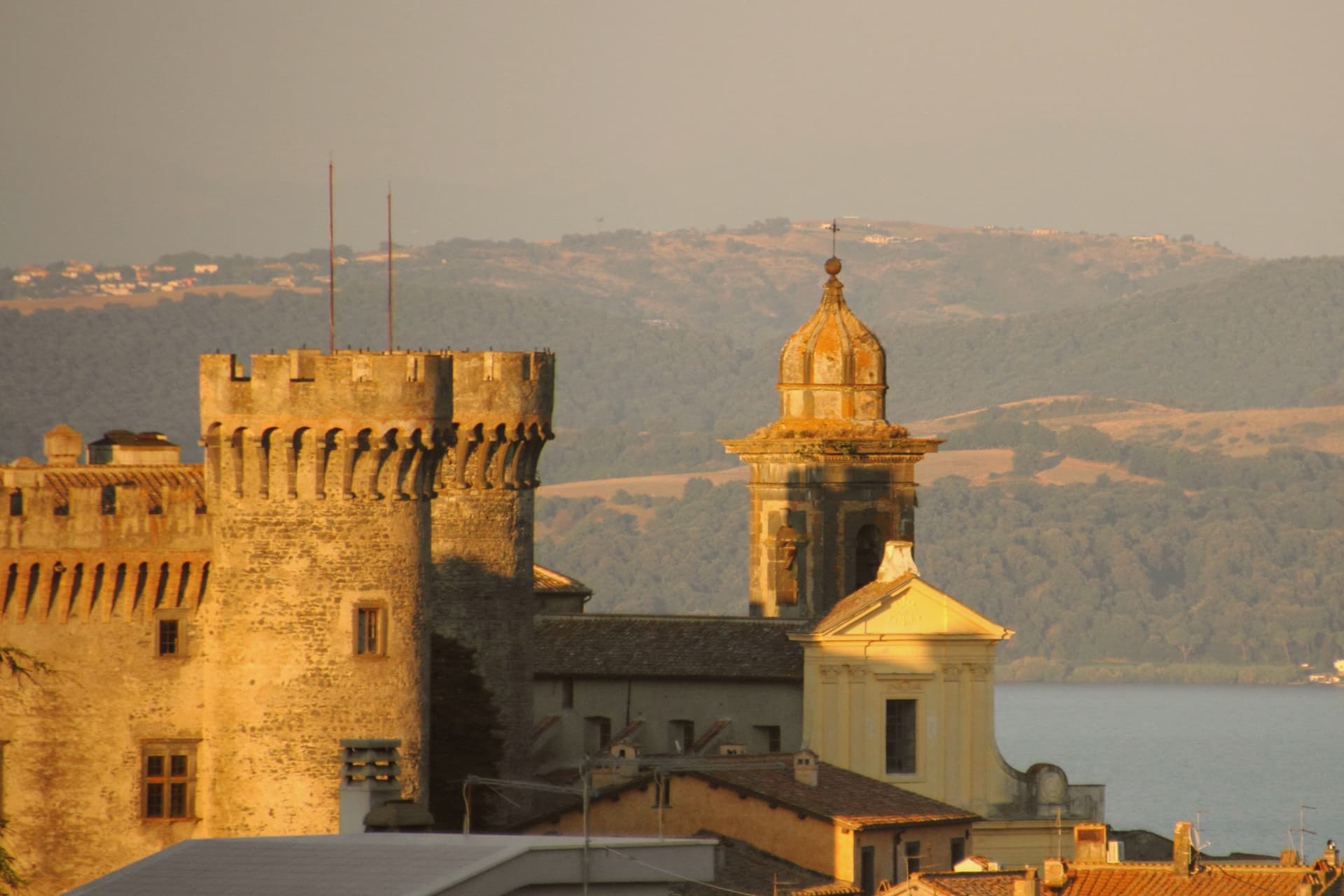
Why visit Bracciano
Bracciano stands at 280 meters above the southern shore of Lago di Bracciano, the volcanic crater lake known historically as Sabatino, the eighth largest in Italy. The Castello Orsini-Odescalchi was begun by Napoleone Orsini in 1470 and completed by his son Virginio Gentile in 1485; the architect was Francesco di Giorgio Martini.
It is one of the better-preserved examples of Renaissance military architecture in Italy, a five-towered pentagon on a polygonal base, with frescoes by Antoniazzo Romano and the Zuccari brothers. The Orsini lost it through debt in 1696 to Livio Odescalchi, nephew of Pope Innocent XI; the Odescalchi still own it.
Bracciano supplies a significant part of Rome's drinking water through the aqueduct that begins in the lake. The town is also a hazelnut commune, member of the Città della Nocciola network.
Tom Cruise married Katie Holmes in the castle in November 2006, which is how most people outside Italy heard of the place.
Cucina ai Monti, ErbacceLab, Percørsi al Vecchio Ponte have been named by a guide.
What to see in Bracciano
- Castello Orsini-Odescalchi. 1470-1485 Renaissance castle, five round towers on a pentagonal plan, frescoes by Antoniazzo Romano and the Zuccari brothers.
- Lago di Bracciano. Volcanic crater lake, eighth largest in Italy at 57 square kilometers, source of part of Rome's drinking water.
- Centro storico. Medieval town below the castle walls, organized in concentric rings around the rocca, with two surviving medieval gates.
How to get to Bracciano
There is a railway station in the town, so you can arrive without a car and never need one while you are here. Roma is roughly 58 minutes away by road.
Our tip
April through October is the lake season. May and June bring the warmest weather without the August crowd from Rome; the shore villages of Anguillara and Trevignano fill on weekends and empty mid-week. July and August are hot and busy.
Cerveteri
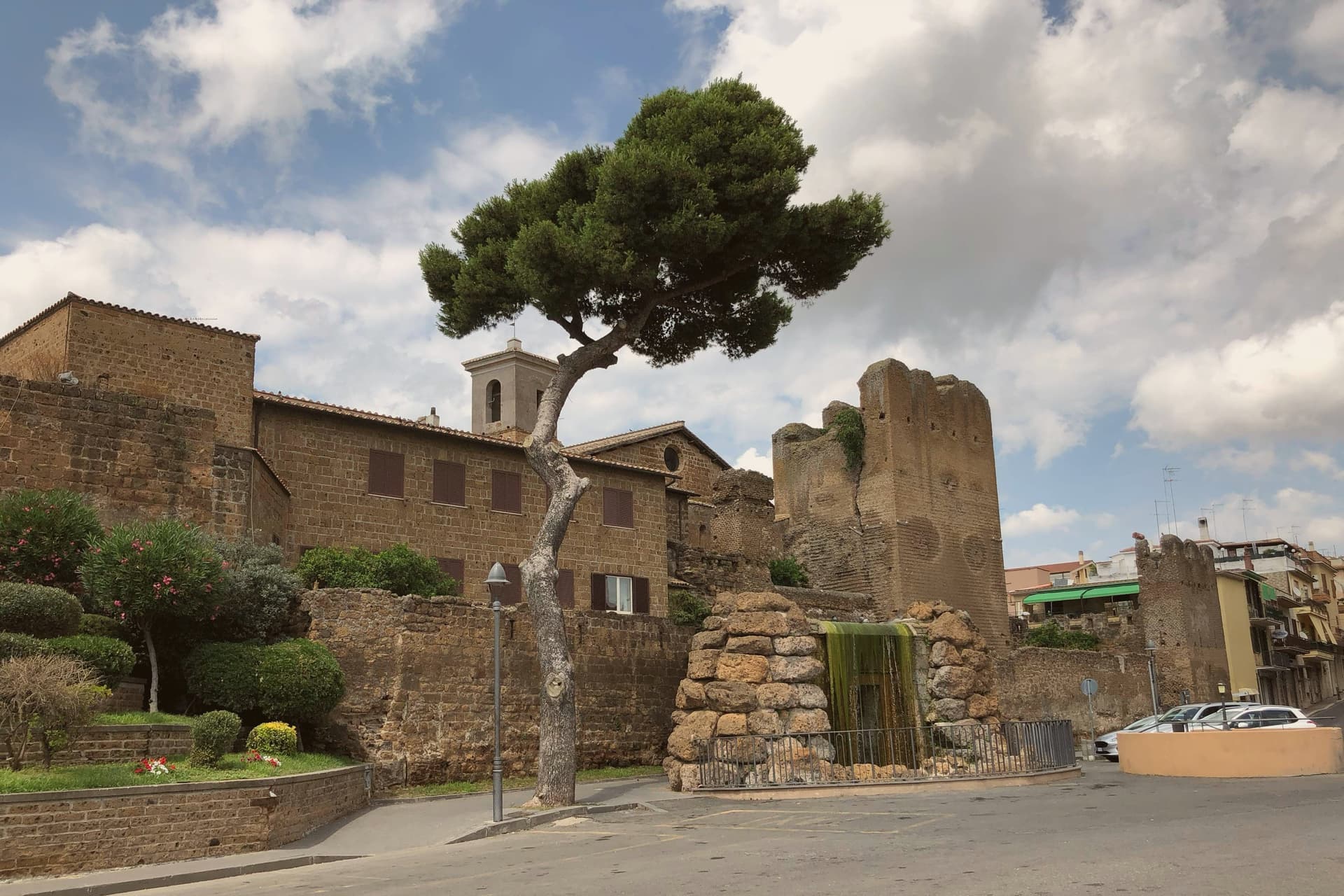
Why visit Cerveteri
Cerveteri sits on a tufa outcrop at 81 meters above the coastal plain, seven kilometers inland from the Tyrrhenian and thirty-five northwest of Rome. The Etruscans called it Caisra, the Greeks Agylla, the Romans Caere; at its height around 600 BC it covered fifteen times the area of the modern town and held an estimated 25,000 to 40,000 people, the equal of Tarquinia at the peak of Etruscan power.
The medieval town inherited the central plateau and was renamed Caere Vetus, the Old Caere, to distinguish it from the coastal Caere Novum that no longer exists. The Castello Ruspoli at the centre of the medieval town encloses sections of fourth-century BC Etruscan walls in its base.
Two kilometers north, the Banditaccia necropolis covers 400 hectares of which 10 are visitable, with around 1,000 rock-cut tombs and the great earth tumuli that gave Etruscan funerary architecture its most concentrated expression. It joined the UNESCO list with Tarquinia in 2004.
Arià Osteria di Fuori Porta have been named by a guide.
What to see in Cerveteri
- Necropoli della Banditaccia. UNESCO Etruscan necropolis 2 km north of town, covering 400 hectares with around 1,000 tombs and the great earth tumuli that defined Etruscan funerary architecture.
- Museo Nazionale Cerite. National Etruscan museum inside the Castello Ruspoli, with sarcophagi, ceramics and grave goods recovered from the Banditaccia tombs.
- Castello Ruspoli. Medieval Orsini-Ruspoli fortress at the centre of the old town, with fourth-century BC Etruscan walls preserved in its base.
How to get to Cerveteri
There is a railway station in the town, so you can arrive without a car and never need one while you are here. Roma is roughly 50 minutes away by road.
Our tip
May through September is the strongest window. The Banditaccia tumuli need open ground and clear weather; April and October are workable but rain blurs the rock-cut interiors. Summer crowds concentrate on the coastal section of the comune around Marina di Cerveteri and Cerenova, leaving the necropolis quieter than the dates would suggest. Festa della Birra falls in August.
Nettuno
Why visit Nettuno
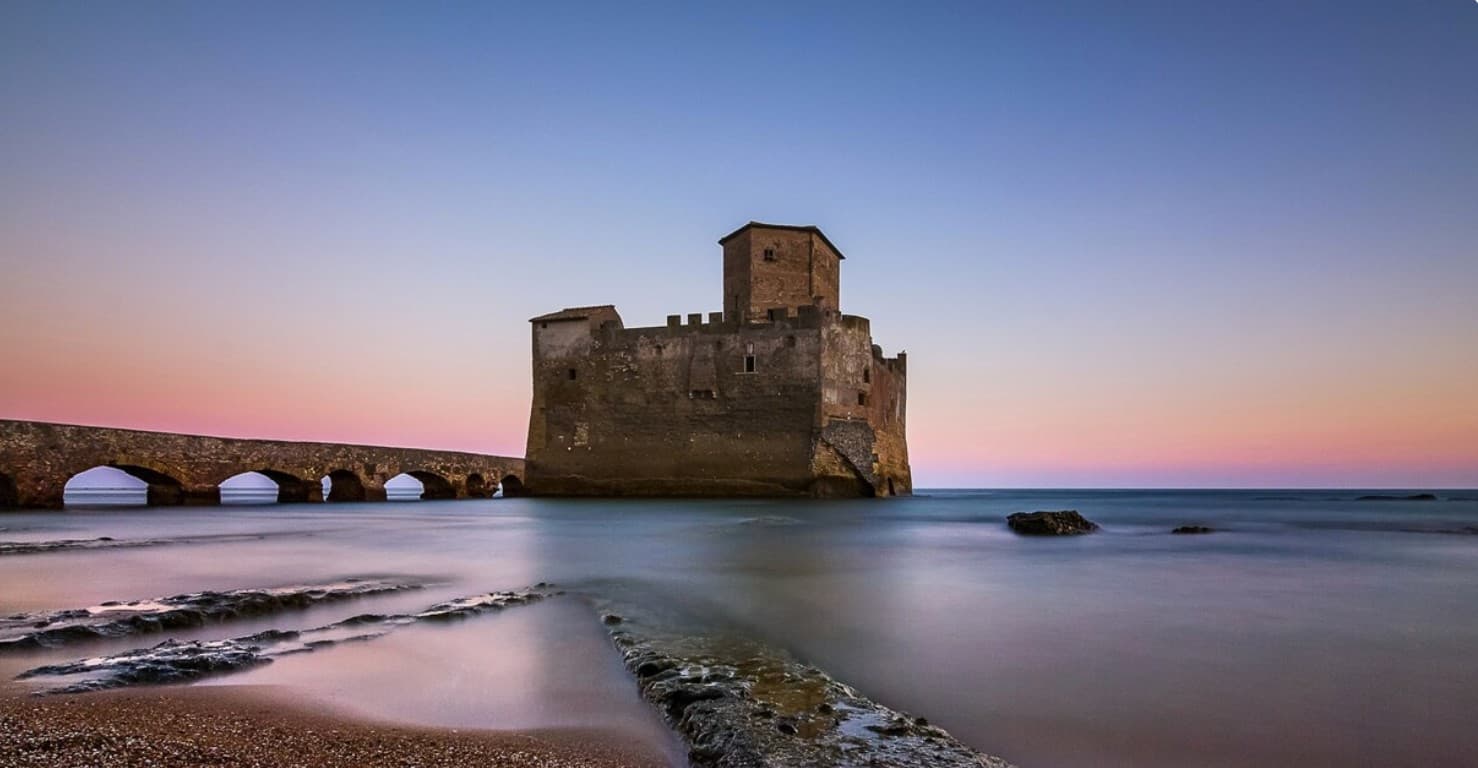
Nettuno is the half of the old Antium coast that kept its walls. The Borgo Medievale stands on a low spur above the beach, ringed by round towers from the 1300s, its lanes and small squares still lived in.
A short walk along the shore, Antonio da Sangallo the Elder built the Forte Sangallo for the Borgia between 1501 and 1503, when Nettuno was the fortified granary of the Lazio coast; it now holds the town's Antiquarium and the Museo dello Sbarco Alleato. That museum is here because of 22 January 1944, when Allied troops came ashore at Anzio and on the beaches running south from Nettuno to Torre Astura.
More than 7,800 American soldiers lie in the Sicily-Rome American Cemetery at the edge of town, and the baseball the troops taught afterwards stayed: the Steno Borghese is the largest baseball stadium in Italy. In summer the town fills from Rome for the beaches and the long evening walk on the lungomare, and the local white is Cacchione, from Bellone grapes.
La Taverna di Bacco have been named by a guide.
What to see in Nettuno
- Borgo Medievale. The walled old town on a spur above the beach, ringed by round towers from the 1300s, with the Palazzo Baronale and the church of San Giovanni among its lanes and small squares.
- Forte Sangallo. Square fortress with four corner bastions, built between 1501 and 1503 by Antonio da Sangallo the Elder to guard the coast. It houses the Antiquarium and the Museo dello Sbarco Alleato.
- Santuario di Nostra Signora delle Grazie e Santa Maria Goretti. Passionist sanctuary at the end of the lungomare, rebuilt in 1914. The crypt holds Maria Goretti, who died in Nettuno in 1902, and the church keeps the wooden Madonna delle Grazie.
How to get to Nettuno
There is a railway station in the town, so you can arrive without a car and never need one while you are here. Roma is roughly 76 minutes away by road.
Our tip
May through September is the season on this coast. June and September are the best months: the sea is warm and Rome's weekend crowds are thinner than in high summer. July and August are hot and full, with the lungomare busy until late.
Tivoli
Why visit Tivoli
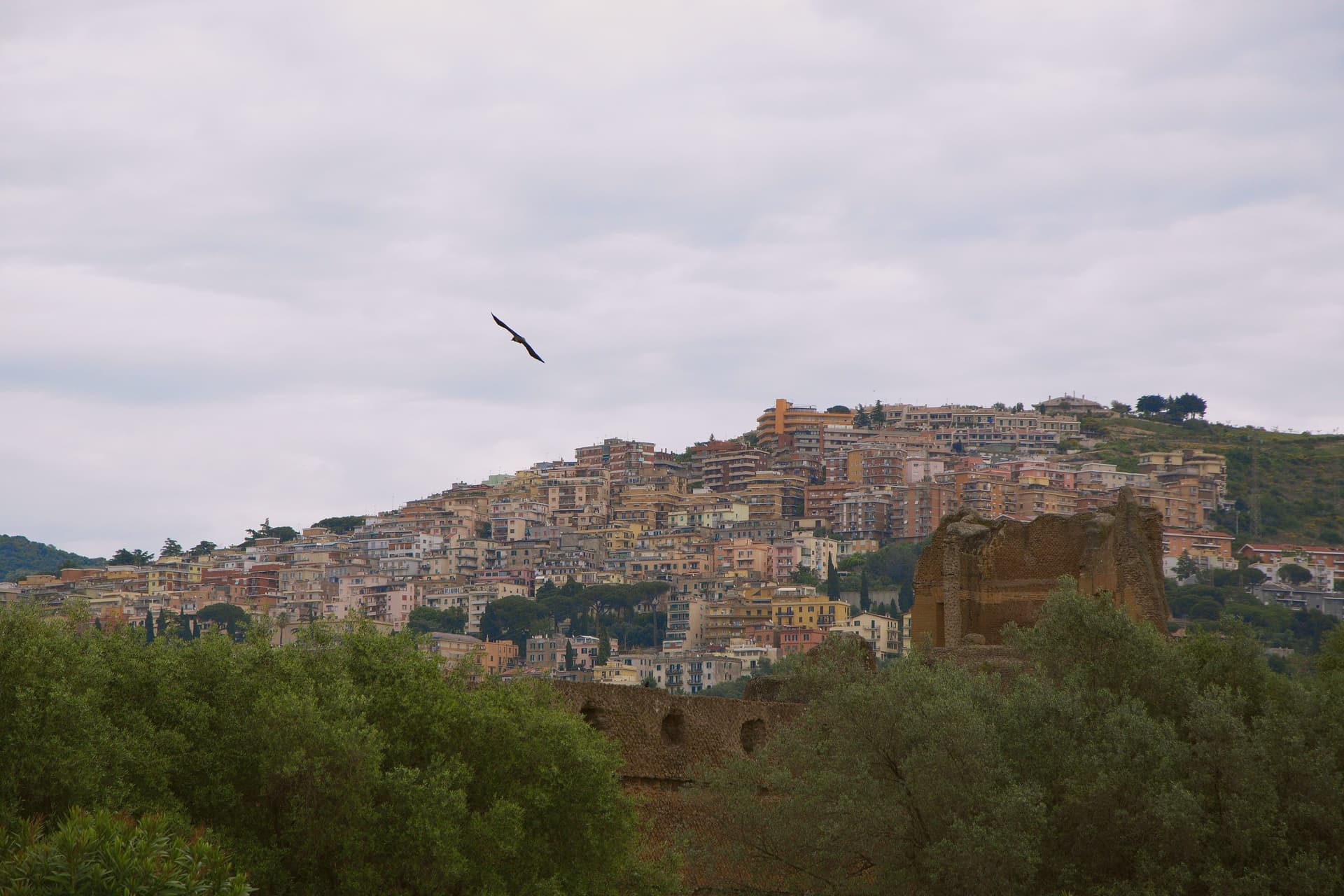
Tivoli sits at 235 meters on the Aniene where it drops 120 meters off the Tiburtini hills, twenty-five kilometers east of Rome. The Romans called it Tibur and built it up as their summer station; the moneyed classes carried on building here for two thousand years afterward.
Two of those projects became UNESCO sites, listed separately despite standing close together. Hadrian's estate, four kilometers below town, covers 120 hectares with the remains of thirty monumental buildings the emperor built between 117 and 138 AD to recreate the architectural memories of Egypt, Greece and Asia Minor.
The Renaissance garden inside the upper town was laid out from 1550 onward for a cardinal of the Este family; its grounds carry 51 fountains powered entirely by gravity from the Aniene. The cardinal stripped much of the marble from Hadrian's estate to decorate his own grounds, so the imperial villa on the plain and the garden in the upper town are bound together by more than proximity: one was quarried to build the other.
Below them both, the Villa Gregoriana park drops into the gorge where the river was diverted in 1832 to create the 120-meter Cascata Grande. The travertine quarries that built Rome are still working in the plain below.
The upper town, the lower estate, and the gorge between them form a single continuous cut through two thousand years of building, borrowing, and quarrying around the same fall of water.
Li Somari, NUH Osteria Contemporanea, Sibilla and 2 more have been named by a guide.
What to see in Tivoli
- Villa d'Este. The fountains step down the hillside in tiers, fed by nothing but gravity, so the sound of falling water carries through the whole garden. Cardinal Ippolito d'Este stripped much of the marble for it from Hadrian's villa down the hill.
- Villa Adriana. The remains of thirty monumental buildings spread across the Tiburtine plain, among them the Canopo and the Teatro Marittimo, a walled island retreat inside the larger estate.
- Villa Gregoriana. The park drops into the gorge cut by the Aniene, where the river was diverted through Monte Catillo to feed the fall below town.
How to get to Tivoli
There is a railway station in the town, so you can arrive without a car and never need one while you are here. Roma is roughly 31 minutes away by road.
Our tip
April through June and September through October are when the Aniene gardens look the way Cardinal Ippolito wanted them to. The Villa d'Este fountains run hardest in spring after the winter rains; the Villa Adriana hectares are walkable in shoulder weather without burning. July and August touch the upper thirties and the unshaded ruins at Villa Adriana become punishing by mid-morning; the gorge at Villa Gregoriana stays cooler. Festa dell'Inchinata falls in August.
More from Anywhere Italy
- The best towns with a serious restaurant that eat well within 90 minutes of Roma
- The best towns you can reach by train in the province of Roma
- The best towns that eat well within an hour of Rome
- The best towns you can reach by train within an hour of Rome
 The best hill towns that eat well within 90 minutes of Roma
 The best hill towns you can reach by train within 90 minutes of Roma