
The best wine towns within two hours of Bari
The land east and south of Bari is flat, then it lifts. Vines run in low rows over red earth between drystone walls, olives standing between them, and the light in late September falls hard on limestone and tufa walls the colour of pale bread. This is Primitivo country on the Salento side and Aglianico country up towards the volcanic soils of Vulture, where the grape ripens late and the harvest can run into November. Tables here serve orecchiette with turnip tops, lamb baked with potatoes, and burrata that arrived that morning, and the wine poured with it usually comes from a zone whose name is on the label and whose vines are visible from the edge of town.
Most people who come to Puglia for wine go to Valle d'Itria, and Alberobello anchors the whole itinerary. The trulli are extraordinary and the surrounding masserie have turned themselves into good hotels with good cellars, but the coach parks fill by mid-morning from Easter until October, and the tasting rooms nearest the famous streets price accordingly. Locorotondo and Martina Franca absorb the overflow. It is a real wine landscape, simply the one everybody has already booked.
The vineyards do not stop at the edge of that valley. They continue down the Ionian coast where Primitivo has its historic heartland, north across the Murge plateau towards the cathedral towns of the Adriatic, and inland into Basilicata where Aglianico grows on old volcanic slopes. The towns below sit inside the production zones of protected wines, and fewer people go to any of them.
Of the 45 communes we have mapped in a 120-minute drive of Bari, 9 qualify as wine towns: each sits inside the production zone of a protected wine. The smallest, Acerenza, has 2,090 residents.
If you are still choosing, we have also written The best hill towns you can reach by train within 90 minutes of Foggia and The best towns you can reach by train that eat well within 90 minutes of Foggia.
Acerenza
Why visit Acerenza
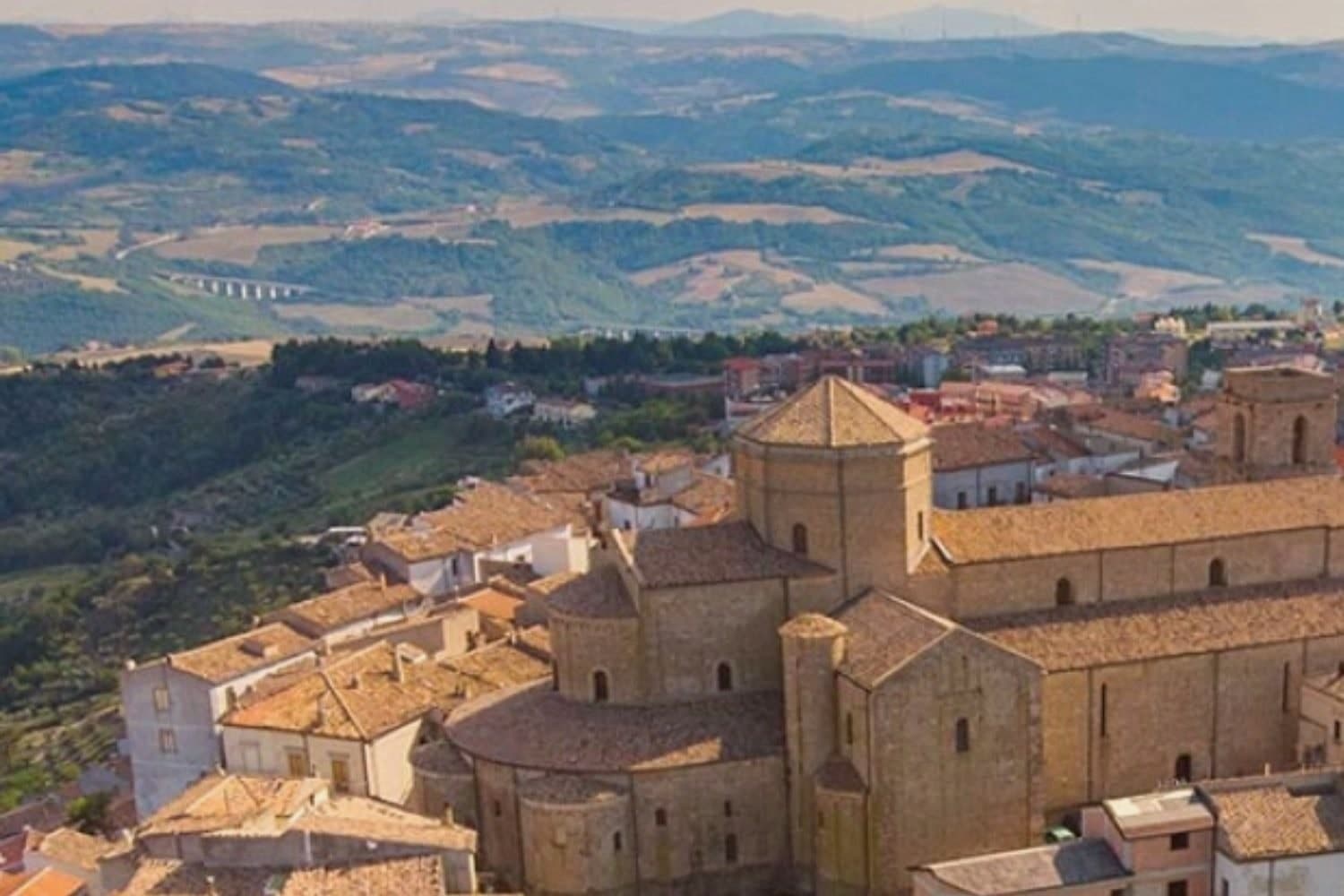
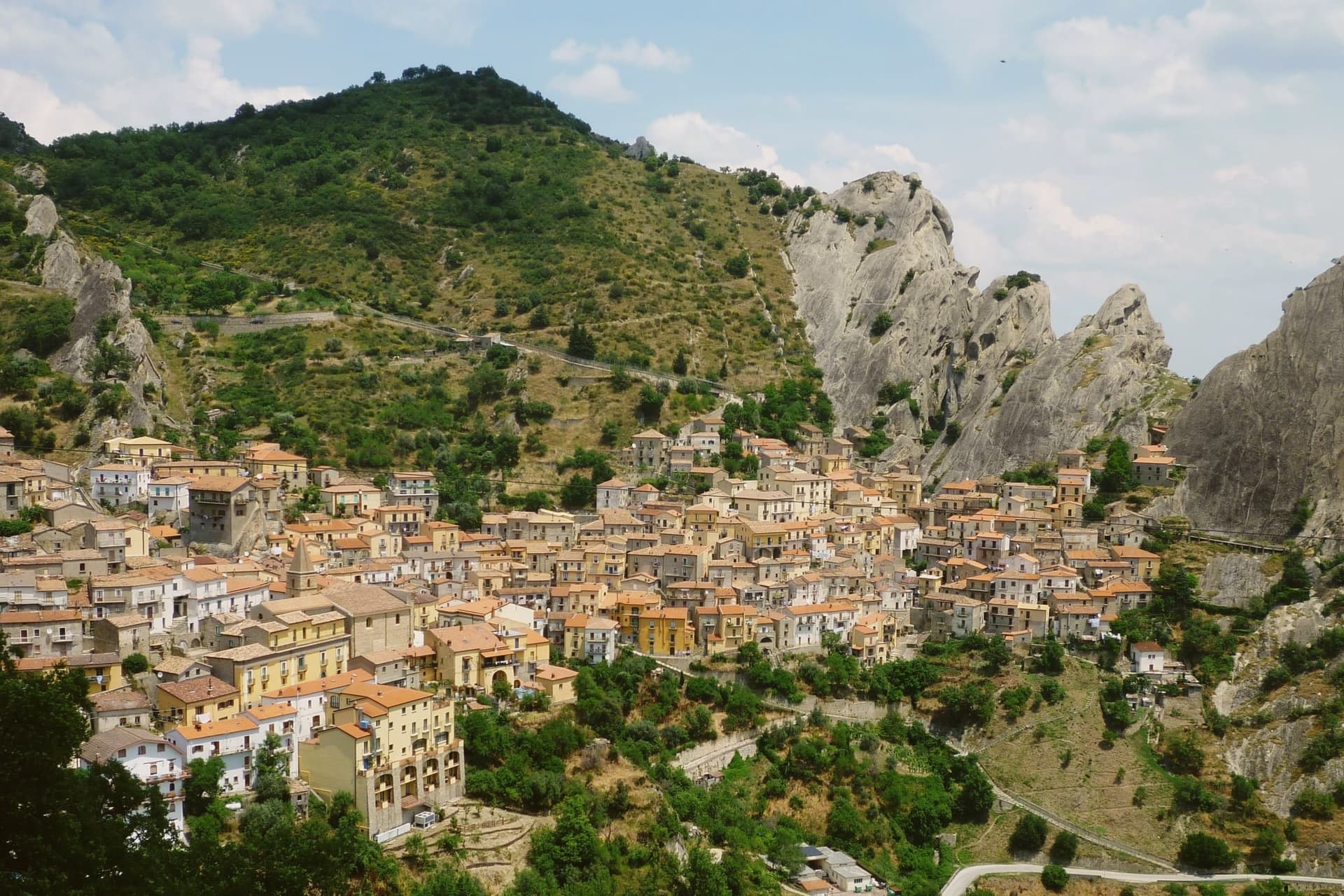
Acerenza stands on a sandstone ridge in the north of the Potenza province, a hundred kilometers inland from Salerno and twenty-two from Venosa. The Romans took it from the Lucanians in 318 BC as Aceruntia; the Ostrogoths and then the Lombards fortified it in turn.
It has been a bishop's seat since at least 499, long before the archbishopric that followed, which places the cathedral at the end of a much longer line of settlement rather than at its start. The town's medieval plan still reads clearly from the square at its summit down to the walls and gates that ring the ridge, the same fortifications raised against the invasions that repeatedly sacked the place.
Vineyards on the slopes below feed the Aglianico produced across the wider area, and the comune holds Città dell'Olio designation alongside its Borghi più belli membership, a working landscape wrapped around a fortified one. The ridge, the walls and the vineyards below them are one continuous piece of geography: a defensible height ringed by the land that has always fed it.
Palazzo Gala have been named by a guide.
What to see in Acerenza
- Cattedrale di Santa Maria Assunta e San Canio. Nave and two aisles under archbishop Arnaldo of Cluny, with sixteenth-century canvases inside and a marble bust identified as Julian the Apostate set among them.
- Centro storico medievale. Concentric plan typical of a fortified borgo, its gates still standing after repeated sackings through the early Middle Ages.
- Cripta del Ferrillo. Frescoes, columns and bas-reliefs beneath the cathedral floor, built as the chapel of the Ferrillo family.
How to get to Acerenza
There is a railway station in the town, so you can arrive without a car and never need one while you are here. Foggia is roughly 101 minutes away by road.
Our tip
May through October is the window when Acerenza's ridge feels right. Spring and autumn bring clear air across the Vulture and long views toward Monte Vulture itself, the extinct volcano whose slopes carry the Aglianico vineyards. July and August push past thirty degrees but the 833-meter elevation keeps the evenings cool; the centro storico empties between two and six. Natale e sapori ad Acerenza falls in December.
Maruggio
Why visit Maruggio
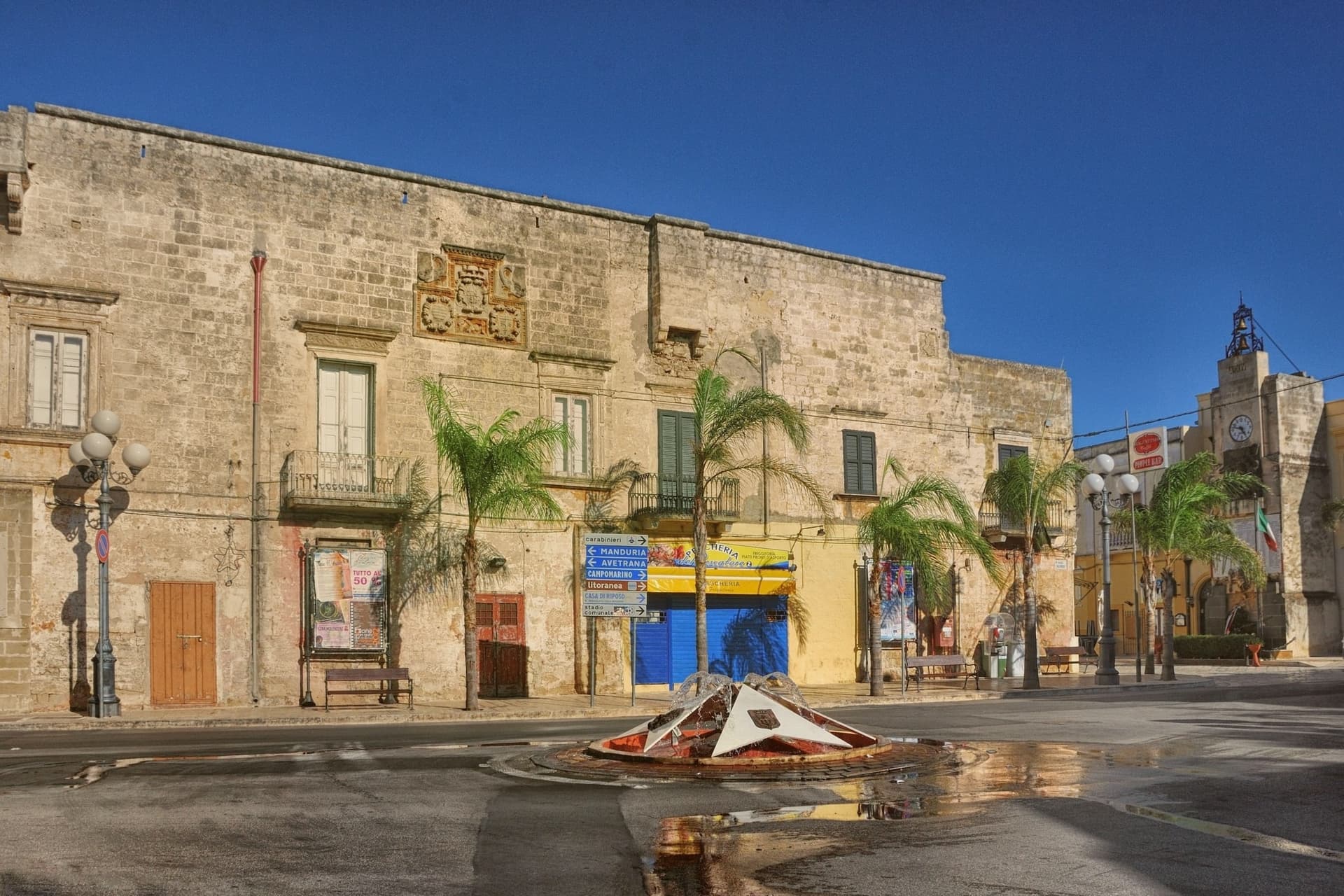
Maruggio sits inland on the Ionian side of Taranto province, a borgo of 5,250 residents built on a low hill with its coastline several kilometres away at Campomarino di Maruggio. The relationship between the two halves defines the place: a walled historic centre turned inward around its towers and commanderies, and a separate coastal strip of sand and dune that belongs administratively to the same town but reads as a different landscape entirely, brackish lagoon and macchia scrub where the borgo is stone and piazza.
The vineyards close that gap. Primitivo and Negroamaro are pressed on farms that run right up to the edge of the built-up centro, so the Città del Vino designation is not a marketing label attached from a distance but a description of what borders the walls.
The food carries the same compression: bombette of pork, panzerotti, sea urchin in spring, and taralli made with fennel seed, all produced within a town small enough that its vineyards, its coast, and its fortifications are never more than a short distance apart. What the place amounts to is a rare case where a single small municipality holds a complete set of Salento's separate identities, military history, wine country, and protected coast, without any of them being a satellite of a larger town nearby.
What to see in Maruggio
- Commenda dei Cavalieri di Malta + Maltese Crosses. The commanderie buildings of San Pietro and Santo Stefano stand side by side, twin structures rather than one. The Chiesa Madre holds the Order's archives, and Maltese cross motifs are carved into doorways throughout the centro.
- Centro storico + four surviving towers. The fortified borgo keeps four of its original eight towers and substantial wall sections, raised against Saracen raids from the sea. Inside, a grid of narrow stone-paved vicoli runs between flat-roofed white-and-honey houses with iron balconies, opening onto the 16th-century Palazzo Ducale on the main piazza.
- Campomarino di Maruggio (Bandiera Blu). Sand backed by dunes for the full stretch of coast, held under Bandiera Blu for over a decade. The reserve at its edge protects 1,000 hectares of dune and lagoon.
How to get to Maruggio
Taranto is roughly 46 minutes away by road.
Our tip
Maruggio is at its best in May–June (warm but not yet packed, sea swimmable, the borgo cool in the morning) and September–October (still beach-warm, vendemmia in full swing, Primitivo and Negroamaro in the press). July and August get crowded at Campomarino — the inland borgo stays quieter. Winter is mild Salento — the centro storico is at its most photogenic but most beach amenities close.
Minervino Murge
Why visit Minervino Murge
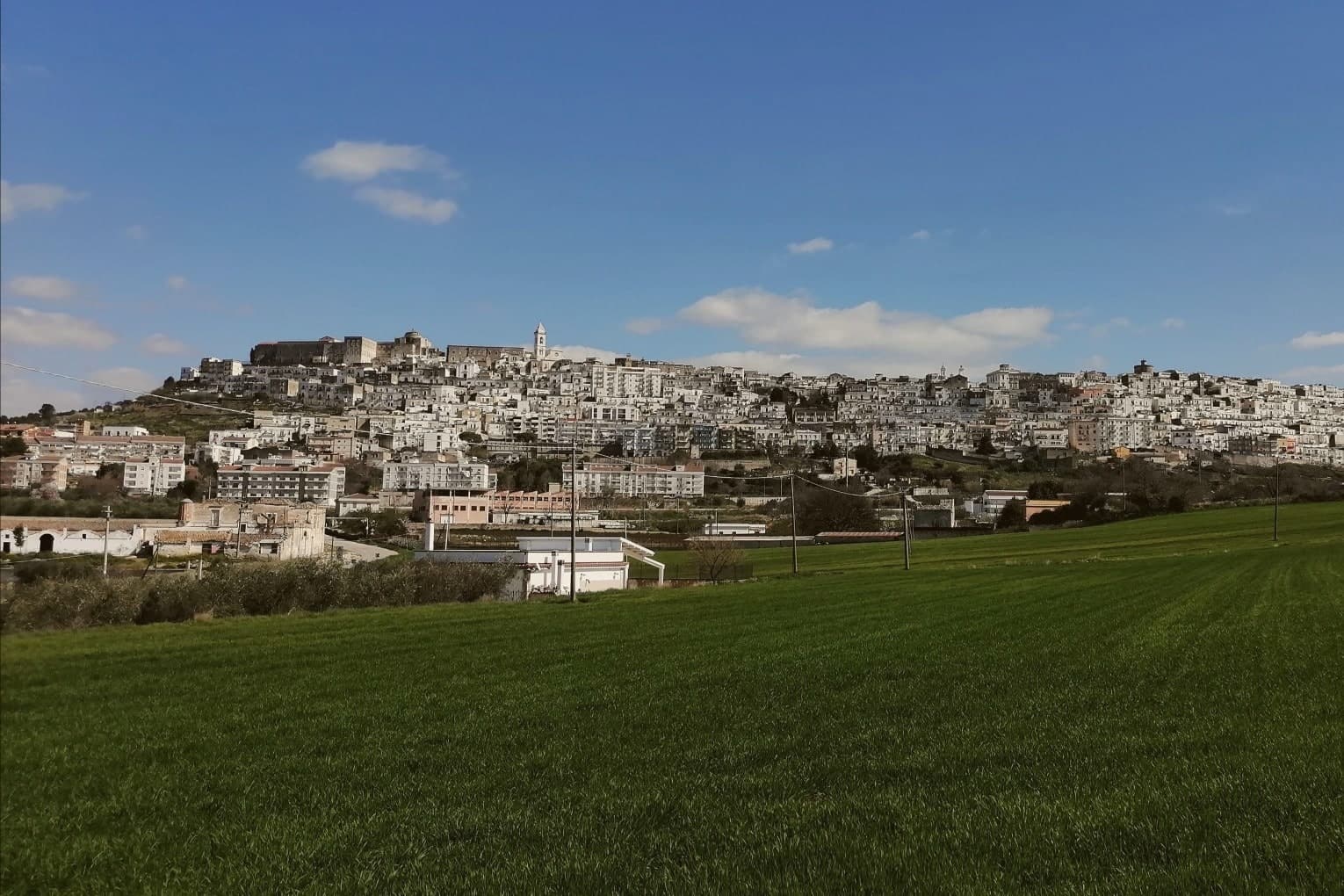
The town is built on two hills at the western edge of the Murgia plateau, where the limestone tableland gives out and the ground drops toward lower country on three sides. That break is what gives the ridge its long view and its nickname: to the east the eye crosses Murgia limestone toward the Gargano and the Adriatic, to the west it crosses cultivated fields into Basilicata, and to the north it runs the length of the Ofanto valley.
The old town sits above this drop, castle and tower on the high ground, cathedral below, the settlement organized around the same ridge that draws the view. Olive oil, almonds and grain define the rural economy beyond the walls, the plateau put to farming where it is not left to steppe grass and karst.
A ridge town, in other words, whose whole character, defensive site, pilgrimage cave, farmed hinterland, follows from the one geological fact of where the plateau ends.
La Tradizione - Cucina Casalinga, Masseria Barbera, A Sud dell'Anima have been named by a guide.
What to see in Minervino Murge
- Castello Normanno-Svevo. Norman fortress remodeled in the baronial period, with surviving towers and bastions on the high ridge above the old town.
- Torre di Pirro del Balzo. Fifteenth-century tower built between 1460 and 1490 when Minervino came to Pirro del Balzo as part of Maria Donata's dowry.
- Grotta di San Michele. Cave formed roughly two million years ago, reached through the karst rather than built, and still kept as a place of pilgrimage rather than display.
How to get to Minervino Murge
There is a railway station in the town, so you can arrive without a car and never need one while you are here. Foggia is roughly 62 minutes away by road.
Our tip
April through June and September through October are the months the Alta Murgia plateau runs best. The wildflower steppe peaks in May, almond blossom comes earlier in February, and the Ofanto valley below stays mild through autumn. July and August push past thirty-five degrees on the limestone with little shade; the centro storico empties between two and five and the panoramic belvedere is best at dawn or dusk.
Venosa
Why visit Venosa
Venosa sits at 415 meters in the Vulture hills, ninety kilometers east of Salerno. The Romans founded Venusia here in 291 BC as a colony on the Appian Way, and it became the birthplace of Quintus Horatius Flaccus, the poet Horace, in 65 BC.
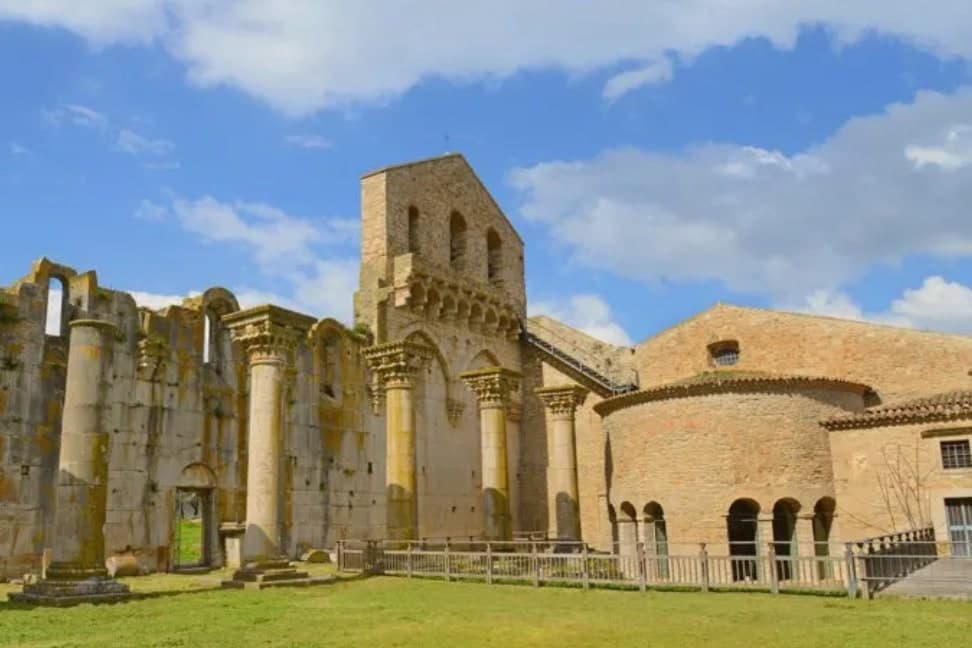
The Parco Archeologico preserves a Roman amphitheater, the baths, and mosaic floors, alongside the so-called Casa di Orazio. Above the ruins stands the Abbazia della Santissima Trinità, an eleventh-century Benedictine complex begun in 1059, with its walls built from blocks salvaged out of the Roman amphitheater next door.
The Incompiuta, the unfinished thirteenth-century cathedral expansion immediately behind the abbey, is roofless and visibly stitched together from Roman fragments. The town centre is dominated by the Castello di Pirro del Balzo, built in 1470 on the foundations of an earlier cathedral and modelled on the Maschio Angioino in Naples.
Venosa is at the heart of the Aglianico del Vulture DOC and DOCG zone, the great red of southern Italy, grown on the volcanic slopes of nearby Monte Vulture.
Al Baliaggio have been named by a guide.
What to see in Venosa
- Abbazia della Santissima Trinità. Benedictine abbey of 1059 with walls built from blocks of the adjacent Roman amphitheater, the spiritual centre of Norman Venosa.
- Incompiuta. Roofless thirteenth-century cathedral expansion behind the abbey of Santissima Trinità, abandoned mid-build, visibly assembled from Roman spolia.
- Castello di Pirro del Balzo. Quadrangular Aragonese castle of 1470 with corner towers, built on the foundations of the earlier cathedral, modelled on Castel Nuovo in Naples.
How to get to Venosa
There is a railway station in the town, so you can arrive without a car and never need one while you are here. Foggia is roughly 70 minutes away by road.
Our tip
April through June is the green window in the Vulture, with cool evenings and the archaeological park empty in the mornings. September and October are dry and gold, the Aglianico harvest runs into November, and the Cantina di Venosa cellars are open for tastings. July and August reach the mid-thirties; visitors retreat to the abbey shade and the wine cellars. Fiera sapori del Sud falls in May.
Oria
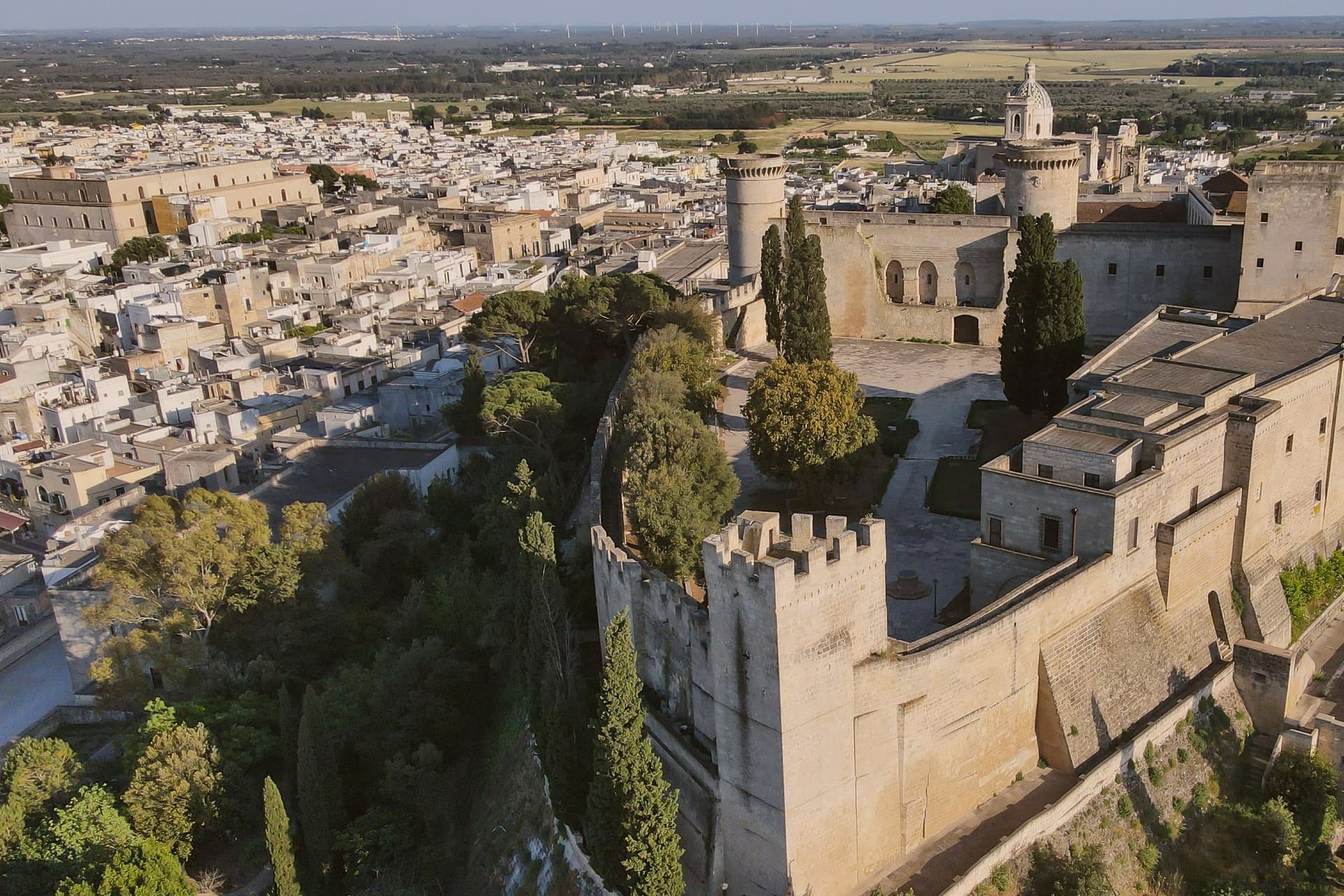
Why visit Oria
Oria sits at 166 meters on a Salento ridge between Taranto and Brindisi, north of Manduria and southeast of the ancient Taras. The town was Hyria, one of the principal Messapian cities, before the Romans absorbed the region.
Frederick II rebuilt the castle on the Messapian acropolis between 1227 and 1233; the triangular plan he chose is unique in southern Italian military architecture, with three towers, the Quadrata (Frederician), the Del Cavaliere and the Del Salto (both Angevin additions). Oria also held one of the oldest Jewish communities in Europe, a study center where philosophy, the Talmud, Greek, Latin, medicine and natural science were taught from the ninth century.
Shefatya ben Amitai and Shabbethai Donnolo, two of the first Hebrew writers native to Europe, both lived and worked here. The Jewish quarter, the Giudecca, still organizes the southern edge of the centro storico.
Osteria Luce, Masseria Palombara, Fuori Porta have been named by a guide.
What to see in Oria
- Castello Svevo di Federico II. Frederician castle of 1227-1233 on the Messapian acropolis, triangular plan with three towers, one Frederician and two Angevin, the town's defining monument.
- Cattedrale di Oria. Eighteenth-century Baroque cathedral raised over earlier medieval foundations, the seat of the diocese of Oria since the Lombard era.
- Giudecca. Old Jewish quarter on the southern flank of the centro storico, organized around the Vico degli Ebrei, a continuous medieval settlement from the ninth century.
How to get to Oria
There is a railway station in the town, so you can arrive without a car and never need one while you are here. Taranto is roughly 46 minutes away by road.
Our tip
April through June and September through October are the Salento interior months: clear light on the castle ridge, mild evenings, olive country in flower or harvest. July and August touch thirty-six degrees on the hilltop and the centro storico empties between two and five; the Corteo Storico di Federico II runs in mid-August anyway and pulls a regional crowd. October is the olive harvest. Palio di Oria falls in July.
Melfi
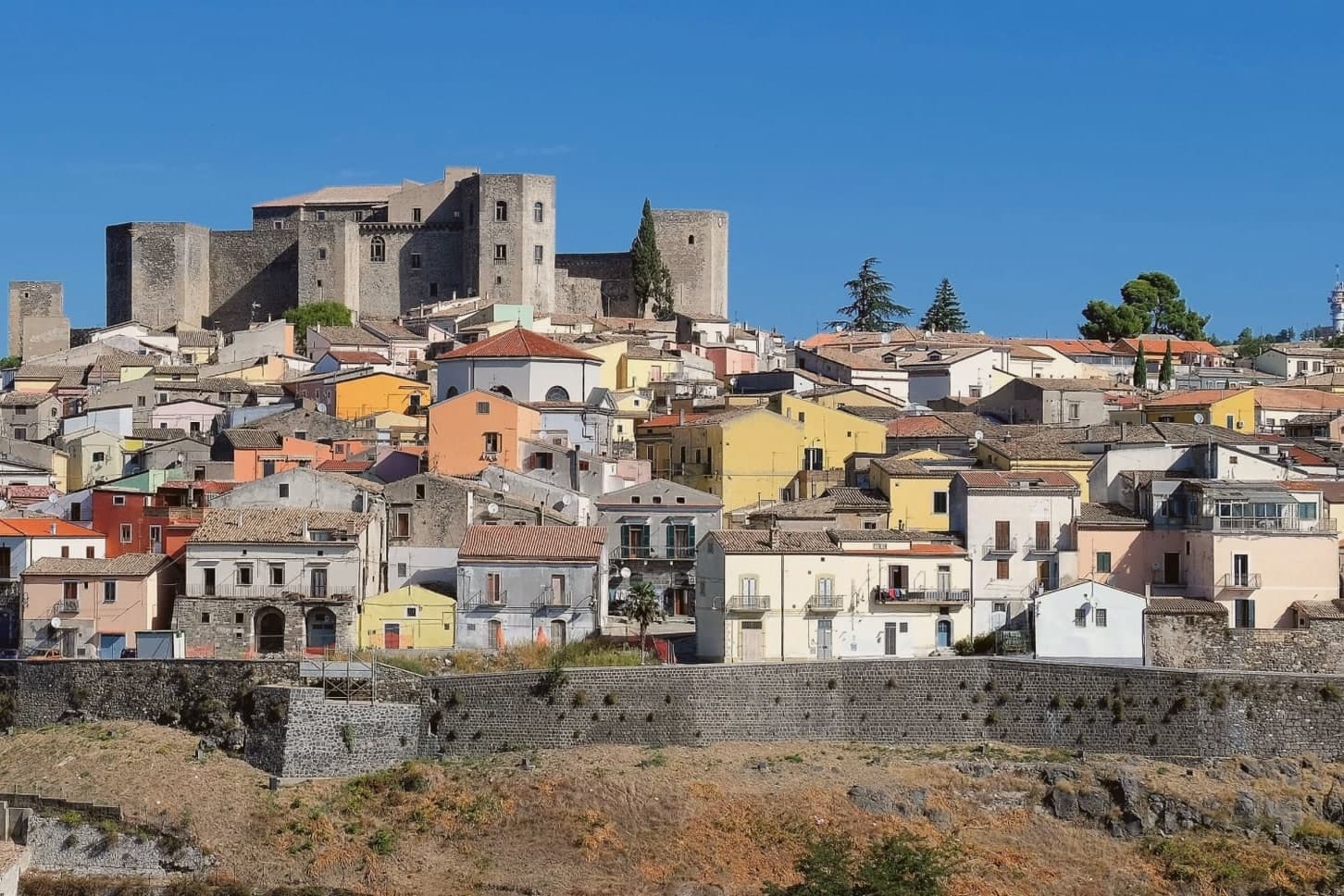
Why visit Melfi
Melfi sits on the slopes of an extinct volcano east of the Apennine spine, the same mass whose crater holds the Laghi di Monticchio and whose soils now define a wine zone. The Hauteville Normans took the town in 1041 and made it the first capital of their southern Italian duchy, a status that explains the density of what followed: a cathedral built within a generation, a castle raised soon after and expanded by an emperor, a legal code drafted within those walls that shaped a kingdom's law.
The walled centro storico spreads below the castle, its gate and noble palazzi still arranged along the lines the Norman-Swabian town laid down. Upper fortress and lower town, volcanic mountain and walled centre: Melfi reads as a place where secular power, church authority and the raw geology of Monte Vulture sat close enough together to shape one small hill town into a seat of empire-level decisions.
La Villa have been named by a guide.
What to see in Melfi
- Castello di Melfi. Late-eleventh-century Norman fortress with ten towers, seven rectangular and three pentagonal. Frederick II expanded it after 1194, and the Constitutions of Melfi were promulgated within its walls.
- Cattedrale di Santa Maria Assunta. Dating from 1056, host of five ecumenical councils between 1059 and 1137. Stands at the heart of the walled centre below the castle.
- Museo Archeologico Nazionale del Vulture-Melfese. Inside the castle, with the second-century Roman sarcophagus of Rapolla and finds from the Daunian, Lucanian and Roman periods.
How to get to Melfi
There is a railway station in the town, so you can arrive without a car and never need one while you are here. Foggia is roughly 55 minutes away by road.
Our tip
April through June and September through October are the best windows in Melfi, with cool evenings and the Aglianico vineyards at their most photogenic. July and August reach the mid-thirties; the castle interiors and the cathedral hold the heat at bay. The Aglianico harvest runs into November and the Cantine and museums stay open. Sagra della castagna Varola falls in October.
Manduria
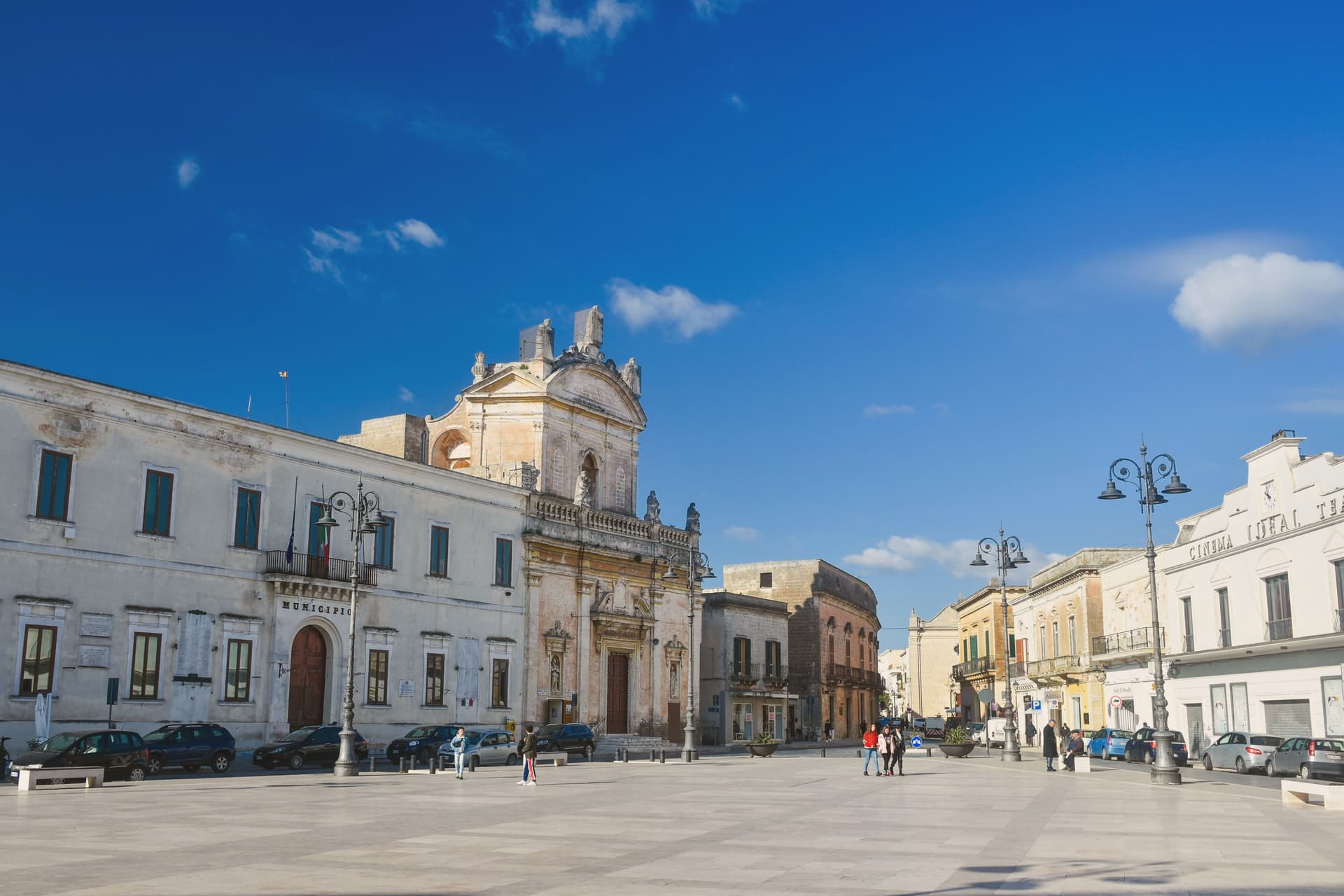
Why visit Manduria
Manduria sits at seventy-nine meters thirty-five kilometers east of Taranto, on the inland edge of the northern Salento. The town was a Messapian stronghold against Greek Taras; Archidamus III, king of Sparta, was killed under its walls in 338 BC.
The Archaeological Park preserves three concentric rings of city walls in drystone, the oldest from the fifth century BC, the middle from the fourth and an outer ring from the third century AD, more than fifteen hectares of fortification still standing. Inside the perimeter, the Fonte Pliniano is a karst cave eighteen meters across, named after Pliny the Elder, who described its constant water level in the Naturalis Historia.
The town gives its name to Primitivo di Manduria DOC, made from 100% Primitivo grapes on the surrounding clay-limestone plain. The Museum of Primitivo and the late-summer Vinitaly cellar tours bring most of the modern visitors.
The coast at San Pietro in Bevagna, fifteen kilometers south, holds the commune's Bandiera Blu beach.
Casamatta, ES Cantina&Ristorante, Gusto Primitivo del Corte Borromeo Hotel and 1 more have been named by a guide.
What to see in Manduria
- Parco Archeologico delle Mura Messapiche. Fifteen hectares of three concentric Messapian walls from the fifth to third century BC, the largest pre-Roman fortification in Salento.
- Fonte Pliniano. Karst cave eighteen meters across, described by Pliny the Elder for its water level that does not rise or fall.
- Borgo Antico. Medieval centro storico inside the inner Messapian wall, with the former Jewish quarter and the Palazzo Imperiali.
How to get to Manduria
There is a railway station in the town, so you can arrive without a car and never need one while you are here. Taranto is roughly 50 minutes away by road.
Our tip
April through June and September through October are the months the Salento inland stays workable. Olive blossom in May, Primitivo harvest in late August and September, mild evenings on the archaeological park trails. July and August push past thirty-five degrees on the limestone plain; the centro storico empties between two and five and the beaches at San Pietro in Bevagna take the heat.
Trani
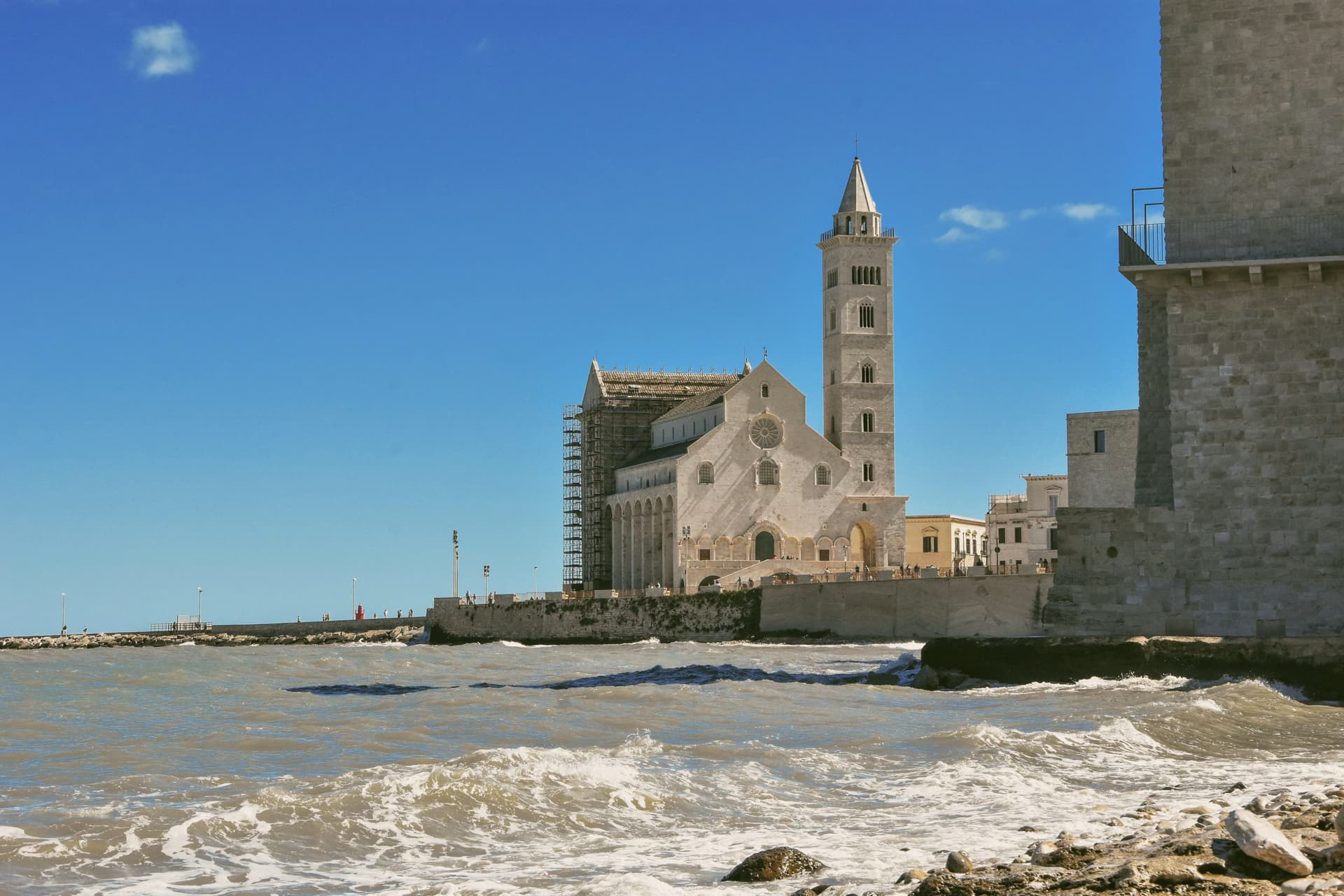
Why visit Trani
Trani sits on the Adriatic forty-five kilometers west-northwest of Bari, one of the three capitals of the Barletta-Andria-Trani province. The cathedral is the reason most travelers come.
Dedicated to Saint Nicholas the Pilgrim, a Greek who died in Trani in 1094, the church was begun in 1159 and built from the local calcareous tuff that quarries pink-white almost to the point of looking bleached. The fifty-nine-meter bell tower was finished in the fourteenth century; the central bronze door is a 1175 work by Barisano da Trani.
The Castello Svevo on the same harbor was built by Frederick II between 1233 and 1249 to guard the roadstead. Trani's eleventh- and twelfth-century maritime republic linked the Crusader Adriatic to the East and produced the Ordinamenta maris, one of the earliest western sea codes.
The cathedral square at dusk, sea on one side and Castello Svevo on the other, is the photograph.
Quintessenza, Casa Sgarra, Il Melograno and 4 more have been named by a guide.
What to see in Trani
- Cattedrale di San Nicola Pellegrino. Romanesque cathedral begun in 1159 on a sea-edge platform, built of local pink-white tuff, with a fifty-nine-meter bell tower and the 1175 bronze door by Barisano da Trani.
- Castello Svevo. Frederick II fortress of 1233-1249 on a rock at the center of the harbor, designed by Filippo Cinardo, later a royal court seat and provincial prison until 1974.
- Porto e lungomare. Working fishing harbor lined with palazzi and trattorie, with the cathedral at one end and the Castello Svevo at the other.
How to get to Trani
There is a railway station in the town, so you can arrive without a car and never need one while you are here. Bari is roughly 38 minutes away by road.
Our tip
May, June, September and October are the easiest months on the harbor: warm without humidity, the cathedral square workable from morning into the evening, the Adriatic still swimmable. July and August are hot and busy, with cruise day-trippers and weekend Bari traffic taking the port. The fish auction at the molo continues through the summer; the local moscato bottling runs from August into September. Festa di San Nicola Pellegrino falls in August.
Andria
Why visit Andria
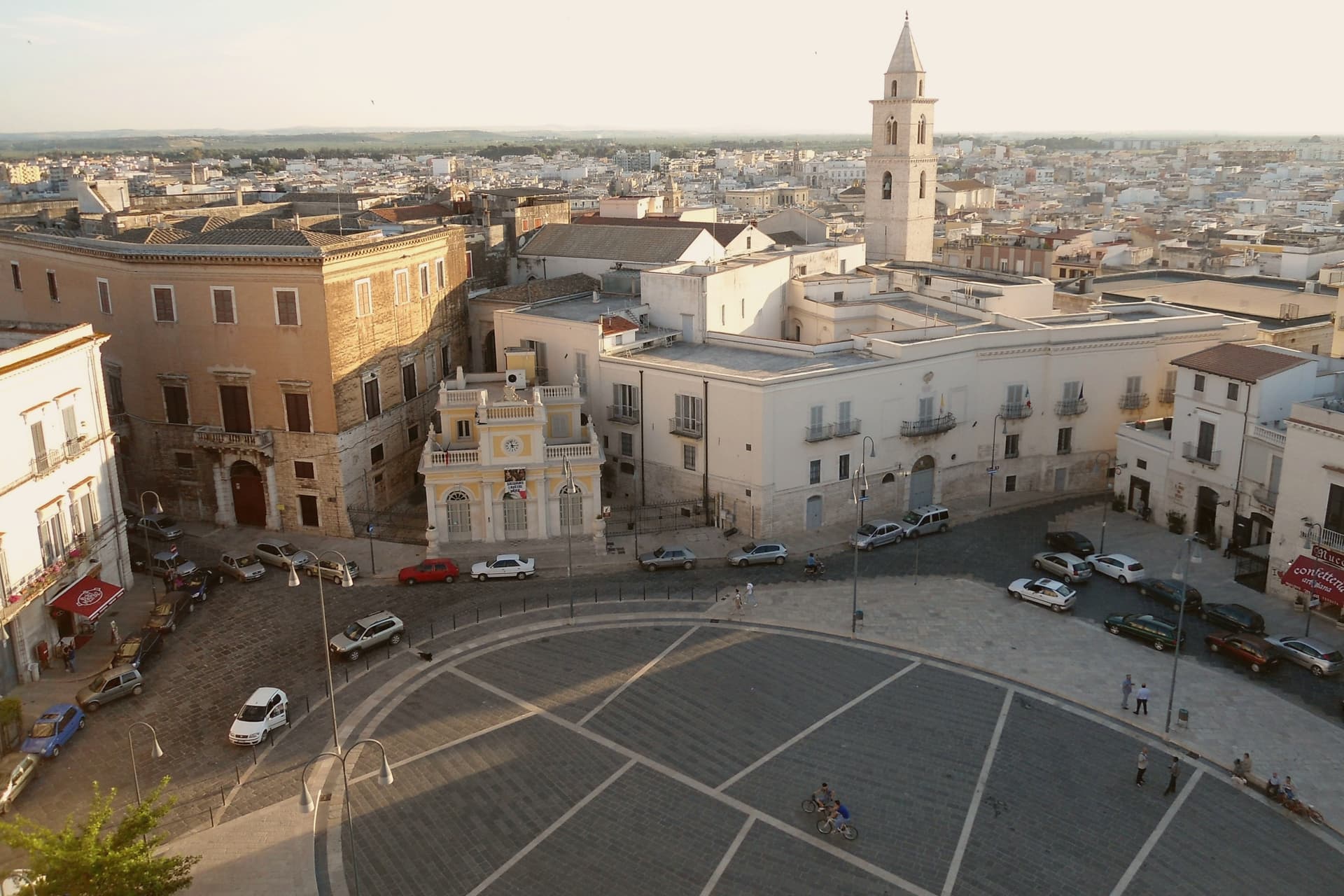
Andria sits on the Murge plateau at 151 meters, ten kilometers from the Adriatic, the third-largest city in Puglia after Bari and Taranto. It was made a fortified civitas in 1046 under Peter the Norman, with twelve towers, three gates and a citadel; Frederick II raised it again in the thirteenth century and built his most famous castle on a hilltop eighteen kilometers south of the city walls.
The city and Castel del Monte read as two expressions of the same Frederician ambition, one a working civitas of towers and gates, the other a solitary geometric exercise on an open plateau with no town around it at all. The other claim Andria makes is burrata, invented around the early twentieth century by the Bianchino family as a way to use leftover mozzarella scraps.
A fortified city, an unfinished castle, and a cheese born from kitchen thrift: the Murge produced a walled seat of power and, separately, an object meant to be looked at rather than defended, and a food born of nothing more than not wanting to waste the scraps.
Confetteria Mucci Giovanni con annesso Museo del Confetto, Antichi Sapori, Il Turacciolo have been named by a guide.
What to see in Andria
- Castel del Monte. An octagonal prism with eight octagonal towers, standing alone on a Murge hilltop and visible for fifty kilometers in any direction. Never finished, never used for war.
- Cattedrale di Santa Maria Assunta. Romanesque cathedral founded in the twelfth century, rebuilt over the centuries, holds the crypt and the relics of San Riccardo, the city's patron.
- Chiesa di Sant'Agostino. Gothic-Romanesque church built by the Teutonic Knights in the late thirteenth century, with a sculpted portal that is one of the finest in Puglia.
How to get to Andria
There is a railway station in the town, so you can arrive without a car and never need one while you are here. Bari is roughly 63 minutes away by road.
Our tip
April through June and September through October are the Murge months: clear light, mild evenings, the Castel del Monte plateau walkable without sweat. July and August hit thirty-six in the city and the castle exposed at 540 meters is brutal between noon and four. October is the olive harvest.
More from Anywhere Italy
 The best hill towns you can reach by train within 90 minutes of Foggia
 The best towns you can reach by train that eat well within 90 minutes of Foggia
- The 10 best hill towns with a serious restaurant in Puglia
 The best towns known for what they grow within 75 minutes of Bari
 The best towns that eat well in the province of Potenza
- The best towns you can reach by train that eat well in Basilicata