
The best towns you can reach by train that eat well within 90 minutes of Bari
90 towns visited, 910 to go. Follow along, free: Subscribe on Substack
The land around Bari is flat, bright and farmed hard, and the food follows the soil. Almond and olive groves run to the horizon, the coast throws up raw prawns and sea urchins eaten straight from the shell, and the inland towns turn durum wheat into orecchiette dressed with turnip tops or a slow ragù of horsemeat. Cheese is the regional argument settled in your favor: burrata, stracciatella, mozzarella still warm in its bag of milk. The old centers are built of pale local limestone that goes gold in late afternoon, and spring and autumn are when the terraces are usable and the trains are quiet.
the trains are the point. Bari sits at the meeting of the state network and the regional lines, so a short ride puts you in a different province before lunch, and you can drink at the table without thinking about the drive back.
Most people arriving in Puglia get straight into a hire car and head for Alberobello, which is a fine thing to see once and now handles its crowds the way Alberobello has to: coach parks, souvenir trulli, queues on the narrow lanes of Rione Monti. The same visitors then push south to Lecce and the Salento beaches, and the middle of the region becomes something to drive through. Restaurants along that corridor have learned what a coach party will pay for, and it shows on the plate.
The coast, the tufa and the wheat do not stop where the tour buses turn off. North of Bari the Adriatic runs past fishing harbors and Norman cathedrals; south it cuts into limestone inlets; inland the plateau climbs toward the ravines of Basilicata. These are the towns on that line with a table worth the journey and a station within walking distance of dinner.
Of the 18 communes we have mapped within 90 minutes of Bari, 9 qualify as towns you can reach by train that eat well: we have confirmed each is reachable without a car, and a dining guide has named a table in each. The smallest, Polignano a Mare, has 17,531 residents.
Elsewhere in the catalogue: The best olive oil towns that eat well within 90 minutes of Bari and The best towns that eat well in the province of Bari.
All the towns within a day trip: day trips from Bari.
Why visit Polignano a Mare
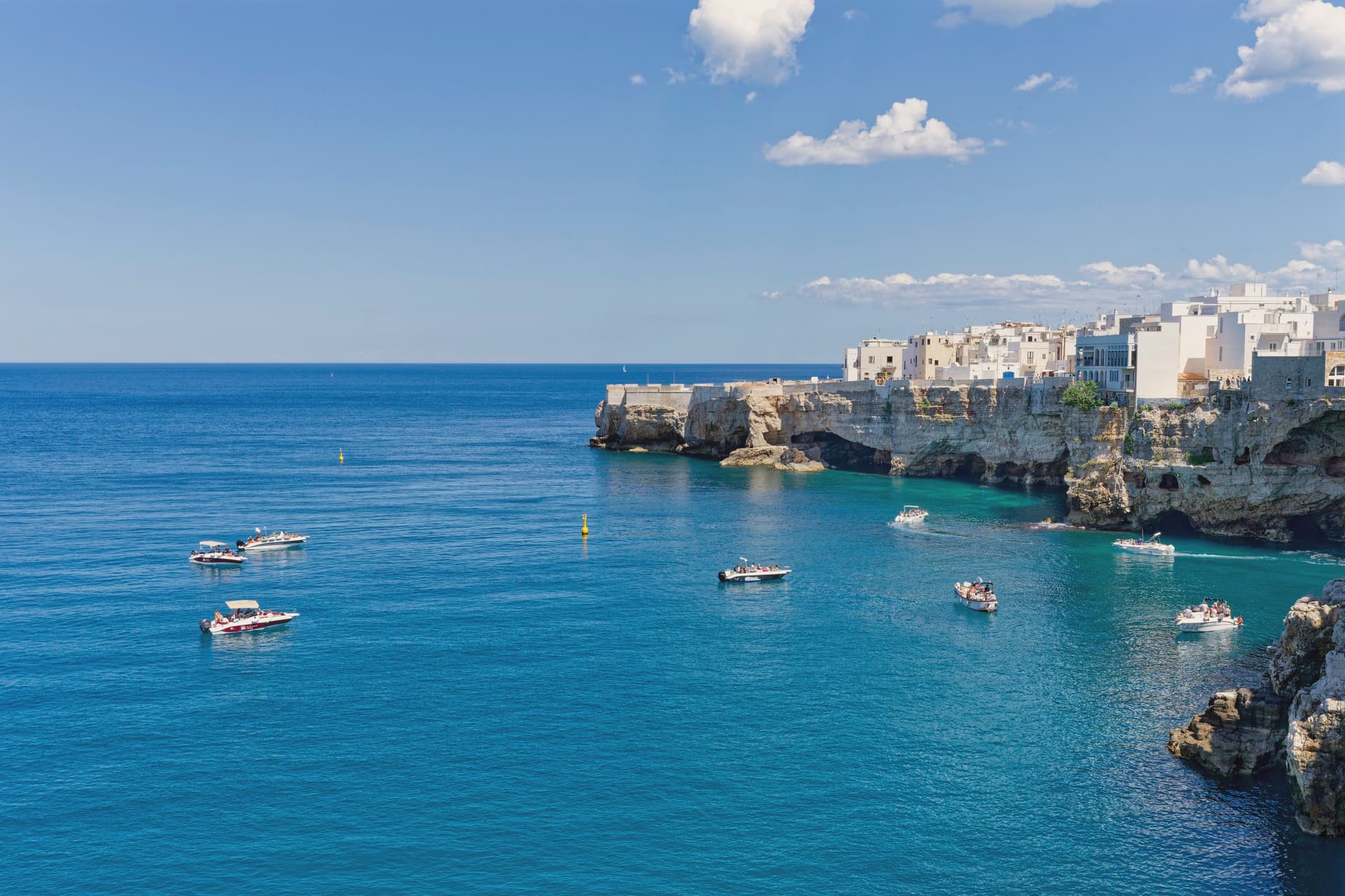
Polignano a Mare sits on a limestone cliff twenty to twenty-seven meters above the Adriatic, thirty kilometers south of Bari. The historic center is a maze of whitewashed lanes cut into the rock, dropping down to the Lama Monachile cove, the narrow beach between two rock walls and under the arches of the Roman bridge of the Via Traiana.
Archaeology in the Santa Barbara district shows continuous settlement since prehistory, and the site has been identified with the ancient Greek Neapolis of Apulia, possibly founded by Dionysius II of Syracuse in the fourth century BC. Julius Caesar features in another origin claim along the Via Traiana.
Domenico Modugno, who wrote and sang "Nel blu dipinto di blu" and won the 1958 Grammy with it, was born here in 1928; his statue stands on the lungomare that bears his name. The Grotta Palazzese, a sea cave under the old town, has held a restaurant since the eighteenth century when the Leto princes used it for banquets.
Pashà (MICHELIN and L'Espresso), Meraviglioso (MICHELIN and Gambero Rosso), Jamantè (MICHELIN and Gambero Rosso) and 2 more places are listed in food guides.
What to see in Polignano a Mare
- Lama Monachile. Narrow cove between two cliff walls in the center of town, under the arches of the Roman bridge of the Via Traiana, the town's signature postcard.
- Centro storico. Whitewashed old town on the limestone cliff, narrow lanes, balconies hanging over the sea, and three surviving medieval gates.
- Grotta Palazzese. Sea cave under the cliff used by the Leto princes for banquets in the eighteenth century, now a restaurant carved into the rock.
How to get to Polignano a Mare
It has its own railway station. Bari is about 36 min away by road. The full route from Bari.
Our tip
May through September is the season the cliffs and the cove work: warm sea, long evenings, the Lama Monachile crowded by ten in the morning in July and August and impossible to swim from after noon. June and September are the better months, the water already warm and the day-tripper buses thinner. October keeps the light and empties the centro storico.
Why visit Giovinazzo
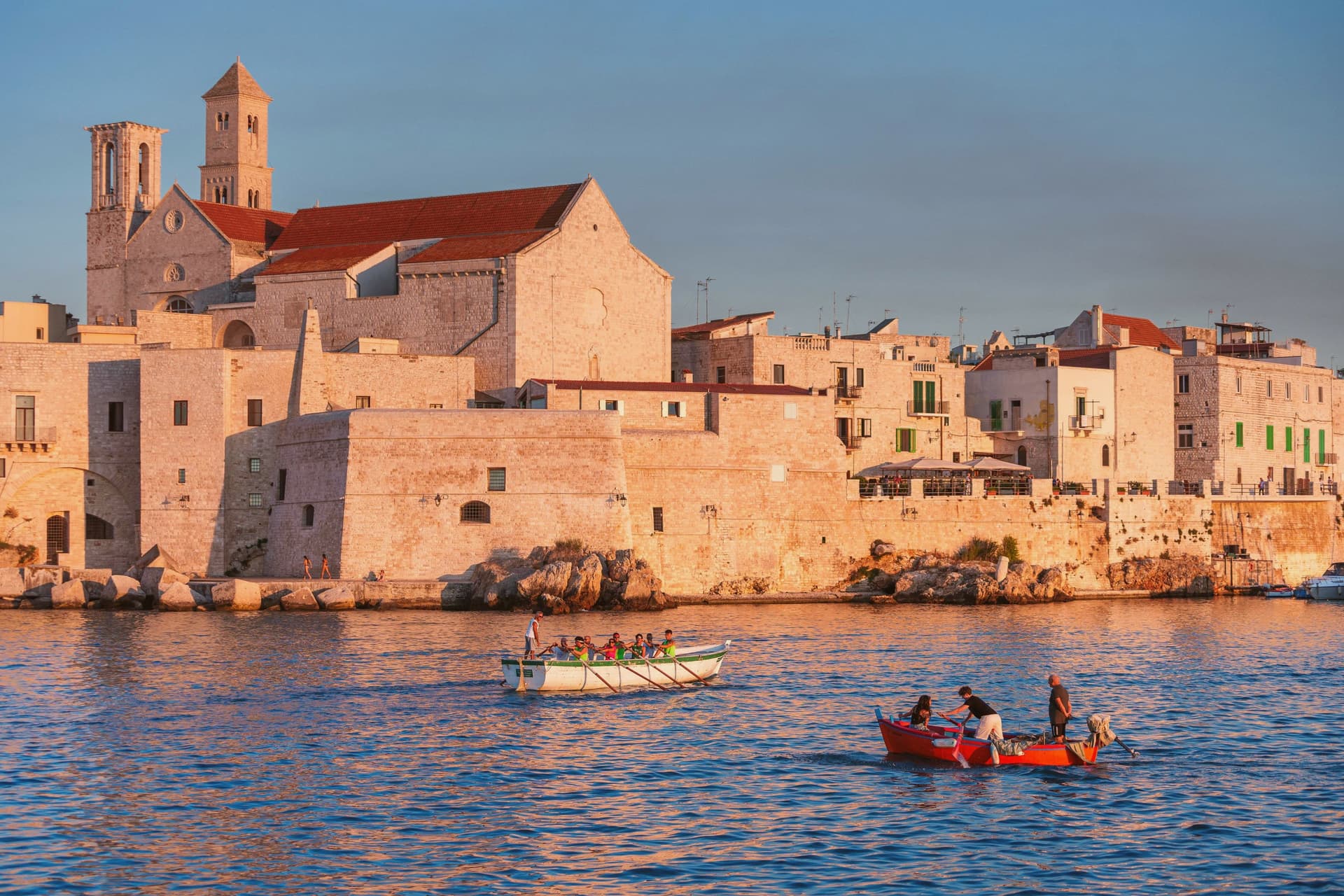
Giovinazzo sits on the Adriatic twenty kilometers northwest of Bari, between Molfetta and the Bari coastal belt, at 7 meters. The Romans called it Natolium, fortifying the site under Trajan in 102 AD on what may be the older Peucetian settlement of Netium.
The Norman cathedral of Santa Maria Assunta was built between 1125 and 1180 in the Puglian Romanesque style and consecrated in 1283; it still holds the Byzantine icon of the Madonna of Corsignano, the patron, celebrated through August. The medieval centro storico runs in narrow stone lanes around the harbor, where the small fishing fleet still ties up below the sea wall.
Five kilometers inland, the Dolmen di San Silvestro is a Bronze Age funerary chamber from around 1500 BC, set in a grove of olive and carob, the agro that makes Giovinazzo a Città dell'Olio. The town hosts one of the few elite roller hockey clubs in Italy.
Ragno d'Oro Caffè dal 1856 (Gambero Rosso) and Toruccio Terrazza Adriatica (Gambero Rosso) are listed in food guides.
What to see in Giovinazzo
- Concattedrale di Santa Maria Assunta. Norman cathedral of 1125-1180 in Puglian Romanesque, consecrated in 1283, with the Byzantine icon of the Madonna of Corsignano above the main altar.
- Centro storico. Medieval old town in narrow stone lanes wrapping the small port, walled on the seaward side and rebuilt after Norman reconquest in the eleventh century.
- Dolmen di San Silvestro. Bronze Age funerary dolmen from around 1500 BC, set on a Murgia terrace among olive and carob trees five kilometers inland from town.
How to get to Giovinazzo
It has its own railway station. Bari is about 31 min away by road. The full route from Bari.
Our tip
May through June and September are the best months on this stretch of Adriatic coast, with warm sea and mild evenings. July and August touch thirty-five degrees and the small harbor fills with weekenders from Bari; the centro storico stays cooler in the lanes than out on the wall. The festa for the Madonna of Corsignano runs through August.
Why visit Conversano
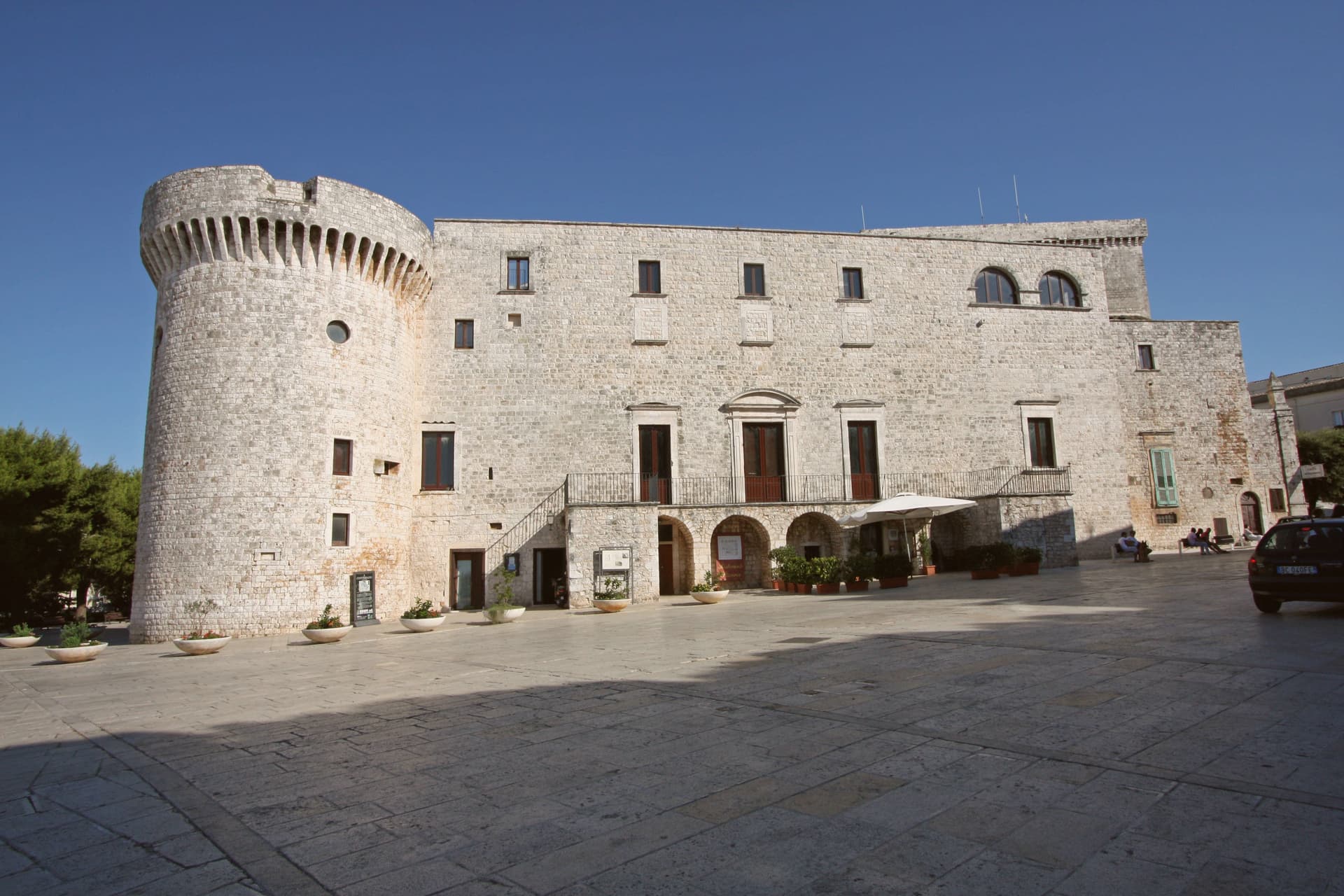
Conversano sits on the first hills of the Murge plateau at 219 meters, twenty-five kilometers southeast of Bari and seven from the Adriatic. The Castello di Conversano was raised around 1054 by the Normans for defence and turned into a seigneurial residence by the Acquaviva d'Aragona counts, who ruled from 1455 until the early nineteenth century.
Inside the castle the Pinacoteca holds the ten-canvas cycle of episodes from Tasso's Gerusalemme Liberata painted by Paolo Domenico Finoglio in the 1640s, commissioned by Count Giangirolamo II d'Acquaviva. Opposite the castle stands the Cattedrale di Santa Maria Assunta, eleventh- and twelfth-century Apulian Romanesque with a sculpted portal, a rose window, and an interior Crucifix that anchors the patronal procession.
The former Monastero di San Benedetto, with a Romanesque cloister, was entrusted in 1266 by Pope Clement IV to Cistercian nuns exiled from Methoni in Greece, an arrangement so unusual it earned the monastery the medieval nickname Monstrum Apuliae, the Wonder of Puglia.
Vita Pugliese is listed in the MICHELIN Guide.
What to see in Conversano
- Castello di Conversano. Norman castle of 1054 turned seigneurial residence by the Acquaviva d'Aragona counts, with the Pinacoteca holding Finoglio's ten Gerusalemme Liberata canvases.
- Cattedrale di Santa Maria Assunta. Apulian Romanesque cathedral of the eleventh and twelfth centuries, sculpted portal, rose window, wooden Crucifix venerated as the city's protector.
- Monastero di San Benedetto. Former Benedictine then Cistercian monastery with Romanesque cloister, called Monstrum Apuliae for the abbess-power of the Greek nuns entrusted to it from 1266.
How to get to Conversano
It has its own railway station. Bari is about 36 min away by road. The full route from Bari.
Our tip
April through June and September through October are the Murge months at this altitude: clear light, mild evenings, the cherry orchards in flower or fruit. Conversano is the center of the IGP cherry zone and the late-May ciliegia harvest is the year's commercial peak. July and August hit thirty-five degrees and the centro storico empties in the afternoon.
Why visit Putignano
The town sits on the Murgia, the karst plateau between Bari and Lecce, at 372 meters, home to just under 26,000 people. The carnival's origin is tied to a specific piece of geography: a Benedictine confraternity carried the relics of Santo Stefano inland from the coast at Monopoli to escape Saracen raids, arriving on 26 December 1394.
Farmers moving grapevines in the same December procession began singing satirical verses, and that song is what survives today as le Propaggini, still the opening event every 26 December. The carnival that grew from it ran across 631 years of plagues, wars, fascism, and pandemics without a break, which is the basis of its claim to being the oldest in Europe.
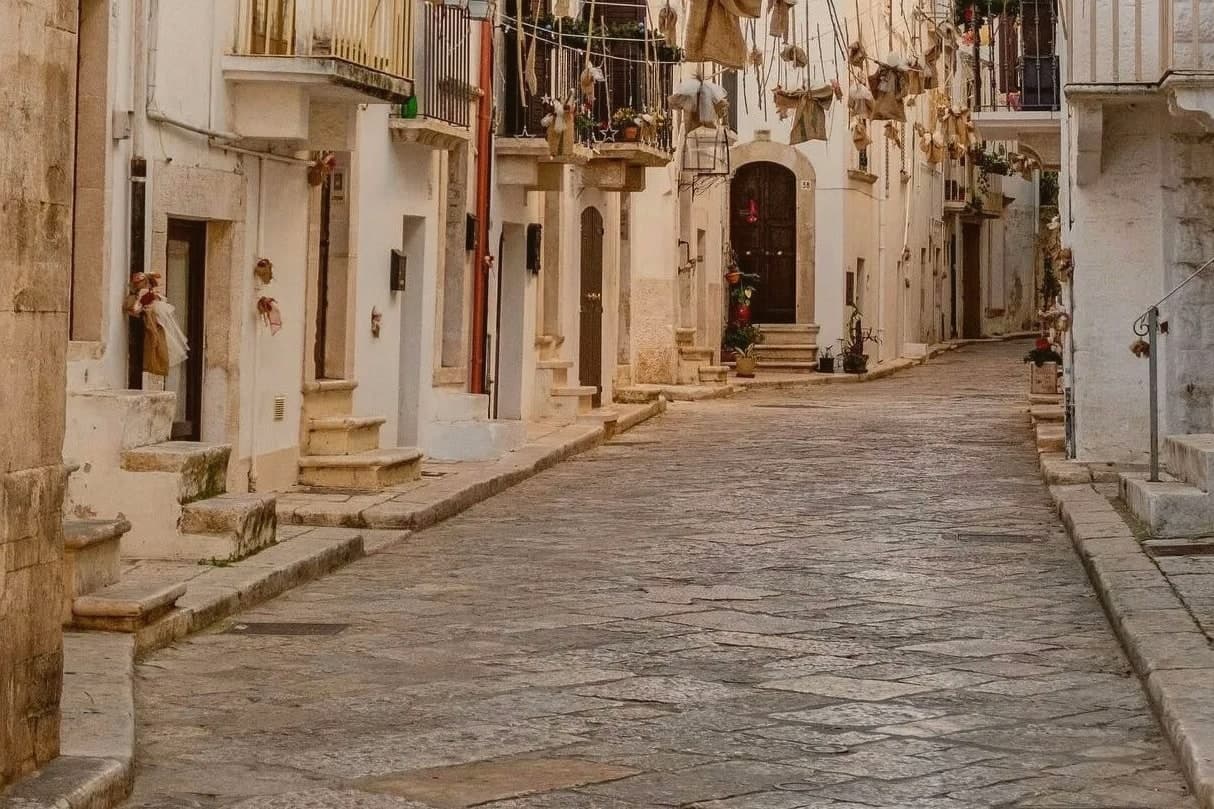
Inside the centro storico the old and the underground meet directly: a karst cave system opens beneath a Trullo-roofed building right in the middle of town, its entrance inside the old center rather than out on the plateau, with stalactites and a section that served as a WWII refuge shelter. The Chiesa Madre di San Pietro Apostolo, a restored Romanesque church with a 16th-century crypt, anchors the same central piazza as the Palazzo del Balì, and stretches of the medieval walls still hold their line nearby.
The kitchen draws on the same plateau and its neighbors: focaccia barese, orecchiette con cime di rapa, capocollo from the next town over, Primitivo di Manduria carried in from 80 km south, and farinella, the sweet polenta cake made with grape must and chickpea flour that belongs specifically to the carnival calendar. What holds the town together is continuity: a religious procession that turned into satire and has not stopped since, a center small enough that the cave, the church, and the workshops all sit within a short walk of each other, and a plateau setting that feeds both the table and the traffic passing through toward Alberobello and the Valle d'Itria.
Angelo Sabatelli (MICHELIN and L'Espresso) and Botteghe Antiche (Slow Food and Gambero Rosso) are listed in food guides.
What to see in Putignano
- Carnevale di Putignano (Dec 26 – Shrove Tuesday). Five Sunday float processions run from January to Shrove Tuesday. Le Propaggini opens the calendar on 26 December, the Funerale del Carnevale closes it, and 365 bells ring out, one for each day until the next.
- Cartapesta workshops + Museo del Carnevale. Many of the workshops are open for visits while the floats take shape. The museum documents the full run of carnival history, plague years, wars, and fascism included.
- Grotta del Trullo. The cave sits under a Trullo-roofed building in the old center, which is where its name comes from. Guided visits take in the stalactites and the section that served as a WWII refuge shelter.
How to get to Putignano
It has its own railway station. Bari is about 46 min away by road. The full route from Bari.
Our tip
Putignano is dominated by Carnevale: January through Shrove Tuesday (typically late January to mid-February or early March depending on Easter date) is the headline season, with the five Sunday float processions drawing 200,000+ visitors per Sunday. Book accommodation 2-3 months ahead for Carnevale weekends. Outside that, the town is best March–June and September–October: summer is brutally hot on the Murgia (frequent 38°C+) and most cartapesta workshops close August.
Why visit Fasano
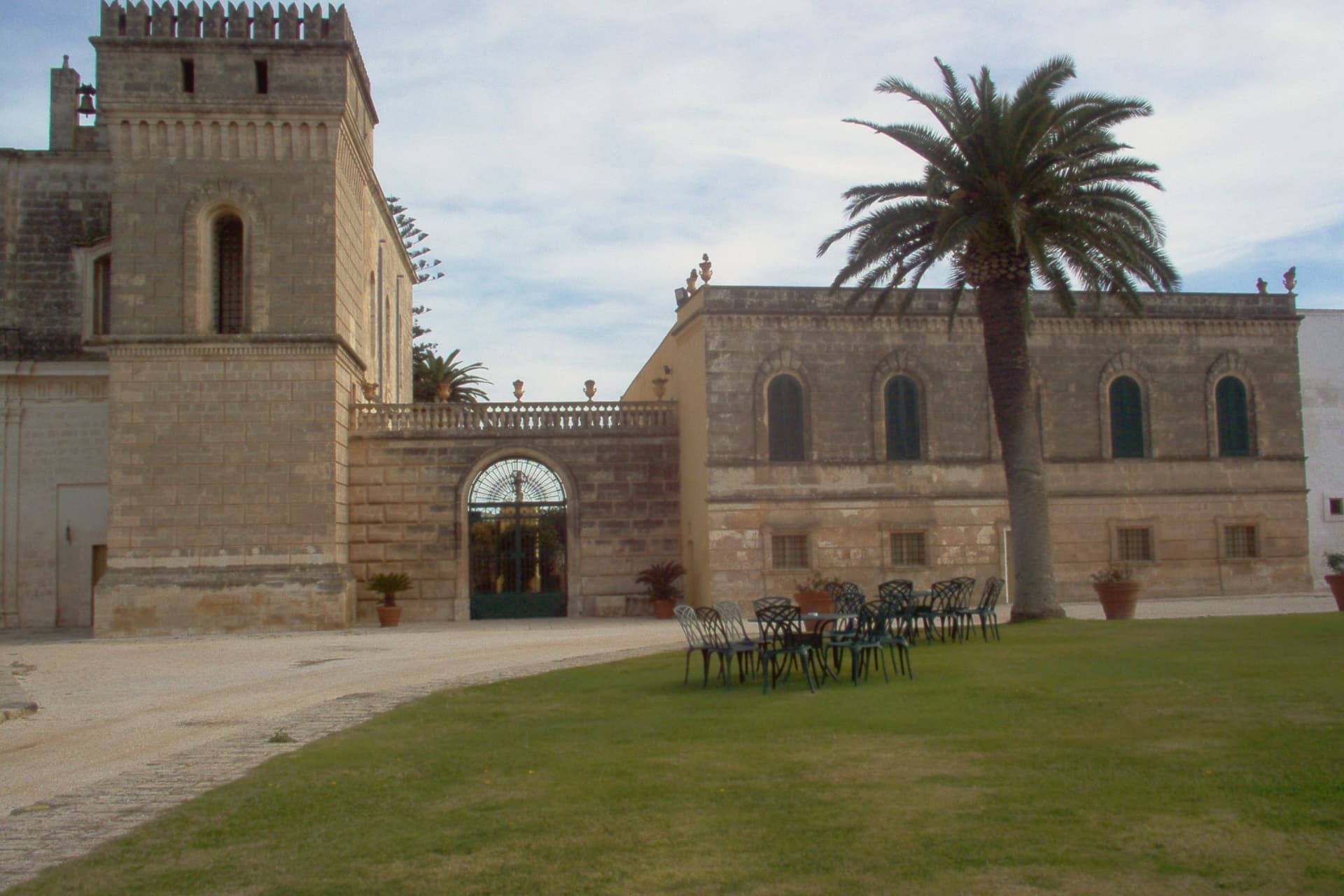
The main center sits at 118 meters, a hinge point in a wide municipal territory that runs from the Adriatic shore up to the Itria escarpment, home to thirty-eight thousand residents spread across three distinct landscapes rather than one compact town. The coast holds the abandoned city, inhabited from the fifteenth century BC and left empty by the Middle Ages, its excavated stone now sitting a short distance from the museum built to house what came out of the ground there.
Inland and uphill, the wooded escarpment climbs to become the highest ground in the province, the same slopes that carry the wildlife park across its carob and olive scrubland. Further along the shore, the fishing port turned resort gives the territory its beach frontage.
The pattern is coastal city, wooded highland, coastal resort, three pieces of a single municipality that never behaves like a single place. What the town offers is that range within one boundary: Roman ruins at sea level, a panorama at the province's highest point, and a working beachfront, none of them a detour from the others.
Pentole e Provette (MICHELIN), Due Camini a Borgo Egnazia (Gambero Rosso) and Raparossa (Gambero Rosso) are listed in food guides.
What to see in Fasano
- Parco Archeologico di Egnazia. Ruins spread across eighty hectares along the coast, with the Via Traiana running through the site alongside the basilica and a cryptoporticus still traceable underfoot.
- Museo Nazionale Archeologico Giuseppe Andreassi. Museum standing next to the archaeological park, holding the objects pulled from the excavations: Messapian inscriptions, Roman finds, and material spanning the long abandonment of the city.
- Selva di Fasano. Wooded escarpment reaching between 411 and 414 meters, the ground rising from carob and olive scrub to open views that give the terrace its nickname.
How to get to Fasano
It has its own railway station. Bari is about 52 min away by road. The full route from Bari.
Our tip
May through September is the working season on this stretch of the Adriatic: warm sea, the Bandiera Blu beaches at Savelletri operating, the Selva ten degrees cooler than the coast for an evening break. July and August fill the coast with Italian holidaymakers; Egnazia exposed on the seafront is brutal between noon and three. April and October are quieter alternatives with the sea still mild, the archaeological park at its photographic best, and the olive harvest opening across the surrounding masserie.
Why visit Monopoli
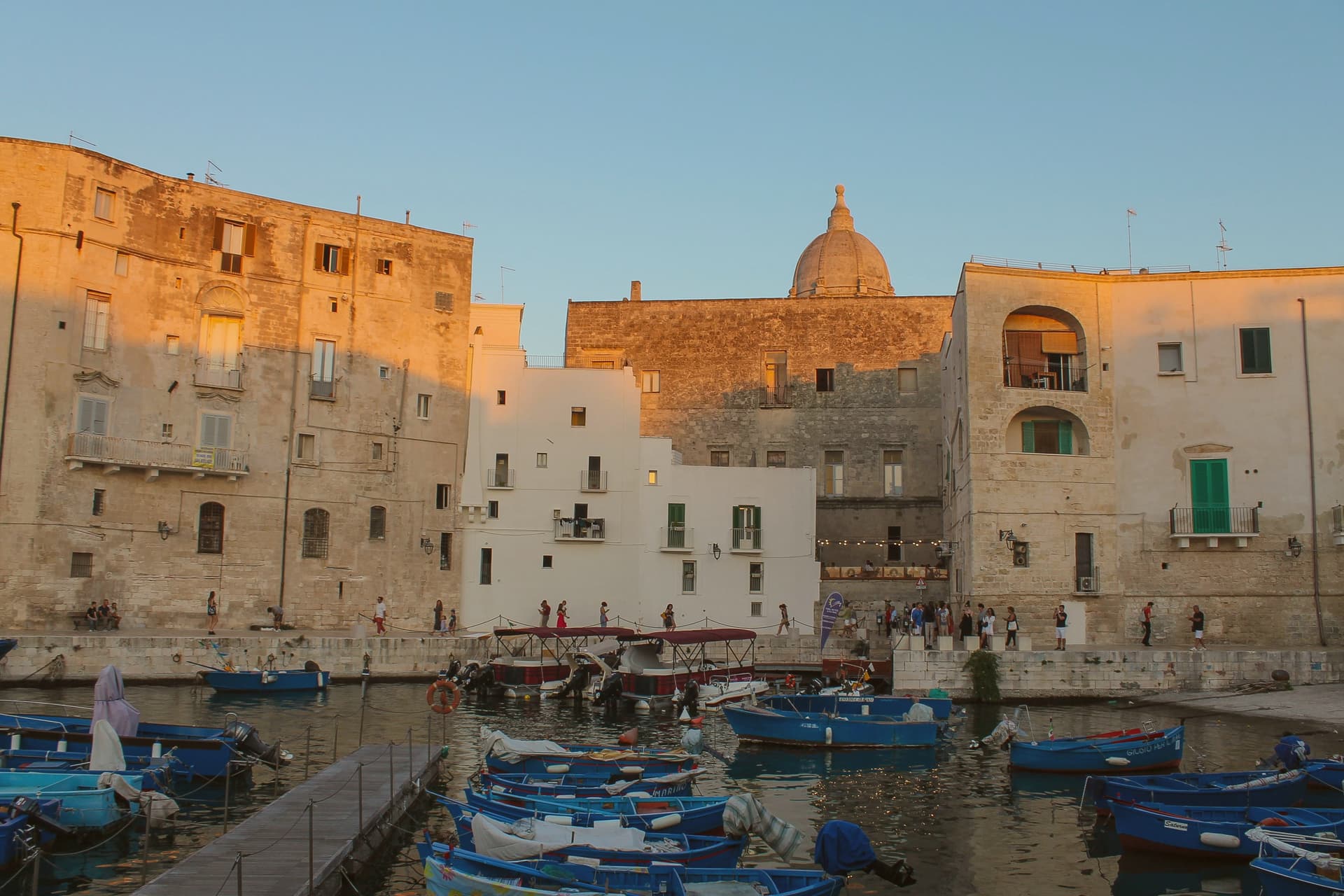
Monopoli sits on the Adriatic forty kilometers southeast of Bari, a walled town extending from the sea fifteen kilometers inland to the first Murge hills. The territory covers 156 square kilometers with sandy coves, cliff sections and the old port at the centro storico.
The site has been inhabited since the Epigravettian, around fifteen thousand years ago; a fortified Messapian settlement existed by 500 BC. The name comes from the Greek for 'only city,' which Monopoli inherited when refugees from nearby Gnatia arrived after the Ostrogoth king Totila destroyed it in 545.
Byzantines, Normans and Hohenstaufen followed. In 1484 Venice took the town and ran it as a trading port between Bari and Brindisi for sixty years.
The Castello Carlo V on the headland and the resistance to the imperial Armada in 1529, which forced the Spaniards to abandon a three-month siege, both belong to that century of fortification.
Radimare (MICHELIN), Orto (MICHELIN and Gambero Rosso), My Wine il piacere del palato (Gambero Rosso) and 1 more place are listed in food guides.
What to see in Monopoli
- Castello Carlo V. Sixteenth-century pentagonal fortress on the headland above the old port, built by the Spanish to defend against Ottoman raids and Venetian return.
- Basilica Cattedrale Maria Santissima della Madia. Eighteenth-century baroque cathedral on the old town's central square, raised over earlier medieval foundations, the city's principal monument.
- Centro storico. Walled old town on the small headland, white limestone alleys, the cathedral and the castle facing each other across narrow lanes above the port.
How to get to Monopoli
It has its own railway station. Bari is about 42 min away by road. The full route from Bari.
Our tip
May through September is the working coastal season, water warm enough for swimming and the old port quay populated until late. July and August push past thirty-three degrees and the centro storico fills with day-trippers from Bari and Polignano; weekends in August are shoulder to shoulder along the quay. June and September are the sane choices, mild evenings and the same water without the crush.
Why visit Trani
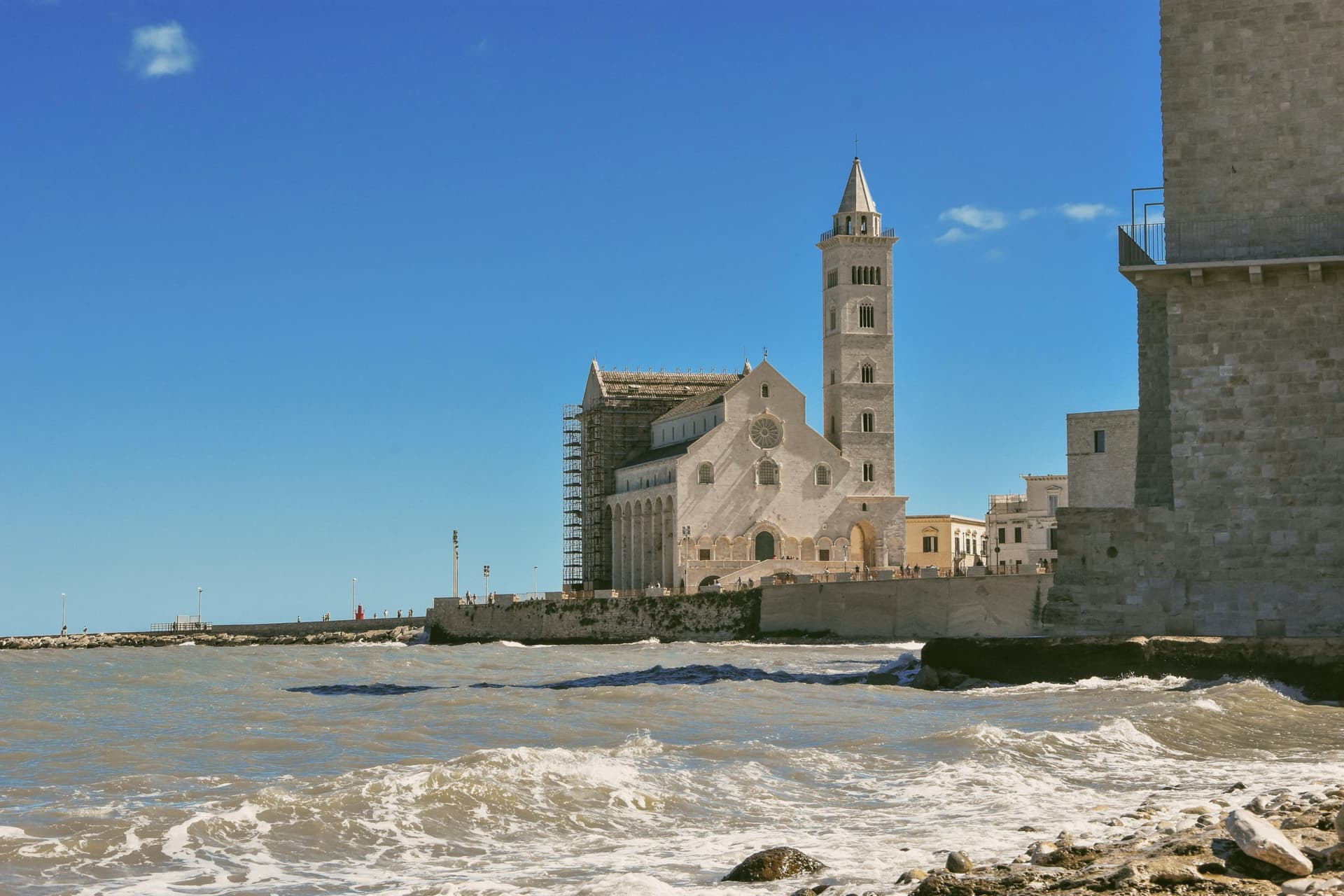
Trani sits on the Adriatic forty-five kilometers west-northwest of Bari, one of the three capitals of the Barletta-Andria-Trani province. The cathedral is the reason most travelers come.
Dedicated to Saint Nicholas the Pilgrim, a Greek who died in Trani in 1094, the church was begun in 1159 and built from the local calcareous tuff that quarries pink-white almost to the point of looking bleached. The fifty-nine-meter bell tower was finished in the fourteenth century; the central bronze door is a 1175 work by Barisano da Trani.
The Castello Svevo on the same harbor was built by Frederick II between 1233 and 1249 to guard the roadstead. Trani's eleventh- and twelfth-century maritime republic linked the Crusader Adriatic to the East and produced the Ordinamenta maris, one of the earliest western sea codes.
The cathedral square at dusk, sea on one side and Castello Svevo on the other, is the photograph.
Quintessenza (MICHELIN and L'Espresso), Casa Sgarra (MICHELIN and Gambero Rosso), Il Melograno (MICHELIN) and 4 more places are listed in food guides.
What to see in Trani
- Cattedrale di San Nicola Pellegrino. Romanesque cathedral begun in 1159 on a sea-edge platform, built of local pink-white tuff, with a fifty-nine-meter bell tower and the 1175 bronze door by Barisano da Trani.
- Castello Svevo. Frederick II fortress of 1233-1249 on a rock at the center of the harbor, designed by Filippo Cinardo, later a royal court seat and provincial prison until 1974.
- Porto e lungomare. Working fishing harbor lined with palazzi and trattorie, with the cathedral at one end and the Castello Svevo at the other.
How to get to Trani
It has its own railway station. Bari is about 38 min away by road. The full route from Bari.
Our tip
May, June, September and October are the easiest months on the harbor: warm without humidity, the cathedral square workable from morning into the evening, the Adriatic still swimmable. July and August are hot and busy, with cruise day-trippers and weekend Bari traffic taking the port. The fish auction at the molo continues through the summer; the local moscato bottling runs from August into September.
Why visit Matera
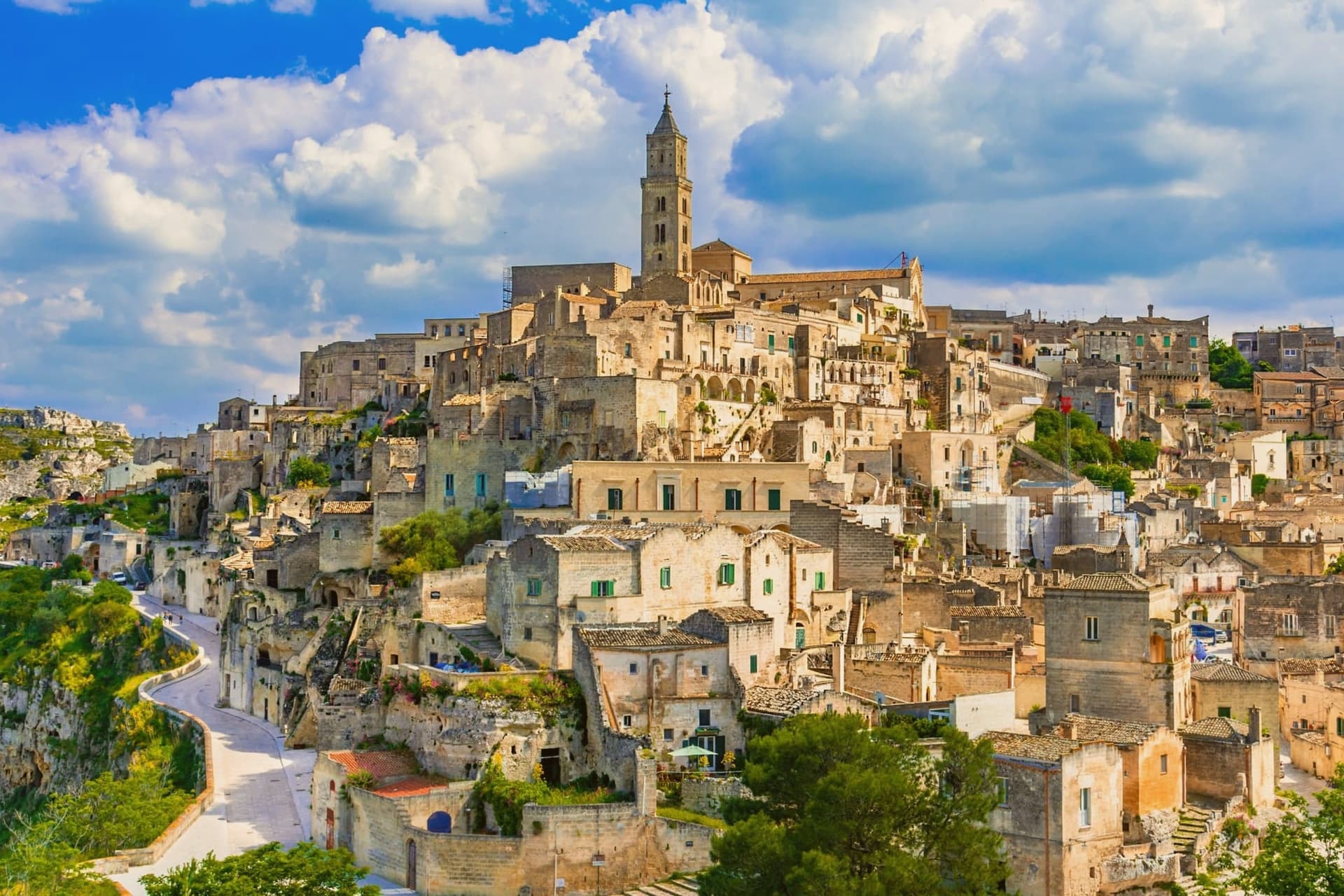
Matera sits at 401 meters on the edge of the Gravina ravine in eastern Basilicata, fifty-five kilometers inland from Bari. The Sassi, two districts of houses, churches and cisterns hollowed from tufa limestone, are among the oldest continuously inhabited settlements on earth, with traces of human presence from the Paleolithic.
Sasso Caveoso and Sasso Barisano dropped down the canyon walls; people lived there with their animals into the 1950s. Carlo Levi's 1945 book and the 1948 photographs that followed turned the Sassi into a national scandal, and a 1952 law moved twenty thousand residents to new housing on the plateau above.
The caves stayed empty for thirty years. UNESCO listed them in 1993.
Mel Gibson shot The Passion of the Christ here in 2004 and the city was European Capital of Culture in 2019; No Time to Die filmed in the Sassi in 2019, bringing twelve million euros into the local economy. Bread, ceramics, and rock churches across the Gravina anchor what is now Basilicata's only mass-tourism destination.
Vitantonio Lombardo (MICHELIN and L'Espresso), Baccanti (MICHELIN and Gambero Rosso), Dimora Ulmo (MICHELIN and L'Espresso) and 9 more places are listed in food guides.
What to see in Matera
- Sassi di Matera. Two districts of cave dwellings, Sasso Caveoso and Sasso Barisano, carved from tufa limestone and inhabited continuously from the Paleolithic until the 1950s evictions.
- Cattedrale della Madonna della Bruna e di Sant'Eustachio. Thirteenth-century Apulian Romanesque cathedral on the highest point of the Civita, between the two Sassi, with rose window and bell tower.
- Chiese rupestri del Parco della Murgia. More than 150 rock-cut churches scattered across the Gravina canyon, frescoed between the eighth and thirteenth centuries by Italo-Greek monks.
How to get to Matera
It has its own railway station. Bari is about 1 h away by road. The full route from Bari.
Our tip
April through June and September into October are the months Matera was built for. The light slants across the tufa façades in the late afternoon and turns the Sassi gold. July and August are punishing: temperatures cross thirty-five degrees and the canyon walls hold the heat past midnight, though hotels stay full because the Bond and Gibson tourism waves have not subsided.
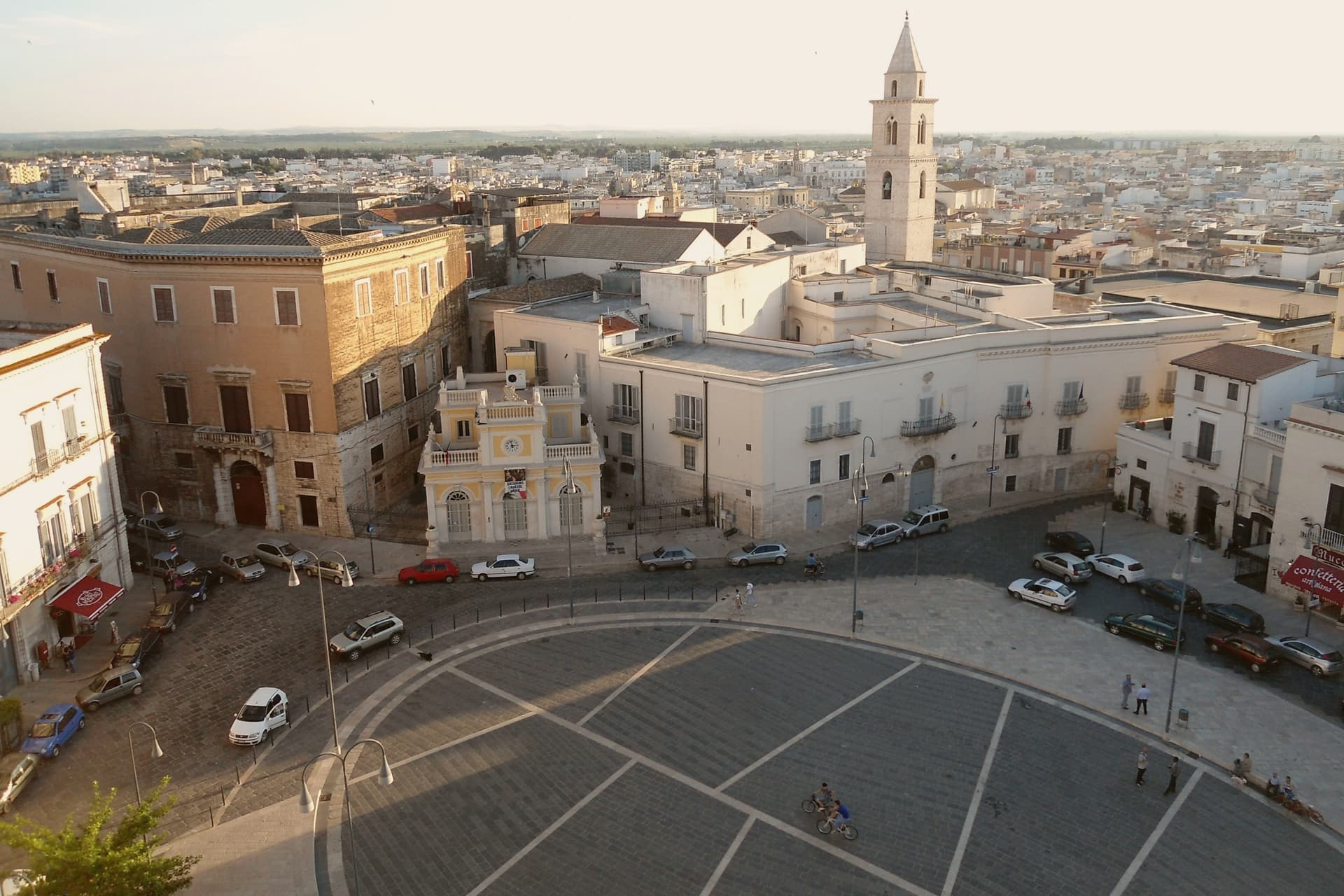
Why visit Andria
Andria sits on the Murge plateau at 151 meters, ten kilometers from the Adriatic, the third-largest city in Puglia after Bari and Taranto. It was made a fortified civitas in 1046 under Peter the Norman, with twelve towers, three gates and a citadel; Frederick II raised it again in the thirteenth century and built his most famous castle on a hilltop eighteen kilometers south of the city walls.
The city and Castel del Monte read as two expressions of the same Frederician ambition, one a working civitas of towers and gates, the other a solitary geometric exercise on an open plateau with no town around it at all. The other claim Andria makes is burrata, invented around the early twentieth century by the Bianchino family as a way to use leftover mozzarella scraps.
A fortified city, an unfinished castle, and a cheese born from kitchen thrift: the Murge produced a walled seat of power and, separately, an object meant to be looked at rather than defended, and a food born of nothing more than not wanting to waste the scraps.
Confetteria Mucci Giovanni con annesso Museo del Confetto (Locali Storici), Antichi Sapori (MICHELIN and Slow Food) and Il Turacciolo (MICHELIN) are listed in food guides.
What to see in Andria
- Castel del Monte. An octagonal prism with eight octagonal towers, standing alone on a Murge hilltop and visible for fifty kilometers in any direction. Never finished, never used for war.
- Cattedrale di Santa Maria Assunta. Romanesque cathedral founded in the twelfth century, rebuilt over the centuries, holds the crypt and the relics of San Riccardo, the city's patron.
- Chiesa di Sant'Agostino. Gothic-Romanesque church built by the Teutonic Knights in the late thirteenth century, with a sculpted portal that is one of the finest in Puglia.
How to get to Andria
It has its own railway station. Bari is about 1 h 3 min away by road. The full route from Bari.
Our tip
April through June and September through October are the Murge months: clear light, mild evenings, the Castel del Monte plateau walkable without sweat. July and August hit thirty-six in the city and the castle exposed at 540 meters is brutal between noon and four. October is the olive harvest.
Read a sample letter
A detour with a fixed race
Letters from the towns we visit. Free.
The button takes you to the letter's own page on Substack, where you leave your email. About the letter
More from Anywhere Italy
- The best olive oil towns that eat well within 90 minutes of BariNear Bariolive oilwithin 90 mineats well6 towns · smallest 19,366 residents · closest 31 min away
- The best towns that eat well in the province of BariBari provinceeats well6 towns · smallest 10,248 residents
- The best coastal towns you can reach by train within 90 minutes of BariNear Baricoastalby trainwithin 90 min6 towns · smallest 17,531 residents · closest 31 min away
- The best hill towns you can reach by train within 90 minutes of BariNear Barihill townby trainwithin 90 min9 towns · smallest 6,022 residents · closest 22 min away
- The best coastal towns with a serious restaurant in PugliaPugliacoastalserious restaurant8 towns · smallest 4,283 residents
- The best olive oil towns with a serious restaurant in PugliaPugliaolive oilserious restaurant9 towns · smallest 8,171 residents