
The 10 best hill towns with a serious restaurant in Puglia
Away from the water, Puglia goes up. The Murge plateau lifts in dry limestone terraces, walled with stones cleared from the fields and planted with olives old enough to have gone hollow. The towns on top are built from the same pale stone, cut into vaults and barrel ceilings and courtyards that hold the cool through August. This is the country of podolica beef and lamb over embers, of burrata carted in from the dairies at dawn, of orecchiette pressed with a thumb, of Primitivo and Nero di Troia poured young and dark, and of kitchens that have quietly outgrown the trattoria label.
Most people meet Puglia on the coast. Polignano a Mare, with its houses on the cliff above the cove, absorbs an enormous share of the summer, and the road along the Adriatic between there and the Salento beaches moves slowly from June until September. It is a fine coast and the crowds are not a mystery. But the lunch queue and the parking situation are part of the deal, and the best cooking is not necessarily happening within sight of the sea.
Turn inland and the same produce, the same stone and the same cellars carry on across the hills. The trulli country, the Valle d'Itria and the ridge towns of the Alta Murgia all sit within an easy drive of the water, and fewer people make the turn. The towns gathered here are the inland ones, each with a dining room that the most demanding of the guides has judged worth the detour, which in Puglia usually means somewhere doing something exact with ingredients from within sight of the door.
Of the 59 communes we have mapped in Puglia, 10 qualify as hill towns with a serious restaurant: each is an inland hill settlement, and each holds a restaurant listed by the most demanding of the guides. The smallest, Minervino Murge, has 8,171 residents.
Elsewhere in the catalogue: The best olive oil towns with a serious restaurant in Puglia and The best towns with a serious restaurant that sit inside a nature park in Puglia.
Minervino Murge
Why visit Minervino Murge
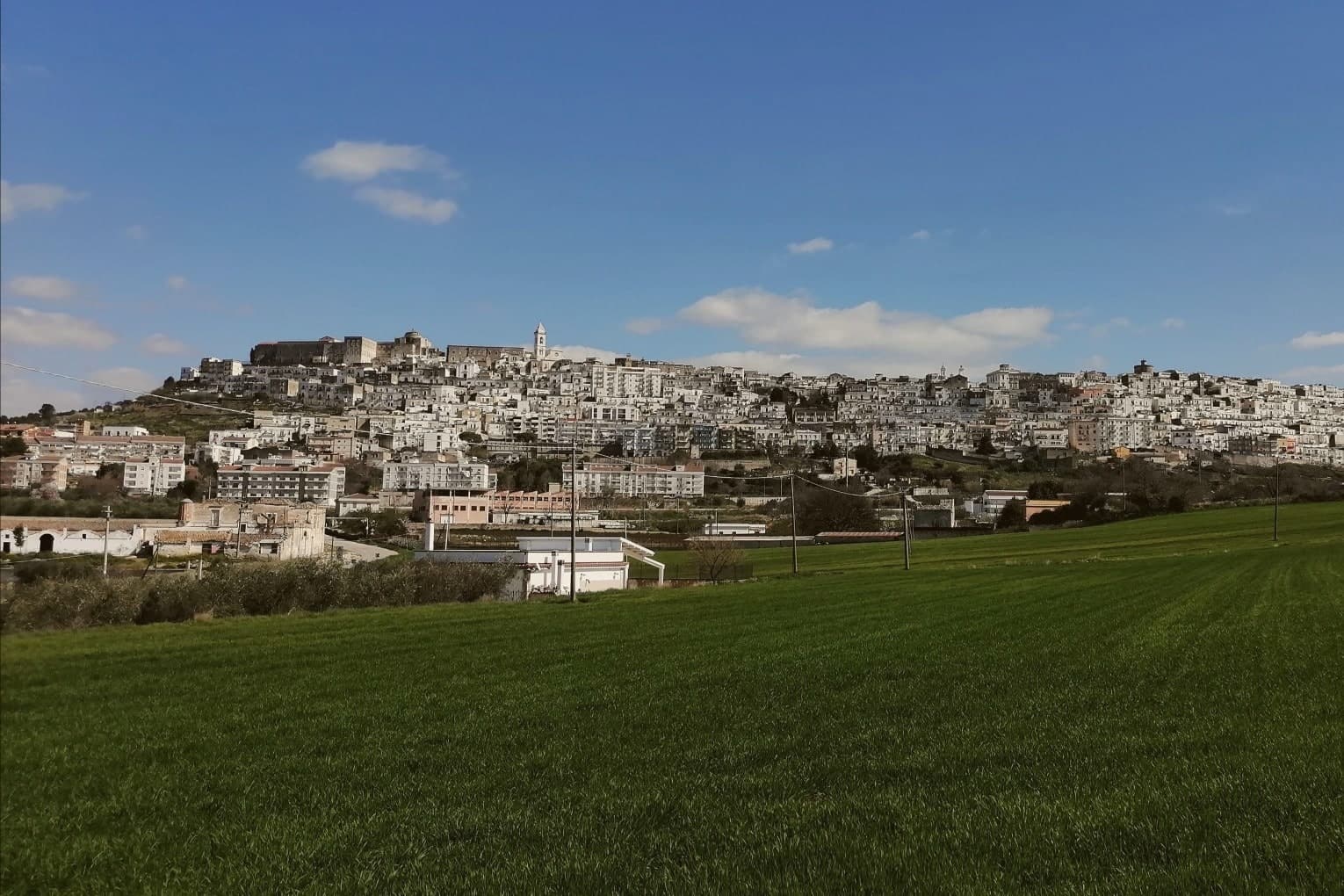
The town is built on two hills at the western edge of the Murgia plateau, where the limestone tableland gives out and the ground drops toward lower country on three sides. That break is what gives the ridge its long view and its nickname: to the east the eye crosses Murgia limestone toward the Gargano and the Adriatic, to the west it crosses cultivated fields into Basilicata, and to the north it runs the length of the Ofanto valley.
The old town sits above this drop, castle and tower on the high ground, cathedral below, the settlement organized around the same ridge that draws the view. Olive oil, almonds and grain define the rural economy beyond the walls, the plateau put to farming where it is not left to steppe grass and karst.
A ridge town, in other words, whose whole character, defensive site, pilgrimage cave, farmed hinterland, follows from the one geological fact of where the plateau ends.
La Tradizione - Cucina Casalinga, Masseria Barbera, A Sud dell'Anima have been named by a guide.
What to see in Minervino Murge
- Castello Normanno-Svevo. Norman fortress remodeled in the baronial period, with surviving towers and bastions on the high ridge above the old town.
- Torre di Pirro del Balzo. Fifteenth-century tower built between 1460 and 1490 when Minervino came to Pirro del Balzo as part of Maria Donata's dowry.
- Grotta di San Michele. Cave formed roughly two million years ago, reached through the karst rather than built, and still kept as a place of pilgrimage rather than display.
How to get to Minervino Murge
There is a railway station in the town, so you can arrive without a car and never need one while you are here. Foggia is roughly 62 minutes away by road.
Our tip
April through June and September through October are the months the Alta Murgia plateau runs best. The wildflower steppe peaks in May, almond blossom comes earlier in February, and the Ofanto valley below stays mild through autumn. July and August push past thirty-five degrees on the limestone with little shade; the centro storico empties between two and five and the panoramic belvedere is best at dawn or dusk.
Alberobello
Why visit Alberobello
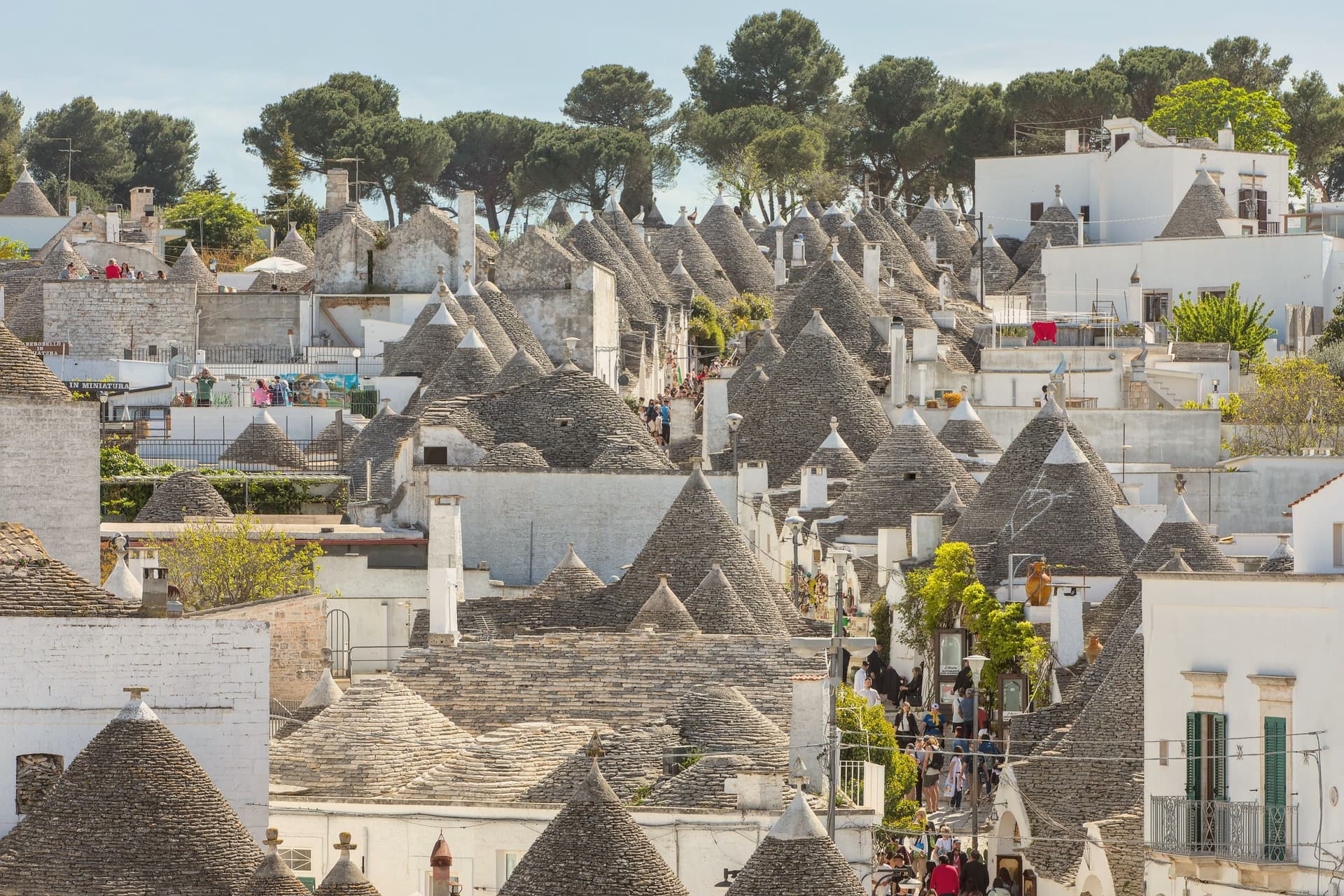
Alberobello sits at 402 meters in the Valle d'Itria, forty-five kilometers southeast of Bari. Two quarters of the town, Rione Monti and Aja Piccola, hold more than 1,500 trulli: limestone cones built from corbelled drystone, with conical or pyramidal roofs piled course by course without mortar.
The technique is prehistoric and still in use across the Murge, but nowhere else is the density and preservation what it is here. The Counts of Conversano enforced drystone construction on their tenant farmers to dodge a Spanish viceroy's tax on permanent settlements: a building that could be dismantled in an afternoon did not count as a town.
UNESCO listed the trulli in 1996. Some are houses, some are shops, some are inhabited by the same families that built them.
The Trullo Sovrano, the only two-storey trullo, was built around 1750 and now functions as a small museum.
Evo Ristorante have been named by a guide.
What to see in Alberobello
- Rione Monti. The larger of the two trulli quarters, a thousand cones running down the hillside, mostly converted to shops and accommodation.
- Aja Piccola. The smaller residential quarter, about four hundred trulli, still occupied as primary housing and quieter than Rione Monti.
- Trullo Sovrano. The only two-storey trullo in town, built around 1750 by the Perta family, now a small museum of trullo construction and daily life.
How to get to Alberobello
There is a railway station in the town, so you can arrive without a car and never need one while you are here. Taranto is roughly 56 minutes away by road.
Our tip
April through June and September through October are the months the Itria valley is green and the trulli are walkable without sweat. July and August push past thirty-three degrees and the Rione Monti fills with day-trippers from the coast; by ten in the morning the main streets are shoulder to shoulder. Late afternoon and after dusk are the times to walk, when the cones cast long shadows and the crowds thin.
Conversano
Why visit Conversano
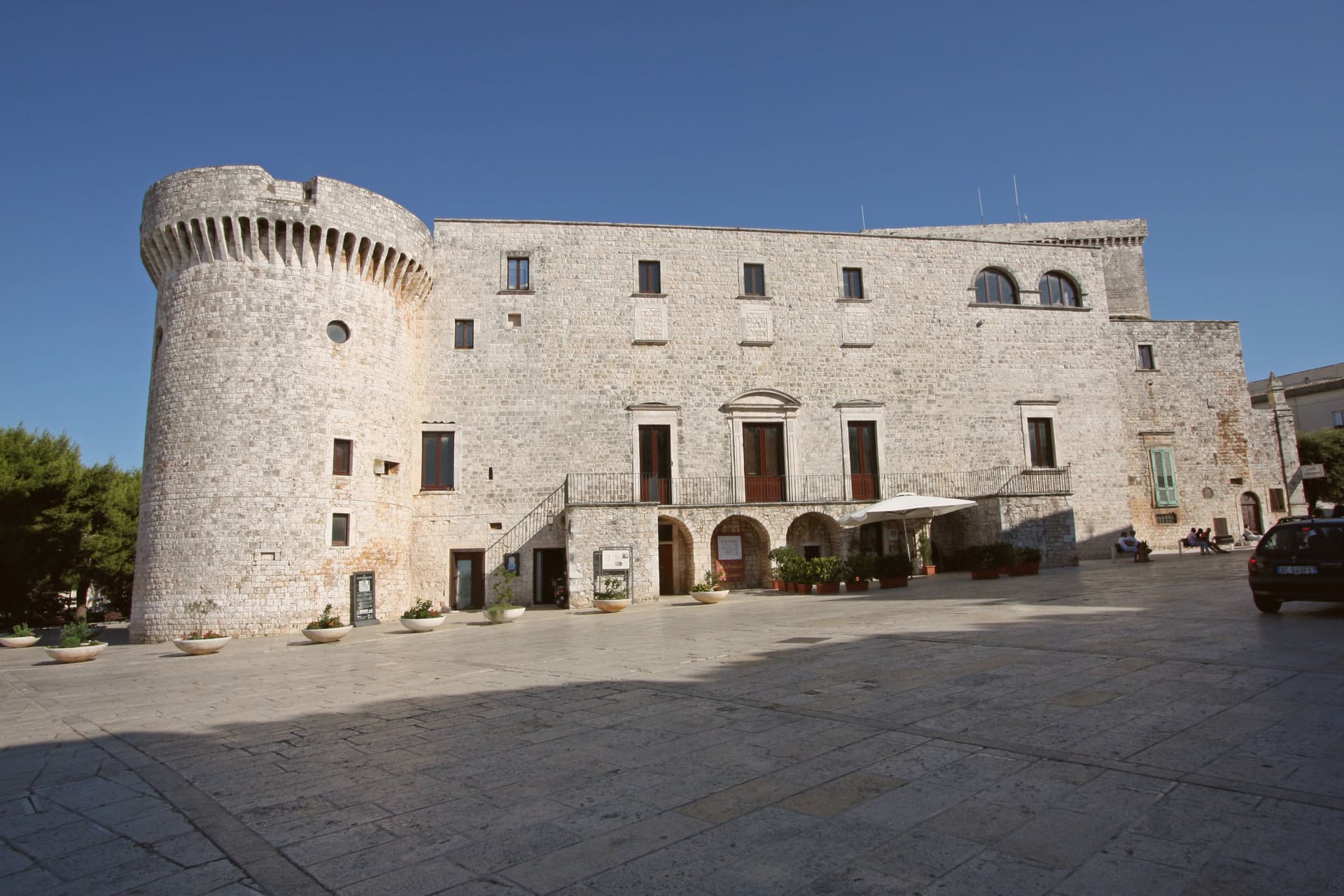
Conversano sits on the first hills of the Murge plateau at 219 meters, twenty-five kilometers southeast of Bari and seven from the Adriatic. The Castello di Conversano was raised around 1054 by the Normans for defence and turned into a seigneurial residence by the Acquaviva d'Aragona counts, who ruled from 1455 until the early nineteenth century.
Inside the castle the Pinacoteca holds the ten-canvas cycle of episodes from Tasso's Gerusalemme Liberata painted by Paolo Domenico Finoglio in the 1640s, commissioned by Count Giangirolamo II d'Acquaviva. Opposite the castle stands the Cattedrale di Santa Maria Assunta, eleventh- and twelfth-century Apulian Romanesque with a sculpted portal, a rose window, and an interior Crucifix that anchors the patronal procession.
The former Monastero di San Benedetto, with a Romanesque cloister, was entrusted in 1266 by Pope Clement IV to Cistercian nuns exiled from Methoni in Greece, an arrangement so unusual it earned the monastery the medieval nickname Monstrum Apuliae, the Wonder of Puglia.
Vita Pugliese have been named by a guide.
What to see in Conversano
- Castello di Conversano. Norman castle of 1054 turned seigneurial residence by the Acquaviva d'Aragona counts, with the Pinacoteca holding Finoglio's ten Gerusalemme Liberata canvases.
- Cattedrale di Santa Maria Assunta. Apulian Romanesque cathedral of the eleventh and twelfth centuries, sculpted portal, rose window, wooden Crucifix venerated as the city's protector.
- Monastero di San Benedetto. Former Benedictine then Cistercian monastery with Romanesque cloister, called Monstrum Apuliae for the abbess-power of the Greek nuns entrusted to it from 1266.
How to get to Conversano
There is a railway station in the town, so you can arrive without a car and never need one while you are here. Bari is roughly 36 minutes away by road.
Our tip
April through June and September through October are the Murge months at this altitude: clear light, mild evenings, the cherry orchards in flower or fruit. Conversano is the centre of the IGP cherry zone and the late-May ciliegia harvest is the year's commercial peak. July and August hit thirty-five degrees and the centro storico empties in the afternoon.
Putignano
Why visit Putignano
The town sits on the Murgia, the karst plateau between Bari and Lecce, at 372 metres, home to just under 26,000 people. The carnival's origin is tied to a specific piece of geography: a Benedictine confraternity carried the relics of Santo Stefano inland from the coast at Monopoli to escape Saracen raids, arriving on 26 December 1394.
Farmers moving grapevines in the same December procession began singing satirical verses, and that song is what survives today as le Propaggini, still the opening event every 26 December. The carnival that grew from it ran across 631 years of plagues, wars, fascism, and pandemics without a break, which is the basis of its claim to being the oldest in Europe.
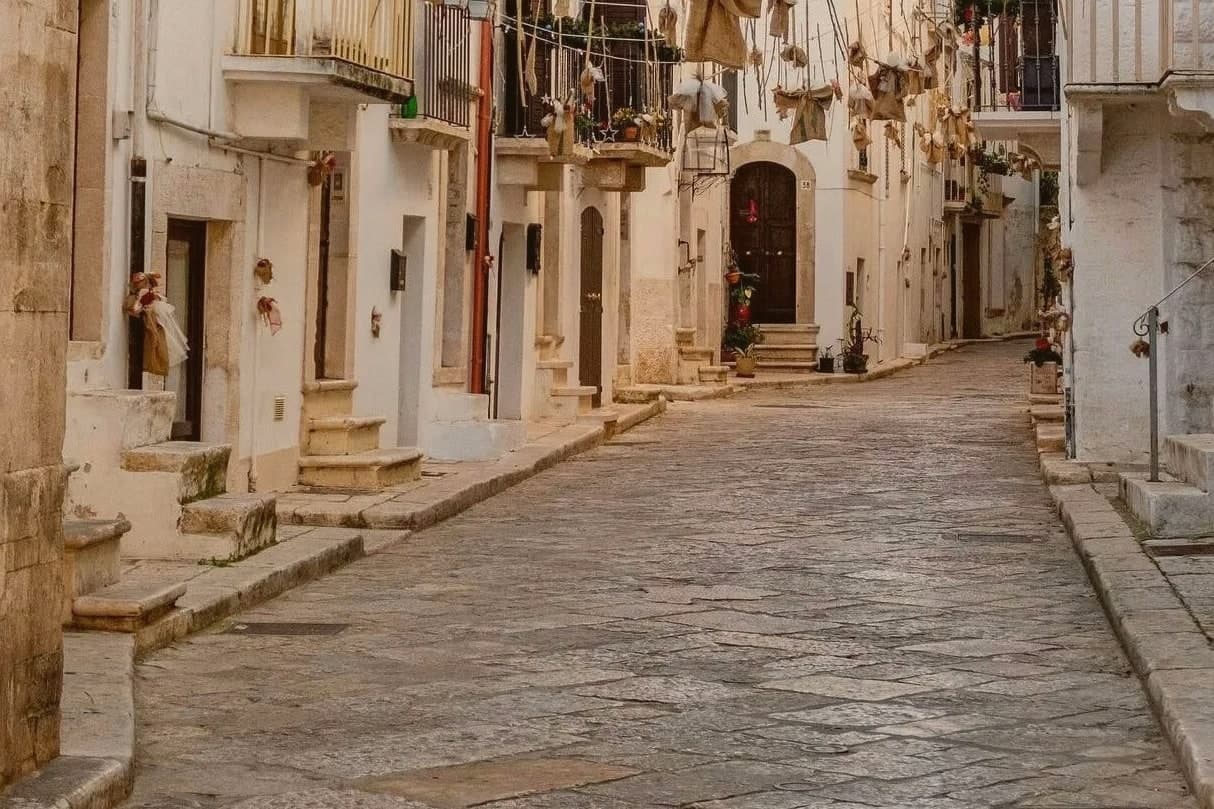
Inside the centro storico the old and the underground meet directly: a karst cave system opens beneath a Trullo-roofed building right in the middle of town, its entrance inside the old centre rather than out on the plateau, with stalactites and a section that served as a WWII refuge shelter. The Chiesa Madre di San Pietro Apostolo, a restored Romanesque church with a 16th-century crypt, anchors the same central piazza as the Palazzo del Balì, and stretches of the medieval walls still hold their line nearby.
The kitchen draws on the same plateau and its neighbours: focaccia barese, orecchiette con cime di rapa, capocollo from the next town over, Primitivo di Manduria carried in from 80 km south, and farinella, the sweet polenta cake made with grape must and chickpea flour that belongs specifically to the carnival calendar. What holds the town together is continuity: a religious procession that turned into satire and has not stopped since, a centre small enough that the cave, the church, and the workshops all sit within a short walk of each other, and a plateau setting that feeds both the table and the traffic passing through toward Alberobello and the Valle d'Itria.
Angelo Sabatelli, Botteghe Antiche have been named by a guide.
What to see in Putignano
- Carnevale di Putignano (Dec 26 – Shrove Tuesday). Five Sunday float processions run from January to Shrove Tuesday. Le Propaggini opens the calendar on 26 December, the Funerale del Carnevale closes it, and 365 bells ring out, one for each day until the next.
- Cartapesta workshops + Museo del Carnevale. Many of the workshops are open for visits while the floats take shape. The museum documents the full run of carnival history, plague years, wars, and fascism included.
- Grotta del Trullo. The cave sits under a Trullo-roofed building in the old centre, which is where its name comes from. Guided visits take in the stalactites and the section that served as a WWII refuge shelter.
How to get to Putignano
There is a railway station in the town, so you can arrive without a car and never need one while you are here. Bari is roughly 46 minutes away by road.
Our tip
Putignano is dominated by Carnevale — January through Shrove Tuesday (typically late January to mid-February or early March depending on Easter date) is the headline season, with the five Sunday float processions drawing 200,000+ visitors per Sunday. Book accommodation 2-3 months ahead for Carnevale weekends. Outside that, the town is best March–June and September–October — summer is brutally hot on the Murgia (frequent 38°C+) and most cartapesta workshops close August. Carnevale di Putignano falls in February.
Manduria
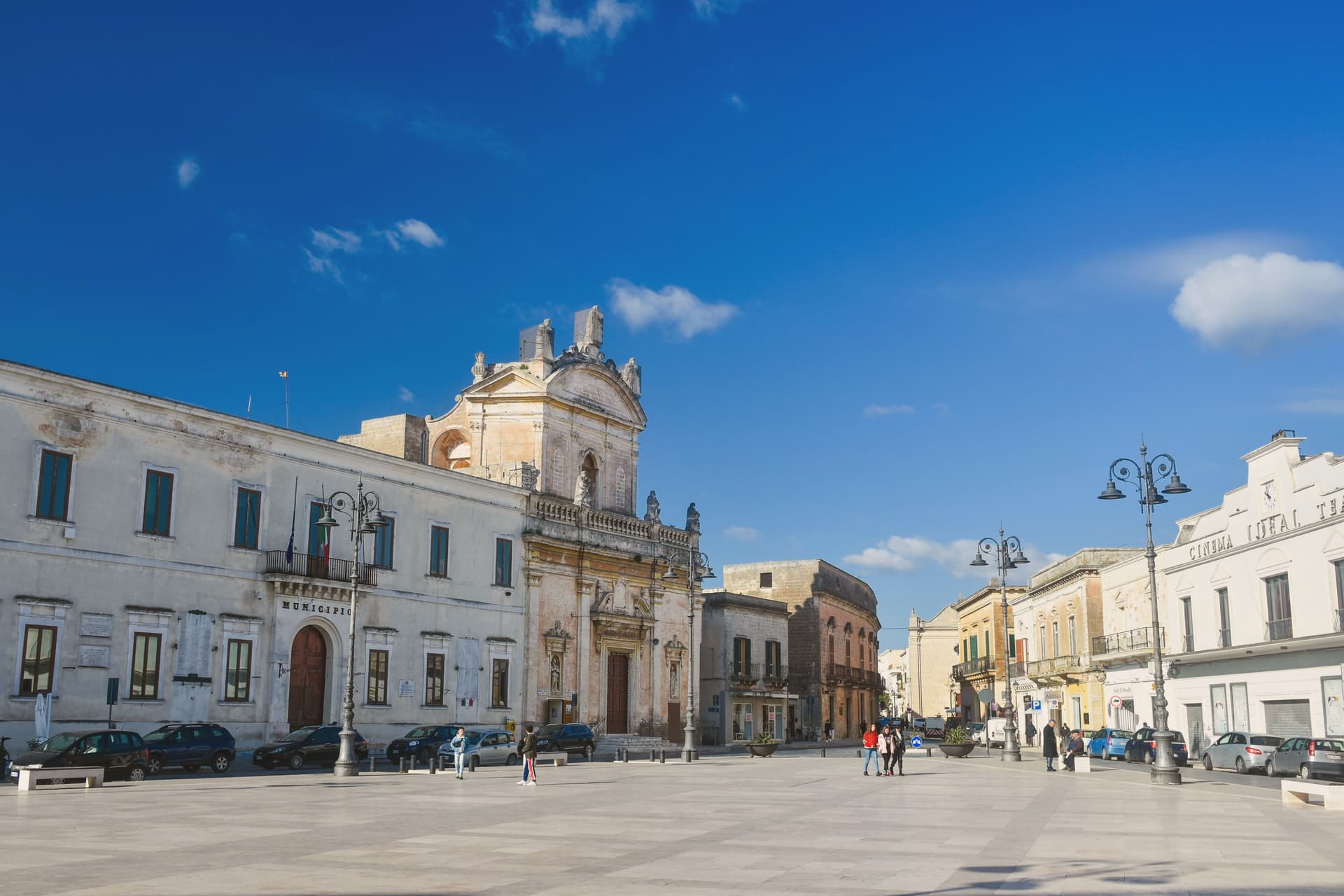
Why visit Manduria
Manduria sits at seventy-nine meters thirty-five kilometers east of Taranto, on the inland edge of the northern Salento. The town was a Messapian stronghold against Greek Taras; Archidamus III, king of Sparta, was killed under its walls in 338 BC.
The Archaeological Park preserves three concentric rings of city walls in drystone, the oldest from the fifth century BC, the middle from the fourth and an outer ring from the third century AD, more than fifteen hectares of fortification still standing. Inside the perimeter, the Fonte Pliniano is a karst cave eighteen meters across, named after Pliny the Elder, who described its constant water level in the Naturalis Historia.
The town gives its name to Primitivo di Manduria DOC, made from 100% Primitivo grapes on the surrounding clay-limestone plain. The Museum of Primitivo and the late-summer Vinitaly cellar tours bring most of the modern visitors.
The coast at San Pietro in Bevagna, fifteen kilometers south, holds the commune's Bandiera Blu beach.
Casamatta, ES Cantina&Ristorante, Gusto Primitivo del Corte Borromeo Hotel and 1 more have been named by a guide.
What to see in Manduria
- Parco Archeologico delle Mura Messapiche. Fifteen hectares of three concentric Messapian walls from the fifth to third century BC, the largest pre-Roman fortification in Salento.
- Fonte Pliniano. Karst cave eighteen meters across, described by Pliny the Elder for its water level that does not rise or fall.
- Borgo Antico. Medieval centro storico inside the inner Messapian wall, with the former Jewish quarter and the Palazzo Imperiali.
How to get to Manduria
There is a railway station in the town, so you can arrive without a car and never need one while you are here. Taranto is roughly 50 minutes away by road.
Our tip
April through June and September through October are the months the Salento inland stays workable. Olive blossom in May, Primitivo harvest in late August and September, mild evenings on the archaeological park trails. July and August push past thirty-five degrees on the limestone plain; the centro storico empties between two and five and the beaches at San Pietro in Bevagna take the heat.
Ostuni
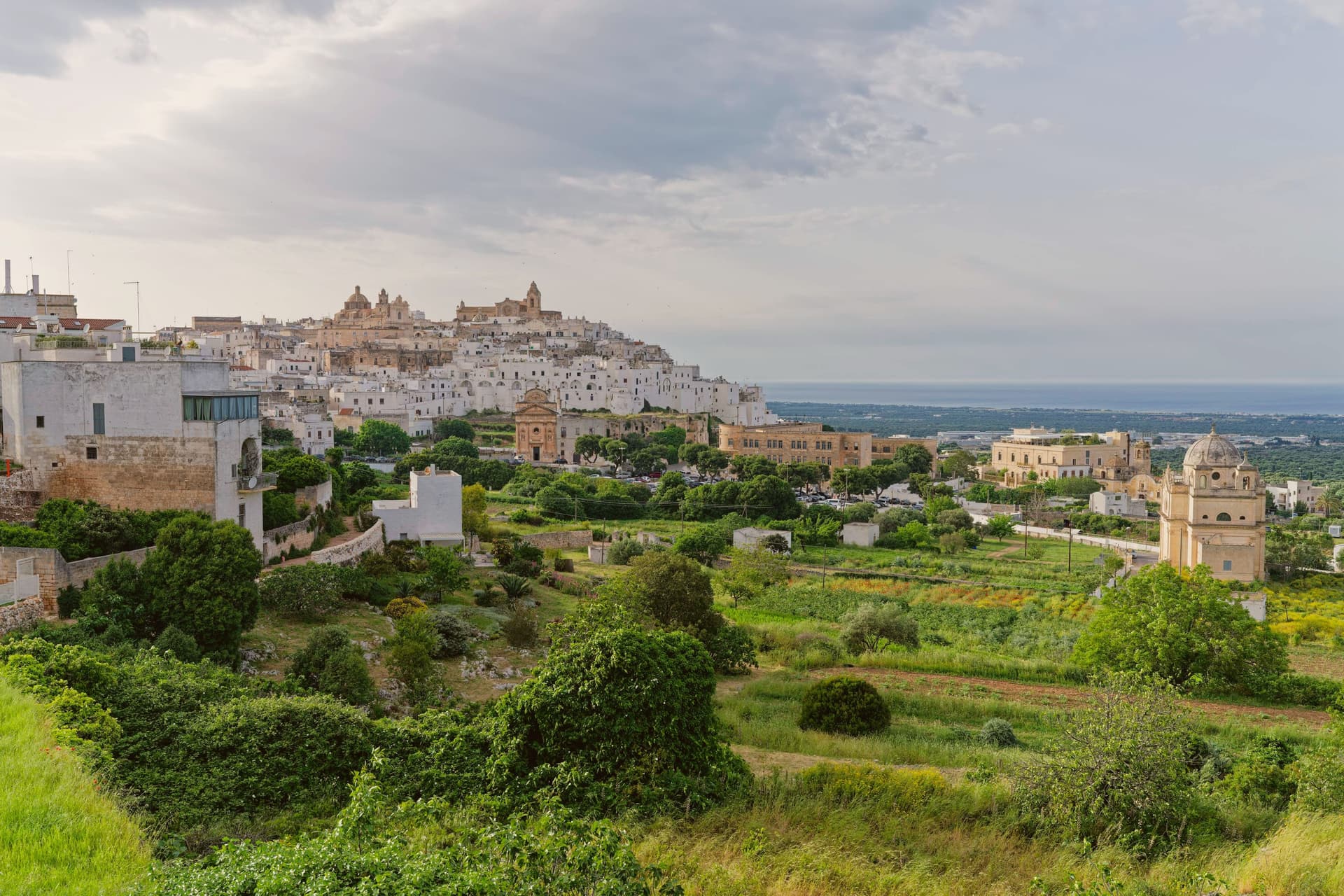
Why visit Ostuni
Ostuni sits at 218 meters on three hills above the Adriatic coastal plain, eight kilometers inland in the southeastern Murge. The whitewashing that gives it the name Città Bianca is medieval in origin, a hygienic measure against plague that survived as the local building convention; the entire centro storico is painted white in lime every spring and reads as a single bright mass from the surrounding olive country.
The territory has been inhabited since the Paleolithic; the Messapii founded the urban nucleus before the Romans absorbed the region. The town joined the Norman County of Lecce in 996.
In 1507 it passed to Isabella, Duchess of Bari, then to her daughter Bona Sforza, queen of Poland, who fortified the coast with watchtowers against Ottoman raids in 1539. The Cattedrale, a late-Gothic facade with a rose window of twenty-four rays, anchors the upper town.
The olive landscape around the commune holds some of the oldest cultivated trees in the Mediterranean.
Osteria Piazzetta Cattedrale, Cielo, Restaurant 700 and 3 more have been named by a guide.
What to see in Ostuni
- Cattedrale di Santa Maria Assunta. Late fifteenth-century Gothic cathedral at the highest point of the centro storico, with a rose window of twenty-four rays unique in Puglia.
- Centro storico. Whitewashed old town on three hills, lime-painted every spring against plague tradition, the single bright mass that names the Città Bianca.
- Piazza della Libertà. Lower civic square outside the medieval walls, with the Guglia di Sant'Oronzo, an early eighteenth-century baroque obelisk to the patron saint.
How to get to Ostuni
There is a railway station in the town, so you can arrive without a car and never need one while you are here. Taranto is roughly 64 minutes away by road.
Our tip
April through June and September through October are the months Ostuni works: olive plain in flower or harvest light, the white walls glowing in mild evenings, the Adriatic eight kilometers away warm enough for swimming by mid-May. July and August touch thirty-five degrees and the centro storico fills with day-trippers from Bari and Brindisi; weekends in August are shoulder to shoulder in the upper alleys. Late afternoon and after dusk are the times to walk, when the white walls cool and the crowds thin.
Martina Franca
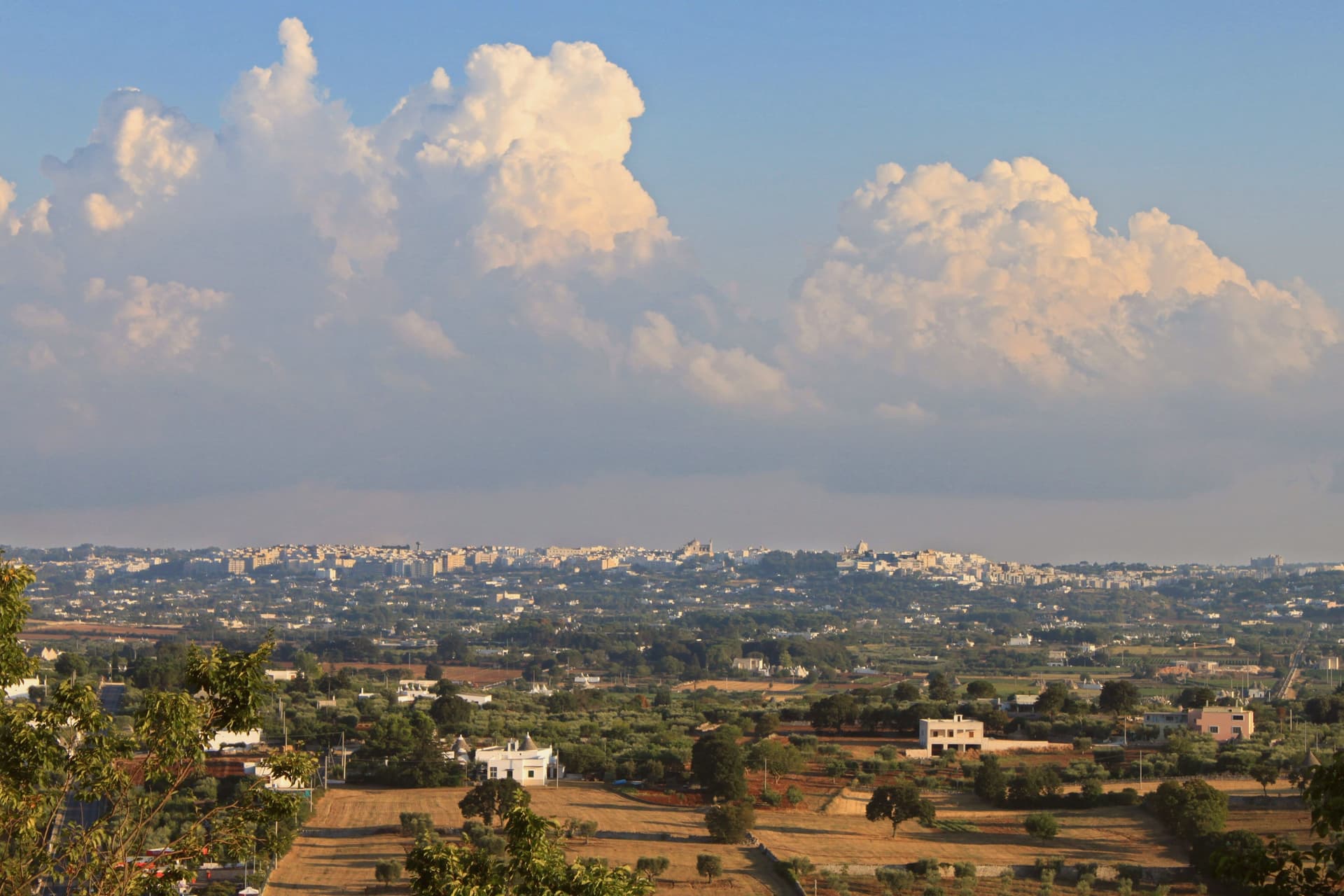
Why visit Martina Franca
Martina Franca sits at 431 meters on the southern edge of the Valle d'Itria, on the border between the provinces of Taranto, Bari and Brindisi. The town was founded in 1310 by Philip I of Anjou, Prince of Taranto, who granted franchigie, tax exemptions, to settlers willing to repopulate the hill, hence Franca in the name.
The centro storico is the densest concentration of Rococo and late-Baroque architecture in Puglia after Lecce: wrought-iron balconies, carved stone portals, churches built or rebuilt after the 1743 earthquake. The Palazzo Ducale of 1668, raised on the foundations of a 1338 medieval castle, is the seat of the municipal offices and the open-air courtyard where the Festival della Valle d'Itria has been performed every July and August since 1975, founded specifically to recover rare and forgotten operas.
The Basilica di San Martino, begun in 1747, is the most complete example of Martinese Rococo. The surrounding plateau makes a Martina Franca DOC white wine and a strong dry-cured capocollo IGP.
Bros' Trattoria, Bros', Four Seasons and 1 more have been named by a guide.
What to see in Martina Franca
- Palazzo Ducale. Built in 1668 on the foundations of a 1338 medieval castle, town hall and home of the Festival della Valle d'Itria summer opera courtyard.
- Basilica di San Martino. Eighteenth-century basilica begun in 1747 after the 1743 earthquake, the most complete Martinese Rococo monument and museum of liturgical art.
- Piazza Roma and Piazza Maria Immacolata. The two main squares of the centro storico, linked by Via Cavour, lined with eighteenth-century palazzi and the town's main passeggiata.
How to get to Martina Franca
There is a railway station in the town, so you can arrive without a car and never need one while you are here. Taranto is roughly 38 minutes away by road.
Our tip
April through June and September through October are the best months on the Itria plateau. The 431-meter elevation keeps the air dry, the limestone walls reflect a clear light, and the surrounding vineyards green up in spring then turn gold by the late September harvest. July and August are hot but mitigated by the altitude; they are also the months the Festival della Valle d'Itria runs in the Palazzo Ducale courtyard, the largest cultural draw in southern Puglia. Festa della bombetta falls in August.
San Severo
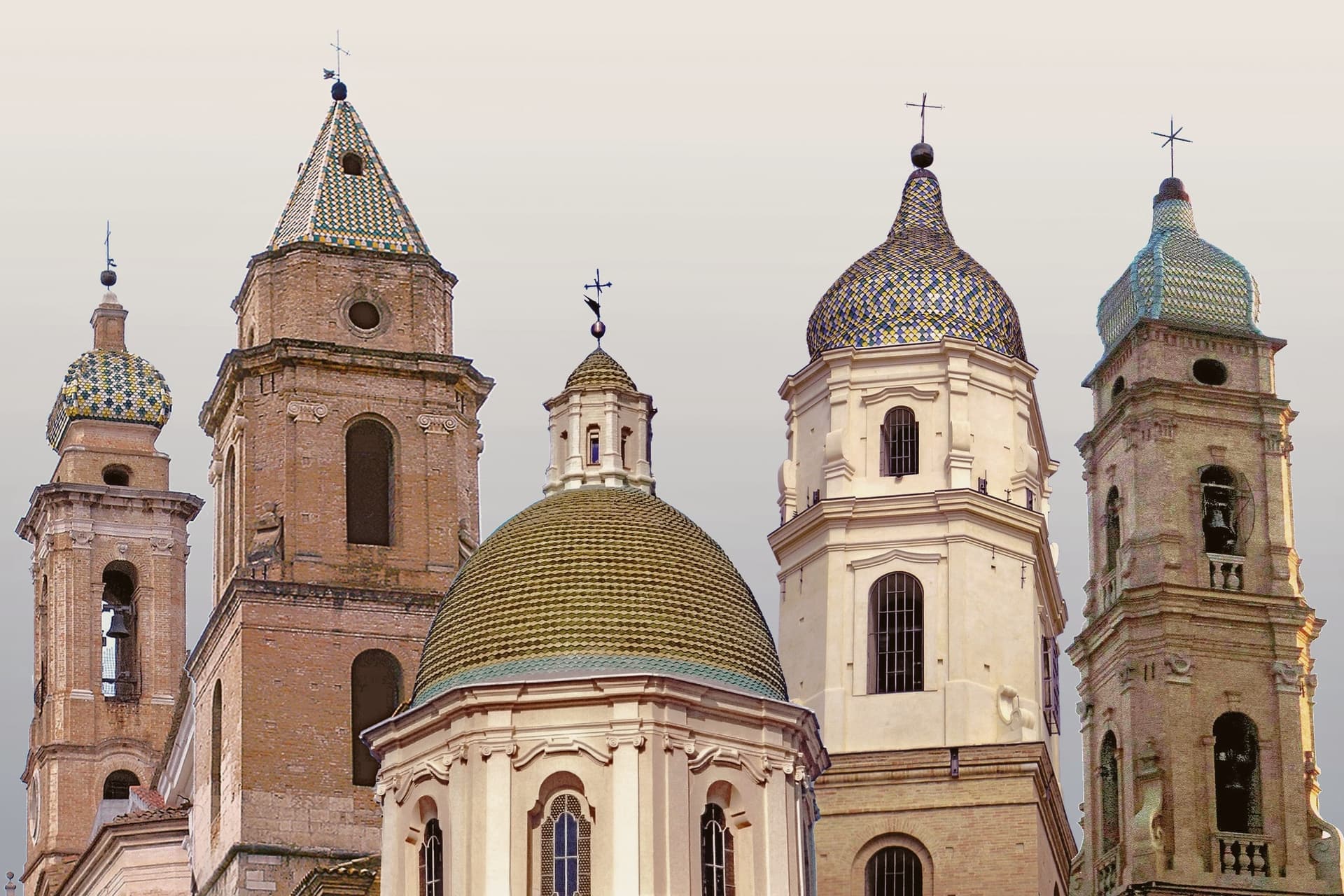
Why visit San Severo
San Severo sits at 86 meters on the Tavoliere delle Puglie, north of Foggia and inland from the Gargano. The town was founded in the eleventh century around a small church built by Benedictine monks from Montecassino, and grew through the medieval period into the capital of the upper Daunia.
The 1627 earthquake almost levelled it, killing eight hundred inhabitants and pulling reconstruction into the late seventeenth century after a plague epidemic in 1656 added three thousand more deaths. The Cattedrale di Santa Maria Assunta, originally late-medieval, was rebuilt in Baroque after the quake.
San Severo is best known nationally for its wine: the San Severo DOC, approved on 19 April 1968 by presidential decree, was the first protected designation in Puglia, with 2,000 hectares of red, white, rosé and the occasional spumante across San Severo, Torremaggiore, San Paolo di Civitate, Apricena, Lucera and Lesina. The annual Carnevale, with its rolling fanoia firework blasts, is one of the loudest in southern Italy.
La Fossa del Grano have been named by a guide.
What to see in San Severo
- Cattedrale di Santa Maria Assunta. Late-medieval cathedral rebuilt in Baroque style after the 1627 earthquake, the principal religious monument of the Daunia.
- Chiesa di San Severino Abate. Baroque basilica dedicated to the patron saint, built over the eleventh-century Benedictine foundation that gave the town its name.
- Palazzi Baroque. Eighteenth-century noble palazzi built in the post-earthquake reconstruction, lining the streets of the centro storico.
How to get to San Severo
There is a railway station in the town, so you can arrive without a car and never need one while you are here. Foggia is roughly 31 minutes away by road.
Our tip
April through June and September through October are the workable months on the Tavoliere. The vineyards of the San Severo DOC are in leaf by April and in harvest from late August through September. July and August push past thirty-eight degrees on the open plain and the centro storico empties between two and five; the Tavoliere is one of the hottest places in Puglia. Festa di San Rocco falls in August.
Lecce
Why visit Lecce
Lecce sits on the Salento plain at 49 meters above sea level, twelve kilometers inland from the Adriatic, the provincial capital. The Messapian settlement of Lupiae stood on this site by the eighth century BC.
Rome took it in the third century BC, and Hadrian later moved the settlement three kilometers away and renamed it Licea, so the modern city occupies a site distinct from either of its named predecessors. The walled centro storico is ringed by Charles V's fortifications, entered from the north through the Porta Napoli arch and anchored on its eastern edge by his castle, built over older Norman foundations.
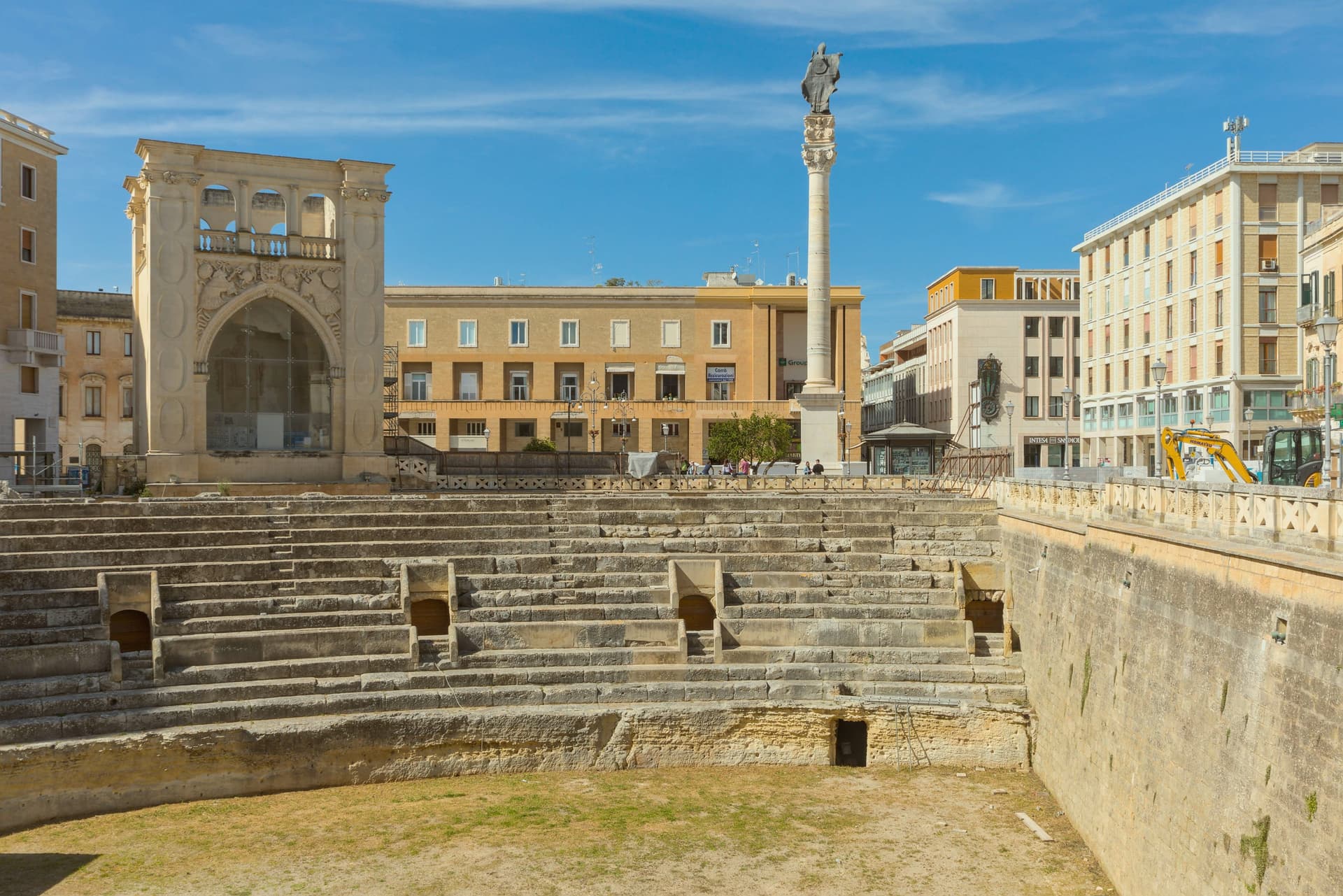
Within those walls the Baroque churches and squares sit close together, the cathedral square closed in on three sides while the amphitheater lies open and half-sunk in the middle of the newer square that formed around it. The University runs a strong humanities program, and the seafront at San Cataldo, some distance from the old center, carries Lecce's Bandiera Blu.
What holds the town together is the stone itself: soft enough to carve finely, hard enough once cut to last, so that a Messapian and Roman settlement site became, centuries later, the surface on which the south's most elaborate Baroque was cut.
Primo Restaurant, Duo Ristorante, Gimmi Restaurant and 11 more have been named by a guide.
What to see in Lecce
- Basilica di Santa Croce. Worked for nearly two hundred years to completion in 1695, the façade carved with cherubs, monsters and allegories layered so densely that the wall surface almost disappears beneath them.
- Piazza del Duomo. Closed on three sides, the only enclosed cathedral square of its kind in Puglia, gathering the Duomo, Campanile, Bishop's Palace and Seminary into one shared courtyard rather than an open street front.
- Piazza Sant'Oronzo. The city's central square, built around a column brought from the Appian Way to honor the patron saint, with the excavated amphitheater floor sitting below street level at its edge.
How to get to Lecce
There is a railway station in the town, so you can arrive without a car and never need one while you are here. Taranto is roughly 95 minutes away by road.
Our tip
April through June is the green window in inland Salento, with the centro storico walkable in the day and aperitivo on Piazza Sant'Oronzo running late. July and August push past thirty-five degrees and the city empties at midday; the Notte della Taranta in nearby Melpignano, the closing concert of the Salento pizzica festival, falls in late August and draws over a hundred thousand. September and October cool back down for the olive harvest. Festa di Sant'Oronzo falls in August.
Andria
Why visit Andria
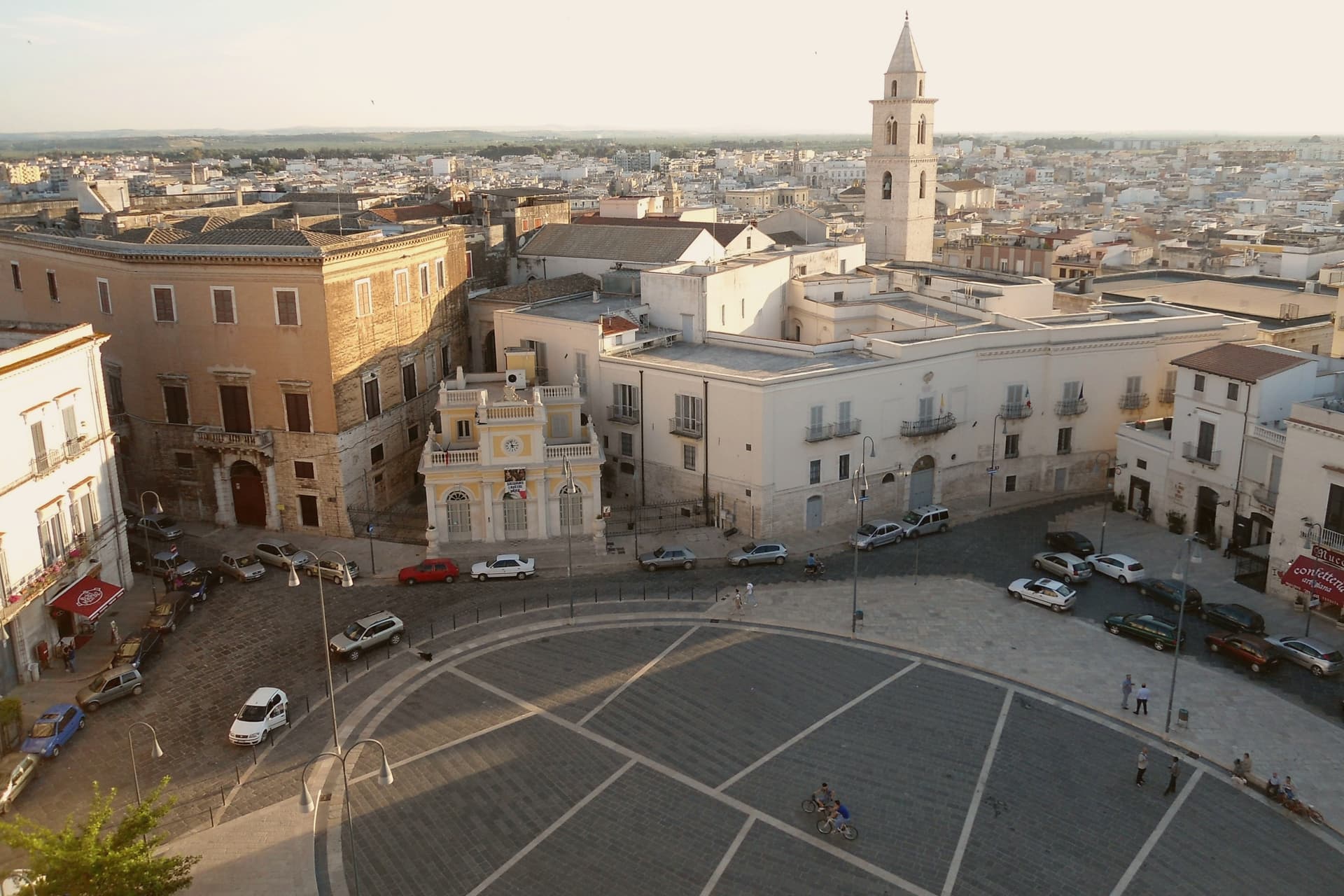
Andria sits on the Murge plateau at 151 meters, ten kilometers from the Adriatic, the third-largest city in Puglia after Bari and Taranto. It was made a fortified civitas in 1046 under Peter the Norman, with twelve towers, three gates and a citadel; Frederick II raised it again in the thirteenth century and built his most famous castle on a hilltop eighteen kilometers south of the city walls.
The city and Castel del Monte read as two expressions of the same Frederician ambition, one a working civitas of towers and gates, the other a solitary geometric exercise on an open plateau with no town around it at all. The other claim Andria makes is burrata, invented around the early twentieth century by the Bianchino family as a way to use leftover mozzarella scraps.
A fortified city, an unfinished castle, and a cheese born from kitchen thrift: the Murge produced a walled seat of power and, separately, an object meant to be looked at rather than defended, and a food born of nothing more than not wanting to waste the scraps.
Confetteria Mucci Giovanni con annesso Museo del Confetto, Antichi Sapori, Il Turacciolo have been named by a guide.
What to see in Andria
- Castel del Monte. An octagonal prism with eight octagonal towers, standing alone on a Murge hilltop and visible for fifty kilometers in any direction. Never finished, never used for war.
- Cattedrale di Santa Maria Assunta. Romanesque cathedral founded in the twelfth century, rebuilt over the centuries, holds the crypt and the relics of San Riccardo, the city's patron.
- Chiesa di Sant'Agostino. Gothic-Romanesque church built by the Teutonic Knights in the late thirteenth century, with a sculpted portal that is one of the finest in Puglia.
How to get to Andria
There is a railway station in the town, so you can arrive without a car and never need one while you are here. Bari is roughly 63 minutes away by road.
Our tip
April through June and September through October are the Murge months: clear light, mild evenings, the Castel del Monte plateau walkable without sweat. July and August hit thirty-six in the city and the castle exposed at 540 meters is brutal between noon and four. October is the olive harvest.
More from Anywhere Italy
- The best olive oil towns with a serious restaurant in Puglia
 The best towns with a serious restaurant that sit inside a nature park in Puglia
- The best hill towns inside a nature park in Puglia
 The best hill towns worth staying overnight in Puglia
- The best cheese towns within two hours of Lecce
- The best towns you can reach by train that eat well within 90 minutes of Taranto