
The best towns you can reach by train that eat well within 90 minutes of Taranto
Puglia's inland cooking is a matter of fire and flour. The Valle d'Itria grills bombette over wood in butcher shops that double as restaurants, the plains south of Taranto press Primitivo dark enough to stain the glass, and every bakery works the same hard durum wheat into taralli, focaccia and orecchiette dragged into shape with a thumb. The building material sets the mood: limestone whitewashed twice a year, drystone walls dividing olive groves, trulli roofs stacked in cones. Spring and autumn are the seasons for it, when the heat lifts and the olive harvest brings the new oil out of the mills.
Most travellers to this part of Puglia head straight for Polignano a Mare and the coast road, where the cliffs and the sea caves fill car parks from May onwards. It is a short drive from Bari airport, it photographs well, and the crowds behave accordingly. The seafood is good and the queue for it is long.
The same wheat, the same wine, the same limestone continue inland, and the railways go there. Regional trains and the Ferrovie del Sud Est network thread out of Taranto through the Murgia and the Salento, reaching market towns with proper kitchens and fewer visitors. These are the ones within easy reach, where a dining guide has named a table worth sitting at.
Of the 20 communes we have mapped within 90 minutes of Taranto, 6 qualify as towns you can reach by train that eat well: we have confirmed each is reachable without a car, and a dining guide has named a table in each. The smallest, Alberobello, has 10,248 residents.
If you are still choosing, we have also written The best towns worth staying overnight that eat well in Puglia and The 10 best hill towns with a serious restaurant in Puglia.
Alberobello
Why visit Alberobello
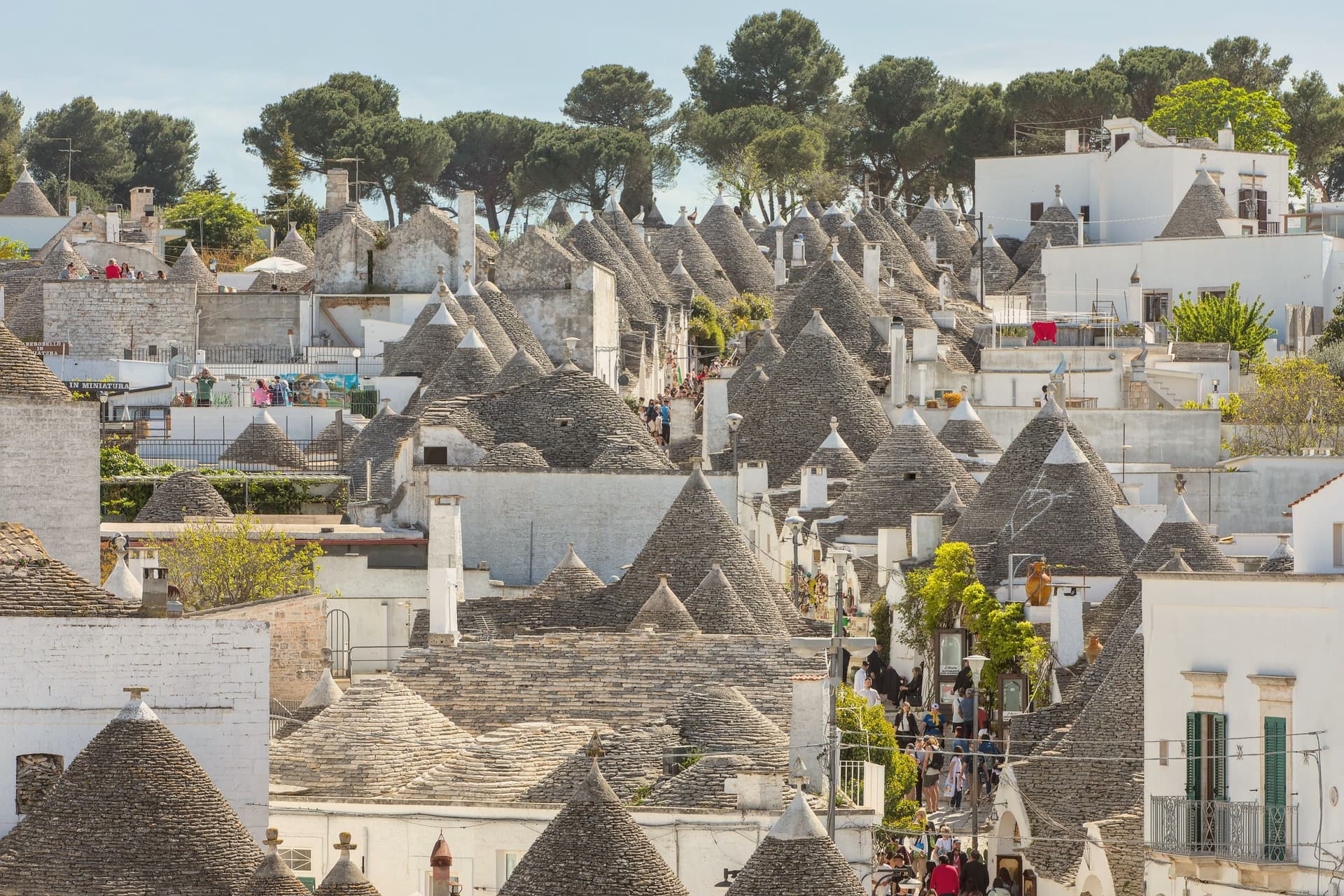
Alberobello sits at 402 meters in the Valle d'Itria, forty-five kilometers southeast of Bari. Two quarters of the town, Rione Monti and Aja Piccola, hold more than 1,500 trulli: limestone cones built from corbelled drystone, with conical or pyramidal roofs piled course by course without mortar.
The technique is prehistoric and still in use across the Murge, but nowhere else is the density and preservation what it is here. The Counts of Conversano enforced drystone construction on their tenant farmers to dodge a Spanish viceroy's tax on permanent settlements: a building that could be dismantled in an afternoon did not count as a town.
UNESCO listed the trulli in 1996. Some are houses, some are shops, some are inhabited by the same families that built them.
The Trullo Sovrano, the only two-storey trullo, was built around 1750 and now functions as a small museum.
Evo Ristorante have been named by a guide.
What to see in Alberobello
- Rione Monti. The larger of the two trulli quarters, a thousand cones running down the hillside, mostly converted to shops and accommodation.
- Aja Piccola. The smaller residential quarter, about four hundred trulli, still occupied as primary housing and quieter than Rione Monti.
- Trullo Sovrano. The only two-storey trullo in town, built around 1750 by the Perta family, now a small museum of trullo construction and daily life.
How to get to Alberobello
There is a railway station in the town, so you can arrive without a car and never need one while you are here. Taranto is roughly 56 minutes away by road.
Our tip
April through June and September through October are the months the Itria valley is green and the trulli are walkable without sweat. July and August push past thirty-three degrees and the Rione Monti fills with day-trippers from the coast; by ten in the morning the main streets are shoulder to shoulder. Late afternoon and after dusk are the times to walk, when the cones cast long shadows and the crowds thin.
Oria
Why visit Oria
Oria sits at 166 meters on a Salento ridge between Taranto and Brindisi, north of Manduria and southeast of the ancient Taras. The town was Hyria, one of the principal Messapian cities, before the Romans absorbed the region.
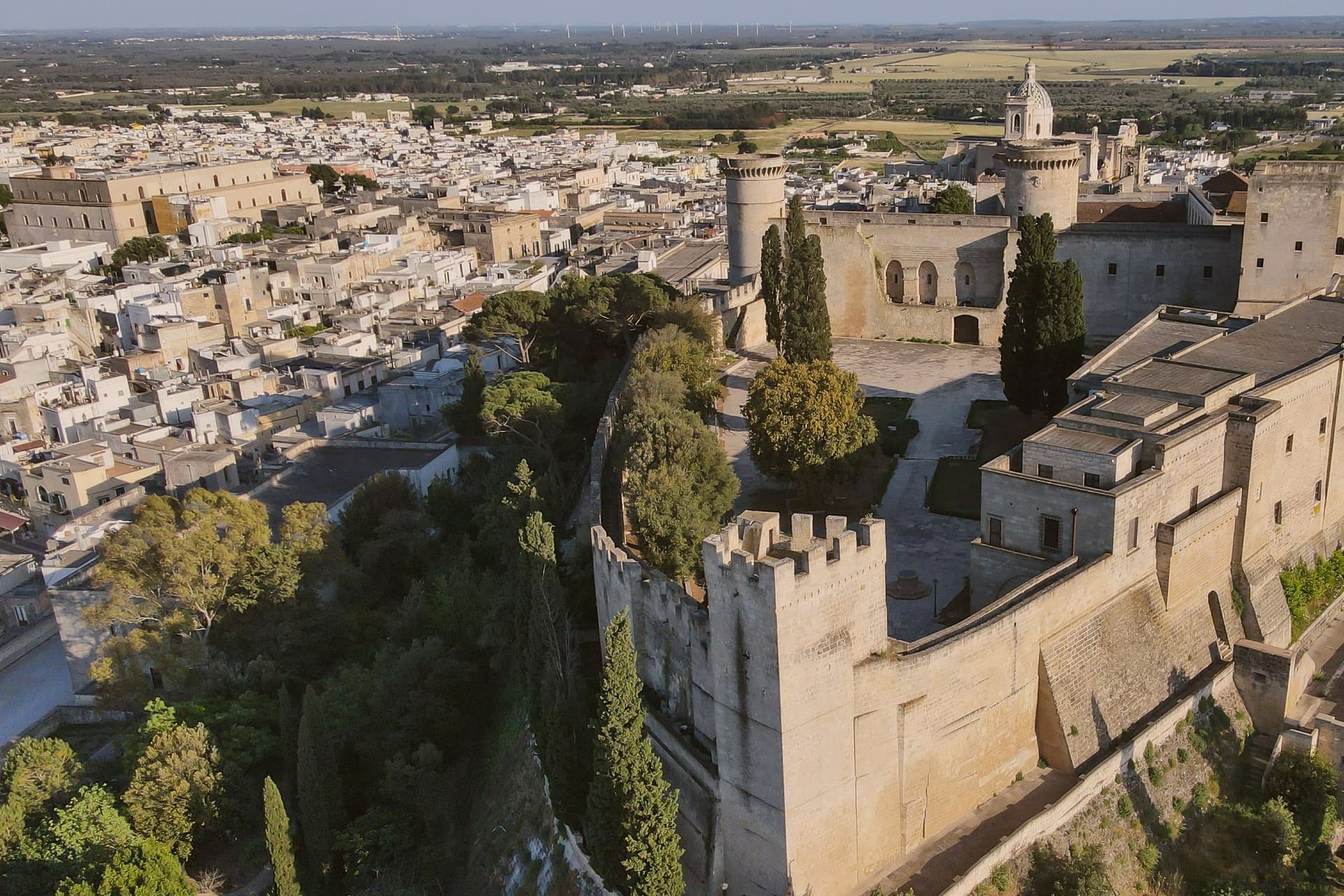
Frederick II rebuilt the castle on the Messapian acropolis between 1227 and 1233; the triangular plan he chose is unique in southern Italian military architecture, with three towers, the Quadrata (Frederician), the Del Cavaliere and the Del Salto (both Angevin additions). Oria also held one of the oldest Jewish communities in Europe, a study center where philosophy, the Talmud, Greek, Latin, medicine and natural science were taught from the ninth century.
Shefatya ben Amitai and Shabbethai Donnolo, two of the first Hebrew writers native to Europe, both lived and worked here. The Jewish quarter, the Giudecca, still organizes the southern edge of the centro storico.
Osteria Luce, Masseria Palombara, Fuori Porta have been named by a guide.
What to see in Oria
- Castello Svevo di Federico II. Frederician castle of 1227-1233 on the Messapian acropolis, triangular plan with three towers, one Frederician and two Angevin, the town's defining monument.
- Cattedrale di Oria. Eighteenth-century Baroque cathedral raised over earlier medieval foundations, the seat of the diocese of Oria since the Lombard era.
- Giudecca. Old Jewish quarter on the southern flank of the centro storico, organized around the Vico degli Ebrei, a continuous medieval settlement from the ninth century.
How to get to Oria
There is a railway station in the town, so you can arrive without a car and never need one while you are here. Taranto is roughly 46 minutes away by road.
Our tip
April through June and September through October are the Salento interior months: clear light on the castle ridge, mild evenings, olive country in flower or harvest. July and August touch thirty-six degrees on the hilltop and the centro storico empties between two and five; the Corteo Storico di Federico II runs in mid-August anyway and pulls a regional crowd. October is the olive harvest. Palio di Oria falls in July.
Carovigno
Why visit Carovigno
Carovigno sits at 161 meters in upper Salento, seven kilometers from the Adriatic and thirty kilometers from Brindisi. The distance between hill and sea shapes the commune: a walled town on high ground looking inland toward Ostuni, and a strip of protected coast running north along the water, eight kilometers of it, separate enough from the centro storico that they read almost as two different places joined by one municipal boundary.
The old town itself is compact, arranged around its mother church with the castle at the summit and the medieval walls, patched with older stone, closing the circuit. Outside the walls, three kilometers off, stands the sanctuary that draws the town out of itself once a year for the Easter procession.
The coast belongs to no season and no rite in particular. It is simply there, kept clear of building, running along the edge of the commune while the life of the town carries on up on the hill.
What holds Carovigno together is this separation of functions: defense and worship concentrated on the high ground, the shoreline left open and undeveloped, and the two connected only by the road and by the yearly walk to the sanctuary.
Dissapore di Andrea Catalano, Già Sotto l'Arco, Casale Ferrovia and 1 more have been named by a guide.
What to see in Carovigno
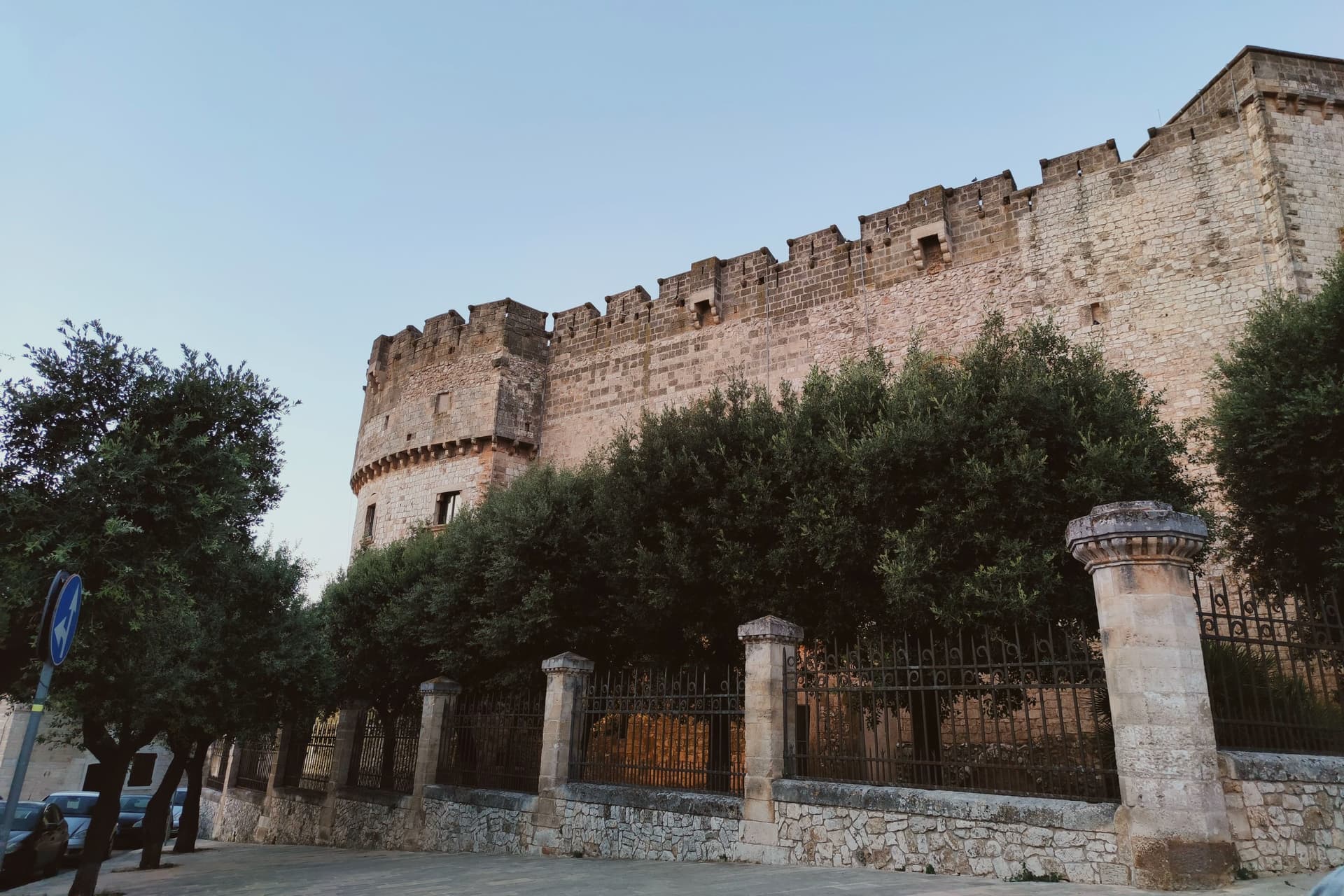
- Castello Dentice di Frasso. Fortress at the highest point of the centro storico, built for defense and later remade into an aristocratic residence, its rooms and outlook telling a different story from its military origins.
- Cinta muraria e torri medievali. Four towers, Torre del Civile, Torre Giranda, Torre delli Brandi and Torre del Prete, still standing on foundations laid before the medieval walls that now bear their names.
- Riserva Naturale di Torre Guaceto. The shoreline itself: shallow clear water, dune systems underfoot and a watchtower standing alone against the coast, reachable north of the town.
How to get to Carovigno
There is a railway station in the town, so you can arrive without a car and never need one while you are here. Taranto is roughly 69 minutes away by road.
Our tip
May through September are the months the Adriatic warms enough to swim at Torre Guaceto and the upper-Salento groves are walkable without sweat. July and August push past thirty-three degrees and the centro storico fills with day-trippers from the Brindisi-Ostuni stretch. June and September are the steadier months, water still warm and the trattorie open without the August crowds.
Manduria
Why visit Manduria
Manduria sits at seventy-nine meters thirty-five kilometers east of Taranto, on the inland edge of the northern Salento. The town was a Messapian stronghold against Greek Taras; Archidamus III, king of Sparta, was killed under its walls in 338 BC.
The Archaeological Park preserves three concentric rings of city walls in drystone, the oldest from the fifth century BC, the middle from the fourth and an outer ring from the third century AD, more than fifteen hectares of fortification still standing. Inside the perimeter, the Fonte Pliniano is a karst cave eighteen meters across, named after Pliny the Elder, who described its constant water level in the Naturalis Historia.
The town gives its name to Primitivo di Manduria DOC, made from 100% Primitivo grapes on the surrounding clay-limestone plain. The Museum of Primitivo and the late-summer Vinitaly cellar tours bring most of the modern visitors.
The coast at San Pietro in Bevagna, fifteen kilometers south, holds the commune's Bandiera Blu beach.
Casamatta, ES Cantina&Ristorante, Gusto Primitivo del Corte Borromeo Hotel and 1 more have been named by a guide.
What to see in Manduria
- Parco Archeologico delle Mura Messapiche. Fifteen hectares of three concentric Messapian walls from the fifth to third century BC, the largest pre-Roman fortification in Salento.
- Fonte Pliniano. Karst cave eighteen meters across, described by Pliny the Elder for its water level that does not rise or fall.
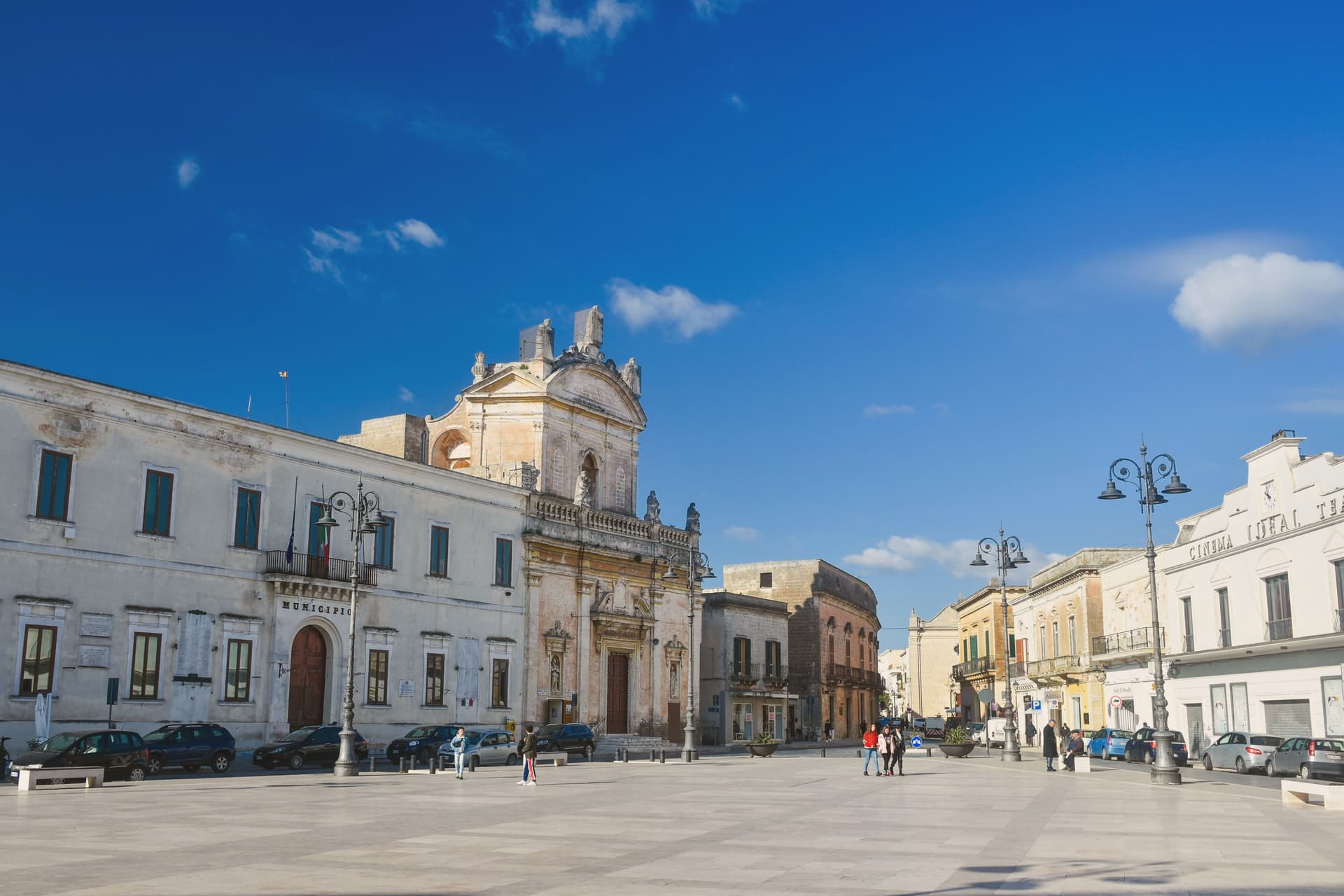
- Borgo Antico. Medieval centro storico inside the inner Messapian wall, with the former Jewish quarter and the Palazzo Imperiali.
How to get to Manduria
There is a railway station in the town, so you can arrive without a car and never need one while you are here. Taranto is roughly 50 minutes away by road.
Our tip
April through June and September through October are the months the Salento inland stays workable. Olive blossom in May, Primitivo harvest in late August and September, mild evenings on the archaeological park trails. July and August push past thirty-five degrees on the limestone plain; the centro storico empties between two and five and the beaches at San Pietro in Bevagna take the heat.
Ostuni
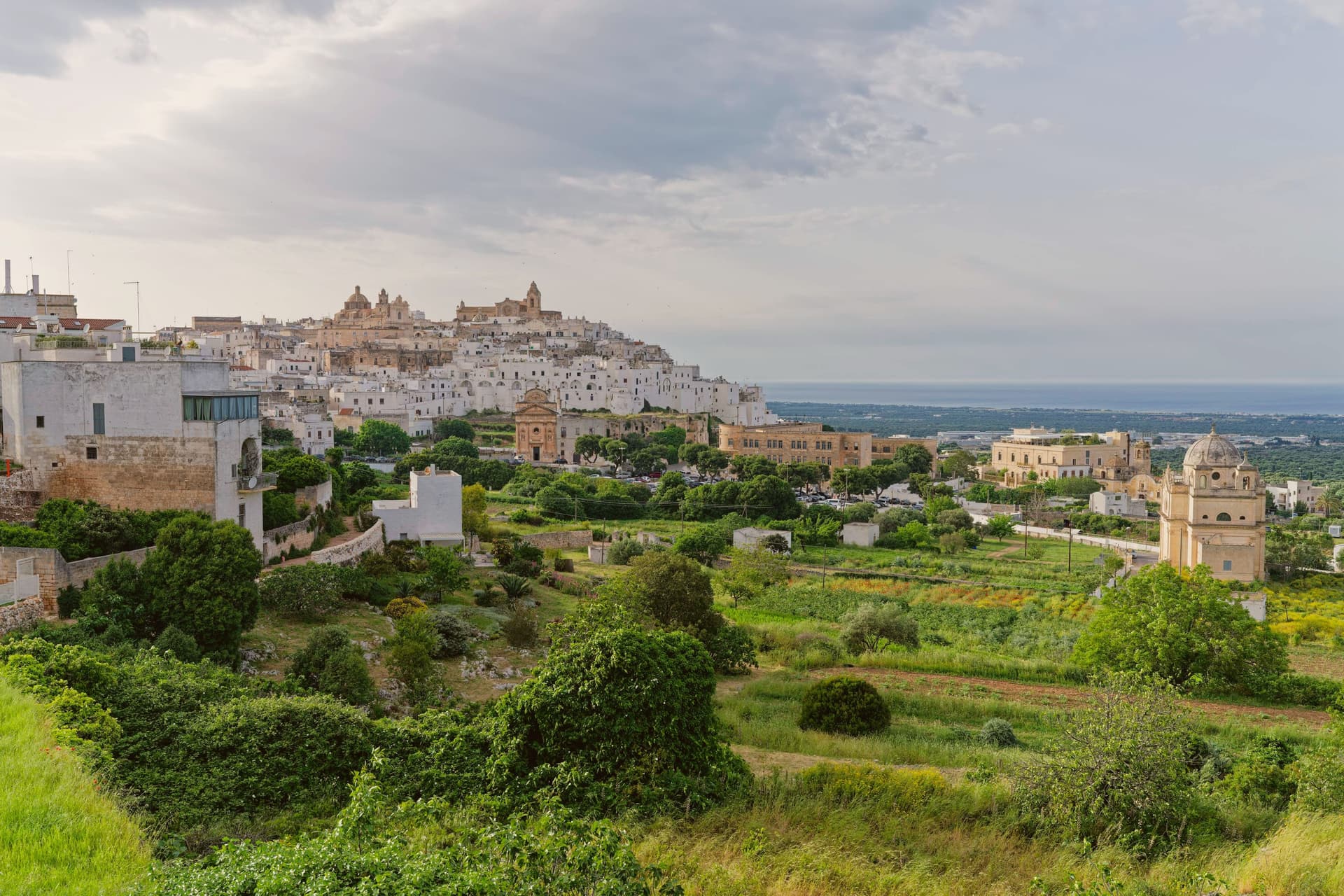
Why visit Ostuni
Ostuni sits at 218 meters on three hills above the Adriatic coastal plain, eight kilometers inland in the southeastern Murge. The whitewashing that gives it the name Città Bianca is medieval in origin, a hygienic measure against plague that survived as the local building convention; the entire centro storico is painted white in lime every spring and reads as a single bright mass from the surrounding olive country.
The territory has been inhabited since the Paleolithic; the Messapii founded the urban nucleus before the Romans absorbed the region. The town joined the Norman County of Lecce in 996.
In 1507 it passed to Isabella, Duchess of Bari, then to her daughter Bona Sforza, queen of Poland, who fortified the coast with watchtowers against Ottoman raids in 1539. The Cattedrale, a late-Gothic facade with a rose window of twenty-four rays, anchors the upper town.
The olive landscape around the commune holds some of the oldest cultivated trees in the Mediterranean.
Osteria Piazzetta Cattedrale, Cielo, Restaurant 700 and 3 more have been named by a guide.
What to see in Ostuni
- Cattedrale di Santa Maria Assunta. Late fifteenth-century Gothic cathedral at the highest point of the centro storico, with a rose window of twenty-four rays unique in Puglia.
- Centro storico. Whitewashed old town on three hills, lime-painted every spring against plague tradition, the single bright mass that names the Città Bianca.
- Piazza della Libertà. Lower civic square outside the medieval walls, with the Guglia di Sant'Oronzo, an early eighteenth-century baroque obelisk to the patron saint.
How to get to Ostuni
There is a railway station in the town, so you can arrive without a car and never need one while you are here. Taranto is roughly 64 minutes away by road.
Our tip
April through June and September through October are the months Ostuni works: olive plain in flower or harvest light, the white walls glowing in mild evenings, the Adriatic eight kilometers away warm enough for swimming by mid-May. July and August touch thirty-five degrees and the centro storico fills with day-trippers from Bari and Brindisi; weekends in August are shoulder to shoulder in the upper alleys. Late afternoon and after dusk are the times to walk, when the white walls cool and the crowds thin.
Martina Franca
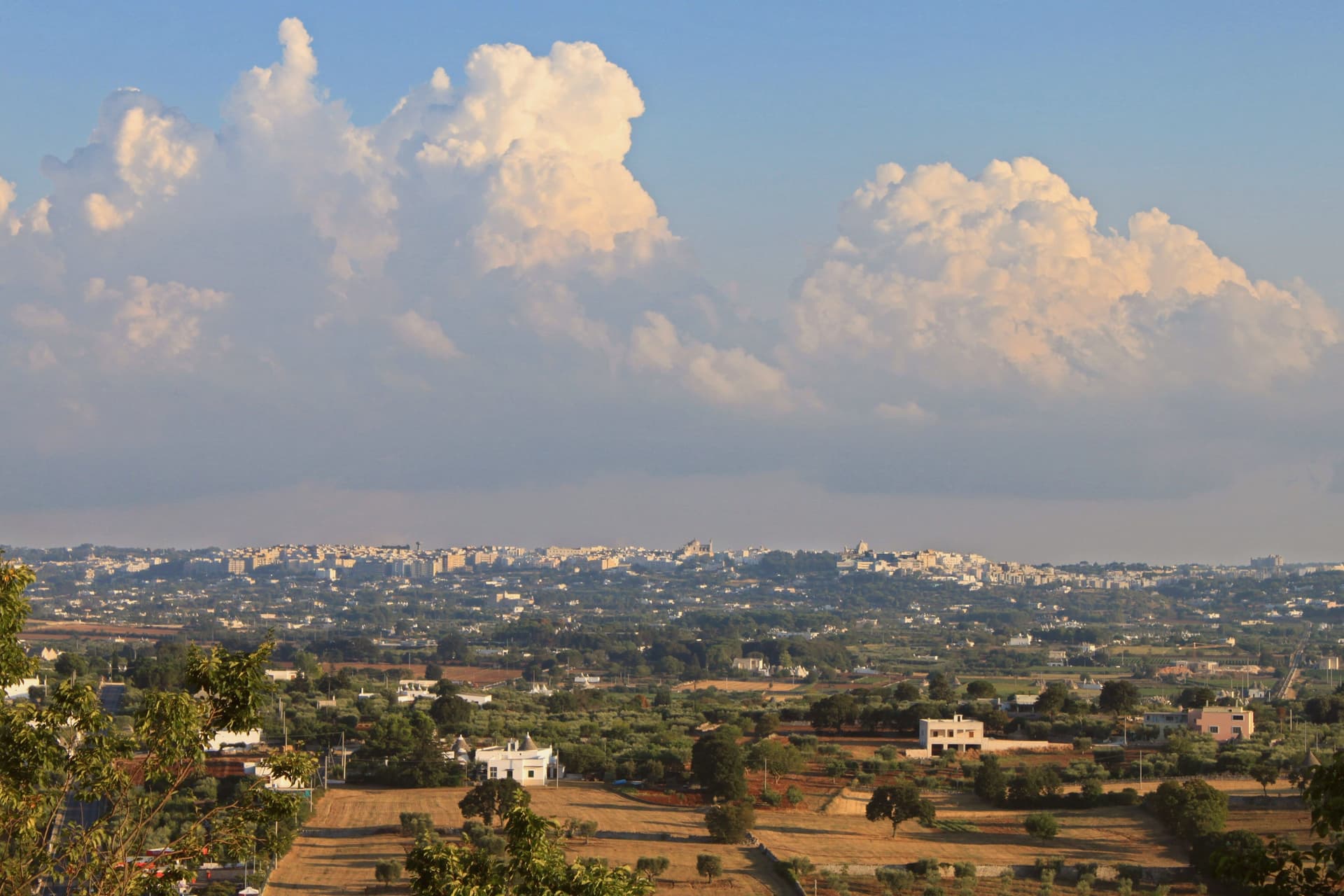
Why visit Martina Franca
Martina Franca sits at 431 meters on the southern edge of the Valle d'Itria, on the border between the provinces of Taranto, Bari and Brindisi. The town was founded in 1310 by Philip I of Anjou, Prince of Taranto, who granted franchigie, tax exemptions, to settlers willing to repopulate the hill, hence Franca in the name.
The centro storico is the densest concentration of Rococo and late-Baroque architecture in Puglia after Lecce: wrought-iron balconies, carved stone portals, churches built or rebuilt after the 1743 earthquake. The Palazzo Ducale of 1668, raised on the foundations of a 1338 medieval castle, is the seat of the municipal offices and the open-air courtyard where the Festival della Valle d'Itria has been performed every July and August since 1975, founded specifically to recover rare and forgotten operas.
The Basilica di San Martino, begun in 1747, is the most complete example of Martinese Rococo. The surrounding plateau makes a Martina Franca DOC white wine and a strong dry-cured capocollo IGP.
Bros' Trattoria, Bros', Four Seasons and 1 more have been named by a guide.
What to see in Martina Franca
- Palazzo Ducale. Built in 1668 on the foundations of a 1338 medieval castle, town hall and home of the Festival della Valle d'Itria summer opera courtyard.
- Basilica di San Martino. Eighteenth-century basilica begun in 1747 after the 1743 earthquake, the most complete Martinese Rococo monument and museum of liturgical art.
- Piazza Roma and Piazza Maria Immacolata. The two main squares of the centro storico, linked by Via Cavour, lined with eighteenth-century palazzi and the town's main passeggiata.
How to get to Martina Franca
There is a railway station in the town, so you can arrive without a car and never need one while you are here. Taranto is roughly 38 minutes away by road.
Our tip
April through June and September through October are the best months on the Itria plateau. The 431-meter elevation keeps the air dry, the limestone walls reflect a clear light, and the surrounding vineyards green up in spring then turn gold by the late September harvest. July and August are hot but mitigated by the altitude; they are also the months the Festival della Valle d'Itria runs in the Palazzo Ducale courtyard, the largest cultural draw in southern Puglia. Festa della bombetta falls in August.
More from Anywhere Italy
 The best towns worth staying overnight that eat well in Puglia
 The 10 best hill towns with a serious restaurant in Puglia
 The 9 best hidden towns you can reach by train that eat well in Puglia
- The best hidden hill towns that eat well in Puglia
 The best hill towns worth staying overnight in Puglia
 The best hidden hill towns within 90 minutes of Taranto