
Friuli-Venezia Giulia · Trieste
Trieste
The Adriatic port the Habsburgs built as their window on the sea, an Italian regional capital still arguing in four languages on the Slovenian border.
- Best time
- May–Sep
- By car
- 1 h from Udine
- By train
- Station in the comune
- Population
- 198,417
Known for
JOYCE AND SVEVO
James Joyce taught English here 1904 to 1915 and drafted Ulysses; his pupil Italo Svevo wrote La Coscienza di Zeno in the city he never left.
HABSBURG PORT
Free port of the Habsburg Empire from 1719 to 1891, the architectural and economic spine of the city, still visible in the Borgo Teresiano and the Lloyd buildings.
THE CAFFÈ
Working literary cafés from the imperial era: Caffè San Marco, Caffè Tommaseo, Caffè degli Specchi on Piazza Unità, Caffè Pirona where Joyce drafted Ulysses.
When to visit
Best · May–Sep
- J9°
- F12°
- M14°
- A17°
- M21°
- J26°
- J30°
- A30°
- S25°
- O20°
- N14°
- D10°
- Best
- Hot or crowded
- Quiet
- Mostly closed
Daytime averages, 2020–2024. The sea is warmest in July at 27° and coldest in February at 10°. Weather data by Open-Meteo.com.
The festa: Giusto di Trieste, 3 November
Why come
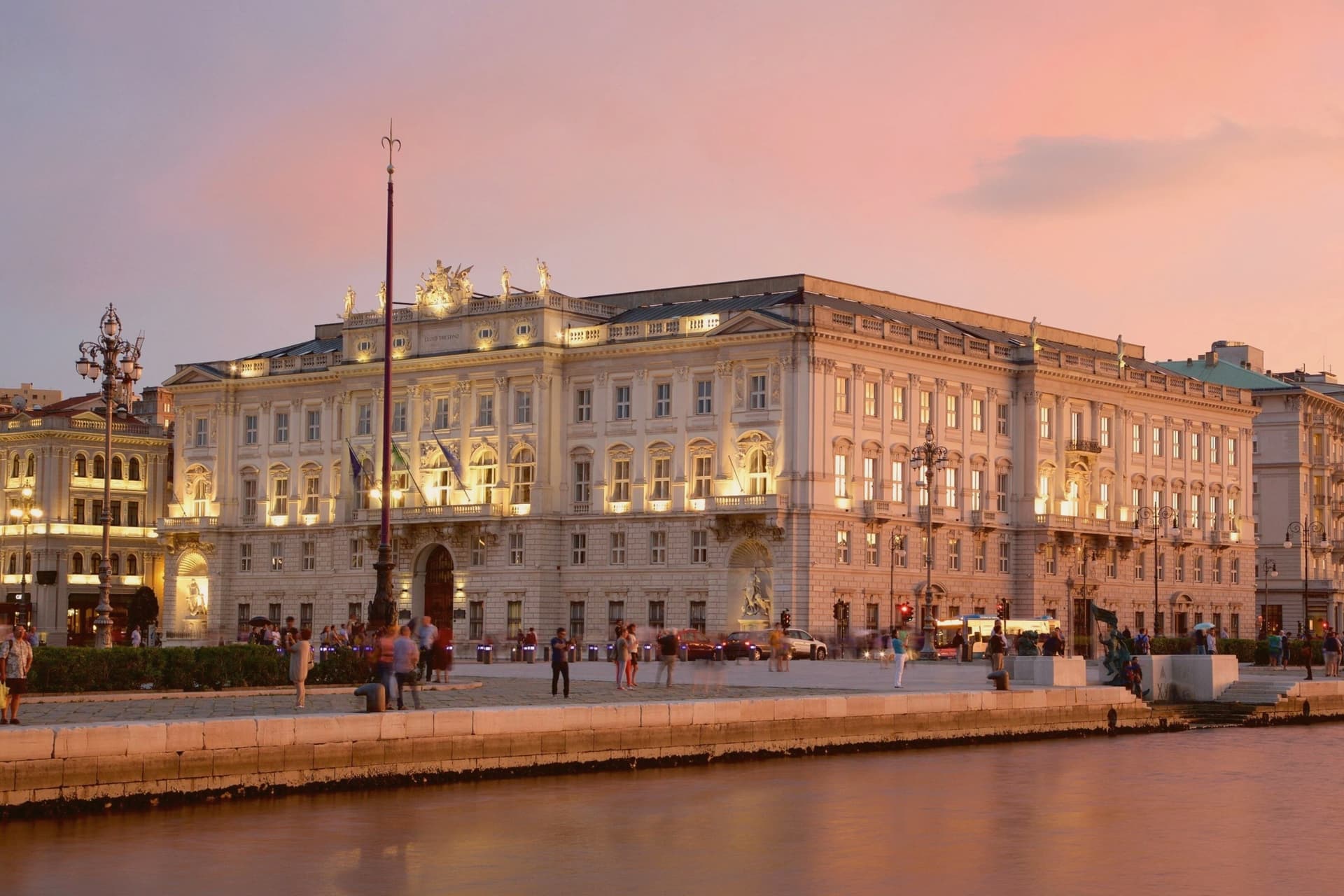
Trieste sits at the head of its gulf, on a narrow strip of Italian land between the Adriatic and Slovenia. Rome made it a colony under Julius Caesar; Augustus built the harbor and walls around 33 BC. The Habsburgs held the city from 1382 until 1918 and ran it as their empire's free port, the access route to the sea for Vienna: that arrangement set the shape of the modern city, laying out the Borgo Teresiano and the Canal Grande that cuts into it, and opening the great sea-facing square onto the water where the old town meets the Habsburg extension.
The castle on the cliffs north of town was built by Archduke Maximilian, who left it for Mexico in 1864 and was executed three years later. The former rice-husking plant used as the only Nazi camp on Italian soil with a crematorium sits in the southern industrial belt, apart from the imperial center. A city built as an empire's outlet to the sea, then handed over at the end of that empire, carries both the harbor it was built for and the border it was built against.
The Sunday letter
Trieste is on our list. Its letter is still to come.
We are writing about all 1,000 of these towns, one at a time, in a free letter every Sunday: the photo, the food, the festa. That is our mission. Sign up and you will be there when Trieste comes up. By Peter & Sophia, from Pietrasanta.
Read on
Trieste in our articles
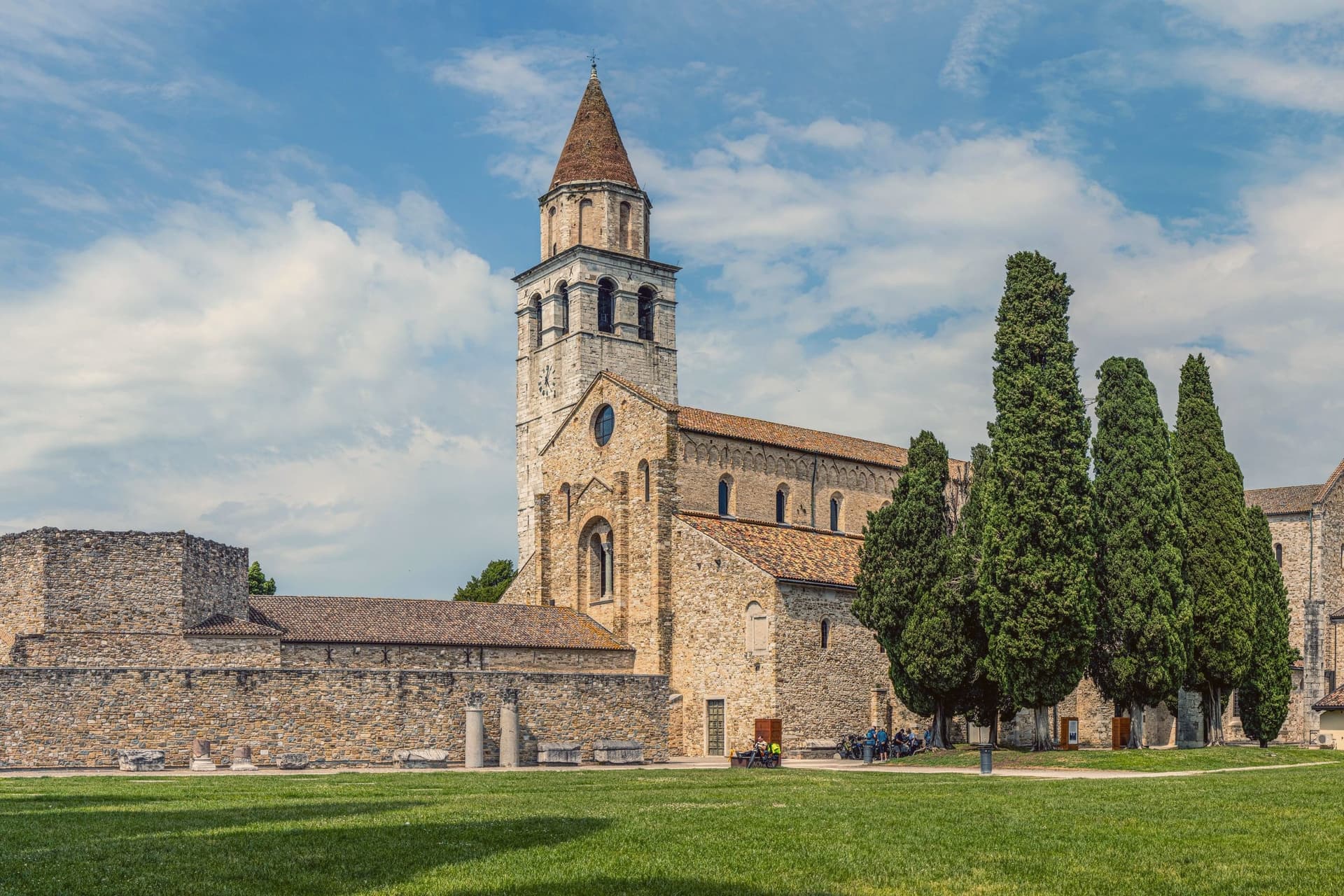
 The best coastal towns within two hours of Udine6 towns, Trieste among them.
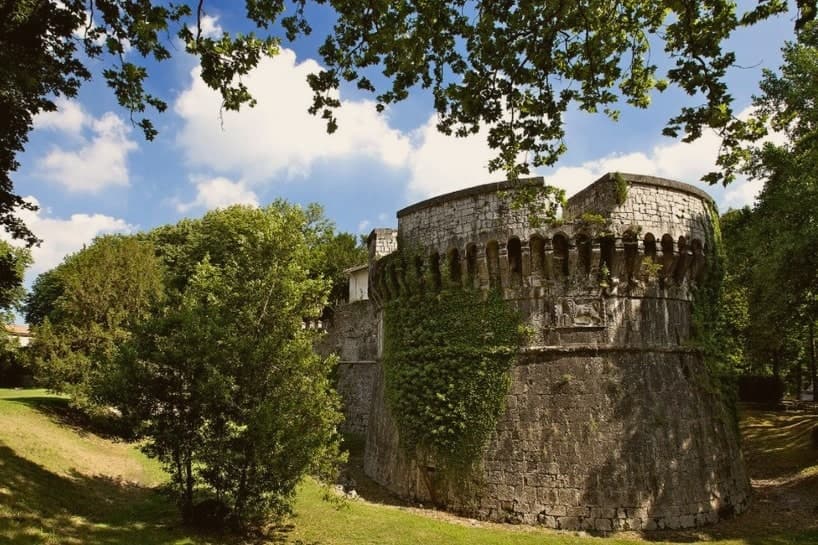
 The best coastal towns within two hours of Venice6 towns, Trieste among them.
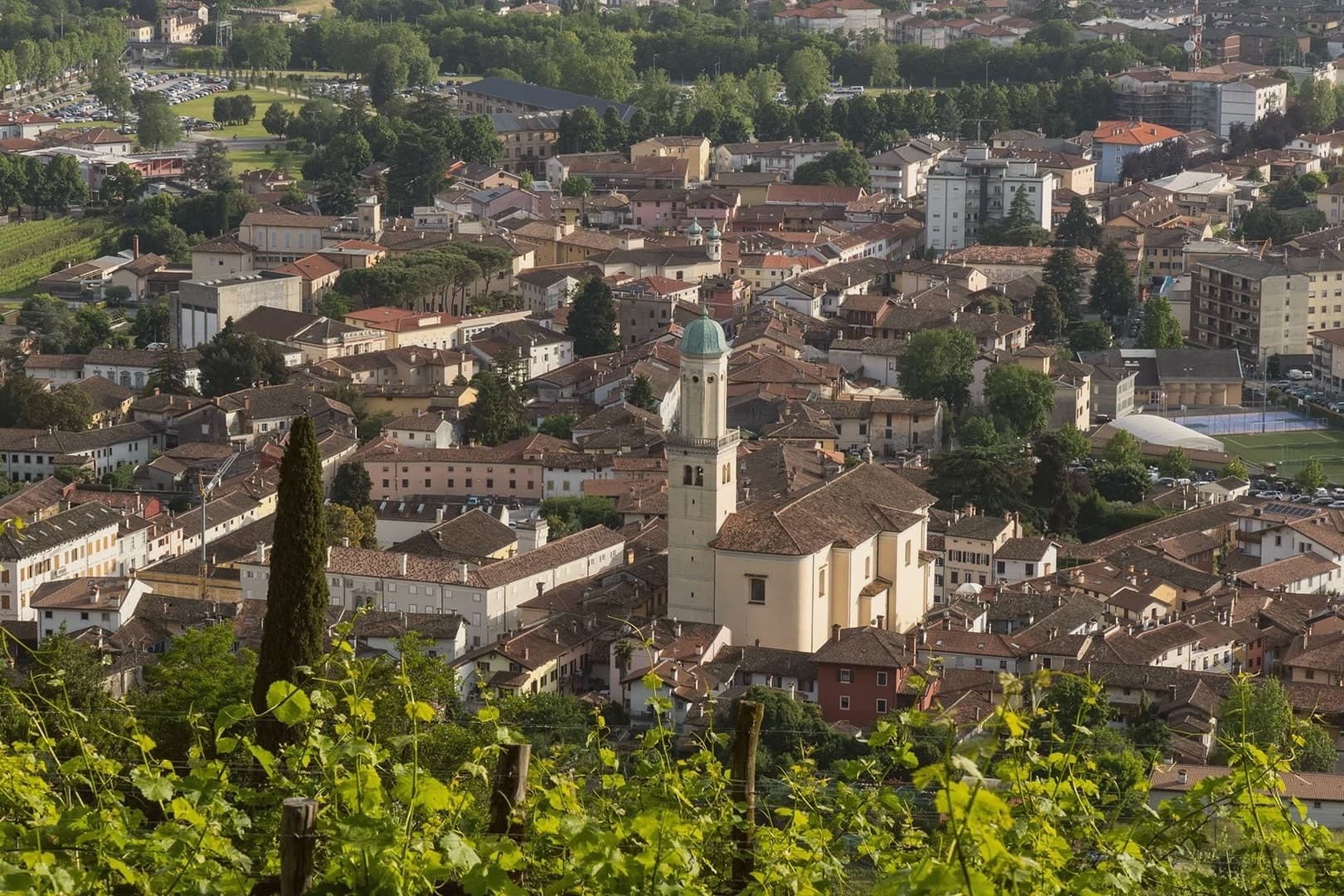
 The best towns you can reach by train that eat well in Friuli-Venezia Giulia6 towns, Trieste among them.
 The best towns that eat well within 75 minutes of Trieste8 towns, Trieste among them.
How to get there
From Venice (TSF), about 2 hours by car.
Verona (VRN) is about 3h 8m away.
By car from the centre of Udine 1 hour.
There is a railway station in the comune, so you can arrive without a car.
Coming from Venice?
Coming by train into Trieste Centrale? Trieste is about 9 minutes away by road.
What to see
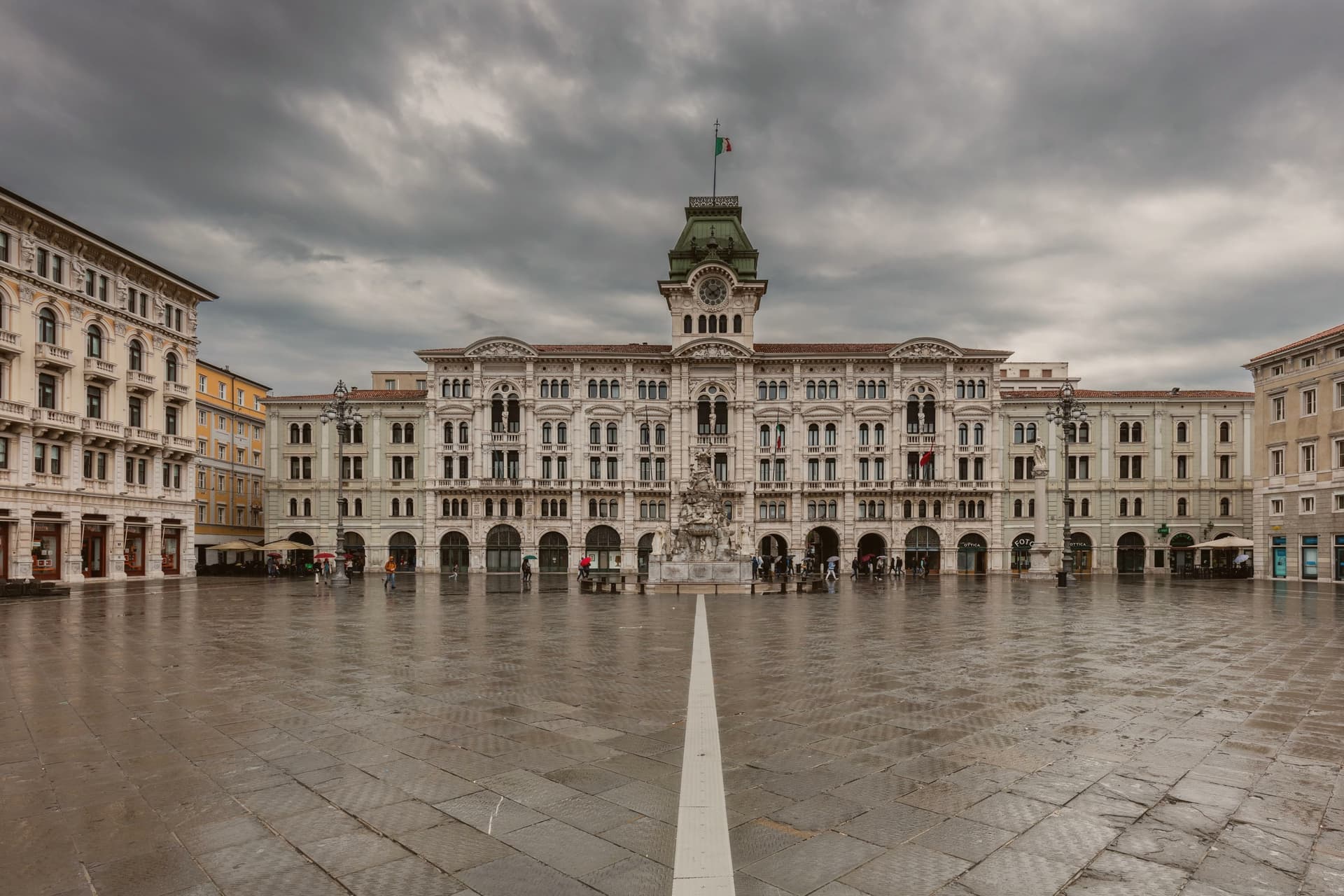
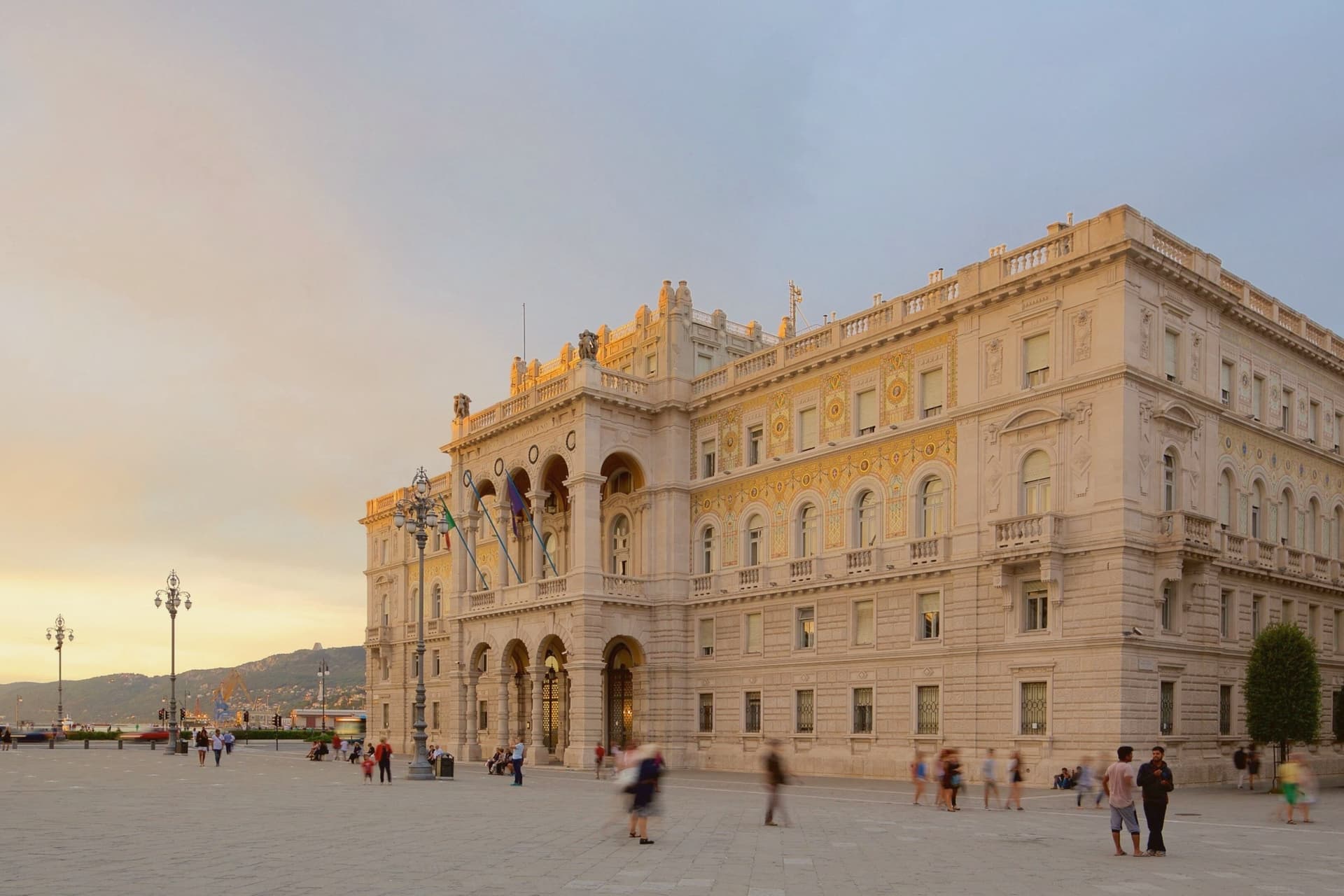
Piazza Unità d'Italia
The largest sea-facing square in Europe, framed by Habsburg-era municipal and Austrian Lloyd buildings opening directly onto the Adriatic.
Castello di Miramare
White castle on the cliffs north of the city, set in a park of acclimatized Mediterranean and exotic species.
Cattedrale di San Giusto
Romanesque cathedral on the San Giusto hill, formed from the eleventh-century fusion of two adjoining basilicas, with fifth-century mosaics and a fourteenth-century rose window.
Borgo Teresiano
Eighteenth-century neighborhood laid out under Maria Theresa around the Canal Grande, the planned Habsburg extension of the old port city.
Risiera di San Sabba
Former rice-husking plant used as a Nazi concentration camp from 1943 to 1945, the only camp on Italian territory equipped with a crematorium, now a national monument.
Museo Revoltella
Nineteenth-century palace museum bequeathed to the city in 1869 by Baron Pasquale Revoltella, with modern art collection extended into adjoining buildings.
Faro della Vittoria
Lighthouse on the Gretta hill above the gulf, commissioned in 1923 to honor Italian sailors lost in World War I, with a panoramic gallery over Trieste and Istria.
The slow-trip planner
Building a trip? Find where Trieste fits in a slow Italy circuit.
Answer five questions. We will shape a geographically coherent slow trip from the 1,000 Italian towns most travelers skip. Yours to save and share.
We recommend
Where to eat and stay
Not our picks, but places the guides put their name to: a Michelin star, a Gambero Rosso fork, a Slow Food snail, a Michelin Key for the hotels. Worth a table, a counter, or a night when you pass through.
Antica trattoria SubanTrattoria
Antica trattoria Suban has a Slow Food snail, a place on Italy's historic-locali register and a Gambero Rosso listing.
Al PetesRistorante
Al Petes has two Gambero Rosso forks (80/100) to its name.
Antica Trattoria MenarostiRistorante
Antica Trattoria Menarosti holds a Slow Food snail.
BollicineBistrot
Bollicine carries two Gambero Rosso tables.
Bracerie VeneteGriglieria
Bracerie Venete has a Gambero Rosso listing to its name.
Chimera di BaccoRistorante
Chimera di Bacco holds one Gambero Rosso fork (79/100).
Harry's PiccoloRistorante
Harry's Piccolo carries three Gambero Rosso forks (91/100).
Harry’s PiccoloRistorante
A La Liste score of 87.5, at Harry’s Piccolo.
L’ApprodoRistorante
L’Approdo has a Slow Food snail to its name.
MenarostiRistorante
Menarosti has two Gambero Rosso forks (81/100) to its name.
NerodiseppiaTrattoria
Three Gambero Rosso prawns, at Nerodiseppia.
Savoia Excelsior Palace Trieste – Starhotels CollezioneHotel
A place in the Michelin hotel guide, at Savoia Excelsior Palace Trieste – Starhotels Collezione.
Through the year
What happens here
Feasts and festivals that come back year after year. We give the month rather than the date, because the date moves and the month rarely does. Check with the source before you plan a journey around one.
Sagra di San Marcofood festival
usually held between April and August. itinerarinelgusto.it
Sagra di Prebenegfood festival
usually held in July. TrovaSagre
Festa Patronale Beata Vergine Addoloratapatron saint's feast
usually held in September. Sagre FVG (Uolli)
Living here
- Population 198,417
- A local hubi
- Pharmacy in town
- High school within a 30-minute drive
- Train station in the comune
- Nearest airport Venice, 1 h 55 min drive
- Regional capital Trieste, 10 min drive
Common questions
- What is Trieste known for?
- Trieste is the Adriatic port the Habsburgs built as their window on the sea, an Italian regional capital still arguing in four languages on the Slovenian border.
- Where is Trieste?
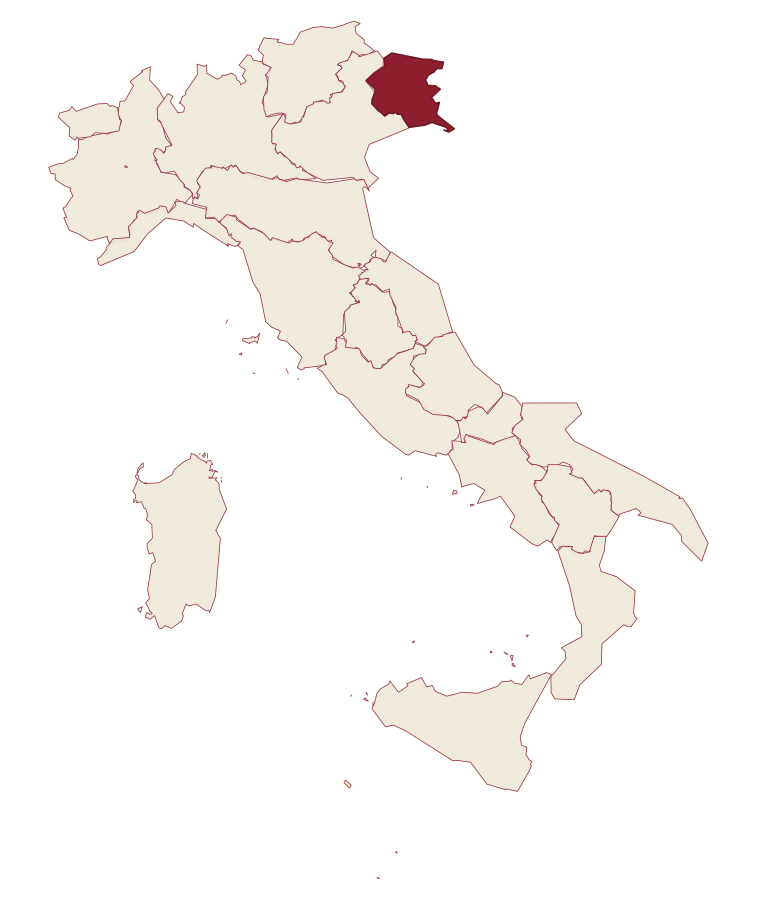
- Trieste is a comune in the province of Trieste, in Friuli-Venezia Giulia, at 2 meters above sea level.
- What is the nearest airport to Trieste?
- Venice (TSF), about 2 hours by car.
- Can you get to Trieste without a car?
- Yes. There is a railway station in the comune, so you can arrive by train.
- How long is the drive from Udine to Trieste?
- About 1 hour by car.
- When is the best time to visit Trieste?
- Best in May–Sep. July is the warmest month, averaging 30 degrees, and May the wettest, with about 15 rain days.
- Is there a sagra or a festival in Trieste?
- Yes. Sagra di San Marco, Sagra di Prebeneg and Festa Patronale Beata Vergine Addolorata. April is when the first of them falls.
- Which other towns are like Trieste?
- Ravenna, Pesaro and Senigallia.
- How many people live in Trieste?
- 198,417 at the 2023 count.
Tags & datadesignations · numbers · sources
Recognised as
The numbers
- Elevation: 2 m
- Population: 198,417
- Surface area: 85.11 km²
These figures were compiled from public directories: ISTAT, OpenStreetMap and Wikidata, and from the official listings of the guides named on this page. Town details change; verify with official sources before you travel.
Similar
Towns like Trieste
Ravenna
Province: Ravenna
both on the Adriatic coast · both over 10,000 people
Pesaro
Province: Pesaro e Urbino
both on the Adriatic coast · both over 10,000 people
Senigallia
Province: Ancona
both on the Adriatic coast · both over 10,000 people
Muggia
Province: Trieste
both on the Adriatic coast · both over 10,000 people
Chioggia
Province: Venezia
both on the Adriatic coast · both over 10,000 people
Trani
Province: Barletta-Andria-Trani
both on the Adriatic coast · both over 10,000 people
🫒 Città dell'Olio
More Città dell'Olio towns
Archi
Province: Chieti
A 492-meter rocky spur called the Terrazza sul Sangro, fief of del Balzo, Cantelmo, Colonna and Carafa, now Città del Tartufo and Città dell'Olio.
Atri
Province: Teramo
At 442 meters on three hills ten kilometers from the Adriatic, ancient Hadria, source of the emperor Hadrian's family name and the Adriatic's.
Casoli
Province: Chieti
A 378-meter hill town above the Aventino under the Maiella, with a pentagonal Norman tower that once hosted a court of artists.
Città Sant'Angelo
Province: Pescara
A hilltop borgo at 320 meters between the Vestina hills and the Adriatic, named for the Archangel and known since 1352 as a Collegiata seat.
Controguerra
Province: Teramo
A 267-meter hill village whose name is legal shorthand for a small Montepulciano and Trebbiano-Passerina DOC.