
The best towns with a serious restaurant that you can reach by train in the province of Perugia
The province of Perugia eats the way its landscape looks: heavy on chestnut and oak, on cured pork, on lentils and farro and the black truffle that comes out of the hills through the cold months. Restaurant kitchens here work with a short list of things and do them at length, so a tasting menu can move from a plate of Lake Trasimeno tegamaccio to wood pigeon without ever leaving the province. The towns themselves are built from the same pale limestone and pink Subasio stone that catches the light at the end of a summer afternoon. Spring and autumn are the better seasons, when the valley haze lifts and the tables move outside.
Most visitors to Umbria arrive on a coach and go to Perugia, up the escalators through the Rocca Paolina to Corso Vannucci, and the centre is busy from Easter until the end of the jazz festival. It is a real city with real food and it deserves the traffic it gets. It also means the good tables book out weeks ahead and the streets around the Fontana Maggiore move slowly in August.
The railway keeps going. The line down the Valle Umbra and the one around the north shore of Trasimeno pass through smaller places where the kitchens are just as ambitious and the station is a short walk from the table. Fewer people get off at these stops. Each town here holds a restaurant listed by the most demanding of the guides, and we have confirmed you can reach it without a car.
Of the 37 communes we have mapped in the province of Perugia, 6 qualify as towns with a serious restaurant you can reach by train: each holds a restaurant listed by the most demanding of the guides, and we have confirmed each is reachable without a car. The smallest, Passignano sul Trasimeno, has 5,714 residents.
If you are still choosing, we have also written The 7 best towns with a serious restaurant that sit inside a nature park in the province of Perugia and The best towns you can reach by train that have a serious restaurant within 90 minutes of Perugia.
Deruta
Why visit Deruta
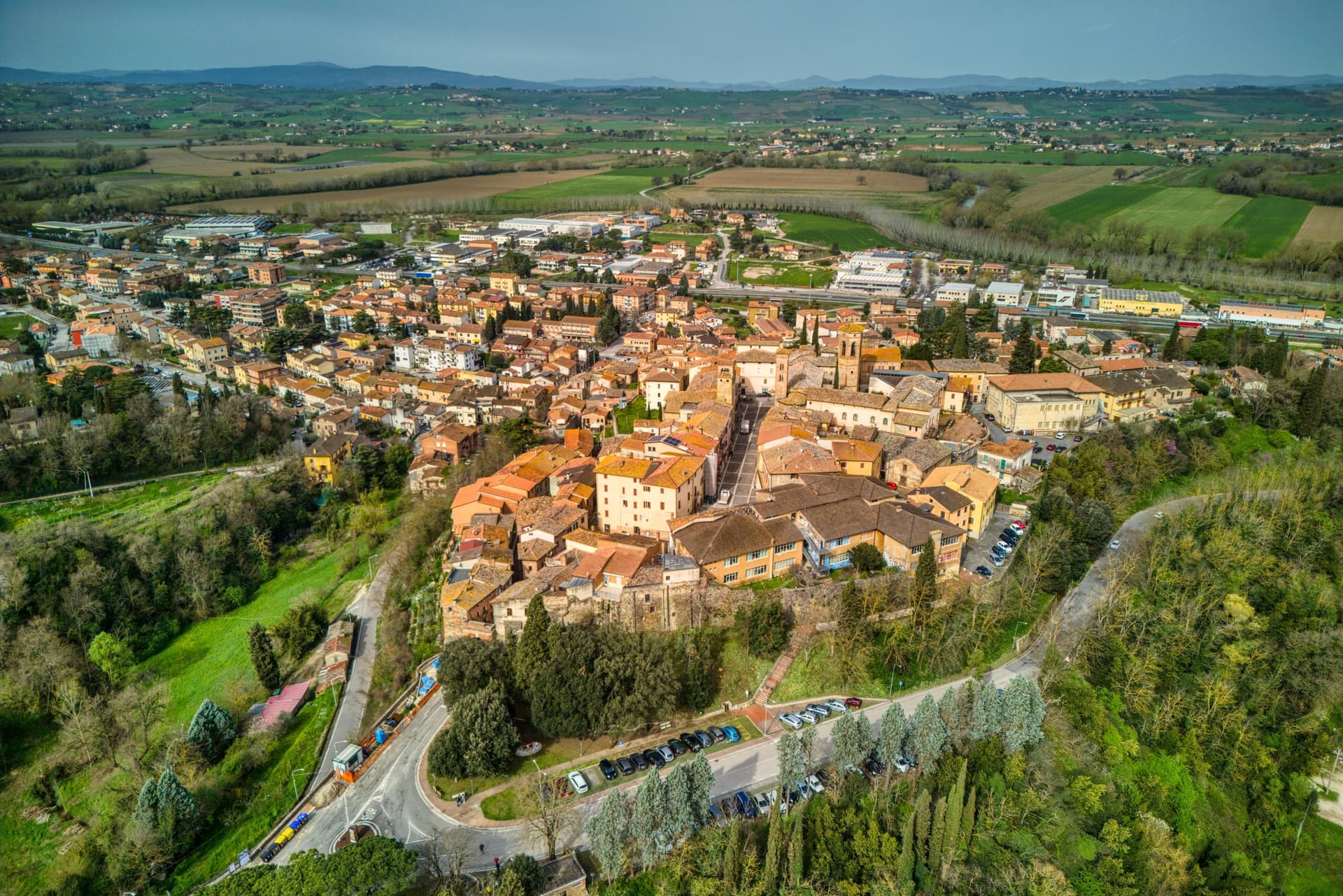
Deruta sits fifteen kilometers south of Perugia, its hill rising above the Tiber on the river's left bank. The walled medieval core, organized around Piazza dei Consoli, occupies the high ground, while the lower town spreads along the old road linking Perugia to Rome.
That road is where the workshops cluster, most of them family businesses running three or four generations deep, and it is also the route that carries traffic five kilometers south to the pilgrimage church, its walls built up over four centuries from votive tiles left by travelers on the same stretch of road. The first documented kilns appear in the archaeological record in the late thirteenth century, and by the early sixteenth the town's workshops had developed the lustro finish that gave Deruta wares their metallic shine, along with the Bella Donna plates that paired painted portraits with flattering banderoles naming the women depicted.
That convent complex, once a working monastery, now holds both the ceramics museum and, next door, the civic gallery with its Perugino and Alunno panels, so the town's religious architecture, its art collection, and its ceramics history sit under the same roof by accident of reuse rather than design. The upper town's churches and museums hold the record of what Deruta made and believed; the lower town's workshops are still making it.
We confirmed you can reach this one by train.
What to see in Deruta
- Museo Regionale della Ceramica. Holds over 6,000 pieces from medieval to modern, arranged through the convent's old cloister and cells.
- Chiesa di San Francesco. Consecrated 1388 after earthquake reconstruction, Sienese 14th-century frescoes inside, Domenico Alfani Raphael-school panel above an altar.
- Pinacoteca Comunale. Civic gallery with Perugino's Eterno and Saints Romano e Rocco, plus two altarpieces by Niccolò Alunno from the surrounding churches.
How to get to Deruta
There is a railway station in the town, so you can arrive without a car and never need one while you are here. Perugia is roughly 19 minutes away by road.
Our tip
April through June and September into October are the months locals prefer. The Tiber valley stays mild and the workshops keep regular hours, with kilns running on weekdays and tastings open on weekends. The Festa della Ceramica in late August opens the cellars and the older workshops to the public. Palio della Brocca falls in August.
Todi
Why visit Todi
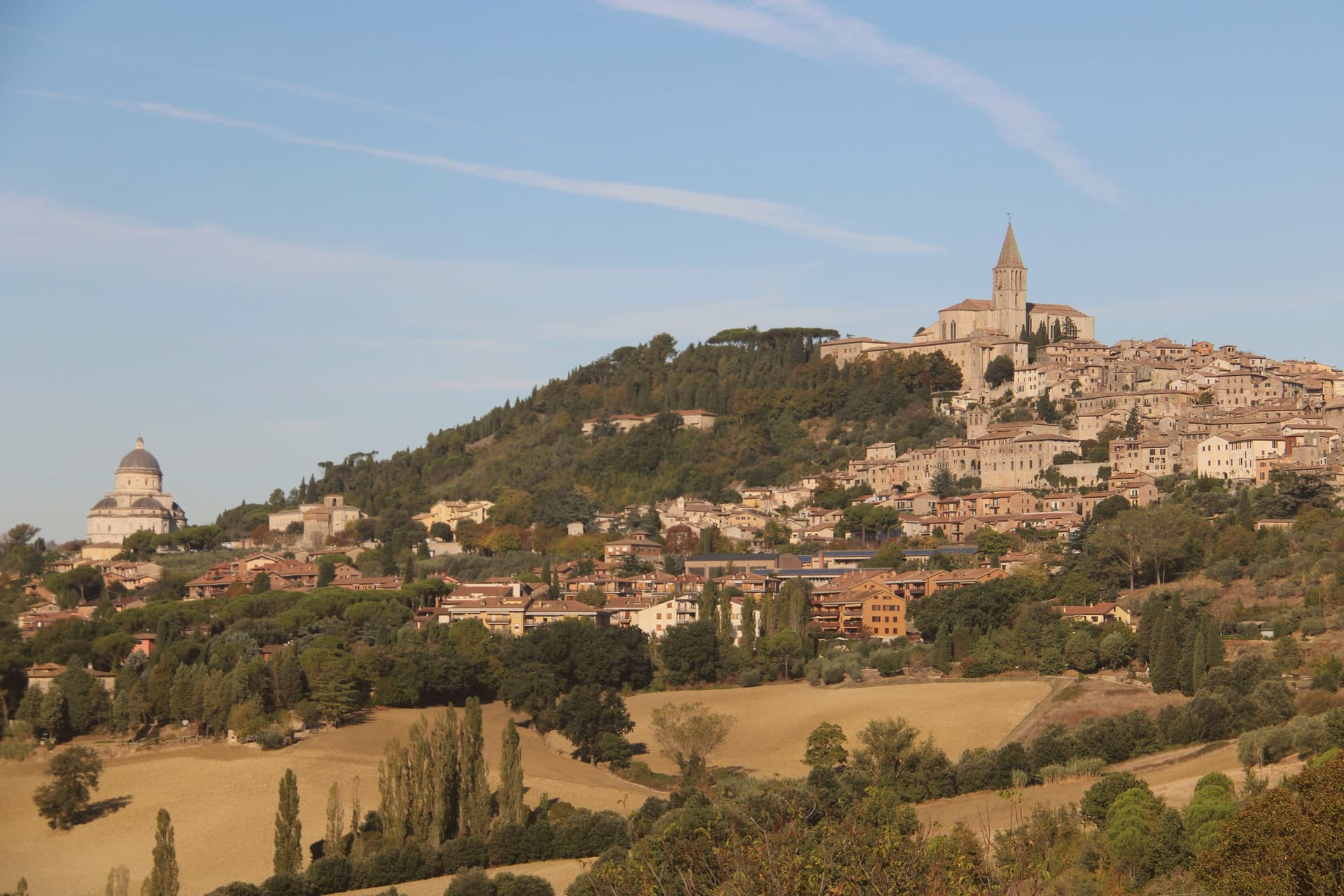
The hill the town occupies, Colle Nidoli, rises above the middle Tiber, and the settlement is built as three concentric ring walls rather than one: Etruscan and Roman courses at the base, a medieval circuit at the summit, the whole sequence readable from the hills around it. The square at the top sits directly over a Roman forum, and the cisterns cut beneath that forum still carry water and drainage for the town today, so the working infrastructure underfoot is as old as anything visible above ground.
The building on the square with the triple window keeps that window from the thirteenth century. The lower ground beyond the medieval walls holds the Roman niches, the surviving wall of a first-century BC public building, set at the foot of the town rather than within its defended core, a reminder that the settlement's Roman life extended past what the medieval walls later enclosed.
Outside the walls in the other direction stands the Renaissance temple, built over a century between 1508 and 1607, deliberately separated from the dense center it complements. Todi's layout is less a single town than a stack of settlements, Etruscan, Roman, medieval, Renaissance, each occupying its own ring or its own ground beyond the walls, none erasing what came before it.
We confirmed you can reach this one by train.
What to see in Todi
- Piazza del Popolo. Square on the highest point of Colle Nidoli, built over Roman cisterns still in use, ringed by cathedral, Palazzo dei Priori, and Palazzo del Capitano.
- Cattedrale della Santissima Annunziata. Twelfth-century cathedral on the site of a Roman temple, north end of Piazza del Popolo, Gothic rose window and a fresco of the Last Judgment by Faenzone inside.
- Tempio di Santa Maria della Consolazione. Outside the walls rather than within the medieval fabric of the center, its dome fifty meters high, a solitary geometric mass against the surrounding hillside.
How to get to Todi
There is a railway station in the town, so you can arrive without a car and never need one while you are here. Terni is roughly 37 minutes away by road.
Our tip
April through June and September into October are the months locals prefer. The Tiber valley below stays green or gold depending on the half, and the upper terraces hold light into the evening. Todi Festival runs in late August with concerts and theater in the centro storico.
Spoleto
Why visit Spoleto
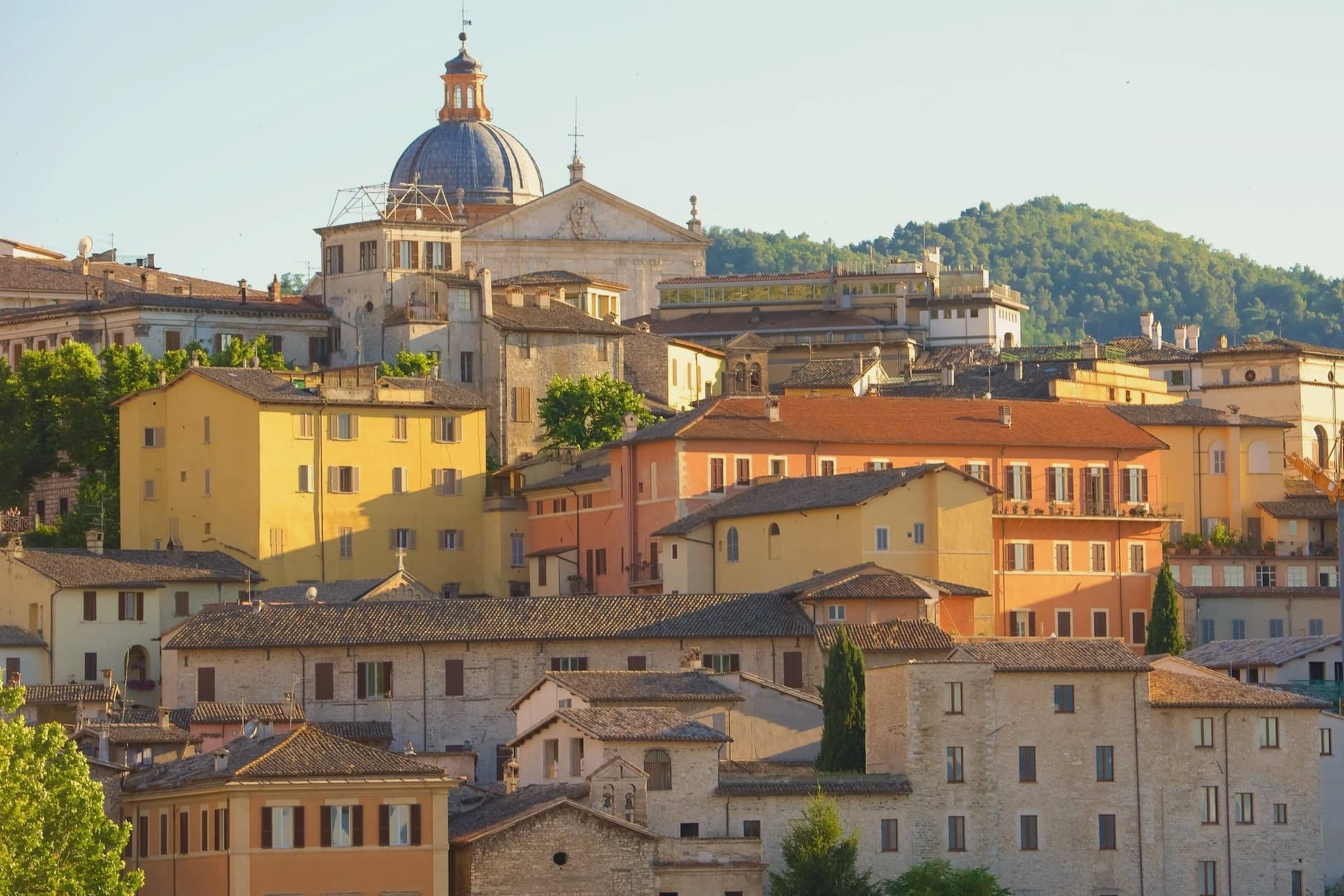
Spoleto sits at 396 meters at the southern edge of the Valle Umbra, the Apennines rising behind it toward Monteluco. The town was Roman Spoletium from 241 BC, then capital of one of the two great Lombard duchies of Italy from 576, controlling Umbria, Sabina, Picenum and the Pescara valley for more than five centuries.
The Rocca Albornoziana on the Colle Sant'Elia was built between 1363 and 1367 by Matteo Gattapone for Cardinal Albornoz, both a papal fortress and a residence, now the Museo Nazionale del Ducato. From the Rocca the Ponte delle Torri, 230 meters long and 80 meters high, crosses the Tessino gorge to Monteluco, an aqueduct of the 13th century built over Roman foundations.
The Duomo holds a Byzantine mosaic of 1207 across its façade and Filippo Lippi's last fresco cycle in the apse. Gian Carlo Menotti founded the Festival dei Due Mondi in 1958; the Roman theater, the Rocca courtyard and Piazza del Duomo still carry the program each year from late June into mid-July.
We confirmed you can reach this one by train.
What to see in Spoleto
- Rocca Albornoziana. Papal fortress built 1363-1367 by Matteo Gattapone for Cardinal Albornoz, now the Museo Nazionale del Ducato di Spoleto.
- Ponte delle Torri. Aqueduct bridge 230 meters long and 80 meters high, crossing the Tessino gorge to Monteluco, 13th-14th century on Roman foundations.
- Duomo di Santa Maria Assunta. Twelfth-century Romanesque cathedral with Byzantine mosaic of 1207 on the façade, Renaissance portico, and Filippo Lippi frescoes in the apse.
How to get to Spoleto
There is a railway station in the town, so you can arrive without a car and never need one while you are here. Terni is roughly 41 minutes away by road.
Our tip
April through June and September into October are the months for Spoleto. The town opens its gardens, the Rocca courtyard fills with sun, and the long walks along the Giro dei Condotti above the Ponte delle Torri become bearable again. The Festival dei Due Mondi runs from late June into mid-July, when Spoleto doubles in population and the Roman theater carries opera into the small hours. Sagra dell'Anguilla e del Gambero di Fiume falls in August.
Passignano sul Trasimeno
Why visit Passignano sul Trasimeno
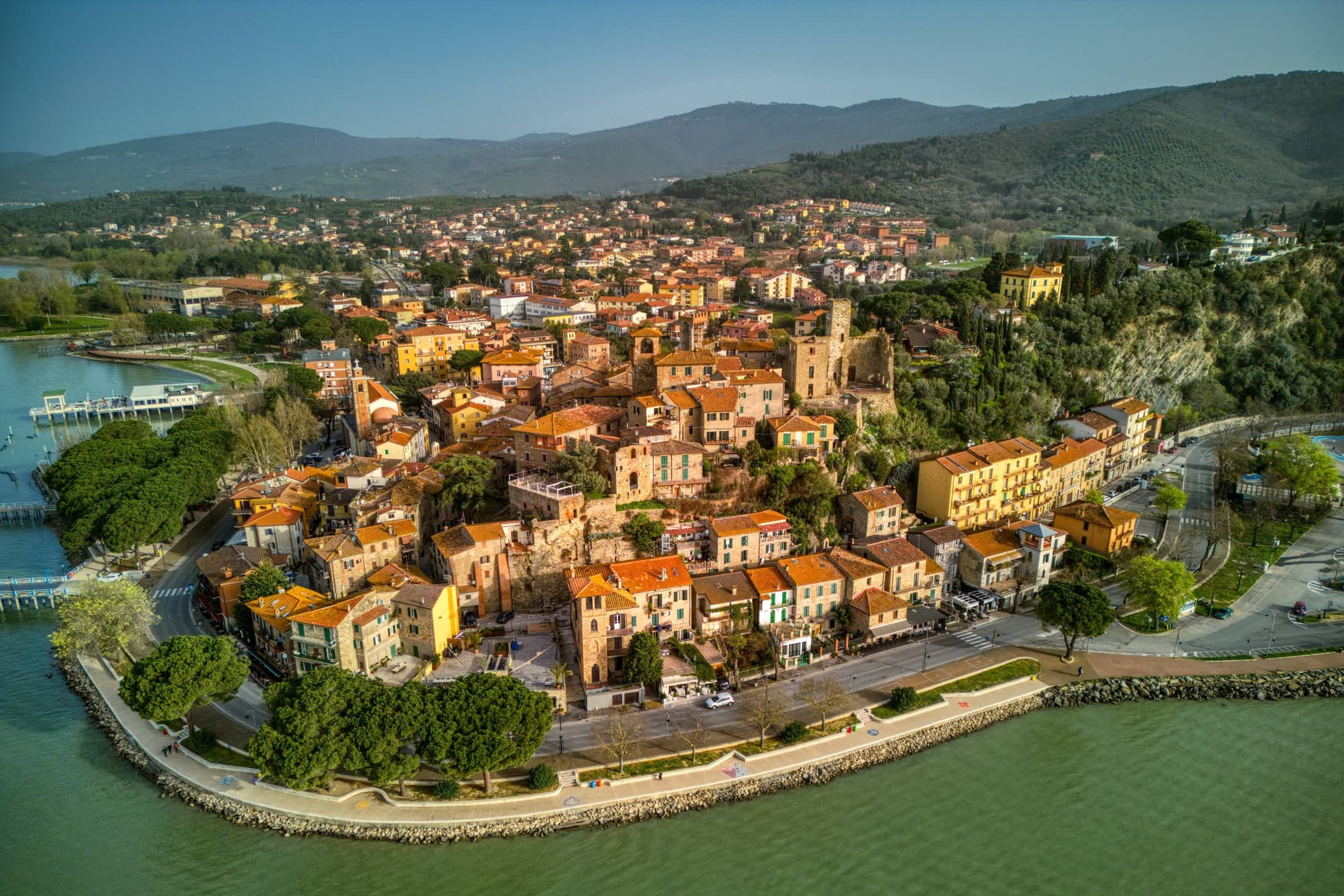
Passignano sul Trasimeno sits on a low promontory on the northern shore of Lake Trasimeno, twenty kilometers northwest of Perugia, separated from the lake only by the road that links Perugia to Tuscany. The Umbri held the ground first, then the Etruscans pushed them east of the Tiber; the Romans turned the spur into a watchtower controlling the pass between northern and central Italy.
In 217 BC Hannibal trapped Gaius Flaminius's army of 25,000 in the narrow road between Tuoro and Passignano, killing about 15,000 Romans in the morning fog of June 21, one of the worst defeats in Roman history. The Rocca, built around 850 by the marquises of Tuscany and conquered by Perugia in 1187, holds a quadrangular plan around a 32-meter keep that survived a 1778 partial demolition.
The Festa della Padella, held in late August, fries lake fish for the village in a four-and-a-half-meter pan on the shore. The Borgo dei Borghi finalist designation arrived in the 2010s.
We confirmed you can reach this one by train.
What to see in Passignano sul Trasimeno
- Rocca di Passignano. Quadrangular fortress built around 850 by the marquises of Tuscany with a 32-meter central keep, partly demolished in 1778.
- Chiesa di San Bernardino. Sixteenth-century church near the Rocca with a Renaissance interior and views down to the lake from its portico.
- Centro di Documentazione Annibale e Battaglia del Trasimeno. Small documentation centre on the Battle of Lake Trasimene of 217 BC and Hannibal's ambush of Gaius Flaminius.
How to get to Passignano sul Trasimeno
There is a railway station in the town, so you can arrive without a car and never need one while you are here. Perugia is roughly 28 minutes away by road.
✷ We have written about Passignano sul Trasimeno
“The lake is like a sanatorium compared to the sea. It’s relaxed. It’s calm. It’s silent. To find this level of almost disturbing quietness, you either go up into the mountains, or you really need to know your way around the sea to find that particular spot not overrun by vacationers and beach people. In Trasimeno, this is easy. Even the most popular towns like Castiglione or Passignano sit in quiet harmony with the stillness of the water.”
Read our piece on Passignano sul Trasimeno →Lago Trasimeno | Never Compete with the Sea
Our tip
April through June and September into October are the months the lake works. The water warms enough by late May for swimming off the Lido and the ferry to Isola Maggiore runs to a steady schedule. July and August are crowded; the Festa della Padella in late August is the loudest weekend of the year. Festa dei Barbari - Castel Rigone falls in July.
Castiglione del Lago
Why visit Castiglione del Lago
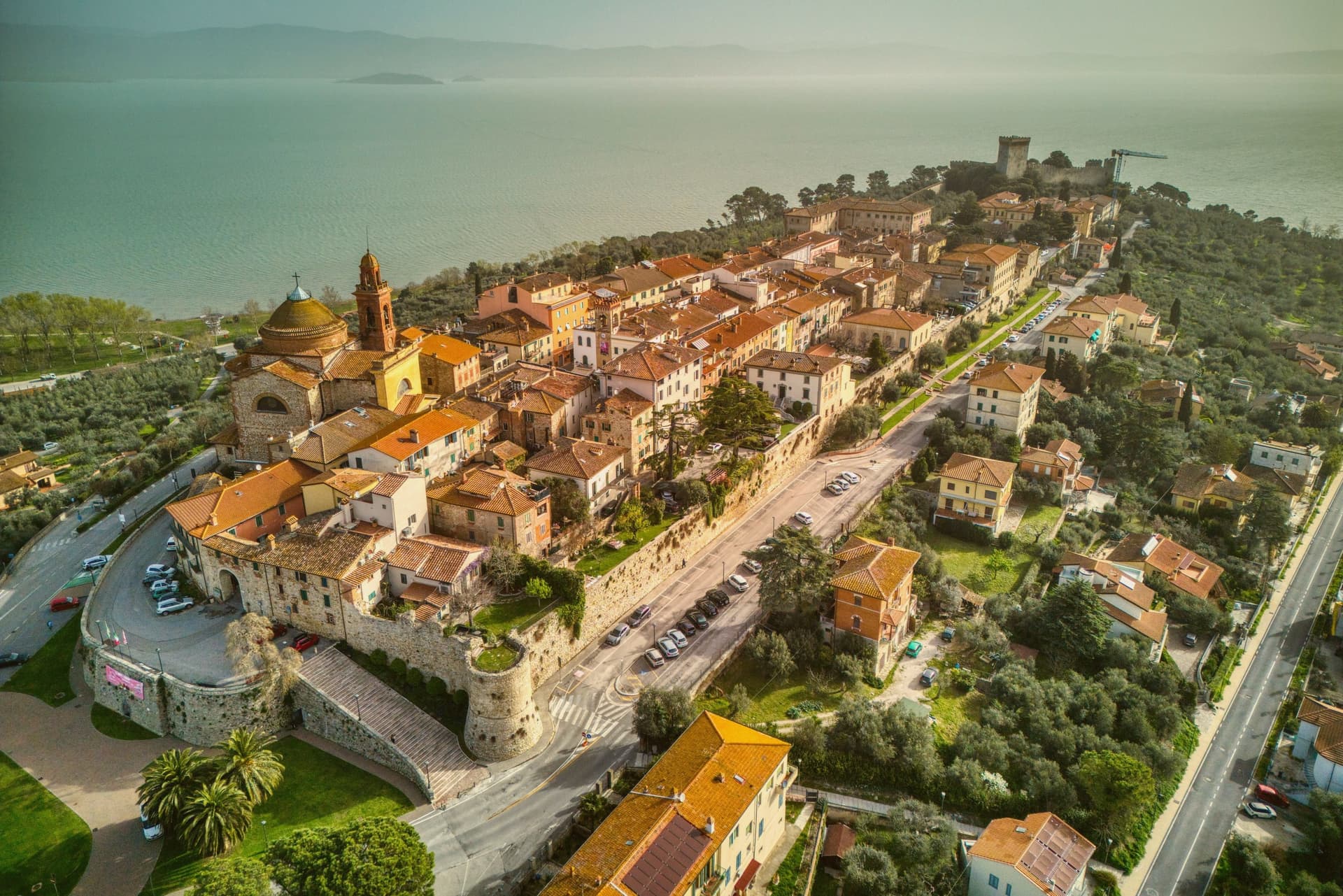
The town sits on a limestone promontory on the western shore of Lake Trasimeno, thirty kilometers from Perugia. That promontory was the fourth island of the lake in antiquity, before the strip of water separating it from the mainland silted in, which is why a place now solidly attached to shore still carries the memory of being an island in its layout and its name.
The fortress anchors the southern end of the centro storico, and a covered passage links it directly to the ducal palace: one museum complex, two buildings, four centuries apart, joined so that a visitor can pass from medieval military architecture into a Mannerist-frescoed residence without stepping outside. The town is the largest commune on the Trasimeno and the western base for the ferries out to the lake's islands, and it is the only one of the lake's shore towns to hold Borghi più belli status.
What this adds up to is a small center where fortification and courtly decoration sit back to back, and where the lake itself, its islands, its silted-in strait, its ferries, is never far from any single building.
We confirmed you can reach this one by train.
What to see in Castiglione del Lago
- Palazzo della Corgna. Sixteenth-century ducal palace built for Ascanio della Corgna on a Baglioni structure, eight rooms frescoed by il Pomarancio between 1574 and 1590.
- Rocca del Leone. Pentagonal medieval fortress commissioned by Federico II di Svevia in 1247, linked to Palazzo della Corgna by a covered passageway.
- Chiesa di Santa Maria Maddalena. Parish church on the centro storico's main axis, bell tower rising to 329 meters above sea level over the lake.
How to get to Castiglione del Lago
There is a railway station in the town, so you can arrive without a car and never need one while you are here. Perugia is roughly 52 minutes away by road.
Our tip
April through June and September into October are the months the Trasimeno shows best: the lake holds the light, the ferry to Isola Maggiore runs full schedule, and the lungolago at evening fills with locals and not yet with day-trippers. July and August push into the low thirties; the lake breeze helps, but weekends draw heavy traffic from Perugia and Florence. November through March is quiet. Stramaialata - Sagra del Mangiar Bene falls in August.
Assisi
Why visit Assisi
Assisi sits on a terraced spur twenty kilometers east of Perugia, the town built into the western flank of Monte Subasio where it drops toward the plain below. The Umbri settled the site before the Romans came, and the municipium of Asisium grew up around what is now Piazza del Comune, the square that still forms the civic center of the medieval town.
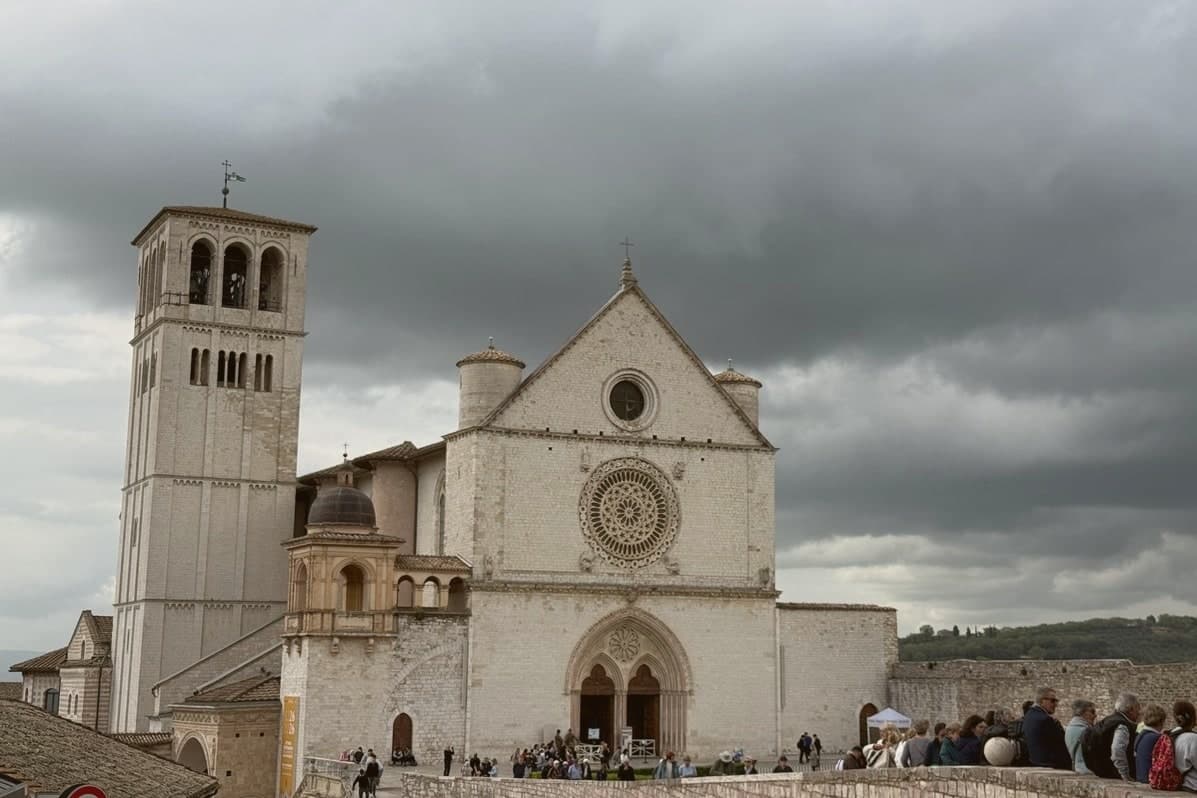
The centro storico runs between two poles: the basilica holding Francis's tomb at one end and the church holding Clare's relics at the other, with the Roman square and its temple facade sitting between them as the oldest layer beneath the medieval one. Below the town, on the plain, stands the basilica built around the chapel where Francis founded his order and died.
Further up the mountain, past the town walls, the hermitage occupies a beech wood where Francis and his companions withdrew from all of it. The layout traces the life it commemorates: birth and burial at the center, founding and death on the plain below, retreat in the wood above.
The town has arranged itself, over centuries, around the geography of one man's biography.
We confirmed you can reach this one by train.
What to see in Assisi
- Basilica di San Francesco. Two superimposed churches over the saint's tomb, frescoed by Cimabue, Giotto, Simone Martini and Pietro Lorenzetti.
- Basilica di Santa Chiara. Church at the eastern end of the centro storico, holding the relics of Saint Clare and the San Damiano Crucifix.
- Tempio di Minerva. Roman temple on Piazza del Comune, six Corinthian columns intact, one of the best-preserved temple façades in the country, converted to a church in 1539.
How to get to Assisi
There is a railway station in the town, so you can arrive without a car and never need one while you are here. Perugia is roughly 35 minutes away by road.
✷ We have written about Assisi
“The basilica is grand, and it is grand from a distance, which is the harder trick. You see it from the valley road as a long horizontal weight along the end of the ridge, held up on arches, wider than the town it belongs to. In front of it there is a huge sloping field, stone, which functions as a piazza sort-of.”
Read our piece on Assisi →Assisi | The Church He Would Have Chosen
Our tip
April through June and September into October are the months Assisi was built for. The hills around Monte Subasio turn green in spring and gold in autumn, and the pilgrim traffic spreads thinly enough that the centro storico keeps its silence in the early morning. October 3 and 4 are the Festa di San Francesco, when delegations from every Italian region process to the basilica. Festa di Sant'Anna falls in July.
More from Anywhere Italy
 The 7 best towns with a serious restaurant that sit inside a nature park in the province of Perugia
 The best towns you can reach by train that have a serious restaurant within 90 minutes of Perugia
 The best hill towns with a serious restaurant in the province of Perugia
- The 6 best hidden towns with a serious restaurant that you can reach by train within 90 minutes of Perugia
 The 8 prettiest villages you can reach by train in the province of Perugia
 The 7 prettiest villages you can reach by train within 90 minutes of Perugia