
The best towns with a serious restaurant that eat well within 90 minutes of Rimini
Romagna eats without apology. Piadina cooked on a testo, cappelletti in capon broth, grilled Adriatic sole and mazzancolle, sangiovese poured young and cold in summer. Behind the coast the land climbs quickly into Montefeltro, a country of brick towers, sandstone farmhouses and beech woods where the autumn brings white truffle and the winter brings slow-cooked meat and chestnut flour. The best kitchens here work between those two larders, salt water and hill, and several of them hold recognition from the most demanding of the guides.
The default plan is the Riviera itself, Riccione and the long strip of Rimini's Marina Centro, where the beach clubs run in numbered rows and the restaurants closest to the sand mostly cook for people who will not return. In August the coast road moves at walking pace and a table without a booking is unlikely. It is a real holiday tradition and it works on its own terms, but the cooking that gets written up seriously is rarely found within sight of the umbrellas.
The same coast and the same hills continue in both directions, north into the Cesenatico canal port and the Rubicone valley, south and inland towards the Metauro, Urbino's brickwork and the truffle country around the Furlo gorge. Fewer people go, and the kitchens there cook for locals who know what a proper brodetto costs. Everything in this list sits within a comfortable drive of Rimini, which makes an evening meal in a hill town a plausible plan rather than an expedition.
Of the 21 communes we have mapped within 90 minutes of Rimini, 10 qualify as towns with a serious restaurant that eat well: each holds a restaurant listed by the most demanding of the guides, and a dining guide has named a table in each. The smallest, Montegridolfo, has 994 residents.
Two more lists worth reading alongside this one: The best hill towns that eat well within 90 minutes of Rimini and The best towns with a serious restaurant in the province of Pesaro e Urbino.
Montegridolfo
Why visit Montegridolfo
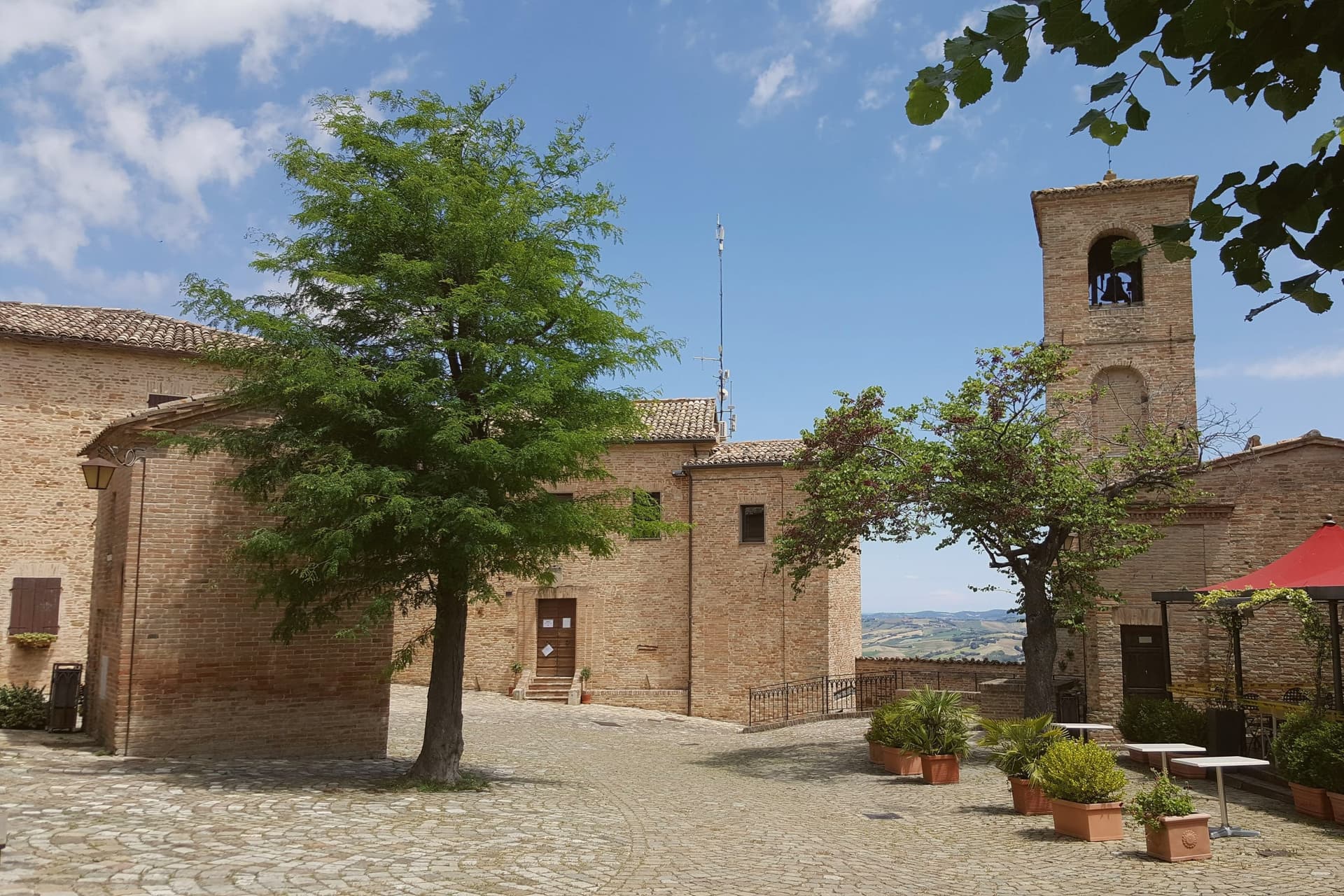
Montegridolfo sits at 290 meters on the Romagna-Marche border ridge, twenty kilometers south of Rimini and just inland from the Adriatic. A first castle is documented here in 1148, belonging to the Abbey of San Pietro of Rimini; the village took its name from the Gridolfi, a Rimini Guelph family that settled here during the conflicts with the Ghibellines.
After a sack in 1288, the Malatesta rebuilt the walls in 1337 with four corner towers. One tower survives, plus the bell tower over the gate.
The borgo passed back and forth between Malatesta and Montefeltro through the fifteenth century, fell briefly to Cesare Borgia in 1502, then to Venice, then to the Papal States in 1509. The walled nucleus today holds barely 200 of the commune's 994 residents, with the rest in Trebbio, San Pietro, and Cabaldo.
Olive oil from the surrounding ridges carries the Colli di Romagna DOP designation; the town joined the Città dell'Olio network on that basis.
Osteria dell'Accademia have been named by a guide.
What to see in Montegridolfo
- Castello di Montegridolfo. Walled fourteenth-century burg built by the Malatesta in 1337 with four corner towers, of which one survives along with the bell tower over the original gate.
- Chiesa di San Rocco. Fifteenth-century church inside the walls, built in thanks after the village was spared a plague outbreak, with frescoes attributed to the school of the Marchigiana.
- Borgo murato. Compact walled nucleus of stone houses, narrow streets and a single piazza, restored in the 1990s and inhabited by artisans and a small permanent population.
How to get to Montegridolfo
Rimini is roughly 42 minutes away by road.
Our tip
April through October are the months that work in Montegridolfo. Spring brings clear views from the walls down to the Conca valley; September and October are the dry, gold months with the olive harvest beginning at the end of October. July and August are hot but the ridge catches the Adriatic breeze and the walled nucleus stays cool in shade.
Pennabilli
Why visit Pennabilli
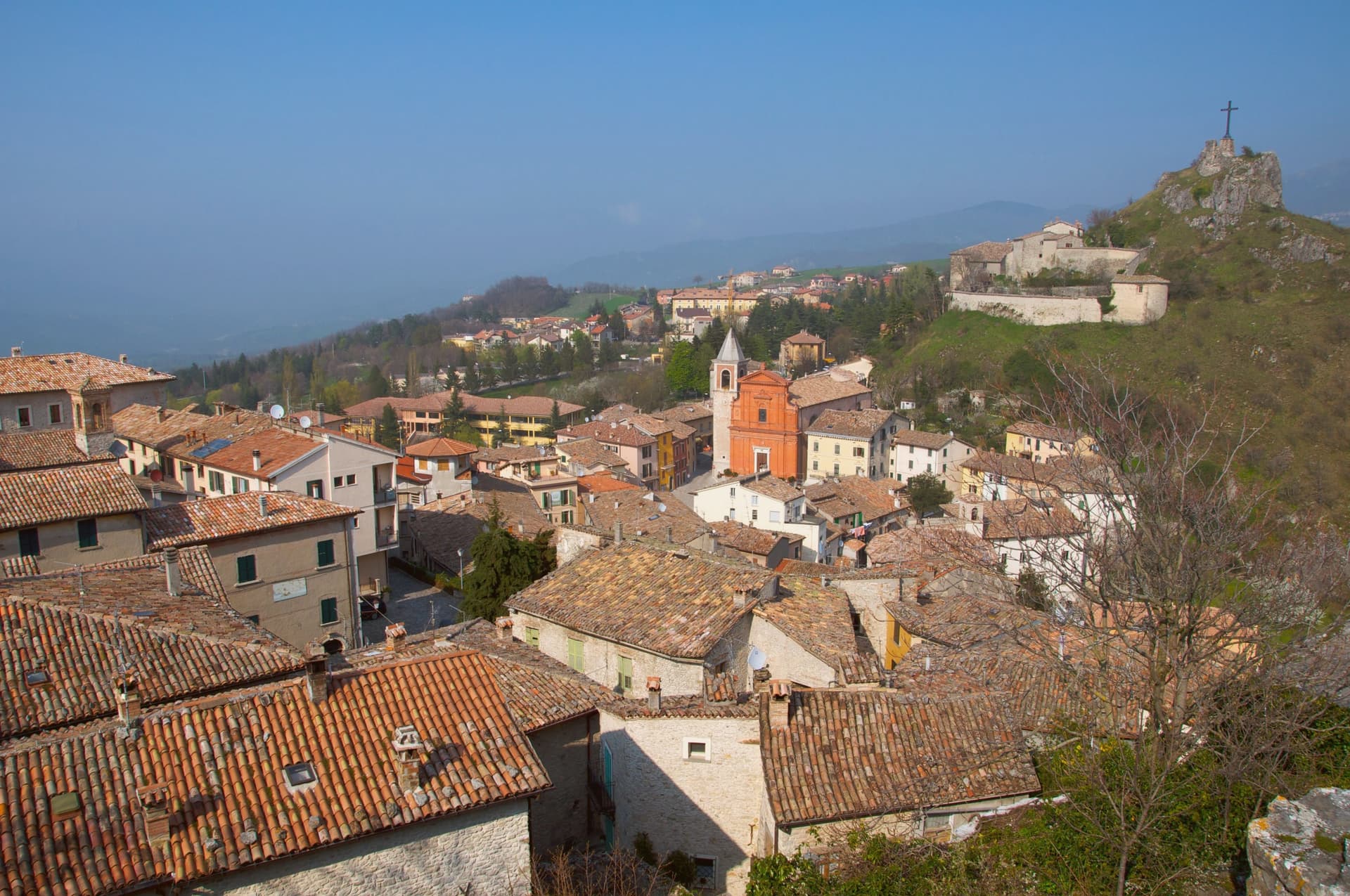
Pennabilli sits at 629 meters on the western slope of Monte Carpegna, at the head of the upper Marecchia valley, forty-five kilometers south of Rimini, inside the historic Montefeltro region. The town grew from the union of two hilltop castles, Penna on the Roccione and Billi on the Rupe, formally joined in 1350 by a stone of peace placed in the marketplace between them.
It has been the episcopal seat of the Diocese of Montefeltro since 1572, a status transferred from the older seat of San Leo. Tonino Guerra, long-time collaborator of Fellini, Antonioni and Tarkovsky, settled here in 1989 and spread his outdoor museum, I Luoghi dell'Anima, across both the town and the valley below it, linking the two former castles and their surroundings into a single walked route.
The garden of forgotten fruits opened the following year, and the antiques fair has continued each July since 1970, older than either. What the place adds up to is a town built twice: once by the stone that joined two castles into one commune, and once by the poet who joined the whole valley into a single museum without walls.
Il Piastrino have been named by a guide.
What to see in Pennabilli
- Orto dei Frutti Dimenticati. Walled garden below the Roccione, its paths lined with sculptures and installations set among the rescued fruit varieties.
- I Luoghi dell'Anima. Network of seven outdoor installations across Pennabilli and the Marecchia valley, conceived by Tonino Guerra between 1989 and 2012.
- Roccione and Rupe. Two rocky outcrops that carried the medieval castles of Penna and Billi, joined into a single commune in 1350.
How to get to Pennabilli
Rimini is roughly 55 minutes away by road.
Our tip
May through October is the open season in Pennabilli. The Marecchia valley turns green in late spring; the air at 629 meters stays cooler than the Rimini coast forty-five kilometers downstream. July is the busiest month, with the Mostra Mercato d'Antiquariato pulling crowds into the centro storico and the Carpegna trails open for hikers. Food Garden falls in August.
Acqualagna
Why visit Acqualagna
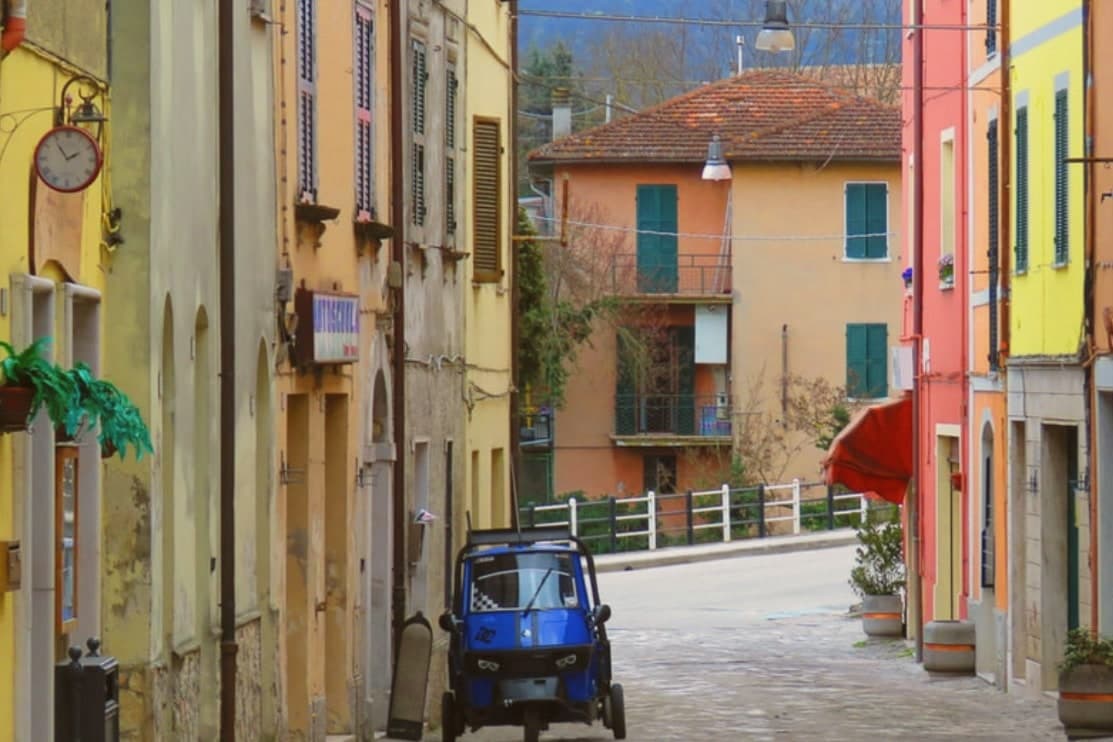
Acqualagna sits at 204 meters in the Metauro valley, twelve kilometers from Urbino, on the plain just downstream from the gorge cut by the Candigliano river. The Roman city of Pitinum Mergens stood nearby until Alaric's Goths destroyed it; the survivors founded Montefalcone, the castle from which today's village grew.
The name Acqualagna comes from Aqua Lanea, water of slaughter, after the sixth-century battle fought on that same plain. Three fairs anchor the year: black truffle on the last Sunday of February, summer black on the last Sunday of July, white truffle across the last weekend of October and the two that follow.
The town below and the gorge above read as one unit, a river valley that has carried Roman road traffic, monastic settlement and truffle trade in turn, each leaving its mark on the ground without erasing what came before.
Anticofurlo have been named by a guide.
What to see in Acqualagna
- Gola del Furlo. The gorge narrows between Monte Paganuccio (977 m) and Monte Pietralata (888 m); the 38-meter Roman tunnel, cut in 76 AD, is still driven through by the Via Flaminia today.
- Abbazia di San Vincenzo al Furlo. Medieval Benedictine monastery set into the slopes above the gorge, counted among the oldest religious foundations in the Metauro valley.
- Riserva Naturale Statale Gola del Furlo. Nature reserve established in 2001, covering 3,600 hectares of woodland, grazing land and ridgeline above the river.
How to get to Acqualagna
There is a railway station in the town, so you can arrive without a car and never need one while you are here. Rimini is roughly 81 minutes away by road.
Our tip
April through June and September into October are the months for Acqualagna. The Metauro hills hold their green, the woods around Monte Paganuccio are open for walking, and summer truffle season turns the piazzas over to tasting tables in late July. July and August touch the high twenties; the gorge stays cooler than the valley floor. Fiera Regionale del Tartufo d'Estate falls in August.
Gabicce Mare
Why visit Gabicce Mare
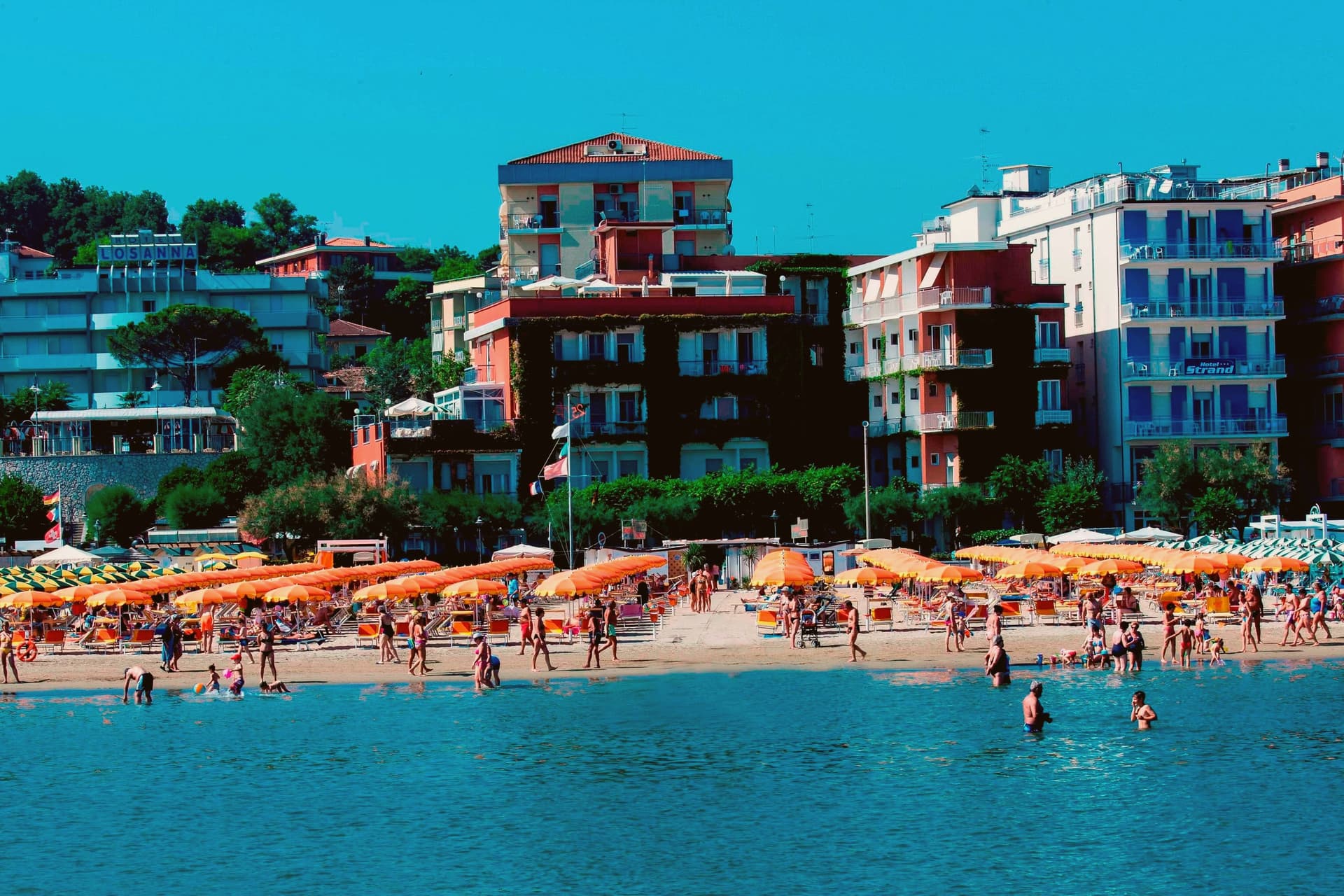
Gabicce Mare sits on the Adriatic at the northernmost point of the Marche, sixteen kilometers north of Pesaro and bordering Cattolica in Emilia-Romagna's province of Rimini. South of the beach, the cliffs of Monte San Bartolo rise abruptly, the only stretch of high coast between Trieste and the Conero, so the town marks the hinge where a long flat sand shore gives way to headland.
Sixteenth-century maps placed the Romagna border further south than it runs today, taking in the upper hamlet inside what is now the park. The archaeological record on the headland runs from the Neolithic at Monte Castellaro through a Roman site on the Via Flaminia to a lost Greek-origin port below the cliffs, layers of settlement stacked on the same few kilometers of high ground.
The town is really two places joined by geography rather than one: a beach that belongs to the sand coast running north, and a cliff and ridge system that belongs to the rock coast running south. Nowhere else on this shore does the flat Adriatic strip end so abruptly against high ground.
Posillipo, Dalla Gioconda have been named by a guide.
What to see in Gabicce Mare
- Spiaggia di Gabicce Mare. Sand beach at the southernmost extension of the Riviera Romagnola strip, the family beach end of the upper Marche coast, backed by the town rather than the cliffs.
- Parco Naturale del Monte San Bartolo. Cliffs, ridge and a run of Renaissance villas above the sea, with fossil fish embedded in the rock face.
- Gabicce Monte. The hamlet climbs above the seafront rather than sitting on it, so the same stretch of coast reads differently from up here, the beach town below, the cliff line running south.
How to get to Gabicce Mare
There is a railway station in the town, so you can arrive without a car and never need one while you are here. Rimini is roughly 26 minutes away by road.
Our tip
May through September is the window for Gabicce Mare. The Adriatic warms by mid-May, the beach reaches full Bandiera Blu service through summer, and the San Bartolo cliff trails are open and dry. July and August touch the low thirties on the sand and the resort runs at peak with the Riviera Romagnola crowds from Rimini and Cattolica spilling south.
Longiano
Why visit Longiano
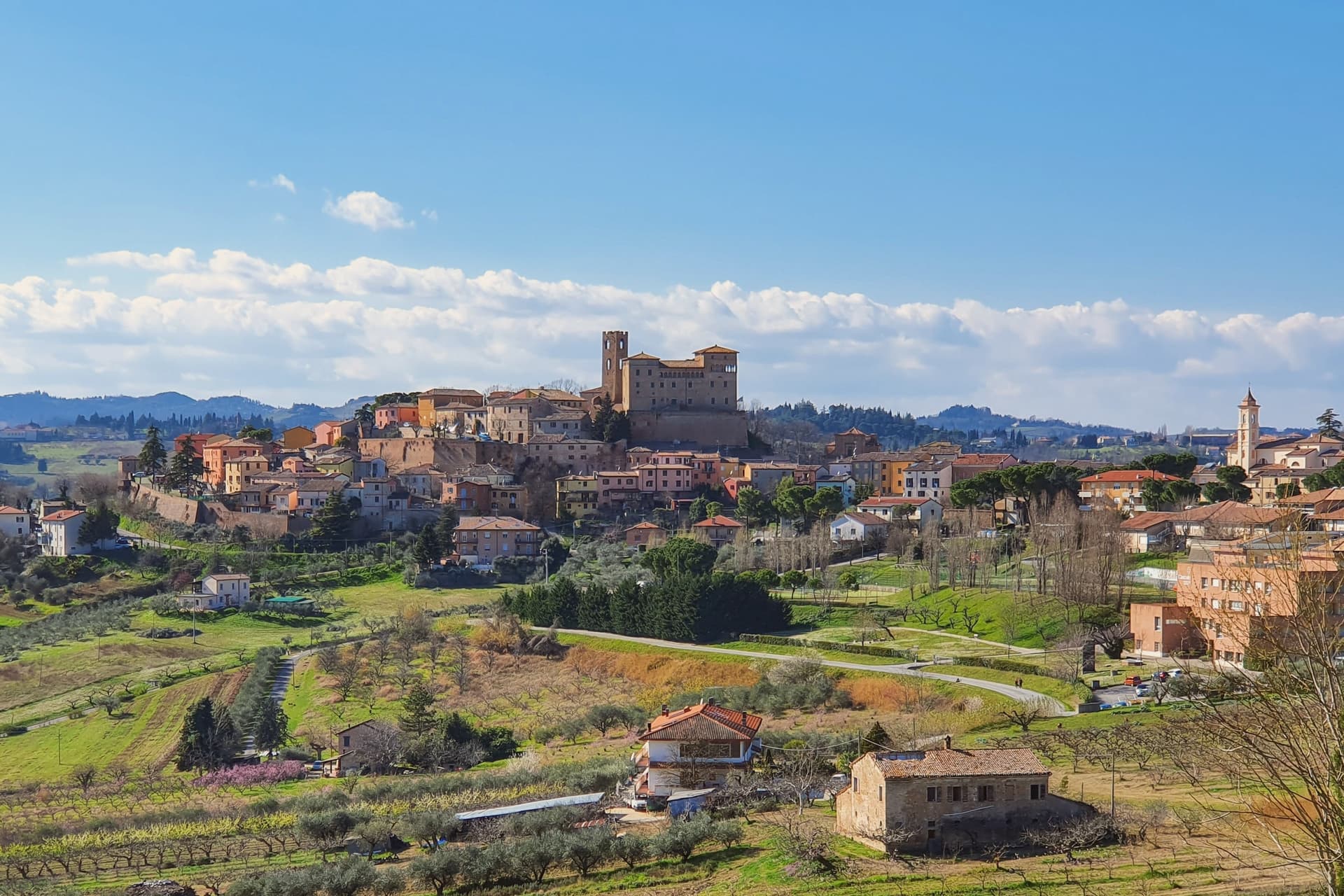
Longiano sits at 179 meters on the first hill line between Cesena and Rimini, eleven kilometers inland from Cesenatico and within sight of the Adriatic. The town shifted from the plain to the hill in the seventh and eighth centuries, when the local population moved up to escape Lombard raids, and the settlement that resulted is the hilltop borgo still walled today, with the castle at its center and the theater just below it.
Longiano passed to the Church in 1581 and stayed under papal rule until unification, before the castle came to the commune in 1989. The sanctuary stands apart from this hilltop cluster, built around its painted crucifix and held by Franciscan presence for over seven centuries, a separate thread of the town's history running alongside the Malatesta line and the civic one.
What ties the parts together is the hill itself: a defensive move made in the seventh and eighth centuries left Longiano with a compact center where a former ruling family's fortress, a nineteenth-century theater and a walled medieval borgo all sit within reach of each other, while the sanctuary's much older devotional history runs on its own separate track nearby.
Magnolia, Dei Cantoni, Terre Alte have been named by a guide.
What to see in Longiano
- Castello Malatestiano. Fortified hilltop seat of the Malatesta of Rimini, later passing to the Church and then the commune. Its rooms now hold the Fondazione Tito Balestra, so the walls that once housed a ruling family now hold paintings, drawings and sculpture.
- Teatro Petrella. Sits just below the castle. Restored in 1986, it is known today for its acoustics inside the horseshoe-shaped hall.
- Santuario del Santissimo Crocifisso. Franciscan sanctuary built around a thirteenth-century painted crucifix on oak panel, with continuous Franciscan presence for over seven centuries.
How to get to Longiano
There is a railway station in the town, so you can arrive without a car and never need one while you are here. Rimini is roughly 30 minutes away by road.
Our tip
April through June and September through October are the months for Longiano. The hilltop catches a breeze the coastal plain below does not, and the views run from the Apennines to the Adriatic on clear days. July and August touch the low thirties and the centro storico empties between two and five; many visitors come up from Cesenatico and Cervia in the late afternoon for the cooler air and the castle. Crocetta 30 in Festa falls in August.
Fossombrone
Why visit Fossombrone
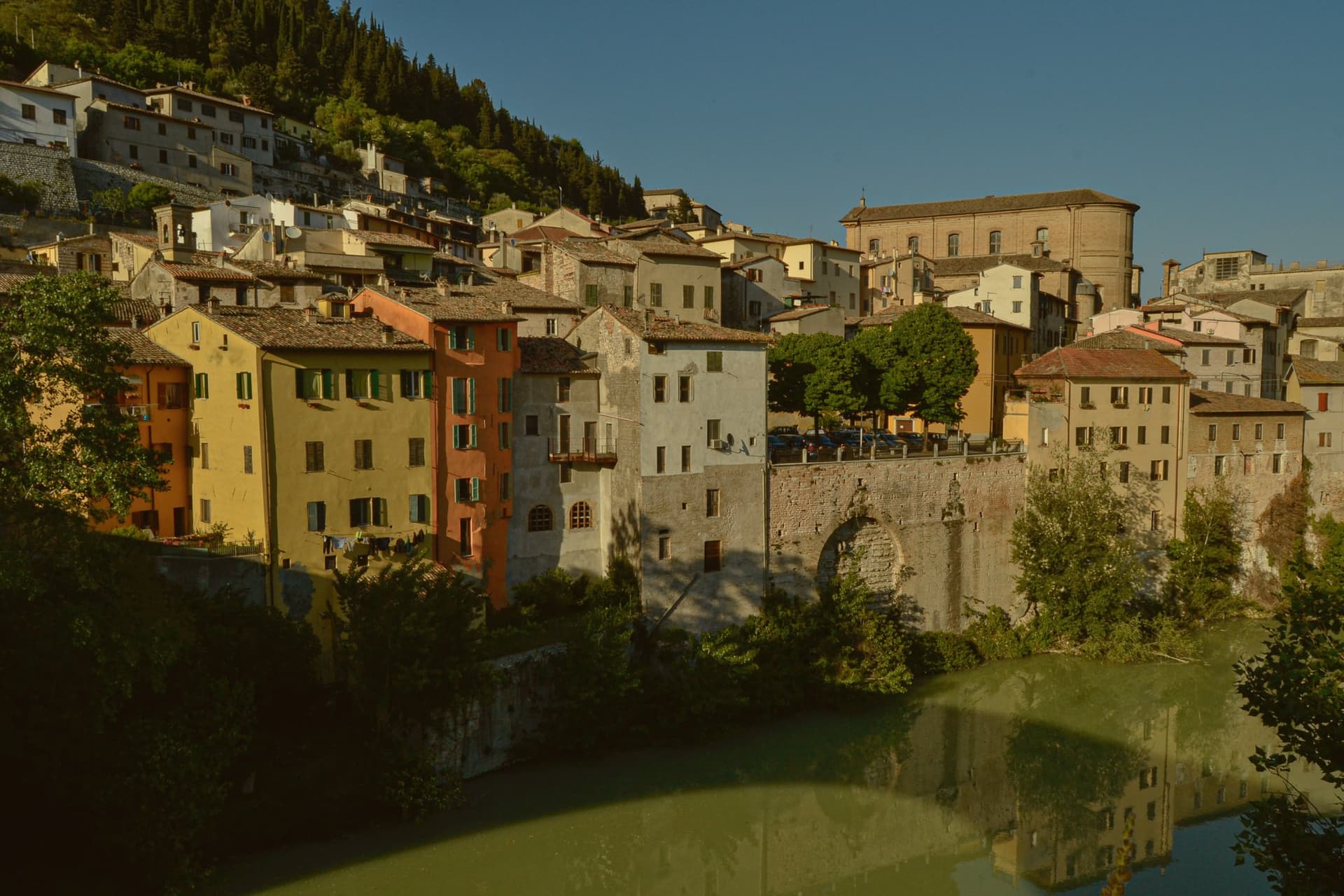
Fossombrone sits on the Metauro river in the foothills of the central Apennines, 30 km inland from Pesaro. The site has been continuously occupied since the 8th century BC: a north-Piceno village, then a partial Celtic settlement, then the Roman colony founded around 120 BC by the consul Caius Sempronius Gracchus.
The town's layers sit stacked in physical order. The Roman city's remains lie in the flat ground just east of the modern centre.
Above it, the medieval and Renaissance town climbs a single long street to the ducal court at its summit. Lower down, the Casa Cattabrini and the cathedral anchor the centro storico by the river.
Upstream, 8 km from the centre, the Metauro narrows into the gorge that gives the town its wider setting, its cliffs cut through by the Roman engineers and now enclosed within a nature reserve. The geography explains the sequence: river valley first, road town second, fortified height last, each built on what the one before had left standing.
Osteria Zanchetti have been named by a guide.
What to see in Fossombrone
- Forum Sempronii (area archeologica). Excavations east of the modern centre reveal the forum, basilica and domus mosaics, with a continuous stratigraphy running from the north-Piceno village through the Roman imperial city. The Via Flaminia ran through the colony.
- Corte Alta. The palace begun by Federico da Montefeltro and completed under the Della Rovere dukes sits at the top of a single long street climbing from the lower town. It holds a small civic museum alongside the frescoed hall.
- Galleria del Furlo (76 AD). The tunnel runs 38 metres through limestone above the narrowing Metauro, with the gorge around it protected as a nature reserve, some of the wildest ground in the Marche.
How to get to Fossombrone
Rimini is roughly 69 minutes away by road.
Our tip
April through October is the open season on the Metauro. May and June are the best months for the Furlo Gorge walks — wildflowers, cool gorge shade, the river running clear. July and August are warm in the valley but the gorge stays cooler than the coast; the Corte Alta keeps regular hours.
Urbino
Why visit Urbino
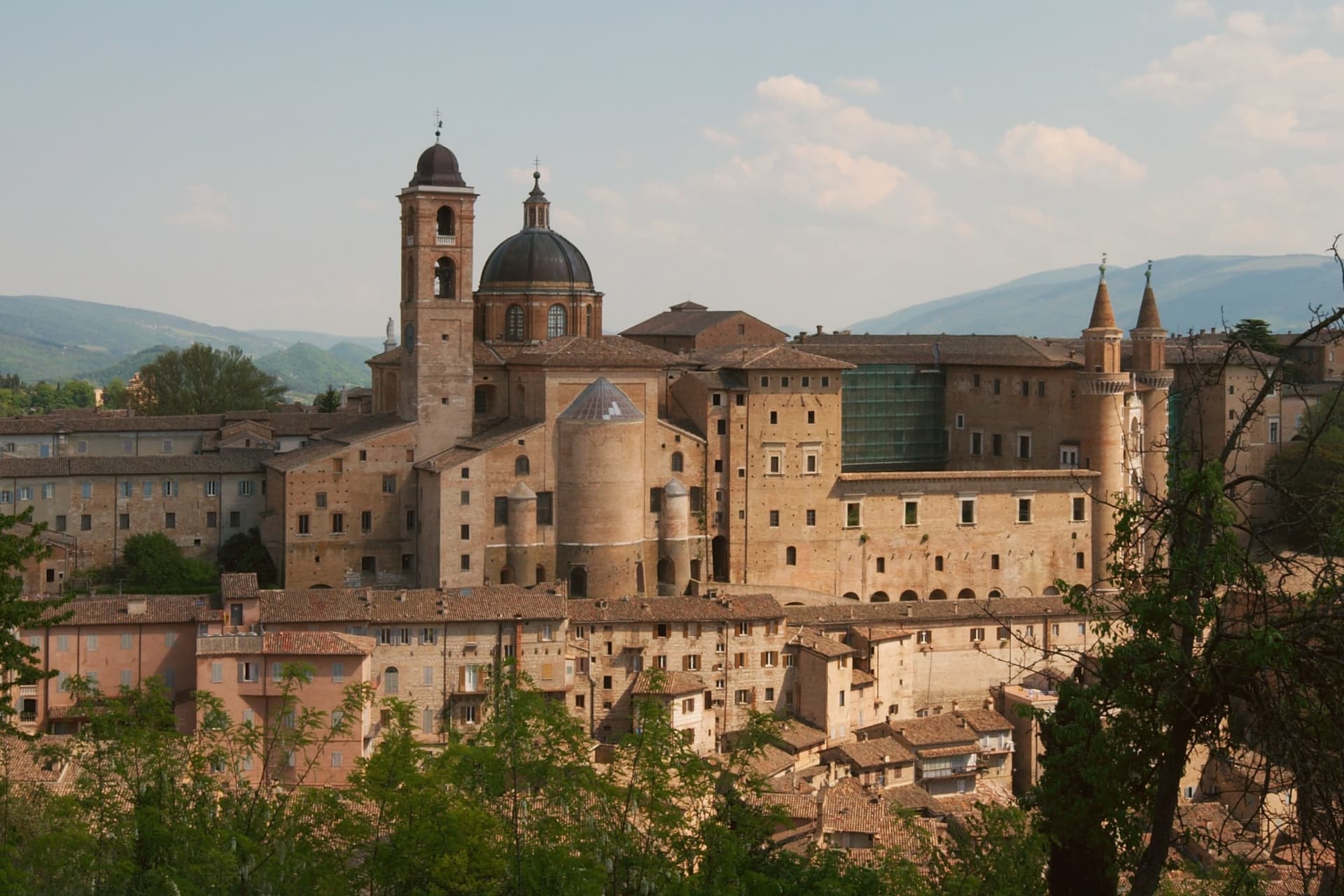
Urbino sits at 451 meters in the Apennine foothills, seventy kilometers north of Perugia, its historic core spread across twin hills with the fortress on the higher of the two and the palace complex below on the other. Federico II da Montefeltro ruled from 1444 to 1482, and under him the town became one of the central courts of the Italian Renaissance: he was condottiere, diplomat, patron and humanist at once, and the building campaign he set running through the 1450s to the 1470s, first under Maso di Bartolomeo, gave the city the asymmetric silhouette that still defines it from a distance.
The university, founded in 1506, keeps that Renaissance investment active in the present rather than fossilized: the centro storico holds roughly 14,000 residents and around 14,000 enrolled students, so the old town runs on a population it did not have in the fifteenth century. The two hills, the ducal seat and the fortress above it, read as the same civic project seen from two elevations: one built to project a court outward, the other to hold the higher ground behind it.
What the 1998 inscription recognizes is that this pairing, court and citadel, survives largely as Federico left it.
Portanova have been named by a guide.
What to see in Urbino
- Palazzo Ducale. Federico da Montefeltro's Renaissance palace begun 1444, completed by Luciano Laurana with the twin torricini facade, now housing the Galleria Nazionale delle Marche.
- Galleria Nazionale delle Marche. One of the most important Renaissance painting collections in Italy, with Raffaello, Piero della Francesca's Flagellazione and Madonna di Senigallia, Paolo Uccello and Tiziano.
- Casa Natale di Raffaello. Fifteenth-century house on Via Raffaello where the painter was born in 1483 in the workshop of his father Giovanni Santi, now a museum of the early years.
How to get to Urbino
There is a railway station in the town, so you can arrive without a car and never need one while you are here. Rimini is roughly 65 minutes away by road.
Our tip
April through June and September into October are the best months for Urbino. The hills hold their green, the city's brick warms in afternoon light, and the long climb to the Fortezza Albornoz is bearable in mild weather. July and August touch the low thirties at 451 meters; the Palazzo Ducale stays cool inside, but the steep streets in afternoon sun are slow going.
Santarcangelo di Romagna
Why visit Santarcangelo di Romagna
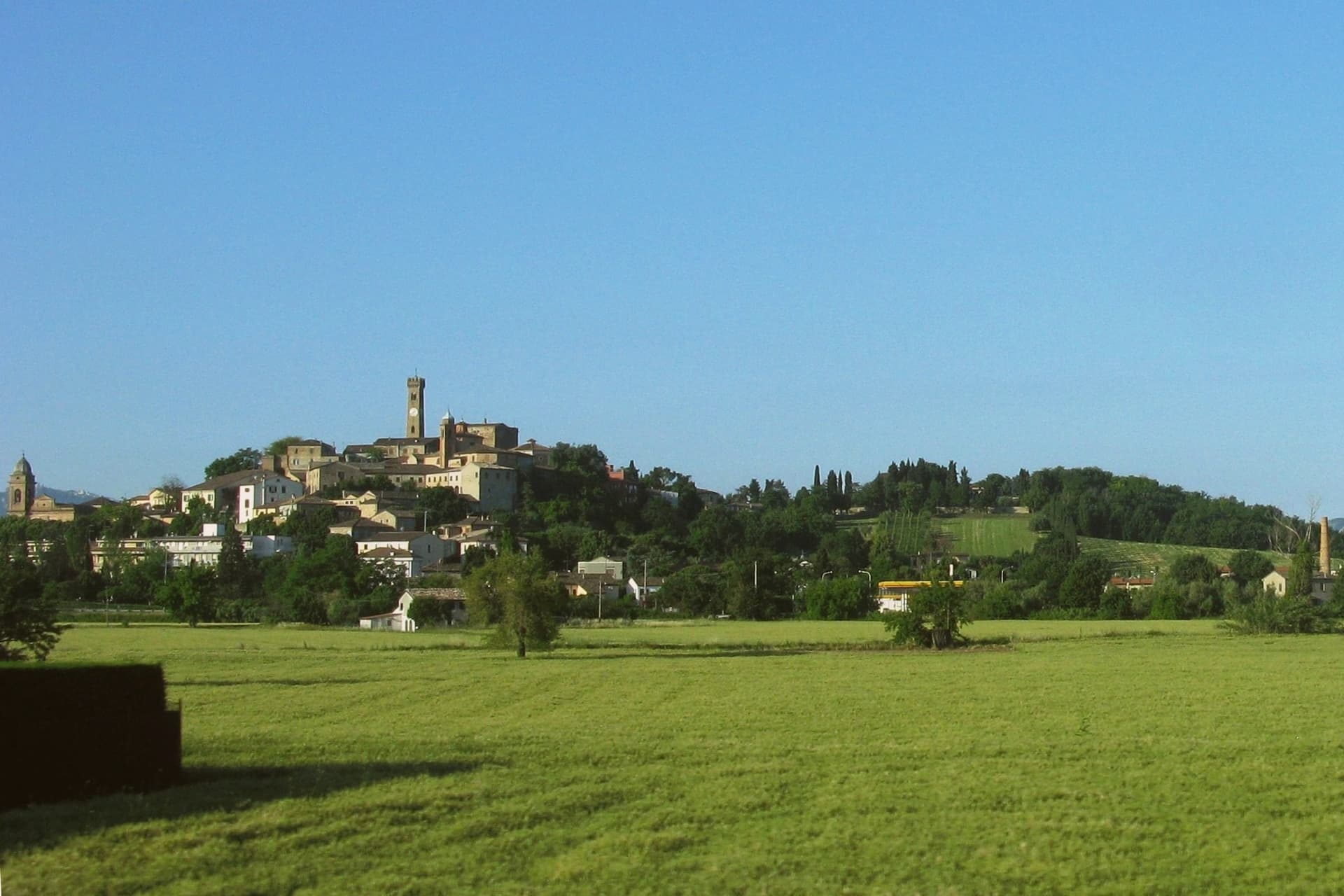
Santarcangelo di Romagna sits at 42 meters on a low hill between the Marecchia and the Uso rivers, eleven kilometers northwest of Rimini on the Via Emilia. Roman in origin, named Pagus Acervolanus, the town grew under the Malatesta of Rimini, who fortified the hill in 1386 with the Rocca Malatestiana that Carlo Malatesta built and contemporaries called an eighth wonder of the world.
Under the centro storico, over 150 man-made caves on eight levels cut into the soft tufa rock form an underground city: pagan place of worship, burial chambers, wine cellars, and in 1944 air-raid shelters that saved most of the population. The town gave the world two dialect poets, Raffaello Baldini and Tonino Guerra, whose verses earned Santarcangelo the title capital of Romagnolo dialect poetry.
Guerra, also Fellini's screenwriter, designed the Strada delle Meridiane that runs through the centro. The Festival Internazionale del Teatro in Piazza, founded in 1971, fills the streets every July.
Lazaroun, Osteria La Sangiovesa have been named by a guide.
What to see in Santarcangelo di Romagna
- Rocca Malatestiana. Hilltop fortress built by Carlo Malatesta in 1386, with the surviving keep, walls, and the Torre del Campanone over the centro.
- Grotte Tufacee. Over 150 man-made caves on eight levels cut into the tufa under the centro storico, used as pagan sanctuaries, wine cellars, and 1944 air-raid shelters.
- Piazza Ganganelli. Central square named for Pope Clement XIV (Giovanni Ganganelli, born here in 1705), with a triumphal arch from 1779.
How to get to Santarcangelo di Romagna
There is a railway station in the town, so you can arrive without a car and never need one while you are here. Rimini is roughly 17 minutes away by road.
Our tip
April through June and September through October are the working months on the Marecchia plain. Spring brings clear evenings on the hill and water in the underground grottos; autumn dries the surrounding fields and brings the wine and olive presses back to work. July fills the streets with the Festival del Teatro in Piazza, with companies performing in the piazze, the Rocca courtyard, and the lavatoio. Fiera di San Michele falls in September.
Cesenatico
Why visit Cesenatico
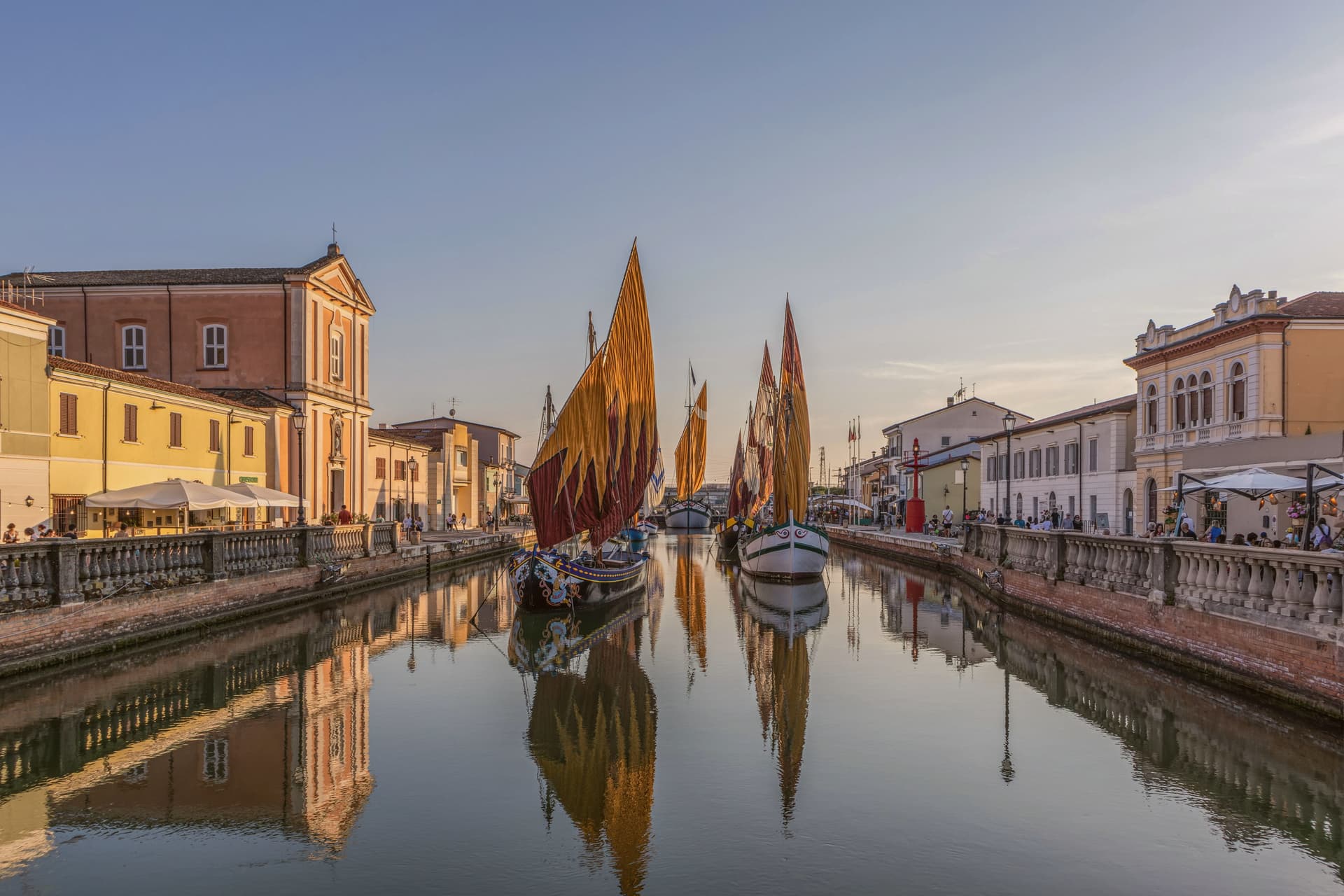
Cesenatico sits at three meters on the Adriatic, fifteen kilometers east of Cesena. The town grew around a canal port begun in 1302 by the Malatesta of Cesena to give the inland city its outlet to the sea, and the canal still runs through the centro storico as the town's working spine.
Leonardo da Vinci arrived in 1502 at the request of a Borgia patron to survey and redraw the port; his sketch, preserved in the Codex L, corresponds to the harbor layout today. Garibaldi embarked from this port in August 1849, fleeing the failed Roman Republic on commandeered fishing boats with about two hundred followers.
The canal separates and joins the two halves of the old town, its banks lined with the pastel facades of fishermen's houses, and it is this same stretch of water that carries the floating section of the Museo della Marineria, sails hoisted through the summer. Cesenatico is also the home town of the cyclist Marco Pantani, marked inland by the Nove Colli ride each May.
The beach carries Bandiera Blu. What holds the town together is the canal itself: a fifteenth-century engineering commission that outlasted the port's original purpose and became the frame for everything Cesenatico later added, from Garibaldi's escape to the moored boats of the maritime museum.
La Buca, Ancòra, Osteria Bartolini and 5 more have been named by a guide.
What to see in Cesenatico
- Porto Canale Leonardesco. Canal port begun in 1302 by the Malatesta, running through the centro storico and lined with the pastel facades of fishermen's houses. Leonardo da Vinci's redrawn layout from 1502 still corresponds to the harbor as it stands.
- Museo della Marineria. Maritime museum with a floating section of historic Adriatic sailboats moored in the canal, their sails hoisted daily in summer.
- Spazio Pantani. Museum near the railway station dedicated to the cyclist, tracing his career including the 1998 Giro and Tour double.
How to get to Cesenatico
There is a railway station in the town, so you can arrive without a car and never need one while you are here. Rimini is roughly 28 minutes away by road.
Our tip
May through September is the working season on the Cesenatico coast. June and the first half of July hold the best balance of warm sea and lighter crowds. Late July and August are the Italian beach peak, when the seven kilometers of sand fill up and the Porto Canale evening passeggiata runs until midnight.
Pesaro
Why visit Pesaro
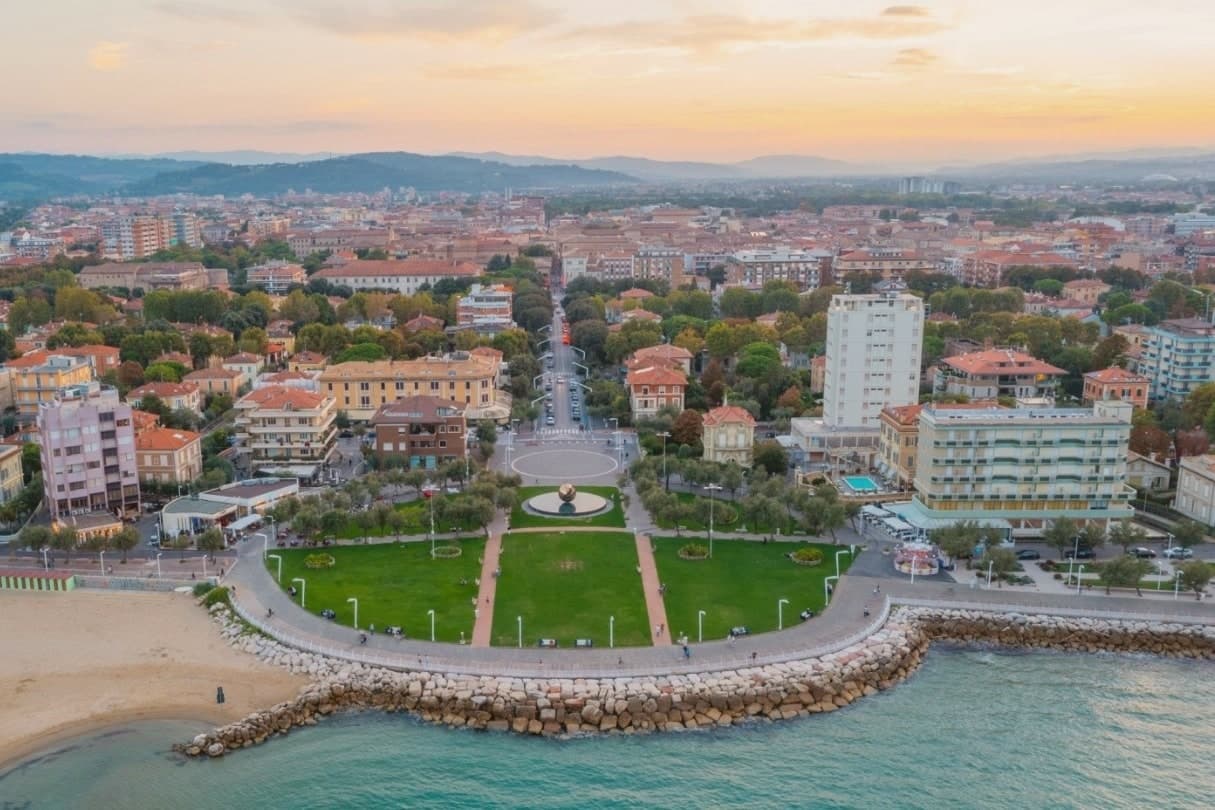
Pesaro sits at the mouth of the Foglia river on the Adriatic, founded as the Roman colony of Pisaurum in 184 BC on the Via Flaminia and held in turn by Montefeltro, Sforza and Della Rovere lords through the Renaissance. The city was Italian Capital of Culture in 2024.
The centro storico is bookended by two poles: the Rocca Costanza holds one end, a fortress built to defend the town, while the beach runs north from the port along the other, the source of the city's working summer economy rather than its history. Inland and above, on the Monte San Bartolo hills, the Della Rovere and Sforza built their summer villa away from the density of the port town below, a separation of ruling residence from civic center that still marks the geography.
The Palazzo Mosca, in the center, gathers what the town has made and collected: paintings, a modern audio amphitheater, and the maiolica that gave Pesaro its recognition as a city of ceramics. Together the fortress, the villa, the beach and the palazzo describe a town shaped by defense, hillside retreat, coastal work and civic collection, each occupying a different piece of ground rather than competing for the same one.
Nostrano, Gibas, Lo Scudiero and 4 more have been named by a guide.
What to see in Pesaro
- Rocca Costanza. Renaissance fortress commissioned by Costanzo Sforza in the 1470s, four corner bastions and a moat, anchoring the eastern edge of the centro storico.
- Musei Civici di Palazzo Mosca. Civic museum in the former Mosca residence, holding paintings, the Pesaro maiolica collection and the Sonosfera audio amphitheater by David Monacchi.
- Teatro Rossini. Nineteenth-century opera house restored after the 1873 reconstruction, filled for two weeks each August when the Rossini Opera Festival takes over, alongside the Vitrifrigo Arena, for the run of performances.
How to get to Pesaro
There is a railway station in the town, so you can arrive without a car and never need one while you are here. Rimini is roughly 40 minutes away by road.
Our tip
May through September is the Pesaro window: the Velvet Beach opens its bagni from late May, the Rossini Opera Festival fills the second half of August, and the September sea stays warm through the start of school. July and August touch the low thirties with humid Adriatic evenings; the festival nights and the seafront passeggiata draw the largest crowds of the year. April, May and October are cooler, calmer months for the Villa Imperiale guided tours and the museum circuit through Palazzo Mosca. Fiera di San Nicola falls in September.
More from Anywhere Italy
- The best hill towns that eat well within 90 minutes of Rimini
- The best towns with a serious restaurant in the province of Pesaro e Urbino
- The best towns you can reach by train within 45 minutes of Rimini
 The 10 best hidden towns with a serious restaurant in Marche
- The 6 best hidden hill towns with a serious restaurant in Marche
- The best hidden towns with a serious restaurant in Emilia-Romagna