
The best towns known for what they grow within 75 minutes of Parma
The land east and south of Parma is agricultural before it is anything else, flat river silt giving way to clay hills, and what grows there carries a protected name. Vignola cherries redden in late spring and are sold from crates by the roadside. Pumpkins go into tortelli on the Mantuan bank of the Po, sweetened with mostarda and crumbled amaretti. Higher up, the Lambrusco Grasparossa vines run in tidy rows above brick farmhouses and bell towers built from the same fired clay, and the vinegar lofts sit under the roofs, barrels shrinking their contents through summer heat and winter cold.
Most visitors take this appetite straight to Modena, and understandably. The Mercato Albinelli, the Duomo, the acetaie that run guided tastings, the restaurant everyone has read about: it is a great food city and it is busy accordingly, with weekend queues and a booking calendar that fills months out. Bologna, an easy train away, absorbs the rest of the crowd. The result is that the region's reputation is concentrated into a couple of postcodes while the fields that supply them stay quiet.
The production zones, though, are drawn around countryside, not cities. The same cherries, the same vinegar, the same Grasparossa soil and the same river-plain pumpkins continue past the ring roads into small towns with arcaded squares, Gonzaga-era planning and osterie that cook one thing well. These are the places named on the paperwork, where the growing actually happens, and fewer people stop in them.
Of the 20 communes we have mapped in a 75-minute drive of Parma, 7 qualify as towns known for what they grow: each sits inside the production zone of a protected fruit or vegetable. The smallest, Pomponesco, has 1,683 residents.
Elsewhere in the catalogue: The best towns known for what they grow within 45 minutes of Bologna and The best towns you can reach by train within 75 minutes of Parma.
Pomponesco
Why visit Pomponesco
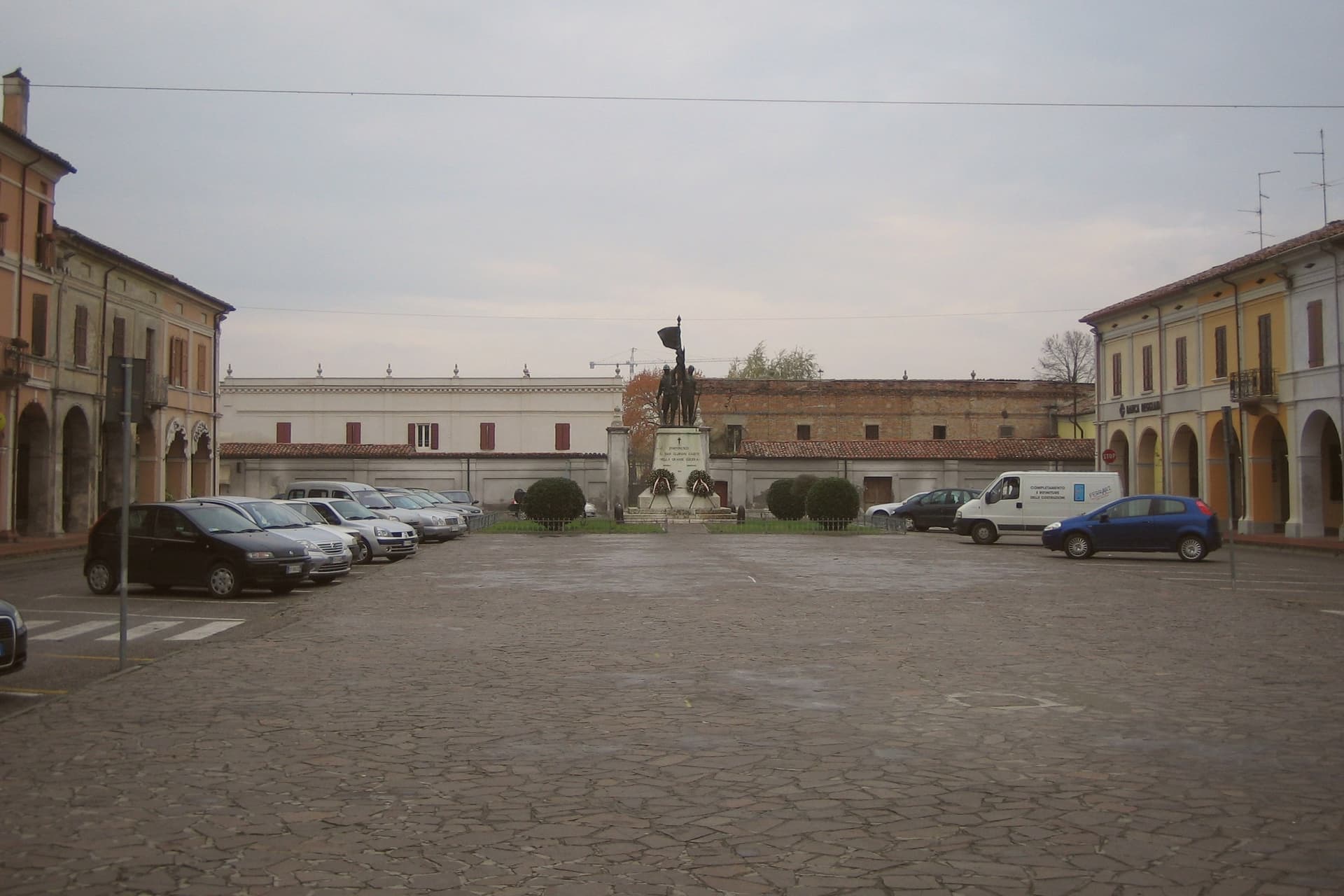
Pomponesco sits at 21 meters on the left bank of the Po, at the southern edge of Mantova province twenty-five kilometers north of Parma. The Roman Pompea family gave the village its name; the Etruscans and Gauls held the ground before them.
The town grid radiates from where a castle once stood, two axes crossing to divide the settlement into four symmetrical quarters, and that castle was pulled down by French troops in the eighteenth century, leaving the open square that replaced it. Around that square the courtier palaces still stand, most built between 1590 and 1630, and behind their arcades a number keep original wooden ceilings and, in rarer cases, original frescoes.
The bell tower of the Comune and the campanile of the parish church face each other across the piazza, almost in competition, before the view narrows toward the embankment and the river beyond. The result is a village whose whole shape, from the vanished castle at its center to the water at its edge, still reads as the plan one Gonzaga governor imposed on it four centuries ago.
What to see in Pomponesco
- Piazza XXIII Aprile. Arcaded square where the Gonzaga castle stood until the French demolition in the eighteenth century, lined with late-sixteenth-century courtier palaces.
- Chiesa di Santa Felicita e dei Sette Martiri. Parish church on the central square, with a tall bell tower facing the town hall across the piazza.
- Late-Cinquecento Gonzaga plan. Town grid laid out by Giulio Cesare Gonzaga at the end of the sixteenth century, with two axes dividing the village into four symmetrical quarters.
How to get to Pomponesco
Reggio Emilia is roughly 47 minutes away by road.
Our tip
April through June and September into October are the workable months on the lower Po. April and May bring stable weather, the river at full water, and the embankment paths in good condition. September and October stay dry and gold, the cleanest light photographers come for.
Sabbioneta
Why visit Sabbioneta
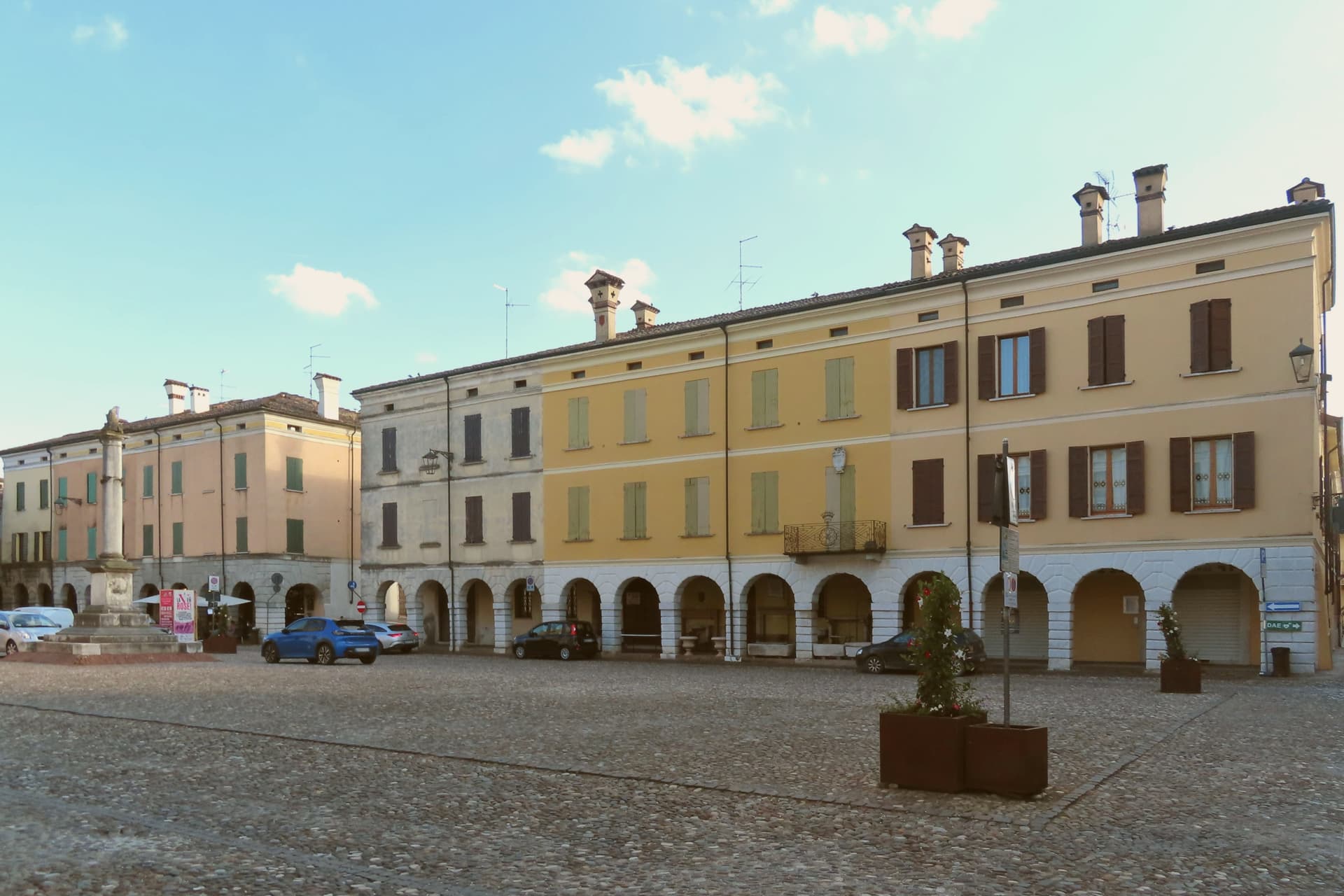
Sabbioneta sits at about 25 meters on a sandy bank of the Po, north of Parma and southwest of Mantova. Vespasiano I Gonzaga, a cadet of the Mantuan line, founded it in the late sixteenth century along the Roman Via Vitelliana as his personal fortress and ducal seat, built almost in one campaign between 1554 and 1591.
The town is organized around two main axes and two squares, with the star walls set at a fixed distance from that grid so the fortification and the street plan read as a single design rather than a wall added to an existing settlement. Vespasiano commissioned the theatre, the gallery, and the two palaces in sequence, each filling a distinct role in the ducal seat: a residence, a pleasure palace, a display case for his marbles, a place for performance.
The church holds his tomb, closing the set with a mausoleum built to the same scale as everything else he raised. What results is a town where every set piece was planned as part of one court rather than accumulated over generations, which is the quality that put it alongside Mantua as the planned counterpart to the organic city.
What to see in Sabbioneta
- Teatro all'Antica. Designed by Vincenzo Scamozzi with a raked wooden cavea and a painted false loggia opening onto a sky that never changes. It still stands as it was built for the Gonzaga court.
- Galleria degli Antichi. 97-meter arcaded gallery built to display Vespasiano's collection of ancient marbles, the longest such gallery of its period. The arcade runs in a single unbroken line, a corridor meant to be walked past statues rather than stood in.
- Palazzo Ducale. Vespasiano's main residence on Piazza Ducale, with frescoed rooms, wooden equestrian statues of the Gonzaga ancestors and gilded ceilings.
How to get to Sabbioneta
Parma is roughly 40 minutes away by road.
Our tip
April through June and September into October are the months Sabbioneta opens up. The Teatro all'Antica and the Galleria degli Antichi keep regular hours, the Po plain is green or gold depending on the half, and the bike path along the Oglio is rideable. July and August are humid and still: shade on the Piazza Ducale stays in short supply, and afternoons empty the centro storico.
Gualtieri
Why visit Gualtieri
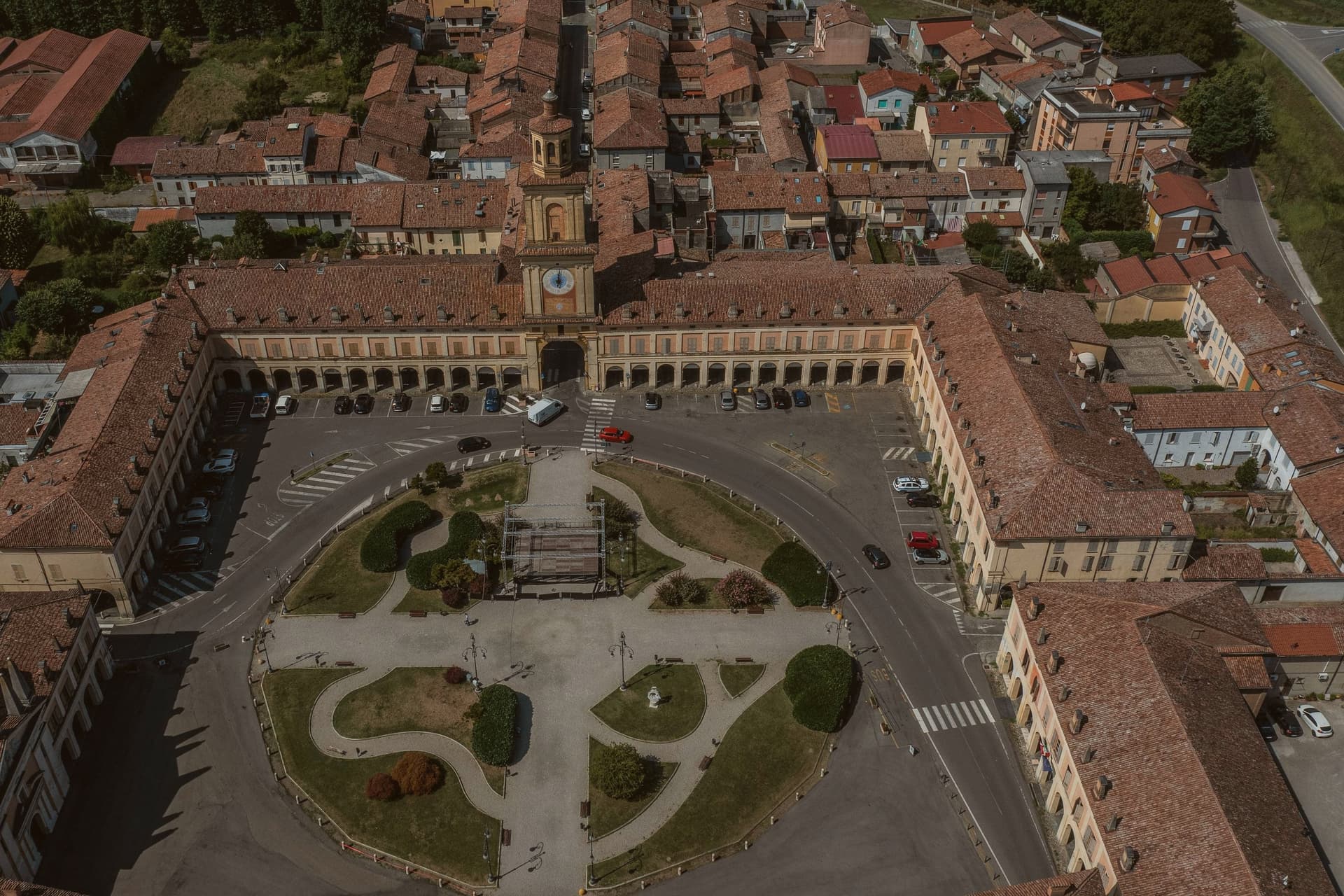
Gualtieri sits at 22 meters on the right bank of the Po, twenty-five kilometers north of Reggio Emilia, on the floodplain the Bentivoglio family reclaimed in the late sixteenth century. Piazza Bentivoglio, designed as a perfect hundred-meter square with arcades on three sides and sixty-nine arches, is the largest porticoed square in Emilia.
Palazzo Bentivoglio at the closed end was built between 1594 and 1600 by Ippolito Bentivoglio, who incorporated the older family Casa Vecchia. The square and the palace flooded repeatedly through the centuries; the 1951 Polesine flood reached 3.80 meters, marked on the arch keystones.
The Palazzo holds the Antonio Ligabue Museum: Ligabue (1899-1965), the self-taught Naïf painter who lived in poverty on the Po floodplain, painted the jaguars, tigers and rural scenes that have made him the most recognised twentieth-century Reggiana artist. The same building holds the Umberto Tirelli costume collection.
What to see in Gualtieri
- Piazza Bentivoglio. Hundred-meter-square arcaded piazza laid out in the late sixteenth century, with sixty-nine arches on three sides and Palazzo Bentivoglio closing the fourth.
- Palazzo Bentivoglio. Late-sixteenth-century palace by Ippolito Bentivoglio, with frescoed halls and a series of allegorical cycles by Pier Francesco Battistelli and Marcantonio Franceschini.
- Museo Antonio Ligabue. Permanent collection of paintings and sculptures by the Naïf master Antonio Ligabue, housed inside Palazzo Bentivoglio.
How to get to Gualtieri
Reggio Emilia is roughly 38 minutes away by road.
Our tip
Gualtieri runs on the Po-plain calendar. April through June and September through October are the working months, with mild air on the floodplain and clear evenings under the arcades. July and August touch thirty-six degrees on the flat and the piazza empties between two and five in the afternoon.
San Benedetto Po
Why visit San Benedetto Po
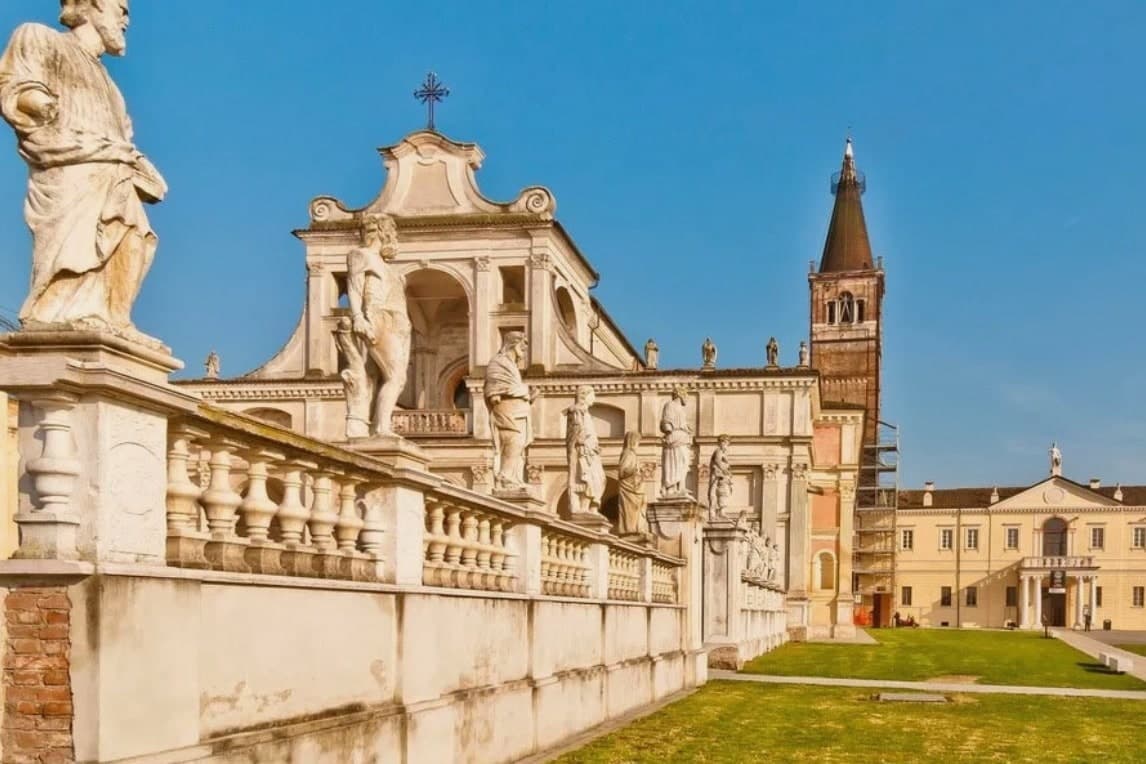
San Benedetto Po sits at 19 meters in the flat Po plain, 22 kilometers southeast of Mantova, on what was once an island between the Po and the Lirone rivers. The town has no origin apart from the abbey: in 1007 Tedald of Canossa, grandfather of Matilda, granted half his land between the two rivers to the Benedictines, and the resulting monastery became one of the principal centers of the Gregorian Reform in northern Italy.
Matilda herself, the countess who hosted the emperor's penance at Canossa in 1077, was buried within it for five centuries before her remains went to Rome. The abbey held its position from its founding until the Napoleonic suppression of 1797 emptied the community out, by which time it had grown its church, its three cloisters, its refectory and infirmary.
What is left standing today is essentially the monastery's own floor plan with the town arranged around it. A place built entirely by and for a religious institution, still legible as such long after the monks themselves are gone.
What to see in San Benedetto Po
- Abbazia di San Benedetto in Polirone. The complex holds frescoes by Correggio and statues by Begarelli, added when Giulio Romano restructured it between 1540 and 1547.
- Basilica di San Benedetto. The church Giulio Romano redesigned stands at cathedral scale, the visual center around which the rest of the monastery is arranged.
- Chiostri di Polirone. Three cloisters, one for each major building phase from medieval through Renaissance, forming the working spine of the monastery behind the church.
How to get to San Benedetto Po
There is a railway station in the town, so you can arrive without a car and never need one while you are here. Modena is roughly 50 minutes away by road.
Our tip
April through June and September into October are the months that suit the Po plain. The basilica is open without summer heat, the cycling routes along the river are dry, and the cloisters hold their cool morning shade. July and August push past thirty-two degrees in the valley and the humidity off the river makes midday heavy.
Castelvetro di Modena
Why visit Castelvetro di Modena
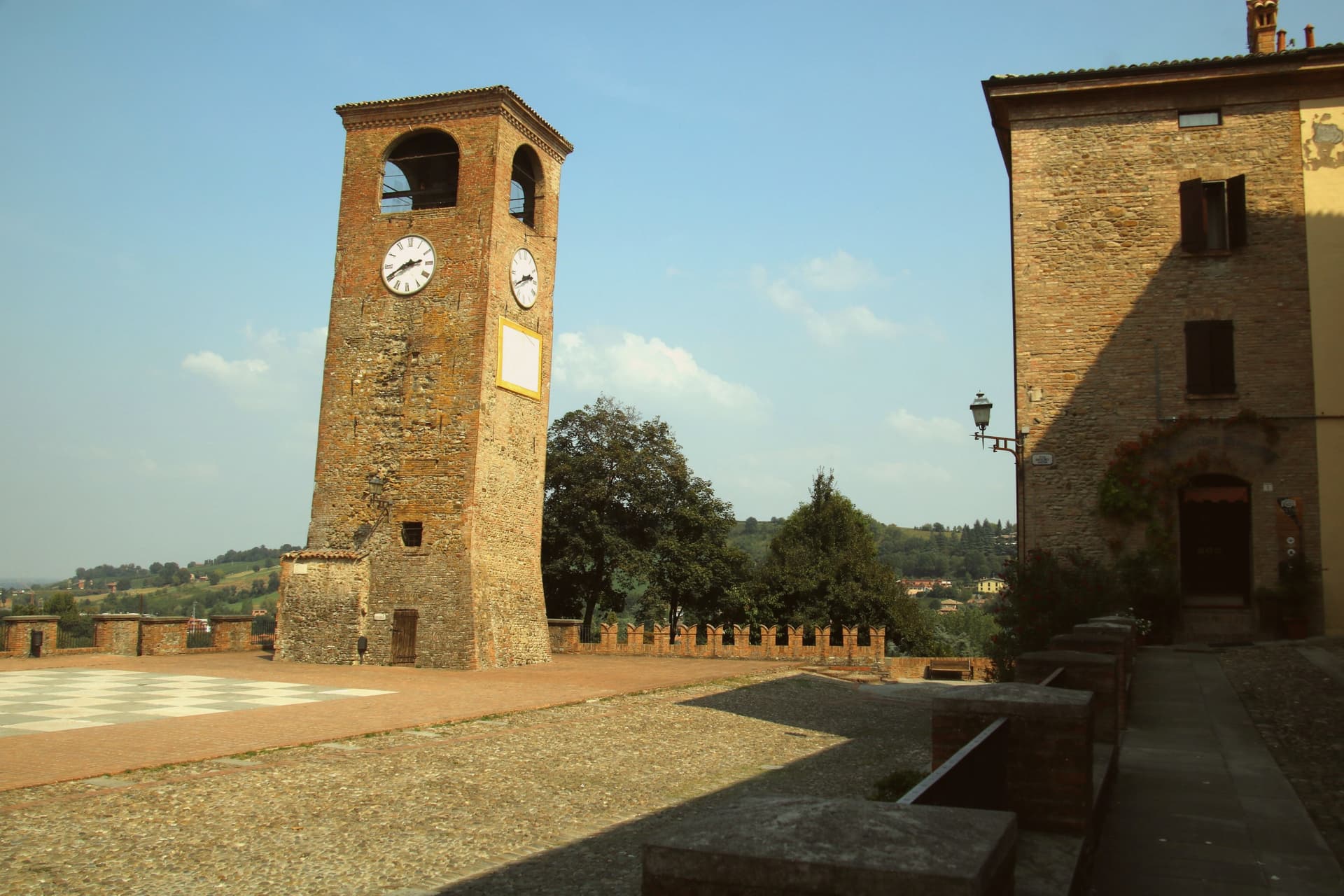
Castelvetro di Modena sits on a hill at 152 meters, eighteen kilometers southeast of Modena and at the northern edge of the Apennine foothills. The medieval centro storico rises around the Piazza Roma, paved in alternating white and black stones that earned it the name Piazza della Dama, the checkerboard piazza, framed by the four surviving towers of the old castle.
The Grasparossa grape grows on the clay slopes around the town, the sandy soil and the south-facing aspect producing the deepest, most tannic of the three main Lambruschi; Lambrusco Grasparossa di Castelvetro received DOC status in 1970. Above the piazza, the Palazzo Rinaldi houses the Museo del Vino and the Museo dell'Aceto Balsamico, the second tracing the same Modenese tradition that nearby Spilamberto codifies.
The municipality holds three institutional signals: Borghi più belli, Bandiera Arancione, Città del Vino. The Sagra dell'Uva e del Lambrusco runs the last weekend of September, when the streets fill with the chess players from the surrounding Lambrusco towns dressed as living pieces on the piazza.
Locanda del Feudo, Opera|02 have been named by a guide.
What to see in Castelvetro di Modena
- Piazza Roma. Checkerboard piazza paved in alternating white and black stones, framed by the four surviving towers of the medieval castle.
- Castello di Levizzano Rangone. Tenth-century fortified frazione four kilometers north, with a tower built in the 990s and a fully preserved medieval village.
- Museo del Vino. Wine museum inside the Palazzo Rinaldi, tracing the Grasparossa production cycle and the DOC zone established in 1970.
How to get to Castelvetro di Modena
There is a railway station in the town, so you can arrive without a car and never need one while you are here. Modena is roughly 28 minutes away by road.
Our tip
April through June and September through October are the Castelvetro months. The hills around the borgo turn green in spring and red in autumn when the Grasparossa vines colour up before the harvest. July and August are hot, thirty-five degrees in the valley, less in the hills above, and the cantine slow down. Sagra dell'Uva e del Lambrusco Grasparossa di Castelvetro falls in September.
Spilamberto
Why visit Spilamberto
Spilamberto sits at 69 meters on the right bank of the Panaro, fifteen kilometers southeast of Modena, on the line of the ancient Via Romea that ran from northern Europe to Rome. The town is documented from 776.
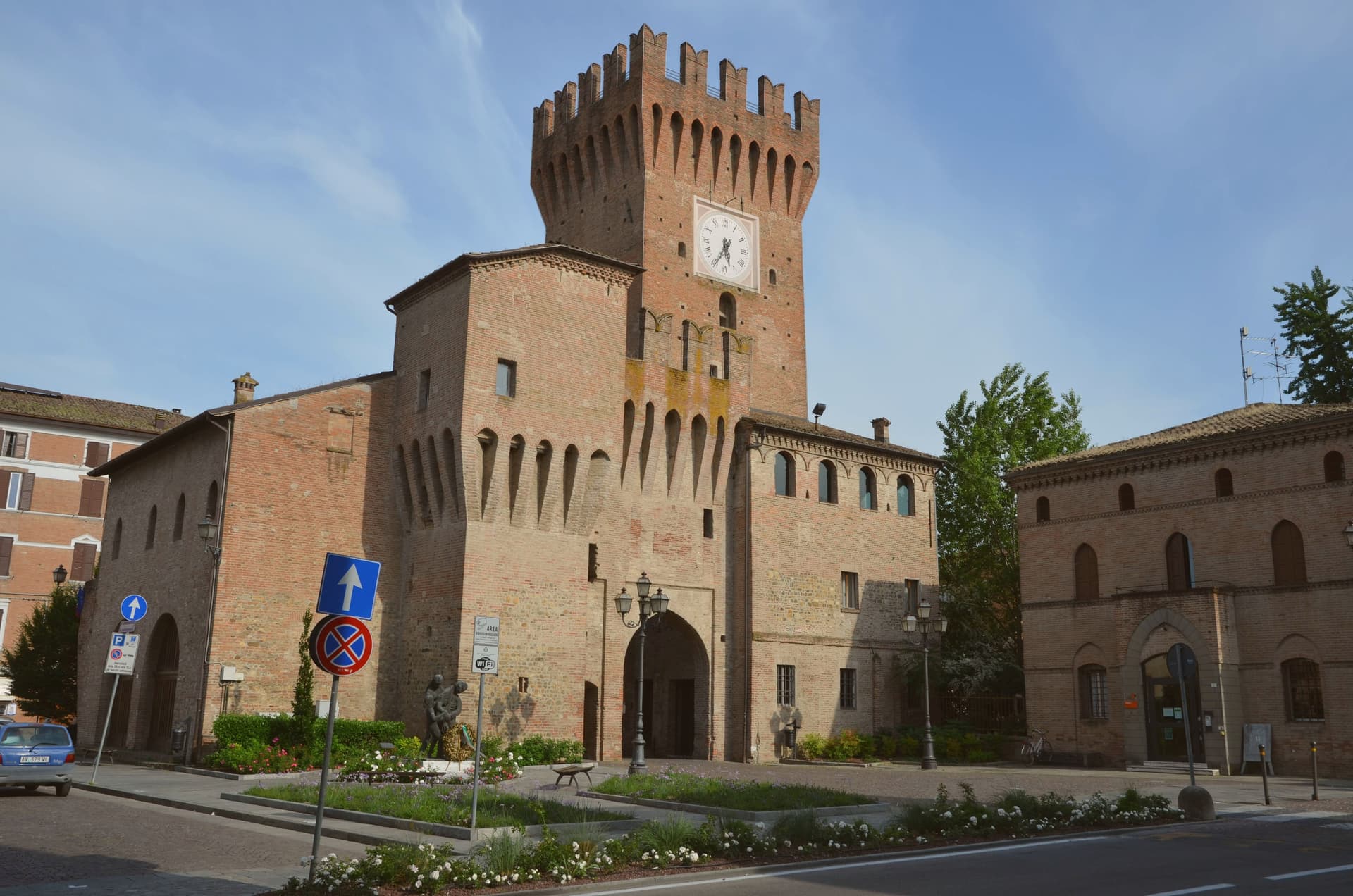
The Rangoni family of Modena held it for more than 650 years, and the fortress they built still anchors the centro storico, with the medieval bell tower at the edge of the borgo holding both an archaeological museum and the headquarters of the walnut liqueur order. In 1967 a group of local enthusiasts founded the Consorteria dell'Aceto Balsamico Tradizionale di Modena here, and it still certifies the twelve- and twenty-five-year-aged DOP product through annual blind tastings.
An eighteenth-century Este road that ran from Modena to Massa leaves the town heading south, a reminder that Spilamberto has always sat at a crossing point: the old route running through it toward the north and Rome, another road departing from it toward the south, the river marking its edge. A plain town that became, almost by local initiative rather than geography, the place where a regional product got its rules written down.
What to see in Spilamberto
- Rocca Rangoni. The fortress anchors the centro storico, its walls facing onto the streets that grew up around it rather than set apart from them.
- Torrione. Medieval bell tower at the edge of the borgo, housing the Antiquarium museum and the headquarters of the Ordine del Nocino Modenese.
- Museo dell'Aceto Balsamico Tradizionale. Museum at Villa Fabriani laying out the production cycle in physical form: the cooked must, the graduated run of casks, the attic rooms where fifty years of seasoning take place.
How to get to Spilamberto
There is a railway station in the town, so you can arrive without a car and never need one while you are here. Modena is roughly 24 minutes away by road.
Our tip
April through June and September through October are the months for Spilamberto. The Greenway del Panaro runs without crowds, the cantine open their tasting rooms, and the Mast Còt festival in October pulls together producers from the entire Modenese balsamic chain for two weekends of new-must boiling and old-cask tasting. July and August are heavy on the plain; thirty-five degrees and humidity that doesn't drop after dark.
Vignola
Why visit Vignola
Vignola sits at 125 meters on the right bank of the Panaro, twenty-five kilometers south of Bologna and twenty east of Modena, where the Modenese plain meets the Apennine foothills. The fortress there is documented from the eighth century, raised by the Abbot of Nonantola to guard the abbey's lands before the Contrari family rebuilt it in the fifteenth century as a fortified residence; in 1577 it passed to the Boncompagni-Ludovisi, who held it until 1965.
The palace beside it takes its second name from the family that acquired it, and from the architect born in the town in 1507, who died in 1573 after a career among the leading figures of late Renaissance architecture. The cherries that carry the town's name upriver and down are IGP-protected across twenty-eight communes stretching from Modena to Bologna, and the blossom that precedes the fruit each spring fills the Panaro valley below the walls.
A disused railway, now a greenway, threads through the same ground on its way between Mirandola and Bologna. The town's identity rests on this pairing of a fortified height above the river and an agricultural valley beneath it, one lineage of stone, one of orchards, both still legible in the place today.
What to see in Vignola
- Rocca di Vignola. Eighth-century origin, built to guard the lands of an abbey and later rebuilt as a fortified residence. The frescoed interiors and four corner towers stand over the river much as the rebuilding left them.
- Scala a Chiocciola di Palazzo Barozzi. The 106 steps rise with no central support, an engineering feat as much as a decorative one, tucked inside the palace next to the fortress.
- Palazzo Boncompagni. The palace passed to the family that gives it its name in the late sixteenth century and held the fortress until 1965. Its reception rooms carry frescoes alongside the staircase it is best known for.
How to get to Vignola
There is a railway station in the town, so you can arrive without a car and never need one while you are here. Modena is roughly 34 minutes away by road.
Our tip
April through June and September through October are the working months on the Panaro foothills. The first two weekends of April fill the centro with the Festa dei Ciliegi in Fiore, when the orchards along the river bloom. June brings cherries to market and the Panaro at high water.
More from Anywhere Italy
 The best towns known for what they grow within 45 minutes of Bologna
 The best towns you can reach by train within 75 minutes of Parma
 The best towns known for what they grow within 90 minutes of Brescia
 The best towns known for what they grow within two hours of Florence
- The best towns known for what they grow within two hours of Trento
 The 6 prettiest villages in the province of Mantova