
The 6 prettiest villages in the province of Mantova
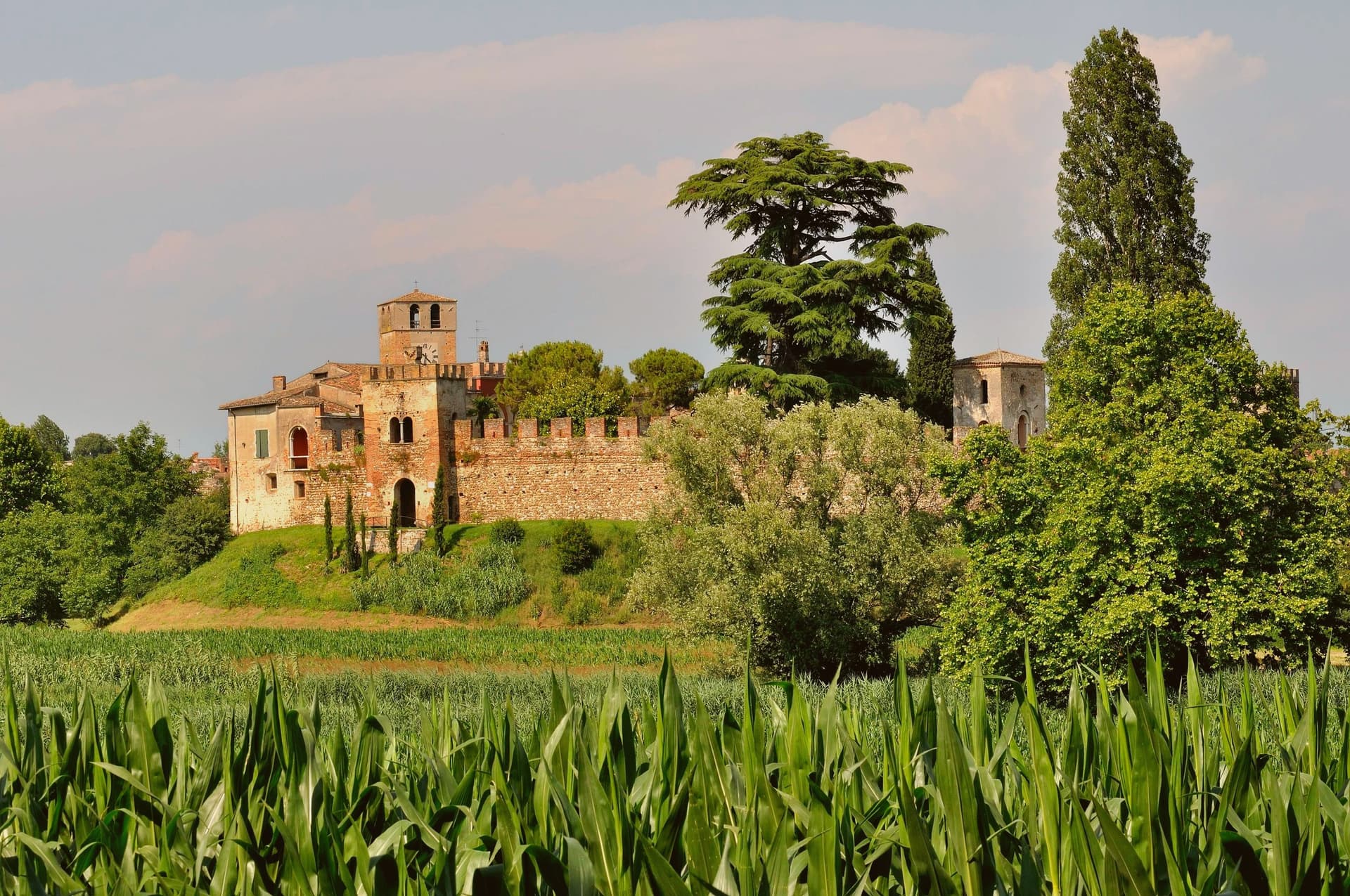
Mantova's province is built from brick and river mud, and it looks like nothing else in Lombardy. Bell towers stand over maize and rice fields, poplar lines mark the Po embankments, and the villages are made of that warm local brick which turns rose-coloured in late afternoon. The food is heavy and precise: tortelli di zucca with amaretto crumbled into the pumpkin, sbrisolona broken by hand, luccio in salsa from the lakes, salame mantovano, Lambrusco poured cold. Autumn is the season, when the fog comes off the water and the trattorie fire up their ovens.
Most people who reach this corner of Lombardy are on their way to Lake Garda, and they stop at Sirmione for the thermal water, the Scaliger castle and the Grotte di Catullo. It is a beautiful spit of land and it is very full, particularly between June and September, when the walk out to the point moves at the speed of the slowest tour group. Mantova city itself, with the Palazzo Ducale and the Camera degli Sposi, takes the rest of the visitors. Both are worth their reputations, and both absorb almost everyone who comes.
The plain does not stop at the lake shore or the city walls. The same brick, the same pumpkin tortelli and the same slow water continue south and west into the province, through moraine hills with a walled village on a small lake, through Gonzaga theatre towns laid out on a grid, down to abbey villages on the Po where the embankment is the main street. Fewer people go, and the ones who do tend to be eating.
Of the 9 communes we have mapped in the province of Mantova, 6 qualify as prettiest villages: each has passed the assessment of the national association of Italy's most beautiful villages. The smallest, Castellaro Lagusello, has 250 residents.
Two more lists worth reading alongside this one: The best towns known for what they grow within 75 minutes of Parma and The best hidden hill towns in Lombardia.
Castellaro Lagusello
Why visit Castellaro Lagusello
Castellaro Lagusello is a frazione of Monzambano on the morainic hills south of Lake Garda, and one of the smallest entries in the Borghi più belli d'Italia network. The village sits inside a tight ring of 13th-century stone walls built by the Scaligeri of Verona, and the single arched gate opens onto the central piazza in front of the parish church of San Nicola.
The defining feature is the small heart-shaped lake below — the laghetto di Castellaro Lagusello, a natural glacial pond formed at the end of the last ice age — which the village overlooks from its low promontory and which has shaped the village's name (Lagusello = "little lake") for centuries. The lakeside path is a marshland reserve protected by the WWF, with birdwatching hides and a constant population of herons and kingfishers.
Villa Tacoli on the south side of the village is privately held but visible from the promenade. The whole place takes less than an hour to walk and is best paired with the morning produce market in Monzambano or an afternoon at the Lago di Garda south shore, twenty minutes away.
What to see in Castellaro Lagusello
- Mura medievali e porta d'ingresso. 13th-century walled ring built by the Scaligeri of Verona, with a single arched gate opening into the village's central piazza.
- Laghetto di Castellaro Lagusello. Small heart-shaped glacial lake below the village, a WWF-protected marshland reserve with birdwatching hides and a circular footpath.
- Chiesa di San Nicola. Parish church on the central piazza, with a 16th-century facade and a single nave looking onto the village's only square.
How to get to Castellaro Lagusello
Verona is roughly 38 minutes away by road.
Our tip
April through October is the open season for the morainic hills south of Lake Garda. May and June bring the wildflowers around the heart-lake and the warmest birdwatching activity. July and August are warmer but the village stays small and uncrowded compared to the Garda shore fifteen kilometers north.
Pomponesco
Why visit Pomponesco
Pomponesco sits at 21 meters on the left bank of the Po, at the southern edge of Mantova province twenty-five kilometers north of Parma. The Roman Pompea family gave the village its name; the Etruscans and Gauls held the ground before them.
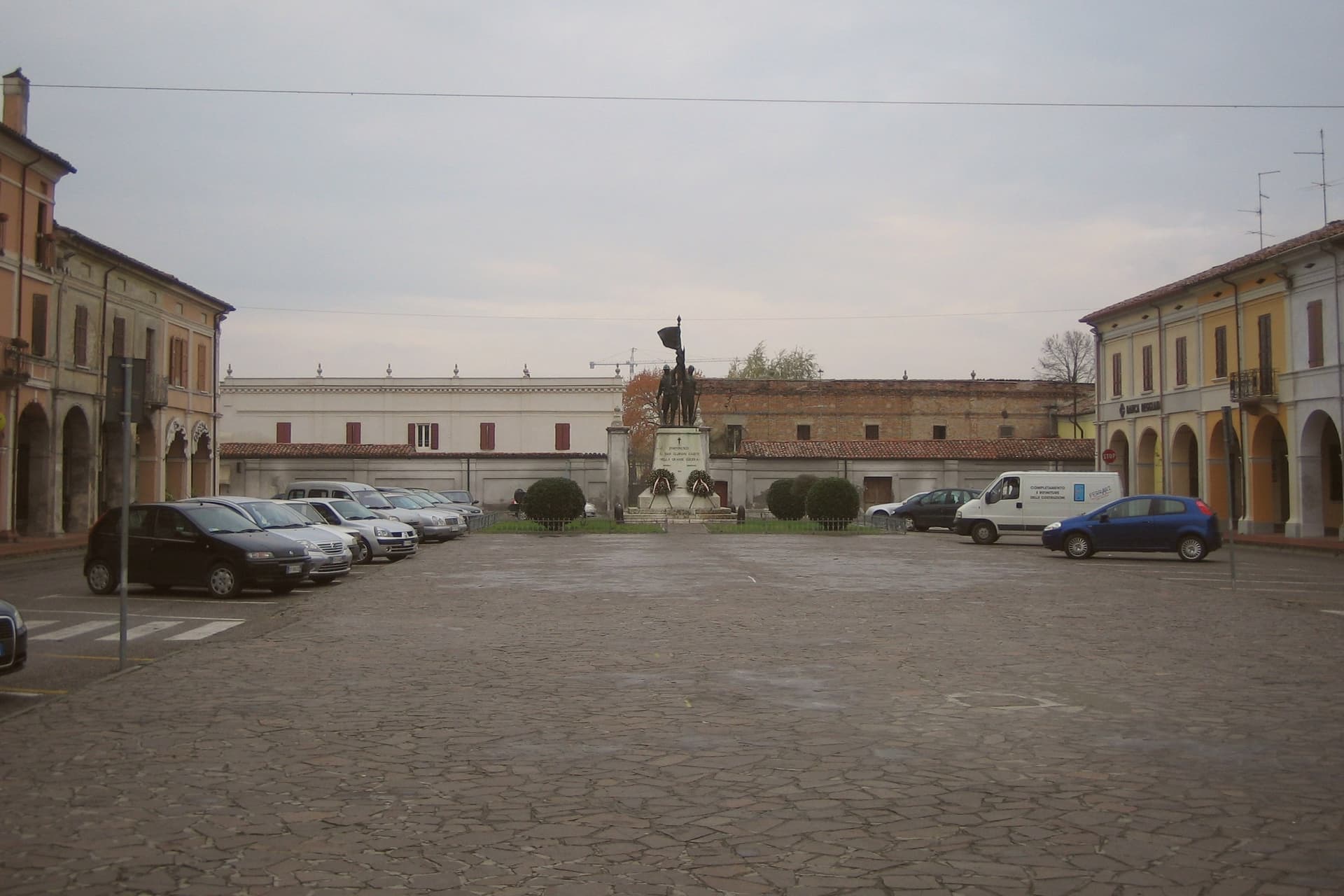
The town grid radiates from where a castle once stood, two axes crossing to divide the settlement into four symmetrical quarters, and that castle was pulled down by French troops in the eighteenth century, leaving the open square that replaced it. Around that square the courtier palaces still stand, most built between 1590 and 1630, and behind their arcades a number keep original wooden ceilings and, in rarer cases, original frescoes.
The bell tower of the Comune and the campanile of the parish church face each other across the piazza, almost in competition, before the view narrows toward the embankment and the river beyond. The result is a village whose whole shape, from the vanished castle at its center to the water at its edge, still reads as the plan one Gonzaga governor imposed on it four centuries ago.
What to see in Pomponesco
- Piazza XXIII Aprile. Arcaded square where the Gonzaga castle stood until the French demolition in the eighteenth century, lined with late-sixteenth-century courtier palaces.
- Chiesa di Santa Felicita e dei Sette Martiri. Parish church on the central square, with a tall bell tower facing the town hall across the piazza.
- Late-Cinquecento Gonzaga plan. Town grid laid out by Giulio Cesare Gonzaga at the end of the sixteenth century, with two axes dividing the village into four symmetrical quarters.
How to get to Pomponesco
Reggio Emilia is roughly 47 minutes away by road.
Our tip
April through June and September into October are the workable months on the lower Po. April and May bring stable weather, the river at full water, and the embankment paths in good condition. September and October stay dry and gold, the cleanest light photographers come for.
Sabbioneta
Why visit Sabbioneta
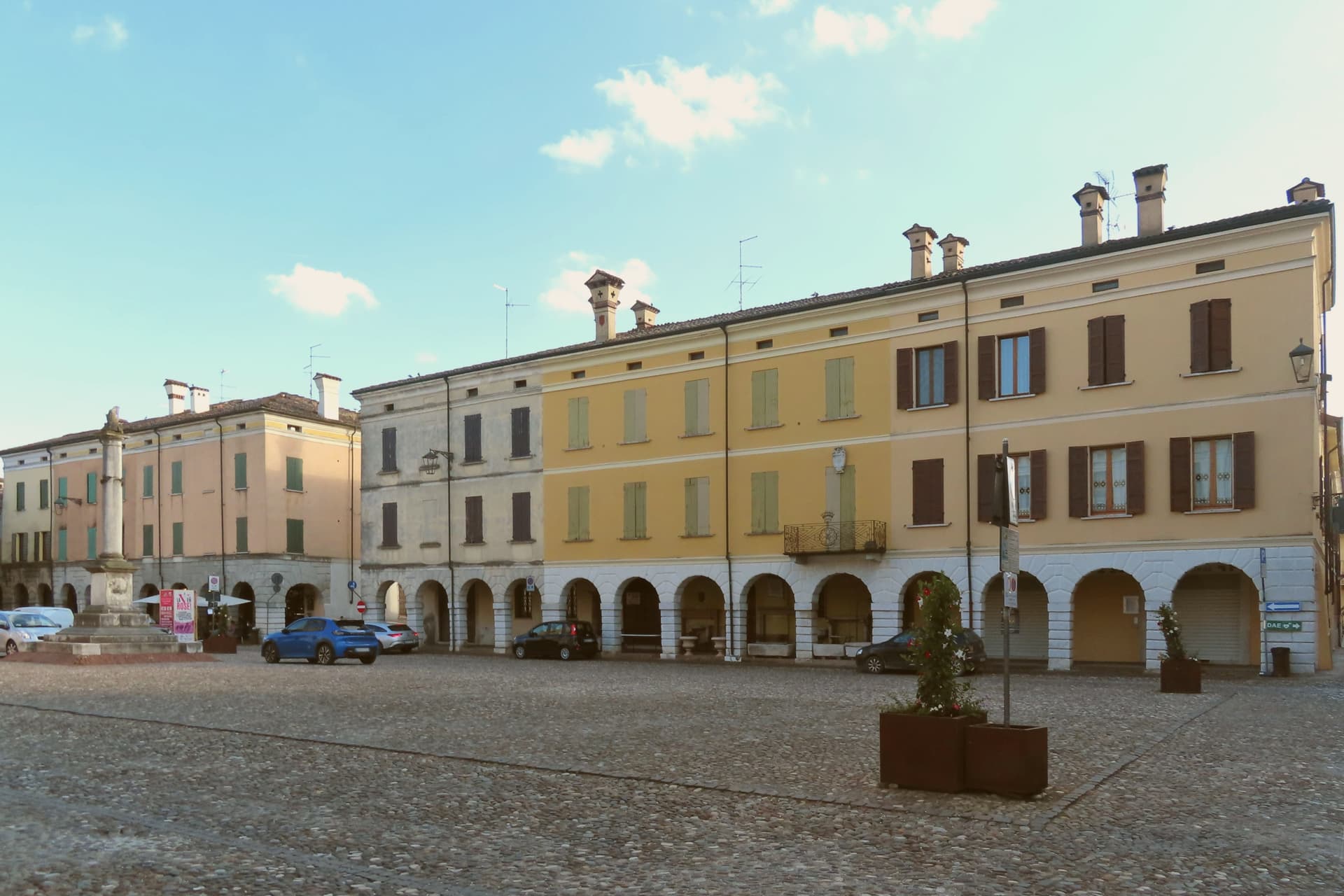
Sabbioneta sits at about 25 meters on a sandy bank of the Po, north of Parma and southwest of Mantova. Vespasiano I Gonzaga, a cadet of the Mantuan line, founded it in the late sixteenth century along the Roman Via Vitelliana as his personal fortress and ducal seat, built almost in one campaign between 1554 and 1591.
The town is organized around two main axes and two squares, with the star walls set at a fixed distance from that grid so the fortification and the street plan read as a single design rather than a wall added to an existing settlement. Vespasiano commissioned the theatre, the gallery, and the two palaces in sequence, each filling a distinct role in the ducal seat: a residence, a pleasure palace, a display case for his marbles, a place for performance.
The church holds his tomb, closing the set with a mausoleum built to the same scale as everything else he raised. What results is a town where every set piece was planned as part of one court rather than accumulated over generations, which is the quality that put it alongside Mantua as the planned counterpart to the organic city.
What to see in Sabbioneta
- Teatro all'Antica. Designed by Vincenzo Scamozzi with a raked wooden cavea and a painted false loggia opening onto a sky that never changes. It still stands as it was built for the Gonzaga court.
- Galleria degli Antichi. 97-meter arcaded gallery built to display Vespasiano's collection of ancient marbles, the longest such gallery of its period. The arcade runs in a single unbroken line, a corridor meant to be walked past statues rather than stood in.
- Palazzo Ducale. Vespasiano's main residence on Piazza Ducale, with frescoed rooms, wooden equestrian statues of the Gonzaga ancestors and gilded ceilings.
How to get to Sabbioneta
Parma is roughly 40 minutes away by road.
Our tip
April through June and September into October are the months Sabbioneta opens up. The Teatro all'Antica and the Galleria degli Antichi keep regular hours, the Po plain is green or gold depending on the half, and the bike path along the Oglio is rideable. July and August are humid and still: shade on the Piazza Ducale stays in short supply, and afternoons empty the centro storico.
Monzambano
Why visit Monzambano
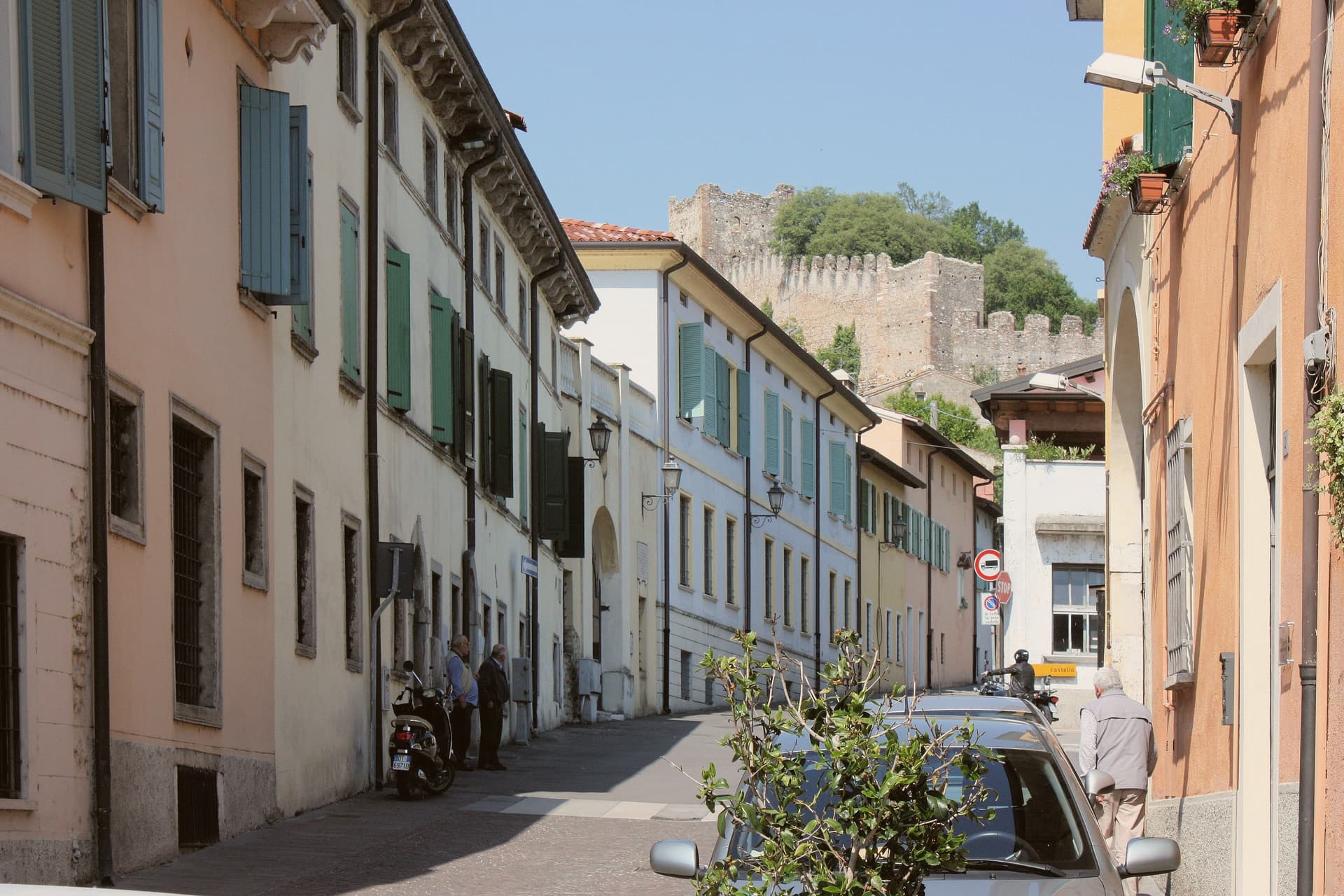
Monzambano sits at 88 meters on the right bank of the Mincio, in the moraine hills the last Alpine glacier pushed up south of Lake Garda. The commune covers 4,800 people across several frazioni, but the one travelers come for is Castellaro Lagusello, a fortified medieval village built around a small heart-shaped lake.
Pope Eugenio III's document of 1145 lists its parish among those of the Diocese of Verona. The castle and walls date to the eleventh and twelfth centuries.
The Gonzaga of Mantua tried and failed to hold it through the Quattrocento, and it passed to Venice, then to Napoleon, who in 1803 annexed it to Monzambano. Pile-dwelling settlements under the lake belong to the Prehistoric Pile Dwellings around the Alps UNESCO site.
The commune holds five institutional signals at once: Borghi più belli, Bandiera Arancione, Borgo dei Borghi finalist, Città del Vino, Città dell'Olio. The wines are Lugana and Garda Colli Mantovani; the oil is Garda DOP.
What to see in Monzambano
- Castellaro Lagusello. Fortified medieval frazione inside crenellated walls and ten towers, set above a heart-shaped lake on a moraine hill.
- Castello di Castellaro. Eleventh- to twelfth-century castle on the hill above the lake, long contested between Mantua and Venice.
- Prehistoric pile dwellings. Submerged Bronze Age stilt-house settlement in the lake, part of the UNESCO Prehistoric Pile Dwellings around the Alps.
How to get to Monzambano
Verona is roughly 39 minutes away by road.
Our tip
April through June and September into October are the months the moraine hills work best. The vines are leafing or harvested, the lake reflects the walls, and the small reserve around Castellaro is open to walkers. July and August get humid and still; Lake Garda is fifteen kilometers away and pulls the day-trippers off the back roads. Sagra di San Bartolomeo falls in August.
San Benedetto Po
Why visit San Benedetto Po
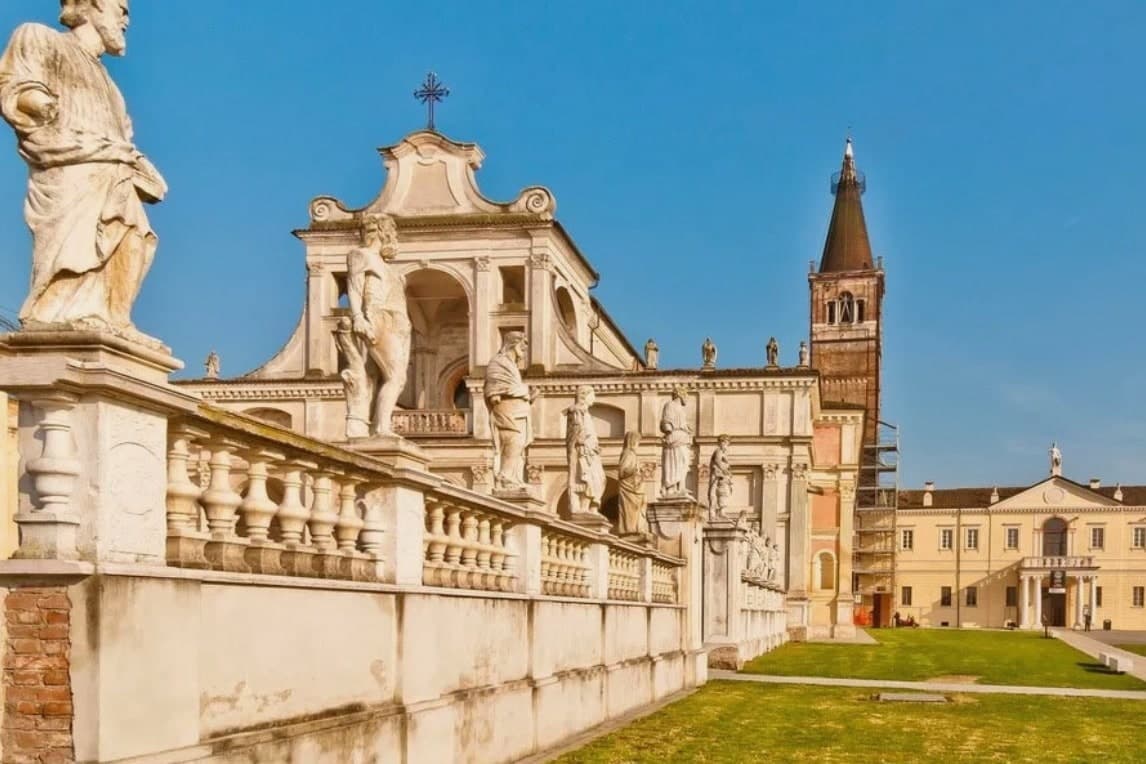
San Benedetto Po sits at 19 meters in the flat Po plain, 22 kilometers southeast of Mantova, on what was once an island between the Po and the Lirone rivers. The town has no origin apart from the abbey: in 1007 Tedald of Canossa, grandfather of Matilda, granted half his land between the two rivers to the Benedictines, and the resulting monastery became one of the principal centers of the Gregorian Reform in northern Italy.
Matilda herself, the countess who hosted the emperor's penance at Canossa in 1077, was buried within it for five centuries before her remains went to Rome. The abbey held its position from its founding until the Napoleonic suppression of 1797 emptied the community out, by which time it had grown its church, its three cloisters, its refectory and infirmary.
What is left standing today is essentially the monastery's own floor plan with the town arranged around it. A place built entirely by and for a religious institution, still legible as such long after the monks themselves are gone.
What to see in San Benedetto Po
- Abbazia di San Benedetto in Polirone. The complex holds frescoes by Correggio and statues by Begarelli, added when Giulio Romano restructured it between 1540 and 1547.
- Basilica di San Benedetto. The church Giulio Romano redesigned stands at cathedral scale, the visual center around which the rest of the monastery is arranged.
- Chiostri di Polirone. Three cloisters, one for each major building phase from medieval through Renaissance, forming the working spine of the monastery behind the church.
How to get to San Benedetto Po
There is a railway station in the town, so you can arrive without a car and never need one while you are here. Modena is roughly 50 minutes away by road.
Our tip
April through June and September into October are the months that suit the Po plain. The basilica is open without summer heat, the cycling routes along the river are dry, and the cloisters hold their cool morning shade. July and August push past thirty-two degrees in the valley and the humidity off the river makes midday heavy.
Curtatone
Why visit Curtatone
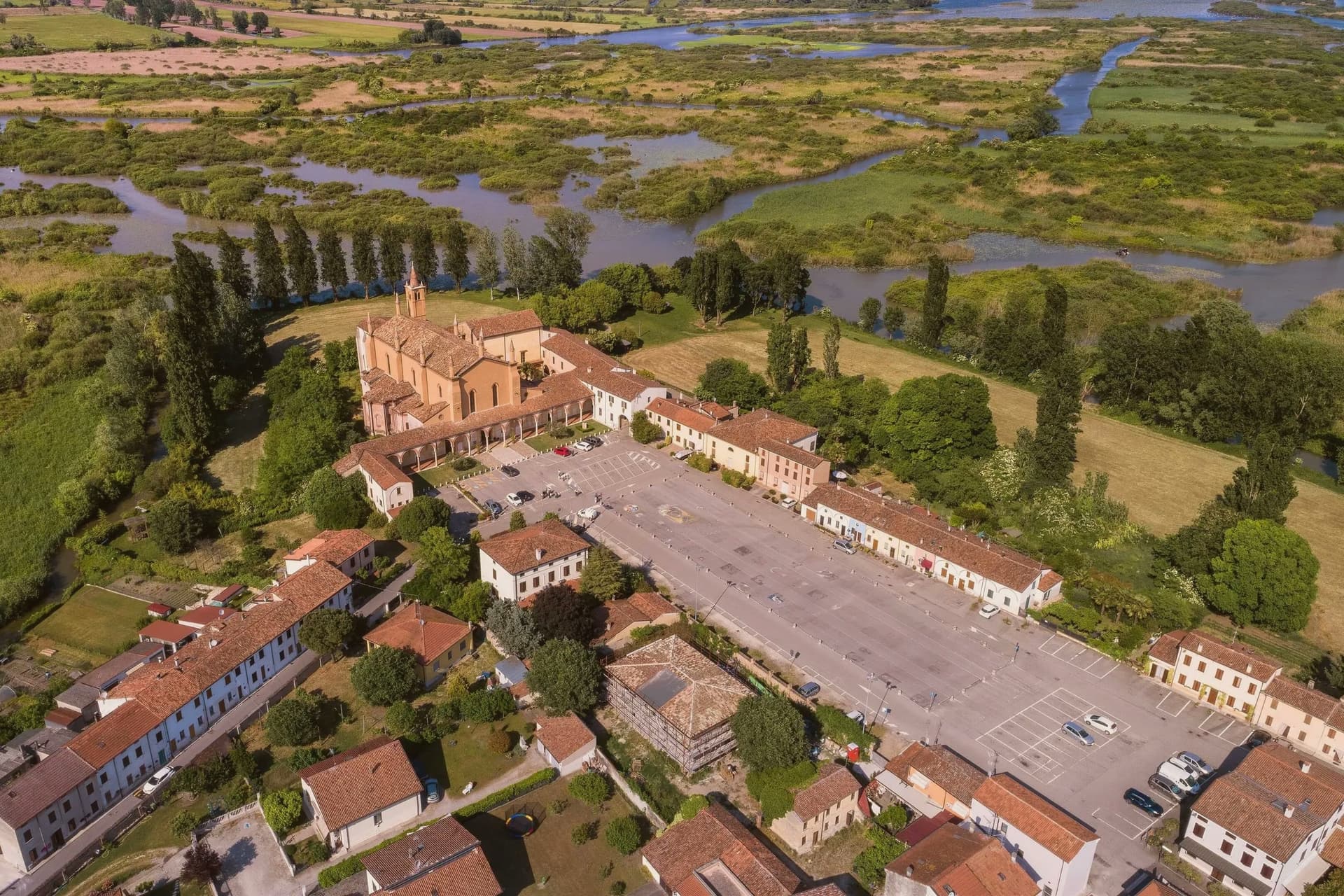
Curtatone is a Mantova commune of eight frazioni in the Parco del Mincio, with its seat at Montanara and its most visited fraction at Grazie. The Santuario della Beata Vergine delle Grazie was commissioned in 1406 by Francesco I Gonzaga and stands on the edge of the Mincio's lower bend, surrounded by lotus flowers that bloom across the river in July and August.
On 29 May 1848, Tuscan and Neapolitan volunteers held this stretch of ground against Austrian forces under Radetzky long enough for the Piedmontese army to reorganize at Goito the following day. The battle is remembered nationally as Curtatone e Montanara.
Every year around Ferragosto the Antichissima Fiera delle Grazie fills the square in front of the sanctuary; since 1973 the fair has hosted the Incontro Nazionale dei Madonnari, with over a hundred chalk artists working through the night on the pavement around the church.
What to see in Curtatone
- Santuario della Beata Vergine delle Grazie. 1406 Gonzaga sanctuary on the Mincio bend, with a unique wooden ex-voto wall lining the nave, and the burial of Baldassarre Castiglione.
- Parco del Mincio. Riverine nature reserve around Grazie, with lotus flower expanses that bloom mid-July through August on the lower Mincio.
- Monument to the Battle of Curtatone and Montanara. Memorial to the 1848 stand by Tuscan and Neapolitan volunteers against Austrian forces under Radetzky on 29 May.
How to get to Curtatone
Verona is roughly 48 minutes away by road.
Our tip
April through June and September into October are the months Po-valley humidity stays bearable. April brings the Mincio in full water and the wetland birds along the parco. The lotus flowers around Grazie bloom from mid-July into August, a brief overlap with the heaviest summer heat, when temperatures climb past thirty-three degrees and the air thickens.
More from Anywhere Italy
- The best towns known for what they grow within 75 minutes of Parma
- The best hidden hill towns in Lombardia
- The best hill towns within 75 minutes of Brescia
- The best hill towns within 75 minutes of Verona
- The best hill towns within 90 minutes of Padua
 The best towns known for what they grow within 90 minutes of Brescia