
The best small towns with a food festival in Liguria
Liguria cooks in a narrow strip. The hills fall almost straight into the sea, so the ingredients are the ones that grow on terraces held up by dry stone walls: basil, olives, lemons, chestnuts higher up, and whatever the boats bring in before dawn. The festivals follow that logic. A square is cleared, a pan the width of a doorway goes over a fire, anchovies come out of the oil in batches, and somebody's aunt sells sacks of dried mushrooms from a trestle table. Spring and autumn are the seasons for it, when the air off the water is cool enough to stand near heat.
Most people meet Ligurian food in Genoa or on the yacht quay at Portofino, where the pesto is good and the bill reflects the postcard. Summer traffic on the coast road funnels into the same few car parks. The ferries run full, the terraces are booked, and the pace of a place with a working harbour is replaced by something more like a queue. None of that makes the region less interesting. It just makes it hard to eat slowly.
The same coast keeps going in both directions, and the same hills keep growing the same things. Painted houses in ochre and dusty pink, slate doorframes, sardines on a grill, a chestnut oven inland where the Apennines start. Fewer people go to these towns, and the festivals in them are still run by the people who live there rather than by a tourist board.
Of the 54 communes we have mapped in Liguria, 23 qualify as towns with a food festival: each holds a recurring food festival built around one local ingredient. This list is the small ones, 10 in all, ordered smallest first. The smallest, Vernazza, has 729 residents.
If you are still choosing, we have also written The best small coastal towns you can reach by train in Liguria and The best small towns inside a nature park in Liguria.
Santo Stefano d'Aveto
Why visit Santo Stefano d'Aveto
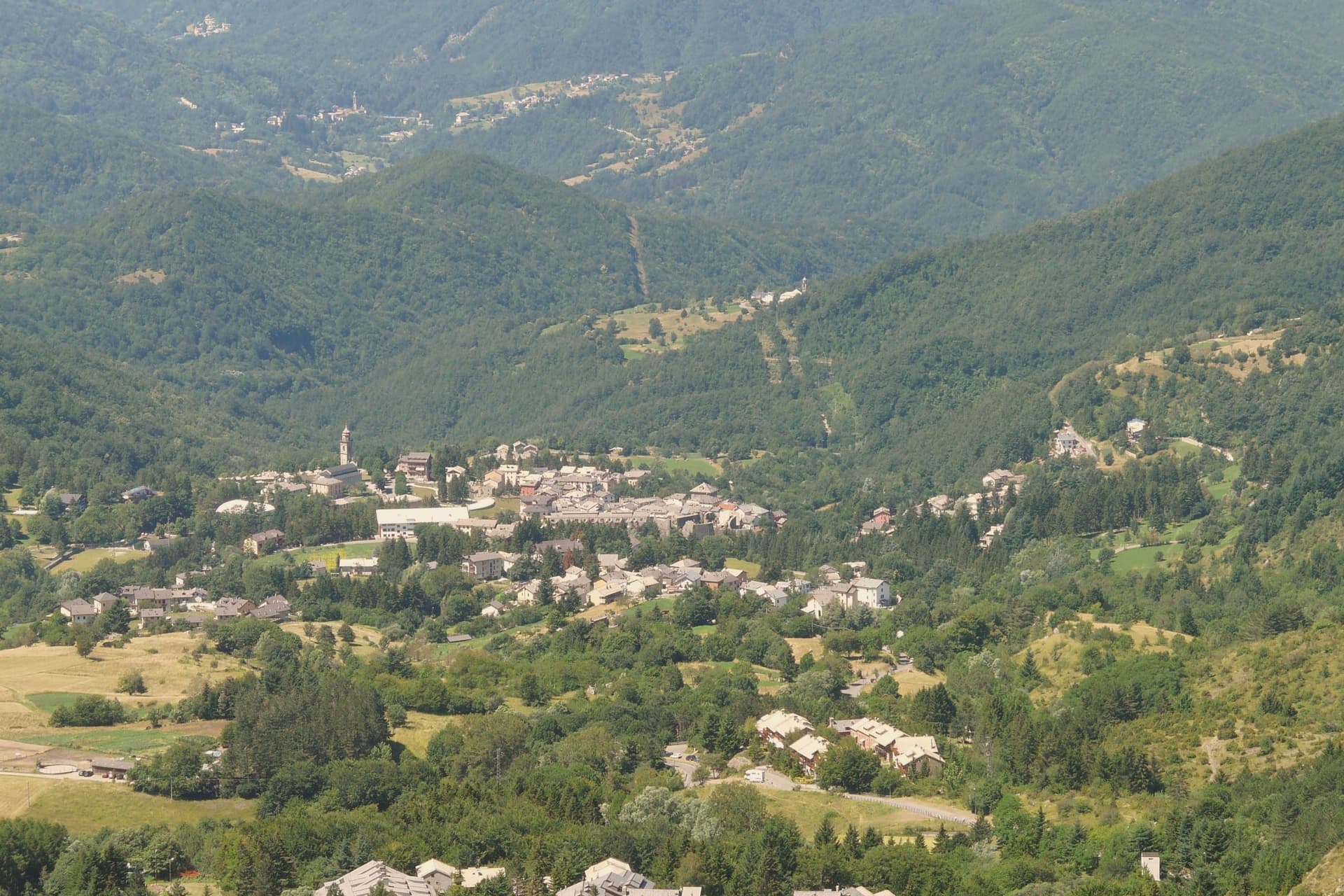
The Upper Val d'Aveto sits forty-five kilometers from Genova, on the border with the provinces of Parma, Piacenza and La Spezia, a position that puts the commune closer to Emilian territory than to the Ligurian coast. Frederick Barbarossa granted the fief to the Malaspina in the twelfth century.
It later passed to the Fieschi and then to the Doria, a succession that left its mark in the layered stonework of the castle rising off the central piazza and in the church furnishings donated generations later by a member of the same Doria line. The town's two halves work on different clocks: the historic center, built around the castle and the piazza, and the higher ground toward the peaks above the valley, given over to the ski area in winter and to the reservoir at Giacopiane in the warmer months.
A commune this high, on a border this far inland, ends up organized less around a single center than around the alternation of the seasons that use its slopes and its lake in turn.
What to see in Santo Stefano d'Aveto
- Castello Malaspina-Doria. Fortress on an irregular polygonal base off the central piazza. The walls still show the outline of successive rebuildings by the families who held the fief.
- Santuario della Madonna di Guadalupe. Parish church built around the donated painting and the door medallion, a small pilgrimage point folded into the ordinary fabric of the town center.
- Monte Bue ski area. Two new chairlifts carry skiers up the slope, the only lift-served skiing in the region and a rare winter draw at this elevation.
How to get to Santo Stefano d'Aveto
Genova is roughly 81 minutes away by road.
Our tip
December through March is the season of the Monte Bue lifts and the only Ligurian ski runs, with snow held above 1,200 meters when conditions are right. June through September is the warm counterpart, with hikes to Lago di Giacopiane and Monte Maggiorasca and temperatures around 22 to 25 degrees, ten cooler than the coast. April and May, October and November are the shoulder months, when the lifts close, the snow melts, and the village rests; many hotels close. Arte e Gusto Mercatini a Santo Stefano d'Aveto falls in July.
Badalucco
Why visit Badalucco
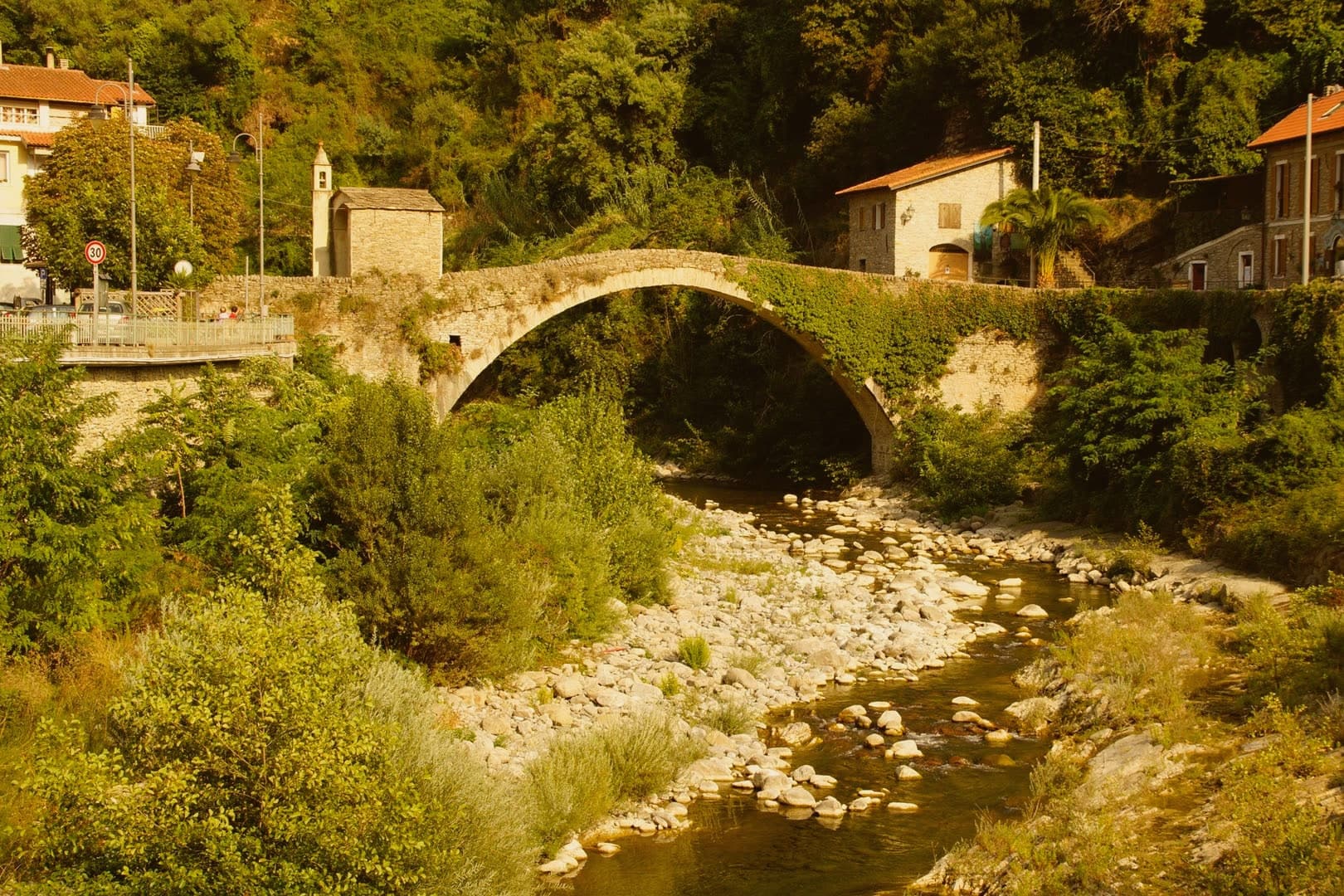
Badalucco sits at 179 meters in the middle Valle Argentina, fifteen kilometers north of Imperia. The torrent that gives the valley its name runs in a wide bend below the village.
The site changed hands between Ligures and Rome in 181 BC, became a fief of the Counts of Ventimiglia, and passed to the Republic of Genova in 1259. The seventeenth century rebuilt the parish Chiesa di Santa Maria Assunta e San Giorgio in full Baroque, with a square bell tower and a fifteenth-century polyptych attributed to Giovanni Canavesio.
The caruggi of stone houses are painted with contemporary murals and trompe-l'oeil, a more recent layer over the medieval shell. The Rundin bean, an indigenous variety grown on the terraces, is a Slow Food Presidium.
Stoccafisso alla badalucchese, stockfish stewed in tomato and olives, is the dish: the third Sunday of September brings the Stockfish Festival to the square.
What to see in Badalucco
- Chiesa di Santa Maria Assunta e San Giorgio. Seventeenth-century Baroque parish church with a square bell tower, holding a fifteenth-century polyptych attributed to Giovanni Canavesio and a seventeenth-century wooden crucifix.
- Chiesa di San Niccolò. Hilltop church above the old village, on the site of a former noble castle that served as a lookout over the valley.
- Ponte sull'Argentina. Stone bridge across the torrent that wraps the village, connecting the centro storico to the valley road.
How to get to Badalucco
Genova is roughly 122 minutes away by road.
Our tip
April through June and September into October are the dry months in the Argentina Valley. The terraces above the village hold olive groves, the Rundin bean, and pockets of grapevine. July and August push into the low thirties, but the valley keeps a few degrees cooler than the coast. Festival dello Stoccafisso falls in September.
Ceriana
Why visit Ceriana
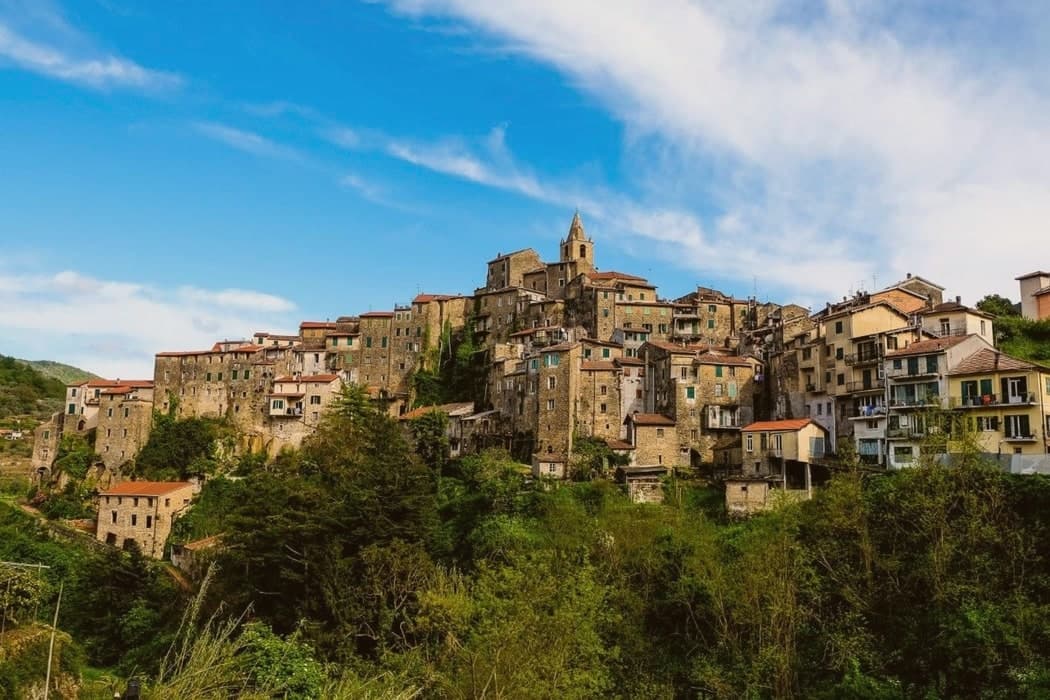
Ceriana sits at 369 meters in the Valle Armea, twenty kilometers west of Imperia and a short climb inland from Sanremo. The Romans built a garrison here called Castrum Coelianae, a watchtower with permanent quarters for legionaries; the name shortened to Ceriana over the centuries.
The town took its present shape in the eleventh and twelfth centuries, passing from the Counts of Ventimiglia to the Mari family in 1297 and to the Republic of Genoa in 1359. The parish church of Santi Pietro e Paolo is reached by climbing the caruggi, narrow Ligurian alleys roofed in places by overpassing houses; inside, an anonymous wooden Virgin from the thirteenth century and a 1526 polyptych of San Pietro in cattedra.
Three confraternities still keep their oratories in town: the Rossi at Santa Caterina, the Azzurri at the Visitazione, and the Neri at the Addolorata. Olive oil from the surrounding terraces carries the Città dell'Olio mark.
What to see in Ceriana
- Chiesa dei Santi Pietro e Paolo. Parish church at the top of the caruggi, with a thirteenth-century anonymous wooden Virgin and a 1526 polyptych of San Pietro in cattedra.
- Oratorio di Santa Caterina. Seventeenth-century oratory of the Confraternita dei Rossi, built under the protection of the Senate of Genoa.
- Oratorio della Visitazione. Seat of the Confraternita degli Azzurri, the second of three colour-coded brotherhoods that still organize the town's processions.
How to get to Ceriana
Genova is roughly 121 minutes away by road.
Our tip
April through June brings the olive flowering on the terraces below the village and warm afternoons that don't yet burn. September and October are the dry months, with the harvest ramping up and pressing beginning in November. Summer is hotter but the 369 meters of elevation keep nights cool enough to sleep; the caruggi stay shaded most of the day. Sagra Della Salsiccia Di Ceriana falls in August.
Vernazza
Why visit Vernazza
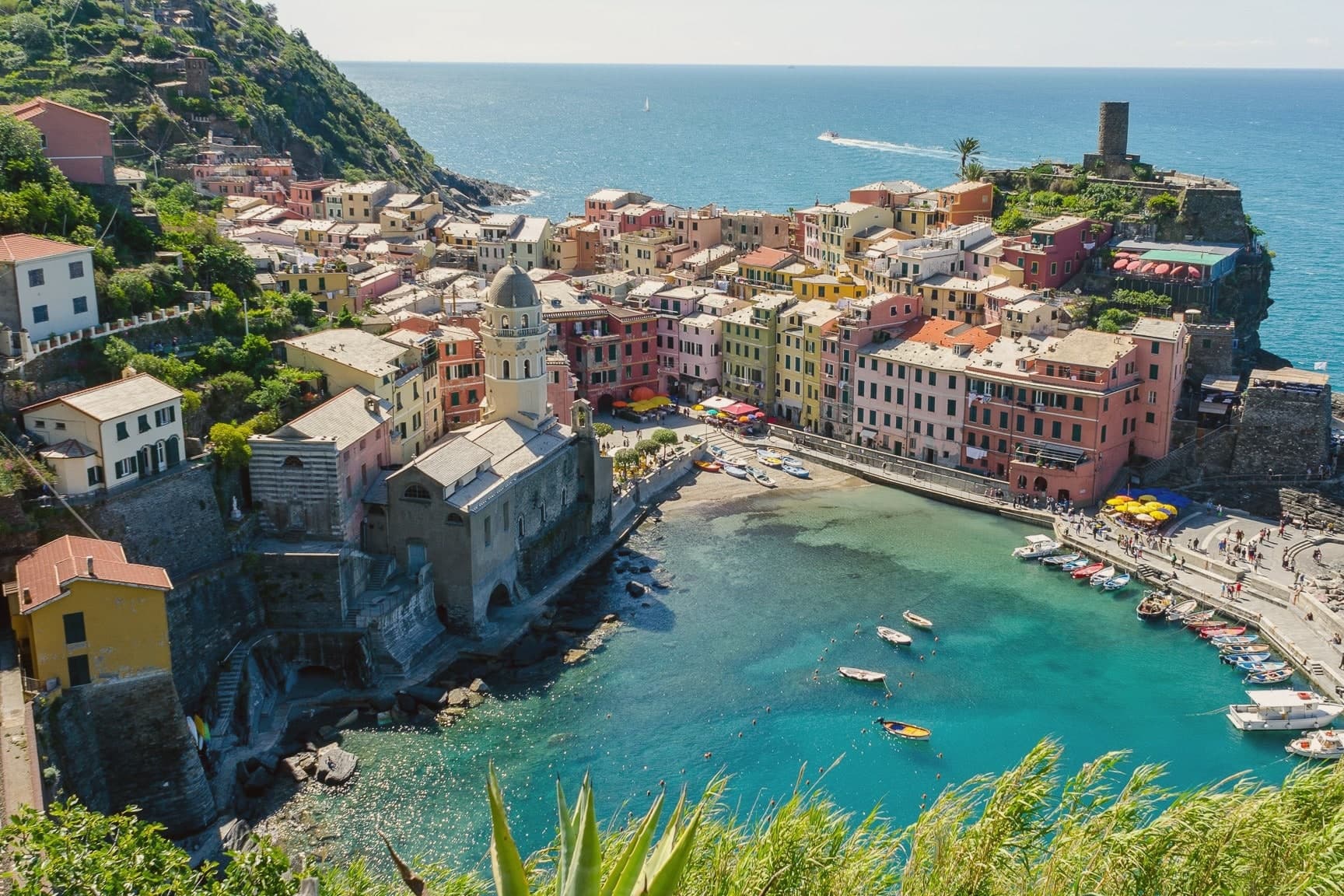
Vernazza sits at sea level, the middle of the five villages along this stretch of coast and the only one with a natural harbor. The houses stack vertically up the gorge of the Vernazzola torrent, painted in faded ochres and pinks, with the square at the harbor marking the seaward end of Via Roma and the social center of the village.
On 25 October 2011, a freak rainstorm dropped 22 inches of water in four hours. The torrent burst its culvert and buried the main street under four meters of mud and debris.
Three people died. The village was closed for months, and most of the houses on Via Roma had to be excavated to the second story before it reopened.
The harbor, the fortified height above it, and the terraced slopes behind form a single working shape: a landing place guarded from above and fed from the terraces, all of it packed into a gorge narrow enough that a few hours of rain could bury the street from end to end.
What to see in Vernazza
- Castello Doria. The keep and the Belforte tower stand over the harbor, built by the Doria as a defense against Saracen raids.
- Chiesa di Santa Margherita d'Antiochia. Fourteenth-century church on a rock platform at the edge of the harbor, documented from 1318, the gothic anchor of the village.
- Porto di Vernazza. The only natural harbor in the Cinque Terre, with a small pebble beach and a ferry pier serving the four other villages and Portovenere.
How to get to Vernazza
There is a railway station in the town, so you can arrive without a car and never need one while you are here. Genova is roughly 101 minutes away by road.
✷ We have written about Vernazza
“The Cinque Terre are five towns with a national park around them and a marketing name that adds up to five. The copies without the name are a few miles away in either direction, and the experience they sell is the same experience, with the crowd divided by a hundred.”
Read our piece on Vernazza →Cinque Terre | How To Do It Right
Our tip
April through June and September into October are the right months in the Cinque Terre. The terraces green in spring, the Sciacchetrà and Vermentino harvest runs from August into early September, and the autumn light on the painted houses is what most photographers come for. July and August are full beyond capacity: ferries, trains and trails all hit limits, the harbor square loses any quiet, and the village rationed entry on the worst weekends of 2023 and 2024. Giochi Di Santa Margherita falls in July.
Monterosso al Mare
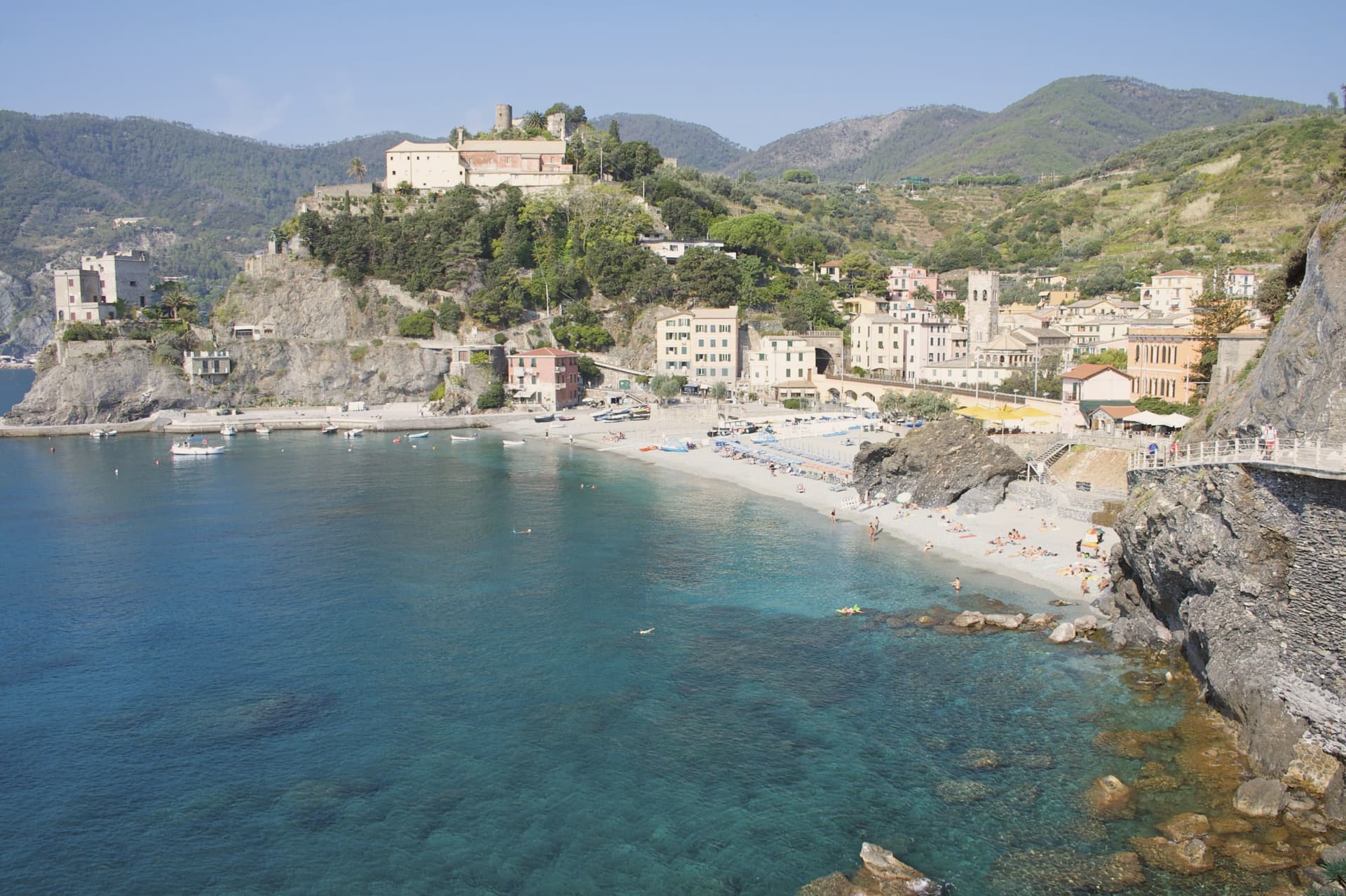
Why visit Monterosso al Mare
The village splits into two halves on either side of a headland: the older centro storico and, on the other side, the Fegina seafront where the railway runs behind the sand. The Capuchin convent looks out over both sides from that same headland, the hinge on which the whole layout turns.
Above the rooftops, at 464 meters, a hilltop sanctuary has stood on the same ground since 740, older than the village below it and the oldest Marian site in Liguria. The parish church down in the old town, banded in black and white marble, was built centuries later, so the two put a long stretch of the coast's religious history on display within sight of each other.
Montale's villa stood in Fegina, and the rocks and cliffs he carried into Ossi di seppia are the same ones visible from either half of the village. The geography here is the story: a headland dividing old from new, and a hillside holding the older of the two by several centuries.
What to see in Monterosso al Mare
- Chiesa di San Giovanni Battista. Parish church built 1282-1307 with a black-and-white-banded marble façade and a fresco of the baptism of Christ over the main portal.
- Santuario di Nostra Signora di Soviore. Hilltop sanctuary at 464 meters above the village, occupied by a church since 740, the oldest Marian site in Liguria.
- Convento dei Cappuccini. Seventeenth-century Capuchin convent on the San Cristoforo headland, separating the centro storico from Fegina.
How to get to Monterosso al Mare
There is a railway station in the town, so you can arrive without a car and never need one while you are here. Genova is roughly 78 minutes away by road.
Our tip
April through June and September through October are the workable months. The Sentiero Azzurro is open, the sea warms from late May, and the village still moves at a manageable pace. July and August are difficult: the Cinque Terre regional system caps walking-path tickets but the centro storico still saturates, and trains arrive standing-room from La Spezia. Festa del Limone falls in May.
Portovenere
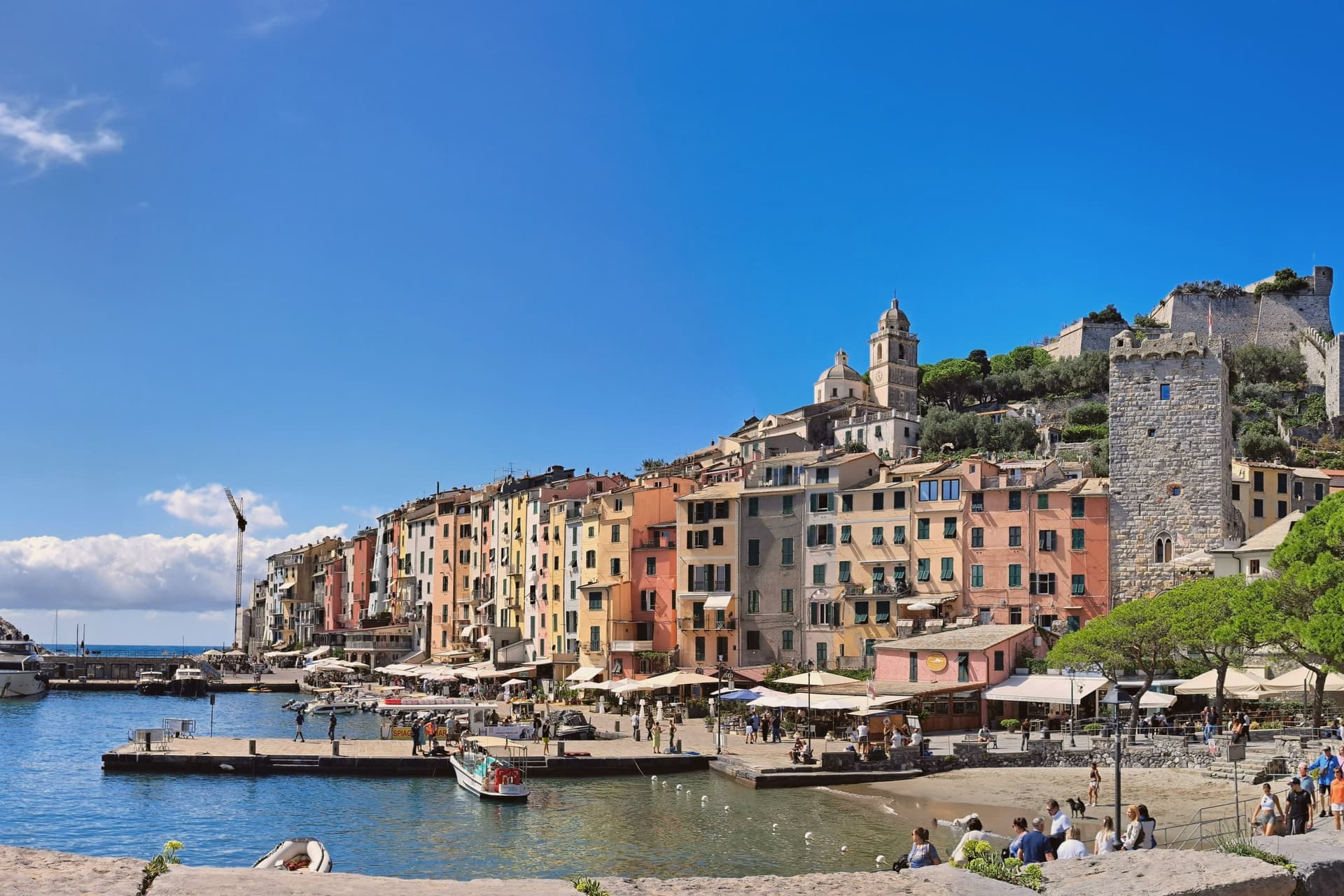
Why visit Portovenere
Portovenere closes the western mouth of the Gulf of La Spezia, three kilometers south of the city by water, facing the islands of Palmaria, Tino and Tinetto across open water. The Roman Portus Veneris dates to at least the first century BC, named for a temple to Venus on the promontory that now carries the striped church at the harbour mouth.
Genoa took control in 1113 and fortified the town as the southern anchor of its Riviera defences, opposite Pisan Lerici across the gulf: the fortress above the harbour and the church on the rock were built to face each other's rival coast rather than each other. The upper town holds the castle and its Romanesque parish church, rebuilt after a fire in 1340 damaged that quarter; the single medieval street below runs parallel to the harbour, its plan unchanged since Genoa first laid the town out in the twelfth century.
The promontory church stands apart from both, reachable along the water's edge, with the sea cave that took Byron's name cut into the rock beneath it. A fortified street, a hilltop castle and a temple site turned church: the town reads as a defensive line built along a single spine of rock, with the gulf doing the rest of the work UNESCO recognized in 1997.
What to see in Portovenere
- Chiesa di San Pietro. Consecrated 1198, black and white striped Gothic rebuild from 1256-1277, on the rocky promontory where the Roman temple of Venus stood.
- Castello Doria. First cited 1139, rebuilt 1161, expanded into the seventeenth century, the Genoese fortress above the harbour, prison under Napoleonic rule.
- Grotta dell'Arpaia. Sea cave below San Pietro, also called Byron's Grotto for the English poet who swam from here to Lerici across the gulf to visit Shelley.
How to get to Portovenere
Pisa is roughly 83 minutes away by road.
✷ We have written about Portovenere
“Most people spend a few hours in Portovenere between the ferry and the aperitivo. We gave it three weeks, and the town we got was the one the couple on the balcony lived in: vertical, repetitive, almost monastic, a town where the day is a staircase you climb the same way at the same hours, where the luxuries are a balcony the size of a doormat and an espresso stretched to thirty minutes because there is no reason on earth to drink it faster.”
Read our piece on Portovenere →Portovenere | The Slowest Coffee in Italy
Our tip
April through June and September to October are the working windows. Ferries to Palmaria run on full schedules from May onwards; the gulf is calm enough to swim by late May. July and August fill the carruggio and the Castello Doria, accommodation runs at three times shoulder rates, and the queue for the climb to San Pietro can reach an hour. Sagra Pansa E Stacca falls in June.
Camogli
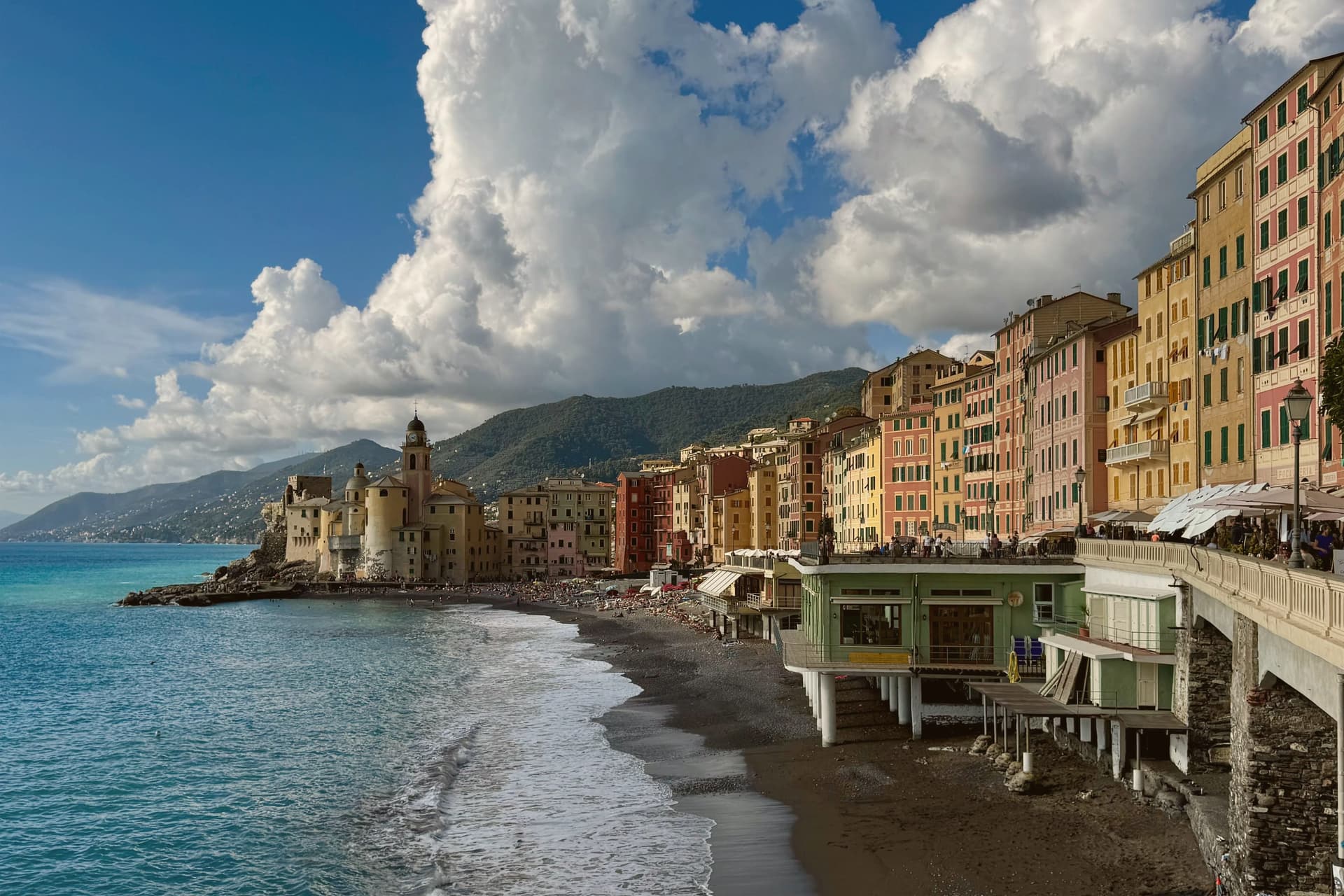
Why visit Camogli
Camogli sits on the west side of the Portofino peninsula, twenty kilometers from Genova on the Golfo Paradiso. The earliest record dates to the tenth century, when it was already a tuna and shrimp fishing port.
By the nineteenth century, the town's fleet of merchant sailing ships ran to several hundred vessels and Camogli was called the city of a thousand white sails. After the naval defeat at Abukir against the British, the camogliesi shipowners reinvested in building merchant sailers under contract to the major European states.
The painted façades of the seafront houses, with their false windows and trompe-l'oeil cornices, served the returning sailors as recognition marks from sea. The Castello della Dragonara, built in the thirteenth century, still guards the harbor.
Every second Sunday of May, the Sagra del Pesce fries thirty thousand portions of fish in a single giant pan on the wharf, in honor of San Fortunato. San Fruttuoso, the eleventh-century abbey reachable by boat or trail, sits in the next cove.
What to see in Camogli
- Castello della Dragonara. Thirteenth-century fortress guarding the harbor, used as municipal seat and now a venue for exhibitions and cultural events.
- Basilica di Santa Maria Assunta. Parish basilica next to the castle on the harbor, baroque interior with marble inlays and seventeenth-century paintings.
- Abbazia di San Fruttuoso. Eleventh-century Benedictine abbey in the next cove, reachable by boat or by the coastal trail across the Portofino peninsula.
How to get to Camogli
There is a railway station in the town, so you can arrive without a car and never need one while you are here. Genova is roughly 33 minutes away by road.
✷ We have written about Camogli
“A steep hill falls into the sea. The houses are crammed on the slope and painted in bright colors because they are old, packed tight, and need help. There is a small port if the cove allows it and a bigger port if the cove is generous. There is a small piazza around a small church, with maybe four restaurants, three bars, and a gelato place. There is no space for a grand square, because there is no space for grand anything in Liguria.”
Read our piece on Camogli →Tigullio Roadtrip | Four Versions of the Same Liguria
Our tip
April through June and September into October are the strongest months for the Camogli seafront, with mild evenings and clean water before the Genova weekend traffic peaks. The Sagra del Pesce on the second Sunday of May is the date that fills the wharf. July and August are warm, often 28 to 30 degrees, and the painted-façade harbor fills with day-trippers off the Genova trains. Sagra Del Pesce falls in May.
Pieve di Teco
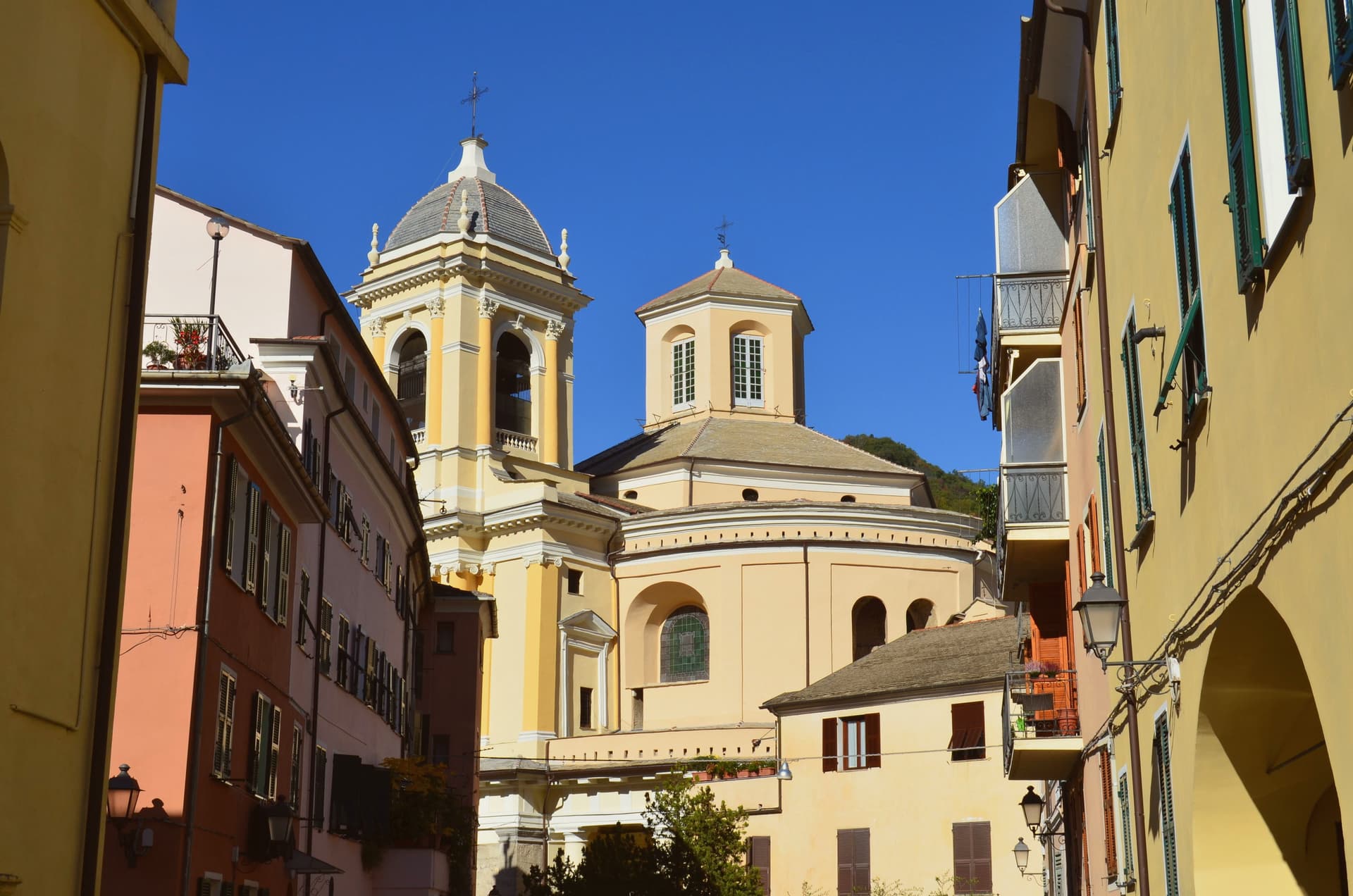
Why visit Pieve di Teco
Pieve di Teco sits at 240 meters in the middle Arroscia valley, twenty kilometers northwest of Imperia. The town was not a slow medieval accretion: it was deliberately founded in 1233 around a parish church, a mill and a well, on a flat stretch where the main roads of the upper valley converged, with the explicit purpose of running a market.
Manufactures followed of paper, leather, soap, ropes, cloth and footwear. The Clavesana family held it until 1386, when it passed to Genoa, and it changed hands repeatedly through the wars that crossed the Ligurian Apennines.
The Corso Mario Ponzoni, porticoed since the sixteenth century, runs the length of the original market layout, and the eighteenth-century Collegiata di San Giovanni Battista anchors one of its squares. The Teatro Salvini, with around a hundred seats, is the second-smallest functioning theater in Italy.
The commune is the seat of the Unione dei Comuni della Valle Arroscia.
What to see in Pieve di Teco
- Corso Mario Ponzoni. Porticoed market street running the length of the original 1233 town plan, with two-storey houses above the sixteenth-century arcades.
- Collegiata di San Giovanni Battista. Eighteenth-century collegiate church overlooking one of the squares on the Corso, the religious anchor of the upper Arroscia valley.
- Teatro Salvini. Roughly one hundred seats, the second-smallest functioning theater in Italy, still in regular use for chamber-scale productions.
How to get to Pieve di Teco
Genova is roughly 94 minutes away by road.
Our tip
April through June and September through October work well for Pieve di Teco. The Arroscia valley at 240 meters runs cooler than the coast through summer; July and August are warm but tolerable, with the porticoed Corso providing continuous shade. The autumn harvest brings the Taggiasca olive picking and the first pressings. Expo Valle Arroscia falls in September.
Sassello
Why visit Sassello
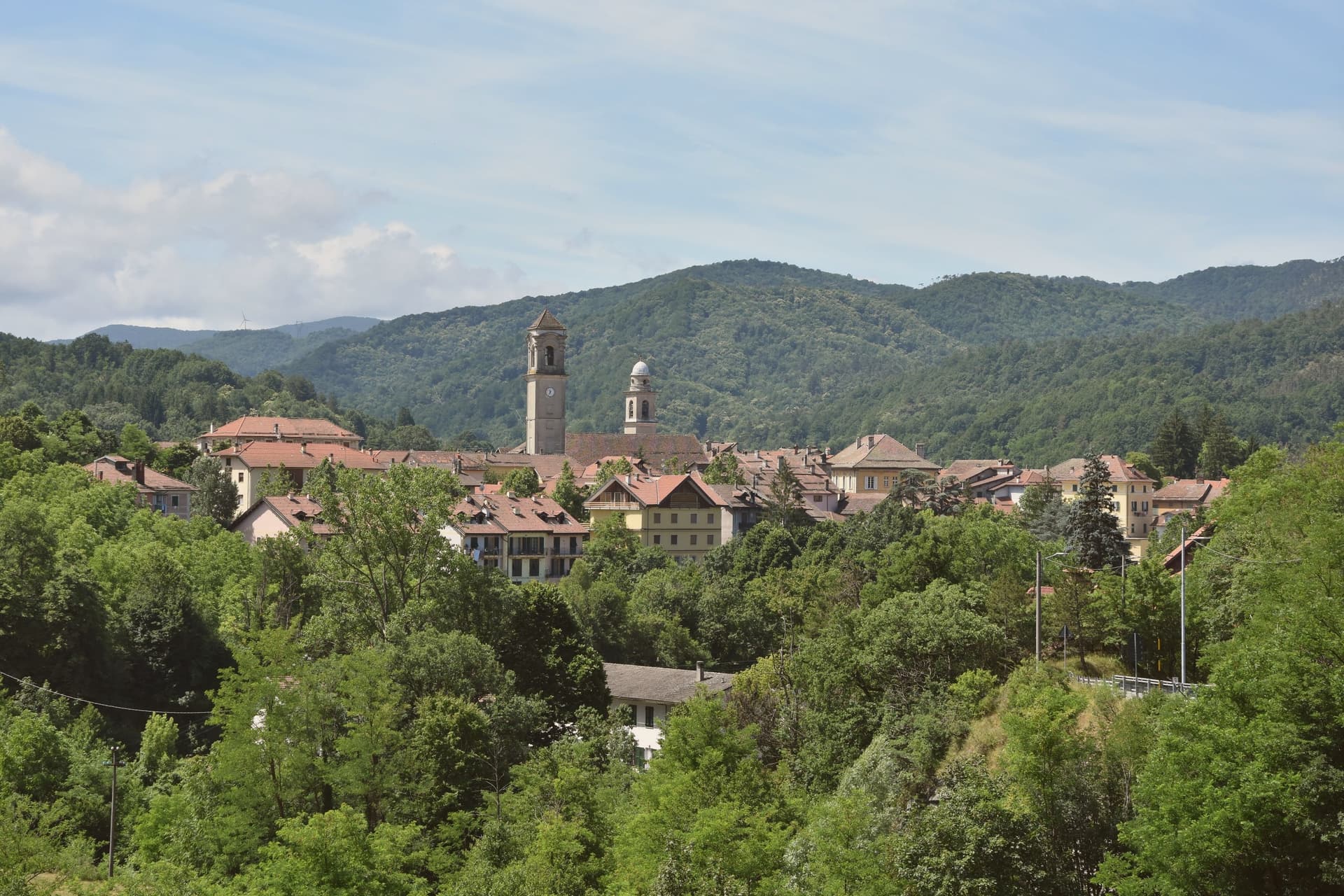
Sassello sits at 381 meters on the northern flank of the Ligurian Apennines, inside a UNESCO Global Geopark that stretches between Genova and Savona. The old village divides into two bastie: the Bastia Soprana, dating to the twelfth century, and the Bastia Sottana, founded by the Doria in the fifteenth, the two halves joined by stone bridges over the Sansobbia stream and threaded with frescoed palaces and baroque churches.
Most visitors arrive from Savona, thirty kilometers south, or from Genova, thirty-five east. The biscuit that carries the town's name past its own borders began in an ordinary kitchen: Geltrude Rossi ran an inn with a kitchen in the centro, and in 1860 started baking small almond biscuits she eventually named amaretti.
By 1892 they had a bronze medal at the Columbian celebrations; by 1911, gold in Paris. The Rossi and Virginia families still make them, and the town holds the trademark on amaretti morbidi di Sassello.
A hill town shaped by a river split and a fifteenth-century feudal addition has, almost as an aside, given its name to something baked in a kitchen and sent to Paris. The geography explains the two halves of the village; the biscuit explains why the name travels.
What to see in Sassello
- Centro storico. Two-bastia village of the twelfth and fifteenth centuries split by the Sansobbia, with frescoed palaces and baroque churches.
- Chiesa della Santissima Trinità. Parish church in the Bastia Sottana, baroque interior with stuccoed vaults and seventeenth-century altarpieces.
- Parco naturale regionale del Beigua. Geopark land stretching between Genova and Savona, reaching up to the peak that anchors it and gives the long sightline to the sea.
How to get to Sassello
Genova is roughly 72 minutes away by road.
Our tip
April through June and September into October are the strongest months for walking the Beigua and pairing the trails with the bakeries on Via Badano. July and August are warm but the elevation keeps the heat below the coastal numbers; the village fills with families from Savona and Genova on summer weekends. November through March is quiet, with the amaretti workshops in steady production for the holiday markets and the Beigua sometimes under snow above 1,000 meters. Festa dell'Amaretto falls in September.
Laigueglia
Why visit Laigueglia
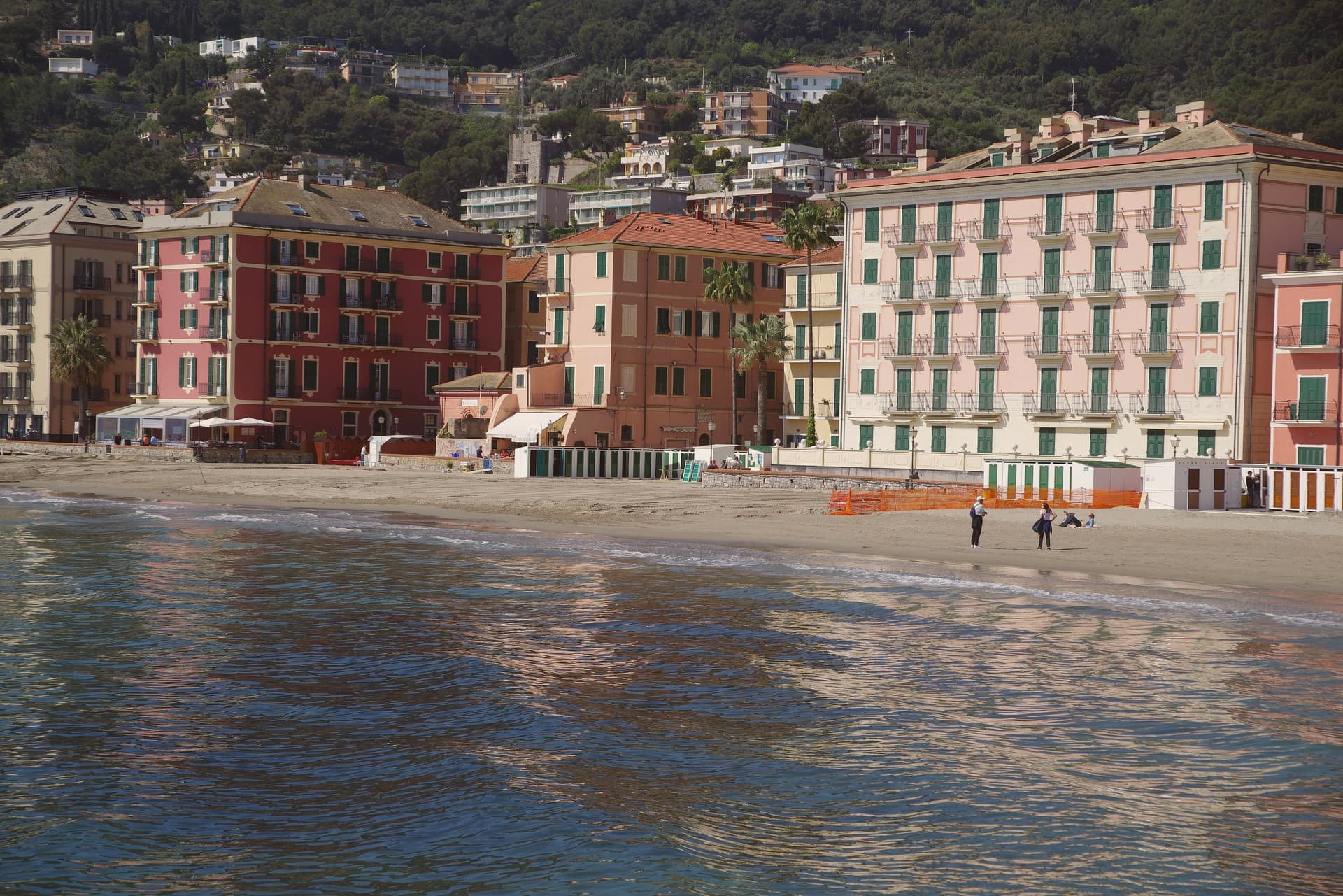
Laigueglia sits at six meters on the Riviera di Ponente, sheltered between the two headlands that frame the bay. The name comes from Aquilia, a reference to the Roman eagle standards, and the village grew from a settlement of fishermen who came over from neighboring Andora.
Genoa bought the borough in 1609. Through the seventeenth century the economy ran on shipbuilding and the coral trade, which drew Catalan fishermen to settle in numbers and left behind the Baroque churches that anchor the centro storico today: the parish church with its curved front, and the confraternity oratory with its carved choir and Piola altarpiece.
Behind the beach, the fishermen's grid still reads as caruggi, small squares opening to the sea, houses in pale violet and ochre, the seafront watchtowers standing at the edge where the town once kept watch for raiders by sea. What the coral money built, the town has simply gone on living inside.
What to see in Laigueglia
- Chiesa di San Matteo. The curved façade fronts a Baroque interior where the three altarpieces hang alongside furnishings paid for in the coral years, when the parish stood as the visible return on the fishery's money.
- Oratorio di Santa Maria Maddalena. 1616 oratory of the Confraternita dei Disciplinanti, with a carved wooden choir and an altarpiece by Domenico Piola.
- Centro storico. Fishermen's grid of caruggi behind the beachfront, with houses painted in the pale lilac and ochre traditional to the Ponente coast.
How to get to Laigueglia
There is a railway station in the town, so you can arrive without a car and never need one while you are here. Genova is roughly 85 minutes away by road.
Our tip
May through June and September through October are the calmer summer-edge months on this coast. The Bandiera Blu beach is open, the sea is warm enough from June onward, and the centro storico is not yet packed. July and August bring crowds, especially from Piedmont and Lombardy, and the litoraneo fills shoulder-to-shoulder. Il Salto Dell'Acciuga falls in October.
More from Anywhere Italy
 The best small coastal towns you can reach by train in Liguria
 The best small towns inside a nature park in Liguria
- The best small towns with a food festival that eat well within 90 minutes of Genova
- The 10 best hidden beach towns with a food festival in Liguria
- The 10 best towns with a food festival that have a serious restaurant in Liguria
- The 9 best small towns you can reach by train that eat well within 90 minutes of Genova