
The 10 best towns with a food festival that have a serious restaurant in Liguria
Liguria cooks with a short list and a long memory. Basil pounded with pine nuts and pecorino, chickpea flour poured into copper pans for farinata, anchovies salted in the spring and eaten all winter, sheets of dough stretched until the light comes through. The coast is slate and pastel plaster, houses stacked up ravines that run straight down to the water, terraced in dry stone above the olives. Late spring and early autumn are when the sagre come round, when a whole town square is given over to one ingredient and a row of trestle tables.
The Cinque Terre absorbs most of the attention and most of the buses. It earns some of it, but the paths are rationed, the trains run full from La Spezia, and lunch in the middle of the day is a queue at a counter rather than a meal at a table. Portofino sits at the other end of the same problem, beautiful and priced accordingly. Both are worth seeing once, in a quiet month, early.
The same coast keeps going in both directions, and so does the cooking. West of Genoa the Riviera di Ponente has caper festivals and fried-fish nights and dining rooms that have held a listing for years. East, past the headlands, the Riviera di Levante runs through slate quarries and river valleys where the focaccia is filled with cheese and the sagra calendar is a local institution. The towns here hold both things at once, a festival with an ingredient behind it and a restaurant that takes its own kitchen seriously.
Of the 54 communes we have mapped in Liguria, 14 qualify as towns with a food festival with a serious restaurant: each holds a recurring food festival built around one local ingredient, and each holds a restaurant listed by the most demanding of the guides. This list is 10 of them. The smallest, Badalucco, has 1,072 residents.
If you are still choosing, we have also written The 10 best hidden beach towns with a food festival in Liguria and The prettiest villages with a serious restaurant in Liguria.
Badalucco
Why visit Badalucco
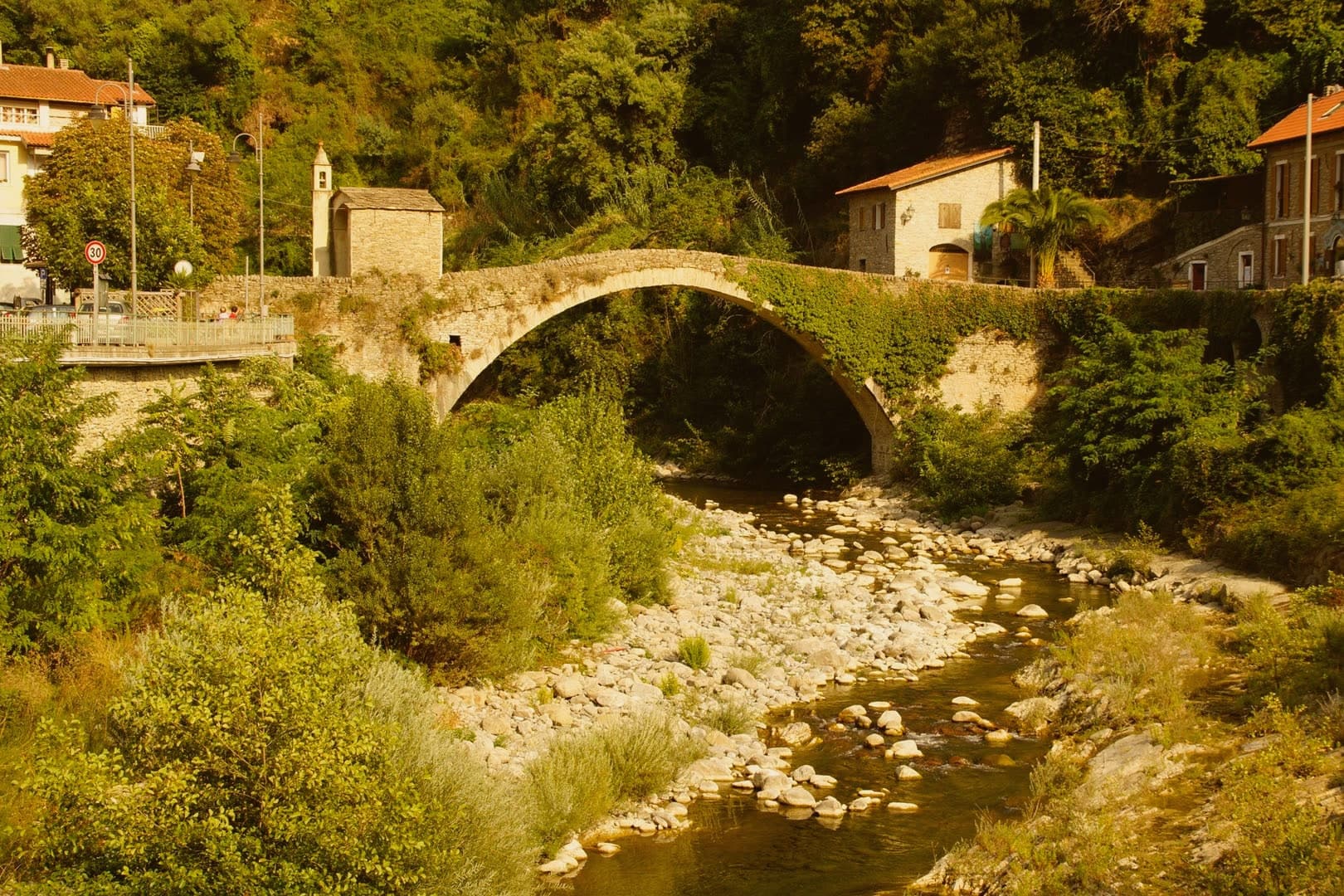
Badalucco sits at 179 meters in the middle Valle Argentina, fifteen kilometers north of Imperia. The torrent that gives the valley its name runs in a wide bend below the village.
The site changed hands between Ligures and Rome in 181 BC, became a fief of the Counts of Ventimiglia, and passed to the Republic of Genova in 1259. The seventeenth century rebuilt the parish Chiesa di Santa Maria Assunta e San Giorgio in full Baroque, with a square bell tower and a fifteenth-century polyptych attributed to Giovanni Canavesio.
The caruggi of stone houses are painted with contemporary murals and trompe-l'oeil, a more recent layer over the medieval shell. The Rundin bean, an indigenous variety grown on the terraces, is a Slow Food Presidium.
Stoccafisso alla badalucchese, stockfish stewed in tomato and olives, is the dish: the third Sunday of September brings the Stockfish Festival to the square.
Umami, Cian de Bià have been named by a guide.
What to see in Badalucco
- Chiesa di Santa Maria Assunta e San Giorgio. Seventeenth-century Baroque parish church with a square bell tower, holding a fifteenth-century polyptych attributed to Giovanni Canavesio and a seventeenth-century wooden crucifix.
- Chiesa di San Niccolò. Hilltop church above the old village, on the site of a former noble castle that served as a lookout over the valley.
- Ponte sull'Argentina. Stone bridge across the torrent that wraps the village, connecting the centro storico to the valley road.
How to get to Badalucco
Genova is roughly 122 minutes away by road.
Our tip
April through June and September into October are the dry months in the Argentina Valley. The terraces above the village hold olive groves, the Rundin bean, and pockets of grapevine. July and August push into the low thirties, but the valley keeps a few degrees cooler than the coast. Festival dello Stoccafisso falls in September.
Celle Ligure
Why visit Celle Ligure
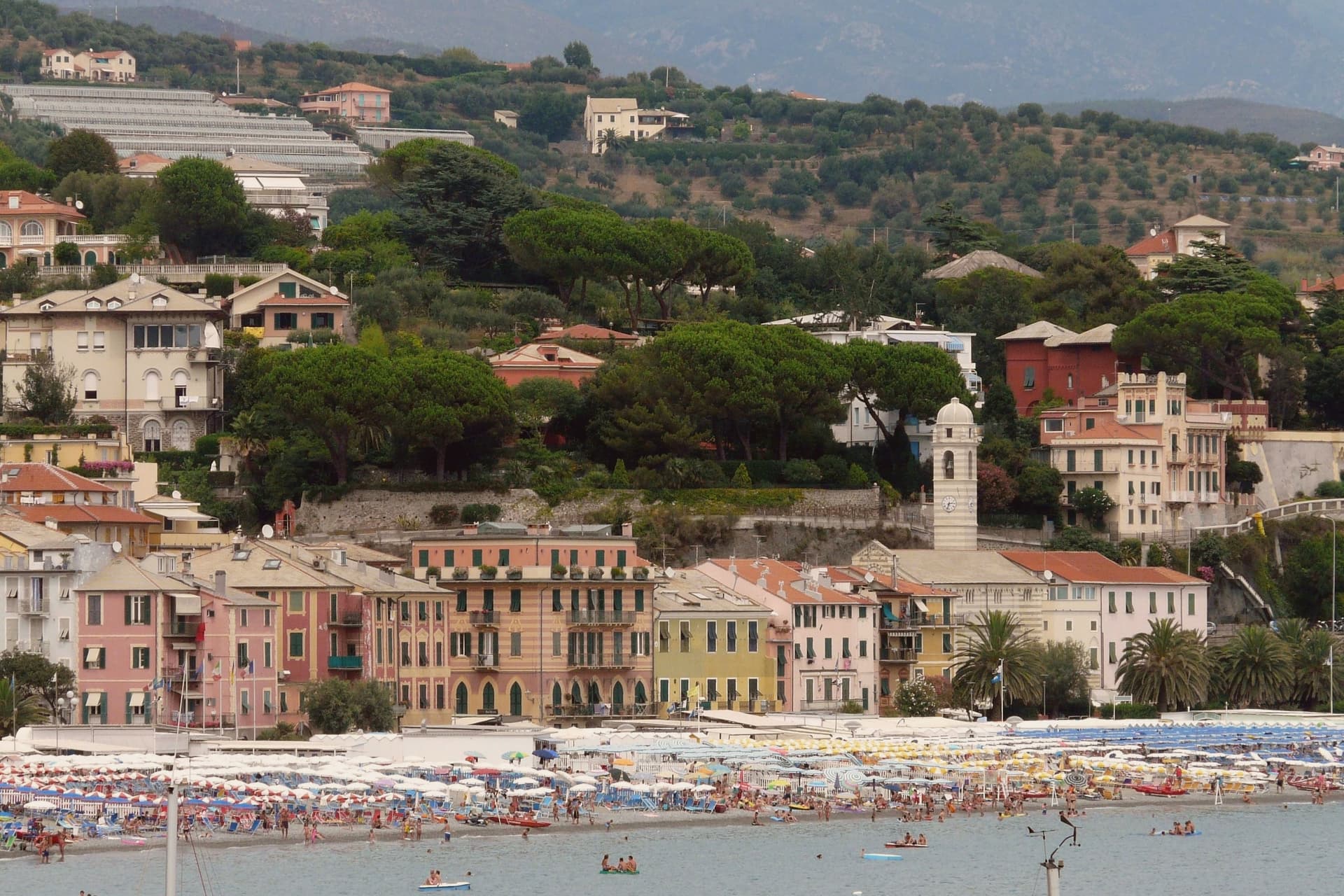
Celle Ligure sits at sea level on the Riviera di Ponente, ten kilometers west of Savona. The Aleramici marquises gave the lands to a Piedmontese monastery in 1014; the Genovese families took them over within a generation.
Pope Sixtus IV's family came from here. The lower town runs along the lungomare, with Piazza dei Mille at its center, while the centro storico sits behind it as a borgo of narrow caruggi, one of the Borghi più belli d'Italia.
A handful of artisan kilns still work these streets, ceramic shop signs marking the buildings where the trade continues. The parish church stands within this old town, its façade carrying the ceramic Assumption by Lucio Fontana, San Michele defeating the dragon rendered in the same medium the town has fired since the seventeenth century.
The pieces read as one place rather than several: a fishing and beach economy along the shore, a ceramic trade worked into the old quarter behind it, and a native artist's public commission set into the church that anchors both.
Meta Ristorante have been named by a guide.
What to see in Celle Ligure
- Chiesa di San Michele Arcangelo. Inside, a Via Crucis by Caminati hangs alongside ceramic stations by Emanuele Luzzati, a pairing of local ceramic craft with the Fontana work on the façade outside.
- Centro storico. Borgo of narrow caruggi behind the lungomare, with active artisan ceramic workshops and ceramic shop signs on the buildings themselves.
- Spiaggia di Celle Ligure. Sand and gravel beach that forms the basis of the town's summer economy, backed by the lungomare and the old town behind it.
How to get to Celle Ligure
There is a railway station in the town, so you can arrive without a car and never need one while you are here. Genova is roughly 40 minutes away by road.
Our tip
April through June and September into October are the dry months on this stretch of the Ponente. The sea warms enough for swimming by late May. July and August are full: the lungomare slows, the beach establishments fill with weekenders from Torino, and the Aurelia stays clogged from Albisola to Varazze on Friday afternoons. Acciugalonga falls in September.
Recco
Why visit Recco
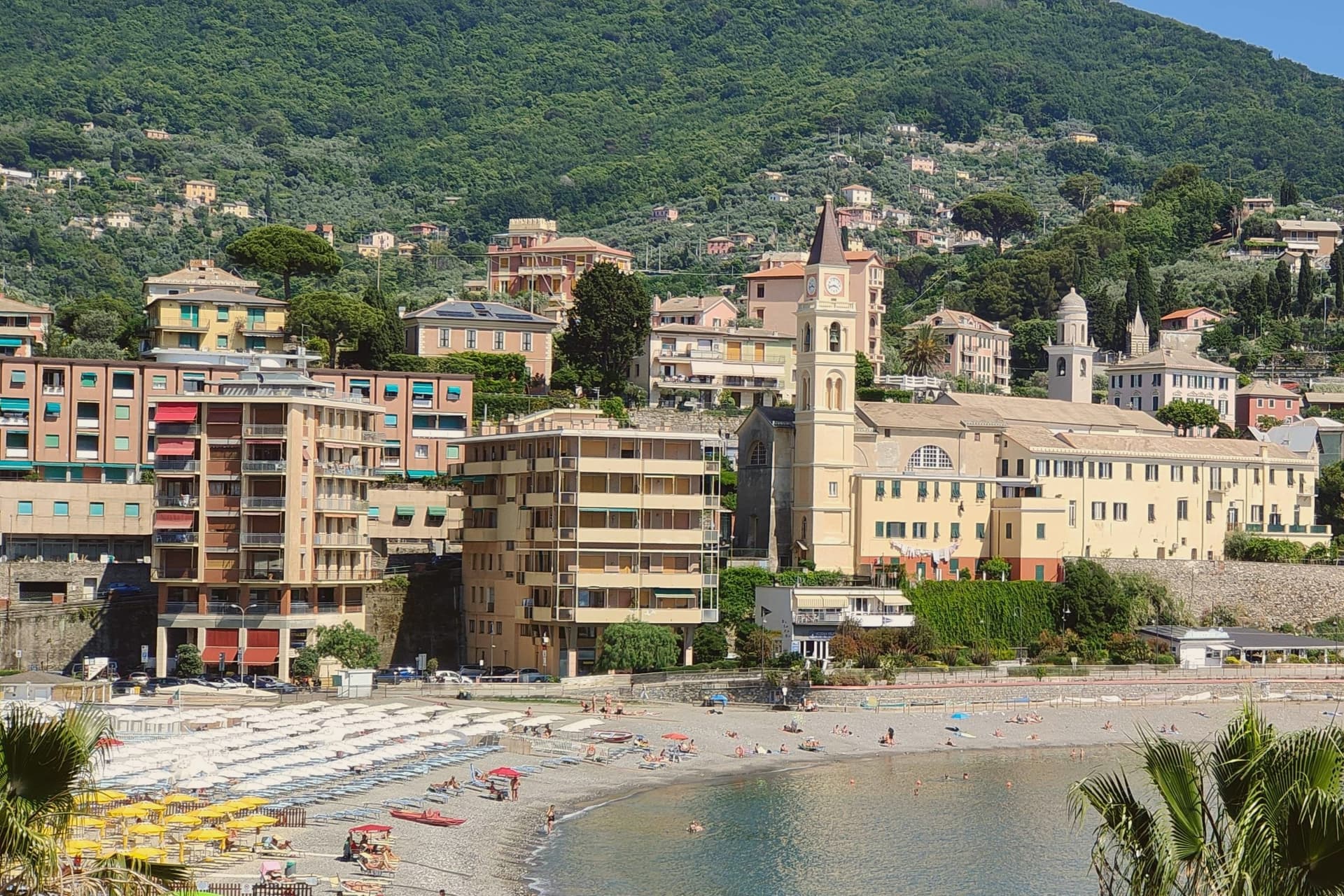
Recco sits on a small inlet of the Golfo Paradiso between Sori and Camogli, fifteen kilometers from Genova. The town's viaduct made it a strategic Allied target in the second world war; the 1943 bombings killed 127 inhabitants and left the town to be rebuilt through the late 1940s and early 1950s, so the church, the bridge and much of the fabric standing today date from that reconstruction rather than before it.
The focaccia has documented origins in the nineteenth century, well before the war or the IGP designation gave it formal status, and it is made in a small cluster of towns along this stretch of coast, of which Recco is only one, though the one that gives the dish its name. Pro Recco's history runs on a separate track entirely, a club founded in 1913 whose record has nothing to do with the town's postwar rebuilding.
What ties the two together is only the place itself: a small gulf town, destroyed and remade, that carries a nineteenth-century food and a twentieth-century sporting dynasty as its two claims to notice.
Da ö Vittorio, Manuelina have been named by a guide.
What to see in Recco
- Santuario di Nostra Signora del Suffragio. The campanile rebuilt on the site of the main church lost to the bombings is the tallest postwar bell tower in Liguria.
- Golfo Paradiso seafront. Small inlet between Sori and Camogli, with the Bandiera Blu beach and a short lungomare looking south to the Portofino peninsula.
- Ponte di Recco. The rebuilt railway viaduct stands on the site of the structure that drew the wartime bombings, and remains the spine of the modern town.
How to get to Recco
There is a railway station in the town, so you can arrive without a car and never need one while you are here. Genova is roughly 25 minutes away by road.
Our tip
April through June and September into October are the strongest months on the Golfo Paradiso, with mild water and the fewest day-trippers from Genova. The Sagra della Focaccia col Formaggio in the last week of May is the date that fills the seafront. July and August are warm, often 28 to 30 degrees, and the beaches fill on weekends with Genovesi on the train line. Mangialonga Nel Golfo Paradiso falls in April.
Monterosso al Mare
Why visit Monterosso al Mare
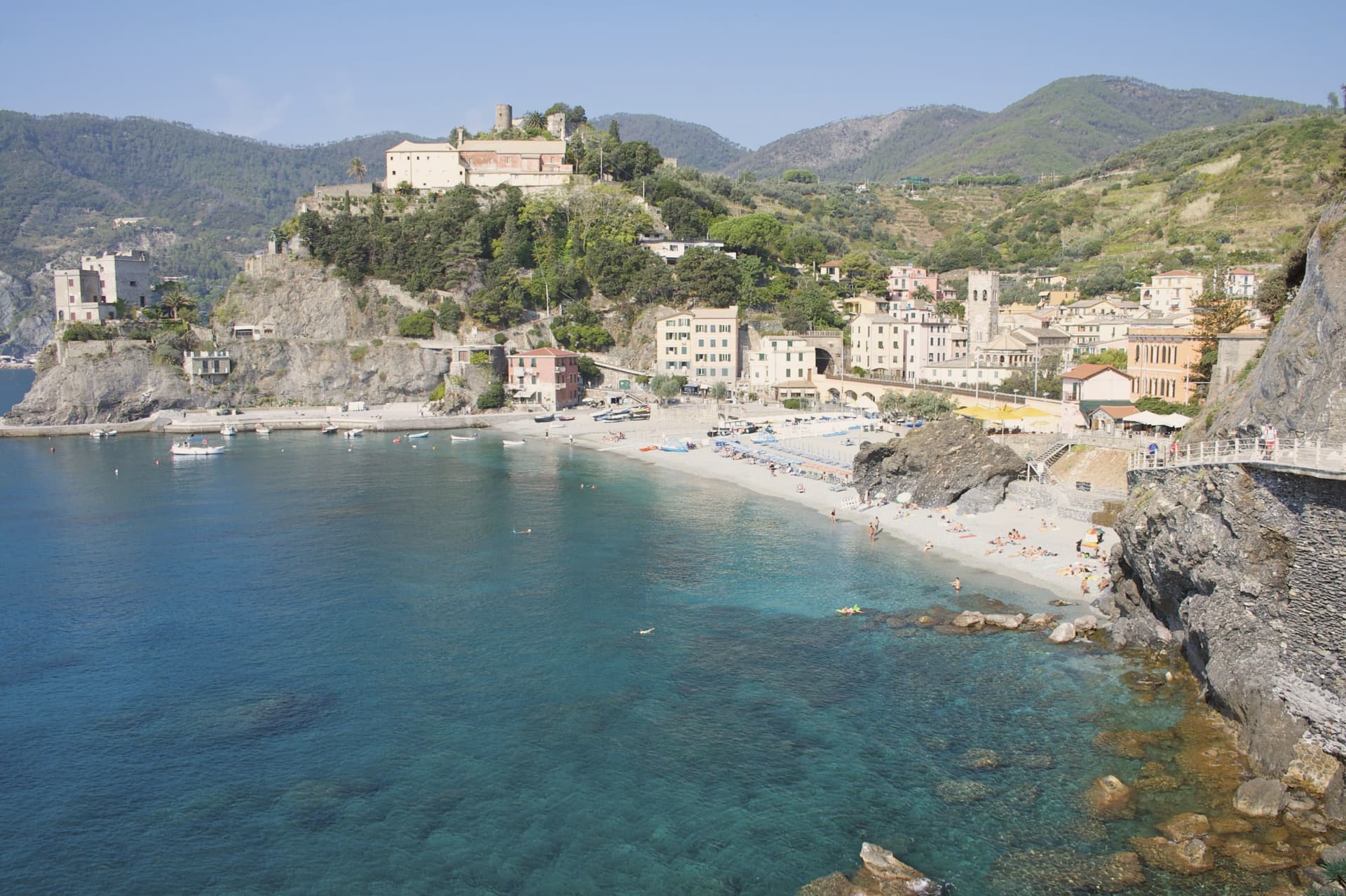
The village splits into two halves on either side of a headland: the older centro storico and, on the other side, the Fegina seafront where the railway runs behind the sand. The Capuchin convent looks out over both sides from that same headland, the hinge on which the whole layout turns.
Above the rooftops, at 464 meters, a hilltop sanctuary has stood on the same ground since 740, older than the village below it and the oldest Marian site in Liguria. The parish church down in the old town, banded in black and white marble, was built centuries later, so the two put a long stretch of the coast's religious history on display within sight of each other.
Montale's villa stood in Fegina, and the rocks and cliffs he carried into Ossi di seppia are the same ones visible from either half of the village. The geography here is the story: a headland dividing old from new, and a hillside holding the older of the two by several centuries.
Da Miky, L'Ancora della Tortuga, Buranco have been named by a guide.
What to see in Monterosso al Mare
- Chiesa di San Giovanni Battista. Parish church built 1282-1307 with a black-and-white-banded marble façade and a fresco of the baptism of Christ over the main portal.
- Santuario di Nostra Signora di Soviore. Hilltop sanctuary at 464 meters above the village, occupied by a church since 740, the oldest Marian site in Liguria.
- Convento dei Cappuccini. Seventeenth-century Capuchin convent on the San Cristoforo headland, separating the centro storico from Fegina.
How to get to Monterosso al Mare
There is a railway station in the town, so you can arrive without a car and never need one while you are here. Genova is roughly 78 minutes away by road.
✷ We have written about Monterosso al Mare
“The Cinque Terre are five towns with a national park around them and a marketing name that adds up to five. The copies without the name are a few miles away in either direction, and the experience they sell is the same experience, with the crowd divided by a hundred.”
Read our piece on Monterosso al Mare →Cinque Terre | How To Do It Right
Our tip
April through June and September through October are the workable months. The Sentiero Azzurro is open, the sea warms from late May, and the village still moves at a manageable pace. July and August are difficult: the Cinque Terre regional system caps walking-path tickets but the centro storico still saturates, and trains arrive standing-room from La Spezia. Festa del Limone falls in May.
Lerici
Why visit Lerici
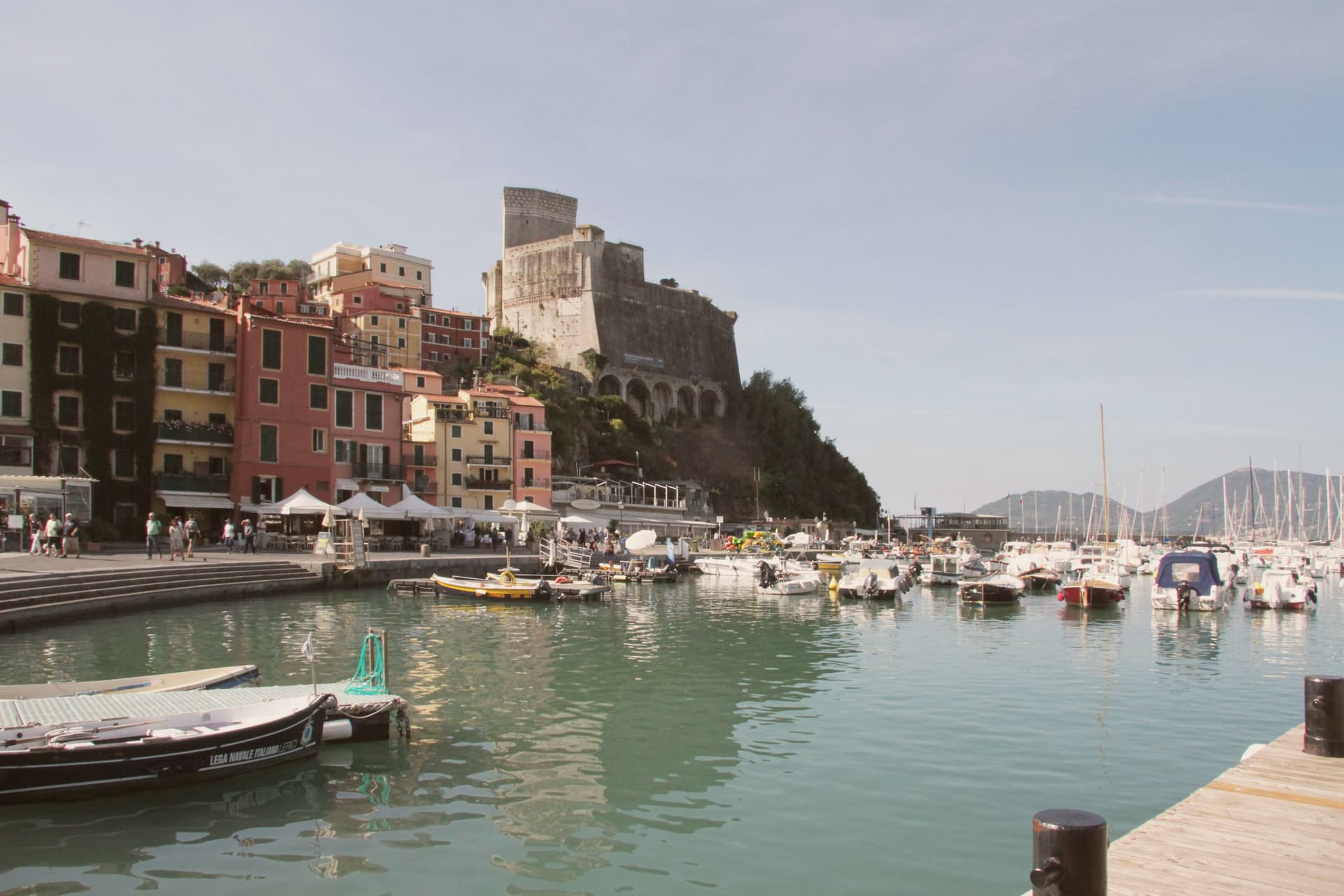
The Gulf of La Spezia takes its eastern shore here, and English Romantics renamed that shore the Bay of Poets after Byron and Shelley made it their address in the early 19th century. The fortress that defines the harbour was begun by the Pisans in 1152 to control the gulf, captured by the Genoese in 1256, and rebuilt in its present pentagonal form through the 14th and 15th centuries; it now holds a paleontology museum with Jurassic dinosaur tracks recovered from the local sandstone.
Shelley lived at a house in nearby San Terenzo in 1822, he drowned that summer sailing from Livorno, and Byron swam across the bay from Portovenere on his way to visit him. Beyond the historic harbour the commune stretches south past a colourful frazione perched on a rocky promontory above the sea, a member of the Borghi più belli d'Italia network in its own right; a coastal trail links the two through olive terraces and pine woods.
The town beach holds a Bandiera Blu and the harbour fills with sailing dinghies all summer. Upper fortress and lower water, working harbour and outlying fishing hamlet: the whole gulf edge here reads as one address that two poets happened to share, and the parts of the commune as its castle, its beach, and its outpost on the rocks.
Il Fico trentacareghe, La Barca have been named by a guide.
What to see in Lerici
- Castello di Lerici. Begun by the Pisans in 1152, captured by Genoa in 1256, rebuilt in its present form in the 14th-15th centuries. The pentagonal walls still hold the harbour under them, and the paleontology museum inside keeps the Jurassic tracks pulled from the local sandstone.
- Bay of Poets / Casa Magni. The Casa Magni at San Terenzo, a Lerici frazione, was Shelley's residence in 1822, the year he drowned in the bay. The house still stands on the shore that gave the Bay of Poets its name.
- Tellaro. Pastel-coloured fishing frazione clinging to a rocky promontory at the southern edge of the bay. Linked to Lerici by the coastal Castelnuovo trail.
How to get to Lerici
Pisa is roughly 61 minutes away by road.
✷ We have written about Lerici
“We know the steep streets above the castle by heart. We know which restaurant is for the view and which is for the dinner. We know that the gelato in San Terenzo, made at a place called La Rana Golosa, is worth the half-hour walk along the sea to find. We know the underpass that takes you to the small free beach under the castle, the rocks at the back of it, and the bench halfway along the promenade to San Terenzo where, on a good day, the wind off the Gulf has the precise temperature of being alive.”
Read our piece on Lerici →Lerici | An Old Friend on the Gulf of Poets
Our tip
April through October is the open season in the Bay of Poets — warm coastal days, calm seas from late spring, and the sailing fleet active all summer. June and September are the best months: warm sea, longer light, fewer crowds than July-August. The castle is open year-round (paleontology museum included) and Tellaro is best in October-November when the colours go warm. Mytiliade a Lerici falls in September.
Sestri Levante
Why visit Sestri Levante
Sestri Levante sits at the head of the Tigullio gulf, forty kilometers southeast of Genova, on a former island the Gromolo river silted into a peninsula by the eighteenth century. Roman Segesta Tigullorum was the predecessor; the town joined the Republic of Genova in 1133.
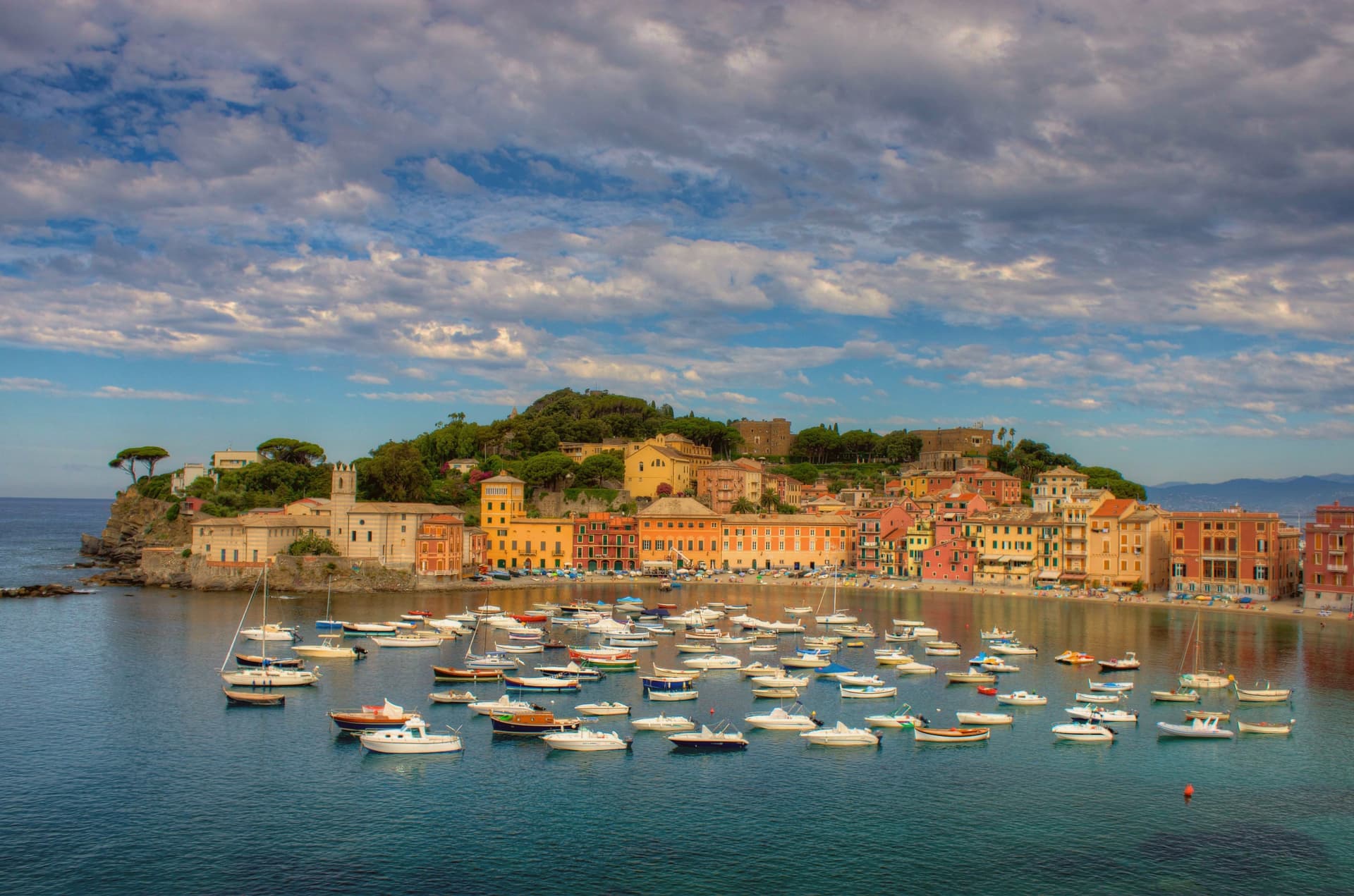
The peninsula splits the coast into two bays that face different ways and carry different names. To the north lies the long beach known as the Bay of Fables, named by a television host in a 1950s broadcast for the Danish writer who stayed here in 1833.
To the south lies the smaller, quieter bay, named by a Ligurian poet in 1919. Between them, on the high ground of the peninsula, stands the old watchtower where an inventor ran some of his most advanced shortwave radio work, work significant enough that the Navy renamed the gulf itself for him.
A town this small holds a beach with a literary name, a bay with a poet's name, and a headland with an engineer's name, three separate claims to attention pressed into one stretch of coast shaped by a silted river.
Pasticcerie Rossignotti, Rezzano Cucina e Vino, Baia del Silenzio and 4 more have been named by a guide.
What to see in Sestri Levante
- Baia del Silenzio. Smaller southern bay enclosed by colorful seventeenth- and eighteenth-century houses, named by poet Giovanni Descalzo in 1919.
- Baia delle Favole. Long northern beach and the Bandiera Blu stretch of the town, its name recalling Hans Christian Andersen, who looked out over the water from his inn.
- Torre Marconi. Old watchtower on the heights of the peninsula where Guglielmo Marconi carried out shortwave radio experiments in 1933 and 1934.
How to get to Sestri Levante
There is a railway station in the town, so you can arrive without a car and never need one while you are here. Genova is roughly 44 minutes away by road.
✷ We have written about Sestri Levante
“A steep hill falls into the sea. The houses are crammed on the slope and painted in bright colors because they are old, packed tight, and need help. There is a small port if the cove allows it and a bigger port if the cove is generous. There is a small piazza around a small church, with maybe four restaurants, three bars, and a gelato place. There is no space for a grand square, because there is no space for grand anything in Liguria.”
Read our piece on Sestri Levante →Tigullio Roadtrip | Four Versions of the Same Liguria
Our tip
April through June and September into October are the dry months on the Tigullio. The sea warms enough for swimming by late May. The Premio Andersen children's literature festival runs in June with author events across the town. Sagra dei Testaieu e Asado a Montedomenico falls in August.
Sarzana
Why visit Sarzana
Sarzana sits on the Magra plain at the Liguria-Tuscany border, eighty kilometers from Parma and thirteen from the sea at Portovenere. The town inherited the episcopal seat of Luni in 1204, when Pope Innocent III moved it here away from the malarial plain, and the cathedral built for that new seat still anchors the centro storico.
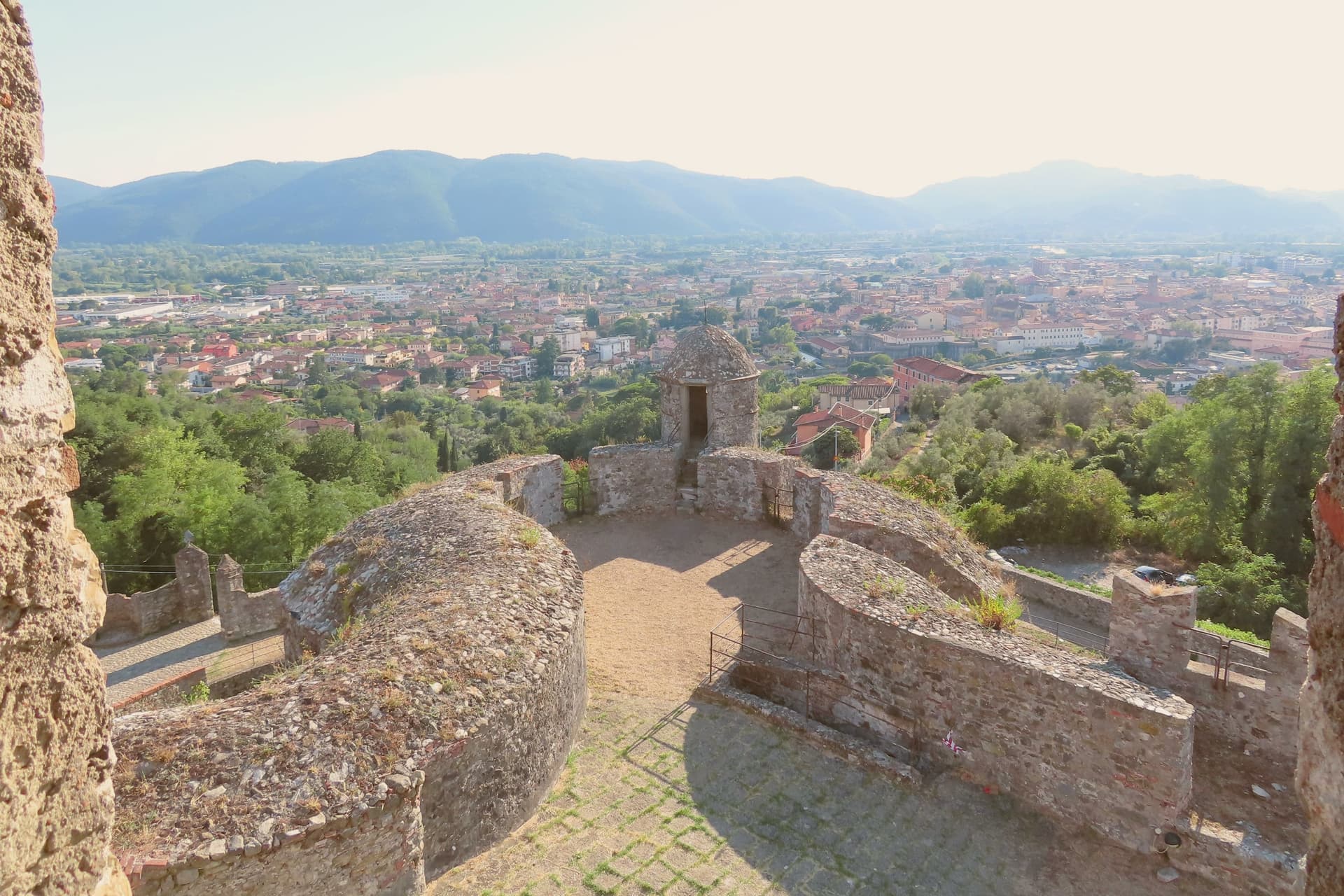
The walled center keeps its grid plan, with Via Mazzini and the cathedral square running through it and the Palazzo Roderio still doing duty as the town hall. Above the town, on a ridge, a second fortress with a triangular plan looks down on the plain and the older one below.
A future pope was born here in 1397. Between the hill fortress from the fourteenth century, the Renaissance rebuilding of the lower cittadella, and a cathedral that changed hands with a diocese, the town's layout reads as a record of who controlled the Magra plain and when.
Pasticceria Gemmi il Loggiato, Il Cardinale Vino e Cucina, Piccolo Ristorante and 1 more have been named by a guide.
What to see in Sarzana
- Fortezza Firmafede. The fortress replaced a medieval cittadella on the same ground. Giuliano da Sangallo's plan survives largely intact, with the bulk and angles of the walls still readable from the approach into town.
- Cattedrale di Santa Maria Assunta. Late Gothic Tuscan cathedral, elevated to minor basilica in 1947. A cardinal born in the town, half-brother to a native-born pope, left his mark on the later additions.
- Croce di Mastro Guglielmo. The cross hangs inside the cathedral it has occupied since the seat moved here. Signed by its maker, it is the object the town's Romanesque reputation rests on.
How to get to Sarzana
There is a railway station in the town, so you can arrive without a car and never need one while you are here. Pisa is roughly 54 minutes away by road.
✷ We have written about Sarzana
“It has the best panorama in Liguria, full stop, and I do not think it is close. The reasons are two. The first is the obvious one. You are 266 meters up, the cliff is high enough that there is no rocky beach below to draw a crowd, the sea on one side is the Gulf of La Spezia with Portovenere across the water and the Cinque Terre fading north, and the view on the other side is the Magra running into its delta with the white Apuane behind it and Tuscany beyond.”
Read our piece on Sarzana →Magra Delta Roadtrip | A Tagine, a Lighthouse, and a Dead Roman City
Our tip
April through June and September into October are the strongest months for the centro storico, with the Festival della Mente filling the squares at the end of August. July and August are hot on the Magra plain, often 32 to 35 degrees; the Fortezza Firmafede holds courtyard concerts in the evenings. The town stays open year-round because it is a working provincial center of 21,650 residents, with daily markets and trains to La Spezia, Pisa, and Parma. Marinella Fish Festival falls in August.
Loano
Why visit Loano
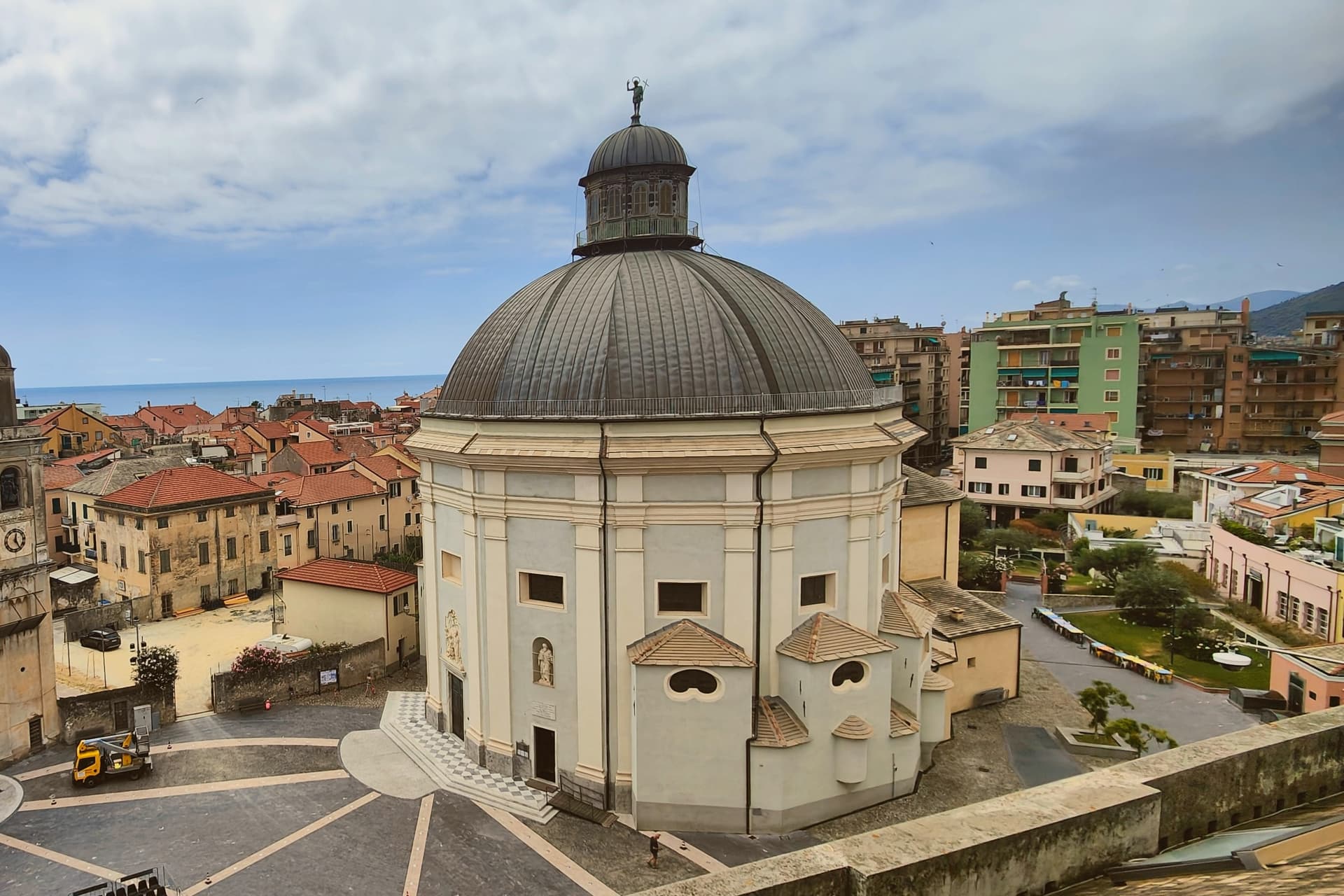
Loano lies sixty kilometers southwest of Genova, at the foot of the arc of mountains that shelters it from inland weather. The town was an imperial fief of the Doria family from the thirteenth century, and the family financed the major public buildings still in use today: the palace at the centro's heart, the loggia beside it where civic business was once conducted, and, indirectly, the church that stands nearer the harbor, built for the town's seafarers and still holding their votive offerings of brigantines and barques.
The old centro, with its palace, loggia and church, sits inland of the modern marina and the two kilometers of beach that run east from it. The mountain at Loano's back and the harbor at its front mark the two poles the town has always worked between: the Doria who governed from the hill and the sailors who prayed by the water.
Bagatto have been named by a guide.
What to see in Loano
- Palazzo Doria. Considered one of the most representative civil Renaissance palaces in Liguria, its rooms now house the town's administrative offices, and the mosaic floor remains open to view on the main level.
- Chiesa di Sant'Agostino. Founded 1582 by Zenobia Del Carretto, rebuilt 1588-98; called the Madonnetta, the seafarers' church, with votive ship models inside.
- Marina di Loano. The Yachting Pages ranking sits alongside a working harbor east of the centro, with the beach running two kilometers of sand and gravel toward it.
How to get to Loano
There is a railway station in the town, so you can arrive without a car and never need one while you are here. Genova is roughly 76 minutes away by road.
Our tip
April through June and September into October are the strongest months on the Loano front, with the marina full of boats and the beach manageable. July and August are warm, often 28 to 31 degrees, and the population doubles with families on long stays from Milano and Torino. November through March is the calmest stretch but the town stays open because 10,700 residents keep daily services running; the Madonnetta opens for the seafarers' mass on 8 December. Sagra di San Pio X e IX Run San Pio falls in August.
Finale Ligure
Why visit Finale Ligure
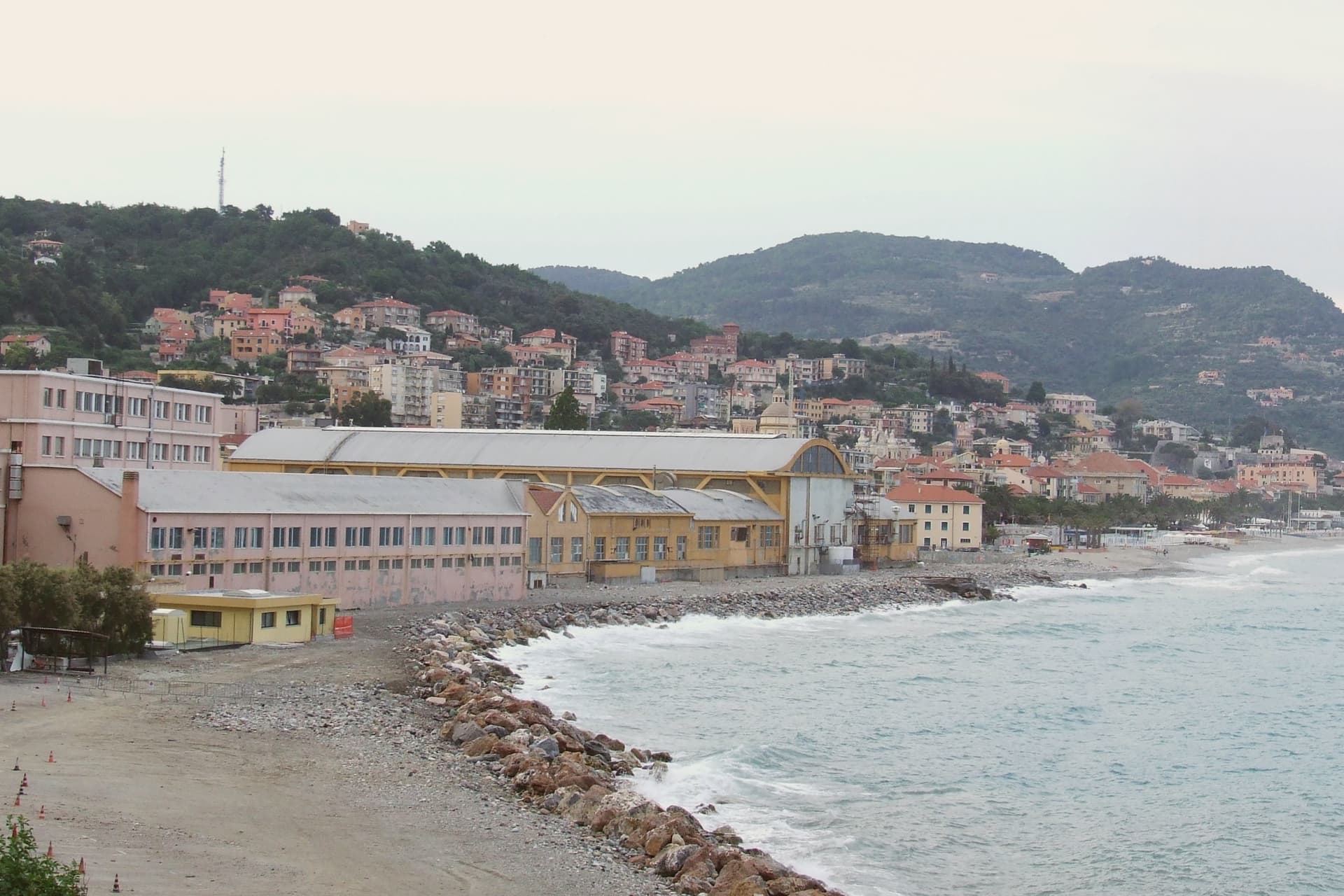
Finale Ligure spans three boroughs and the slope above them: Finalmarina and Finalpia on the coast, the walled inland borough set back at the junction of the Aquila and Pora streams. The two coastal quarters face the water and carry the beachfront trade; the inland borough, built as the seat of the marquisate under the Del Carretto from the late twelfth century onward, kept the family's fortifications and its street plan intact behind the walls rather than along the shore.
The stronghold above the borgo passed through building, wartime destruction, and rebuilding before the Genoese conquest left it largely dismantled in 1715, and the Spanish fort on the ridge above continued to ring the town after that conquest was complete. The coastal stretch below carries the Bandiera Blu and now serves as the starting point for the karst climbing and mountain-biking circuit that has drawn outdoor sport to Finale since the 1990s.
The arrangement is a working division rather than a coincidence: the fortified marquisate seat set inland and upslope, the modern leisure economy running along the water below it.
Ai Torchi, Muraglia - Conchiglia d'Oro, Rosita and 2 more have been named by a guide.
What to see in Finale Ligure
- Castel Gavone. Del Carretto stronghold built by Enrico II in 1181, destroyed in the wars with Genoa, rebuilt in 1451-52 and dismantled by the Genoese in 1715, leaving the diamond-faceted Torre dei Diamanti standing.
- Castel San Giovanni. Seventeenth-century Spanish fort on a higher ridge above Finalborgo, still ringing the walled town.
- Finalborgo. Walled medieval borough at the junction of the Aquila and Pora streams, listed among the Borghi più belli d'Italia.
How to get to Finale Ligure
There is a railway station in the town, so you can arrive without a car and never need one while you are here. Genova is roughly 71 minutes away by road.
Our tip
May through June and September through October are the easy months: warm sea, dry rock for climbing on the karst above the town, mild evenings in Finalborgo. July and August bring summer beach traffic; the coastal road clogs and Finalmarina fills, while Finalborgo two kilometers inland stays calmer. Winter is mild on this exposure and the climbing and mountain-biking seasons continue through it; many international visitors come specifically between November and March for the limestone routes. Ecosagra Delle Melanzane Ripiene falls in August.
Lavagna
Why visit Lavagna
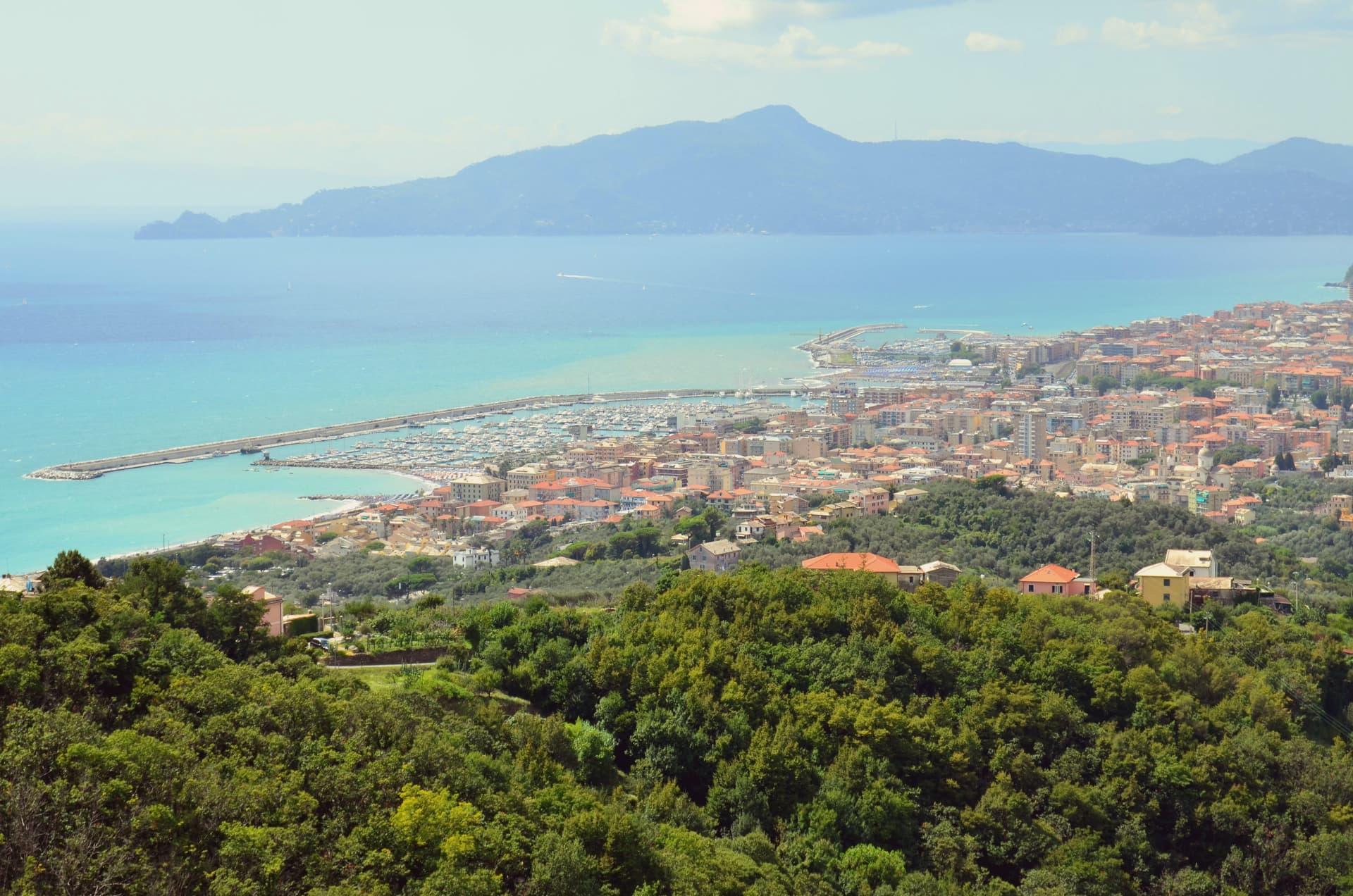
Lavagna sits at sea level on the eastern Tigullio, thirty-five kilometers southeast of Genova. The slate quarried from the San Giacomo mountains behind the town roofed the Genovese palazzi and lined the schoolrooms of half of Italy, which is why the Italian word for chalkboard is also lavagna.
Around the year 1000 the Counts of Lavagna held this territory, and the family that descended from them, the Fieschi, rose from it to produce two popes. The frazione of San Salvatore sits above the main town, holding the basilica that one of those popes ordered built in bands of white marble and slate.
Down at sea level, the old center folds around the staircase and square where, on 14 August, the town reenacts a thirteenth-century wedding with the Torta dei Fieschi, a giant cake carried out to the crowd. The beach holds Bandiera Blu at the opposite edge of town, near the port.
A town built on a stone that traveled far beyond it, and on a family that did the same.
Impronta d'Acqua, Raieü, Aria and 1 more have been named by a guide.
What to see in Lavagna
- Basilica di Santo Stefano. Parish church rebuilt over a sixth-century foundation, crowning the main square at the top of a wide staircase where the annual cake pageant begins its procession.
- Basilica di San Salvatore dei Fieschi. Thirteenth-century basilica in the frazione of San Salvatore, ordered by Pope Innocent IV in 1244, façade in alternating bands of white marble and local slate.
- Spiaggia di Lavagna. Long Bandiera Blu beach on the Tigullio, with one of the largest tourist ports in northern Italy at the western end.
How to get to Lavagna
There is a railway station in the town, so you can arrive without a car and never need one while you are here. Genova is roughly 44 minutes away by road.
Our tip
April through June and September into October are the dry months on the Tigullio. The beach water warms enough for swimming by late May. The 14 August Torta dei Fieschi is the central event of the summer: period costumes, procession from the Basilica di San Salvatore down to Piazza Marconi, and a giant cake distributed to anyone who matches a paired ticket. La Torta dei Fieschi falls in August.
More from Anywhere Italy
 The 10 best hidden beach towns with a food festival in Liguria
 The prettiest villages with a serious restaurant in Liguria
 The best towns inside a nature park that have a serious restaurant in Liguria
 The 9 best towns with a food festival in the province of Savona
 The best towns with a serious restaurant in the province of Genova
- The best towns with a serious restaurant in the province of La Spezia