
The best small olive oil towns within 90 minutes of Perugia
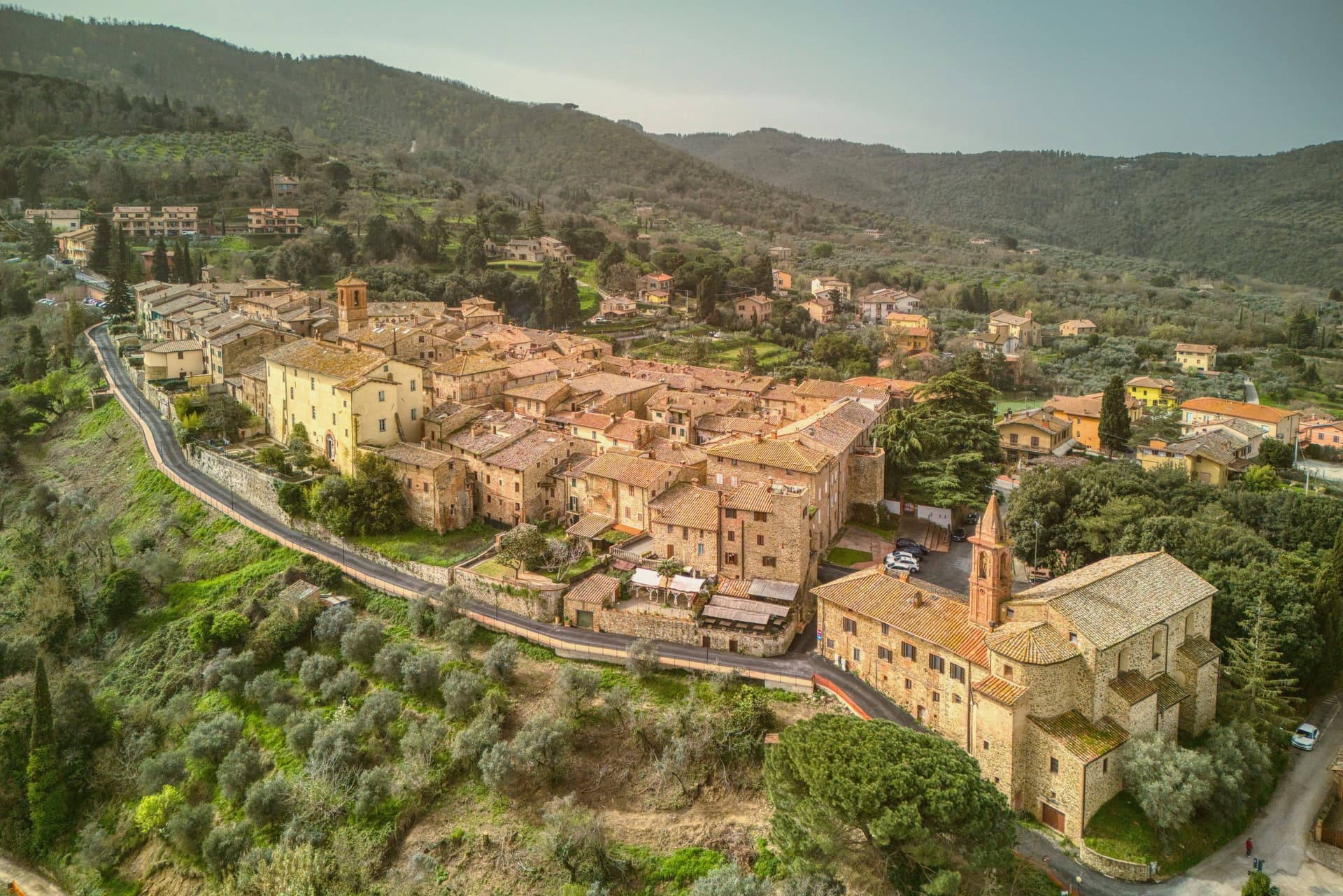
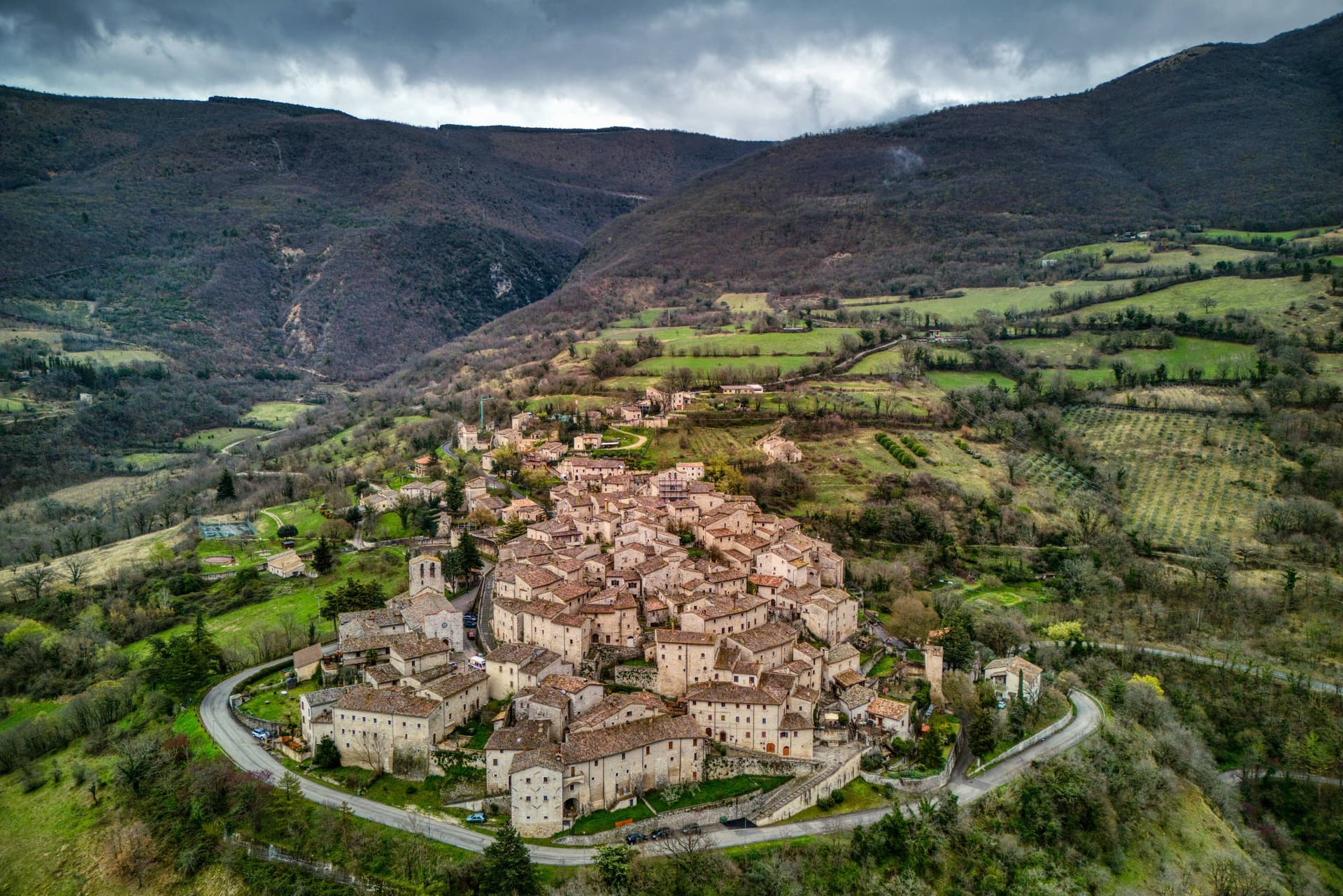
The olive belt around Perugia runs across low limestone hills, and in autumn the nets go down under trees that have been worked for centuries. The new oil comes out of the mill cloudy and green, tasting of artichoke and black pepper, and the local kitchens do very little to it: bruschetta rubbed with garlic, a bowl of chickpeas, grilled pigeon, torta al testo split and dressed. Houses here are built from the same pale stone and dusty brick as the terrace walls, which is why the villages look grown rather than placed. Late October into November is the season, when the frantoi run day and night and the air near them smells of crushed fruit.
Most visitors to this part of Italy give their days to Assisi, and the basilica earns the coach parks it has acquired. The town is walkable in an afternoon, sits close to the motorway and the railway, and appears on every Umbrian itinerary sold abroad, so its main street carries a steady load from spring to autumn. Nothing about that is a scandal. It simply means the crowd concentrates in one place while the hills beyond it stay quiet.
The olive groves do not stop at the edge of the famous towns. They carry on west into the Trasimeno hills and across the Tuscan border into the Val di Chiana and the Val d'Orcia, and the smaller places along that line take their oil seriously enough to have joined the national association of olive-oil towns. These are the villages in this list, each within a comfortable drive of Perugia, each with a mill or a producer worth stopping for.
Of the 41 communes we have mapped within 90 minutes of Perugia, 18 qualify as olive oil towns: each belongs to the national association of olive-oil towns. This list is the small ones, 7 in all, ordered smallest first. The smallest, Paciano, has 957 residents.
Two more lists worth reading alongside this one: The prettiest small villages within 90 minutes of Perugia and The best olive oil towns with a medieval festival within 90 minutes of Perugia.
Paciano
Why visit Paciano
The town is first documented in 917, in an imperial charter of Berengar I, and appears again in 1260 as a castrum, a fortified site. Perugia rebuilt the walls and main tower between 1461 and 1473, using the site as a watch-post over the western approach to the lake below.
Inside the circuit, three parallel streets are linked by orthogonal alleys, a layout that carries the Renaissance palace with the Vignola staircase, the oldest noble residence in the town, and the 17th-century Palazzo Cennini, once the summer residence of a cardinal. The gates and towers sit at the edge of this grid, facing outward toward the water.
Olive oil from the slopes that drop toward the shore is the present-day specialty. What remains is a small fortified grid, built to watch a lake, that turned its military purpose into a domestic one once the watching was no longer needed.
What to see in Paciano
- Medieval walls. About 600 meters of circuit, with the three original gates named Fiorentina, Perugina and Rastrella still standing among the eight towers.
- Palazzo Baldeschi. Assembled from earlier tower houses, with a staircase attributed to Jacopo Barozzi da Vignola. Now used as an exhibition and cultural space.
- Rocca Buitoni. The oldest surviving palace in the town, built as a noble residence inside the walls, with a small private chapel.
How to get to Paciano
Perugia is roughly 44 minutes away by road.
Our tip
April through June and September into October are the months for Paciano. The slopes of Monte Petrarvella hold the wildflowers, Trasimeno is warm enough to swim from late May, and the olive groves run from green to silver-gold across the half-year. The Infiorata fills the three parallel streets each Corpus Domini in late May or June. Sagra dello Strozzaprete falls in August.
Trequanda
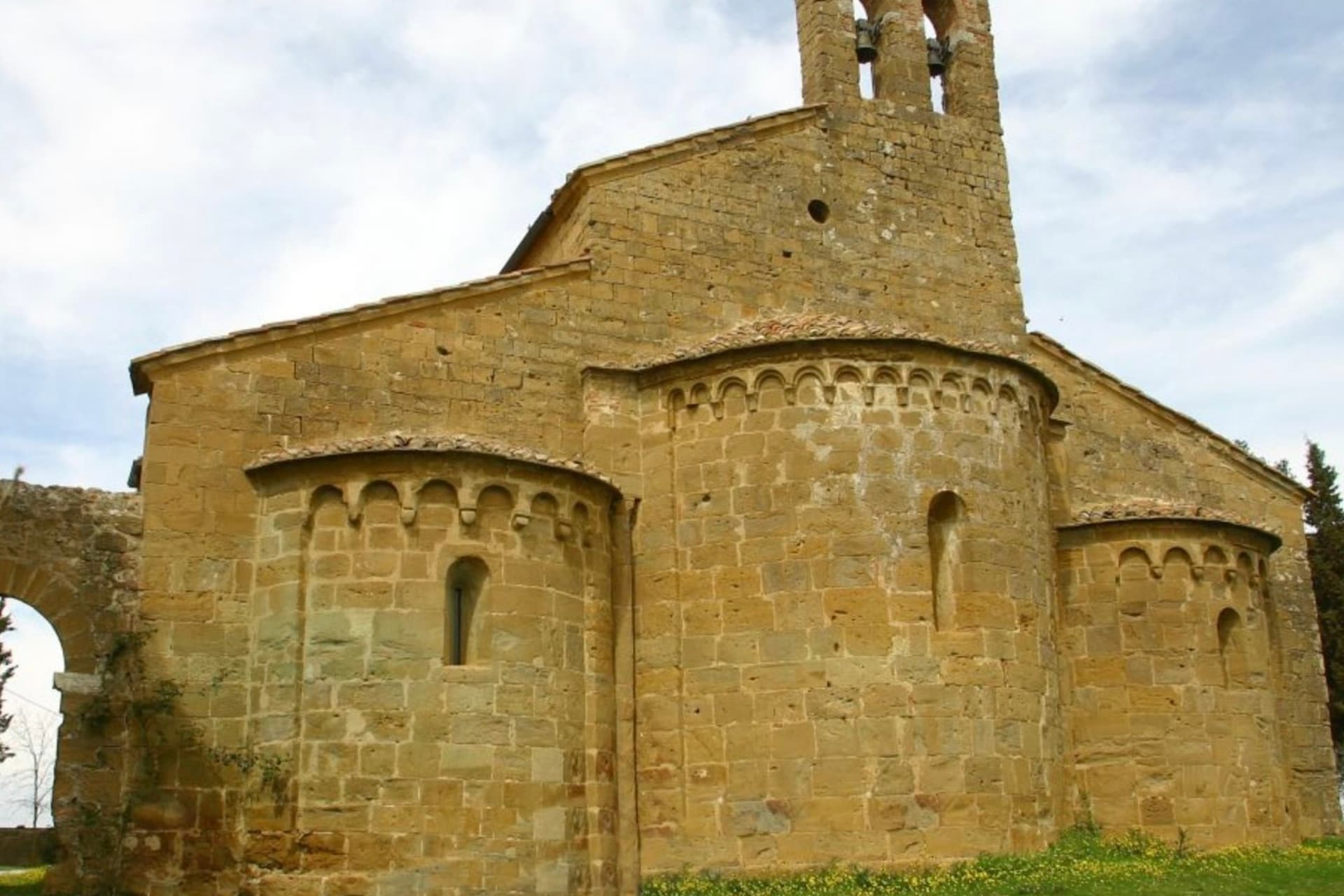
Why visit Trequanda
Trequanda is three villages in one comune: Trequanda itself at 453 meters, Castelmuzio, and Petroio at 486 meters, scattered across the hills southeast of Siena. The first written record dates to 1198, when the Cacciaconti of Scialenga held it as fief; in 1211 Emperor Otto IV gave them the right to collect tolls.
In 1553 the village was among the first to be annexed to the Grand Duchy of Tuscany. The Cacciaconti castle still anchors the centro storico, the Pieve dei Santi Pietro e Andrea next to it, built from 1327 in a Gothic-Romanesque mix and renovated in the Renaissance.
Petroio has produced fine ornamental terracotta since the early sixteenth century: lions and dogs and pineapples and chimney pots, the surface of half the gardens in central Tuscany. The municipality holds the Orange Flag from the Italian Touring Club and was inscribed in 2018 in the national register of historic rural landscapes.
Il Conte Matto, Fattoria del Colle have been named by a guide.
What to see in Trequanda
- Castello dei Cacciaconti. Medieval fortress at the center of Trequanda, seat of the Cacciaconti di Scialenga from the twelfth century.
- Pieve dei Santi Pietro e Andrea. Gothic-Romanesque parish church begun in 1327, expanded in the Renaissance, holding a fresco attributed to Sodoma.
- Castelmuzio. Walled hilltop frazione between Trequanda and Pienza, on the rural landscape register, the smallest of the three borghi.
How to get to Trequanda
There is a railway station in the town, so you can arrive without a car and never need one while you are here. Perugia is roughly 70 minutes away by road.
Our tip
April through June brings the green months across the Crete Senesi, the clay hills holding their color before the summer burn. September and October are dry and gold, the olive harvest running through November in the Petroio and Castelmuzio frantoi. July and August touch thirty-six degrees and the three borghi go quiet between four and seven in the afternoon. Festa dell'Olio Novo falls in the season.
San Casciano dei Bagni
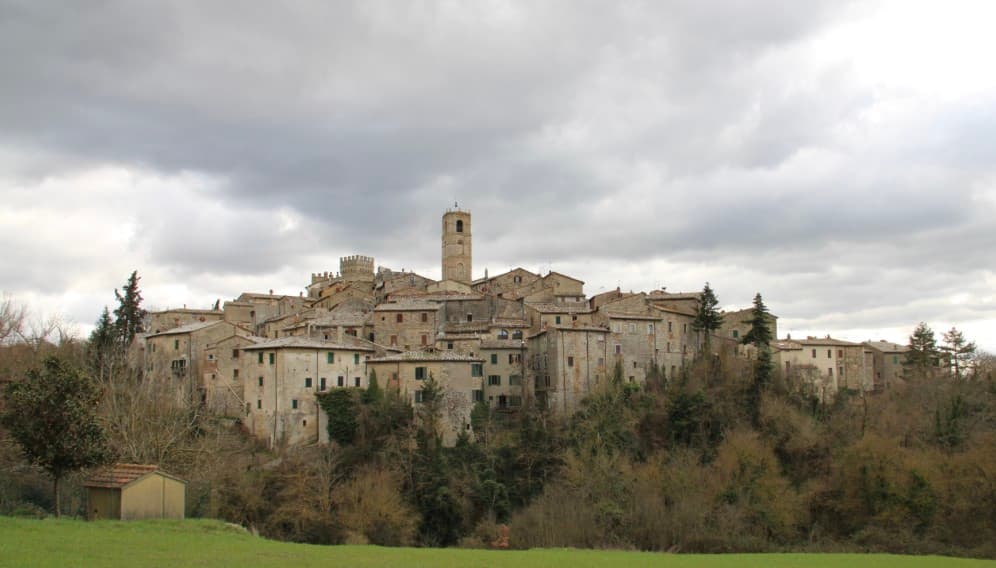
Why visit San Casciano dei Bagni
San Casciano dei Bagni sits at 582 meters at the southern edge of the province of Siena, above 42 hot springs that average 42 degrees Celsius. The baths were used continuously from Etruscan through Roman times and again from the Renaissance, when visitors came from across Europe.
In 2022, an excavation that began in 2019 at the ancient sanctuary turned up 24 bronze votive statues protected by mud, with around 6,000 coins in gold, silver and bronze. The find was the largest of its kind in fifty years; most surviving Etruscan votive material is terracotta.
The 1,500 residents live on a basalt outcrop above the Roman thermal complex, in a centro storico of stone houses and three small churches. The borgo joined the Borghi più belli network in 2014 and remains one of the smallest communes in Toscana to carry both that label and Bandiera Arancione.
Daniela, Castello di Fighine have been named by a guide.
What to see in San Casciano dei Bagni
- Santuario Ritrovato. Etruscan-Roman thermal sanctuary excavated since 2019, where 24 bronze votives and around 6,000 coins were recovered in 2022.
- Bagno Grande. The principal natural pool of the 42 hot springs, used from the second century BC through the Renaissance and reopened to the public.
- Collegiata di San Leonardo. Romanesque parish church in the centro storico, restored in the seventeenth century, with a baptismal font carved from local travertine.
How to get to San Casciano dei Bagni
Perugia is roughly 68 minutes away by road.
Our tip
The thermal pools make the calendar different here. Winter is the season many visitors prefer, when the 42-degree water steams against cold air and snow occasionally dusts the basalt outcrop. April through June and September into October are the most balanced months: warm hill light, the dry-stone walls of the borgo at their best, the sanctuary excavations open to guided tours. Sagra del Ciaffagnone di San Casciano dei Bagni falls in June.
Cetona
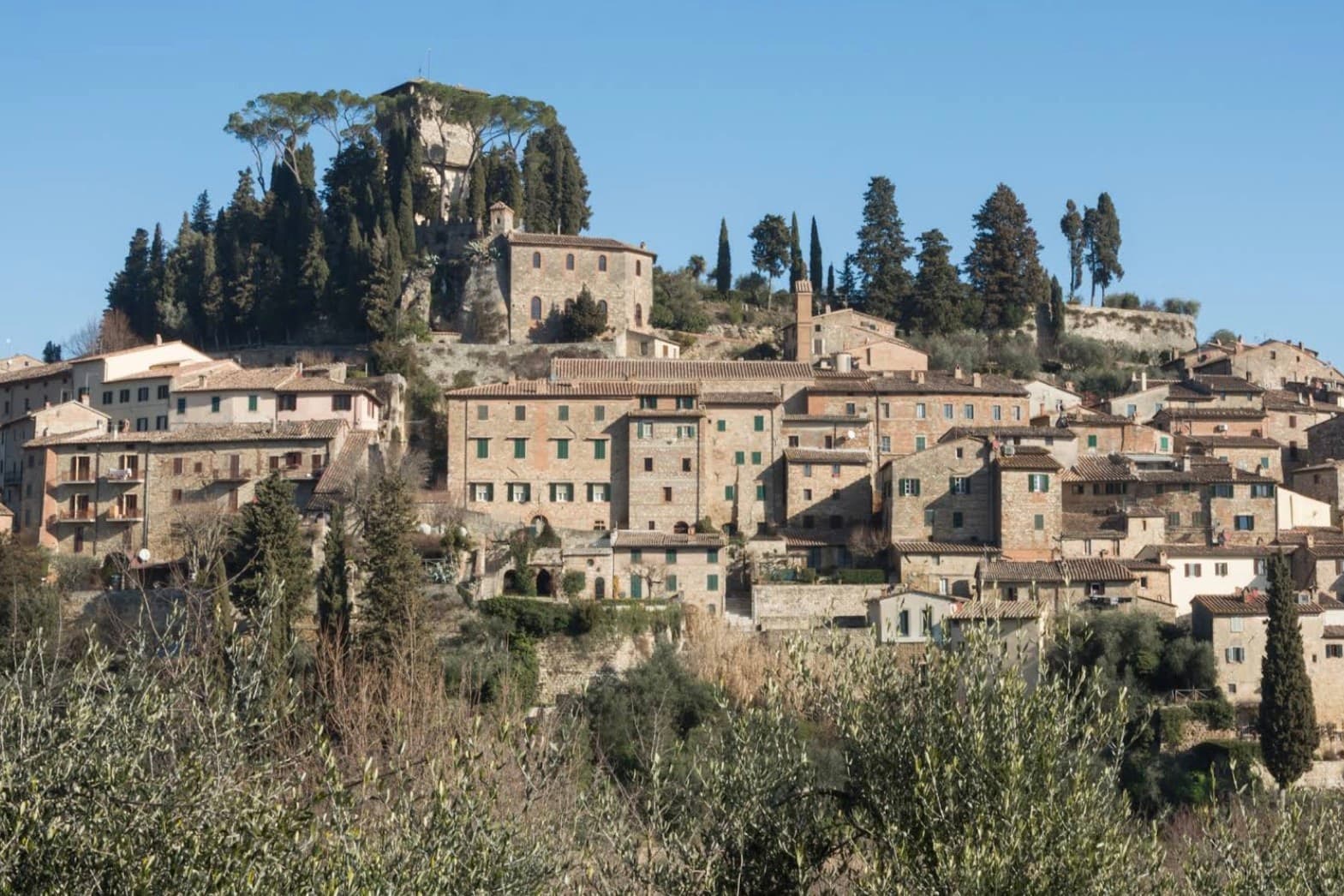
Why visit Cetona
The town sits on the western flank of a ridge at the meeting point of Toscana, Umbria and Lazio, where the mountain divides the Val d'Orcia from the Val di Chiana. The medieval comune passed between Siena, Orvieto and Perugia before falling to Siena in the late fourteenth century, and it was Cosimo I who later sold it whole to a marchese.
The fortress at the top of the grid and the square laid out below it are two halves of the same Renaissance move: a private residence replacing a garrison at the summit, a flat civic stage opened up at the base. Above the town, in the woods, the hermitage and the caves belong to a much older layer, human use of the mountain reaching back to the Mesolithic, long before any comune or marchese laid claim to it.
What the town adds up to is a settlement built in tiers: a prehistoric mountain, a contested medieval center, and a Renaissance overlay that reorganized the base of the hill without touching what stood above it.
Da Nilo, Il Tiglio di Piazza da Nilo have been named by a guide.
What to see in Cetona
- Piazza Garibaldi. Elliptical square at the foot of the medieval grid, flat and open where the streets above it climb steeply. The civic stage of the borgo, still the first thing that orients a visitor.
- Rocca di Cetona. Fortress at the top of the centro storico, its walls and keep still standing though the interior became a private residence rather than a garrison.
- Convento di San Francesco. Franciscan convent below the borgo, founded in 1212, with a single-nave church and a small cloister still in religious use.
How to get to Cetona
Perugia is roughly 78 minutes away by road.
Our tip
April through June and September into October are the months Cetona keeps its calmest pace, the wooded slopes of Monte Cetona green or rust depending on the half. July and August are hot in the centro storico but the mountain trails above 800 meters stay cool. The Mostra del Tartufo, dedicated to the local white truffles, runs the second weekend of November in Piazza Garibaldi. Sagra del Bico di Cetona falls in June.
Lucignano
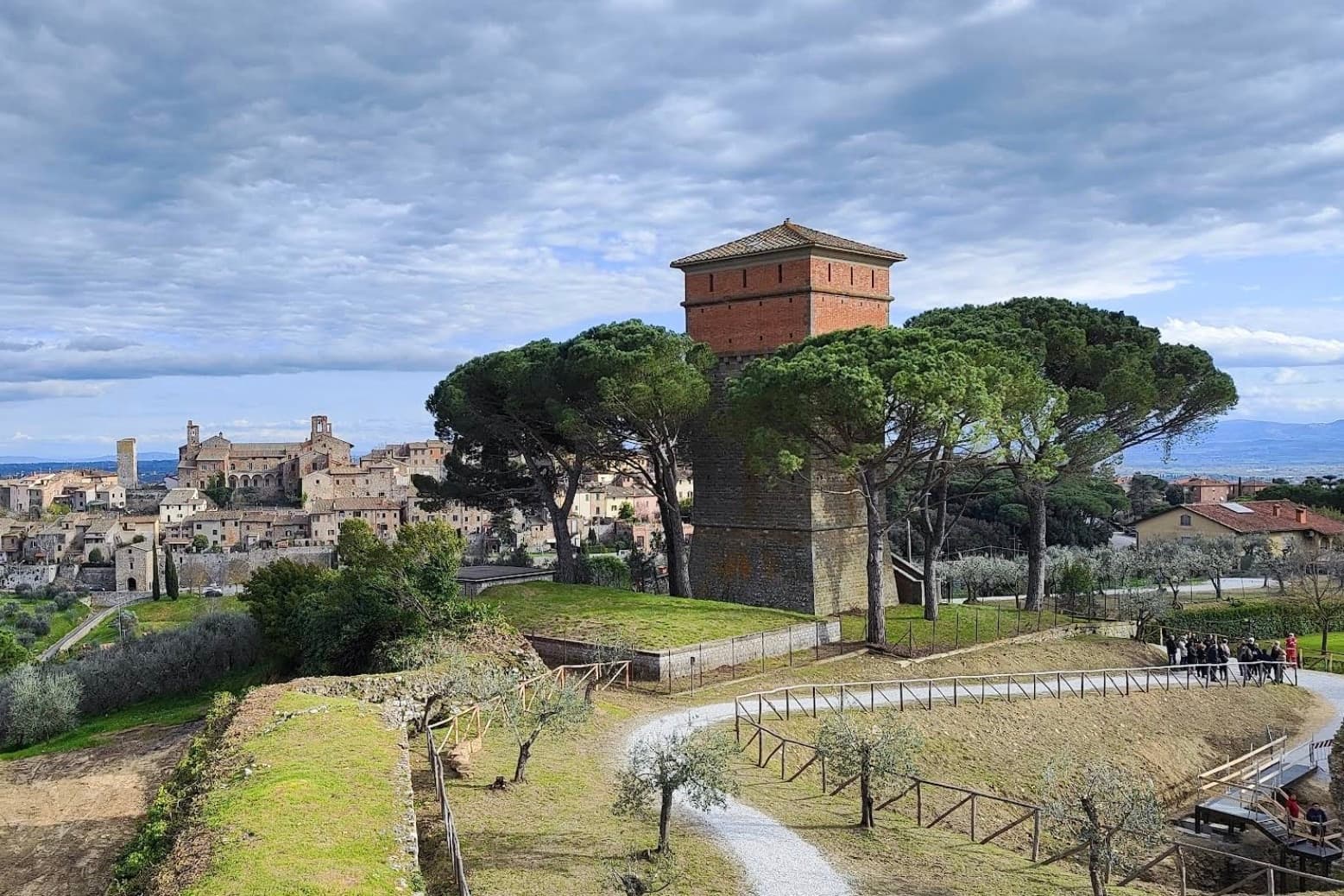
Why visit Lucignano
Lucignano sits at 400 meters on a hill in the Valdichiana, halfway between Siena and Arezzo, built on a tight elliptical plan of four concentric rings of streets. Its position made it one of the most contested settlements of medieval Toscana: Siena, Arezzo, Florence and Perugia all fought over it between 1200 and 1500.
The current walls and three gates date to a Sienese reconstruction of 1371. In the Museo Civico inside the Palazzo Comunale stands the Albero d'Oro, a 260-centimeter Gothic gold-and-coral reliquary in the shape of a tree, begun by Ugolino di Vieri in 1350 and finished by Gabriello d'Antonio in 1471.
Local tradition turned it into the Albero dell'Amore, a marriage charm. The Collegiata di San Michele Arcangelo dominates the highest ring of the borgo, and the elliptical plan is best read from the air, which is why drone footage of Lucignano keeps appearing in articles about medieval Tuscan urbanism.
What to see in Lucignano
- Albero d'Oro. 260-cm Gothic reliquary in the shape of a tree, gold, coral and enamel, begun by Ugolino di Vieri in 1350 and completed by Gabriello d'Antonio in 1471.
- Centro storico ellittico. Four concentric rings of streets inside elliptical walls, the most complete example of medieval Tuscan elliptical town planning.
- Collegiata di San Michele Arcangelo. Eighteenth-century church on the highest ring of the borgo, with a Vasari façade adjustment and a baroque organ inside the medieval shell.
How to get to Lucignano
There is a railway station in the town, so you can arrive without a car and never need one while you are here. Perugia is roughly 65 minutes away by road.
Our tip
April through June and September into October are the months Lucignano keeps its balance, the Valdichiana green or gold depending on the half and the centro storico cool inside its elliptical walls. The Maggiolata, a flower festival between the four quarters of the borgo, runs across the last two Sundays of May. July and August push the valley past thirty and the centro storico thins after lunch. Sagra della Filiera del Tartufo Marzuolo falls in March.
Bettona
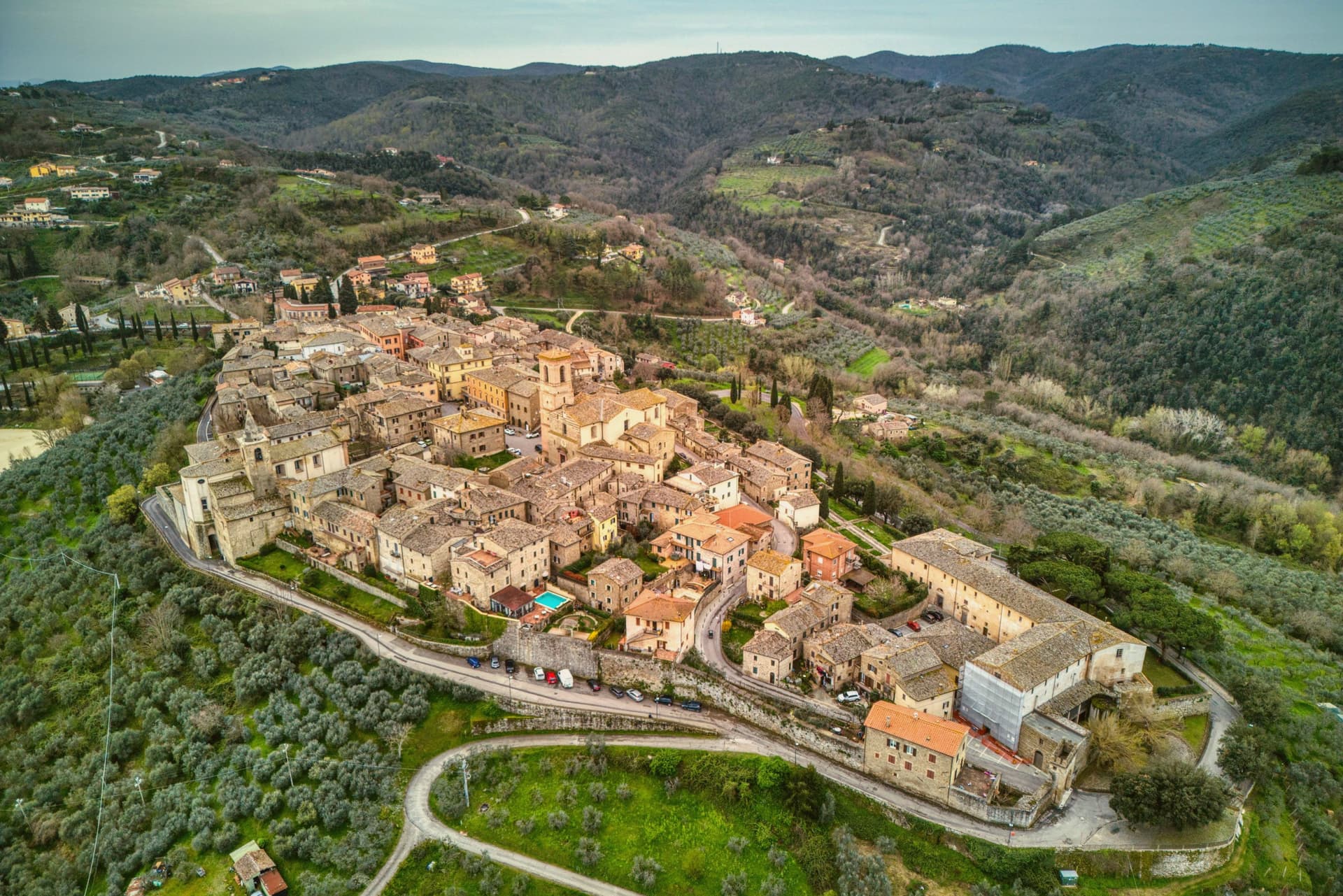
Why visit Bettona
Bettona sits at 353 meters on a hill north of the Colli Martani, looking across the cultivated plain toward Perugia. The Etruscans built here in the seventh century BC, and Bettona remains the only known Etruscan settlement east of the Tiber.
Stretches of polygonal walls from that period are still visible at the base of the medieval circuit, mixed with later Roman blocks. The town became a municipium under Augustus, declined during the barbarian invasions, was sacked by Totila in 548, and rebuilt as a self-governing commune by the late twelfth century.
Papal rule held from 1648 to unification. The Pinacoteca Civica, housed in the Palazzetto del Podestà on Piazza Cavour, keeps two paintings by Pietro Perugino (Sant'Antonio da Padova and Madonna della Misericordia), tabernacle panels attributed to El Greco, and Etruscan funerary stones and architectural terracottas from the territory.
The olive groves below town carry the Città dell'Olio designation.
What to see in Bettona
- Mura etrusche. Stretches of polygonal Etruscan walls visible at the base of the medieval circuit, from the seventh and sixth centuries BC.
- Pinacoteca Civica. Civic art gallery in the Palazzetto del Podestà holding two Perugino paintings, tablets attributed to El Greco and Etruscan finds.
- Chiesa di Santa Maria Maggiore. Main parish church on Piazza Cavour, with a reordered interior holding altarpieces and a Crocifissione fresco.
How to get to Bettona
Perugia is roughly 27 minutes away by road.
Our tip
April through June and September into October are the windows that work. The olive harvest runs from late October through November and gives the town its working rhythm, with the frantoi pressing into the evening. July and August are dry and hot; the centro storico is small enough that midday empties it. Sagra dell'Oca falls in July.
Bevagna
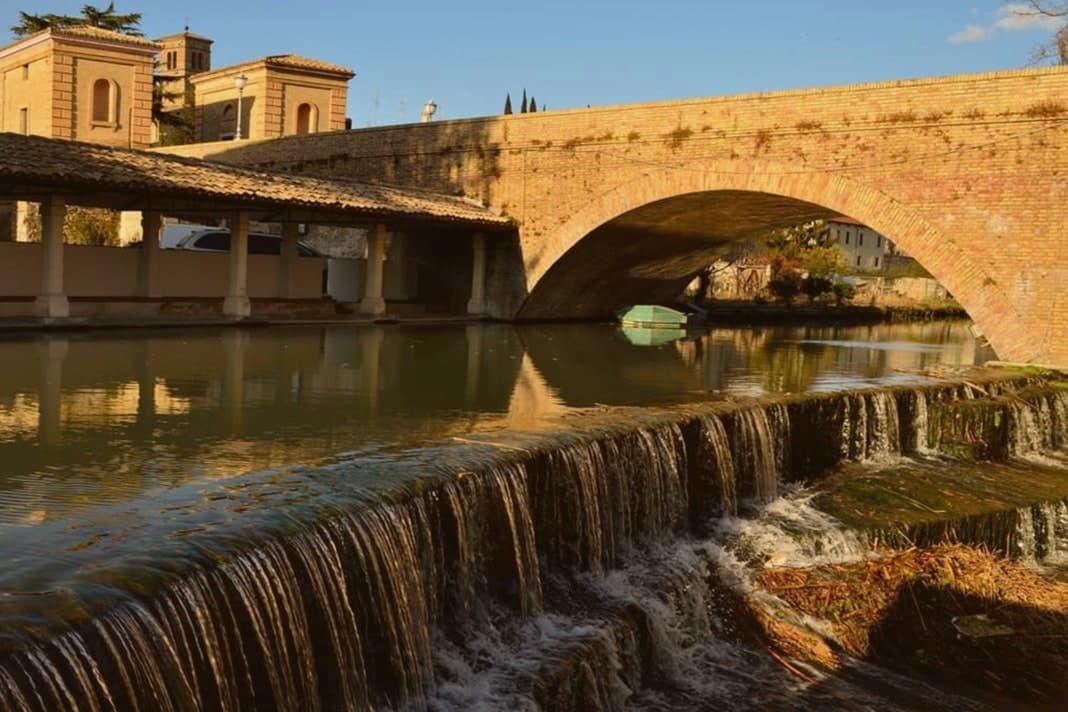
Why visit Bevagna
Bevagna sits on the floor of the Umbrian valley at 225 meters, where the Clitunno meets the Timia. Ancient Mevania, the name means she who stands in the middle, was a Roman mansio on the Via Flaminia, listed in the Antonine Itinerary.
A black-and-white mosaic of the 2nd century AD survives almost intact in the frigidarium of the Roman baths, twelve meters by seven, octopuses and dolphins in the center, tritons and sea-horses on the short sides. Piazza Silvestri at the heart of the centro storico holds two Romanesque churches that face each other at odd angles, San Michele Arcangelo and San Silvestro, built within years of each other in the late 12th century.
The Mercato delle Gaite each June turns the town into the year 1300 for ten days, four quarters competing on medieval trades and tavern menus, no anachronisms allowed. The Sagrantino slopes of Montefalco are nine kilometers up the road.
Serpillo, Ottavi Mare have been named by a guide.
What to see in Bevagna
- Piazza Silvestri. Twelfth-century civic square ringed by the Palazzo dei Consoli, the churches of San Silvestro and San Michele, and the fountain of 1896.
- Chiesa di San Michele Arcangelo. Romanesque collegiate church built by Binello and Rodolfo at the end of the 12th century, on the main square.
- Chiesa di San Silvestro. Romanesque parish church across the piazza, signed and dated 1195 by Binello, the same builder as San Michele.
How to get to Bevagna
Perugia is roughly 39 minutes away by road.
Our tip
April through June and September into October are the months for Bevagna. The valley fills with green, the Sagrantino vines run on the slopes above town, and the rose festival fills the gardens around the walls in May. The Mercato delle Gaite runs the second half of June and is the single most concentrated weekend on the Umbrian medieval calendar. Sagra della Lumaca falls in August.
More from Anywhere Italy
- The prettiest small villages within 90 minutes of Perugia
- The best olive oil towns with a medieval festival within 90 minutes of Perugia
- The best olive oil towns with a serious restaurant within 90 minutes of Perugia
 The best hidden hill towns with a food festival within 90 minutes of Perugia
- The prettiest villages with a food festival within 90 minutes of Perugia
 The best small olive oil towns in the province of Perugia