
The 6 best small hill towns that eat well in Marche
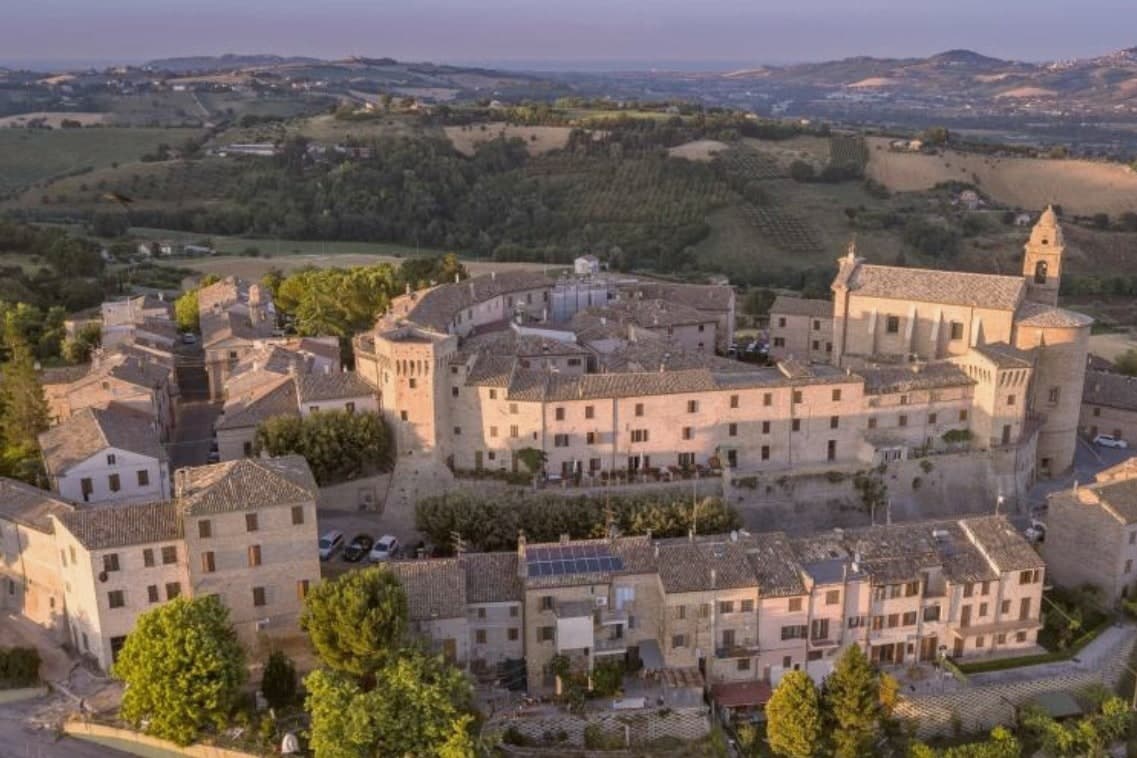
Marche away from the sea is brick and sandstone, ridges of it, each hill carrying a walled town with a piazza at the top and olive terraces falling away beneath. The food is heavy in the good sense: vincisgrassi layered with offal and béchamel, olive ascolane fried until the crust cracks, rabbit in porchetta, ciauscolo soft enough to spread on bread. Autumn brings the black truffle down from the Metauro valley and the new Verdicchio into the cellars, which is when the inland restaurants fill with people who drove up from the coast for lunch and stayed for dinner. Winter is cold and clear here, and the dining rooms are small, wood-panelled and booked out on Sundays.
The Marche most visitors see is the Conero riviera and Urbino, the ducal palace and the beaches at Sirolo and Numana, and both deserve the traffic they get. In July and August the coast road is solid, the Conero car parks fill early, and Urbino's steep lanes carry more coach groups than the town was built for. It is a fine day out. It is also the version of the region that every itinerary already includes.
The same hills, the same truffle woods and the same Verdicchio slopes carry on inland past all of it, and that is where these towns are. They are small, they sit above the valleys rather than on the sea, and a dining guide has named a table in each one. Fewer people make the drive, which mostly means it is easier to get a seat.
Of the 63 communes we have mapped in Marche, 17 qualify as hill towns that eat well: each is an inland hill settlement, and a dining guide has named a table in each. This list is the small ones, 6 in all, ordered smallest first. The smallest, Magliano di Tenna, has 1,414 residents.
Two more lists worth reading alongside this one: The best small towns that eat well in Marche and The 10 best hill towns that eat well within 90 minutes of Ancona.
Magliano di Tenna
Why visit Magliano di Tenna
Magliano di Tenna sits at 281 meters on a low hill above the Tenna river in the province of Fermo, eleven kilometers inland from the provincial capital. The castle is first documented in 1030.
Tradition gives the foundation to a captain of fortune named Malleano or Majano around the year 1000, from whom the town took its name. By the late Middle Ages Magliano belonged to Fermo as Castrum Ultra Tomiam, an outpost on the south bank of the river.
The circular fourteenth-century walls still run almost completely around the borgo. Of the original six towers, two remain visible: Porta da Bora at the northwest, the main gate and the largest tower, now a private residence, and the Torre da Sole on the south side.
The double-faced houses along the perimeter follow the line of the walls and open onto narrow inner alleys. The commune joined the Borghi Autentici d'Italia for the preserved medieval geometry.
Osteria dell'Arco have been named by a guide.
What to see in Magliano di Tenna
- Porta da Bora. The largest of the original six towers and main northwestern gate to the borgo, now a private residence preserving its medieval profile.
- Torre da Sole. Southern tower on the perimeter walls, connected to Porta da Bora by surviving sections of fourteenth-century stonework.
- Mura medievali. Fourteenth-century walls running in a circular line around the borgo, once defended by six towers and a moat now filled in.
How to get to Magliano di Tenna
Ancona is roughly 66 minutes away by road.
Our tip
April through October is the working season for Magliano di Tenna. The Tenna valley turns green from April, the perimeter walls and the two surviving towers are walkable through the warm months, and the surrounding hills toward Fermo and Servigliano open to slow walks. July and August touch the low thirties in the valley; the borgo at 281 meters stays a few degrees cooler than the river bed below.
Staffolo
Why visit Staffolo
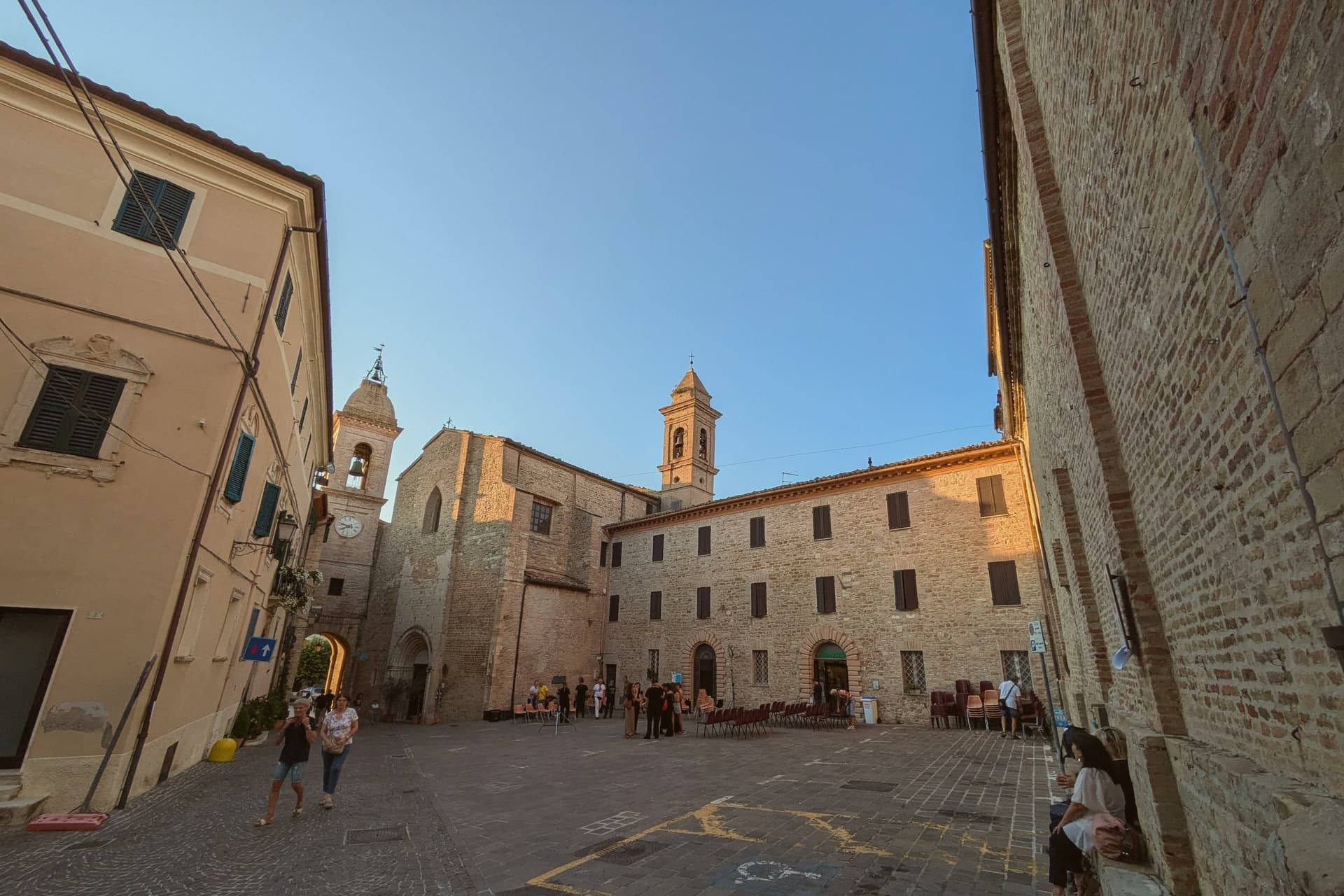
Staffolo rises to 442 meters on a hill between the Esino, Misa and Musone valleys, thirty-five kilometers from Ancona. The town calls itself the Balcone della Vallesina for the panoramic ridge it stands on, and Colle del Verdicchio for the vines that cover the south-facing slopes around it.
Verdicchio cultivation here is documented from 1569; the surrounding Castelli di Jesi DOCG zone draws from south-facing parcels between 220 and 500 meters of altitude. The centro storico is almost circular, walled with partly original ramparts and entered through two opposing gates; the fourteenth-century Albornoz tower rises above the walls.
The Museo dell'Arte del Vino, carved into rooms inside the walls themselves, holds an oak press from 1695 and the working tools of the local cellars, with an enoteca attached. Three churches anchor the village: Sant'Egidio with a fifteenth-century Master of Staffolo polyptych, San Francesco with a 1769 Callido organ, and the baroque Santa Maria di Castellaretta built by survivors of the Battle of Lepanto.
Osteria Vino e Cucina have been named by a guide.
What to see in Staffolo
- Centro storico. Almost circular walled medieval nucleus with partly original ramparts, two opposing gates and the fourteenth-century Torre Albornoz rising above the circuit.
- Museo dell'Arte del Vino. Wine museum carved into rooms inside the walls themselves, holding an oak grape press from 1695 and the working tools of the Staffolo cellars, with attached enoteca.
- Chiesa di Sant'Egidio. Parish church on the ridge, holding a fifteenth-century polyptych by the anonymous Master of Staffolo of the Fabrianese school.
How to get to Staffolo
Ancona is roughly 42 minutes away by road.
Our tip
April through June and September into October are the best months for Staffolo. The ridge stays cooler than the valleys below, the vineyards turn green by April and gold from late September, and the views to the Adriatic and the Apennines run cleanest in the dry weeks. July and August can touch the high twenties at 442 meters, but the breeze along the Vallesina ridge moves through town most afternoons. Verdicchio Festival falls in August.
Mondavio
Why visit Mondavio
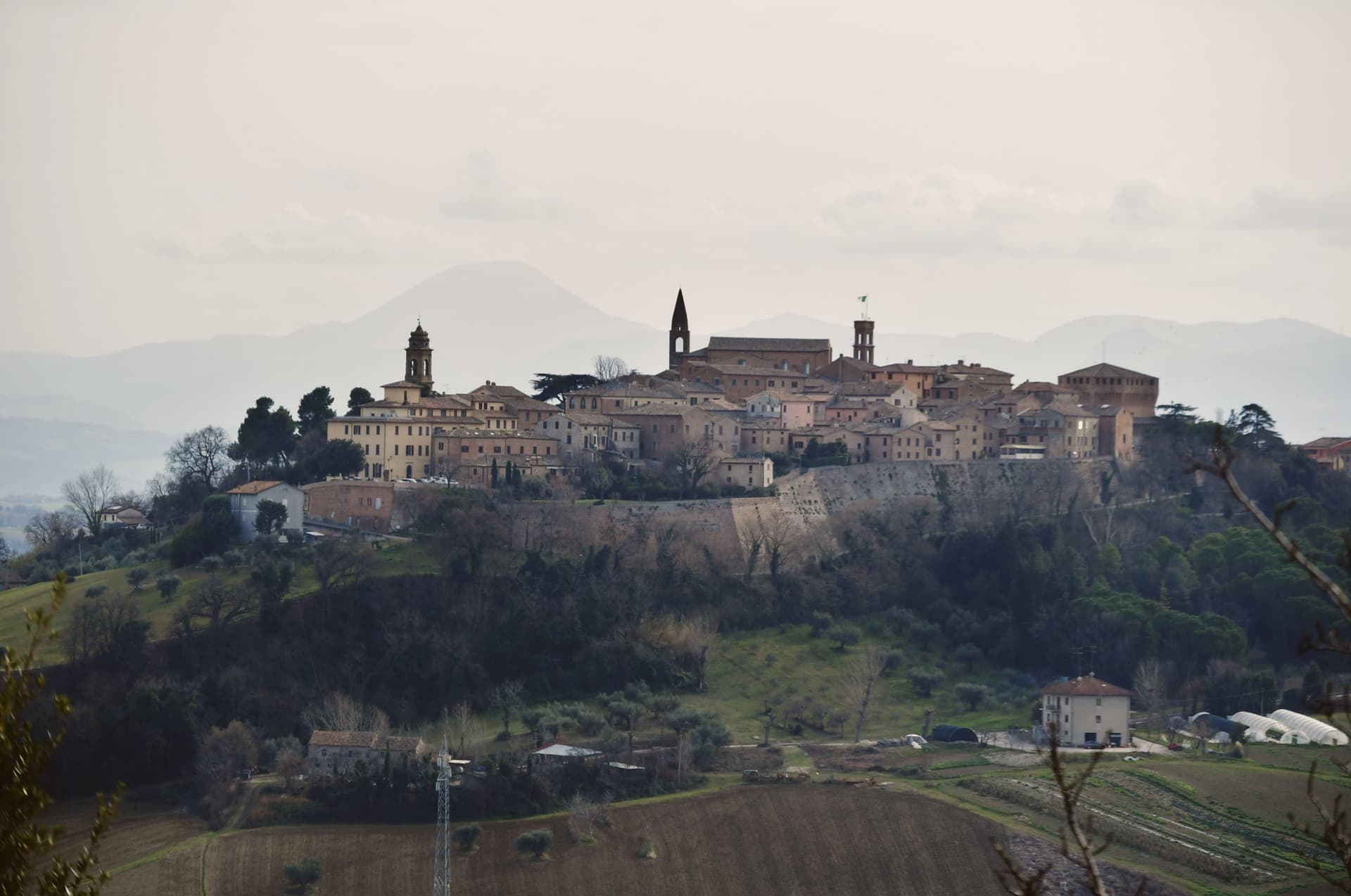
Mondavio sits at 280 meters on a hill between the Cesano and the Metauro rivers, twenty kilometers inland from Senigallia. The fortress at its center was built over an earlier medieval structure, and its patron used the commission to test a new kind of defensive geometry: an octagonal keep on a wide base of trapezoidal walls that incline outward in a helical line, with sightlines arranged so attackers could not aim straight at the walls.
The fortress was never attacked. Both the patron and the architect died in 1501, and the building remained slightly short of the original plan.
The town's walled core still gathers around that fortress, entered through two surviving gates and threaded with stone lanes that open onto the central piazza and the Palazzo Comunale. The Festa del Duca in August fills those same streets with costumed jousting and crossbow trials, a fair echo of the military purpose the walls were built for.
What the geometry was designed to prevent, an attack that never came, is now what the town preserves and re-enacts each summer.
Al Giardino da Giamburesti, Maria have been named by a guide.
What to see in Mondavio
- Rocca Roveresca. Commissioned by Giovanni della Rovere from Francesco di Giorgio Martini, built 1482-1492, octagonal keep on inclined trapezoidal walls designed to deflect cannon fire.
- Museo di Rievocazione Storica. Inside the Rocca, presents life in a Renaissance fortress with reconstructed armory, kitchen, prison and ballista chamber.
- Teatro Apollo. Eighteenth-century theatre at the heart of the borgo, all wood, with a horseshoe plan and four orders of boxes.
How to get to Mondavio
Ancona is roughly 61 minutes away by road.
Our tip
April through October is the working window for Mondavio. The hills between the Cesano and the Metauro turn green from April, the Rocca and the Teatro Apollo are open every day, and the surrounding olive and grain country opens for slow walks. The Festa del Duca in mid-August fills the streets with costumed jousting and crossbow trials.
Ripatransone
Why visit Ripatransone
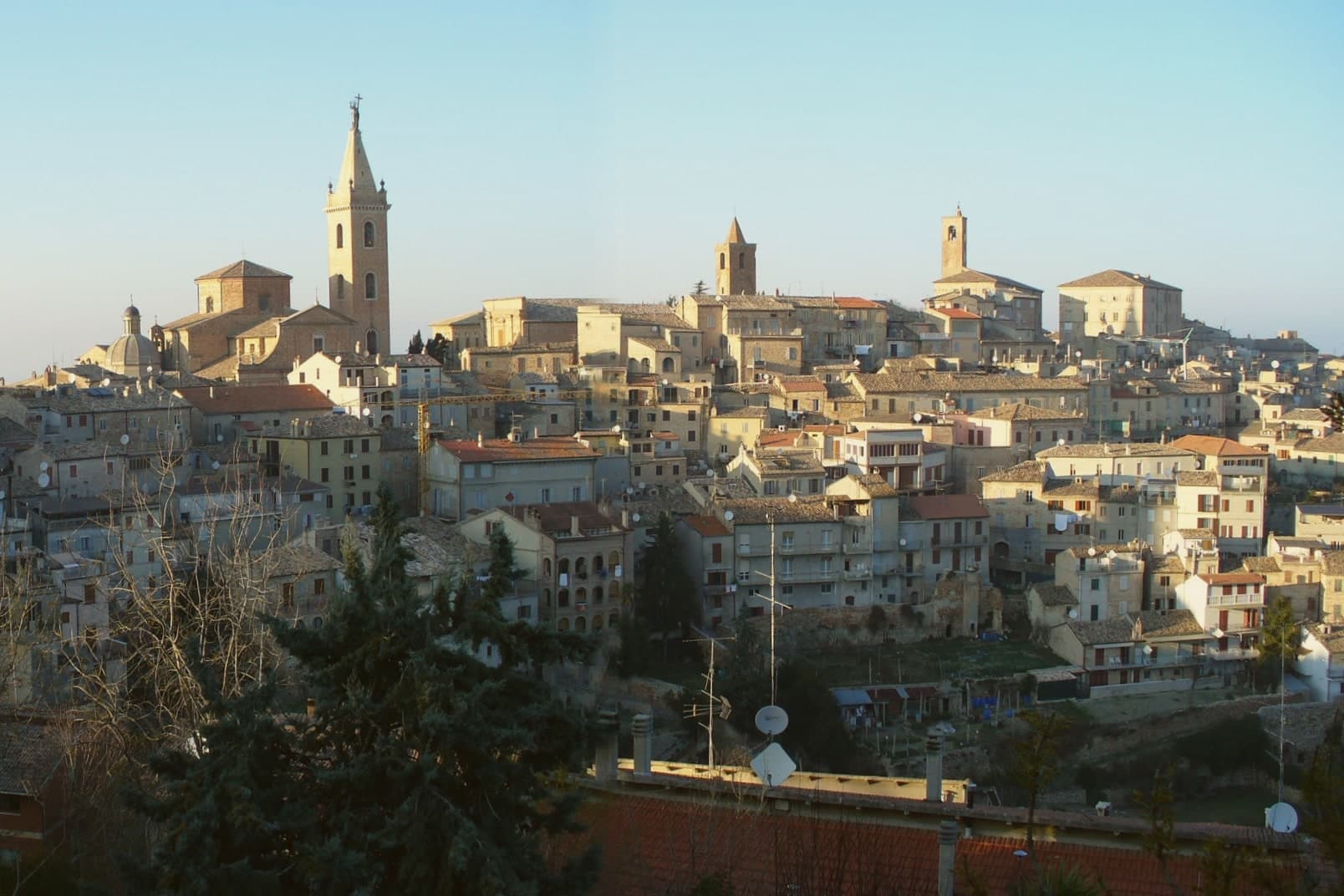
Ripatransone sits at 494 meters on a ridge between the Tesino and Menocchia valleys, twenty kilometers from Ascoli Piceno and seven from the Adriatic, with views from the Sibillini and Gran Sasso to the coast that earned it the nickname Belvedere del Piceno. The hill has been inhabited since prehistory and was settled by the Umbri and then the Piceni; after centuries of Roman quiet a medieval town grew here from a circle of castles unified in 1096.
Pope Pius V raised it to City and diocesan see in 1571. The name combines ripa, cliff, with Transone, the first feudal lord.
The Vicolo più stretto d'Italia, the narrowest alley in Italy at 43 centimeters and 32 at its tightest point, runs between two stone houses near Via Margherita: shoulders go sideways. The Cavallo di Fuoco, a wooden horse covered in fireworks that gallops across the main piazza on the Sunday after Easter, has run since 1682.
Iervasciò, Trattoria da Rita have been named by a guide.
What to see in Ripatransone
- Vicolo più stretto d'Italia. The narrowest alley in Italy, 43 centimeters wide and 32 at its tightest point, between two stone houses near Via Margherita.
- Piazza XX Settembre. The main square of the centro storico, with the Palazzo del Podestà, the Cathedral of San Gregorio Magno and the medieval Torre Civica.
- Cattedrale di San Gregorio Magno. Cathedral built between the seventeenth and eighteenth centuries on the site of an earlier church, raised to cathedral status by Pope Pius V in 1571.
How to get to Ripatransone
Pescara is roughly 70 minutes away by road.
Our tip
April through June and September into October are the working months for Ripatransone. The Tesino and Menocchia valleys turn green from April, the Cavallo di Fuoco runs on the Sunday after Easter, and the autumn light brings the clearest views from the ridge across to the Sibillini and the sea. July and August touch the low thirties; the ridge breeze keeps the centro storico cooler than the coastal plain seven kilometers below. Festival Frittella di Zia Maria falls in September.
Acqualagna
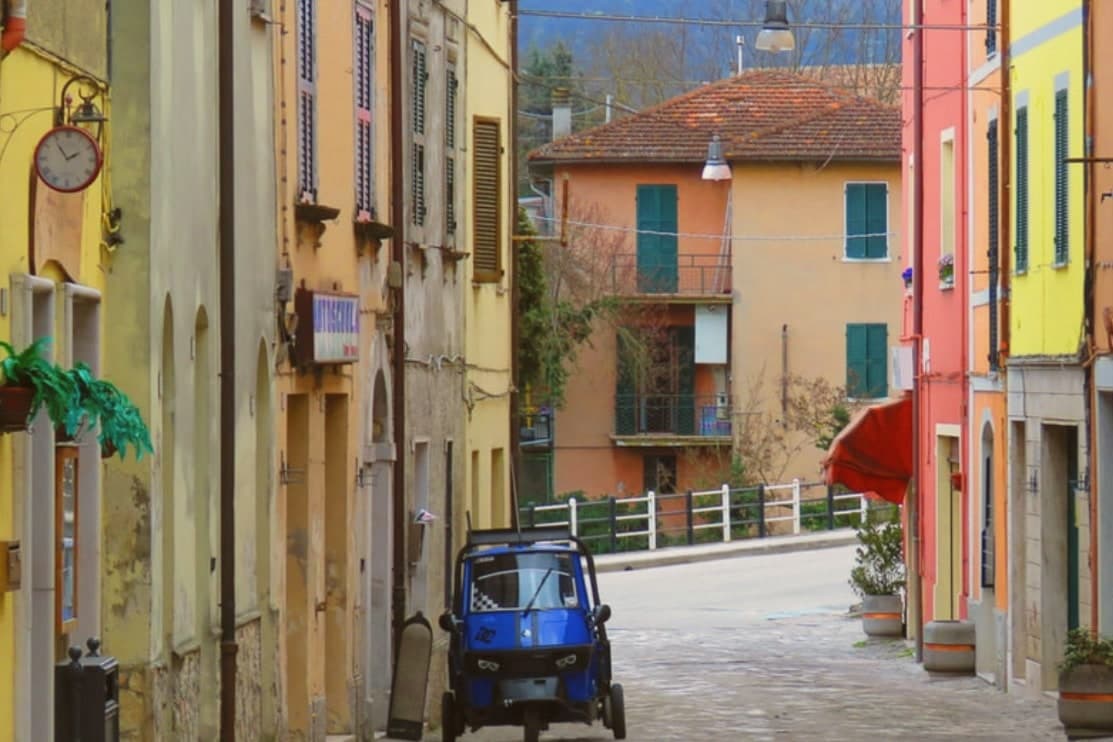
Why visit Acqualagna
Acqualagna sits at 204 meters in the Metauro valley, twelve kilometers from Urbino, on the plain just downstream from the gorge cut by the Candigliano river. The Roman city of Pitinum Mergens stood nearby until Alaric's Goths destroyed it; the survivors founded Montefalcone, the castle from which today's village grew.
The name Acqualagna comes from Aqua Lanea, water of slaughter, after the sixth-century battle fought on that same plain. Three fairs anchor the year: black truffle on the last Sunday of February, summer black on the last Sunday of July, white truffle across the last weekend of October and the two that follow.
The town below and the gorge above read as one unit, a river valley that has carried Roman road traffic, monastic settlement and truffle trade in turn, each leaving its mark on the ground without erasing what came before.
Anticofurlo have been named by a guide.
What to see in Acqualagna
- Gola del Furlo. The gorge narrows between Monte Paganuccio (977 m) and Monte Pietralata (888 m); the 38-meter Roman tunnel, cut in 76 AD, is still driven through by the Via Flaminia today.
- Abbazia di San Vincenzo al Furlo. Medieval Benedictine monastery set into the slopes above the gorge, counted among the oldest religious foundations in the Metauro valley.
- Riserva Naturale Statale Gola del Furlo. Nature reserve established in 2001, covering 3,600 hectares of woodland, grazing land and ridgeline above the river.
How to get to Acqualagna
There is a railway station in the town, so you can arrive without a car and never need one while you are here. Rimini is roughly 81 minutes away by road.
Our tip
April through June and September into October are the months for Acqualagna. The Metauro hills hold their green, the woods around Monte Paganuccio are open for walking, and summer truffle season turns the piazzas over to tasting tables in late July. July and August touch the high twenties; the gorge stays cooler than the valley floor. Fiera Regionale del Tartufo d'Estate falls in August.
Offida
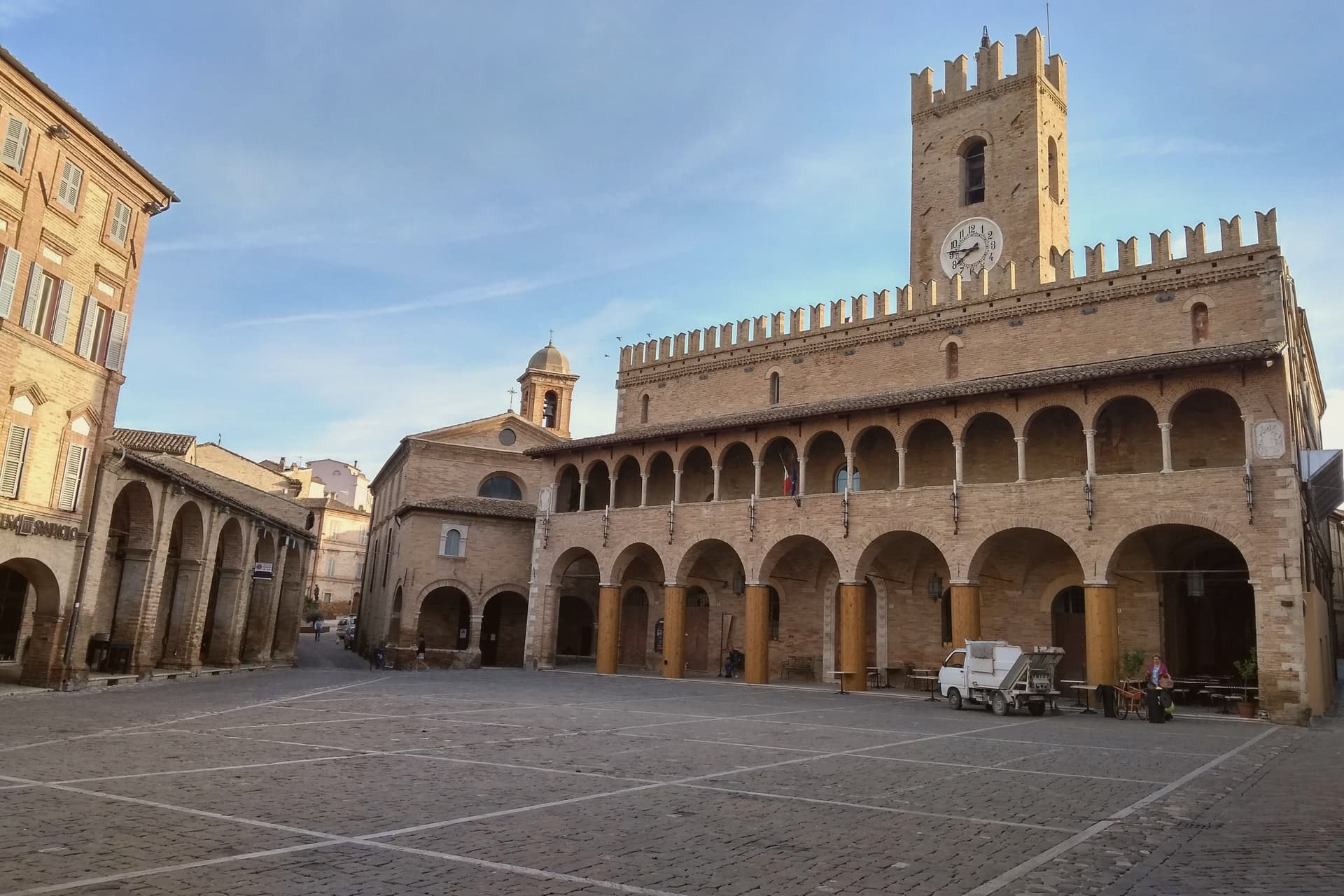
Why visit Offida
Offida sits at 293 meters on a cliff between the Tesino and Tronto valleys, twenty-three kilometers from Ascoli Piceno. The Chiesa di Santa Maria della Rocca rises on a rock spur at the western edge of the village, surrounded on three sides by cliffs that drop into two valleys: a Romanesque-Gothic temple in brick and travertine, raised by Master Albertino in 1330 on an older Benedictine foundation, with a double row of trilobed arches around the apse.
Inside, the apse and transept hold the fresco cycle of the Master of Offida, an anonymous monk painter who carried Giotto's lesson through the Rimini school, with the Marriage of Saint Catherine and Saint Christopher dated by inscription to 1367. Bobbin lace, merletto a tombolo, has been worked in town since the fifteenth century; the Museo del Merletto in Palazzo De Castellotti holds the collection.
The Carnevale Storico, with the Bove finto run and the Vlurd fire bundles, dates from before Lent in early February.
Osteria Ophis, Blob Caffè & Ristorante have been named by a guide.
What to see in Offida
- Chiesa di Santa Maria della Rocca. Romanesque-Gothic brick-and-travertine church raised in 1330 by Master Albertino on a rock spur west of town, with the Master of Offida fresco cycle dated 1367 in the transept.
- Museo del Merletto a Tombolo. Inside Palazzo De Castellotti, with the lace collection, tools, historical documents and demonstrations of the bobbin-lace work practiced in town since the fifteenth century.
- Palazzo Comunale. Civic palace on the long Piazza del Popolo, with a portico, the Teatro Serpente Aureo and the access to the Museo del Merletto and the archaeological museum.
How to get to Offida
Pescara is roughly 74 minutes away by road.
Our tip
April through June and September into October are the best months for Offida. The hills around the town turn green by April and gold through the September harvest, the wine cellars run open tastings between vendemmia and St. Martin, and the Pecorino and Passerina vineyards stand out along the ridges. Sagra del Chichìripieno falls in August.
More from Anywhere Italy
 The best small towns that eat well in Marche
- The 10 best hill towns that eat well within 90 minutes of Ancona
- The 8 prettiest villages that eat well in Marche
- The best towns with a food festival that eat well in Marche
- The 8 best hill towns that eat well within 90 minutes of Pescara
 The best wine towns in Marche