
The 7 prettiest villages inside a nature park in Lombardia
Lombardia's nature parks protect more than reedbeds and ridgelines. They hold villages built from what was to hand: dark Alpine stone in the Bergamo valleys, brick and terracotta down on the Po plain, limestone and lemon-house pillars on the western shore of Garda. Spring brings water lilies to the Mincio and asparagus to the market tables; autumn brings chestnuts, casoncelli, polenta taragna and the lake olive oil pressed on the slopes above Garda. The light in these parks is different from the light in the cities, cooler off the water, longer through the poplars.
Most visitors to the Lombard lakes go to Como, and specifically to Bellagio, where the ferries dock and the promenade fills from late morning until the last boat. Sirmione does the same work on Garda, with a queue for the castle bridge and a crowd on the thermal peninsula. The scenery earns the attention, but the roads are narrow, the parking is finite and the season now runs long.
The parks continue past all of that. The same lake shore climbs into terraced cliffs and protected uplands, the same rivers widen into wetland reserves, and the same mountain valleys keep their old stone villages well beyond the last resort. These are the smaller places inside those boundaries, where fewer people go and the walking starts at the edge of the houses.
Of the 65 communes we have mapped in Lombardia, 7 qualify as prettiest villages inside a nature park: each has passed the national assessment of Italy's most beautiful villages, and each sits inside a regional nature park. The smallest, Limone sul Garda, has 1,130 residents.
Two more lists worth reading alongside this one: The best small towns inside a nature park in Lombardia and The best lake towns inside a nature park in Lombardia.
Why visit Limone sul Garda
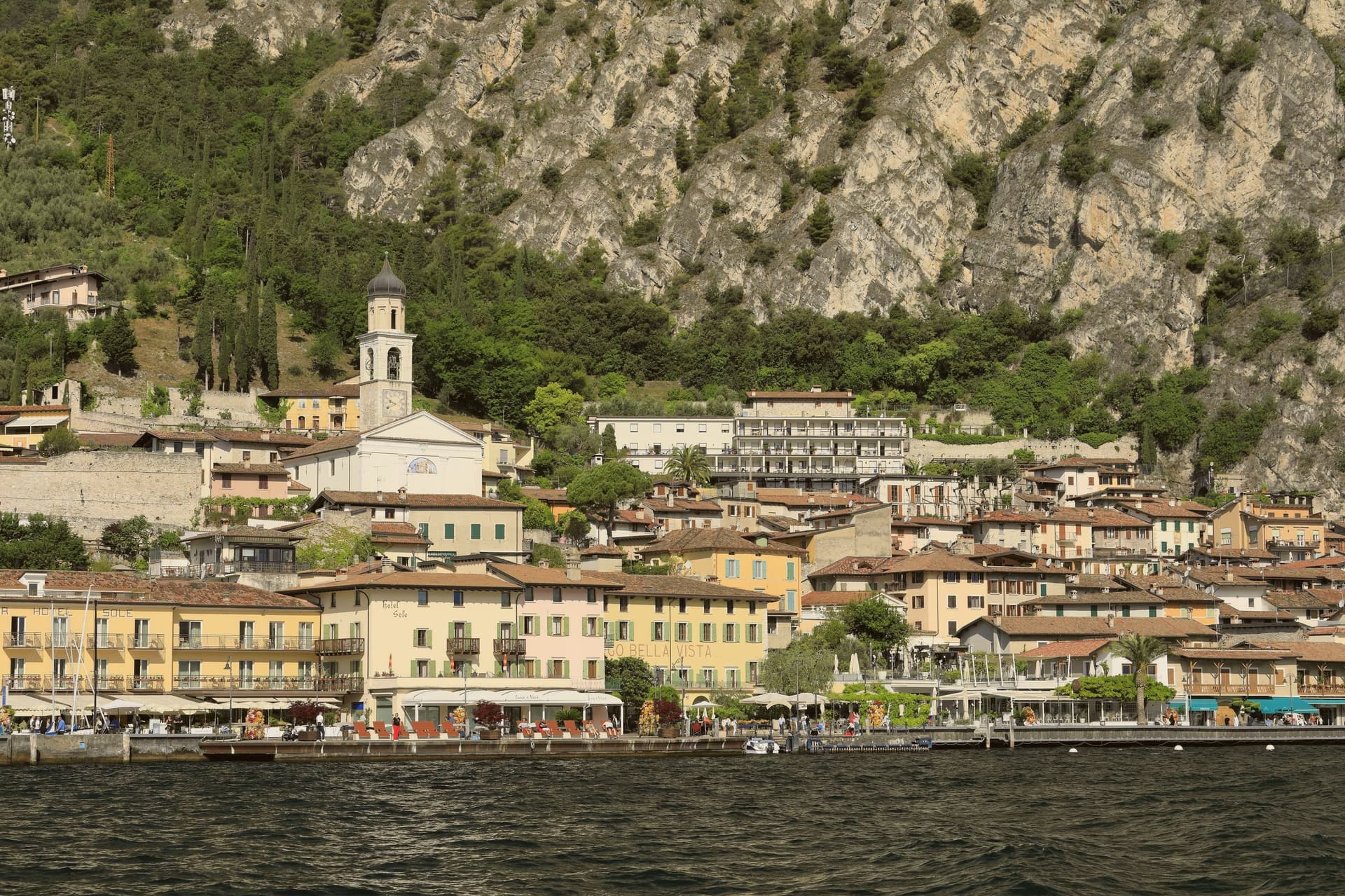
Limone sul Garda sits on the western shore of Lake Garda at the foot of vertical limestone cliffs, the northernmost commercial lemon-growing town in the world at almost 46 degrees north. The Latin limes, meaning border, gave the place its name; the Bettoni counts gave it its industry.
From the seventeenth century, limonaie, stone-pillared greenhouses heated and covered through winter, allowed lemons to be exported to Austria, Germany, Poland and Russia. The road to Riva del Garda, the Gardesana Occidentale, was carved into the cliff and finished in 1932; until then the town reached the outside world by boat or mule track.
In 1974 a Milanese pharmacologist traced a mutant apolipoprotein, ApoA-1 Milano, to a single eighteenth-century resident, Giovanni Pomarelli. Roughly forty of his descendants in town carry the variant, which suppresses cardiovascular disease and helps a handful of residents past one hundred.
What to see in Limone sul Garda
- Limonaia del Castèl. Restored seventeenth-century lemon greenhouse on stone pillars above the lake, demonstrating the heated wooden cover that protected the trees through winter.
- Chiesa di San Benedetto. Eighteenth-century parish church on the lake front, with a single nave and Baroque altars rebuilt over an older medieval foundation.
- Centro storico. Tight grid of stone alleys between the old harbour and the cliff, with narrow porticoes that survive from the pre-road fishing and citrus village.
How to get to Limone sul Garda
Trento is roughly 57 minutes away by road.
Our tip
April through June and September into October are the months that suit Limone. The lake holds spring temperatures, the lemons flower, the cliff above the town keeps morning shade until noon. July and August fill the lakefront and the cycle path, with peak crowds on weekends drawn from Verona, Milano and German-speaking Europe.
Why visit Gromo
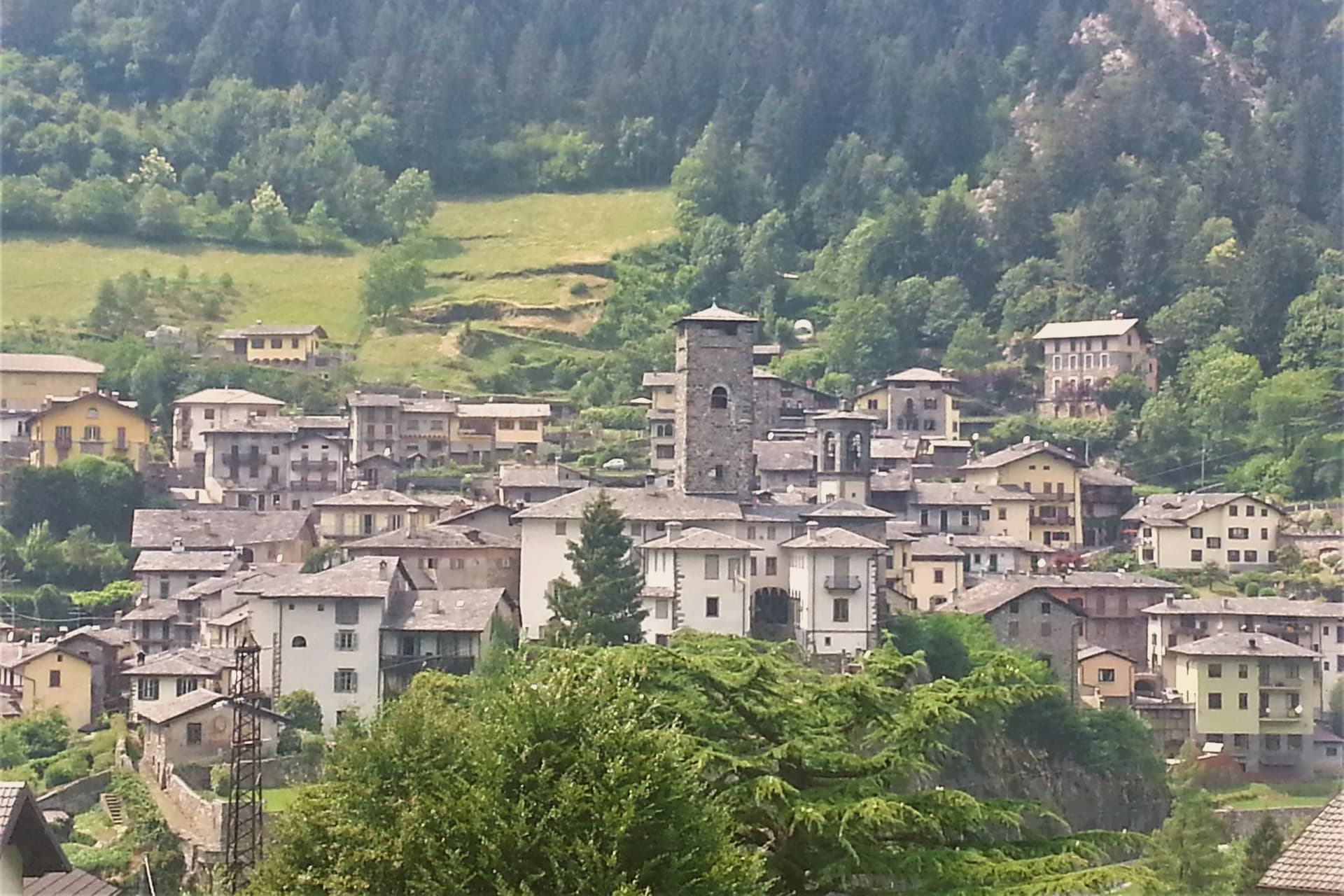
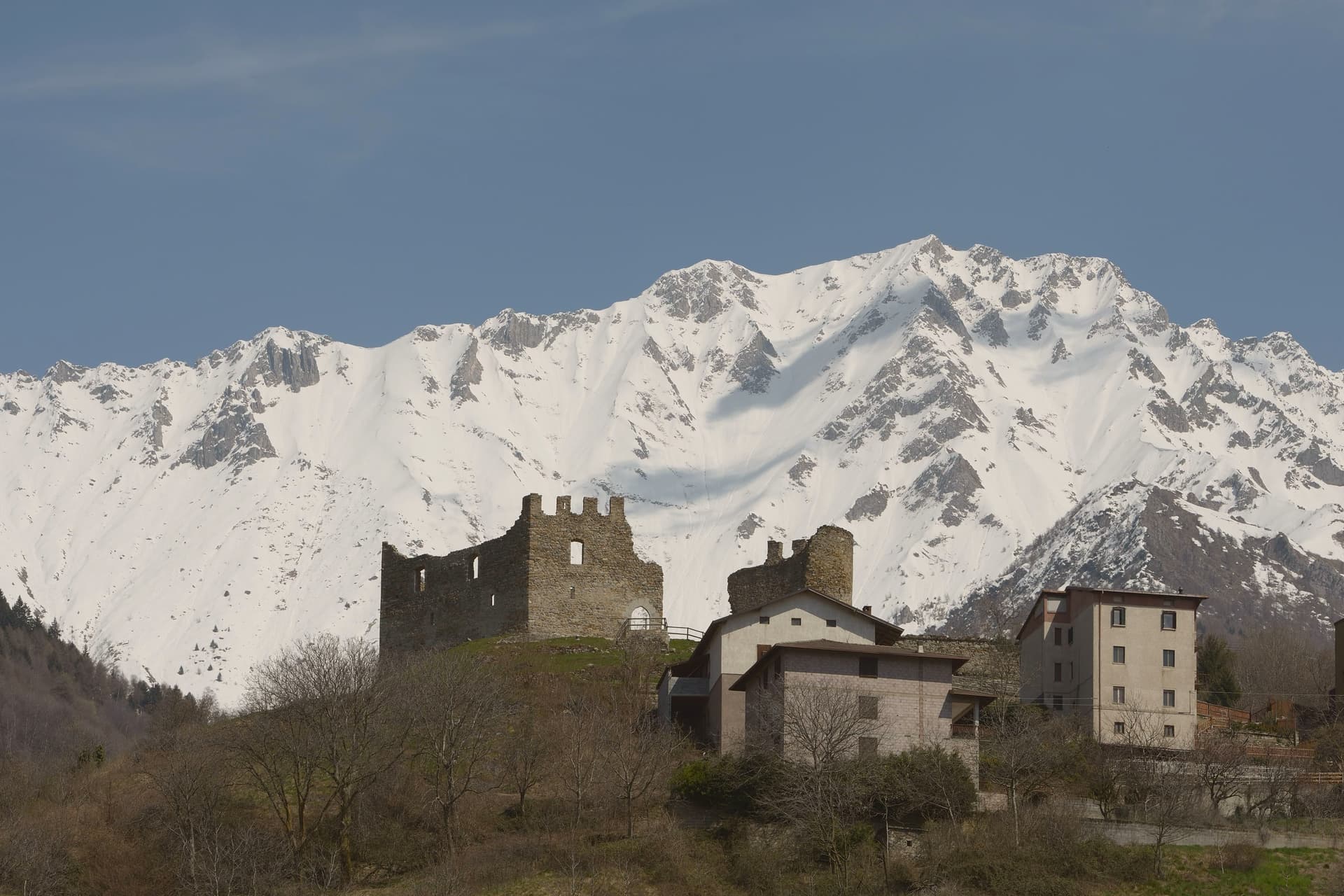
Gromo sits at 676 meters on a rocky spur above the right bank of the Serio, forty kilometers northeast of Bergamo in the upper Seriana Valley. In the Middle Ages, the village was called the little Toledo: its forges produced swords, daggers, halberds, shields and cuirasses exported across Lombardy and beyond, powered by the current of the stream below.
Silver mining in nearby veins fed the Bergamo mint until the fourteenth century. With the official act of 12 February 1267, Gromo gained autonomy and the rights to sell its metals.
The Castello Ginami, built on the rock in the first half of the thirteenth century by the Buccelleni and later passed to the Ginami family, still dominates the village. The Chiesa di San Giacomo, fifteenth century, holds gilded altars, sixteenth-century frescoes, wooden statues and old parchments.
In winter, the Spiazzi di Gromo plateau above town runs alpine and cross-country skiing; in summer, the same valleys feed trekking into the Orobie.
What to see in Gromo
- Castello Ginami. Thirteenth-century fortress on a rock spur, built by the Buccelleni and passed to the Ginami in the sixteenth century, modified into the seventeenth.
- Chiesa di San Giacomo. Fifteenth-century parish church above the historic centre, with gilded altars, sixteenth-century frescoes, wooden statues and ancient parchments.
- Piazza Dante. Medieval square at the heart of the borgo, lined with stone palazzi and the surviving defensive walls of the iron-working town.
How to get to Gromo
Bergamo is roughly 62 minutes away by road.
Our tip
May through October is the workable window at 676 meters. June, July and September are the best months: green pastures, alpine flowers, mild evenings, trails open across the Spiazzi plateau and into the Orobie. August brings vacationers from Bergamo and Milan, though the mountain keeps the heat down.
Why visit Tremosine sul Garda
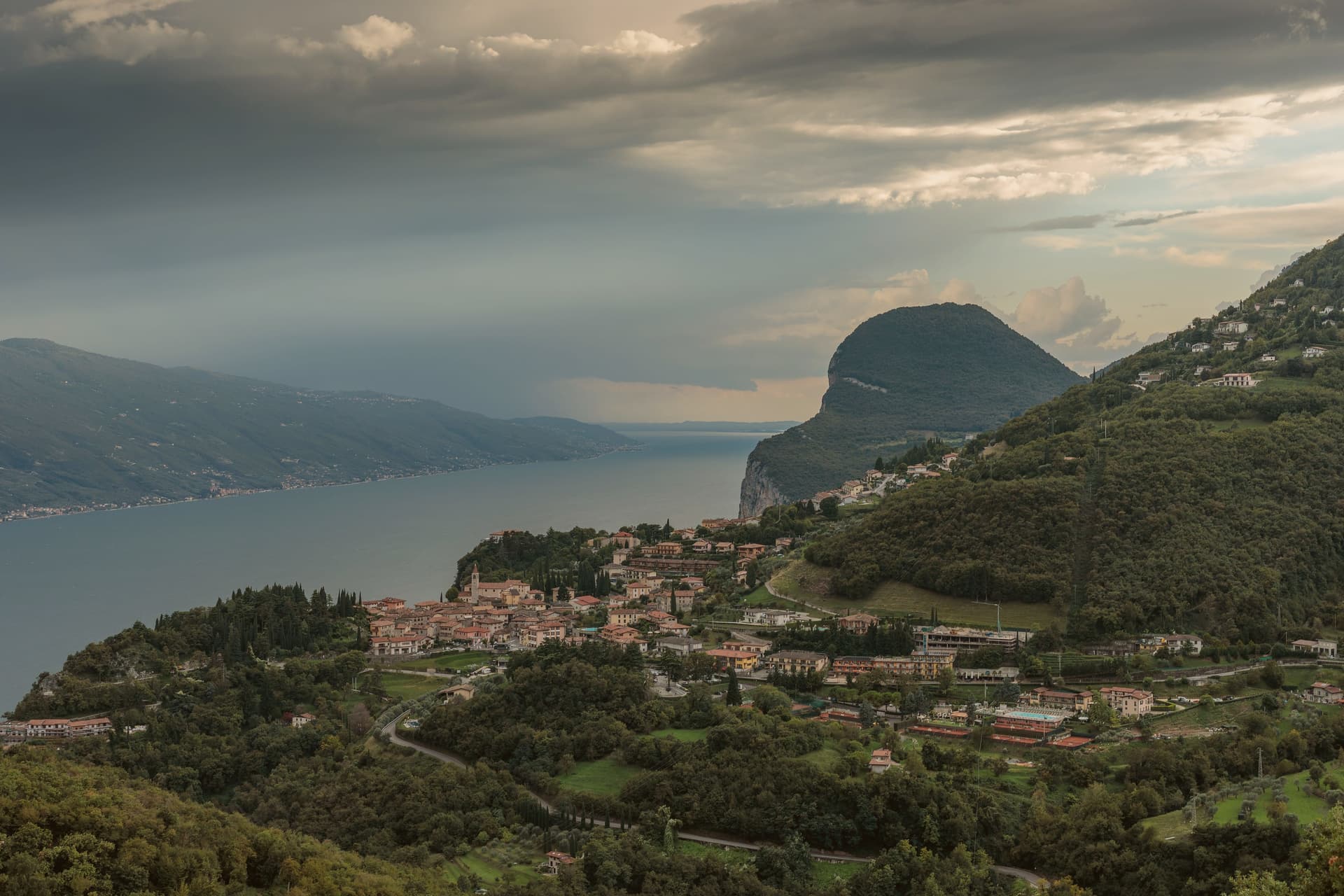
The plateau sits above the strip of road called the Gardesana Occidentale, its cliff edge dropping straight to the water. The commune divides into 18 frazioni scattered between that edge and the Alpe di Tremosine inland; Pieve, the capoluogo, holds the town hall and the Borghi più belli listing, while Campione del Garda, down at lake level, is the one frazione with direct shore access and a windsurfing beach.
The distance between Pieve on its cliff and Campione on the water is the whole shape of the place: a plateau town with a single foothold on the lake itself. The only road climb from that shore is the route designed by Arturo Cozzaglio of Tremosine and built between 1908 and 1913 through the gorge carved by the Brasa stream: 200 meters of vertical, tunnels and switchbacks cut through limestone.
Winston Churchill called it the eighth wonder of the world. The Tignale and Limone communes are close on either side along the cliff.
What holds Tremosine together, then, is verticality: a plateau of hamlets, a single road up from the water, and a capoluogo that sits at the edge looking straight down.
What to see in Tremosine sul Garda
- Pieve. Capoluogo and one of the Borghi più belli d'Italia, on the limestone cliff edge at 413 meters directly above the lake.
- Terrazza del Brivido. Concrete platform at the Hotel Paradiso, suspending visitors over the void with a full view of the southern Lake Garda.
- Strada della Forra. 5.8-kilometer cliff road by Arturo Cozzaglio, built 1908-1913 through the gorge of the Brasa stream; used in Quantum of Solace.
How to get to Tremosine sul Garda
Trento is roughly 117 minutes away by road.
Our tip
April through October is the lake season. The Strada della Forra is open for cars and motorbikes, the Terrazza del Brivido draws weekend traffic, and the cliff air keeps Pieve cooler than the lake floor. July and August are the busiest months, with the Bond-road crowd and the European motorcycle riders.
Why visit Gardone Riviera
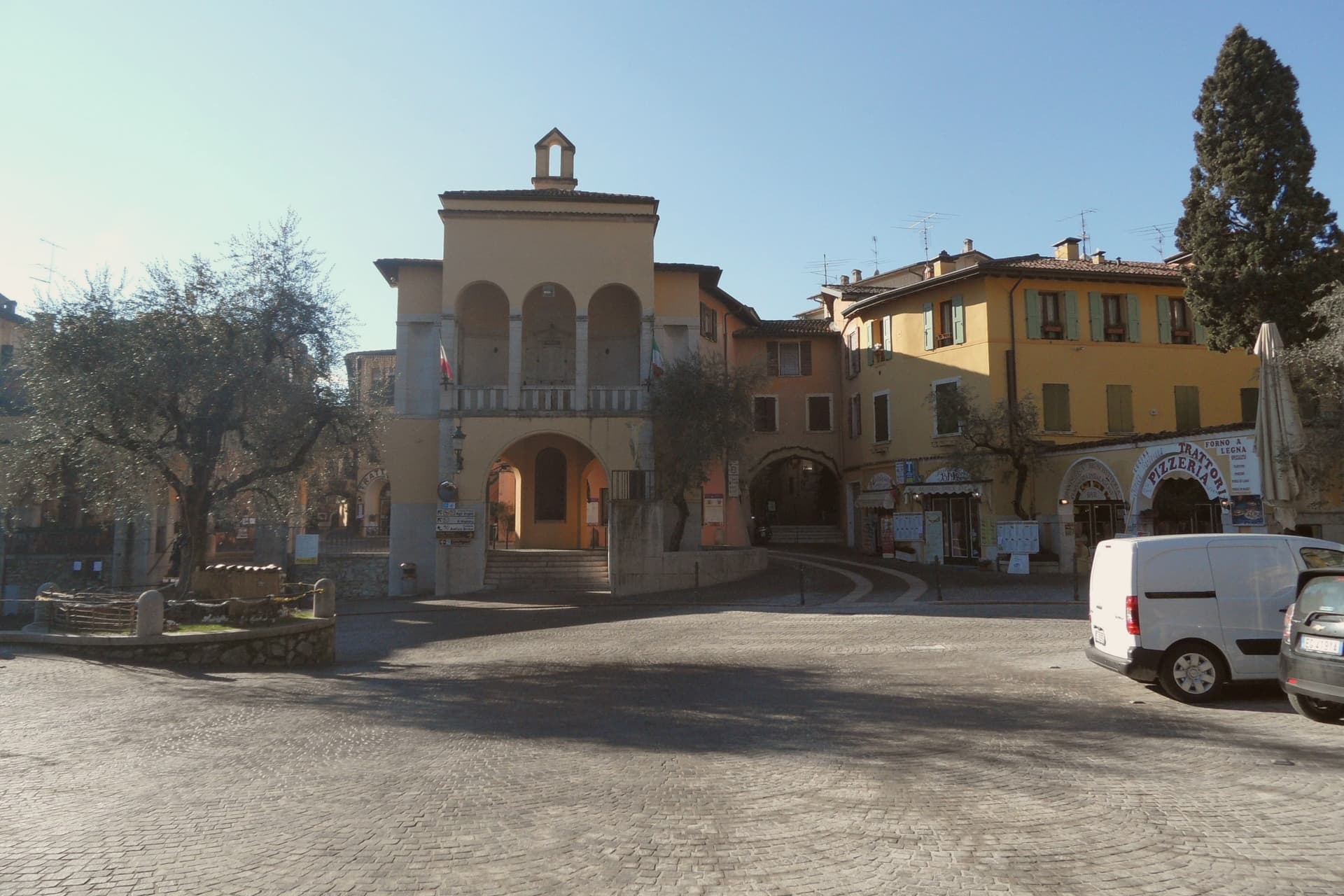
Gardone Riviera sits at 71 meters on the western shore of Lake Garda, in the province of Brescia. The lake here runs deep against the wall of Monte Pizzocolo, and the climate stays mild enough that lemons, olives and bamboo grow within walking distance of each other.
The town divides between the lakefront and the hill above it. Along the water, Gardone Sotto holds the promenade and harbour; above the centro storico, the ground rises toward the estate grounds and, further up, toward the garden that has drawn on the same mild hillside climate since the start of the twentieth century.
The boathouse on the estate holds a torpedo boat from a 1918 wartime raid, alongside the villa called the Prioria, an amphitheatre and a circular mausoleum. The garden above town spent six decades being arranged, one man working a single hillside into bamboo groves, alpine ravines, Japanese ponds and waterfalls.
The lakefront promenade carries the Bandiera Blu. What holds the town together is that division of altitude: a working lakefront below, and above it two hillside projects, one architectural and one botanical, each built slowly and by a single hand over decades on the same slope.
What to see in Gardone Riviera
- Vittoriale degli Italiani. Nine-hectare hillside estate occupied by Gabriele D'Annunzio from 1922 to 1938, with villa, amphitheatre, mausoleum and the cruiser Puglia.
- Nave Puglia. Protected cruiser of the Regia Marina set into the slope above the lake, gifted to D'Annunzio in 1923 and assembled on land at the Vittoriale.
- Giardino Botanico Hruska (Heller Garden). Botanical garden begun around 1901 by Arturo Hruska, with bamboo, Japanese ponds, alpine ravines and waterfalls on a single hillside.
How to get to Gardone Riviera
Brescia is roughly 53 minutes away by road.
Our tip
April through June and September into October are the months western Garda works best. The Vittoriale grounds are walkable, the Heller Garden is in full bloom, and the ferry between Salò and Riva del Garda runs regular service. July and August fill the lakefront with day-trippers and the Vittoriale amphitheatre hosts its summer opera season; afternoons get warm but the lake breeze holds steady.
Why visit Monzambano
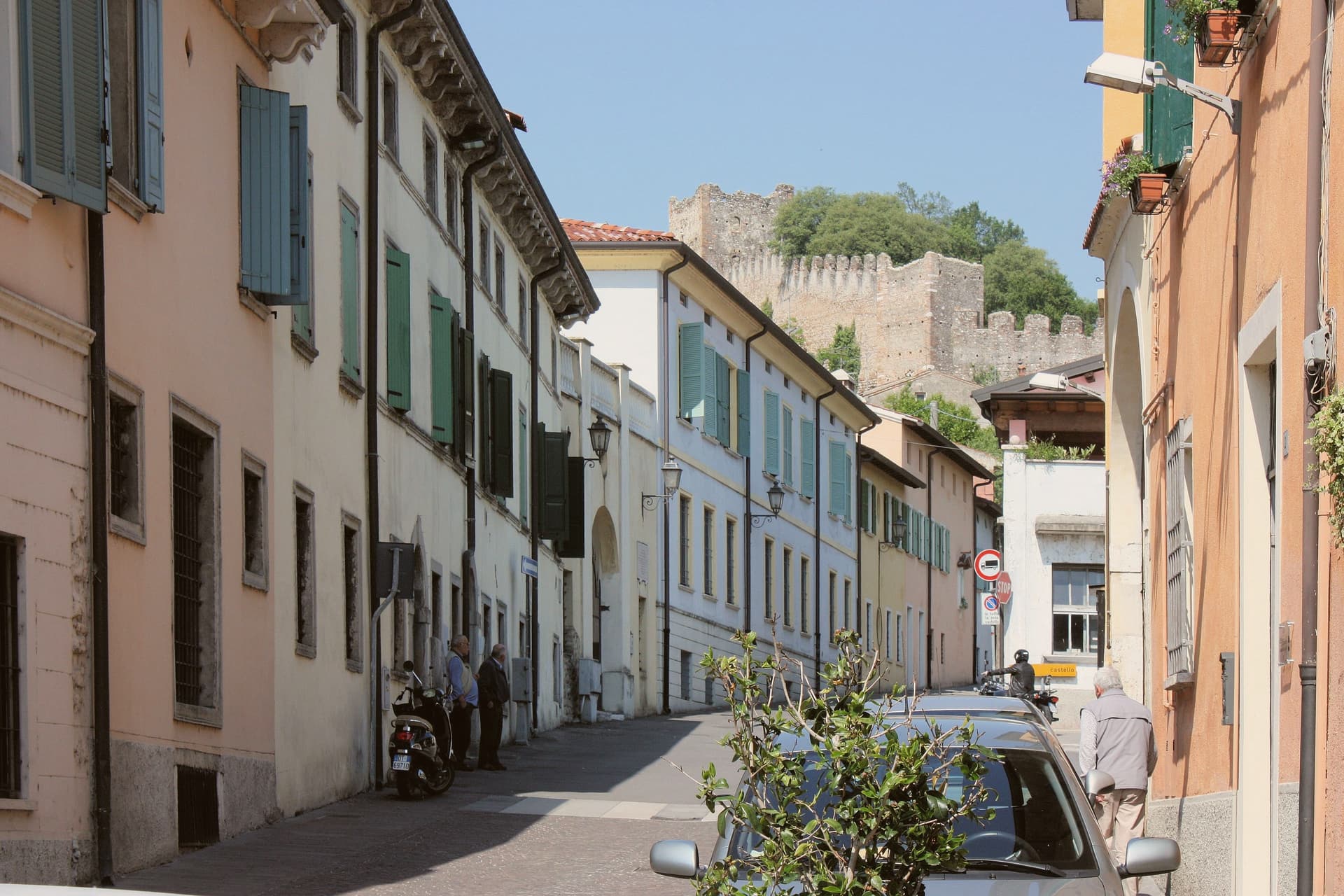
Monzambano sits at 88 meters on the right bank of the Mincio, in the moraine hills the last Alpine glacier pushed up south of Lake Garda. The commune covers 4,800 people across several frazioni, but the one travelers come for is Castellaro Lagusello, a fortified medieval village built around a small heart-shaped lake.
Pope Eugenio III's document of 1145 lists its parish among those of the Diocese of Verona. The castle and walls date to the eleventh and twelfth centuries.
The Gonzaga of Mantua tried and failed to hold it through the Quattrocento, and it passed to Venice, then to Napoleon, who in 1803 annexed it to Monzambano. Pile-dwelling settlements under the lake belong to the Prehistoric Pile Dwellings around the Alps UNESCO site.
The commune holds five institutional signals at once: Borghi più belli, Bandiera Arancione, Borgo dei Borghi finalist, Città del Vino, Città dell'Olio. The wines are Lugana and Garda Colli Mantovani; the oil is Garda DOP.
What to see in Monzambano
- Castellaro Lagusello. Fortified medieval frazione inside crenellated walls and ten towers, set above a heart-shaped lake on a moraine hill.
- Castello di Castellaro. Eleventh- to twelfth-century castle on the hill above the lake, long contested between Mantua and Venice.
- Prehistoric pile dwellings. Submerged Bronze Age stilt-house settlement in the lake, part of the UNESCO Prehistoric Pile Dwellings around the Alps.
How to get to Monzambano
Verona is roughly 39 minutes away by road.
Our tip
April through June and September into October are the months the moraine hills work best. The vines are leafing or harvested, the lake reflects the walls, and the small reserve around Castellaro is open to walkers. July and August get humid and still; Lake Garda is fifteen kilometers away and pulls the day-trippers off the back roads. Sagra di San Bartolomeo falls in August.
Why visit Soncino
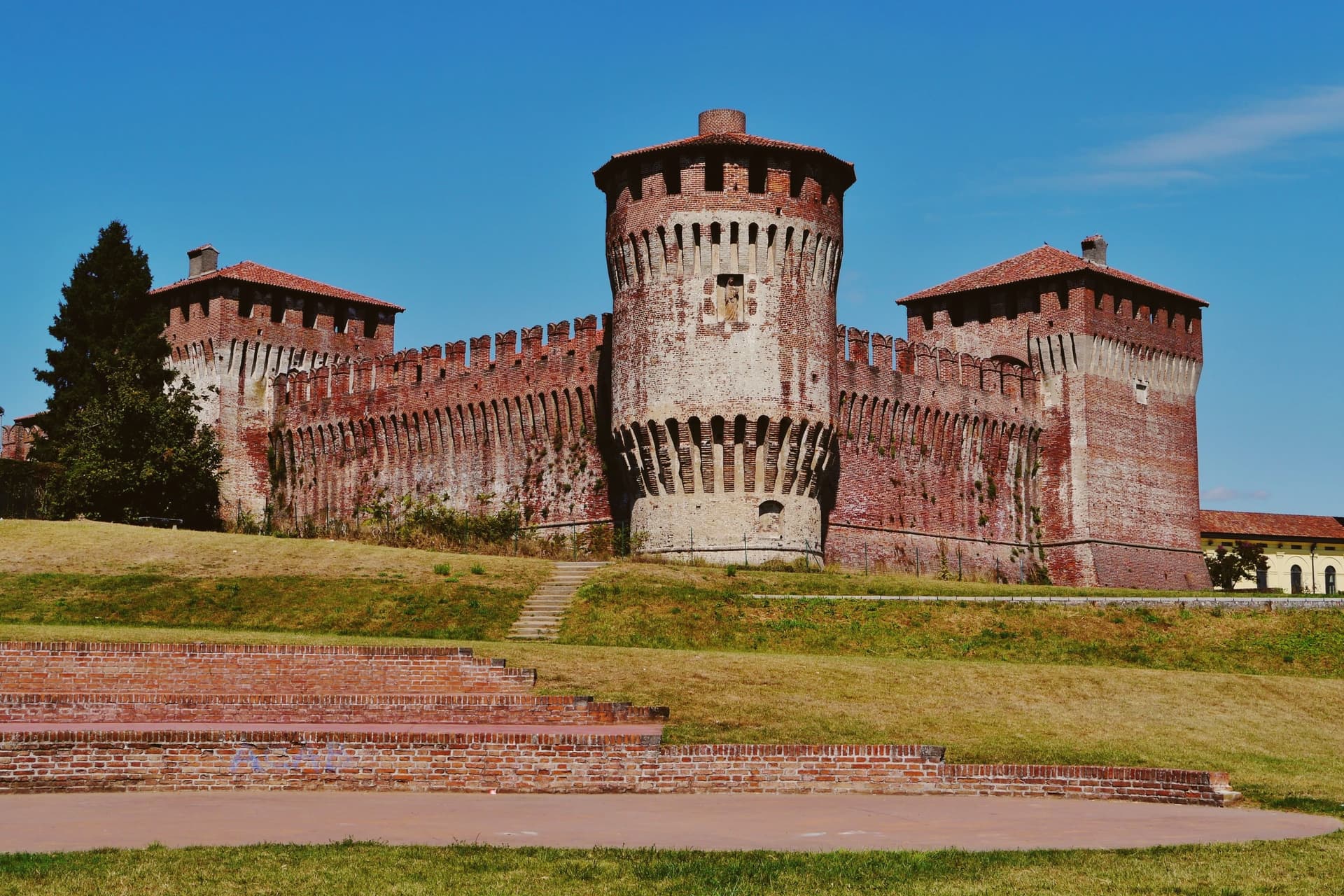
Soncino sits on the Oglio river at the point where the provinces of Cremona, Brescia, and Bergamo meet, a position on the Lombard frontier that kept the town militarized through the medieval centuries and explains the walls and the fortress alike. Inside the circuit, the town's religious center predates its military architecture: the parish church at the heart of the centro storico served the borough from the twelfth century, while the frescoed church nearby belongs to the later Renaissance layer of building.
The fortress itself, raised in brick rather than stone, took only two years to complete and is unusually whole for its age. The other thread running through the town is the press, worked by a family who later carried the town's name across Europe when they dispersed, leaving behind the house where they worked and, in it, the object that made the town briefly a center of Hebrew printing.
What Soncino adds up to, then, is a frontier garrison town whose walls and castle speak to centuries of defense, cut through by one short episode of printing that gave it a different kind of reach entirely.
What to see in Soncino
- Rocca Sforzesca. Built by Galeazzo Maria Sforza in the space of two years, using brick rather than stone to speed the work. The keep and towers stand largely as built, with little of the wear or later rebuilding common to castles of the period.
- Casa degli Stampatori. The house where the printers worked still stands, its rooms now given over to the Museo della Stampa, tracing the mechanics of the press rather than the book it produced.
- Chiesa di Santa Maria delle Grazie. Late fifteenth-century church whose interior is covered floor to ceiling in Lombard Renaissance frescoes, a density of painted surface unusual for a town this size.
How to get to Soncino
There is a railway station in the town, so you can arrive without a car and never need one while you are here. Brescia is roughly 38 minutes away by road.
Our tip
April through June and September into October are the right months. The Rocca and the Pieve are open, the frescoes at Santa Maria delle Grazie read cleanly in shoulder-season light, and the Oglio walk is dry. July and August reach thirty-three degrees with valley humidity; the borgo empties between two and six. Sagra delle Radici falls in October.
Why visit Curtatone
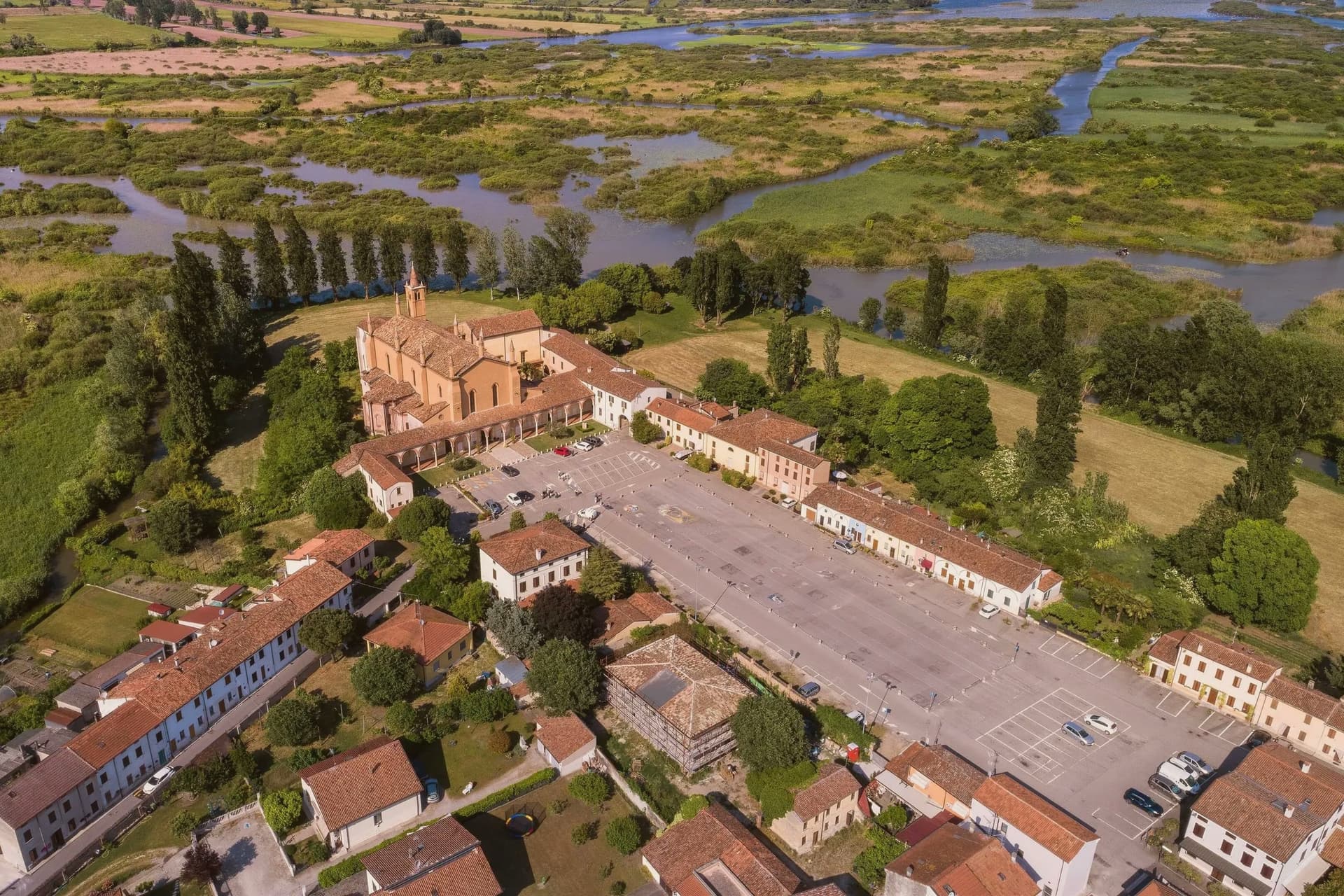
Curtatone is a Mantova commune of eight frazioni in the Parco del Mincio, with its seat at Montanara and its most visited fraction at Grazie. The Santuario della Beata Vergine delle Grazie was commissioned in 1406 by Francesco I Gonzaga and stands on the edge of the Mincio's lower bend, surrounded by lotus flowers that bloom across the river in July and August.
On 29 May 1848, Tuscan and Neapolitan volunteers held this stretch of ground against Austrian forces under Radetzky long enough for the Piedmontese army to reorganize at Goito the following day. The battle is remembered nationally as Curtatone e Montanara.
Every year around Ferragosto the Antichissima Fiera delle Grazie fills the square in front of the sanctuary; since 1973 the fair has hosted the Incontro Nazionale dei Madonnari, with over a hundred chalk artists working through the night on the pavement around the church.
What to see in Curtatone
- Santuario della Beata Vergine delle Grazie. 1406 Gonzaga sanctuary on the Mincio bend, with a unique wooden ex-voto wall lining the nave, and the burial of Baldassarre Castiglione.
- Parco del Mincio. Riverine nature reserve around Grazie, with lotus flower expanses that bloom mid-July through August on the lower Mincio.
- Monument to the Battle of Curtatone and Montanara. Memorial to the 1848 stand by Tuscan and Neapolitan volunteers against Austrian forces under Radetzky on 29 May.
How to get to Curtatone
Verona is roughly 48 minutes away by road.
Our tip
April through June and September into October are the months Po-valley humidity stays bearable. April brings the Mincio in full water and the wetland birds along the parco. The lotus flowers around Grazie bloom from mid-July into August, a brief overlap with the heaviest summer heat, when temperatures climb past thirty-three degrees and the air thickens.
More from Anywhere Italy
 The best small towns inside a nature park in Lombardia
 The best lake towns inside a nature park in Lombardia
- The 9 best towns with a serious restaurant that sit inside a nature park in Lombardia
- The 8 best towns inside a nature park in the province of Brescia
 The 6 prettiest villages in the province of Mantova
- The prettiest villages in the province of Brescia