
The best olive oil towns with a serious restaurant in Puglia
Puglia's olive country runs from the Murgia plateau down to the sea, groves of trees old enough to have trunks like melted rock, some of them still worked by hand. The oil pressed here is green, bitter at the back of the throat, peppery enough to make you cough, and it turns up on everything: raw broad bean puree, orecchiette with turnip tops, grilled lamb, a plate of bread and nothing else. Towns are built in tufa and limestone, white and pale gold, with cellars cut below street level where the old mills ground stone on stone. Autumn, when the harvest and the frantoi run, is the season worth planning around, though the tables are good all year.
The crowd goes to Ostuni, the white town on its hill, and to Lecce for the baroque, and both earn it. Buses arrive by mid-morning, the terraces fill, and menus start to read the same from one street to the next. In high summer, Polignano a Mare's beach cove is photographed more than it is swum in. None of this is a reason to stay away, but it is a reason not to stop there.
The same groves, the same limestone, the same kitchens continue inland and along the coast past all of it. These towns belong to the national association of olive-oil towns, and each one holds a restaurant that the most demanding of the Italian guides has judged worth naming, which is a rarer combination than the region's reputation suggests. Fewer people book here, and the cooking answers to locals first.
Of the 59 communes we have mapped in Puglia, 9 qualify as olive oil towns with a serious restaurant: each belongs to the national association of olive-oil towns, and each holds a restaurant listed by the most demanding of the guides. The smallest, Minervino Murge, has 8,171 residents.
Elsewhere in the catalogue: The 10 best hill towns with a serious restaurant in Puglia and The best coastal towns with a serious restaurant in Puglia.
Minervino Murge
Why visit Minervino Murge
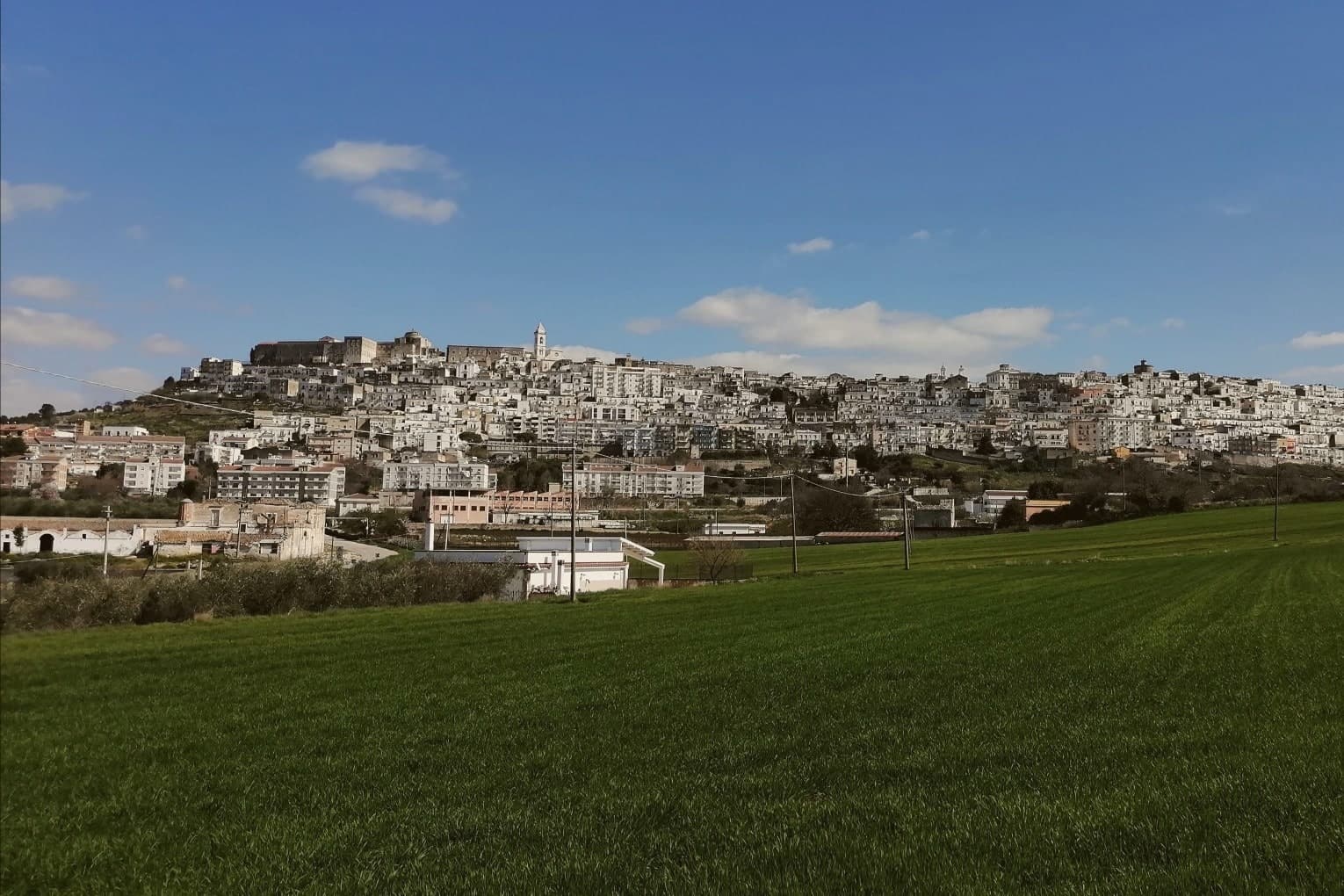
The town is built on two hills at the western edge of the Murgia plateau, where the limestone tableland gives out and the ground drops toward lower country on three sides. That break is what gives the ridge its long view and its nickname: to the east the eye crosses Murgia limestone toward the Gargano and the Adriatic, to the west it crosses cultivated fields into Basilicata, and to the north it runs the length of the Ofanto valley.
The old town sits above this drop, castle and tower on the high ground, cathedral below, the settlement organized around the same ridge that draws the view. Olive oil, almonds and grain define the rural economy beyond the walls, the plateau put to farming where it is not left to steppe grass and karst.
A ridge town, in other words, whose whole character, defensive site, pilgrimage cave, farmed hinterland, follows from the one geological fact of where the plateau ends.
La Tradizione - Cucina Casalinga, Masseria Barbera, A Sud dell'Anima have been named by a guide.
What to see in Minervino Murge
- Castello Normanno-Svevo. Norman fortress remodeled in the baronial period, with surviving towers and bastions on the high ridge above the old town.
- Torre di Pirro del Balzo. Fifteenth-century tower built between 1460 and 1490 when Minervino came to Pirro del Balzo as part of Maria Donata's dowry.
- Grotta di San Michele. Cave formed roughly two million years ago, reached through the karst rather than built, and still kept as a place of pilgrimage rather than display.
How to get to Minervino Murge
There is a railway station in the town, so you can arrive without a car and never need one while you are here. Foggia is roughly 62 minutes away by road.
Our tip
April through June and September through October are the months the Alta Murgia plateau runs best. The wildflower steppe peaks in May, almond blossom comes earlier in February, and the Ofanto valley below stays mild through autumn. July and August push past thirty-five degrees on the limestone with little shade; the centro storico empties between two and five and the panoramic belvedere is best at dawn or dusk.
Alberobello
Why visit Alberobello
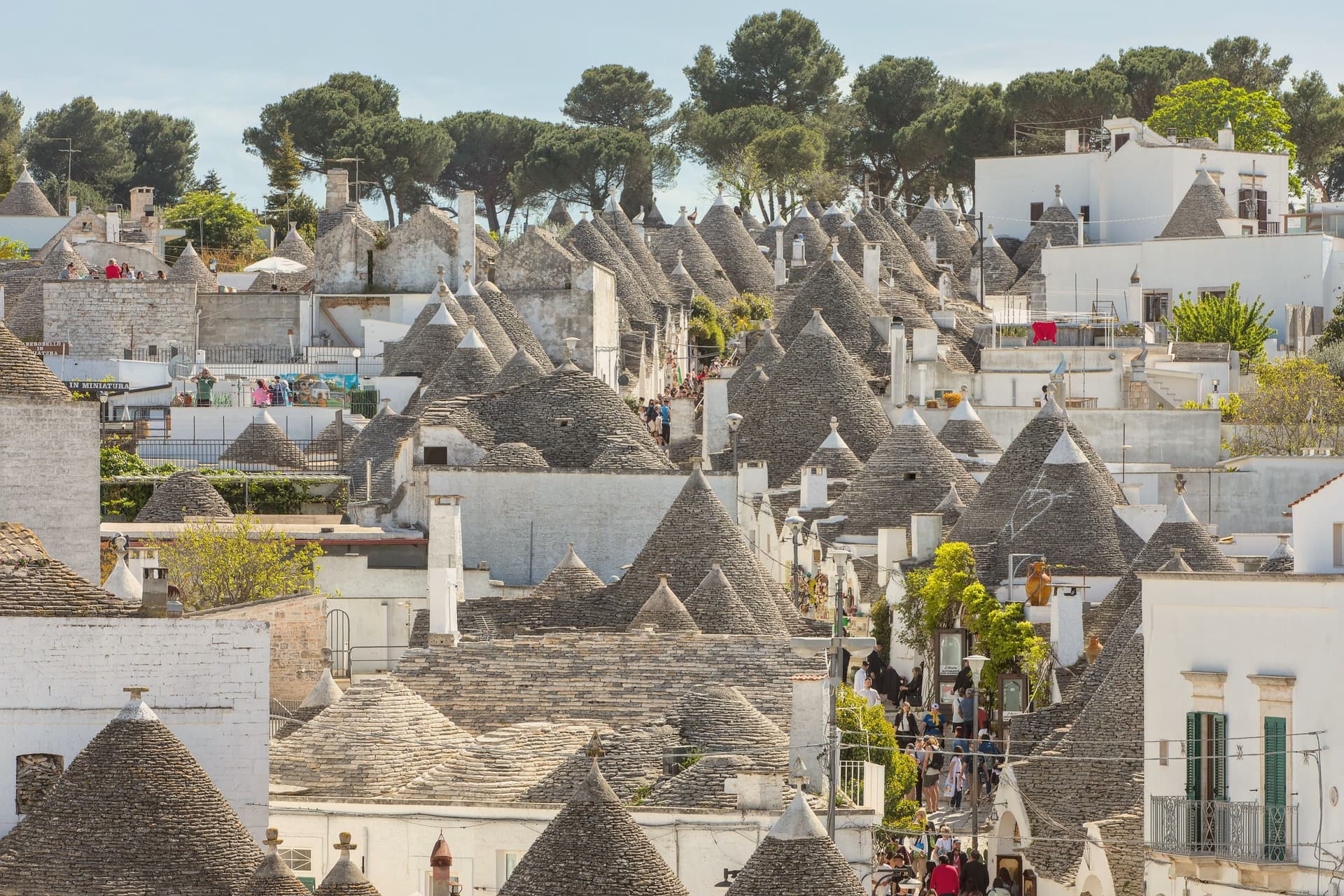
Alberobello sits at 402 meters in the Valle d'Itria, forty-five kilometers southeast of Bari. Two quarters of the town, Rione Monti and Aja Piccola, hold more than 1,500 trulli: limestone cones built from corbelled drystone, with conical or pyramidal roofs piled course by course without mortar.
The technique is prehistoric and still in use across the Murge, but nowhere else is the density and preservation what it is here. The Counts of Conversano enforced drystone construction on their tenant farmers to dodge a Spanish viceroy's tax on permanent settlements: a building that could be dismantled in an afternoon did not count as a town.
UNESCO listed the trulli in 1996. Some are houses, some are shops, some are inhabited by the same families that built them.
The Trullo Sovrano, the only two-storey trullo, was built around 1750 and now functions as a small museum.
Evo Ristorante have been named by a guide.
What to see in Alberobello
- Rione Monti. The larger of the two trulli quarters, a thousand cones running down the hillside, mostly converted to shops and accommodation.
- Aja Piccola. The smaller residential quarter, about four hundred trulli, still occupied as primary housing and quieter than Rione Monti.
- Trullo Sovrano. The only two-storey trullo in town, built around 1750 by the Perta family, now a small museum of trullo construction and daily life.
How to get to Alberobello
There is a railway station in the town, so you can arrive without a car and never need one while you are here. Taranto is roughly 56 minutes away by road.
Our tip
April through June and September through October are the months the Itria valley is green and the trulli are walkable without sweat. July and August push past thirty-three degrees and the Rione Monti fills with day-trippers from the coast; by ten in the morning the main streets are shoulder to shoulder. Late afternoon and after dusk are the times to walk, when the cones cast long shadows and the crowds thin.
Vieste
Why visit Vieste
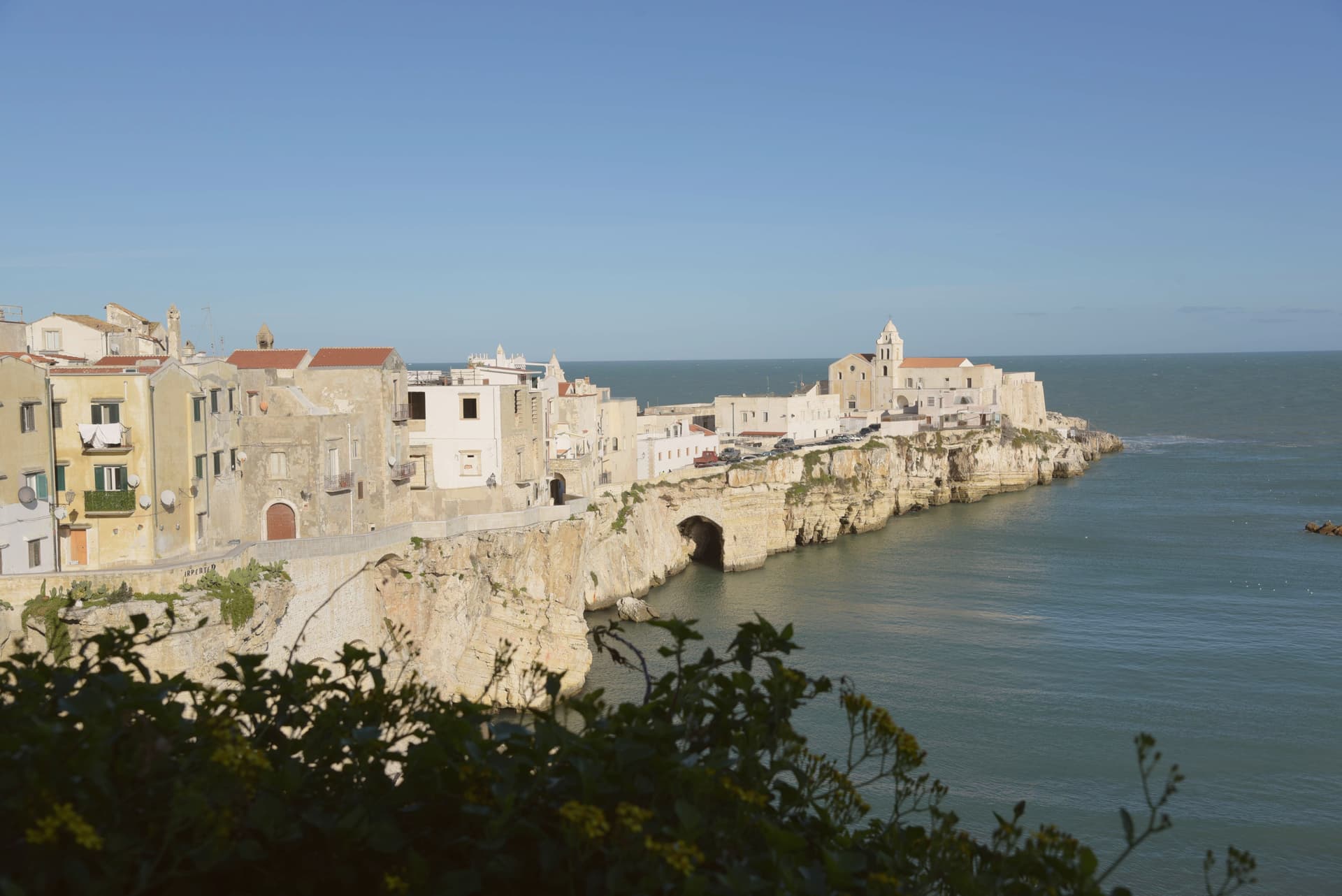
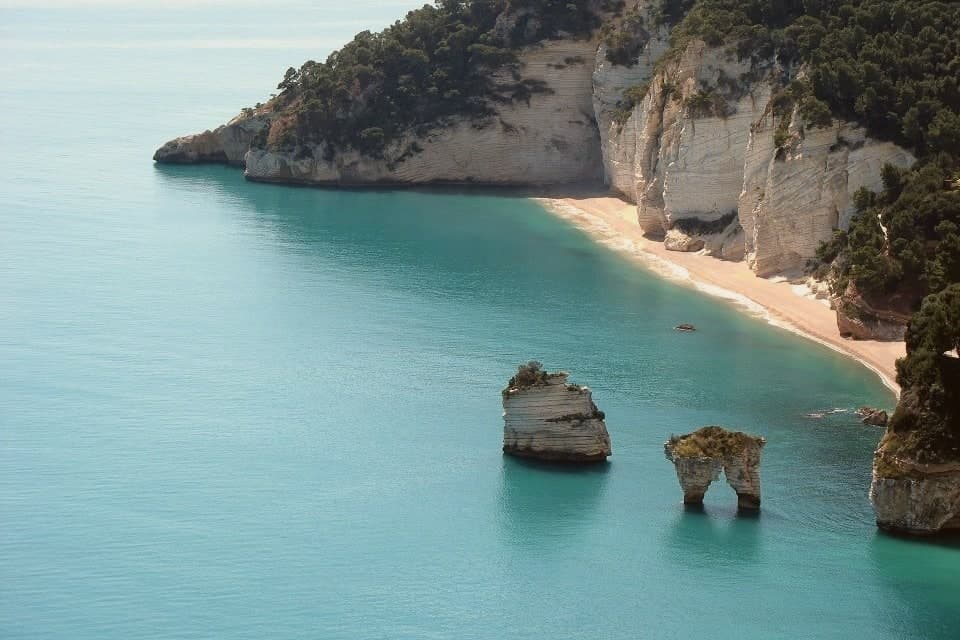
Vieste sits at the eastern tip of the Gargano promontory inside Gargano National Park, a medieval town on a white limestone cliff dropping straight into the Adriatic. The Cathedral was begun in the second half of the eleventh century in Apulian Romanesque, with three naves on two rows of six columns and capitals carved in oriental floral and animal motifs.
The Norman castle of the eleventh century was rebuilt by Frederick II in 1242 as part of a coastal fortification line; the trapezoidal block of 1242 still anchors the headland. On July 18-21, 1554, the Ottoman corsair Dragut sacked the town and executed roughly 5,000 inhabitants on the slab of stone now known as the Chianca Amara, the bitter stone, set into the lane that carries the memory.
Pizzomunno, the 26.6-meter limestone sea stack on Spiaggia del Castello, is the symbol of the Gargano and the centerpiece of a local legend about a fisherman whose lover was taken by sirens. The Bandiera Blu marks the water at Pizzomunno, Scialmarino and Lungomare Mattei.
Al Dragone, Donlù, La Ripa and 1 more have been named by a guide.
What to see in Vieste
- Cattedrale di Santa Maria Assunta. Eleventh-century Apulian Romanesque cathedral, three naves on two rows of six columns, with Corinthian and cubic capitals carved in zoomorphic and floral motifs.
- Castello Svevo. Norman fortress rebuilt by Frederick II in 1242 on the headland above the sea, part of the Hohenstaufen Adriatic defensive line, still anchoring the old town.
- Pizzomunno. Limestone sea stack 26.6 meters high on Spiaggia del Castello, the symbol of Vieste and the Gargano, attached to the legend of the fisherman and his stolen lover.
How to get to Vieste
Foggia is roughly 109 minutes away by road.
Our tip
May, June, September and the first half of October are the windows when Vieste works without the heat or the August crowd: warm Adriatic, breezy headland, the centro storico walkable in afternoon as well as evening. July and August are very hot and crowded, with the Bandiera Blu beaches at capacity and rates at peak; the centro storico empties between two and five and refills after sunset for the passeggiata. October still holds for swimming on the south-facing beaches.
Carovigno
Why visit Carovigno
Carovigno sits at 161 meters in upper Salento, seven kilometers from the Adriatic and thirty kilometers from Brindisi. The distance between hill and sea shapes the commune: a walled town on high ground looking inland toward Ostuni, and a strip of protected coast running north along the water, eight kilometers of it, separate enough from the centro storico that they read almost as two different places joined by one municipal boundary.
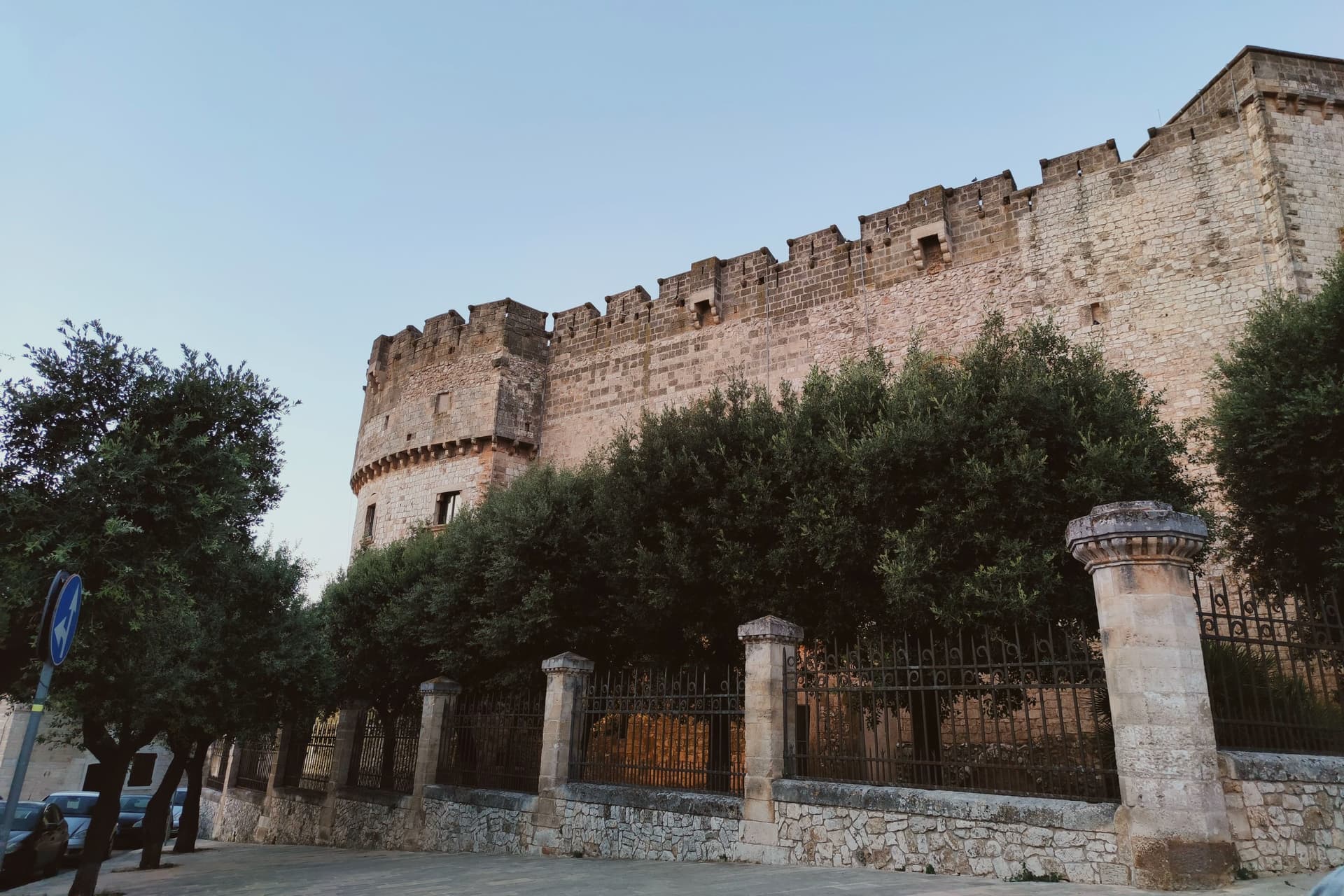
The old town itself is compact, arranged around its mother church with the castle at the summit and the medieval walls, patched with older stone, closing the circuit. Outside the walls, three kilometers off, stands the sanctuary that draws the town out of itself once a year for the Easter procession.
The coast belongs to no season and no rite in particular. It is simply there, kept clear of building, running along the edge of the commune while the life of the town carries on up on the hill.
What holds Carovigno together is this separation of functions: defense and worship concentrated on the high ground, the shoreline left open and undeveloped, and the two connected only by the road and by the yearly walk to the sanctuary.
Dissapore di Andrea Catalano, Già Sotto l'Arco, Casale Ferrovia and 1 more have been named by a guide.
What to see in Carovigno
- Castello Dentice di Frasso. Fortress at the highest point of the centro storico, built for defense and later remade into an aristocratic residence, its rooms and outlook telling a different story from its military origins.
- Cinta muraria e torri medievali. Four towers, Torre del Civile, Torre Giranda, Torre delli Brandi and Torre del Prete, still standing on foundations laid before the medieval walls that now bear their names.
- Riserva Naturale di Torre Guaceto. The shoreline itself: shallow clear water, dune systems underfoot and a watchtower standing alone against the coast, reachable north of the town.
How to get to Carovigno
There is a railway station in the town, so you can arrive without a car and never need one while you are here. Taranto is roughly 69 minutes away by road.
Our tip
May through September are the months the Adriatic warms enough to swim at Torre Guaceto and the upper-Salento groves are walkable without sweat. July and August push past thirty-three degrees and the centro storico fills with day-trippers from the Brindisi-Ostuni stretch. June and September are the steadier months, water still warm and the trattorie open without the August crowds.
Conversano
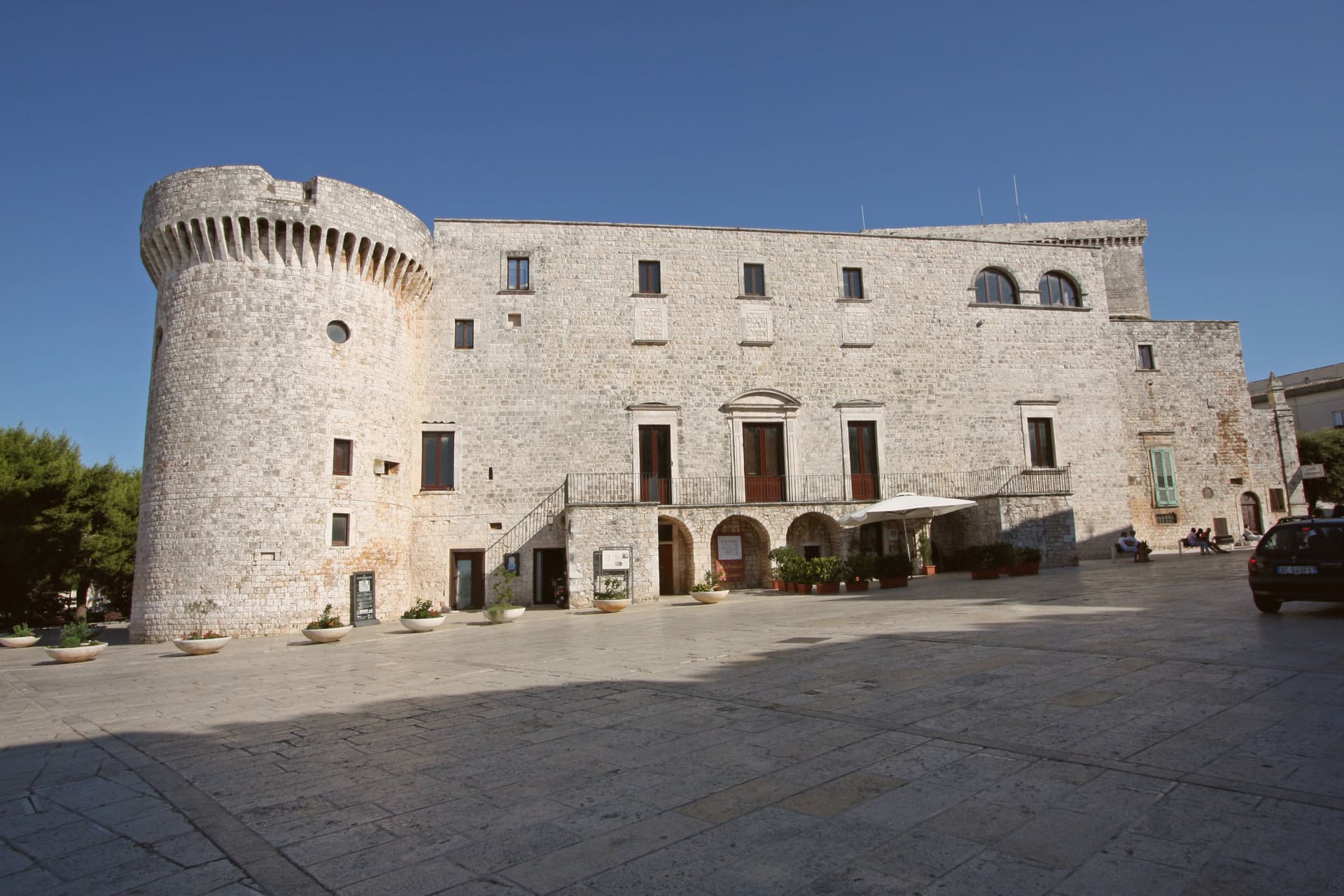
Why visit Conversano
Conversano sits on the first hills of the Murge plateau at 219 meters, twenty-five kilometers southeast of Bari and seven from the Adriatic. The Castello di Conversano was raised around 1054 by the Normans for defence and turned into a seigneurial residence by the Acquaviva d'Aragona counts, who ruled from 1455 until the early nineteenth century.
Inside the castle the Pinacoteca holds the ten-canvas cycle of episodes from Tasso's Gerusalemme Liberata painted by Paolo Domenico Finoglio in the 1640s, commissioned by Count Giangirolamo II d'Acquaviva. Opposite the castle stands the Cattedrale di Santa Maria Assunta, eleventh- and twelfth-century Apulian Romanesque with a sculpted portal, a rose window, and an interior Crucifix that anchors the patronal procession.
The former Monastero di San Benedetto, with a Romanesque cloister, was entrusted in 1266 by Pope Clement IV to Cistercian nuns exiled from Methoni in Greece, an arrangement so unusual it earned the monastery the medieval nickname Monstrum Apuliae, the Wonder of Puglia.
Vita Pugliese have been named by a guide.
What to see in Conversano
- Castello di Conversano. Norman castle of 1054 turned seigneurial residence by the Acquaviva d'Aragona counts, with the Pinacoteca holding Finoglio's ten Gerusalemme Liberata canvases.
- Cattedrale di Santa Maria Assunta. Apulian Romanesque cathedral of the eleventh and twelfth centuries, sculpted portal, rose window, wooden Crucifix venerated as the city's protector.
- Monastero di San Benedetto. Former Benedictine then Cistercian monastery with Romanesque cloister, called Monstrum Apuliae for the abbess-power of the Greek nuns entrusted to it from 1266.
How to get to Conversano
There is a railway station in the town, so you can arrive without a car and never need one while you are here. Bari is roughly 36 minutes away by road.
Our tip
April through June and September through October are the Murge months at this altitude: clear light, mild evenings, the cherry orchards in flower or fruit. Conversano is the centre of the IGP cherry zone and the late-May ciliegia harvest is the year's commercial peak. July and August hit thirty-five degrees and the centro storico empties in the afternoon.
Fasano
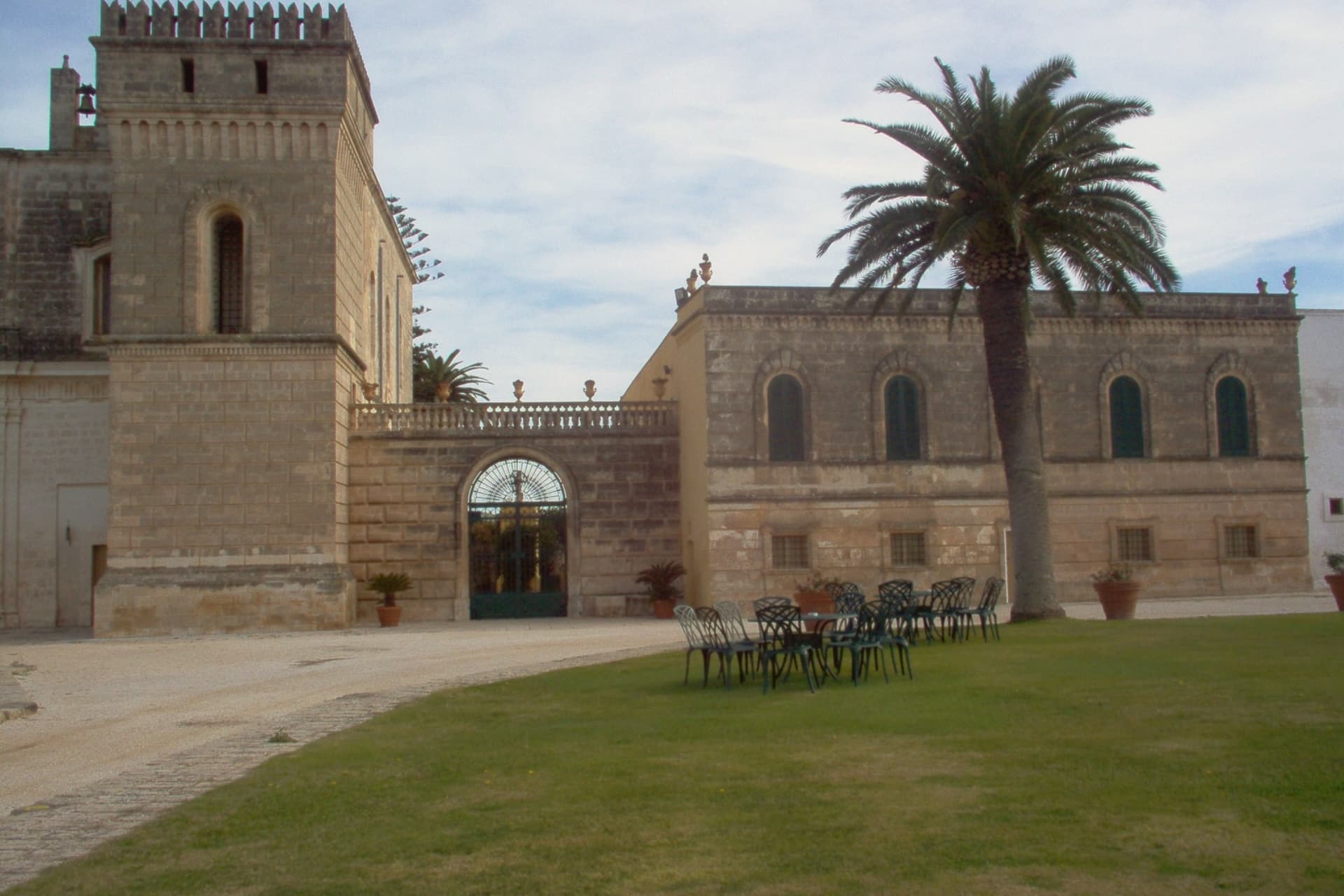
Why visit Fasano
The main centre sits at 118 meters, a hinge point in a wide municipal territory that runs from the Adriatic shore up to the Itria escarpment, home to thirty-eight thousand residents spread across three distinct landscapes rather than one compact town. The coast holds the abandoned city, inhabited from the fifteenth century BC and left empty by the Middle Ages, its excavated stone now sitting a short distance from the museum built to house what came out of the ground there.
Inland and uphill, the wooded escarpment climbs to become the highest ground in the province, the same slopes that carry the wildlife park across its carob and olive scrubland. Further along the shore, the fishing port turned resort gives the territory its beach frontage.
The pattern is coastal city, wooded highland, coastal resort, three pieces of a single municipality that never behaves like a single place. What the town offers is that range within one boundary: Roman ruins at sea level, a panorama at the province's highest point, and a working beachfront, none of them a detour from the others.
Pentole e Provette, Due Camini a Borgo Egnazia, Raparossa have been named by a guide.
What to see in Fasano
- Parco Archeologico di Egnazia. Ruins spread across eighty hectares along the coast, with the Via Traiana running through the site alongside the basilica and a cryptoporticus still traceable underfoot.
- Museo Nazionale Archeologico Giuseppe Andreassi. Museum standing next to the archaeological park, holding the objects pulled from the excavations: Messapian inscriptions, Roman finds, and material spanning the long abandonment of the city.
- Selva di Fasano. Wooded escarpment reaching between 411 and 414 meters, the ground rising from carob and olive scrub to open views that give the terrace its nickname.
How to get to Fasano
There is a railway station in the town, so you can arrive without a car and never need one while you are here. Bari is roughly 52 minutes away by road.
Our tip
May through September is the working season on this stretch of the Adriatic: warm sea, the Bandiera Blu beaches at Savelletri operating, the Selva ten degrees cooler than the coast for an evening break. July and August fill the coast with Italian holidaymakers; Egnazia exposed on the seafront is brutal between noon and three. April and October are quieter alternatives with the sea still mild, the archaeological park at its photographic best, and the olive harvest opening across the surrounding masserie. Festa Della Mietitura E Trebbiatura Del Grano falls in August.
Monopoli
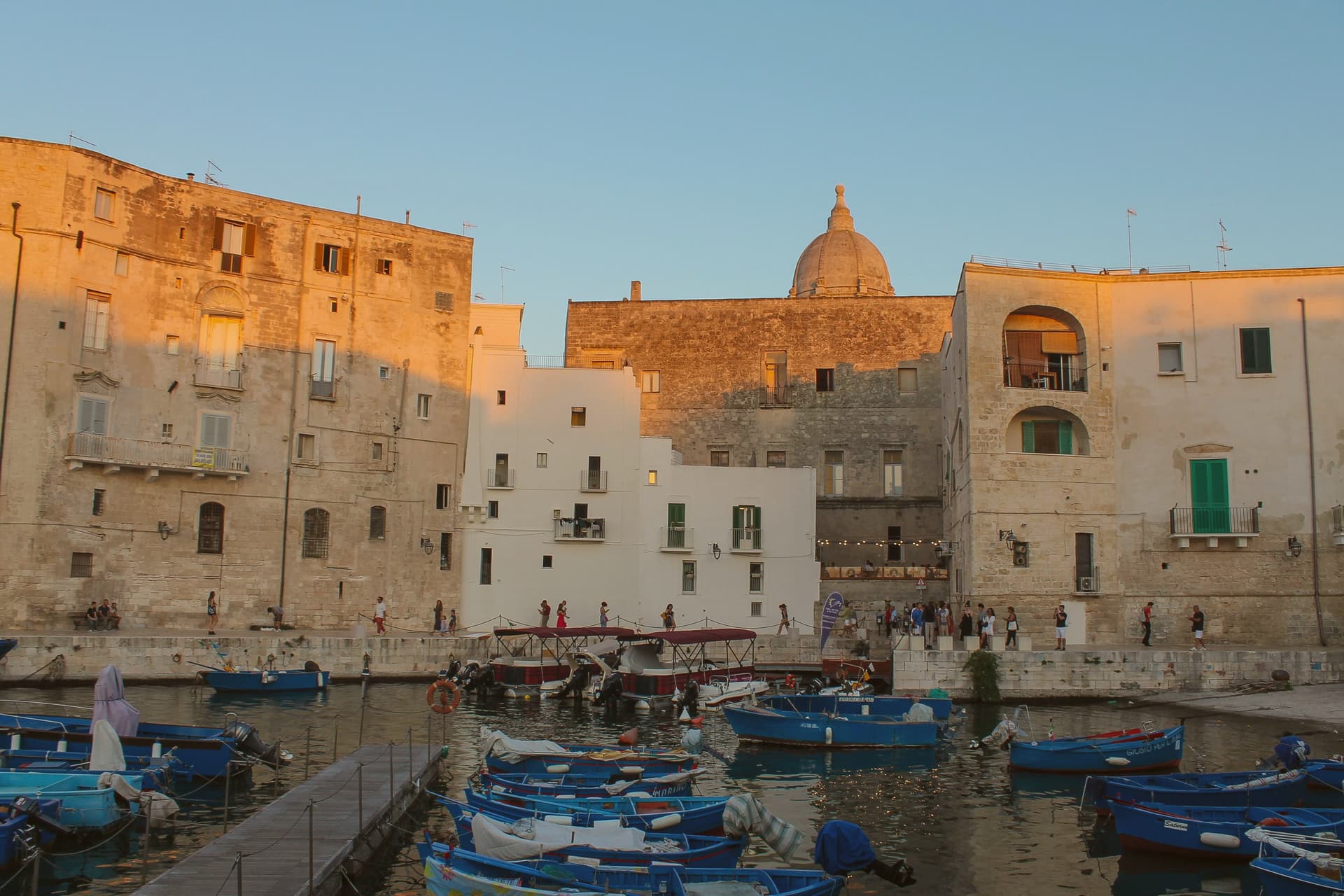
Why visit Monopoli
Monopoli sits on the Adriatic forty kilometers southeast of Bari, a walled town extending from the sea fifteen kilometers inland to the first Murge hills. The territory covers 156 square kilometers with sandy coves, cliff sections and the old port at the centro storico.
The site has been inhabited since the Epigravettian, around fifteen thousand years ago; a fortified Messapian settlement existed by 500 BC. The name comes from the Greek for 'only city,' which Monopoli inherited when refugees from nearby Gnatia arrived after the Ostrogoth king Totila destroyed it in 545.
Byzantines, Normans and Hohenstaufen followed. In 1484 Venice took the town and ran it as a trading port between Bari and Brindisi for sixty years.
The Castello Carlo V on the headland and the resistance to the imperial Armada in 1529, which forced the Spaniards to abandon a three-month siege, both belong to that century of fortification.
Radimare, Orto, My Wine il piacere del palato and 1 more have been named by a guide.
What to see in Monopoli
- Castello Carlo V. Sixteenth-century pentagonal fortress on the headland above the old port, built by the Spanish to defend against Ottoman raids and Venetian return.
- Basilica Cattedrale Maria Santissima della Madia. Eighteenth-century baroque cathedral on the old town's central square, raised over earlier medieval foundations, the city's principal monument.
- Centro storico. Walled old town on the small headland, white limestone alleys, the cathedral and the castle facing each other across narrow lanes above the port.
How to get to Monopoli
There is a railway station in the town, so you can arrive without a car and never need one while you are here. Bari is roughly 42 minutes away by road.
Our tip
May through September is the working coastal season, water warm enough for swimming and the old port quay populated until late. July and August push past thirty-three degrees and the centro storico fills with day-trippers from Bari and Polignano; weekends in August are shoulder to shoulder along the quay. June and September are the sane choices, mild evenings and the same water without the crush.
San Severo
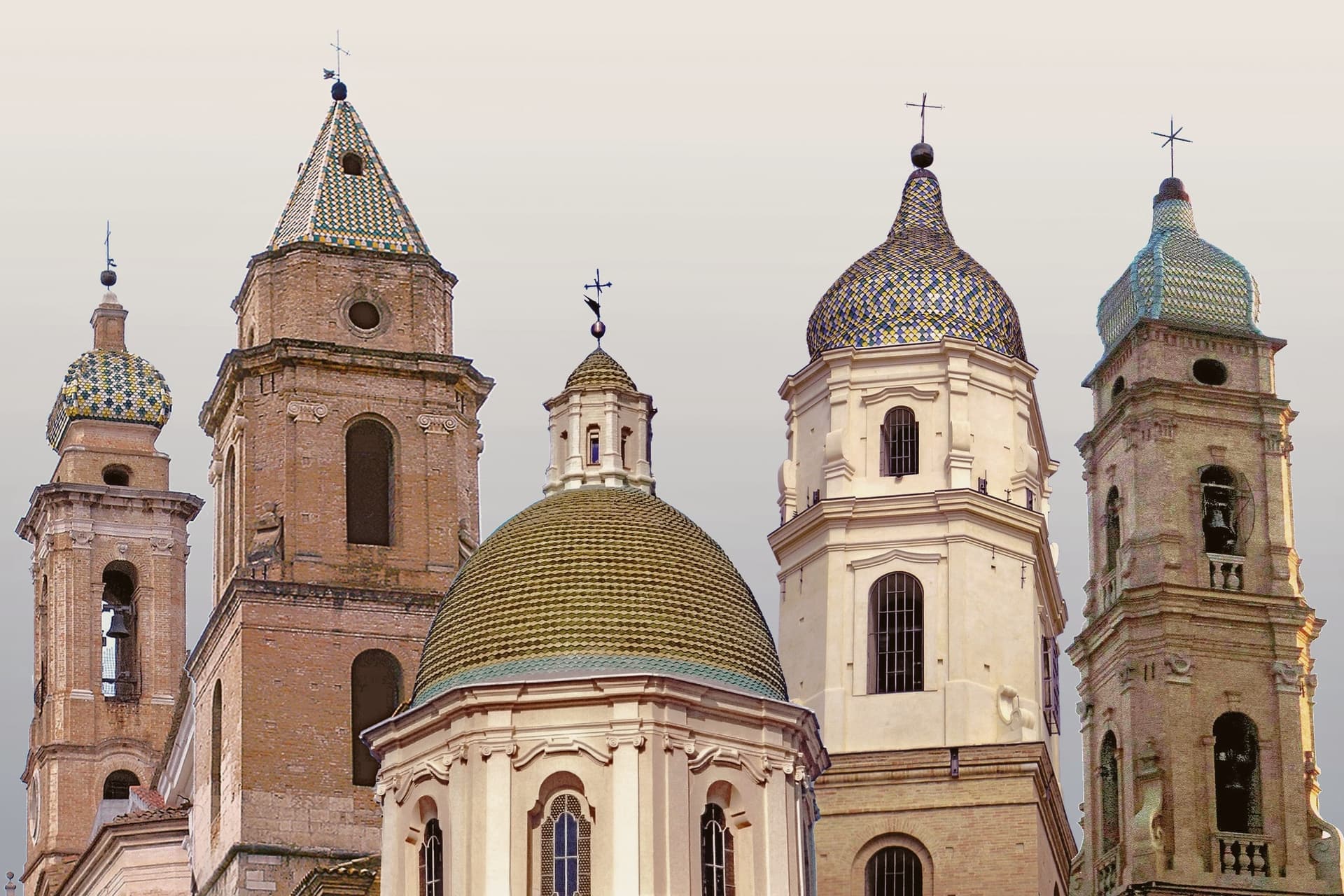
Why visit San Severo
San Severo sits at 86 meters on the Tavoliere delle Puglie, north of Foggia and inland from the Gargano. The town was founded in the eleventh century around a small church built by Benedictine monks from Montecassino, and grew through the medieval period into the capital of the upper Daunia.
The 1627 earthquake almost levelled it, killing eight hundred inhabitants and pulling reconstruction into the late seventeenth century after a plague epidemic in 1656 added three thousand more deaths. The Cattedrale di Santa Maria Assunta, originally late-medieval, was rebuilt in Baroque after the quake.
San Severo is best known nationally for its wine: the San Severo DOC, approved on 19 April 1968 by presidential decree, was the first protected designation in Puglia, with 2,000 hectares of red, white, rosé and the occasional spumante across San Severo, Torremaggiore, San Paolo di Civitate, Apricena, Lucera and Lesina. The annual Carnevale, with its rolling fanoia firework blasts, is one of the loudest in southern Italy.
La Fossa del Grano have been named by a guide.
What to see in San Severo
- Cattedrale di Santa Maria Assunta. Late-medieval cathedral rebuilt in Baroque style after the 1627 earthquake, the principal religious monument of the Daunia.
- Chiesa di San Severino Abate. Baroque basilica dedicated to the patron saint, built over the eleventh-century Benedictine foundation that gave the town its name.
- Palazzi Baroque. Eighteenth-century noble palazzi built in the post-earthquake reconstruction, lining the streets of the centro storico.
How to get to San Severo
There is a railway station in the town, so you can arrive without a car and never need one while you are here. Foggia is roughly 31 minutes away by road.
Our tip
April through June and September through October are the workable months on the Tavoliere. The vineyards of the San Severo DOC are in leaf by April and in harvest from late August through September. July and August push past thirty-eight degrees on the open plain and the centro storico empties between two and five; the Tavoliere is one of the hottest places in Puglia. Festa di San Rocco falls in August.
Andria
Why visit Andria
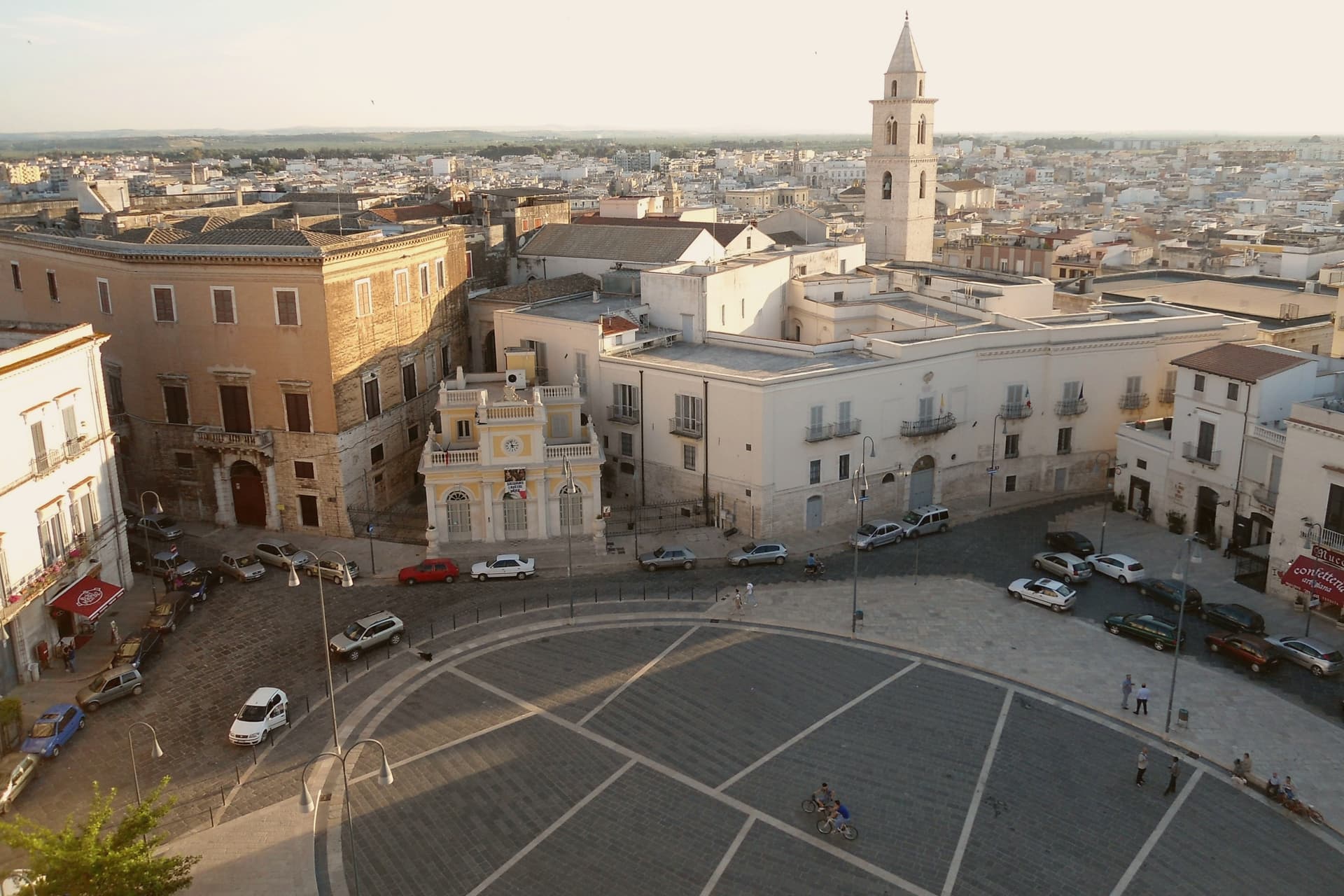
Andria sits on the Murge plateau at 151 meters, ten kilometers from the Adriatic, the third-largest city in Puglia after Bari and Taranto. It was made a fortified civitas in 1046 under Peter the Norman, with twelve towers, three gates and a citadel; Frederick II raised it again in the thirteenth century and built his most famous castle on a hilltop eighteen kilometers south of the city walls.
The city and Castel del Monte read as two expressions of the same Frederician ambition, one a working civitas of towers and gates, the other a solitary geometric exercise on an open plateau with no town around it at all. The other claim Andria makes is burrata, invented around the early twentieth century by the Bianchino family as a way to use leftover mozzarella scraps.
A fortified city, an unfinished castle, and a cheese born from kitchen thrift: the Murge produced a walled seat of power and, separately, an object meant to be looked at rather than defended, and a food born of nothing more than not wanting to waste the scraps.
Confetteria Mucci Giovanni con annesso Museo del Confetto, Antichi Sapori, Il Turacciolo have been named by a guide.
What to see in Andria
- Castel del Monte. An octagonal prism with eight octagonal towers, standing alone on a Murge hilltop and visible for fifty kilometers in any direction. Never finished, never used for war.
- Cattedrale di Santa Maria Assunta. Romanesque cathedral founded in the twelfth century, rebuilt over the centuries, holds the crypt and the relics of San Riccardo, the city's patron.
- Chiesa di Sant'Agostino. Gothic-Romanesque church built by the Teutonic Knights in the late thirteenth century, with a sculpted portal that is one of the finest in Puglia.
How to get to Andria
There is a railway station in the town, so you can arrive without a car and never need one while you are here. Bari is roughly 63 minutes away by road.
Our tip
April through June and September through October are the Murge months: clear light, mild evenings, the Castel del Monte plateau walkable without sweat. July and August hit thirty-six in the city and the castle exposed at 540 meters is brutal between noon and four. October is the olive harvest.
More from Anywhere Italy
- The 10 best hill towns with a serious restaurant in Puglia
 The best coastal towns with a serious restaurant in Puglia
 The best olive oil towns that eat well within 90 minutes of Bari
 The best hidden olive oil towns in Puglia
 The best hidden olive oil towns that eat well in Puglia
- The best hidden towns with a serious restaurant in Puglia