
The best hidden towns with a serious restaurant in Puglia
Puglia eats in a way that stays close to the ground it comes from: cime di rapa with orecchiette, raw prawns from the Adriatic, burrata still warm in its knotted skin, lamb turned on a spit in a butcher's back room, bitter chicory with a pool of fava purée. The houses are limestone and tufo, whitewashed against the summer, and the light off the stone in late spring is hard and clean. Autumn is the good season for the interior, when olives come in and the new oil tastes green and peppery. Along the coast the water stays swimmable well into October, and the fish menus lengthen rather than shorten.
Most visitors follow the same line, and it runs through Polignano a Mare and Lecce, with a stop in the Valle d'Itria for a masseria hotel and a cookery lesson. Polignano's cove is one of the most photographed pieces of coastline in the south, which means the terraces above it are booked out from June and the parking is a minor ordeal. Lecce's baroque centre is worth the crowd, but its restaurants have learned what visitors will pay. Neither place is a mistake. They are simply the part of Puglia that has already been decided for you.
The limestone, the olive groves and the good kitchens continue well past that stretch. They carry north into the Murgia and the Gargano, where the cooking turns to lamb, sheep's cheese, mushrooms and forest game, and out along the Adriatic to towns whose harbours still land the fish their own restaurants serve. The towns here are the smaller ones, and fewer people go, but each holds a table listed by the most demanding of the dining guides. Several are best in the shoulder seasons, when the dining rooms are quieter and the cooks have time to talk.
Of the 59 communes we have mapped in Puglia, 19 qualify as towns with a serious restaurant: each holds a restaurant listed by the most demanding of the dining guides. This list is the hidden ones, 6 in all, ordered smallest first. The smallest, Peschici, has 4,283 residents.
Elsewhere in the catalogue: The best coastal towns with a serious restaurant in Puglia and The best olive oil towns with a serious restaurant in Puglia.
Peschici
Why visit Peschici
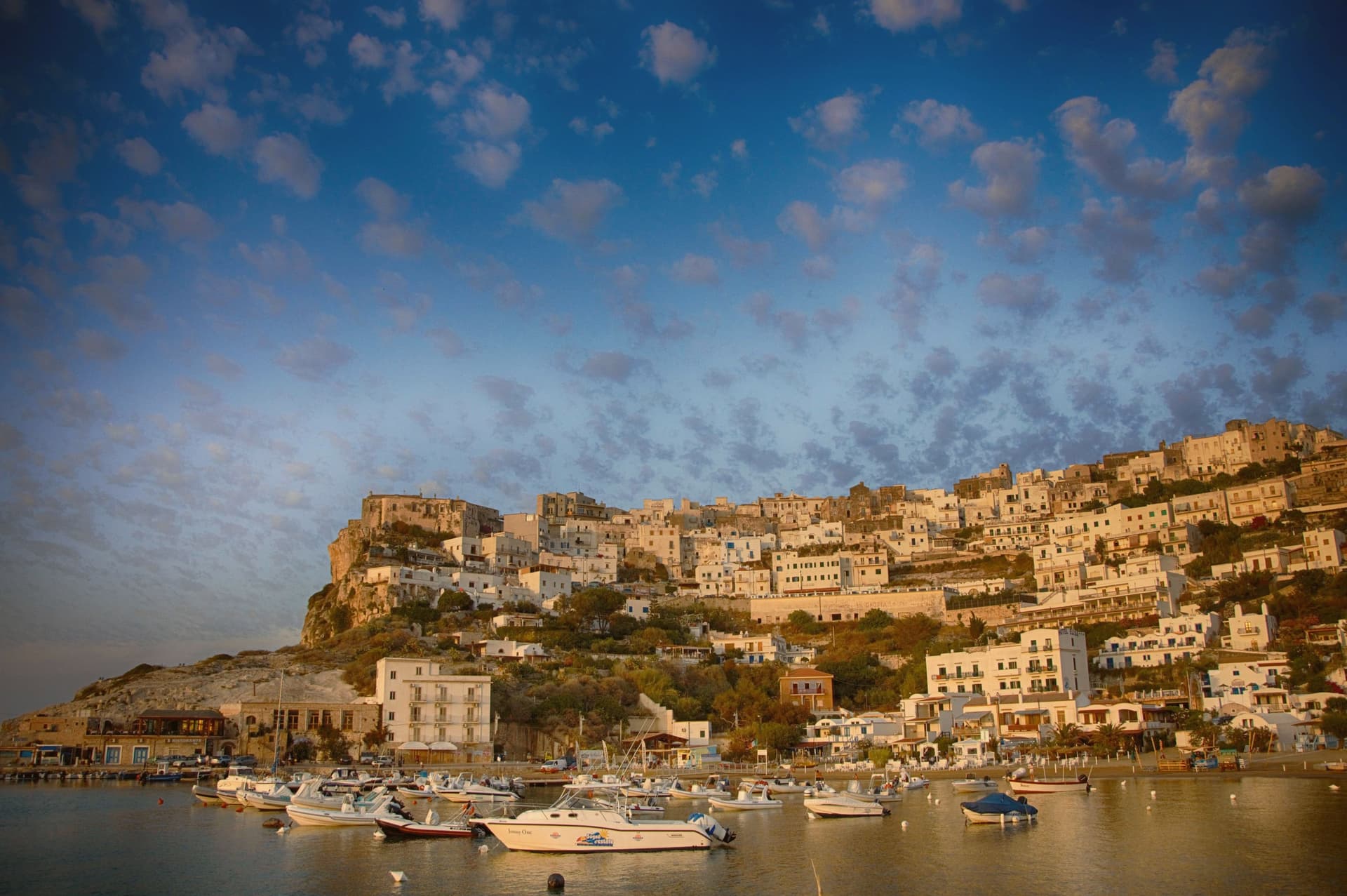
Peschici sits on a karst spur on the northeastern Gargano, 91 meters above the Adriatic, nine kilometers east of San Menaio and nineteen kilometers west of Vieste. The town was founded by the Daunians and later taken by the Romans, and the present village grew up around its cliff-top castle overlooking the small port below.
The municipal territory splits between the built village on its spur and the inland half, which falls within Gargano National Park: karst pine forest and limestone gorges running back from the coast. The coastline itself alternates sandy bays between limestone headlands with cliff sections reachable only from the sea, and the fishing platforms that work this stretch of Adriatic sit on the headlands at both ends of town, timber and rope structures fixed into the rock rather than built up from a harbor.
What holds the place together is the contrast between the white crown of the village, unusual on this coast for its flat and shallow-domed roofs, and the working coast beneath it: a fixed settlement on high ground looking down over a shoreline still worked by hand.
Porta di Basso, Eden, Al Trabucco da Mimì have been named by a guide.
What to see in Peschici
- Castello Normanno-Svevo. Expanded by the Swabians after its Norman origin, the castle stands over the port and is visible from the sea and from inland well before the village itself comes into view.
- Centro storico. White cliff-top village of small whitewashed houses with flat or shallow-domed roofs, unusual on the Gargano, terraced down the karst spur toward the sea.
- Baia di San Nicola. Sandy bay west of the village beneath limestone cliffs, with the small medieval monastery of San Nicola on the headland above the beach.
How to get to Peschici
Foggia is roughly 115 minutes away by road.
Our tip
May through September is the working season, Adriatic water warm enough to swim by late May and the cliff village operational until late. July and August fill the small headland with families from Foggia, Naples and Rome; the town's population multiplies several times and the karst spur runs out of parking by mid-morning. June and September are the sane choices, mild evenings and the same beaches without the crush.
Otranto
Why visit Otranto
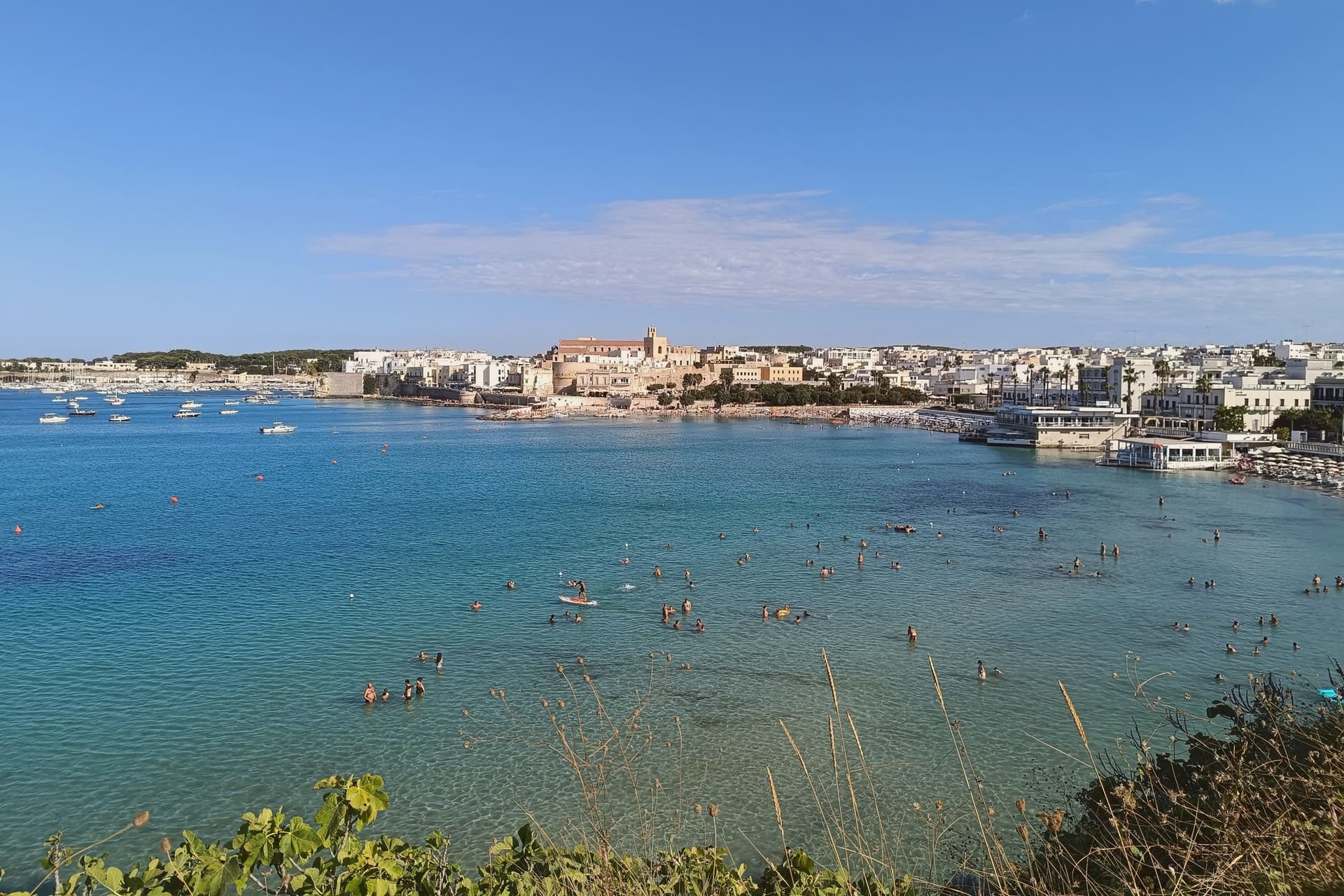
Otranto sits at sea level on a small promontory thirty kilometers southeast of Lecce, the easternmost city of Italy and the closest mainland point to Albania across the eighty-kilometer Strait of Otranto. The Cattedrale di Santa Maria Annunziata, consecrated in 1088, holds a mosaic floor laid between 1163 and 1165 by the monk Pantaleone for Archbishop Gionata.
About 800,000 tesserae across the three naves depict Adam and Eve, Noah, the Tower of Babel and a Tree of Life with biblical, classical and chivalric figures: Alexander the Great, Arthur, the months of the year. On 14 August 1480 an Ottoman force under Gedik Ahmed Pasha took the city; 813 inhabitants who refused to convert were beheaded on the Colle della Minerva and their bones are now in the cathedral, in seven glass-fronted recesses.
Pope Francis canonized them in 2013. The Castello Aragonese, raised by Ferdinand I of Aragon between 1485 and 1498, is the response: a five-sided fortress with a moat, built specifically to prevent a second sack.
Retrogusto, L' Altro Baffo, Umberto 1972 have been named by a guide.
What to see in Otranto
- Cattedrale di Santa Maria Annunziata. Norman cathedral consecrated in 1088, with Pantaleone's mosaic floor of 1163-1165 and the relics of the 813 martyrs of 1480 in seven glass recesses.
- Castello Aragonese. Five-sided Aragonese fortress raised 1485-1498 by Ferdinand I after the Ottoman sack, irregular plan with moat running the full perimeter.
- Chiesa di San Pietro. Byzantine cross-plan church in the centro storico, ninth-tenth century, with three apses and frescoes from the tenth through fifteenth centuries.
How to get to Otranto
There is a railway station in the town, so you can arrive without a car and never need one while you are here. Taranto is roughly 137 minutes away by road.
Our tip
May through September is the working coastal season, Adriatic water warm enough to swim by mid-May and the centro storico operational into the evening. July and August fill the small headland with day-trippers from across Salento and beyond; weekends in August are shoulder to shoulder along the Lungomare and the cathedral fills with queues. June and September are the sane choices, mild evenings and the same water without the crush.
Minervino Murge
Why visit Minervino Murge
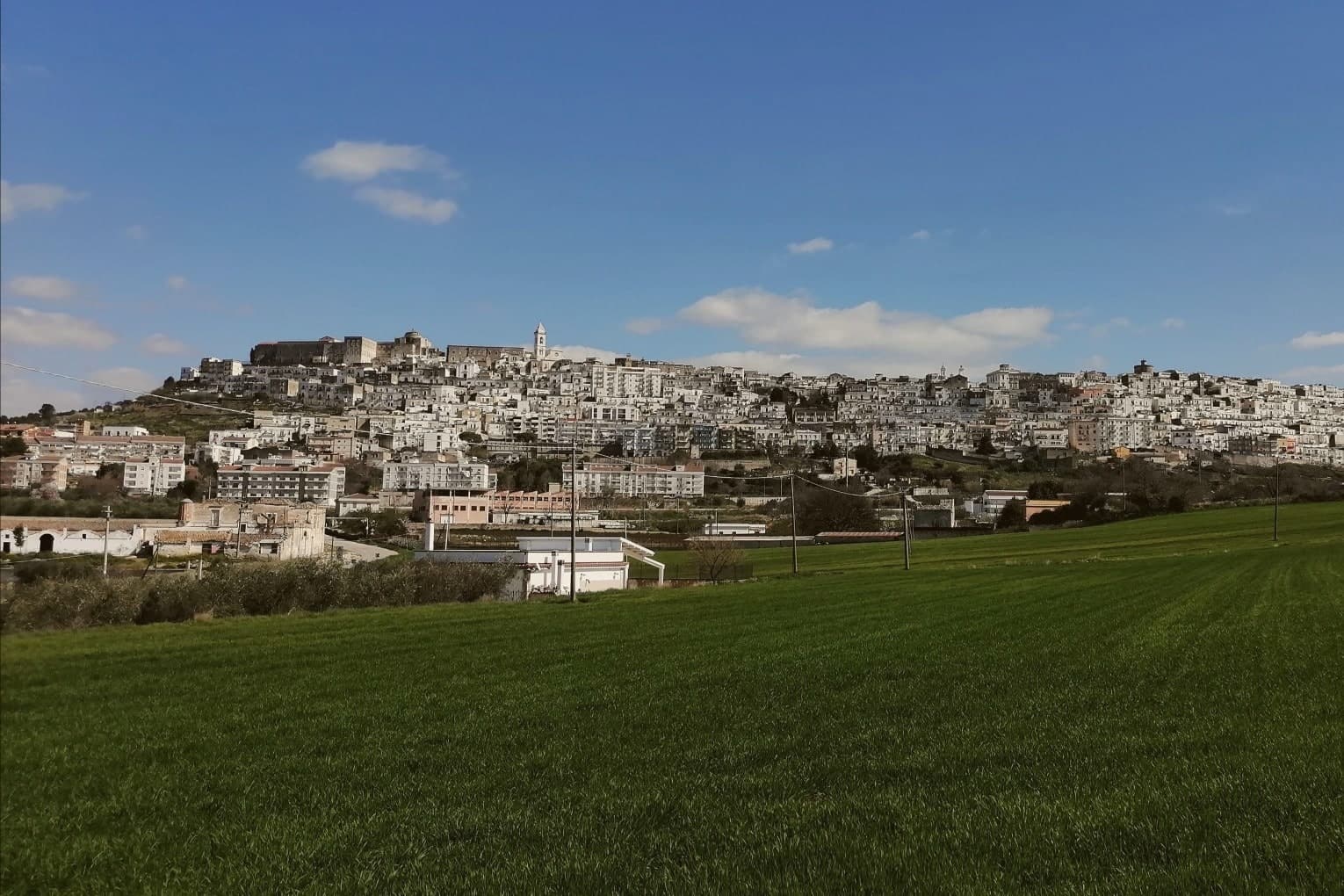
The town is built on two hills at the western edge of the Murgia plateau, where the limestone tableland gives out and the ground drops toward lower country on three sides. That break is what gives the ridge its long view and its nickname: to the east the eye crosses Murgia limestone toward the Gargano and the Adriatic, to the west it crosses cultivated fields into Basilicata, and to the north it runs the length of the Ofanto valley.
The old town sits above this drop, castle and tower on the high ground, cathedral below, the settlement organized around the same ridge that draws the view. Olive oil, almonds and grain define the rural economy beyond the walls, the plateau put to farming where it is not left to steppe grass and karst.
A ridge town, in other words, whose whole character, defensive site, pilgrimage cave, farmed hinterland, follows from the one geological fact of where the plateau ends.
La Tradizione - Cucina Casalinga, Masseria Barbera, A Sud dell'Anima have been named by a guide.
What to see in Minervino Murge
- Castello Normanno-Svevo. Norman fortress remodeled in the baronial period, with surviving towers and bastions on the high ridge above the old town.
- Torre di Pirro del Balzo. Fifteenth-century tower built between 1460 and 1490 when Minervino came to Pirro del Balzo as part of Maria Donata's dowry.
- Grotta di San Michele. Cave formed roughly two million years ago, reached through the karst rather than built, and still kept as a place of pilgrimage rather than display.
How to get to Minervino Murge
There is a railway station in the town, so you can arrive without a car and never need one while you are here. Foggia is roughly 62 minutes away by road.
Our tip
April through June and September through October are the months the Alta Murgia plateau runs best. The wildflower steppe peaks in May, almond blossom comes earlier in February, and the Ofanto valley below stays mild through autumn. July and August push past thirty-five degrees on the limestone with little shade; the centro storico empties between two and five and the panoramic belvedere is best at dawn or dusk.
Alberobello
Why visit Alberobello
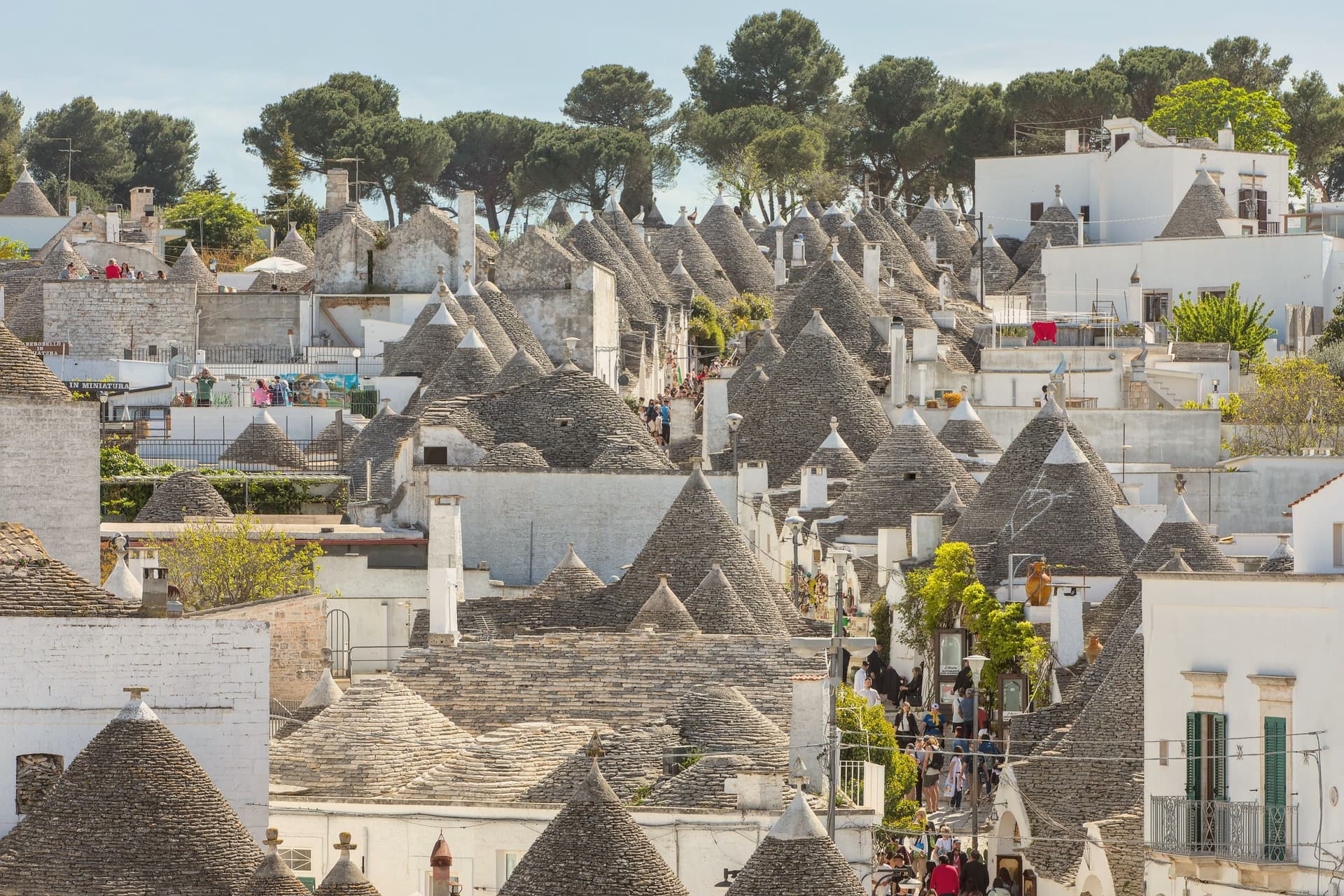
Alberobello sits at 402 meters in the Valle d'Itria, forty-five kilometers southeast of Bari. Two quarters of the town, Rione Monti and Aja Piccola, hold more than 1,500 trulli: limestone cones built from corbelled drystone, with conical or pyramidal roofs piled course by course without mortar.
The technique is prehistoric and still in use across the Murge, but nowhere else is the density and preservation what it is here. The Counts of Conversano enforced drystone construction on their tenant farmers to dodge a Spanish viceroy's tax on permanent settlements: a building that could be dismantled in an afternoon did not count as a town.
UNESCO listed the trulli in 1996. Some are houses, some are shops, some are inhabited by the same families that built them.
The Trullo Sovrano, the only two-storey trullo, was built around 1750 and now functions as a small museum.
Evo Ristorante have been named by a guide.
What to see in Alberobello
- Rione Monti. The larger of the two trulli quarters, a thousand cones running down the hillside, mostly converted to shops and accommodation.
- Aja Piccola. The smaller residential quarter, about four hundred trulli, still occupied as primary housing and quieter than Rione Monti.
- Trullo Sovrano. The only two-storey trullo in town, built around 1750 by the Perta family, now a small museum of trullo construction and daily life.
How to get to Alberobello
There is a railway station in the town, so you can arrive without a car and never need one while you are here. Taranto is roughly 56 minutes away by road.
Our tip
April through June and September through October are the months the Itria valley is green and the trulli are walkable without sweat. July and August push past thirty-three degrees and the Rione Monti fills with day-trippers from the coast; by ten in the morning the main streets are shoulder to shoulder. Late afternoon and after dusk are the times to walk, when the cones cast long shadows and the crowds thin.
Monte Sant'Angelo
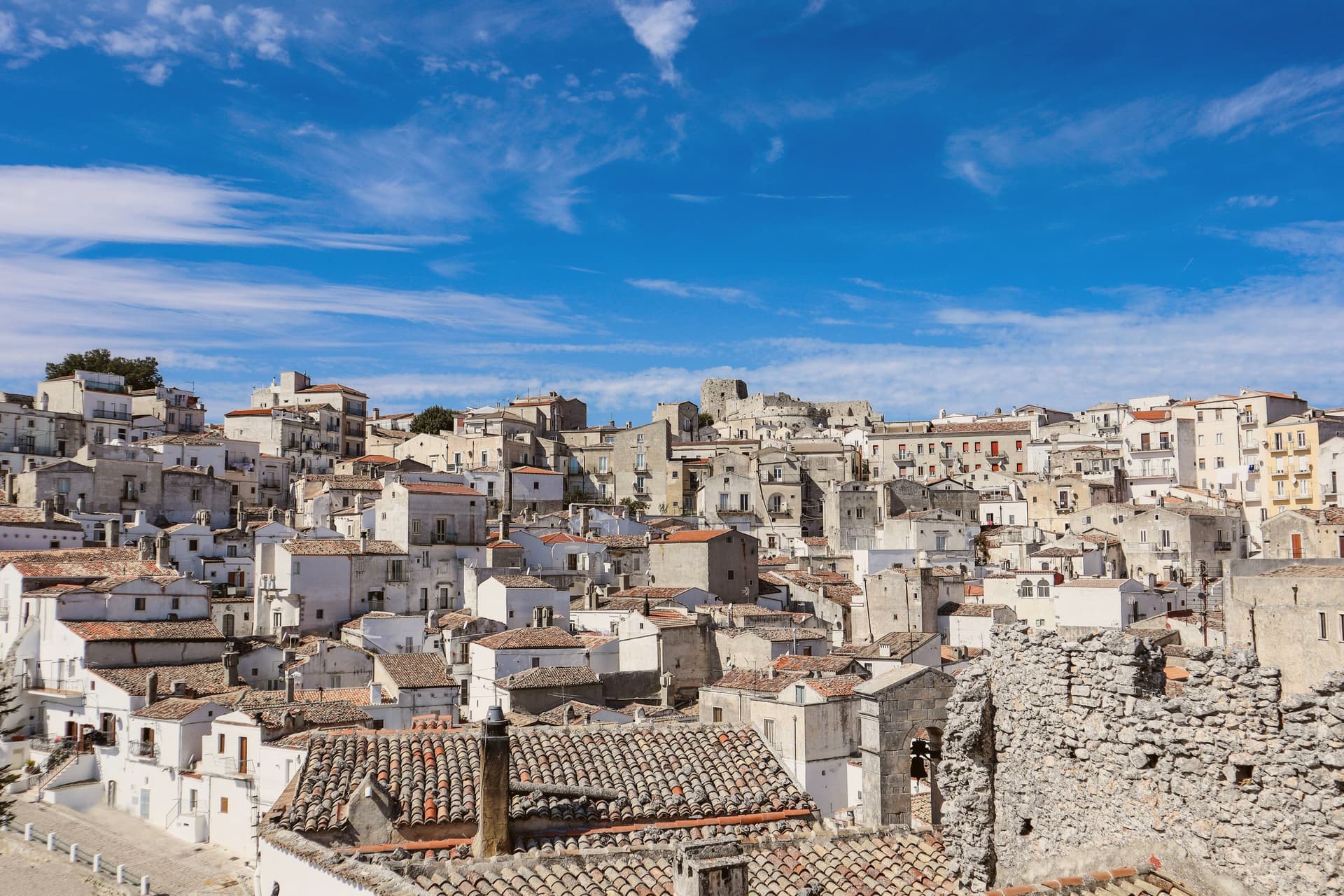
Why visit Monte Sant'Angelo
The town sits at 843 meters on the southern slope of the Gargano promontory, the highest inhabited settlement in the massif, with the Adriatic visible to the east on clear days. It is built around a cave where, according to tradition, the Archangel Michael appeared to the bishop of Siponto in 490.
A first sanctuary was raised over the cave in 493, and by the seventh century the Lombards of the Duchy of Benevento had made it the principal Michaeline shrine in the West and a fixed stop on the pilgrimage route to Jerusalem now called the Via Sacra Langobardorum. UNESCO inscribed the site in 2011 as one of seven sites in the serial property 'Longobards in Italy: Places of Power (568-774 A.D.)'.
The town itself steps down from the castle at its highest point through the sanctuary at its center to Rione Junno below, the old pilgrim quarter of stepped alleys and single-pitch roofs that housed the people who served the shrine. Beyond the commune, beech and oak forest of the Gargano National Park closes in on all sides.
What stands today is a settlement shaped entirely around one act of devotion, its layers of castle, cave, and quarter marking who came to guard, worship, and house the pilgrimage rather than any separate reason for a town to exist here at all.
Li Jalantuùmene, Casa li Jalantuùmene, Il Rifugio dell'Elda Hotel have been named by a guide.
What to see in Monte Sant'Angelo
- Santuario di San Michele Arcangelo. The cave sits at the heart of town, reached by descending stone stairs into rock that has been a shrine since the fifth century. Archangel Michael is said to have appeared here, and the sanctuary that grew around the site remains the town's core.
- Castello di Monte Sant'Angelo. Norman-Swabian-Aragonese castle above the sanctuary, expanded over five centuries on the highest point of the town, with views across the Gargano.
- Tomba di Rotari. Twelfth-century baptistery near the sanctuary, long misidentified as the tomb of the Lombard king Rotari, a fragment of the older religious complex.
How to get to Monte Sant'Angelo
Foggia is roughly 73 minutes away by road.
Our tip
May through October is the working season at 843 meters: cool mornings, dry afternoons, the sanctuary cave naturally cold year-round. June through August stay around twenty-six to twenty-nine degrees in town while Foggia bakes at thirty-eight on the Tavoliere below. The Festa di San Michele on 29 September is the patronal day and the busiest moment in the sanctuary calendar; pilgrims walk the final stretch of the Via Sacra from Siponto.
Vieste
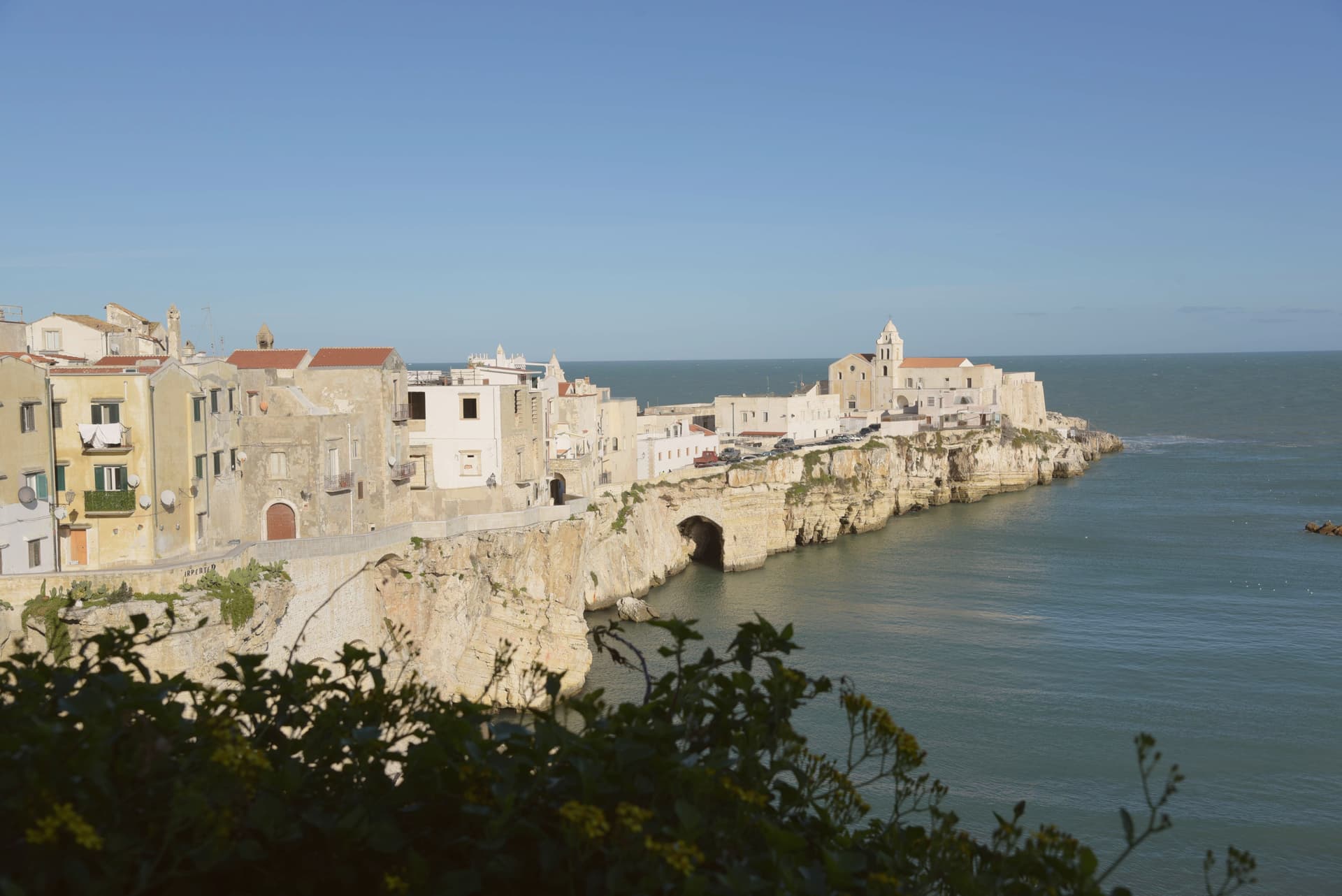
Why visit Vieste
Vieste sits at the eastern tip of the Gargano promontory inside Gargano National Park, a medieval town on a white limestone cliff dropping straight into the Adriatic. The Cathedral was begun in the second half of the eleventh century in Apulian Romanesque, with three naves on two rows of six columns and capitals carved in oriental floral and animal motifs.
The Norman castle of the eleventh century was rebuilt by Frederick II in 1242 as part of a coastal fortification line; the trapezoidal block of 1242 still anchors the headland. On July 18-21, 1554, the Ottoman corsair Dragut sacked the town and executed roughly 5,000 inhabitants on the slab of stone now known as the Chianca Amara, the bitter stone, set into the lane that carries the memory.
Pizzomunno, the 26.6-meter limestone sea stack on Spiaggia del Castello, is the symbol of the Gargano and the centerpiece of a local legend about a fisherman whose lover was taken by sirens. The Bandiera Blu marks the water at Pizzomunno, Scialmarino and Lungomare Mattei.
Al Dragone, Donlù, La Ripa and 1 more have been named by a guide.
What to see in Vieste
- Cattedrale di Santa Maria Assunta. Eleventh-century Apulian Romanesque cathedral, three naves on two rows of six columns, with Corinthian and cubic capitals carved in zoomorphic and floral motifs.
- Castello Svevo. Norman fortress rebuilt by Frederick II in 1242 on the headland above the sea, part of the Hohenstaufen Adriatic defensive line, still anchoring the old town.
- Pizzomunno. Limestone sea stack 26.6 meters high on Spiaggia del Castello, the symbol of Vieste and the Gargano, attached to the legend of the fisherman and his stolen lover.
How to get to Vieste
Foggia is roughly 109 minutes away by road.
Our tip
May, June, September and the first half of October are the windows when Vieste works without the heat or the August crowd: warm Adriatic, breezy headland, the centro storico walkable in afternoon as well as evening. July and August are very hot and crowded, with the Bandiera Blu beaches at capacity and rates at peak; the centro storico empties between two and five and refills after sunset for the passeggiata. October still holds for swimming on the south-facing beaches.
More from Anywhere Italy
- The best coastal towns with a serious restaurant in Puglia
- The best olive oil towns with a serious restaurant in Puglia
- The 7 best towns inside a national park that eat well in Puglia
- The best hidden coastal towns that eat well in Puglia
 The best hidden olive oil towns in Puglia
 The best hidden olive oil towns that eat well in Puglia