
The best towns inside a nature park that are worth a night in Puglia
90 towns visited, 910 to go. Follow along, free: Subscribe on Substack
Puglia is built out of pale limestone that holds the light late into the evening, and the towns that sit inside its regional nature parks get the landscape as well as the architecture: umbrella pines along the dunes, dry stone walls dividing olive groves that have been worked for centuries, macchia scrub smelling of myrtle and wild fennel after rain. Spring brings green wheat and poppies to the Murgia plateau before the heat sets in; September gives warm sea and quieter beaches. The food follows the ground, orecchiette with turnip tops, burrata and stracciatella from the dairies around the Itria Valley, sea urchins and raw prawns on the Ionian side, bread from Altamura wheat. Rooms in masserie, converted farm buildings with thick walls and vaulted ceilings, are the reason to stay the night rather than drive back.
Most visitors to the region head for Alberobello, where the conical trulli roofs are dense enough to have earned UNESCO protection and coach parties queue along the same two streets from mid-morning onward. It is remarkable and it is also small, which means the crowd has nowhere to spread out. Peak season turns the lower quarter into a souvenir corridor. People come for a couple of hours, photograph the roofs, and leave without sleeping anywhere near it.
The same limestone, the same trulli-dotted countryside and the same coastline continue well past that one town, and much of it falls inside protected park land: coastal dunes, salt marshes, karst gorges, ancient olive groves under regional designation. The towns in this list all sit within those park boundaries, and each has somewhere to stay that a travel guide has put its name to. Staying overnight is the point, because the parks read differently at dawn and at dusk than they do at noon from a car park.
Of the 59 communes we have mapped in Puglia, 7 qualify as towns inside a nature park worth staying overnight: each sits inside a regional nature park, and each has a hotel a travel guide has vouched for. The smallest, Otranto, has 5,631 residents.
If you are still choosing, we have also written The 7 best beach towns inside a nature park in Puglia and The best towns with a serious restaurant that sit inside a nature park in Puglia.
Why visit Otranto
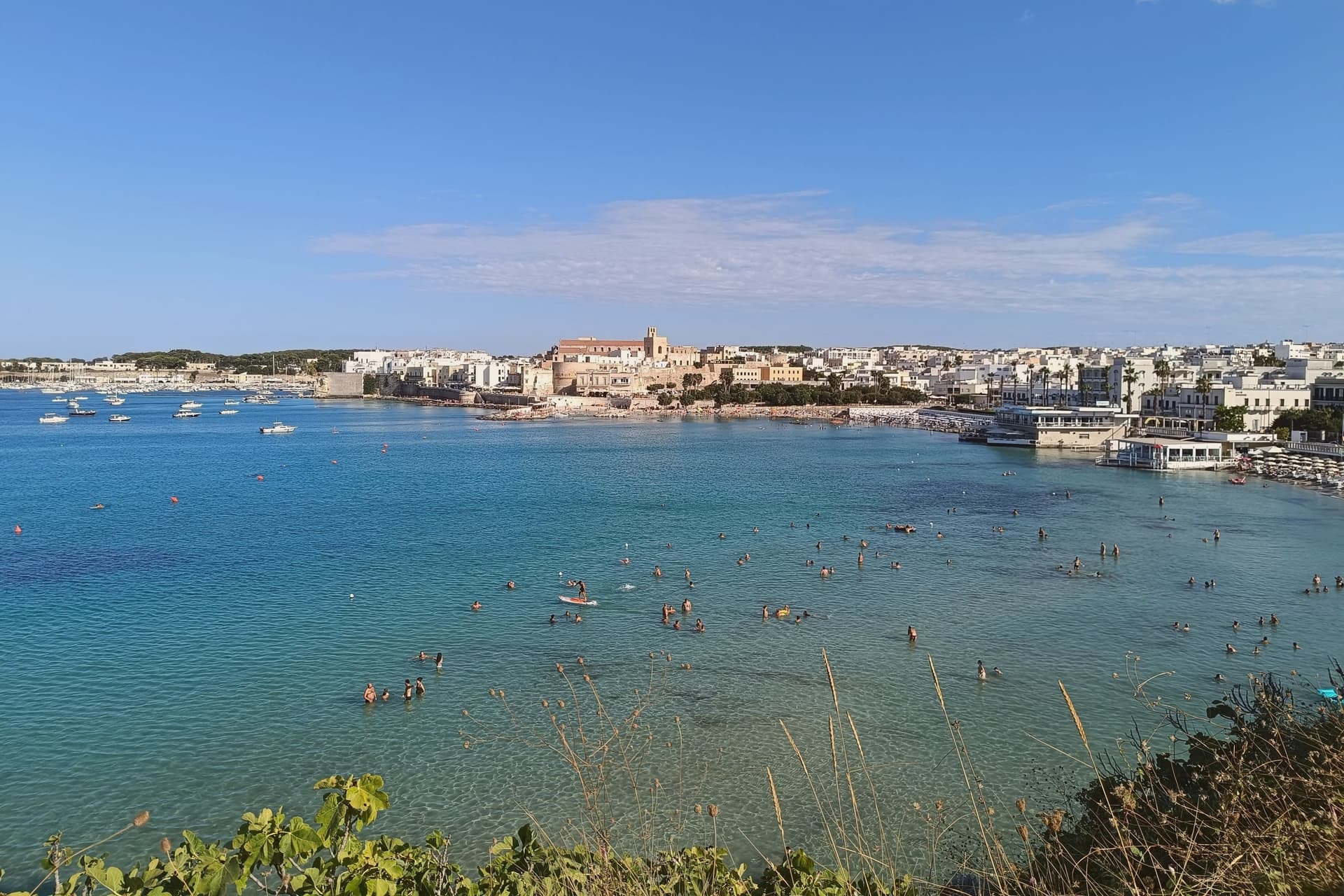
Otranto sits at sea level on a small promontory thirty kilometers southeast of Lecce, the easternmost city of Italy and the closest mainland point to Albania across the eighty-kilometer Strait of Otranto. The Cattedrale di Santa Maria Annunziata, consecrated in 1088, holds a mosaic floor laid between 1163 and 1165 by the monk Pantaleone for Archbishop Gionata.
About 800,000 tesserae across the three naves depict Adam and Eve, Noah, the Tower of Babel and a Tree of Life with biblical, classical and chivalric figures: Alexander the Great, Arthur, the months of the year. On 14 August 1480 an Ottoman force under Gedik Ahmed Pasha took the city; 813 inhabitants who refused to convert were beheaded on the Colle della Minerva and their bones are now in the cathedral, in seven glass-fronted recesses.
Pope Francis canonized them in 2013. The Castello Aragonese, raised by Ferdinand I of Aragon between 1485 and 1498, is the response: a five-sided fortress with a moat, built specifically to prevent a second sack.
What to see in Otranto
- Cattedrale di Santa Maria Annunziata. Norman cathedral consecrated in 1088, with Pantaleone's mosaic floor of 1163-1165 and the relics of the 813 martyrs of 1480 in seven glass recesses.
- Castello Aragonese. Five-sided Aragonese fortress raised 1485-1498 by Ferdinand I after the Ottoman sack, irregular plan with moat running the full perimeter.
- Chiesa di San Pietro. Byzantine cross-plan church in the centro storico, ninth-tenth century, with three apses and frescoes from the tenth through fifteenth centuries.
How to get to Otranto
Taranto is about 2 h 17 min away by road.
Our tip
May through September is the working coastal season, Adriatic water warm enough to swim by mid-May and the centro storico operational into the evening. July and August fill the small headland with day-trippers from across Salento and beyond; weekends in August are shoulder to shoulder along the Lungomare and the cathedral fills with queues. June and September are the sane choices, mild evenings and the same water without the crush.
Why visit Gallipoli
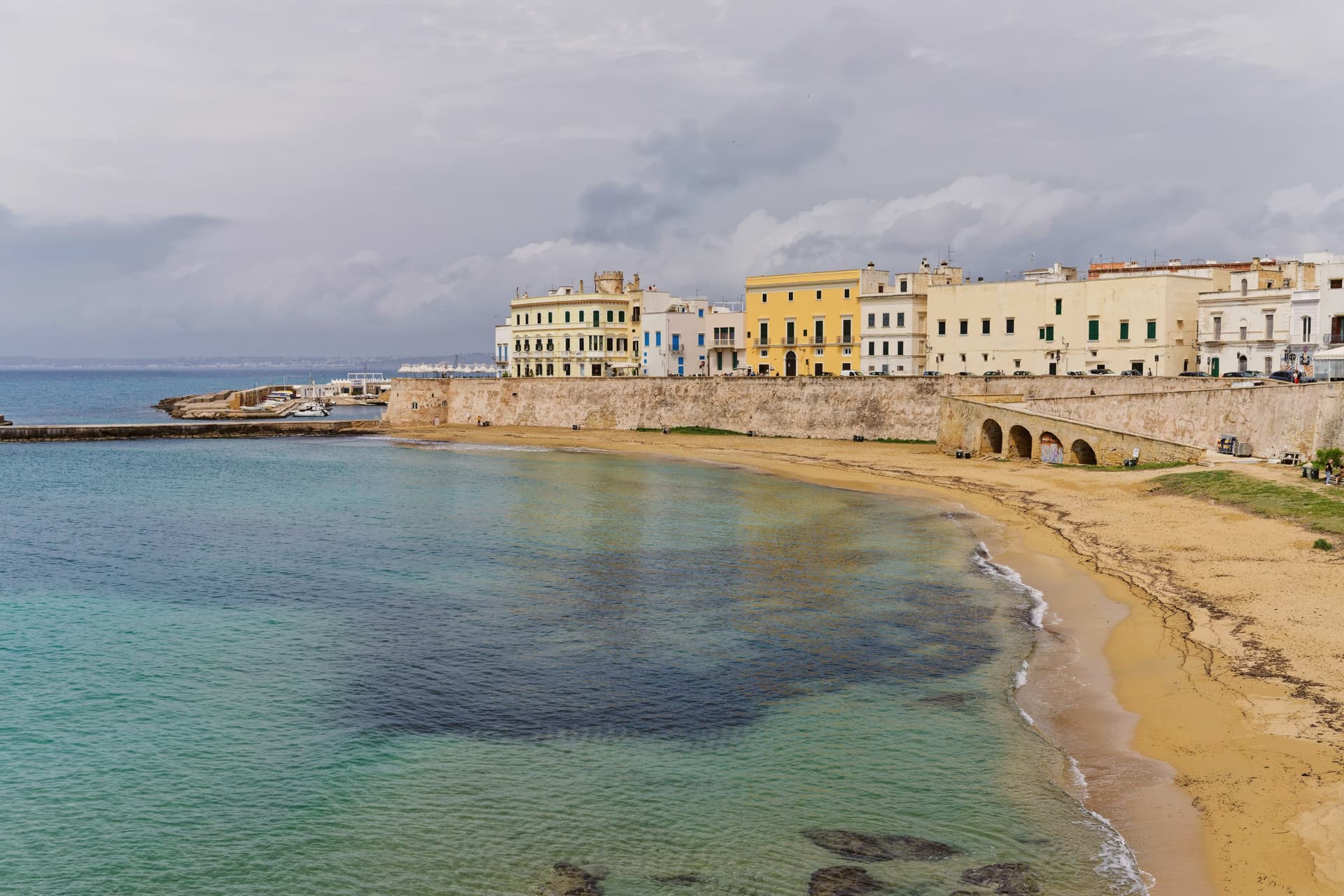
Gallipoli is built on a limestone island off the Ionian coast of Salento, linked to the modern mainland town by a seventeenth-century bridge. The Greek name Kallipolis means beautiful city; the site has been a bishopric since the sixth century.
The Castello Angioino guards the bridge end and was raised on Roman fortifications in the thirteenth century, expanded later under Aragonese and Spanish rule. Inside the walled città vecchia, whitewashed lanes wrap around the Basilica Cattedrale di Sant'Agata, built between 1629 and 1696 in carparo limestone under the Spanish bishop Consalvo de Rueda.
Below the streets, thirty-five frantoi ipogei, underground olive mills cut into the rock from the sixteenth century, once produced the lamp oil that lit the capitals of Europe. The Spiaggia della Purità sits directly under the sea walls.
Gallipoli got its first Bandiera Blu and a five-Vele Legambiente rating in 2024. In summer, the city flips from fishing port to the densest nightlife town in Salento.
What to see in Gallipoli
- Castello Angioino. Thirteenth-century castle on Roman foundations at the bridge crossing, expanded under the Aragonese and Spanish, now an exhibition space.
- Basilica Cattedrale di Sant'Agata. Baroque cathedral of 1629-1696 in carparo limestone, with Doric colonnade and polychrome marble altar, built under Bishop Consalvo de Rueda.
- Città vecchia. Walled old town on the limestone island, a tight grid of whitewashed lanes, palazzi, and small churches wrapped by sea walls on three sides.
How to get to Gallipoli
It has its own railway station. Taranto is about 1 h 51 min away by road.
Our tip
May through June is the window before the summer push, with warm sea and the old town still walkable. July and August are the loudest months in Salento: Gallipoli runs the densest nightlife on the Ionian, the Baia Verde fills with day-trippers from across Puglia, and the città vecchia is shoulder to shoulder after sundown. September is the better month if you want the same beaches without the crush.
Why visit Ostuni
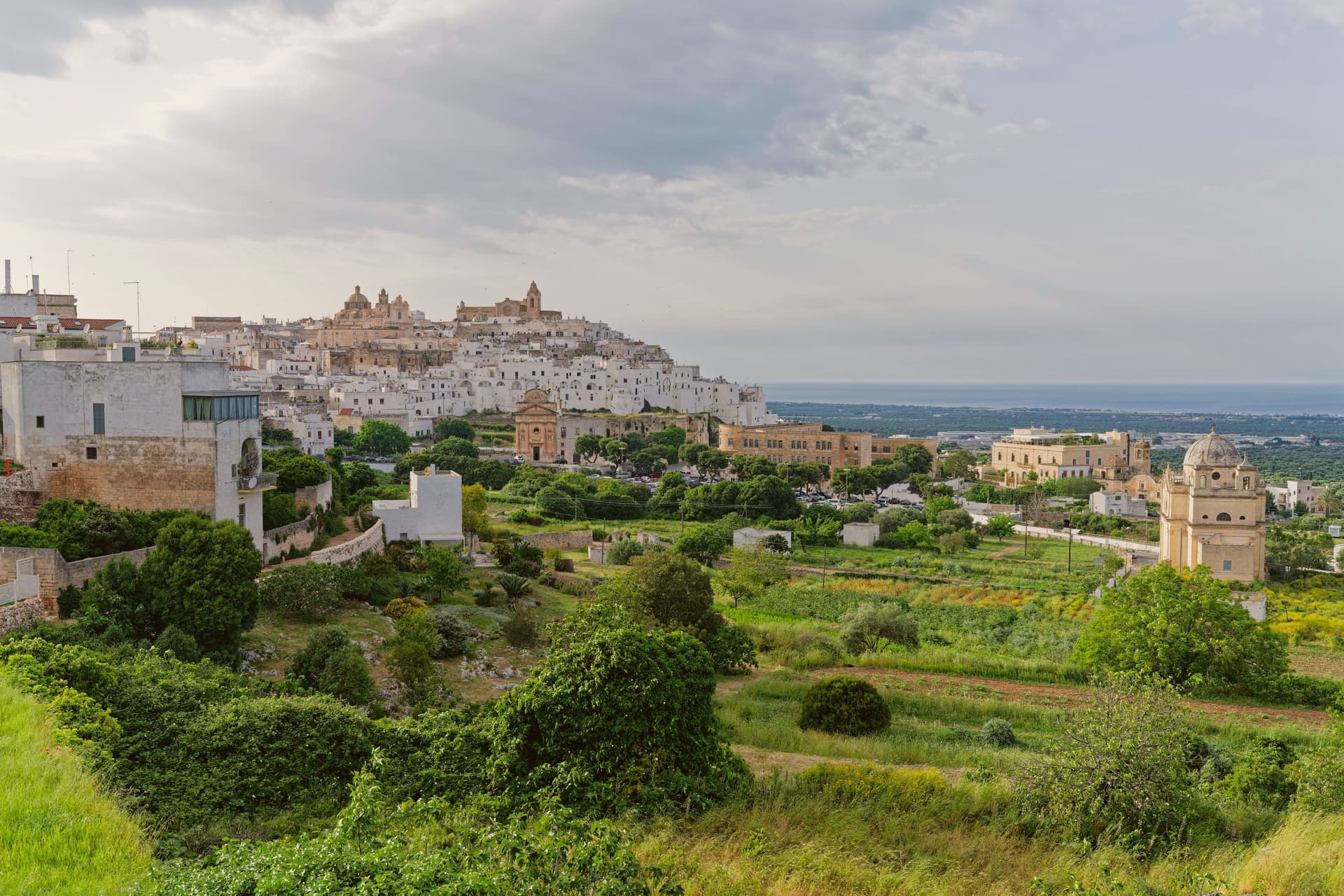
Ostuni sits at 218 meters on three hills above the Adriatic coastal plain, eight kilometers inland in the southeastern Murge. The whitewashing that gives it the name Città Bianca is medieval in origin, a hygienic measure against plague that survived as the local building convention; the entire centro storico is painted white in lime every spring and reads as a single bright mass from the surrounding olive country.
The territory has been inhabited since the Paleolithic; the Messapii founded the urban nucleus before the Romans absorbed the region. In 1507 it passed to Isabella, Duchess of Bari, then to her daughter Bona Sforza, queen of Poland, who fortified the coast with watchtowers against Ottoman raids in 1539.
The Cattedrale, a late-Gothic facade with a rose window of twenty-four rays, anchors the upper town. The olive landscape around the commune holds some of the oldest cultivated trees in the Mediterranean.
What to see in Ostuni
- Cattedrale di Santa Maria Assunta. Late fifteenth-century Gothic cathedral at the highest point of the centro storico, with a rose window of twenty-four rays unique in Puglia.
- Centro storico. Whitewashed old town on three hills, lime-painted every spring against plague tradition, the single bright mass that names the Città Bianca.
- Piazza della Libertà. Lower civic square outside the medieval walls, with the Guglia di Sant'Oronzo, an early eighteenth-century baroque obelisk to the patron saint.
How to get to Ostuni
It has its own railway station. Taranto is about 1 h 4 min away by road. The full route from Bari.
Our tip
April through June and September through October are the months Ostuni works: olive plain in flower or harvest light, the white walls glowing in mild evenings, the Adriatic eight kilometers away warm enough for swimming by mid-May. July and August touch thirty-five degrees and the centro storico fills with day-trippers from Bari and Brindisi; weekends in August are shoulder to shoulder in the upper alleys. Late afternoon and after dusk are the times to walk, when the white walls cool and the crowds thin.
Why visit Nardò
The town sits at 45 meters in the northwestern Salento, about ten kilometers inland from the Ionian coast. With just under 31,000 inhabitants and 190 square kilometers of territory, it is the second-largest commune in the province after the capital.
It was a Byzantine stronghold for centuries; in 1497 the dukes of Acquaviva acquired it and turned it into a cultural seat, with universities, academies and literary circles that drew on the same humanist current as Lecce and Gallipoli. The centro storico, built up under that ducal patronage, forms a dense fabric of palaces and church facades in the local pietra leccese, with the castle standing at its edge, now serving as the municipal seat.
Ten kilometers of inland distance separate that historic core from the municipal coastline, where the Porto Selvaggio nature reserve occupies a stretch of Mediterranean pine forest above limestone cliffs, held by the commune as a regional park. Inland seat of government and culture, coastal reserve of forest and cliff: the two halves of the commune's territory answer to different centuries and different purposes, joined only by the ten kilometers between them.
What to see in Nardò
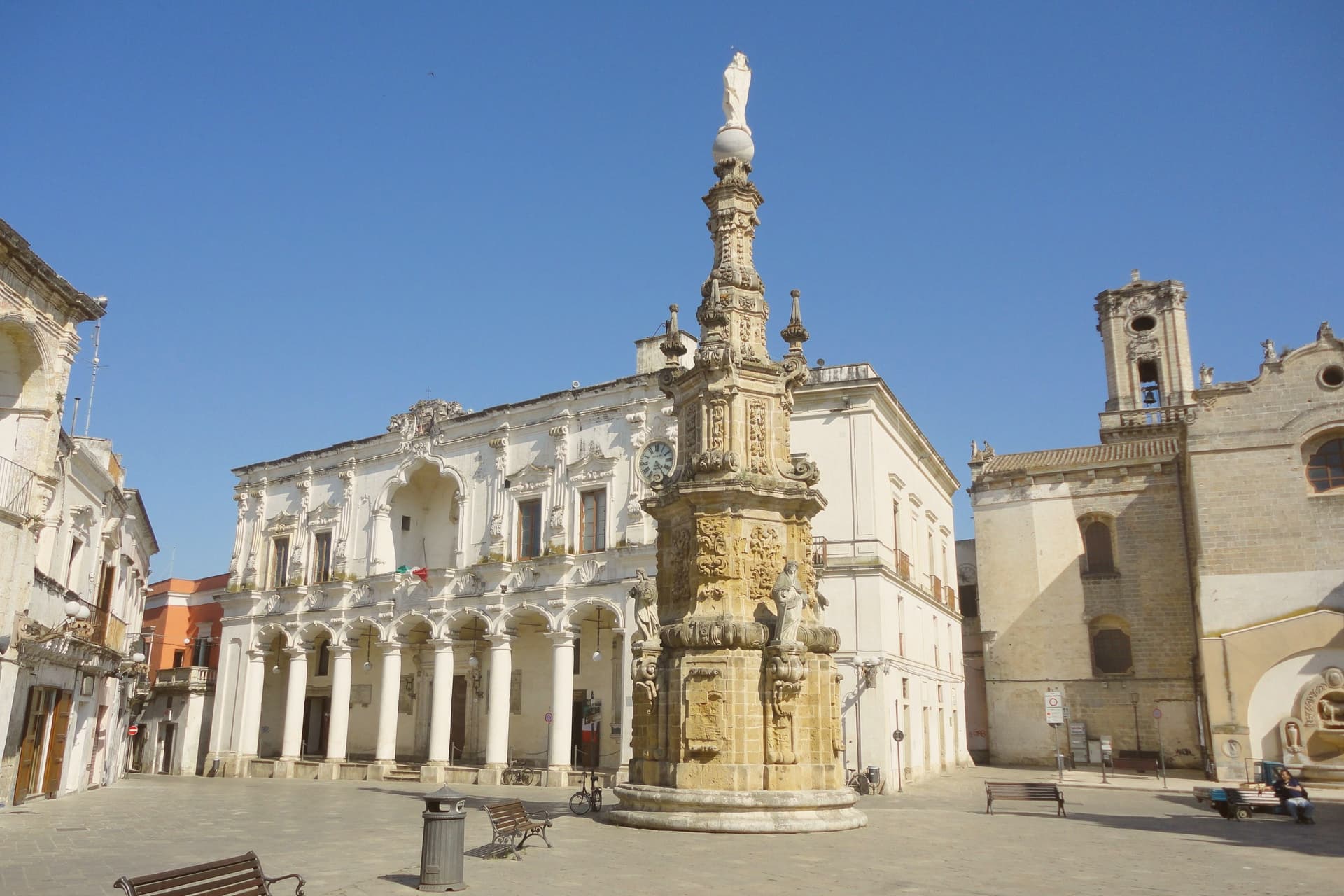
- Piazza Salandra. Central Baroque square of the centro storico, the Guglia dell'Immacolata at its center, ringed by palazzi and church facades in pietra leccese.
- Castello Acquaviva. Aragonese-Acquaviva castle on the edge of the centro storico, residence of the ducal house from 1497, now the municipal seat.
- Cattedrale di Maria Santissima Assunta. Romanesque-Baroque cathedral founded in the eleventh century and remodelled across the seventeenth, with later Baroque facade and bell tower.
How to get to Nardò
It has its own railway station. Taranto is about 1 h 20 min away by road. The full route from Bari.
Our tip
April through June and September through October are the months Nardò is at its best: Baroque facades in raking light, the Porto Selvaggio pine forest cool, the Ionian water warm enough to swim by mid-May. July and August touch thirty-six degrees and the centro storico empties between two and five in the afternoon; the coastal hamlets of Santa Caterina and Sant'Isidoro fill with Lecce families. The Festa di San Gregorio Armeno in mid-February is the local patronal day, the only large winter event.
Why visit Fasano
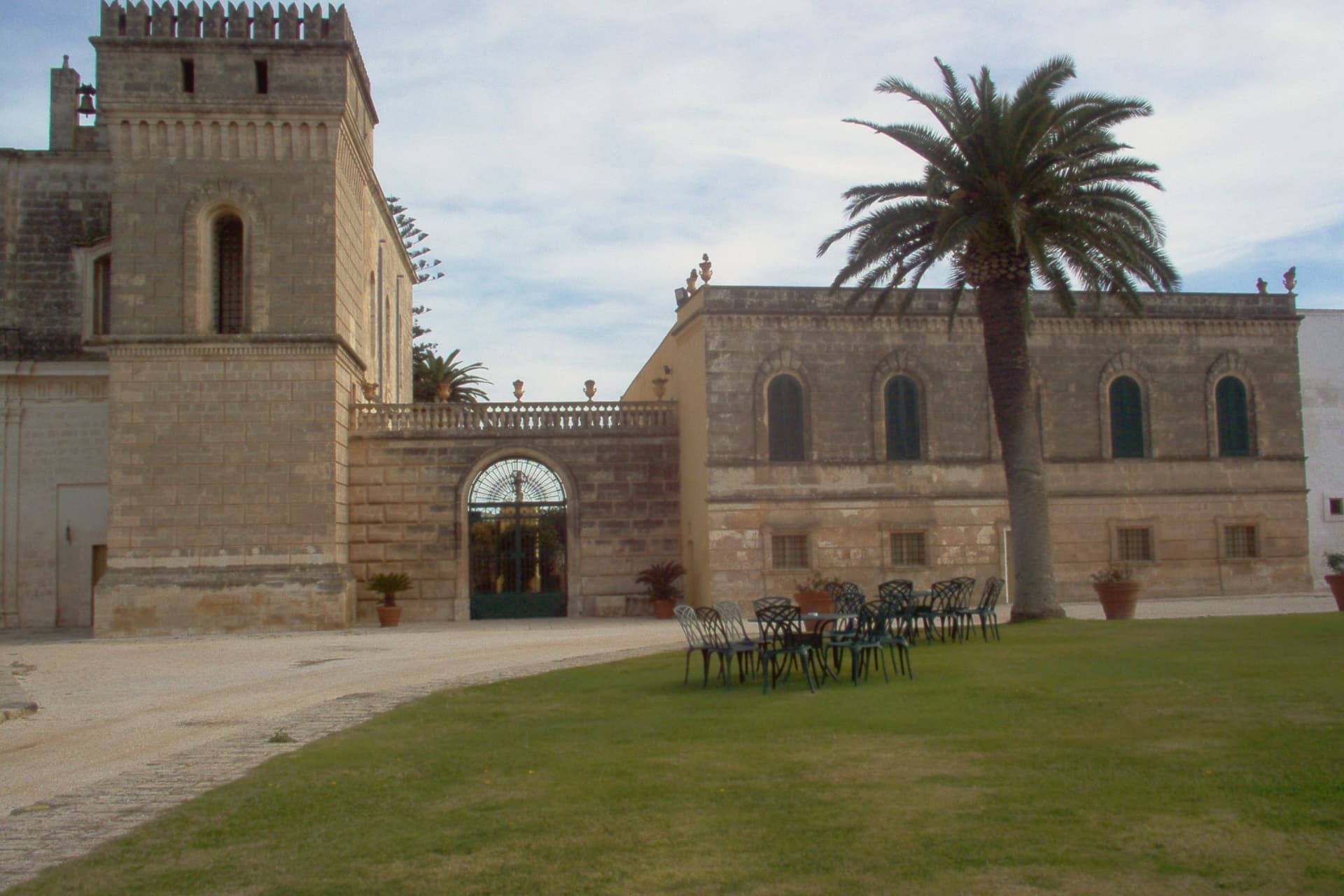
The main center sits at 118 meters, a hinge point in a wide municipal territory that runs from the Adriatic shore up to the Itria escarpment, home to thirty-eight thousand residents spread across three distinct landscapes rather than one compact town. The coast holds the abandoned city, inhabited from the fifteenth century BC and left empty by the Middle Ages, its excavated stone now sitting a short distance from the museum built to house what came out of the ground there.
Inland and uphill, the wooded escarpment climbs to become the highest ground in the province, the same slopes that carry the wildlife park across its carob and olive scrubland. Further along the shore, the fishing port turned resort gives the territory its beach frontage.
The pattern is coastal city, wooded highland, coastal resort, three pieces of a single municipality that never behaves like a single place. What the town offers is that range within one boundary: Roman ruins at sea level, a panorama at the province's highest point, and a working beachfront, none of them a detour from the others.
What to see in Fasano
- Parco Archeologico di Egnazia. Ruins spread across eighty hectares along the coast, with the Via Traiana running through the site alongside the basilica and a cryptoporticus still traceable underfoot.
- Museo Nazionale Archeologico Giuseppe Andreassi. Museum standing next to the archaeological park, holding the objects pulled from the excavations: Messapian inscriptions, Roman finds, and material spanning the long abandonment of the city.
- Selva di Fasano. Wooded escarpment reaching between 411 and 414 meters, the ground rising from carob and olive scrub to open views that give the terrace its nickname.
How to get to Fasano
It has its own railway station. Bari is about 52 min away by road. The full route from Bari.
Our tip
May through September is the working season on this stretch of the Adriatic: warm sea, the Bandiera Blu beaches at Savelletri operating, the Selva ten degrees cooler than the coast for an evening break. July and August fill the coast with Italian holidaymakers; Egnazia exposed on the seafront is brutal between noon and three. April and October are quieter alternatives with the sea still mild, the archaeological park at its photographic best, and the olive harvest opening across the surrounding masserie.
Why visit Martina Franca
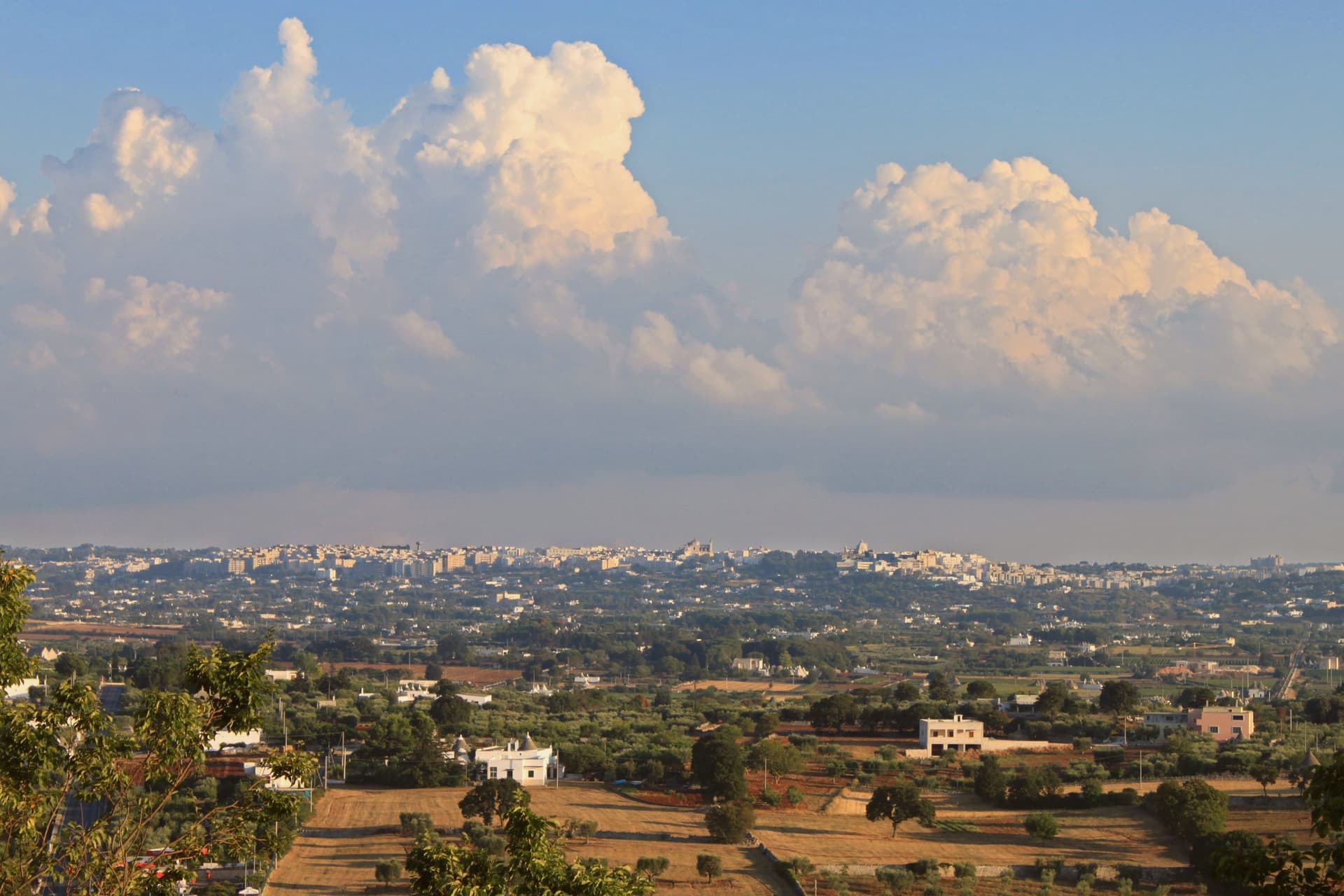
Martina Franca sits at 431 meters on the southern edge of the Valle d'Itria, on the border between the provinces of Taranto, Bari and Brindisi. The town was founded in 1310 by Philip I of Anjou, Prince of Taranto, who granted franchigie, tax exemptions, to settlers willing to repopulate the hill, hence Franca in the name.
The centro storico is the densest concentration of Rococo and late-Baroque architecture in Puglia after Lecce: wrought-iron balconies, carved stone portals, churches built or rebuilt after the 1743 earthquake. The Palazzo Ducale of 1668, raised on the foundations of a 1338 medieval castle, is the seat of the municipal offices and the open-air courtyard where the Festival della Valle d'Itria has been performed every July and August since 1975, founded specifically to recover rare and forgotten operas.
The Basilica di San Martino, begun in 1747, is the most complete example of Martinese Rococo. The surrounding plateau makes a Martina Franca DOC white wine and a strong dry-cured capocollo IGP.
What to see in Martina Franca
- Palazzo Ducale. Built in 1668 on the foundations of a 1338 medieval castle, town hall and home of the Festival della Valle d'Itria summer opera courtyard.
- Basilica di San Martino. Eighteenth-century basilica begun in 1747 after the 1743 earthquake, the most complete Martinese Rococo monument and museum of liturgical art.
- Piazza Roma and Piazza Maria Immacolata. The two main squares of the centro storico, linked by Via Cavour, lined with eighteenth-century palazzi and the town's main passeggiata.
How to get to Martina Franca
It has its own railway station. Taranto is about 38 min away by road. The full route from Bari.
Our tip
April through June and September through October are the best months on the Itria plateau. The 431-meter elevation keeps the air dry, the limestone walls reflect a clear light, and the surrounding vineyards green up in spring then turn gold by the late September harvest. July and August are hot but mitigated by the altitude; they are also the months the Festival della Valle d'Itria runs in the Palazzo Ducale courtyard, the largest cultural draw in southern Puglia.
Why visit Lecce
Lecce sits on the Salento plain at 49 meters above sea level, twelve kilometers inland from the Adriatic, the provincial capital. The Messapian settlement of Lupiae stood on this site by the eighth century BC.
Rome took it in the third century BC. The walled centro storico is ringed by Charles V's fortifications, entered from the north through the Porta Napoli arch and anchored on its eastern edge by his castle, built over older Norman foundations.
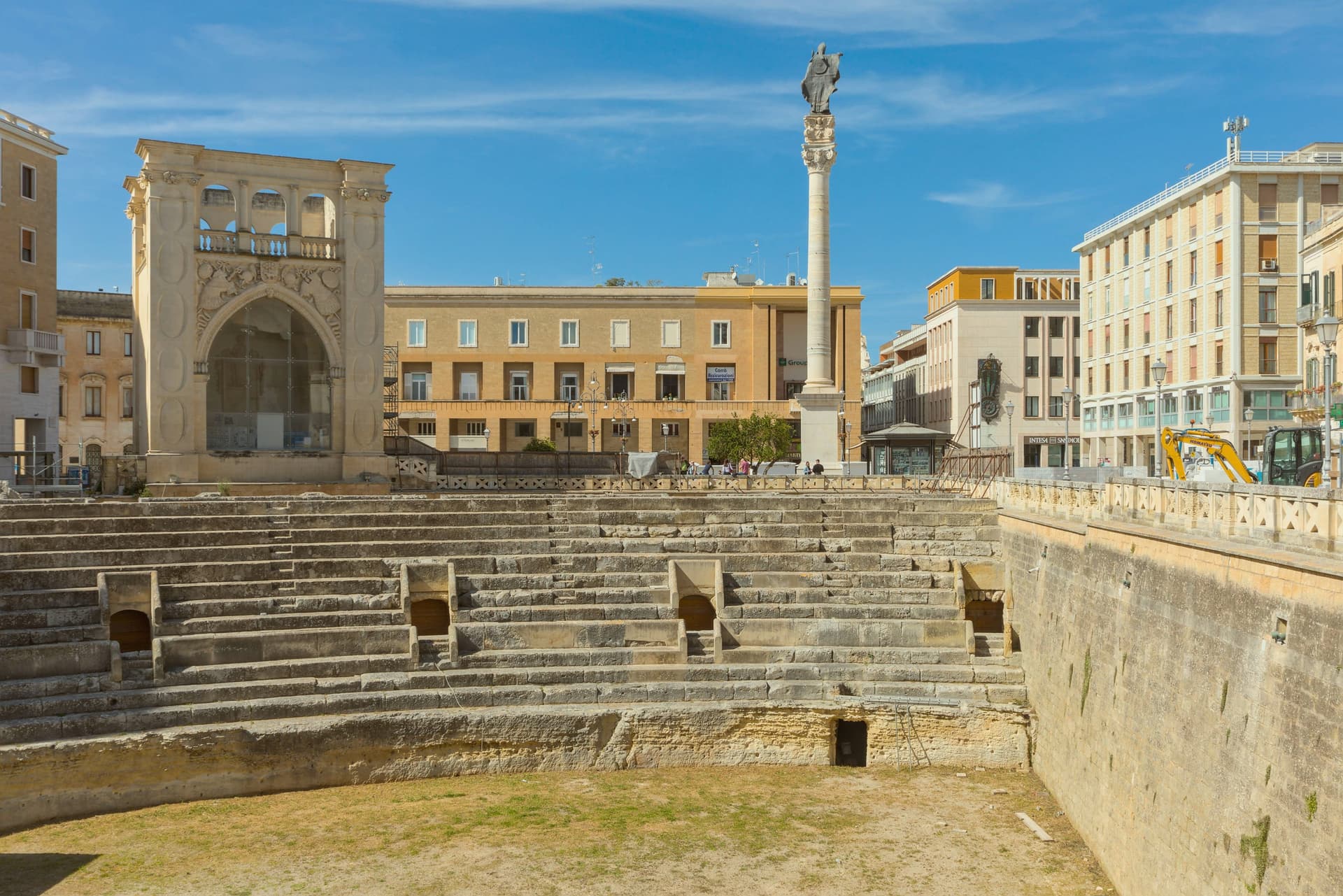
Within those walls the Baroque churches and squares sit close together, the cathedral square closed in on three sides while the amphitheater lies open and half-sunk in the middle of the newer square that formed around it. The University runs a strong humanities program, and the seafront at San Cataldo, some distance from the old center, carries Lecce's Bandiera Blu.
What holds the town together is the stone itself: soft enough to carve finely, hard enough once cut to last, so that a Messapian and Roman settlement site became, centuries later, the surface on which the south's most elaborate Baroque was cut.
What to see in Lecce
- Basilica di Santa Croce. Worked for nearly two hundred years to completion in 1695, the façade carved with cherubs, monsters and allegories layered so densely that the wall surface almost disappears beneath them.
- Piazza del Duomo. Closed on three sides, the only enclosed cathedral square of its kind in Puglia, gathering the Duomo, Campanile, Bishop's Palace and Seminary into one shared courtyard rather than an open street front.
- Piazza Sant'Oronzo. The city's central square, built around a column brought from the Appian Way to honor the patron saint, with the excavated amphitheater floor sitting below street level at its edge.
How to get to Lecce
It has its own railway station. Taranto is about 1 h 35 min away by road. The full route from Bari.
Our tip
April through June is the green window in inland Salento, with the centro storico walkable in the day and aperitivo on Piazza Sant'Oronzo running late. July and August push past thirty-five degrees and the city empties at midday; the Notte della Taranta in nearby Melpignano, the closing concert of the Salento pizzica festival, falls in late August and draws over a hundred thousand. September and October cool back down for the olive harvest.
More from Anywhere Italy
- The 7 best beach towns inside a nature park in PugliaPugliaclean beachinside a park7 towns · smallest 11,988 residents
- The best towns with a serious restaurant that sit inside a nature park in PugliaPugliainside a parkserious restaurant6 towns · smallest 5,631 residents
- The best hill towns inside a nature park in PugliaPugliahill towninside a park6 towns · smallest 8,171 residents
- The best beach towns worth staying overnight in PugliaPugliaclean beachworth staying overnight6 towns · smallest 17,531 residents
- The best towns worth staying overnight that eat well in PugliaPugliaeats wellworth staying overnight7 towns · smallest 5,631 residents
- The best hill towns worth staying overnight in PugliaPugliahill townworth staying overnight7 towns · smallest 11,139 residents