
Mountain towns
Mountain towns in Sicily
17 towns
Towns inside a named range: the Alps, the Dolomites, the Apennines, the Pollino, the Aspromonte. Around 800 metres and up, where the season decides the trip.
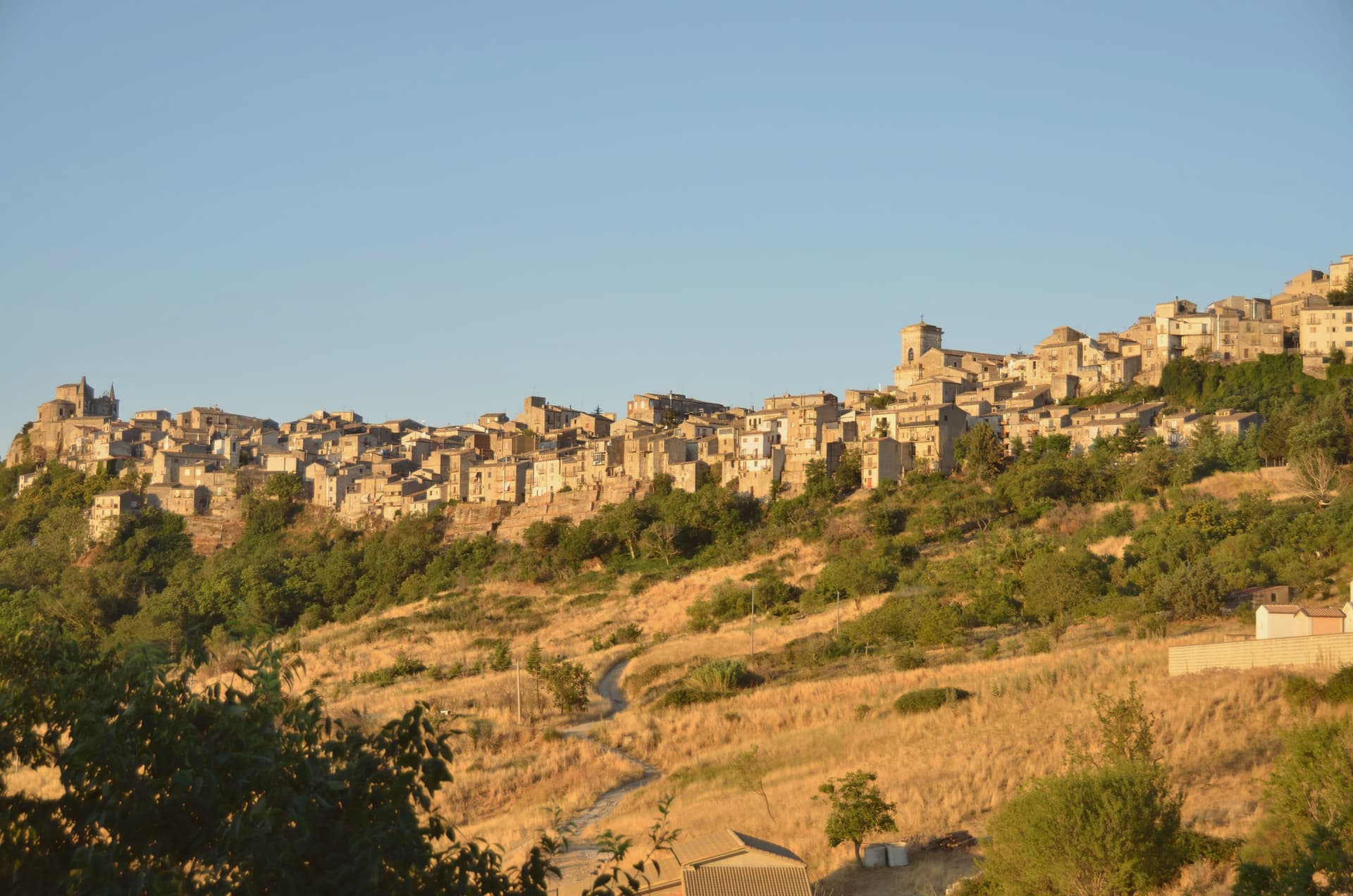
Petralia Soprana
Province: Palermo · 1,147 m
The highest village in the Madonie at 1,147 meters, RAI Borgo dei Borghi 2018 winner, sitting above 80 kilometers of salt tunnels.
Troina
Province: Enna · 1,121 m
At 1,121 meters on the Nebrodi ridge, the first capital and first bishopric the Normans set up in Sicily after taking it from the Arabs.
Geraci Siculo
Province: Palermo · 1,077 m
A Madonie ridge village at 1,077 meters, capital of the Ventimiglia marquisate from 1258 and the first marquisate granted in Sicily.
Gangi
Province: Palermo · 1,011 m
A Madonie hill town stacked in concentric rings at 1,011 meters, RAI's Borgo dei Borghi 2014 and the launching pad for the one-euro-house programme.
Petralia Sottana
Province: Palermo · 1,000 m
A Madonie village at 1,000 meters, the only Bandiera Arancione in Sicily, and the headquarters of the Parco delle Madonie.
Polizzi Generosa
Province: Palermo · 917 m
A Madonie town at 917 meters, hazelnut country and the birthplace of Domenico Dolce.
Montalbano Elicona
Province: Messina · 907 m
A Nebrodi castle town at 907 meters, Frederick III of Aragon's summer residence and gateway to the Argimusco megalithic plateau.
Buccheri
Province: Siracusa · 820 m
The highest village in the province of Syracuse, world capital of Tonda Iblea olive oil at the 2015 Sol d'Oro.
Erice
Province: Trapani · 751 m
An Elymian mountaintop city at 751 meters above Trapani, with a Norman castle on the site of the temple of Venus Erycina and a Cold War physics centre.
Castel di Lucio
Province: Messina · 750 m
A Nebrodi village at 750 meters on the borderline of three provinces, with a Ventimiglia castle from 1090 and a Fiumara d'Arte sculpture by Paolo Schiavocampo.
Randazzo
Province: Catania · 750 m
A medieval town in black lava stone at 750 meters on Etna's north foot, with three quarter churches for Latins, Greeks and Lombards.
Sperlinga
Province: Enna · 750 m
A sandstone borgo at 750 meters in the Nebrodi foothills where a Norman castle and dwellings are carved into the rock as one continuous mass.
Nicosia
Province: Enna · 720 m
A Byzantine-Norman royal city at 720 meters on four hills, one of Sicily's principal Gallo-Italic centres where the Lombard dialect nkoukkà still survives.
Piana degli Albanesi
Province: Palermo · 720 m
The principal Arbëresh town of Sicily at 720 meters, founded in the fifteenth century by Albanians fleeing the Ottomans and still speaking arbëresh.
Cammarata
Province: Agrigento · 700 m
A Sicani town at 700 meters on the northeast slope of the peak that gives the comune its name and shape.
Nicolosi
Province: Catania · 698 m
The southern gateway to Etna at 698 meters, twice destroyed by the 1669 eruption.
Castiglione di Sicilia
Province: Catania · 621 m
A hill town on the north flank of Etna at 621 meters, base camp for the Alcantara valley and the volcano's most serious red wines.
The slow-trip planner
Plan a slow trip across the towns travelers skip.
Answer five questions. We will shape a geographically coherent slow trip from the 1,000 Italian towns most travelers skip. Yours to save and share.
From elsewhere in Italy
Five more towns to discover
Visso
Province: Macerata
The northern Sibillini gate at 607 meters where the Nera meets the Ussita, holding one of two surviving manuscripts of Leopardi's L'Infinito.
Goriano Sicoli
Province: L'Aquila
At 720 meters in the Subequana valley, a medieval village drawn by M.C. Escher in 1929 keeps a May ritual folklorists trace to Demeter.
Ugento
Province: Lecce
A Messapian-Roman town five kilometers from the Ionian, where a Baroque castle sits on the walls of the ancient city of Ozan.
Fontanellato
Province: Parma
A Parma-plain town built around the Rocca Sanvitale, the moated fortress at its center.
Pescina
Province: L'Aquila
A Marsica town at 735 meters, on the rim of the drained Fucino basin, that lost five thousand of six thousand people in a single morning in 1915.