
By geography
Italian island towns
18 towns
Towns you reach by ferry. Small catalogue, and the getting there is most of the point.
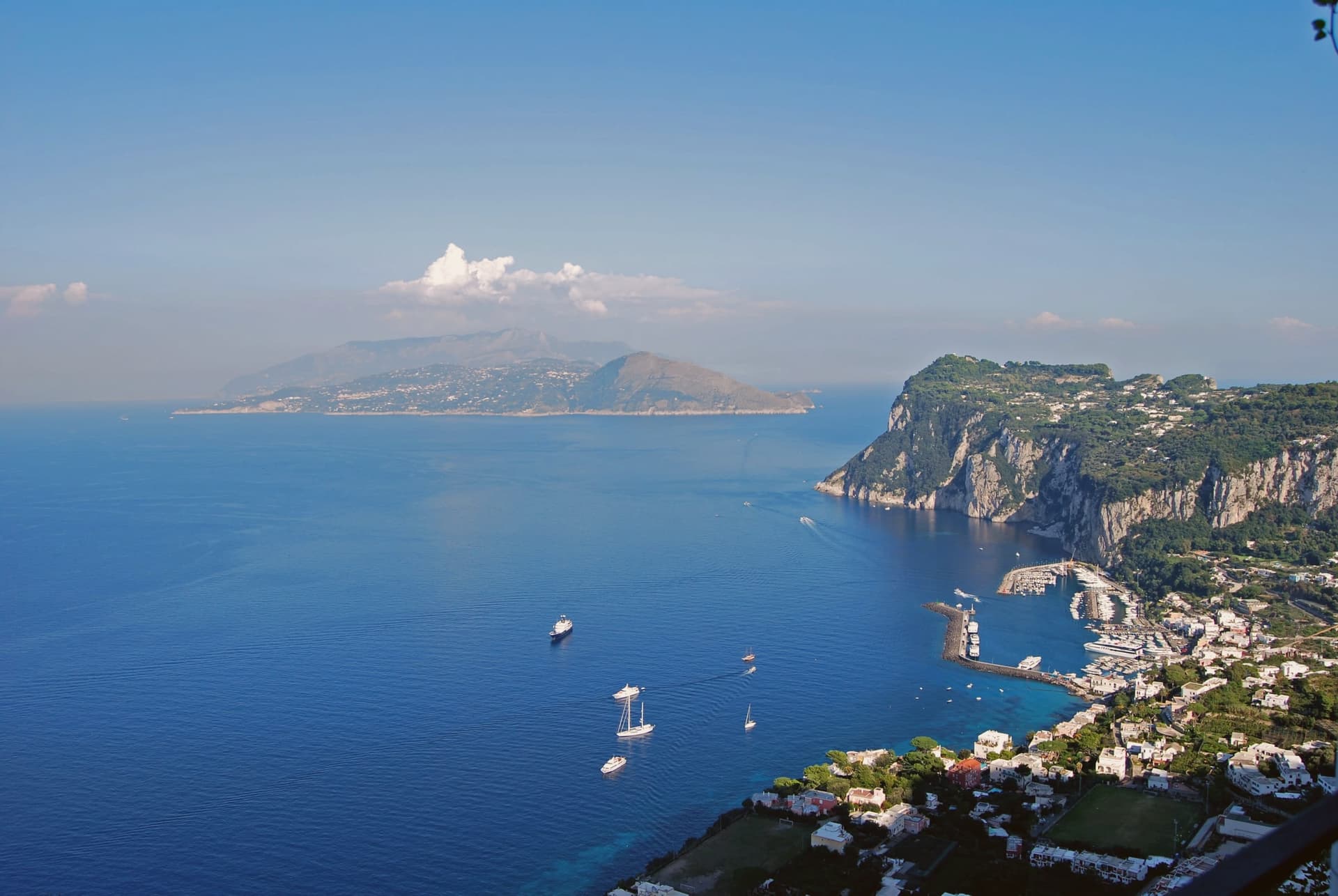
Anacapri
Province: Napoli · 275 m
The upper half of Capri, 150 meters above its famous twin.
Capri
Province: Napoli · 142 m
The 142-meter Tyrrhenian island town where Tiberius governed Rome for a decade from twelve villas above limestone cliffs.
Casamicciola Terme
Province: Napoli · 81 m
Ischia's thermal town on the flank of Monte Epomeo, levelled by the 1883 earthquake and again in 2017, rebuilt on the Gurgitello springs.
Forio
Province: Napoli · 18 m
The largest Ischia commune by area, a Tyrrhenian coastal town facing the island's only sunset.
Procida
Province: Napoli · 4 m
A four-square-kilometer Flegrean island of pastel fishing houses, the 2022 Italian Capital of Culture.
Ponza
Province: Latina · 5 m
The main island of the Pontine archipelago, a volcanic crescent 40 km off Formia with white tuff cliffs, Roman fishpond tunnels at Pilato, Cala Feola's natural pools, and a 3,200-resident borgo curving around a horseshoe harbour painted in 18th-century Bourbon-pastel.
Ventotene
Province: Latina · 18 m
The smaller of the inhabited Pontine Islands, a flat three-kilometer tuff platform southeast of Ponza.
Isole Tremiti
Province: Foggia · 116 m
An Adriatic archipelago of five islands twenty-two kilometers off the Gargano, the only Italian commune scattered across an open-sea group.
Calasetta
Province: Sud Sardegna · 9 m
The Ligurian town founded by Tabarka exiles in 1770 on the northwest tip of Sant'Antioco, where Tabarchino is still spoken in the streets.
Carloforte
Province: Sud Sardegna · 10 m
A Ligurian-speaking fishing town on the Isola di San Pietro, founded in 1738 by coral fishers returning from Tunisian Tabarka.
La Maddalena
Province: Sassari · 19 m
The only inhabited town of a sixty-island granite archipelago between Sardinia and Corsica, and the place Giuseppe Garibaldi chose to die.
Favignana
Province: Trapani · 6 m
The largest of the Egadi Islands off western Sicily, ringed by calcarenite cliffs and flooded quarries in place of beaches, with a 19th-century tuna fishery at its center.
Lampedusa e Linosa
Province: Agrigento · 25 m
Italy's southernmost comune, three islands on the African continental shelf, closer to Tunisia than to Sicily.
Lipari
Province: Messina · 44 m
The largest Aeolian island and the only municipality that administers six of the seven, with a clifftop castle citadel rising above two harbors.
Pantelleria
Province: Trapani · 8 m
A volcanic island closer to Tunisia than Sicily, where dry-stone dammusi sit among bush-trained Zibibbo vines listed by UNESCO.
Ustica
Province: Palermo · 49 m
A volcanic island fifty-two kilometers north of Palermo with Italy's first marine protected area, lentil fields on lava, and a long memory as a prison.
Capraia Isola
Province: Livorno · 19 m
A volcanic island of 370 residents and one village, a penal colony from 1873 to 1986 and a national park since.
Isola del Giglio
Province: Grosseto · 405 m
A granite island in the Tyrrhenian Archipelago, walled village on the ridge, port below, where the Costa Concordia ran aground in January 2012.
The slow-trip planner
Plan a slow trip across the towns travelers skip.
Answer five questions. We will shape a geographically coherent slow trip from the 1,000 Italian towns most travelers skip. Yours to save and share.
From elsewhere in Italy
Five more towns to discover
Visso
Province: Macerata
The northern Sibillini gate at 607 meters where the Nera meets the Ussita, holding one of two surviving manuscripts of Leopardi's L'Infinito.
Goriano Sicoli
Province: L'Aquila
At 720 meters in the Subequana valley, a medieval village drawn by M.C. Escher in 1929 keeps a May ritual folklorists trace to Demeter.
Ugento
Province: Lecce
A Messapian-Roman town five kilometers from the Ionian, where a Baroque castle sits on the walls of the ancient city of Ozan.
Fontanellato
Province: Parma
A Parma-plain town built around the Rocca Sanvitale, the moated fortress at its center.
Pescina
Province: L'Aquila
A Marsica town at 735 meters, on the rim of the drained Fucino basin, that lost five thousand of six thousand people in a single morning in 1915.